A Quick Note on an Interesting Squabble

i019My friend Eugene Curry sent me Edward Feser’s latest salvo in the fracas between him and David Bentley Hart.  I will not summarize the squabble here because Feser lays out a bit of a timeline in his post.  It is an interesting discussion, and a rather heady one.  I daresay that ego certainly appears to be playing its role on both sides of what is otherwise an insightful exchange.



I am intrigued, however, by Feser’s reference to the “terrorism of obscurantism” and think that is probably a reasonable charge to lay at Hart’s feet.  I am, again, much more familiar with Hart, and have read with great profit his Atheist Delusions and The Doors of the Sea.  That being said, I have been disappointed with Hart on two fronts:  (a) his overly-simplistic skewering of conservative hermeneutics and (b) his (in my opinion) caricaturing of William Lane Craig.  Even so, I appreciate Hart’s work on atheism and theodicy, though he likely does at times traffic in excessive obscurantism.  Here’s the Feser post.

Barry Hankins’ Enthralling 2007 Fides et Historia Piece on Francis Schaeffer’s Conflict With Christian Historians

FAS-III-pic-1I have only recently read Barry Hankins’ article, “‘I’m Just Making a Point’:  Francis Schaeffer and the Irony of Faithful Christian Scholarship.”  If you are familiar with the late Francis Schaeffer or, if like me and countless others, you were influenced at some point in your life by his writings, you will likely find this article troubling and enthralling.

As I say, like many others, I was deeply influenced by Francis Schaeffer, particularly as a teenager and a college student.  Those who were impacted by Schaeffer oftentimes have a similar story:  he awakened within us the possibility of being intellectually satisfied Christians who could emerge from the fundamentalist ghetto and engage the culture without hating or hiding from it.  Especially those coming out of fundamentalism found reading Schaeffer to be a heady, exhilarating, and even dangerous experience.  Could one really actually like and appreciate Bob Dylan, Led Zeppelin, Albert Camus, etc?  For those raised in certain branches of conservative Southern Protestantism in particular, this was gloriously liberating.

But, like many others, Schaeffer managed to sow the seeds that would oftentimes grow to cause his fans to question him.  For me, this happened when, under Schaeffer’s influence, I actually read Soren Kierkegaard.  In short, the experience caused me to question Schaeffer’s method and the very broad brush with which he painted (in the case of Kierkegaard, this was a very negative brush).  Furthermore, some of Schaeffer’s conclusion are too neat, too tidy, and lacking in the nuance that real life usually presents the observer.

At the end of the day, I retain a fondness for Schaeffer, a fondness that is somewhat buttressed by nostalgia, but now it is measured with a strong degree of hesitation and a recognition of his limitations and, at points, outright mistakes.  Schaeffer opened a door for me.  Having walked through it, I realize with a degree of sadness that I have, in part, parted company with him.

In part.

Hankins’ article is a fascinating look at Schaeffer’s falling out with Christian historians Mark Noll, George Marsden, and Ronald Wells over some of the issues I have referenced above.  I offer a pdf of the article here as a fascinating case study in competing approaches to Christianity and culture and the Christian understanding of history and philosophy.

“‘I’m Just Making a Point’: Francis Schaeffer and the Irony of Faithful Christian Scholarship”

Ruth 3

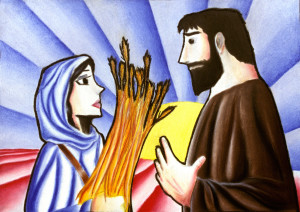
Ruth 3 At Boaz's FeetRuth 3

1 Then Naomi her mother-in-law said to her, “My daughter, should I not seek rest for you, that it may be well with you? 2 Is not Boaz our relative, with whose young women you were? See, he is winnowing barley tonight at the threshing floor. 3 Wash therefore and anoint yourself, and put on your cloak and go down to the threshing floor, but do not make yourself known to the man until he has finished eating and drinking. 4 But when he lies down, observe the place where he lies. Then go and uncover his feet and lie down, and he will tell you what to do.” 5 And she replied, “All that you say I will do.” 6 So she went down to the threshing floor and did just as her mother-in-law had commanded her. 7 And when Boaz had eaten and drunk, and his heart was merry, he went to lie down at the end of the heap of grain. Then she came softly and uncovered his feet and lay down. 8 At midnight the man was startled and turned over, and behold, a woman lay at his feet! 9 He said, “Who are you?” And she answered, “I am Ruth, your servant. Spread your wings over your servant, for you are a redeemer.” 10 And he said, “May you be blessed by the Lord, my daughter. You have made this last kindness greater than the first in that you have not gone after young men, whether poor or rich. 11 And now, my daughter, do not fear. I will do for you all that you ask, for all my fellow townsmen know that you are a worthy woman. 12 And now it is true that I am a redeemer. Yet there is a redeemer nearer than I. 13 Remain tonight, and in the morning, if he will redeem you, good; let him do it. But if he is not willing to redeem you, then, as the Lord lives, I will redeem you. Lie down until the morning.” 14 So she lay at his feet until the morning, but arose before one could recognize another. And he said, “Let it not be known that the woman came to the threshing floor.” 15 And he said, “Bring the garment you are wearing and hold it out.” So she held it, and he measured out six measures of barley and put it on her. Then she went into the city. 16 And when she came to her mother-in-law, she said, “How did you fare, my daughter?” Then she told her all that the man had done for her, 17 saying, “These six measures of barley he gave to me, for he said to me, ‘You must not go back empty-handed to your mother-in-law.’” 18 She replied, “Wait, my daughter, until you learn how the matter turns out, for the man will not rest but will settle the matter today.”

Oddly enough, our chapter made the news recently. On May 12, 2015, a BBC article entitled “Rare 1611 ‘Great She Bible’ found in Lancashire church” tells of a British church’s discovery of a most interesting Bible in their church.

A rare 400-year-old Bible worth about £50,000 has been discovered in a Lancashire village church.

Printed in 1611 and known as the “Great She Bible”, it is one of the earliest known copies of the King James Version (KJV) of the Christian holy book.

It will be displayed at St Mary’s Parish Church in Gisburn on Saturday.

The Reverend Anderson Jeremiah and the Reverend Alexander Baker found the old book following their appointment at the church last August.

It is called a “She Bible” because Chapter 3, Verse 15 of the Book of Ruth mistakenly reads: “She went into the city”.

Thought to be typographical mistake, this verse was changed from another KJV edition which said “He”.

The Bible has been assessed and authenticated by the Antiquarian Booksellers’ Association.

Only a handful of the “She Bibles” still exist. Oxford and Cambridge Universities have one, as do Salisbury, Exeter and Durham cathedrals.[1]

Strange, no? The Hebrew text says that “he” went into the city in Ruth 3:15, whereas the context clearly demands that is was “she” who went into the city. So this Great She Bible is so named because of a translation issue surrounding a particular part of a particular verse in Ruth 3. It is humorous, really, because the great scandal of the chapter is not that she left the threshing floor and went into the city but rather that she, Ruth, left the city and came to the threshing floor!

This is a rather eyebrow-raising chapter, and a profoundly important one, for in Ruth 3 Ruth does something that, if taken the wrong way, could have seriously backfired and put her in a very dangerous situation. If received, it could open the door for her and Boaz’s relationship to move to new heights. I am talking about Ruth coming to Boaz in the night and making a surprising statement of love and devotion to him in a rather surprising way.

The chapter has been subject to various interpretations over the years. Katharine Sakenfeld writes that she has talked with people who see what happens in Ruth 3 as “a steamy tryst between mutually desiring persons (in the genre of the North American soap opera or formulaic romance novel),” whereas others she has spoken with see it as “a beautiful but needy young Ruth forcing herself to relate to a rough, pot-bellied, snaggle-toothed (but rich) old man for the sake of her mother-in-law,” and still others who see it as “a wily, scheming Ruth cooperating with Naomi to compromise and thus force the hand of the most handsome and wealthy bachelor of the community.”[2]

In truth, the context and tone and details of the story would suggest that what we have here is, again, a shocking declaration of love. Ruth, to use our terminology, really puts herself out there! There is nothing sinful in what she does, though there is something very unorthodox about it. On the upper level of the story, what we have here is a plea for salvation that is met by the offered redemption of a loving God.

We will be approaching Ruth 3 with the following thesis in mind: redemption happens when desperate need leads to a radical plea for salvation and is met with saving grace. We will deal first with the nature of the radical plea.

Redemption happens when desperate need leads to a radical plea for salvation and is met with saving grace.

As chapter two ends, Ruth has recounted to her mother-in-law that is was one of their kinsman-redeemers, Boaz, who had so richly and generously blessed the women through the kindness and provision and offered her. Naomi apparently realized that this relationship could become even more.

1 Then Naomi her mother-in-law said to her, “My daughter, should I not seek rest for you, that it may be well with you? 2 Is not Boaz our relative, with whose young women you were? See, he is winnowing barley tonight at the threshing floor. 3 Wash therefore and anoint yourself, and put on your cloak and go down to the threshing floor, but do not make yourself known to the man until he has finished eating and drinking. 4 But when he lies down, observe the place where he lies. Then go and uncover his feet and lie down, and he will tell you what to do.” 5 And she replied, “All that you say I will do.” 6 So she went down to the threshing floor and did just as her mother-in-law had commanded her. 7 And when Boaz had eaten and drunk, and his heart was merry, he went to lie down at the end of the heap of grain. Then she came softly and uncovered his feet and lay down. 8 At midnight the man was startled and turned over, and behold, a woman lay at his feet! 9 He said, “Who are you?” And she answered, “I am Ruth, your servant. Spread your wings over your servant, for you are a redeemer.”

Let us first understand the historical setting for what happens here. The harvest has come to a conclusion and now Boaz has come to winnow the harvest on the threshing floor. J. Hardee Kennedy explains:

            The threshing floor probably was privately owned by Boaz and located on his property. In accord with general practice, however, it may have been common to the whole village (cf. 2 Sam. 24:15-25). There the ripe sheaves were brought and loosed in a circle on the smooth hard surface, possibly a flat rock floor. The grain was separated from the straw by the trampling of the oxen and the cutting of the sled or roller studded with sharp pieces of stone and metal (cr. Jer. 51:33; Mic. 4:12-13). In the winnowing process the threshed grain was tossed high in the air with shovels or forks and the chaff blown aside by the wind. Afterward the grain was gathered in a heap on the firm ground or smooth rock floor.

            Winnowing took place in the evening, usually from four or five o’clock until shortly after sunset, when a cool breeze blew in from the Mediterranean Sea. Apparently the workmen often closed their day’s labor by celebrating the harvest with considerable license, eating and drinking (v.3). Afterward they slept on the threshing floor to protect the grain.[3]

This is the situation into which Naomi sent her daughter-in-law. She first told Ruth to wash and perfume herself. Kennedy rather humorously writes that Naomi “advised Ruth to prepare for maximum impression.”[4] Indeed she did!

Naomi tells Ruth that she is looking out for Ruth’s well being. Undoubtedly that is true, but it is not the whole truth. In point of fact, the security that Boaz would offer Ruth would naturally extend to Naomi as well. This is not to say that Naomi was being manipulative per se, but one cannot help but chuckle a bit at the obvious dynamics at play in this older woman’s fairly aggressive maneuvering of her daughter-in-law toward a desired end.

It should be pointed out that many people have read into Ruth 3 an outright seduction. In point of fact, if one were to read Ruth 3 in this way it would make Boaz’s invocation of the Lord’s name once he discovered Ruth essentially nonsensical. Boaz saw Ruth’s behavior here as a chaste act of love and not as something tawdry. The 5th century church father, Theodoret of Cyr, wrote that, “[Naomi] suggests to her that she sleep at Boaz’s feet, not that she might sell her body (for the words of the narrative signify the opposite); rather, she trusts the man’s temperance and judgment.” Furthermore, Theodoret argued that Boaz “praised Ruth’s deed and, moreover, he did not betray temperance, but he kept to the law of nuptial congress.”[5]

This is not merely a church father trying to protect Ruth’s dignity. This is the most natural reading of the text.

Ruth, we are told, slipped onto the threshing floor, approached sleeping Boaz in the night, uncovered his feet, and lay down there. When he awoke, he was understandably startled. When verse 8 tells us that Boaz was “startled” it uses a Hebrew word that carries the meaning of “seized with fear and shivering.” Some have suggested that it might be a reflection of the fear that many ancient men had of the demon, Lilith, who would allegedly seduce men during the night and steal their power.[6] Perhaps. Or perhaps it is simply the natural shock any person would feel when awakening and realizing that another human being is essentially in bed with them when there should be no other human being in bed with them!

Boaz awoke and asked Ruth who she was. “I am Ruth, your servant. Spread your wings over your servant, for you are a redeemer.” “Spread your wings over your servant” was an idiomatic expression that meant, “Marry me.” It “reflected the custom, still practiced by some Arabs, of a man’s throwing a garment over the woman he has decided to take as his wife.”[7]

In short, Ruth proposed to Boaz.

One cannot overstate just how risky, how dangerous, how unorthodox, and how shocking an act this was for a foreign woman or any woman at this time to do. In doing so, Ruth put herself completely at Boaz’s mercy. By lying at his feet, she was making a symbolic statement of devotion and submission to Boaz. It was a touching act, but, by any reasonable human standard, it was amazingly inappropriate.

Yet, she did it. Why? One does not feel that she was begrudgingly obeying her mother-in-law’s command in so doing. Rather, while Naomi suggested the idea, Ruth seems to have been in complete agreement, to the extent that it must be said that the act really and truly was Ruth’s.

By why? Undoubtedly she saw in Boaz the qualities of the kind of man to whom she wanted to attach herself. Futhermore, Ruth said, “I am Ruth, your servant. Spread your wings over your servant, for you are a redeemer.” This should not be seen as coldly pragmatic or as calculatingly self-serving. We have every reason to think to Ruth felt drawn to Boaz and highly esteemed him. Yet she also realized that this man is in a position to take her into his family, to marry her, and to save her.

At this point, the lower level love story and the upper level story of salvation come very close to each other. Just as Ruth asks Boaz for loving salvation, so we too cry out to God to save us. And the scandalous audacity of Ruth’s asking must not be forgotten. Redemption happens when desperate need leads to a radical plea for salvation and is met with saving grace.

Ruth had a growing love for Boaz and she had desperate need. Thus, she offered a radical plea for salvation.

It is interesting how, when people grow truly desperate for Jesus, they forget about the maintaining their dignity and they radically reach for Christ simply because they must have Him. Mark 2 offers one of the truly beautiful examples of this kind of radical plea for salvation.

1 And when he returned to Capernaum after some days, it was reported that he was at home. 2 And many were gathered together, so that there was no more room, not even at the door. And he was preaching the word to them. 3 And they came, bringing to him a paralytic carried by four men. 4 And when they could not get near him because of the crowd, they removed the roof above him, and when they had made an opening, they let down the bed on which the paralytic lay. 5 And when Jesus saw their faith, he said to the paralytic, “Son, your sins are forgiven.”

So desperate were these men to see the Lord Jesus heal the paralytic that they ripped the roof off of a house to get him near. Behold the scandalous, risking, no-holding-back nature of the sinner’s plea for salvation! And behold the love of Christ, who looks upon such audacious efforts and says, “Son, your sins are forgiven.”

Perhaps less dramatically, Zacchaeus’ charming and moving efforts in Luke 19 provide another example.

1 He entered Jericho and was passing through. 2 And behold, there was a man named Zacchaeus. He was a chief tax collector and was rich. 3 And he was seeking to see who Jesus was, but on account of the crowd he could not, because he was small in stature. 4 So he ran on ahead and climbed up into a sycamore tree to see him, for he was about to pass that way. 5 And when Jesus came to the place, he looked up and said to him, “Zacchaeus, hurry and come down, for I must stay at your house today.”

See the running, climbing Zacchaeus. Anything to see Jesus! And Jesus, in turn, sees him. In fact, Jesus seems to be particularly drawn to those who are so desperate for an encounter with Him that they go to scandalous and embarrassing extents to reach him. Consider the poor woman of Luke 8.

43 And there was a woman who had had a discharge of blood for twelve years, and though she had spent all her living on physicians, she could not be healed by anyone. 44 She came up behind him and touched the fringe of his garment, and immediately her discharge of blood ceased.

Here, too, great need leads to a radical plea. Even a quiet effort to touch the hem of Jesus’ garment in the midst of a pressing crowd is radical when merely going out of your house is a scandal because of a shameful physical debilitation. Such was the case with this woman. Yet she risked it all. Why? Because great need drove her to a radical plea for help!

Ruth’s plea for Boaz to cover her with his garment and save her was a radical plea arising from great need. When a person knows that they need the covering protection of the Lord God, they do not fear to ask, even in shocking ways. Being saved is all that they can think of! In a beautiful passage in Ezekiel 16, the Lord uses this very image to describe His salvation of His people. Speaking of Israel, the Lord said:

8 “When I passed by you again and saw you, behold, you were at the age for love, and I spread the corner of my garment over you and covered your nakedness; I made my vow to you and entered into a covenant with you, declares the Lord God, and you became mine.

This is what Ruth was crying for through her actions. This is what we must cry for as well.

Redemption happens when desperate need leads to a radical plea for salvation and is met with saving grace.

And what, we should ask, will be God’s response to the heartfelt cry for salvation? Let us behold Boaz’s response to Ruth’s audacious request.

10 And he said, “May you be blessed by the Lord, my daughter. You have made this last kindness greater than the first in that you have not gone after young men, whether poor or rich. 11 And now, my daughter, do not fear. I will do for you all that you ask, for all my fellow townsmen know that you are a worthy woman. 12 And now it is true that I am a redeemer. Yet there is a redeemer nearer than I. 13 Remain tonight, and in the morning, if he will redeem you, good; let him do it. But if he is not willing to redeem you, then, as the Lord lives, I will redeem you. Lie down until the morning.” 14 So she lay at his feet until the morning, but arose before one could recognize another. And he said, “Let it not be known that the woman came to the threshing floor.” 15 And he said, “Bring the garment you are wearing and hold it out.” So she held it, and he measured out six measures of barley and put it on her. Then she went into the city. 16 And when she came to her mother-in-law, she said, “How did you fare, my daughter?” Then she told her all that the man had done for her, 17 saying, “These six measures of barley he gave to me, for he said to me, ‘You must not go back empty-handed to your mother-in-law.’” 18 She replied, “Wait, my daughter, until you learn how the matter turns out, for the man will not rest but will settle the matter today.”

I repeat: Boaz could have sounded the alarm, painted Ruth’s actions in the worst possible light, accused her of inappropriate behavior, and likely had her killed. Ruth’s life was quite literally in Boaz’s hands because of the manner in which she approached him.

But what does Boaz do?

  • He called for God to bless her.
  • He extoled her character and virtue.
  • He told her not to be afraid.
  • He announced that he would indeed save her (though there is one obstacle to overcome).
  • He gave her rest.
  • He protected her dignity.
  • He shielded her from the wrath of those who would judge her.
  • He blessed her and her mother-in-law with food.

Redemption happens when desperate need leads to a radical plea for salvation and is met with saving grace.

Once again, Boaz blessed Ruth with amazing grace! All she brought was her vulnerability, her humble spirit, her great need, and her faith and love…and it was met with saving grace!

This is how Boaz the redeemer treated Ruth. This is how Christ the redeemer treats all who similarly come to Him. He, too, meets us with saving grace! He, too, shields us from judgment! He, too, sends us back with bountiful blessings!

I wonder: do you see in Ruth’s desperate plea a picture of your own cry for salvation, for help, for healing, for life? Have you come to Christ like this: setting aside your dignity, opening your heart to Him, and demonstrating humility and submission to His gracious will?

Church, here is a powerful picture of a heart that yearned for salvation and was willing to risk all to have it!

May we do likewise.

Our Redeemer is good.
[1] https://www.bbc.com/news/uk-england-lancashire-32705720

[2] Katharine Doob Sakenfeld, Ruth. Interpretation. (Louisville, KY: John Knox Press, 1999), p.67.

[3] J. Hardee Kennedy, Ruth. The Broadman Bible Commentary. Vol. 2. Gen. Ed., Clifton J. Allen (Nashville, TN: Broadman Press, 1970), p.474.

[4] J. Hardee Kennedy, p.474.

[5] John R. Franke, ed., Joshua, Judges, Ruth, 1-2 Samuel. Ancient Christian Commentary on Scripture. Old Testament Vol IV. Gen. Ed., Thomas C. Oden (Downers Grove, IL: InterVarsity Press, 2005), p.187.

[6] Kirsten Nielson, Ruth. The Old Testament Library. (Louisville, KY: Westminster John Knox Press, 1997), p.72.

[7] Walter C. Kaiser, Jr., Peter H. Davids, F.F. Bruce, Manfred T. Brauch, Hard Sayings of the Bible. (Downers Grove, IL: InterVarsity Press, 1996), p.200.

Concerning Andrea Arnold’s 2011 “Wuthering Heights” Adaptation

wh4I had somehow missed Andrea Arnold’s 2011 “Wuthering Heights.” The book is one of my favorites.  I do so love the Bronte darkness over the Austen cheer (though I certainly appreciate Jane Austen as well) and, as a result, I greatly appreciate good film adaptations of Jane Eyre and Wuthering Heights in particular.

This particular adaptation is unique for three reasons.  First, Heathcliff is black, a former slave.  Truthfully, against my initial skepticism, I thought this worked.  In the book, he is described as a dark-skinned gypsy, thus, his being black and a former slave fits the exotic foreignness that the book sought to project on his character.  Secondly, the language and some of the scenes will go down, as far as I know, as more coarse than the language and scenes of the previous film adaptations of the book.  Some of this struck me as fitting the book’s tone and temperament and some of it struck me as unnecessary, and, in one instance, gratuitous.

The third unique factor is what struck me as most intriguing.  It also explains why fan reactions to the movie tend to be some shade of either abhorrence or adulation.  I am speaking of the film’s heavy reliance on atmosphere, its elevation of nature (wind, in particular) to the status of a character, its bleak vision, and its sparse dialogue and brooding pace.  In terms of pace, think Philip Gröning’s 2005 documentary on the Carthusians monks, “Into Great Silence.”  I’m being serious here.  A consideration of the trailers for the two films will show what I mean.

The camera lingers long over scenes.  There is no music in the film until the very end (and the choice of song was, in my opinion, a misstep).  It is a very different experience watching this movie.  Long shots of moths fluttering at windows, bugs crawling over the ground, fruit, the moors, dogs, the sky, birds, the characters staring into the distance or each other’s faces in silence, etc. dominate the film.  In particular, the wind is given prominence, rightly so, and becomes a character in its own right, particularly in the grueling scene in which Heathcliff attempts to pry open Catherine’s coffin.

Furthermore, the imagery is grey, grey, grey.  It, too, highlights the tension, the angst, and the tragedy of the story of Heathcliff and Catherine.  Here I could not help but think of Sally Mann’s enthralling “Deep South” images.  Just compare the images:

Deep South

Sally_Mann_Deep_South_03

maxresdefault

sally-mann-virginia-from-the-mother-land-series-1992

Wuthering Heights stills:

wuthering-heights05

Wuthering Heights

nichola_burley

The overall effect is ominous, Gothic, and profoundly contemplative.  I kept thinking of my earlier bouts with Seasonal Affective Disorder and how I simply would not have survived the moors at a certain time in my life.

Now, however, I find this whole ethos to be powerful and beautiful.  As such, I greatly appreciated the film.  One will either like this approach or hate it.  It forces a kind of stillness upon the viewer, and demands an emotional and psychological investment in the pathos and sadness of the story itself.

I can imagine that the film is not for everyone.  I can even see why many did not like it.  For me, it fit the book perfectly in its sparse, bleak, strangely beautiful, and sometimes brutal depiction of a doomed relationship and of human nature in general.

Exodus 15:1-21

The-song-of-MosesExodus 15:1-21

1 Then Moses and the people of Israel sang this song to the Lord, saying, “I will sing to the Lord, for he has triumphed gloriously; the horse and his rider he has thrown into the sea. The Lord is my strength and my song, and he has become my salvation; this is my God, and I will praise him, my father’s God, and I will exalt him. The Lord is a man of war; the Lord is his name. “Pharaoh’s chariots and his host he cast into the sea, and his chosen officers were sunk in the Red Sea. The floods covered them; they went down into the depths like a stone. Your right hand, O Lord, glorious in power, your right hand, O Lord, shatters the enemy. In the greatness of your majesty you overthrow your adversaries; you send out your fury; it consumes them like stubble. At the blast of your nostrils the waters piled up; the floods stood up in a heap; the deeps congealed in the heart of the sea. The enemy said, ‘I will pursue, I will overtake, I will divide the spoil, my desire shall have its fill of them. I will draw my sword; my hand shall destroy them.’ 10 You blew with your wind; the sea covered them; they sank like lead in the mighty waters. 11 “Who is like you, O Lord, among the gods? Who is like you, majestic in holiness, awesome in glorious deeds, doing wonders? 12 You stretched out your right hand; the earth swallowed them. 13  “You have led in your steadfast love the people whom you have redeemed; you have guided them by your strength to your holy abode. 14 The peoples have heard; they tremble; pangs have seized the inhabitants of Philistia. 15 Now are the chiefs of Edom dismayed; trembling seizes the leaders of Moab; all the inhabitants of Canaan have melted away. 16 Terror and dread fall upon them; because of the greatness of your arm, they are still as a stone, till your people, O Lord, pass by, till the people pass by whom you have purchased. 17 You will bring them in and plant them on your own mountain, the place, O Lord, which you have made for your abode, the sanctuary, O Lord, which your hands have established. 18 The Lord will reign forever and ever.” 19 For when the horses of Pharaoh with his chariots and his horsemen went into the sea, the Lord brought back the waters of the sea upon them, but the people of Israel walked on dry ground in the midst of the sea. 20 Then Miriam the prophetess, the sister of Aaron, took a tambourine in her hand, and all the women went out after her with tambourines and dancing. 21 And Miriam sang to them: “Sing to the Lord, for he has triumphed gloriously; the horse and his rider he has thrown into the sea.”

Exodus 15 records the great song of Moses that he and the Israelites sang on the far shore of the Red Sea after their miraculous deliverance through it. In 1879, W.M. Taylor had this to say about the song:

It is presumably the oldest poem in the world, and in sublimity of conception and grandeur of expression, it is unsurpassed by anything that has been written since. It might almost be said that poetry here sprang full-grown from the heart of Moses, even as [in] heathen mythology fables Minerva came full-armed from the brain of Jupiter. Long before the ballads of Homer were sung through the streets of the Grecian cities, or the foundation of the seven-hilled metropolis of the ancient world was laid by the banks of the Tiber, this matchless ode, in comparison with which Pindar is tame, was chanted by the leader of the emancipated Hebrews on the Red Sea shore; and yet we have in it no polytheism, no foolish mythological story concerning gods and goddesses, no gilding of immortality, no glorification of mere force; but, instead, the firmest recognition of the personality, the supremacy, the holiness, the retributive rectitude of God…Here is a literary miracle, as great as the physical sign of the parting of the Sea.[1]

Some seventeen years before these words, around 1862, Charles Henry Mackintosh called this “a fine specimen of a song of praise” and contrasted the tone of Exodus 15 with that of Exodus 14.

Up to this moment, we have not heard so much as a single note of praise. We have heard their cry of deep sorrow as they toiled amid the brick-kilns of Egypt, we have hearkened to their cry of unbelief when surrounded by what they deemed insuperable difficulties, but, until now, we have heard no song of praise. It was not until, as a saved people, they found themselves surrounded by the fruits of God’s salvation, that the triumphal hymn burst forth from the whole redeemed assembly. It was when they emerged from their significant baptism “in the cloud and in the sea,” and were able to gaze upon the rich spoils of victory which lay scattered around them, that six hundred thousand voices were heard chanting the song of victory. The waters of the Red Sea rolled between them and Egypt, and they stood on the shore as a fully delivered people, and therefore were able to praise Jehovah.[2]

I share these older statements on Exodus 15 because the beauty and grandeur of Israel’s song deserves the kind of likewise beautiful comments that such older commentators were able to write. It is a moving chapter. It is theology in song.

The army of Pharaoh lies drowned at the bottom of the Red Sea and here we are privileged to see the reaction of God’s people. Tellingly, they react in song. Singing is a special act of worship, at its best it is an overflowing of the grateful hearts of the people of God. This is what we have here. We also have a lesson in theology proper, a powerful exposition on the nature of God.

God is all powerful.

Hanging over this amazing expression of praise is a striking proclamation of the omnipotence and might and sovereign power of God. Take a moment and let the rich imagery of the first ten verses wash over you.

1 Then Moses and the people of Israel sang this song to the Lord, saying, “I will sing to the Lord, for he has triumphed gloriously; the horse and his rider he has thrown into the sea. The Lord is my strength and my song, and he has become my salvation; this is my God, and I will praise him, my father’s God, and I will exalt him. The Lord is a man of war; the Lord is his name. “Pharaoh’s chariots and his host he cast into the sea, and his chosen officers were sunk in the Red Sea. The floods covered them; they went down into the depths like a stone. Your right hand, O Lord, glorious in power, your right hand, O Lord, shatters the enemy. In the greatness of your majesty you overthrow your adversaries; you send out your fury; it consumes them like stubble. At the blast of your nostrils the waters piled up; the floods stood up in a heap; the deeps congealed in the heart of the sea. The enemy said, ‘I will pursue, I will overtake, I will divide the spoil, my desire shall have its fill of them. I will draw my sword; my hand shall destroy them.’ 10 You blew with your wind; the sea covered them; they sank like lead in the mighty waters.

Let us first note how very interesting it is that this astonishing display of divine power led the Israelites to burst into song specifically. Music and theology actually go hand-in-hand. Martin Luther understood this well. In 1538, Luther wrote the following:

I most heartily desire that music, that divine and precious gift, be praised and extolled before all people…Experience proves that, next to the Word of God, only music deserves being extolled as the mistress and governess of the feelings of the human heart….A greater praise than this we cannot imagine.

Again, in a letter to the composer Ludwig Senfl, Luther wrote:

There are, without doubt, in the human heart many seed-grains of virtue which are stirred up by music. All those with whom this is not the case I regard as blockheads and senseless stones. For we know that to the devils music is something altogether hateful and unbearable. I am not ashamed to confess publicly that next to theology there is no art which is the equal of music. For it alone, after theology, can do what otherwise only theology can accomplish, namely, quiet and cheer up the soul of man, which is clear evidence that the devil, the originator of depressing worries and troubled thoughts, flees from the voice of music just as he flees from the words of theology. For this very reason the prophets cultivated no art so much as music in that they attached their theology not to geometry, nor to arithmetic, nor to astronomy, but to music, speaking the truth through psalms and hymns.[3]

That is well said, and said, I might add, as only Luther could say it. Here, in Exodus 15, we have the two arts, theology and music, walking together in a most striking fashion. It would seem that one of the primary reasons for this outburst of song was the jaw-dropping display of power that God revealed in His destruction of the Egyptian army.

The beginning of the song is filled with wonder at the power of God: “He has triumphed,” “the horse and the rider He has cast into the sea,” “the Lord is my strength,” “the Lord is a man of war,” “He cast [them] into the sea,” “Your right hand, O Lord, glorious in power, your right hand, O Lord, shatters the enemy,” “the greatness of your majesty,” “you send out your fury; it consumes them like stubble.” Then we see the amazing metaphor, “at the blast of your nostrils the waters piled up…the deeps congealed in the heart of the sea.” “You blew with your wind…they sank like lead.”

This is a picture not only of the strength and power of God, but also of the devastating totality of His victory over Egypt. Terence Fretheim summarized this latter thought with the memorable phrase, “the defeat of the Hitlerian horde is total.”[4]

Let us be sure of this: there is none that matches the Lord God in power and strength.

Do you remember the scene in the film “Forrest Gump” when Lt. Dan hoists himself to the top of the mast of Forrest’s shrimping boat and angrily shouts at God in the midst of the storm? As he screams defiantly toward heaven, Lt. Dan asks, “Is that the best you’ve got?!”

It is a memorable scene, but the answer to the question is, “Of course not.” If the Lord God of heaven and earth were to unleash the best He’s got, we would all be instantaneously obliterated. His might is complete and without weakness!

God is unparalleled.

This was the conclusion the Israelites drew from God’s display of power: there is none like God. He is unparalleled. He is matchless.

11 “Who is like you, O Lord, among the gods? Who is like you, majestic in holiness, awesome in glorious deeds, doing wonders? 12 You stretched out your right hand; the earth swallowed them. 13  “You have led in your steadfast love the people whom you have redeemed; you have guided them by your strength to your holy abode.

It is a wonderful rhetorical question, “Who is like you, O Lord, among the gods?” None! None are like our great God!

In Psalm 113:5, the Psalmist asks, “Who is like the Lord our God, the One who sits enthroned on high?” In Jeremiah 10, the prophet said:

6 No one is like you, Lord; you are great, and your name is mighty in power. 7 Who should not fear you, King of the nations? This is your due. Among all the wise leaders of the nations and in all their kingdoms, there is no one like you.

There was even a name in the ancient world that meant, “Who is like God?” That name is Michael, which is a transliteration of the Hebrew question, “Who is like God?” In Latin that is, “Quis ut Deus,” and it is sometimes associated with the archangel Michael in Christian art, iconography, and statuary.

It is a question that is worthy of being asked, and the answer must never be forgotten: “No one.” “No one is like our God.”

11 “Who is like you, O Lord, among the gods? Who is like you, majestic in holiness, awesome in glorious deeds, doing wonders? 12 You stretched out your right hand; the earth swallowed them. 13  “You have led in your steadfast love the people whom you have redeemed; you have guided them by your strength to your holy abode.

His is matchless, the Israelites sang, in His majesty, holiness, glorious deeds, and works of wonder. Furthermore, He is matchless in His steadfast love, His redemption, and His provision for His people.

There is no one like our God!

God is terrifying in His wrath.

Furthermore, He is terrifying in His wrath. The song moves on to the trembling responses of the people who observe the might of God.

14 The peoples have heard; they tremble; pangs have seized the inhabitants of Philistia. 15 Now are the chiefs of Edom dismayed; trembling seizes the leaders of Moab; all the inhabitants of Canaan have melted away. 16 Terror and dread fall upon them; because of the greatness of your arm, they are still as a stone, till your people, O Lord, pass by, till the people pass by whom you have purchased.

Notice the reactions of the people: trembling, pangs of terror, dismay, the leaders tremble, the pagan peoples melt away, terror, dread, and the people are frozen in horror like stone. Let us make no mistake: when God reveals His wrath, it is a horrifying thing to see.

“In the holy war,” writes Douglas Stuart, “one of God’s weapons is psychological affliction, the creation of fear and cowardice in an enemy that might otherwise pose a formidable obstacle to the well-being of his people.”[5] That is true, but it would be better to say that God simple reveals His awesome power and holiness and the psychological affliction comes naturally. God does not have to aim to terrify. He simply has to pull back the curtain just enough for those who oppose Him and His people to see who He is.

In his novel Blood Meridian, Cormac McCarthy has an old Mennonite give this warning to the murderous soldiers who had entered Mexico to hunt marauding bands of Apache Indians:

The wrath of God lies sleeping. It was hid a million years before men were and only men have power to wake it. Hell aint half full. Hear me. Ye carry war of a madman’s making onto a foreign land. Ye’ll wake more than the dogs.[6]

“Ye’ll wake more than the dogs.” It is a terrifying thing to “wake” (to use McCarthy’s metaphor) a wrathful God with one’s wickedness and evil!

We are not in a Church age that appreciates the reality of the wrath of God. We are in a Church age that rather elevates God’s tenderness and gentleness to the exclusion of His wrath. Richard John Neuhaus offered a troubling example of this some years back, in this case concerning God’s flooding of the earth in Genesis.

Mr. Miles reportedly approves of Episcopal Church guidelines for teaching the flood in Sunday School. Harold O. J. Brown is of a different view: “Because children love pets, it could be extremely disagreeable to them to hear that God destroyed all of the animals (not to mention the people, of course). For this reason, this destructive, vengeful aspect is to be played down, and the totally unrelated Twenty-third Psalm, with God as the Good Shepherd, is to be introduced as a kind of counterpoint. The rainbow after the Flood, rather than the destructive Deluge itself, is to be emphasized, and each child given a card with a little rainbow on it. The message, of course, is that God is Very Nice and would not do anything mean or nasty. This is all quite sweet, of course, but it does totally obfuscate one essential part of the Deluge account, namely, that God is not willing to tolerate human depravity indefinitely and that human evil will bring destruction upon nature and upon innocent bystanders as well as on the evildoers themselves-a message that might seem particularly appropriate in an age of terrorism and environmental pollution.”[7]

I daresay the Israelites did not wish to shield their children from the reality of the awful wrath of God against wickedness and evil. Remember, their children presumably joined with them in singing this song. The people of God, like the people of the world, dare not forget God’s wrath. For the people of the world, it leads to fear and trembling. For the people of God, it leads ultimately to deeper love for our God. F.W. Faber rightly wrote:

They love thee, little, if at all,

Who do not fear thee much

If love is thine attraction, Lord!

Fear is thy very touch.[8]

Yes, God is perfect in His wrath just as He is in His love, but His people are the objects of His love. The Lord Jesus has satisfied the wrath of God on the cross and opened the door to the loving heart of the Father.

God is faithful to His people.

The song concludes with a beautiful proclamation of the faithfulness of God.

17 You will bring them in and plant them on your own mountain, the place, O Lord, which you have made for your abode, the sanctuary, O Lord, which your hands have established. 18 The Lord will reign forever and ever.” 19 For when the horses of Pharaoh with his chariots and his horsemen went into the sea, the Lord brought back the waters of the sea upon them, but the people of Israel walked on dry ground in the midst of the sea. 20 Then Miriam the prophetess, the sister of Aaron, took a tambourine in her hand, and all the women went out after her with tambourines and dancing. 21 And Miriam sang to them: “Sing to the Lord, for he has triumphed gloriously; the horse and his rider he has thrown into the sea.”

The conclusion of the song contrasts with the beginning of the song: the army of Egypt is destroyed by the awesome power of God, but that same power saved the Israelites. The walls of water collapsed on Pharaoh like a cataract of death, but not until God’s people walked through on dry land. The Egyptian horde would never again return to their homeland, but the people of God would ultimately be delivered to theirs.

The power that destroys is the power that saves, for it all emanates from the wise hand of God. He is perfect in wrath and perfect in mercy. He is perfect in justice and perfect in grace. He is strong and He is tender. He is ferocious and He is gentle. He thunders and He whispers.

He is not schizophrenic in His properties and attributes. Rather, our minds cannot conceive of the perfect harmony of His own holiness and totality.

He is the thundering Lord over the Red Sea…and He is the crying baby of Bethlehem. He is the God who crushes the wicked. He is the God who offers salvation and forgiveness to the wicked.

He is God. See Him as He is.

We occasionally sing the hymn, “Behold Our God,” interestingly subtitled, “Who Has Held the Oceans.” Its lyrics will be our conclusion.

Who has held the oceans in His hands?

Who has numbered every grain of sand?

Kings and nations tremble at His voice

All creation rises to rejoice

Behold our God seated on His throne

Come let us adore Him

Behold our King nothing can compare

Come let us adore Him!

Who has given counsel to the Lord?

Who can question any of His Words?

Who can teach the One who knows all things?

Who can fathom all His wondrous deeds?

Behold our God seated on His throne

Come let us adore Him

Behold our King nothing can compare

Come let us adore Him!

Who has felt the nails upon His hands

Bearing all the guilt of sinful man?

God eternal humbled to the grave

Jesus, Savior risen now to reign!

Behold our God seated on His throne

Come let us adore Him

Behold our King nothing can compare

Come let us adore Him!

Men: You will reign forever!

Women: Let Your glory fill the earth

Behold our God seated on His throne

Come let us adore Him

Behold our King nothing can compare

Come let us adore Him! [9]

Amen. And Amen.


[1] Quoted in Arthur W. Pink, Gleanings in Exodus. (Chicago, IL: Moody Publishers, 1981), p.113.

[2] Charles Henry Mackintosh, Notes on the Book of Exodus. (New York, NY: Loizeaux Brothers, 1862), 195,192.

[3] Quoted in https://www.wlsessays.net/files/EggertLuther.pdf

[4] Terence E. Fretheim, Exodus. Interpretation (Louisville, KY: Westminster John Knox Press, 2010), p.169.

[5] Douglas K. Stuart, Exodus. The New American Commentary. Vol 2. Gen. Ed., E. Ray Clendenen (Nashville, TN: B&H Publishing Group, 2006), p.359.

[6] McCarthy, Cormac (2010-08-11). Blood Meridian: Or the Evening Redness in the West (Vintage International) (p. 39). Knopf Doubleday Publishing Group. Kindle Edition.

[7] RJN, “While We’re At It,” First Things. December 1996.

[8] Calvin Miller, The Path of Celtic Prayer: An Ancient Way to Everyday Joy (Downers Grove, Illinois: IVP Books, 2007), p.155.

[9] https://www.sovereigngracemusic.org/Songs/Behold_Our_God_(Who_has_held_the_oceans)/1

James Leo Garrett, Jr.’s Presentations Before Authorities in the Greek Orthodox Church

2504-rawIn the 1990’s, Baptist representatives from the Baptist World Alliance (BWA) entered into “pre-conversations” with authorities in the Greek Orthodox Church.  These conversations, regrettably, did not continue for very long.  I quote here from Ken Manley’s “A Survey of Baptist World Alliance Conversations With Other Churches: Some Implications for Baptist Identity” from July of 2002, posted on the BWA website.

The Baptist World Alliance has now completed four inter-church conversations. The first was with the World Alliance of Reformed Churches (1973-77); the second with Roman Catholics through the Vatican Secretariat for Promoting Christian Unity (1984-88); the third with the Lutheran World Federation (1986-89); the fourth with the Mennonite World Conference (1989-92). Since then conversations have been held with the Orthodox Church or, more precisely, ‘pre-conversations’ have been shared with the Ecumenical Patriarchate in Istanbul (1994-97) although these seem to have been discontinued by the Orthodox representatives…

Tensions between Orthodox churches and Baptists have at times been severe with Baptists enduring discrimination and persecution. For this reason the BWA welcomed the possibility of conversations in the wake of the changes in many Eastern European countries in the 1990s. Preliminary meetings were held in 1994, then a major dialogue was held in Istanbul May 10-13, 1996. These ‘Conversations between Baptists and the Ecumenical Patriarchate’, or ‘Pre-conversations’, were with a view to later full conversations between the BWA and representatives from the 15 autocephalous and autonomous Orthodox churches. The last ‘pre-conversation’ meeting took place at Oxford, May 16 to 19, 1997. The only meaningful contact since then has been a meeting between Dr Lotz and Dr Popkes with the Patriarch of the Romanian Orthodox Church in Bucharest in December 1997. Relations between Baptists and Orthodox in a number of European countries have since become quite difficult with Baptists characteristically being accused of being a foreign sect. A striking illustration of this stance is the publication in 1995 of a pamphlet, with the imprimatur of the Patriarch of Moscow and all of Russia, entitled Baptists. The Most pernicious Sect.

The BWA sent a prestigious group to Istanbul for the 1996 meetings. Denton Lotz spoke on Baptist identity and Tony Cupit gave an overview of BWA world statistics; Wiard Popkes introduced Baptists in Europe, Euro-Asia and the Middle East; James Leo Garrett outlined the authority of the Bible for Baptists; Bruce Milne gave a Baptist perspective on evangelism in the life of the church. Others to participate included Dr Gerald Borchert, Dr William Brackney, Dr John Briggs, Dr Russ Bush and Dr Paul Fiddes. It was not that the Orthodox had no awareness of Evangelicals, as a consultation between Evangelicals and Orthodox, sponsored by the WCC, was held in Alexandria, Egypt in July 1995. None the less, it was apparent that there were deep-rooted differences, especially about the place of mission in the life of the church. Dr Bruce Milne had included a thoughtful distinction between proselytism and evangelism in his paper, but this remained a problem issue. Dr Erich Geldbach of Germany linked evangelism with religious liberty in a paper to the Vancouver (1997) Study Commission on ‘Religious Liberty, Proselytism, Evangelism: Some Baptist Considerations’ and Paul Fiddes had addressed the topic, ‘Mission: Essence or Responsibility of the Church’ at the May meeting with the Orthodox in Oxford.

Baptists remain hopeful that conversations might resume. The observation of the General Secretary to the 1996 General Council in Hong Kong remains true:

Our understanding of evangelism and proselytism may differ, as well as our understanding of church and state, and authority. Nevertheless, we rejoice at the Orthodox defence throughout history of the trinity, the divinity of Christ, the cross and resurrection, and the triumph of Christ and His kingdom. We pray that conversations will take place for the edification of both communions.

The collapse of these talks was and is regrettable and the tension between Baptists and the Greek Orthodox Church remains in many quarters to this day.  Even so, two of the statements that emerged from these pre-conversations are particularly helpful.  I am referring to the two papers presented by retired Emeritus Professor of Theology at Southwestern Baptist Theological Seminary, Dr. James Leo Garrett, Jr.

I have written often of my esteem for Dr. Garrett.  A consideration of the careful, scholarly, reasoned, and thorough nature of these papers will reveal why. The papers are (1) “Major Emphases in Baptist Theology” and (2) “The Authority of the Bible for Baptists.”  Both were published in the Southwestern Journal of Theology and I am making pdf’s of both presentations available here.  They should be read as one Baptist’s attempts to explain who Baptists are to a non-Baptist audience.  As such, I consider them very pertinent and helpful today.  Take a look:

“Major Emphases in Baptist Theology”

“The Authority of the Bible for Baptists”

Ruth 2:14-23

ruthboaz3Ruth 2:14-23

14 And at mealtime Boaz said to her, “Come here and eat some bread and dip your morsel in the wine.” So she sat beside the reapers, and he passed to her roasted grain. And she ate until she was satisfied, and she had some left over. 15 When she rose to glean, Boaz instructed his young men, saying, “Let her glean even among the sheaves, and do not reproach her. 16 And also pull out some from the bundles for her and leave it for her to glean, and do not rebuke her.” 17 So she gleaned in the field until evening. Then she beat out what she had gleaned, and it was about an ephah of barley. 18 And she took it up and went into the city. Her mother-in-law saw what she had gleaned. She also brought out and gave her what food she had left over after being satisfied. 19 And her mother-in-law said to her, “Where did you glean today? And where have you worked? Blessed be the man who took notice of you.” So she told her mother-in-law with whom she had worked and said, “The man’s name with whom I worked today is Boaz.” 20 And Naomi said to her daughter-in-law, “May he be blessed by the Lord, whose kindness has not forsaken the living or the dead!” Naomi also said to her, “The man is a close relative of ours, one of our redeemers.” 21 And Ruth the Moabite said, “Besides, he said to me, ‘You shall keep close by my young men until they have finished all my harvest.’” 22 And Naomi said to Ruth, her daughter-in-law, “It is good, my daughter, that you go out with his young women, lest in another field you be assaulted.” 23 So she kept close to the young women of Boaz, gleaning until the end of the barley and wheat harvests. And she lived with her mother-in-law.

I recently read a fascinating story that struck me as equal parts beautiful and sad.

This is the true story of twin brothers from Australia. As they were growing up, Leslie and Karl were close throughout their chaotic childhood. But after their dad abandoned the family, a week after their 22nd birthday, Karl disappeared. For 23 years Leslie kept searching for his brother. Finally, on May 5th, 2013 the police found Karl dead on York Lane in Sydney. Karl had died where he had spent much of the second half of his life—on the street as a homeless person.

When the police contacted Leslie, he travelled to Sydney to take his brother back home and bury him. Much to his surprise, Leslie found a bank account in Karl’s name that was worth $30,000. The Australian Department of Human Services had been depositing a check into Karl’s account every month for the past 23 years. Leslie wanted to use the funds to support the dedicated people and shelters which had supported his brother. Unfortunately, the money was earmarked for the next of kin, which in this case was Karl and Leslie’s father, the man who had abandoned both brothers decades ago.

But Leslie also discovered an exception to the financial regulations: He could use the money from the account to pay for Leslie’s funeral and burial expenses—the entire balance of $30,000. So Leslie organized a lavish service for Karl. Before the funeral, he hosted a delicious hot lunch with a bouquet of flowers on every table for all the men and women who lived at the shelter that Karl frequented. For the funeral Leslie hired the finest organist in Sydney to play hymns. Leslie designed and printed a beautiful order of service on the best paper available. Flowers filled the church.

During the eulogy for his brother Leslie said, “I never gave up looking for my brother.” Leslie chose the following verse from the Gospel of Luke: “‘My son,’ the father said [to the prodigal son], ‘you are always with me, and everything I have is yours. But we had to celebrate and be glad, because this brother of yours was dead and is alive again; he was lost and is found.'”[1]

That is beautiful because of the wonderful fact that a homeless man had a lavish funeral. It is sad because a homeless man had a lavish funeral.

It strikes me, hearing that story, that that is how many people view the Christian life: a life of misery here and now but a lavish party after we die. Somehow the story of Ruth strikes me as a much needed corrective to this idea. If Ruth tells us anything, it tells us that the astonishing grace of God begins to be lavished upon us here and now. That may or may not translate into physical comfort and provision, but it certainly translates into provision for the heart and soul here and now. In other words, while the full benefits of grace will not be realized until we stand before the Lord, very real benefits are open to us here and now.

You do not have to die to experience lavish grace, though, through Christ, we certainly will experience inconceivable joy after we die. The Lord Jesus came to give us life, and that abundant (John 10:10). As we rejoin Ruth gleaning in the fields of Boaz, let us continue our consideration of Boaz as a type or picture or foreshadowing of Jesus and let us continue to consider his actions towards Ruth as an unfolding vision of grace. In the process, however, let us not lose sight of the beautiful love story unfolding before our eyes as well.

God’s grace is lavish and blesses us with more and more as we draw closer and closer to Jesus.

One of the truly fascinating developments in the story of Ruth is how Ruth draws closer and closer to Boaz throughout the book. It begins with Ruth in Moab and Boaz in Bethlehem. Then Ruth moved to Bethlehem with her mother-in-law, Naomi. Then Ruth moved to the field of Boaz. Then Boaz saw Ruth and inquired about her. Then Boaz addressed Ruth, telling her not to leave his field but to stay near his women where she could continue to glean the grain that was dropped or left behind. This gradual but consistent diminishment of distance continues in our text.

14 And at mealtime Boaz said to her, “Come here and eat some bread and dip your morsel in the wine.” So she sat beside the reapers, and he passed to her roasted grain. And she ate until she was satisfied, and she had some left over. 15 When she rose to glean, Boaz instructed his young men, saying, “Let her glean even among the sheaves, and do not reproach her. 16 And also pull out some from the bundles for her and leave it for her to glean, and do not rebuke her.” 17 So she gleaned in the field until evening. Then she beat out what she had gleaned, and it was about an ephah of barley. 18 And she took it up and went into the city. Her mother-in-law saw what she had gleaned. She also brought out and gave her what food she had left over after being satisfied.

Her distance from Boaz decreased as the blessings she received increased. Boaz, as we saw in the first half of chapter 2, had already blessed her by (1) acknowledging her, (2) granting her a degree of status, and (3) offering her protection. In the second half of the chapter, the blessings increase to a degree that can only be described as lavish. In our text, Boaz (1) invited Ruth to sit closer, (2) passed her roasted grain, (3) personally told his young men to let her glean not only where grain had been left behind but also “among the sheaves,” among the bound bundles of grain stalks, (4) told the young men actually to pull stalks from the bundles and drop them for her to gather, and (5) personally and directly forbade the young men to harass or harm her (as opposed to his initially sending word to the young men through his servant).

Whatever Boaz’s actions are, they are not subtle. This is outlandish, lavish, over-the-top, eyebrow raising grace! So outlandish is this kindness, that when Ruth threshed what she had gleaned, she ended up with “about an ephah of barley.” An ephah is roughly 29-50 pounds, according to our reckoning. An ephah would be enough grain to provide a single person enough food for a number of weeks.[2] She took the grain home to a very surprised Naomi, as well as the left overs from her earlier meal of roasted grain cakes.

Here is a picture of Boaz’s growing affection for Naomi. Here is a picture of how God blesses us.

But do not forget: the blessings increase as the distance decreases.

I suppose that one of the more common and more frustrating phenomena I have encountered are Christians who complain that they are not experiencing the blessings and peace of God but who will, in the same breath, admit that they have not drawn closer to Jesus in their own walks. The blessings increase as the distance decreases. Simply put, there is something patently absurd about complaining that you do not feel God near when you are refusing to go to Him consistently in prayer, to read and immerse yourself in His word, and to serve Him. Remember: the father allowed the prodigal son to run away. When the son hit bottom and started home, however, the father ran to him with open arms. The blessings increase as the distance decreases.

The Lord Jesus had obliterated all distance by coming to us, yet we still seek to keep Him at arm’s length. Why? The closer we draw to Jesus, the more we are able to see and understand and receive and celebrate the amazing and lavish blessings He gives us. We are Ruth. We are the recipients of an embarrassing amount of grace! The Lord has opened the treasury to us in Christ and his given us stunning amounts of love, grace, mercy, peace, hope, and joy!

God’s grace gives us spiritual healing, allowing us to move from anger to praise.

What is more, there are healing properties in grace. This can be seen in the effect that Boaz’s kindness had on Naomi. Naomi, understandably, wanted to know who had shown her daughter-in-law such unexpected kindness.

19 And her mother-in-law said to her, “Where did you glean today? And where have you worked? Blessed be the man who took notice of you.” So she told her mother-in-law with whom she had worked and said, “The man’s name with whom I worked today is Boaz.” 20a And Naomi said to her daughter-in-law, “May he be blessed by the Lord, whose kindness has not forsaken the living or the dead!”

Naomi was stunned to hear that Ruth had gleaned in Boaz’s field. But her reaction is telling for another reason. For the first time since Naomi’s bitter complaint against God’s treatment of her in chapter 1, the realization of the grace that God had shown her and Ruth moved her to praise God. Katharine Doob Sakenfeld proposes that Naomi’s response “may be regarded as the turning point of the story both theologically and rhetorically.” She furthermore suggests that, “Naomi has begun a healing journey, a journey from despair to hope, a journey from a living death to a life worth living.”[3]

This would seem to be the case. Naomi moves from anger at God in chapter 1 to worship and praising God in chapter 2. Old Testament scholars are divided on just what Naomi is saying in verse 20: “And Naomi said to her daughter-in-law, ‘May [Boaz] be blessed by the Lord, whose kindness has not forsaken the living or the dead!’” The question is, whose kindness has not forsaken the living or the dead, Boaz’s kindness or God’s kindness? It is notoriously difficult to translate.

Many scholars suggest that the rendering is intentionally ambiguous, however, and that it is making the point that God’s kindness is all bound up in Boaz’s kindness. This would support the idea of Boaz as a type or picture of the lovingkindness, the hesed, of God.

Regardless of how you render it, Naomi turned to God now with praise and not complaint. The name of the Lord was no longer bitter on her lips. It was sweet. She asked that God bless Boaz because God, through Boaz, had blessed her and Ruth.

It is almost certainly the case that Ruth saw beyond the blessing of food, lavish though it was, and foresaw the eventual marriage of Boaz and Ruth, or at least the possibility of such. Old Testament scholar Robert Hubbard has pointed out how similar Ruth 2 is to Genesis 24. In Genesis 24, Abraham sends his servant to Mesopotamia in order to find a wife for his son, Isaac. You may recall that the servant goes and waits by the well and asks that God reveal Isaac’s bride by having her respond to his request for water by saying that she will draw water for him as well as for his camels. In that context, when the servant discovers Rebekah, he says, “Blessed be the Lord, the God of my master Abraham, who has not forsaken his steadfast love and his faithfulness toward my master. As for me, the Lord has led me in the way to the house of my master’s kinsmen.” This is very similar to Naomi’s words in verse 20: “May he be blessed by the Lord, whose kindness has not forsaken the living or the dead!

Russell concludes that “the similarity of Ruth 2 and Genesis 24 suggests that Naomi’s remark probably has marriage in mind.” He also quotes Alter to the effect that “the entire dialogue between Boaz and Ruth conforms to a common Hebrew literary convention, the ‘betrothal type-scene.’ That is, in reporting vv.8-17, the author employed certain literary conventions well known to his audience in order to portray the episode as a betrothal – more precisely, a prelude to betrothal.”[4]

Did Naomi know for sure that Ruth and Naomi would eventually marry? Who knows, but she appeared to realize that there was more in the air than just kindness. She seemed to suspect that love was in the air as well.

Regardless, Naomi was now overwhelmed by grace and its life-changing possibilities, and this grace healed her spiritually.

Are you struggling with bitterness or anger toward God? Let me challenge and encourage you to do this one thing: take some time and reflect long and hard at all the many acts of grace and kindness and hesed and love that God has shown you and is showing you now. How do you do that? Take some time and reflect long and deeply on the cross of Jesus. Consider what He has done for you, what He has won for you, what He has secured for you! Even in the midst of pain, consider what grace Jesus has lavished upon you! It will be medicine to your soul! Grace heals the hurting heart!

God’s grace provides us with a family, a people to whom to belong.

And it is God’s grace that gives us a family. Boaz had already granted Ruth a kind of familial status in his field, at least to some extent. Naomi, however, did two things to suggest that Ruth’s meeting with Boaz meant that Ruth now had family status.

20b Naomi also said to her, “The man is a close relative of ours, one of our redeemers.” 21 And Ruth the Moabite said, “Besides, he said to me, ‘You shall keep close by my young men until they have finished all my harvest.’” 22 And Naomi said to Ruth, her daughter-in-law, “It is good, my daughter, that you go out with his young women, lest in another field you be assaulted.” 23 So she kept close to the young women of Boaz, gleaning until the end of the barley and wheat harvests. And she lived with her mother-in-law.

First, Ruth tellingly uses the pronoun “our” in speaking to Ruth: “The man is a close relative of ours, one of our redeemers.” In doing so, Naomi appears to have warmed to Ruth. The rudeness she showed her in chapter 1 has now given way to open acceptance and acknowledgement of her. Ruth is now part of “our family.”

More significantly, Naomi identified Boaz as “one of our redeemers.” This had rich implications. Boaz was a kinsman-redeemer. The kinsman-redeemer referred to the closest relative who had the right and responsibility to care for destitute members of the extended family by doing certain things:

  • The redeemer was to repurchase clan land sold because of economic hardships (Leviticus 25:25-30).
  • The redeemer was to buy back relatives who had sold themselves into slavery as a result of poverty (Leviticus 25:47-55).
  • The redeemer was to avenge murdered family members by hunting down the murderers and killing them (Numbers 35:12,19-27; Deuteronomy 19:6,12; Joshua 20:2-3,5,9).
  • The redeemer “was the recipient of money paid as restitution for a wrong committed against someone now deceased (Num[bers] 5:8).”
  • The redeemer assisted clan members in lawsuits.[5]

Thus, Naomi pointed out to Ruth the possibility that Boaz could do more than merely feed them. After all, the harvest was ending soon. But we are getting ahead of ourselves. Even if we did not have the rest of the story, Boaz had already changed Ruth’s familial status. He had seen her, acknowledged her, drawn her into the circle of his people, extended to her his protection, provided for her above and beyond all expectation, and had blessed her extended family as well, her mother-in-law. He had taken a foreign woman who had no significant connections in Bethlehem and given her a name, in essence, a family.

In Romans 11, the Apostle Paul made a fascinating statement about (1) Israel’s rejection of Jesus and (2) the acceptance of the Gentiles into the family of God. He uses the imagery of branches.

11 So I ask, did they stumble in order that they might fall? By no means! Rather through their trespass salvation has come to the Gentiles, so as to make Israel jealous. 12 Now if their trespass means riches for the world, and if their failure means riches for the Gentiles, how much more will their full inclusion mean! 13 Now I am speaking to you Gentiles. Inasmuch then as I am an apostle to the Gentiles, I magnify my ministry 14 in order somehow to make my fellow Jews jealous, and thus save some of them. 15 For if their rejection means the reconciliation of the world, what will their acceptance mean but life from the dead? 16 If the dough offered as firstfruits is holy, so is the whole lump, and if the root is holy, so are the branches. 17 But if some of the branches were broken off, and you, although a wild olive shoot, were grafted in among the others and now share in the nourishing root of the olive tree, 18 do not be arrogant toward the branches. If you are, remember it is not you who support the root, but the root that supports you. 19 Then you will say, “Branches were broken off so that I might be grafted in.” 20 That is true. They were broken off because of their unbelief, but you stand fast through faith. So do not become proud, but fear. 21 For if God did not spare the natural branches, neither will he spare you. 22 Note then the kindness and the severity of God: severity toward those who have fallen, but God’s kindness to you, provided you continue in his kindness. Otherwise you too will be cut off. 23 And even they, if they do not continue in their unbelief, will be grafted in, for God has the power to graft them in again. 24 For if you were cut from what is by nature a wild olive tree, and grafted, contrary to nature, into a cultivated olive tree, how much more will these, the natural branches, be grafted back into their own olive tree.

It is a compelling image. Paul says that we Gentiles are like branches from a wild olive tree that have, by God’s grace, been grafted into a cultivated olive tree. The cultivated olive tree stands for God’s covenant people. The wild olive tree stands for the Gentile world, the pagan world. The two do not naturally belong together. It is an act of grace that welcomes the wild branch into the cultivated tree.

Ruth does not naturally belong with Boaz. She is accepted into the circle of his people because of his grace.

You and I do not naturally belong in the family of God. We are accepted into the circle of his people because of His grace.

Grace is so powerful. Grace is so beautiful. Grace is so amazing.

It is lavish. It is powerful. It is has the ability to heal, to welcome, to draw, to include, to protect, to fill, and to bless.

All of this and more is offered to all of us this very day in Jesus Christ, the lamb of God who comes to take away the sins of the world and offer grace.


[1] https://www.preachingtoday.com/illustrations/2013/july/2072913.html?utm_source=feedburner&utm_medium =feed&utm_campaign=Feed%3A+preachingtoday%2Fillustrations+%28Preaching+Today+Illustrations%29&utm_content=Google+Feedfetcher

[2] Kirsten Nielson, Ruth. The Old Testament Library. (Louisville, KY: Westminster John Knox Press, 1997), p.61.

[3] Katharine Doob Sakenfeld, Ruth. Interpretation. (Louisville, KY: John Knox Press, 1999), p.47-48.

[4] Robert L. Hubbard, Jr., The Book of Ruth. The New International Commentary on the Old Testament (Grand Rapids, MI: William B. Eerdmans Publishing Company, 1988), p.187.

[5] Robert L. Hubbard, Jr., p.188-189.

Scaling Back a Bit: A Personal Note

Last Sunday afternoon through Tuesday I took a personal sabbatical at the campuses of Southwestern Baptist Theological Seminary in Fort Worth, TX, and Dallas Theological Seminary in Dallas to try to slow down, catch my breath, and assess my life.  One of the things that has become abundantly clear to me is the need to minimize somewhat my relationship with technology.  To that end, I deactivated my Twitter account yesterday (you will notice the feed is now gone from the right column), am in the process of shutting down Words With Friends (a relaxing game to which I am way too addicted), and, biggest of all for me, will be changing my phone number next Monday in an effort to better guard my time as well.

All of this is difficult for me to do.  I do not see social media as necessarily inherently pernicious (nor do I see it as inherently benign – I’m still chewing on this).  Rather, for me, it kind of became a too-easy-venue for time wasting and for viewing reality through a series of 140 character sound bites.  I will say that I have begun thinking a great deal about the nature of social media and what it does to our view of the world, of others, of human interactions, etc.  I suppose the jury will be out for some time on the overall effects of social media on the national psyche, but I do wonder if it does not have certain damaging effects.  (I have been off of Facebook for two years now.  That was easy.  I came to hate it.  I have never missed it.  My advice:  start doing a lot of marriage counseling for struggling couples and you will soon see the other side of some of these social media platforms.)

That being said, I again want to stress that I am not trying to make judgments about social media per se or those who enjoy being on it.  All of this is much more a commentary on me than social media.  Many people use it well, benefit from it, and enjoy it.  For me, it became somewhat counterproductive.

As for my phone, this is a tricky one.  I am an odd mixture of recluse and extrovert.  That is simply a matter of temperate.  Ministry dynamics play a role in this as well.  It’s interesting being a pastor:  you love and care for and want to be accessible to the people to whom you have been called to serve, but you cannot let the church utterly consume you.  It’s a balance.  Regardless, it has become clear to me that, simply put, way too many people have my phone number.  Central Baptist Church is averaging just over 500 people in attendance this year.  A sizable percentage of those 500 people have my phone number.  This means that it is very difficult to ever really detach and rest, even if the phone is cut off.  (The moment you turn the phone back on, a stream of messages and texts are waiting.)

I say this is tricky because I fully believe that a pastor should indeed be accessible to his people, and, to the best of my ability, I have striven to be and will continue to strive to be.  To that end, I am working on a plan whereby church members will have an emergency line that will be manned by a ministerial staff member, myself included, on a rotational basis on weekends.  In this manner, Central Baptist Church members will be able to get ahold of ministerial staff members at any time (in the case of emergency of great need), as it should be.

On the other hand, it is becoming increasingly clear to me that boundaries are necessary in all relationships, even (especially?) those closest to you.  A failure to establish boundaries can destroy relationships.  My previous church ran around 200 folks.  My current church, 500 folks.  But I have taken the same approach to my phone in a church of 500 as I did in a church of 200.  Eventually, that will catch up to you.

Thus, I am now trying to make adjustments so that I can be a better husband, father, pastor, son, brother, and friend.

This is not about me wanting to do less.  It is about me wanting to be more.

I will be keeping this website.  It is a creative outlet that I am mainly using now for posting sermon manuscripts and audio as well as the odd random post here and there.  I have a much more relaxed approach to this site.  It takes a little more to actually post on it, as opposed to the immediate availability of something like, say, Twitter, so I don’t really sit around looking at this site other than when I feel the need to post.

We only have so much time in a day, and managing that time is a matter of great importance.  I would covet your prayers as I try to hit the right stride in managing the time allotted me, and I would encourage you to do so as well.  We all face this challenge in an increasingly busy world.

The Be Good Tanyas’ “Gospel Song”

When I pastored in Dawson, Georgia, a church member gave me a cd by The Be Good Tanyas, a bluegrass(ish) group of three ladies from Canada.  The sound was gloriously eclectic and beautiful.  I have not heard them in some time, but recently I heard their song “Gospel Song.”  It’s not really a gospel song, but it struck me as particularly beautiful and I thought I’d share it here.

Ruth 2:1-13

hires_ruth_boazRuth 2:1-13

1 Now Naomi had a relative of her husband’s, a worthy man of the clan of Elimelech, whose name was Boaz. 2 And Ruth the Moabite said to Naomi, “Let me go to the field and glean among the ears of grain after him in whose sight I shall find favor.” And she said to her, “Go, my daughter.” 3 So she set out and went and gleaned in the field after the reapers, and she happened to come to the part of the field belonging to Boaz, who was of the clan of Elimelech. 4 And behold, Boaz came from Bethlehem. And he said to the reapers, “The Lord be with you!” And they answered, “The Lord bless you.” 5 Then Boaz said to his young man who was in charge of the reapers, “Whose young woman is this?” 6 And the servant who was in charge of the reapers answered, “She is the young Moabite woman, who came back with Naomi from the country of Moab. 7 She said, ‘Please let me glean and gather among the sheaves after the reapers.’ So she came, and she has continued from early morning until now, except for a short rest.” 8 Then Boaz said to Ruth, “Now, listen, my daughter, do not go to glean in another field or leave this one, but keep close to my young women. 9 Let your eyes be on the field that they are reaping, and go after them. Have I not charged the young men not to touch you? And when you are thirsty, go to the vessels and drink what the young men have drawn.” 10 Then she fell on her face, bowing to the ground, and said to him, “Why have I found favor in your eyes, that you should take notice of me, since I am a foreigner?” 11 But Boaz answered her, “All that you have done for your mother-in-law since the death of your husband has been fully told to me, and how you left your father and mother and your native land and came to a people that you did not know before. 12 The Lord repay you for what you have done, and a full reward be given you by the Lord, the God of Israel, under whose wings you have come to take refuge!” 13 Then she said, “I have found favor in your eyes, my lord, for you have comforted me and spoken kindly to your servant, though I am not one of your servants.”

Shane Clairborne tells a story about a friend of his who had fallen upon hard times and was panhandling on a street corner. He made up a little sign, as folks begging on street corners sometimes will. His cardboard sign said this: “In need of grace.”[1]

There is something compelling and convicting about that: “In need of grace.” I suspect I find that moving because I could make up a sign like that on any day of the week and just stand out on a street corner as well. “In need of grace.” The reality is that we all could hold signs like that because we all need grace. It is a basic human need, like the need for food or sleep.

Grace is the unmerited, undeserved mercy of God. R.C. Sproul put it well when he wrote:

            It is impossible for anyone, anywhere, anytime to deserve grace. Grace by definition is undeserved. As soon as we talk about deserving something we are no longer talking about grace; we are talking about justice. Only justice can be deserved…God never “owes” grace….God reserves for Himself the supreme right of executive clemency.[2]

I suppose that is what makes grace so fascinating, so amazing, and so beautiful: it can only be given to us by the God whom we have sinned and rebelled against…but it is exactly what He gives us in Jesus! He who reserves “supreme right of executive clemency” has granted it willingly and lavishly in Jesus.

In the unfolding of the story of Ruth, we now come to chapter two and the fascinating character of Boaz. As we consider Ruth 2:1-13, I am going to use Boaz unapologetically as an allegory for the nature of grace. Not to put too fine a point on it, I am going to argue that Boaz is a type or a depiction of Jesus. How Boaz treats Ruth is going to serve as an image for how Jesus treats us.

I say I am going to do this unapologetically for it seems clear to me that this is one of the intentions of the story: to depict the love of God for His people in and through the actions of Boaz toward Ruth. I will also point out to you that the first and last statements we hear from Boaz in our text involve the blessings and goodness of God.

4 And behold, Boaz came from Bethlehem. And he said to the reapers, “The Lord be with you!” And they answered, “The Lord bless you.”

12 The Lord repay you for what you have done, and a full reward be given you by the Lord, the God of Israel, under whose wings you have come to take refuge!”

I want to argue that those two statements about the goodness of God form what is called an inclusio. An inclusio is a literary tool by which identical or similar words or phrases bookend a text. That is, a similar phrase or word or idea comes at the beginning of a text and at the end. In so doing, the inclusio informs what happens in the middle. Thus between the invoking of God’s name and blessings at the beginning and end of our text, Boaz demonstrates hesed, lovingkindness, and grace.

How Boaz treats Ruth is what grace looks like. How Boaz treats Ruth is how God treats us. Let us watch this beautiful scene unfold.

Boaz saw Ruth.

It will sound overly simplistic, but the first step of grace is when the one who is able to give grace sees the one who needs it. This happens in the beginning of our text when Boaz sees Ruth.

1 Now Naomi had a relative of her husband’s, a worthy man of the clan of Elimelech, whose name was Boaz. 2 And Ruth the Moabite said to Naomi, “Let me go to the field and glean among the ears of grain after him in whose sight I shall find favor.” And she said to her, “Go, my daughter.” 3 So she set out and went and gleaned in the field after the reapers, and she happened to come to the part of the field belonging to Boaz, who was of the clan of Elimelech. 4 And behold, Boaz came from Bethlehem. And he said to the reapers, “The Lord be with you!” And they answered, “The Lord bless you.” 5 Then Boaz said to his young man who was in charge of the reapers, “Whose young woman is this?” 6 And the servant who was in charge of the reapers answered, “She is the young Moabite woman, who came back with Naomi from the country of Moab. 7 She said, ‘Please let me glean and gather among the sheaves after the reapers.’ So she came, and she has continued from early morning until now, except for a short rest.”

Here is the setting for our drama of grace: Ruth, the foreigner, has come to Naomi, her mother-in-law’s land. She, Ruth, has no status. She has, from a human perspective, risked a great deal in coming and in rejecting her mother-in-law’s initial advice that she stay in her own homeland of Moab. She returns with Naomi instead. The two women are widows and are impoverished. Their husbands are deceased. They are in a precarious position to be sure.

But Ruth shows a courageous and industrious spirit. She says to her mother-in-law that she wants to go glean in the fields after the reapers. You will recall that chapter one concluded with the significant fact that Naomi and Ruth returned to Bethlehem during the barley harvest. Thus, the famine had ended. Even so, you can starve to death next to a buffet if you have no means of receiving the food yourself, so Ruth, the foreign daughter-in-law, proposes that she go and glean.

Gleaning refers to the process of picking up the stalks and grains that the reapers accidentally dropped or intentionally left while harvesting the crop. It is important to realize that gleaning was viewed by Israel as a kind of welfare program for those in need. Thus, it was legislated by God in Israel’s laws. For instance, we read this in Leviticus 19:

9 “When you reap the harvest of your land, you shall not reap your field right up to its edge, neither shall you gather the gleanings after your harvest. 10 And you shall not strip your vineyard bare, neither shall you gather the fallen grapes of your vineyard. You shall leave them for the poor and for the sojourner: I am the Lord your God.

In other words, those who owned and those who harvested fields were to leave some of the harvest on the edges and in the corners for the poor to glean. Deuteronomy 24 says the same.

19 “When you reap your harvest in your field and forget a sheaf in the field, you shall not go back to get it. It shall be for the sojourner, the fatherless, and the widow, that the Lord your God may bless you in all the work of your hands. 20 When you beat your olive trees, you shall not go over them again. It shall be for the sojourner, the fatherless, and the widow. 21 When you gather the grapes of your vineyard, you shall not strip it afterward. It shall be for the sojourner, the fatherless, and the widow. 22 You shall remember that you were a slave in the land of Egypt; therefore I command you to do this.

The edges of the field were to be left unharvested and any of the grain that was dropped was to be left there for the poor. And this was what Ruth proposed to Naomi: that she go and glean behind the reapers of the harvest. Naomi gave her blessing and Ruth went to the field of Boaz, unbeknownst to her, who was a kinsman of Naomi’s late husband Ebimelech.

While resting, Boaz, who owned the portion of the field in which Ruth was gleaning, came along and began talking to his servant. While talking to him, he noticed this strange foreign girl.

5 Then Boaz said to his young man who was in charge of the reapers, “Whose young woman is this?”

May I suggest that this is the very doorway to grace: when the one who has grace to give sees and acknowledges the one who is in desperate need of grace? Nothing happens without that: he sees her!

Perhaps you feel as if nobody at all sees you. The good news of the gospel of Christ is that God sees you. The amazing statement, “For God so loved the world,” means, at its most basic level, that God sees the world and has compassion upon it.

Look at the birds of the air,” Jesus says in Matthew 6:26, “they neither sow nor reap nor gather into barns, and yet your heavenly Father feeds them. Are you not of more value than they?” Yes. Yes you are. God cares for the little birds and the you are more valuable than the little birds. He sees you! He loves you!

Ruth certainly did not miss the significance of her being seen. Near the conclusion of our text we read this:

10 Then she fell on her face, bowing to the ground, and said to him, “Why have I found favor in your eyes, that you should take notice of me, since I am a foreigner?”

She marveled that Boaz took notice of her. But he did! And God notices you as well!

Boaz included Ruth among his own people even though she was not originally his people.

Not content with merely seeing her, Boaz also drew her near to his own people.

8 Then Boaz said to Ruth, “Now, listen, my daughter, do not go to glean in another field or leave this one, but keep close to my young women. 9a Let your eyes be on the field that they are reaping, and go after them.

Boaz tells her two things initially: (1) stay in my field and (2) stay close to my young women. Robert Hubbard suggests that Boaz’s invitation for Ruth to stay in his field with his young women “is not as unimportant a detail as it might seem.” He explains:

First, his instruction seemed to grant Ruth some sort of status in Boaz’s household…Certainly Ruth’s reaction suggested that she got more than she originally sought (see v.10)…Probably the most one can say is that Boaz granted Ruth an informal status as – again, by modern analogy – “most favored gleaner.” His workers would treat her as if she belonged with them because he said so (see vv.15-16)…As a follow-up to 1:14-17…here she stepped from “outside” Israel to the outer edge of the “inner” circle. Second, the instruction in effect placed Ruth under Boaz’s protection…[3]

How wonderfully beautiful this! Ruth, the outsider, is welcomed into the company of Boaz’s people. Leon Morris agrees with Hubbard that this invitation to Ruth “apparently indicates some form of status in Boaz’ household.”[4] Status was simply more than Ruth could have hoped for. Remember her vulnerable position: a foreign widow woman who did not know a soul in Boaz’s field comes and dares to seek the leftovers…and she is not rebuffed! She is welcomed.

The Church has often failed to welcome the outsider into the family of God. At times we have not been Boaz to Ruth. In Larry Eskridge’s fascinating history of the Jesus people, God’s Forever Family, he passes on one such example. Many of the Christians who were ministering to the hippy kids on the streets of San Francisco in the 1960’s turned to established churches in an effort to get them to help reach and house these oftentimes homeless and drug addicted youth.

One woman’s response to a request to house one of the hippie kids that they were trying to get off the street spoke volumes of the attitudes of many conservative church members. Evangelical Concerns board member Ed Plowman remembered that after he had made the request, the woman just stared at him in disbelief and blurted out: “Pastor— THAT between my clean sheets?”[5]

How heartbreaking! What a tragedy the Church’s failure to welcome the outsider in is! That was not Boaz’s posture toward the foreigner Ruth. More importantly, that is not God’s posture toward us, who are naturally outsiders to the Kingdom of God. God does not shame us and reject us. God opens the door of the Kingdom to us through Jesus.

In Hosea 2, the Lord God speaks of a day of ultimate restoration when He will save His people and when forgiveness will conquer. The wording is fascinating.

21 “And in that day I will answer, declares the Lord,
I will answer the heavens,
and they shall answer the earth, 22 and the earth shall answer the grain, the wine, and the oil,
and they shall answer Jezreel, 23 and I will sow her for myself in the land.
And I will have mercy on No Mercy,
and I will say to Not My People, ‘You are my people’;
and he shall say, ‘You are my God.’”

“I will say to Not My People, ‘You are my people’; and he shall say, ‘You are my God.’”

This is why I said earlier that I am unapologetic in presenting Boaz as a type or a foreshadowing of the Lord Jesus, for this is precisely what Boaz does: he says to “Not My People,” “You are now my people!”

This is what Jesus does for us. He opens the door to the outsider and to the foreigner, to the stranger and to the person in the back of the crowd who feels unworthy to be present. Jesus is in the business of spotting Ruths and welcoming them in. This is what grace is: welcoming the outsider in.

Boaz offered Ruth protection and security against those who would harm her.

But he did not stop there. Boaz next extended to Ruth his personal protection against any threat of harm.

9b Have I not charged the young men not to touch you?

This is a revealing and unsettling thing for Boaz to say. It implies, of course, that without his edict the young men would have possibly harassed or assaulted Ruth. This likely reveals a number of dynamics at play in the cultural setting of the story of Ruth: the status of women in this culture, the status of foreigners in this culture, and the status of the gleaning poor in this culture. To be a woman was risky enough because of the low view of women that many had at the time, but to be a foreign poor woman gleaning the fields of another was an extremely precarious position to be in. While the rights of gleaners were spelled out in the law, it is easy to imagine how tensions might arise between the paid field laborers and the poor seeking to gather up what was left behind.

Ruth, then, was in a profoundly vulnerable situation. It is therefore all the more moving that Boaz the landowner extended to her his protection. Daniel Block makes the fascinating observation that “Boaz is hereby instituting the first anti-sexual-harassment policy in the workplace recorded in the Bible.”[6] He is correct. By identifying Ruth with his young women and by warning the young men not to harass her, Boaz brought her under his care and his mantle of protection, a most welcome gift indeed.

This, too, is the nature of God’s grace: it draws us under His protective wings. Boaz will invoke this very image a bit later in our text, but before he invoked the image he enacted the reality. He offered the protection that he prayed for. In doing so, He was a type of the protecting Christ.

In 1 Peter 5:8, Peter wrote, “Be sober-minded; be watchful. Your adversary the devil prowls around like a roaring lion, seeking someone to devour.” We, too, need protection!

There is a telling scene in Luke 22:31-32a in which Jesus said to Peter, “Simon, Simon, behold, Satan demanded to have you, that he might sift you like wheat, but I have prayed for you that your faith may not fail.”

Here we see Jesus acknowledging the pernicious intentions of the devil against the people of God but also His intention to stand with us and for us. In Matthew 22:37, Jesus proclaimed his desire to gather unrepentant Jerusalem under his wings “as a hen gathers her chicks.”

Make not mistake: the Lord Jesus offers you spiritual protection from the enemy who would destroy you. He loves His people and He will see us through to the end. He does not promise the avoidance of pain, but He does promise that He will never abandon us and that our inheritance is secure through His blood and resurrection.

Biblical grace is protecting grace, grace that assures the people of God that they will not be left alone before the vicious wiles of the devil.

Boaz went beyond mere provision to excessive generosity.

And grace is lavish grace. There is an interesting final gift that Boaz gave to Ruth, though it may not seem lavish on the face of it.

9c And when you are thirsty, go to the vessels and drink what the young men have drawn.”

Boaz saw Ruth. Boaz welcomed Ruth into the company of his people. Boaz offered Ruth his protection. And Boaz capped it off with an act of lavish generosity. He informed her that she too was welcome to drink the water from the vessels the young men would fill.

There are good reasons to see this as a surprising kindness. Customarily, women drew water for men and foreigners drew water for Israelites. In telling Ruth to take water with the Israelites that was drawn by his young men, Boaz was removing yet another occasion for Ruth to experience stigma and shame.

“What an interesting touch,” Hubbard observes, “a foreign woman who customarily would draw water for Israelites was welcome to drink water drawn by Israelites. Further, coupled with his granting of permission, the gesture marked a very generous, unexpected concession.”[7] Katharine Doob Sakenfeld further notes that “although we do not know any details of the customs surrounding gleaning, it is quite likely that this was a special privilege not usually granted.”[8] Furthermore Daniel Block sees this as “indeed extraordinary.”[9]

Water is a glorious luxury to those who are thirsty. It is even more so to the thirsty one who has no inherent right to the water. It was an act of grace, this invitation to drink with his people. That Ruth recognized it as amazing grace can be seen in her moving response.

10 Then she fell on her face, bowing to the ground, and said to him, “Why have I found favor in your eyes, that you should take notice of me, since I am a foreigner?” 11 But Boaz answered her, “All that you have done for your mother-in-law since the death of your husband has been fully told to me, and how you left your father and mother and your native land and came to a people that you did not know before. 12 The Lord repay you for what you have done, and a full reward be given you by the Lord, the God of Israel, under whose wings you have come to take refuge!” 13 Then she said, “I have found favor in your eyes, my lord, for you have comforted me and spoken kindly to your servant, though I am not one of your servants.”

Boaz’s words revealed the foreshadowing nature of his own offer of grace: “The Lord repay you for what you have done, and a full reward be given you by the Lord, the God of Israel, under whose wings you have come to take refuge!”

It is as if Boaz said, “I have shown you grace, yes, but God will complete the gift. He will give you a full reward.”

In response, tellingly, Ruth said, “I have found favor in your eyes…”

In bringing the attention back to Boaz, Ruth was not neglecting the goodness of God. Instead, she was recognizing that God’s goodness had already begun in and through Boaz’s treatment of her.

It is a powerful moment.

Church, hear me: the grace of God is a seeing, accepting, protecting, blessing grace! And it is found in Jesus.

In John 4, Jesus also spoke to a woman about her need for water.

13 Jesus said to her, “Everyone who drinks of this water will be thirsty again, 14 but whoever drinks of the water that I will give him will never be thirsty again. The water that I will give him will become in him a spring of water welling up to eternal life.”

Behold the lavish grace of God! We hope for crumbs and God gives us a feast in Jesus. We hope for a sip and God gives us a never-ending spring of water in Jesus. We simply want to crawl through the door of heaven and sit contentedly in the back corner but God gives us a room and a home in Jesus.

The grace of God! The amazing grace of God in Christ!


[1] Shane Clairborne, The Irresistible Revolution (Grand Rapids, MI: Zondervan, 2006), p.245, fn.1.

[2] R.C. Sproul, Holiness (Carol Stream, IL: Tyndale House Publishers, Inc., 1998), p.127.

[3] Robert L. Hubbard, Jr., The Book of Ruth. The New International Commentary on the Old Testament (Grand Rapids, MI: William B. Eerdmans Publishing Company, 1988), p.156.

[4] Arthur E. Cundall and Leon Morris (2008-09-19). TOTC Judges & Ruth (Tyndale Old Testament Commentaries) (Kindle Locations 4023-4024). Inter-Varsity Press. Kindle Edition.”

[5] Eskridge, Larry (2013-05-31). God’s Forever Family: The Jesus People Movement in America (p. 39). Oxford University Press. Kindle Edition.

[6] Daniel I. Block, Judges, Ruth. The New American Commentary. Vol. 6. Gen. Ed., E. Ray Clendenen. (Nashville, TN: B&H Publishing Group, 1999), p.660.

[7] Robert L. Hubbard, Jr., p.160.

[8] Katharine Doob Sakenfeld, Ruth. Interpretation. (Louisville, KY: John Knox Press, 1999), p.43.

[9] Daniel Block, p.660.