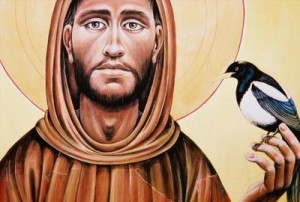
“Francis of Assisi” Class in The Great Courses

Saint_Francis_of_assisi_in_his_tombI recently completed the 12 lectures on Francis of Assisi made available through The Great Courses series.  I specifically listened to the lectures through Audible via Kindle, where I believe you will be able to purchase them more cheaply than if you get them through The Great Courses directly.  The lectures are engaging and are delivered in a tag-team and largely conversational manner by William R. Cook and Ronald B. Herzman, both of the State University of New York in Geneseo.

Here are the twelve lecture topics:

1. Why Francis of Assisi Is Alive Today
2. The Larger World Francis Inherited
3. The Local World Francis Inherited
4. From Worldly Knight to Knight of Christ
5. Francis and the Church
6. Humility, Poverty, Simplicity
7. Preaching and Ministries of Compassion
8. Knowing and Experiencing Christ
9. Not Francis AloneThe Order(s) Francis Founded
10. Not Men AloneSt. Clare and St. Francis
11. The Franciscans After Francis
12. A Message for Our Time

Despite the fact that Ronald Herzman says “kind of” a LOT and William Cook says “sort of” a LOT, these lectures are very, very good.  They are basically introductory in nature, though even those familiar with the story of Francis will benefit from many of their points and interpretations regarding Francis and his life.  They provide very helpful information about the cultural realities of Francis’ day and about how the Franciscan movement must have appeared at that time.  Their discussion of Claire was extremely interesting and I learned a great deal from it.  Furthermore, I thought that the two presenters did a very good job discussing the movement in the years following Francis’ death.

I suppose more than anything I really appreciated the respectful tone of the presenters.  They clearly appreciate Francis though they do not indulge in hagiography.  Neither do they exhibit any hyper-skeptical materialism.  For some reason, I expected to hear some of this.  I did not.  I know not if the presenters are believers, but they handled the story of Francis and what he stood for very fairly and very, again, respectfully.

J.R.R. Tolkien’s Beowulf

packshotFor years Christopher Tolkien, son of J.R.R. Tolkien, has been doing the world a service by issuing works of his father’s that have not been published yet or that were not completed (he has edited many of Tolkien’s incomplete works).  As executor of the Tolkien estate, Christopher, now eighty-nine years old, has done yeoman’s work.

It was truly exciting to hear earlier this year that Christopher would be publishing his father’s translation of Beowulf.  There was some very helpful and interesting press surrounding the publication, for instance here, here, here, here, and here.  When it came out recently and I went to the bookstore to pick up a copy for myself (as a Father’s Day gift from my wife and daughter) and for my father (as a Father’s Day gift from me), I could hardly wait to get into it.  I read it to my wife, as is our custom, and we have only just finished it.

This work contains Tolkien’s complete prose translation of Beowulf.  He had completed around six hundred lines of an alliterative verse translation as well, and many were hoping that the new publication would contain both, but it only contains the prose rendition.  It is difficult to understand why the incomplete verse translation was not included as well, especially as this work also contains Tolkien’s notes and commentary on Beowulf as well as his own Sellic Spell.

Furthermore, what is a significant publishing story without some drama?  There apparently was some drama behind the scenes of getting all of this to press.  This involved Professor Michael Drout, Professor of Old English at Wheaton College, who was working on the Tolkien translations before they were taken back by Christopher and the Tolkien Estate after what appears to have been a misunderstanding.  That strange tale can be read about here with some of Dr. Drout’s follow-up thoughts about the new translation here.

As for the prose translation itself, I can only comment as a layman and a general reader.  In short, my wife and I absolutely loved it.  There are sections that soar with exhilarating heroism.  The language can, at times, feel a bit stilted, but it was completed in 1926 and was never really completed at that.  Tolkien did not intend to have it published, as far as can be told, and these factors should be kept in mind.  Even so, it is a profoundly impressive work.  Purists do not appear to like the prose, but I daresay this will be one of those cases when the readership is divided between those who simply want to appreciate a fascinating tale well-told by a more than capable translator and those looking for a substantial contribution to Beowulf scholarship.  Those in the latter camp appear to be assuaged more by Tolkien’s learned commentary on the translation than by the provided translation.

As I say, this is an extremely enjoyable work.  I was struck by how very much Beowulf obviously influenced the world of Middle Earth, even, at times, down to the direct borrowing of names in a couple of cases.  Tolkien is at his best in some of the protracted speeches, as in Beowulf’s moving declaration that he will conquer Grendel.  It is also intriguing to see the suggestions of C.S. Lewis on various points, as reflected in the notes.

It is a sign of Tolkien’s genius that an early project he deemed worthy of tossing into a drawer and essentially forgetting would turn out to be such an enjoyable and enthralling read.  I do hope that Beowulf purists and scholars will appreciate how, at the end of the day, the appearance of this work will lead many people to consider the epic story of the great hero Beowulf either again or for the first time.  At the end of the day, the story is more important than the scholarly community surrounding it…though I readily recognize that the scholarly community serves a critical role as stewards of the story and its world.

Read Tolkien’s Beowulf!

Acts 1:12-26

Acts 1:12-26

12 Then they returned to Jerusalem from the mount called Olivet, which is near Jerusalem, a Sabbath day’s journey away. 13 And when they had entered, they went up to the upper room, where they were staying, Peter and John and James and Andrew, Philip and Thomas, Bartholomew and Matthew, James the son of Alphaeus and Simon the Zealot and Judas the son of James. 14 All these with one accord were devoting themselves to prayer, together with the women and Mary the mother of Jesus, and his brothers. 15 In those days Peter stood up among the brothers (the company of persons was in all about 120) and said, 16 “Brothers, the Scripture had to be fulfilled, which the Holy Spirit spoke beforehand by the mouth of David concerning Judas, who became a guide to those who arrested Jesus. 17 For he was numbered among us and was allotted his share in this ministry.” 18 (Now this man acquired a field with the reward of his wickedness, and falling headlong he burst open in the middle and all his bowels gushed out. 19 And it became known to all the inhabitants of Jerusalem, so that the field was called in their own language Akeldama, that is, Field of Blood.) 20 “For it is written in the Book of Psalms, “‘May his camp become desolate, and let there be no one to dwell in it’; and “‘Let another take his office.’ 21 So one of the men who have accompanied us during all the time that the Lord Jesus went in and out among us, 22 beginning from the baptism of John until the day when he was taken up from us—one of these men must become with us a witness to his resurrection.” 23 And they put forward two, Joseph called Barsabbas, who was also called Justus, and Matthias. 24 And they prayed and said, “You, Lord, who know the hearts of all, show which one of these two you have chosen 25 to take the place in this ministry and apostleship from which Judas turned aside to go to his own place.” 26 And they cast lots for them, and the lot fell on Matthias, and he was numbered with the eleven apostles.


Between the ascension of Christ and Pentecost, the Church has to wait.  They are waiting for the promised Spirit who will be poured out upon them in enabling power.  Even so, the Church demonstrates in its waiting that it understands itself to be the body of Christ, and it does so in fascinating ways.

The Church was united in prayerful expectation.

First, the Church binds itself together in the unity of prayerful expectation.  They know something is about to happen in and among them, so they come together and call on the name of God.

12 Then they returned to Jerusalem from the mount called Olivet, which is near Jerusalem, a Sabbath day’s journey away. 13 And when they had entered, they went up to the upper room, where they were staying, Peter and John and James and Andrew, Philip and Thomas, Bartholomew and Matthew, James the son of Alphaeus and Simon the Zealot and Judas the son of James. 14 All these with one accord were devoting themselves to prayer, together with the women and Mary the mother of Jesus, and his brothers.

They return from Jerusalem, the eleven disciples and “the women” and Jesus’ brothers.  They return, and they “devote” themselves to prayer.  What a beautiful, sweet picture of gospel fellowship, these men and woman joined together in prayer.  I cannot help but note that they are not praying to Mary, but they are praying with Mary, together, to the Father.

This unity crossed gender barriers and also crossed the barriers of at least some of their earlier denials.  We see this in the presence of Jesus’ brothers.  Suffice it to say that, despite the protests of most within the Roman Catholic Church, there is no reason to see these “brothers” as anything other than biological brothers.  This has been denied by many who want to maintain the idea of Mary’s perpetual virginity.  Even so, the text here and in the gospels seem clear enough:  Jesus had biological brothers.

Their presence in our text is beautiful.  Previously, in the gospels, we see that Jesus’ brothers did not believe in Him.  This is evident in His exchange with His brothers in the beginning of John 7.

1 After this Jesus went about in Galilee. He would not go about in Judea, because the Jews were seeking to kill him. 2 Now the Jews’ Feast of Booths was at hand. 3 So his brothers said to him, “Leave here and go to Judea, that your disciples also may see the works you are doing. 4 For no one works in secret if he seeks to be known openly. If you do these things, show yourself to the world.” 5 For not even his brothers believed in him. 6 Jesus said to them, “My time has not yet come, but your time is always here. 7 The world cannot hate you, but it hates me because I testify about it that its works are evil. 8 You go up to the feast. I am not going up to this feast, for my time has not yet fully come.” 9 After saying this, he remained in Galilee.

So there had existed a kind of tension between Jesus and His brothers, with His brothers challenging Him to show Himself publicly for who He claimed to be, no doubt out of a desire to see an end to the scandal surrounding their brother Jesus’ life.  It is possible that we may also see this tension in Matthew 12, though here we have to conjecture about what Jesus’ family wanted to speak with Him about.

46 While he was still speaking to the people, behold, his mother and his brothers stood outside, asking to speak to him. 48 But he replied to the man who told him, “Who is my mother, and who are my brothers?” 49 And stretching out his hand toward his disciples, he said, “Here are my mother and my brothers! 50 For whoever does the will of my Father in heaven is my brother and sister and mother.”

However we interpret this, it is clear that the brothers of Jesus did not count themselves among His followers in the gospels.  We perhaps should be slow to judge.  How would we have responded to having a brother like Jesus?  It could not have easy.  It is a lot to ask of a man that he believe his brother is God-made-flesh.  Regardless, this was the case, even though his brothers initially rejected this idea.

How beautiful it is, then, to see His brothers joined with the gathered Church here, in Acts, to devote themselves to prayer and to await the Spirit.  They join with the gathered Church as part of the gathered Church.  They now believe!

This picture of unity in prayer and watchful expectation is, again, a beautiful picture to be sure.  The 17th century French Protestant, Moise Amyraut, wrote movingly about this scene.

[T]he affection that they had for one another, and the common expectation that they shared of what had to happen, did not allow them to be separated, nor did their condition and the state of their affairs allow them to be scattered, because they were greatly counting on one another.  Thus, they would go up to this room and there they would meditate on all these things…It is necessary to mention here that [God’s] goodness had joined them together.  Thus, all of them not only remained in the same dwelling but also spent time together in common affection, with a singular diligence, and with great perseverance in the practice of prayer and praise, asking God to grant the blessings that Jesus had promised them and to deliver them from wicked people and the persecution with which they were threatened by their enemies.[1]

This is well said!  They were bound together, Amyraut says, by affection, by common expectation, by their condition and the state of their affairs, by God’s goodness, by a singular diligence, and with great perseverance.  Nothing less than the name Christ was at stake in their unity.

It is the same with us.  Surely if those who lived on that side of the bestowing of the Spirit of God could bind themselves together in such a unity, we who are born on this side of the bestowing of the Spirit can do the same!

The Church was united in continuing the original intention of Christ.

We also find in our text that the early Church continued the original intention of Christ.  We see this in the continuance of the original structure of the twelve, first established by Christ, and now continued in the early Church’s desire to fill Judas Iscariot’s vacancy.

15 In those days Peter stood up among the brothers (the company of persons was in all about 120) and said, 16 “Brothers, the Scripture had to be fulfilled, which the Holy Spirit spoke beforehand by the mouth of David concerning Judas, who became a guide to those who arrested Jesus. 17 For he was numbered among us and was allotted his share in this ministry.” 18 (Now this man acquired a field with the reward of his wickedness, and falling headlong he burst open in the middle and all his bowels gushed out. 19 And it became known to all the inhabitants of Jerusalem, so that the field was called in their own language Akeldama, that is, Field of Blood.)

Peter retells the story of Judas’ betrayal in seemingly gory detail.  It had to be painful to hear.  This is a heart-breaking story, and one steeped in shame.  It involved the shame of their friend, Judas, and his ignominious end.

Throughout the ages, many have tried to imagine how Judas was punished for his betrayal of the Lord Jesus.  In Umberto Eco’s novel, The Island of the Day Before, a 17th century man named Ferrante encounters Judas Iscariot chained to a rock in the sea.  After inquiring as to the nature of his punishment, Judas offers this explanation:

            Why, because God has willed that my punishment consist in living always on Good Friday, to celebrate always and every day the Passion of the man I betrayed.  The first day of my suffering, when for other human beings sunset approached, and then night, and then the dawn of Saturday, for me only an atom of an atom of a minute of the ninth hour of that Friday had gone by.  As the course of my sun began to move even more slowly, for the rest of you Christ was rising from the dead, but I was still barely a step from that hour.  And now, when centuries and centuries have passed for you, I am still only a crumb of time from that instant…[2]

Calvin Miller has passed on a Celtic Christian imagining of Judas’ punishment.

On the island Brendan [the first Celtic sailor] meets Judas Iscariot, the betrayer of Jesus!  Judas explains that, by the mercy of Jesus, he is on the island for a brief respite from his never-ending suffering in hell:

“I am Judas, most wretched, and the greatest traitor.  I am here not on account of my own merits but because of the mysterious mercy of Jesus Christ.  For me this is not a place of torment but rather a place of respite granted me by the Savior in honor of his Resurrection.”  It was the Lord’s own day.  “It seems to me when I sit here that I am in the Garden of Delights in comparison with the agonies which I know I shall suffer this evening.  For I burn like molten lead in a crucible day and night at the heart of the mountain which you see, where Leviathan lives with his companions.  I have a respite here every Sunday from first to second vespers, from Christmas until Epiphany, from Easter until Pentecost, and on the Feast of the Purification and the Assumption of the Mother of God.  The rest of the year I am tortured in the depths of hell with Herod and Pilate, Annas and Caiaphas.  Therefore I beseech you by the Savior of the world to be kind enough to intercede for me with the Lord Jesus Christ that I may be allowed to remain here until sunset tomorrow and that the devils may not torment me, seeing your arrival here, and drag me off to the hideous destiny which I purchased with so terrible a price.”  St. Brendan replied:  “The Lord’s will be done.  You shall not be consumed by devils tonight until dawn.”[3]

These are chilling images, even though fictional.  In reality, the most shameful image we have in Judas’ sad and pitiful saga, outside, of course, of his actual betrayal of Jesus, is the vacancy of his office here in the gathered early Church.  The fact that the eleven have gathered, but not Judas, is a powerful indictment and reminder of the shame of abandoning Jesus.  His empty chair is an indictment to all who would put their hand to the plow and then turn back.  Jesus warned of such in Luke 14.

25 Now great crowds accompanied him, and he turned and said to them, 26 “If anyone comes to me and does not hate his own father and mother and wife and children and brothers and sisters, yes, and even his own life, he cannot be my disciple. 27 Whoever does not bear his own cross and come after me cannot be my disciple. 28 For which of you, desiring to build a tower, does not first sit down and count the cost, whether he has enough to complete it? 29 Otherwise, when he has laid a foundation and is not able to finish, all who see it begin to mock him, 30 saying, ‘This man began to build and was not able to finish.’ 31 Or what king, going out to encounter another king in war, will not sit down first and deliberate whether he is able with ten thousand to meet him who comes against him with twenty thousand? 32 And if not, while the other is yet a great way off, he sends a delegation and asks for terms of peace.

It is tragic when one begins to follow Christ but then abandons Him.  The truth of Judas’ abandonment of Christ and His cause needed to be expressed.  In truth, almost all the original disciples abandoned Jesus in His time of greatest need, but all but Judas returned in repentance and with a new resolve never to do so again.

But Peter does not tell the story of Judas as a cautionary tell.  Instead, he tells the story of Judas in order to call the early band of believers to fill the vacancy.

20 “For it is written in the Book of Psalms, “‘May his camp become desolate, and let there be no one to dwell in it’; and “‘Let another take his office.’ 21 So one of the men who have accompanied us during all the time that the Lord Jesus went in and out among us, 22 beginning from the baptism of John until the day when he was taken up from us—one of these men must become with us a witness to his resurrection.”

The disciples felt a responsibility to place somebody in Judas’ abandoned post.  Peter lists the qualifications of the replacement.  He must be “one of the men who have accompanied us during all the time that the Lord Jesus went in and out among us” and he “must become with us a witness to his resurrection.”  So he must have walked with Jesus and he must have been present to receive the news that Christ, who had been crucified, yet lived.  As we mentioned earlier, his job would be the same as the job of all Christ-followers:  to bear witness to the resurrection.  John Chrysostom pointed out that, “He did not say a witness of the rest of his actions but a witness of the resurrection alone…the thing required was the resurrection.”[4]

The disciples felt they were fulfilling scripture in appointing a twelfth disciple, particularly scripture found in Psalms.  Even more so, we may see in their actions a desire to continue the original model of Christ.  To be sure, there is no evidence that the next generation of the Church continued the precise model of the twelve, but so long as the original disciples lived they maintained the standard established by Christ:  twelve disciples.

This is symbolic, I believe, of the Church’s great need to continue the work of Christ as He intended it.  Not, again, in terms of precise numerics.  That is not the point.  The remainder of God’s Word will flesh out, to an extent, how the churches in various locales were to be organized.  Even so, the action is profoundly significant in demonstrating that the early Church saw no radical disconnect or discontinuity between their lives as a body and their lives as they walked with Christ incarnate.  That is to say the early Church undoubtedly had already begun to realize that they were the body of Christ, even if they had yet to develop a full-orbed theology of what that meant.

There is something admirable in this, something touching, something courageous.  This early band of beleaguered disciples do the only thing they know to do as they await the Spirit:  they do what Jesus did.  They fill the number back to twelve.  It is not a small thing to do.  It is powerful!  In so doing they communicate to themselves and, soon, to the watching world, that they will carry on the movement of Christ in the world.

The Church was united in trusting God to keep them unified in the face of potential division.

Their method of filling the vacancy is most intriguing.

23 And they put forward two, Joseph called Barsabbas, who was also called Justus, and Matthias. 24 And they prayed and said, “You, Lord, who know the hearts of all, show which one of these two you have chosen 25 to take the place in this ministry and apostleship from which Judas turned aside to go to his own place.” 26 And they cast lots for them, and the lot fell on Matthias, and he was numbered with the eleven apostles.

The casting of lots will sound strange to us, no doubt.  This sounds rather like hocus pocus to us, and I daresay we should note that this episode is descriptive and not prescriptive.  That is, it simply tells us what they did in a particular and particularly unique case, not what the Church should normally do in cases that can never replicate this (i.e., the appointing of an eye-witness disciple).

In point of fact, however, lot casting was an occasional practice of the Jews and they did not have the qualms with it that we do.  There were times when they felt that God could speak through this method when they reached points of decision in which they were uncertain which way to go.  Thus, in Proverbs 16:33, we read, “The lot is cast into the lap, but its every decision is from the Lord.”

This is undoubtedly the sentiment here.  They put forth two equally qualified candidates, but they let the Lord make the decision.  The Lord chose Matthias to be Judas’ successor.

What is most interesting here, however, is how the Church maintained its unity even in the face of a potentially divisive decision.  There had to be people, even in that early and small assembly, who favored Joseph and others who favored Matthias.  Yet they were both put forward because it was right that they should be:  they both met the qualifications.

Tellingly, we see a complete absence of division on the process and on the final decision.  We also note the absence of manipulative, top-down power politics.  Peter does not assume the place of Christ here.  Had he done so, he would simply have appointed the one he wanted.  Furthermore, we see no haughtiness in Matthias for being chosen and no bitterness in Joseph for not being chosen.

In fact, the whole story is told with a refreshingly understated air.  It is almost as if Luke, in recounting this scene, wants to communicate a crucial fact:  that the early Church was so bound together in love for Christ and in solidarity around their calling to be witnesses that they would allow no petty divisions to divert them from the task at hand.

To be sure, the New Testament recounts more than a few divisions in the early Church, but this choosing of the twelfth should stand as a powerful reminder to us that it need not be so.  We, like these first followers, can also determine to stand together in prayer and earnest expectation and witness and mission and ministry.  We too can decide that the decisions we face will not tear us asunder or rend our fellowship one with another.  We too can decide that our story, when and if written later, will communicate to future generations that we refused to fragment, that we refused to practice power politics, that we refused to bite at each other when we did not get our way, that we refused to be many, but instead chose to be one.

So much hinged on the early Church staying together.  So much hinged on them not falling apart.

So much hinges on our unity as well.

Let us stand together in Christ.  Let us join together as an authentic family around the whole gospel for the glory of God and the reaching of the nations.


[1] Esther Chung-Kim and Todd R. Hains, eds. Acts. Reformation Commentary on Scripture. New Testament, vol.VI. Timothy George, gen. ed. (Downers Grove, IL: InterVarsity Press, 2014), p.14.

[2] Umberto Eco.  The Island of the Day Before (New York:  Harcourt Brace & Company, 1994), p. 466-467.

[3] Calvin Miller, The Path of Celtic Prayer: An Ancient Way to Everyday Joy (Downers Grove, Illinois: IVP Books, 2007), p.76.

[4] Francis Martin, ed. Acts. Ancient Christian Commentary on Scripture. New Testament, vol.V. Thomas C. Oden, gen. ed. (Downers Grove, IL: InterVarsity Press, 2006), p.17

Acts 1:6-11

Acts 1:6-11

6 So when they had come together, they asked him, “Lord, will you at this time restore the kingdom to Israel?” 7 He said to them, “It is not for you to know times or seasons that the Father has fixed by his own authority. 8 But you will receive power when the Holy Spirit has come upon you, and you will be my witnesses in Jerusalem and in all Judea and Samaria, and to the end of the earth.” 9 And when he had said these things, as they were looking on, he was lifted up, and a cloud took him out of their sight. 10 And while they were gazing into heaven as he went, behold, two men stood by them in white robes, 11 and said, “Men of Galilee, why do you stand looking into heaven? This Jesus, who was taken up from you into heaven, will come in the same way as you saw him go into heaven.”


Last week, after attending the Southern Baptist Convention gathering in Baltimore, Roni and I took a day to look around Washington, DC.  After arriving at Union Station, we took a cab to a restaurant for lunch.  As we were riding to the restaurant, we began to pass through an area of town where the buildings began to look very interesting and very distinct.  We then realized that these were the embassies of foreign countries.  The architecture of the embassies reflected the country that embassy was representing.  It was like seeing little glimpses of foreign countries here in America.

As we drove through this area I began to think about the nature of embassies.  Each of these embassies represent the interests of their respective nations.  They are, in fact, bearing witness to realities beyond our own borders.  These embassies are actually considered foreign soil, little pieces of the nations represented.  The ambassadors of these nations are here not only to represent the interests of their homelands, but also to bear witness here, in a foreign land, to the reality and existence of their nations.  In an odd way, each embassy says to any who drive by, “There is something beyond your borders.  There are other lands and other peoples and other rulers.  We are here to bear witness to them.”

It is a fascinating thing, these embassies, and the ambassadors that head them up.  It is also fascinating to see Paul using this term in 2 Corinthians 5:20.

Therefore, we are ambassadors for Christ, God making his appeal through us. We implore you on behalf of Christ, be reconciled to God.

We Christ-followers are ambassadors.  We represent and bear witness to the interests of our King and His Kingdom.  We are here to remind the fallen world order that there is another order:  a Kingdom of love and life and light and mercy and peace and forgiveness, a Kingdom entered through repentance and faith in the crucified and resurrected King, Jesus.

It is abundantly clear that this was the self-understanding of the first century Christians, of the Church.  If we are to regain the passion of this first generation of believers, we must reclaim this understanding of the Church.  As we consider now the ascension of Christ and His words to the gathered Church, watch closely what He called them, and is calling us, to be.

The Church is called to go, not to speculate.

Our text begins with a speculative question asked out of a serious desire on the parts of the followers of Jesus to understand what is going to happen next.

6 So when they had come together, they asked him, “Lord, will you at this time restore the kingdom to Israel?”

The question was whether or not Christ was going to bring the Kingdom as they conceived of it and as they desired it:  an earthly Kingdom of power that would oust the imperial might of Rome and restore the homeland of the Jews to them under the righteous and just rule of a warrior King.  They were still, even now, on this side of the cross and the empty tomb, trying to conceive of the agenda of Christ in human terms.  Jesus’ reply is as telling as it is direct.

7 He said to them, “It is not for you to know times or seasons that the Father has fixed by his own authority.”

When I was a boy, I asked my mother how much money she made.  Her response was that that information was frankly none of my business.  She was not trying to be mean to be.  Rather, she simply understood that my young mind really did not posses the conceptual framework to make sense of that information and that, practically speaking, there was nothing good I could do with it.  It was not for me to know.  She was being a good parent.

So it is with us and God.  We always want to know more than we can handle, especially about the final culmination of all things.  The late church historian, Jaroslav Pelikan, put it well when he said:

The history of the church suggests that Christians are not very good at such waiting, as they have oscillated between an occasional eschatological fervor that stands on tiptoe and asks eagerly (and repeatedly), “Lord, is it at this time that you will bring about the restoration, and when will the kingdom of Israel be?”…and their more customary torpor, which has needed to be reminded yet again “that the end of the world comes suddenly,” as Cyprian put it on the basis of this passage from Acts.[1]

This is a good way of saying that we do not need to know so much about final things that we get sidetracked in idle waiting and watching, but we do need to know enough to know that He is coming again and what the signs are.  Which is simply to say that Christ Jesus has told His people precisely enough.

Even so, speculative theology has its allurements and it is difficult not to give in to the siren sign of greater and deeper knowledge.  There have been more and less effective ways of dealing with this speculative impulse.  One approach was that of St. Augustine who, when asked, “What was God doing before He created the world,” allegedly responded, “He was making a hell for people who ask stupid questions.”

Well, that’s one approach.

The other approach, and, of course, the superior one, is found in God’s response to Job when Job demanded to know the mysteries of human suffering and why God had allowed Him to suffer as he did.  His response is found in Job 38 and 39.  I shall summarize:  “I am God.  You are not.”

We cannot know all that we would like to know.  We are not equipped to do so.  But we can know what we are intended to know, which is a great deal to be sure.  The mysteries of the Kingdom have been revealed clearly but not exhaustively.  We do not know all, but we know enough, and we may thank God for this.

In truth, we are not called to speculate but to go, as Christ reveals next.

The Church’s witness should reflect the fact that the Church is indwelt by the Spirit of the living God.

The Lord Jesus continues.  He has told them what they cannot know.  Now He reveals to them what they can.

8 But you will receive power when the Holy Spirit has come upon you, and you will be my witnesses in Jerusalem and in all Judea and Samaria, and to the end of the earth.” 9 And when he had said these things, as they were looking on, he was lifted up, and a cloud took him out of their sight.

We see here the primary calling of the Church:  to be witnesses.  Witnesses to what?  A quick survey of how the word “witness” is used in just the first three chapters of Acts will help us at this point.  Later in our chapter, when the apostles are choosing one to fill the vacancy left after Judas’ betrayal, Peter says:

21 So one of the men who have accompanied us during all the time that the Lord Jesus went in and out among us, 22 beginning from the baptism of John until the day when he was taken up from us—one of these men must become with us a witness to his resurrection.”

In Peter’s Pentecost sermon in chapter two of Acts, he says this:

30 Being therefore a prophet, and knowing that God had sworn with an oath to him that he would set one of his descendants on his throne, 31 he foresaw and spoke about the resurrection of the Christ, that he was not abandoned to Hades, nor did his flesh see corruption. 32 This Jesus God raised up, and of that we all are witnesses.

In Acts 3, Peter is preaching in Solomon’s Portico when he says this:

14 But you denied the Holy and Righteous One, and asked for a murderer to be granted to you, 15 and you killed the Author of life, whom God raised from the dead. To this we are witnesses.

This is but a sampling of many such examples, all pointing to the same object of the early Church’s witness bearing:  the resurrection of Christ.  That is, the story the Church is to tell time and time again is the story that Jesus, who was crucified, has overcome death itself and that in Him is life now and everlasting.

It is a beautiful calling.  Bearing witness to the most astounding event in human history is the privilege of the people of God.  For two thousand years, this has been our calling:  to say that God wins, that God has won, and that Christ is King of Heaven and Earth.

It was a calling that God, through the prophets, had issued before to His people.  Thus, in Isaiah 43:10, we find:

“You are my witnesses,” declares the Lord, “and my servant whom I have chosen,
that you may know and believe me
and understand that I am he.
Before me no god was formed,
nor shall there be any after me.

God’s people are always called to be witnesses to His character and His work, and to be so to the ends of the earth.

8 But you will receive power when the Holy Spirit has come upon you, and you will be my witnesses in Jerusalem and in all Judea and Samaria, and to the end of the earth.”

This commission, as well as the geographical parameters of it, is beyond significant.  The late New Testament scholar F.F. Bruce said that the phrase “you will be my witnesses” “might be regarded as announcing the theme of the book” and pointed out that many people see the geographical locations mentioned as an “Index of Contents” in which “‘in Jerusalem’ covers the first seven chapters, ‘in all Judaea and Samaria’ covers 8:1 to 11:18, and the remainder of the book traces the progress of the gospel outside the frontiers of the Holy Land until at last it reaches Rome.”[2]

Whether or not the geographical categories form an outline for the book, they most certainly provide an outline for the church.  We are to be, if anything, a worldwide witnessing people.  We are a witnessing people or we are nothing.  This is why the Church’s abandonment of its calling to be witnesses is such a tragedy and travesty.

In the mid-1800’s, from 1854 to 1855, Soren Kierkegaard launched a withering attack against the state Lutheran church of Denmark on just this point, arguing that the leaders of the church were bearing the title of “witness” without fulfilling the responsibilities of being witnesses.

Now I ask, is there the least resemblance between these priests, deans, bishops, and what Christ calls “witnesses”?  Or is it not just as ridiculous to call such priests, deans, bishops, “witnesses,” just as ridiculous as to call a maneuver on the town common a “battle”?  No, if the clergy want to be called “witnesses,” “witnesses to the truth,” they must also resemble what the New Testament calls witnesses, witnesses to the truth; if they have no mind at all to resemble what the New Testament understands by witnesses, witnesses to the truth, neither must they be called that; they may be called “teachers,” “civil functionaries,” “professors,” “councilors,” in short, what you will, only not “witnesses to the truth.”[3]

Yes, we should not take the name of “witness” if we do not intend to be witnesses to the resurrected Christ.  This is because Jesus linked the Church’s witness to the indwelling power of the Spirit He was about to pour out upon them.

8 But you will receive power when the Holy Spirit has come upon you, and you will be my witnesses in Jerusalem and in all Judea and Samaria, and to the end of the earth.”

And then Jesus ascends!

9 And when he had said these things, as they were looking on, he was lifted up, and a cloud took him out of their sight.

This being caught up into Heaven and subsequent coming of the Spirit is a picture that we have seen before in the Bible.  Ben Witherington suggests[4] an interesting parallel between the events recorded in our text and Elijah’s passing of his mantle to Elisha in 2 Kings 2.

9 When they had crossed, Elijah said to Elisha, “Ask what I shall do for you, before I am taken from you.” And Elisha said, “Please let there be a double portion of your spirit on me.” 10 And he said, “You have asked a hard thing; yet, if you see me as I am being taken from you, it shall be so for you, but if you do not see me, it shall not be so.” 11 And as they still went on and talked, behold, chariots of fire and horses of fire separated the two of them. And Elijah went up by a whirlwind into heaven. 12 And Elisha saw it and he cried, “My father, my father! The chariots of Israel and its horsemen!” And he saw him no more. Then he took hold of his own clothes and tore them in two pieces. 13 And he took up the cloak of Elijah that had fallen from him and went back and stood on the bank of the Jordan. 14 Then he took the cloak of Elijah that had fallen from him and struck the water, saying, “Where is the Lord, the God of Elijah?” And when he had struck the water, the water was parted to the one side and to the other, and Elisha went over. 15 Now when the sons of the prophets who were at Jericho saw him opposite them, they said, “The spirit of Elijah rests on Elisha.” And they came to meet him and bowed to the ground before him.

In both cases, the man of God is caught up and the Spirit falls to a successor.  The major difference, of course, is that Jesus is God-with-us whereas Elijah was not.  Even so, it is a fascinating point, for if the images parallel, then Christ leaves His mantle to the Church just as Elijah did to Elisha.  Furthermore, the Spirit falls:  the Spirit Who empowers the mantle-receiver to continue the ministry of the one caught up.

Regardless, the truth of this does not really even depend on a parallel to Elijah and Elisha.  It likely means that Elijah and Elisha are foreshadowings, types, of Christ and His Church.  But the point is sufficiently evident in Acts alone:  Christ commissions His Church, ascends, and sends the Spirit to enable the Church to fulfill the commission.  The Church, then, must live as Spirit-filled witnesses to the resurrected Christ.

A standing and staring church is a scandal.  MOVE!!!

The inescapable conclusion confronts us in our complacency:  a standing and staring church is a scandal.  Move!!!  The Church is not called to stand and to stare.  On the very heels of the ascension of Christ, the standing, staring, gawking Church is called to move and not to stand.

10 And while they were gazing into heaven as he went, behold, two men stood by them in white robes, 11 and said, “Men of Galilee, why do you stand looking into heaven? This Jesus, who was taken up from you into heaven, will come in the same way as you saw him go into heaven.”

In a sense, one feels for the disciples.  Why, after all, would they not be standing and staring?  Christ Jesus had just been caught up into the air in their very presence!  But the mild rebuke is timely nonetheless.  There is no time to waste!  The Church must go!  The Church must move!  “Why are you standing looking into heaven?”

Carl F.H. Henry once famously said, “The gospel is only good news if it gets there in time.”  This is wise indeed!

We are not called to loiter, shuffling about discussing our favorite theological topics.  We are not called to be so deep that we do not go.  Some of you feel the desire to be deep in your faith.  It is an admirable goal.  But deepness for deepness’ sake is not a Christian virtue.  Simply knowing more while doing less for the Kingdom negates the more we know.

We are not the Church so long as we wait and stare.  We are not the Church so long as we debate and discuss.  We are not the Church so long as we consume.

No, we are the Church when the truths of the gospel, the reality of the risen Christ, and the power of the indwelling Spirit compel us to go, now, for the sake of the Kingdom.


[1] Jaroslav Pelikan, Acts. Brazos Theological Commentary on the Bible. (Grand Rapids, MI: Brazos Press, 2005), p.43.

[2] F.F. Bruce, The Book of Acts (Revised). The New International Commentary on the New Testament. Gordon D. Fee, gen. ed. (Grand Rapids, MI: William B. Eerdmans Publishing Company, 1988), p.36.

[3] Soren Kierkegaard.  Attack Upon Christendom.  (Princeton, NJ:  Princeton University Press, 1968), p.23.

[4] Ben Witherington III, The Acts of the Apostles. (Grand Rapids, MI: William B. Eerdmans Publishing Company,  1998), p.112.

What Went Right in Baltimore

sbc14logoartHaving already expressed some concerns about what happened in Baltimore at the annual gathering of the Southern Baptist Convention, I’d like to share some thoughts on the things that struck me as right, good, and encouraging.  I am not offering these to try to offset my earlier critiques.  On the contrary, it struck me at various times during the week that, despite my own cynicism, I really am happy to belong to the family called Southern Baptists.  At numerous points I turned to my wife and said, “That’s just awesome.”  I thought I’d share some of the reasons why I felt that way.

  • The music and the worship was strong and God-honoring and inspirational.  All of the different kinds of music were strong:  from big names to unknowns.  Beautiful!
  • Having Naghmeh Abedini there to represent her husband, jailed Iranian pastor Saeed Abedini, was particularly moving and really put a face on the persecuted Church.
  • Having the pastor of the Canadian church plant, La Chapelle, as well as a young musician who had recently come to Christ present was beautiful and was a poignant reminder that almost-completely-unchurched regions cannot stop the advance of the gospel.
  • Russell Moore’s Ethics and Religious Liberty Commission report was strong, passionate, and very encouraging.
  • Hearing the story of the two churches that merged, and having Ray on the stage, an elderly man in the original church that was declining, was sweet and showed me that we never have to lose our passion for Christ or our willingness to change.
  • Seeing old friends and making new ones reminded me of the sweet ties that bind us together in the Southern Baptist Convention.
  • Being a large body in which people are free to speak their minds – no matter how odd-sounding at times – is a blessing.  The Free Church tradition, with all of its quirks, is a wonderful tradition to which to belong.
  • Seeing committed stands on biblical authority and orthodoxy and seeing an absence of wrangling over the core theological tenets of our faith is a fresh reminder that whatever weaknesses we might have, a lack of solidarity around the gospel is not one of them.
  • Seeing Southern Baptists given the opportunity to ask questions of denominational leaders is critical, and this was in evidence in Baltimore.  Whatever controversies may be currently discussed in the Convention, it is a strength that nobody is beyond open questioning.  This kind of transparency must be safeguarded.
  • Seeing the presence of various and diverse subgroups presented in the exhibit hall, even around sometimes conflicting secondary and tertiary theological issues, is a strength and shows that there is room in the Southern Baptist Convention on issues deemed adiaphoric.
  • There appeared to be a larger number of young people at this year’s Convention.  At least my wife felt this way.  I think I agree.  This is hopeful and encouraging.
  • There were some tremendous sermons delivered at the Convention this year and some genuine passion for the salvation of lost people exhibited.
  • My wife, Roni, points out that Fred Luter did a wonderful job in his final year as President.  I agree 100%!
  • Roni also points to the increasing ethnic diversity present in the Convention.

Yes, there are many things that went right in Baltimore.  We are very glad we went!

Concluding Thoughts/Questions on the Situation at Southwestern Seminary

Yesterday, as the 2014 annual gathering of the Southern Baptist Convention approached its conclusion, Dr. Paige Patterson, President of my alma mater, Southwestern Baptist Theological Seminary, gave his report.  It was a much-anticipated report because of controversy that has been surrounding Dr. Patterson as a result of his decision to admit a Muslim student into the student body of Southwestern Seminary against stated admissions policies.

Earlier in the day my wife and I were discussing the situation and I told her what I thought was going to happen in the report.  I predicted that Dr. Patterson would apologize for technically breaking policy then go on to appeal to his love for lost people and the higher bar of God’s justice and would receive a standing ovation from the messengers who by that time would be emotionally invested in the act as an act of evangelism.

That is exactly what happened.

Now, one does hesitate to appear coldly analytical in the face of apparently genuine feeling, but as I chewed on what happened yesterday, I am left with a number of questions and convictions about the situation.  I will present them here in no certain order.  I would very much like to have some answers to these questions as they are genuinely troubling me.

  • Have we now established the principle that SBC entity heads may unilaterally violate SBC entity policy when they deem it is for the greater good or for the possible salvation of a person?
  • Have we thought through the full implications of what that will mean for institutional management, policy integrity, and leadership precedence across all of our institutions?
  • Are we really ready to live with that as an operating principle?
  • For those favoring the establishment of this principle, what are the guardrails?
  • For instance, on what basis would one oppose a seminary President admitting an openly homosexual couple to our seminaries under the banner of concern for their souls and the possibility of their evangelization and salvation?
  • If the answer to the former question is that, in that scenario, the candidates for admission would have violated the conduct policy of the institution, are we now establishing the principle that the denial of Christ is less significant than sexual immorality?
  • What are the guidelines for which policies our entity heads may now violate and which they may not?
  • What exactly does Dr. Patterson’s apology for causing others pain mean?  What would he have done differently?  What will now change as a result of the apology?
  • On the basis of Dr. Patterson’s appeal to the judgment seat of God, of his desire not to have “blood on his hands” regarding the souls of non-believers who wish to attend our seminaries, and of the subsequent applauding of these sentiments as related to seminary admissions policies, on what possible basis can Southwestern Baptist Theological Seminary not embrace a policy of open enrollment regardless of whether or not the candidate for admissions is a believer?
  • I repeat:  if admissions is now an evangelistic tool (which is the only way I can interpret what happened yesterday), is Southwestern Seminary now practicing open enrollment?  If not, why?
  • If the admission of one non-believer is a matter of not wanting blood on our hands, then certainly the admission of as many non-believers as possible is the logical result of our evangelistic hearts.  True?

Let me be perfectly clear:  my questions are not about the salvation of souls.  All Southern Baptists of good will are settled on that point.  I daresay that Dr. Patterson does not want the young man to come to know Christ more than I do.  I pray he does and will rejoice when he does!  This is what was so very confusing about Dr. Danny Akin’s opening comment (in the Southeastern Baptist Theological Seminary President’s report that followed) that, “Paige Patterson does not owe me an apology for having a heart for lost people.”  In the thunderous applause that followed, I thought, “What?  Who on earth has asked for an apology for having a heart for lost people?”  (As an aside, there are times in these large gatherings when one really does feel that he has entered a kind of Twilight Zone dynamic between the platform and the crowd, a kind of odd detached-from-reality group-think dynamic in which it is hard to process what is happening in anything closely related to rationality.)

My questions are rather about the management of institutions and how integrity in the management process reflects on our stewardship of these institutions before God.

My questions are about the ways in which violations of stated policies today establish precedence that, in the hands of a President down the road who does not share our core convictions, can be wielded against the better interests of the Convention tomorrow.

In short, my concern is this:  that we have now applauded the establishment of a precedence that can prove utterly injurious to the cause of Southern Baptists around the world.

Acts 1:1-5

Acts 1:1-5

1 In the first book, O Theophilus, I have dealt with all that Jesus began to do and teach, 2 until the day when he was taken up, after he had given commands through the Holy Spirit to the apostles whom he had chosen. 3 He presented himself alive to them after his suffering by many proofs, appearing to them during forty days and speaking about the kingdom of God. And while staying with them he ordered them not to depart from Jerusalem, but to wait for the promise of the Father, which, he said, “you heard from me; 5 for John baptized with water, but you will be baptized with the Holy Spirit not many days from now.”

Once upon a time, many years ago, into the dark and pagan world of the first century, a world of violence, tyranny, slavery, and ignorance, a new people emerged.  Their presence was, at best, tolerated with bemused irritation or, at worst, despised and plotted against.  They were a strange people and they had strange ways.  The faithful members of this new group sounded like madmen.  They refused to offer incense to the Emporer as a god, claiming instead that they could only offer praise and offerings to the one true God of Heaven and earth.  They practiced a strange kind of classless society:  the poor and the wealthy were treated the same and were seen to be of equal value.  They valued those elements of society that society at large saw as irksome reminders of human weakness:  the sick, the infirm, the impoverished, the outcast, the undesirable.  When respectable Roman women had babies they did not want and followed the custom of putting the baby in the wild to be consumed by wild animals or the elements, these odd people would go, gather them up, and raise them.  They acted as if people had intrinsic value, not value conferred by status or earned by accomplishment.  They called for peace and the end of violence.  They suffered bravely when persecuted and did not complain.  The conferred the title of “brother” and “sister” to those who were not of their biological family, thereby redefining the very nature of family.

Their beliefs strained credulity.  They claimed that God had become a man and had been born in Palestine, of all places, to a virgin girl.  They claimed He worked miracles and healed the sick.  They claimed He announced the coming of a new Kingdom, a Kingdom of which He was King and a Kingdom populated by all who would come to Him in repentance and faith.  When this God-Man was nailed to a cross and killed, they claimed He allowed it to happen so that, in so doing, He could pay the price for the sins of the world.  When He was buried they claimed the grave could not hold Him and that He rose again.  They claimed He lived still, reigning at the right hand of the one true God, but reigning also in the hearts of His people through the Holy Spirit Who He sent to seal, keep, instruct, and guide His people.  They claimed He is coming again.

It is fascinating to see what this strange group of people did say two thousand years ago.  It is also fascinating to note what they did not say.  We never find them involved in sustained complaint against the fallenness of the world.  We never find them protesting the secular businesses of the Roman Empire.  We never find them protesting this or that movement in the world.  We never find them appealing to the secular powers to aid and assist them in the advancement of their cause.  We never find them angry at the world for being the world.  We never find them hating the world for being the world.  We never find them expecting Rome to be anything other than Rome.  We never find them expecting Rome to legislate in their favor.  There were no “culture warriors” among these people.  They were concerned only with proclaiming their peculiar message to the lost culture and calling fallen men and women to come to their King in obedience and faith.

As I say, it was a strange group indeed!

This group of people were first called “Christians” in the city of Antioch but were also known as “The Way.”  They were also called “the Church”:  that body of people comprised of Jesus-followers who recognized Him as Lord, King, and God.

It is interesting to hear the Church spoken of in this way in our day.  In our day, the Church, in many quarters of America anyway, has become a somewhat domesticated puppet of the state:  held on a leash of false promises, manipulated and cajoled into thinking that the Church still matters, is still valued by society at large.  For our parts, we want desperately to believe this nonsense, though the increasing secularization of our society is making this mythology harder and harder to believe.  Born on this side of Constantine as we are, we have been raised in a context where government support or, at least, appreciation is a given.  It is debatable if this has ever really been the case, of course, or if the Church in America simply received the thankful nod of the state insofar as it was politically expedient for the state to do so.

Regardless, it is time for us to come to terms with the death of the Bible Belt and the coming death of nominal Christianity in America. Why?  Because as our society becomes increasingly secularized and thereby more belligerent to the Church, it will ostensibly cost more and more to follow Jesus in this society.  Thus, there will be a kind of pruning of the fringe.  We will experience what the believers of the first centuries experienced and what the persecuted Church experiences today:  the need for genuine commitment if we are going to identify as Christ-followers in the world.

Which is simply to say that the Church needs the book of Acts now more than ever.  This is because the dominant culture ethos in which we reside is coming increasingly to mirror the ethos of the society in which the first Christians first lived.  The world of Acts is now our world, and we would do well to listen.

I say none of this in an effort to complain.  Far from it.  The stripping away of the nominal Christian veneer from society will force the Church to be the Church.  This is a good thing.  It is so because it means we now reside in an arena in which the scandal and prophetic challenge of the gospel can be clearly seen and clearly felt by society insofar as it is clearly proclaimed by the Church.  And this means that the light may now shine in the darkness since we can no longer deceive ourselves that the darkness is really light after all.  It is not.  It is darkness.  Christ is light.  The sides are now clear and the lines are more easily discernible.

This means that we are now free to receive both the outrage and admiration of the watching world since the watching world, in our country anyway, no longer feels the need to pretend to be Christian.  Make no mistake, the watching world of the first century felt both:  outrage and admiration, the desire to kill or the desire to join.  There were very few responses in between.

The coming of Christ and, then, of His Church was a threat to the dominant world system.  Christ turned everything on its head.  In For the Time Being, W.H. Auden imagines Herod’s reaction to the news that “God has been born.”  Though a fictional imagining, of course, this is likely an accurate depiction of what despots then and now feel when they see Christ and His gospel taking root in the populace:

Reason will be replaced by Revelation. Instead of Rational Law, objective truths perceptible to any who will undergo the necessary intellectual discipline, and the same for all. Knowledge will degenerate into a riot of subjective visions…Idealism will be replaced by Materialism . . . Life after death will be an eternal dinner where all the guests are twenty years old. . . . Justice will be replaced by Pity as the cardinal human virtue, and all fear of retribution will vanish. . . . The New Aristocracy will consist exclusively of hermits, bums, and permanent invalids. The Rough Diamond, the Consumptive Whore, the bandit who is good to his mother, the epileptic girl who has a way with animals will be the heroes and heroines of the New Tragedy when the general, the statesman, and the philosopher have become the butt of every farce and satire.[1]

Yes!  This is the threat of Christ and His Church to a society lost in darkness.  It inverts the assumed verities and shows them for the farces they are.  Christ changes everything!

More positively, Boris Pasternak got at the revolutionary implications of the coming of Christ in Doctor Zhivago, when he had Nikolai Nikolaievich record the following in his diary:

            Rome was a flea market of borrowed gods and conquered peoples, a bargain basement on two floors, earth and heaven, a mass of filth convoluted in a triple knot as in an intestinal obstruction.  Dacians, Herulians, Scythians, Sarmatians, Gyperboreans, heavy wheels without spokes, eyes sunk in fat, sodomy, double chins, illiterate emperors, fish fed on the flesh of learned slaves.  There were more people in the world than there have ever been since, all crammed into the passages of the Coliseum, and all wretched.

            And then, into this tasteless heap of gold and marble, He came, light and clothed in an aura, emphatically human, deliberately provincial, Galilean, and at that moment gods and nations ceased to be and man came into being – man the carpenter, man the plowman, man the shepherd with his flock of sheep at sunset, man who does not sound in the least proud, man thankfully celebrated in all the cradle songs of mothers and in all the picture galleries the world over.[2]

The revolutionary impact of Christ on civilization simply cannot be overstated.  The book of Acts tells the beginning of His impact on and in the world through the life of His people, the church.  Again, we desperately need to reacquaint ourselves with the story of Acts, if for no other reason than to see again what Jesus did through a group of people living in a predominately hostile environment and what He can do in and through us in a similar environment today.

Acts is presenting evidence that the work of Jesus continues in and through the Church.

Acts is the second volume written by Luke, the physician and historian, as he notes in the beginning of Acts.

1 In the first book, O Theophilus, I have dealt with all that Jesus began to do and teach

This Theophilus is either an individual who bears that name, or he is an individual to whom Luke has given a pseudonym, possibly for his protection, or this is a general reference to those who are “loved by God,” as the word suggests.  Regardless, Luke sends this letter as a follow-up to his “first book.”[3]

The first book was Luke, the gospel of Luke.  It tells the story of Jesus:  His birth, His life, His teachings, His miracles, His death, His burial, and His resurrection.  That is telling because of how it pours meaning and significance into one word in Acts 1:1.  That word is began.  “I have dealt with all that Jesus began to do and teach…”

Why is that significant?  Think it through.  It is as if Luke is saying this:

Theophilus, do you remember the first book I wrote and sent to you?  The book of Luke?  Do you remember how in that book I told you all about Jesus?  And do you remember how in that book I told you about what Jesus began doing?  Well, in this second book I want to tell you the rest of the story.  I want to tell you what Jesus is still doing.  You see, Theophilus, He is still at work.  He has not stopped.  You might wonder how He is still working, since He has ascended to Heaven.  I’ll tell you.  He is working through His church.  That’s right.  Think of it like this:   Volume 1 – What Jesus started doing.  Volume 2 – What He is still doing.  Volume 1 – Jesus’ incarnate life.  Volume 2 – Jesus’ life continuing through His church.

T.C. Smith notes that many commentators see the phrase “began to do” in “Jesus began to do” as being “poor form” grammatically, or grammatically “clumsy.”  Against these critics, Smith argues that Luke “has a purpose in using this so-called clumsy expression.”  The purpose in using this wording is to show that “the earthly ministry of Jesus is but the beginning of an action which is without termination.”[4]

This is why Acts needs to be studied and studied carefully:  it is a chronicle of how Jesus continued His life in and through the life of His people after He ascended.

Do you see?  If we do not grasp the reality of the current reign of Christ in and through His people we will be forever limited to discussing our Christian life in terms of our conversions and not in terms of what Christ is doing in and through us today, here and now.

Acts is presenting evidence that the Church continues the work of Jesus through the power of the Holy Spirit (v.2,4-5)

But how does the life of Christ continue in and through His church?  It cannot be through mere imitation of Christ.  Left to our own devices, our best-intended efforts to do what Jesus did inevitably end with futility and an increased awareness of the disconnect between who He is and who we are.

Left to our own devices, that is.

But what if we aren’t left to our own devices?  Based on Luke’s introduction to his second volume, the early church was certainly not left to its own devices.  This is abundantly clear in verse 2 as well as in verses 4-5.

2 until the day when he was taken up, after he had given commands through the Holy Spirit to the apostles whom he had chosen.

Luke says first that Jesus instructed his disciples during the forty days between his resurrection and ascension “through the Holy Spirit.”  His instructions, in other words, leading up to His bodily removal from them through the resurrection were bathed in the Holy Spirit.  True, the Spirit of God would fall upon the disciples in a unique and powerful way at Pentecost, but here, in this season of preparation, Christ speaks to them “through the Holy Spirit” about what is going to happen when He ascends.

In verses 4 and 5, Jesus foretells this powerful coming of the Spirit.

And while staying with them he ordered them not to depart from Jerusalem, but to wait for the promise of the Father, which, he said, “you heard from me; 5 for John baptized with water, but you will be baptized with the Holy Spirit not many days from now.”

“You will be baptized with the Holy Spirit.”  Jesus tells them to wait and get ready because something amazing, something cataclysmic was about to happen to them.  That amazing cataclysmic “something” was, in fact, Someone:  the Holy Spirit.

What role did the Holy Spirit play in the life of the early church?  Simply this:  the Spirit enabled the church to live the life of Christ.  He is the animating Spirit.  He is the presence of Christ in us.  He is our seal and our deposit.  He is the indwelling, enabling, empowering Spirit of God.  St. Augustine said, “What the soul is in our body, the Holy Spirit is in the body of Christ, which is the church.”[5]

That is very true!  Without the Spirit’s indwelling power and presence the church has no power and is no presence.  This is why it is so tragic that so many churches corporately and so many Christians individually do not depend on the Spirit who has been given to them.  Francis Chan put it like this:

If I were Satan and my ultimate goal was to thwart God’s kingdom and purposes, one of my main strategies would be to get churchgoers to ignore the Holy Spirit. The degree to which this has happened (and I would argue that it is a prolific disease in the body of Christ) is directly connected to the dissatisfaction most of us feel with and in the church. We understand something very important is missing. The feeling is so strong that some have run away from the church and God’s Word completely.

I believe that this missing something is actually a missing Someone-namely, the Holy Spirit. Without Him, people operate in their own strength and only accomplish human-size results. The world is not moved by love or actions that are of human creation.  And the church is not empowered to live differently from any other gathering of people without the Holy Spirit. But when believers live in the power of the Spirit, the evidence in their lives is supernatural.  The church cannot help but be different, and the world cannot help but notice.[6]

The early church was Spirit-led.  The early church was Spirit-empowered.  The early church was Spirit-filled.  The early church was Spirit-driven.

Jesus told them that what they were about to do they would only be able to do through the power of the Spirit.  The Spirit fell and the church moved and the church lived and the church worked and changed…the…world.

Want to know the difference between a club and the church?  The Holy Spirit.

Want to know the difference between an institution and a movement?  The Holy Spirit.

Want to know the difference between church as a product and church as a life?  The Holy Spirit.

Without the Holy Spirit, we will read the story of Acts as a story alien to us, for the presence of the Spirit of the living God can be the only connection point between us.  We are separated from the church of the first century by two thousand years, by wildly different customs and cultures, by language, by ethnicity, by political context…in short, by a thousand different things.  But the one thing we have in common is the presence of the Spirit of the living God Who has been sent by the divine and resurrected second person of the Trinity to indwell and to empower us.

Acts is our story only insofar as we are truly the people of God.

Acts is demonstrating how the Church advances the breaking-in of the Kingdom of God in the world. (v.3)

The church continues the life of Christ, and it does so through the power of the Spirit.  But to what end?  Why?  Note what Jesus said in verse 3.

3 He presented himself alive to them after his suffering by many proofs, appearing to them during forty days and speaking about the kingdom of God.

What did Jesus speak about in the forty days leading up to His ascension to Heaven?  The Kingdom of God.  Why?  Because the Church is ultimately serving the Kingdom’s advancement.  How?  By calling men and women into it through repentance and faith, by modeling Kingdom lives before the watching world, and by salting this current decaying order by being salt and light through their Kingdom lives.

What this means is that the Church in the world is to be a subversive movement, but a movement that subverts with love, the love of Christ.  The Church represents the door through which the Spirit of God breaks into the world.

How revolutionary this is!  How it shatters our petty church consumerism and our church shopping.  When we return the church to its rightful status as a revolutionary movement, we are freed from the tyranny of having always to make the church about us.  We are thereby enabled to see the Church as about God:  His plan for humanity, His design, His priorities, His Son.

And when we do this, the story of Acts really does become our story.  We are now able to read it as a story that is continuing, here and now, in our own lives as Christians.  Acts, then, really is for us.  It is our model but it is also our prequel.

The great poet John Donne put it well when he wrote:

Now the Acts of the Apostles were to convey that name of Christ Jesus and to propagate his gospel throughout the whole world.  Beloved, you too are actors on this same stage.  The end of the earth is your scene.  Act out the Acts of the Apostles!  Be a light to the Gentiles who sit in darkness!  Be content to carry over these seas him who dried up one red sea for his first people and who has poured out another red sea – his own blood – for them and for us.[7]

Yes!  May we “act out the Acts of the Apostles.”  We have the same King, Jesus.  We are empowered by the same Spirit.  We are commissioned by the same Father.  We have the same goal:  the salvation of every man, woman, and child on this plant.

Be the Church.

Be the Church!


[2] Boris Pasternak.  Doctor Zhivago.  (New York, N.Y.:  Pantheon Books, Inc., 1958), p. 43.

[3] F.F. Bruce rejects the idea that this was a reference to Christians in general, pointing out that “Theophilus was a perfectly ordinary personal name, attested from the third century B.C. onward.”  He goes on to surmise, “It is quite probable that Theophilus was a representative member of the intelligent middle-class public at Rome whom Luke wished to win over to a less prejudiced and more favorable opinion of Christianity than that which was current among them.”  F.F. Bruce, The Book of Acts (Revised). The New International Commentary on the New Testament. Gordon D. Fee, gen. ed. (Grand Rapids, MI: William B. Eerdmans Publishing Company, 1988), p.29.

[4] T.C. Smith, “Acts.” The Broadman Bible Commentary. Vol.10. Clifton J. Allen, gen. ed. (Nashville, TN: Broadman Press, 1970), p.17.

[5] Francis Chan, Forgotten God: Reversing Our Tragic Neglect of the Holy Spirit.  Kindle Loc. 964.

[6] Francis Chan, Forgotten God: Reversing Our Tragic Neglect of the Holy Spirit.  Kindle Loc. 42-58.

[7] Esther Chung-Kim and Todd R. Hains, eds. Acts. Reformation Commentary on Scripture. New Testament, vol.VI. Timothy George, gen. ed. (Downers Grove, IL: InterVarsity Press, 2014), p.2.

A Copy of the Workbook on St. Francis Used at the 2014 Central Baptist Men’s Retreat

319From June 6-7, a number of men from Central Baptist Church, North Little Rock, spent time in a retreat at Subiaco Abbey in Subiaco, Arkansas.  This was the first of what I intend to be annual “Mighty Men of God” retreats in which men consider the lives of great men from Christian history.  This year we considered the life of Francis of Assisi and what his example can show us about what it means to follow Jesus.  To that end, I put together a workbook highlighting four episodes from Francis’ life.  I am providing the Leader’s Guide of the workbook here, as a pdf.  I hope it encourages and challenges you.

SBC Executive Committee Chair Ernest Easley on Article III of the SBC Constitution

sla11I’ve written about internal Southern Baptist Convention issues more than I care to recently (here, here, here, and here), but the proposed changes to the Constitution of the Southern Baptist Convention are noteworthy and significant.  As SBC Messengers prepare to travel to Baltimore for the annual meeting, the summer edition of SBC Life, the news organ of the Executive Committee, touched again on the issue, and, in particular, on the controversial proposed changes to Article III.  The entire article can be found here, but I will provide the relevant portion here:


Question: Why did the Executive Committee include the phrase, “Has not intentionally operated in any manner demonstrating opposition to the doctrine expressed in the Convention’s most recently adopted statement of faith”?

Easley: At its September 2013 meeting, the EC Bylaws Workgroup tried to envision a “blue sky” approach to Article III; that is, if Article III did not currently exist, what should an article on messenger composition of the Convention look like? Numerous ideas were expressed and considered. Some were immediately added; others immediately discarded; and a few were retained for further consideration. One that was retained was the idea of making reference to our confessional statement. This idea seemed to make sense and was retained in the draft proposal presented to the EC in February.

Since the February EC meeting, individual Baptists have emailed us at article3@sbc.net, and bloggers and state paper editors have debated the wisdom and value of this sentence. Some pointed to the potential upside of how such a statement would clearly identify who we are. Others expressed alarm at how such a statement could be used to command a rigid doctrinal conformity even on matters which historically we have agreed to disagree. We have monitored this debate and I am sure this sentence about our confession of faith will be carefully reviewed by the EC at its June 9 meeting.

Let us hope this means that the disputed wording will not make its way into the final proposal.

Interview Index

Below is an index of all the interviews on the Walking Together Ministries site.  The interviews are arranged in alphabetical order by last name. 

Brisco, Brad – “Missional Living”

Dever, Mark – “Church Discipline”

Garrett, James Leo, Jr. – “Baptist Theology”

Garrett, James Leo, Jr. – “Baptist Theology” (Review/Interview of/on Baptist Theology)

Garrett, James Leo, Jr. – “Reflections on Theology”

George, Timothy – “Reading Scripture With the Reformers”

George, Timothy – “Reformed Theology and the Church”

Harmon, Steve – “Baptist Catholicity”

Kidd, Thomas and Barry Hankins – “Baptists in America”

Miller, Calvin – “Christianity and the Arts”

Piper, Barnabas – On The Pastor’s Kid

Stanglin, Keith – “Arminius”

Van Neste, Ray – “The Lord’s Supper in the Context of the Local Church”

Yarnell, Malcolm – “The Formation of Christian Doctrine”