Preben Vang and Terry Carter’s Telling God’s Story

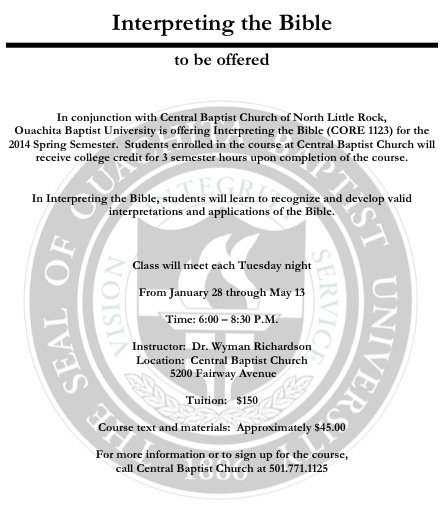
In the Fall of 2013, I taught a Ouachita University extension class surveying the Bible.  The textbook was Telling God’s Story, by Ouachita professors Preben Vang and Terry Carter.  This will be a simple and short review.  Simply put:  this is a very well done basic introduction to the Bible.  The students in the class really benefited from it, as did I.

Vang and Carter work through the Bible from Genesis to Revelation, summarizing the contents and theology of the books.  Along the way, they ably address the pertinent issues and questions that arise from the text.  Again, it is a solid evangelical introduction that I highly recommend for anybody or any group wanting an accessible tool that will help them grasp the big picture of the Bible.  It is general enough to be useful for the beginning student, but addresses enough specific issues that it will be helpful for those who already have at least a rudimentary grasp of the Bible as well.

Concerning John Howard Yoder: His Sins and His Books

john-howard-yoderI am no expert on the late Anabaptist theologian John Howard Yoder, but, like many others, I have benefited from his work, particularly his seminal work, The Politics of Jesus. And, like many others, I came to know Yoder’s work through the work of Stanley Hauerwas.  It was through reading Hauerwas’ autobiography, Hannah’s Child, that I came to learn of Yoder’s earlier sexual misconduct.  It was a disheartening revelation, for, around that same time, I learned of the sexual misconduct of Karl Barth as well as the troubled private life of New Testament scholar George Eldon Ladd (through John D’Elia’s fascinating book, A Place at the Table: George Eldon Ladd and the Rehabilitation of Evangelical Scholarship).  It was a weird time.  It seemed to me that numerous stalwart voices within the theological academy had, in fact, fairly sordid private lives.

Now, I knew this, of course, but I knew it theoretically.  Had you asked me then if the greatest of theologians were deeply flawed and sinful, I would have responded, “But of course they are!”  But it is one thing to know it and another thing to know it.

The Yoder accusations were/are deeply troubling.  I will not chronicle them here.  A simple Google search will tell you way more than you want to know (the essential articles are here).  To summarize, though, Yoder sexually harassed a number of women under the guise of developing a theology (as he saw it) of extra-marital sexual conduct that stopped short of sexual intercourse, and, in his mind, short of sin.  It seems that Yoder actually believed the kind of stuff he was saying to the women who were his victims. As I understand it, Yoder never actually had sexual intercourse with any woman other than his wife, but he, in essence, was propositioning women in theological language that would, inevitably, have led to such. (Again, my opinion.) Furthermore, he apparently did force himself upon the wife of a man who invited him to lecture while the husband was away, but, when she resisted, he stopped.  Nobody has accused Yoder of rape, though what he did was clearly a violation.  What he did and proposed was abusive, harassing, and adulterous.  It was sinful.  It was wrong.  I haven’t the slightest desire or inclination to minimize Yoder’s actions.  It matters not to me how he justified his actions with theological window dressing.  They were pernicious actions.

Before his death in 1997, Yoder underwent a discipline process among the Mennonites.  However – again, as I understand it – the victims of his harassment never saw the kind of public acknowledgment of his misdeeds that they warranted.  His books continue/d to be published and his name remains a bright star in the theological world.  I am evidence of this fact, by the way.  I first read Yoder somewhere around the year 2000.  I was completely unaware of these accusations until two or three years ago.

Apparently, Herald Press, the Anabaptist publisher of many of Yoder’s works, now feels that it needs to acknowledge Yoder’s sins.  According to this story in Christianity Today, Herald Press will now include the following notice on all of Yoder’s books that they publish:

John Howard Yoder (1927–1997) was perhaps the most well-known Mennonite theologian in the twentieth century. While his work on Christian ethics helped define Anabaptism to an audience far outside the Mennonite Church, he is also remembered for his long-term sexual harassment and abuse of women.

At Herald Press we recognize the complex tensions involved in presenting work by someone who called Christians to reconciliation and yet used his position of power to abuse others. We believe that Yoder and those who write about his work deserve to be heard; we also believe readers should know that Yoder engaged in abusive behavior.

This book is published with the hope that those studying Yoder’s writings will not dismiss the complexity of these issues and will instead wrestle with, evaluate, and learn from Yoder’s work in the full context of his personal, scholarly, and churchly legacy.

The purpose of this post is to express my own struggle with this move.  It is a genuine struggle:  just when I think I’ve reached a conclusion I see the other side.

On the one hand, it seems reasonable to me that the victims of Yoder’s abuse should not have had to suffer the indignity of what likely appeared to them to be a kind of corporate cover-up.  That is, the publishers continued to make money off of Yoder, he continued to teach at Notre Dame, and, as others have pointed out, he continued to lecture widely to much acclaim.  In this sense, it seems to me a good thing that those who financially benefited off of the mythological mystique of Yoder should have to acknowledge that the man off of whom they benefited was living in radical violation of his own programme of pacifism and peace.

On the other hand, this is happening twenty-two years too late, after Yoder’s death.  Furthermore, it seems an odd thing to publish the sins of an author on all of his books (from that press).  It seems to me that if Yoder’s sins invalidate his works, they should be pulled.  If they do not invalidate his works, they should stand.  The victims need/ed justice and the reading public (like myself) needs not to be naive.

Furthermore, I do wonder about the precedence this sets.  Should the works of Barth proclaim his adultery?  Should the works of Paul Tillich proclaim his adultery?  Should the works of Francis Schaeffer proclaim his problems with anger and temper?  Should the works of George Eldon Ladd mention his deep insecurities, his ego, and his misdeeds?

All of that being said, what makes this case unique is that Yoder was arguing for pacifism, peace, and justice, for the protection of the weak against the powerful and for a radical living out of the Sermon on the Mount.  Perhaps it is the incongruity between Yoder’s sexual misdeeds and the core of his entire message that makes the disconnect worthy of publication, worthy of a literary scarlet letter.  Who knows?

As I think about the whole sordid affair it occurs to me that there was one author who once published his own disclaimer about his own hypocrisy and failures.  In 1 Timothy 1:15, Paul announced that Christ Jesus had come into the world to save sinners, “of whom I am the foremost.”  Yoder should have acknowledged this himself.  We all should.

It’s a tough question, this publishing of sins, and one with which I’ll likely continue to wrestle.  Regardless, there is a cautionary tale here about our words and our lives, and one we had best heed well.

 

N.D. Wilson’s Death by Living

I kept seeing this book pop on Twitter and the blogosphere and finally decided to give it a shot.  VERY glad I did.  Wow!  Honestly, this is a fantastic piece of work.

I’m pretty hard on books, and I’m particularly hard on books that I think are trying to be provocative.  I do not like the feel of “manufactured-incindiary,” and I do suspect that a new generation of writers is becoming convinced that this kind of writing is the way forward.  You likely know what I mean:  the intentional employment of provocative, random concepts intended, as I see it, to communicate that the writer (in Christian books anyway) does not inhabit the fundamentalist ghetto, that he has considered unorthodox things.  It’s a literary attempt at garnering street cred.  It is a form of literary posturing, usually, and is a way of saying, “Let me prove to you that I can be shocking and dangerous before I feed you a Sunday School lesson.”

After reading the first page of N.D. Wilson’s Death by Living, I had a vague suspicion that this was going to be one of those kinds of books.  Make no mistake about it:  Wilson is eclectic and provocative in tone.  However, I very quickly figured out that he wasn’t posturing.  Rather, there is deep content beneath the provocations and idiosyncratic meanderings.  More than that, there is a stridently Christian view of the world woven in a tapestry of powerful stories and images by the hands of a skilled storyteller.

The book is hard to describe.  In a sense, it is a meditation on life via a meditation on death.  Wilson tells the stories of his family, primarily of his grandparents, and even more primarily (if you’ll allow it) of the life and death of one of his grandfathers.  Interspersed throughout are tales of his children and his wife.  More than that:  theological musings, deductions, and – a rarity among many young Christian writers – conclusions are allowed to arise from the familial tales.

My attempt at a summary statement will sound pedantic and shallow:  we are dying, therefore we best be about living…and the life we are living is a purposeful story to which we are privileged to contribute despite our not being the primary author.  That really does not do justice to what Wilson has done in this book.  Along the way we find insightful and moving discussions of time, existence, life, death, physicality (in a nice swipe at neo-gnosticism) and a couple of compelling critiques of the new atheism.  (These musings on atheism were particularly poignant and helpful.)

To be perfectly frank, it’s a tough book to review precisely because of how it is structured.  I will simply say this:  Wilson’s musings are worth the time it takes to consider them.  You will be touched, inspired, intellectually stimulated, and challenged by what you find in this book.

WELL worth reading!

James Leo Garrett, Jr.’s Evangelism for Discipleship

ImageServerDB.aspThe best books are not always either currently on store shelves or even currently in print.  I was reminded of that fact today when I read James Leo Garrett, Jr.’s little book, Evangelism for Discipliship.  Published almost fifty years ago, the addresses that comprise this book were originally delivered to the Kentucky Baptist Evangelistic Conference meeting January 15-17, 1962, and published in 1964.  I found a copy through an online used book site.  I note that one more copy is available from www.abebooks.com.

My interest in acquiring this book was two-fold.  First of all, the subject matter:  I am interested in the idea that true evangelism aims for discipleship and not merely conversion. Second, a personal reason:  I have the utmost respect for Dr. Garrett, who I took for Systematic Theology at Southwestern Seminary, and who I am privileged to call a friend today.  Dr. Garrett has been called the last of the gentlemen theologians.  This may well be the case.  His impact on Southern Baptist life and education has been significant, and I am part of a large group of former students who realize the great treasure we had in sitting under the teaching of Dr. Garrett.  Furthermore, I interviewed him and reviewed his book, Baptist Theology, for The Founder’s Journal here, and earlier for my site here.  I have reviewed another work by Dr. Garrett here.  I turn frequently to his Systematic Theology and have taught portions of it at Central Baptist Church.  What is more, Dr. Garrett wrote the Foreword for my first book, Walking Together, and cast his shadow over my second book, On Earth as it is In Heaven, as well (through his work on church discipline and regenerate church membership).

In this book, Evangelism for Discipleship, Dr. Garrett offers careful definitions of six biblical concepts:  repentance, forgiveness and reconciliation, new life, discipleship, and sanctification.  His handling is vintage Leo Garrett and offers an early glimpse of the kind of careful, methodical approach that would later characterize his magnum opus two-volume Systematic Theology.  By that I mean he offers a thorough etymology of each word and concept, examples of how the concepts have been approached and understood throughout the church universal, examples of fallacious approaches that should be avoided, and concluding comments pointing forward to a healthy embrace of these important truths.  In particular, one can note Garrett’s careful ecumenism, his concern for Southern Baptist life, and his impressive grasp of Christian history in this treatment.

The work is, of course, dated at points, particularly when he addresses this or that current issue facing Southern Baptists.  A couple of times he approaches the need for racial justice, an idea that was certainly more controversial in the Southern Baptist Convention of 1964 than of today.  In discussing regeneration, he interestingly notes that Southern Baptists had perhaps inordinately stressed the human aspect of the new life to the neglect of the sovereign work of God and should be reminded that God is indeed at work in salvation.  I could not help but wonder if Dr Garrett could say such a thing now with the advent of neo-Calvinism in the SBC and whether or not he would perceive that particular pendulum as having swung to the other extreme in our day.

Many aspects of this work were quite helpful.  In discussing the relationship between justification and sanctification, Dr. Garrett stresses that while the former term is almost always used in Scripture to refer to a moment, the simplistic assertion that sanctification always refers to a process is a bit naive as the New Testament uses the word in other ways as well.  Thus, sanctification has a more fluid definition.  Furthermore, in discussing the ordo salutis of faith and regeneration, Dr. Garrett proposes not listing these in a chronological sequence on a linear timeline but rather as an upper and lower story singular notion, with regeneration being the work of God above and faith being the response of man below.

I suppose what I found most interesting about this work was the personal and, at times, conversational tone of the work.  This is no doubt due to two factors:  the fact that these were originally sermons at an evangelism conference and the fact that Dr. Garrett would have been only thirty-seven years old when he delivered them.  His age at the time is impressive in and of itself, given the care and scholarly acumen evidenced in this book.  Regardless, it was fascinating to hear Dr. Garrett (1) use sermonic illustrations, (2) make direct appeals to the audience concerning current issues in the SBC, (3) evidence some rhetorical flourish at points, and (4) even use humor at one point.

Dr. Garrett is not a humorless or dour man, but he is a historical and systematic theologian.  Thus, the work he has primarily done does not lend itself much to these kinds of personal touches.  I thoroughly enjoyed reading them!

Is this book still relevant?  To be sure it is.  A new generation of ministers and laypeople could really benefit from the kind of careful and meticulous approach Dr. Garrett takes here and elsewhere.  I suspect that is why I, and others, do try as we can to keep his legacy alive.

If you’re near a theological library or care to search online, this would be a helpful work for you to read and, if possible, own.

“The Institute”: What a Strange Documentary About a Strange Game Reveals About Human Nature

We were iced in today in Sherwood, AR.  It was a great day for laziness and relaxation.  So this morning, indulging in said laziness, while scrolling through the U-Verse On Demand documentary offerings, I noticed “The Institute.”

Curious, I checked it out. It was, in a word, enthralling.

Essentially, here is what happened:  in 2008 a California-based artist named Jeff Hull developed an elaborate game in San Francisco.  In reality, he created a false world centered around the Jejune Institute and its conflict with the Elsewhere Public Works Agency.  It’s kind of hard to explain the story, though it dealt with the Jejune Institute’s very New Agey efforts at helping people develop in their understanding of themselves and of reality and of human potential.  Furthermore, there was a backstory concerning the disappearance of a girl named Eva and clues surrounding her perceptions and discoveries of deep truths regarding these themes.  I realize that does not make much sense.  Not much about this whole thing makes sense.  The game was carried on for about three years in the San Francisco area and had lots of twists and turns.

Participants walked into the game after answering advertisements posted in the SF area.  You must understand that those answering these advertisements were unaware what they were stepping into or that the Jejune Institute (where they first went to begin their journey through the game) was a farce or that this was a game at all.  Jeff Hull did a brilliant job of bathing the fliers and notices regarding the Jejune Institute in language and images and verbiage that will be immediately familiar to anybody who has ever looked closely at cults (particularly California-based cults in the 60’s and 70’s) and New Age movements.

Over the three year period of the game, thousands of people got caught up in it.  Most dropped out before reaching the end (the game itself was divided up into chapters), but the level of commitment evidenced by those who took part is telling.  They followed the signs and clues that Hull and his team cleverly placed throughout the city, analyzing the evidence they discovered about the disappearance of Eva and the mysterious Jejune Institute.  The game was basically an urban scavenger hunt.  How many people thought this was a game is hard to say.  Clearly many people thought this was reality and that they were caught up in a true story.  I suspect most people were conflicted about what was actually happening.

Some crossed the line.  One man in the documentary, interviewed with his visage obscured by darkness, refused to believe this was a game and lashed out at those who realized it was.  He read deep meanings into the arcane clues Hull offered and internalized the story in a troubling way.  Hull claims he was stunned at this phenomenon.  Finally, Hull brought the game to a conclusion with a truly weird day-long self-actualization event with the major characters of the game (sans Eva) revealing that they had reached a fragile peace.  At no point did anybody ever say, “None of this is real.  This has all been an elaborate game, a hoax.”  The participants who stayed all the way through to the end seemed to feel a kind of anticlimactic disappointment, with some saying they slipped into a depression when it ended.

This documentary should be watched and watched carefully.  What struck me must deeply were a few things:

  • The brilliance of Jeff Hull and his team.  Truly, it is amazing to see the world that this guy created and the lengths to which he went to create a believable if strange narrative that many people found compelling and intriguing.
  • The deep desire within people for transcendence.  This documentary clearly demonstrates how strongly people feel that there must be more than the reality we see before our eyes.  Though many people likely suspected this was a game or something like it, it seems to me that what drove them forward was a suspension of belief and a sincere hope that such an eclectic tale might possibly be true.
  • The human longing for community and solidarity.  It was fascinating to see people come together around Hull’s concocted world and imagined story.  In particular, it was interesting to see how many young people allowed themselves to be absorbed into this carnival and spectacle.
  • The ease with which human beings can be led to take up a cause or a movement that they do not even understand.  At one point, Hull even had 250 people protest in the streets of SF concerning they knew not what!  One of the troubling things about this whole experiment, to this observer anyway, is how it demonstrates the gullibility of people.  More than that, it demonstrates how people will put faith and trust in a movement that they do not understand.  I kept thinking, while watching this documentary, about how easy it is for cults to get started and get a following.

I’m not sure what Jeff Hull wanted to prove or demonstrate, but the quasi-religious/cultic element of this experiment, and the eagerness with which people gave themselves to this “cause” strikes me as telling and illuminating.

It’s a weird journey, but “The Institute” is an intriguing documentary that is well worth consideration.

Liturgical Gangstas Redux, Part III: The Authority/Dissent Issue

What is “Liturgical Gangstas Redux”?

In 2009, Michael Spencer asked some of us across denominational lines to come together as “The Liturgical Gangstas.”  The intent was for Michael to throw a question to Christians of different traditions to see how we would approach the questions and, ostensibly, to help ourselves and the readers to think through spiritual issues more deeply.  We did this over the following year.  I bowed out after Michael’s passing, though I think the Liturgical Gangstas continue on over at the Internet Monk site.  Anyway, in looking through the older content at Internet Monk, I thought I might post my answers to those questions over here, in case they are of use to anybody. (I don’t feel comfortable lifting the entire Gangsta posts from the site, but, in time, I’ll move the questions and my responses here.)


“If we cannot join our Catholic brothers and sisters in simply trusting the teaching authority of the Roman Catholic church, then what is the answer to the “authority” question for non-Catholic Christians?”

The question of authority is indeed a bit difficult for those without an official Magisterium (though many observers of the modern SBC would point out that we now seem to have a kind of magisterium!). In short, Luther’s declaration at Worms about his “heart being captive to the Word of God” resonates deeply with Baptists, even if Lutherans would no doubt point out that Luther would be quite suspect of much Baptist handling of the word! Furthermore, I fully acknowledge that every believer of every communion will, at heart, assert with equal strength that God’s word is ultimately their authority as well. The question then becomes one of mediation. How do we hear and find and understand this authoritative word to which we are accountable?

The Baptist finds it in his experience with the word, as it is opened through the Holy Spirit’s unction via the means of careful exegesis and sound hermeneutics. He finds it particularly as it is fleshed out in the local church. We see the Bible as the encapsulation, in written form, of that early authority to which, Acts tell us, the early church devoted herself: “the Apostle’s teaching.”

I understand the dilemma in arguing that the word of God is our authority. Have Baptists not simply abandoned one pope for sixteen million popes (as the official but absurdly inflated numbers of the SBC would suggest)? Has not the idea of the lone soul standing with his Bible before his God given rise to a pandora’s box of chaotic, idiosyncratic interpretations and splintering? Has not the cry of ecclesia semper reformanda simply become a first principle by which we validate whatever tangent we happen to want to go on at the moment?

I don’t deny the practical realities of these problems, I simply deny that claiming the word of God as your authority must necessarily be this way. To be sure, in a Baptist climate of disappearing ecclesiology, the deceptive cry of “no creed but the Bible” (not originally a Baptist cry anyway) has morphed into “no creed but me.”  But it need not be this way.

In truth, a more full-orbed Baptist understanding of authority can be found in the congregational renewal that is currently taking place among the many Baptists who are seeking to reclaim the cherished principle of regenerate church membership.  This does not position authority in the church, but it does give a healthier oversight of our handling of the word in the context of a local, covenanted, accountable, and disciplined congregation. A concurrent retrieval of the once-strong system of accountability among these local congregations would likewise strike a blow at the church-shopper mentality that says, “Ok, if my quirks aren’t welcome here, then I’ll just find someplace where they are.”

Alongside this ecclesiastical parameter that surrounds and guides the individual and his Bible, I firmly believe that many of those calling for a greater appreciation of historic, consensual exegesis as a tempering guide for reading the Bible are hitting on something key. You can find this in many of the Baptist catholicity guys (Timothy George, D.H. Williams, Steve Harmon, et al.), but perhaps it has been best articulated in Tom Oden’s paleo-orthodoxy programme.

Thus, I would argue that the Christian’s source of authority is the enscripturated Word of God as it is read, understood, and lived in the context of an accountable, covenanted local congregation, and as it is guided and tempered by a renewed appreciation for the voice of the Church throughout time (a voice which does not eclipse the word, but which certainly ought to be respected and heeded in the reading of the word.)

Gregory Thornbury’s Recovering Classic Evangelicalism

I’ve read a lot of books that I thought were powerful, and a lot of books that I thought were memorable, but only a few books that I thought were “important.”  Gregory Thornbury’s Recovering Classic Evangelicalism: Applying the Wisdom and Vision of Carl F.H. Henry is one of those few books.  I daresay that Thornbury’s carefully crafted, wisely conceived, and strategically nuanced proposal for the way forward for Evangelicals is worthy of the serious attention of all who bare the moniker, and I will be personally impressing the need to read this work on my own friends.

For some time I have felt a kind of schizophrenic pull toward the culture-warrior-fundamentalism of my youth and the subtle-salt-and-light-quietism of the neo-Anabaptist movement (at least as I have perceived it).  When pressed, neither has seemed to me to be tenable because neither seems, at heart, concurrent with the ipsissima vox of scripture.  Alongside this, it has seemed to me, especially in listening to young ministers interact biblically with the ethical issues of the day (perhaps, preeminent among them, same-sex marriage) that there has been a consistent erosion of inerrancy and its implications among those who self-identify as Evangelicals.  Outwardly, it has seemed to me that the fundamental issue facing modern American culture is the question of authority in general, and the possibility of epistemological confidence specifically.

Perhaps the seething cauldron (to use Augustine’s memorable image of his time in Carthage – albeit in quite another vein) of my own neuroses on these matters is what made the impact of Thornbury’s proposal on this reader so intense.  I felt time and again, while reading Thornbury, that here was a proposal that shot the gap betwixt Scylla and Charybdis  with the careful guidance of a mind that I still marvel is only in its early forties.

Let me also say that if ever there was a book due a second reading, it is this one.  I intend to start again very soon.  Thus, these reflections are, in my mind, thoughts offered en route.

In short, Thornbury is proposing that Evangelicalism once again consider the rich, fertile, provocative vision of Evangelicalism found in the writings of Carl F.H. Henry.  This is a proposed Evangelicalism that rejects epistemological hubris on the one hand but stands confidently in the inerrant Word of God on the other.  This is a proposed Evangelicalism that eschews the myopic negativism of fundamentalism while speaking clearly and carefully to a lost culture today.  It is non-entrenched Evangelicalism that yet has a sense of perimeter and circumference.  It is an intellectually-engaged Evangelicalism, interacting with acumen in the marketplace of ideas on the basis of the radical explanatory power of the gospel rightly conceived.  It is an Evangelicalism that stands gladly alongside secular opposition to injustice and evil while not jettisoning its distinct character as the Body of Christ in the process.  It is an Evangelicalism that once again understands sin institutionally and corporately and not only individually, but that still sees itself as the purveyor of good news to lost men and women.  It is an appropriately ecumenical Evangelicalism, that yet does not abandon ecclesial distinctives.

The thought of Carl F.H. Henry is, for Thornbury, a repository from which such ideas can be faithfully mined.  Yet, one gathers this is no mere professorial crush for Thornbury.  He has read Henry widely and he has buttressed his central contentions carefully.  He is no blind Henry apologist, as I read him.  Rather, in seeking to “make Carl Henry cool again,” Thornbury really believes and convincingly demonstrates that here we can find goods in the Henry cupboard sufficient for the reformation needed.

Thornbury’s proposal for the church to demonstrate radical Christ-likeness in local communities was phenomenal.  The fact that this aspect of his proposal was grounded within a decidedly Christian intellectual framework, as opposed to being grounded despite or contra such a framework, was refreshing and strengthened his position.

As far the book itself, it is very well written, very engaging, and a clarion clear.  Thornbury has read widely and he interacts impressively with a variety of theological, philosophical, and cultural questions, issues, and debates.  In short, he has demonstrated in the writing of his proposal that which he is proposing:  irenic but tough interaction with world views Christian and otherwise from a gospel-grounded vantage point.

Read this book.

Cormac McCarthy’s Screenplay, The Counselor

For what it’s worth, I consider Cormac McCarthy to be the world’s greatest living author.  I do not say that lightly.  I truly mean it.  I am not a fan of all of his works, but I am of most.  All the Pretty Horses, No Country for Old Men, and The Road stand out as exemplary reasons why I would say such a thing.  McCarthy deals consistently with the big issues (life, death, meaning, love, morality, and God), and he does so in a way that evidences a keen mind and, I have long suspected, a Christian mind.  His writing is frequently too beautiful for words, and there are times when it soars.  When McCarthy is good, he is better than anybody.  He is not Faulkner, but he is in that kind of company.

This is what made reading The Counselor so very difficult.  It is a screenplay, but screenplays can still be vehicles of great writing.  Instead, what I see in The Counselor is a work as off-putting as his novel, Child of God, without the great writing of the latter.

In short, The Counselor struck this reader as a tawdry, unnecessarily explicit, shabby replica of No Country for Old Men.  Honestly, the two stories are very similar:  a man gets caught up in a drug deal believing he can control it and believing that the money is worth the risk, without understanding the inky blackness and amorality of the souls of those who live in the nihilistic underbelly of the world, leading to the inevitable demise of the person and all that they hold dear.  The basic points of the stories are the same:  there is a viciousness in the world that takes one’s breath away, and it can challenge the sanity and break the hearts of those who want to live in this fallen world with anything like a semblance of meaning, virtue, beauty, and transcendence.  It is an important lesson, and one McCarthy is especially adept at telling.  Regrettably, the moral gets lost in the nearly pornographic language and the overstressed explicitness, profanity, and gutter talk.

Look.  McCarthy isn’t writing for LifeWay.  I get that and I’m thankful for it.  He is not for the prudish, to be sure.  However, this was just too much, and I do not flinch from saying that sometimes it’s possible for a great writer to get so close to the darkness he is writing about that that darkness manifests itself even in the writing.  Moreso, the writing was bad and shallow.  I known, I know:  it’s a screenplay.  I get the limitations that come with the medium.  Regardless, it feels like he was trying to write a screenplay, if that makes sense.  One hopes this will be the end of this kind of experiment for McCarthy.

The Counselor is a disappointing read.

It is regrettable…especially for the world’s greatest living writer.