Why Article VII of the Baptist Faith and Message Should be Changed (Part II)

In Part I of this series, I discussed the current wording and implications of Article VII as well as the current practices of Southern Baptists.  Here, I would like to propose amended wording for the article.

Amended Wording for Article VII:  A Proposal

Below, I offer the current wording with the two emendations marked throughout as well as a “cleaned up” version of the amended article.  First, the article with emendations:

VII. Baptism and the Lord’s Supper

Christian baptism is the immersion of a believer in water in the name of the Father, the Son, and the Holy Spirit. It is an act of obedience symbolizing the believer’s faith in a crucified, buried, and risen Saviour, the believer’s death to sin, the burial of the old life, and the resurrection to walk in newness of life in Christ Jesus. It is a testimony to his faith in the final resurrection of the dead. Being a church ordinance, it is prerequisite to the privileges of church membership and to the Lord’s Supper.

The Lord’s Supper is a symbolic act of obedience whereby members of the church [believers], through partaking of the bread and the fruit of the vine, memorialize the death of the Redeemer and anticipate His second coming.

Matthew 3:13-17; 26:26-30; 28:19-20; Mark 1:9-11; 14:22-26; Luke 3:21-22; 22:19-20; John 3:23; Acts 2:41-42; 8:35-39; 16:30-33; 20:7; Romans 6:3-5; 1 Corinthians 10:16,21; 11:23-29; Colossians 2:12.

 Now, a “cleaned up” version of the amended article:

VII. Baptism and the Lord’s Supper

Christian baptism is the immersion of a believer in water in the name of the Father, the Son, and the Holy Spirit. It is an act of obedience symbolizing the believer’s faith in a crucified, buried, and risen Saviour, the believer’s death to sin, the burial of the old life, and the resurrection to walk in newness of life in Christ Jesus. It is a testimony to his faith in the final resurrection of the dead.

The Lord’s Supper is a symbolic act of obedience whereby believers, through partaking of the bread and the fruit of the vine, memorialize the death of the Redeemer and anticipate His second coming.

Matthew 3:13-17; 26:26-30; 28:19-20; Mark 1:9-11; 14:22-26; Luke 3:21-22; 22:19-20; John 3:23; Acts 2:41-42; 8:35-39; 16:30-33; 20:7; Romans 6:3-5; 1 Corinthians 10:16,21; 11:23-29; Colossians 2:12.

I am therefore proposing two changes:  (1) striking the final sentence of the first paragraph and (2) broadening “members of the church” to “believers.”

Rationale and Concluding Thoughts

I would like to make two important points:

  • The amended version of Article VII that I am proposing does not move the Baptist Faith and Message from a close/d communion position to an open communion position.  It simply broadens it enough to allow for breadth of interpretation.
  • One could hold to strict closed communion and vote for this amendment in good conscience knowing that the amended article would not discount their position.

The issue, therefore, is not which position Article VII will advocate, but whether or not it is necessary for Article VII to advocate a position at all.  To put it in a little more incendiary form, the real issue is whether or not the Baptist Faith and Message should make room for honest and sincere Baptist believers in Jesus Christ to differ on this particular question and still reside in agreement on our common confession of faith?

Why Article VII of the Baptist Faith & Message Should be Changed (Part I)

For some time now I’ve been giving thought to proposing from the floor of the Southern Baptist Convention annual meeting that we alter the wording of Article VII of the Baptist Faith and Message, the “official” confession of the Southern Baptist Convention.  While I have not taken the time to look up the specific dates and wording, such proposals have been made before from the floor of earlier meetings at which I was present.  They have never succeeded.  I have not decided with certainty that I am going to do this in Houston.  I’m mulling it over currently.

Regardless, I’ll be posting some (hopefully) short pieces along and along on this issue as I try to put some of my thoughts in writing.  I have already stated my opposition to the wording of Article VII publicly here, in an ealier article in the Arkansas Baptist News on some general thoughts concerning the article and the issue of the Lord’s Supper in general.

For this post, I would simply like to point out two facts:  (1) that Article VII of the Baptist Faith and Message restricts the Table of the Lord to those who have been immersed as believers and (2) that the majority of Southern Baptists are living in open conflict with Article VII.

What Article VII Actually Says

The article itself is relatively straight forward, though I note (with some amazement) that a surprising number of Southern Baptist pastors I have spoken to about this seem unaware of what it does, in fact, say.

VII. Baptism and the Lord’s Supper

Christian baptism is the immersion of a believer in water in the name of the Father, the Son, and the Holy Spirit. It is an act of obedience symbolizing the believer’s faith in a crucified, buried, and risen Saviour, the believer’s death to sin, the burial of the old life, and the resurrection to walk in newness of life in Christ Jesus. It is a testimony to his faith in the final resurrection of the dead. Being a church ordinance, it is prerequisite to the privileges of church membership and to the Lord’s Supper.

The Lord’s Supper is a symbolic act of obedience whereby members of the church, through partaking of the bread and the fruit of the vine, memorialize the death of the Redeemer and anticipate His second coming.

Matthew 3:13-17; 26:26-30; 28:19-20; Mark 1:9-11; 14:22-26; Luke 3:21-22; 22:19-20; John 3:23; Acts 2:41-42; 8:35-39; 16:30-33; 20:7; Romans 6:3-5; 1 Corinthians 10:16,21; 11:23-29; Colossians 2:12.

Here we have close communion, the restriction of admittance to the Lord’s Table to those who have been baptized as believers by immersion.  To put it another way:  (a) true baptism is for believers by immersion, (b) the Lord’s Supper is a church ordinance, (b) all members of the church have been truly baptized, therefore, (c) only those who have been baptized as believers by immersion may partake.

The beginning of the second paragraph may teach closed communion, the restriction of admittance to the Lord’s Table to members of that particular local church.  That depends on how strictly one chooses to interpret it.

How Most Southern Baptists View Article VII

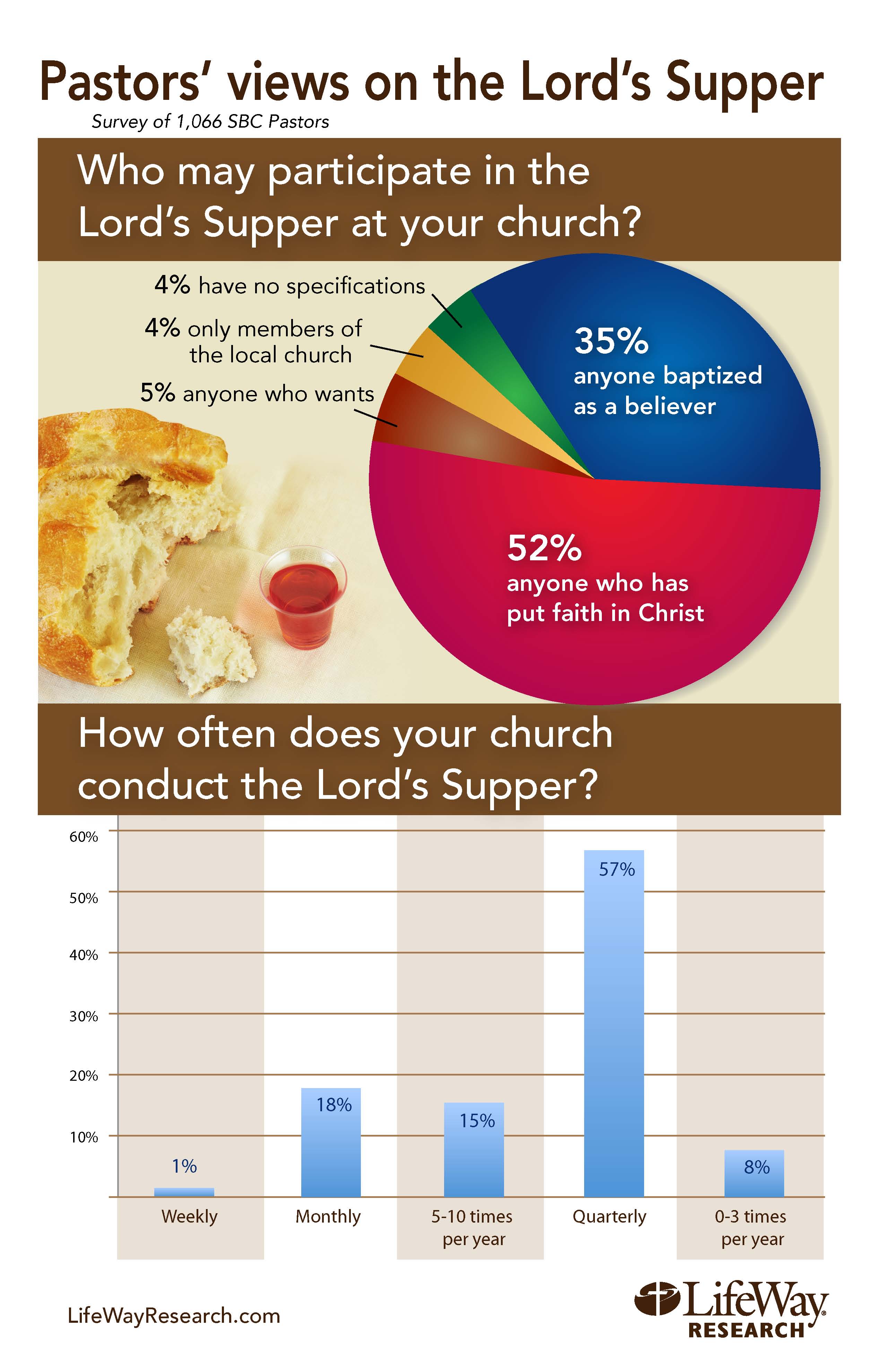
In 2012, LifeWay research surveyed over 1,000 pastors concerning how their churches observe the Lord’s Supper.  Here are the results.

IMG20129178010HI

The implications are clear:  61% of Southern Baptist churches do not bar non-immersed believers from partaking. 96% reject strict closed communion.

In a September 2012 Baptist Press article on the survey, Scott McConnel of LifeWay Research said this:

“Clearly, though, this survey points out a difference between the beliefs expressed in the Baptist Faith and Message, and the Lord’s Supper practices of many Southern Baptist churches.”

The article added:

Article VII of the Baptist Faith and Message 2000 (SBC.net/bfm) lists baptism as a “prerequisite to the privileges of church membership and to the Lord’s Supper.” Article VII also says the Lord’s Supper is for “members of the church.”

Lest any who disagree with the direction I’m going here sense that I am suggesting that our convictions should be determined by majority vote, I would quickly say that I reject such a notion out of hand.  Truth is truth, regardless of poll results.  That is not my premise.  Instead, my premise is this:  highly-controverted and majority-ignored assertions on secondary matters are unwise and utterly unnecessary.

Conclusion

As I say, this will be a series of posts touching on this and that aspect of the question at hand.  But let me lay my cards on the table.  I do not propose that Article VII move from a close/d position to an open position.  I simply propose that Article VII define baptism and the Lord’s Supper while leaving the controverted and historically-disputed issue of who is allowed to partake as a local church matter.

There is no reason to address that issue in Article VII at all, and the majority of Southern Baptists disagree anyway.

In my next post in the series I’ll offer a proposed rewrite of Article VII.

Exodus 2:1-10

Exodus 2:1-10

1 Now a man from the house of Levi went and took as his wife a Levite woman. 2 The woman conceived and bore a son, and when she saw that he was a fine child, she hid him three months. 3 When she could hide him no longer, she took for him a basket made of bulrushes and daubed it with bitumen and pitch. She put the child in it and placed it among the reeds by the river bank. 4 And his sister stood at a distance to know what would be done to him. 5 Now the daughter of Pharaoh came down to bathe at the river, while her young women walked beside the river. She saw the basket among the reeds and sent her servant woman, and she took it. 6 When she opened it, she saw the child, and behold, the baby was crying. She took pity on him and said, “This is one of the Hebrews’ children.” 7 Then his sister said to Pharaoh’s daughter, “Shall I go and call you a nurse from the Hebrew women to nurse the child for you?” 8 And Pharaoh’s daughter said to her, “Go.” So the girl went and called the child’s mother. 9 And Pharaoh’s daughter said to her, “Take this child away and nurse him for me, and I will give you your wages.” So the woman took the child and nursed him. 10 When the child grew older, she brought him to Pharaoh’s daughter, and he became her son. She named him Moses, “Because,” she said, “I drew him out of the water.”


I recently read a book in which a left-leaning scholar noted that Martin Luther viewed the Old Testament as essentially Christian “because it contains the Christ-centered divine covenant between God and Israel, promising salvation from sin, evil, and death.”  This scholar rejected Luther’s view and went so far as to say that “Luther’s view of the Old Testament is unacceptable in any responsible biblical scholarship.”[1]  In other words, this author is suggesting that no true biblical scholar would see the prefiguring of the New Testament in the Old Testament.  The comment made me chuckle, for, in point of fact, there are numerous scholars who see types and figures of the New Testament in the Old, who see Christ foreshadowed in the events of creation and in the life of Israel.  Indeed, as a Christian, it is extremely difficult not to see Jesus all over the pages of the Old Testament.

One of the areas in which this is clear is in the birth of Moses.  It is undeniable that Moses is a type of Christ, that the events surrounding his birth and life point to the coming of a greater Moses, a Messiah, who free God’s people from sin, death, and hell.  The fourth century Christian poet, Prudentius, put it like this:

Thus Moses in a former age

Escaped proud Pharaoh’s foolish law,

And as the savior of his race

Prefigured Christ who was to come.[2]

I would agree with Prudentius that Moses “prefigured Christ who was to come.”  This evening, let us consider the birth of Moses.  In doing so, let us consider the many ways that Moses’ birth points forward to the birth of Jesus, so many years later.

I. Moses and Jesus both had unlikely births.

Let us begin by considering the unlikely births of Moses and Jesus.  Of course, the birth of Moses does not match the uniquely miraculous nature of the birth of Jesus.  How could it?  Jesus was born of the virgin Mary, a miracle that was as staggering as it was unlikely.  The shocking nature of the birth of Jesus is summed up definitively in Mary’s response in Luke 1:34 to Gabriel’s announcement that she would bear a son:  “How will this be, since I am a virgin?”

While Moses’ birth does not rise to that miraculous degree, it, too, was unlikely and, in fact, it was also possibly miraculous.  His birth was unlikely in that Moses was born among a persecuted people and, specifically, under a decree from on high forbidding his survival, and, in deed, the survival of any Jewish baby boy.  While we saw last week that the midwives disobeyed Pharaoh’s demonic decree, it is nonetheless moving that the savior of Israel should be born in such an environment.

I said that Moses’ birth was possibly even miraculous.  Let me explain.  Later in Exodus, we will learn that Moses’ father was named Amram and his mother was named Jochebed.  Exodus 6 tells us that Amram married his own aunt.  Victor Hamilton points out something very interesting about this:

That Amram marries his aunt raises the possibility that Moses’s mother is a good bit older than his father…Taking the expression “daughter of Levi” in Exod. 2:1 and Num. 26:59 literally, rather than reading it as a metonym for a distant relative, Brichto…computes that Jochebed is forty years older than her husband and that she is 176 in the year she gives birth to Moses!…So then, there are two miracles in this story: the miraculous preservation of the baby from the king’s edict, and a mother who, pushing the second-century mark, conceives and gives birth.[3]

While this cannot be proven, it is an intriguing suggestion.  Regardless, the birth of Moses, like the birth of Jesus, was surrounded by the miraculous, preserving, providential hand of Almighty God.

II. Moses and Jesus were both born among a politically oppressed people.

Of course, Moses and Jesus were also born into similar situations.  The Israelites among whom Moses was born were an oppressed people living on foreign soil.  The Israelites among whom Jesus was born were an oppressed people living on their own soil.  Moses was born under the yoke of Egyptian tyranny.  Jesus was born under the yoke of Roman tyranny.  Moses was born under the scepter of Pharaoh.  Jesus was born under the scepter of Caesar.  Moses’ Israelites dreamed of leaving Egypt.  Jesus’ Israelites dreamed of Rome leaving them.

While the divine titles of verses 6b and 7 apply only and ever to Jesus, Isaiah 9’s description of the political oppression into which Jesus would be born applies to both Jesus and Moses.

2 The people who walked in darkness
have seen a great light;
those who dwelt in a land of deep darkness,
on them has light shone. You have multiplied the nation;
you have increased its joy;
they rejoice before you
as with joy at the harvest,
as they are glad when they divide the spoil. 4 For the yoke of his burden,
and the staff for his shoulder,
the rod of his oppressor,
you have broken as on the day of Midian. 5 For every boot of the tramping warrior in battle tumult
and every garment rolled in blood
will be burned as fuel for the fire. 6 For to us a child is born,
to us a son is given;
and the government shall be upon his shoulder,
and his name shall be called
Wonderful Counselor, Mighty God, Everlasting Father, Prince of Peace. 7 Of the increase of his government and of peace
there will be no end,
on the throne of David and over his kingdom,
to establish it and to uphold it
with justice and with righteousness
from this time forth and forevermore.
The zeal of the Lord of hosts will do this.

Both Moses and Jesus were born in humble circumstance, and both were born under foreign tyranny.

III. Moses and Jesus were both born under the threat of a murderous king.

While both were born among an oppressed people, it is telling that both Moses and Jesus were born under intentional decrees that baby boys be killed.  We find Pharaoh’s decree in Exodus 1.

15 Then the king of Egypt said to the Hebrew midwives, one of whom was named Shiphrah and the other Puah, 16 “When you serve as midwife to the Hebrew women and see them on the birthstool, if it is a son, you shall kill him, but if it is a daughter, she shall live.”

We find Herod’s in Matthew 2.

16 Then Herod, when he saw that he had been tricked by the wise men, became furious, and he sent and killed all the male children in Bethlehem and in all that region who were two years old or under, according to the time that he had ascertained from the wise men.

Thus, Pharaoh and Herod share the dubious distinction of being tools of Satan whereby the devil used infanticide to try to blot out Israel’s deliverers.  These two are blood brothers of the most hellish sort, and to this day we do not even name our dogs Pharaoh or Herod.

IV. Moses and Jesus were both taken into the house of Egypt for protection.

Another similarity in these two births is that both Moses and Jesus both found protection in Egypt from the murderous intentions of oppressive rulers.

In our text tonight, we read of the events leading to Moses’ adoption into the house of Pharaoh.

5 Now the daughter of Pharaoh came down to bathe at the river, while her young women walked beside the river. She saw the basket among the reeds and sent her servant woman, and she took it. 6 When she opened it, she saw the child, and behold, the baby was crying. She took pity on him and said, “This is one of the Hebrews’ children.” 7 Then his sister said to Pharaoh’s daughter, “Shall I go and call you a nurse from the Hebrew women to nurse the child for you?” 8 And Pharaoh’s daughter said to her, “Go.” So the girl went and called the child’s mother. 9 And Pharaoh’s daughter said to her, “Take this child away and nurse him for me, and I will give you your wages.” So the woman took the child and nursed him. 10 When the child grew older, she brought him to Pharaoh’s daughter, and he became her son. She named him Moses, “Because,” she said, “I drew him out of the water.”

It is a poignant irony that Moses finds protection from the house of Pharaoh within the house of Pharaoh!  I am almost tempted to say that Moses and Jesus share yet another connection in that they were both adopted:  Moses by Pharaoh’s daughter, Jesus by Joseph.  Regardless, by adopting this Hebrew boy, Pharaoh’s daughter essentially brings him in too close to Pharaoh for Pharaoh to kill him.  Moses was saved under Pharaoh’s very nose, as it were.  It is an intriguing occurrence within a fascinating story:  Moses finds protection from Egypt within the very walls of Egypt.

Jesus does as well.  An angel of the Lord cautions and instructs Joseph and Mary in Matthew 2 concerning the need for them to flee so as to escape Herod’s reign of terror.

13 Now when they had departed, behold, an angel of the Lord appeared to Joseph in a dream and said, “Rise, take the child and his mother, and flee to Egypt, and remain there until I tell you, for Herod is about to search for the child, to destroy him.” 14 And he rose and took the child and his mother by night and departed to Egypt 15 and remained there until the death of Herod. This was to fulfill what the Lord had spoken by the prophet, “Out of Egypt I called my son.”

The holy family flees into the arms of Egypt where God protects them from Herod’s wicked intentions.  Like Moses, young Jesus survives for a spell in Pharaoh’s house.

V. Moses and Jesus both had mothers who had to be willing to give them up.

There is yet another similarity in the fact that both Moses and Jesus had mothers who had to be willing to give them up.  Moses was weaned by his mother, but verse 10 surely holds within it a great deal of maternal grief.

10 When the child grew older, she brought him to Pharaoh’s daughter, and he became her son. She named him Moses, “Because,” she said, “I drew him out of the water.”

Poor Jochebed had to hand her baby over to another woman and watch this other woman name her child and take him into her house.  It must have been terribly difficult, yet Jochebed had to be willing to give Moses up for the greater purposes of God and Israel’s deliverance.

Jochebed’s grief was surpassed perhaps only by Mary’s.  After the birth of Jesus, when Joseph and Mary were in Jerusalem, Simeon took the child into his arms and praised God.  Yet Simeon also made a chilling prophecy over Mary in Luke 2.

34 And Simeon blessed them and said to Mary his mother, “Behold, this child is appointed for the fall and rising of many in Israel, and for a sign that is opposed 35 (and a sword will pierce through your own soul also), so that thoughts from many hearts may be revealed.”

“Mary, a sword will pierce through your own soul also.”  And so it did.  For whereas Jochebed had to hand her son over to Pharaoh’s daughter that he might be raised in a palace among the riches of Pharaoh’s house, Mary had to hand her son over to the cross and watch Him die there in agony.

These two noble mothers shared the burden of letting their boys go, but only Mary, among the two of them, shared the burden of seeing her Son lay down His life in ways that pierced her soul through like a sword.

VI. Moses and Jesus were both born to deliver an oppressed people from bondage.

Moses and Jesus were both saviors, born to deliver an oppressed people from bondage.  They were both saviors, but only Jesus is The Savior.  Moses could deliver Israel from Egypt by the strong hand of God, but He could not deliver their hearts and souls from sin.  Moses could take them to the edge of the Promised Land, but he could not take them to paradise.

Even so, both Moses and Jesus had deliverance as their vocations. Jesus’ Nazareth synagogue reading in Luke 4 is applicable, in spirit, to both deliverers:

18 “The Spirit of the Lord is upon me,
because he has anointed me
to proclaim good news to the poor.
He has sent me to proclaim liberty to the captives
and recovering of sight to the blind,
to set at liberty those who are oppressed, 19 to proclaim the year of the Lord’s favor.”

Both Jesus and Moses could say, “He has sent me to proclaim liberty to the captives…to set at liberty those who are oppressed” though only Jesus could say, “Today this Scripture has been fulfilled in your hearing” (Luke 4:21b).  Both Moses and Jesus came to lead a people out of bondage, but the bondage from which Jesus leads us is greater than mere slavery and the Promised Land into which He takes us is greater than Israel.

VII. Moses and Jesus were both born with unique relationships to God.

Finally, both Moses and Jesus had unique relationships with God.  Consider Moses.  We have seen that his mother’s name was Jochebed.  The “jo” in Jochebed is a part of God’s name.  Whereas all names in the book of Genesis that share a part of God’s name contain the letters “el” (for the divine name, Elohim), “jo” is a shortened form of “Yahweh.”  “Her name means ‘Yo/Yah/Yahweh is glorious.”[4]  Her very name shares an abbreviated form of the great high name of the Lord God, Yahweh.

It is significant, because the hand of Yahweh God was uniquely on her son, Moses.  He was born with a divine vocation and the favor of the Lord.  He was not a perfect man.  Moses was a sinner.  But he remains the great hero of Israel’s history, the flawed but fascinating deliverer who was a mighty weapon in the hand of God.

In a general sense, Moses is like Jesus regarding his unique relationship to God…but only in a general sense, for here the comparison collapses.  While they both had unique relationships with God, only Jesus was uniquely God.  “In the beginning was the Word, and the Word was with God, and the Word was God” (John 1:1).

Moses was born of the priestly lineage of the Levites (1 Now a man from the house of Levi went and took as his wife a Levite woman).  As such, he could perform priestly duties as an intercessor between Israel and God.  He could do this, and he did.  But there is quite a difference between saying, “I can beseech God on your behalf,” and saying, “He who has seen Me has seen the Father” (John 14:9b).

It is one thing to lead the people through parted waters.  It is another thing to be parted yourself as the way to salvation.  It is one thing to lead the people of God away from a king bent on destruction.  It is quite another thing to be an eternal King of glory and salvation!  It is one thing to receive the Law from God on a mountain.  It is another thing to be the God who speaks the Law over the mountain.  It is one thing to bring a people to the edge of the Promised Land.  It is quite another to be able to take whosoever will may come through the gates of Heaven itself.

Yes, these two, Moses and Jesus, both had a unique relationship with God, but Moses’ pales in comparison with Jesus’.  Moses could say, “I know the one true God!”  But only Jesus could say, “I and the Father are one” (John 10:30).


[1] Eric W. Gritsch, Martin Luther’s Anti-Semitism. (Grand Rapids, MI: William B. Eerdmans Publishing Company, 2012), Kindle Loc. 1534-1537.  Gritsch’s main point is to reject Luther’s anti-semitism.  In this, he is absolutely correct and his book is very helpful.  But one may hold to Luther’s view of the Old Testament and reject his anti-semitism.  I certainly do.

[2] Joseph T. Lienhard, ed., Exodus, Leviticus, Numbers, Deuteronomy. Ancient Christian Commentary on Scripture. Old Testament, vol.III. Thomas C. Oden, ed. (Downer’s Grove, IL: InterVarsity Press, 2001), p.6

[3] Victor P. Hamilton, Exodus: An Exegetical Commentary. (Grand Rapids, MI: Baker Academic, 2011), Kindle Loc. 1248-1258.

[4] Hamilton, Kindle Loc. 1258.

Matthew 5:8

Matthew 5:8

8 “Blessed are the pure in heart, for they shall see God.”


Some years ago I read a poem by Stephen Crane, the author of The Red Badge of Courage. It is entitled, “In the Desert,” and it is one of the more haunting little poems you’re likely ever to read.  In fact, “haunting” may not be strong enough.  It is actually fairly disturbing, but I think it is significant nonetheless.  Here it is:

In the desert

I saw a creature, naked, bestial,

Who, squatting upon the ground,

Held his heart in his hands,

And ate of it.

I said, “Is it good, friend?”

“It is bitter—bitter,” he answered;

“But I like it

“Because it is bitter,

“And because it is my heart.”[1]

That is troubling:  a man eating his own heart, finding it bitter in the eating, but liking it nonetheless because that bitter heart is, in fact, his.  As I say, it is troubling.  I think it is troubling less because of the graphic and disturbing image it paints than because of the deep spiritual truth we know it contains:  that our hearts are, by nature, bitter and fallen and that we, by nature, are drawn to the bitter taste of it.

It reminds me of a statement by Itzhak Zuckermann, the second-in-command of the Jewish Combat Organization, a resistance movement in World War II that was behind the Warsaw Ghetto Uprising.  After the war, Zuckermann was asked about his state of mind, about how he felt as he looked back on the terrible events of the war, about his impressions of the conflict.  This was his response to Claude, the one who asked him this:  “Claude, you asked for my impression.  If you could lick my heart, it would poison you.”

Zuckermann had reason to be bitter, of course, but, even so, we know what he is speaking of, do we not?  We all, if we are honest with ourselves, know that our hearts, left to themselves, are bitter and poisonous.  The old 1930’s radio show, “The Shadow,” used to ask, “Who knows what evil lurks in the hearts of men?  The Shadow knows!”  Maybe so, but even more terrifying than that, I know what evil my heart holds and even more terrifying than that, God knows!

Outside of the heart-changing work of God, there is a poison within us, and it resides in our hearts, in the core of who we really are.  It is therefore troubling and fascinating, that Jesus says in the sixth Beatitude:  “Blessed are the pure in heart, for they shall see God.”

I. Impurity of Heart:  The Curse Under Which We Are Born and With Which We Comply

Why is that troubling, “Blessed are the pure in heart, for they shall see God”?  Simply put, it is troubling because of what the Bible itself tells us about the human heart.  Consider, for instance, Genesis 6:5, “The Lord saw that the wickedness of man was great in the earth, and that every intention of the thoughts of his heart was only evil continually.”  How many of the intentions of the thoughts of our hearts are evil?  Every one of them.  And how often are they evil?  Continually.  And what are they besides evil?  They are only evil.

“Blessed are the pure in heart.”  “Every intention of the thoughts of [man’s] heart [is] only evil continually.”  Do you see the problem?

In Genesis 8:21b, God’s Word declares that “…the intention of man’s heart is evil from his youth.”  What is it?  Evil.  From when?  From our youth.

Jeremiah sounds absolutely flabbergasted by his heart in Jeremiah 17:9. “The heart is deceitful above all things,
and desperately sick;
who can understand it?”  How deceitful is it?  It is deceitful above all things.  And how sick is it?  It is desperately sick.  And who can understand it?  Apparently, no human being can understand the human heart.

In Matthew 15, Jesus offends the Pharisees by saying that purity is a matter of the heart, not a matter of external matters like food.  The disciples ask Him to explain what that means.

16 And he said, “Are you also still without understanding? 17 Do you not see that whatever goes into the mouth passes into the stomach and is expelled? 18 But what comes out of the mouth proceeds from the heart, and this defiles a person. 19 For out of the heart come evil thoughts, murder, adultery, sexual immorality, theft, false witness, slander. 20 These are what defile a person. But to eat with unwashed hands does not defile anyone.”

That seems clear enough.  The Bible says that the human heart is wicked and twisted and bent inward in a weird kind of cannibalistic self-destruction.  Our hearts are warring against from within us with evil, and we, in our sinfulness, are slaves to its desires.  Unless something happens to our hearts, this is the terrifying truth of the matter.

Well, ok, but so what?  So what if the heart is evil?  Can’t God overlook it?  Just how crucial is this fact to my life and to my eternal destiny?

The psalmist answered that question in Psalm 101:4, “A perverse heart shall be far from me; I will know nothing of evil.”  Wicked hearts must, of necessity, be far from God.  Why?  Because God “will know nothing of evil.”

Thus, left to our own devices, we are doomed.  Friends, there is nothing we can do about it.  Hear me.  there is nothing we can do about it.  Solomon, in Proverbs 20:9, voices this daunting fact rhetorically:  “Who can say, ‘I have made my heart pure;
I am clean from my sin’?”

Who?  Nobody.  Nobody can say, “I have made my heart pure.”

Do you see the utter futility of the modern obsession with character reformation through mere education?  If we’ve heard it once, we’ve heard it a thousand times:  the political gods of our age believe that the fundamental sickness of the human heart can be fixed through increased education and funding.  The idea seems to be that if we can understand something better, we’ll be less likely to do it.  But human history is filled with people who have done evil things who know precisely and exactly what they are doing.  And in this very room, how many of us can honestly say that all or most of our sins were committed simply because we did not have enough information?

No!  We sin because we want to sin.  The problem of the human heart is not the absence of information it is the presence of spiritual decay.

Therefore, when Jesus says, “Blessed are the pure of heart, for they shall see God,” our instinctive reaction is, “Oh no!  Oh no!  We are doomed, doomed, doomed!

II. Purity of Heart:  The Created, Transformed Heart Turned Godward

Even so, if we are to have life, if we are to see God, we must be pure in heart.  If we must have purity of heart, we need to know first what it is.  It will be best, as always, to let Scripture define the term.

In Psalm 24, David writes:

Who shall ascend the hill of the Lord?
And who shall stand in his holy place? 4 He who has clean hands and a pure heart,
who does not lift up his soul to what is false
and does not swear deceitfully. He will receive blessing from the Lord
and righteousness from the God of his salvation.

This is helpful.  To be pure in heart, according to the psalm, is to have clean hands and to refrain from falsity and deceit.  In Psalm 73, he writes, “1 Truly God is good to Israel, to those who are pure in heart. 2 But as for me, my feet had almost stumbled,
my steps had nearly slipped. 3 For I was envious of the arrogant
when I saw the prosperity of the wicked.”  David says that he almost stumbled into impurity of heart by being envious of wicked people.  So purity of heart means being content with the righteousness of God and not desiring wickedness.

Paul, in 1 Timothy 1:5, links purity of heart with love, with a good conscience, and with faith:  “The aim of our charge is love that issues from a pure heart and a good conscience and a sincere faith.”  In 2 Timothy 2:22, he writes, “So flee youthful passions and pursue righteousness, faith, love, and peace, along with those who call on the Lord from a pure heart.”

When we put together these biblical images, we find that these are the marks of purity of heart:  to have clean hands, to avoid lying and deceitfulness, not to desire wickedness, to love, to have a good conscience and sincere faith, to flee evil passions, and to pursue, instead, righteousness, faith, love, and peace.

Many Christians of yesteryear have offered their own biblically-informed definitions of the pure in heart.  The anonymous fifth century commentary on Matthew, Opus Imperfectum in Matthaeum, defines the pure in heart as those “who not only do no evil or think it but also those who do every good deed and think about it.”  St. Augustine said that a pure heart “is a single heart” and that the pure in heart are “those who have been made clean within.”  John Chrysostom defined the pure in heart as “those who have so fully filled their lives with goodness that they are practically unaware of evil within themselves.”  The early Christian Chromatius defined the pure in heart as “those who have gotten rid of sin’s filth, have cleansed themselves of all the pollution of the flesh and have pleased God through works of faith and justice.”  Apollinaris referred to them as “those who have acquired virtue in general.”  Martin Luther defined a pure heart as “one that is watching and pondering what God says and replacing its own ideas with the Word of God.”[2]

There you have it!  The wicked, twisted, evil, dead, sinful heart with which we are all born must somehow come to desire the beauty and righteousness and glory of God and the sweet fruits of obedience, holiness, and goodness.  Our hearts of hate must become hearts of love.  But the Bible tells me that I cannot affect this change.  I cannot make it so.  I cannot resuscitate my own heart.  But if I am to see God, I must.  And, according to Jesus, if I am to be blessed, I must have a pure heart.

Interestingly, the Bible begins to give clues as to how this happens in the Old Testament, continuing with greater and greater light into the New Testament.

For instance, in Jeremiah 4:4, Jeremiah says this:  “Circumcise yourselves to the Lord; remove the foreskin of your hearts, O men of Judah and inhabitants of Jerusalem; lest my wrath go forth like fire, and burn with none to quench it, because of the evil of your deeds.”

That sounds very strange, “Circumcise yourselves to the Lord; remove the foreskin of your hearts.”  That’s not the kind of thing we would normally say aloud, but there it is.  In fact, it is a crucial idea, since circumcision was the physical mark of belonging to God for the Jewish people.  It was a covenant mark of belonging.  So when Jeremiah says this, what he is saying is that our hearts must be marked by covenant faithfulness and belonging.  In other words, our rebel hearts need to come home.

Later in the same chapter, Jeremiah says, “O Jerusalem, wash your heart from evil, that you may be saved” (4:14a).  Our hearts must be circumcised and our hearts must be washed.  This undoubtedly is drawing on the Jewish understanding of the rites of purification whereby the people of God could draw near to worship.  So this must happen to our hearts.  They must be marked and purified before a holy God.

We get that, but that still doesn’t tell us how.  How is this to happen if you and I cannot make it happen?  The answer begins, again, in the Old Testament.  David says something very interesting in Psalm 51.  Listen:

7 Purge me with hyssop, and I shall be clean; wash me, and I shall be whiter than snow.

8 Let me hear joy and gladness; let the bones that you have broken rejoice.

9 Hide your face from my sins, and blot out all my iniquities.

10 Create in me a clean heart, O God,
and renew a right spirit within me.

11 Cast me not away from your presence,
and take not your Holy Spirit from me.

12 Restore to me the joy of your salvation,
and uphold me with a willing spirit.

This grabs our attention!  God, you wash my heart!  God, you circumcise my heart!  “Create in me a clean heart, O God, and renew a right spirit within me!”  Charles Quarles has noted that the word for “create” in v.10 is the Hebrew word bara’.  This is interesting because the word bara’ “consistently refers to an act of divine creation ex nihilo.”[3]  In other words, that word, bara’, is consistently used to refer to God creating something out of nothing.  God created the world ex nihilo, from nothing.  God creates a new heart from nothing.  Why?  Because our hearts are dead and warped by sin and rebellion.  We do not need reformed hearts, we need new hearts.  There is an act of transformation, but it such a radical transformation that it is truly an act of new creation.

So for my heart to be pure, God must create a new heart.  But how does this happen?  How does God remove my heart of stone and put in its place a living heart that desires Him?  As I mentioned, the Bible sheds more light as we move through it.  Therefore, in Hebrews 10, we find the means by which God creates a new heart.  Listen closely:

19 Therefore, brothers, since we have confidence to enter the holy places by the blood of Jesus, 20 by the new and living way that he opened for us through the curtain, that is, through his flesh, 21 and since we have a great priest over the house of God, 22 let us draw near with a true heart in full assurance of faith, with our hearts sprinkled clean from an evil conscience and our bodies washed with pure water.

This is critical to our understanding of how God creates the new heart within us.  First, the writer of Hebrews says that we can draw near to God through Jesus “with a true heart in full assurance and faith.”  That means we can indeed have a new heart.  We can have a pure heart.  We can have the type of heart that desires God.  How?  Listen again to verse 22: “…let us draw near with a true heart in full assurance of faith, with our hearts sprinkled clean from an evil conscience and our bodies washed with pure water.”

God sprinkles our hearts clean from an evil conscience.  He gives us a new heart.  And with what does He sprinkle our hearts?  Look back at verses 19 and 20.

19 Therefore, brothers, since we have confidence to enter the holy places by the blood of Jesus, 20 by the new and living way that he opened for us through the curtain, that is, through his flesh

Our hearts are sprinkled clean by the body and blood of Jesus Christ.  The blood of Christ is the only water that can wash us clean.  The blood of Christ is the means by which the Lord God creates within us a new heart.

This is how Peter put it in 1 Peter 1:

22 Having purified your souls by your obedience to the truth for a sincere brotherly love, love one another earnestly from a pure heart, 23 since you have been born again, not of perishable seed but of imperishable, through the living and abiding word of God

Listen again:  “love one another earnestly from a pure heart, since you have been born again, not of perishable seed but of imperishable, through the living and abiding word of God.”

Do you see the connection?  “…a pure heart, since you have been born again…”  We receive a new heart when we are born again.  We are born again as we come to God through the crucifixion and resurrection of His Son, Jesus.  When we trust in Christ, He comes within us, removing our hearts and replacing them with a new one.

Blessed are the pure in heart.  Blessed are those whose old hearts have been humbled, have been broken under conviction of sin, have died, and have been replaced with a new heart.

III. Seeing God:  Now Through a Glass Dimly, but Then Face to Face

When this happens, Jesus says, the pure in heart “will see God.”  There is a present application in the sense that the born again, the pure heart can now discern the nature and character of God, can now understand who God is, and can now obey and follow this great God.  Yet, this is one of those blessings that really is primarily future:  one day we will see God as He is.  We will see Him.  We will see God.

How will we see God?  In 1Corinthians 13:12, Paul writes, “For now we see in a mirror dimly, but then face to face. Now I know in part; then I shall know fully, even as I have been fully known.”  We shall see with perfect clarity.  He will be forever God and we will be forever creation, but when we are finally and ultimately restored in the new heaven and the new earth, our eyes will not be marred by the scars of sin and the Fall.  We will no longer see through a mirror dimly.  We will see him face to face!

I love how poor, beaten down Job put it in Job 19.  After arguing with his friends over the nature of his deep and profound suffering, Job says:

23 “Oh that my words were written!
Oh that they were inscribed in a book!

24 Oh that with an iron pen and lead
they were engraved in the rock forever!

25 For I know that my Redeemer lives,
and at the last he will stand upon the earth.

26 And after my skin has been thus destroyed,
yet in my flesh I shall see God,

27 whom I shall see for myself,
and my eyes shall behold, and not another.

On April 12, 1863, Charles Spurgeon stood before his church and addressed Job’s statement and the idea that we will one day see God:

Oh, blessed anticipation—”I shall see God.” He does not say, “I shall see the saints”—doubtless we shall see them all in heaven—but, “I shall see God.” Note he does not say, “I shall see the pearly gates, I shall see the walls of jasper, I shall see the crowns of gold and the harps of harmony,” but “I shall see God;” as if that were the sum and substance of heaven. “In my flesh shall I see God.” The pure in heart shall see God. It was their delight to see him in the ordinances by faith. They delighted to behold him in communion and in prayer. There in heaven they shall have a vision of another sort. We shall see God in heaven, and be made completely like him; the divine character shall be stamped upon us; and being made like to him we shall be perfectly satisfied and content. Likeness to God, what can we wish for more? And a sight of God, what can we desire better? We shall see God and so there shall be perfect contentment to the soul and a satisfaction of all the faculties…Think not, dear friend, that this will be a narrow sphere for our mind to dwell in. It is but one source of delight, “I shall see God,” but that source is infinite. His wisdom, his love, his power, all his attributes shall be subjects for your eternal contemplation, and as he is infinite under each aspect there is no fear of exhaustion. His works, his purposes, his gifts, his love to you, and his glory in all his purposes, and in all his deeds of love—why, these shall make a theme that never can be exhausted. You may with divine delight anticipate the time when in your flesh you shall see God.[4]

I read of a man born blind.  He was a Christian man who lived a long and good life of love and service.  Near the end of his life, a well-meaning church member said, “Brother, you are an inspiration to me.  It must be so difficult to have gone through your whole life blind, but you handle it with such grace.”

To which the elderly, blind man said:  “Oh do not feel sorry for me!  In fact, I am richly blessed.  Do you realize, brother, that the very first sight I ever see will be the face of Jesus?  Can you imagine how fortunate I am?”

Will you see Him?  Will you see God?  Has your heart been purified by the blood of Jesus?


[1] Stephen Crane.  Stories and Collected Poems.  (New York: Quality Paperback Book Club, 1997), p.5.

[2] Thomas C. Oden, ed., James . Kellerman, trans., Incomplete Commentary on Matthew (Opus imperfectum). vol.1. Ancient Christian Texts. Thomas C. Oden and Gerald L. Bray, eds. (Downers Grove, IL: IVP Academic, 2010), p.87. Augustine, Sermon on the Mount, Harmony of the Gospels, Homilies on the Gospels. Nicene and Post-Nicene Fathers. First Series, Vol.6. Philip Schaff, ed. (Peabody, MA: Hendrickson Publishers, 2004), p.3. Manlio Simonetti, ed. Matthew 1-13. Ancient Christian Commentary on Scripture. New Testament, vol.Ia. Thomas C. Oden, ed. (Downer’s Grove, IL: InterVarsity Press, 2001), p.86-87. Martin Luther, The Sermon on the Mount and The Magnificat. Luther’s Works. Vol.21. ed. Jaroslav Pelikan (Saint Louis, MO: Concordia Publishing House, 1956), p.34.

[3] Charles Quarles, Sermon on the Mount. NAC Studies in Bible & Theology. Ed., E. Ray Clendenen. Vol.11 (Nashville, TN: Broadman & Holman Academic, 2011), p.66.

[4] https://www.spurgeon.org/sermons/0504.htm

On the Baptist Observance of Holy Week

holyweek
Holy Week refers to the week leading up to Easter.  It is the week in which the events surrounding the crucifixion and resurrection of Jesus took place.  As such, it is a very important week in which Christians take time to reflect on the passion of Jesus and all the world-altering events that occurred around it.  The traditional ordering of the days of this week are alluded to in a late 4th century letter entitled “Pilgrimage of Egeria,” in which a lady, writing back home to a group of her friends, describes what she saw in Jerusalem during Holy Week.  This means that by the late 300’s AD the basic ordering and observance of this week was already well established, making it a very old tradition indeed.
 
Some Baptist Christians may object to Holy Week as “something we don’t do.”  What they usually mean, when pressed, is that Baptists have not always observed the language and traditions of this week.  To which I say, “Fine and good.  Call the week whatever you want…just so long as we gather to remember the most important week in the history of the world!”  Indeed, the language and customs surrounding Holy Week are not the point:  the events of the week are, and Baptists have always seen the importance of these salvific events.
 
Some occasionally object to the traditional delineation of the days, arguing about the specifics of chronology or exact timing for this or that event (was the crucifixion actually on Friday, etc.).  Fair enough, but the traditional structures of Holy Week are less about technical precision on debated questions of chronology and timing than about observing the events themselves that indisputably happened during the week leading up to the resurrection.
 
Our church observes this week, beginning with Palm Sunday (March 24) and continuing with services everyday except Saturday, the day before Easter.  We will be having lunch-time prayer services on Monday and Tuesday of that week, then services Wednesday, Thursday, and Friday nights.  On Thursday, we will observe the Lord’s Supper.  On Friday, we will join together to reflect on the crucifixion of Jesus in a modified Tenebrae service.  Then, on Easter Sunday morning, March 31, we will join for a Sunrise Service at 7:30, followed by breakfast at 8, Sunday School at 9, and morning worship at 10:15.  We will not having evening services on Easter Sunday morning.
 
Consider setting aside this week.
 
There is a reason we call it “Holy”.

Exodus 1

Exodus 1

1 These are the names of the sons of Israel who came to Egypt with Jacob, each with his household: 2 Reuben, Simeon, Levi, and Judah, 3 Issachar, Zebulun, and Benjamin, Dan and Naphtali, Gad and Asher. 5 All the descendants of Jacob were seventy persons; Joseph was already in Egypt. 6 Then Joseph died, and all his brothers and all that generation. 7 But the people of Israel were fruitful and increased greatly; they multiplied and grew exceedingly strong, so that the land was filled with them. 8 Now there arose a new king over Egypt, who did not know Joseph. 9 And he said to his people, “Behold, the people of Israel are too many and too mighty for us. 10 Come, let us deal shrewdly with them, lest they multiply, and, if war breaks out, they join our enemies and fight against us and escape from the land.” 11 Therefore they set taskmasters over them to afflict them with heavy burdens. They built for Pharaoh store cities, Pithom and Raamses. 12 But the more they were oppressed, the more they multiplied and the more they spread abroad. And the Egyptians were in dread of the people of Israel. 13 So they ruthlessly made the people of Israel work as slaves 14 and made their lives bitter with hard service, in mortar and brick, and in all kinds of work in the field. In all their work they ruthlessly made them work as slaves. 15 Then the king of Egypt said to the Hebrew midwives, one of whom was named Shiphrah and the other Puah, 16 “When you serve as midwife to the Hebrew women and see them on the birthstool, if it is a son, you shall kill him, but if it is a daughter, she shall live.” 17 But the midwives feared God and did not do as the king of Egypt commanded them, but let the male children live. 18 So the king of Egypt called the midwives and said to them, “Why have you done this, and let the male children live?” 19 The midwives said to Pharaoh, “Because the Hebrew women are not like the Egyptian women, for they are vigorous and give birth before the midwife comes to them.” 20 So God dealt well with the midwives. And the people multiplied and grew very strong. 21 And because the midwives feared God, he gave them families. 22 Then Pharaoh commanded all his people, “Every son that is born to the Hebrews you shall cast into the Nile, but you shall let every daughter live.”


History is full of irony.  For instance, consider the following:

Ronald Reagan Is Shot By His Own Bulletproof Limo

As Reagan exited a luncheon address in D.C., Hinckley fired six shots, wounding three members of the president’s staff. The sixth bullet hit the side of Reagan’s limousine and, rather than stopping there (as happens with most people’s limos) ricocheted off the bulletproof armor and lodged itself in Reagan’s chest.

80,000 Safety Buttons Recalled For Being Unsafe

In 1974, the U.S. Consumer Product Safety Commission…went so far as to distribute 80,000 lapel buttons promoting toy safety, and therein lay the rub. The buttons were soon discovered to be unsafe, and universally recalled, because somehow they went out without the Commission noticing that they had sharp edges, paint that contained way too much lead, and tiny clips that could be broken off and eaten by children.

Health Guru and Jogging Author Jim Fixx Dies of a Heart Attack While Running

Jim Fixx was one healthy dude. He wrote “The Complete Book of Running”, thought it’s hard to imagine how this book was more than a couple pages long (Chapter One: Running Fast. Chapter Two: Running Slow). He lectured about how running and a healthy diet promoted longevity. And then, in 1984 at age 52, he dropped dead from three massively blocked arteries during a routine jog.

Cane Toads Meant To Help Australia’s Ecosystem… Destroy Australia’s Ecosystem

In the 1930’s, people in northeastern Australia had a problem worse that just living in northeastern Australia. One of their major crops, sugarcane, was being ravaged by cane beetles, particularly the greyback beetle and the frenchi beetle…Having heard cane toad success stories from Hawaii and other places, Australian officials introduced a few hundred cane toads into Queensland. The toads quickly spread, aided by their lack of natural predators, and by 1980 there were more than 200 million of them. Problem was, they didn’t control the cane beetle. There were other, easier sources of food, which the toads won by out-competing Australia’s native frog species, and the cane fields didn’t offer much daytime protection from what few native predators (birds, etc) DID learn to hunt the toads. So the toads stayed away from the cane fields. But they went everywhere else.

Since the 1940’s, there have been marked reductions in numerous Australian snake, reptile and crocodile species. Since the toads are poisonous, there are constant cases of pets and humans being injured from toad toxin, and various water and fish supplies have been contaminate. Not to mention, nobody wants their country coated in huge, disgusting toads. Cane growers had no choice but to go right back to chemicals to control the beetle population. As for controlling the toads, farmers have hatched a number of plans, including one that involves releasing parasites to curb the toad population.

Daredevil Bobby Leech Dies From Slipping on an Orange Peel

On July 25th, 1911, circus performer Bobby Leach became only the second person ever to go over Niagara Falls in a barrel, back before the X Games made it an official event in 1912. Despite riding the monstrous falls in a metal barrel with minimal padding and fracturing both kneecaps and his jaw, the invincible Leech recovered and went on to a life of surviving swims in whirlpool rapids and generally being a man among men.

…Until 1926, anyway, when Leech was touring in New Zealand and slipped on an orange peel, injuring his leg. The leg became gangrenous, had to be amputed, and Leech died in his bed just after the operation, the opposite death you’d expect from an iron-bellied daredevil. At least Evel Knievel died of heart complications from too many blood transfusions after his spectacular wipeouts. Bobby Leech died from a fruit skin.

Kind of makes you chuckle, doesn’t it?  Ironies are amusing because they are so very unlikely.  What is interesting to note is how many important historical moments hinged on ironic happenings.

I could not help but think about irony as I read the first chapter of Exodus.  This chapter marks the beginning of the great and crucial story of Israel’s deliverance from bondage in Egypt.  It looks back to Genesis, particularly to the covenant that God made with the patriarchs and to the arrival of Israel in Egypt in the persons of Jacob’s house.  It also looks forward, ultimately to Jesus Christ and the exodus He offers all who will come to Him in faith and repentance.  Jesus is the second and superior Moses who leads us out of bondage to sin, death, and hell and into the glorious light of salvation.

Exodus, then, is a book whose importance cannot be overstressed.  It teems with significant revelations about God and about what it means to be the people of God.  Interestingly, it also teems with irony, especially here in our introductory chapter.

Consider, for instance, the following.

I. The Irony of Israel’s Oppression Arising From a King who Didn’t Remember While Israel’s Salvation Arose From a King who Couldn’t Forget (v.1-8)

Israel’s trouble in Egypt begins with an earthly king, a pharaoh to be exact, who did not remember the house of Israel or the promises and provisions extended to it by an earlier Pharaoh.  You will remember the great story of Joseph and his dramatic but bumpy ascendancy to the top of the Egyptian power structure.  Joseph became so powerful in Egypt that he was second only to Pharaoh himself.  But by the time of the Exodus, that was ancient history.

Exodus begins with an acknowledgment of these earlier events, but then shows us how very long ago the events of Genesis really were.

1 These are the names of the sons of Israel who came to Egypt with Jacob, each with his household: 2 Reuben, Simeon, Levi, and Judah, 3 Issachar, Zebulun, and Benjamin, Dan and Naphtali, Gad and Asher. 5 All the descendants of Jacob were seventy persons; Joseph was already in Egypt. 6 Then Joseph died, and all his brothers and all that generation. 7 But the people of Israel were fruitful and increased greatly; they multiplied and grew exceedingly strong, so that the land was filled with them. 8 Now there arose a new king over Egypt, who did not know Joseph.

So this new king “did not know Joseph,” meaning, of course, the house of Joseph, as Joseph was long dead and buried.  Did he really not know, or was it simply that the time of Joseph and his sojourn in Egypt was so long ago that this new king did not feel bound by it?  Did he know it only as ancient history, a long-ago story that was no longer binding on him and his household?  Whatever the motivation or reasons for it, this new leader of Egypt did not acknowledge the place of Israel within Egyptian society or the protections and promises that first accompanied that place.

He had forgotten the promises made to Israel, either intentionally or not.  By choice or ignorance, he did not remember.  And this is very ironic?  Why?  Because Israel’s oppression came about as a result of his not remembering.  And how is that ironic?  Because whereas Israel’s oppression arose from a king who did not remember, Israel’s salvation arose from a King who could not forget.  Forgetfulness led to their persecution.  Remembrance led to their salvation.

How did remembrance lead to their salvation?  Who was the King who could not forget?  Why, He was none other than Yahweh God, the King of Kings and Lord of Lords.  Pharaoh forgot, therefore Pharaoh persecuted.  The Lord God remembered, therefore the Lord God saved.  And what did He remember that led Him to save?  He remembered the promises He had made with Israel, the promise to never leave them, to never abandon them, but, instead, to prosper them and to deliver them from a distant and hostile land.  Consider the promise, the covenant, that God made with Abraham in Genesis 15.

3 And Abram said, “Behold, you have given me no offspring, and a member of my household will be my heir.” 4 And behold, the word of the Lord came to him: “This man shall not be your heir; your very own son shall be your heir.” 5 And he brought him outside and said, “Look toward heaven, and number the stars, if you are able to number them.” Then he said to him, “So shall your offspring be.” 6 And he believed the Lord, and he counted it to him as righteousness.

13 Then the Lord said to Abram, “Know for certain that your offspring will be sojourners in a land that is not theirs and will be servants there, and they will be afflicted for four hundred years. 14 But I will bring judgment on the nation that they serve, and afterward they shall come out with great possessions.

Ah!  God made a promise!  When?  From our reckoning, a long, long time ago, but from His reckoning, only a second ago, a millisecond ago.  He made the promise to Israel’s earthly father, Abraham, and to the generations that would follow.  It is a significant fact, yet a promise is only as good as the power of the promise-giver’s word and the strength of his remembrance.  Fortunately for us, God never forgets His promises.  God always remembers!

In Genesis 8:1, after Noah and his family have survived the harrowing flood, we read, “But God remembered Noah and all the beasts and all the livestock that were with him in the ark. And God made a wind blow over the earth, and the waters subsided.”  The salvation of Noah and his family hinged on the power of God’s remembrance and faithfulness.

After God destroyed Sodom, Genesis 19:29 says, “So it was that, when God destroyed the cities of the valley, God remembered Abraham and sent Lot out of the midst of the overthrow when he overthrew the cities in which Lot had lived.”  Lot was saved because God remembered.

In Genesis 30:22, we read that, “Then God remembered Rachel, and God listened to her and opened her womb.”  Rachel became a mother because God remembered.

In the next chapter of our study, Exodus 2, the cries of God’s enslaved people reach his ears.

23 During those many days the king of Egypt died, and the people of Israel groaned because of their slavery and cried out for help. Their cry for rescue from slavery came up to God. 24 And God heard their groaning, and God remembered his covenant with Abraham, with Isaac, and with Jacob. 25 God saw the people of Israel—and God knew.

Israel was saved from oppression because God remembered His people and His promises.

In Numbers 10:9, the Lord instructed Moses to blow trumpets as he led the Israelites against their enemies in battle.  “And when you go to war in your land against the adversary who oppresses you, then you shall sound an alarm with the trumpets, that you may be remembered before the Lord your God, and you shall be saved from your enemies.”  Israel conquered and claimed and entered the land of rest because God remembered them.

In Psalm 98:3, “He has remembered his steadfast love and faithfulness to the house of Israel.”  His love is bound up with His remembrance.  It is founded on His remembrance.  He has not forgotten us.  He has not forgotten His promises to us.  He remembers and He loves.

God made a covenant with Israel and God remembered His covenant.  Covenant and remembrance:  these are vital components of our understanding of who God is.

That is also true on this side of the cross, the need for covenant and remembrance.  Thus, in 1 Corinthians 11, in Jesus’ words of institution over the Lord’s Supper, passed on to us by Paul, we read this:

23 For I received from the Lord what I also delivered to you, that the Lord Jesus on the night when he was betrayed took bread, 24 and when he had given thanks, he broke it, and said, “This is my body which is for you. Do this in remembrance of me.” 25 In the same way also he took the cup, after supper, saying, “This cup is the new covenant in my blood. Do this, as often as you drink it, in remembrance of me.” 26 For as often as you eat this bread and drink the cup, you proclaim the Lord’s death until he comes.

Do you see?  The new covenant is in His blood.  He has covenanted with us in His crucifixion and resurrection to redeem us, to save us.  In His covenant, He remembers us.  The Father does not forget the blood of His Son or the lives of those washed in it.  He has made a covenant with the world through Jesus, that all who come to the Father through the Son will be saved.  He remembers His covenant.  Interestingly for us, we are called on likewise to remember the covenant, likewise not to forget:  “Do this in remembrance of me.”

We remember our great God because, in His love, He has remembered us, just as He remembered Israel.

Israel’s oppression arose from one king’s forgetfulness.  Israel’s salvation arose from another King’s remembrance.

II. The Irony of Israel’s Growth and Expansion Occurring in the Midst of an Intentional Effort to Cause the Exact Opposite. (v.9-14)

There is another irony here, namely that Pharaoh got the exact opposite of what he intended in persecuting Israel.  He intended to subdue and crush Israel.  Instead, as he hammered against them, Israel grew and thrived.

9 And he said to his people, “Behold, the people of Israel are too many and too mighty for us. 10 Come, let us deal shrewdly with them, lest they multiply, and, if war breaks out, they join our enemies and fight against us and escape from the land.” 11 Therefore they set taskmasters over them to afflict them with heavy burdens. They built for Pharaoh store cities, Pithom and Raamses.

“The best laid schemes of mice and men,” wrote Robert Burns,”Go often awry, And leave us nothing but grief and pain, For promised joy!”  Behold the futility of earthly thinking detached from the mind and heart of God.  Pharaoh perceives a threat, so he strikes out with rage.  God perceives His promise, so He prospers with grace and love.  What Pharaoh intended for evil, God intended for good.  Pharaoh’s inflictions did not have the desired result.

12 But the more they were oppressed, the more they multiplied and the more they spread abroad. And the Egyptians were in dread of the people of Israel.

Instead of realizing the shallowness and faultiness of their own carnal minds, the Egyptians simply upped their devious efforts.

13 So they ruthlessly made the people of Israel work as slaves 14 and made their lives bitter with hard service, in mortar and brick, and in all kinds of work in the field. In all their work they ruthlessly made them work as slaves.

But the harder they hit, the more the people of God prospered.  How could this be?  For one thing, Pharaoh’s oppression of Israel had the undoubtedly unintended consequence of shaking God’s people out of their complacency and reminding them that Egypt was not their home.  The cruelty of Pharaoh awoke the people to the reality of their comfort in a foreign land.  Perhaps Israel, too, had forgotten.  Perhaps, Israel, too, needed to be reminded of the covenant and of their covenant-keeping God.

Charles Spurgeon put it beautifully:

In all probability, if they had been left to themselves, they would have been melted and absorbed into the Egyptian race and lost their identity as God’s special people. They were content to be in Egypt and they were quite willing to be “Egyptianized.” To a large degree, they began to adopt the superstitions, idolatries and iniquities of Egypt. And these things clung to them, in later years, to such a terrible extent that we can easily imagine that their heart must have turned aside very much towards the sins of Egypt. Yet, all the while, God was resolved to bring them out of that evil connection. They must be a separated people—they could not be Egyptians, nor yet live permanently like Egyptians, for Jehovah had chosen them for Himself, and He meant to make an abiding difference between Israel and Egypt…In order to cut loose the bonds that bound them to Egypt, the sharp knife of affliction must be used; and Pharaoh though he knew it not, was God’s instrument in weaning them from the Egyptian world, and helping them as his church to take up their separate place in the wilderness, and receive the portion which God had appointed for them.

Amazing!  Pharoah pushes the Israelites into enslavement…but at least they were enslaved together.  And there, in their chains, they talk again of the old ways and of who they really are.  They speak of the God of their fathers, of the covenant and the promises.  They speak of their true home, the promised land, and, as they speak, their hearts turn Godward.  They begin to pray again, to unite again.  They grow discontent with this foreign home of oppression and yearn to walk in the will of God.

And God prospers them.  Even in their misery, God prospers them.  God blesses them with growth and with children and with a renewed sense of identity and purpose.  Even through their tears, they live.

It is a blessed irony:  Pharaoh’s oppression is used as an instrument of salvation in the hands of God.

III. The Irony of Fear Leading to Salvation Whereas Pharaoh Intended Fear to Lead to Annihilation (v.15-22)

Pharaoh panics.  His plan is not working.  So he comes up with something harder, something more diabolical, something positively demonic.

15 Then the king of Egypt said to the Hebrew midwives, one of whom was named Shiphrah and the other Puah, 16 “When you serve as midwife to the Hebrew women and see them on the birthstool, if it is a son, you shall kill him, but if it is a daughter, she shall live.”

He commands the midwives, “Kill the baby boys!”  Surely they will do so, for Pharaoh has a weapon that has never failed him to this point:  fear.  These midwives, Shiphrah and Puah, are but two women and he is the mighty Pharaoh.  Surely they will tremble before him and they will obey.  They will cower in fear before his might and do his bidding.  Pharaoh intends to create fear in the midwives, and their murderous obedience will create fear in the Israelites, and the people of God will wilt and fall in their grief.  That is Pharaoh’s plan:  fear-induced annihilation.

But herein we find irony yet again.  The midwives do indeed fear, but not as Pharaoh thought they would.  He intended fear that would lead to annihilation.  They feared, but it led to Israel’s salvation.  Why?  Because they feared another more than they feared Pharaoh.

17 But the midwives feared God and did not do as the king of Egypt commanded them, but let the male children live. 18 So the king of Egypt called the midwives and said to them, “Why have you done this, and let the male children live?” 19 The midwives said to Pharaoh, “Because the Hebrew women are not like the Egyptian women, for they are vigorous and give birth before the midwife comes to them.” 20 So God dealt well with the midwives. And the people multiplied and grew very strong. 21 And because the midwives feared God, he gave them families. 22 Then Pharaoh commanded all his people, “Every son that is born to the Hebrews you shall cast into the Nile, but you shall let every daughter live.”

Pharaoh intended fear to lead to annihilation, but, in fact, fear led to salvation as the midwives feared God more than Pharaoh.  As a result, the midwives are true heroes while Pharaoh is a true heel.  It has been noted that Moses nowhere names Pharaoh.  Certainly he could have.  He does not name Pharaoh, but he does name these humble midwives: Shiphrah and Puah.  This is almost certainly intentional.  In doing this, Moses is almost certainly making a statement about the nature of true greatness.  A mighty man who does not fear God is unworthy of a name, whereas two humble women who do are worthy of being named.

There is even further irony in this scene, as Victor Hamilton notes:

There is surely some irony in the fact that because the midwives befuddle this pharaoh, God gives each a house(hold).  Most Egyptologists believe that “Pharaoh” in Egyptian means something like “Great House.”  Those who pull the wool over the eyes of King Great House end up with their own houses.

The “Great House” will become homeless while the homeless will be given a great house.  Ancient Egypt now must be dug out of the earth where it is buried, but Israel has a home and a name even now.  It is an amazing irony, and one that we must heed!

Safe in the Hands of the Covenant-Keeping God 

Indeed, Exodus 1 is pregnant with irony.  Yet, undergirding it all, is a simple and profound truth:  to be safe in the hands of the Covenant-Keeping God is to be in the safest place at all.  Israel was allowed to go through great trials, yet the forgetfulness of God was not one of them.  In fact, nothing could separate Israel from the love of God.

That is a truth that is at the very heart of the gospel.  We who have been delivered from the bondage of sin, death, and hell cannot be separated from the love of God.  We are safe in His hands.  We are secure in His grace.  He remembers.  He never forgets.  The promise at the end of Romans 8 was Israel’s promise as well as our own.

35 Who shall separate us from the love of Christ? Shall tribulation, or distress, or persecution, or famine, or nakedness, or danger, or sword? 36 As it is written,

“For your sake we are being killed all the day long;
we are regarded as sheep to be slaughtered.” 37 No, in all these things we are more than conquerors through him who loved us. 38 For I am sure that neither death nor life, nor angels nor rulers, nor things present nor things to come, nor powers, 39 nor height nor depth, nor anything else in all creation, will be able to separate us from the love of God in Christ Jesus our Lord.


Matthew 5:7

Matthew 5:7

7 “Blessed are the merciful, for they shall receive mercy.

 

Egeria.

I’d like to introduce you to a very interesting lady.  Her name is Egeria (though sometimes it’s spelled Etheria and sometimes Aetheria).  She lived in the late 300’s and early 400’s AD.  She was possibly from Spain or the regions thereabouts, though nobody can be really sure.  In the late 300’s, the end of the 4th century, Egeria traveled a great deal, spending an extensive period of time in Palestine.

In Palestine, she had an opportunity to visit and observe Christian churches.  She wrote a letter to a group of ladies who were friends of hers describing much of what she saw in these churches.  Fragments of that letter survive today and, as you can imagine, are quite important for the study of Christian history.

In the letter, Egeria says something very interesting.  She says that she attended a worship service in which, at a certain point, a deacon stood to read a commemorative list of those in the church who had died.  To the side of the deacon, she wrote, was a group of boys, a kind of choir almost.  As the deacon read the names, Egeria noted that the groups of boys kept saying something after each name.  What they were saying was two words in the Greek language.  They were, “kyrie eleison.”  The deacon would read a petition for prayer and the boys would say in unison, “kyrie eleison.”  To help her Latin speaking friends back home, Egeria explained that the Greek words “kyrie eleison” were the same as the Latin words “miserere Domine.”  But the boys were saying “kyrie eleison,” and Egeria noted that they were saying it very loudly, over and over again.

But what does that mean, “kyrie eleison”?  What were the boys saying?

The words translate in this way:  “Lord have mercy.”  “Kyrie” means “Lord.”  “Eleison” means “mercy.”  Lord have mercy.

That little phrase, “kyrie eleison,” would go on to achieve a place of real prominence in the worship services of Christians at that time and, indeed, of many Christians today.  It is the basis of “the Jesus Prayer,” a prayer that you might have heard of.  Oddly enough, many of us may have first heard the phrase in the 1985 song, “Kyrie Eleison,” by the group, Mr. Mister, who repeats the famous words over and over throughout the song.

The phrase has even passed into a common, and perhaps especially Southern, colloquialism.  When I mentioned the phrase to Roni, she said she could still hear her late Grandmother saying, “Lord have mercy!” over various situations and occurrences.  I have chuckled to myself over the last few days thinking about Southern women who I have heard use the abbreviated, drawled version of this:  “Law!”  My Great Aunt Tootsie, God rest her soul, had her own variation of this.  She would say, in her elderly trembling voice, “Merciful fathers!”  I’m not quite sure what that means, bit it’s clearly a derivative of the famous phrase.

It’s interesting, isn’t it, the prevalence of this phrase and its many mutations:  “Lord have mercy!”  Interesting, but not really surprising.  After all, there is something about this phrase, “Lord have mercy,” that begs repetition.  We want to say it:  “Kyrie eleison!  Lord have mercy!”  I suppose that because of how often the Bible speaks of God as merciful or God showing mercy.  We know deep down that mercy rests in the heart of God.  Furthermore, we know divine mercy is our only hope.  At the end of the day, it is all we have, and it is the reason for Jesus’ coming.  Not only is God merciful, God has shown us mercy. So we keep saying it, in ways conscious and not so conscious, in ways we are aware of and not aware of:  “Lord have mercy!”

What is intriguing about the fifth Beatitude is that, in it, Jesus calls us to be merciful.  That seems logical enough, but it is, in fact, very difficult.  Why?  Because it may be better to give than to receive, but it is not easier or more natural.  We want God’s mercy more than we want to extend it to others.  Therefore it is very important that we take note of the fact that Jesus calls us to be agents of mercy and not merely recipients.

I. Mercy Defined: Christ-Driven Sympathy

The Greek word for “mercy” is eleemon.  That word is connected to the Hebrew word for “mercy,” chesedhChesedh, William Barclay tells us, is “untranslatable,” but it appears to mean something like, “the ability to get right inside the other person’s skin until we can see things with his eyes, think things with his mind, and feel things with his feelings.”  Furthermore, it is connected to the idea of “sympathy,” which is derived from the Greek words sun (“together with”) and paschein (“to experience or to suffer”).  Sympathy means “experiencing things together with the other person, literally going through what he is going through.”[1]

Mercy, then, has something to do with empathy, sympathy, understanding, and grace.  It also has something to do with forgiveness as we can see in the way that people in scripture asked God for mercy.

In 2 Samuel 24, the prophet Gad confronts David about his sin and offers him three options for judgment.  David responds in verse 14, “I am in great distress. Let us fall into the hand of the Lord, for his mercy is great; but let me not fall into the hand of man.”  Meaning, David realized that he was more like to receive mercy and forgiveness from God than from men.

Jesus also linked the ideas of mercy and forgiveness in Matthew 9.  In this chapter, Jesus is confronted by the Pharisees about his dining with sinners.  Listen to what he says.

9 As Jesus passed on from there, he saw a man called Matthew sitting at the tax booth, and he said to him, “Follow me.” And he rose and followed him. 10 And as Jesus reclined at table in the house, behold, many tax collectors and sinners came and were reclining with Jesus and his disciples. 11 And when the Pharisees saw this, they said to his disciples, “Why does your teacher eat with tax collectors and sinners?” 12 But when he heard it, he said, “Those who are well have no need of a physician, but those who are sick. 13 Go and learn what this means, ‘I desire mercy, and not sacrifice.’ For I came not to call the righteous, but sinners.”

Sinners need mercy.  David knew this well when he said in Psalm 51:1-2, “Have mercy on me, O God,
according to your steadfast love;
according to your abundant mercy
blot out my transgressions. Wash me thoroughly from my iniquity,
and cleanse me from my sin!”

God forgives us out of the storehouses of His own mercy.  However, mercy, while it is largely connected to forgiveness, is not restricted only to the realm of forgiveness.  For instance, those who fall on hard times or are going through terrible circumstances also need mercy.  Do you remember how Jesus defined the good Samaritan in that famous parable in Luke 10?

29 But he, desiring to justify himself, said to Jesus, “And who is my neighbor?” 30 Jesus replied, “A man was going down from Jerusalem to Jericho, and he fell among robbers, who stripped him and beat him and departed, leaving him half dead. 31 Now by chance a priest was going down that road, and when he saw him he passed by on the other side. 32 So likewise a Levite, when he came to the place and saw him, passed by on the other side. 33 But a Samaritan, as he journeyed, came to where he was, and when he saw him, he had compassion. 34 He went to him and bound up his wounds, pouring on oil and wine. Then he set him on his own animal and brought him to an inn and took care of him. 35 And the next day he took out two denarii and gave them to the innkeeper, saying, ‘Take care of him, and whatever more you spend, I will repay you when I come back.’ 36 Which of these three, do you think, proved to be a neighbor to the man who fell among the robbers?” 37 He said, “The one who showed him mercy.” And Jesus said to him, “You go, and do likewise.”

Ah!  The good Samaritan is defined as “the one who showed him mercy.”  So this means that mercy is required also in situations that do not necessarily involve the need for forgiveness.  The man who was robbed and beaten in the story had not sinned.  He had simply been mugged.  Even so, he needed mercy, which he received from the good Samaritan.

Of course, nowhere is God’s extended mercy seen more clearly than in the coming of Jesus.  When Mary is expecting the birth of Jesus, she sings a song about what His coming means to the world.  The words are recorded in Luke 1.

46 And Mary said, “My soul magnifies the Lord, 47 and my spirit rejoices in God my Savior, 48 for he has looked on the humble estate of his servant.
For behold, from now on all generations will call me blessed; 49 for he who is mighty has done great things for me, and holy is his name. 50 And his mercy is for those who fear him
from generation to generation.

So Jesus comes to offer staggering mercy to the undeserving, demonstrated most clearly through the forgiveness of our sins but also through the exaltation of the lowly and downtrodden to the position of being called children of God.  What this means is that mercy is not only the doorway into a relationship with Almighty God, is the sustaining principle of our very lives.  We live off of God’s mercy!

Perhaps this is why Paul said, in 2 Corinthians 4:1, “Therefore, having this ministry by the mercy of God, we do not lose heart.”  Do you see?  Paul is saying that his entire ministry, everything that he is about, is because of the mercy of God.  So it is with us.

Taking all of this into consideration, let us define mercy in this way:  mercy is the extension of true sympathy, undeserved favor, and Christ-driven grace to one who is crushed under the weight of their own actions or circumstances.

II. Mercy and its Inescapable Demand: The Scandal of Taking but not Giving

Jesus did not come simply to define mercy, however.  He came to call us to a life of mercy.  “Blessed are the merciful…”

Here is where this gets tricky.  Receiving mercy?  That’s more than easy.  Yes, give me mercy!  Giving mercy?  Well now…

In truth, the Beatitude seems to be more about just giving mercy.  It seems to be about becoming the type of person who is defined by mercy.  “Blessed are the merciful…”  Blessed are those who are in the habit of dispensing mercy.  Blessed are those whose lives are marked by gifts of mercy.

Chip Bell describes a scene from a Clint Eastwood film called Absolute Power:

I saw a Clint Eastwood movie in which the bad guy tries to kill Clint’s daughter. In one scene, as the daughter lay badly injured in a hospital bed, the killer comes in to finish her off.  But Clint gets the jump on him and sticks a needle in his neck. The killer, feeling groggy from the poison entering his body, can only manage to get out one word to Clint, begging for his life: “Mercy?” Clint looks at him with that steely Eastwood glare, and, as he injects the remainder of the poison into the killer’s neck, he says, “Mercy? [I’m] fresh out.”[2]

Isn’t that cool?  Isn’t that tough?  “Mercy?  I’m fresh out!”  Come now:  who wouldn’t love to say that over somebody who had done you or a family member great evil?  There is a part of us, even those of us whose very salvation is dependent upon the fact that somebody else took the justice that would have crushed us and gave us mercy instead, that loves giving justice to others.

The only problem with that is that the Bible consistently speaks of human beings who will not give mercy as being wicked and godless.  For instance, in Proverbs 21:10, we read, “The soul of the wicked desires evil;
 his neighbor finds no mercy in his eyes.”

When God announces coming judgment over his people in Jeremiah 6:23, he says this about the nation that will crush them: “They lay hold on bow and javelin; 
they are cruel and have no mercy; 
the sound of them is like the roaring sea; 
they ride on horses,
set in array as a man for battle,
 against you, O daughter of Zion!”

Jesus condemns the scribes and Pharisees in Matthew 23 in this way:

23 “Woe to you, scribes and Pharisees, hypocrites! For you tithe mint and dill and cumin, and have neglected the weightier matters of the law: justice and mercy and faithfulness. These you ought to have done, without neglecting the others. 24 You blind guides, straining out a gnat and swallowing a camel!

But why is this?  Why is the withholding of mercy so very wrong?  Why are the merciful blessed and the unmerciful condemned in scripture.  The answer is very simple:  because if you are a follower of Jesus Christ this morning, your very life, your very salvation, your eternal destination and home, your daily existence, your ability to remain sane, to be forgiven, to be restored, to be healed, to have peace, to have joy, and to have life itself is utterly and completely dependent upon the fact that God has shown you mercy.

It is a scandal beyond scandals for a born again Christian to withhold mercy when that same born again Christian has received so very much himself.  In Titus 3, Paul writes:

3 For we ourselves were once foolish, disobedient, led astray, slaves to various passions and pleasures, passing our days in malice and envy, hated by others and hating one another. 4 But when the goodness and loving kindness of God our Savior appeared, 5 he saved us, not because of works done by us in righteousness, but according to his own mercy, by the washing of regeneration and renewal of the Holy Spirit, 6 whom he poured out on us richly through Jesus Christ our Savior,so that being justified by his grace we might become heirs according to the hope of eternal life.

More succinctly, Peter says, in 1 Peter 2:10, “Once you were not a people, but now you are God’s people; once you had not received mercy, but now you have received mercy.”

Everything you have depends upon the fact that God has given you mercy.  Everything you have depends upon the fact that God has given you mercy!  Perhaps we realize this but say, “Yes, that’s true, but you do not know how he or she has harmed me!”  True enough, but consider this:  it is utterly impossible for you to be wronged by any human being on the earth to the extent that we have wronged God in our sinfulness and rebellion.  There is no crime that has been or could be committed against you that comes within a million miles of the crimes we have committed against a Holy God.  The mercy you have received will always, always be greater than the mercy you are called on to give.  How then can you not give it when you have received so much of it?!

This is precisely the point of Jesus’s terrifying story in Matthew 18 where He speaks of the servant who was shown mercy but who then would not show it to another.

23 “Therefore the kingdom of heaven may be compared to a king who wished to settle accounts with his servants. 24 When he began to settle, one was brought to him who owed him ten thousand talents. 25 And since he could not pay, his master ordered him to be sold, with his wife and children and all that he had, and payment to be made. 26 So the servant fell on his knees, imploring him, ‘Have patience with me, and I will pay you everything.’ 27 And out of pity for him, the master of that servant released him and forgave him the debt. 28 But when that same servant went out, he found one of his fellow servants who owed him a hundred denarii, and seizing him, he began to choke him, saying, ‘Pay what you owe.’ 29 So his fellow servant fell down and pleaded with him, ‘Have patience with me, and I will pay you.’ 30 He refused and went and put him in prison until he should pay the debt. 31 When his fellow servants saw what had taken place, they were greatly distressed, and they went and reported to their master all that had taken place. 32 Then his master summoned him and said to him, ‘You wicked servant! I forgave you all that debt because you pleaded with me. 33 And should not you have had mercy on your fellow servant, as I had mercy on you?’ 34 And in anger his master delivered him to the jailers, until he should pay all his debt. 35 So also my heavenly Father will do to every one of you, if you do not forgive your brother from your heart.”

“Should not you have had mercy on your fellow servant, as I had mercy on you?”  Church, should not we have mercy on one another as God has had mercy on us?  The gospel of Jesus Christ takes away our lust for revenge and replaces it instead with mercy.

Have you seen the movie, “To End All Wars”? The movie is an adaptation of the book which was originally entitled Miracle on the River Kwai.

To End All Wars, (formerly entitled Miracle on the River Kwai) is the autobiography of Ernest Gordon and recounts the experiences of faith and hope of the men held in a Japanese prisoner of war labour camp, building the Burma Railway during the last three and a half years of World War II.”[3]

It’s a fascinating story of survival.  At the very core of the story is the struggle between mercy and vengeance.  Ernest Gordon and some other prisoners set up a “school” in their prison camp in which Gordon and others taught literature, ethics, and philosophy to their fellow prisoners.  They also established a “church without walls.”  Through it all, Gordon pleads with the men to value mercy over vengeance.  At the conclusion of the story, when the camp is liberated by American soldiers, the prisoners struggle with how they are to respond to their captors and tormentors.  Should they show mercy or should they not?  It is the fundamental conflict at the heart of that amazing story.

Apparently the movie had quite an effect on its stars:

One bit of production lore has it that when Kiefer Sutherland started the film he bore a tattoo on his left arm with the word “revenge” emblazoned across his deltoid. After filming To End All Wars, he (and a few others) went out and tattooed “mercy” on the other arm.[4]

It is an interesting tidbit, isn’t it?  Let me ask you:  if your soul were inked on your skin, what would it say, “revenge” or “mercy”?  What type of person are you, in general?  Can you think of anybody from whom you are withholding mercy?  I ask us all:  if God were to show you the mercy you have shown or are showing others, what would that mean for you?

I’ve got to hand it to William Shakespeare.  He really nailed it in The Merchant of Venice when he wrote this:

Though justice be thy plea, consider this,

That in the course of justice, none of us

Should see salvation: we do pray for mercy;

And that same prayer doth teach us all to render

The deeds of mercy.

“Blessed are the merciful…”

III. Mercy and Eternity: The Believer as Conduit and Recipient

“Blessed are the merciful, for they shall receive mercy.”  They shall receive it.  That’s future tense.  Now, as we have seen, the middle six Beatitudes are future tense, but they are bookended by the present tense promise of the Kingdom of Heaven found in the first and eighth Beatitude (we call this bookending statement an “inclusio”).  That means that the blessings of all the Beatitudes are coming but are also available now.  So “they shall receive mercy” does not mean that mercy is not extended now, it simply means that mercy is open to us now but is also a future, eternal reality in which we will live.  Mercy has come, but it is still coming.

Who is the “they” who “shall receive mercy”?  Why, none other than “the merciful.”  The merciful will receive mercy.

That means, to our great discomfort, that those who do not give mercy will not receive mercy.  In Matthew 6:12, we find Jesus teaching us to pray this statement in the Lord’s Prayer: “and forgive us our debts,
as we also have forgiven our debtors.”  Immediately after the conclusion of the Lord’s Prayer, Jesus says, “14 For if you forgive others their trespasses, your heavenly Father will also forgive you, 15 but if you do not forgive others their trespasses, neither will your Father forgive your trespasses.”

James is even more blunt.  In James 2:13, he puts it like this: “For judgment is without mercy to one who has shown no mercy. Mercy triumphs over judgment.”

Now that is plain enough.  Those who do not show mercy are not shown mercy.  However, D.A. Carson rightly warns that we should not define this in such a way that “God’s mercy thus becomes essentially contingent to our own.”[5]  I think this is a subtle but important point.  Let us be clear that even believers who die will die with some sins unconfessed, perhaps even the sin of not showing mercy.  Meaning, we will all die under the mercy of God but in need of the mercy of God.  And the good news of the gospel is that God has given us this mercy in Jesus now and forever.

But the Bible is emphatically clear that the unmerciful will not receive mercy.  What this must mean, then, is something much deeper than a mechanical, “If you do ‘A’ God will do ‘B.’” No, it means something much more significant.  It means that the person in whom there is no mercy is almost certainly a person who has not received mercy, who, indeed, may even be incapable of receiving mercy.  As Carson puts it, “[H]ow could the unmerciful man receive mercy?  The one who is not merciful is inevitably so unaware of his own state that he thinks he needs no mercy.”[6]

What this means is that the person who refuses to give mercy is very likely not even born again.  He has never been broken himself.  His lack of giving mercy is evidence of his lack of receiving mercy.  For I ask you, how on earth can a man who knows he is a sinner, who knows that he is worthy of hell, who knows that he has been plucked from the fire by the unmerited favor and mercy and grace of Jesus Christ not, at the least, feel a desire to extend that same gift to others?  The thought is so unthinkable that Jesus offers it as an impossibility.  The man or woman who will not give mercy cannot receive mercy.  They know nothing about mercy.  It is obviously, as evidence by their own mercilessness, a foreign idea to their minds and hearts and souls.

But what of the one who is merciful?  What of the one who does give it?  “Bless are the merciful, for they shall receive mercy.”  You will receive mercy!  Yes, you will!

Mercy has changed your heart, if you have given it to Jesus.  Mercy is guiding your steps.  Mercy is your constant gift to those who need it.  You delight in showing mercy, and mercy will be your eternal reward!  Mercy will not let you go!  There will never be a moment in all of eternity when mercy leaves your side.

Maybe we’ve all heard the 23rd Psalm so much that we have forgotten its dramatic conclusion.  Do you remember?  Listen:

5 You prepare a table before me
in the presence of my enemies;
you anoint my head with oil;
my cup overflows. 6 Surely goodness and mercy shall follow me
all the days of my life,
and I shall dwell in the house of the Lord
forever.

What’s that?  “Sure goodness and mercy shall follow me.”  Mercy is following me.  It is always and ever on my heels.  When I stand up, there is mercy.  When I lie down, there is mercy.  When I sin, there is mercy.  When I am sinned against, there is mercy within me to give.  When I rejoice, there is mercy.  When I weep, there is mercy.  When evil seems to triumph, there is mercy.  When the good refuses to go away, there is mercy.

All is mercy, brothers and sisters, for those who come to Jesus.  It is ours to receive, by His amazing grace.  It is ours to give, by His amazing grace.  How can we fathom this mercy?  How can we be silent in the face of a love like this?


[1] William Barclay, Gospel of Matthew. Vol.1. The Daily Study Bible (Edinburgh: The Saint Andrew Press, 1968), p.98.

[2] Chip Bell, “With Liberty and Justice for Me.” https://www.bible.org/page. php? page_id=3082

[5] D.A. Carson, Jesus’ Sermon on the Mount (Grand Rapids, MI: Baker Books, 1987), p.24.  Carson, while acknowledging that oftentimes grace and mercy are essentially synonymous, defines grace as “a loving response when love is undeserved” and mercy as “a loving response prompted by the misery and helplessness of the one on whom the love is to be showered.  Grace answers to the undeserving; mercy answers to the miserable.”

[6] Ibid., p.25.

Liturgical Gangstas Redux, Part I: Concerning Spiritual Growth

What is “Liturgical Gangstas Redux”?

In 2009, Michael Spencer asked some of us across denominational lines to come together as “The Liturgical Gangstas.”  The intent was for Michael to throw a question to Christians of different traditions to see how we would approach the questions and, ostensibly, to help ourselves and the readers to think through spiritual issues more deeply.  We did this over the following year.  I bowed out after Michael’s passing, though I think the Liturgical Gangstas continue on over at the Internet Monk site.  Anyway, in looking through the older content at Internet Monk, I thought I might post my answers to those questions over here, in case they are of use to anybody. (I don’t feel comfortable lifting the entire Gangsta posts from the site, but, in time, I’ll move the questions and my responses here.)


“A person comes to you and says “I want to grow significantly as a Christian in the next year. Using the resources we all share and the specific resources of your tradition, what kind of guidance would you give this person? Be as specific as possible.”

To begin with, I’d likely ask the person to make sure he/she understands what he/she means by the word “significantly.” I think we oftentimes set ourselves up for spiritual frustration and disillusionment by trying, in one fell swoop, to be the next Saint Francis, or, for Baptists, to achieve William Carey status in a week! Now, the questioner isn’t necessarily implying such a thing, but I’d just want to make sure. I think I’d want to point out that, in the economy of God, “significant” is often small in the eyes of the world. So I’d encourage the person to relish the small victories and not get frustrated when, 2 days into 2009, you’re not seeing the progress you want to see.

Secondly, I increasingly find in my own life that loving my neighbor as myself is ground-zero for my relationship with Jesus. I’d encourage the questioner to make a deliberate, intentional plan for being Christlike to his or her “neighbor,” whoever that might be. By Christlike, I mean acts of service and the giving of time.

Third, I’d encourage the person to break what Calvin Miller called “the sensual thrall.” This is the obsession with creature comforts. Here’s where a little St. Francis might help, by the way! We don’t talk enough in Baptist circles about the devastating effects our consumer culture has on our walk with Christ. So, I’d encourage the person to give something that they have and that they value away…possibly each month and maybe even preferably to a complete stranger.

And finally, as a Baptist, I’d like to take the opportunity of this question to strike at the root of what C.S. Lewis called “the heresy of Jesus and me” (Letters to Malcolm). I want to challenge, a bit, that first word in the question: “I”. I’d want to encourage the brother or sister in Christ certainly to strive for advancement in his/her personal pilgrimage with Christ. That’s essential. But I’d like to also encourage him/her to work hard to make that “I” a “we,” especially in a Baptist culture that seems to have a diminishing ecclesiology.

A Jesus-Shaped Baptist: A Tribute to the Late Michael Spencer

Michael Spencer was a widely-known and beloved blogger who wrote under the name Internet Monk.  Shortly before his death on April 5, 2010, a friend of Michael’s asked if I would contribute an essay, along with some other of Michael’s friends, to a festschrift for Michael that we would self-publish.  I did so, but the project never got off the ground.  As it’s been three years, I thought I would provide my essay here.  It is a late offering to the gloriously eclectic Michael Spencer, who I was honored to call a friend.

“A Jesus-Shaped Baptist?”

When presented with the opportunity to contribute an essay in honor and memory of my friend Michael Spencer, I quickly settled on the phrase, “Jesus-shaped Baptist.”  Michael strove to be faithful to both of these visions (1. Jesus-shaped and 2. Baptist), while privileging the former over the latter at all times.  Yet Michael strove to be passionately faithful to both visions as a matter of conviction and integrity.

An Apology for Jesus-Shaped Denominationalism

The very idea of a Jesus-shaped Baptist raises an interesting question:  is it possible for one to be a convinced denominationalist and radically Christocentric at the same time?  Can one truly be a Jesus-shaped Baptist?  Is the very idea not an oxymoron?  After all, should not a desire to be Jesus-shaped necessarily cause us to abandon all denominational qualifiers?

In truth, the answer is “no.”  I note with interest that Paul’s lamenting of the divisions among the Corinthian believers in 1 Corinthians 1:12 mentions not only a party of Paul, Apollos, and Peter, but also an equally-sectarian party of Jesus.  Apparently, even those who claim to be in the party of Jesus and Jesus alone may be as sectarian as their less-nobly-monikored denominational counterparts.  To be Christocentric in name does not necessarily denote a Jesus-shaped heart, and to hold with conviction to certain denominational distinctions does not necessarily mean a dilution of one’s desire to follow Christ and Christ alone.

We all begin at and live in and come from a certain place, a certain perspective.  One may be a Jesus-shaped _________ (fill-in-the-blank) and be so with integrity so long as that particular vantage point is couched within biblical, Trinitarian orthodoxy and is seeking to interpret the scriptures with integrity and under the guidance of the Holy Spirit.  Michael understood the dialectic and inevitability of being Jesus-shaped within the context of theological and ecclesial distinctives, and his fleshing-out of this approach was simultaneously enlightening and challenging while being, of course, unavoidably idiosyncratic.

In this essay, I would like to attempt to work out what a Jesus-shaped Baptist looks like.  I will do so by considering these five marks of a Jesus-shaped Baptist:  radical Christocentrism, uncompromising orthodoxy, intentional catholicity, unapologetic denominationalism, and convictional irenicism.  As I do so, I will refer the reader in the footnotes to those writings of Michael’s that speak to or illustrate that particular attribute.[1]

Radical Christocentrism

            In the Fall of 2001, Muslim Imam Fisal Hammouda joined Bill Hybels at Willow Creek church for a dialogue about Islam.  The Imam raised eyebrows at Willow Creek and beyond by responding to Hybels’ question about the Muslim view of Jesus with the words, “We believe in Jesus – more than you do, in fact.”[2]

Many believers, however, were no-doubt less shocked by the assertion itself than by the eerie insightfulness and tragic truthfulness of the proposition.  Indeed, many who have a woefully stunted and heterodox Christology (as Islam certainly does) seem to believe more in their falsely construed Jesus than some of God’s own people do in the second person of the Trinity.

When all is said and done, the scandalous disconnect between the orthodox Christology of many in the church and the actual living of our lives anathematizes us more than any other indictment could.  The Jesus-shaped Baptist joins with the great cloud of witnesses in asserting that the living of the Christian life is inextricably interwoven with orthodox Christology.  The latter tragically does not insure the former (especially when the latter is allowed to be mere furniture of the mind), but the former can never be without the latter.

A Jesus-shaped Baptist will always keep those words in that particular order.  He is a Jesus-shaped Baptist.  He resolutely denies having a Baptist-shaped Jesus.  He is not tepid about his Baptist identity, but neither will he allow himself that self-deluding hubris which reshapes Jesus into his own image.  He seeks to embrace the Jesus of the scriptures, the Jesus who, at points, confirms his own understanding of theology and church, and at other points, pushes against his understanding and reminds him that the living Christ transcends all niche efforts at defining who He is.  This is not to suggest that high Christology entails low epistemology.  Rather, it simply means that as Christ increases, we decrease, as does our stubborn insistence that our particular understanding of issues that have been highly disputed among orthodox Christians for large swathes of two-millennia must be the only possible answer.  To put it another way, high Christology humbles the Baptist as well as all other Christians under the glory of the exalted Christ.

A Jesus-shaped Baptist understands that the elevation of distinctives over Christology can lead to that ludicrous but oft-repeated fiasco describe so aptly by William Blake:

The vision of Christ that thou dost see

Is my vision’s greatest enemy:

Thine has a great hook nose like thine,

Mine has a snub nose like to mine. . . .

Both read the Bible day and night,

But thou read’st black where I read white.[3]

Voltaire likewise lampooned the Christian reshaping of Jesus into this or that sectarian mold by proclaiming that God created man in His own image…and man has returned the favor.  The innate and instinctive desire of all denominational Christians to recast Jesus in the mold of their own particular community has more to do with self-justification and pride than with arriving at the truth, and the Jesus-shaped Baptist refuses to play that dead-end game.

A Jesus-shaped Baptist agrees with philosopher and theologian (and Baptist) Dallas Willard when he says, “Our aim is to be pervasively possessed by Jesus through constant companionship with him.”[4]  A Jesus-shaped Baptist wishes to walk through Galilee before he walks through Nashville (in the case of Southern Baptists, anyway), for it is only in the presence of the unfettered and unobscured Lamb of God that we truly live.

Uncompromising Orthodoxy

A Jesus-shaped Baptist holds tenaciously and without compromise to the faith “once for all delivered to the saints” (Jude 3).  He stands with Paul and all of the people of God in denouncing all false gospels (Galatians 1:6-9).  He affirms the seven-fold apostolic articulation of “one body…one Spirit…one hope…one Lord, one faith, one baptism, one God and Father of all” (Galatians 4:5-6) as the sine qua non of the Christian’s very existence.  A Jesus-shaped Baptist says with that uniquely fascinating earlier Baptist, John Bunyan, that he wishes simply to be called “a Christian.”

Historian Tom Nettles has approvingly pointed to 17th century British Particular Baptist Hercules Collins’ contention that Baptists believe “the essence of Christianity exists outside the parameters of denominational distinctive.”  Nettles goes on to argue that “the inerrancy of Scripture, the Trinity, the deity and humanity of Christ in one person, substitutionary atonement, justification by faith, the necessity of regeneration, God’s invincible purpose of holiness for his people, the certainty of Christ’s physical return, and the eternal destinies of heaven and hell constitutes a more central Christian commitment than the denominational peculiarities of any group that confesses these same truths….Before one may be a Baptist, he must first be a Christian.”[5] [italics mine]

This must be so!  A Jesus-shaped Baptist clings to a Jesus-centered orthodoxy with an vice-like grip.  He celebrates the great verities of the faith with all those who have and who are and who will call on the name of Christ.

Intentional Catholicity

            What is more, the Jesus-shaped Baptist holds to a healthy and intentional catholicity.[6]  Michael Spencer knew well the importance of catholicity and our friendship was grounded in it.  Our own relationship began when I submitted to Michael a series of posts I had entitled “Towards a Baptist Paleo-Orthodoxy.”  They were the first-fruit efforts of a young Baptist minister who had recently encountered the writings of Thomas Oden and his paleo-orthodoxy programme and was trying to move out of the suffocating confines of Baptist fundamentalist tribalism and into the fresh air of the Church triumphant throughout time.

Michael, too, shared in this yearning.  He had a deep appreciation for Baptist catholicity and wrote frequently towards that end.  He believed it was not only possible but necessary that Baptists stand within the great 5th century Vincentian ideal of “that which has been believed everywhere, always and by all.”  In 2007, Michael approvingly quoted the following statement from The World Council of Churches:  “Each church is the church catholic and not simply a part of it. Each church is the church catholic, but not the whole of it. Each church fulfills its catholicity when it is in communion with the other churches.”[7]  For Michael, and for many of us, Baptists are unapologetically members of the church catholic.

In the eighth chapter of his early 2nd century Letter to the Smyrnaeans, Ignatius of Antioch asserted that “wherever Jesus Christ is, there is the catholic church.”  To be sure, Roman Catholics would object to the Baptist appeal to this definition without its concomitant link to espicopacy (a link that is clear enough in Ignatius, it seems to me), but I daresay that Ignatius was saying more than even he knew when he rightly and thus defined “catholic.”

Many Baptists have applied the term “catholic” to themselves.  Steven R. Harmon begins his seminal Towards Baptist Catholicity with quotations from the 1678 Baptist “Orthodox Creed” to the effect that “the visible church of Christ on earth is made up of several distinct congregations which make up that one catholick church, or mystical body of Christ” and from the 1905 pronouncement of Judge Willis (then President of the Baptist Union of Great Britain) to the first Baptist World Congress in London that, “We believe, and our fathers have believed, in the Holy Catholic Church…The catholicity of the Church of Christ is not…a doctrine of Rome:  it is an essential consequence resulting from the principles on which Christ’s Church is founded.”[8]

Indeed, there is a growing number of Baptists who see catholicity not only as a possible option for Baptists, but as a necessary and even definitional reality inherent in the very experience of being Baptist.  This does not mean a naïve return to the various and often-embarrassing theories of succession that have been propagated by some Baptists.  It simply means that Baptists are an organic and authentic expression of the Body of Christ as it has existed throughout time and, as an authentic expression, it takes its place in the body catholic.

Baptist catholicity, then, as I see it, refers to the validity of Baptists’ triune baptism, offer of the Lord’s Supper, preaching of the Word of God, and exaltation of Christ Jesus in the gathered people of God and, through it, to the world.  Baptist catholicity refers, then, to the Baptist right to proclaim “Jesus is Lord” with integrity alongside those who assert the same even as they embrace a different understanding of ecclesial distinctives.

Baptist catholicity has an inward prophetic voice insofar as it challenges and pushes against Baptist tribalism, elitism, and factionalism.  What is more, Baptist catholicity may call the Baptist to modify or nuance some traditional Baptist stances in light of a re-reading of Holy Scripture and in consideration of solid arguments arising from within the Church throughout time.[9]  Outwardly, it prophetically calls other Christians to consider the biblical truth of believer’s baptism as well as other aspects of Baptist identity that may serve as a prophetic corrective to error in the greater body.

Unapologetic Denominationalism

            But the Jesus-shaped Baptist is, indeed, a Baptist.  He feels no compulsion towards a jettisoning of his distinctive identity in favor of a nebulous and largely undefined spirituality that would, indeed, remove the occasional awkwardness of his stance but would do so at the cost of his own conscience.[10]

To be a Baptist means that he holds to certain ideals:  regenerate church membership, believer’s baptism by immersion, congregational polity, and the priesthood of the believer (to name but a few).  He does not do so because he was born believing such things but because it is a matter of his own convictions and reading of Holy Scripture.  His conscience is captive to the Word of God.

To take but one example, the Jesus-shaped Baptist declares with the Church triumphant throughout the ages the central proclamation of “Iesus Kurios!”, but he does indeed believe that this expression of the heart must be known and grasped by the individual Christian before the death, burial, and resurrection of the Lord is proclaimed in baptism.[11]  His baptism is not an anticipation of this most crucial cry.  It is an affirmation of it in his own life.

He finds this view in the pages of the New Testament and he finds it in the early history of the church.[12]  He is fully cognizant of the ecumenical speed bump that his Baptist convictions present, but he nonetheless reaches out to believers of all denominations in the name of the risen Christ while asserting this understanding of divine truth.

Convictional Irenicism

Some years back I was a student in a seminar with Dr. Timothy George, Dean of the Beeson Divinity School.  Dr. George was commenting on his own Baptist convictions and the place they held in his desire to be a Christian first of all.  I’ll never forget how he summed it up:  “I’m a Baptist, I’m just not angry about it.”  In many ways I think that nicely sums up the convictions of my friend Michael Spencer as well.[13]

The Jesus-shaped Baptist is not an angry or bitter elitist.  He holds to his convictions and argues them from the Scriptures, but he does so with humility and irenicism.  He askews the kind of pompous myopia that seems to characterize too many denominational apologists of all stripes.  He is not bashful about being a Baptist, but neither is he belligerently so.

The Jesus-shaped Baptist yearns for the future unity of the Church, but also for increasing visible unity here and now.  His is not an ecumenism of compromise, but he does yearn and strive towards the culmination of the Lord’s prayer that His disciples would all be one (John 17:20-23).

The Jesus-shaped Baptist seeks to show the grace, mercy, kindness, and meekness of the Lord in His dealings with people.  He seeks to model the temperament of Jesus in his dealings with Christians and non-Christians alike.

Michael Spencer exhibited the attributes of a Jesus-shaped Baptist in ways that were memorable, challenging, and encouraging.  He was, of course, an imperfect man.  Even so, he will forever stand in my mind as an example of Christlikeness to which I can only hope to attain.  May his tribe increase among that wonderfully odd little corner of the Church who call themselves “the Baptists,” and may it likewise increase in the Body of Christ at large.


[1] These citations will be largely from The Internet Monk website and will be noted by title so as to avoid the unsightly clutter of multiple url addresses.  Furthermore, the use of the male pronoun throughout is purely for brevity’s sake.  The author recognizes that many of the greatest Jesus-shaped Baptists have been women!

[2] Christianity Today, December 3, 2001, p.15.

[3] Quoted in Philip Yancey, The Jesus I Never Knew (Grand Rapids, MI: Zondervan, 1995), 18.

[4] Dallas Willard, The Great Omission (New York, NY: HarperOne, 2006), 16.

[5] Tom J. Nettles and Russell D. Moore, eds., Why I Am A Baptist (Nashville, TN: Broadman & Holman Publishers, 2001), 12.

[6] IM: “A Generous Catholicity.” “The Liturgical Gangstas” series of questions and answers. “Stop Me Before I Turn Into A.W. Pink.” “Is Your Church One, Holy, Catholic, and Apostolic?”

[7] IM: “Quote.”

[8] Steven R. Harmon, Towards Baptist Catholicity. Studies in Baptist History and Thought. Vol.27. (Waynesboro, GA: Paternoster Press, 2006), p.1.

[9] “Dr. Timothy George on the Baptist View of the Lord’s Supper.” “Russ Moore on the Lord’s Supper.” “Problems With Baptists and the Lord’s Supper.” “David Chanski on the Baptist View of the Lord’s Supper.” “A Lord’s Supper Book for the Rest of Us.” “Laugh or Else: The Reasons Baptist Give for Not Celebrating The Lord’s Supper More Often.”

[10] IM: “A List of Factors Affecting Current Events in the SBC.” “A Special Challenge to Southern Baptists.” “My Thoughts on Today’s Southern Baptist Convention Meeting.” “Baptists – The New Methodists?” “Are Southern Baptists Getting It?  Maybe.”

[11] IM:  See the “The Baptist Way” series. “Rebaptism: Where To From Here?” “Rebaptism: How Did We Get Here?”

[12] Indeed, he finds in some of the most recent and fascinating partristic research further reasons to hold to his position.  Cf. Everett Ferguson, Baptism in the Early Church (Grand Rapids, MI: William B. Eerdmans Publishing Co.), 2009.

[13] IM: “My Theology Can Beat Up Your Theology.”