Luke 23:43

Screen Shot 2015-08-27 at 3.08.11 PMLuke 23

39 One of the criminals who were hanged railed at him, saying, “Are you not the Christ? Save yourself and us!” 40 But the other rebuked him, saying, “Do you not fear God, since you are under the same sentence of condemnation? 41 And we indeed justly, for we are receiving the due reward of our deeds; but this man has done nothing wrong.” 42 And he said, “Jesus, remember me when you come into your kingdom.” 43 And he said to him, “Truly, I say to you, today you will be with me in Paradise.”

In Act I of Samuel Beckett’s enigmatic play, “Waiting for Godot,” the two main characters, Vladimir and Estragon, are in conversation when Vladimir alludes to the penitent thief on the cross.

VLADIMIR: Ah yes, the two thieves. Do you remember the story?

ESTRAGON: No.

VLADIMIR: Shall I tell it to you?

ESTRAGON: No.

VLADIMIR: It’ll pass the time. (Pause.) Two thieves, crucified at the same time as our Saviour. One—

ESTRAGON: Our what?

VLADIMIR: Our Saviour. Two thieves. One is supposed to have been saved and the other . . . (he searches for the contrary of saved) . . . damned.

ESTRAGON: Saved from what?

VLADIMIR: Hell.

ESTRAGON: I’m going. (He does not move.)

VLADIMIR: And yet…(pause)…how is it – this is not boring you I hope – how is it that of the four Evangelists only one speaks of a thief being saved. The four of them were there – or thereabouts – and only one speaks of a thief being saved…

ESTRAGON: (with exaggerated enthusiasm). I find this really most extraordinarily interesting.

VLADIMIR: One out of four. Of the other three, two don’t mention any thieves at all and the third says that both of them abused him…

ESTRAGON: Well what of it?

VLADIMIR: Then the two of them must have been damned.

ESTRAGON: And why not?

VLADIMIR: But one of the four says that one of the two was saved.

ESTRAGON: Well? They don’t agree and that’s all there is to it.

VLADIMIR: But all four were there. And only one speaks of a thief being saved. Why believe him rather than the others?

ESTRAGON: Who believes him?

VLADIMIR: Everybody. It’s the only version they know.

It is a fascinating conversation to overhear, and one that raises an interesting question. In reality, three of the gospels, the three synoptic gospels (Matthew, Mark, and Luke), don’t mention the two thieves at all and, yes, only one mentions that one of the two repented. Vladimir, looking at that fact from a purely numerical vantage point, is bothered by this fact. His suggestion is that the episode with the penitent thief is a minority reading and therefore has less weight.

Of course, that is not a good way to do Bible interpretation. The four gospels highlight different things throughout, and the absence of a scene from one gospel that is present in another does not mean that the scene did not happen. On the contrary, I would propose that we see Luke’s inclusion of the thief’s repentance is a fortunate and, indeed, a beautiful thing, for it provides us with an amazing insight into the nature of Christ, the nature of His love for lost humanity, the nature of saving faith, the nature of the cross, and the nature of eternal life.

The audacious certainty and immediacy of eternal life in Jesus.

The first thing we notice is that there is a kind of audacity about our text. This is found in the amazing response of Jesus to the thief’s dying appeal. Before we get to that, though, let us consider the thief.

39 One of the criminals who were hanged railed at him, saying, “Are you not the Christ? Save yourself and us!” 40 But the other rebuked him, saying, “Do you not fear God, since you are under the same sentence of condemnation? 41 And we indeed justly, for we are receiving the due reward of our deeds; but this man has done nothing wrong.” 42 And he said, “Jesus, remember me when you come into your kingdom.” 43 And he said to him, “Truly, I say to you, today you will be with me in Paradise.”

In truth, we do not know much about this condemned criminal. He is known traditionally as “the penitent thief,” a title that contrasts him with the unpenitent thief that hung on the other side of Jesus. William Barlcay has passed on some of the legends that have grown up around this thief.

Legend has been busy with the penitent thief. He is called variously Dismas, Demas and Dumachus. One legend makes him a Judaean Robin Hood who robbed the rich to give to the poor. The loveliest legend tells how the holy family was attacked by robbers when they fled with Jesus, as a little child, from Bethlehem to Egypt. Jesus was saved by the kindness of a youth who was the son of the captain of the robber band. The little baby Jesus was so lovely that the young brigand could not bear to lay hands on Him but set Him free, saying, “O most blessed of children, if ever there come a time for having mercy on me, then remember me and forget not this hour.” So, they say, that the robber youth who had saved Jesus when He was a baby, met Him again on a Cross on Calvary; and this time Jesus saved him.[1]

That is all very interesting…and very fanciful. On the basis of our text, we know this about him: (1) he was a criminal, (2) he initially mocked Jesus with the other condemned criminal and the crowd, (3) at some point during his crucifixion he came to see the truth about Jesus, changed his mind, and rebuked the other thief, (4) he saw himself as guilty, (5) he saw Jesus as innocent, and (6) he saw Jesus as one having authority, and (7) he cried out for Jesus to save him.

I mentioned that there is a glorious audacity in our text and that it resides largely in Jesus’ response to the thief, but there is something audacious in the thief as well, namely, his cry for Jesus to save him. First, the thief on the cross makes bold to cry out for remembrance and `salvation when just some moments before he was mocking Jesus. It takes a radical change of heart and a daring faith to mock in one moment and cry out for mercy the next. Furthermore, Richard John Neuhaus points out that the thief referring to Jesus simply as “Jesus” in verse 42 marks “the only time in any Gospel account that someone addresses Jesus simply by name. Otherwise it is always ‘Jesus Son of God,’ ‘Jesus Son of David’ or some other form of particular respect.” Neuhaus concludes, “Dying together is a great social leveler.”[2]

It is interesting, is it not? When we reach the end of our ropes and the end of our lives, suddenly we lose our pretensions and are ready for raw honesty. The thief calling Jesus “Jesus” was not demonstrating insolence, he was demonstrating the raw, naked reality of the moment in which he realized that death had come for him, that this Jesus truly is the King, and that he is not in right relationship with him. Notably, instead of screaming out justifications for his actions and behaviors, and instead of crying out that he had been misunderstood, he confesses his guilt and boldly calls Jesus by name.

I am using the word “audacity” here to refer to shocking and unsettling boldness, not foolish arrogance. There is indeed a glorious and disarming audacity about this man, of all men, on this cross, on this hill, on this day presuming to say the name: “Jesus.” It is the cry of faith that must pass the lips of all who will be saved. It is the “end of your rope” plea for mercy, the evidence of a realization of the stark and inescapable reality of impending judgment and, significantly, of one’s undeniable guilt. It is a guilty man turning to an innocent King and saying, “Could you possibly have mercy on even a wretch like me?”

And in response, Jesus offers the second word from the cross.

“Truly, I say to you, today you will be with me in Paradise.”

There is an audacious certainty about this promise: a man dying on a cross guaranteeing paradise to another man dying on a cross. Behold the gospel! The audacious certainty is found in the first word of this second word from the cross: “Truly.” It is a common refrain with Jesus, this “truly.” New Testament scholar Darrell Bock notes that “the ‘truly I say to you’ formula represents Jesus’ most solemn way to reassure his neighbor.”[3]

It is Jesus’ guarantee! It is Jesus’ word! It is Jesus’ promise!

“Truly…”

This is the very opposite of the evasive tactics I employ when I am asked something awkward or something I am not ready to answer or something that I simply do not want to answer. In such cases, I tend to say, “Well, let us ponder that further,” or, “Let me get back to you on that.” To my daughter I sometimes say, “We’ll see…”

We may thank God that Jesus did not indulge in such obfuscation, such evasive fog. On the contrary, in answer to the thief’s plea to be remembered, Jesus boldly says, “Truly…This is going to happen!”

In reality, this bold proclamation is not only unlike my evasive dodging of uncomfortable or inconvenient questions, it is also utterly unlike my own promises! In reality, even when we intend to express certainty, who among us can do so in truth? Even our promises tend to be subject to the external realities that besiege us. This is true of all human beings precisely because uncertainty is one of the many tragic consequences of the fall. This is why Jesus warned us against worrying about tomorrow, for we do not really know what is going to happen tomorrow. We do not even know what is going to happen today.

But Jesus knows what is going to happen today: “Truly, I say to you, today you will be with me in Paradise.”

In the prayers of the ninth hour in The Daily Prayer Book for Orthodox Christians

O Master, Lord Jesus Christ our God, thou hast led us to the present hour, in which, as thou hung upon the life-giving Tree, thou didst make a way into Paradise for the penitent thief, and by death destroyed death…We implore thine unending goodness: Spare us, O Lord, according to the multitude of thy mercies, and save us for thy holy name’s sake, for our days are passing away in vanity. Take us from the hand of the adversary and forgive us our sins…[4]

Such cries for salvation depend upon the audacious certainty that Jesus exhibited in His answer. There is also a startling immediacy to Jesus’ answer.

“Truly, I say to you, today you will be with me in Paradise.”

Jesus pronounces that the dying thief will be with him “today.” Today!

There is a bit of hermeneutical or interpretive problem here, or at least a textual (relative) uncertainty. In a very perceptive article entitled, “The Believer’s Intermediate State After Death,” Larry Waters explains the problem of the comma.

The major interpretive problem here is whether a comma should be placed before or after the word “today” in Jesus’ sentence. Some say Jesus said, “I say to you today, you will be with me in Paradise.” Others say Jesus said, “I say to you, today you will be with me in Paradise.” No punctuation is in the Greek, but the natural reading of the verse agrees with the second rendering. “Today” means “this very day,” and “with me” means a beautiful place associated with genuine, close fellowship with Christ (cf. John 17:24).

Waters then quotes Bock as saying, “This emphasis on the current day involves an immediacy that Luke likes to use (2:11; 4:21; 5:26; 13:32-33; 22:34, 61)…It seems…that some sense of moving immediately into an intermediate state, conscious of God’s blessing, is alluded to here.”[5] This has certainly been the dominant reading of the Church throughout the ages, and it fits both the character of Jesus and the tone of the scene.

He is not saying, “Yes, eventually, we will all be together.” He is saying, “You and I will be together in Paradise today!”

What makes it so audacious is the way in which that “today” contrasts with the thief’s life of wickedness and the horror of the crucified moment that the two of them found themselves in when Jesus said. That word “today” is like a shaft of sunlight that breaks through an otherwise impenetrable cover of thick clouds. “Yes, you have lived a life of sin and crime. Yes, we are hanging, each of us, on a cruel and violent cross. But…today you will be with me in Paradise!”

Dear friends, the Lord Jesus Christ does not offer purgatory, does not offer a close examination period, does not offer a waiting period, does not offer a heavenly foyer, and does not offer second-class citizenship in the Kingdom on the basis of the heinousness of the thief’s crimes. No. He offers salvation today! Life today! Forgiveness today! Mercy today! Today! Now! Here! Right now!

Why would you wait when life is offered to you today?!

Jesus offers certain and immediate fulfillment…and that points us to the beautiful unfairness of forgiveness.

The beautiful unfairness of forgiveness in Jesus.

What do I mean by “beautiful unfairness”? I mean that, from a human perspective, there is something profoundly unfair about Jesus’s promise.

“Truly, I say to you, today you will be with me in Paradise.”

Jesus promises the penitent thief Paradise “today.” Now, theologically, this has raised some questions about how we are to understand the nature of heaven. We know that our bodies will be resurrected at the end of all things and we will live for all eternity with our resurrected, transformed bodies in Heaven. But here Jesus promises, “today you will be with me in Paradise.” This suggests that there is a realm of conscious bliss with Jesus that exists before the final resurrection. Theologian James Leo Garrett, Jr., explains.

Unless one should affirm that resurrection in its completeness occurs for every human being at the time of death or unless one should hold that human death effects a cessation of existence, the Christian thinker faces as reality some kind of postmortal, preresurrection state – unless the eternal is to destroy all semblance of meaning for time…Protestant theologians have commonly referred to this state as “the intermediate state,” since it seemingly stands between death and resurrection, but, so as to emphasize the non-corporeal nature of the state, it has also been called “the disembodied state.” Alvah Hovey called it “the middle state,” and James Robinson Graves “the middle life,” consisting of Paradise and Tartarus.[6]

In Millard Erickson’s consideration of the intermediate state, he concludes that “upon death believers go immediately to a place and condition of blessedness, and unbelievers to an experience of misery, torment, and punishment,” but that, while these two places will end up being their final abode after the resurrection of their bodies, “the experiences of paradise and Hades are doubtless not as intense as what will ultimately be, since the person is in a somewhat incomplete condition.”[7]

Well, that is a provocative thought, to be sure, and perhaps there may be justification here for appealing to some sort of disembodied pre-resurrection intermediate state called Paradise distinguished from Heaven by virtue of it being a disembodied state, but it is indeed difficult to understand how being with Jesus in Paradise before the final resurrection could be less “intense” than being with Jesus in our resurrected state in Heaven. I hasten to add that I do understand why Erickson makes the argument, for, in such a scenario, there is a kind of incompleteness in Paradise for our bodies have yet to be raised. Even so, the incompleteness would be on our side, not on Jesus, and being with Jesus in Paradise would a blissful condition the intensity of which it would be impossible to measure.

All of that is interesting, and it holds relative importance to be sure, but let me suggest that the most astounding theological conundrum is not the exact state of the post-mortem, pre-resurrection state, but rather the fact that a scoundrel and a thief can cry out to Jesus in his final dying moments and, just like that, all of the accumulated wickedness of his life can be covered by the blood of Christ and he can be saved!

Neuhaus puts it nicely: “The first one home is a thief. Jesus is not very fastidious about the company he keeps.”[8]

Indeed He is not…and for that we may thank Almighty God!

It must be admitted, again, that from a human vantage point this is staggeringly unfair. Why does this guy and his life of crime get as much Paradise upon death as a man who dies without ever having been in jail? Why does a thief get to be with Jesus as much as your saintly Grandmother? Why does the one comes into the Kingdom at the end of the day get given just as much as the one who came at the beginning of the day? It reminds us, does it not, of the words of Jesus from Matthew 20.

1 “For the kingdom of heaven is like a master of a house who went out early in the morning to hire laborers for his vineyard. 2 After agreeing with the laborers for a denarius a day, he sent them into his vineyard. 3 And going out about the third hour he saw others standing idle in the marketplace, 4 and to them he said, ‘You go into the vineyard too, and whatever is right I will give you.’ 5 So they went. Going out again about the sixth hour and the ninth hour, he did the same. 6 And about the eleventh hour he went out and found others standing. And he said to them, ‘Why do you stand here idle all day?’ 7 They said to him, ‘Because no one has hired us.’ He said to them, ‘You go into the vineyard too.’ 8 And when evening came, the owner of the vineyard said to his foreman, ‘Call the laborers and pay them their wages, beginning with the last, up to the first.’ 9 And when those hired about the eleventh hour came, each of them received a denarius. 10 Now when those hired first came, they thought they would receive more, but each of them also received a denarius. 11 And on receiving it they grumbled at the master of the house, 12 saying, ‘These last worked only one hour, and you have made them equal to us who have borne the burden of the day and the scorching heat.’ 13 But he replied to one of them, ‘Friend, I am doing you no wrong. Did you not agree with me for a denarius? 14 Take what belongs to you and go. I choose to give to this last worker as I give to you. 15 Am I not allowed to do what I choose with what belongs to me? Or do you begrudge my generosity?’ 16 So the last will be first, and the first last.”

Ah! This is what the Kingdom is like. Thieves and vagabonds and murderers and terrorists, if they cry out in true repentance and faith, even if it is in their last moment, will be as saved the saintly elderly woman who was on the cradle roll of the church eighty-five years ago and has never missed a morning worship service.

It is so unfair…it is so beautifully unfair. I say beautifully unfair because “fairness” is not really a standard we want. Want to know why? Here is the secret: because we are all thieves and vagabonds and murderers and terrorists, and “fair” does not result in the you getting a little more than the dying thief, “fair” results in Jesus coming off the cross and you and me and the dying thief all being cast into hell.

Thank…God…the…Kingdom…is…not…fair!

I do not want fair. You do not either. That will not work out for any of us. I want mercy. And here is the thing about mercy: it is, by definition, for the undeserving, and it does not count the measure of the degree of “undeservingness.”

The Kingdom of God is therefore not like an account who scrupulously goes over the books, it is like an accountant who finds a massive debt, pays the debt out of his own pocket, then throws a massive party for all his clients in which they all are invited: those who owed a lot and those who owe a little. The thief is invited to the party just like the saint, and only a fool stands in the middle of a party watching the door with a scowl on his face.

The penitent thief gives hope to penitent thieves like us. The great Russian writer Leo Tolstoy once compared himself to the thief on the cross. I leave you with his words and with an invitation to come to Jesus with just the same audacious hope and plea with which the penitent thief came. Here is what Tolstoy said:

            The thief on the cross believe in Christ, and was saved…Like the thief on the cross, I believed in the doctrine of Christ, and was saved. This is not a vain comparison, but a most accurate expression of my spiritual condition of horror and despair in the presence of life and death, in which I found myself formerly, and of that condition of happiness and peace in which I find myself now.

            Like the thief, I knew that my past and present life was vile; I saw that the majority of men about me lived the same way. I knew, like the thief, that I was wretched and suffering, that all those about me suffered and were wretched; and I saw before me no escape from this condition but in death. As the thief was nailed to his cross, so was I nailed to this life of suffering and evil by an incomprehensible power. And as the thief saw before him, after the senseless and evil sufferings of life, the horrible shadows of death, so did I behold the same prospect.

            In all this I was absolutely like the thief. But there was a difference in our conditions; he was about to die, and I was still alive. The thief might believe that his salvation would be beyond the grave, while I had not only that before me, but also life this side of the grave. I understood nothing of this life, it seemed to me frightful; and then suddenly I heard the words of Christ, and understood them; life and death ceased to seem evil, and instead of despair I tasted the joy and happiness that death could not take away.[9]

[1] William Barclay, The Gospel of Luke. The Daily Study Bible (Edinburgh: The Saint Andrew Press, 1970), p.299.

[2] Richard John Neuhaus, Death on a Friday Afternoon. (New York, NY: Basic Books, 2000), p.36.

[3] Darrell L. Bock, Luke. The IVP New Testament Commentary Series. Vol. 3 (Downers Grove, IL: InterVarsity Press, 1994), p.375.

[4] https://www.touchstonemag.com/archives/article.php?id=19-07-026-f

[5] Larry J. Waters, “The Believer’s Intermediate State After Death.” Bibliotheca Sacra. 169 (July-September 2012), p.295, 295n.51.

[6] James Leo Garrett, Jr., Systematic Theology. Second Edition. Vol. 2 (Eugene, OR: Wipf & Stock, 2014), p.739.

[7] Millard J. Erickson, Christian Theology. Second Edition (Grand Rapids, MI: Baker Books, 1998), p.1189.

[8] Richard John Neuhaus, p.35.

[9] Leo Tolstoy, The Complete Works of Lyof N. Tolstoi (New York, NY: The Kelmscott Society Publishers, 1899), p.77-78.

Luke 23:34

Screen Shot 2015-08-27 at 3.08.11 PMLuke 23

34 “Father, forgive them, for they know not what they do.”

Let me introduce you to Christian de Cherge. He was a Trappist monk, the prior of the Tibhirine monastery in Algeria. In 1993, Christian de Cherge and his brothers refused to leave Algeria after the rise of Islamic radicals and the very real threat of death. And he did die. He and seven other French monks were kidnapped by Muslim radicals on March 26-27, 1996. On May 31st, their heads were founds. They had been brutally murdered.

After his death, it was discovered that Christian de Cherge had left a letter with his family that was to be opened if he was killed. The letter is quite amazing. In it, the monk tells his family not to listen to those who will use the occasion of his death to depict him as foolish or naïve for not leaving. He points out that “such people should know that my death will satisfy my most burning curiosity.” He then goes on to speak to his coming executioner, the man who would murder him. He writes that he wishes to thank the man. He then tells the man that, when he executes him, “he will not know what he is doing” and says that he hopes they might one day meet in heaven.[1]

It is a powerful thing, these words of forgiveness offered to an executioner. It is powerful because it is so rare, and also because it is counterintuitive. It goes against what we instinctively imagine doing in such a situation. What we imagine doing, of course, is cursing or condemning those who would inflict an unjust death upon us. We imagine using our last words to seek to level the playing field, to mete out some kind of justice in our last moments. That is our natural inclination.

For instance, somebody posted a provocative question on a public forum online and asked, “What would be your last words to someone you hate?” The responses were telling.

“If the paranormal exists, expect me.”

“I hope you die slowly, painfully and alone.”

“I’m going to haunt you for the rest of your life”

“I wish everything you did for me comes back to you twice over.”

“I hope your day is as pleasant as you are.”

This has always been the natural, instinctive reaction of man. For instance, when the Maccabean martyrs, a woman and her seven sons, were murdered by Antiochus IV Epiphanes, they cried out against their accusers:

            Keep on, and see how his mighty power will torture you and your descendants!…But do not think that you will go unpunished for having tried to fight against God!…

            But you, unholy wretch, you most defiled of all mortals, do not be elated in vain and puffed up by uncertain hopes, when you raise your hand against the children of heaven. You have not yet escaped the judgment of the almighty, all-seeing God.[2]

Now that, we understand. Forgiving the ones who have wronged us is a whole other matter. And yet, some have done this. Christian de Cherge did it. Before him, in the Bible, Stephen, one of the first deacons of the Church and the first martyr, did this. In Acts 7, we read this about Stephen’s last words as he is being stoned to death:

59 While they were stoning him, Stephen prayed, “Lord Jesus, receive my spirit.” 60 Then he fell on his knees and cried out, “Lord, do not hold this sin against them.” When he had said this, he fell asleep.

Again, powerful.

Of course, there was one who did this before Stephen did it. In fact, Stephen was merely saying aloud the words of Jesus from the cross as He was dying. Traditionally, the Church has spoken of “the seven last words of Christ from the cross.” That is, Christ made seven statements while on the cross, and each of them carried a power and insight into the nature of God that we need to hear and consider and accept.

The first word of Christ from the cross was, “Father forgive them, for they know not what they do.”

We are going to frame our consideration of this first word by looking closely at the first three words that comprise it: “Father forgive them.” Here we see three words, three realities, and three characters in the great story of redemption: “Father forgive them.”

Father: the Almighty God who desires to forgive

forgive: the merciful Savior who enables forgiveness

them: us, the ones who need forgiveness

We will deal with the first and last words, then the second.

Father: the Almighty God who desires to forgive

We first see the Father. This is Jesus’ address to Father God. His attributes are numerous and awesome, but one that we should consider foremost is God’s holiness. The word “holy” appears over 600 times in the Bible.[3] When it describes God, it is describing His otherness, His transcendent majesty, and His majesty and glory as they are revealed in and throughout the earth. His holiness is his perfection. He is holy.

In Exodus 3:5, the presence of God in the burning bush renders the very ground holy.

Then he said, “Do not come near; take your sandals off your feet, for the place on which you are standing is holy ground.”

Throughout Leviticus, we see God’s holiness repeatedly proclaimed. Thus, in Leviticus 11:44a-45; 20:7,26:

For I am the Lord your God. Consecrate yourselves therefore, and be holy, for I am holy…For I am the Lord who brought you up out of the land of Egypt to be your God. You shall therefore be holy, for I am holy.”

Consecrate yourselves, therefore, and be holy, for I am the Lord your God…You shall be holy to me, for I the Lord am holy and have separated you from the peoples, that you should be mine.

Similarly, we find in1 Samuel 2:2; 6:20a that God is utterly unique in His holiness.

There is none holy like the Lord: for there is none besides you; there is no rock like our God.

Then the men of Beth-shemesh said, “Who is able to stand before the Lord, this holy God?

The psalms are replete with the holiness of God, as we see, for instance, in Psalm 3:4; 5:7; 22:3; 77:13.

I cried aloud to the Lord, and he answered me from his holy hill. Selah

But I, through the abundance of your steadfast love, will enter your house. I will bow down toward your holy temple in the fear of you.

Yet you are holy, enthroned on the praises of Israel.

Your way, O God, is holy. What god is great like our God?

The last book of the Bible provides us with one of the most beautiful statements on divine glory. We see this in Revelation 4.

1 After this I looked, and behold, a door standing open in heaven! And the first voice, which I had heard speaking to me like a trumpet, said, “Come up here, and I will show you what must take place after this.” 2 At once I was in the Spirit, and behold, a throne stood in heaven, with one seated on the throne. 3 And he who sat there had the appearance of jasper and carnelian, and around the throne was a rainbow that had the appearance of an emerald. 4 Around the throne were twenty-four thrones, and seated on the thrones were twenty-four elders, clothed in white garments, with golden crowns on their heads. 5 From the throne came flashes of lightning, and rumblings and peals of thunder, and before the throne were burning seven torches of fire, which are the seven spirits of God, 6 and before the throne there was as it were a sea of glass, like crystal. And around the throne, on each side of the throne, are four living creatures, full of eyes in front and behind: 7 the first living creature like a lion, the second living creature like an ox, the third living creature with the face of a man, and the fourth living creature like an eagle in flight. 8 And the four living creatures, each of them with six wings, are full of eyes all around and within, and day and night they never cease to say, “Holy, holy, holy, is the Lord God Almighty, who was and is and is to come!” 9 And whenever the living creatures give glory and honor and thanks to him who is seated on the throne, who lives forever and ever, 10 the twenty-four elders fall down before him who is seated on the throne and worship him who lives forever and ever. They cast their crowns before the throne, saying, 11 “Worthy are you, our Lord and God, to receive glory and honor and power, for you created all things, and by your will they existed and were created.”

R.C. Sproul has appealed to [Rudolf] Otto’s “special term for the holy. He called it the mysterium tremendum. A simple translation of this concept is the ‘awful mystery.’” That is a fitting phrase, for His holiness is what most highlights His otherness and distance from us. Sproul also noted the uniqueness of the Bible’s attribution of God as “holy, holy, holy.”

            Only once in sacred Scripture is an attribute of God elevated to the third degree. Only once is a characteristic of God mentioned three times in succession. The Bible says that God is holy, holy, holy. Not that He is merely holy, or even holy, holy. He is holy, holy, holy. The Bible never says that God is love, love, love; or mercy, mercy, mercy; or wrath, wrath, wrath; or justice, justice, justice. It does say that He is holy, holy, holy, that the whole earth is full of His glory.[4]

This is not to privilege holiness above His other attributes. Rather, it is to say that holiness is, in a sense, foundational, that it is critical to our understanding of the divine nature, that it cannot be jettisoned without doing great damage to a proper understanding of who God is.

them: us, the ones who need forgiveness

Jesus first points us to God who is above and He lastly points to man who is below. “Father forgive them.” Between the Father and the “them” there is a staggering gulf and distance, for man is, at heart, a rebel. Man is the crucifier of the One God sends. He always has been.

The writer of Ecclesiastes was not optimistic about the nature of man in Ecclesiastes 7:20, “Surely there is not a righteous man on earth who does good and never sins.” Paul said the same in Romans 3:23 when he wrote, “for all have sinned and fall short of the glory of God.” That is a well-known passage, but before Paul wrote that he offered a more thorough indictment of human sinfulness.

10 as it is written: “None is righteous, no, not one; 11 no one understands; no one seeks for God. 12 All have turned aside; together they have become worthless; no one does good, not even one.” 13 “Their throat is an open grave; they use their tongues to deceive.” “The venom of asps is under their lips.” 14 “Their mouth is full of curses and bitterness.” 15 “Their feet are swift to shed blood; 16 in their paths are ruin and misery, 17 and the way of peace they have not known.” 18 “There is no fear of God before their eyes.”

The fundamental tragedy of human sinfulness is the way in which it fractures our relationship with God. God will not live peacefully with a rebellious creation. One of the most jarring examples of this can be found in God’s determination to destroy the earth with water in Genesis 6.

5 The Lord saw that the wickedness of man was great in the earth, and that every intention of the thoughts of his heart was only evil continually. 6 And the Lord regretted that he had made man on the earth, and it grieved him to his heart. 7 So the Lord said, “I will blot out man whom I have created from the face of the land, man and animals and creeping things and birds of the heavens, for I am sorry that I have made them.”

In the starkest possible of ways, even given the Lord’s promise after His flooding of the earth that He would not do so again, this text demonstrates the ugliness of sin and the fact that God will not forever abide human wickedness. The contrast, then, between “Father” and “them” could not be starker, for the “them” refers to wicked humanity, rebellious humanity, sinful and lost humanity…and the “them” is “us.”

“Them” is all of us.

“Father forgive them” is Christ’s word before the Father concerning the world

Not everybody agrees with this interpretation. A.T. Robertson, for instance, felt that Jesus “evidently is praying for the Roman soldiers, who were only obeying, but not for the Sanhedrin.”[5] According to Robertson, “them” does not include all of them, for, he suggests, only the Roman soldiers could be said to be acting in ignorance. “They know not what they do,” in other words, is hard to apply to the Jewish religious establishment for the Jews plotted their dastardly deed and presumably knew what they were doing.

However, against Robertson’s interpretation is the fact that ignorance is in fact ascribed to the Jews later in the New Testament. For instance, Peter, in Acts 3, said this:

17 “And now, brothers, I know that you acted in ignorance, as did also your rulers. 18 But what God foretold by the mouth of all the prophets, that his Christ would suffer, he thus fulfilled. 19 Repent therefore, and turn back, that your sins may be blotted out, 20 that times of refreshing may come from the presence of the Lord, and that he may send the Christ appointed for you, Jesus, 21 whom heaven must receive until the time for restoring all the things about which God spoke by the mouth of his holy prophets long ago.

Similarly, Paul preached this in Acts 13:

26 “Brothers, sons of the family of Abraham, and those among you who fear God, to us has been sent the message of this salvation. 27 For those who live in Jerusalem and their rulers, because they did not recognize him nor understand the utterances of the prophets, which are read every Sabbath, fulfilled them by condemning him. 28 And though they found in him no guilt worthy of death, they asked Pilate to have him executed.

This would suggest that Jesus’ “for they know not what to do” was understood by the apostles to apply likewise to the Jews who handed Jesus over to the Romans. To be sure, this ignorance does not remove culpability, for Peter still calls upon the Jews to repent in Acts 3:19, and so must we. We must repent and receive the forgiveness of God in Christ, but the crucial point is that Christ called for forgiveness for those who committed this crime…that is, for us, for it was our sins for which He died, and it was our sin He became on the cross that warranted Him the judgment of God in our place.

Christ cries out to the utterly holy Father and Christ points Him to utterly sinful humanity. And this should cause us to tremble, for we know that God will not dwell in peace with a rebellious humanity that is intent on mocking Him.

It should cause us to tremble…but then we see the second word of the first word from the cross: forgive.

forgive: the merciful Savior who enables forgiveness

Here we see the amazing beauty of the gospel: “Father forgive them…” The 16th century reformer Miles Coverdale said of these words:

The last words which Jesus spoke on the cross should be written by all faithful believers in their hearts, and they should diligently keep them there…O, the wonderful and great lenience of our Lord Jesus Christ!…Who will despair of God’s mercy, even if they are now in sin, when the great offenders who crucified and killed the giver of all remission found such great grace and goodness.[6]

In the 4th/5th century, Augustine wrote this of these words:

He prayed as man, and as God with the Father, he heard the prayer…They were raging, but he was praying. They were saying to Pilate “Crucify,” be he was crying out, “Father, forgive.” He was hanging from the cruel nails, but he did not lose his gentleness.[7]

Yes, “the wonderful and great lenience of our Lord,” as Coverdale said, and “his gentleness,” as Augustine said. We see these displayed in beautiful glory in this first word from the cross: “Father forgive them.”

Jesus could have said, “Father destroy them…Father annihilate them…Father judge them…Father avenge Me!” But he did not. No, “Father forgive them.”

The cross therefore becomes the place where the reality of human sinfulness is shown most clearly but it is also the place where the grace and mercy of God is shown most beautifully.

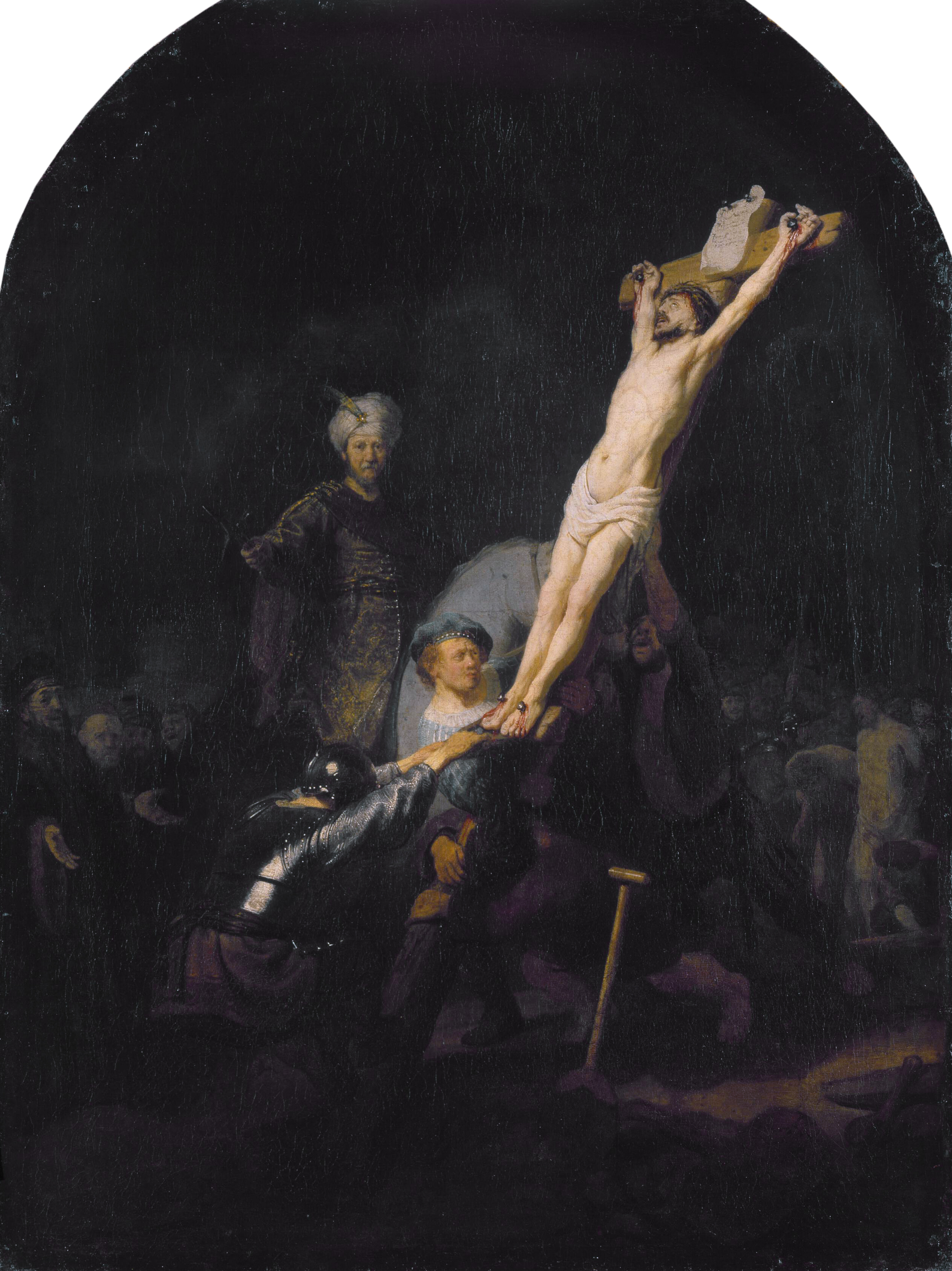
A wonderful depiction of this twin reality can be seen in Rembrandt’s 1633 painting, “The Raising of the Cross,” that he completed for Prince Frederick Henry of Orange.

The Raising of the Cross  *oil on canvas  *95.7 x 72.2 cm  *ca. 1633

The Raising of the Cross
*oil on canvas
*95.7 x 72.2 cm
*ca. 1633

In many ways it looks like just one of any number of crucifixion paintings, and one of the better ones. It is powerful and evokes the somber reality of the cross. However, there is something interesting in this painting, something that, in terms of raw history, does not fit the chronology. If you look at the center of the painting you will see a small Dutchman wearing a blue hat. He is not wearing clothing from the time. He is wearing clothing from the time of Rembrandt.

__STORAGE02_afd-data_Mellon_BStGS_394_D804_2013

He is doing so because the man in the painting is Rembrandt.

He painted himself in this scene of the raising of the cross.

Why? Because Rembrandt knew that it was his sin that put Jesus on the cross. Thus, it was Rembrandt who helped to raise the cross. But he also put himself in the painting for another reason. He put himself in the painting because he knew that Christ died for him and that back there on Calvary Jesus was thinking of Rembrandt and all of us. So the inclusion of a self-portrait was a statement on human sinfulness but also a statement on divine grace.

Dear Church, dear friends and guests, Christ died for us. What unexpected and unbelievable good news this is! What a beautiful gospel we have presented to us here in this first word from the cross.

Christ has purchased forgiveness and life for us all and He has offered it to us all. It was not cheaply purchased but it is freely offered. If you will humble yourself before the crucified and risen Christ and receive this gift into a repentant heart, you will be saved. You will live.

Behold the glory of the crucified Christ! “Father forgive them, for they know not what they do!”


[1] Stanley Hauerwas, Cross-Shattered Christ. (Grand Rapids, MI: Brazos Press, 2004), p.31-33.

[2] Clinton E. Arnold, gen.ed., Zondervan Illustrated Bible Backgrounds Commentary. Vol. 1 (Grand Rapids, MI: Zondervan, 2002), p.492.

[3] Jerry Bridges, The Pursuit of Holiness (Colorado Springs, CO: NavPress, 2003), 19.

[4] R.C. Sproul, Holiness (Carol Stream, IL: Tyndale House Publishers, Inc., 1998), p.41.

[5] A.T. Robertson, Word Pictures in the New Testament. Vol. II (Nashville, TN: Broadman Press, 1930), p.285.

[6] Beth Kreitzer, Luke. Reformation Commentary on Scripture. New Testament III (Downers Grove, IL: InterVarsity Press, 2015), p.464-465.

[7] Arthur A. Just, Jr., ed., Luke. Ancient Christian Commentary on Scripture. New Testament III (Downers Grove, IL: InterVarsity Press, 2003), p.361.

Exodus 21:12-36

justice_iconExodus 21

12 “Whoever strikes a man so that he dies shall be put to death. 13 But if he did not lie in wait for him, but God let him fall into his hand, then I will appoint for you a place to which he may flee. 14 But if a man willfully attacks another to kill him by cunning, you shall take him from my altar, that he may die. 15 “Whoever strikes his father or his mother shall be put to death. 16 “Whoever steals a man and sells him, and anyone found in possession of him, shall be put to death. 17 “Whoever curses his father or his mother shall be put to death. 18 “When men quarrel and one strikes the other with a stone or with his fist and the man does not die but takes to his bed, 19 then if the man rises again and walks outdoors with his staff, he who struck him shall be clear; only he shall pay for the loss of his time, and shall have him thoroughly healed. 20 “When a man strikes his slave, male or female, with a rod and the slave dies under his hand, he shall be avenged. 21 But if the slave survives a day or two, he is not to be avenged, for the slave is his money. 22 “When men strive together and hit a pregnant woman, so that her children come out, but there is no harm, the one who hit her shall surely be fined, as the woman’s husband shall impose on him, and he shall pay as the judges determine. 23 But if there is harm, then you shall pay life for life, 24 eye for eye, tooth for tooth, hand for hand, foot for foot, 25 burn for burn, wound for wound, stripe for stripe. 26 “When a man strikes the eye of his slave, male or female, and destroys it, he shall let the slave go free because of his eye. 27 If he knocks out the tooth of his slave, male or female, he shall let the slave go free because of his tooth. 28 “When an ox gores a man or a woman to death, the ox shall be stoned, and its flesh shall not be eaten, but the owner of the ox shall not be liable. 29 But if the ox has been accustomed to gore in the past, and its owner has been warned but has not kept it in, and it kills a man or a woman, the ox shall be stoned, and its owner also shall be put to death. 30 If a ransom is imposed on him, then he shall give for the redemption of his life whatever is imposed on him. 31 If it gores a man’s son or daughter, he shall be dealt with according to this same rule. 32 If the ox gores a slave, male or female, the owner shall give to their master thirty shekels of silver, and the ox shall be stoned. 33 “When a man opens a pit, or when a man digs a pit and does not cover it, and an ox or a donkey falls into it, 34 the owner of the pit shall make restoration. He shall give money to its owner, and the dead beast shall be his. 35 “When one man’s ox butts another’s, so that it dies, then they shall sell the live ox and share its price, and the dead beast also they shall share. 36 Or if it is known that the ox has been accustomed to gore in the past, and its owner has not kept it in, he shall repay ox for ox, and the dead beast shall be his.

On October 23, 1963, Bob Dylan recorded a song that some consider the greatest protest song ever written. It is entitled, “The Lonesome Death of Hattie Carroll.” It is about the death of a fifty-one year old African American barmaid at the hands of a white man named William Zantzinger and the injustice of his light sentence. The details of the song have been disputed, as any search online will show, but the song itself stands as a fascinating and well-done exposė on the nature of injustice.

William Zanzinger killed poor Hattie Carroll

With a cane that he twirled around his diamond ring finger

At a Baltimore hotel society gath’rin’

And the cops were called in and his weapon took from him

As they rode him in custody down to the station

And booked William Zanzinger for first-degree murder

But you who philosophize disgrace and criticize all fears

Take the rag away from your face

Now ain’t the time for your tears

William Zanzinger, who at twenty-four years

Owns a tobacco farm of six hundred acres

With rich wealthy parents who provide and protect him

And high office relations in the politics of Maryland

Reacted to his deed with a shrug of his shoulders

And swear words and sneering, and his tongue it was snarling

In a matter of minutes on bail was out walking

But you who philosophize disgrace and criticize all fears

Take the rag away from your face

Now ain’t the time for your tears

Hattie Carroll was a maid of the kitchen

She was fifty-one years old and gave birth to ten children

Who carried the dishes and took out the garbage

And never sat once at the head of the table

And didn’t even talk to the people at the table

Who just cleaned up all the food from the table

And emptied the ashtrays on a whole other level

Got killed by a blow, lay slain by a cane

That sailed through the air and came down through the room

Doomed and determined to destroy all the gentle

And she never done nothing to William Zanzinger

But you who philosophize disgrace and criticize all fears

Take the rag away from your face

Now ain’t the time for your tears

In the courtroom of honor, the judge pounded his gavel

To show that all’s equal and that the courts are on the level

And that the strings in the books ain’t pulled and persuaded

And that even the nobles get properly handled

Once that the cops have chased after and caught ’em

And that the ladder of law has no top and no bottom

Stared at the person who killed for no reason

Who just happened to be feelin’ that way without warnin’

And he spoke through his cloak, most deep and distinguished

And handed out strongly, for penalty and repentance

William Zanzinger with a six-month sentence

Oh, but you who philosophize disgrace and criticize all fears

Bury the rag deep in your face

For now’s the time for your tears

The power of the song lies in its contrast between the crime committed and the insufficient punishment for the crime. The song (again, whether accurate or not) suggests that the wealthy and powerful can take life without having to really pay a proportionate price for it. Furthermore, it taps into racial and class injustice: a wealthy white man essentially gets away with killing a poor black woman.

At the end of the day, human beings recognize that what makes a just society just is that the laws are equitable and fair and are upheld with a sense of consistency for the common good. Our text shows that this was a concern for ancient Israel as well. In these verses, the Lord prescribes punishments for certain crimes. Philip Ryken proposes that the verses can be broken down into three sections reflecting three different types of crimes.

Section 1: capital crimes (v.12-17)

Section 2: personal injuries (v.18-27)

Section 3: criminal negligence (v.28-36)[1]

That is helpful. These verses contain numerous references to numerous crimes and their respective prescribed punishments. For our purposes, let us consider two crucial details that emerge and that can help us understand the nature of justice in Israel and the nature of justice in our day as well.

Equitable and just law prescribes punishments that are proportionate to the crimes committed and that restrain the vengeful impulse of man.

Our text has numerous case studies of crimes and proportionate punishments, but at the heart of it is a basic principle of foundational justice. In verses 23 through 25 we see the idea of what would come to be known as lex talionis.

23 But if there is harm, then you shall pay life for life, 24 eye for eye, tooth for tooth, hand for hand, foot for foot, 25 burn for burn, wound for wound, stripe for stripe.

As we will see, Jesus would in time bring further light to this, but it should be noted that this basic principle of justice had the benefit of (a) deterring crime, (b) restraining the one wronged from a disproportionate response, and (c) restraining the state from a disproportionate response. It also exalted a high view of life and demonstrated that the taking of life was a heinous crime indeed. St. Augustine commented on these verses by arguing for their value, even though he argued that there was a higher way than even this.

Not to exceed due measure in inflicting punishment, lest the requital be greater than the injury…And it is a high degree of justice, for it would not be easy to find a man who, on receiving a fisticuff, would be content to give only one in return and who, on hearing one word from a reviler, would be content to return one word exactly equivalent. On the contrary, either he exceeds moderation because he is angry, or he thinks that, with regard to one who has inflicted an injury on another, justice demands a penalty greater than the injury suffered by the innocent person. To a great extent, such a spirit is restrained by the law, in which is written the directive, “An eye for an eye” and “A tooth for a tooth.” Moderation is signified by these words, so that the penalty may not be greater than the injury. And this is the beginning of peace. But to have absolutely no with for any such retribution – that is perfect peace.[2]

There is indeed moderation in these verses, and a helpful restraint to the more vengeful impulses of man and the state. These vengeful impulses and the danger of failing to restrain them can be seen in the memorable conversation between the characters Jim Malone and Elliot Ness in the 1987 film, “The Untouchables.”

Malone: You said you wanted to know how to get Capone. [Ness nods] Do you really want to get him? [pause] You see what I’m saying? What are you prepared to do?

Ness: Everything within the law.

Malone: And then what are you prepared to do? If you open the ball on these people, Mr. Ness, you must be prepared to go all the way. Because they won’t give up the fight until one of you is dead.

Ness: I want to get Capone. I don’t know how to get him.

Malone: You want to get Capone? Here’s how you get him. He pulls a knife, you pull a gun. He sends one of yours to the hospital, you send one of his to the morgue! That’s the Chicago way, and that’s how you get Capone! Now, do you want to do that? Are you ready to do that? I’m making you a deal. Do you want this deal?

Ness: I have sworn to put this man away with any and all legal means at my disposal, and I will do so.

Malone: Well, the Lord hates a coward. Do you know what a blood oath is, Mr. Ness?

Ness: Yes.

Malone: Good, ’cause you just took one.[3]

That is what happens when restraining parameters are removed. Knives are met with guns and morgues are the response to hospitals. In other words, violence and rage increases with each wrong inflicted and suffered and the world is reduced to a madhouse.

Here is the genius of this basic law code: they deterred and appropriately restrained. They recognized that it is possible to respond, even to a great wrong, wrongly. These laws were provided to protect good people from wicked people and then good people from themselves, for all of us are capable of great harm in the name of vengeance.

Christ Jesus, however, pushes us past mere justice and into grace.

When Jesus came among us, He spoke of these words in the sermon on the mount. In so doing, he pushed us past justice and into grace. We find His words in Matthew 5.

38 “You have heard that it was said, ‘An eye for an eye and a tooth for a tooth.’ 39 But I say to you, Do not resist the one who is evil. But if anyone slaps you on the right cheek, turn to him the other also. 40 And if anyone would sue you and take your tunic, let him have your cloak as well. 41 And if anyone forces you to go one mile, go with him two miles. 42 Give to the one who begs from you, and do not refuse the one who would borrow from you.

To be sure, there is still great evil in the world and the state still must use force against individuals and other states that threaten human life, but Jesus is offering a better way, a way that should be adopted by His people, the Church, and that should increasingly infiltrate fallen society through the life and witness of the Church. Cyril of Alexandria suggested that the Old Testament law was a schoolmaster for Israel that prepared them bit by bit for the coming of the higher and highest law preached and demonstrated by Christ.

[T]he general bearing of the legal mode of life was by no means pleasing to God. It was even given to those of old time as a schoolmaster, accustoming them little by little to a fitting righteousness and leading them on gently toward the possession of the perfect good. For it is written, “To do what is just is the beginning of the good way”; but finally all perfection is in Christ and his precepts. “For to him that strikes you on the cheek,” he says, “offer also the other.”[4]

“The perfect good,” Cyril called this. He was correct. For the people of God, there is a concern that trumps both vengeance and justice: eternal life. The children of God are not primarily seeking to have those who wrong us imprisoned, we are seeking ultimately to have them redeemed. This is the call of Christ to turn the other cheek, to give to those who take you to court, to go the extra mile is a call to a Kingdom-focused and Kingdom-driven life of subversion whereby the assumptions and exercise of mere justice are infused with the sweet aroma of grace.

By not being consumed with a desire for recompense, we may just open a door where grace can enter in. By not seeing justice as the highest goal, we allow the higher goal of salvation to be seen through the moral fog of our times.

In truth, the most disarming act we can take is the act of refusing to take up arms, and the greatest vengeance is to see the devil frustrated by our refusal to enact revenge.

I once heard the late Calvin Miller tell of visiting a difficult man in the community where he pastored. The man was notorious for his wild living, his rough behavior, and his general wickedness. He lived in a small Nebraska home with his wife and sons. Dr. Miller said that he visited the man and began to present the gospel to him. The man angrily refused to listen. When Dr. Miller asked him if he did not feel some responsibility to raise his children in the Lord, the man snapped and punched him in the face. Dr. Miller recounted that he woke up, staring at the man’s ceiling and feeling the blood from his nose and mouth seep into his beard. He then recounted how he stood up and quietly left the house without reacting or responding. The next Sunday, the man was sitting on the front pew. He would go on to accept Christ, join the church, and become a faithful and great leader in the church and friend to Dr. Miller.

I sometimes wonder what the reaction would have been had Dr. Miller responded with anger or outrage. What would have happened if he would have filed a police report for assault? I am not sure, but I rather suspect it would not have ended with the man coming to Christ and becoming valuable in the Kingdom.

That is but one of many examples of those who have refused to respond to evil with evil, and it is but one of many examples of God moving mightily through the refusal of his people to demand justice and retribution.

Does society need justice? Yes. It does. In a fallen world we need just laws and proportionate responses. But Christ brings grace to the table. Society needs that two. And the individuals who make up society need that. You need that. I need that. The whole world needs grace. And the grace that Jesus offers is enough for the whole world. He has opened wide His arms on the cross to welcome home all who will come.

Our eternal hope rests in the fact that Jesus met the demands of justice so that you and I can receive the sweet gift of divine grace and mercy and forgiveness. To receive these gifts, all we need do is come to Jesus in repentance and faith and be saved.


[1] Philip Graham Ryken, Exodus. (Wheaton, IL: Crossway Books, 2005), p.710.

[2] Joseph T. Lienhard, ed., Exodus, Leviticus, Numbers, Deuteronomy. Ancient Christian Commentary on Scripture. Old Testament, Vol.III (Downers Grove, IL: InterVarsity Press, 2001), p.113.

[3] https://en.wikiquote.org/wiki/The_Untouchables

[4] Joseph T. Lienhard, ed., p.113.

Matthew 27:27-44

Screen Shot 2015-08-27 at 3.08.11 PMMatthew 27

27 Then the soldiers of the governor took Jesus into the governor’s headquarters, and they gathered the whole battalion before him. 28 And they stripped him and put a scarlet robe on him, 29 and twisting together a crown of thorns, they put it on his head and put a reed in his right hand. And kneeling before him, they mocked him, saying, “Hail, King of the Jews!” 30 And they spit on him and took the reed and struck him on the head. 31 And when they had mocked him, they stripped him of the robe and put his own clothes on him and led him away to crucify him. 32 As they went out, they found a man of Cyrene, Simon by name. They compelled this man to carry his cross. 33 And when they came to a place called Golgotha (which means Place of a Skull), 34 they offered him wine to drink, mixed with gall, but when he tasted it, he would not drink it. 35 And when they had crucified him, they divided his garments among them by casting lots. 36 Then they sat down and kept watch over him there. 37 And over his head they put the charge against him, which read, “This is Jesus, the King of the Jews.” 38 Then two robbers were crucified with him, one on the right and one on the left. 39 And those who passed by derided him, wagging their heads 40 and saying, “You who would destroy the temple and rebuild it in three days, save yourself! If you are the Son of God, come down from the cross.” 41 So also the chief priests, with the scribes and elders, mocked him, saying, 42 “He saved others; he cannot save himself. He is the King of Israel; let him come down now from the cross, and we will believe in him. 43 He trusts in God; let God deliver him now, if he desires him. For he said, ‘I am the Son of God.’” 44 And the robbers who were crucified with him also reviled him in the same way.

N.T. Wright has shared an intriguing story about a spelunking friend of his.

            A friend of mine was leading a party of explorers through underground caverns and tunnels. They had trained for this expedition and knew the way. Not all the caves had been explored before, and my friend was convinced that there was a way right through, bringing them out by a different route after some miles underground. It would involve them at one point going down under water inside the cave, in order to come up the other side in a continuing tunnel. Nobody had even attempted to go this way before.

            But when they got to the crucial point in the cave, some of the party lost their nerve. It was a stupid idea, they said. There were no maps, no charts to indicate that there was a way through. They might go down into the water and simply drown while trying to find the way forward. Some got angry with the leader. What right had he got, they said, to push them into doing something crazy just because he had the dream of finding a new way? Eventually he realized there was only one thing to do. He would have to go through himself and find the way, and then come back to take them with him.

            As he went down into the water, some of the group stood there nervously silent, but the ones who had objected laughed at him. So much for your great dreams, they said. Either you’ll come back soaked and defeated or you won’t come back at all. That’s what happens to people who think they know too much and discover too late that they don’t.

            Of course – I wouldn’t be telling the story otherwise! – he did find the way through, and eventually they all followed, including the grumblers. But the point of the story…is to show what it was like as Jesus pioneered the way through death and out the other side into the new life that he knew was there but which nobody else understood.[1]

That is a great illustration of what Christ has done for us on the cross: He has swum into the murky deep of death and returned to tell us there is a way…and the way is the way of the cross and empty tomb in which death was defeated by Christ. And, like Wright’s friend, Jesus was mocked and laughed at during His journey through death and out the other side. The men who put Jesus on the cross mocked Him as He died. In so doing they revealed their ignorance concerning what was actually happening on Calvary. Some years back there was a CBS miniseries on Jesus. There is a scene in it in which the devil confronts Jesus in Gethsemane. The devil says this to Jesus: “They do not understand your cross, Jesus. They will never understand your cross.”[2] That is true. That has always been true.

The mocking crowd revealed their own spiritual blindness and ignorance. Before we consider Jesus’ seven last words from the cross, let us consider the three ignorant words directed towards the cross.

A word of mockery that revealed their ignorance concerning Jesus.

The first word of mockery directed toward the cross revealed a fundamental ignorance on the part of those killing Jesus concerning who He was and is. It is a verbal word and also an enacted word of violence, and it is spoken by the Roman soldiers.

27 Then the soldiers of the governor took Jesus into the governor’s headquarters, and they gathered the whole battalion before him. 28 And they stripped him and put a scarlet robe on him, 29 and twisting together a crown of thorns, they put it on his head and put a reed in his right hand. And kneeling before him, they mocked him, saying, “Hail, King of the Jews!” 30 And they spit on him and took the reed and struck him on the head. 31 And when they had mocked him, they stripped him of the robe and put his own clothes on him and led him away to crucify him.

The tragic irony of this first word of mockery is nearly staggering in its blind audacity. “Hail, King of the Jews!” they shout, as they dress Him as a mock king, crown Him with thorns, and then strike Him with the reed they offered Him as a mock scepter.

It needs to be noted that this mock coronation was not limited only to Jesus. Michael Wilkins notes that Roman soldiers sometimes played a cruel game with prisoners called “the king’s game” in which “the prisoner was dressed up like a burlesque king and used as a game piece” in which he was “moved around a game board etched in the floor…for the entertainment of the troops as they hurled verbal and physical abuse at the mock king.”[3]

There can be no doubt that the association of kingship with the trial of Jesus brought a certain heightened degree of disdain to this playing of “the king’s game,” but it was nonetheless still the normal process of mocking and breaking the spirit of common criminals condemned to die in that brutal culture.

The spiritual blindness of the guards is highlighted by the fact that Jesus was and is in fact King and Lord of heaven and earth! If ever the ignominy and shame of mankind was captured in a microcosm, this is it! They mock the one who created them. They spit upon the one who made the oceans. They crown with thorns the one who crowned the heavens with glory. They clothe in a mocking robe the one who clothes the earth with the morning dew, the mountaintops with snow, prairies with grass. They kneel disdainfully before the one before whom every knee on heaven and earth will one day kneel.

They see this mocking as a delusional fool’s defeat without realizing that it is actually the King of Kings greatest victory, for it is here on the cross and in the Easter morning tomb that Christ will ultimately defeat sin, death, and hell.

A.T. Robertson, speaking of the crown of thorns, wrote that the crown “was more like a victor’s garland (stephanon) than a royal diadem (diadema), but it served the purpose.”[4] That is most fitting, for Christ is indeed the victor.

A word of mockery that revealed their ignorance of the Father.

The crowd next offers a mocking word that reveals their ignorance of the Father.

32 As they went out, they found a man of Cyrene, Simon by name. They compelled this man to carry his cross. 33 And when they came to a place called Golgotha (which means Place of a Skull), 34 they offered him wine to drink, mixed with gall, but when he tasted it, he would not drink it. 35 And when they had crucified him, they divided his garments among them by casting lots. 36 Then they sat down and kept watch over him there. 37 And over his head they put the charge against him, which read, “This is Jesus, the King of the Jews.” 38 Then two robbers were crucified with him, one on the right and one on the left. 39 And those who passed by derided him, wagging their heads 40 and saying, “You who would destroy the temple and rebuild it in three days, save yourself! If you are the Son of God, come down from the cross.”

Michael Card has offered a rather fascinating proposal concerning the wine mixed with gall.

            In verse 34, Jesus is offered a drink of wine mixed with what is usually referred to as myrrh. Besides being a perfume, myrrh is also a narcotic. The majority view on this passage is that it represents a custom whereby the righteous women of Jerusalem, in an act of compassion, provided the mixture to ease the pain of condemned criminals. But the Aramaic words for “myrrh” and “gall” are virtually identical. In Psalm 69:21, which prophetically portrays the scene, the word gall is used. Matthew uses gall as well.

            It is important to realize that gall is not the same thing as myrrh. Gall, in fact, is poison. There is at least a chance that this offer of a drink was Satan’s last attempt to kill Jesus before the cross. After all, he had tried to kill Jesus as an infant (Mt 2:16). He had tried to convince Jesus to jump off the roof of the temple (Mt 4:6). He had tried to drown Jesus in the storm (Mt 8:24). He had tried to have Jesus stoned by the crowd (Jn 11:8). Is it too much to believe that a drink, perhaps with poison gall, was Satan’s last attempt to kill Jesus before he made it to the cross? The fact that Jesus spits the drink out after he tastes it might be an indication that he realized it was poisonous.[5]

That is a provocative idea, and while it cannot be said with certainty that this is what is happening here, there is nothing objectionable in the idea. After all, Satan had indeed attempted to kill the Lord Jesus before, and he indeed would have liked for Jesus not to have died upon a cross. Regardless, Jesus refuses to drink the gall.

The most telling words are found in verses 39 and 40.

39 And those who passed by derided him, wagging their heads 40 and saying, “You who would destroy the temple and rebuild it in three days, save yourself! If you are the Son of God, come down from the cross.”

A.T. Robertson points out that the wording of verse 40, “If you are the Son of God,” is a mimic of Satan’s temptation of Jesus in Matthew 4:3.[6] To be sure, there is a diabolical hand behind the taunt. Perhaps more than anything, however, there is an ignorance of the true nature of God in these words.

We must remember that the common religious idea advocated by at least some of the religious teachers was an idea saturated in works righteousness and a concept of something like what we would call “karma.” Basically it went like this: if you are good then God will be happy with you and bad things will not happen to you. If you are bad then God will be unhappy with you and bad things will not happen to you. Conversely, if bad things happen to you, it is most likely the case that you sinned somehow and did something to deserve it.

There is an entire book of the Bible that seeks to show the folly of this kind of overly simplistic theology. That book is called Job. This mentality can be seen lurking behind many of the words of Job’s friends. And it was present likewise in the staggering legalism of the Pharisees. We can see it today in certain strands of Christianity. It is a very dangerous idea, this idea that if you are suffering it is because you have somehow offended God and that if you are a good boy or girl nothing bad will happen to you.

Let me suggest that if that theological premise was true, then the logic undergirding their taunt was correct, for if, they would say, God actually had a son, then certainly He would not have allowed such a shameful occurrence as the cross to happen to him. Conversely, the fact that Jesus was on the cross was seen as irrefutable proof that He could not have been the Son of God.

“If you are the Son of God, come down from the cross.”

Do you see the assumption? The assumption is that if He was indeed the Son of God (a) God would not want Him on the cross and (b) the cross would never have happened. Why? Because God would of course be pleased with any son He might have and would never allow such a thing to happen.

The logic is right if the premise is true, but the problem is the premise itself. The premise that God will not allow suffering if He is happy with you was precisely their theological problem, for there has never been one with whom the Lord God was more pleased than Jesus yet He sent Him precisely for the cross! What if it is exactly because God loves the Son and loves lost humanity that He calls upon the Son to do what only the Son can do? What if God’s glory and love is most evident in Christ’s fulfillment of the great and daunting work of the cross?

“If you are the Son of God, come down from the cross.”

But it is precisely because He alone is the Son of God that He is on the cross, for only the Son could fulfill the Father’s just demands and righteous requirements! Only the Son is a fit mediator for God and man! Only the Son is able to suffer in our stead, to bleed in our place, and, in so doing, to secure the salvation of all who will trust in Him.

A word of mockery that revealed their ignorance of their own hearts.

Not to be outdone, the religious establishment offers the third word of mockery. This word is significant because it demonstrates their ignorance of their own hearts.

41 So also the chief priests, with the scribes and elders, mocked him, saying, 42 “He saved others; he cannot save himself. He is the King of Israel; let him come down now from the cross, and we will believe in him. 43 He trusts in God; let God deliver him now, if he desires him. For he said, ‘I am the Son of God.’” 44 And the robbers who were crucified with him also reviled him in the same way.

There is something comically absurd about their statement, “Let him come down now from the cross, and we will believe in him.” There is an obviously absurd element, then a more subtle one. The obviously absurd element is that when Jesus was not on the cross they most emphatically did not believe in Him. The more subtle absurdity is the assumption on their part that they are reasonable people who are capable of seeing and discerning and believing the truth of God.

In reality, the truth of God stood in their very midst, and crucifixion was their answer. The cross demonstrates once and for all just what fallen man does with the truth when God reveals it: fallen man hates it and seeks to eradicate it.

The arrogance of thinking that fallen people are predisposed to receive joyfully the truths of a holy God was also demonstrated in the jarring story of the rich man and Lazarus in Luke 16.

19 “There was a rich man who was clothed in purple and fine linen and who feasted sumptuously every day. 20 And at his gate was laid a poor man named Lazarus, covered with sores, 21 who desired to be fed with what fell from the rich man’s table. Moreover, even the dogs came and licked his sores. 22 The poor man died and was carried by the angels to Abraham’s side. The rich man also died and was buried, 23 and in Hades, being in torment, he lifted up his eyes and saw Abraham far off and Lazarus at his side. 24 And he called out, ‘Father Abraham, have mercy on me, and send Lazarus to dip the end of his finger in water and cool my tongue, for I am in anguish in this flame.’ 25 But Abraham said, ‘Child, remember that you in your lifetime received your good things, and Lazarus in like manner bad things; but now he is comforted here, and you are in anguish. 26 And besides all this, between us and you a great chasm has been fixed, in order that those who would pass from here to you may not be able, and none may cross from there to us.’ 27 And he said, ‘Then I beg you, father, to send him to my father’s house— 28 for I have five brothers—so that he may warn them, lest they also come into this place of torment.’ 29 But Abraham said, ‘They have Moses and the Prophets; let them hear them.’ 30 And he said, ‘No, father Abraham, but if someone goes to them from the dead, they will repent.’ 31 He said to him, ‘If they do not hear Moses and the Prophets, neither will they be convinced if someone should rise from the dead.’”

You will perhaps note that the assumption of the taunting religious leaders was the same assumption of the tormented rich man in hell: if the truth is plainly revealed to people, they will accept it. But Abraham’s response is the absolute truth: “neither will they be convinced if someone rises from the dead.”

That was prophetic of course, especially when we remember that is was Jesus who told that parable. Jesus would indeed rise from the dead and most would still refuse to believe.

This third taunt reveals that man is not only ignorant about the true nature of Christ and the true nature of the Father, he is also ignorant of the depravity of his own heart, seeing in it a reasonable place, a place of spiritual harmony and discernment, when in fact it is anything but.

No, the heart of man is a wicked thing and the cross is its fruit. We try to kill the truth when we encounter it. The most precious truths are usually met with the most virulent evil. Usually…but not always. For there always seems to be some whose hearts are broken by the Spirit of God and who are able to see and embrace the truth. Jesus spoke of these as those on the narrow way to eternal life whereas the masses populate the broad way to destruction (Matthew 7:13-14).

Here is the truth of the matter, and it is a truth we need to understand: most reject, but the offer of life has been made to you and is being made to you now. Will you stand with the mocking crowd or will you be part of the few that stand with the crucified and risen Lamb? It is a critically important question. In truth, it is the only question that really matters.

The Roman soldiers, the crowd passing by, the religious authorities: they mocked and in their mocking they revealed not only their own distance from God but the distance of all of humanity from God. And yet, it is Jesus that they mock…and Jesus reveals the closeness of God to man, the reality of God’s loving offer of grace and invitation to new life.

Most will stand with the mocking crowd, but you need not do so. You can come to Jesus. If you do so, He will not turn you away. For the point of the cross is that He loves us that much…and His love is an open door.


[1] Tom Wright, Matthew for Everyone. Part Two (Louisville, KY: Westminster John Knox Press, 2004) p.184-185.

[2] Shane Clairborne, The Irresistible Revolution (Grand Rapids, MI: Zondervan, 2006), p.250, fn.3.

[3] Clinton E. Arnold, gen. ed., Zondervan Illustrated Bible Backgrounds Commentary. Vol. 1 (Grand Rapids, MI: Zondervan, 2002), p.176-177.

[4] A.T. Robertson, Word Pictures in the New Testament. Vol. I (Nashville, TN: Broadman Press, 1930), p.230.

[5] Michael Card, Matthew. (Downers Grove, IL: InterVarsity Press, 2013), p.242.

[6] A.T. Robertson, p.232.

Exodus 21:1-11

F003Exodus 21

1 “Now these are the rules that you shall set before them. 2 When you buy a Hebrew slave, he shall serve six years, and in the seventh he shall go out free, for nothing. 3 If he comes in single, he shall go out single; if he comes in married, then his wife shall go out with him. 4 If his master gives him a wife and she bears him sons or daughters, the wife and her children shall be her master’s, and he shall go out alone. 5 But if the slave plainly says, ‘I love my master, my wife, and my children; I will not go out free,’ 6 then his master shall bring him to God, and he shall bring him to the door or the doorpost. And his master shall bore his ear through with an awl, and he shall be his slave forever. 7 “When a man sells his daughter as a slave, she shall not go out as the male slaves do. 8 If she does not please her master, who has designated her for himself, then he shall let her be redeemed. He shall have no right to sell her to a foreign people, since he has broken faith with her. 9 If he designates her for his son, he shall deal with her as with a daughter. 10 If he takes another wife to himself, he shall not diminish her food, her clothing, or her marital rights. 11 And if he does not do these three things for her, she shall go out for nothing, without payment of money.

One of the interesting things about preaching through whole books of the Bible is that you cannot skip the hard parts. And that is a good thing. If we believe the Bible to be God’s Word and believe that all of it is profitable, that means we must be willing to wrestle with the parts we find difficult. Let us remember that while there are timeless principles in all of scripture, there are indeed parts that are culturally conditioned to the day in which it was written. In these parts, we do not simply lift, move to our day, and literally apply a given text because the cultural structures in which these kinds of texts made sense do not apply today. So what we do in these cases is make a distinction between the element that was literally applicable to that given culture and the element that is timeless and applies across all generations and locales.

For instance, our text delineates rules concerning the institution of slavery. Obviously, we do not have slaves today and we would join with Christians the world over in seeing such an institution as unbecoming of the children of God. In truth, we would see it as a violation of the image of God in man. But here, and even at points in the New Testament, we find references to slavery that are not condemning the institution outright like we would like. So what are we to make of such texts? First, let us hear the passage:

1 “Now these are the rules that you shall set before them. 2 When you buy a Hebrew slave, he shall serve six years, and in the seventh he shall go out free, for nothing. 3 If he comes in single, he shall go out single; if he comes in married, then his wife shall go out with him. 4 If his master gives him a wife and she bears him sons or daughters, the wife and her children shall be her master’s, and he shall go out alone. 5 But if the slave plainly says, ‘I love my master, my wife, and my children; I will not go out free,’ 6 then his master shall bring him to God, and he shall bring him to the door or the doorpost. And his master shall bore his ear through with an awl, and he shall be his slave forever. 7 “When a man sells his daughter as a slave, she shall not go out as the male slaves do. 8 If she does not please her master, who has designated her for himself, then he shall let her be redeemed. He shall have no right to sell her to a foreign people, since he has broken faith with her. 9 If he designates her for his son, he shall deal with her as with a daughter. 10 If he takes another wife to himself, he shall not diminish her food, her clothing, or her marital rights. 11 And if he does not do these three things for her, she shall go out for nothing, without payment of money.

Our text is drawing a distinction between the handling of male slaves and the handling of female slaves, or, as many suggest, the handling of concubines. Let us consider what this means.

It seems clear that, for whatever reason, the Lord regulated certain undesirable realities in the Old Testament in light of the hardness of the Israelite’s hearts without advocating those realities He regulated.

I would like to begin by pointing out that, regardless of how one understands this, it seems clear that the Lord sometimes regulated certain undesirable realities in the Old Testament in light of the hardness of the Israelite’s hearts without advocating the realities He regulated. What do this mean? It means that the Lord allowed certain things to happen, and put guidelines around these things, that were neither ideal nor good but were part of the culture of the day.

This is difficult to understand, and we must be careful with such an idea, but I will note that Jesus appear to acknowledge this phenomenon in Matthew 19.

3 And Pharisees came up to him and tested him by asking, “Is it lawful to divorce one’s wife for any cause?” 4 He answered, “Have you not read that he who created them from the beginning made them male and female, 5 and said, ‘Therefore a man shall leave his father and his mother and hold fast to his wife, and the two shall become one flesh’? 6 So they are no longer two but one flesh. What therefore God has joined together, let not man separate.” 7 They said to him, “Why then did Moses command one to give a certificate of divorce and to send her away?” 8 He said to them, “Because of your hardness of heart Moses allowed you to divorce your wives, but from the beginning it was not so. 9 And I say to you: whoever divorces his wife, except for sexual immorality, and marries another, commits adultery.”

Again, the implications of this need to be thought through, but the point seems to be firmly established: it seems clear that, for whatever reason, the Lord regulated certain undesirable realities in the Old Testament in light of the hardness of the Israelite’s hearts without advocating those realities He regulated.

While the Old Testament does not offer a denunciation of slavery, it is quite possible that it is discouraging it even in the regulations it offers for it.

What is more, the presence of regulations do not necessarily equate to approval of that which is being regulated if, in fact, the structure of the regulations build in an element of shame for those who indulge in such. This is a bit of a nuance on the first point, and it is an intriguing argument. Old Testament scholar Victor Hamilton has made this argument and it is worthy of consideration.

Before turning to Exod. 21: 1– 11, let me state my own position. I reject the view that the Bible gives its imprimatur to slavery and looks the other way when ethical concerns raise their heads. Nor do I accept the view that the Bible endorses but tries to modify and ameliorate the practice of slavery. There are other things that the pagan nations did and the OT absolutely prohibits, like having idols, or cutting oneself, or eating pork, or working on Saturdays. The OT never tries to modify them. It exorcises them.

I believe the OT attempts, through its slave laws, to dissuade Israelites from the practice of slavery. I say this for two reasons. First, the most interesting slave law of all in the Bible is Deut. 23:15–16: “If a slave has taken refuge with you, do not hand him over to his master. Let him live among you wherever he likes and in whatever town he chooses” (and possibly the OT background to Paul’s Letter to Philemon). That is to say, a slave can choose not to be a slave. To gain his freedom, he need not wait those six years. He can simply and legally run away, without consequence to either the fugitive or to the one who is harboring him. Here is one major difference between the codes. In the Laws of Eshnunna (laws 12– 13) is a stiff fine for harboring a runaway slave, and Hammurabi’s Code (numbers 15– 16) makes it a capital offense. As Clines (1995a: 78, 81) has pointed out, “If a slave can choose not to be a slave, the concept of slavery does not exist as it once was thought to exist. . . . Slavery is in a sense abolished when it ceases to be a state that a person is forced into against their will.”

Here is the second reason why I believe the OT tries to dissuade the practice of slavery (and I reference here to Sternberg [1998: 483– 93] as the source of some of my thoughts). Exodus 21: 2 begins with “When you buy [qānâ] a Hebrew slave [ʿebedʿibrî ]. . . .” These expressions appear in Genesis in conjunction with Joseph’s slavery in Egypt. His brothers sell (mākar) him to some caravaners heading to Egypt (Gen. 37: 28). Potiphar buys [qānâ] him from them (Gen. 39: 1), and Potiphar’s wife sneeringly refers to Joseph as “that Hebrew slave” (hāʿebed hāʿibrî) in Gen. 39: 17. If Exod. 21: 2 would say, “When you acquire/ buy an Israelite slave,” the parallel of the Exodus slave law with Joseph would be nonexistent. As it now stands, the slave law of Exod. 21 appears to hold out Potiphar and Mrs. Potiphar as the model of somebody who has “bought” a “Hebrew slave,” resulting in all the tragic misfortunes that befall this Hebrew slave (years of imprisonment, character assassination, to name a few). As Sternberg (1998: 486) says, “The tacit Josephic precedent triggers its own, story-length prolepsis in the Mosaic audience’s mind, with a view to deterring them from reenacting this follow-up in the world.”

Another parallel with Genesis language is this. One may assume that a major reason why a person would voluntarily become a slave, or sell one’s daughter into slavery, is because of staggering debt and poverty from which one cannot extricate oneself. The Egyptian people, because of their famine-ravaged land, say to Joseph, now their Egyptian prime minister, “Buy [qānâ] us.” So Joseph “bought [qānâ] all the land of Egypt. . . . I have bought [qanah] you and your land” (Gen. 47: 19, 20, 23), in return for which the people promised (Gen. 47: 25) to be “slaves” (ʿăbādîm) to Pharaoh (NIV, “in bondage to Pharaoh”). Joseph, the one “bought,” has become Joseph the “buyer.” Joseph, once the ʿebed, “slave,” has become the ʾādôn, “master.” The enslaved has become the enslaver.

The Israelites now are only about three months out of Egypt. On three earlier occasions during those three months, slavery back in Egypt is their preferred option (Exod. 14: 10– 12; 16: 2– 3; 17: 1– 3), and here is the Lord speaking to his people about enslaving a Hebrew brother. In its own way Exod. 21: 5’ s “I love my master” is a later form of an earlier “I love my Egypt (and all the security and comforts it provides).” In a review of Sternberg’s book, Cohn (2001: 740) catches the drift of the argument: “The texts aim to stigmatize an Israelite who would enslave another by coding him in the role of a Hamite [Egyptian] master, as well as tarring an Israelite who would choose servitude over liberty by coding him as a throwback to Egyptian slavery.”[1]

Thus, the surprising allowances for the liberation of escaped slaves as well as the evocation of very recent memories of the Jews’ own enslavement in Egypt introduces an element of shame into the very institution. It is a subtle point, and perhaps one that we wish would be much more explicit, but it does hold relative significance.

Ultimately, the gospel of Christ would lay the foundation for abolitionism.

For followers of Christ, of course, all that God commands finds its ultimate fulfillment in Jesus Christ. It is profoundly important to notice that the gospel Christ preached did in fact lay the foundation for the eventual abolition of the slave trade. To be sure, it is historically disingenuous to suggest that the Church did not traffic in the slave trade in ways that are truly shameful. Large numbers of Christians did do so, and it is a tragedy of the first order. Even so, we find within the gospel the seeds that eventually grew into the undermining of slavery. Those seeds are sown in the life and teachings and saving work of Christ and begin to bear fruit even in the apostolic age. Thus, Paul could proclaim in Galatians 3:28:

27 For as many of you as were baptized into Christ have put on Christ. 28 There is neither Jew nor Greek, there is neither slave nor free, there is no male and female, for you are all one in Christ Jesus. 29 And if you are Christ’s, then you are Abraham’s offspring, heirs according to promise.

That is a radical pronouncement: “there is neither slave nor free…for you are all one in Christ Jesus.” Here we begin to see the theological ammunition that would be used to undermine the very foundations of slavery. Even and especially in Philemon, a book in which Paul is returning a run away slave to his Christian master, we find principles that, if followed in the ancient world, would have utterly revolutionized and ultimately destroyed slavery as an social institution. Consider Philemon 10-22 and the ways in which Paul strikes at the very notion of slavery.

10 I appeal to you for my child, Onesimus, whose father I became in my imprisonment. 11 (Formerly he was useless to you, but now he is indeed useful to you and to me.) 12 I am sending him back to you, sending my very heart. 13 I would have been glad to keep him with me, in order that he might serve me on your behalf during my imprisonment for the gospel, 14 but I preferred to do nothing without your consent in order that your goodness might not be by compulsion but of your own accord. 15 For this perhaps is why he was parted from you for a while, that you might have him back forever, 16 no longer as a bondservant but more than a bondservant, as a beloved brother—especially to me, but how much more to you, both in the flesh and in the Lord. 17 So if you consider me your partner, receive him as you would receive me. 18 If he has wronged you at all, or owes you anything, charge that to my account. 19 I, Paul, write this with my own hand: I will repay it—to say nothing of your owing me even your own self. 20 Yes, brother, I want some benefit from you in the Lord. Refresh my heart in Christ. 21 Confident of your obedience, I write to you, knowing that you will do even more than I say. 22 At the same time, prepare a guest room for me, for I am hoping that through your prayers I will be graciously given to you. [bold, mine]

Let us ask ourselves a simple question: if slave owners in the ancient world treated slaves as their brothers who were no longer slaves with whom they would spend eternity who were useful to them in the Lord, would it not have obliterated slavery in the ancient world? This is why we begin to see Christianity striking blows at the edifice of slavery in the ancient and, later, in the modern world.

In the fourth century, Gregory of Nyssa denounced the institution of slavery as wicked. David Bentley Hart points out that the entire ancient world does not contain a denunciation as fierce as Gregory’s.

Nowhere in the literary remains of antiquity is there another document quite comparable to Gregory of Nyssa’s fourth homily on the book of Ecclesiastes: certainly no other ancient text still known to us—Christian, Jewish, or Pagan—contains so fierce, unequivocal, and indignant a condemnation of the institution of slavery.[2]

In his book, The Path of Celtic Prayer, Calvin Miller pointed that, in the fifth century, St. Patrick of Ireland “was, for example, always speaking against the slave trade and unkind and cruel leaders (see his Letter to Coroticus).”[3]

In William Carey’s 1792 missionary manifesto, An Enquiry into the Obligations of Christians to Use Means for the Conversion of the Heathens, he remarked that “a noble effort has been made to abolish the inhuman Slave-Trade, and though at present it has not been so successful as might be wished, yet it is to be hoped it will be persevered in, till it is accomplished.”[4]

And of course we must not forget that noble follower of Jesus, William Wilberforce, who fought so valiantly to abolish the British slave trade.

As I said earlier, we rightly wish that these examples were much more numerous and intense, but it should be noted that the earliest voices and many of the most noble voices for the abolition of slavery were the voices of those who had bowed before the Lordship of Christ and embraced the truth of the gospel. That is no small thing.

What, then, of the regulations concerning slavery in Exodus? They are concessions, the reasons for which we cannot ultimately know, that were intended to establish guidelines around a social institution that was widely embraced in the ancient world, that certainly was not and is not part of God’s ideal for His people, but which was allowed for reasons that reside in the mysteries of God’s will. They spoke to an institution that was a regrettable part of the ancient world, and is, we note with sadness, still a regrettable part of too much of the world today, but an institution the foundations of which were eroded and then finally demolished by the liberating power of the gospel of Christ…for which we say, Amen!

The gospel of Christ sets free the slaves, then and now. As ever, the greatest slavery as the slavery of the fallen human heart. It is our slavery to our own passions and our own egos and our own fallen minds. And Christ Jesus comes to all of us slaves and throws open the door through the power of His life, death, and resurrection, and bids us emerge as free men and women.


[1] Hamilton, Victor P. (2011-11-01). Exodus: An Exegetical Commentary (Kindle Locations 12079-12116). Baker Publishing Group. Kindle Edition.

[2] D. Bentley Hart, “The `Whole Humanity’: Gregory of Nyssa’s Critique of Slavery in Light of His Eschatology,” Scottish Journal of Theology, 54:1 (February 2001): 51. See also “Gregory of Nyssa and the Culture of Oppression.” https://www.baylor.edu/content/services/document.php/110976.pdf

[3] Calvin Miller, The Path of Celtic Prayer: An Ancient Way to Everyday Joy (Downers Grove, Illinois: IVP Books, 2007), p.138.

[4] William Carey, An Enquiry into the Obligations of Christians to Use Means for the Conversion of the Heathens. Kindle Edition. (530-531)

Matthew 27:1-2, 11-14, 22-26

Screen Shot 2015-08-27 at 3.08.11 PMMatthew 27

1 When morning came, all the chief priests and the elders of the people took counsel against Jesus to put him to death. 2 And they bound him and led him away and delivered him over to Pilate the governor.

11 Now Jesus stood before the governor, and the governor asked him, “Are you the King of the Jews?” Jesus said, “You have said so.” 12 But when he was accused by the chief priests and elders, he gave no answer. 13 Then Pilate said to him, “Do you not hear how many things they testify against you?” 14 But he gave him no answer, not even to a single charge, so that the governor was greatly amazed.

22 Pilate said to them, “Then what shall I do with Jesus who is called Christ?” They all said, “Let him be crucified!” 23 And he said, “Why, what evil has he done?” But they shouted all the more, “Let him be crucified!” 24 So when Pilate saw that he was gaining nothing, but rather that a riot was beginning, he took water and washed his hands before the crowd, saying, “I am innocent of this man’s blood; see to it yourselves.” 25 And all the people answered, “His blood be on us and on our children!” 26 Then he released for them Barabbas, and having scourged Jesus, delivered him to be crucified.

Two days from now the Greek Orthodox Church will be honoring a rather unlikely saint: Pontius Pilate’s wife. The scriptures do paint her in a rather favorable light, so it is not that difficult to see her as good woman. However, I must say it is indeed surprising to see the Ethiopian Church venerating Pilate’s wife and Pontius Pilate every June 19. While this is quite surprising to a lot of us, it apparently would not have been so to many in the early Church.

In Jerry Ryan’s Commonweal article, “Saint Pontius Pilate?” he notes that many in the early Church viewed Pilate in a favorable light.

Early Christianity went easy on Pilate…Tertullian invokes Pilate as a witness to the death and resurrection of Christ and of the truth of Christianity—and explains that this is why he is mentioned in the Nicean Creed. St. Augustine saw Pilate as a prophet of the Kingdom of God (cf. sermon 201). Hippolytus draws a parallel between Pilate and Daniel—in so far as both proclaim themselves absolved from the shedding of innocent blood (Daniel 14:40). Other Church Fathers likened Pilate to the Magi, who also recognized Jesus as King of the Jews.[1]

As somebody who tries to be a student of Christian history, and who believes that we should dismiss the wisdom of the early Christians only with great care and after firmly establishing their error, I must say that I simply disagree with this. The picture of Pilate that emerges from the pages of the New Testament is not one that inspires appreciation, much less veneration. On the contrary, the picture that emerges of Pilate is one of a selfish, self-serving, and cowardly politician who tried to have his cake and eat it too.

Pilate rejected Jesus in order to safeguard his own life and career.

To be perfectly blunt about it, Pilate was looking out for one person: Pilate! Here is what our text reveals about him.

1 When morning came, all the chief priests and the elders of the people took counsel against Jesus to put him to death. 2 And they bound him and led him away and delivered him over to Pilate the governor.

11 Now Jesus stood before the governor, and the governor asked him, “Are you the King of the Jews?” Jesus said, “You have said so.” 12 But when he was accused by the chief priests and elders, he gave no answer. 13 Then Pilate said to him, “Do you not hear how many things they testify against you?” 14 But he gave him no answer, not even to a single charge, so that the governor was greatly amazed.

22 Pilate said to them, “Then what shall I do with Jesus who is called Christ?” They all said, “Let him be crucified!” 23 And he said, “Why, what evil has he done?” But they shouted all the more, “Let him be crucified!” 24 So when Pilate saw that he was gaining nothing, but rather that a riot was beginning, he took water and washed his hands before the crowd,

Pilate, seeing that he was losing control of the crowd, relented to their demands and handed Jesus over to be crucified. To understand why, you have to understand who Pilate was.

Until 1961, the primary evidence for the existence of Pontius Pilate was the New Testament record and a few scant references in later copies of Roman histories. Then, in 1961, archaeologists discovered “the Pilate Stone,” a limestone block with three lines of Latin carved into it.

8

Line One: TIBERIEUM

Line Two: (PON) TIUS

Line Three: (PRAEF) ECTUS IUDA (EAE)

William Barclay offers some insight into what kind of man he must have been.

            Pilate was officially procurator of the province; and he was directly responsible, not to the Roman senate, but to the Roman Emperor. He must have been at least twenty-seven years of age, for that was the minimum age for entering on the office of procurator. He must have been a man of considerable experience, for there was a ladder of offices, including military command, up which a man must climb until he became qualified to become a governor. Pilate must have been a tried and tested soldier and administrator. He became procurator of Judaea in A.D. 26 and held office for ten years, until he was recalled from his post.[2]

Barclay has further outlined certain details of Pilate’s life and career that demonstrate the kind of man he was and the reason why the Jews despised him so very much. Among these details are the following:

  • Every governor of Judaea before Pilate had removed the Roman insignia of the eagle in order to honor the Jews’ abhorrence of graven images. Pilate would not do so.
  • When Pilate launched a major product to put a new aqueduct in Jerusalem to insure better water for the city, he paid for it with money from the Temple treasury.
  • The Jews had threatened to report Pilate’s obstinacy and cruelty to the Emperor, a fact that galled him greatly.
  • Pilate was recalled to Rome after he savagely butchered a group of Samaritans who had gathered at Mount Gerizim in Samaria to see a reputed messianic figure.
  • Legend has it that Pilate committed suicide and his body was thrown into the Tiber River. However, his evil spirit agitated the waters so much that they pulled him out and threw him in the Rhone. After those waters were likewise agitated, he was buried in Lausanne.[3]

Again, the picture that emerges is not worthy of emulation. It is is worthy of disdain. Pilate knew that he was already on thin ice with Rome and that he likely would not survive another uprising. Thus, he did what was politically expedient and gave in to the unjust demands of the baying crowd. Even modern politicians see this in Pilate’s behavior. For instance, former Prime Minister Tony Blair admits to being intrigued by Pilate and said this about him:

[Pilate] commands our moral attention not because he is a bad man, but because he was so nearly a good man. One can imagine him agonising, seeing that Jesus had done nothing wrong, and wishing to release him. Just as easily, however, one can envisage his advisers telling him of the risks, warning him not to inflame public opinion. It is a timeless parable of political life.[4]

It is true that Pilate seems not to have had any personal animus toward Jesus. It is true that Pilate seems to have been intrigued by Jesus. It is likewise true that Pilate appears to have known that Jesus was innocent. But I ask you: do those facts make Pilates’ capitulation less or more shameful? Surely they make them more shameful.

Pilate was protecting Pilate…much as you and I are tempted to protect ourselves when following Jesus would cost us something. Is it not so? The subtle temptation to be silent instead of speaking up for the truth of the gospel is itself a Pilate temptation. The temptation to take the easy road just at that point where following Jesus would actually cost us something is a Pilate temptation.

Church, it costs to follow Jesus. It would have cost Pilate to do so, but it would have been the better way.

Pilate rejected Jesus though he attempted to say that he had not really done so.

Of course, Pilate, like us, was quick to justify his rejection as not really being a rejection. He even indulged in dramatic theater in an effort to distance himself from his own rejection.

24 So when Pilate saw that he was gaining nothing, but rather that a riot was beginning, he took water and washed his hands before the crowd, saying, “I am innocent of this man’s blood; see to it yourselves.” 25 And all the people answered, “His blood be on us and on our children!” 26 Then he released for them Barabbas, and having scourged Jesus, delivered him to be crucified.

“I am innocent of this man’s blood.” Would that it were that easy. Would that we could actually remove ourselves from culpability on the basis that, while, yes, we did reject Jesus, we nonetheless think very highly of him. It is no use saying that you personally saw nothing wrong in Jesus while you yourself turn Him over to the mob.

We try the very same thing. In numerous ways we try to say that our rejections are not actual rejections. We dress up our rejections in the language of cultural sensitivity or language about this not being “the right time” to bear witness to Christ. In truth, it seems that the most timid people in the modern world are Christians. But these timid avoidances of proclamation are as much rejections in the moment as was Pilate’s. They are as much an attempt to wash our hands clean of the charge of abandonment as was Pilate’s.

There is a an old legend stating that Pilate rises from his mountain grave and emerges every good Friday to wash his hands. The idea behind the legend is that this token effort at proclaiming innocence was shamefully inadequate and now is his eternal curse. We are known by our fruits, and, in the end, Jesus passes through Pilate’s hands to get to the cross. He cannot escape that.

This is why I object to the veneration of Pilate as some sort of saint. I am afraid if we canonize him as some have we will be canonizing one of the more absurd efforts at sidestepping the obvious in the history of the world. We will be canonizing the political dodge, the loophole, the, “Well, I always liked Jesus so it cannot really be said that I rejected Him per se.”

But that is exactly what it means, be it Pilate or us.

Pilate could have stood with Jesus. He was simply unwilling to pay the price for doing so.

As we prepare to approach the Lord’s Supper table, I would like to remind us of this fairly obvious fact: Pilate could have stood with Jesus.

He could have.

What would have happened if he would have refused to turn Jesus over, if he would have proclaimed his allegiance to Christ? At the least it would have been the end of his political career and it may have cost him his life. But he would have been standing with the King of Kings and Lord of Lords.

This text on Pilate is an unlikely communion text, but perhaps not as unlikely as we might think. After all, the table of the Lord calls us to a clear proclamation of what side we inhabit. Will we stand with Jesus or, like Pilate, will we reject Him and then try to say that it really was not a rejection at all? Will we take the cross, or will we choose the path of self-preservation? After all, the elements speak of a torn body and shed blood. It costs to follow Jesus. That is why we eat and drink.

This do in remembrance of Me.

To do in remembrance of Pilate is to look out for yourself. To do in remembrance of Jesus is to take the cross and follow Him.

We come to a table and think about flesh and blood, not about Roman thrones and upward mobility.

So here is the question: will you come to the table, or will you deny King Jesus? It does no good to say that your denials are not, in fact, denials. Of course they are. There really is no murky middle ground in which we are somewhat for Jesus and somewhat against Him. There is only a choice between Jesus or Pilate.

Which will you choose?

Which will you choose?


[1] https://www.commonwealmagazine.org/blog/saint-pontius-pilate

[2] William Barclay, Gospel of Matthew. Vol. 2. The Daily Study Bible (Edinburgh: The Saint Andrew Press, 1967), p.394-395.

[3] William Barclay, pp.395-397.

[4] https://www.telegraph.co.uk/comment/personal-view/3556458/How-much-blood-is-on-Pontius-Pilates-hands.html

Exodus 20:22-26

what-are-ten-commandments_472_314_80Exodus 20

22 And the Lord said to Moses, “Thus you shall say to the people of Israel: ‘You have seen for yourselves that I have talked with you from heaven. 23 You shall not make gods of silver to be with me, nor shall you make for yourselves gods of gold. 24 An altar of earth you shall make for me and sacrifice on it your burnt offerings and your peace offerings, your sheep and your oxen. In every place where I cause my name to be remembered I will come to you and bless you. 25 If you make me an altar of stone, you shall not build it of hewn stones, for if you wield your tool on it you profane it. 26 And you shall not go up by steps to my altar, that your nakedness be not exposed on it.’

Having given the Ten Commandments to Israel, the Lord then expresses what we would call the theological implications of the giving of the Law. The fact that God gives His law has profound meaning and significance. It means much more than that God is a law-giver. He means that God is sovereign, that God reveals Himself, and that God seeks a relationship with His people. It also sets the stage for Israel’s worship as it establishes God’s holiness and otherness but also His desire for His people to walk rightly before Him.

God’s revelation of Himself from Heaven establishes a relationship that renders all alternative efforts at relationship inferior and blasphemous.

God had already forbidden the creation of graven images or idols. Even so, He condemns idolatry again here on this side of the giving of the commandments.

22 And the Lord said to Moses, “Thus you shall say to the people of Israel: ‘You have seen for yourselves that I have talked with you from heaven. 23 You shall not make gods of silver to be with me, nor shall you make for yourselves gods of gold.

There is an added dimension here to the earlier prohibition against idols. Now, having received the Law, Israel should be able to see the utter futility, absurdity, and insanity of creating false gods. Why? Because the true God of Heaven and earth has now spoken. It is on this basis that God repeats His forbiddance of idols: “You have seen for yourselves that I have talked with you from heaven.”

The implications are many and are compelling. God has spoken, so why would Israel want to create gods who cannot speak? God has moved toward Israel, so why would Israel want to craft gods who cannot move at all? God has revealed His nature and character, so why would Israel want to make gods of mute silver and gold?

Do you see? God speaking changes everything. In fact, this is a theologically rich sentence: “You have seen for yourselves that I have talked with you from heaven.” Specifically, this sentence carries with it three critically important theological truths:

  • Revelation: “I have talked…”
  • Relationship: “I have talked with you…”
  • Sovereignty: “I have talked with you from Heaven.”

Christianity is a revealed religion. It is not like one of the old mystery cults or one of the arcane gnostic sects. Its knowledge is not secret or hidden or coded. On the contrary, Christians worship the God who has revealed Himself.

“I have talked” is a statement the importance of which simply cannot be overstated. If God has not talked then we are still lost and blind and ignorant, for if God has not talked then we have not heard. The God of the deists does not talk. He merely observes from a distance. The gods of idolatry do not talk. They merely sit while their worshipers grovel before them. In 1 Kings 18, Elijah mocked the prophets of Baal for the silence and inactivity of their god.

25 Now Elijah said to the prophets of Baal, “Choose one bull for yourselves and prepare it first, for you are many; and call on the name of your god, but put no fire under it.26 So they took the bull which was given them, and they prepared it, and called on the name of Baal from morning even till noon, saying, “O Baal, hear us!” But there was no voice; no one answered. Then they leaped about the altar which they had made. 27 And so it was, at noon, that Elijah mocked them and said, “Cry aloud, for he is a god; either he is meditating, or he is busy, or he is on a journey, or perhaps he is sleeping and must be awakened.” 28 So they cried aloud, and cut themselves, as was their custom, with knives and lances, until the blood gushed out on them. 29 And when midday was past, they prophesied until the time of the offering of the evening sacrifice. But there was no voice; no one answered, no one paid attention. (NKJV)

Do you see the difference in God and Baal? The Lord says, “I have talked.” But of Baal it can only be said, “But there was no voice.” Our God is a revealing God.

And our God is a relational God. “I have talked with you.” He could have merely talked and thundered aloud to Himself for all to see. He could have talked at us, pronouncing righteous judgment over us. But instead, “I have talked with you.” What an amazing thing! The God who creates the Heavens and the earth has talked with us! He has spoken to us!

God is relational. Within Himself He lives in Trinitarian relationship and, outwardly, He seeks a relationship with us. The God who creates all knows your name. He speaks to you! This forever alters how we view God.

Even so, He speaks “from Heaven.” He seeks relationship, but this does not reveal any insufficiency on His part. He speaks to His creation but He is yet outside of and above His creation. He speaks to man, but He is not man. He speaks “from Heaven,” that is, He speaks from the vantage point of sovereignty and power.

Each of these elements – revelation, relationship, sovereignty – must be held to in order to have an adequate picture of God. Without revelation God becomes unknowable. Without relationship God becomes unapproachable. Without sovereignty God becomes “unworship-able.” However, when these three elements of the nature of God are seen for what they are, the majesty of God shines all the brighter! Our sovereign King reveals His nature and character to us!

God commissioned altars because altars highlighted God’s transcendence and reminded Israel of their distance from Him while providing Israel with a forum for sacrifice thereby reminding them of His love and forgiveness.

These truths also establish the nature of all true worship. While idols are forbidden, altars to the one, true God are encouraged. This must be read in light of what we have just seen: the revealing, relational, sovereign character of God!

24 An altar of earth you shall make for me and sacrifice on it your burnt offerings and your peace offerings, your sheep and your oxen. In every place where I cause my name to be remembered I will come to you and bless you.

The Lord commands His people to create altars on which they are to offer sacrifices to God. Victor Hamilton points out that “Verse 24 does not speak of four offerings but of two. The preposition mēʾēt should be understood in place of et (‘your whole-burnt offerings and fellowship offerings from your sheep and cattle’).”[1]

The offerings are important for they remind the people that while God is knowable He is nonetheless God and is nonetheless other. Furthermore, the need for them to offer offerings highlights their distance from Him, their sinfulness. Yet the fact that God has shown them a way to come before Him through worship and sacrifice reminds them that God’s otherness is not a cause of despair, for the God who is other is the God who has called His people to approach Him.

As a result, their worship should be holy and sacred and sincere. For this reason, we find two prohibitions in our text. The first has to do with the nature of the altar.

25 If you make me an altar of stone, you shall not build it of hewn stones, for if you wield your tool on it you profane it.

The altar is to be made of earth and stone, but the stone must not be hewn. Why? Because the hewing of stone introduces an element of human craftsmanship that, if allowed to run wild, can ultimately distract the worship, elevate the craftsman, and even introduce an element of idolatry into the act of worship. Thus, the stones should be offered as they are, not as man wishes them to be, even if his intentions are to honor God.

There is a principle in this prohibition that should be remembered and heeded: worship must not become about the skill of man or the production and showiness of man. Worship must ever and always be about the holiness and grandeur and glory and grace of God. At that moment when our hewn stones begin to pull us away from the purity of worship, we should cast them aside and repent.

What is more, the Lord calls for modesty in worship.

26 And you shall not go up by steps to my altar, that your nakedness be not exposed on it.’

That is an interesting verse, and perhaps even a verse that might makes us blush with embarrassment. The logistics are simple enough: if a man is going to be standing above the people, he must make sure that he is not exposed. In Exodus 28 we find more specific guidelines regulating this principle.

42 You shall make for them linen undergarments to cover their naked flesh. They shall reach from the hips to the thighs; 43 and they shall be on Aaron and on his sons when they go into the tent of meeting or when they come near the altar to minister in the Holy Place, lest they bear guilt and die. This shall be a statute forever for him and for his offspring after him.

Likewise, we find this in Leviticus 6.

10 And the priest shall put on his linen garment and put his linen undergarment on his body, and he shall take up the ashes to which the fire has reduced the burnt offering on the altar and put them beside the altar.

Like the prohibition against hewn stones, there is a timeless principle here as well. Modesty must be maintained in worship and anything we might do in terms of our appearance that might distract others from worship should be shunned. It is possible to offend in this area by wearing too little or by adorning oneself too much. Thus, Paul writes this in 1 Timothy 2:

8 I desire then that in every place the men should pray, lifting holy hands without anger or quarreling; 9 likewise also that women should adorn themselves in respectable apparel, with modesty and self-control, not with braided hair and gold or pearls or costly attire, 10 but with what is proper for women who profess godliness—with good works. 11 Let a woman learn quietly with all submissiveness.

Likewise Peter in 1 Peter 3:

3 Do not let your adorning be external—the braiding of hair and the putting on of gold jewelry, or the clothing you wear— 4 but let your adorning be the hidden person of the heart with the imperishable beauty of a gentle and quiet spirit, which in God’s sight is very precious.

While the two New Testament examples I have cited both pertain to the appearance of women, let us remember that the first warning concerning modesty was toward male priests approaching the altar. Truly this commandment applies to both men and women and there are numerous was we can violate it. The question is how? We should perhaps say that if there is a component of our appearance that is avoidable and that causes offense, distracts, violates accepted standards of decency and modesty, or in any way trivializes, cheapens, or mocks worship, the name of God, or the people of God, it should be avoided.

To be sure, there are grey areas, and churches can become overly legalistic in their monitoring of such things, but it likely will not be denied that ours is a day in which even the clearer violations of standards of modesty are not addressed at all. The pendulum, after all, can swing both ways: suffocating legalism or immodest libertinism. It is for the people of God to consider such matters and approach them prayerfully, carefully, and always with an eye toward keeping our worship focused.

What we find, then, in the call to worship is a desire on God’s part for His people to come before Him, seeking Him, confessing their sins to Him, and knowing that He loves them. Our worship should be driven by our knowledge of the goodness and holiness of God.

Jesus fulfilled all that Israel’s altars and sacrifices pointed to.

Our passage helps us understand the nature of true worship and, indeed, the nature of God. So why do we not worship like this today? Meaning, why do we not come to church, buy our sacrificial animal, and offer it on an altar of stone and earth? On this side of the cross, it is because we realize that a greater offering has been given, that a perfect Lamb has been slain.

The writer of Hebrews put is so beautifully in Hebrews 10.

11 And every priest stands daily at his service, offering repeatedly the same sacrifices, which can never take away sins. 12 But when Christ had offered for all time a single sacrifice for sins, he sat down at the right hand of God, 13 waiting from that time until his enemies should be made a footstool for his feet. 14 For by a single offering he has perfected for all time those who are being sanctified.

Ah! So all of the altars that Israel ever built and all of the components of the Temple that Israel would eventually build and all of the sacrifices that Israel ever offered to God pointed and point to Jesus, the one, supreme, eternal, sufficient, once-for-all, one-for-all offering. So we do not hope in the blood of bulls and goats and doves and lambs. We hope in the blood of Christ! His sacrifice is sufficient and His cross is the altar that is above all other altars.

Jesus the Lamb has given Himself. Jesus the sacrifice has paid the price. Jesus the Lord of Heaven and earth has both established the standards of righteousness and fulfilled them! Jesus the Righteous Judge has both passed sentence against all iniquity and paid the debt incurred by our own wickedness and rebellion. Jesus was stripped bear on the altar of God so that we can be clothed in His righteousness. Jesus was pierced so that we can be healed. Jesus was broken so that we can be made whole.

Behold the Lamb of God who takes away the sin of the world.


[1] Hamilton, Victor P. (2011-11-01). Exodus: An Exegetical Commentary (Kindle Locations 11725-11731). Baker Publishing Group. Kindle Edition.

Matthew 26:57-68

Screen Shot 2015-08-27 at 3.08.11 PMMatthew 26

57 Then those who had seized Jesus led him to Caiaphas the high priest, where the scribes and the elders had gathered. 58 And Peter was following him at a distance, as far as the courtyard of the high priest, and going inside he sat with the guards to see the end. 59 Now the chief priests and the whole council were seeking false testimony against Jesus that they might put him to death, 60 but they found none, though many false witnesses came forward. At last two came forward 61 and said, “This man said, ‘I am able to destroy the temple of God, and to rebuild it in three days.’” 62 And the high priest stood up and said, “Have you no answer to make? What is it that these men testify against you?” 63 But Jesus remained silent. And the high priest said to him, “I adjure you by the living God, tell us if you are the Christ, the Son of God.” 64 Jesus said to him, “You have said so. But I tell you, from now on you will see the Son of Man seated at the right hand of Power and coming on the clouds of heaven.” 65 Then the high priest tore his robes and said, “He has uttered blasphemy. What further witnesses do we need? You have now heard his blasphemy. 66 What is your judgment?” They answered, “He deserves death.” 67 Then they spit in his face and struck him. And some slapped him, 68 saying, “Prophesy to us, you Christ! Who is it that struck you?” 

In 1914 and 1915, Franz Kafka, the enigmatic writer from Austria-Hungary, wrote his novel, The Trial. He did not intend for it to be published and he left instructions that all of his works were to be destroyed. Fortunately his friends did not follow these instructions. Kafka died in 1924 and The Trial was published by his friend Max Brod the next year.

The Trial has come to mind a few times over the last few weeks. In the story, a young bank employee man named Josef K. wakes up to find two shadowy agents in his room who inform him that he is being charged with a crime and will stand trial. He demands to know what for but they will not say. He is led to a higher official who informs him that he is, in fact, to stand trial. Like the first two agents, this official will not tell Josef what he is being charged with, what agency they are with, what court they represent, or any details about the trial. In fact, they tell him to return to work at the bank and carry on with his life like normal though he is to keep in mind that he has been charged and will stand trial for the undisclosed crime.

The rest of the story unfolds like some weird episode of “The Twilight Zone” or like some kind of nightmare. Josef is slowly driven to despair and finally resignation through his efforts to find out what he has been charged with, when his trial is to be, who exactly this court is, and how he is to receive a fair and just trial and why he cannot know these things. Every turn he makes in trying to discover more about this leads him into increasingly absurd and frustrating discoveries that really are not discoveries at all. The story ends with two court officials showing up at Josef’s home, taking him outside of the city, and killing him.

It is a fascinating and intriguing tale. People discuss what Kafka was trying to say through this story. The exact meaning will never be known, but this much seems clear: Kafka was highlighting the absurdity that seems to reside in modern society and sometimes, it seems, in life itself.

As I said, I have thought of Kafka’s Trial a good bit lately as we have been considering the crucifixion with Jesus. Last week we saw the arrest of Jesus in the Garden of Gethsemane. Now we turn to the initial steps of His trial.

There are differences, of course, in the account of Jesus’ trial and in Kafka’s story. Jesus knew exactly who it was who had arrested Him and He also knew why he was being tried and then why, ultimately, He was going to be executed. But there is also a very basic similarity: namely the ever-increasing sense of the absurd that surrounds the trial of Jesus coupled with a profound sense of injustice. In the providence of God, this was necessary for Jesus to reach the cross. However, from a human perspective, each unfolding event in this trial is more absurd, unjust, nightmarish, and obscene than the one before.

Just imagine the insanity of it. In the trial of Jesus:

  • the guilty accuse, try, and then kill the innocent.
  • the blasphemous accuse the only one who is righteous of blasphemy.
  • those caught in a lie accuse the truth of telling lies.
  • those who are ignorant claim to know more than the one who is omniscient.
  • those who could not see God rebuke God in the name of God.

There is indeed something Kafkaesque about the trial of Jesus, something surreal. Yet Jesus submits Himself to this for us and for our salvation. The trial of Jesus reveals certain things about us and about Jesus. I would like to approach this by way of a thesis statement: Human beings tend to misunderstand the truth when they first hear it and to hate the truth when they finally understand it. The trial of Jesus demonstrates this. But the truth is the truth regardless of our reaction to it, and the truth is named Jesus.

Human beings tend to misunderstand the truth when they first hear it and to hate the truth when they finally understand it.

First, human beings tend to misunderstand the truth when they see it.

57 Then those who had seized Jesus led him to Caiaphas the high priest, where the scribes and the elders had gathered. 58 And Peter was following him at a distance, as far as the courtyard of the high priest, and going inside he sat with the guards to see the end. 59 Now the chief priests and the whole council were seeking false testimony against Jesus that they might put him to death, 60 but they found none, though many false witnesses came forward. At last two came forward 61 and said, “This man said, ‘I am able to destroy the temple of God, and to rebuild it in three days.’”

In an effort to find grounds rid themselves of Jesus, His accusers were finally forced to take a statement of His that they simply did not understand and use it against Jesus: “This man said, ‘I am able to destroy the temple of God, and to rebuild it in three days.’” Caiaphas acted with outrage and demanded a response. Jesus remained silent.

Face to face with the truth, they could not understand it.

The episode Jesus’ accusers referenced is found in John 2.

19 Jesus answered them, “Destroy this temple, and in three days I will raise it up.” 20 The Jews then said, “It has taken forty-six years to build this temple, and will you raise it up in three days?” 21 But he was speaking about the temple of his body. 22 When therefore he was raised from the dead, his disciples remembered that he had said this, and they believed the Scripture and the word that Jesus had spoken.

You will notice, first, that the words of Jesus are misquoted by His accusers. What Jesus had said was, “Destroy this temple, and in three days I will raise it up.” However, His accusers quoted Him as saying, “I am able to destroy the temple of God, and to rebuild it in three days.” Jesus had said that if they destroyed the temple He would build it back, not that He would destroy the temple.

Most tragic of all, they had completely misunderstood the meaning of Jesus’ saying. What they saw as talk of insurrection was really talk of resurrection. Jesus, John informs us, was not talking about the building, He was talking about His coming death and resurrection. This means, ironically, that in misunderstanding Jesus’ words they were fulfilling Jesus’ words by condemning Him and taking one step closer to the cross.

Faced with the truth, they misunderstood the truth, then fulfilled the truth. It is ever the case with lost man that he misunderstands the truth upon seeing it. And modern man misunderstands the truth because he does not believe it even exists. Some years ago, David Samuels was writing against pro-life activists in The New York Times Magazine and said this: “It is a shared if unspoken premise of the world that most of us inhabit that absolutes do not exist and that people who claim to have them are crazy.”[1]

Modern man does not believe that absolute truth exists. His problem is less one of misunderstanding than of simple denial. Even still, when he encounters Jesus, he is apt to misunderstand Jesus. For instance, consider Manson family member Squeaky Fromme’s response to be asked whether or not she thought Charles Manson was Jesus Christ.

“Did you think that Charles Manson was Jesus Christ?” Squeaky hesitated a moment before answering. Would she be the apostle who denied Jesus? Apparently she decided she would not, for she replied: “I think that the Christians in the caves and in the woods were a lot of kids just living and being without guilt, without shame, being able to take off their clothes and lay in the sun…And I see Jesus Christ as a man who came from a woman who did not know who the father of her baby was.”[2]

Yes, ever and again people misunderstand the point of Jesus. Then as now, His message seems to ricochet off of those whose minds and hearts are unprepared to receive Him. This helps us to understand Jesus’ lack of response at this point.

62 And the high priest stood up and said, “Have you no answer to make? What is it that these men testify against you?” 63a But Jesus remained silent.

He remained silent because there was no point to speaking. There are times when human beings are so oblivious to the truth that speech is almost wasted breath. In remaining silent, He also fulfilled the prophesy of Isaiah 53:7.

He was oppressed, and he was afflicted, yet he opened not his mouth; like a lamb that is led to the slaughter, and like a sheep that before its shearers is silent, so he opened not his mouth.

Human beings tend to misunderstand the truth when they hear it and to hate the truth when they finally understand it.

Yes, human beings tend to misunderstand the truth when they first hear it. However, when they finally understand it, human beings tend to hate the truth. This is evident in the trial of Jesus when He plainly reveals to them who He is.

63b And the high priest said to him, “I adjure you by the living God, tell us if you are the Christ, the Son of God.”

There is profound and tragic irony in Caiaphas’ words, “I adjure you by the living God…” In the name of God Caiaphas accuses God and then condemns God for revealing that He is God! Jesus responds:

64 Jesus said to him, “You have said so. But I tell you, from now on you will see the Son of Man seated at the right hand of Power and coming on the clouds of heaven.”

And there it is: the truth plain and simple. This Jesus is the Christ, the Son of God, and He reigns in power. Caiaphas? Response?

65 Then the high priest tore his robes and said, “He has uttered blasphemy. What further witnesses do we need? You have now heard his blasphemy. 66 What is your judgment?” They answered, “He deserves death.” 67 Then they spit in his face and struck him. And some slapped him, 68 saying, “Prophesy to us, you Christ! Who is it that struck you?”

This is how the world responds to the truth: misunderstanding then outright hatred. It is fascinating to see Jesus, the truth, standing alone among the majority who miss it. It is even more fascinating to consider how much weight we grant the opinion of the majority today in light of this fact. More than this, it is fascinating and curious to see how much weight we grant the pronouncements of the media and Hollywood celebrates, as if the opinions of either have any claim to accuracy.

See Jesus standing here alone against the majority who cannot see the truth and it will forever call into question the supposed wisdom of the mob. The idea of truth by majority vote is a terrifying idea indeed. In reality, the truth is generally missed and despised.

And it is mocked. After spitting on Jesus, slapping Jesus, and striking Jesus, they mocked Him, saying, “Prophesy to us, you Christ! Who is it that struck you?”

Again, behold how the world responds to the truth and take comfort when you are similarly despised for the truth.

But the truth is the truth regardless of our reaction to it, and the truth is named Jesus.

The world may misunderstand and then hate the truth, but its doing so does not render it less true. The truth is the truth regardless of our reaction to it, and the truth is named Jesus. Jesus Himself said in John 14:6, “I am the way, and the truth, and the life. No one comes to the Father except through me.” In doing so He went beyond merely claiming to know the truth or have the truth. He actually claimed to be the truth.

This is what renders the trial of Jesus so Kafkaesque, so nightmarish, so absurd. Mankind is privileged to look the truth in the eye, and his response is utter disdain. In fact, in the name of truth they seek to destroy the truth.

Part of following Jesus is embracing the conviction that Jesus is the truth even if the truth of Jesus stands alone against the alleged truths of the world. Dostoevsky once wrote the following:

I believe there is nothing lovelier, deeper, more sympathetic and more perfect than the Saviour; I say to myself with jealous love that not only is there no one else like Him, but that there could be no one. I would say even more. If any one could prove to me that Christ is outside the truth, and if the truth really did exclude Christ, I should prefer to stay with Christ and not with truth. There is in the world only one figure of absolute beauty: Christ. That infinitely lovely figure is as a matter of course an infinite marvel.[3]

This is occasionally quoted as a positive statement of devotion to Christ. However, I would like to object to the second part of this, the part in which Dostoevsky writes that he would prefer to stay with Christ even “if the truth really did exclude Christ.” As I read this, he is not speaking of the truth as defined by the world but the actual truth. In other words, if Jesus was not the truth Dostoevsky would still prefer Jesus.

To be charitable, Dostoevsky was probably simply lost in an admirable and maybe even enviable moment of ecstatic praise. Maybe he was trying to make a bigger point and was being a bit careless with His words. However he came to write this, I disagree. If Jesus is not the truth then Jesus is a lie and it does no good to say that we would prefer Jesus even if Jesus was not the truth. As a mental exercise, imagine how Jesus might respond if you were to say such a thing to Him: “Jesus, I believe you whether you are actually telling the truth or not.” I wonder if He would receive such a sentiment given how clear He was to establish His truthfulness.

No, we stand with Jesus not regardless of whether or not He is truth but because He is truth. We trust Him because He is trustworthy. We praise Him because He is praiseworthy. We follow Him because He alone knows the way. We pray in His name because it is only in and through His name that we can actually pray. We stand with Jesus because those who accused Him of telling a lie were in fact wrong. We stand with Jesus because He is the way, the truth, and the life, and nobody comes to the Father except through Him.

In the trial of Jesus, a lie was elevated above the truth. In the Church of Jesus, the truth must be elevated above the lie. And here is the truth: that man is a sinner but that God is a saving God. And here is truth as well: that this saving God sent His Son, Jesus, to lay down His life on the cross then rise victorious from the dead to save us, to redeem us, to purchase us for Himself.

Dear friends, Jesus is not on trial, we are. But the good news of the gospel is that the Judge has left His bench and stood beside us. More than that: the Judge has left His bench, stood beside us, and taken our punishment onto Himself, paying the price for our sins on the cross so that we might be forgiven. So the Judge becomes the condemned willingly so that the condemned can be set free.

All you need do is let the Son set you free. Trust in Jesus. He is merciful and mighty to save.


[1] RJN, “While We’re At It,” First Things. August/September 1999.

[2] Helter Skelter: The True Story of the Manson Murders (Vincent Bugliosi) – Highlight Loc. 10294-9

[3] Quoted in Calvin Miller. The Book of Jesus. (Simon and Schuster), p.52.


Matthew 26:47-56

Screen Shot 2015-08-27 at 3.08.11 PMMatthew 26

47 While he was still speaking, Judas came, one of the twelve, and with him a great crowd with swords and clubs, from the chief priests and the elders of the people. 48 Now the betrayer had given them a sign, saying, “The one I will kiss is the man; seize him.” 49 And he came up to Jesus at once and said, “Greetings, Rabbi!” And he kissed him. 50 Jesus said to him, “Friend, do what you came to do.” Then they came up and laid hands on Jesus and seized him. 51 And behold, one of those who were with Jesus stretched out his hand and drew his sword and struck the servant of the high priest and cut off his ear. 52 Then Jesus said to him, “Put your sword back into its place. For all who take the sword will perish by the sword. 53 Do you think that I cannot appeal to my Father, and he will at once send me more than twelve legions of angels? 54 But how then should the Scriptures be fulfilled, that it must be so?” 55 At that hour Jesus said to the crowds, “Have you come out as against a robber, with swords and clubs to capture me? Day after day I sat in the temple teaching, and you did not seize me. 56 But all this has taken place that the Scriptures of the prophets might be fulfilled.” Then all the disciples left him and fled.

The religious establishment saw the threat of Jesus and realized that they needed to move against Him if the power structures they had built were going to be maintained. Having plotted and schemed, they found an open door in the treacherous heart of Judas. Now, in the garden of Gethsemane, they make their move. Here in the garden where Jesus’ disciples slept and where He agonized, wicked men come to lay hands on the sinless Lamb of God. In doing so, they set in motion the most infamous and legally unjust proceedings in the history of the world. Even so, it was through these ignominious proceedings that God accomplished His great plan of salvation, for these proceedings will end with a cross and an empty tomb.

When we turn back to the garden, we see a number of revealing dynamics at play.

An act of betrayal intended to destroy.

First, we see the traitor, Judas, coming to perpetrate his heinous crime.

47 While he was still speaking, Judas came, one of the twelve, and with him a great crowd with swords and clubs, from the chief priests and the elders of the people. 48 Now the betrayer had given them a sign, saying, “The one I will kiss is the man; seize him.” 49 And he came up to Jesus at once and said, “Greetings, Rabbi!” And he kissed him. 50a Jesus said to him, “Friend, do what you came to do.”

Shame is heaped upon shame as Judas feigns loyalty by referring to Jesus as “Rabbi” and then feigns friendship by kissing Jesus. This kiss was not in and of itself abnormal for that time and culture. Male friends might kiss each other in such away as a sign of filial devotion. However, A.T. Robertson notes that the verb used for “kiss” is katephilesen which means “kissed him fervently.”[1]

Could it be that Judas overplayed his hand in a fit of nerves? Could it be that his kiss was more fervent than was customary because of the dastardly deed he was trying so very hard to conceal? The words of Proverbs 27 seem especially pertinent at this point:

6 Faithful are the wounds of a friend; profuse are the kisses of an enemy.

Profuse indeed are the kisses of an enemy. Profuse too are the kisses of true friendship and love. For instance, the same verb used for Judas’ kiss appears also in Luke 15:20, when the father welcomed home his prodigal son.

20 And he arose and came to his father. But while he was still a long way off, his father saw him and felt compassion, and ran and embraced him and kissed him.

So profuse are the kisses of actual love, but profuse as well are the kisses of an enemy. The difference is in the intent, the motivation, and, ultimately, the fruit. Jesus’ response is painful to read.

50a Jesus said to him, “Friend, do what you came to do.”

Jesus called Judas “friend.” What must have passed between the two in that moment? I envision Jesus looking deeply into the traitorous eyes of Judas as he said this. Did Judas go pail? Did he flinch? Did he blink or stare wide-eyed? Whatever his response, he surely understood that Jesus completely understood what he had come to do.

Jesus called Judas “friend.”

When I was a student at Southwestern Baptist Theological Seminary in Fort Worth, Texas, Dr. Thomas Long, then Professor of Preaching at Princeton Divinity School, came and spoke to us in chapel. I recall him making the point that “in the book of Matthew ‘friend’ is a bad word.” What he meant was that every time the word “friend” is used in Matthew it is in a scene of tension or conflict.

For instance, in Matthew 11 we see that Jesus’ friendship with sinners was used against Him by His critics. In this instance, the word “friend” is said with a sneer of contempt.

19 The Son of Man came eating and drinking, and they say, ‘Look at him! A glutton and a drunkard, a friend of tax collectors and sinners!’ Yet wisdom is justified by her deeds.”

In Matthew 20, Jesus used the word as he tried to explain to the outraged vineyard workers who were hired at the beginning of the day that he had done them no wrong by paying all the workers the same.

13 But he replied to one of them, ‘Friend, I am doing you no wrong. Did you not agree with me for a denarius?

In the parable of the wedding banquet in Matthew 22, the King questions a man who had come without proper attire.

12 And he said to him, ‘Friend, how did you get in here without a wedding garment?’ And he was speechless.

He next instructs that this man be tied up and thrown out into the darkness. Then here, in Matthew 26, Jesus used the word of Judas.

50 Jesus said to him, “Friend, do what you came to do.” Then they came up and laid hands on Jesus and seized him.

I recall Thomas Long saying that if ever you preach out of Matthew you should not sing, “What a Friend We Have in Jesus.”

Jesus called Judas “friend.” The heart pang of this moment comes in the fact that Jesus truly had extended friendship to Judas, and so much more. He had offered eternal life. Jesus could have been and should have been the greatest friend that Judas ever had, but Judas returned the love of Jesus with deceit and betrayal.

In Michael Card’s song, “Why?” he sings this:

Why did it have to be a friend

Who chose to betray the Lord

Why did he use a kiss to show them

That’s not what a kiss is for

Only a friend can betray a friend

A stranger has nothing to gain

And only a friend comes close enough

To ever cause so much pain

That is so very well said, and so very, very true.

An act of violence intended to defend.

Now we begin to see movement and a heightening of tension.

50b Then they came up and laid hands on Jesus and seized him. 51 And behold, one of those who were with Jesus stretched out his hand and drew his sword and struck the servant of the high priest and cut off his ear. 52 Then Jesus said to him, “Put your sword back into its place. For all who take the sword will perish by the sword.”

Here we see an act of violence intended to defend. Peter drew a sword and struck the ear of the servant of the high priest off. Why? What was he thinking?

Undoubtedly he was feeling a sense of outrage at Judas’ betrayal, a sense of need to defend Jesus, and likely a sense of fear coupled with a desire to take control of the situation himself. Most likely Peter’s actions were reflective of the feelings of most or all of the eleven disciples. They were, from our vantage point, very natural actions to take.

Peter was the head disciple, it would seem, and it is almost certainly the case that he wanted to do something brave. After all, he had sworn that he would stand with Jesus until the end. So, in a surge of adrenaline and righteous indignation, Peter drew his sword and then drew blood.

It is a critical moment, for here we see what Jesus is truly about. Will He endorse this act of violence and thereby call His followers to the sword, or will He not?

52 Then Jesus said to him, “Put your sword back into its place. For all who take the sword will perish by the sword.”

Jesus calls His disciples to the cross, not to a stockpile of weapons with an eye toward violent overthrow. And let us remember this as well: had the disciples of Jesus thwarted this arrest, they would have disrupted God’s plan for Jesus to lay down His life for the world.

It is a good thing that this episode appears in the garden of Gethsemane account, for it tells us that the posture of the Church is not to be one of violence, coercion, force, and power on the world’s terms, but rather one of love, obedience, and sacrifice. “Put your sword back in its place” is a word the Church has often ignored over the years. The Church has tragically taken up its sword at critical moments and the result has always been disaster.

Remember: we were called to carry a cross, not unsheathe a sword. We were called to love our neighbors, not attack our neighbors. We were called to speak truth to power, not overthrow power and replace it with our own version.

It is occasionally pointed out that in Luke’s account, Jesus tells His disciples to get swords for themselves. We find this in Luke 22.

35 Then Jesus asked them, “When I sent you without purse, bag or sandals, did you lack anything?” “Nothing,” they answered. 36 He said to them, “But now if you have a purse, take it, and also a bag; and if you don’t have a sword, sell your cloak and buy one. 37 It is written: ‘And he was numbered with the transgressors’; and I tell you that this must be fulfilled in me. Yes, what is written about me is reaching its fulfillment.” 38 The disciples said, “See, Lord, here are two swords.” “That’s enough!” he replied.

Jesus does indeed instruct His disciples to sell their cloaks and buy a sword. It is a fascinating statement and a curious one. However, a number of things should be kept in mind.

  • Immediately after this, Peter draws his sword and strikes the servant of the high priest and is rebuked by Jesus. This would seem to rule out the idea that what Jesus was doing in calling His disciples to get swords was calling them to a life of violent engagement with the enemies of the faith.
  • It should be noted that Jesus tells them that two swords are “enough” for eleven disciples. This would seem to rule out the idea that Jesus is calling for a stockpile of weapons that would be sufficient to arm the body of Christ for conflict.
  • Nowhere in the book of Acts do we see the early Church appealing to this saying and arming themselves for battle. That does not appear to be how the earliest Christians interpreted these words at all.

Almost certainly what Jesus is doing here is highlighting the fact that their mission will soon move beyond Judea and into increasingly hostile territory. Perhaps it is a statement filled with prophetic symbolism. There likely is a statement about the coming and likely occasional need to defend themselves in these words, though, once again, His proclamation of two swords as “enough” for eleven disciples must inform even that idea.

It is a basic rule of bible interpretation that more extensive and clearer passages should be allowed to inform more enigmatic passages. Given that immediately after this saying Jesus rebukes Peter for using the sword, and given that Jesus condemns the life of sword-bearing, we must simply rule out any notion that Christ Jesus was calling the Church to military power, to strategic force, and to a mission of dominance and coercion.

You cannot love your neighbor if you have him or her at the point of your sword. You cannot lead a person to Christ by the threat of death. That is not the way of Christ. That is not how the early Church overtook the world. The early Church overtook the world through radical demonstrations of selflessness, love, generosity, kindness, and the preaching of the gospel of Christ.

Perhaps this word is the word the Church most needs today: “Put your sword back into its place. For all who take the sword will perish by the sword.” I say this because in times of great social upheaval, times in which the Church feels beleaguered, we also feel the temptation to fight power with power. As the powers that previously were favorable to the Church become less so, we are tempted to topple the powers and enthrone ourselves. But note the Jesus did not call upon His disciples to overthrow the Romans or to slaughter the Jewish religious elites. He called upon them to take the gospel to the nations.

An act of submission intended to save.

Over and against Peter’s act of violence intended to defend we see Jesus’ act of submission intended to save.

53 Do you think that I cannot appeal to my Father, and he will at once send me more than twelve legions of angels? 54 But how then should the Scriptures be fulfilled, that it must be so?” 55 At that hour Jesus said to the crowds, “Have you come out as against a robber, with swords and clubs to capture me? Day after day I sat in the temple teaching, and you did not seize me. 56 But all this has taken place that the Scriptures of the prophets might be fulfilled.” Then all the disciples left him and fled.

In Jesus’ rebuke of Peter, He demonstrated radical power by revealing that He has the authority to call down an entire host of avenging angels should He so desire. The Zondervan Illustrated Bible Background Commentary points out that “a Roman legion had six thousand soldiers, which means Jesus could have called on 72,000 angels.”[2] Imagine the scene in Heaven! Thousands upon thousands of righteously angered angels wait with weapons drawn for the sign from Jesus that they should descend and slaughter and wreak havoc upon the earth because of this heinous crime. Had He given the sign, it would have been an immediate and horrifying bloodbath, and the angels would have been justified in bringing vengeance.

Had Jesus given the sign.

But Jesus did not give the sign. Here was Jesus’ demonstration of power: He kept the angels at bay, resisted the temptation to vengeance, resisted an escape from the pain that was coming, and submitted Himself to the will of the Father.

This, Church, is power!

And let us note that Jesus said he could have called more than twelve legions of angels. That number is most interesting. Michael Card sees the significance of “more than twelve legions of angels” as being a reference to the number of disciples: “For each of the twelve disciples, Jesus says he has a legion of angels ready.”[3] In other words, is it not possible that even here what Jesus is saying to Peter is not primarily about Jesus’ protection but about the disciples’ protection? If so, this may reveal a subtle acknowledgment on Jesus’ part that what Peter’s act of violence was really about was saving his own neck and not Jesus’. Thus, Jesus reminded Peter that He could call down an entire legion of angels for each of the disciples.

But He did not.

Praise God, Jesus did not call down the army of angels.

Jesus embraced the salvific will of the Father and embraced the cross.

In John 10, Jesus said this:

14 I am the good shepherd. I know my own and my own know me, 15 just as the Father knows me and I know the Father; and I lay down my life for the sheep. 16 And I have other sheep that are not of this fold. I must bring them also, and they will listen to my voice. So there will be one flock, one shepherd. 17 For this reason the Father loves me, because I lay down my life that I may take it up again. 18 No one takes it from me, but I lay it down of my own accord. I have authority to lay it down, and I have authority to take it up again. This charge I have received from my Father.”

“I lay down my life for the sheep.”

“I lay down my life.”

“No one takes it from me, but I lay it down of my own accord.”

“I have authority to lay it down, and I have authority to take it up again.”

Jesus gives His life!

And yet, He does so in accordance with the will of the Father: “This charge I have received from my Father.”

Dear Church: behold true power! Behold true love! Behold true glory! Jesus is the manifestation of the power, love, and glory of God, and He manifests it in the most shocking and scandalous and unlikely of places: the cross!

We have a crucified and risen King, Church! Not a Caesar. Not a President. Not a Prime Minister. Not an earthly King. Not a dictator. Human beings are under these temporal powers for a temporal time, but the Church’s ultimate devotion is to a King who embraced a cross…and that matters. It matters a lot. It shows us the way of life, the way of ultimate victory, the way of true power, the way of the Kingdom.

To embrace Christ is to embrace His cross.

This is the way He has shown us.

This is the means by which He has saved us.


[1] A.T. Robertson, Matthew, Mark. Word Pictures in the New Testament. Vol.I (Nashville, TN: Broadman Press, 1930), p.215.

[2] Clinton E. Arnold, ed., Matthew, Mark, Luke. Zondervan Illustrated Bible Background Commentary. Vol 1 (Grand Rapids, MI: Zondervan, 2002), p.167.

[3] Michael Card, Matthew (Downers Grove, IL: InterVarsity Press, 2013), p.231-232.