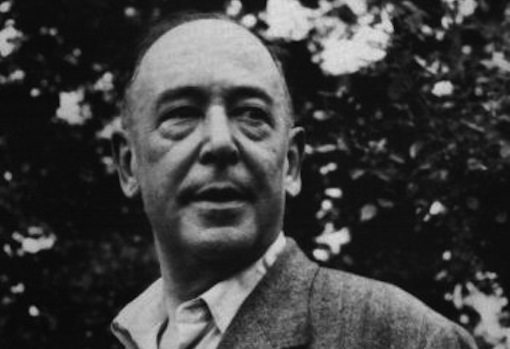
Fifty years ago today, C.S. Lewis died. Twenty-four years ago, I first read C.S. Lewis. I have been driven to reflect on the latter fact by the former fact, and I thought I might share a few thoughts regarding what C.S. Lewis has meant to me.
At the age of fifteen, my father put a copy of Mere Christianity in my hands. I do not know if I could overstate what that book did for me and for my Christian journey. It rocked my world. It absolutely revolutionized how I viewed the Christian life and, in particular, my own walk with Jesus.
Looking back on it, I suspect the major contribution it made to my own mind was to introduce the idea of an intellectually viable faith. It is hard to describe what Lewis’ initial appeal to the reality of a universal, objective, moral law did to my understanding of the faith. It showed me that faith was not reason-less, not a blind grasping for what we could not know. Throughout that book, Lewis showed the staggering explanatory power of Christianity, and, for the first time, I realized that the faith had ideational content that could be asserted as intellectually compelling in light of the realities of the world. It was, for me, the beginning of the end of the fundamentalist anti-intellectualism I had witnessed in some quarters of the church of my youth.
Secondly, it shattered the last vestiges of sectarian hubris within me. Here I was, reading an Anglican (who smoked and drank, no less!) and learning the faith in a way I had never learned it. It showed me that the faith transcended the little denominational boundaries I knew, and that the Church was a worldwide entity with lots of intriguing characters from whom I might draw help and guidance.
Its description of “mere Christianity” overwhelmed me with its simple brilliance. In short, I loved the idea of it. I did not come to see ecclesial distinctives as unimportant as a result of this approach. Rather, I think I first began to grasp what Al Mohler would later call “theological triage”: the difference between primary, secondary, and tertiary truths.
Furthermore, Lewis introduced me to G.K. Chesterton, about whom another post will have to speak. He also introduced me to George MacDonald. Furthermore, my interest in Tolkien is at least in some sense connected to his connection with Lewis and his role in Lewis’ conversion…though, there again, it was my father who first encouraged me to read J.R.R. Tolkien. So Lewis impacted me not only through what he wrote, but also through the writings of those to whom he introduced me.
After reading Mere Christianity, I began consuming everything Lewis had written…even the big volume of letters to Arthur Greeves. Looking back, I can see how irritating I became in it. I became obsessed with Lewis, a member of the cult of Lewis, if you will. I think my mimicking of Lewis’ way of speaking and my constant quoting of his words must have been very irksome to deal with. In due time, I outgrew such fixations, but the impact of Lewis has remained on my life to this day.
Oddly enough, I eventually reacted to my obsession with Lewis by setting him aside. I actually have not read him in years…though I have memorized more of Lewis’ words than I have of any other writer. Even so, the specter of Lewis (if you will allow the image) always seems to be around, and I rarely go very long without thinking about how he approached the faith or how he would have approached this or that question.
I will be forever grateful to Lewis for as long as I live, and to God for creating such a mind. Again, it’s been a while since I’ve actually read Lewis…a problem that I will have to remedy soon.
For some time, I have been fascinated by the historical figure of Jacobus Arminius. Anybody who has attempted to keep up with the issue of Calvinism will be familiar with the term. “Arminianism” is usually pitted against “Calvinism” as an antithetical system, no matter how accurate or inaccurate that pitting might be.
There was a time when I read relatively deeply on these issues. Along the way, I have been consistently intrigued by the character and theology of Arminius. Reading Carl Bangs’ magisterial biography only heightened my interest in the man. In short, I remain amazed at the phenomenon of a man’s name being used so frequently by so many who have never read any of his works or anything about him. To be sure, Arminius’ writings are often difficult, but they are always available.
Arminius himself was a complex, fascinating thinker who, I dare say, does not match the caricatures of him that one often hears. My point is not to say that Arminius was right or wrong. Personally, I feel that he was right in some areas and wrong in others…which is to say that he was human.
Regardless, he is a figure who needs to be more widely known and understood, especially by people who continue to evoke his name. To that end, I think those interested in the issues surrounding Calvinism and Arminianism will benefit from this helpful series of lectures, delivered earlier this year by the authors of a new Arminius biography: Keith Stanglin (who I interviewed here) and Thomas McCall.
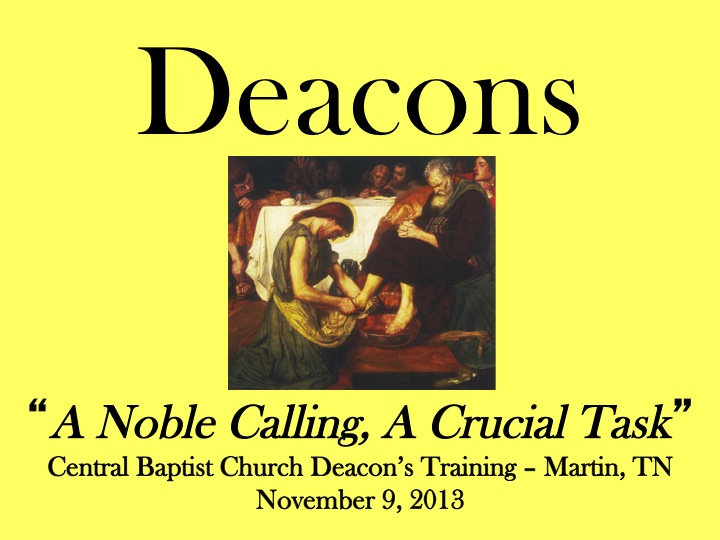
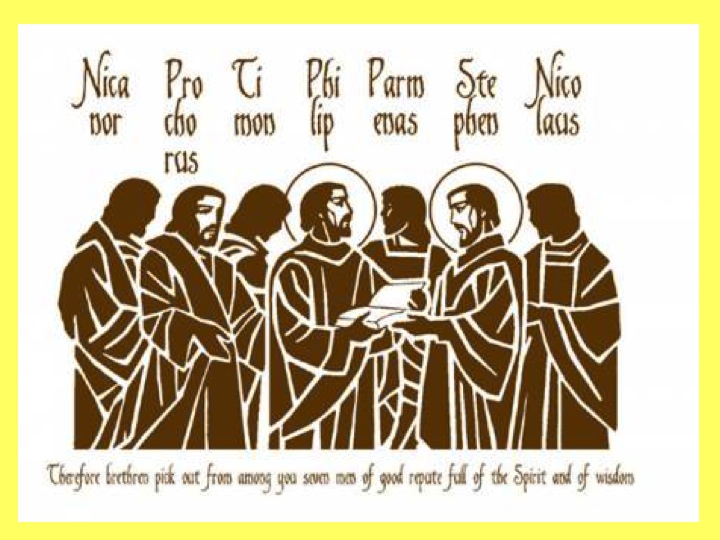
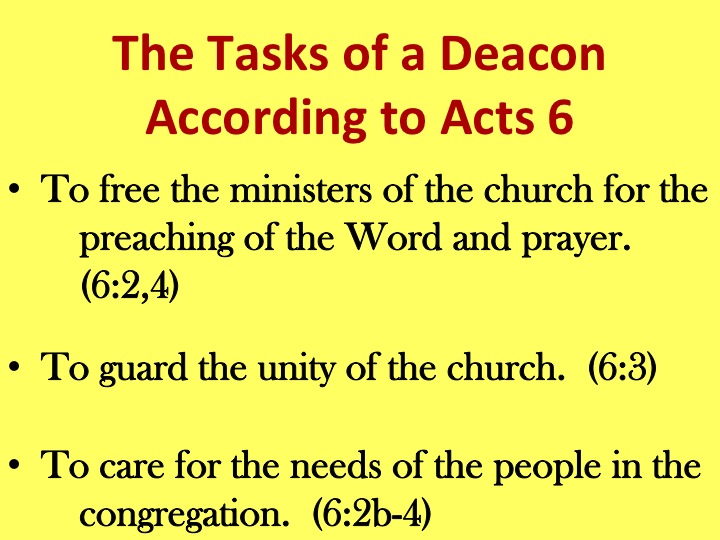
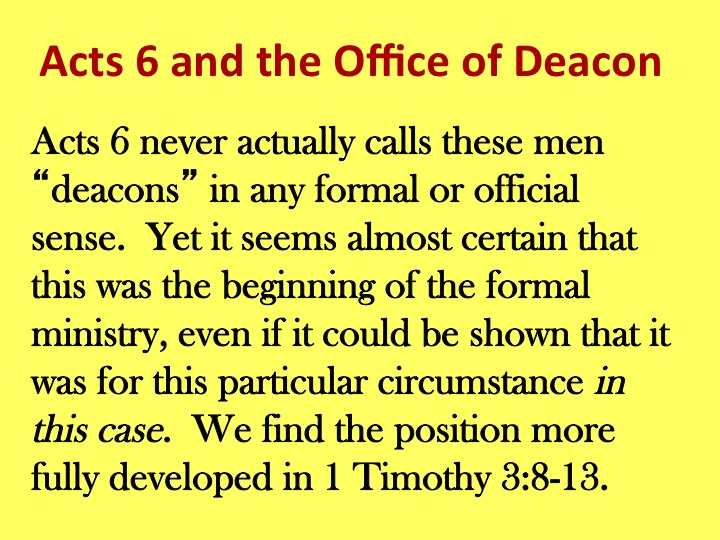
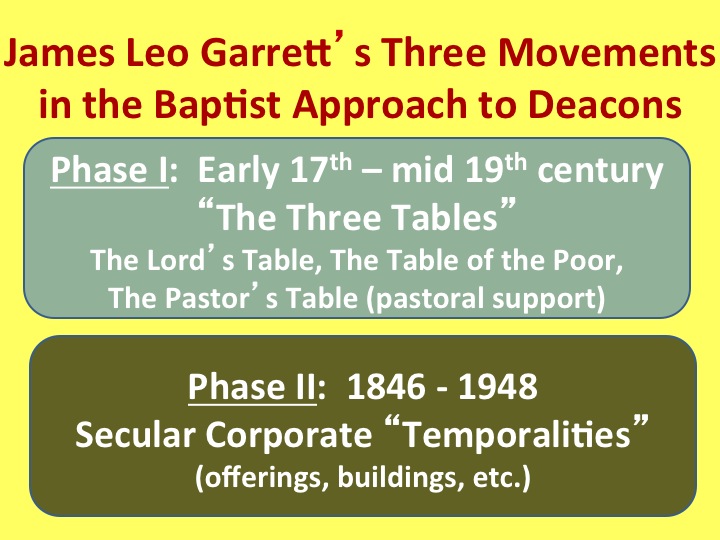
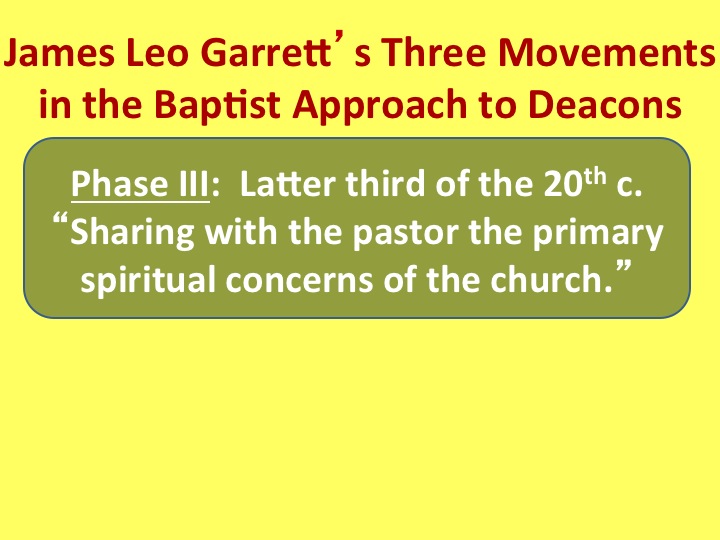
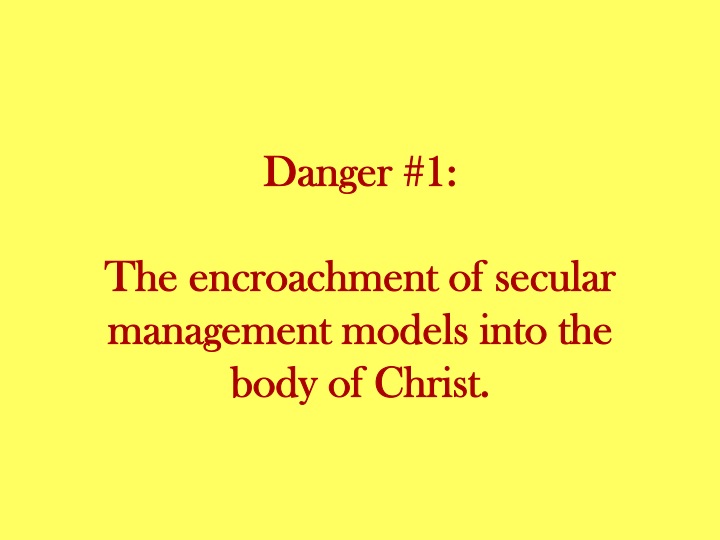
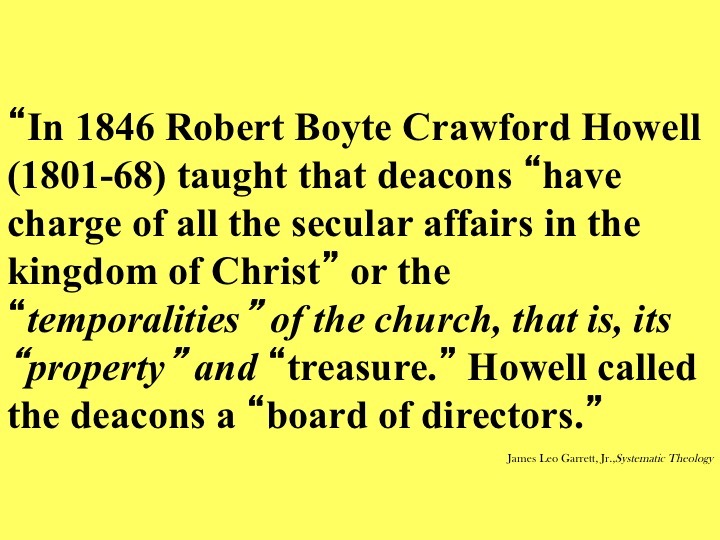
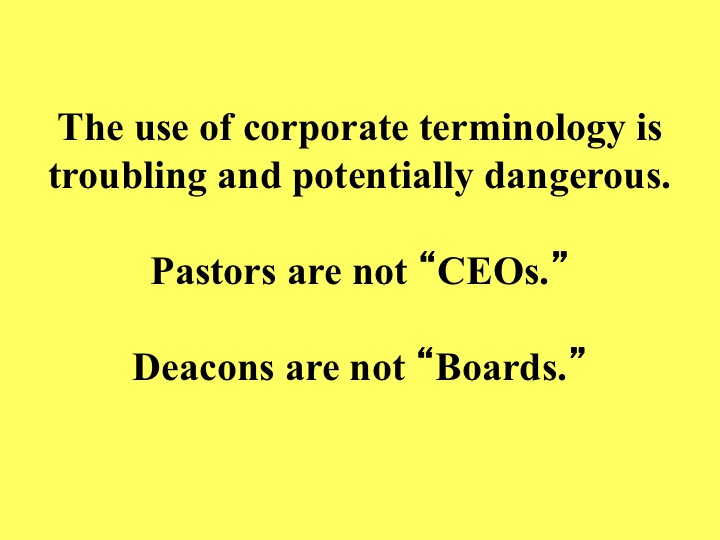
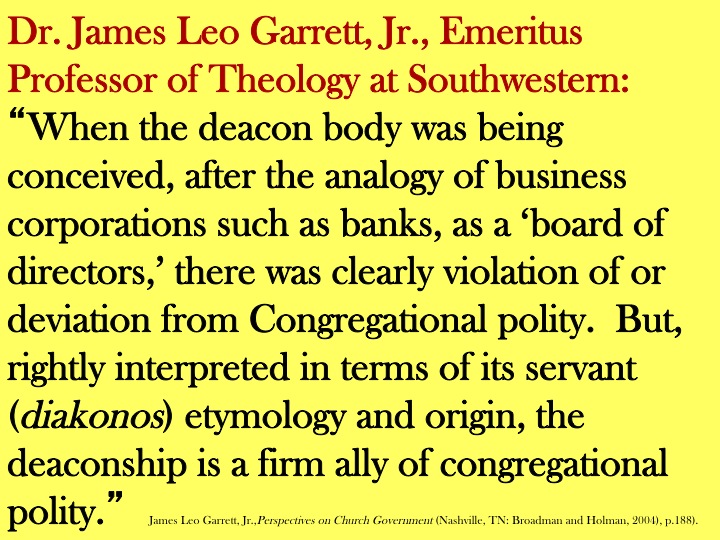
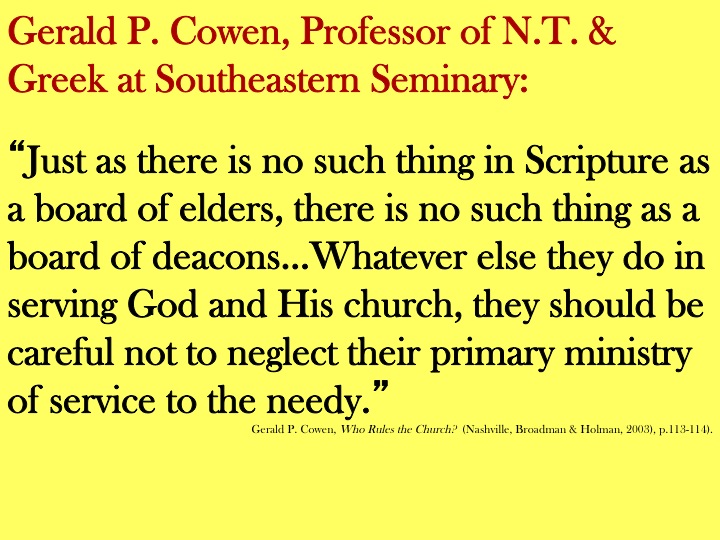
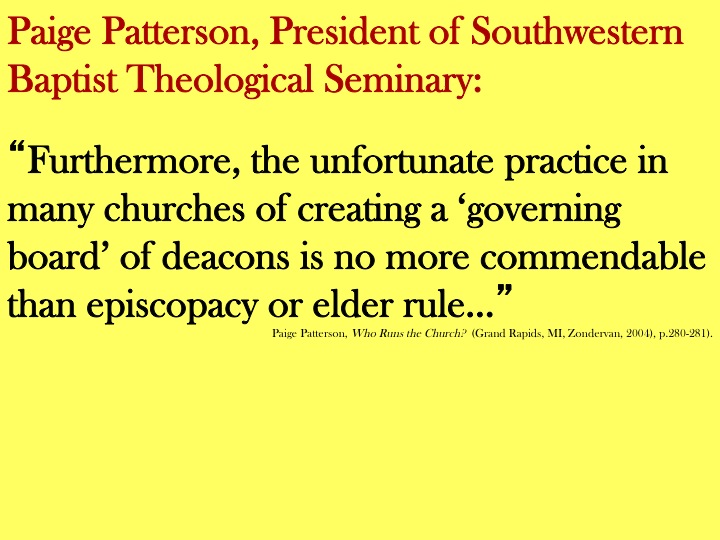
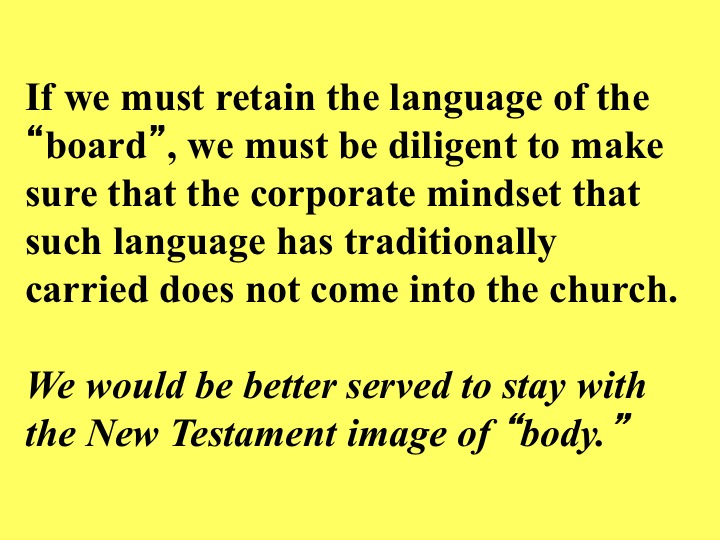
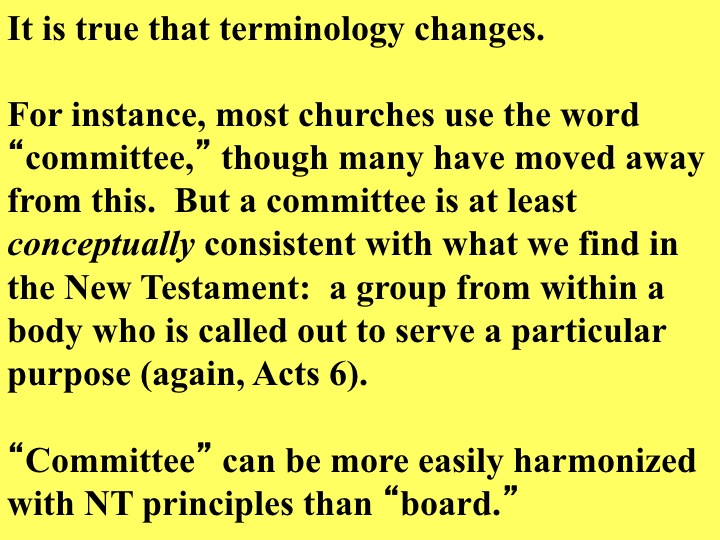
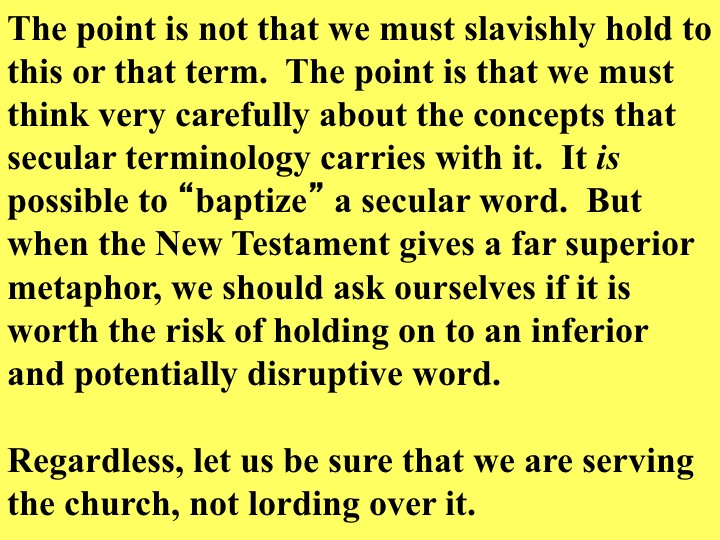
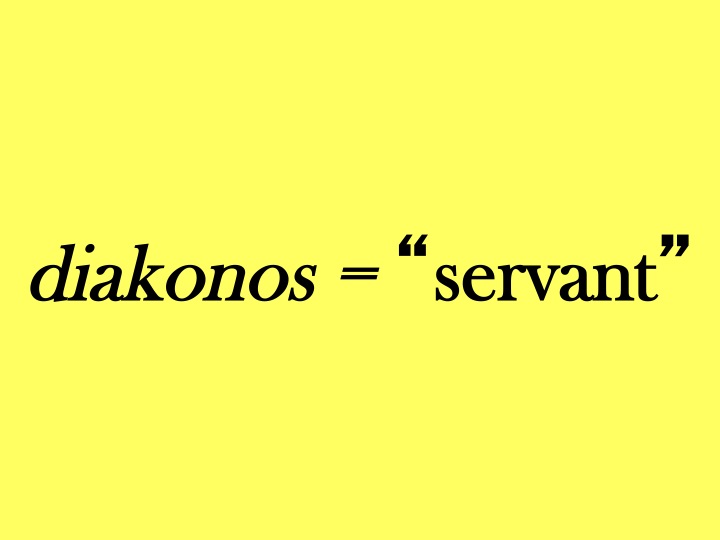
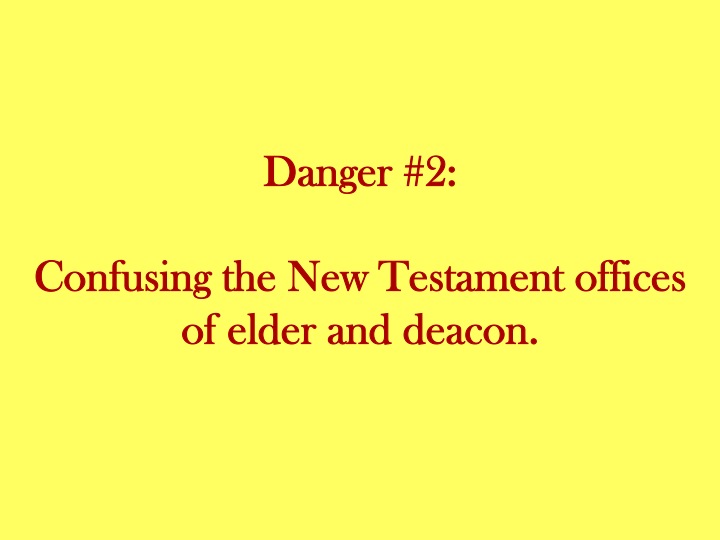
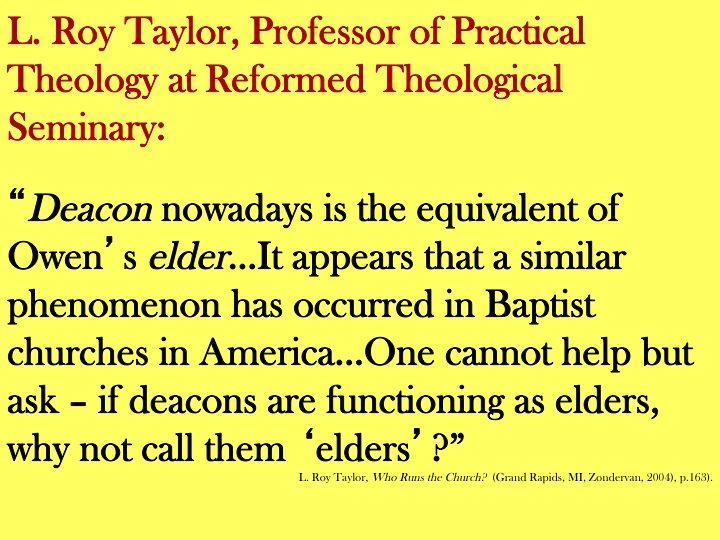
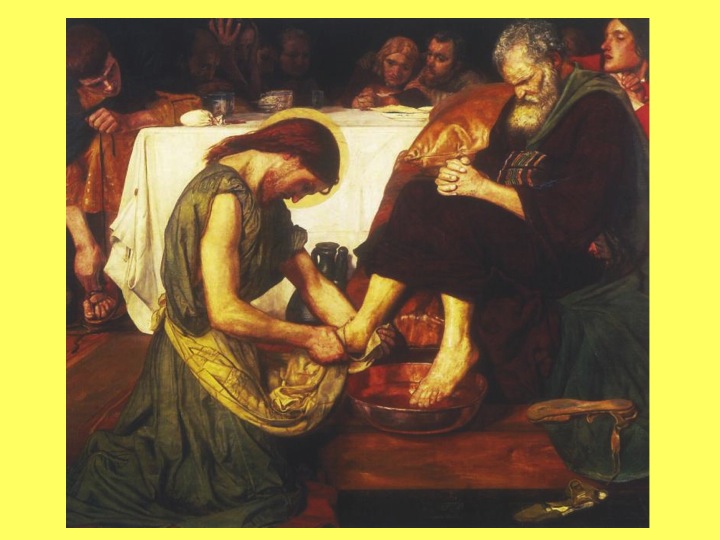
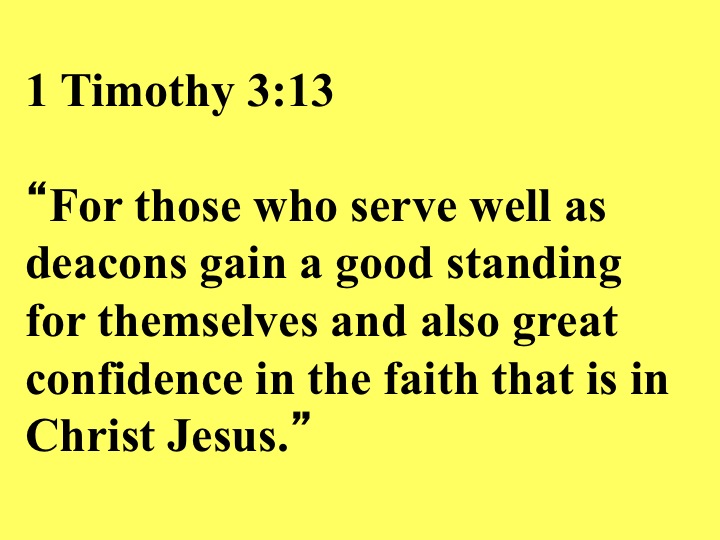
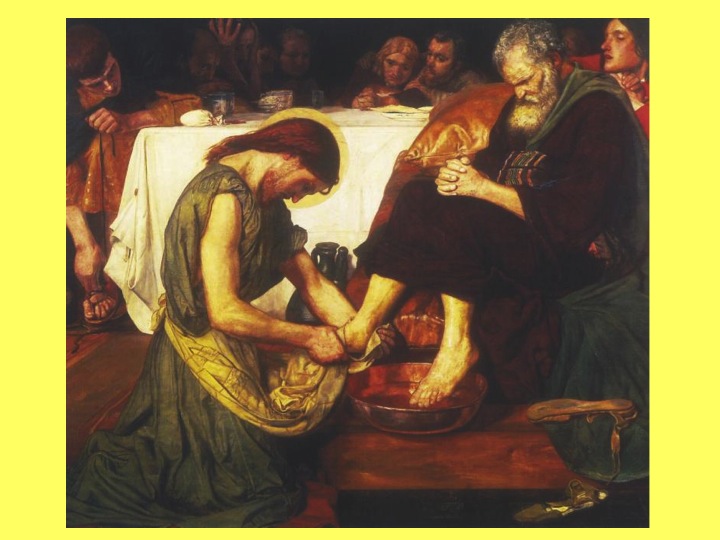
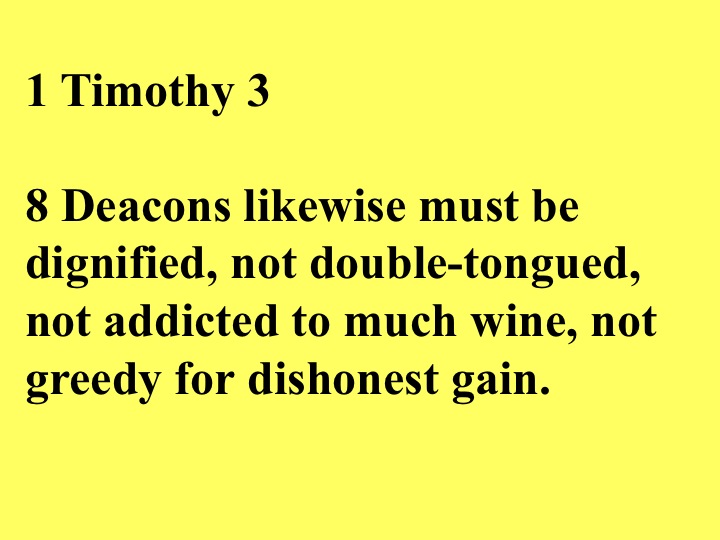
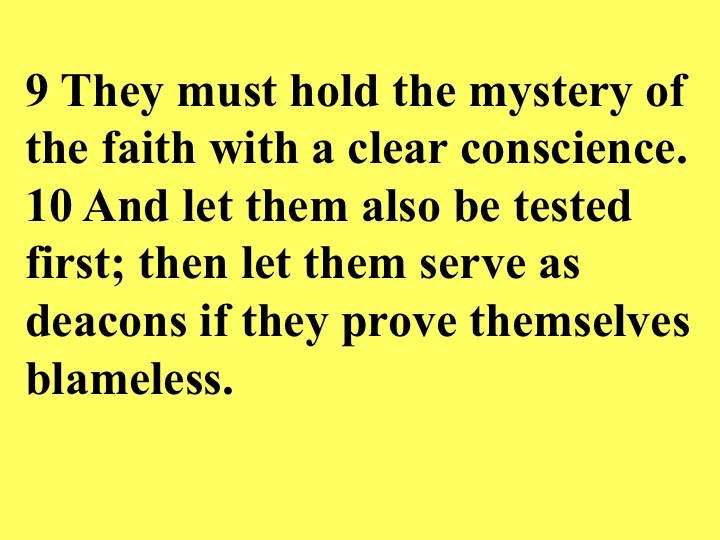
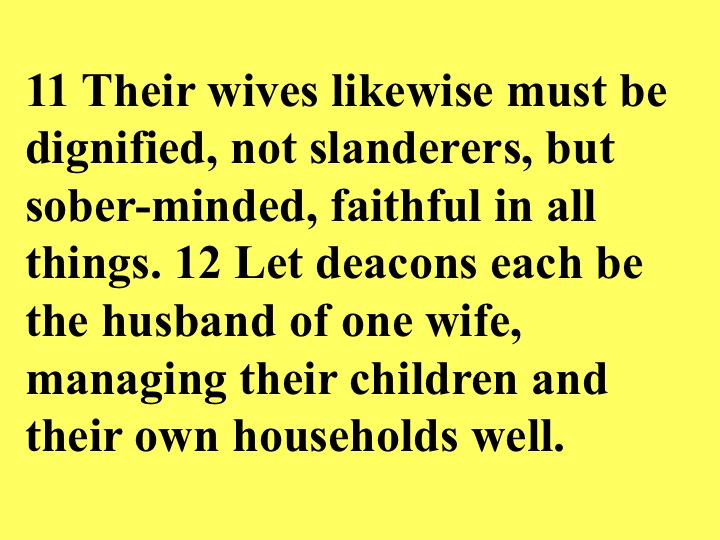
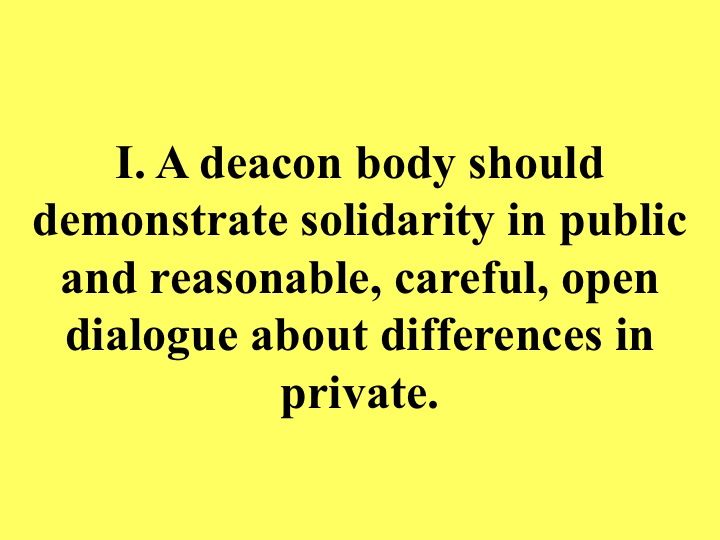
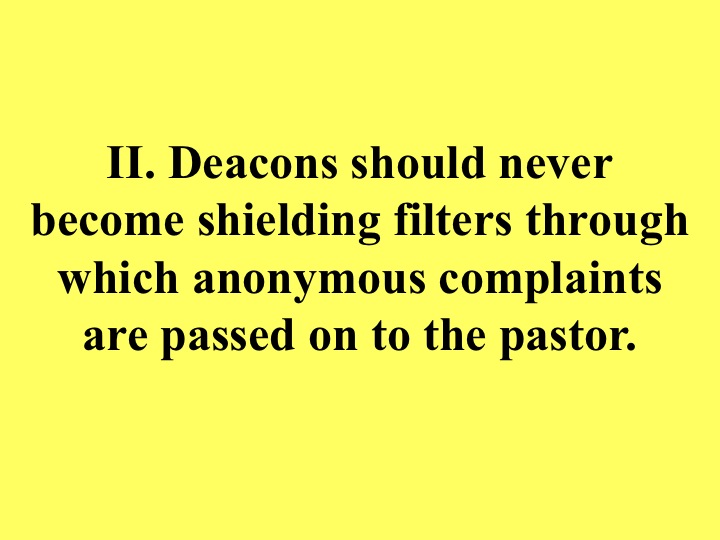
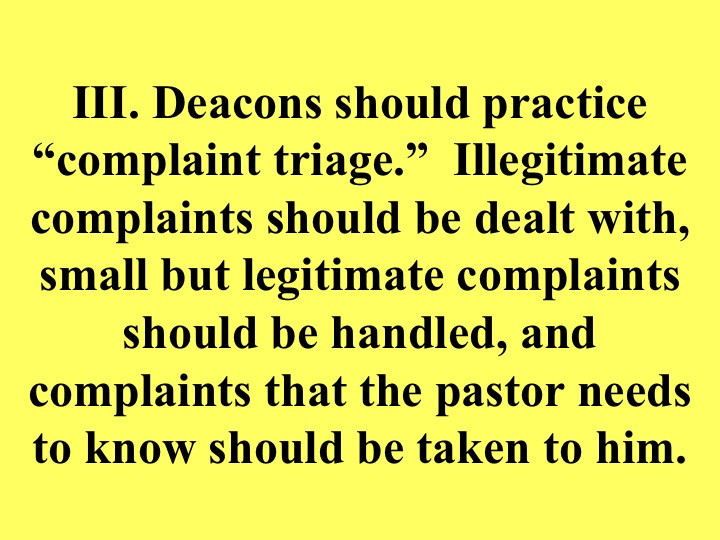
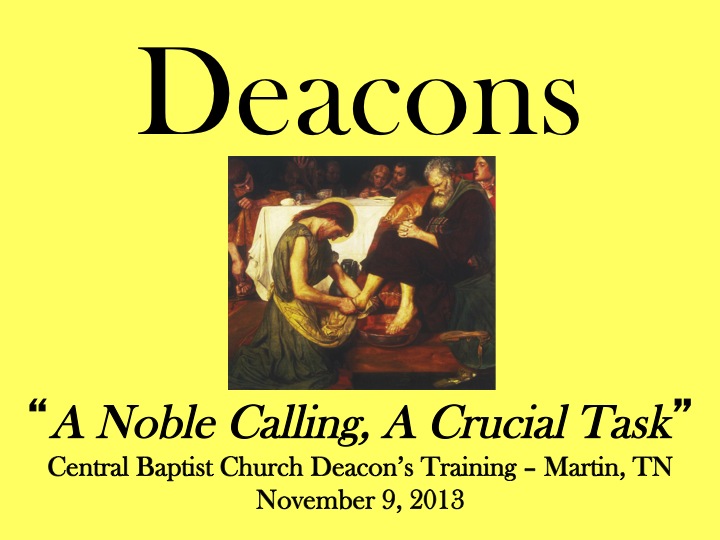
On Saturday, November 9, I offered the following presentation to the Deacon body of Central Baptist Church in Martin, TN. I’m grateful to Pastor Kylan Mann for the invitation. Kylan and I worked together for a few months when I first came to Central Baptist Church in North Little Rock in January of 2011, where he was serving, at that time, as the Minister of Youth. He is doing a great job in Martin, TN, and his transition into the pastorate has been a very smooth and effective one. I was honored to be able to spend some time with these deacons, not least of all because it challenged me to think again about this important ministry and the godly men who undertake it.
The recent “Strange Fire” conference at John MacArthur’s church advocated the cessationist position, that is, the position that the gifts of healing, prophecy, and tongues ceased with the apostolic age and are therefore not present in the church today. This conference, as you can imagine, stirred up quite a bit of controversy, especially among those who adhere to the continuationist position, the position that these gifts do indeed continue to this day.
My own position is that while I am suspicious of much that goes on under the charismatic and pentecostal banners, and while I think we are right to outright reject the clearly unbiblical excesses of some branches of these movements, scripture does not contain the explicit biblical evidence for cessationism that I would need to see to hold to that position. As such, I am cautious but open to the continuance of these gifts should they draw attention to Christ and not violate any of the clear teaching of God’s Word.
I saw yesterday that James White’s Alpha and Omega Ministries (this is not an endorsement of James White, by the way, though he has done some good work in some important areas) hosted a debate between Dr. Michael Brown and Dr. Sam Waldron on the question, “Have the New Testament Charismatic Gifts Ceased?” I was able to listen to this debate today and found it helpful insofar as it presents two well-thought-out representative cases for these positions.
I am currently preaching through our church’s “Four Canons” and devoted my November newsletter to them. I thought I would provide it here as a bit of a summary of our view of what a church is and should be.
The Four Canons: A Vision and a Goal
If you have been at Central Baptist Church for any period of time, you have likely heard the phrase “The Four Canons” or have seen the symbols. If you have been here for a long time you might have heard more about them than you want to! Why? Because a church without a clear sense of vision is a church that is doomed to float directionless and without a clear trajectory.
If you are a member of Central Baptist Church you should be able to tell anybody who we are and what we are about at the drop of a hat. The Four Canons help us in that regard. Remember: a canon is a set standard. These four are our ideals, our goals, our mission. They are thoroughly biblical in content and imminently practical in terms of helping us assess what we do and why we do it.
Here are The Four Canons:
An Authentic Family [This is our ecclesiology, our view of the church.]
Around the Whole Gospel [This is our theology, our central conviction.]
For the Glory of God [This is our doxology, our Spirit-led focus.]
And the Reaching of the Nations [This is our missiology, our sense of mission and outreach.]
These are good canons, and they are God-honoring. We are seeking to aspire toward these goals and this vision. Through our church covenant, we have united around a practical vision of what the living out of these canons looks like.
Leading up to Christmas, I will be preaching again through The Four Canons. We are doing this to remind us of who we are, and of what we are about.
On Monday of this week, Dr. R. Albert Mohler, President of Southern Seminary in Louisville, KY, delivered the following speech at Brigham Young University. I was first intrigued by his comments to the Mormons about their theology, but I ended up most moved by the actual content of his speech regarding marriage, family, and the new sexual revolution.
In short, I think this may be the clearest and most helpful articulation of where we are in the modern age on these vital issues that I have ever read. I am copying the message in its entirety with permission.
A Clear and Present Danger: Religious Liberty, Marriage, and the Family in the Late Modern Age — An Address at Brigham Young University
An address delivered at Brigham Young University by Dr. R. Albert Mohler, Jr., President of The Southern Baptist Theological Seminary on Monday, October 21, 2013.
I deeply appreciate your invitation to speak at Brigham Young University and to address the faculty at this greatly respected center of learning. I am so glad to be on this campus, filled with so many gracious people, such admirable students, and so many committed scholars on the faculty. To many people, shaped in their worldview by the modern age and its constant mandate to accommodate, it will seem very odd that a Baptist theologian and seminary president would be invited to speak at the central institution of intellectual life among the Latter-Day Saints.
But here I am, and I am thankful for the invitation. The wonderfully prophetic Catholic novelist Flannery O’Connor rightly warned that we must “push back against the age as hard as it is pressing you.” I have come to Brigham Young University because I intend with you to push back against the modernist notion that only the accommodated can converse. There are those who sincerely believe that meaningful and respectful conversation can take place only among those who believe the least—that only those who believe the least and thus may disagree the least can engage one another in the kind of conversation that matters. I reject that notion, and I reject it forcefully. To paraphrase Dorothy Parker, that is the kind of idea that must not be cast aside lightly, but thrown with full force.
I come as a Christian theologian to speak explicitly and respectfully as a Christian—a Christian who defines Christianity only within the historic creeds and confessions of the Christian church and who comes as one committed to the Gospel of Jesus Christ and to the ancient and eternal Trinitarian faith of the Christian church. I have not come as less, and you know whom you have invited. I come knowing who you are—to an institution that stands as the most powerful intellectual center of the Latter-Day Saints, the most visible academic institution of Mormonism. You know who I am and what I believe. I know who you are and what you believe. It has been my great privilege to know friendship and share conversation with leaders of the LDS church, such as Elder Tom Perry, Elder Quentin Cook, and Elder Todd Christofferson. I am thankful for the collegiality extended by President Cecil Samuelson at this great university. We do not enjoy such friendship and constructive conversation in spite of our theological differences, but in light of them. This does not eliminate the possibility of conversation. To the contrary, this kind of convictional difference at the deepest level makes for the most important kind of conversation. This is why I am so thankful for your gracious invitation.
Our conversation comes in the context of a particularly interesting historical moment. We are living in times rightly, if awkwardly, described as the Late Modern Age. Just a decade or so ago, we spoke of the Postmodern Age, as if modernity had given way to something new. Like every new and self-declared epoch, the Postmodern Age was declared to be a form of liberation. Whereas the Modern Age announced itself as a secular liberation from a Christian authority that operated on claims of revelation, the Postmodern Age was proposed as a liberation from the great secular authorities of reason and rationality. The Postmodern Age, it was claimed, would liberate humanity by operating with an official incredulity toward all metanarratives. And yet, postmodern thought eventuated, as all intellectual movements must, in its own metanarrative. And then it passed away. We still speak of postmodern thinking, even as we speak rightly of postmodern architecture and postmodern art, but we are speaking, for the most part, of a movement that has given way and given up. In retrospect, the Postmodern Age was not a new age at all, only the alarm that announced the Late Modern Age. Modernity has not disappeared. It has only grown stronger, if also more complex.
The claim that humanity can only come into its own and overcome various invidious forms of discrimination by secular liberation is not new, but it is now mainstream. It is now so common to the cultures of Western societies that it need not be announced, and often is not noticed. Those born into the cultures of late modernity simply breathe these assumptions as they breathe the atmosphere, and their worldviews are radically realigned, even if their language retains elements of the old worldview.
Recent research demonstrates this clearly. The Pew Research Center has released a torrent of research underlining these trends. We are now told that one in five Americans is essentially secular—thoroughly secularized, with no religious affiliation at all. Even more revealing is the fact that one in three younger Americans under age 30 is so identified. If anything, anecdotal evidence and any sophisticated analysis of their worldviews indicate that these figures may be an underestimation. More recently, the researchers at Pew have revealed that American Judaism is being radically secularized, traced by evidence of skyrocketing intermarriage rates and very low estimates of religious belief. No belief system is immune or impervious to modernity.
There is plenty of evidence that the same phenomenon is at work among Roman Catholic young people. Among evangelical Christians, a frightening percentage of youth and “emerging adults” hold to what sociologist Christian Smith and his associates have called “Moralistic Therapeutic Deism,” a religion that bears no substantive resemblance to biblical Christianity.
The background to this great intellectual shift is the secularization of Western societies. Modernity has brought many cultural goods, but it has also, as predicted, brought a radical change in the way citizens of Western societies think, feel, relate, and reason. The Enlightenment’s liberation of reason at the expense of revelation was followed by a radical anti-supernaturalism that can scarcely be exaggerated. Looking at Europe and Great Britain, it is clear that the Modern Age has alienated an entire civilization from its Christian roots, along with Christian moral and intellectual commitments. This did not happen all at once, of course, though in nations such as France and Germany the change came very quickly. Scandinavian nations now register almost imperceptible levels of Christian belief. Increasingly, the same is true of both the Netherlands and Great Britain. Sociologists now speak openly of the death of Christian Britain—and the evidence of Christian decline is abundant.
Peter Berger, one of the founding fathers of the modern theory of secularization, has suggested that secularization should be better understood as pluralization: the presence of plural worldviews in proximity offering an array of intellectual and theological options. But the result is nearly the same. The world might be, as he says, “furiously religious,” but the modern world is not controlled by any coherent supernatural worldview.
Actually, Berger argues that secularization, in exactly the shape and form predicted by the prophets of secularization theory, did operate exactly according to plan in two social locations, western Europe and the American college and university campus.
In his important Massey Lectures delivered in 1991, Canadian philosopher Charles Taylor spoke of The Malaise of Modernity. The Modern Age, he argued, is marked by two great intellectual moves. The first intellectual move is a pervasive individualism. The second is the reduction of all public discourse to the authority of instrumental reason. The rise of modern individualism came at the cost of rejecting all other moral authorities. “Modern freedom was won by our breaking loose from older moral horizons,” Taylor explains. This required the toppling of all hierarchical authorities and their established moral orders. “People used to see themselves as part of a larger order,” he observed. “Modern freedom came about through the discrediting of such orders.”
The primacy of instrumental reason means the elimination of the old order and its specifically theological and teleological moral order. As Taylor explains:
No doubt sweeping away the old orders has immensely widened the scope of instrumental reason. Once society no longer has a sacred structure, once social arrangements and modes of action are no longer grounded in the order of things or the will of God, they are in a sense up for grabs. They can be redesigned with their consequences for the happiness or well-being of individuals as our goal.
More recently, Taylor has written the greatest work yet completed on the secular reality of our times. In A Secular Age, he describes three successive sets of intellectual conditions. In the first, associated with the Premodern Age of antiquity and the medieval synthesis, it was impossible not to believe. There was simply no intellectual alternative to theism in the West. There was no alternative set of explanations for the world and its operations, or for moral order. All that changed with the arrival of modernity. In the Modern Age it became possible not to believe. A secular alternative to Christian theism emerged as a real choice. As a matter of fact, choice now ruled the intellectual field. As Peter Berger famously observed decades ago, this is the “heretical imperative,” the imperative to choose. The third set of intellectual conditions is identified with late modernity and our own intellectual epoch. For most people living in the context of self-conscious late modernity, it is now impossible to believe.
This is a stunning intellectual and moral revolution. It defies exaggeration. We must recognize that it is far more pervasive than we might want to believe, for this intellectual revolution has changed the worldviews of even those who believe themselves to be opposed to it. If nothing else, many religious believers in modern societies now operate as theological and ideological consumers, constantly shopping for new intellectual clothing, even as they believe themselves to be traditional believers. Everything is now reduced to choice, and choice is, as Taylor reminds us, central to the moral project of late modernity, the project of individual authenticity.
As he explains this project: “There is a certain way of being human that is my way. I am called upon to live my life in this way, and not in imitation of anyone else’s. But this gives a new importance to being true to myself. If I am not, I miss the point of my life, I miss what being human is for me.”
The pressing question is this: can any sustainable moral order survive this scale of intellectual revolution? We hear in the today’s intellectual and ideological chorus the refrains of Karl Marx’s threat and promise as stated in The Communist Manifesto: “All that is solid melts into air.” The melting is everywhere around us.
The clearest demonstration of this monumental shift in morality and worldview is the revolution now underway with regard to marriage, the family, and human sexuality. Long ago, historians Will and Ariel Durant noted that sex is “a river of fire that must be banked and cooled by a hundred restraints.” The primary restraint has always been the institution of marriage itself, an institution that is inescapably heterosexual and based in the monogamous union of a man and a woman as husband and wife. In our times, the fires of sex and sexuality are increasingly unbanked and uncooled.
Similarly, Pitirim Sorokin, the founder of sociology at Harvard University, pointed to the regulation of sexuality as the essential first mark of civilization. According to Sorokin, civilization is possible only when marriage is normative and sexual conduct is censured outside of the marital relationship. Furthermore, Sorokin traced the rise and fall of civilizations and concluded that the weakening of marriage was a first sign of civilizational collapse.
We should note carefully that Sorokin made these arguments long before anything like homosexual marriage had been openly discussed, much less legislated. Sorokin’s insight was the realization that civilization requires men to take responsibility for their offspring. This was possible, he was convinced, only when marriage was held to be the unconditional expectation for sexual activity and procreation. Once individuals—especially males—are freed for sexual behavior outside of marriage, civilizational collapse becomes an inevitability. The weakening of marriage—even on heterosexual terms—has already brought a harvest of disaster to mothers and children abandoned in the name of sexual liberation.
We must note with honesty and candor that this moral revolution and the disestablishment of marriage did not begin with the demand of same-sex couples to marry. The subversion of marriage began within the context of the great intellectual shift of modernity. Marriage was redefined in terms of personal fulfillment rather than covenant obligation. Duty disappeared in the fog of demands for authenticity and the romanticized ideal of personal fulfillment. Marriage became merely a choice and then a personal expression. Companionate marriage was secularized and redefined solely in terms of erotic and romantic appeal—for so long as these might last.
In an important new book, Has Marriage for Love Failed?, French intellectual Pascal Bruckner ponders the secularly imponderable: has the romantic revolution of secular modernity led to human happiness? He thinks not.
He does clearly understand what modernity hath wrought: “Since the Enlightenment, marriage reforms have focused on three points: giving priority to feelings over obligation, doing away with the requirement of virginity, and making it easy for badly matched spouses to separate.”
Bruckner is right—devastatingly right. Note carefully that all three of these points require the secularization of the moral order and the marital contract. Feelings now rule, defined and projected at will. Virginity is, as Bruckner notes, an embarrassment for most moderns. Cohabitation is now the order of the day for young moderns, and for an astonishingly large percentage of their parents and grandparents. The young are indoctrinated into the morality of expressive sexuality and erotic fulfillment, with children hardly able to read force-fed the curriculum of “safe sex” and erotic experimentation. And, sadly, the divorce revolution has not only made marriage a tentative, if not temporary, condition, it has redefined marriage as nothing more than a public celebration of an essentially and non-negotiably individual act of self-expression.
As Barbara Defoe Whitehead has observed, expressive marriage was followed almost instantly by expressive divorce. Divorce, like marriage, now becomes an expected act of self-expression for moderns, complete with greeting cards, celebrations, and public announcements of new erotic and romantic availability.
Has this made moderns happier? This is where Pascal Bruckner is particularly helpful and insightful. Modern romantic love, he argues, simply cannot sustain marriage. He describes this reality as a “terrible absurdity.” Marriage has “become more difficult to endure since of all its roles it has retained only that of being a model of fulfillment. Because it wants to succeed at any cost, it is consumed with anxiety, fears the law of entropy, the aridity of slack periods.”
Add to this the realization that no one can now grow old and mellow. Ardor must continue and erotic fulfillment must rule, even into later decades of life and marriage. A revealing article appeared in the health pages of USA Today, announcing that Viagra is now a prominent factor in divorce among the middle-aged and older. As reporter Karen S. Peterson explained: “Nobody claims Viagra causes affairs or divorce. But increasingly, it is a factor in both, says Dominic Barbara, who heads a Manhattan law firm with 15 attorneys. In about one of every 15 or 20 new divorce cases, somebody mentions Viagra, he says.”
Heterosexuals did a very good job of undermining marriage before same-sex couples arrived with their demands. The marriage crisis is a moral crisis and it did not start with same-sex marriage, nor will it end there. The logic of same-sex marriage will not end with same-sex marriage. Once marriage can mean anything other than a heterosexual union, it can and must mean everything. It is just a matter of time.
Of course, one of the issues we must confront is the fact that marriage is a pre-political institution, recognized and solemnized throughout history by virtually every human culture and civilization. But we are living in an age in which everything is political and nothing is honored as pre-political. In the recent words of Justice Antonin Scalia, we are all now waiting for the other shoe (or shoes) to drop.
This has all been made possible by a breakdown in the immune system of human society—and this breakdown was no accident. Immunologists will explain that one of the wonders of human life is the fact that each of us receives from our mother an amazing array of defenses within our immune system. Throughout time, we develop further immunities to disease, or we grow sick and vulnerable. A severely compromised immune system leads to chronic disease, constant vulnerability, and potential death. If this is true for an individual, it is also true of a society or civilization.
We have forfeited our immunity against the breakdown of marriage, the family, and integrity of human sexuality. We can point to others who have been the prophets and agents of this self-injury to society, but we must recognize that we have all contributed to it, in so far as we have embraced essentially modern understandings of love, romance, liberty, personal autonomy, obligation, and authority. Furthermore, the separation of the conjugal union and openness to the gift of children has further undermined both our conscience and our credibility in the defense of marriage. We separated sex from marriage and marriage from reproduction. We sowed the seeds of the current confusion. At the very least, we did not address this confusion with sufficient moral clarity and credibility.
Marriage is the most basic unit of civilization. In fact, it is the basic molecular structure of human society. The redefinition of marriage will bring great human unhappiness. As Pascal Bruckner reminds us, this is true of heterosexual divorce. It promised happiness but has produced misery and brokenness. It declared itself to be liberation, but it imprisons all moderns in its penitentiary of idealized and unattainable romance and sexual fulfillment.
The family, as properly pre-political as marriage, is now the great laboratory for human social experimentation. Children are routinely sacrificed to the romantic whims and sexual demands of their parents, who may or may not be married, may or may not stay married, and may or may not include both a father and a mother at any point.
The epidemic of fatherlessness is well documented and no longer even denied, but there is no social consensus to address a phenomenon that has wrought incalculable human costs, both individually and socially.
A basic principle of Christian theology was once written into the moral immune system of Western civilization—what God commands and institutes is what leads to genuine human flourishing. Our civilization now lives in open revolt against that affirmation.
The moral revolution we are now witnessing on the issue of homosexuality is without precedent in human history in terms of its scale and velocity. We are not looking at a span of centuries, or even the length of one century. This revolution is taking place within a single human generation.
I would argue that no moral revolution on this scale has ever been experienced by a society that remained intact, even as no moral revolution of this velocity has yet been experienced. We can now see more clearly where this revolution began. It is virtually impossible to see where it ends.
But, for the first time in the experience of most Americans, the moral revolution revolving around marriage, the family, and human sexuality is now clearly becoming a religious liberty issue. The rights of parents to raise their children according to their most basic and fundamental theological and moral convictions are now at stake. Courts have ruled in some jurisdictions that parents cannot even “opt out” their children from sex education driven by moral revisionism. Legislatures in California and New Jersey have made it illegal for mental health professionals to tell minors that there is anything wrong with homosexual sexuality, orientation, or relationships. Parents are put on notice. How long will it be before the moral authority of the secular state is employed to allow children to “divorce” their parents? How long before the logic of sexual revolution and sexual self-expression leads to parents being told what they must allow and facilitate with their own children when it comes to sex, gender, and sexual orientation? The logic of moral change by legal coercion is already fully on display in many modern legal debates. How long will a respect for parental rights and religious liberty hold back the flooding river of this moral revolution?
Religious liberty is already severely compromised by modern political regimes that claim to be democratic and respectful of human rights. Given the shape of current arguments for sexual expression and liberty, religious institutions, especially schools, colleges, universities, welfare agencies, and benevolent ministries, are already under fire and under warning. Some have already been forced to make a decision: forfeit your convictions or forfeit your work. Some have chosen one, some the other. One way leads to an honorable extinction, the other to a dishonorable surrender. Both are violations of religious liberty.
The conflict of liberties we are now experiencing is unprecedented and ominous. Forced to choose between erotic liberty and religious liberty, many Americans would clearly sacrifice freedom of religion. How long will it be until many becomes most?
This is what brings me to Brigham Young University today. I am not here because I believe we are going to heaven together. I do not believe that. I believe that salvation comes only to those who believe and trust only in Christ and in his substitutionary atonement for salvation. I believe in justification by faith alone, in Christ alone. I love and respect you as friends, and as friends we would speak only what we believe to be true, especially on matters of eternal significance. We inhabit separate and irreconcilable theological worlds, made clear with respect to the doctrine of the Trinity. And yet here I am, and gladly so. We will speak to one another of what we most sincerely believe to be true, precisely because we love and respect one another.
I do not believe that we are going to heaven together, but I do believe we may go to jail together. I do not mean to exaggerate, but we are living in the shadow of a great moral revolution that we commonly believe will have grave and devastating human consequences. Your faith has held high the importance of marriage and family. Your theology requires such an affirmation, and it is lovingly lived out by millions of Mormon families. That is why I and my evangelical brothers and sisters are so glad to have Mormon neighbors. We stand together for the natural family, for natural marriage, for the integrity of sexuality within marriage alone, and for the hope of human flourishing.
The great Christian theologian Augustine, writing in the final years of the Roman Empire, reminded Christians that we live simultaneously as citizens of two cities: a heavenly city and an earthly city. The one is eternal, the other is passing. But the earthly city is also a city of God’s good pleasure and divine compassion. As a Christian, I am instructed by the Bible to work for the good and flourishing of this earthly city, even as I work to see as many as possible also become citizens of the heavenly city through faith in Christ Jesus.
In this city, I am honored to come among those who, though of a different faith, share common concerns and urgencies. I come as a Christian, and I come as one who is honored by your kind and gracious invitation. I come in the hope of much further conversations, conversations about urgencies both temporal and eternal. I am unashamed to stand with you in the defense of marriage and family and a vision of human sexual integrity. I am urgently ready to speak and act in your defense against threats to your religious liberty, even as you have shown equal readiness to speak and act in defense of mine. We share love for the family, love for marriage, love for the gift of children, love of liberty, and love of human society. We do so out of love and respect for each other.
That is why only those with the deepest beliefs, and even the deepest differences, can help each other against encroaching threats to religious liberty, marriage, and the family. I guess I am back to Flannery O’Connor again. We must push back against this age as hard as it is pressing against us. We had better press hard, for this age is pressing ever harder against us.
Well, almost entire anyway: audio is missing from two sermons due to technical difficulties. Regardless, this has been, on a personal note, an amazing journey. I stand more amazed now at this stunning Sermon on the Mount than I ever have. I also feel a sense of futility and frustration, as if the surface has only been scratched, again, personally, and as if this is really just the beginning of a personal walk with Christ through this sermon for this pastor. What an amazing, scandalous, incendiary, shocking message this is…and what an amazing Savior who preached it.
I am grateful to pastor a wonderful church who was nothing but encouraging through this series. And we, together, as a church family, are grateful for the gospel of the living Christ.
Matthew 5:1-2 (Preached on January 27, 2013, at Central Baptist Church, North Little Rock, AR) [manuscript]
Matthew 5:3 (Preached on February 3, 2013, at Central Baptist Church, North Little Rock, AR) [manuscript]
Matthew 5:4 (Preached on February 10, 2013, at Central Baptist Church, North Little Rock, AR) [manuscript]
Matthew 5:5 (Preached on February 17, 2013, at Central Baptist Church, North Little Rock, AR) [manuscript]
Matthew 5:6 (Preached on February 24, 2013, at Central Baptist Church, North Little Rock, AR) [manuscript]
Matthew 5:7 (Preached on March 3, 2013, at Central Baptist Church, North Little Rock, AR) [manuscript]
Matthew 5:8 (Preached on March 10, 2013, at Central Baptist Church, North Little Rock, AR) [manuscript]
Matthew 5:9 (Preached on March 17, 2013, at Central Baptist Church, North Little Rock, AR) [manuscript]
Matthew 5:10-12 (Preached on April 7, 2013, at Central Baptist Church, North Little Rock, AR) [manuscript]
Matthew 5:13-16 (Preached on April 14, 2013, at Central Baptist Church, North Little Rock, AR) [manuscript]
Matthew 5:17-20 (Preached on April 21, 2013, at Central Baptist Church, North Little Rock, AR) [manuscript]
Matthew 5:21-26 (Preached on April 28, 2013, at Central Baptist Church, North Little Rock, AR) [manuscript]
Matthew 5:27-30 (Preached on May 5, 2013, at Central Baptist Church, North Little Rock, AR) [manuscript]
Matthew 5:31-32 (Preached on May 19, 2013, at Central Baptist Church, North Little Rock, AR) [manuscript]
Matthew 5:33-37 [no audio due to technical difficulties] (Preached on May 26, 2013, at Central Baptist Church, North Little Rock, AR) [manuscript]
Matthew 5:38-48 (Preached on June 2, 2013, at Central Baptist Church, North Little Rock, AR) [manuscript]
Matthew 6:1-8 (Preached on June 9, 2013, at Central Baptist Church, North Little Rock, AR) [manuscript]
Matthew 6:9 (Preached on June 16, 2013, at Central Baptist Church, North Little Rock, AR) [manuscript]
Matthew 6:10 (Preached on June 23, 2013, at Central Baptist Church, North Little Rock, AR) [manuscript]
Matthew 6:11 (Preached on June 30, 2013, at Central Baptist Church, North Little Rock, AR) [manuscript]
Matthew 6:13 (Preached on July 14, 2013, at Central Baptist Church, North Little Rock, AR) [manuscript]
Matthew 6:16-18 (Preached on July 21, 2013, at Central Baptist Church, North Little Rock, AR) [manuscript]
Matthew 6:19-24 (Preached on July 28, 2013, at Central Baptist Church, North Little Rock, AR) [manuscript]
Matthew 6:25-34 (Preached on August 4, 2013, at Central Baptist Church, North Little Rock, AR) [manuscript]
Matthew 7:1-6 (Preached on August 11, 2013, at Central Baptist Church, North Little Rock, AR) [manuscript]
Matthew 7:7-11 (Preached on August 18, 2013, at Central Baptist Church, North Little Rock, AR) [manuscript]
Matthew 7:12 (Preached on August 25, 2013, at Central Baptist Church, North Little Rock, AR) [manuscript]
Matthew 7:13-14 (Preached on September 1, 2013, at Central Baptist Church, North Little Rock, AR) [manuscript]
Matthew 7:15-20 (Preached on September 15, 2013, at Central Baptist Church, North Little Rock, AR) [manuscript]
Matthew 7:21-23 (Preached on September 22, 2013, at Central Baptist Church, North Little Rock, AR) [manuscript]
Matthew 7:24-27 [no audio due to technical difficulties] (Preached on September 29, 2013, at Central Baptist Church, North Little Rock, AR) [manuscript]
Matthew 7:28-8:1 (Preached on October 6, 2013, at Central Baptist Church, North Little Rock, AR) [manuscript]
28 And when Jesus finished these sayings, the crowds were astonished at his teaching, 29 for he was teaching them as one who had authority, and not as their scribes. 1 When he came down from the mountain, great crowds followed him.
Reactions to sermons can be fascinating things. In Luke 4, the crowd responds to Jesus’ sermon in the synagogue by trying to throw him off a cliff. In Acts 7, Stephen’s sermon leads to his immediate execution at the hands of an angry mob. In Acts 20, we find that a young man named Eutychus responded to a long sermon by Paul in Troas by falling out of an upper story window to his death. It is reported that Jonathan Edwards’ sermon, “Sinners in the Hands of an Angry God,” caused people to weep, faint, and white-knuckle their pews.
Some reactions to sermons are humorous. On January 11, 1629, Fray Hortensio Paravicino de Arteage preached a sermon that so irritated the playwright Calderon that he promptly wrote some extra lines for the character of the Fool in his play, “The Constant Prince,” in which the Fool speaks of a sermon he heard that was “a sermon full of nonsense” and names the preacher by name.[1] Personally, I once preached a sermon in which a lady, at the back door of the church, said, as she was leaving, “Frankly, my dear…” leaving me to fill in the rest of the sermon.
Yes, reactions to sermons can be fascinating things. That was certainly the case with the crowd’s reaction to the Sermon on the Mount. The reaction reveals much about both Jesus and His hearers.
I. The Message of Christ is Astonishing (v.28)
The most obvious reaction was one of astonishment.
28 And when Jesus finished these sayings, the crowds were astonished at his teaching.
Indeed, there is something astonishing about the first words of verse 28, though this particular facet is only evident to those of us who read the gospel and was not evident to Jesus’ first hearers. “And when Jesus finished” is a formula that is used five times in the gospel of Matthew. It is always used at the end of a major discourse from Jesus. The five usages of this formula to these discourses can be found:
at the conclusion of His Sermon on the Mount in Matthew 7:28,
at the conclusion of His missionary sermon in Matthew 11:1,
at the conclusion of His parables on the Kingdom in Matthew 13:53,
at the conclusion of His “community discipline discourse” in Matthew 19:1,
and at the conclusion of His prophetic message in Matthew 26:1.
Many New Testament scholars believe that the five-fold use of this formula is intentionally mirroring the use of the same formula that is used to describe the conclusion of Moses’ discourses in Deuteronomy. Indeed, the structuring of Matthew around five major discourses may be alluding to the Pentateuch itself, the first five books of the Old Testament. New Testament scholar Craig Evans believes this is deliberate and that this “provides conclusive evidence that [Matthew] has indeed arranged Jesus’ teaching into five major blocks of material, probably as part of a Moses typology.”[2]
So there is something astonishing about the way Matthew has framed the conclusion of the sermon. However, more importantly, the sermon was immediately astonishing to those who first heard it. A.T. Robertson said that the Greek word translated “astonished” here literally means “were struck out of themselves.”[3]
In a moment we will consider why they were astonished, but the reaction itself is what we first notice. The message of Christ is inherently flabbergasting, amazing, astonishing. It struck His first century hearers that way, and it strikes us that way as well. In fact, whenever Jesus preached His message tended to drive people either to outrage or overwhelming joy. Such is the incendiary message of the Son of God that nobody could be indifferent to it.
Of course, many of us have become indifferent to it because we have heard it so often. Familiarity breeds contempt. But this is a not a compliment to us. It is a sad commentary on the human capacity to domesticate even the most earth-shaking truths that so many of us have lost our sense of astonishment at hearing the gospel of Christ.
Consider: were it not for Christ Jesus, we would be heading for an eternity of separation from God in Hell. When is the last time somebody asked you, “How are you today?” and you responded, “I’m fantastic. I could be in Hell right now!” Or when is the last time you were tempted to complain, but, instead, said, “As bad as this is, it’s better than Hell!”
I am not trying to joke. On the contrary, there is a serious bottom line reality that should compel us to daily astonishment: we were lost and bound for hell and now we are not…all because of Jesus. It is intriguing to note how often those who beheld Jesus felt a sense of awe at Him.
Matthew 27:54
When the centurion and those who were with him, keeping watch over Jesus, saw the earthquake and what took place, they were filled with awe and said, “Truly this was the Son of God!”
Luke 5:26
And amazement seized them all, and they glorified God and were filled with awe, saying, “We have seen extraordinary things today.”
Acts 2:43
And awe came upon every soul, and many wonders and signs were being done through the apostles.
Hebrews 12:28
Therefore let us be grateful for receiving a kingdom that cannot be shaken, and thus let us offer to God acceptable worship, with reverence and awe
Yes, the people who beheld Jesus, and the early church in general, were bathed in awe, amazement, and astonishment. How about you?
II. The Message of Christ is Uniquely Authoritative (v.29)
The primary reason for their amazement was the nature of Jesus’ teachings.
29 for he was teaching them as one who had authority, and not as their scribes.
There was something different and unique about the way this Jesus taught. To understand why, we need to understand the nature of the preaching that first century people were accustomed to hearing.New Testament scholar Charles Quarles explains:
First-century Jewish teachers appealed to the authority of their rabbinic predecessors in their teaching. The Jerusalem Talmud notes that Rabbi Hillel lectured on a controversial topic all day but that his followers did not accept his teaching until he cited the authority of his predecessors Shemaiah and Abtalion.[4]
R. Kent Hughes gives further helpful examples.
Their teachers, mostly Pharisees, were in bondage to quotation marks – they loved to quote authorities. For example, R. Elieser affirmed in the Talmud: “Nor have I ever in my life said a thing which I did not hear from my teachers.” The same was said of R. Johanan B. Zakkai: “He never in his life said anything which he had not heard from his teachers.” Thus their teaching was a chain of references: “R. Hillel says…but also R. Isaac says…” It was secondhand theology – labyrinthine, petty, legalistic, joyless, boring, and weightless.[5]
This is significant, this reliance upon earlier tradition for the establishment of present day authority. What it means is that none of the preachers that first century Jews would have listened to would have dared attempt to ground the authority of their message in their own persons. The authority of their messages hinged on the past tense. The authority of their message hinged on their ability to say, “You should believe this because I am speaking in agreement with the earlier rabbis.” Never would they have said, “You should believe this because I am speaking.”
But that is precisely what Jesus did say. He spoke consistently and confidently of His own word and how life and death for His hearers hinged on their response to His word as His word. Meaning, Jesus’ authority resided in who He was, not who He quoted. It is a powerful and jarring contrast. It sets Jesus not only apart from the other teachers, but above them. It sets Jesus on a wholly different plane.
Friends, Jesus’ voice was not one of opinion or persuasive conjecture. His voice was one of inherent and unrivaled authority. Christ and Christ alone can say, “Believe it because I said it.” Even Christian preachers today dare not say that. Our authority, such as it is, rests only in our faithful conveyance of His words, never in our own word.
Do you know that when you hear the word of Christ you hear the word of truth? Do you know this? Do you know that His word is trustworthy because it is His word?
The great tragedy of the modern age is the absence of any solid foundation of authority, any objective basis on which we can stand and say, “This is it.” But Jesus claimed to be just such a foundation. He did not come to allude but to reveal. He did not come to quote but assert. His word is the word that silences all others.
III. The Message of Christ Presents the Hearers With a Choice (8:1)
Furthermore, His word demands a choice. It demands a choice about Jesus Himself. We see this in the reaction of the crowd.
1 When he came down from the mountain, great crowds followed him.
“Great crowds followed him,” though, no doubt, some of that crowd was just caught up in the moment. That is always how it goes with crowds and Jesus. Even so, the important thing to see is that the crowd understood that the words of Jesus demanded a choice and that choice centered around the person of Jesus. Jesus’ original hearers understood that you could not separate the message of Christ from the authority of Christ that is itself rooted in the person of Christ, the divine Son of God. Modern people often try to do this, claiming they like the message of Jesus but do not buy all that is claimed about the person of Jesus.
John Stott has passed on a couple of examples of this. An adherent to Hinduism once said to Stanley Jones, “The Jesus of dogma I do not understand, but the Jesus of the Sermon on the Mount and the cross I love and am drawn to.” Another man, a Muslim Sufi teacher, similarly said that while he could not believe all that the New Testament said about Jesus, he was nonetheless “could not keep back the tears” when he read the Sermon on the Mount.[6]
It is understandable, of course, that people would be moved by the Sermon on the Mount, but the effort to embrace the Sermon without embracing the Sermon Giver is a futile effort. The One who preached the Sermon on the Mount was Christ Jesus, the second person of the Trinity, the eternal Lamb of God. This is important because the choice that the Sermon compels us to consider is a choice about whether or not to follow this Jesus.
Notice that we have no record of anybody hearing the Sermon on the Mount and saying, “Hmmm, neat sermon. Little long though.” No, they understood that they were being presented with something epoch-shaping, something world-altering, something life-changing. They understood that this message was like no other precisely because this Messenger was like no other. That is why their reaction to the Sermon was to marvel at the One who delivered it, Jesus.
And so, I think, we are faced with the same choice. The Sermon on the Mount presents us with an alternative vision of reality that we need either to embrace or reject. I am struck by the following reflection on the Sermon on the Mount from Dietrich Bonhoeffer.
I think I am right in saying that I would only achieve true inward clarity and sincerity by really starting work on the Sermon on the Mount. Here alone lies the force that can blow all this stuff and nonsense sky-high, in a fireworks display that will leave nothing behind but one or two charred remains. The restoration of the Church must surely depend on a new kind of monasticism, having nothing in common with the old but a life of uncompromising adherence to the Sermon on the Mount in imitation of Christ. I believe the time has come to rally men together for this.[7]
Yes, the way forward is an “uncompromising adherence to the Sermon on the Mount in imitation of Christ.” Not that these words have primacy over His other words, but rather that the words of this Sermon present us with the most compelling collection of the words of Jesus in all of Scripture.
We are faced, then, with the same choice with which His first hearers were faced: the choice of embracing this incendiary message of revolution, or the choice to shrug these words off as just unapproachable ideals that, yes, we should be cognizant of, but, no, we should not truly seek to embrace with our lives. And then, beyond the words, we are faced with the choice of accepting or rejecting the Jesus who said these words.
I ask you: what do you intend to do with this Jesus? What do you intend to do?
The Jesus who spoke the Sermon on the Mount is waiting for you right now, right here.
Will you come to Him?
Will you?
[1] Erika Fisher-Litche, History of European Drama and Theatre. (New York, NY: Routledge, 2002), p.91.
[2] Craig A. Evans, Matthew. New Cambridge Bible Commentary (New York, NY: Cambridge University Press, 2012), p.182-183.
[3] A.T. Robertson, Word Pictures in the New Testament. Vol.1. (Nashville, TN: Broadman Press, 1930), p.39.
[4] Charles Quarles, Sermon on the Mount. NAC Studies in Bible & Theology (Nashville, TN: B&H Academic, 2011), p.351.
[5] R. Kent Hughes, Luke. (Wheaton, IL: Crossway Books, 1998), p.148.
[6] John R.W. Stott, The Message of the Sermon on the Mount. (Downers Grove, IL: InterVarsity Press, 1978), p.212.
[7] Dietrich Bonhoeffer quoted in Paul R. Dekar, Community of the Transfiguration (Eugene, OR: Cascade Books, 2008, p.18.
24 “Everyone then who hears these words of mine and does them will be like a wise man who built his house on the rock. 25 And the rain fell, and the floods came, and the winds blew and beat on that house, but it did not fall, because it had been founded on the rock. 26 And everyone who hears these words of mine and does not do them will be like a foolish man who built his house on the sand. 27 And the rain fell, and the floods came, and the winds blew and beat against that house, and it fell, and great was the fall of it.”
Imagine with me that you are a Jewish child in the first century. You have grown up being taught the Old Testament. Time and again you have been taught from God’s Word that obeying the words of Yahweh God will bring life and disobeying His words will bring death.
For instance, you have heard the words of Deuteronomy 28, which name blessings and cursings on the basis of whether or not you heed and obey the commands of the one true God. Thus, your parents read this verse to you from that chapter:
24 The Lord will make the rain of your land powder. From heaven dust shall come down on you until you are destroyed.
If you do not obey the words of Yahweh God, He will send a destructive rain upon you. Then, in verse 30, you hear these words:
30b You shall build a house, but you shall not dwell in it.
These words stay with you: if I obey the Lord God I will be blessed. If I do not obey the Lord God, He will send a rain that will destroy me. In particular, He will send a rain that will make the house I have built uninhabitable. If I do not obey God, I will build a house that will be unable to withstand the coming rains.
And imagine with me that you hear this idea reinforced in popular preaching. One rabbi tells a story in which a man who studies and obeys the Torah, the Word of God, is compared to “a builder who erected a foundation of stones and then built walls of bricks on the stone foundation so that floodwaters would not dissolve the bricks and cause the house to fall.” On the other hand, this rabbi compares a man who hears God’s Word and does not obey it to “a man who built his home with mud bricks on the ground. Even a small amount of water dissolved the bricks and caused the walls to collapse.”[1]
There’s that idea again: the man who hears and obeys God builds a house that can withstand the rains. The man who hears but does not obey God builds a house that is destined to collapse.
Then imagine with me that you, a young Jewish boy or girl who has been nurtured on the Word and Law of Almighty God, the God of Israel, the true God of all, hears another teacher teaching one day. He is standing there, surrounded by people. He is saying something truly amazing and truly terrifying. He is talking about carrying a cross. You creep closer so that you can hear. This is what you hear:
27 Whoever does not bear his own cross and come after me cannot be my disciple. 28 For which of you, desiring to build a tower, does not first sit down and count the cost, whether he has enough to complete it? 29 Otherwise, when he has laid a foundation and is not able to finish, all who see it begin to mock him, 30 saying, ‘This man began to build and was not able to finish.’ (Luke 14)
What can this mean? Two things disturb your young ears. The first is the disturbing image of carrying a cross. After all, a cross was an instrument of torture on which Roman soldiers nailed the worst of the worst criminals. What could this teacher mean, “carry your cross if you want to be my disciple.” But, secondly, that thing He said about a man building a tower…that sounded familiar to what you were taught in the Old Testament. But this teacher says that if a man started building something without counting the cost of building it before beginning, he would not finish it and would look like a fool. That sounded strangely like the idea you were taught that if you heard but did not obey God’s commands, the house of your life would collapse.
You go home chewing on these things. Who was that strange teacher who spoke of crosses and building projects? And what was this strange feeling you had stirring in your heart. You try to put all of it out of your mind. However, about a week later, as you are walking with your father, you stop. There’s his voice again: the voice of the teacher from the week before. He is surrounded by a very large crowd. His voice is raised and He is teaching again. This time, His words stop you cold.
24 “Everyone then who hears these words of mine and does them will be like a wise man who built his house on the rock. 25 And the rain fell, and the floods came, and the winds blew and beat on that house, but it did not fall, because it had been founded on the rock. 26 And everyone who hears these words of mine and does not do them will be like a foolish man who built his house on the sand. 27 And the rain fell, and the floods came, and the winds blew and beat against that house, and it fell, and great was the fall of it.”
What did He say? What did this man say? You have been taught your whole life that the rains will come and the house of your life will collapse if you do not obey the words of Almighty God, Yahweh, the covenant-keeping, delivering, saving, God of Israel. But here is this man saying, “Everyone then who hears these words of mine and does them will be like a wise man who built his house on the rock…”
How can this be? Who is this man who would dare put His words on the level of the words of God Himself, who would use the popular image of building a house on a foundation and of the rains of judgment in relation to His own self? Who would dare do such a thing? Who could do such a thing?
Disturbed and stunned, you tug at your daddy’s sleeve. “Papa,” you ask, “who is that man? Who is the man who is teaching there.”
Your father looks down at you and then back at the teacher. “They say His name is Jesus.”
I. Everybody is Building Their Lives on a Foundation (v.24,26)
Church, let us begin with a simple acknowledgment: everybody is building their lives on a foundation. This is assumed in the words of Jesus found in our text.
24 “Everyone then who hears these words of mine and does them will be like a wise man who built his house on the rock.
26 And everyone who hears these words of mine and does not do them will be like a foolish man who built his house on the sand.
“A wise man who built his house…a foolish man who built his house.” Both are building. All are building.
Now, for any who suffer from a malady of excessive literalism, let me point out that the “house” mentioned here is really our very lives. We are building our lives on something. Everybody is building on something. It may be a foundation of despair, or blind optimism, or entitlement, or self-reliance. Or it may be a foundation of Jewish theology, Muslim theology, Buddhist philosophy, atheism, or political idealism. It may be a foundation of materialism or asceticism. It may be a foundation of hedonism, in which the pursuit of pleasure drives you. It may be a foundation of fatalism in which you think that nothing you do in life really matters. It may be a foundation of nihilistic despair, in which you feel that there is no real meaning or purpose in the universe. It may be a foundation of materialism, in which the accumulation of goods is your all-consuming desire. It may be a foundation of upward mobility, in which doing a little bit better for yourself each year is the goal. It may be a foundation of meaning-through-relationship, in which having a romantic attachment defines you and your sense of self-worth. It may be a foundation of hypochondriac fear, of political ambition, of drug addiction, or of health.
It may be any number of things, but it is something. Knowing and naming our foundation is vitally important to the living of our lives. We must know that on which we are building. And we must not allow our own confessions to deceive us. There are people who say that Christ is their foundation, but He really is not. Jesus warned about this very thing in Matthew 7:21, which we considered last week. We may deceive ourselves about the reality of our true foundation. We may tell ourselves that it is Christ when it is not.
Let me ask you a question: when is the last time you looked up under the foundation of your own life in order to evaluate the foundation on which you are building? Do you know your foundation? If we are honest, we all do.
II. The Strength of Every Foundation Will Be Tested By Storms (v.25,27)
Everybody builds on a foundation and every foundation will be tested.
25 And the rain fell, and the floods came, and the winds blew and beat on that house, but it did not fall, because it had been founded on the rock.
27 And the rain fell, and the floods came, and the winds blew and beat against that house, and it fell, and great was the fall of it.”
That is a simple fact. Jesus names different foundations but common circumstances: rain, floods, wind. We might interpret these storms in two ways. In one sense they can refer to the trials of life, the trying times that befall all human beings.
It is fascinating how the trials of life reveal the integrity of our true foundations. The storms of life will indeed come and, when they do, they will test the strength of our foundations. So I ask you: have you built your life on a foundation able to withstand the brutal hardships of life? When you are hammered with cancer, will your house stand? When you are hammered with deep, painful disappointment, will your house stand? When you are hammered with abandonment, with betrayal, with violence, with a crime committed against you, will your house stand? Will your house stand when he says, “I don’t love you anymore.” Will your house stand when the doctor says, “You’ve got 3 weeks, maybe.” Will your house stand when the voice on the other line says, “I’m in jail.” Will your house stand when she says, “There’s something I have to tell you, and it’s going to hurt.”
Will your house stand when you hurt yourself, when you look in the mirror and realize that you have dropped the ball, that you have really messed up, that you have let everybody down? Will it stand when you fall? Will it stand when you are drunk on the euphoria of some great success, some great blessing? Will your foundation withstand the storm of really good things?
Clarence Jordan observed thus:
All around us we are hearing the crashing of our civilizations, as one tornado after another rips it apart. Individuals, homes, communities, and nations are collapsing at an alarming rate. If the experiences of the last fifty years prove anything, they prove that we moderns, in spite of our tremendous scientific achievement, haven’t found a decent way of life. We have learned to build houses, but we don’t seem to understand the nature of foundations. We are skillful, but we aren’t wise.[2]
These storms may indeed refer to the storms of life. But what of the ultimate test, the coming storm of judgment? When you stand before God, will your house stand? Have you built on a foundation that is so sure that that it passes that test? “What can that mean,” you ask? “What is the foundation that can stand even under the eye of a perfect and holy God?”
III. Jesus is the Only Solid Foundation for Life (v.24)
There is one, brothers and sister. There is one foundation that can withstand even that…and it can withstand it because it, this foundation I am speaking of, was given as a gift from God. The foundation I am speaking of is Christ. Here is what Jesus says in verse 24:
24 “Everyone then who hears these words of mine and does them will be like a wise man who built his house on the rock.
There is the foundation: “who hears these words of mine and does them.” Hearing, accepting, and doing the words of Jesus is the foundation. Jesus Christ is the only solid foundation for life. That foundation is laid not by mere observation of Jesus. I will remind you of the chilling words of James in James 2.
18 But someone will say, “You have faith and I have works.” Show me your faith apart from your works, and I will show you my faith by my works. 19 You believe that God is one; you do well. Even the demons believe—and shudder! 20 Do you want to be shown, you foolish person, that faith apart from works is useless?
Satan observes the work of Jesus. Satan is also utterly orthodox in his theology. Meaning, Satan knows that Jesus is the second person of the Trinity, that He was virgin-born, that He was God incarnate, that He laid down His life for His sheep on the cross of Calvary, that he rose from the dead, that He ascended on high, that He is seated at the right hand of the Father, that He intercedes for the saints, that He is coming again one day, and that His rule will be eternal.
Satan knows all of that. He knows the Bible front and back. He knows the truth. He has seen it. He has observed it. He knows it inside and out. But he has not trusted in it and he does not walk in it. The Devil’s knowledge is just that: knowledge. He knows but he does not follow. He observes but he does not walk in the ways of the Lord.
No, Jesus said that the true foundation is hearing and doing His words. There it is. That is what the Bible calls faith: trust and obedience. To hear the words of Jesus and to do them is the one, true foundation on which our lives can be built. What this means is that any attempt to live life outside of a walk with Jesus Christ is doomed for failure, for only Christ gives us the a foundation sure enough and strong enough to handle what life throws at us.
Perhaps you have heard of William Golding’s novel, The Spire. It is the story of a man, Dean Jocelin, who is obsessed with building a 404-foot spire on the cathedral of which he is Dean. He is warned time and again that the foundation of the cathedral is insufficient to handle the extra weight of so high a spire. Regardless, Jocelin persists. In the end, he is left with broken relationships, the destruction of worship within the cathedral, and a spire that sinks and settles crooked on the cathedral. He becomes the laughingstock of the entire area because he tried to build big on an insufficient foundation.
This is what Jesus is warning us about in the parable: trying to build on an insufficient foundation.
Is your life crooked? What is your foundation?
Is your life skewed? What is your foundation?
Has your life not turned out as you thought it would? What is your foundation?
Church, hear me: there is only one foundation worthy of building a life upon, and His name is Jesus.
[1] This is an actual story from 2nd-century Jewish teaching. Charles Quarles, Sermon on the Mount. NAC Studies in Bible and Theology. Vol.11 (Nashville, TN: B&H Academic, 2011), p.349.
[2] Clarence Jordan, Sermon on the Mount. (Valley Forge, PA: Judson Press, 1952), p.94.

 Fifty years ago today, C.S. Lewis died. Twenty-four years ago, I first read C.S. Lewis. I have been driven to reflect on the latter fact by the former fact, and I thought I might share a few thoughts regarding what C.S. Lewis has meant to me.