Acts 24

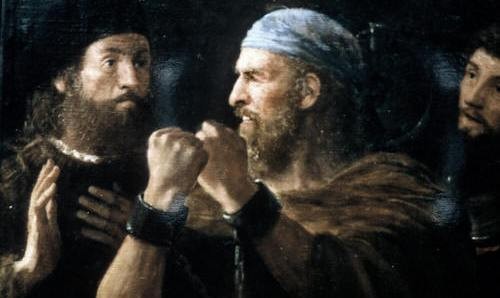
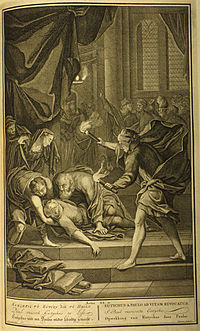
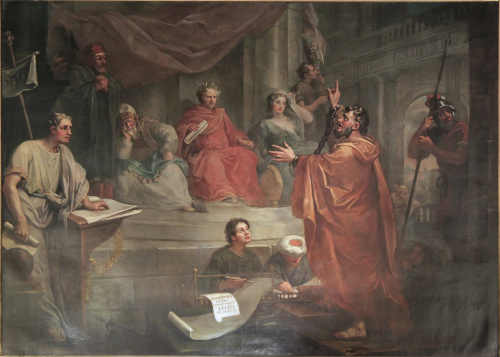
hogarth-paul-before-felix-picActs 24

1 And after five days the high priest Ananias came down with some elders and a spokesman, one Tertullus. They laid before the governor their case against Paul. 2 And when he had been summoned, Tertullus began to accuse him, saying: “Since through you we enjoy much peace, and since by your foresight, most excellent Felix, reforms are being made for this nation, 3 in every way and everywhere we accept this with all gratitude. 4 But, to detain you no further, I beg you in your kindness to hear us briefly. 5 For we have found this man a plague, one who stirs up riots among all the Jews throughout the world and is a ringleader of the sect of the Nazarenes. 6 He even tried to profane the temple, but we seized him. 8 By examining him yourself you will be able to find out from him about everything of which we accuse him.” 9 The Jews also joined in the charge, affirming that all these things were so. 10 And when the governor had nodded to him to speak, Paul replied: “Knowing that for many years you have been a judge over this nation, I cheerfully make my defense. 11 You can verify that it is not more than twelve days since I went up to worship in Jerusalem, 12 and they did not find me disputing with anyone or stirring up a crowd, either in the temple or in the synagogues or in the city. 13 Neither can they prove to you what they now bring up against me. 14 But this I confess to you, that according to the Way, which they call a sect, I worship the God of our fathers, believing everything laid down by the Law and written in the Prophets, 15 having a hope in God, which these men themselves accept, that there will be a resurrection of both the just and the unjust. 16 So I always take pains to have a clear conscience toward both God and man. 17 Now after several years I came to bring alms to my nation and to present offerings. 18 While I was doing this, they found me purified in the temple, without any crowd or tumult. But some Jews from Asia— 19 they ought to be here before you and to make an accusation, should they have anything against me. 20 Or else let these men themselves say what wrongdoing they found when I stood before the council, 21 other than this one thing that I cried out while standing among them: ‘It is with respect to the resurrection of the dead that I am on trial before you this day.’” 22 But Felix, having a rather accurate knowledge of the Way, put them off, saying, “When Lysias the tribune comes down, I will decide your case.” 23 Then he gave orders to the centurion that he should be kept in custody but have some liberty, and that none of his friends should be prevented from attending to his needs. 24 After some days Felix came with his wife Drusilla, who was Jewish, and he sent for Paul and heard him speak about faith in Christ Jesus. 25 And as he reasoned about righteousness and self-control and the coming judgment, Felix was alarmed and said, “Go away for the present. When I get an opportunity I will summon you.” 26 At the same time he hoped that money would be given him by Paul. So he sent for him often and conversed with him. 27 When two years had elapsed, Felix was succeeded by Porcius Festus. And desiring to do the Jews a favor, Felix left Paul in prison.

Evelyn Waugh was a famous satirist and novelist in the early part of the twentieth century. A Christian, Waugh usually found a way to speak in all of his novels about the most important things in life. In his novel, Decline and Fall, there is a scene in which Otto Silenus tells the hero of the story, Paul, about the meaning of life. His illustration is powerful:

“…Shall I tell you about life?”

            “Yes, do,” said Paul politely.

            “Well, it’s like the big wheel at Luna Park. Have you seen the big wheel?”

            “No, I’m afraid not.”

            “You pay five francs and go into a room with tiers of seats all round, and in the centre the floor is made of a great disc of polished wood that revolves quickly. At first you sit down and watch the others. They are all trying to sit in the wheel, and they keep getting flung off, and that makes them laugh, and you laugh too. It’s great fun.”

            “I don’t think that sounds very much like life,” said Paul rather sadly.

            “Oh, but it is, though. You see, the nearer you can get to the hub of the wheel the slower it is moving and the easier it is to stay on. There’s generally some one in the centre who stands up and sometimes does a sort of dance. Often he’s paid by the management, though, or, at any rate, he’s allowed in free. Of course at the very centre there’s a point completely at rest, if one could only find it. I’m not sure I am not very near that point myself. Of course the professional men get in the way. Lots of people just enjoy scrambling on and being whisked off and scrambling on again. How they all shriek and giggle! Then there are others…who sit as far out as they can and hold on for dear life and enjoy that.”[1]

What a fascinating picture of life, and how true! Life, Otto says, is like a great turning wheel. If you sit at the edges, you get thrown off and hurt. At the very least, you get dizzy and disoriented at the edges of life. The closer you move to the center, however, the more stability you have. At the very center, he says, “there’s a point completely at rest, if one could only find it.”

Did you hear what else he said? He said that the people who own the wheel will usually hire somebody who knows how to get to the very center. So they stand in the center and dance. By doing so, they are providing an example to everybody else in the room. They are saying, by their dancing, that you can have joy and live at the very center, but not until you get there.

I believe this is a very helpful illustration for life. There is a place of stability, of calm, a place where we can stand and live and even dance. But that place is at the very center, and none of us ever seem to be able to reach the center. But One did. Jesus came and showed us how to stand in the center of life so that we would not be thrown off, so that we could find a place of equilibrium. Jesus showed us the way.

I love the fact that the early Church was known as followers of “the Way.” In fact, the Church itself came to be called “the Way.” Why? It is undoubtedly related to the Church’s conviction that Jesus is the way, as He said in John 14.

1 “Let not your hearts be troubled. Believe in God; believe also in me. 2 In my Father’s house are many rooms. If it were not so, would I have told you that I go to prepare a place for you? 3 And if I go and prepare a place for you, I will come again and will take you to myself, that where I am you may be also. 4 And you know the way to where I am going.” 5 Thomas said to him, “Lord, we do not know where you are going. How can we know the way?” 6 Jesus said to him, “I am the way, and the truth, and the life. No one comes to the Father except through me.

Yes, Jesus is the way. Why? Because He opens the door to God. Because He is the door to God. Because He is God! He is the One who stands the center and calls all of us to Him. He is, therefore, the source of stability, of life, of living! So the Church came to be known as “the Way” because it had embraced the way of Christ.

Jesus enables all of those who come to Him to have life and that abundantly. Paul knew this. For Paul, Jesus was the way. For Paul, Jesus was the key to unlocking everything he had been missing. He says as much in his defense before the governor Felix. Let us first set the stage. As usual, Paul was being accused of wrongdoing.

1 And after five days the high priest Ananias came down with some elders and a spokesman, one Tertullus. They laid before the governor their case against Paul. 2 And when he had been summoned, Tertullus began to accuse him, saying: “Since through you we enjoy much peace, and since by your foresight, most excellent Felix, reforms are being made for this nation, 3 in every way and everywhere we accept this with all gratitude. 4 But, to detain you no further, I beg you in your kindness to hear us briefly. 5 For we have found this man a plague, one who stirs up riots among all the Jews throughout the world and is a ringleader of the sect of the Nazarenes. 6 He even tried to profane the temple, but we seized him. 8 By examining him yourself you will be able to find out from him about everything of which we accuse him.” 9 The Jews also joined in the charge, affirming that all these things were so.

This Turtullus would appear to be a lawyer who is going to present the Jews’ case against Paul to Felix. He began with a flowery introduction intended to flatter Felix. This is called a captatio benevolentiae and was a standard rhetorical device intended to win the favor of the presiding authority. Turtullus, by all accounts, lays it on thick. Craig Keener, commenting on this introduction, writes that “although flattery was sometimes true, this example is blatantly false: revolutionaries had escalated under Felix’s corrupt and repressive administration, bringing neither peace nor reforms.”[2]

Regardless, Turtullus laid out his case, charging Paul with being an instigator, a troublemaker, and seditious. Felix, hearing the charges, turned his attention to Paul.

10 And when the governor had nodded to him to speak, Paul replied: “Knowing that for many years you have been a judge over this nation, I cheerfully make my defense. 11 You can verify that it is not more than twelve days since I went up to worship in Jerusalem, 12 and they did not find me disputing with anyone or stirring up a crowd, either in the temple or in the synagogues or in the city. 13 Neither can they prove to you what they now bring up against me.

Paul began by brushing off the allegations of the Jews, flatly denying that he had gone up to the Temple to cause any trouble. Then, Paul moved to a positive statement about who he wa and what he was about. It is here that we can begin to unfold just what Jesus had freed Paul to do and how Jesus had brought Paul to the stable center of life.

14 But this I confess to you, that according to the Way, which they call a sect, I worship the God of our fathers, believing everything laid down by the Law and written in the Prophets 15 having a hope in God, which these men themselves accept, that there will be a resurrection of both the just and the unjust.

The key phrase in verse 14 is “according to the Way.” That is a controlling phrase and it colors all of the particulars that follow it. “According to the Way” could just as easily be rendered “because of Jesus.” In other words, all that follows is situated by Paul within the context of Jesus Christ and the gospel of Christ. “According to the Way.” “According to Jesus and what He has done for me, for us.”

And what had Jesus done for Paul? Four things, the first three of which are in verses 14 and 15.

Worship

First, Jesus had freed Paul to worship.

14a But this I confess to you, that according to the Way, which they call a sect, I worship the God of our fathers

Paul said that he worshipped “the God of our fathers.” The “our” there is a reference to the Jews who stand beside him condemning him. This is a critically important phrase. Paul did not see Jesus as having pulled him away from the worship of the God of Israel. Paul saw Jesus as pulling him deeper into the worship of the God of Israel.

Paul undoubtedly knew the words of Jesus from Matthew 5:

17 “Do not think that I have come to abolish the Law or the Prophets; I have not come to abolish them but to fulfill them. 18 For truly, I say to you, until heaven and earth pass away, not an iota, not a dot, will pass from the Law until all is accomplished.

Whether or not he knew that exact statement, he knew the truth of it: that in Christ Jesus God’s promises to His people and the covenants had been fulfilled. Jesus said that nothing from the Law would pass until all was accomplished…then Jesus accomplished it! So in Christ we find the perfection to which the Law pointed and which the Law demanded. Jesus is the hope of Israel.

For this reason, Paul said he worshipped God “according to the Way” or “according to the way of Jesus” or “because of Jesus.”

Jesus is the door through which the true worship of God takes place. This is what makes the modern ecumenical effort to allegedly beautify worship by pouring any and all other forms of (i.e., non-Jesus-based) worship into one large pot so very frustrating. I heard last week of a Baptist church that called a preacher fixated on Buddhist meditation techniques. So he began to teach these Buddhist meditation techniques. Understandably, the church was upset! We do not believe that the gospel of Christ needs Buddha to make it cool or edgy. Christ is enough!

Christ, for Paul, was the key, he was “the Way.” Jesus had unlocked for Paul a deeper and fuller understanding of what worship is than he had ever known before…and may I remind us that, prior to coming to know Jesus, Paul was a very devout man! He had worshiped before, but not like this! This is what he meant when he said he worshipped “according to the Way.”

Belief

Similiarly, Jesus enabled Paul to believe.

14b But this I confess to you, that according to the Way…believing everything laid down by the Law and written in the Prophets

What can this mean? Had Paul not believed before? Yes, he had known belief before. Listen to what he says in Philippians 3.

4b If anyone else thinks he has reason for confidence in the flesh, I have more: 5 circumcised on the eighth day, of the people of Israel, of the tribe of Benjamin, a Hebrew of Hebrews; as to the law, a Pharisee; 6 as to zeal, a persecutor of the church; as to righteousness under the law, blameless.

What, then, was the problem? With a religious pedigree like that, how could Paul attain a deeper position of belief “according to the Way”? Listen to that text again but with Paul’s conclusion.

4b If anyone else thinks he has reason for confidence in the flesh, I have more: 5 circumcised on the eighth day, of the people of Israel, of the tribe of Benjamin, a Hebrew of Hebrews; as to the law, a Pharisee; 6 as to zeal, a persecutor of the church; as to righteousness under the law, blameless. 7 But whatever gain I had, I counted as loss for the sake of Christ. 8 Indeed, I count everything as loss because of the surpassing worth of knowing Christ Jesus my Lord. For his sake I have suffered the loss of all things and count them as rubbish, in order that I may gain Christ 9 and be found in him, not having a righteousness of my own that comes from the law, but that which comes through faith in Christ, the righteousness from God that depends on faith— 10 that I may know him and the power of his resurrection, and may share his sufferings, becoming like him in his death, 11 that by any means possible I may attain the resurrection from the dead.

Amazing! Paul essentially says, “All that I thought I knew before and all of my religious devotions and actions are nothing compared to knowing Jesus!”

Paul refers to “the surpassing worth of knowing Christ Jesus my Lord.” What a beautiful way of putting it! Indeed, there is an infinitely exceptional quality to Jesus Christ that makes all rival truth claims recede into the darkness!

According to the Way…I believe!

We are told in our supposedly progressive age that faith itself is inherently beautiful. “Just believe in something,” we are told, as if the object of that belief is superfluous. Hollywood people say this kind of thing all the time: “I’m not religious but I’m spiritual. I believe deeply. I feel deeply. I am aware of some kind of vague but present power.”

Dear friends, is that enough? Is it enough to console yourself with the fact that you know this visible, temporal world is not all there is? How can that be enough! A child of 2 years old knows that!

No, give us Jesus! Let the object of our affections be the Jesus of space and time and the Jesus of eternity, the Jesus who walked the dusty streets of Palestine and the Jesus who now sits at the right hand of the Father making intercession for the saints!

Hope

And on the basis of this belief, Paul now had hope!

14a But this I confess to you, that according to the Way…15 having a hope in God, which these men themselves accept, that there will be a resurrection of both the just and the unjust.

Paul is here alluding to his earlier argument before the Jewish high priest that both he and the Pharisees held to a belief in the resurrection of the dead, which is true. But Paul also meant the resurrection of the dead in Christ because of the resurrection of Christ Himself! Paul therefore had hope in this life and the life to come because Paul knew that Jesus had defeated death in the resurrection.

“According to the Way…having a hope in God.”

Jesus gives us hope.

It is a terrible thing to have no hope.

Nikos Kazantzakis, the author of Zorba the Greek and The Last Temptation of Christ, held to a kind of eclectic spirituality. He held to certain aspects of Christianity and rejected others. As a result, he was excommunicated by the Greek Orthodox Church. Kazantzakis died of leukemia in 1957. His tombstone reads, “I hope for nothing. I fear nothing. I am free.”[3]

No doubt he thought that was a brave sentiment. “I hope for nothing. I fear nothing. I am free.”

I find it tragic.

Christians do not say, “I hope for nothing.” Paul said that he had hope in God “that there will be a resurrection.” But so many today do not have hope!

On Edgar Allen Poe’s deathbed, he was tormented by a lack of hope. One biographer described his deathbed scene like this:

He asked her [Dr. Moran’s wife] if there was any hope. She replied, thinking he meant, hope for recovery, that her husband thought him a very ill man. He then said, “I meant hope for a wretch like me beyond this life.” She tried to comfort him, “with words of the Great Physician,” and read him the fourteenth chapter of St. John. Wiping the beads of perspiration from his brow, she smoothed his pillow, gave him a soothing draught, and departed to make his shroud. What Poe thought no one will ever know. Nothing less heartrending can truthfully be said, than that the death of Edgar Allan Poe was more painful than his life.[4]

How very, very sad! Poe had no hope! Did he trust in Christ there at the very end? Oh, I very much hope so! But we do not know, and so we are left to wonder.

But Paul knew the rock-solid reality of the hope that Christ brings. Paul had wagered all on Christ and, “according to the Way,” he now how the hope of life eternal!

Live

He also had the hope of life here and now! Paul continued the account of his story before Felix.

16 So I always take pains to have a clear conscience toward both God and man. 17 Now after several years I came to bring alms to my nation and to present offerings. 18 While I was doing this, they found me purified in the temple, without any crowd or tumult. But some Jews from Asia— 19 they ought to be here before you and to make an accusation, should they have anything against me. 20 Or else let these men themselves say what wrongdoing they found when I stood before the council, 21 other than this one thing that I cried out while standing among them: ‘It is with respect to the resurrection of the dead that I am on trial before you this day.’” 22 But Felix, having a rather accurate knowledge of the Way, put them off, saying, “When Lysias the tribune comes down, I will decide your case.” 23 Then he gave orders to the centurion that he should be kept in custody but have some liberty, and that none of his friends should be prevented from attending to his needs. 24 After some days Felix came with his wife Drusilla, who was Jewish, and he sent for Paul and heard him speak about faith in Christ Jesus.

This is most interesting. It is helpful to know that Felix had stolen his Jewish wife Drusilla from her Jewish husband after he became fixated on her. It was something of a scandal. Thus, the contents of Paul’s words to this couple take on a poignant and pointed meaning.

25 And as he reasoned about righteousness and self-control and the coming judgment, Felix was alarmed and said, “Go away for the present. When I get an opportunity I will summon you.” 26 At the same time he hoped that money would be given him by Paul. So he sent for him often and conversed with him. 27 When two years had elapsed, Felix was succeeded by Porcius Festus. And desiring to do the Jews a favor, Felix left Paul in prison.

Paul “reasoned about righteousness and self-control and the coming judgment.” It is understandable, then, that “Felix was alarmed.” His marriage had been founded on a complete lack of righteousness and self-control and fear of the coming judgment. Was Paul trying to make a point to this couple in particular? Almost certainly! Felix’s alarm almost certainly knew the uncomfortable implications of Paul’s words.

That being said, he is making a point for us as well. We must remember that this proclamation was likewise related to that phrase “according to the Way.” In other words, because of Jesus I now know how to exercise self-control, to live righteousness, and to be ready for judgment. That is, because of the Way, because of Jesus, we are now equipped to live life.

What Jesus gave Paul was therefore not only hope for the life to come but the tools to live life here and now. John Stott has written that “life on earth is a brief pilgrimage between two moments of nakedness. So we would be wise to travel light. We shall take nothing with us.”[5] How very well said!

Paul stood between his two moments of nakedness with the knowledge that now, finally, he had found the center of life, the point of peace and equilibrium: Jesus Himself. For Paul, and for us, this meant regaining the ability to worship, believe, hope, and live!

The gifts of Christ are rich gifts indeed! Have you received them? If not, it is not for any lack of offering on His part, but rather for a lack of receiving on your own.

He offers them to you now.

Jesus’ hand is extended to you.

In that hand is life itself.

Won’t you take it?

Take it now.


[1] Evelyn Waugh, Decline and Fall (New York, NY: Little, Brown and Company, 1956), p.282-283.

[2] Craig S. Keener, The IVP Bible Background Commentary: New Testament. (Downers Grove, IL: 1993), p.394.

[3] Kazantzakis, Nikos (2012-09-04). Saint Francis (Kindle Location 51). Simon & Schuster. Kindle Edition.

[4] Hervey Allen. Israfel: The Life and Times of Edgar Allen Poe. (Murray Hill, New York: Farrar & Rinehart, Inc., 1934), p.674.

[5] John Stott, The Radical Disciple (Downers Grove, IL: InterVarsity Press, 2010), p.21.
Acts 23

paul-before-the-sanherin1Acts 23

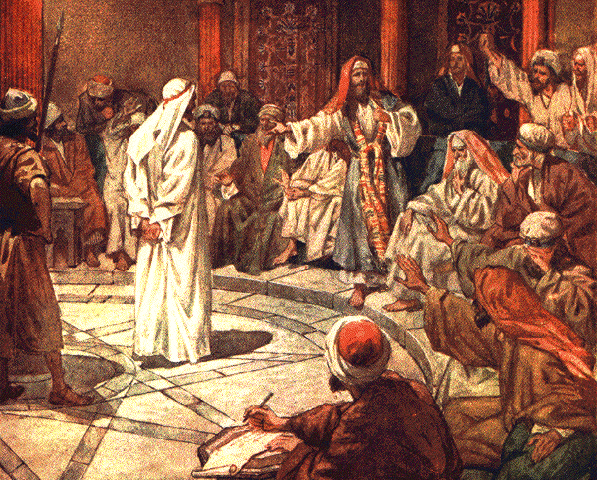
1 And looking intently at the council, Paul said, “Brothers, I have lived my life before God in all good conscience up to this day.” 2 And the high priest Ananias commanded those who stood by him to strike him on the mouth. 3 Then Paul said to him, “God is going to strike you, you whitewashed wall! Are you sitting to judge me according to the law, and yet contrary to the law you order me to be struck?” 4 Those who stood by said, “Would you revile God’s high priest?” 5 And Paul said, “I did not know, brothers, that he was the high priest, for it is written, ‘You shall not speak evil of a ruler of your people.’” 6 Now when Paul perceived that one part were Sadducees and the other Pharisees, he cried out in the council, “Brothers, I am a Pharisee, a son of Pharisees. It is with respect to the hope and the resurrection of the dead that I am on trial.” 7 And when he had said this, a dissension arose between the Pharisees and the Sadducees, and the assembly was divided. 8 For the Sadducees say that there is no resurrection, nor angel, nor spirit, but the Pharisees acknowledge them all. 9 Then a great clamor arose, and some of the scribes of the Pharisees’ party stood up and contended sharply, “We find nothing wrong in this man. What if a spirit or an angel spoke to him?” 10 And when the dissension became violent, the tribune, afraid that Paul would be torn to pieces by them, commanded the soldiers to go down and take him away from among them by force and bring him into the barracks. 11 The following night the Lord stood by him and said, “Take courage, for as you have testified to the facts about me in Jerusalem, so you must testify also in Rome.” 12 When it was day, the Jews made a plot and bound themselves by an oath neither to eat nor drink till they had killed Paul. 13 There were more than forty who made this conspiracy. 14 They went to the chief priests and elders and said, “We have strictly bound ourselves by an oath to taste no food till we have killed Paul. 15 Now therefore you, along with the council, give notice to the tribune to bring him down to you, as though you were going to determine his case more exactly. And we are ready to kill him before he comes near.” 16 Now the son of Paul’s sister heard of their ambush, so he went and entered the barracks and told Paul. 17 Paul called one of the centurions and said, “Take this young man to the tribune, for he has something to tell him.” 18 So he took him and brought him to the tribune and said, “Paul the prisoner called me and asked me to bring this young man to you, as he has something to say to you.” 19 The tribune took him by the hand, and going aside asked him privately, “What is it that you have to tell me?” 20 And he said, “The Jews have agreed to ask you to bring Paul down to the council tomorrow, as though they were going to inquire somewhat more closely about him. 21 But do not be persuaded by them, for more than forty of their men are lying in ambush for him, who have bound themselves by an oath neither to eat nor drink till they have killed him. And now they are ready, waiting for your consent.” 22 So the tribune dismissed the young man, charging him, “Tell no one that you have informed me of these things.” 23 Then he called two of the centurions and said, “Get ready two hundred soldiers, with seventy horsemen and two hundred spearmen to go as far as Caesarea at the third hour of the night. 24 Also provide mounts for Paul to ride and bring him safely to Felix the governor.” 25 And he wrote a letter to this effect: 26 “Claudius Lysias, to his Excellency the governor Felix, greetings. 27 This man was seized by the Jews and was about to be killed by them when I came upon them with the soldiers and rescued him, having learned that he was a Roman citizen. 28 And desiring to know the charge for which they were accusing him, I brought him down to their council. 29 I found that he was being accused about questions of their law, but charged with nothing deserving death or imprisonment. 30 And when it was disclosed to me that there would be a plot against the man, I sent him to you at once, ordering his accusers also to state before you what they have against him.” 31 So the soldiers, according to their instructions, took Paul and brought him by night to Antipatris. 32 And on the next day they returned to the barracks, letting the horsemen go on with him. 33 When they had come to Caesarea and delivered the letter to the governor, they presented Paul also before him. 34 On reading the letter, he asked what province he was from. And when he learned that he was from Cilicia, 35 he said, “I will give you a hearing when your accusers arrive.” And he commanded him to be guarded in Herod’s praetorium.

Francis Chan is a well known Christian pastor, and understandably so. He has a true passion for the gospel as well as for the body of Christ and frequently communicates gospel truths in quite unique ways. For instance, in his book Crazy Love, Chan used a bag of potato chips to illustrate the tragedy of the lack of integrity in many Christians’ lives.

Recently I saw a bag of potato chips with a bold declaration splashed across the front: “Zero grams of trans fat.” I was glad to know that I wouldn’t be consuming trans fat, which research has shown is detrimental to my health. But then I flipped the bag over and read the ingredients list, which included things like “yellow #6” and other artificial colors, and partially hydrogenated oil (which is trans fat, just a small enough amount that they can legally call it “0 grams”). I thought it was incredibly ironic that these chips were being advertised in a way that makes me think they are not harmful yet were really full of empty calories, weird chemicals, and, ironically, trans fat.

It struck me that many Christians flash around their “no trans fat” label, trying to convince everyone they are healthy and good. Yet they have no substantive or healthful elements to their faith…Obviously, it’s not what you advertise that counts; it’s what you are really made of.[1]

Wow! That raises an interesting question: what are we really made of? You can usually tell what somebody is truly made of in times of great trial or testing. In those moments, we get to see if the label matches the reality. That was the case with Paul, anyway, as he stood before the Jewish high council to launch a defense of himself: his label matched his reality. His example in this episode (which really is just an explanation of his life) provides us with a model for how we too should live as followers of Jesus.

Live with such a fierce consistency that the charge of hypocrisy cannot stick.

Paul has already offered his apologia, his defense, before a larger crowd of the Jews. Now he is speaking to the religious authorities, indeed before the Jewish high priest himself, before whom he had been hauled.

1 And looking intently at the council, Paul said, “Brothers, I have lived my life before God in all good conscience up to this day.”

Notice, first, the intensity of Paul’s focus and defense. He looked at them, not away from them. He did not mumble. He was not afraid. He was prepared to say what he needed to say. However, what he said first is most troubling! “I have lived my life before God in all good conscience up to this day.”

Well.

What on earth can this mean? After all, Paul was keenly aware of his own sinfulness, even going so far as to call himself “the chief of sinners.” How, then, can he say with a straight face that he had lived his life…before God…in good conscience…up to this day?

This is one of those instances in which a consideration of the original language will help us tremendously.

A.T. Robertson notes that the Greek for the phrase “lived my life before God” is pepoliteumai toi theoi and that the verb pepoliteumai is an “old verb” that means “to manage [the] affairs of [a] city (polis) or state, to be a citizen, [to] behave as a citizen.” He then quotes a paraphrase of the verse from Rackham as, “He had lived as God’s citizen, as a member of God’s commonwealth.” Furthermore, the word “conscience” is suneidesis which literally means “joint-knowledge” and probably carries the meaning here of Paul having lived consistently with what he felt was true at each stage of his life, whether wrongly as a persecutor of the Church or rightly now as a follower of Jesus. Regardles, Robertson tells us, “the golden thread of consistency runs through, as a good citizen of God’s commonwealth.”[2]

What Paul is saying, then, is that when he was a Jew and persecuted the Church, he was in error, yes, but he was nonetheless living consistently with what he thought was true and with what he thought would most bring glory to God. Then, when he became a believer, he saw the error of his ways and became a follower and champion of Jesus. In the former instance, he was in error. In the latter instance, he was correct. But in neither instance did Paul act as a hypocrite.

He was not arguing for moral perfection. That indeed would have been an audacious and false thing for Paul to do. On the contrary, he was trying to say that he was the type of person that lived in fierce consistency with his principles, even if his principles were mistaken. Thus, he seemed to be saying, “You can look at me and tell me you think I’m in error, but I defy you to look at me and tell me that I’m a hypocrite, or that I lack integrity, or that I’m an opportunist, or that I ride whatever wave happens to be fashionable at the time.”

Paul was radically committed to what he felt was true. This meant that when he was in error, he was all in with his error! But when he was right, he was all in with the truth! What he did not lack was integrity, and, in that sense, Paul could say he had operated in good conscience before God throughout his life. That is, he was a man who believed what he believed and said what he thought was true and would continue to do so until such time as he was shown to be in error.

Our age, like Paul’s age, is sorely lacking in this type of stubborn consistency. In Umberto Eco’s novel, Focault’s Pendulum, Signor Salon makes the following comment to Casaubon:

Today, even among ideologies, there’s no consistency. There are times when I think of switching to narcotics. There, at least you can rely on a heroin pusher to push heroin.[3]

Ha! Well, he is right. You can count on drug pushers to push drugs. You can say (rightly) that they are in error, but the average drug pusher knows what he is about. Tragically, this cannot be said of large swathes of the Christian Church today. Os Guinness put it like this:

Anyone who wants to observe religion in the modern world and find the sort of belief that behaves would be advised to look at the cults rather than at Christians. What cult members believe may be bizarre, and the way they behave even worse, but to their credit there is a consistency between their belief and their behavior which is rare in the modern world.[4]

Church, live with such a fierce consistency that the charge of hypocrisy cannot stick. Paul did! He was right in what he asserted, even though, as we will see, his assertion was not well received.

2 And the high priest Ananias commanded those who stood by him to strike him on the mouth. 3 Then Paul said to him, “God is going to strike you, you whitewashed wall! Are you sitting to judge me according to the law, and yet contrary to the law you order me to be struck?” 4 Those who stood by said, “Would you revile God’s high priest?” 5 And Paul said, “I did not know, brothers, that he was the high priest, for it is written, ‘You shall not speak evil of a ruler of your people.’” 6 Now when Paul perceived that one part were Sadducees and the other Pharisees, he cried out in the council, “Brothers, I am a Pharisee, a son of Pharisees. It is with respect to the hope and the resurrection of the dead that I am on trial.” 7 And when he had said this, a dissension arose between the Pharisees and the Sadducees, and the assembly was divided. 8 For the Sadducees say that there is no resurrection, nor angel, nor spirit, but the Pharisees acknowledge them all. 9 Then a great clamor arose, and some of the scribes of the Pharisees’ party stood up and contended sharply, “We find nothing wrong in this man. What if a spirit or an angel spoke to him?” 10 And when the dissension became violent, the tribune, afraid that Paul would be torn to pieces by them, commanded the soldiers to go down and take him away from among them by force and bring him into the barracks.

Paul deftly sized up the situation and played on the inter-party politics and theological conflicts between the Pharisees (who believed in a final resurrection of the dead) and Sadducees (who did not) to get the two sides to turn on each other. This conflict turned ugly and then violent, so Paul, once more, was saved by the soldiers who hauled him away from the riot.

Live with undaunted courage, knowing that the Lord Jesus stands beside you.

In addition to living with fierce consistency, this episode shows us that we should live with undaunted courage, knowing that the Lord Jesus stands beside us. After this tumultuous escape, something amazing happened to Paul in the night.

11 The following night the Lord stood by him and said, “Take courage, for as you have testified to the facts about me in Jerusalem, so you must testify also in Rome.”

The wording here (“the Lord stood by him”) means that Jesus himself appeared to Paul. He not only appeared to him, he spoke words of profound comfort and courage to him: “Take courage, for as you have testified to the facts about me in Jerusalem, so you must testify also in Rome.” Meaning, “Paul, I am with you, and I am not done with you. You have more to do in my service…but you will not do it alone.”

R.C. Sproul has pointed out something intriguing about the actual wording at this point in our text.

The English translation of Jesus’ words here doesn’t really grasp the force of what happened. First, it says that Jesus “stood by” him. That is weak. The Greek words indicate that Jesus came and in a sense overshadowed Paul. His presence was enormous. There was Paul cringing in his cell, and suddenly the risen Christ came and hovered over him and said, “Be of good cheer.” The Latin translation uses a word that is the foundation for the English word constancy. This was no glib “Cheer up!” Jesus was saying, “Paul, be constant. Be consistent. Stay with the ministry you have had through all these years, day in and day out.” That is a message we all need to hear. This is how Jesus encouraged His Apostle. If anybody had ever been constant in ministry from the day he was called, it was Paul; yet Jesus had come to him personally and shore him up.[5]

Yes, we all need to hear this challenge to constancy! Many, many years before Sproul’s observation, John Chrysostom asked a question about this text and then answered it.

Why didn’t [Jesus] appear to him before he fell into danger. Because, as always, it is in afflictions that God consoles. For then he appears more desirable, as he trains us even in the midst of dangers.[6]

Oh, Church! “As always, it is in afflictions that God consoles!” It is ok to need encouragement. Paul did! So do we! Live with undaunted courage, knowing that the Lord Jesus stands beside you.

Live unwaveringly as an agent of holy unrest in the midst of an age that is blind to the truth.

And Church, create trouble in this troubled world! Oh, I do not mean mere mischief or trouble for trouble’s sake. I mean, be an agent of sanctified agitation. Live unwaveringly as an agent of holy unrest in the midst of an age that is blind to the truth! See the agitation that seemed to follow Paul:

12 When it was day, the Jews made a plot and bound themselves by an oath neither to eat nor drink till they had killed Paul. 13 There were more than forty who made this conspiracy. 14 They went to the chief priests and elders and said, “We have strictly bound ourselves by an oath to taste no food till we have killed Paul. 15 Now therefore you, along with the council, give notice to the tribune to bring him down to you, as though you were going to determine his case more exactly. And we are ready to kill him before he comes near.” 16 Now the son of Paul’s sister heard of their ambush, so he went and entered the barracks and told Paul. 17 Paul called one of the centurions and said, “Take this young man to the tribune, for he has something to tell him.” 18 So he took him and brought him to the tribune and said, “Paul the prisoner called me and asked me to bring this young man to you, as he has something to say to you.” 19 The tribune took him by the hand, and going aside asked him privately, “What is it that you have to tell me?” 20 And he said, “The Jews have agreed to ask you to bring Paul down to the council tomorrow, as though they were going to inquire somewhat more closely about him. 21 But do not be persuaded by them, for more than forty of their men are lying in ambush for him, who have bound themselves by an oath neither to eat nor drink till they have killed him. And now they are ready, waiting for your consent.” 22 So the tribune dismissed the young man, charging him, “Tell no one that you have informed me of these things.” 23 Then he called two of the centurions and said, “Get ready two hundred soldiers, with seventy horsemen and two hundred spearmen to go as far as Caesarea at the third hour of the night. 24 Also provide mounts for Paul to ride and bring him safely to Felix the governor.” 25 And he wrote a letter to this effect: 26 “Claudius Lysias, to his Excellency the governor Felix, greetings. 27 This man was seized by the Jews and was about to be killed by them when I came upon them with the soldiers and rescued him, having learned that he was a Roman citizen. 28 And desiring to know the charge for which they were accusing him, I brought him down to their council. 29 I found that he was being accused about questions of their law, but charged with nothing deserving death or imprisonment. 30 And when it was disclosed to me that there would be a plot against the man, I sent him to you at once, ordering his accusers also to state before you what they have against him.” 31 So the soldiers, according to their instructions, took Paul and brought him by night to Antipatris. 32 And on the next day they returned to the barracks, letting the horsemen go on with him. 33 When they had come to Caesarea and delivered the letter to the governor, they presented Paul also before him. 34 On reading the letter, he asked what province he was from. And when he learned that he was from Cilicia, 35 he said, “I will give you a hearing when your accusers arrive.” And he commanded him to be guarded in Herod’s praetorium.

Say what you will about Paul, but he lived with such unbelievable fidelity to Christ and His gospel that the world could not be complacent around him. You have to be a particular kind of person to have more than forty folk vow not to eat or drink until they succeeded in murdering you! Paul was a sanctified trouble maker! French theologian Jacques Ellul once said, “Christians should be troublemakers, creators of uncertainty, agents of a dimension incompatible with society.”[7] Yes, and that dimension that is incompatible with society as it is currently ordered is the Kingdom of God!

Do you see? To be a faithful ambassador and representative of the Kingdom of God is to live in such conflict with the current world order that your mere presence is an agitation. Shane Clairborne has passed on some amazing and inspiring words about this critical dynamic.

[Kaj] Munk was an outspoken priest and playwright who uttered these prophetic words before he was killed, with his Bible next to him, by the Gestapo in January 1944…

What is, therefore, our task today? Shall I answer: “Faith, hope, and love”? That sounds beautiful. But I would say – courage. No, even that is not challenging enough to be the whole truth. Our task today is recklessness. For what we Christians lack is not psychology or literature…we lack a holy rage – the recklessness which comes from the knowledge of God and humanity. The ability to rage when justice lies prostrate on the streets, and when the lie rages across the face of the earth…To rage against complacency. To restlessly seek that recklessness that will challenge and seek to change human history until it conforms to the norms of the Kingdom of God. And remember the signs of the Christian Church have been the Lion, the Lamb, the Dove, and the Fish…but never the chameleon.[8]

Ah, amen and amen, Church! Live unwaveringly as an agent of holy unrest in the midst of an age that is blind to the truth!


[1] Francis Chan, Crazy Love (Colorado Springs, CO: David Cook, 2008), p.93.

[2] A.T. Robertson, Acts. Word Pictures in the New Testament. Vol.III (Nashville, TN: Broadman Press, 1930), p.398.

[3] Umberto Eco. Focault’s Pendulum. (New York: Harcourt Brace & Company, 1989), p.315.

[4] Os Guinness. The Devil’s Gauntlet. (Downers Grove, IL: InterVarsity Press, 1989), p.13.

[5] Sproul, R.C. Acts (St. Andrews Expositional Commentary) (Location 5911-5920). Crossway Books. Kindle Edition.

[6] Francis Martin, ed. Acts. Ancient Christian Commentary on Scripture. New Testament, vol.V. Thomas C. Oden, gen. ed. (Downers Grove, IL: InterVarsity Press, 2006), p.279.

[7] Quoted in Shane Clairborne, The Irresistible Revolution (Grand Rapids, MI: Zondervan, 2006), p.231.

[8] Shane Clairborne, p.294-295.


Thomas C. Oden’s A Change of Heart

41J+2pF9hSL._SY344_BO1,204,203,200_It would be hard for me to overstate what the work of Methodist theologian Thomas Oden has meant to me since I first encountered it almost twenty years ago.  Simply put, Oden helped pull me away from the ahistorical fundamentalism of my youth into the exhilarating and liberating fields of orthodoxy and classical Christian truth.  A Change of Heart is Oden’s fascinating tale of his journey into, through, and then out the other side of radical activist theological faddishness on his journey toward orthodoxy.  It is an enthralling tale covering a dizzying array of 20th century theological movements, most of the leaders of which Tom Oden either met, worked with, or knew.  He mentions a lot of names, but amazingly one does not get the feel that he is “name dropping.”  Oden has walked too long a road for such foolishness, and the reader will no doubt see his earnest intentions if he reads this memoir with any sense of charity.
Oden is a man who has thought deeply about Christian truth.  He walked in the fields of radical leftist ideologies for quite some time, contributing to its literature and its institutional manifestations.  He drank deeply from the well of modernity and turned his keen mind toward the defense and advancement of its premises and worldview.  Then a colleague challenged Oden to consider the foundation on which he had built his career to that point. More so, he told Oden that he would never truly be a Christian theologian until he entered the world of the early Church fathers and classical consensual Christianity.  What Oden found there shook him to his core.  He found that these earlier generations of believers were not the simplistic and often grotesque caricatures that the intelligentsia of the radical left had painted them to be.  Rather, they were deeply passionate men and women of God who, while imperfect and prone themselves to error (as are we all), passed on the core of the faith to each successive generation.

Oden was overwhelmed by the beauty of Christianity in its purer forms as opposed to its hyper-modernistic recasting.  As a result, his earlier assumptions and extremes began to give way beneath the deep wellsprings of Christian truth.  It changed the trajectory of his life and, ever since, he has become perhaps the leading Protestant champion of the reclamation of patristic wisdom, conciliar Christian truth, and a robust orthodoxy alive today.

This story is very well told and is insightful, challenging, and convicting.  Of particular interest are the anecdotal stories of Oden’s encounters with the theological giants of the 20th century and of his insider’s look at the workings of leftist theological institutional life.  Furthermore, his account of how the Ancient Christian Commentary on Scripture (of which he is editor) came to be is fascinating as is his explanation of his current work on the history of African Christianity.

Oden is an elderly man now, but it is clear that his mind is still sharp and his heart attuned to the beauty of the gospel.  The Church today is stronger because of the work and insights of men like Oden.  I, for one, am deeply appreciative of the man and his work and wish him many more long years and published works!

Acts 21:40-22:30

236Acts 21:40-22:30

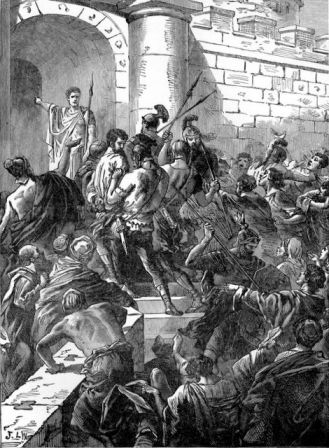
40 And when he had given him permission, Paul, standing on the steps, motioned with his hand to the people. And when there was a great hush, he addressed them in the Hebrew language, saying: 1 “Brothers and fathers, hear the defense that I now make before you.” 2 And when they heard that he was addressing them in the Hebrew language, they became even more quiet. And he said: 3 “I am a Jew, born in Tarsus in Cilicia, but brought up in this city, educated at the feet of Gamaliel according to the strict manner of the law of our fathers, being zealous for God as all of you are this day. 4 I persecuted this Way to the death, binding and delivering to prison both men and women, 5 as the high priest and the whole council of elders can bear me witness. From them I received letters to the brothers, and I journeyed toward Damascus to take those also who were there and bring them in bonds to Jerusalem to be punished. 6 “As I was on my way and drew near to Damascus, about noon a great light from heaven suddenly shone around me. 7 And I fell to the ground and heard a voice saying to me, ‘Saul, Saul, why are you persecuting me?’ 8 And I answered, ‘Who are you, Lord?’ And he said to me, ‘I am Jesus of Nazareth, whom you are persecuting.’ 9 Now those who were with me saw the light but did not understand the voice of the one who was speaking to me. 10 And I said, ‘What shall I do, Lord?’ And the Lord said to me, ‘Rise, and go into Damascus, and there you will be told all that is appointed for you to do.’ 11 And since I could not see because of the brightness of that light, I was led by the hand by those who were with me, and came into Damascus. 12 “And one Ananias, a devout man according to the law, well spoken of by all the Jews who lived there, 13 came to me, and standing by me said to me, ‘Brother Saul, receive your sight.’ And at that very hour I received my sight and saw him. 14 And he said, ‘The God of our fathers appointed you to know his will, to see the Righteous One and to hear a voice from his mouth; 15 for you will be a witness for him to everyone of what you have seen and heard. 16 And now why do you wait? Rise and be baptized and wash away your sins, calling on his name.’ 17 “When I had returned to Jerusalem and was praying in the temple, I fell into a trance 18 and saw him saying to me, ‘Make haste and get out of Jerusalem quickly, because they will not accept your testimony about me.’ 19 And I said, ‘Lord, they themselves know that in one synagogue after another I imprisoned and beat those who believed in you. 20 And when the blood of Stephen your witness was being shed, I myself was standing by and approving and watching over the garments of those who killed him.’ 21 And he said to me, ‘Go, for I will send you far away to the Gentiles.’” 22 Up to this word they listened to him. Then they raised their voices and said, “Away with such a fellow from the earth! For he should not be allowed to live.” 23 And as they were shouting and throwing off their cloaks and flinging dust into the air, 24 the tribune ordered him to be brought into the barracks, saying that he should be examined by flogging, to find out why they were shouting against him like this. 25 But when they had stretched him out for the whips, Paul said to the centurion who was standing by, “Is it lawful for you to flog a man who is a Roman citizen and uncondemned?” 26 When the centurion heard this, he went to the tribune and said to him, “What are you about to do? For this man is a Roman citizen.” 27 So the tribune came and said to him, “Tell me, are you a Roman citizen?” And he said, “Yes.” 28 The tribune answered, “I bought this citizenship for a large sum.” Paul said, “But I am a citizen by birth.” 29 So those who were about to examine him withdrew from him immediately, and the tribune also was afraid, for he realized that Paul was a Roman citizen and that he had bound him. 30 But on the next day, desiring to know the real reason why he was being accused by the Jews, he unbound him and commanded the chief priests and all the council to meet, and he brought Paul down and set him before them.

On March 2, 2004, the American theologian Avery Cardinal Dulles delivered the McGinley Lecture at Fordham University. It was entitled “The Rebirth of Apologetics.” That is a word we need to learn: apologetics. Apologetics refers to the act of defending the Christian faith. A Christian apologist is somebody who gives particular attention to defending the faith and countering arguments against the Christian faith with the truth of the gospel. There are people who have this as their primary ministry, but, in truth, every Christian needs to be an apologist.

Dulles’ lecture, “The Rebirth of Apologetics,” dealt with the question of how the Christian Church has defended the Christian faith over the last two thousand years and how it should seek to defend the Christian faith today. It was a very interesting lecture filled with very interesting insights. He shared how in earlier periods of Church history different approaches to defending the faith took center stage: some of them philosophical and some of them argumentative and some of them confronting particular heretical ideas or non-Christian religions that seemed to be threatening the Church at particular times or in particular places. In his lecture, after outlining the history of Christian apologetics, Dulles proposed that the future of Christian apologetics, the future of how we will most effectively defend the faith, will be through the sharing of testimonies. That is, we will best defend the faith by telling our stories about our personal relationships with Jesus.[1]

Church, there is something powerful about the story of how you came to Jesus and what difference He has made in your life! Do you remember the great old hymn “Blessed Assurance”? In 1873, Fanny Crosby wrote this hymn. Notice the words of it.

Blessed assurance, Jesus is mine! Oh, what a foretaste of glory divine!
Heir of salvation, purchase of God,
Born of His Spirit, washed in His blood.

Perfect submission, perfect delight, Visions of rapture now burst on my sight;
Angels, descending, bring from above
Echoes of mercy, whispers of love.

Perfect submission, all is at rest, I in my Savior am happy and blest,
Watching and waiting, looking above,
Filled with His goodness, lost in His love.

And after each stanza, the refrain:

This is my story, this is my song, Praising my Savior all the day long;
This is my story, this is my song, 
Praising my Savior all the day long.

Yes, “This is my story, this is my song!”

We need to regain a sense of the beauty and power of telling our stories, our testimonies. Some of you may be hearing this and may be thinking, “I do not have a story. I do not even know Jesus!” To you I would like to say, “You can begin your story today! You can accept Jesus today! Today could be the first chapter of your story with Jesus!”

I also realize that some of you are thinking, “Oh, I know all about these testimonies. The really good ones involve people who have done truly terrible things, who met Jesus in unbelievably shocking ways, and who have then had amazing, public ministries as a result! My story is nothing like that. I was raised in a Christian home and came to know Jesus at a very early life. My testimony is boring! Nobody would want to hear that!”

To anybody here today who is saying that, may I share with you some words from Megan Hill? She wrote these in an article she entitled, “My Boring Christian Testimony,” in Christianity Today.

There is no dull salvation. The Son of God took on flesh to suffer and die, purchasing a people for his glory. As Gloria Furman writes, “The idea that anyone’s testimony of blood-bought salvation could be uninteresting or unspectacular is a defamation of the work of Christ.”[2]

To that I say, “Amen!”

Again, there is great power in telling your story! For instance, in our text today, the Apostle Paul is standing before a very large, very angry crowd of people who want to kill him. He begs permission to be able to address this hostile crowd. When it is granted, the people, and all of us, wait on the edge of our seats to see what this infamous Paul will say. Will he deliver a three point sermon? Will he wax eloquent with a profound philosophical discourse? Will he attack and berate the people? What will he do?

Here is what he does: he tells his story. Watch and see how Paul chose to defend the faith by giving his testimony.

Your story about your relationship with Jesus is your greatest defense of the truth of the gospel.

Let us begin by first noting that Paul viewed his testimony as a defense and not simply a story.

40 And when he had given him permission, Paul, standing on the steps, motioned with his hand to the people. And when there was a great hush, he addressed them in the Hebrew language, saying: 1 “Brothers and fathers, hear the defense that I now make before you.” 2 And when they heard that he was addressing them in the Hebrew language, they became even more quiet. And he said:

Paul, addressing the audience in their native tongue, said, “hear the defense that I now make before you.” Do you remember that I began this sermon talking about apologetics? Well here is that word. The word “defense” is the Greek word apologia. Tellingly, Paul uses it to describe his testimony. That is, his testimony, his story, was his apologia, his defense.

One thing we must realize is that the idea of an apologia, a defense, was well known in the ancient world. In the Roman Empire it had become popular for speakers to give an apologia, a defense of oneself. It was fashionable because it was associated with Socrates and so had a kind of cultural authority. In the wider culture of the time, historians tell us that an apologia was a rhetorical device, “a strategic vehicle through which individuals were able to ‘write the self’ or perform idealized cultural identities.” Furthermore, “the apologia was a rhetorical opportunity for sophists to present highly stylized versions of themselves in imagined scenarios” in order to “present themselves in culturally authoritative ways.”[3]

That is most interesting. We must note that Paul used a device that was well known at the time. However, contrary to how some sophists or mere rhetoricians might have made their apologias, Paul was in no way seeking crassly to “present [a] highly stylized version of [himself] in [an] imagined scenario.” He was, however, seeking to “write the self,” because what had happened to him was real and life-changing. Furthermore, it was so real that he could stand confidently on what had happened to him and say to everybody who would listen, “You need this too! You need this Jesus too!”

Please note: Paul sees his story as his defense.

We should too.

Why is your story, your testimony, also your best apologia? Because nobody can take away from you what happened to you when you met Jesus. Theoretical arguments can be dismissed and philosophical proposals can be shrugged off, but the story of how you met Jesus and what difference it has made in your life carries a power that goes right to the hearts of all who will listen.

Some of you are afraid to share your faith. Tell your story! Some of you worry about whether or not you will be asked a question that you cannot answer. Tell your story!

Would you like to see an amazing example of the stubborn power of personal testimony? Consider the man born blind who Jesus healed in John 9. He was healed by Jesus and the religious authorities were angry about it so they approached the man and tried to slander Jesus and engage the man in an argument. Watch how this unfolded.

18 The Jews did not believe that he had been blind and had received his sight, until they called the parents of the man who had received his sight 19 and asked them, “Is this your son, who you say was born blind? How then does he now see?” 20 His parents answered, “We know that this is our son and that he was born blind. 21 But how he now sees we do not know, nor do we know who opened his eyes. Ask him; he is of age. He will speak for himself.” 22 (His parents said these things because they feared the Jews, for the Jews had already agreed that if anyone should confess Jesus to be Christ, he was to be put out of the synagogue.) 23 Therefore his parents said, “He is of age; ask him.” 24 So for the second time they called the man who had been blind and said to him, “Give glory to God. We know that this man is a sinner.” 25 He answered, “Whether he is a sinner I do not know. One thing I do know, that though I was blind, now I see.” 26 They said to him, “What did he do to you? How did he open your eyes?” 27 He answered them, “I have told you already, and you would not listen. Why do you want to hear it again? Do you also want to become his disciples?” 28 And they reviled him, saying, “You are his disciple, but we are disciples of Moses. 29 We know that God has spoken to Moses, but as for this man, we do not know where he comes from.” 30 The man answered, “Why, this is an amazing thing! You do not know where he comes from, and yet he opened my eyes. 31 We know that God does not listen to sinners, but if anyone is a worshiper of God and does his will, God listens to him. 32 Never since the world began has it been heard that anyone opened the eyes of a man born blind. 33 If this man were not from God, he could do nothing.” 34 They answered him, “You were born in utter sin, and would you teach us?” And they cast him out.

Ha! I love it! You can hear the utter frustration in the voices of his critics when the man just goes back to his story time and again. “Whether he is a sinner I do not know. One thing I do know, that though I was blind, now I see.”

Oh, Church, we do indeed need to learn theology and doctrine and the deep things of God. There is no excuse to be willfully ignorant of the truths of Jesus. But may I say that if all you have is your story, then tell it and know that God can work through it! You do not need a PhD in theology to tell your story! You do not have to be Thomas Aquinas to tell your story! You do not have to know the ordo salutis, what a good definition of the hypostatic union is, what apophatic theology is, what supralapsarianism, antelapsarianism, infralapsarianism, sublapsarianism, or postlapsarianism is, what theophany is, what the exact calibrations and formulations of Trinitarian theology are, what perichoresis is, what transubstantiation is, how many angels can dance on the head of a pin or whether or not Adam had a belly button to tell your story!

We can grow in our understanding of theological truths, and we should, but, at the least, we should have a story. And, if we do, that story has power! D.L. Moody, the great Chicago preacher of yesteryear, put it like this:

You ask me to explain regeneration. I cannot do it. But one thing I know: that I have been regenerated. All the infidels and skeptics could not make me feel differently. I feel a different man than I did twenty-one years ago last March, when God gave me a new heart. I have not sworn since that night, and I have no desire to swear. I delight to labor for God, and all the influences of the world cannot convince me that I am not a different man.[4]

Simply awesome! Your best defense of the truth of the gospel of Jesus is your own story of how Jesus has changed your life!

Your story should have three key elements.

And what should your story sound like? Well, it is uniquely your story so it will not sound just like anybody else’s. So stop beating yourself up that your story does not sound like the stories of others. Each is unique! Even so, a Christian’s story should generally have three basic elements:

  1. An awareness of your need for Jesus.
  2. How you came to know Jesus.
  3. What difference knowing Jesus has made in your life.

1. An awareness of your need for Jesus.

When Paul began to tell his story to the watching, listening crowd, he began by telling them that he was once far from Jesus and needed a Savior.

3 “I am a Jew, born in Tarsus in Cilicia, but brought up in this city, educated at the feet of Gamaliel according to the strict manner of the law of our fathers, being zealous for God as all of you are this day. 4 I persecuted this Way to the death, binding and delivering to prison both men and women, 5 as the high priest and the whole council of elders can bear me witness. From them I received letters to the brothers, and I journeyed toward Damascus to take those also who were there and bring them in bonds to Jerusalem to be punished.

Do you see? Paul is trying to say that he was not always as he is now. There was a time when he did not know Jesus. In fact, there was a time when he hated the things of Christ and actively sought to stomp out the Christian movement!

Church, however your story unfolds, it should have somewhere in its telling an awareness on your part that you needed Jesus, that you would be lost in your sins and rebellions without Jesus! For Paul, it was persecution. For all of us, it is something. “For all have sinned and fall short of the glory of God” (Romans 3:23).

At this point I think that many of us who grew up Christians sometimes struggle. We hear dramatic testimonies of horrible crimes committed and we think, “I accepted Jesus when I was a child. I knew I needed him but I did not have a prison record or a drug habit or a violent past. But I knew I needed him!”

That is the key: you knew you needed him. I daresay that a child can come to know that he needs a Savior. To be sure, he or she will grow in greater awareness of this need, but a child can know he or she is a sinner.

I speak from experience. When my mother and father sat on the side of my bed and led me to Jesus as a six or seven year old boy, I had committed no great crime in the eyes of man, but I had in my own heart. Believe me when I tell you that when my parents told me I needed forgiveness I could say even at that age with as much sincerity as a prisoner on death row that I did need it. Even then I knew that my little heart wanted to do what I wanted to do and was bent toward every kind of wickedness.

Had I known these words from William Faulkner at that age I would have agreed with him:

When grown people speak of the innocence of children, they don’t really know what they mean. Pressed, they will go a step further and say, Well, ignorance then. The child is neither. There is no crime which a boy of eleven had not envisaged long ago. His only innocence is, he may not be old enough to desire the fruits of it, which is not innocence but appetite; his ignorance is, he does not know how to commit it, which is not ignorance but size.[5]

Pessimistic, you say? Not for me. And not for you.

My point is this: you do not have to have been to jail to be a criminal. You may laugh, but when I stole a sucker from the Piggly Wiggly of Sumter, SC, as a boy I waited until my mother was not looking before I did it. Are stealing suckers and committing mass murder different things? Yes, but only as a matter of degree.

If you have truly accepted Christ that means that you knew you needed to do so. If you have never felt the need to do so then in what sense is He your Savior? But if you have felt the need for Christ, if you have felt conviction over your sins, whether as a child or as an elderly person, then you can tell that part of your story. It is your story!

2. How you came to know Christ.

Paul then tells how he came to receive Jesus. His story was, of course, jaw-droppingly dramatic.

6 “As I was on my way and drew near to Damascus, about noon a great light from heaven suddenly shone around me. 7 And I fell to the ground and heard a voice saying to me, ‘Saul, Saul, why are you persecuting me?’ 8 And I answered, ‘Who are you, Lord?’ And he said to me, ‘I am Jesus of Nazareth, whom you are persecuting.’ 9 Now those who were with me saw the light but did not understand the voice of the one who was speaking to me. 10 And I said, ‘What shall I do, Lord?’ And the Lord said to me, ‘Rise, and go into Damascus, and there you will be told all that is appointed for you to do.’ 11 And since I could not see because of the brightness of that light, I was led by the hand by those who were with me, and came into Damascus. 12 “And one Ananias, a devout man according to the law, well spoken of by all the Jews who lived there, 13 came to me, and standing by me said to me, ‘Brother Saul, receive your sight.’ And at that very hour I received my sight and saw him.

Not all of us have been struck to the ground before the revealed Christ, but all of us need to know that we have received and accepted Him, that we have met the Lord Jesus. Sometimes this is dramatic and sometimes this is not. Sometimes this happens later in life and sometimes it does not. Some people can give you the date and time and what they were wearing when they accepted Christ and others simply know that they have accepted Jesus, that He is their Lord.

Once again, do not beat yourself up over the fact that your way of coming to receive Christ was not like others’ ways. The Puritan Thomas Watson said this:

The Lord does not tie himself to a particular way, or use the same order with all. He comes sometimes in a still small voice. Such as have had godly parents, and have sat under the warm sunshine of religious education, often do not know how or when they were called. The Lord did secretly and gradually instil [sic] grace into their hearts, as dew falls unnoticed in drops.[6]

I believe this is well said. I have had two occasions in the last couple of weeks to talk to people who know they love the Lord and know that He is Lord of their lives but who struggle to remember the exact moment of their conversion. But they know they have been converted. So I have asked them, “Do you love Jesus now? Is He your Lord? Does Jesus reside within you as Savior and King? Then follow Him. Walk with Him. Stop worrying about the template that we have created for how exactly you should come to know him and follow your King.”

I recently reminded a young believer of the words of Paul from 1 Corinthians 12:3. “Therefore I want you to understand that no one speaking in the Spirit of God ever says ‘Jesus is accursed!’ and no one can say ‘Jesus is Lord’ except in the Holy Spirit.” If you can claim “Jesus is Lord!” as the truth, then walk in the power of the indwelling Spirit and in the name of the King who was slain and yet Who rose again!

Yes, some of us have had dramatic moments and some of us were raised in the faith and took the hand of Christ along and along beginning early in life. But here is the key: both are examples of coming to know Christ.

To be a Christian is to have a relationship with Jesus. There are people who mouthed a formulaic prayer in their youth who have no relationship with Jesus. There are others who are fuzzier on the exact moment but know they have a relationship with Jesus. Your story, no matter what twists and turns it has made, needs to include how you came to know Jesus, be it a Damascus Road experience like Paul or the warm love of a Christian household that brought you up in Christ.

Tell your story, and be sure to tell how your relationship with Jesus came to be!

3. What difference knowing Jesus has made in your life.

And tell what difference it has made. Paul moved from telling of his life before Christ, to telling of his fateful meeting with Christ, to telling of what coming to know Christ meant for the rest of His life.

14 And he said, ‘The God of our fathers appointed you to know his will, to see the Righteous One and to hear a voice from his mouth; 15 for you will be a witness for him to everyone of what you have seen and heard. 16 And now why do you wait? Rise and be baptized and wash away your sins, calling on his name.’ 17 “When I had returned to Jerusalem and was praying in the temple, I fell into a trance 18 and saw him saying to me, ‘Make haste and get out of Jerusalem quickly, because they will not accept your testimony about me.’ 19 And I said, ‘Lord, they themselves know that in one synagogue after another I imprisoned and beat those who believed in you. 20 And when the blood of Stephen your witness was being shed, I myself was standing by and approving and watching over the garments of those who killed him.’ 21 And he said to me, ‘Go, for I will send you far away to the Gentiles.’”

Do you see the calling that God put on Paul’s life? “You will be a witness for him to everyone of what you have seen and heard.” So the first calling of the believer is to bear witness to your own story of coming to know Christ. We might say that this as the general calling for all believers. And specifically, in verse 21, the Lord told Paul that He would send him “far away to the Gentiles.”

On the road to Damascus, Paul met Jesus and Jesus turned his whole life around. So this is what Paul shared with the Jews. He simply told his story. Did they receive his story? No.

22 Up to this word they listened to him. Then they raised their voices and said, “Away with such a fellow from the earth! For he should not be allowed to live.” 23 And as they were shouting and throwing off their cloaks and flinging dust into the air, 24 the tribune ordered him to be brought into the barracks, saying that he should be examined by flogging, to find out why they were shouting against him like this. 25 But when they had stretched him out for the whips, Paul said to the centurion who was standing by, “Is it lawful for you to flog a man who is a Roman citizen and uncondemned?” 26 When the centurion heard this, he went to the tribune and said to him, “What are you about to do? For this man is a Roman citizen.” 27 So the tribune came and said to him, “Tell me, are you a Roman citizen?” And he said, “Yes.” 28 The tribune answered, “I bought this citizenship for a large sum.” Paul said, “But I am a citizen by birth.” 29 So those who were about to examine him withdrew from him immediately, and the tribune also was afraid, for he realized that Paul was a Roman citizen and that he had bound him. 30 But on the next day, desiring to know the real reason why he was being accused by the Jews, he unbound him and commanded the chief priests and all the council to meet, and he brought Paul down and set him before them.

They did not receive Paul’s story, but even in their rejection they demonstrated the power of testimony: “Away with such a fellow from the earth! For he should not be allowed to live.”

If you tell your story, some will trust and believe and others might want you to be blotted from the face of the earth, but this much is certain: no one who hears it will be indifferent. Why? Because it is your story, and you are a living and breathing human being, and you are recounting the amazing tale of how Christ got ahold of your life! Not all will like it, but all to whom you say it will hear how the risen Christ changed you and will be confronted with the powerful challenge of a life forever altered.

Church, hear me: tell your story! It is the greatest defense of the truth of the gospel of Christ!


[1] https://www.firstthings.com/article/2004/05/the-rebirth-of-apologetics

[2] https://www.christianitytoday.com/ct/2014/december/how-i-know-my-testimony-is-real.html?start=3

[3] Ryan Carhart, “The Second Sophistic and the cultural idealization of Paul in Acts.” Engaging Early Christian History: Reading Acts in the Second Century. Eds., Ruben R. Dupertuis and Todd Penner (New York, NY: Routledge, 2014), p.199.

[4] https://www.firstthings.com/article/2003/08/what-narrative-theology-forgot

[5] William Faulkner. The Reivers. (New York: Vintage Books, 1990), p.46.

[6] Quoted in https://www.christianitytoday.com/ct/2014/december/how-i-know-my-testimony-is-real.html?start=3

Acts 21:17-39

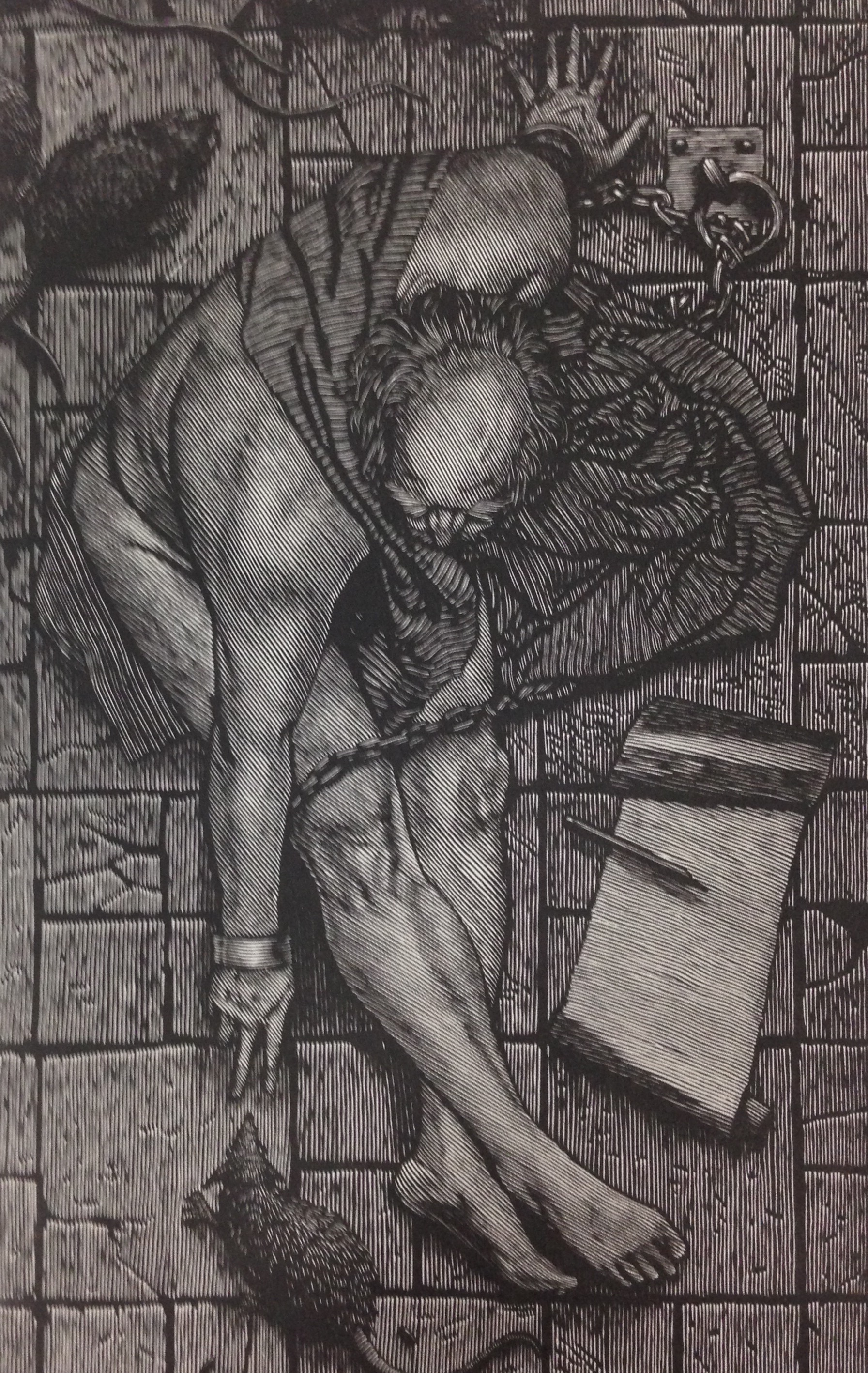
Barry Moser.PaulActs 21:17-39

17 When we had come to Jerusalem, the brothers received us gladly. 18 On the following day Paul went in with us to James, and all the elders were present. 19 After greeting them, he related one by one the things that God had done among the Gentiles through his ministry. 20 And when they heard it, they glorified God. And they said to him, “You see, brother, how many thousands there are among the Jews of those who have believed. They are all zealous for the law, 21 and they have been told about you that you teach all the Jews who are among the Gentiles to forsake Moses, telling them not to circumcise their children or walk according to our customs. 22 What then is to be done? They will certainly hear that you have come. 23 Do therefore what we tell you. We have four men who are under a vow; 24 take these men and purify yourself along with them and pay their expenses, so that they may shave their heads. Thus all will know that there is nothing in what they have been told about you, but that you yourself also live in observance of the law. 25 But as for the Gentiles who have believed, we have sent a letter with our judgment that they should abstain from what has been sacrificed to idols, and from blood, and from what has been strangled, and from sexual immorality.” 26 Then Paul took the men, and the next day he purified himself along with them and went into the temple, giving notice when the days of purification would be fulfilled and the offering presented for each one of them. 27 When the seven days were almost completed, the Jews from Asia, seeing him in the temple, stirred up the whole crowd and laid hands on him, 28 crying out, “Men of Israel, help! This is the man who is teaching everyone everywhere against the people and the law and this place. Moreover, he even brought Greeks into the temple and has defiled this holy place.” 29 For they had previously seen Trophimus the Ephesian with him in the city, and they supposed that Paul had brought him into the temple. 30 Then all the city was stirred up, and the people ran together. They seized Paul and dragged him out of the temple, and at once the gates were shut. 31 And as they were seeking to kill him, word came to the tribune of the cohort that all Jerusalem was in confusion. 32 He at once took soldiers and centurions and ran down to them. And when they saw the tribune and the soldiers, they stopped beating Paul. 33 Then the tribune came up and arrested him and ordered him to be bound with two chains. He inquired who he was and what he had done. 34 Some in the crowd were shouting one thing, some another. And as he could not learn the facts because of the uproar, he ordered him to be brought into the barracks. 35 And when he came to the steps, he was actually carried by the soldiers because of the violence of the crowd, 36 for the mob of the people followed, crying out, “Away with him!” 37 As Paul was about to be brought into the barracks, he said to the tribune, “May I say something to you?” And he said, “Do you know Greek? 38 Are you not the Egyptian, then, who recently stirred up a revolt and led the four thousand men of the Assassins out into the wilderness?” 39 Paul replied, “I am a Jew, from Tarsus in Cilicia, a citizen of no obscure city. I beg you, permit me to speak to the people.”

In 1742, Charles Wesley wrote the hymn that we today know as “Gentle Jesus, Meek and Mild.” Consider its depiction of Christ.

Gentle Jesus, meek and mild,

Look upon a little child;

Pity my simplicity,

Suffer me to come to Thee.

Fain I would to Thee be brought,

Dearest God, forbid it not;

Give me, dearest God, a place

In the kingdom of Thy grace

Lamb of God, I look to Thee;

Thou shalt my Example be;

Thou art gentle, meek, and mild;

Thou wast once a little child.

Fain I would be as Thou art;

Give me Thine obedient heart;

Thou art pitiful and kind,

Let me have Thy loving mind.

Let me, above all, fulfill

God my heav’nly Father’s will;

Never His good Spirit grieve;

Only to His glory live.

Thou didst live to God alone;

Thou didst never seek Thin own;

Thou Thyself didst never please:

God was all Thy happiness.

Loving Jesus, gentle Lamb,

In Thy gracious hands I am;

Make me, Savior, what Thou art,

Live Thyself within my heart.

I shall then show forth Thy praise,

Serve Thee all my happy days;

Then the world shall always see

Christ, the holy Child, in me.

I am very hesitant to critique a hymn by the brilliant and godly Charles Wesley. After all, in the right context and stressed to the right proportion, this is a perfectly biblical vision of Jesus. Furthermore, it is likely that in the mid 1700’s this picture of Jesus may have been needed to balance a predominantly stern or hard vision of Christ. Who knows?

But read in our day it gives one pause. If earlier ages of the Church depicted Jesus as overly stern or hard or wrathful, our age has a vision of Jesus that is so saccharine it is hard to call it “biblical” at all. In other words, take that hymn and drop it into a modern worship pep rally with its vaguely biblical but largely therapeutic sermons, its consumerism, its sentimentalized and Americanized Jesus, and its general demeanor of a carefree euphoria and obliviousness and that hymn will positively turn your stomach.

Again, the problem is not calling Jesus “meek” and “mild.” Both are biblical virtues held in balance by all other biblical virtues. The problem is our culture can only conceive of a mild Jesus. Wesley’s words have a point, but they ought not be taken to eclipse the words of Christ about Himself in, say, Matthew 10.

34 “Do not think that I have come to bring peace to the earth. I have not come to bring peace, but a sword. 35 For I have come to set a man against his father, and a daughter against her mother, and a daughter-in-law against her mother-in-law. 36 And a person’s enemies will be those of his own household.

Meek? Yes. Mild? Properly understood, perhaps. But also divisive, controversial, incendiary, world-changing, and conflict bringing! Jesus is all of these things.

Paul came to understand these latter realities when faced with the response of both non-Christian and even some Christian Jews in Jerusalem when he returned to Church there. He learned that following Jesus can mean great and difficult interpersonal conflicts with people you love. In truth, largely as a result of Paul’s astounding missionary efforts, the entire Church found itself in a precarious situation with the Jewish people. This led to some awkwardness as well as, as we shall see, some careful efforts to clarify what it is the Church was and was not saying.

The Jewish believers within the early Church walked a fine line between proclaiming the completeness of the work of Christ for our salvation and not needlessly offending the sensibilities of Jews seeking to honor the Law.

To call this line “a fine line” is an understatement. It was an outright dangerous line, as Paul already knew and as the Church at large would soon learn. The occasion for this latest controversy came with Paul’s return to Jerusalem.

17 When we had come to Jerusalem, the brothers received us gladly. 18 On the following day Paul went in with us to James, and all the elders were present. 19 After greeting them, he related one by one the things that God had done among the Gentiles through his ministry. 20a And when they heard it, they glorified God.

These beginning verses are crucial for helping us understand a very important truth: there was no division between James and Paul or between the Jerusalem church and Paul. They genuinely praised God for what was happening among the Gentiles. Many people have tried to suggest a conflict between James and Paul and I would like to point out that such an idea is uncharitable to James.

Even so, James was situated in the Jerusalem church and his daily reality was having to negotiate exactly what it meant for Jews to accept Jesus as Savior and Lord. Furthermore, the news of Paul’s great missionary journeys, while profoundly exciting for all believers who heard it, was creating some tense situations in and around the mother church of Jerusalem as James explained to Paul.

20b And they said to him, “You see, brother, how many thousands there are among the Jews of those who have believed. They are all zealous for the law, 21 and they have been told about you that you teach all the Jews who are among the Gentiles to forsake Moses, telling them not to circumcise their children or walk according to our customs. 22 What then is to be done? They will certainly hear that you have come.

So the problem becomes clearer. It is important that you read carefully what James is saying. He is saying that many Jews who have accepted Christ (“who have believed”) want to follow Jesus but still have an appreciation for the Law and the customs of Israel. We know, of course, that there were some Jews who actually tried to import adherence to the Law into the gospel itself thereby announcing that one had to accept Jesus and be circumcised and keep the dietary laws and observe all the feasts, etc. But this does not seem to be the case here. What seems to be happening here is that some Jews were coming to Jesus and were still wanting to honor the ceremonial law – temple worship, circumcision, the food laws – but did not necessarily see this as saving.

In other words, we should make a distinction between Jewish believers who tried to add to the gospel and Jewish believers who understood the gospel but still sought to live as observant Jews and honor the customs of the Jews. And what needs to be understood is that neither Paul nor anybody else in the early Church was saying that this was, in and of itself, a problem. On the contrary, Paul himself held to this to some extent as evidenced by his having taken a Nazirite vow just before his last trip to Jerusalem.

Paul understood perfectly well that Christ and Christ alone saves us. Furthermore, Paul saw the Law as revealing to us our sinfulness and need for a Savior. Paul did not hate or disparage the Law. Rather, he saw it as limited in terms of what it could accomplish, but as having certain useful functions. The Law could condemn but it could not save.

What is more, as Paul went to the Gentiles and began to see more and more non-Jews come to Christ, he made it abundantly clear (as, we should note, did James and the earlier Jerusalem Council), that it was not necessary for non-Jewish Christians to become Jews. Therefore, it was not necessary for Gentiles to be circumcised, to keep kosher, etc.

The situation was made even more complex, however, by the fact that the missionary churches Paul was planting oftentimes had both Jewish and Gentile Christians. This fact may have been the situation that gave rise to the false rumor James reported that Paul was telling Jewish believers to abandon Moses and the Law. In reality, though, while Paul absolutely exalted Christ as the Savior of all who would come to Him, and while Paul also pointed out the limitations of the Law for the Jews, and while Paul did not bind Gentile converts to the Law, he had never told Jewish believers that they had to abandon their observance of the customs of the Jews. He had only called upon them to understand these things more clearly in the light of the crucifixion and resurrection of Jesus Christ! However, some Jewish believers may have been softening their adherence to the traditional customs as they were cast out of their synagogues and entered churches with Gentile members.

John Polhill has summarized the situation probably as succinctly as it can be summarized:

In short, Paul saw one’s status in Christ as transcending the distinction between Jew and Gentile (Gal 3:28). Being in Christ neither required that the Gentile become a Jew nor that the Jew cease to be a Jew (cf. 1 Cor 9:19f.). Still, there may have been a grain of truth in the rumor that Paul was encouraging Jews of the Diaspora to abandon the Torah. It would not have been Paul’s having actually urged the Jews to do so but rather the social situation of Paul’s Diaspora churches. In the Diaspora, Jews who became Christians would almost inevitably have transferred form the synagogue to the predominantly Gentile churches. Acts 19:9 would indicate that this had been the case in Ephesus. Having left the base of support for their Jewish identity in the synagogue, there would be the natural inclination to adapt to the ways of the Gentile majority in the Christian churches. Whether or not this was the case, Paul himself had not urged Jewish Christians to abandon the Torah, and there is no evidence that the elders themselves lent any credence to the allegations.[1]

The rumors in Jerusalem about Paul were therefore false. But perception is 9/10ths reality, as they say, so James and the other leaders were wondering if Paul might could take some action to help squelch the rumors and to assure Jewish believers in Christ that they were not in error to keep the customs and observances of the Jews. Here was their proposal:

23 Do therefore what we tell you. We have four men who are under a vow; 24 take these men and purify yourself along with them and pay their expenses, so that they may shave their heads. Thus all will know that there is nothing in what they have been told about you, but that you yourself also live in observance of the law. 25 But as for the Gentiles who have believed, we have sent a letter with our judgment that they should abstain from what has been sacrificed to idols, and from blood, and from what has been strangled, and from sexual immorality.”

This is a most fascinating proposal. Tellingly, on the question of Gentile believers, James and the other elders upheld the earlier decision of the Jerusalem Council and did not ask that they become Jews. On the question of Jewish believers and, specifically, of those who had heard rumors of Paul disparaging the Law, James had an intriguing proposal concerning a way for Paul to clarify his position. Four of the Jewish converts in the Church had taken a Nazirite vow that, as we have seen, required them to abstain from cutting their hair, drinking wine, or coming into contact with dead bodies for thirty days. At the end of the thirty days, they were to make a sacrifice at the temple, offering their hair as part of it in completion of the vow. James asked Paul to join with them, defraying the expenses associated with their vow, and undergoing purification himself as a sign of understanding and approval. Paul’s purification should likely be differentiated from the Nazirite vow these Jewish brothers took and was probably associated with Paul’s having just come back from Gentile lands and extensive contact with Gentiles.

Paul’s response to this idea is quite moving.

26 Then Paul took the men, and the next day he purified himself along with them and went into the temple, giving notice when the days of purification would be fulfilled and the offering presented for each one of them.

In other words, he did what was proposed. He underwent purification himself and prepared to pay their expenses.

What does this tell us about Paul? For one thing, it tells us that Paul, while understanding the freedom he had in Christ, was willing to give up those freedoms for the sake of weaker brothers. F.F. Bruce put it beautifully when he said, “a truly emancipated spirit such as Paul’s is not in bondage to its own emancipation.”[2] I love that!

To insist on your rights simply because you have them with no regard to where other believers are in their own journeys is a most selfish thing to do. Furthermore, to insist on your freedoms simply because you have them with no regard for how the exercise of those freedoms may cause weaker brothers to stumble is callousness.

Did Paul have to undergo purification in the temple? No. He knew he had been cleansed by Christ. But he did so in order not to cause offense on a non-salvific issue among brothers who still highly prized these aspects of the Jewish customs. Paul would address his approach most clearly in 1 Corinthians 9.

19 For though I am free from all, I have made myself a servant to all, that I might win more of them. 20 To the Jews I became as a Jew, in order to win Jews. To those under the law I became as one under the law (though not being myself under the law) that I might win those under the law. 21 To those outside the law I became as one outside the law (not being outside the law of God but under the law of Christ) that I might win those outside the law. 22 To the weak I became weak, that I might win the weak. I have become all things to all people, that by all means I might save some. 23 I do it all for the sake of the gospel, that I may share with them in its blessings.

So there is a powerful example of humility for the sake of the body of Christ in Paul’s agreement to this proposal. It should give us pause. How attuned are we to the spiritual growth of our brothers and sisters? Do we consider where they are and what we can do to help them in their growth? Are we willing to abstain from certain freedoms for the sake of helping others in the Church? Do we insist on our rights, our freedoms, our desires, or do we value others as more important than ourselves? Paul valued others.

Paul’s actions also demonstrate something else about Paul. Ajith Fernando writes, “We cannot be certain whether this act was a mistake. But it shows us how serious Paul was about preserving unity in the body of Christ.”[3] “Serious” is a good way to describe it. This was serious business to Paul. It mattered whether or not the Church fractured on this point. For Paul, such a fracturing was unnecessary, so he made concessions to keep the believers together.

That fine line ultimately proved very difficult to walk and led to a break between Judaism and Christianity.

Paul, then, attempted to foster peace and understanding by agreeing to James’ proposal. Unfortunately, things did not go well.

27 When the seven days were almost completed, the Jews from Asia, seeing him in the temple, stirred up the whole crowd and laid hands on him,

Notice who these Jews are. They are “Jews from Asia.” Why is that significant? Because Ephesus was in Asia. In other words, these were Jews from the territory where Paul spent three years ministering. These were Jews, in other words, who had seen the comingling of Jewish and Gentile believers and had seen the disruption of the synagogues that the preaching of the gospel caused. So they had an ax to grind. Thus, seeing Paul in the temple, they made their move.

28 crying out, “Men of Israel, help! This is the man who is teaching everyone everywhere against the people and the law and this place. Moreover, he even brought Greeks into the temple and has defiled this holy place.” 29 For they had previously seen Trophimus the Ephesian with him in the city, and they supposed that Paul had brought him into the temple.

The Jews drew attention to Paul and slandered him. Paul had never spoken “against” the Jews, the law, or the temple, though his preaching of the gospel had implications for all of these. Most slanderous of all was their outright false assertion that Paul took Trophimus the Ephesian, a non-Jewish man, into the temple. It was strictly forbidden to take Gentiles past the court of the Gentiles. Archeologists have discovered two markers that were in the temple of this time warning Gentiles that they would be put to death if they ventured further into the temple. But Paul had, in fact, not taken Trophimus in. He was likely just seen in the Court of the Gentiles with him and they pinned this allegation on him on that basis.

Regardless, it had the desired effect.

30 Then all the city was stirred up, and the people ran together. They seized Paul and dragged him out of the temple, and at once the gates were shut. 31 And as they were seeking to kill him, word came to the tribune of the cohort that all Jerusalem was in confusion. 32 He at once took soldiers and centurions and ran down to them. And when they saw the tribune and the soldiers, they stopped beating Paul. 33 Then the tribune came up and arrested him and ordered him to be bound with two chains. He inquired who he was and what he had done. 34 Some in the crowd were shouting one thing, some another. And as he could not learn the facts because of the uproar, he ordered him to be brought into the barracks. 35 And when he came to the steps, he was actually carried by the soldiers because of the violence of the crowd, 36 for the mob of the people followed, crying out, “Away with him!” 37 As Paul was about to be brought into the barracks, he said to the tribune, “May I say something to you?” And he said, “Do you know Greek? 38 Are you not the Egyptian, then, who recently stirred up a revolt and led the four thousand men of the Assassins out into the wilderness?” 39 Paul replied, “I am a Jew, from Tarsus in Cilicia, a citizen of no obscure city. I beg you, permit me to speak to the people.”

Another riot ensued, and this time Paul was saved by the Roman soldiers stationed near the temple. Our text ends with Paul asking permission to speak to the angry crowd, which he does, but what is most telling at this point are the words from the latter half of verse 30: “They seized Paul and dragged him out of the temple, and at once the gates were shut.”

That phrase, “and at once the gates were shut,” is likely saying more than it seems. In fact, this was the beginning of the end of the Jewish-Christian attempt to live at peace as observant Jews who followed Jesus. The gate was shut on Paul and it would soon be shut on the Church.

F.F. Bruce quotes T. D. Bernard as saying in his 1864 Bampton Lectures, “‘Believing all things which are written in the Law and in the Prophets’ and ‘having committed nothing against the people or customs of [his] fathers’, he [Paul] and his creed are forced from their proper home. On it as well as him the temple doors are shut.” To which Bruce adds:

For Luke himself, this may have been the moment when the Jerusalem temple ceased to fill the honorable role hitherto ascribed to it in his twofold history. The exclusion of God’s message and messenger from the house once called by his name sealed its doom: it was now ripe for the destruction which Jesus had predicted for it many years before (Luke 21:6).[4]

Not too long after this, the temple would be destroyed. Furthermore, the Jews would formally cast out those Jews who professed faith in Christ. This, in other words, was the beginning in the end.

In this sense, the attempt to calm the tension in the city failed. In another sense, however, it was a success: in the sense that Paul, the great missionary to the Gentiles, had demonstrated deep sensitivity to the complexities of life for the Jewish believers and had been willing to humble himself, without compromising the gospel, for the greater good of the body of Christ.

That, friends, is an example worth imitating.


[1] Polhill, Acts, p.117. Robertson, Acts, p.36. Ben Witherington III, The Acts of the Apostles: A Socio-Rhetorical Commentary. (Grand Rapids, MI: William B. Eerdmans Publishing Company, 1998), p.448.

[2] Quoted in Stott, John (2014-04-02). The Message of Acts (The Bible Speaks Today Series) (Kindle Location 6305). InterVarsity Press. Kindle Edition.

[3] Fernando, Ajith (2010-12-21). Acts (The NIV Application Commentary) (p. 511). Zondervan. Kindle Edition.

[4] Bruce, F.F. (1988-06-30). The Book of Acts (New International Commentary on the New Testament) (p. 410). Eerdmans Publishing Co – A. Kindle Edition.

Acts 21:1-16

48b27df0897966e3920af49d7da2bbffActs 21:1-16

1 And when we had parted from them and set sail, we came by a straight course to Cos, and the next day to Rhodes, and from there to Patara. 2 And having found a ship crossing to Phoenicia, we went aboard and set sail. 3 When we had come in sight of Cyprus, leaving it on the left we sailed to Syria and landed at Tyre, for there the ship was to unload its cargo. 4 And having sought out the disciples, we stayed there for seven days. And through the Spirit they were telling Paul not to go on to Jerusalem. 5 When our days there were ended, we departed and went on our journey, and they all, with wives and children, accompanied us until we were outside the city. And kneeling down on the beach, we prayed 6 and said farewell to one another. Then we went on board the ship, and they returned home. 7 When we had finished the voyage from Tyre, we arrived at Ptolemais, and we greeted the brothers and stayed with them for one day. 8 On the next day we departed and came to Caesarea, and we entered the house of Philip the evangelist, who was one of the seven, and stayed with him. 9 He had four unmarried daughters, who prophesied. 10 While we were staying for many days, a prophet named Agabus came down from Judea. 11 And coming to us, he took Paul’s belt and bound his own feet and hands and said, “Thus says the Holy Spirit, ‘This is how the Jews at Jerusalem will bind the man who owns this belt and deliver him into the hands of the Gentiles.’” 12 When we heard this, we and the people there urged him not to go up to Jerusalem. 13 Then Paul answered, “What are you doing, weeping and breaking my heart? For I am ready not only to be imprisoned but even to die in Jerusalem for the name of the Lord Jesus.” 14 And since he would not be persuaded, we ceased and said, “Let the will of the Lord be done.” 15 After these days we got ready and went up to Jerusalem. 16 And some of the disciples from Caesarea went with us, bringing us to the house of Mnason of Cyprus, an early disciple, with whom we should lodge. 

There seems to be two general approaches to the idea of death among non-believers: fear or defiance. Many people, perhaps most, have a deep and unsettling fear of death. John Stott provides two examples.

Death inspires terror in many people. Woody Allen’s angst in relation to death is well known. He sees it as a total annihilation of being and finds it “absolutely stupefying in its terror.” “It’s not that I’m afraid to die,” he quips,” I just don’t want to be there when it happens.”

            Another similar example is given by Ronald Dworkin QC, the American legal philosopher, who has held chairs in London, Oxford and New York universities. He has written: “Death’s central horror is oblivion – the terrifying absolute dying of the light…Death has dominion because it is not only the start of nothing, but the end of everything.”[1]

The other response is defiance, a kind of angry shaking of one’s fist against death. We may think, for instance, of Dylan Thomas’ famous 1951 poem, “Do Not Go Gentle Into That Good Night.”

Do not go gentle into that good night,

Old age should burn and rave at close of day;

Rage, rage against the dying of the light.

Though wise men at their end know dark is right,

Because their words had forked no lightning they

Do not go gentle into that good night.

Good men, the last wave by, crying how bright

Their frail deeds might have danced in a green bay,

Rage, rage against the dying of the light.

Wild men who caught and sang the sun in flight,

And learn, too late, they grieved it on its way,

Do not go gentle into that good night.

Grave men, near death, who see with blinding sight

Blind eyes could blaze like meteors and be gay,

Rage, rage against the dying of the light.

And you, my father, there on the sad height,

Curse, bless, me now with your fierce tears, I pray.

Do not go gentle into that good night.

Rage, rage against the dying of the light.

I actually love that poem, but it certainly is a challenge to the inevitability of death. Thomas calls upon his father and, ostensibly, all of us to rage against death!

More sinister is a poem that served as the last words of one of America’s most infamous criminals. On April 19, 1995, Timothy McVeigh detonated a truck bomb the Alfred P. Murrah Federal Building in Oklahoma City, OK. The explosion killed 168 people and wounded over 600 others. On June 11, 2001, McVeigh was executed by lethal injection at a penitentiary in Indiana. His last words were a poem that he had copied on paper by hand and handed to the jailor. It was a poem written by William Ernest Henley in 1875 entitled “Invictus.” Here it is:

Out of the night that covers me,

      Black as the pit from pole to pole,

I thank whatever gods may be

      For my unconquerable soul.

In the fell clutch of circumstance

      I have not winced nor cried aloud.

Under the bludgeonings of chance

      My head is bloody, but unbowed.

Beyond this place of wrath and tears

      Looms but the Horror of the shade,

And yet the menace of the years

      Finds and shall find me unafraid.

It matters not how strait the gate,

      How charged with punishments the scroll,

I am the master of my fate,

      I am the captain of my soul.

As a Christian, I find those words chilling. They certainly would not have been quoted by Paul. Paul saw himself as anything but the captain of his own soul. He had come to terms with that issue back on the Damascus road. Christ held the papers to his soul and Christ was his captain.

In fact, Paul’s whole attitude to death was dramatically different from the examples I quoted above. As he continues his journey toward Jerusalem, he demonstrates this in a most memorable way.

Paul receives numerous warnings about going to Jerusalem.

The occasion for Paul’s demonstration of his own peace concerning death was the frequent warnings he received about going to Jerusalem from his friends.

1 And when we had parted from them and set sail, we came by a straight course to Cos, and the next day to Rhodes, and from there to Patara. 2 And having found a ship crossing to Phoenicia, we went aboard and set sail. 3 When we had come in sight of Cyprus, leaving it on the left we sailed to Syria and landed at Tyre, for there the ship was to unload its cargo. 4 And having sought out the disciples, we stayed there for seven days. And through the Spirit they were telling Paul not to go on to Jerusalem.

It is noteworthy that Luke says Paul’s friends were warning him “through the Spirit.” It raises an interesting question about who was hearing the Spirit speak most accurately, Paul or his friends. Regardless, the warnings persisted apparently everywhere he turned.

5 When our days there were ended, we departed and went on our journey, and they all, with wives and children, accompanied us until we were outside the city. And kneeling down on the beach, we prayed 6 and said farewell to one another. Then we went on board the ship, and they returned home. 7 When we had finished the voyage from Tyre, we arrived at Ptolemais, and we greeted the brothers and stayed with them for one day. 8 On the next day we departed and came to Caesarea, and we entered the house of Philip the evangelist, who was one of the seven, and stayed with him. 9 He had four unmarried daughters, who prophesied.

We are privileged at this point to get a glimpse into the home life of Philip, one of the original deacons. You will remember that Philip has an amazing impact on Samaria during the dispersion of the Jewish believers after the martyrdom of Stephen. His story is told in Acts 8.

4 Now those who were scattered went about preaching the word. 5 Philip went down to the city of Samaria and proclaimed to them the Christ. 6 And the crowds with one accord paid attention to what was being said by Philip when they heard him and saw the signs that he did. 7 For unclean spirits, crying out with a loud voice, came out of many who had them, and many who were paralyzed or lame were healed. 8 So there was much joy in that city.

Philip also famously led the Ethiopian Eunuch to Christ and did many other great things in the name of Christ. And now we see that he had a family that was likewise involved in transformative ministry for the Kingdom of God. “He had four unmarried daughters,” Luke tells us, “who prophesied.” This is a tantalizing insight and it raises questions for us today. What did this ministry of prophesy look like? How did it work? It is hard to say for sure, but they were not the first female prophets mentioned in the Bible. Furthermore, they appear to be a fulfillment of Peter’s quotation of the prophet Joel in his Pentecost sermon in Acts 2.

14 But Peter, standing with the eleven, lifted up his voice and addressed them: “Men of Judea and all who dwell in Jerusalem, let this be known to you, and give ear to my words. 15 For these people are not drunk, as you suppose, since it is only the third hour of the day. 16 But this is what was uttered through the prophet Joel: 17 “‘And in the last days it shall be, God declares,
that I will pour out my Spirit on all flesh,
and your sons and your daughters shall prophesy,
and your young men shall see visions, and your old men shall dream dreams

“Your daughters shall prophesy,” Joel had said, and here we see the daughters of Philip doing precisely that! Let me simply say this: whatever your view on women in the ministry, it seems perfectly clear that they were not intended to be mere wallflowers in the Church. While the pastoral office would appear to be restricted to men, any theology that would tell a woman that she can literally never speak would violate what we see here as well as numerous other examples in the New Testament.

Paul was no doubt thrilled to be able to spend some time with this great man of God and his fascinating family. He then receives another warning, this time from a male prophet.

10 While we were staying for many days, a prophet named Agabus came down from Judea. 11 And coming to us, he took Paul’s belt and bound his own feet and hands and said, “Thus says the Holy Spirit, ‘This is how the Jews at Jerusalem will bind the man who owns this belt and deliver him into the hands of the Gentiles.’” 12 When we heard this, we and the people there urged him not to go up to Jerusalem.

Agabus appeals to the Holy Spirit, as did all who warned Paul. But Paul saw himself as being faithful to the Spirit’s leadership by going to Jerusalem. So, again, who was hearing the Spirit rightly? What is likely happening here is that Paul’s friends are being told by the Spirit that Paul will face persecution and suffering if he moves forward toward Jerusalem and they, on that basis, plead with him not to go. But the Spirit’s revelation of future suffering does not mean that the Spirit Himself was calling upon Paul not to go. That was simply the natural reactions of friends to what the Spirit was revealing.

Clinton Arnold put it nicely when he said this:

There is probably no contradiction here. It appears that the Spirit is telling prophets in a variety of places that Paul will face suffering and imprisonment in Jerusalem. The prophets conclude, out of their natural human concern, that Paul should not go to Jerusalem in order to avoid the persecution. Paul, however, is thoroughly convinced that the Spirit is leading him to go. He is willing to suffer anything for the sake of Christ.[2]

So Paul is warned, repeatedly, not to go to Jerusalem. However, he has set his face toward the great city and will not be distracted from his task.

Paul, freed from the fear of physical death, was free to be courageous with his life.

In response to the pleadings of his friends, Paul reveals just how freed he had become from the fear of death.

13 Then Paul answered, “What are you doing, weeping and breaking my heart? For I am ready not only to be imprisoned but even to die in Jerusalem for the name of the Lord Jesus.” 14 And since he would not be persuaded, we ceased and said, “Let the will of the Lord be done.” 15 After these days we got ready and went up to Jerusalem. 16 And some of the disciples from Caesarea went with us, bringing us to the house of Mnason of Cyprus, an early disciple, with whom we should lodge.

How moving! Paul was ready for whatever lay ahead of him, even suffering and death. Again, he had come to peace with these things and, in his mind, his friends needed to do the same. According to Jaroslav Pelikan, Paul “manifested…a fierce sense of determination, which was sometimes difficult to distinguish from just plain stubbornness.” He went on to say that “one almost expects a ‘sigh’…in the sentence, ‘And when he would not be persuaded, we ceased and said, ‘The will of the Lord be done.’”[3] It is easy to imagine such a sigh. No doubt his friends were somewhat exasperated, but no doubt they also had the deepest respect for Paul’s dogged determination and steely resolve to do what he felt the Lord was calling him to do.

It is amazing to observe just how free Paul was from the fears that so enslave many of us. Paul, freed from the fear of physical death, was free to be courageous with his life. He was liberated by setting aside the fear-based clinging to life that had no doubt early enslaved him. Christ had broken the shackles of fear by giving him a new life…and that had come at the expense of the old life he previously new. Paul put this perhaps nowhere more beautifully than in Galatians 2:20.

I have been crucified with Christ. It is no longer I who live, but Christ who lives in me. And the life I now live in the flesh I live by faith in the Son of God, who loved me and gave himself for me.

He did not fear crucifixion simply because he had already been crucified on Calvary with Christ! His old life ended at the foot of the cross and he now walked in resurrection power! Christ, to put it simply, was his life.

How beautiful would it be to live with this perspective and to walk in this reality?! How wonderful would it be to be free of the fear of death?!

Other Christians have gotten close to this blessed freedom. On May 25, 1994, Aleksandr Solzhenitsyn was asked by a reporter if he was afraid of death.

David Remnick had asked him if he feared dying. His face lit up with pleasure. “Absolutely not! It will just be a peaceful transition. As a Christian, I believe there is a life after death, and so I understand that this is not the end of life. The soul has a continuation, the soul lives on. Death is only a stage, some would even say a liberation. In any case, I have no fear of death.”[4]

“I have no fear of death!” There it is! That is it!

In 160 A.D., the church father Justin Martyr wrote his own testimony, noting therein that, like the jailor in Acts 16, it was the bold and unflagging witness and joy of the Christians in the midst of persecution that drew him to the faith:

When I was delighting in the doctrines of Plato, I heard Christians being slandered. Yet, I saw that they were fearless in death and unafraid of all other things that are considered fearful. And I realized that it was impossible that they could be living in wickedness and pleasure. For what sensual or intemperate person…could welcome death, which would deprive him of his enjoyments? Such a person would prefer to continue always in the present life.[5]

It was the fearlessness of suffering Christians that so impacted Justin Martyr. Consider this the evangelistic tool of fearlessness. It made an impact then and would make a similar impact now if we could really trust Christ enough to be free of fear.

I ask you: are you free from the fear of death? When others watch you and listen to you discuss the inevitability of dying, what do they hear in your voice? Fear? Trepidation? Uncertainty? Dread?

Ah, may they hear a joyful confidence in our voices that we know death has no power over us…for we have died already and will rejoice to go home to our King!


[1] John Stott, The Radical Disciple (Downers Grove, IL: InterVarsity Press, 2010), p.128.

[2] Clinton E. Arnold, “Acts.” Zondervan Illustrated Bible Backgrounds Commentary. Vol.2. Clinton E. Arnold, gen. ed. (Grand Rapids, MI: Zondervan, 2002), p.428-429.

[3] Jaroslav Pelikan, Acts. Brazos Theological Commentary on the Bible. (Grand Rapids, MI: Brazos Press, 2005), p.230.

[4] D.M. Thomas. Alexander Solzhenitsyn: A Century in His Life. (New York: St. Martin’s Press, 1998), p.509.

[5] A Dictionary of Early Christian Beliefs, ed. David W. Bercot (Peabody, MA: Hendrickson Publishers, 1998), p.174-175.

Acts 20:17-38

Paul-says-goodbye-to-the-EphesiansActs 20:17-38

17 Now from Miletus he sent to Ephesus and called the elders of the church to come to him. 18 And when they came to him, he said to them: “You yourselves know how I lived among you the whole time from the first day that I set foot in Asia, 19 serving the Lord with all humility and with tears and with trials that happened to me through the plots of the Jews; 20 how I did not shrink from declaring to you anything that was profitable, and teaching you in public and from house to house, 21 testifying both to Jews and to Greeks of repentance toward God and of faith in our Lord Jesus Christ. 22 And now, behold, I am going to Jerusalem, constrained by the Spirit, not knowing what will happen to me there, 23 except that the Holy Spirit testifies to me in every city that imprisonment and afflictions await me. 24 But I do not account my life of any value nor as precious to myself, if only I may finish my course and the ministry that I received from the Lord Jesus, to testify to the gospel of the grace of God. 25 And now, behold, I know that none of you among whom I have gone about proclaiming the kingdom will see my face again. 26 Therefore I testify to you this day that I am innocent of the blood of all, 27 for I did not shrink from declaring to you the whole counsel of God. 28 Pay careful attention to yourselves and to all the flock, in which the Holy Spirit has made you overseers, to care for the church of God, which he obtained with his own blood. 29 I know that after my departure fierce wolves will come in among you, not sparing the flock; 30 and from among your own selves will arise men speaking twisted things, to draw away the disciples after them. 31 Therefore be alert, remembering that for three years I did not cease night or day to admonish every one with tears. 32 And now I commend you to God and to the word of his grace, which is able to build you up and to give you the inheritance among all those who are sanctified. 33 I coveted no one’s silver or gold or apparel. 34 You yourselves know that these hands ministered to my necessities and to those who were with me. 35 In all things I have shown you that by working hard in this way we must help the weak and remember the words of the Lord Jesus, how he himself said, ‘It is more blessed to give than to receive.’” 36 And when he had said these things, he knelt down and prayed with them all. 37 And there was much weeping on the part of all; they embraced Paul and kissed him, 38 being sorrowful most of all because of the word he had spoken, that they would not see his face again. And they accompanied him to the ship.

Gene Dilliland was a missionary to Africa in the 1960’s. He tells an interesting story about how the African believers with whom he worked told him and his family goodbye as they prepared to go home on furlough.

After an extremely difficult term as superintendent of the Nigeria mission, I recall when I and my wife, Lois, and our five children were leaving Nigeria for a one-year furlough in 1963. This African church has always had to deal with the painful problem of tribalism. Over six major language groups make up the total membership. Each ethnic group struggled to keep its own people in leadership positions and to gain attention for its own particular causes. I, along with three other church leaders, had recently negotiated that the headquarters of the church be moved from its traditional site to a more promising place, a location more central to the whole church. This meant that the people in the historic location had lost the prestige that comes with residing at the official center of power. The church leaders came to the airfield to celebrate our farewell. They had actually arranged a service that included speeches, songs, and prayers. Africans are very careful about saying good-bye so that their guests will carry a special kind of memory as they depart. The purpose of the farewell was to review our progress and to attempt to quiet down the controversy that had ensued with the moving of the headquarters. The farewell was meant to show honor and to ensure that, during our absence, we would not forget events or promised intentions.

            However, the African leaders were not aware of the stress this farewell would have on the pilot’s schedule or on the other passengers who were en route. Even though little patience was being shown for the farewell, the African leaders were not moved. They eloquently summed up what they had to say, presented my wife and me with new African clothes, sang an African hymn, and closed with prayer. The meaning of the entire event was meant to say, “Missionaries, you have been with us and have led us. Now, as you leave, promise that you will not forget the work we have already done together and that you will keep your commitment to finishing what we have started.”[1]

It is fascinating to see such an intense intentionality about a goodbye. When one reads this account, it is almost as if the African Christians were doggedly and almost stubbornly saying, “You simply cannot leave until we do get this goodbye right. We do not care what the pilots think or what the other passengers think. This is serious business and we need to communicate some very important things. The plane can wait! Let us say farewell rightly!”

Please understand: I am not criticizing the African believers. On the contrary, we could learn from their example. A goodbye, especially in the context of shared life and ministry and witness, should be anything but casual. The Church, when it is the Church, forms bonds that are not lightly set aside. This is family. This is what it means to be the body of Christ! So I think there is something profoundly moving in the way that the Nigerian believers said goodbye to their missionary friend.

Paul understood this. He understood that you have to get your goodbye’s right. This is important business, serious business, and crucial truths need to be expressed. So, like Gene Dilliland and the Nigerian church, in our text today we find Paul and the Ephesian church saying goodbye. But in this case it is the departing missionary who convenes the farewell and it is him who speaks. There are things Paul must say, and what he says are truths we truly need to heed today!

Paul called for the Church to embrace total commitment to Christ by being wary of wolves and by planting its life deep in the gospel of Christ.

Paul had been with the Ephesians for three years. In our text, he has set his face toward Jerusalem. He was not sure what would happen to him there. He suspected that trouble lay ahead. So as he made his way toward Jerusalem he stopped at the port city of Miletus, about fifty miles from Ephesus. There, he sent word back to the Ephesian church leaders. He asked if they might come to Miletus so that he could speak to them there. What happened there was one of the most moving and tender displays of fraternal affection ever witnessed.

Paul had two points to his talk, and we are going to approach them in reverse order. The first had to do with how he acted and behaved with the Ephesian church for those three years and the second was a charge to the church leaders there to be careful and diligent. We will begin with the second point first, Paul’s charge to the Ephesian elders.

28 Pay careful attention to yourselves and to all the flock, in which the Holy Spirit has made you overseers, to care for the church of God, which he obtained with his own blood.

Let us deal first of all with the question of who is in this audience Paul is addressing. In verse 28 and, earlier, in verse 17, Paul gives two titles to the men to whom he is speaking.

17 Now from Miletus he sent to Ephesus and called the elders (presbyteroi) of the church to come to him.

28 Pay careful attention to yourselves and to all the flock, in which the Holy Spirit has made you overseers (episkopoi), to care for the church of God, which he obtained with his own blood.

In verse 17 he refers to them as “elders” (presbyteroi) and in verse 28 he refers to them as “overseers” (episkopoi). The first word is where we get out denominational name “Presbyterian” and the second word is where we get the denominational name “Episcopalian.” Episkopoi is often translated “bishop.” But in Paul’s usage these Greek words do not refer to denominations but rather to offices, and, what is most interesting and, I would say, obvious, is that Paul applies the word “elder” and the word “overseer” the same office. R.C. Sproul notes that “the difficulty of discerning the biblical structure of church government occurs because in the same context Paul calls those assembled here ‘elders’ and ‘bishops,’ indicating that, at least at that stage in church history, the titles ‘elder’ and ‘bishop’ were used interchangeably.”[2] Indeed they were. The early churches had two offices: elders (which we call pastors) and deacons. It was not until the late 1st/early 2nd century that Ignatius of Antioch drew a distinction between “elders” and “bishops” that the Church was said to have three offices: bishops, elders, and deacons. Clearly, though, for Paul, the elders and the overseers were the same office.

Furthermore, let us stop and take note of the fact that Paul here makes a powerful statement concerning the deity of Christ. If you read verse 28 carefully, you will notice that Paul attributes the shedding of saving blood with God: “the church of God, which he obtained with his own blood.” This is a powerful statement about the fact that Christ is God with us, God in human flesh, God reconciling the world unto Himself.

It is a beautiful truth. Even so, it is a jarring choice of words, and an unusual way of putting it. Early theologians of Eastern Orthodox Christianity called such attributions of the human nature of Christ to His divine nature communicatio idiomatum (“interchange of the properties”) “by which properties or actions belonging to one nature of Christ may be attributed to, or predicated of, the other nature, because of the unity of the single person of the God-man,” to use Jaroslav Pelikan’s definition. In the Tome of 449, Leo the Great wrote, “It does not belong to the same nature to weep out for deep-felt pity for a dead friend, and to call him back to life again at the word of command [John 11:35-44], because only the human nature could do the first and only the divine nature could do the second and yet the actions are both attributed to the single person of the incarnate Logos.”[3] We can see this dynamic at work in Paul’s words about God’s blood.

Paul then moves on to a warning.

29 I know that after my departure fierce wolves will come in among you, not sparing the flock; 30 and from among your own selves will arise men speaking twisted things, to draw away the disciples after them. 31 Therefore be alert, remembering that for three years I did not cease night or day to admonish every one with tears. 32 And now I commend you to God and to the word of his grace, which is able to build you up and to give you the inheritance among all those who are sanctified.

Perhaps some might think that this is a bit of a downer in a farewell. In our culture we try to say sweet things as we depart. But Paul was not part of our shallow culture and for that we may be thankful. He knew that the survival of the Church was life or death. Specifically, he had invested his own life into it and, above that, the Lord Jesus had laid down His life for it. So he wanted them to be aware and to be forewarned: wolves are coming! That is, false teachers and those who will seek to dismantle the Church of the living God. And from where will they arise? “From among your own selves,” Paul says. How sobering! How terrifying!

Lest we are tempted to think that Paul was being unduly pessimistic, consider the frequent warnings in the New Testament concerning the coming of false teachers and corrupters of the faith.

In Matthew 10:16, Jesus had said to the disciples, “Behold, I am sending you out as sheep in the midst of wolves, so be wise as serpents and innocent as doves.”

In 2 Peter 2, Peter wrote:

1 But false prophets also arose among the people, just as there will be false teachers among you, who will secretly bring in destructive heresies, even denying the Master who bought them, bringing upon themselves swift destruction. 2 And many will follow their sensuality, and because of them the way of truth will be blasphemed. 3 And in their greed they will exploit you with false words. Their condemnation from long ago is not idle, and their destruction is not asleep.

Paul repeatedly warned Timothy, who interestingly pastored in Ephesus, about this danger.

3 As I urged you when I was going to Macedonia, remain at Ephesus so that you may charge certain persons not to teach any different doctrine, 4 nor to devote themselves to myths and endless genealogies, which promote speculations rather than the stewardship from God that is by faith. 5 The aim of our charge is love that issues from a pure heart and a good conscience and a sincere faith. 6 Certain persons, by swerving from these, have wandered away into vain discussion, 7 desiring to be teachers of the law, without understanding either what they are saying or the things about which they make confident assertions. (1 Timothy 1:3-7)

1 Now the Spirit expressly says that in later times some will depart from the faith by devoting themselves to deceitful spirits and teachings of demons, 2 through the insincerity of liars whose consciences are seared, 3 who forbid marriage and require abstinence from foods that God created to be received with thanksgiving by those who believe and know the truth. (1 Timothy 4:1-3)

3 If anyone teaches a different doctrine and does not agree with the sound words of our Lord Jesus Christ and the teaching that accords with godliness, 4 he is puffed up with conceit and understands nothing. He has an unhealthy craving for controversy and for quarrels about words, which produce envy, dissension, slander, evil suspicions, 5 and constant friction among people who are depraved in mind and deprived of the truth, imagining that godliness is a means of gain. (1 Timothy 6:3-5)

And in Jude 3-5, Jude wrote that he wanted to talk to the believers about more positive things, but felt compelled to warn them about false teachers.

3 Beloved, although I was very eager to write to you about our common salvation, I found it necessary to write appealing to you to contend for the faith that was once for all delivered to the saints. 4 For certain people have crept in unnoticed who long ago were designated for this condemnation, ungodly people, who pervert the grace of our God into sensuality and deny our only Master and Lord, Jesus Christ.

We see, then, that time and time again the Church had to be warned about those who will seek to derail it. This is a very timely word for us today! R.C. Sproul writes, “The church lives out the drama of Little Red Riding Hood every day.”[4] Yes, it does. One need only peruse the shelves of Christian bookstores or listen to some radio and TV preachers to see that this is so. Please do not misunderstand me: there are wonderful, sound Christian books being published and sermons being preached on radio and TV, but have you not noticed that some teachers and preachers that have massive followings do not even appear to be preaching the gospel of Christ? It is most alarming!

Every year my wife and I attend the Southern Baptist Convention and every year the same thing happens: somebody goes to a microphone on the floor and makes a motion that LifeWay bookstores – the SBC retail chain no less – carry only Christian materials! I always feel kind of bad for the President of LifeWay because, in general, I think they do a good job and I know that he is a biblically grounded person. And, at times, I have felt exasperated with this repeated effort to pass a resolution that our own bookstores carry only Christian materials.

But then I stop and think: maybe that is a good thing. Maybe our stores and our churches and our pulpits need somebody to say over and over and over again: “Let us make sure that this is Christian! Let us make sure that this is the gospel!”

I am not talking about taking an uncharitable posture of innate suspicion toward our brothers and sisters. I am talking about being careful. Remember, wolves are roaming about, and not all who claim the name of Christ have the interests of His Kingdom in their hearts!

Paul determined that Jesus was more important than his own survival and this freed him to live for Christ with reckless abandon.

Paul cautioned the Church to be careful and to be watchful. Paul also poured out his own heart speaking about what he did among the Ephesians and where his priorities were.

17 Now from Miletus he sent to Ephesus and called the elders of the church to come to him. 18 And when they came to him, he said to them: “You yourselves know how I lived among you the whole time from the first day that I set foot in Asia, 19 serving the Lord with all humility and with tears and with trials that happened to me through the plots of the Jews; 20 how I did not shrink from declaring to you anything that was profitable, and teaching you in public and from house to house, 21 testifying both to Jews and to Greeks of repentance toward God and of faith in our Lord Jesus Christ. 22 And now, behold, I am going to Jerusalem, constrained by the Spirit, not knowing what will happen to me there, 23 except that the Holy Spirit testifies to me in every city that imprisonment and afflictions await me. 24 But I do not account my life of any value nor as precious to myself, if only I may finish my course and the ministry that I received from the Lord Jesus, to testify to the gospel of the grace of God. 25 And now, behold, I know that none of you among whom I have gone about proclaiming the kingdom will see my face again. 26 Therefore I testify to you this day that I am innocent of the blood of all, 27 for I did not shrink from declaring to you the whole counsel of God.

33 I coveted no one’s silver or gold or apparel. 34 You yourselves know that these hands ministered to my necessities and to those who were with me. 35 In all things I have shown you that by working hard in this way we must help the weak and remember the words of the Lord Jesus, how he himself said, ‘It is more blessed to give than to receive.’”

What a beautiful and even heartbreaking scene. Paul told the Ephesian elders that he did not think he would see them again. He foresaw persecution and hard times ahead. Even so, he must press on.

In verse 19, Paul told them that he had lived among them “serving the Lord with all humility and with tears and with trials…” A.T. Robertson translates “with all humility” (meta pases tapeinophrosunes) as “with all lowliness of mind” and passes on Lightfoot’s comment that while “heathen writers use this word for a grovelling, abject state of mind…Paul follows Christ in using it for humility, humble-mindedness that should mark every Christian and in particular the preacher.”[5]

He is indeed following Christ’s example of humility, for in Philippians 2 Paul would write these words:

5 Have this mind among yourselves, which is yours in Christ Jesus, 6 who, though he was in the form of God, did not count equality with God a thing to be grasped, 7 but emptied himself, by taking the form of a servant, being born in the likeness of men. 8 And being found in human form, he humbled himself by becoming obedient to the point of death, even death on a cross. 9 Therefore God has highly exalted him and bestowed on him the name that is above every name, 10 so that at the name of Jesus every knee should bow, in heaven and on earth and under the earth, 11 and every tongue confess that Jesus Christ is Lord, to the glory of God the Father.

Paul, like Christ, had determined to empty himself for the Church, to become nothing, to be willing to die for the body of Christ. This truth reaches its most powerful expression in verse 24.

24 But I do not account my life of any value nor as precious to myself, if only I may finish my course and the ministry that I received from the Lord Jesus, to testify to the gospel of the grace of God.

“I do not account my life of any value nor as precious to myself…” This is not self-loathing. This is not a death wish. This is not a bent toward suicide. No, he accounted his own life as nothing because he had caught a glimpse of something more beautiful and more enduring and more powerful than even his own existence: Jesus! He had seen Christ Jesus and that had changed everything! Now the life of Christ was what Paul wanted! Now the cross was wanted he wanted to carry! Now the empty tomb was his greatest treasure! Now the gospel was his wealth! Now bearing witness to this Jesus was his greatest passion!

John Chrysostom made a curious and fascinating comment about this verse. In speaking of these words, Chrysostom said, “Do you see that these are not the words of one lamenting but of one who is in control…? He did not say, ‘We grieve, but it is necessary to bear it,’ but “I do not account…”[6] I never would have put it that way, but it is so very true! Paul is not having a nervous breakdown. He is in possession of his faculties…by giving Christ possession of his faculties! Paradoxically, Paul had broken free by becoming a slave to Christ and Paul had finally discovered life by losing it for Christ! How I wish we could see that our desperate grasping for life leads only to our inevitable losing of it! But when we let go, when we give it all to Jesus, when we lay down and die for Christ, then we live!

F.F. Bruce, commenting on this verse, wrote, “Self-preservation was not a motive which he esteemed highly.”[7] I do not think Bruce was trying to be funny, but I chuckled when I read that! It is such a glorious understatement: “Self-preservation was not a motive which he esteemed highly.” Paul lived as a champion of the gospel. There is no doubt that his life and efforts in the cause of Christ made a huge impact on the Ephesians. We can see this in their response to his words.

36 And when he had said these things, he knelt down and prayed with them all. 37 And there was much weeping on the part of all; they embraced Paul and kissed him, 38 being sorrowful most of all because of the word he had spoken, that they would not see his face again. And they accompanied him to the ship.

It is hard to let go of a friend who has loved Jesus like this! It is so rare that we do not want such a hero to say goodbye.

Dear friends, may we live with such devotion to Christ that the Church of the living God grieves when we have to say goodbye.


[1] Dean S. Gillilan, “For Missionaries and Leaders: Paul’s Farewell to the Ephesian Elders.” Mission in Acts: Ancient Narratives in Contemporary Context, eds., Robert L. Gallagher and Paul Hertig (Maryknoll, NY: Orbis Books, 2004), p.258.

[2] Sproul, R.C. Acts (St. Andrews Expositional Commentary) (Location 5401). Crossway Books. Kindle Edition.

[3] Jaroslav Pelikan, Acts. Brazos Theological Commentary on the Bible. (Grand Rapids, MI: Brazos Press, 2005), p.222.

[4] Sproul, Location 5461.

[5] A.T. Robertson, Acts. Word Pictures in the New Testament. Vol.III (Nashville, TN: Broadman Press, 1930), p.163-348.

[6] Francis Martin, ed. Acts. Ancient Christian Commentary on Scripture. New Testament, vol.V. Thomas C. Oden, gen. ed. (Downers Grove, IL: InterVarsity Press, 2006), p.251.

[7] Bruce, F.F. (1988-06-30). The Book of Acts (New International Commentary on the New Testament) (p. 390). Eerdmans Publishing Co – A. Kindle Edition.

Acts 20:1-16

200px-Paul_raiseth_Eutychus_to_lifeActs 20:1-16

1 After the uproar ceased, Paul sent for the disciples, and after encouraging them, he said farewell and departed for Macedonia. 2 When he had gone through those regions and had given them much encouragement, he came to Greece. 3 There he spent three months, and when a plot was made against him by the Jews as he was about to set sail for Syria, he decided to return through Macedonia. 4 Sopater the Berean, son of Pyrrhus, accompanied him; and of the Thessalonians, Aristarchus and Secundus; and Gaius of Derbe, and Timothy; and the Asians, Tychicus and Trophimus. 5 These went on ahead and were waiting for us at Troas, 6 but we sailed away from Philippi after the days of Unleavened Bread, and in five days we came to them at Troas, where we stayed for seven days. 7 On the first day of the week, when we were gathered together to break bread, Paul talked with them, intending to depart on the next day, and he prolonged his speech until midnight. 8 There were many lamps in the upper room where we were gathered. 9 And a young man named Eutychus, sitting at the window, sank into a deep sleep as Paul talked still longer. And being overcome by sleep, he fell down from the third story and was taken up dead. 10 But Paul went down and bent over him, and taking him in his arms, said, “Do not be alarmed, for his life is in him.” 11 And when Paul had gone up and had broken bread and eaten, he conversed with them a long while, until daybreak, and so departed. 12 And they took the youth away alive, and were not a little comforted. 13 But going ahead to the ship, we set sail for Assos, intending to take Paul aboard there, for so he had arranged, intending himself to go by land. 14 And when he met us at Assos, we took him on board and went to Mitylene. 15 And sailing from there we came the following day opposite Chios; the next day we touched at Samos; and the day after that we went to Miletus. 16 For Paul had decided to sail past Ephesus, so that he might not have to spend time in Asia, for he was hastening to be at Jerusalem, if possible, on the day of Pentecost.

I like Will Willimon. I may be an unlikely fan of his. I am more conservative than Willimon, though I would not call him a radical leftist or anything like that. He is a Methodist churchman, a former Methodist bishop in Alabama who is now associated with Duke University. He says some things I disagree with and some things I agree with. His book with Stanley Hauerwas, Resident Aliens, had and continues to have a great influence on me, however, because I think it is radically New Testament and counterculture in its view of the church. I think Willimon frequently gets the idea of “church” right.

For instance, in his commentary on Acts he notes that the early church did two things: (1) it moved on mission engaging the world and (2) it gathered for worship around the preached word and the Lord’s Supper. Willimon noted that there was a balance in these two things, and that there needed to be a balance for a church to be a healthy church. Then, in looking at the American Church today, he asked an interesting question. Let me let him share his thoughts.

            The church of Acts is not always pushing out, on the move, opening its doors, appealing to unbelievers. The church also gathers for worship and fellowship. Without the sustenance received at its Sunday gatherings, the church might lose itself in mere busyness, might forget who it is and whose it is, might lose heart amidst the myriad of demands and assaults upon it by the surrounding world. The things which happen when the church “gathered together to break bread” (v.7) simply do not happen for the church anywhere else. While we are busy praising God and exploring the ways of God in our worship, something happens to us – the ministry of encouragement.

            A church with no prophetic thrust, which does not challenge the status quo, has little need for the weekly rhythm of worship. So relaxed and at home in the world, this church needs no encouragement. Or does the problem arise from the other side of the equation? A church without vision, without power flowing from its gathering around the Lord’s Table, has little energy or insight and thus no basis for a prophetic challenge to present arrangements in the world.[1]

I think that is very well said. To summarize, Willimon asks:

  1. Do our churches today fail to worship deeply because our lack of ministry and mission efforts during the weeks results in us not needing any rest and spiritual recuperation together?

or

  1. Do our lack of ministry and mission efforts during the week result from the shallowness of our worship?

That insight hit me hard and really has me thinking about my own life and the life of our church. Regardless, what cannot be denied is that the Church needs both elements in its life: life-giving mission and life-renewing worship. Acts 20 begins with a depiction of both, but we will be paying special attention to its worship. This is because it is one of the few actual looks at what we would call today a “worship service.” Thus, it deserves our attention! Let us consider four truths that our passage reveals about the worship life of the early Church.

  1. The early Church met on Sundays.

First, our passage describes for us when the early Church met.

7a On the first day of the week…

They met on Sunday, the first day of the week. This was a departure from the Sabbath worship they knew before they came to know Christ. John Polhill has highlighted an interesting question about what exactly the wording of our particular text and this particular church gathering means.

There is some question whether this was Saturday night or Sunday night. If Luke’s reckoning was the normal Jewish method, it would have been Saturday nkght, since the days were reckoned as beginning at sunset and running until the following sunset. If Luke was following Roman reckoning, and this seems to have been the case, days were reckoned from midnight to midnight, as is our own procedure. It thus would have been Sunday night, and Paul’s projected departure was Monday morning.[2]

It is likely that the Church met on Sunday night in our text. Regardless of when on Sunday, Sunday was the day they gathered. One of the things that should be fairly obvious to us that we perhaps forget is that, at this time, the Church was not in a culture that took Sundays off! This was likely just another workday for these Christians. But, for them, of course, it was so much more. Sunday was the Lord’s Day! That is, it was resurrection day!

It is interesting to realize that, for us, Easter is the biggest day on the Christian calendar. And rightfully so. But the truth of the matter is that every Sunday is Easter. At least that is how the early Church saw it. The resurrection of Jesus Christ was such a momentous event that it shaped the very patterns of the early Church’s worship.

On Easter we cry out, “He is risen! He is risen indeed!” But this should be our cry every Sunday! Indeed, it should be our cry every day!

Furthermore, there are other important statements being made by the Church’s Sunday assembling. Let me share with you some fascinating insights from David VanDrunen:

Jesus rose “after the Sabbath” (Matt. 28:1; Mark 16:1), on the “first day of the week” (Luke 24:1; John 20:1)—Sunday. The timing is truly amazing. The day that Jesus lay dead in the tomb turned out to be the last Sabbath of the Old Testament era (for after his resurrection the old covenant was no more). Remember that the Old Testament Year of Jubilee had occurred on the fiftieth year—that is, the year immediately after the “perfect” number of Sabbath years (7 × 7 = 49). And thus Jesus rose from the dead on the day immediately after the number of Old Testament seventh-day Sabbaths had reached their complete and perfect number! His resurrection was the true Year of Jubilee.

This is why it is a terrible thing for Christians to continue to observe a seventh day Sabbath. No longer do we work first and then rest. What we do instead is rest first, and only then take up our work. Sunday—the first day of the week, the day of resurrection—became the day on which Christ met with his disciples (John 20:19, 26) and on which the church gathered for its worship (Acts 20:7; 1 Cor. 16:1–2). As the seventh-day Sabbath of the Old Testament testified that the task assigned to the first Adam remained uncompleted, so the first-day Sabbath of the New Testament testifies that the last Adam has fulfilled it. By resting first and then working, the Christian doctrine of salvation is portrayed in live action. God first justifies us by uniting us to his resurrected Son in heaven apart from any work of our own, and then he calls us to work obediently in this world, not to earn our rest but to express our gratitude that the rest has already been earned by the work of another. We are still image-bearers of God, thus we are still Sabbath-keepers by nature. But we no longer bear the image after the pattern of the first Adam but after the pattern of Christ, the last Adam.[3]

How utterly enthralling! Sunday, then, is the resurrection-empowered launch pad off of which we leap into the week that stretches before it! It is pregnant with meaning. It is a victorious beginning of the week, not a restful conclusion. It is a shout for joy over the six days that follow it!

The early Church walked in this kind of Easter power and expectation. We should reclaim a sense of the majesty of these things!

  1. The early Church put an emphasis on the Lord’s Supper.

The early Church met on Sundays, and, Luke tells us, they “gathered together to break bread.” Later in the text, in verse 11, he refers to them having “broken bread and eaten.”

7b …when we were gathered together to break bread…

11 And when Paul had gone up and had broken bread and eaten…

Commentators discuss whether or not this is a reference to the Lord’s Supper. Most seem to think it is. I myself think it is as well. Regardless, table fellowship was in the very DNA of the early Church’s worship. Consider Luke’s earlier description of the life of the Church from Acts 2.

42 And they devoted themselves to the apostles’ teaching and the fellowship, to the breaking of bread and the prayers. 43 And awe came upon every soul, and many wonders and signs were being done through the apostles. 44 And all who believed were together and had all things in common. 45 And they were selling their possessions and belongings and distributing the proceeds to all, as any had need. 46 And day by day, attending the temple together and breaking bread in their homes, they received their food with glad and generous hearts, 47 praising God and having favor with all the people. And the Lord added to their number day by day those who were being saved.

Did you see it there? Right there in the midst of this amazing passage about powerful community being formed in the life of the Church we find the words “devoted themselves…to the breaking of bread…” The Lord’s Supper was no small thing to the early Church!

In truth, it would seem that the early Church (1) likely had the Lord’s Supper every time they gathered and (2) likely had the Lord’s Supper in the context of a larger community meal. If you read 1 Corinthians 11 closely, for example, you will perhaps see both meals in Paul’s instructions about the Supper and the right way to conduct it.

17 But in the following instructions I do not commend you, because when you come together it is not for the better but for the worse. 18 For, in the first place, when you come together as a church, I hear that there are divisions among you. And I believe it in part, 19 for there must be factions among you in order that those who are genuine among you may be recognized. 20 When you come together, it is not the Lord’s supper that you eat. 21 For in eating, each one goes ahead with his own meal. One goes hungry, another gets drunk. 22 What! Do you not have houses to eat and drink in? Or do you despise the church of God and humiliate those who have nothing? What shall I say to you? Shall I commend you in this? No, I will not. 23 For I received from the Lord what I also delivered to you, that the Lord Jesus on the night when he was betrayed took bread, 24 and when he had given thanks, he broke it, and said, “This is my body which is for you. Do this in remembrance of me.” 25 In the same way also he took the cup, after supper, saying, “This cup is the new covenant in my blood. Do this, as often as you drink it, in remembrance of me.” 26 For as often as you eat this bread and drink the cup, you proclaim the Lord’s death until he comes.

I very much like how Leonard Sweet and Frank Viola described the significance of the Lord’s Supper.

Jesus’ body is laid out twice in the Bible: once on a table, and once in a tomb. The body on the supper table is eaten not with family but with friends. But these friends become Jesus’ new family, and they would soon become His new body.[4]

Yes, the body is laid out twice, the first as a historical, saving event and the second as a repeated symbol that draws our hearts back to that event. That is why we dare not neglect the powerful act of remembrance that the Lord’s Supper offers us!

III. The early Church put an emphasis on apostolic teaching.

Furthermore, they gathered to hear apostolic truth. This can be seen in the rather humorous repetition on Luke’s part of the lengthiness of Paul’s speech!

7c …Paul talked with them, intending to depart on the next day, and he prolonged his speech until midnight.

9b … as Paul talked still longer…

11 And when Paul had gone up and had broken bread and eaten, he conversed with them a long while, until daybreak, and so departed.

In a moment we will see one of the shocking results of Paul’s long sermon, but let us not miss the most obvious truth: the Church submitted herself to and gathered around apostolic teaching. This, too, can be seen in the verses from Acts 2 referenced earlier.

42 And they devoted themselves to the apostles’ teaching and the fellowship, to the breaking of bread and the prayers.

This devotion to the apostles’ teaching continues today in the body of Christ whenever we open the Word of God and read, preach, and receive the witness of scripture. Specifically, when we read one of Paul’s letters we are joining with this early Church community in the very act of devotion they were engaged in in our text. For two thousand years the Church has sat with the apostles who passed on the truths of Christ and listened. Furthermore, when we read the gospels together we sit at the feet of Christ Himself, hearing and submitting ourselves to His teaching.

Let us also observe the practical point that the early Church did not “watch the clock,” to use our terminology. Yes, the length of the service was too much for one member, as we will see, but they clearly accepted as permissible and even a blessing the idea of sitting beneath the apostle’s teaching all night long. This fervency of spirit can still be found in persecuted churches that see corporate worship as a privilege they dare not take for granted or in impoverished parts of the world where the church truly is life and survival for its members. The bored churches of the West have likely had it so easy for so long that we have grown lax in our intensity of worship and of listening to the Word preached and sung and prayed.

The early Church is a challenge to our complacency and, indeed, to our laziness in worship. They devoted themselves to the apostles’ teaching.

  1. The early Church was marked by miraculous works of power.

And they were a community marked by miraculous works of power. This is evident in the shocking/humorous/powerful episode of Eutychus. As we have seen, Paul did speak at great length. In fact, he spoke at such great length that a member of the church named Eutychus fell asleep. But he did not just fall asleep. Listen:

8 There were many lamps in the upper room where we were gathered. 9 And a young man named Eutychus, sitting at the window, sank into a deep sleep as Paul talked still longer. And being overcome by sleep, he fell down from the third story and was taken up dead. 10 But Paul went down and bent over him, and taking him in his arms, said, “Do not be alarmed, for his life is in him.” 11 And when Paul had gone up and had broken bread and eaten, he conversed with them a long while, until daybreak, and so departed. 12 And they took the youth away alive, and were not a little comforted.

It is hard not to chuckle at this, though that is only because we know how the story ended. In the moment it would have been horrifying for all involved! Poor Eutychus fell asleep during Paul’s sermon and fell three stories to his death! Some have proposed that he was not truly dead, but the language would suggest that he was.

So he fell asleep…then he literally fell…and he died! The church rushed down to ground level and circled around poor Eutychus. Paul went as well. And then Paul lifted him up, alive!

Imagine being asked after that service, “How was church today?” What a story you would have to tell! We have perhaps all joked about some sermon “boring us to death.” Well, Paul’s literally did that Eutychus! But what began as a tragedy ended in a dramatic display of divine power.

May I remind all of us that the early Christian community was one of divine power and miraculous movements of God. We are rightly and justifiably cautious and even skeptical of much that passes for miraculous in the Church today, especially when these alleged miracles happen just before the offering plates are passed. Furthermore, incidences like this are descriptive, not prescriptive. They simply describe what happened and do not prescribe what must happen in every service. God moves when He will and we dare not seek to manipulate Him to act.

Even so, God moved…and God has not changed!

I was recently asked if I believed that miracles had primarily ceased with the apostolic age. I absolutely do not think that is the case! In fact, I think miracles happen all the time and we simply do not have eyes to see them or hearts to receive them. While I do think that the whole miracle industry of modern American big-time religion is profoundly suspect, there can be no doubt that God still moves and works in dramatic and surprising ways!

We should not seek miracles. We should seek God. But the God we seek and worship is a miracle-working God! Are we open to seeing mighty displays of His power? I very much hope so!

The early Church met on Sunday, put a high value on the Lord’s Supper, treasured apostolic teaching, and saw God move in amazing ways.

That is the Church!

May we be the Church!


[1] William H. Willimon, Acts. Interpretation. (Louisville, KY: John Knox Press, 1988), p.153-154.

[2] John B. Polhill, Acts. The New American Commentary. Vol.26. David Dockery, gen. ed. (Nashville, TN: Broadman Press, 1992), p.418.

[3] VanDrunen, David (2010-10-15). Living in God’s Two Kingdoms (p. 139). Good News Publishers. Kindle Edition.

[4] Leonard Sweet and Frank Viola, Jesus Manifesto (Nashville, TN: Thomas Nelson, 2010), p.153-154.

Acts 19:21-41

The-riot-st-Ephesus.-Artist-unknownActs 19:21-41

21 Now after these events Paul resolved in the Spirit to pass through Macedonia and Achaia and go to Jerusalem, saying, “After I have been there, I must also see Rome.” 22 And having sent into Macedonia two of his helpers, Timothy and Erastus, he himself stayed in Asia for a while. 23 About that time there arose no little disturbance concerning the Way. 24 For a man named Demetrius, a silversmith, who made silver shrines of Artemis, brought no little business to the craftsmen. 25 These he gathered together, with the workmen in similar trades, and said, “Men, you know that from this business we have our wealth. 26 And you see and hear that not only in Ephesus but in almost all of Asia this Paul has persuaded and turned away a great many people, saying that gods made with hands are not gods. 27 And there is danger not only that this trade of ours may come into disrepute but also that the temple of the great goddess Artemis may be counted as nothing, and that she may even be deposed from her magnificence, she whom all Asia and the world worship.” 28 When they heard this they were enraged and were crying out, “Great is Artemis of the Ephesians!” 29 So the city was filled with the confusion, and they rushed together into the theater, dragging with them Gaius and Aristarchus, Macedonians who were Paul’s companions in travel. 30 But when Paul wished to go in among the crowd, the disciples would not let him. 31 And even some of the Asiarchs, who were friends of his, sent to him and were urging him not to venture into the theater. 32 Now some cried out one thing, some another, for the assembly was in confusion, and most of them did not know why they had come together. 33 Some of the crowd prompted Alexander, whom the Jews had put forward. And Alexander, motioning with his hand, wanted to make a defense to the crowd. 34 But when they recognized that he was a Jew, for about two hours they all cried out with one voice, “Great is Artemis of the Ephesians!” 35 And when the town clerk had quieted the crowd, he said, “Men of Ephesus, who is there who does not know that the city of the Ephesians is temple keeper of the great Artemis, and of the sacred stone that fell from the sky? 36 Seeing then that these things cannot be denied, you ought to be quiet and do nothing rash. 37 For you have brought these men here who are neither sacrilegious nor blasphemers of our goddess. 38 If therefore Demetrius and the craftsmen with him have a complaint against anyone, the courts are open, and there are proconsuls. Let them bring charges against one another. 39 But if you seek anything further, it shall be settled in the regular assembly. 40 For we really are in danger of being charged with rioting today, since there is no cause that we can give to justify this commotion.” 41 And when he had said these things, he dismissed the assembly.

A friend of mine in this church asked me last week which period of time I would want to live in if I could choose any period of time in which to live. I replied that I thought maybe the period of the early Church because it would have been so amazing to see the events of the book of Acts unfold. He then asked me if I thought I would have been a preacher had I lived back then…so I determined inwardly that I no longer liked this member!

I jest!

In all seriousness, that is a pretty tough question to answer, and a painful one. It is painful because it made me ask myself that question: “Would I have been a preacher back then?” If the question is, “Do you hope you would have been a preacher back then,” then the answer is “Yes!” I certainly hope I would have. But, “Would you have been a preacher back then,” is different. Would I have been the type of person – and am I now the type of person – who would be willing to suffer and die and stand in the furnace of the first century and preach the gospel of Christ?

Ouch! That will humble you to ask yourself that question!

The fact of the matter is that the first century Church faced unbelievable trials and persecutions. The type of people who walked with Jesus in that time were, by definition, sold out to Christ and His gospel. They had to be. We cannot really say if we would have been preachers at that time because we cannot imagine what that would have cost. I very much hope we would have been. I very much hope that all of us are walking with Jesus in such a way that you could pick us up, drop us in the first century, and we would not miss a beat. But is that so? Do we possess the courage and grit and determination it would have required to stand in the crucible of the first century and preach Christ?

The gospel at that time was often met with outrage and violence, unlike in our day when it seems to be met with indifference (in western Europe and the United States anyway). Consider what it meant to follow Jesus at that time. Consider, for example, what happened in Ephesus when Paul stayed and preached and planted churches and followed Jesus there. Want to know what happened? The place rioted!

Acts 19:21-41 tells of a riot that broke out in Ephesus as a result of the Church’s and, specifically, Paul’s efforts at spreading the gospel throughout the world. Let us consider this passage and what it tells us about the nature of the Church and devotion to Christ.

The Church has the power to transform whole communities, cities, and regions.

The most glaring truth of this passage is that the Church has the power to transform whole communities, cities, and regions! Let us work through the text, making comments as we go, so we can understand what is happening in this fascinating scene.

21 Now after these events Paul resolved in the Spirit to pass through Macedonia and Achaia and go to Jerusalem, saying, “After I have been there, I must also see Rome.” 22 And having sent into Macedonia two of his helpers, Timothy and Erastus, he himself stayed in Asia for a while. 23 About that time there arose no little disturbance concerning the Way. 24 For a man named Demetrius, a silversmith, who made silver shrines of Artemis, brought no little business to the craftsmen.

These details about Demetrius are most helpful for they enable us to understand the economic, religious, and social dynamics of Ephesus at this time. First of all, he was a silversmith. Interestingly, A.T. Robertson says that there “is on an inscription at Ephesus near the close of the century a Demetrius called neopoios Artemidos a temple warden of Artemis (Diana).”[1] Second, he provided silver to craftsman. Third, he and the craftsmen shaped the silver into objects of devotion for the goddess Artemis. F.F. Bruce has provided some most helpful information about Ephesian Artemis.

The cult of Ephesian Artemis was of earlier date than the Greek settlement at Ephesus; the name Artemis is non-Greek. Artemis was traditionally venerated as the protector of wild creatures. This association with wild creatures survives, in an altered form, in her worship on the Greek mainland as the “queen and huntress, chaste and fair” of Ben Jonson’s poem; Ephesian Artemis, on the other hand, seems to have acquired some of the features of the great mother-goddess venerated from time immemorial in Asia Minor. Her temple, replacing an earlier one which was destroyed by fire in 356 B.C, was reckoned one of the seven wonders of the ancient world. It covered an area four times as large as that of the Parthenon in Athens; it was supported by 127 pillars, each of them sixty feet high, and was adorned by Praxiteles and other great sculptors of antiquity. It stood about a mile and a half northeast of the city which Paul knew. All knowledge of its whereabouts had been forgotten for centuries, when its foundations were discovered on the last day of 1869. The great altar, west of the main building, was discovered in 1965.

The worship of Diana dominated first century Ephesus. Ephesian Artemis (as distinct from the Greek Artemis, the sister of Apollo), was the goddess of fertility and she was highly revered. One inscription found at Ephesus refers to her as he megiste theos, “the greatest god.”[2] What was happening, then, was an entire guild of merchants were profiting off of this great devotion to Diana. Archaeologists have found “silver reproductions of her image and terra-cotta [clay] models of her temple.”[3]

Now that we know the lay of the land, we can begin to understand the source of the trouble in Ephesus.

25 These he gathered together, with the workmen in similar trades, and said, “Men, you know that from this business we have our wealth. 26 And you see and hear that not only in Ephesus but in almost all of Asia this Paul has persuaded and turned away a great many people, saying that gods made with hands are not gods. 27 And there is danger not only that this trade of ours may come into disrepute but also that the temple of the great goddess Artemis may be counted as nothing, and that she may even be deposed from her magnificence, she whom all Asia and the world worship.”

Ah! So there is the rub! The expansion of Christianity into what was then called Asia was disrupting the commercial aspect of pagan worship. It was not the first time that Christianity came into conflict with market forces, nor would it be the last. As more and more people came to know Christ there was less and less demand for the silver trinkets of Diana worship. Thus, the sellers of these goods were incensed. Their foundational objection was likely economic, but the mob quickly dressed it up in spiritual language. They whipped themselves into a frenzy, the crowd grew, and they seized two Christians, dragging them into the theater of Ephesus. Watch:

28 When they heard this they were enraged and were crying out, “Great is Artemis of the Ephesians!” 29 So the city was filled with the confusion, and they rushed together into the theater, dragging with them Gaius and Aristarchus, Macedonians who were Paul’s companions in travel. 30 But when Paul wished to go in among the crowd, the disciples would not let him. 31 And even some of the Asiarchs, who were friends of his, sent to him and were urging him not to venture into the theater.

Notice the sheer bravery of Paul. He wants to rush into a theater full of people, many of whom want to kill him, but he is restrained by his friends. In the Texas Rangers Museum of Waco, Texas you will see the motto, “One Riot, One Ranger.” That comes from an apocryphal story about a Texas Ranger who arrived at a town in which a riot had broken out. When the city fathers met the Ranger and asked, “They only sent one Ranger?” he responded, “There’s only one riot, isn’t there?” I cannot help but think of that when I observe Paul’s desire to plunge into this dangerous scene. Where his friends saw almost certain death, Paul undoubtedly saw an opportunity to preach the gospel!

32 Now some cried out one thing, some another, for the assembly was in confusion, and most of them did not know why they had come together. 33 Some of the crowd prompted Alexander, whom the Jews had put forward. And Alexander, motioning with his hand, wanted to make a defense to the crowd. 34 But when they recognized that he was a Jew, for about two hours they all cried out with one voice, “Great is Artemis of the Ephesians!”

This is a most interesting development. First, notice the nature of the rioting crowd: there is confusion about why they are there and what they are upset about. Some have no idea at all! Finally, a Jewish man named Alexander steps forward to speak. Almost certainly what is happening here is Alexander is attempting to speak as a representative of the Jewish community of Ephesus so that this community might distance themselves from the early Church. Again, we must remember that outsiders likely saw the early Christians as simply a strange branch of Judaism. Thus, the Jews had a motive in distancing themselves so that they could shield themselves from the anger of the crowd. Regardless, Alexander was never given the chance to speak for the crowd refused to let him do so. Instead, they began a chant of, “Great is Artemis of the Ephesians!” that lasts, Luke tells us, “about two hours.”

This chanting is significant for some early pagans would enter into elongated corporate chanting in an effort to reach a state of spiritual frenzy. Undoubtedly that happened here. Imagine this large, raucous crowd chanting this over and over again until they slipped into a kind of corporate hypnosis! Finally, the crowd was dispersed by a most unlikely source.

35 And when the town clerk had quieted the crowd, he said, “Men of Ephesus, who is there who does not know that the city of the Ephesians is temple keeper of the great Artemis, and of the sacred stone that fell from the sky? 36 Seeing then that these things cannot be denied, you ought to be quiet and do nothing rash. 37 For you have brought these men here who are neither sacrilegious nor blasphemers of our goddess. 38 If therefore Demetrius and the craftsmen with him have a complaint against anyone, the courts are open, and there are proconsuls. Let them bring charges against one another. 39 But if you seek anything further, it shall be settled in the regular assembly. 40 For we really are in danger of being charged with rioting today, since there is no cause that we can give to justify this commotion.” 41 And when he had said these things, he dismissed the assembly.

Once again, God chooses to work through a non-Christian government official to shield His Church from harm. Our God is the God who uses most unlikely means to His own ends, and He does so here.

This is frankly a fascinating episode in the life of the early Church, and one that is undergirded by a simple but profound truth: the Church has the power to transform whole communities, cities, and regions. We simply must reclaim this fact in our day of Christian retreat!

We have been given the Holy Spirit. The Lord God is with us and for us. Christ Jesus has risen from the dead! We are the stewards and heralds of the most revolutionary message every voiced or heard in human history! We do indeed possess the power to change whole communities, cities, and regions.

I wonder if we still believe this? Do we still believe that the crime rate of North Little Rock could actually be lowered because we are here? Do we still believe that the divorce rate could go down because we are here? Do we still believe that we could win so much of our community to Jesus Christ that it would literally change the landscape of where we live?

The early Church understood what they had and they went forth into the darkness committed to be light everywhere! They had a vision for the expansion of the Kingdom of God all over the earth and, as a result, God moved and worked through their tireless efforts!

Church: we could change the world!

A single Christian sold out to Jesus has the power to transform whole communities, cities, and regions.

But there is something even more obvious in our passage. It is related to the first point, but is more pointed and poignant: a single Christian sold out to Jesus has the power to transform whole communities, cities, and regions.

Did you hear Demetrius’ complaint?

26 And you see and hear that not only in Ephesus but in almost all of Asia this Paul has persuaded and turned away a great many people, saying that gods made with hands are not gods. 27 And there is danger not only that this trade of ours may come into disrepute but also that the temple of the great goddess Artemis may be counted as nothing, and that she may even be deposed from her magnificence, she whom all Asia and the world worship.”

It was the Church, yes, but it was specifically Paul, the champion of the gospel of Christ! Paul’s preaching was so powerful and his efforts so relentless and his courage so undaunted that the entire foundation of pagan goddess worship in first century Ephesus was being eroded! Unbelievable!

Specifically, Paul was “saying that gods made with hands are not gods.” Indeed he was saying this for a Christian can so no other. We must proclaim that the God of heaven and earth cannot be contained in either a glorious temple or a silver trinket. He simply cannot be contained by anything we can make! In saying that “gods made with hands are not gods,” Paul was expressing what Jaroslav Pelikan vividly described as “the unanimous disgust and consistent horror of Jewish and Christian monotheism at the sight of idolatry and polytheism.”[4]

A.T. Robertson makes the interesting point that “there had long been a Jewish colony in Ephesus, but their protest against idolatry was as nothing compared with Paul’s preaching.”[5] He raises a great question: if Jews and Christians alike both abhorred idolatry, then why had a long-established Jewish population in Ephesus been so inept at combating it? Clearly the answer is that they held their convictions within the walls of their own synagogues and did not challenge the predominant culture on the point. They were not missionaries. But Paul, driven by the reality of the resurrected Christ – a reality rejected by the Jewish community – could not help but challenge the spiritual darkness of the region. So that is what he did.

Paul was a mighty weapon in the hands of God! Ernst Haenchen has written that “in the final analysis the only thing heathenism can do against Paul is to shout itself hoarse.”[6] Indeed! Indeed!

Church: one person can make a difference.

Just one.

Consider John Geddie.

John Geddie was a Canadian missionary to the New Hebrides Islands in the mid-1800s. When he arrived, he came face to face with a tribe of cannibals, considered to be one of the most dangerous groups of people in the world at that time. Violence, thievery, and murder were very common among this barbaric tribe. In 1849, early in his work, he wrote these words in his journal: “In the darkness, degradation, pollution, and misery that surrounds me, I look forward in faith to the time when some of these poor islanders will unite in the triumph song of ransomed souls.”…

Geddie died just before Christmas 1872. Inscribed on his gravestone was this testimony, “In memory of John Geddie. When he landed in 1848 there were no Christians here. When he left in 1872 there were no heathen here.” One man made an eternal difference simply because he believed it could happen.[7]

Oh my! “When he landed in 1848 there were no Christians here. When he left in 1872 there were no heathen here.”

One person, Church! One!

Consider William Wilberforce. Wilberforce was a devout Christian who was determined to end the slave trade in England. He said:

So enormous, so dreadful, so irremediable did the [slave] trade’s wickedness appear that my own mind was completely made up for abolition. Let the consequences be what they would: I from this time determined that I would never rest until I had effected its abolition.

So Wilberforce determined that he would make a difference whether or not anybody else would.

…Wilberforce was initially optimistic, even naively so. He expressed “no doubt” about his chances of quick success. As early as 1789, he and Clarkson managed to have 12 resolutions against the slave trade introduced—only to be outmaneuvered on fine legal points. The pathway to abolition was blocked by vested interests, parliamentary filibustering, entrenched bigotry, international politics, slave unrest, personal sickness, and political fear. Other bills introduced by Wilberforce were defeated in 1791, 1792, 1793, 1797, 1798, 1799, 1804, and 1805…

…Wilberforce—dubbed “the prime minister of a cabinet of philanthropists”—was at one time active in support of 69 philanthropic causes. He gave away one-quarter of his annual income to the poor. He fought on behalf of chimney sweeps, single mothers, Sunday schools, orphans, and juvenile delinquents. He helped found parachurch groups like the Society for Bettering the Cause of the Poor, the Church Missionary Society, the British and Foreign Bible Society, and the Antislavery Society….

…His antislavery efforts finally bore fruit in 1807: Parliament abolished the slave trade in the British Empire. He then worked to ensure the slave trade laws were enforced and, finally, that slavery in the British Empire was abolished. Wilberforce’s health prevented him from leading the last charge, though he heard three days before he died that the final passage of the emancipation bill was ensured in committee.[8]

Just one person, Church! Just one person determined to give all for Jesus Christ!

Consider Lottie Moon.

Moon began her career as a missionary in China in 1873…She became an expert in the language and cultural graces of China. She adopted a Chinese form of dress and came to love the people and culture. In 1885, a group of men walked 300 miles to beg her to come “teach truth” to them. Moon heeded their call, making a four-day mule journey to settle in the city of Pingdu. She was thought to be the first woman of any foreign mission group in China to live alone among the Chinese people, beyond the reach of U.S. government protection. She was also one of the first women to establish a church in China. She did everything but baptize the new converts in Shaling (Saling) Village, just outside of Pingdu. She usually taught women only. Yet she was glad when men listened outside the paper-covered windows, or at the edge of the threshing floor where women learned while they worked. One of her male converts was the famed Pastor Li Shou-ting. He became a highly regarded evangelist and was credited with baptizing over 10,000 people.

In almost 40 years of service, she welcomed the first Southern Baptist missionary doctor, nurse, hospital, women’s college, social work institutions, and high-level theological seminary. A terrible number of missionaries fell into depression, insanity, or disputes. Many died from common diseases and dangers of the times. By her charm, wit, and wisdom, she became a tower of stability and a help to new missionaries…

During her life, Moon wrote hundreds of letters to Baptist periodicals, churches, and women…Her letters were a major force in the formation of the Woman’s Missionary Union of the Southern Baptist Convention (WMU) in May 1888. As their first project, the WMU adopted Lottie Moon’s idea that they take an offering at Christmastime each year…When news of her self-sacrificial death reached America, it gave new urgency to the WMU’s annual Christmas offering. In 1918, the WMU renamed the foreign mission offering in honor of the one who first proposed it. Now known as the Lottie Moon Christmas Offering for International Missions, this offering provides 50 percent of the funding for over 5,500 Southern Baptist missionaries today. Baptist churches gave $150.4 million to the annual Lottie Moon offering in 2007. No other annual offering can match this record in longevity and amount…

…In Pingdu region, Christians from about 30 surrounding villages formed local congregations. They united under the umbrella of one city church, which claims a congregation of more than 4,000. A new building seating 1,500 was dedicated in May 2006.[9]

Paul.

John Geddie.

William Wilberforce.

Lottie Moon.

You?

You?

Yes, you.


[1] A.T. Robertson, Acts. Word Pictures in the New Testament. Vol.III (Nashville, TN: Broadman Press, 1930), p.322.

[2] Bruce, F.F. (1988-06-30). The Book of Acts (New International Commentary on the New Testament) (p. 373-364). Eerdmans Publishing Co – A. Kindle Edition.

[3] Fernando, Ajith (2010-12-21). Acts (The NIV Application Commentary) (p. 470). Zondervan. Kindle Edition.

[4] Jaroslav Pelikan, Acts. Brazos Theological Commentary on the Bible. (Grand Rapids, MI: Brazos Press, 2005), p.212.

[5] A.T. Robertson, p.325.

[6] Quoted in Stott, John (2014-04-02). The Message of Acts (The Bible Speaks Today Series) (Kindle Location 5676). InterVarsity Press. Kindle Edition.

[7] https://thebaptistvoice.com/categories/ministry-leadership/making-difference

[8] https://www.christianitytoday.com/ch/131christians/activists/wilberforce.html

[9] https://www.christianitytoday.com/ch/bytopic/missionsworldchristianity/thelittlewomanwiththebiglegacy.html

Acts 19:1-20

sons-of-scevaActs 19:1-20

1 And it happened that while Apollos was at Corinth, Paul passed through the inland country and came to Ephesus. There he found some disciples. 2 And he said to them, “Did you receive the Holy Spirit when you believed?” And they said, “No, we have not even heard that there is a Holy Spirit.” 3 And he said, “Into what then were you baptized?” They said, “Into John’s baptism.” 4 And Paul said, “John baptized with the baptism of repentance, telling the people to believe in the one who was to come after him, that is, Jesus.” 5 On hearing this, they were baptized in the name of the Lord Jesus. 6 And when Paul had laid his hands on them, the Holy Spirit came on them, and they began speaking in tongues and prophesying. 7 There were about twelve men in all. 8 And he entered the synagogue and for three months spoke boldly, reasoning and persuading them about the kingdom of God. 9 But when some became stubborn and continued in unbelief, speaking evil of the Way before the congregation, he withdrew from them and took the disciples with him, reasoning daily in the hall of Tyrannus. 10 This continued for two years, so that all the residents of Asia heard the word of the Lord, both Jews and Greeks. 11 And God was doing extraordinary miracles by the hands of Paul, 12 so that even handkerchiefs or aprons that had touched his skin were carried away to the sick, and their diseases left them and the evil spirits came out of them. 13 Then some of the itinerant Jewish exorcists undertook to invoke the name of the Lord Jesus over those who had evil spirits, saying, “I adjure you by the Jesus whom Paul proclaims.” 14 Seven sons of a Jewish high priest named Sceva were doing this. 15 But the evil spirit answered them, “Jesus I know, and Paul I recognize, but who are you?” 16 And the man in whom was the evil spirit leaped on them, mastered all of them and overpowered them, so that they fled out of that house naked and wounded. 17 And this became known to all the residents of Ephesus, both Jews and Greeks. And fear fell upon them all, and the name of the Lord Jesus was extolled. 18 Also many of those who were now believers came, confessing and divulging their practices. 19 And a number of those who had practiced magic arts brought their books together and burned them in the sight of all. And they counted the value of them and found it came to fifty thousand pieces of silver. 20 So the word of the Lord continued to increase and prevail mightily.

In 1986, a Christian novel was published that gripped the imagination and attention of large swathes of the evangelical world. It was written by Frank Peretti and was entitled This Present Darkness. I would go on to sell 2.5 million copies and become a genuine publishing sensation.

The general spiritual theme of the novel was spiritual warfare. It told a story on two levels: the ground level of the happenings of the lives of the characters in the story and the upper level of the spiritual dynamics going on around and behind these happenings. Peretti’s point was that we should appreciate the existence of an unseen spirit world and we should recognize that the forces of light (in the book, angels) and the forces of darkness (demons) are constantly vying for the soul of mankind.

I remember the stir that this novel caused. A lot of people swore it represented solid biblical truth. Other Christians criticized it on various grounds, not the least of which was the idea of territorial demons that controlled certain geographical areas. As with lots of Christian bestsellers, some folks seemed to idolize it and others seem to demonize it (for lack of a better word).

My purpose in mentioning this title is not to argue for or against the merits of the book. My purpose is simply to say that, whatever its strengths or weaknesses – and I suppose it had a measure of both – the book seemed to strike a chord by reminding people that there are indeed powerful spiritual happenings going on all around us. I will not vouch for Peretti’s particular take, but I will say that it is a truth we all feel and it is jarring to be reminded of it in unsettling ways.

There is a world around us that we do not see. We should, I would caution, restrict our ideas about this world to what scripture plainly says about it, but what scripture does plainly say is that this world exists! The first twenty verses of Acts 19 are very interesting because they highlight this reality in a powerful and memorable way. In fact, the first ten verses speak of the Holy Spirit of God and the next ten verses speak of demonic forces. We will allow this natural division within the text to frame our approach to it.

The Holy Spirit comes upon believers as they truly embrace gospel.

Paul is now beginning his third missionary journey. He came to Ephesus where Apollos had previously preached. While there, he meets an interesting group of disciples and has a most fascinating conversation with them about spiritual matters.

1 And it happened that while Apollos was at Corinth, Paul passed through the inland country and came to Ephesus. There he found some disciples. 2 And he said to them, “Did you receive the Holy Spirit when you believed?” And they said, “No, we have not even heard that there is a Holy Spirit.” 3 And he said, “Into what then were you baptized?” They said, “Into John’s baptism.” 4 And Paul said, “John baptized with the baptism of repentance, telling the people to believe in the one who was to come after him, that is, Jesus.” 5 On hearing this, they were baptized in the name of the Lord Jesus. 6 And when Paul had laid his hands on them, the Holy Spirit came on them, and they began speaking in tongues and prophesying. 7 There were about twelve men in all. 8 And he entered the synagogue and for three months spoke boldly, reasoning and persuading them about the kingdom of God. 9 But when some became stubborn and continued in unbelief, speaking evil of the Way before the congregation, he withdrew from them and took the disciples with him, reasoning daily in the hall of Tyrannus. 10 This continued for two years, so that all the residents of Asia heard the word of the Lord, both Jews and Greeks.

Paul encountered a group of disciples and something prompted him to ask if they had received the Holy Spirit. Surprisingly, they responded that they had never heard of the Holy Spirit being familiar with only John’s baptism. Thus, their view of the gospel was limited and stunted. This has led Will Willimon to suggest that these disciples who had never heard of the Holy Spirit were “Apollos’ converts.”[1] Why would he suggest this? Do you recall what we learned about Apollos in Acts 18?

24 Now a Jew named Apollos, a native of Alexandria, came to Ephesus. He was an eloquent man, competent in the Scriptures. 25 He had been instructed in the way of the Lord. And being fervent in spirit, he spoke and taught accurately the things concerning Jesus, though he knew only the baptism of John. 26 He began to speak boldly in the synagogue, but when Priscilla and Aquila heard him, they took him aside and explained to him the way of God more accurately. 27 And when he wished to cross to Achaia, the brothers encouraged him and wrote to the disciples to welcome him. When he arrived, he greatly helped those who through grace had believed, 28 for he powerfully refuted the Jews in public, showing by the Scriptures that the Christ was Jesus.

It is quite possible, then, that these disciples Paul encountered received their incomplete understanding of the gospel from Apollos in his earlier preaching ministry before he received correction from Priscilla and Aquila. Regardless, an incomplete understanding of the gospel they did in fact have. Paul remedied this by informing them that John the Baptist was in fact pointing to One greater than himself: “John baptized with the baptism of repentance, telling the people to believe in the one who was to come after him, that is, Jesus.” As a result, they believed and, when they believed, the Holy Spirit fell upon them with spectacular displays of his presence.

This reveals to us that the Holy Spirit comes upon believers as they truly embrace gospel. To be sure we need not have an absolutely perfect understanding of the gospel. Nobody does. We are all growing day by day in our understanding of the gospel. But we must indeed embrace the gospel!

Perhaps we may question why it is that the Lord God withheld His Spirit from these sincere disciples who simply were unaware of the whole story. It is no doubt because God does not wish to bless and thereby leave us in error. John the Baptist was a great man. Jesus Himself said so. But to content ourselves with John the Baptist and not move on to Jesus is to keep reading the introduction of the story over and over without ever actually moving on to the actual story! To stay with John at the Jordan instead of walking with Jesus to Calvary and the empty tomb is to build a hut in the foyer of the grand cathedral of God’s glory without ever moving into the marvelous, dizzying, overwhelming beauty of the sanctuary itself!

To receive the Holy Spirit we need to embrace Christ! It is fascinating to see how Paul more fully fleshed this out in his beautiful introduction to the letter he would go on to write to these believers. This is the letter we know as Ephesians. Observe the flow of thought from the Father to the Son to the Spirit:

3 Blessed be the God and Father of our Lord Jesus Christ, who has blessed us in Christ with every spiritual blessing in the heavenly places, 4 even as he chose us in him before the foundation of the world, that we should be holy and blameless before him. In love 5 he predestined us for adoption as sons through Jesus Christ, according to the purpose of his will, 6 to the praise of his glorious grace, with which he has blessed us in the Beloved. 7 In him we have redemption through his blood, the forgiveness of our trespasses, according to the riches of his grace, 8 which he lavished upon us, in all wisdom and insight 9 making known to us the mystery of his will, according to his purpose, which he set forth in Christ 10 as a plan for the fullness of time, to unite all things in him, things in heaven and things on earth. 11 In him we have obtained an inheritance, having been predestined according to the purpose of him who works all things according to the counsel of his will, 12 so that we who were the first to hope in Christ might be to the praise of his glory. 13 In him you also, when you heard the word of truth, the gospel of your salvation, and believed in him, were sealed with the promised Holy Spirit, 14 who is the guarantee of our inheritance until we acquire possession of it, to the praise of his glory.

We are, Paul says, “sealed with the promised Holy Spirit” when we “hear the word of truth, the gospel of [our] salvation, and believe in Him.” Belief in Christ and the reception of the Holy Spirit go hand in hand. And the Spirit “is the guarantee of our inheritance until we acquire possession of it, to the praise of his glory.”

Here is the bright light of the spiritual reality surrounding us: the Father and the Son send the Spirit to take up residence within all who will embrace Christ. I would ask you what Paul asked these brothers: “Do you have the Holy Spirit?” If you have trusted in Christ and embraced the gospel, you do have Him! If you do not have Him, you need to come to Christ and be saved!

Evil spirits attack the lost as they attempt to manipulate the demons in the name of the Jesus they reject.

But there is indeed a darkness as well, and one that we must ever be aware of. Immediately following this beautiful and joyful description of the coming of the Spirit of God upon the Ephesian disciples we find the other side of the story: demonic attack upon those who sought to use the name of Jesus for their own purposes.

11 And God was doing extraordinary miracles by the hands of Paul, 12 so that even handkerchiefs or aprons that had touched his skin were carried away to the sick, and their diseases left them and the evil spirits came out of them.

I am personally skeptical of the notion of territorial spirits, spirits or demons who control certain geographical regions, but there can be no doubt that Ephesus in particular was a region that, at this time, was steeped in the idea of magic and spiritual powers. For instance, Clinton Arnold offers the following fascinating insight into the culture of the region:

            Ephesus was renown as being something of a center for magical practices in the Mediterranean world. The practice of magic was everywhere – it was part of the fabric of common “folk belief” – but Ephesus acquired a significant reputation for it.

            This reputation was perpetuated, in part, by the so-called “Ephesian Letters” (Ephesia Grammata). These were actually six names – askion, kataskion, lix, tetrax, damnemeneus, and aisia – thought to be laden with protective power for warding off evil demons. One ancient writer says that the “magi” instructed people possessed by evil spirits to repeat to themselves the magic words in order to drive the demons out. There was a story that circulated about an Ephesian wrestler who traveled to Olympia to compete in the games. This wrestler wore the “Ephesian Letters” on an ankle bracelet while he competed and was winning every match. Finally an opponent from Miletus discovered the bracelet and protested, whereupon the item was removed by the officials. The Ephesian wrestler then fell to three successive defeats by his Milesian opponent.

So magic and spirits and unseen forces were “in the air” of Ephesus. Perhaps this can be seen in the actions of some who were seeking healing through contact with physical objects that belonged to Paul. Luke tells us that some people were picking up Paul’s discarded handkerchiefs and were being healed. Craig Keener writes that “Paul’s ‘handkerchiefs and aprons’ (NIV) are rags tied around his head to catch sweat and his work aprons tied around his waist; they could have been taken without his knowledge. Magicians often healed by such means…”[2]

What are we to make of this? It is hard to say for sure exactly what is happening here, but this much is true: those who were being healed were being healed by the Spirit of God in the name of Jesus, not because of any inherent properties in Paul’s handkerchief. Why did God choose for such healing to be mediated through these objects? Who can say? Whatever the reason, we must not impart ideas of “magic” into this scene. That would violate the whole spirit of this passage and, indeed, of the New Testament as a whole.

Seeing these impressive events, some sought to use the name of Jesus as a kind of verbal talisman for their own ministries of exorcism.

13 Then some of the itinerant Jewish exorcists undertook to invoke the name of the Lord Jesus over those who had evil spirits, saying, “I adjure you by the Jesus whom Paul proclaims.” 14 Seven sons of a Jewish high priest named Sceva were doing this.

The sons of Sceva were trying to invoke the name of Jesus in their own exorcism efforts though they did not personally believe in Jesus! Interestingly, this seems to have become something of a practice for non-Christian exorcists. For instance, Clinton Arnold quotes the words of “an Egyptian magical papyrus that dates to the late Roman period” and mentions Jesus among the many names it mentions.

A tested charm of Pibechis [a legendary magician from Egypt] for those possessed by daimons: Take oil of unripe olives with the herb mastigia and the fruit pulp of the lotus, and boil them with colorless marjoram while saying, “IOEL OS SARTHIOMI EMORI THEOCHIPSOITH SITHEMEOCH SOTHE IOE MIMIPSOTHIOOPH PHERSOTHI AEEIOYO IOE EO CHARI PHTHA” [Ptah is the Egyptian creator god], come out from (the name of the victim). The phylactery: On a time lamelle write “IAEO ABRAOTH IOCH PHTHA MESENPSIN IAO PHEOCH IAEO CHARSOK,” and hang it on the patient. It is terrifying to every daimon, a thing he fears. After placing the patient opposite to you, conjure. This is the conjuration: “I conjur you by the god of the Hebrews, Jesus, IABA IAE ABRAOTH AIA THOTH ELE ELO AEO EOY ILLBAECH ABARMAS IABARAOU ABELBEL LONA ABRA MAROIA BRAKION, who appears in fire, who is in the midst of the land, snow, and fog. TANNETIS; let your angel, the implacable, descend and let him assign the daimon flying around this form, which god formed in his holy paradise, because I pray to the holy god, calling up AMMON IPSENTANCHO.[3]

There it is. Amidst all these garbled words we find, “This is the conjuration: ‘I conjur you by the god of the Hebrews, Jesus…” This was the kind of thing that the sons of Sceva were attempting, though surely in a different form than this. The result?

15 But the evil spirit answered them, “Jesus I know, and Paul I recognize, but who are you?” 16 And the man in whom was the evil spirit leaped on them, mastered all of them and overpowered them, so that they fled out of that house naked and wounded. 17 And this became known to all the residents of Ephesus, both Jews and Greeks. And fear fell upon them all, and the name of the Lord Jesus was extolled. 18 Also many of those who were now believers came, confessing and divulging their practices. 19 And a number of those who had practiced magic arts brought their books together and burned them in the sight of all. And they counted the value of them and found it came to fifty thousand pieces of silver. 20 So the word of the Lord continued to increase and prevail mightily.

Oh my! What an absolutely chilling scene! The evil spirit addressed the sons of Sceva! “Jesus I know, and Paul I recognize, but who are you?”

This offers us some amazing insights into spiritual realities we cannot see. It shows us, for instance, that the devil knows who Jesus is. In James 2:19, James wrote, “You believe that God is one; you do well. Even the demons believe—and shudder!” So yes, the devil and his demons know who Jesus is.

Furthermore, they know who belongs to the family of God. “Paul I recognize,” the spirit says. In Job 1 Satan reveals that he knows who Job is. In Luke 22:31, Jesus said to Peter, “Simon, Simon, behold, Satan demanded to have you, that he might sift you like wheat…” This reveals that Satan knew who Peter was and wanted to attack him.

Be aware: the devil knows who belongs to the family of God! He can only attack us with God’s permission, but attack us he does. To come to Christ is to draw the attention of the evil one, but to come to Christ is also to receive the protection of Christ who loves us, prays for us, and is with us!

The evil spirit’s comment and actions also reveal that a mere mechanistic and manipulative usage of the name “Jesus” carries with it no particular spiritual protection. This is dramatically and scarily demonstrated in the spirit’s attack upon the men who flee naked and battered from his presence.

Let us be sure of this: the name of Jesus is not to be handled like a verbal talisman. Saying “Jesus” if you are not walking with Jesus affords you no particular spiritual protection. Wearing a cross on a necklace if you have not embraced the cross of Christ in faith and repentance means nothing in terms of your soul. Physical crosses only have inherent protective powers in vampire movies, and that is pure nonsense. Wearing a Jesus t-shirt while you get in your car covered with Jesus bumper stickers and turn on your Jesus music means nothing if you have not truly accepted Jesus!

Church, it is the living presence of Christ within you that protects you spiritually! It is the living Christ – not the mere word “Jesus” or the mere shape of the cross – that gives us life!

Come to Christ and you will receive the Holy Spirit! Come to Christ and He will be with you to protect you and grant forgiveness and life and salvation and peace and hope!


[1] William H. Willimon, Acts. Interpretation. (Louisville, KY: John Knox Press, 1988), p.146.

[2] Craig S. Keener, The IVP Bible Background Commentary: New Testament. (Downers Grove, IL: 1993), p.378.

[3] Clinton E. Arnold, “Acts.” Zondervan Illustrated Bible Backgrounds Commentary. Vol.2. Clinton E. Arnold, gen. ed. (Grand Rapids, MI: Zondervan, 2002), p.411,409-410.