Exodus 18

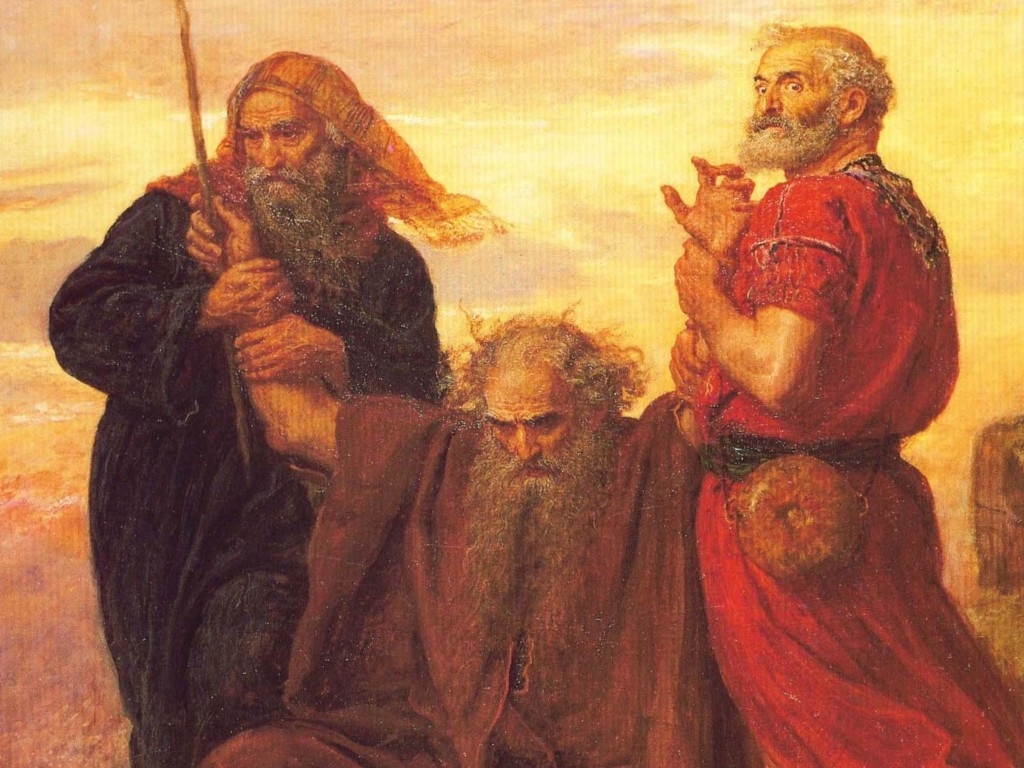
jethromeetsmosesinthedesertExodus 18


1 Jethro, the priest of Midian, Moses’ father-in-law, heard of all that God had done for Moses and for Israel his people, how the Lord had brought Israel out of Egypt. 2 Now Jethro, Moses’ father-in-law, had taken Zipporah, Moses’ wife, after he had sent her home, 3 along with her two sons. The name of the one was Gershom (for he said, “I have been a sojourner in a foreign land”), 4 and the name of the other, Eliezer (for he said, “The God of my father was my help, and delivered me from the sword of Pharaoh”). 5 Jethro, Moses’ father-in-law, came with his sons and his wife to Moses in the wilderness where he was encamped at the mountain of God. 6 And when he sent word to Moses, “I, your father-in-law Jethro, am coming to you with your wife and her two sons with her,” 7 Moses went out to meet his father-in-law and bowed down and kissed him. And they asked each other of their welfare and went into the tent. 8 Then Moses told his father-in-law all that the Lord had done to Pharaoh and to the Egyptians for Israel’s sake, all the hardship that had come upon them in the way, and how the Lord had delivered them. 9 And Jethro rejoiced for all the good that the Lord had done to Israel, in that he had delivered them out of the hand of the Egyptians. 10 Jethro said, “Blessed be the Lord, who has delivered you out of the hand of the Egyptians and out of the hand of Pharaoh and has delivered the people from under the hand of the Egyptians. 11 Now I know that the Lord is greater than all gods, because in this affair they dealt arrogantly with the people.” 12 And Jethro, Moses’ father-in-law, brought a burnt offering and sacrifices to God; and Aaron came with all the elders of Israel to eat bread with Moses’ father-in-law before God. 13 The next day Moses sat to judge the people, and the people stood around Moses from morning till evening. 14 When Moses’ father-in-law saw all that he was doing for the people, he said, “What is this that you are doing for the people? Why do you sit alone, and all the people stand around you from morning till evening?” 15 And Moses said to his father-in-law, “Because the people come to me to inquire of God; 16 when they have a dispute, they come to me and I decide between one person and another, and I make them know the statutes of God and his laws.” 17 Moses’ father-in-law said to him, “What you are doing is not good. 18 You and the people with you will certainly wear yourselves out, for the thing is too heavy for you. You are not able to do it alone. 19 Now obey my voice; I will give you advice, and God be with you! You shall represent the people before God and bring their cases to God, 20 and you shall warn them about the statutes and the laws, and make them know the way in which they must walk and what they must do. 21 Moreover, look for able men from all the people, men who fear God, who are trustworthy and hate a bribe, and place such men over the people as chiefs of thousands, of hundreds, of fifties, and of tens. 22 And let them judge the people at all times. Every great matter they shall bring to you, but any small matter they shall decide themselves. So it will be easier for you, and they will bear the burden with you. 23 If you do this, God will direct you, you will be able to endure, and all this people also will go to their place in peace.” 24 So Moses listened to the voice of his father-in-law and did all that he had said. 25 Moses chose able men out of all Israel and made them heads over the people, chiefs of thousands, of hundreds, of fifties, and of tens. 26 And they judged the people at all times. Any hard case they brought to Moses, but any small matter they decided themselves. 27 Then Moses let his father-in-law depart, and he went away to his own country.

Philip Ryken has shared the story of the conversion of Edward Studd.

            One man who excelled at telling the gospel truth was Edward Studd, the father of C.T. Studd, the famous missionary to Africa.  Studd was a wealthy Englishman who led a life of ease and entertainment until suddenly he was converted by the preaching of D.L. Moody.  Edward’s sons were away at school at the time; so they didn’t know anything about what had happened to their father.  They were shocked when he arrived at Eton in the middle of the term and instead of taking them to the theater, as was his custom, took them to hear Moody preach.  C.T. Studd later said:


Before that time, I used to think that religion was a Sunday thing, like one’s Sunday clothes, to be put away on Monday morning.  We boys were brought up to go to church regularly, but, although we had a kind of religion, it didn’t amount to much…Then all at once I had the good fortune to meet a real live…Christian.  It was my own father.  But it did make one’s hair stand on end.  Everyone in the house had a dog’s life of it until they were converted.  I was not altogether pleased with him.  He used to come into my room at night and ask if I was converted.[i]

It is a powerful thing when the head of a home comes to know the Lord.  It tends to leave a marked impact on all who are in the family.  That was certainly the case with C.T. Studd and the conversion of his father.  Even though C.T. Studd would come to be more well known than his father, the conversion of his father was a seminal moment in his life.

Something along those same lines is happening in Exodus 18.  Moses is certainly more well known than his father-in-law Jethro, but here we are privileged to witness the conversion of Jethro and his ascendancy among the people of God to a position of leadership.  The chapter may be viewed in two parts:  first, Jethro’s entry into the family of God and, second, Jethro’s role in organizing the family of God.

Becoming part of the people of God

Moses had first met Jethro, the priest of Midian, after he saved his daughters from the threatening shepherds in Exodus 2.  Moses married Zipporah and she bore him two sons.  Then God called Moses back to Egypt to deliver His people.  What we have here, then, is a reunion.  Moses is being reunited with his wife, children, and father-in-law.

1 Jethro, the priest of Midian, Moses’ father-in-law, heard of all that God had done for Moses and for Israel his people, how the Lord had brought Israel out of Egypt. 2 Now Jethro, Moses’ father-in-law, had taken Zipporah, Moses’ wife, after he had sent her home, 3 along with her two sons. The name of the one was Gershom (for he said, “I have been a sojourner in a foreign land”), 4 and the name of the other, Eliezer (for he said, “The God of my father was my help, and delivered me from the sword of Pharaoh”). 5 Jethro, Moses’ father-in-law, came with his sons and his wife to Moses in the wilderness where he was encamped at the mountain of God. 6 And when he sent word to Moses, “I, your father-in-law Jethro, am coming to you with your wife and her two sons with her,” 7 Moses went out to meet his father-in-law and bowed down and kissed him. And they asked each other of their welfare and went into the tent. 8 Then Moses told his father-in-law all that the Lord had done to Pharaoh and to the Egyptians for Israel’s sake, all the hardship that had come upon them in the way, and how the Lord had delivered them. 9 And Jethro rejoiced for all the good that the Lord had done to Israel, in that he had delivered them out of the hand of the Egyptians. 10 Jethro said, “Blessed be the Lord, who has delivered you out of the hand of the Egyptians and out of the hand of Pharaoh and has delivered the people from under the hand of the Egyptians. 11 Now I know that the Lord is greater than all gods, because in this affair they dealt arrogantly with the people.” 12 And Jethro, Moses’ father-in-law, brought a burnt offering and sacrifices to God; and Aaron came with all the elders of Israel to eat bread with Moses’ father-in-law before God.

Moses was understandably elated to see his wife, children, and father-in-law.  Less understandable to the modern reader is the immediate affection he shows to Jethro with no record of him showing affection to his wife.  Victor Hamilton has said of this:

But what about seeing Zipporah and the boys? I am sure that if I have seen neither my father-in-law nor my wife for a long time, I know which one I am going to kiss first! But that is a Westerner speaking. Middle Eastern cultures, both past and present, operate differently.[ii]

Hamilton is right in pointing to the differing times in which Moses lived, but likely what is happening here is simply a matter of spotlight.  That is, the spotlight needs to fall on Moses and Jethro at this point in order to show Jethro’s entry into the community of God and the role he would play in their strategic organization.  The story of Israel’s salvation is more focused on key developments than on assuaging the romantic curiosity of sentimental moderns like us.

What we see, then, is Jethro’s apparent conversion.  We will use the term “conversion” here, though the details of Jethro’s theology are not as exhaustively revealed as we would like.  The Anchor Bible Dictionary points out that some have attempted “to connect [Jethro’s] priesthood with a pre-Mosaic Yahweh cult whose beliefs and rituals were transferred to Moses and Aaron (Exodus 18).  This concept maintains that the Hebrew religion has Midianite roots.”  It then goes on, rightly, I believe, to reject this view as “doubtful” on the basis of our text, noting that Jethro seems to come to a confirmed belief in Yahweh only in Exodus 18 and that Jethro’s belief in Yahweh makes him “unique, for it is clear from other sources that generally the Midianites were idolaters (cf. Num 25:17-18; 31:16).”[iii]

What does seem to be abundantly clear is that when Jethro hears the tale of God’s deliverance of his people, he realizes and accepts that Yahweh God is the supreme God over all.

Terence Fretheim, while cautioning against forcing a conversionist template onto this scene, helpfully lists the telling steps in Exodus 18 that point to Jethro and his family’s assimilation into the people of God.

1. Jethro hears what God has done for Israel (v.1).

2. Jethro with Moses’ family visits the newly delivered community.

3. They go into the tent (sanctuary).

4. Moses declares the good news to Jethro…

5. Jethro rejoices over all the good that God has brought to Israel…

6. Jethro gives public thanks (=blesses) to God…

7. Jethro publicly confesses that Yahweh is God of gods and Lord of lords.

8. Jethro presents an offering to God…[iv]

It is tempting to make this a kind of template for conversion.  Moshe Reiss, writing for the Jewish Bible Quarterly, shows how many rabbinic commentators did just that.

The suggestion that Jethro was a convert has a threefold basis: the fact that he

blessed the Lord; that he made sacrifices and a burnt offering to God; and that he then participated in a festive meal, breaking bread with Aaron and the elders before God (Ex. l 8:1 0,12). The battle with Amalek (Ex. 17:8-16) that immediately precedes Jethro’s arrival apparently leads on to Exodus 18:1, Jethro…heard everything that God had done for Moses and for Israel. This fostered the rabbinic understanding that Jethro was inspired to convert after hearing about the defeat of Amalek (TB Zevahim 116a; Pesikta de-Rav Kahana, 3). In other midrashic sources, Jethro and his family spontaneously converted before ever meeting Moses. This explains why the shepherds in Midian disliked and oppressed Jethro’s daughters (Shemot Rabbah 1:32)…


…R. Berechiah explains that Jethro converted and then returned to Midian in order to convert the rest of the Kenites, who later came to live in Israel (Judg. 1:16). R. Berechiah’s pro-convert stance is attested by his statement that Israel’s merit can be ascertained from the number and quality of converts, “like Jethro, Rahab and Ruth” (Kohelet Rabbah 6:5). Going even further, R. Eleazar states that God told Moses:  “1 am He that brought Jethro near, not keeping him at a distance . . . some say that the Shekhinah went with him” (Mekhilta, Yitro).[v]

The only possible problem with this is Jethro’s statement in verse 11, “Now I know that the Lord is greater than all gods, because in this affair they dealt arrogantly with the people.”  Does this mean that Jethro believed there are still other gods but they are not as powerful as Yahweh, or does this mean that Jethro now saw that there was only one God?  In other words, did Jethro convert to monotheism, did he reject the pagan deities for whom he was a priest, or did he simply come to see that the God of Israel was the most powerful of many gods?

It is hard to say, and it is not an unimportant question, but the answer to that question still does not negate the point that what we do see in Jethro’s behavior contains all the marks of true conversion:  he is drawn to God, he learns the good news of God’s amazing saving works, he rejoices at this good news, he embraces the Lord God as supreme, and he moves on to worship God.  Conversion is more than this (in the sense that it does indeed need to include belief that God alone is God), but it is not less than this.

It raises an interesting question.  Have our lives been similarly marked by these movements of faith:  coming, hearing, accepting, rejoicing, worshiping?  When you look at Jethro, do you see your own journey?  Of course, there are a thousand different ways we move from point to point, but these points should be there:  coming, hearing, accepting, rejoicing, worshiping.

Organization within the people of God

Having entered into the family of God, Jethro noticed something about his son-in-law’s leadership style that prompted him to offer some paternal advice.

13 The next day Moses sat to judge the people, and the people stood around Moses from morning till evening. 14 When Moses’ father-in-law saw all that he was doing for the people, he said, “What is this that you are doing for the people? Why do you sit alone, and all the people stand around you from morning till evening?” 15 And Moses said to his father-in-law, “Because the people come to me to inquire of God; 16 when they have a dispute, they come to me and I decide between one person and another, and I make them know the statutes of God and his laws.” 17 Moses’ father-in-law said to him, “What you are doing is not good. 18 You and the people with you will certainly wear yourselves out, for the thing is too heavy for you. You are not able to do it alone. 19 Now obey my voice; I will give you advice, and God be with you! You shall represent the people before God and bring their cases to God, 20 and you shall warn them about the statutes and the laws, and make them know the way in which they must walk and what they must do. 21 Moreover, look for able men from all the people, men who fear God, who are trustworthy and hate a bribe, and place such men over the people as chiefs of thousands, of hundreds, of fifties, and of tens. 22 And let them judge the people at all times. Every great matter they shall bring to you, but any small matter they shall decide themselves. So it will be easier for you, and they will bear the burden with you. 23 If you do this, God will direct you, you will be able to endure, and all this people also will go to their place in peace.” 24 So Moses listened to the voice of his father-in-law and did all that he had said. 25 Moses chose able men out of all Israel and made them heads over the people, chiefs of thousands, of hundreds, of fifties, and of tens. 26 And they judged the people at all times. Any hard case they brought to Moses, but any small matter they decided themselves. 27 Then Moses let his father-in-law depart, and he went away to his own country.

This may seem to be a matter of mere logistics, delegation, and organization, but notice that what was at stake ultimately was the survival of the leader of Israel and the people of God and their final entry into the land of promise:  If you do this, God will direct you, you will be able to endure, and all this people also will go to their place in peace.”

Jethro’s entry into the community of Israel was therefore significant both for what it meant for Jethro and his own salvation and for Moses and his own survival.  Simply put, God brought the right man at the right time.

One cannot help but be struck by the humility of Moses in hearing and heeding the advice of his father-in-law.  Moses could have brushed him off with wounded pride or he could have asked self-righteously what exactly a new convert had to teach a champion like himself.  But Moses did neither.  He honored and heard and obeyed his father-in-law.  Perhaps he was so exhausted that he knew something had to change.  Perhaps he simply knew his father to be a wise man who was not to be lightly dismissed.  Either way, Moses did something that it is hard for leaders to do:  he humbled himself and listened.

As a result, the large congregation was strategically segmented into units that could be more manageably ministered to.  In the Church, this passage is occasionally appealed to as a kind of Old Testament forerunner of the New Testament office of deacon.  Indeed, the rationale for this organization we find in Exodus 18 is similar to that of Acts 6.

1 Now in these days when the disciples were increasing in number, a complaint by the Hellenists arose against the Hebrews because their widows were being neglected in the daily distribution. 2 And the twelve summoned the full number of the disciples and said, “It is not right that we should give up preaching the word of God to serve tables. 3 Therefore, brothers, pick out from among you seven men of good repute, full of the Spirit and of wisdom, whom we will appoint to this duty. 4 But we will devote ourselves to prayer and to the ministry of the word.” 5 And what they said pleased the whole gathering, and they chose Stephen, a man full of faith and of the Holy Spirit, and Philip, and Prochorus, and Nicanor, and Timon, and Parmenas, and Nicolaus, a proselyte of Antioch. 6 These they set before the apostles, and they prayed and laid their hands on them. 7 And the word of God continued to increase, and the number of the disciples multiplied greatly in Jerusalem, and a great many of the priests became obedient to the faith.

In both cases, organization and delegation are necessary so that the leaders of the congregation will not burn out and ultimately be of no use to God’s people and so that they can focus on their primary tasks.  Furthermore, it is interesting to compare the qualifications of Israel’s division heads with the qualifications of New Testament deacons.  In our text, Jethro called for a particular kind of man to be given leadership.

21 Moreover, look for able men from all the people, men who fear God, who are trustworthy and hate a bribe

Similarly, Paul writes this in 1 Timothy 3:

8 Deacons likewise must be dignified, not double-tongued, not addicted to much wine, not greedy for dishonest gain. 9 They must hold the mystery of the faith with a clear conscience. 10 And let them also be tested first; then let them serve as deacons if they prove themselves blameless. 11 Their wives likewise must be dignified, not slanderers, but sober-minded, faithful in all things. 12 Let deacons each be the husband of one wife, managing their children and their own households well. 13 For those who serve well as deacons gain a good standing for themselves and also great confidence in the faith that is in Christ Jesus.

This should not surprise us, these similarities, for the character of God does not change and His love for His people does not change and the marks of a useful servant of God does not change.  In both cases we see the providential care of God for His people:  His raising up of new leaders, His granting of humility to those leaders who have already been raised, His involvement of willing servants in the care of his people, His concern about the concerns of all His people, and His provision for His people on their journey home.


[i] Philip Graham Ryken, Exodus. Preaching the Word (Wheaton, IL: Crossway Books, 2005), p.476.

[ii] Hamilton, Victor P. (2011-11-01). Exodus: An Exegetical Commentary (Kindle Locations 9229-9231). Baker Publishing Group. Kindle Edition.

[iii] Joel C. Slayton, “Jethro.” The Anchor Bible Dictionary. Vol.3, H-J (New York, NY: Doubleday, 1992), p.821.

[iv] Terence E. Fretheim, Exodus. Interpretation (Louisville, KY: Westminster John Knox Press, 2010), p.195-196.

[v] Moshe Reiss, “Jethro the Convert.” Jewish Bible Quarterly. (April 1, 2013), p.93-94.
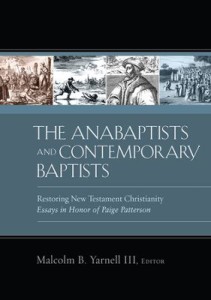
Malcolm Yarnell’s (editor) The Anabaptists and Contemporary Baptists

681745This book contains the presentations that were given at a 2012 conference by (essentially) the same name at my alma mater, Southwestern Baptist Theological Seminary in Fort Worth, Texas.  (Videos of the presentations can be viewed here.)  I have been mildly interested in reading this, to be honest, but not overly so.  However, when I saw it offered on sale at Amazon the other day I happily purchased it.  Having just finished it, I can say that this is an extremely interesting and informative work and one, I should say, that is more than worth the full retail cost.  (In fact, I may very well purchase a hardcopy because I think this would be a valuable addition to my library.)  Thus, my mild skepticism was wrong, and I gladly stand corrected!

There is way too much information in the book to summarize here, but, suffice it to say, you will walk away from a reading of this book with a very good understanding of the key personalities, historical developments, and controversies of the Anabaptists.  You will also come away with a deep appreciation for these brave men and women.  To be sure, the authors do not seek to gloss over some of the more unfortunate theological, political, and personal aspects that have been associated with the movement, but they convincingly show these to be anomalies and perversions of the true Anabaptist spirit.

What is the true Anabaptist spirit?  I would say it is radical discipleship.  This discipleship arose out of a fearless and honest reading of scripture and a desire to implement what was read therein.  This led to regenerate church membership, believers baptism, missions, and personal holiness.  The Anabaptist movement was filled with fascinating and colorful personalities who were persecuted by Catholics and (amazingly) Protestants alike.

There were many things in the book that I found very interesting.  The Anabaptists’ relationship with Zwingli, for example, is as interesting as it is frustrating.  Furthermore, if Luther hatched the egg that Erasmus laid then the Anabaptists can rightly be said to have hatched the egg that Luther laid.  Speaking of Erasmus, the book’s discussion of his impact on Balthasar Hubmaier was likewise intriguing.  The account of Luther’s detestation of the Anabaptists is tragic.  What is more, the magisterial Reformers’ wrestling with and ultimate rejection of believer’s baptism is a most unfortunate example of the victory of eisegesis over exegesis.

This is a very, very good book.  I’m sorry I did not read it when it first appeared.  If you would like to see church history taught in an engaging way, read the lectures in this book.

Apologia: A Sermon Series in Defense of the Faith – Part IIb: “Can We Trust the Bible?”

apologiaAs we continue with our consideration of the reliability of the Bible (with special attention being paid to the writings of the New Testament), I would like to review the premise and the three basic historical facts we looked at earlier.

The premise from which we are operating is as follows: the reliability of the Bible is important as it is from the Bible that we learn information about the person of Jesus: who He is, why He came, and what He has done and is doing.

We believe this is a matter of paramount importance. Can we trust what we read in our Bibles? Behind this specific consideration is the larger theological issue of revelation and the modern skepticism concerning the reality of it. But Christianity is a revealed religion, and, in fact, is the steward of the definitive revelation of God in Christ. It is through the teachings of the Bible that we learn about Christ. Thus, our confidence in scripture is our confidence in the revealed truth of God, or God’s word.

The three basic historical facts that will continue to frame our discussion are:

  1. The books of the New Testament were written. The original manuscripts are called “the autographs”
  2. Immediately, copies began to be made of the autographs and spread throughout the world. We refer to these as “the New Testament manuscripts.”
  3. In the year 367 AD, Athanasius, in his Festal Letter, provided the earliest known list of the 27 books of the New Testament as we know them.

We will be giving the first two facts particular attention.

No other ancient work has such a strong body of manuscript evidence as close to the time of its writing as does the Bible.

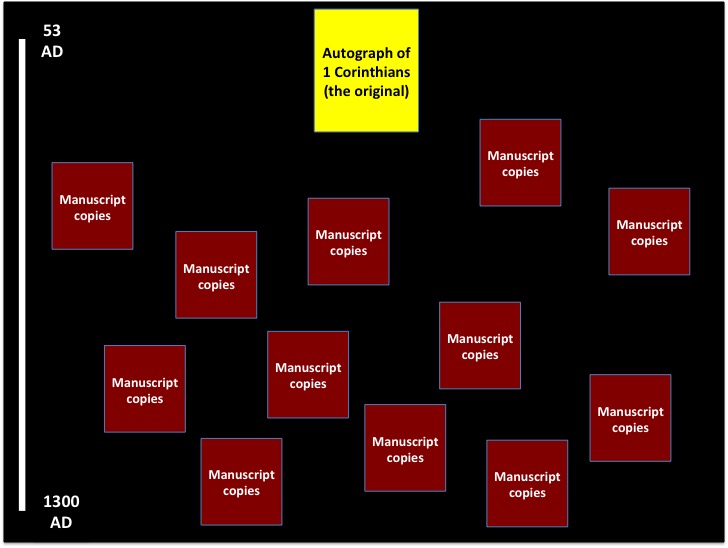
One of the significant arguments for the reliability of the Bible has to do with the manuscript evidence that we possess. In order to get at this, we will need to remember especially those first two facts. Let us use 1 Corinthians as a case study. First, let us realize that 1 Corinthians was written by Paul in the mid 50’s AD.

a

The original letter, the first edition of 1 Corinthians, is call “the autograph.” We do not possess it. We do not possess any of the New Testament autographs. However, what we do possess are numerous copies of the original letter.

b

So how do we know what 1 Corinthians says? Primarily by looking at the earliest manuscripts. The earliest manuscripts are usually given the greatest weight because they were copied closest to the time of the original writing. Then we look at all the manuscripts we have for 1 Corinthians, comparing them as we go. We also consider the writings of the earliest church fathers and how they referred to and quoted or paraphrased 1 Corinthians. In this way, we are able to see what the original said. The process is a lot more complicated, of course, and there are specialists in numerous fields that contribute to this process, but, in general, this is how we come to know what, say, 1 Corinthians says.

It has become fashionable for critics to harp on the fact that we only possess copies of the New Testament writings and not the originals. As we have already said, this is not terribly significant. Papyrus and other mediums do not last forever and the fact that the autographs have not survived is neither here nor there. Perhaps God in His wisdom knew that the Church would be tempted to make an idol of the original writings had they survived. And, of course, perhaps they have survived and have not yet been discovered. Exciting early manuscript finds happen all the time!

No, the truth is that, what we have with the New Testament and its manuscripts is, in the words of Dan Wallace, “an embarrassment of riches.”

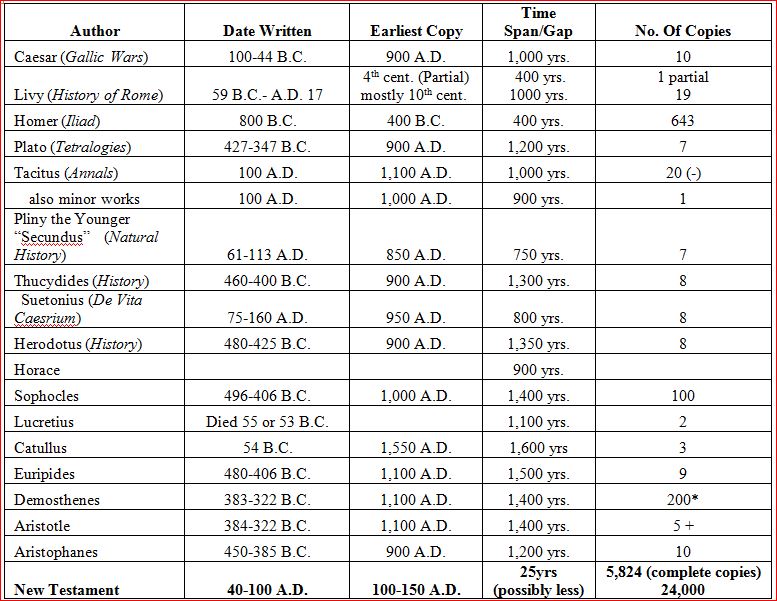
What does he mean by that? What he means is that the manuscripts we have for the books of the New Testament are so voluminous and are so much closer to the time of the writing of the biblical autographs than are the manuscripts for other ancient works that are generally trusted today that if we cannot trust the Bible, then we have much more reason not to trust these other works.

Let me demonstrate. Below is a series of ancient works. Their authors are listed as are the book/s they wrote, the date they were written, and the date of the earliest surviving copy we have for that book. We likewise possess none of the autographs, the originals, for any of these writings. Then the time gap between the date of the writing of the autograph and the date of the earliest manuscript is written along with the number of manuscripts we have for that work. Let us consider how the New Testament stacks up to these other works of antiquity.

10An embarrassment of riches indeed! This is simply staggering. Let me share Dr. Wallace’s conclusion concerning this amazing comparison:

In terms of extant manuscripts, the New Testament textual critic is confronted with an embarrassment of riches. If we have doubts about what the autographic New Testament said, those doubts would have to be multiplied at least a hundred-fold for the average classical author. And when we compare the New Testament manuscripts to the very best that the classical world has to offer, it still stands head and shoulders above the rest. The New Testament is far and away the best-attested work of Greek or Latin literature from the ancient world. Precisely because we have hundreds of thousands of variants and hundreds of early manuscripts, we are in an excellent position for recovering the wording of the original. Further, if the radical skeptics applied their principles to the rest of Greco-Roman literature, they would thrust us right back into the Dark Ages, where ignorance was anything but bliss. Their arguments only sound impressive in a vacuum.[1]

The late Frederic Kenyon, famed British paleographer and classical scholar, put it even more poignantly:

The interval then between the dates of original composition and the earliest extant evidence becomes so small as to be negligible, and the last foundation for any doubt that the Scriptures have come down to us substantially as they were written has now been removed. Both the authenticity and the general integrity of the books of the New Testament may be regarded as finally established.[2]

Church, marvel at the amazing evidence and the mountain of confirmation that God has left His people concerning the reliability of His word.

The variants in the manuscript copies are almost completely trivial.

But let us go back a moment to the autograph and the manuscript copies.

b

The next question is do the manuscript copies we have contain discrepancies between themselves? In other words, if we compare all of the copies do they all completely agree? And the answer is clearly no. There are discrepancies among the manuscripts.

Much is made of this fact by detractors of the Bible. Indeed, of all the arguments marshaled against scripture, this is one of the most common. It is asserted with confidence that since there are discrepancies among the manuscripts we therefore cannot know what the Bible says. But when this attack is made, those making it are really revealing their own biases and personal agendas.

In point of fact, discrepancies among the manuscripts do not matter and do not touch on the reliability of the Bible for two important reasons.

The first is that the doctrine of inerrancy, or the idea that the Bible has no errors, applies to the autographs, to what Paul or Matthew or John or whomever actually wrote, not to later copies. For instance, were I to ask all of you to open your Bibles to the little book of Philemon in the New Testament and then give you all pen and paper and ask you to copy the book of Philemon, I guarantee you there would be discrepancies in our copies. But the fact that you and I might have made mistakes in copying the book does not mean (a) that the book itself has errors or (b) that our errors make the original wording of the book unattainable.

The doctrine of inerrancy has always applied to the autographs. The classic evangelical statement on inerrancy is the 1978 “Chicago Statement on Inerrancy.” It is a very interesting and well-done statement that should be closely considered. A few of its affirmations and denials are especially apropos for our considerations.

Article VI. We affirm that the whole of Scripture and all its parts, down to the very words of the original, were given by divine inspiration.

Article X. We affirm that inspiration, strictly speaking, applies only to the autographic text of Scripture, which in the providence of God can be ascertained from available manuscripts with great accuracy. We further affirm that copies and translations of Scripture are the Word of God to the extent that they faithfully represent the original.

            We deny that any essential element of the Christian faith is affected by the absence of the autographs. We further deny that this absence renders the assertion of biblical inerrancy invalid or irrelevant.[3]

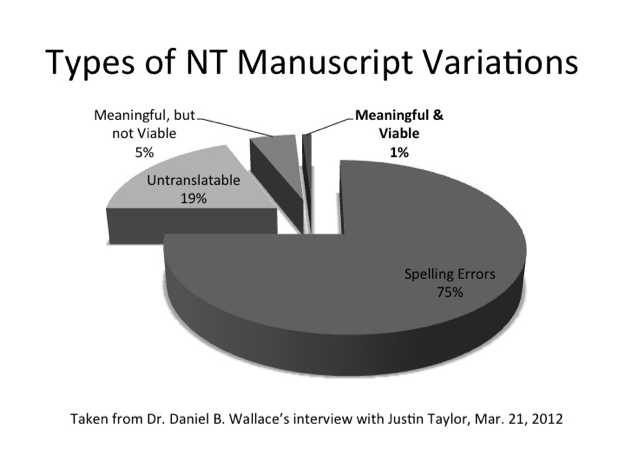
Thus, any discrepancies in the manuscripts simply cannot touch the doctrine of inerrancy. But what of the discrepancies? What kind of variances are there? Are they so great that they conceal the wording of the original from view? Hardly. The fact is that the vast, vast majority of these discrepancies are matters of spelling or obscurity.

6

This certainly takes a good deal of steam out of the bluster of the critics. Theologian Wayne Grudem has summarized the differences in the manuscripts like this:

…for over 99 percent of the words of the Bible, we know what the original manuscript said. Even for many of the verses where there are textual variants (that is, different words in different ancient copies of the same verse), the correct decision is often quite clear, and there are really very few places where the textual variant is both difficult to evaluate and significant in determining the meaning. In the small percentage of cases where there is significant uncertainty about what the original text said, the general sense of the sentence is usually quite clear form the context.[4]

More significant is the conclusion of Bart Ehrman concerning these differences. His conclusions are significant because Ehrman is a former evangelical turned atheist New Testament scholar. He is the current media darling on these matters and has made quite a comfortable living attempting to debunk and cast doubt on the New Testament in particular. To be clear, he feels that there are a few places where the discrepancies really do matter, but in his book, Misquoting Jesus, Ehrman, in answering a question posed to him by the editors, likewise admitted that the presence of discrepancies is not simply shattering to Christianity and that the vast majority of them simply do not matter.

Why do you believe these core tenets of Christian orthodoxy to be in jeopardy based on scribal errors you discovered in the biblical manuscripts?

Essential Christian beliefs are not affected by textual variants in the manuscript tradition of the New Testament.[5]

Furthermore, last year, in a June 19, 2014, blog post entitle, “Who Cares?? Do the Variants in the Manuscripts Matter for Anything?” Ehrman spoke further to this when he said the following:

“[T]he vast majority of the…differences are immaterial, insignificant, and trivial…Probably the majority matter only in showing that Christian scribes centuries ago could spell no better than my students can today…[N]one of the variants that we have ultimately would make any Christian in the history of the universe come to think something opposite of what they already think about whatever doctrines are usually considered ‘major.’”[6]

Church, given the staggering amount of manuscript evidence over the first fifteen hundred years of the Christian era, we would expect human errors in the copies. What is truly wonderful, however, is that the insignificant and truly petty nature of over 99% of these discrepancies in no way affect our understanding of what the original manuscript said. You may therefore hold your Bible with confidence, especially in the face of uniformed challenges to its reliability from those who, on the basis of a surface reading and understanding of the data, think they have found an irrefutable silver bullet against the faith.

Jesus and the Apostles viewed the Bible as reliable and God-given and quoted from it extensively.

Above all of these reasons, however, is one that is more significant than all others. We can get at this reason by listening closely to what Jesus said in His wilderness temptations in Matthew 4.

1 Then Jesus was led up by the Spirit into the wilderness to be tempted by the devil. 2 And after fasting forty days and forty nights, he was hungry. 3 And the tempter came and said to him, “If you are the Son of God, command these stones to become loaves of bread.” 4 But he answered, “It is written, “‘Man shall not live by bread alone, but by every word that comes from the mouth of God.’” 5 Then the devil took him to the holy city and set him on the pinnacle of the temple 6 and said to him, “If you are the Son of God, throw yourself down, for it is written, “‘He will command his angels concerning you,’ and “‘On their hands they will bear you up, lest you strike your foot against a stone.’” 7 Jesus said to him, “Again it is written, ‘You shall not put the Lord your God to the test.’” 8 Again, the devil took him to a very high mountain and showed him all the kingdoms of the world and their glory. 9 And he said to him, “All these I will give you, if you will fall down and worship me.” 10 Then Jesus said to him, “Be gone, Satan! For it is written, “‘You shall worship the Lord your God and him only shall you serve.’” 11 Then the devil left him, and behold, angels came and were ministering to him.

Do you notice how Jesus began all three of his responses to the devil?

4 It is written…

7 Again, it is written…

10 For it is written

“It is written.” Jesus appeals three times to the writings. What writings? The writings of scripture.

Jesus thought the Bible was reliable and authoritative. He agreed that the scriptures are theopneustos, God-breathed.

This is the evidence above all other evidence, the proof above all proof: Jesus, the Son of God, quoted and relied upon scripture. Furthermore, so did the apostles. In fact, the New Testament is filled with references to the Old Testament. Here, for instance, is a chart showing every place in which the New Testament quotes the Old Testament, in which any portion of scripture references any other portion:

8

And here is another showing how often Jesus quoted the Old Testament:

9

The evidence is undeniable: Jesus and His apostles felt that the scriptures were authoritative and reliable. In his essay, “New Testament Use of the Old Testament,” Roger Nicole writes:

[A] very conservative count discloses unquestionably at least 295 separate references to the Old Testament [in the New Testament]. These occupy some 352 verses of the New Testament, or more than 4.4 per cent. Therefore one verse in 22.5 of the New Testament is a quotation.

If clear allusions are taken into consideration, the figures are much higher: C. H. Toy lists 613 such instances, Wilhelm Dittmar goes as high as 1640, while Eugen Huehn indicates 4105 passages reminiscent of Old Testament Scripture. It can therefore be asserted, without exaggeration, that more than 10 per cent of the New Testament text is made up of citations or direct allusions to the Old Testament. The recorded words of Jesus disclose a similar percentage. Certain books like Revelation, Hebrews, Romans are well nigh saturated with Old Testament forms of language, allusions and quotations…

If we limit ourselves to the specific quotations and direct allusions which form the basis of our previous reckoning, we shall note that 278 different Old Testament verses are cited in the New Testament: 94 from the Pentateuch, 99 from the Prophets, and 85 from the Writings. Out of the 22 books in the Hebrew reckoning of the Canon only six (Judges-Ruth, Song of Solomon, Ecclesiastes, Esther, Ezra-Nehemlah, Chronicles) are not explicitly referred to. The more extensive lists of Dittmar and Huehn show passages reminiscent of all Old Testament books without exception.

Nicole then says this about the New Testament use of the Old Testament.

The New Testament writers used quotations in their sermons, in their histories, in their letters, in their prayers. They used them when addressing Jews or Gentiles, churches or individuals, friends or antagonists, new converts or seasoned Christians. They used them for argumentation, for illustration, for instruction, for documentation, for prophecy, for reproof. They used them in times of stress and in hours of mature thinking, in liberty and in prison, at home and abroad. Everywhere and always they were ready to refer to the impregnable authority of Scripture.

Jesus Christ…quoted the Old Testament in support of his teaching to the crowds; he quoted it in his discussions with antagonistic Jews; he quoted it in answer to questions both captious and sincere; he quoted it in instructing the disciples who would have readily accepted his teaching on his own authority; he referred to it in his prayers, when alone in the presence of the Father; he quoted it on the cross, when his sufferings could easily have drawn his attention elsewhere; he quoted it in his resurrection glory, when any limitation, real or alleged, of the days of his flesh was clearly superseded. Whatever may be the differences between the pictures of Jesus drawn by the four Gospels, they certainly agree in their representation of our Lord’s attitude toward the Old Testament: one of constant use and of unquestioning endorsement of its authority.[7]

The Bible is authoritative and reliable and trustworthy. It is God’s word to us. It is the Bible that Jesus quoted and pointed to time and again. It is the Bible that the apostles quoted in advancing the gospel in the world. It is the Bible that the early church fathers pointed to and quoted and alluded to time and time and time again. It is the Bible that the followers of Jesus wrote then copied over and over and over and over again. It is the Bible that was spread and sent and carried throughout the world. It is the Bible that followers of Jesus have labored to copy and preserve and whose value many of them have demonstrated and confirmed with their own blood. It is the Bible that this Church preaches and on which we stand.

It is God’s word to humanity. It points us to Jesus, the Word who was with God and who is God. It is the infallible, inerrant, trustworthy, reliant word, the scriptures that still reveal the power of the gospel and teach us divine truth and draw our eyes to Jesus.


[1] (2013-07-01). In Defense of the Bible: A Comprehensive Apologetic for the Authority of Scripture (Kindle Locations 3210-3219). B&H Publishing Group. Kindle Edition.

[2] Quoted in F.F. Bruce, The New Testament Documents: Are They Reliable? (Downers Grove, IL: InterVarsity Press, 1995), p.20.

[3] Carl F.H. Henry. “The God Who Speaks and Shows: Fifteen Theses, Part Three.” God, Revelation, and Authority. Volume IV. (Wheaton, IL: Crossway Books, 1999), p.213.

[4] Wayne Grudem, Systematic Theology. (Grand Rapids, MI: Zondervan, 1994), p.96.

[5] Referenced by Dan Wallace at the 50.20 mark in his 2013 Ouachita Baptist University lecture, “How Much Did the Scribes Corrupt the New Testament?” https://vimeo.com/74471900

[6] https://ehrmanblog.org/who-cares-do-the-variants-in-the-manuscripts-matter-for-anything/

[7] https://www.bible-researcher.com/nicole.html

Some Thoughts Occasioned by Mark Tansey’s 1994 Painting “Landscape”

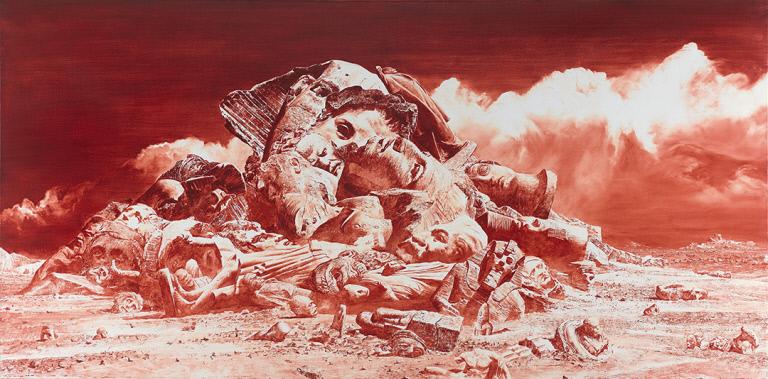
I took yesterday off and Mrs. Richardson and I traveled to Crystal Bridges Museum of American Art in Bentonville, Arkansas.  It was the second time I had been to this truly wonderful museum.  However, I did not recall yesterday having seen Mark Tansey’s 1994 painting, “Landscape,” on our first trip (you can zoom in on the painting through the Sotheby’s page here).

2014_29v1

It is an arresting piece, and one about which I would like to share a few thoughts.  Or perhaps it would be more accurate to say I would like to share my immediate reaction to the piece.  It struck me as a poignant piece, and an ironic one, given the current cultural disequilibrium resulting from the seismic shifts in the ideological underpinnings of Western society that have taken place as a result of the project of modernity.  In short, the painting was a jarring reminder to me of the necessarily temporal nature of worldviews, ideologies, programmes, nations, leaders, and movements.

Today’s colossus is tomorrow’s footnote, be it a person or a zeitgeist.

The oft-alluded-to ash heap of history is a reality that should comfort those who feel philosophically and theologically displaced by the latest and trendiest orthodoxies of the age.  I say “orthodoxies” because, whilst relatively new, the most recent manifestations are shrouded in all the gravitas of orthodoxy and their opponents are essentially viewed as heretics by their priests.

It raises the question:  is there a King who will not be discarded and is there a movement that will last?

The Church answers both in the affirmative.

The painting is fascinating to me.  Take some time and zoom into the piece and see how many of the faces you can identify.

Lastly, the text from the Sotheby’s catalogue is interesting in its own right, and includes some brief observations from the artist.  I am providing it below.

“I think of the painted picture as an embodiment of the very problem that we face with the notion of ‘reality’. The problem or question is, which reality? In a painted picture, is it the depicted reality, or the reality of the picture plane, or the multidimensional reality the artist and viewer exist in? That all three are involved points to the fact that all pictures are inherently problematic.” (the artist cited in Arthur C. Danto, Visions and Revisions, New York, 1992, p. 132)

Armed with compelling intellect and inspiring levity, Mark Tansey is both an architect of thought and a visual archaeologist of the most unruly manner. A history painting of the highest order, the monumentally panoramic Landscape from 1994 draws us into its crimson depths, opening a spectacular vista of rich pictorial data that is completely and utterly engrossing. Calm and deliberate, Tansey’s brush expertly captures the details of overlapping perspective and shadows, inspiring pure awe in its overall scope and close-up precision. Landscape allegorizes history in what appears by its representational nature to be explanatory, but upon close observation one begins to understand that his mound of rubble in fact conceals much more than it reveals; Tansey, like René Magritte, prefers to leave his pictures open-ended, achieving at once an accessibility in its figurative quality while opening the disquieting potential for numerous interpretations and persistent rereading. The resultant tableau seduces the viewer into the artist’s speculative reenactment, which borrows from several historical sources, all artistically choreographed for heightened visual drama. Tansey’s intricately detailed compositions are rife with hidden codas: tiny text, secret symbols, and infinitesimal images which are informed with a greater sense of historiography than any of his contemporaries. A dazzling technician, with a pictorial language that results in achingly beautiful trompe l’oeil, Tansey’s Landscape informs as much as it suggests and answers as much as it questions.

Tansey unravels modes of perception and representation, perennially testing the eye and eluding narrative clarity in favor of incredulous wonder. By adhering to the conventions of representational painting, Tansey encourages an instantaneous familiarity that he quickly corrupts, thereby making us aware of our own susceptibility to images. Though realistic in appearance, the scene is completely contrived. In its complex composition and classical subject matter, the hill of ancient ruins appears rooted in a particular period of painting far removed from the contemporary, and yet untangling the fragments buried in the mountain of Tansey’s painting reveals a completely ahistorical and atemporal narrative. An impossible encounter between antiquity, the Renaissance, and brutalist Cold War-era sculpture, Landscape instead proffers a pastiche of art history, while toppling the past in a hill of wreckage to illustrate the conflicts inherent in fabricating categorical chronologies. Representations of powerful male figures in sculpture from throughout history comprise the hill of debris—excavating the dense surface of the painting reveals the visages of Stalin, Lincoln, Hitler, Julius Caesar, George Washington, and Constantine enmeshed among remnants of archaic Egyptian pharaohs, Mayan kings, young male kouroi, and the Sphinx, an assortment of characters both real and invented. Tansey constructs a pyramid of testosterone-fueled history, jumbling a collage of famous men to seduce the viewer into an alluring game of identification. The proposition presented to us in untangling the web of references is simultaneously thrilling and daunting, enhanced by the instant recognizability of some with the ambiguity of others’ foreshortened and warped likenesses. In Landscape’s monolithic tower of political rulers whose empires eventually faced upheaval with the inevitable progression of time, Tansey tracks a recurrent plotline throughout history of territorial competition and patriarchal dominion—the painter seems to suggest the ceaseless repetition of history in the landfill of rulers past. Deceptively legible, Tansey’s paintings offer us the promise of veracity in their naturalistic style, yet quickly by their supernormal mélange of constituent elements we decode the dream-world of the painter’s mind, populated by the relics of bygone dynasties.

The compositional drama is formally underscored by the exaggerated chiaroscuro. Storms of shadowy red envelop the atmospheric force of the painting’s amplitude, creating an overwhelming tonal value that lends the work its striking immediacy. Evocative of the surrealist landscapes of Dalí and de Chirico, who melted the space-time continuum by shattering perspective and confusing light and shadow, Tansey’s Landscape harnesses a resounding visual power that enraptures the eye and stimulates the mind through foreshortening and optical illusionism. Tansey’s method of painting is excruciatingly time sensitive. Beginning with applying a heavily gessoed ground to the surface, layer upon layer of paint is then successively added to build up a rich surface from which Tansey carves and swipes away paint with a variety of tools and implements. Working within the six hour time frame before his paint dries and becomes unpliable, Tansey operates under formidable time constraints, akin to the technique of fresco-painting. Through his additive and reductive method, Tansey takes on the role of draughtsman, painter, and sculptor. His images thus emerge from the monochromatic abyss by means of a constant process of wiping and pulling pigment away in order to render the painstaking details that fill the vast expanse.

Exemplified by the ingenuity of the present work, Tansey is a virtuoso of narrative, culling his themes from a litany of rhetorical sources and filtering them through his distinctly surreal imagination. When postmodernist thought gained traction in the 1970s with the pioneers of the Pictures generation—artists such as Cindy Sherman, Richard Prince, and Louise Lawler—art concerned with the mechanics of picture-making and representation intentionally evaded painting. Committed to searching the archives for means of persistently questioning the nature of images, Tansey’s strategy of appropriation within his painting to investigate historical modes of image construction was increasingly unique. An extraordinary bibliophile, Tansey draws from various texts—literary, cinematic, and peerlessly uncanny, Tansey’s painting evokes an insatiable curiosity that is coupled with unforgiving intelligence. Landscape maintains a photographic exactitude in its monochromatic resplendence, enrobing the surface of the canvas in a sumptuous wave of luscious red. As is the case of all of the most sought after works in Tansey’s aesthetic arsenal, Landscape is deliberately monochromatic; he varies the value but not the tone of his colors. Like a black and white photograph, Tansey’s monochrome contours evoke the outmoded and archaic, yet spun through the preposterous tone of deep cerise. The hue is as otherworldly as the picture itself, a breathtaking image whose reality is belied by the photographic nature in which it is painted.

Franz Kafka’s The Trial

5a1In Franz Kafka’s novel, The Trial, a man named Josef K. (referred to simply as “K.” throughout the book) is arrested on charges that are never explained to him by a court that is shrouded in mystery, presided over by judges that wield seemingly arbitrary power, and in which lawyers and agents of the court appear to be experts in obfuscation. K. attempts to live his life like normal in the midst of this odd ordeal, per the instructions of the court, but the ever-looming trial haunts and torments him, pulling him further and further into the depths of the system’s insanity.  Ultimately, K. is taken out by two agents of the court and executed with a knife.

This is a strange, frustrating, but intriguing and provocative tale.  The genius of Kafka was in creating mysterious, nightmarish tales that are open to various interpretations.  There is an absurdity about this story that is terrifying because it evokes the absurdity of life as we oftentimes actually encounter it.

The story left me with many questions.  What is the trial?  Is K. Kafka and is this a psychological or spiritual autobiography?  Is this a story about religion?  If Kafka saying that life itself is a strange trial the rules of which are never made clear to us, that God is the ominous Judge before whom we are somehow guilty and from whom we can never escape?  Is it a story about government, its power over man, its stifling and absurdist bureaucracy and labyrinthine red-tape, or is it simply a commentary on the suffocating, vicious underbelly of society and its power structures?  Is the trial more personal, a projection of Kafka’s own sense of being trapped in something he cannot possibly begin to understand, of being doomed by ominous forces outside of his control?  Is this an ode to existential despair, pessimism, nihilism even?

Is the key to the story to be found in the final words (or what appear to be the final words – Kafka never finished and polished the story, and fragments remain, but this appears to be the conclusion), K.’s final observation at the moment of his murder as the knife is plunged into him:  “Like a dog”?  Does that mean that Kafka’s tale is about how the maddening and nonsensical dynamics of life that we find ourselves trapped in eventually succeed in robbing us of our dignity and our humanity, that they reduce us to animals, “like a dog”?

There is a despair about this story that is unsettling, that somehow resonates with much that we experience in life.  It is reminiscent of Solomon’s more pessimistic musings in the book of Ecclesiastes, yet without the overarching hope of God’s deliverance.

This is a book to read more than once, but likely with some time in between.  I suppose the genius of Kafka is that he taps into the human sense of angst that all of us, at times feel.  I was drawn to and repelled by this story.

K.’s conversation with the priest in the cathedral had the most overtly theological (or theodical?) tone to it, and there I was close to concluding that this story is an accusation against God, that, in reality, The Trial is putting God on trial.  But I am not sure.  I fluctuated between thinking that and thinking that The Trial is simply life itself and its penchant for absurdist, inescapable dehumanization.  In that view, it is not unlike his story, The Metamorphosis [which I reviewed here].

I’m not sure what to say in terms of recommendation.  I can imagine many folks not liking this story at all.  But if you would like to see an attention-grabbing exercise in existential anxiety, and if you enjoy trying to decipher literary riddles, you should probably check this out.

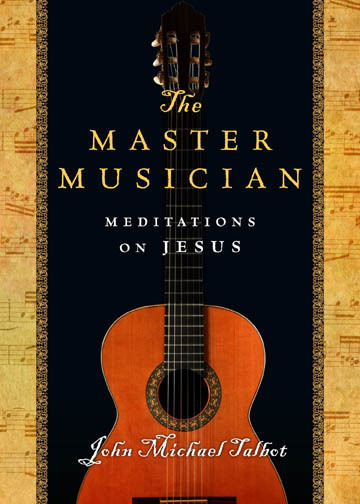
John Michael Talbot’s The Master Musician

The-Master-Music-Cover-Lo-Res

InterVarsity Press has republished musician John Michael Talbot’s book, The Master Musician, and I wanted to recommend it here as a nice, brief, but poignant devotional reflection on Christian growth both individually and corporately.  Talbot is a Franciscan monk based in Eureka Springs, Arkansas, whose music I have been listening to for over twenty years.  He has been writing and performing music on a very high level for a very long time, and his expertise will be evident as you read this book.

He establishes his operational premise at the outset of the book:

God is the Master Musician. We are his instruments. He gently plucks the strings of our lives to make a harmonious song for all creation. We are like a beautifully crafted guitar, formed, seasoned and brought to expression by the same hand. (Kindle Locations 30-32)

The remainder of the book is the fleshing out of this analogy.  Individually, he likens the Christian to a guitar and discusses the implications of a guitar’s creation and playing for the Christian life.  Corporately, he expands the analogy out to encompass various forms of musical expression:  choral, symphonic, ensembles, folk, rock, etc.  His ecclesiological and, specifically, ecumenical conclusions from this exercise are intriguing and thought-provoking.  He comes closing to pushing the analogy beyond the brink, but never quite does so.

In all, this is an accessible, creative, and helpful look at the Christian life through the eyes of a tremendous musician who is drawing on the world he knows best.  Highly recommended.

“Concerning the Church and Marriage”: A Last Minute Sermon Change

Marriage Heart HealthI’m not going to say much about this here.  I’ll just let the sermon speak for itself until I decide to address the issue further.  But, for numerous reasons, I did something yesterday (Saturday) that I almost never do.  I set aside the sermon I had worked on all week and wrote a new one in light of the recent Supreme Court decision concerning marriage.  I am not a political preacher.  I’m a Jesus preacher.  But I simply felt that I had a responsibility to speak from a gospel perspective to this issue.  I am grateful to pastor a church where I can simply share my heart on such controversial matters.  Here’s the sermon.

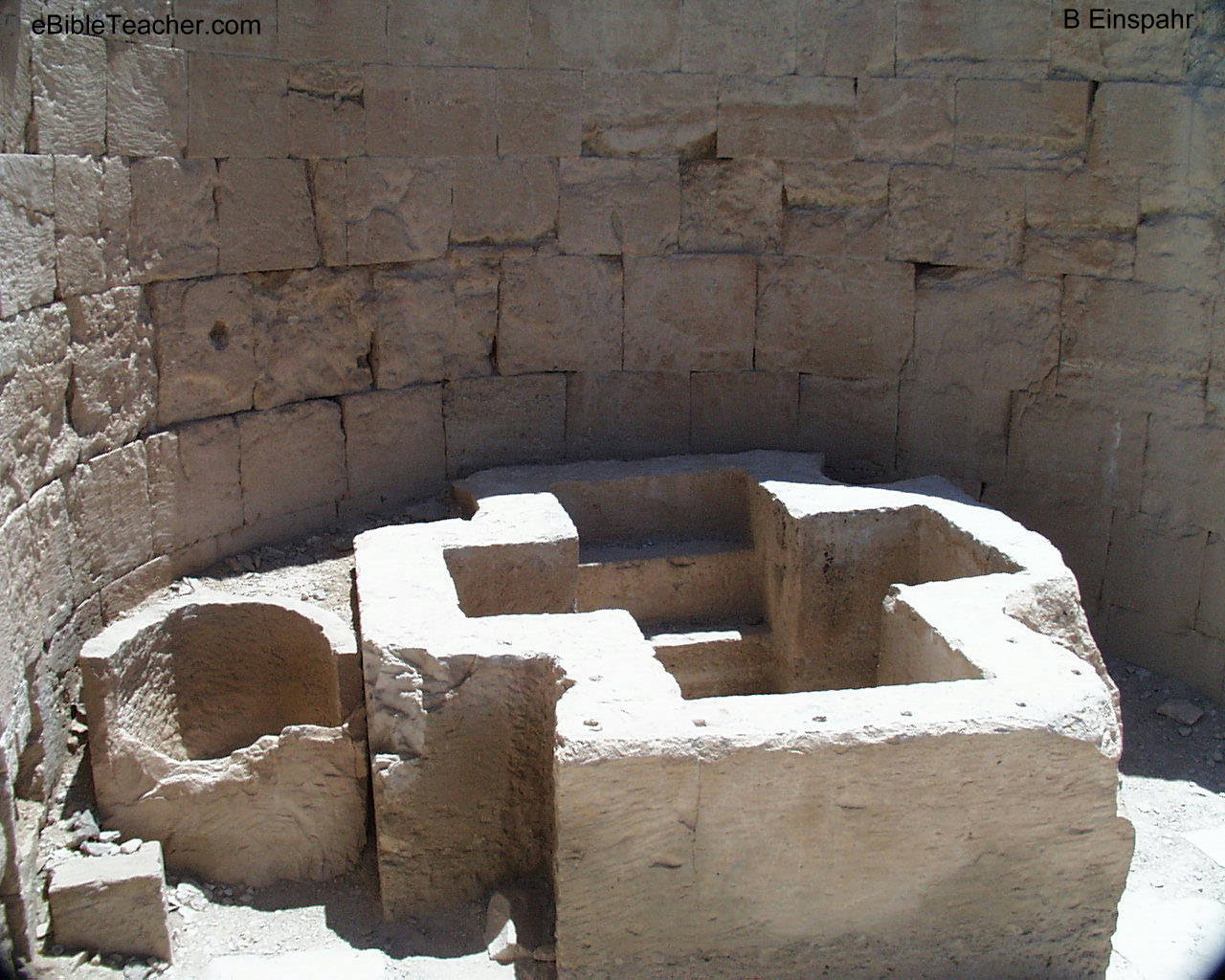
Concerning Believer’s Baptism by Immersion

baptbyzantI work very hard to make sure that my ministry is much more about being a Christian than being a Baptist.  That being said, I certainly do not apologize for being a Baptist.  On Wednesday nights through the summer we have been looking at Baptist distinctives.  Last Wednesday night I spoke on the Baptist belief in believer’s baptism by immersion.  I am providing the audio of that presentation here.

Exodus 17

moses-holding-up-his-arms-during-the-battleExodus 17

1 All the congregation of the people of Israel moved on from the wilderness of Sin by stages, according to the commandment of the Lord, and camped at Rephidim, but there was no water for the people to drink. 2 Therefore the people quarreled with Moses and said, “Give us water to drink.” And Moses said to them, “Why do you quarrel with me? Why do you test the Lord?” 3 But the people thirsted there for water, and the people grumbled against Moses and said, “Why did you bring us up out of Egypt, to kill us and our children and our livestock with thirst?” 4 So Moses cried to the Lord, “What shall I do with this people? They are almost ready to stone me.” 5 And the Lord said to Moses, “Pass on before the people, taking with you some of the elders of Israel, and take in your hand the staff with which you struck the Nile, and go. 6 Behold, I will stand before you there on the rock at Horeb, and you shall strike the rock, and water shall come out of it, and the people will drink.” And Moses did so, in the sight of the elders of Israel. 7 And he called the name of the place Massah and Meribah, because of the quarreling of the people of Israel, and because they tested the Lord by saying, “Is the Lord among us or not?” 8 Then Amalek came and fought with Israel at Rephidim. 9 So Moses said to Joshua, “Choose for us men, and go out and fight with Amalek. Tomorrow I will stand on the top of the hill with the staff of God in my hand.” 10 So Joshua did as Moses told him, and fought with Amalek, while Moses, Aaron, and Hur went up to the top of the hill. 11 Whenever Moses held up his hand, Israel prevailed, and whenever he lowered his hand, Amalek prevailed. 12 But Moses’ hands grew weary, so they took a stone and put it under him, and he sat on it, while Aaron and Hur held up his hands, one on one side, and the other on the other side. So his hands were steady until the going down of the sun. 13 And Joshua overwhelmed Amalek and his people with the sword. 14 Then the Lord said to Moses, “Write this as a memorial in a book and recite it in the ears of Joshua, that I will utterly blot out the memory of Amalek from under heaven.” 15 And Moses built an altar and called the name of it, The Lord Is My Banner, 16 saying, “A hand upon the throne of the Lord! The Lord will have war with Amalek from generation to generation.”

There is a story behind the following picture that lends it more significance than we might otherwise imagine at first glance.

trpanamatrippictures7post

This is a picture of Theodore Roosevelt on the back of a train during his 1906 visit to the then-being-built Panama Canal. He had gone to Panama to see and inspect the work as well as to inspire the workers in their grueling and dangerous efforts to complete the canal. His visit was significant. It was the first time a sitting president of the United States had visited a foreign country while in office, so to say it created quite a stir would be an understatement.

In his amazing book, The Path Between the Seas, David McCullough writes of the effect that the sight of Roosevelt had upon many of those who saw him.

To the majority of those on the job his presence had been magical. Years afterward, the wife of one of the steam-shovel engineers, Mrs. Rose van Hardeveld, would recall, “We saw him . . . on the end of the train. Jan got small flags for the children, and told us about when the train would pass . . . Mr. Roosevelt flashed us one of his well-known toothy smiles and waved his hat at the children . . .” In an instant, she said, she understood her husband’s faith in the man.” And I was more certain than ever that we ourselves would not leave until it [the canal] was finished.” Two years before, they had been living in Wyoming on a lonely stop on the Union Pacific. When her husband heard of the work at Panama, he had immediately wanted to go, because, he told her, “With Teddy Roosevelt, anything is possible.” At the time neither of them had known quite where Panama was located.[1]

That strikes me as very interesting, perhaps because the modern American political landscape has engendered such skepticism among people that one wonders if the sight of any leader could actually inspire anything like hope in people today. It is also interesting because it points to, at least, the potential impact that a lone person can have on others. But even as I say that I realize it is too simplistic. What caused this wife to immediately take courage and have hope for the future was not Roosevelt per se, but what Roosevelt had come to represent: American ingenuity, resolve, determination, and strength. In other words, Roosevelt himself had become a symbol of greater realities, realities that contained what was necessary to lift embattled laborers out of despair and into new vistas of hope and optimism.

Symbols can do that. There mere sight of the right symbol can do that. I think we see this dynamic at work all throughout scripture. I believe we certainly see it at work in Exodus 17. The chapter contains two different stories that are united by common symbols: Moses and his hands and his staff. And, like all symbols, these encouraged the people by pointing to realities that far superseded a man and a staff.

God gave Israel a symbol that reminded them of past deliverance.

We begin, amazingly, with yet more complaints about water. Water has played a large part in the story of Exodus thus far, both on the far side of the Red Sea and, of course, through the Red Sea, and now on the promised land side as well.

1 All the congregation of the people of Israel moved on from the wilderness of Sin by stages, according to the commandment of the Lord, and camped at Rephidim, but there was no water for the people to drink. 2 Therefore the people quarreled with Moses and said, “Give us water to drink.” And Moses said to them, “Why do you quarrel with me? Why do you test the Lord?” 3 But the people thirsted there for water, and the people grumbled against Moses and said, “Why did you bring us up out of Egypt, to kill us and our children and our livestock with thirst?” 4 So Moses cried to the Lord, “What shall I do with this people? They are almost ready to stone me.” 5 And the Lord said to Moses, “Pass on before the people, taking with you some of the elders of Israel, and take in your hand the staff with which you struck the Nile, and go. 6 Behold, I will stand before you there on the rock at Horeb, and you shall strike the rock, and water shall come out of it, and the people will drink.” And Moses did so, in the sight of the elders of Israel. 7 And he called the name of the place Massah and Meribah, because of the quarreling of the people of Israel, and because they tested the Lord by saying, “Is the Lord among us or not?”

Yes, from the waters of the Nile, to the waters of the Red Sea, to the bitter waters of Marah, to the absence of water at Rephidim, water shows up again as both a necessity and a barrier. Above all, it (or its absence) shows up as an opportunity for the Lord God to prove once again his faithfulness.

The miracle at Rephidim is straight-forward enough: the children of Israel encamp, the children of Israel cry out for water, Moses, following the instructions of Yahweh God, strikes a rock and water gushes forth saving the life of God’s people yet again.

The IVP Bible Background Commentary rightly points out that “sedimentary rock is known to feature pockets where water can collect just below the surface. If there is some seepage, one can see where these pockets exist and by breaking through the surface can release the collected waters.” However, it also rightly goes on to say, “however, we are dealing with a quantity of water beyond what this explanation affords.”[2] We again see that naturalistic explanations will not work, even if God employed natural materials to work His wonders.

We see a pattern forming among the people of God: blessing – forgetfulness – complaint – rebuke – deliverance – blessing – etc. Time and time again we see this pattern or some variation of it. It is frustrating to observe, until, that is, we remember that we perpetuate this pattern in our own lives.

We are struck by the wonder of yet another miracle pointing to the glory of our great God. However, what stands out here is God’s instructions to Moses concerning how he was to approach the rock.

“Pass on before the people, taking with you some of the elders of Israel, and take in your hand the staff with which you struck the Nile, and go. 6 Behold, I will stand before you there on the rock at Horeb, and you shall strike the rock, and water shall come out of it, and the people will drink.”

There is an element of theater here that catches our attention. Moses is to (a) take his staff, (b) walk before the people, and (c) take with him some of the elders. He is then to (d) strike the rock with the same staff with which he had struck the Nile. This was also the same staff that Moses held over the waters of the Red Sea as God divided the waters and then returned the waters. We see this in Exodus 14.

15 The Lord said to Moses, “Why do you cry to me? Tell the people of Israel to go forward. 16 Lift up your staff, and stretch out your hand over the sea and divide it, that the people of Israel may go through the sea on dry ground.

21 Then Moses stretched out his hand over the sea, and the Lord drove the sea back by a strong east wind all night and made the sea dry land, and the waters were divided.

26 Then the Lord said to Moses, “Stretch out your hand over the sea, that the water may come back upon the Egyptians, upon their chariots, and upon their horsemen.” 27 So Moses stretched out his hand over the sea, and the sea returned to its normal course when the morning appeared. And as the Egyptians fled into it, the Lord threw the Egyptians into the midst of the sea. 28 The waters returned and covered the chariots and the horsemen; of all the host of Pharaoh that had followed them into the sea, not one of them remained. 29 But the people of Israel walked on dry ground through the sea, the waters being a wall to them on their right hand and on their left.

I am struck by these gestures that God repeatedly called upon Moses to employ and enact. After all, it was God working the miracle, not Moses, not his hands, and not his staff. So why ask Moses to act out these elements? There may be many reasons. Undoubtedly there is a certain element of leadership verification. God was thereby showing His own people that Moses was His divinely called instrument whom He was empowering to lead His children. Undoubtedly there was an element of clarification to Israel’s enemies as well. By allowing them to see that God was working through Moses, specifically, God was removing any temptation His enemies might have had of claiming that these events were simply freak occurrences.

There is something here about the abiding power of symbols and their importance in keeping God’s people focused and thinking clearly. At this point in the wilderness account, it is clear that Moses and his hands and staff had become symbols for the people of God. Simply put, they were symbols of God’s faithfulness, God’s might, God’s strength, and God’s love for His people.

Here at Rephidim, then, Moses walking before the people with his staff and his striking the rock was a way of reminding the people that the same God who turned the waters of the Nile to blood was the same God who divided the waters of Red Sea and was the same God who had turned the bitter waters of Marah sweet.

Thus, God was establishing among His people a symbol to remind them of past deliverance so that they would not lose heart in a time of present trial.

Of course, God has done the very same thing with His people today, the Church.

23 For I received from the Lord what I also delivered to you, that the Lord Jesus on the night when he was betrayed took bread, 24 and when he had given thanks, he broke it, and said, “This is my body which is for you. Do this in remembrance of me.” (1 Corinthians 11)

Bound up with all of this, of course, is the cross itself that the Church the world over has adopted as a symbol of the love and faithfulness of God.

God has left us physical symbols because Christians are not Gnostics. We do not consider all material creation to be evil. As physical beings, it is oftentimes through physical symbols that we are most helped to remember divine truths. Thus, the bread and the wine remind us, just as Moses and his staff reminded the Israelites, that God has not abandoned us, that God is with us, that God has not brought us into the wilderness to die of thirst, and that God will provide for His people.

Once again, God worked a miracle through Moses and his hands and his staff. At Rephidim, this miracle reminded the people. Then, on the heels of this great work, God called upon Moses and his hands and his staff to once more symbolize His divine power and majesty. This next miracle was occasioned by Israel’s first armed conflict since leaving Egypt.

God gave Israel a symbol that assured them of future victory.

Having provided miraculous waters, the Lord now moved to provide deliverance from an attacking army of Amalekites.

8 Then Amalek came and fought with Israel at Rephidim. 9 So Moses said to Joshua, “Choose for us men, and go out and fight with Amalek. Tomorrow I will stand on the top of the hill with the staff of God in my hand.”

The Amalekites were the descendants of Esau. They set upon the Israelites in the wilderness believing they could wipe out the wandering people. Of course, this was not to be. The Israelites were God’s people under divine commission to survive the wilderness and take back the land of promise. This meant that no army, be it the mighty army of Pharaoh or the undoubtedly less impressive but still dangerous army of the Amalekites, would conquer them. However, their victory still involved their obedience.

Moses called upon Joshua to act. This is the first time we meet Joshua. He was to play a crucial role in Israel’s eventual conquest of the land. Here, he is called upon to muster what troops he can to go and face the Amalekites. Tellingly, Moses said to him, “Tomorrow I will stand on the top of the hill with the staff of God in my hand.”

Here is the point of connection between the two stories: Moses, his hands, the staff, and the power of God. Tomorrow, Moses would once again be the instrument through which God would work. Peter Enns has pointed out something telling about the use of the word “tomorrow” in verse 9.

“Tomorrow” Moses will climb a “hill” with “the staff of God in [his] hand.”…Why wait until “tomorrow”? Throughout Exodus “tomorrow” represents the time in which God will act to punish Israel’s enemies. We saw this in the plague narrative (8:23,29; 9:5,18; 10:4). Most recently the word was used in 16:23 with respect to Israel’s gathering of bread on the sixth day in anticipation of the Sabbath. In other words, tomorrow is when something “big” happens. That the defeat of the Amalekites is to take place “tomorrow” signals to the reader that this is another redemptive event. It is a plague on another of Israel’s enemies.[3]

This is intriguing to be sure. Indeed, something “big” did happen on the morrow! Thus, Moses made preparations for the children of Israel to engage in its first war as a post-Egyptian-exile people. Old Testament scholar Douglas Stuart calls this conflict between Israel and the Amalekites “an example of Old Testament holy war.” He then offers twelve characteristics of holy war for Israel based on Deuteronomy 20:1-20 and other passages in the Old Testament. These characteristics are:

  1. No standing army was allowed.
  2. No pay for soldiers was permitted.
  3. No personal spoil/plunder could be taken.
  4. Holy war could be fought only for the conquest or defense of the promised land.
  5. Only at Yahweh’s call could holy war be launched.
  6. Solely through a prophet could that divine call come.
  7. Yahweh did the real fighting in holy war because the war was always His.
  8. Holy war was a religious undertaking, involving fasting, abstinence from sex, and/or other forms of self denial.
  9. A goal of holy war was the total annihilation of an evil culture.
  10. The violator of the rules of holy war became an enemy.
  11. Exceptions and mutations were possible, especially in the case of combat with those who were not original inhabitants of the promised land.
  12. Decisive, rapid victory characterized faithful holy war.[4]

These points describe the recurring pattern of Israel’s conflicts with it enemies in the wilderness wanderings and conquest, and deviations from these guidelines resulted in great catastrophe. But here Israel was faithful and the people of God were victorious and received God’s favor and blessings as our text recounts.

10 So Joshua did as Moses told him, and fought with Amalek, while Moses, Aaron, and Hur went up to the top of the hill. 11 Whenever Moses held up his hand, Israel prevailed, and whenever he lowered his hand, Amalek prevailed. 12 But Moses’ hands grew weary, so they took a stone and put it under him, and he sat on it, while Aaron and Hur held up his hands, one on one side, and the other on the other side. So his hands were steady until the going down of the sun. 13 And Joshua overwhelmed Amalek and his people with the sword. 14 Then the Lord said to Moses, “Write this as a memorial in a book and recite it in the ears of Joshua, that I will utterly blot out the memory of Amalek from under heaven.” 15 And Moses built an altar and called the name of it, The Lord Is My Banner, 16 saying, “A hand upon the throne of the Lord! The Lord will have war with Amalek from generation to generation.”

Moses, standing upon a hill, led the children to victory. When his hands were raised, Israel triumphed. When he lowered them, the Amalekites began to win. Therefore two men, Aaron and Hur, helped keep his hands up. In so doing, they demonstrated once again that while the victory was wholly God’s, the symbolic means through which God worked His wonders mattered greatly. The hands needed to be raised.

Thus, the symbol of remembrance before the rock gushing water became also a symbol of victory, present and future, here on the hill above the raging battle. The same symbol therefore pointed backward and forward. It reminded and it anticipated.

Earlier we pointed to the Lord’s Supper as God’s final symbol of remembrance for His people. At Rephidim, God had established a symbol of past deliverance for grumbling Israel, just as, in the Supper, Christ established a symbol of remembrance for His beleaguered Church. Interestingly, the Lord’s Supper, like Moses and his hands and his staff, is also a symbol of present and future victory. Notice the anticipatory element in the words of institution concerning the wine.

25 In the same way also he took the cup, after supper, saying, “This cup is the new covenant in my blood. Do this, as often as you drink it, in remembrance of me.” 26 For as often as you eat this bread and drink the cup, you proclaim the Lord’s death until he comes. (1 Corinthians 11)

The Lord’s Supper is a symbol that we do over and over again “until he comes.” It is an act of remembrance and anticipation. The Church needs ever and again to be reminded of her Champion.

Israel knew that God was with them when they saw Moses upon the hill with his arms upraised.

The Church knows that God is with us when we see Jesus with His arms outstretched.

Moses’ upraised arms meant victory by might was assured.

Jesus’ outstretched arms mean that victory is assured by love, by forgiveness, and by obedience.

The cross is the living symbol of God’s presence, God’s mercy, God’s love, and God’s faithfulness.

There on the hill we still see the symbol of life for us: the cross upon which Jesus died. And we also see the empty tomb, reminding us that Jesus has overcome sin, death, and hell.

The people of God still need reminders that we have a Champion and that His arms are raised forever for us.


[1] McCullough, David (2001-10-27). The Path Between the Seas: The Creation of the Panama Canal, 1870-1914 (pp. 499-500). Simon & Schuster. Kindle Edition.

[2] John H. Walton, Victor H. Matthews and Mark W. Chavalas, The IVP Bible Background Commentary: Old Testament. (Downers Grove, IL: InterVarsity Press, 2000), p.92.

[3] Peter Enns, Exodus. The NIV Application Commentary (Grand Rapids, MI: Zondervan, 2000), p.346.

[4] Douglas K. Stuart, Exodus. Vol.2. The New American Commentary. New Testament, Vol.2 (Nashville, TN: Broadman and Holman, 2006), p.395-397.