Job 17

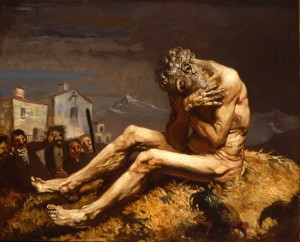
WILLIAM ORPEN_JobJob 17

1 “My spirit is broken; my days are extinct; the graveyard is ready for me. 2 Surely there are mockers about me, and my eye dwells on their provocation. 3 “Lay down a pledge for me with you; who is there who will put up security for me? 4 Since you have closed their hearts to understanding, therefore you will not let them triumph. 5 He who informs against his friends to get a share of their property—the eyes of his children will fail. 6 “He has made me a byword of the peoples, and I am one before whom men spit. 7 My eye has grown dim from vexation, and all my members are like a shadow. 8 The upright are appalled at this, and the innocent stirs himself up against the godless. 9 Yet the righteous holds to his way, and he who has clean hands grows stronger and stronger. 10 But you, come on again, all of you, and I shall not find a wise man among you. 11 My days are past; my plans are broken off, the desires of my heart. 12 They make night into day: ‘The light,’ they say, ‘is near to the darkness.’ 13 If I hope for Sheol as my house, if I make my bed in darkness, 14 if I say to the pit, ‘You are my father,’ and to the worm, ‘My mother,’ or ‘My sister,’ 15 where then is my hope? Who will see my hope? 16 Will it go down to the bars of Sheol? Shall we descend together into the dust?”

In his bestselling book, Healing for Damaged Emotions, the late David Seamands wrote this about depression:

The most concise definition of depression I know is this: “Depression is frozen rage.” If you have a consistently serious problem with depression, you have not resolved some area of anger in your life. As surely as the night follows the day, depression follows unresolved, repressed, or improperly expressed anger.[1]

“Depression is frozen rage.” That is a very helpful definition to keep in mind as we consider Job’s next speech. At this point there seems no doubt that Job is dealing with serious depression and also that a strong aspect of that depression is, in fact, bound up with rage: rage at his unhelpful friends and rage at God Himself. And it had become frozen rage, a hard, deep-frozen knot of pain and confusion and resentment and bitterness that was ever working itself out of Job in words of disappointment and great grief.

This is what frozen rage looks like. Consider the cautionary tale of Job’s despair.

Job alternates between bemoaning his unhelpful friends, calling on God to vindicate him, and bemoaning God’s treatment of him.

Earlier in my ministry, I had an unpleasant meeting with a person whose spouse we had to confront concerning behavior he/she was involved in that was inappropriate and unbecoming of a Christian. The person we were meeting with was angry that we had confronted his/her spouse though we tried to explain that we had tried to do so redemptively, carefully, and biblically. I recall that meeting with a sense of pity, for the dear person through tears would alternately lash out at us for confronting his/her spouse then defend his/her spouse then lash out at the spouse that he/she had just defended a breath before. I recall feeling a sense of heartbreak for this person as he/she was obviously so hurt that he/she did not know where to assign blame. There is something of that happening with Job in Job 17. Like a wounded animal, Job lashed out at any and all.

1 “My spirit is broken; my days are extinct; the graveyard is ready for me. 2 Surely there are mockers about me, and my eye dwells on their provocation. 3 “Lay down a pledge for me with you; who is there who will put up security for me? 4 Since you have closed their hearts to understanding, therefore you will not let them triumph.

Job begins by returning once again to the idea of death. Specifically, Job sees himself as a man who is dead already in every way save his body. His “spirit is broken.” Something deep and profound within Job was beyond repair, he seems to say. The only thing he had to look forward to was death: “the graveyard is ready for me.”

Next, Job interestingly asks God to “lay down a pledge” for him and to “put up security” for him. Robert Alden has offered a helpful explanation of these enigmatic words.

The interpretation of this verse is dependent on the understanding of two cultural practices, not too different from our own. “Pledge” in the first line refers to some proof necessary to back up words. No testimony other than God’s would do to persuade Job’s friends that he was sinless.

            The idiom of the second line is literally, “Who will strike hands?” that is, agree with a handshake to vouch for Job. Both verbs occur in Prov 6:1, a passage warning against cosigning notes. Job could find no one to endorse his innocence and by this question in v.3b did not expect to find anyone other than God (cf. 16:19).[2]

What is interesting about this is that Job still holds fast to his innocence (which is something he has done in every one of his speeches) and Job also realizes that God could vindicate him if God wanted. Alden sees in verse 4 Job’s belief that “it was God’s fault” since God had closed the eyes of his friends to the truth, but this seems to miss Job’s further point that God will not allow his friends to triumph. It should be noted, however, that there is great debate concerning how the final line of verse 4 should be translated. Regardless, Job does still see God as transcendent and powerful and able to vindicate him, even as Job is clearly angry at God. Thus, like the person I mentioned earlier, Job lashes out in anger in all directions, but not always in a consistent manner.

He continues his complaint in verses 5 and 6 by condemning God and his friends alike.

5 He who informs against his friends to get a share of their property—the eyes of his children will fail. 6 “He has made me a byword of the peoples, and I am one before whom men spit. 7 My eye has grown dim from vexation, and all my members are like a shadow. 8 The upright are appalled at this, and the innocent stirs himself up against the godless.

Job curses his friends and their children by suggesting that they have selfish motives for condemning him. He then announces that God has reduced Him to a loathsome thing: “I am one before whom men spit.” Job sees himself as contemptible in the eyes of all who see him, a cursed object of derision and scorn. Such is the weight of Job’s curse that he feels himself slipping from the land of the living and into the realm of shadow and darkness.

Next, Job makes another proclamation of his own innocence and, surprisingly, possibly even of his own future victory.

9 Yet the righteous holds to his way, and he who has clean hands grows stronger and stronger. 10 But you, come on again, all of you, and I shall not find a wise man among you. 11 My days are past; my plans are broken off, the desires of my heart. 12 They make night into day: ‘The light,’ they say, ‘is near to the darkness.’

Verse 9 sits oddly within the surrounding verses. As has happened before, a faint light breaks through the darkness of Job’s anger and dismay. He pronounces himself as “righteous” once again and notes that “he who has clean hands grows stronger and stronger.” Does this mean that Job has some small hope of future vindication and vindication. Concerning Job’s expression of innocence in verse 9, Delitzsch said, “These words of Job are like a rocket which shoots above the tragic darkness of the book, lighting it up suddenly, although only for a short time.”[3]

One is tempted to say that there is almost a schizophrenic quality about Job’s words. They seem almost to emanate from two distinct personages. But that would be a cruel thing to say. Job’s malady is not madness. Rather, it is crippling loss and grief and pain. He is speaking not like a man who has lost his mind but rather like a man whose heart has been shattered. Thus, Job can condemn his friends, recognize God’s power to vindicate, rage against God, proclaim himself dying and defeated, and announce that the innocent grow stronger and stronger all at the same time before returning to the idea that he is defeated, crushed, and done for.

Grief and pain have an amazing capacity to cloud the mind and distort the speech. This is evident in Job’s vacillations. The vacillating nature of Job’s words should perhaps lead us to be careful and cautious in how we respond to people who are deeply hurting. We should see in Job the results of mental, spiritual, and physical agony, namely, the loss of rigid consistency and linear lucidity in thought. Hurting people are often “all over the map,” we might say, and so might we be in a similar situation.

This reality can finally be seen in the concluding words of Job 17.

While Job appears hopeless, hope is still in his vocabulary.

Job next begins speaking of “his hope.”

13 If I hope for Sheol as my house, if I make my bed in darkness, 14 if I say to the pit, ‘You are my father,’ and to the worm, ‘My mother,’ or ‘My sister,’ 15 where then is my hope? Who will see my hope? 16 Will it go down to the bars of Sheol? Shall we descend together into the dust?”

Interpreting this section can be a challenge. Tremper Longman, for instance, sees Job’s hope as his own death. He is hoping for death. Thus, in Longman’s view, his reference to hope is truly not hope at all. John Hartley, however, sees Job’s reference to hope as referring to “his vindication that would eventuate in the restoration of his honor and his health,” but recognizes that Job sees this hope as impossible since his death is imminent and certain. “Since hope is synonymous with life,” writes Hartley, “it could have no existence in death. Therefore, the dust will be the end for both his hope and himself.” In Hartley’s view, Job’s death destroys his hope.[4] I am inclined to agree with Harley in this. Job is speaking of hope in terms of future vindication but he does realize that this is a fleeting fancy in the face of his immanent death.

The famed Greek author Nikos Kazantzakis died of leukemia in 1957. His tombstone read, “I hope for nothing. I fear nothing. I am free.”[5] In contrast, Job wanted to hope but could not. His lack of hope was not a liberation, and, in truth, it should be said, neither was Kazantzakis’. Job’s lack of hope did not comfort him. He wanted hope but realized that he had to abandon it in death. Death divorced Job from his hope and, in so doing, it divorced him from peace of mind.

It is an interesting thing to observe, this conviction that the coming of death means the departure of hope. Undoubtedly many feel this way today. As followers of Jesus, however, we can never view it in these terms, for if Christ came to do anything at all He came to remove the sting of death so that hope could flourish in the face of it and beyond it. If the resurrection of Jesus tells us anything, it is that death does not defeat hope. Paul put this beautifully in 1 Corinthians 15.

12 Now if Christ is proclaimed as raised from the dead, how can some of you say that there is no resurrection of the dead? 13 But if there is no resurrection of the dead, then not even Christ has been raised. 14 And if Christ has not been raised, then our preaching is in vain and your faith is in vain. 15 We are even found to be misrepresenting God, because we testified about God that he raised Christ, whom he did not raise if it is true that the dead are not raised. 16 For if the dead are not raised, not even Christ has been raised. 17 And if Christ has not been raised, your faith is futile and you are still in your sins. 18 Then those also who have fallen asleep in Christ have perished. 19 If in Christ we have hope in this life only, we are of all people most to be pitied. 20 But in fact Christ has been raised from the dead, the firstfruits of those who have fallen asleep.

Easter means that hope goes beyond the grave. Death does not defeat hope for Christ has defeated death. The resurrected Christ is therefore “the firstfruits,” meaning the first of the many who will arise with Him. All who are in Christ have hope beyond the grave!

Yet again, we wish we could preach the gospel to Job…but we know that now we have no need, for Job now stands in the presence of the risen Christ. Job now knows what we on this side of the cross know: that hope does indeed follow us if we are God’s people, that hope does not have stop at our funerals, that there is life and life eternal beyond the grave.

If depression is frozen rage, surely the warm glow of the grace of God and the hope of the gospel can melt it into non-existence. Surely the fire of the Spirit of God that indwells all who have come to Christ in hope and repentance can banish the ice of rage, disappointment, and pain. In so doing, the Holy Spirit makes room for love, for peace, for joy, for contentment, and for hope.

Such is the power of the risen Lamb.


[1] Seamands, David A. (2010-11-01). Healing for Damaged Emotions (Kindle Locations 2061-2063). David C Cook. Kindle Edition.

[2] Robert A. Alden, Job. The New American Commentary. Vol. 11 (Nashville, TN: Broadman & Holman Publishing Group, 1993), p.189.

[3] Quoted in Robert A. Alden, p.191.

[4] Tremper Longman III, Job. Baker Commentary on the Old Testament. (Grand Rapids, MI: Baker Books, 2012), p.243. John E. Hartley, The Book of Job. The New International Commentary on the Old Testament. Eds., R.K. Harrison and Robert L. Hubbard, Jr. (Grand Rapids, MI: William B. Eerdmans Publishing Company, 1988), p.271.

[5] Kazantzakis, Nikos (2012-09-04). Saint Francis (Kindle Location 51). Simon & Schuster. Kindle Edition.

 

Mark 1:21-28

MarkSeriesTitleSlide1Mark 1

21 And they went into Capernaum, and immediately on the Sabbath he entered the synagogue and was teaching. 22 And they were astonished at his teaching, for he taught them as one who had authority, and not as the scribes. 23 And immediately there was in their synagogue a man with an unclean spirit. And he cried out, 24 “What have you to do with us, Jesus of Nazareth? Have you come to destroy us? I know who you are—the Holy One of God.” 25 But Jesus rebuked him, saying, “Be silent, and come out of him!” 26 And the unclean spirit, convulsing him and crying out with a loud voice, came out of him. 27 And they were all amazed, so that they questioned among themselves, saying, “What is this? A new teaching with authority! He commands even the unclean spirits, and they obey him.” 28 And at once his fame spread everywhere throughout all the surrounding region of Galilee.

In 1 Corinthians 12:27, the Apostle Paul made a statement that has revolutionary implications for the very idea of “church” and specifically for what the Church is supposed to be and do. In 1 Corinthians 12:27, “Now you are the body of Christ, and each one of you is a part of it.”

This image, the image of the Church as “the body of Christ,” also immediately changes how we read the gospels. If the Church is the body of Christ, that means that Mark’s gospel is suddenly transformed from a history to an example, an example of what we must do. In other words, the Church, as the body of Christ, must watch what Christ did in His body and continue those movements and motions.

This is why Mark 1:21-28 is so very important. It is important because it shows us what Christ in His body did immediately after calling His first disciples to follow Him. These verses therefore record the very first things that the disciples of Jesus could emulate in their imitation of Him. Put yet another way, the actions of Jesus in these verses constitute, in Mark’s gospel, the first actions His disciples would have deserved and therefore the ideational content of what it meant for Jesus to say, “follow me.”

Jesus is a missionary and thereby demonstrates the reaching love of God for lost humanity.

Compellingly, the first thing Jesus’ disciples observed Him do was go.

21 And they went into Capernaum, and immediately on the Sabbath he entered the synagogue and was teaching.

“And they went…” Forgetting for a moment where He went. For now, let us simply notice that He went. Jesus did not form a commune. He formed a traveling band of disciples. He was not stationary. He did not wait for people to come to Him. He did not put the burden of movement on the world. He came to the world and, in it, He went to the lost.

More than that, He went first to the synagogue, the religious establishment. He went, Mark tells us, “and was teaching.” Thus, Christ was a missionary. Jesus went and He spoke. Christ is a missionary because God is a missionary.

“For God so loved the world that He gave…” (John 3:16a)

Our God is the sending, going, calling, speaking, teaching God. He is a pursuing, reaching God.

On May 5, 2016, Israel Today published an article entitled, “Israeli Man Sues God for Treating Him Unfairly.” It reads:

A resident of the northern Israel port city of Haifa this week turned to the courts to seek a restraining order against God.

The man said that he had turned repeatedly to the police over the past three years, and on several occasions police were sent to his home to examine the complaint.

According to the suit, God has been treating the man unkindly.

The court protocols made note of the fact that the defendant, God, failed to appear at the proceedings.

In his decision, Judge Ihsan Kanaan called the request delusional, and said that the plaintiff clearly needs help, but not from the courts.[1]

It is a fascinating idea, taking out a restraining order against God. To see somebody actually attempt this is indeed humorous, but, truth be told, this gentleman has simply done openly what many Christians think seriously. There are many both within and outside of the Church who would like to have God around when they want Him. But a God who is always there, pursuing you and acting, and moving towards you, is quite a terrifying thought to the natural heart of man. In truth, we have a kind of spiritual claustrophobia when it comes to God. We would like Him at our beck and call…but not too close. It brings to mind Colonel Korn’s relationship with the chaplain in Joseph Heller’s Catch-22.

It was Colonel Korn who had mapped out this way of life for the chaplain…Another good reason was the fact that having the chaplain around Headquarters all the time made the other officers uncomfortable. It was one thing to maintain liaison with the Lord, and they were all in favor of that; it was something else, though, to have Him hanging around twenty-four hours a day.[2]

This, too, is an accurate depiction of what man wants, but if Mark’s description of Jesus’ initial missionary activities tells us anything, it tells us that we have a moving, reaching, loving God who pursues us in love.

Thus, if we are His body, we must do the same. We too must send, yes, but also go. We are the missionary that God has sent.

Jesus has authority and thereby demonstrates His sovereign rule.

It is also important to note the strong emphasis on authority in our text. We find these references at the beginning and end of our text in reference to Jesus’ teaching and His ministry of exorcism respectively.

22 And they were astonished at his teaching, for he taught them as one who had authority, and not as the scribes.

27 And they were all amazed, so that they questioned among themselves, saying, “What is this? A new teaching with authority! He commands even the unclean spirits, and they obey him.” 28 And at once his fame spread everywhere throughout all the surrounding region of Galilee.

Twice those in the synagogue marveled at the authority of Jesus. This authority in teaching was quite different from the sermons of the scribes who essentially marshaled copious references to the competing views of scholars and wise men ancient and modern in their sermons on a given text. The scribes were, to some extent, cataloguers, experts on the debates surrounding doctrines. They quoted others. They appealed to the authority of others.

Not so, Jesus. Jesus speaks of His own authority, “and not as the scribes.” “What is this,” they ask in amazement, “a new teaching with authority!” Furthermore, as we will see, the demons themselves had to submit to the authority of Jesus.

Christ went and Christ spoke but Christ did not speak as other men. Christ spoke authoritatively! Ronald Kernaghan aptly observed this about the teaching of Jesus:

Jesus’ teaching was much more than collection of novel or encouraging ideas. It was an exercise of power…Jesus’ preaching and teaching were not inspirational in the typical sense of that word. He did not dispense hopeful thoughts. His sermons and teachings were expositions of power. They were confrontational, and when he spoke, something happened. Contemporary preachers might do well to reflect on Mark’s portrayal of Jesus.[3]

Kernaghan is correct to encourage preachers to consider the authoritative teaching of Christ, the boldness of Christ, the confrontation of Christ with the powers of darkness. How very unlike so much modern preaching this is!

We modern preachers are ever and always tempted to entertain, to smooth out and lessen possible offense with a perpetual tone of uncertainty through the consisting hedging of our bets when boldness is required. Preachers should reflect the authority of Christ when they faithfully preach the word of Christ.

So, too, should we all submit ourselves the word of God as revealed in the Scriptures. I ask you:   when you read your Bible do you do so with an eye toward the authority of Christ? When faced with life’s questions and life’s challenges, do you consult the words of Jesus in the Bible and then submit yourself to these? In other words, does Christ have authority over you?

He must, dear Church! He must! We must bow before the authoritative word of Christ, seeing it as the very Word of God, for truly the word of Christ is the word of God.

Jesus is a destroyer and thereby demonstrates His intention to free us from all destructive forces.

Most dramatically, what we see in this text is Christ the destroyer of evil.

23 And immediately there was in their synagogue a man with an unclean spirit. And he cried out, 24 “What have you to do with us, Jesus of Nazareth? Have you come to destroy us? I know who you are—the Holy One of God.” 25 But Jesus rebuked him, saying, “Be silent, and come out of him!” 26 And the unclean spirit, convulsing him and crying out with a loud voice, came out of him.

In the synagogue, a demon possessed man confronts the Lord Jesus. It is commonly argued today that the ancient diagnosed mental illness as demon possession in their ignorance.   But surely this is a profoundly unjust and arrogant assertion. Not, that is to say, that people then as now did not and do not do this. Tragically, mental illness is sometimes misdiagnosed as demon possession. But the misdiagnosis of something does not mean that the faulty diagnosis does not actually exist in other cases. Truly it does. We see this numerous times throughout the New Testament.

It is a bit painful to watch an insightful Bible commentator like William Barclay struggle with this. After speaking of the ways in which ancient people believed in demons, Barclay concludes, “Now it does not matter whether or not we believe in all this; whether it is true or not is not the point. The point is that the people in New Testament times did.”[4] Well, that is, to put it simply absurd. Of course it matters whether or not the story is true.

The New Testament certainly presents this as true. Jesus was confronted by a demon possessed man. What the demons said to Christ was most interesting.

24 “What have you to do with us, Jesus of Nazareth? Have you come to destroy us? I know who you are—the Holy One of God.”

What is fascinating to observe is that what the demon said to and of Christ was absolutely true. This is significant for what it means about mere knowledge about Jesus. J.C. Ryle points to the words of the demons as a demonstration of “the uselessness of a mere intellectual knowledge of religion.” “The mere belief of the facts an doctrines of Christianity,” he writes, “will never save our souls. Such belief is no better than the belief of demons.”[5] “You believe that there is one God,” writes James in James 2:19, “Good! Even the demons believe that—and shudder.” In other words, merely knowing something means very little if one does not truly accept and embrace the truth of what one knows.

James Brooks points out that demonic question, “Have you come to destroy us?” “could be an assertion rather than a question: ‘You have come to destroy us!’”[6] Regardless, the demon was correct. Jesus is indeed a destroyer. It is not a title we use often of Christ, but it is accurate. Christ Jesus has come to destroy the evil that threatens to destroy us. That process of destruction has begun and will one day be completed when Christ returns.

Jesus’ first act of destruction can be seen in His authoritative demolition of the demons’ speech. He silences the demon. The demon must yield to Christ’s demand for silence and for evacuation. R.T. France notes that the word Jesus uses in verse 25 for “be silent” is literally the word “muzzle.” Thus, Jesus literally tells the demons to “Be muzzled!” This, France informs us, “is simply a vivid colloquial way of saying ‘Shut up!’”[7]

There is a simplicity about Jesus’ work as an exorcist. It stands in stark contrast to many of the techniques of exorcism in the ancient world. For instance, Josephus tells of an exorcist named Aleazar who would put agitating herbs beneath the nose of possessed people, causing the person afflicted to sneeze and thereby extricate the demon through his nostrils. He would then invoke the name of Solomon and command the demon never to return.[8]

There is none of this in Jesus. There are not gimmicks, no tricks. There is simply the word of power that the devil must obey.

I recall being overwhelmed by this episode when, in high school, I was studying my Bible one morning. I read this passage in which Jesus rebukes the talkative demon and the demon had to shut up and depart the oppressed man. Suddenly, and quite unexpectedly, I began to cry, undone by the power and, in truth, simplicity of it. I felt in that moment that all of my attempts to overcome the devil’s wiles were silly when all I needed to do was give Jesus reign and rule in my life so that I might find victory in Him. Truly the authority of Christ is our hope and our salvation!

Christ is the destroyer of the power of the devil. “Do not think that I have come to bring peace to the earth,” Jesus said in Matthew 10:34, “I have not come to bring peace, but a sword.” Specifically, Jesus said this about the conflict that would arise within families over Him, but it is likewise true of His works of demolition against the powers of darkness. Christ brings a sword against the devil and his demons, and it is a sword that the devil and his demons fear.

It is a powerful thing to see what happened when Jesus went to church (to use our terminology). The very presence of Christ seemed to cause the spiritual forces of darkness to panic and shriek. The presence of Christ in their midst was a presence they had not yet encountered, but a power of which they were aware. But now, in Christ, the power of God and the presence of God had walked into their very midst and His presence marked the beginning of the devil’s end.

This means two very important things, among others. It means that the Church, as the body of Christ, should reflect the power and authority of Christ. This is not a power inherent in the Church. It is a power inherent in Christ and we are His body. Thus, when we speak the word of the gospel we speak the word before which the devil and his legions quake and tremble. It is the word that destroys the strongholds of evil. It is light in the darkness. We are therefore light bearers and truth proclaimers. As the body of Christ, we must do what Christ did in His body.

But this text is also a text of great comfort and joy for the believer. See here the power and majesty and regal sovereignty of Christ. He speaks but a word and the devil flees! “Be muzzled,” Christ commands, and the demons are silent. “Come out of him,” Jesus commands, and the demons flee in terror.

This Jesus – this authoritative, powerful, majestic, sovereign King – is the Jesus who has come to you, the Jesus who calls to you, the Jesus who has opened wide His arms to you. This is Christ! Behold our God! This is the God who created you, who loves you, who forgives you, who restores you, who resurrects you, who causes you to be born again.

This same Jesus who has authority over the devil seeks residence in your life. This means that you have been given the Spirit of freedom and of deliverance, the Spirit of victory over the devil. He may now only harass unless we give him undue sway in our lives. In Christ, we have a greater power.

“Little children,” wrote John in 1 John 4:4, “you are from God and have overcome them, for he who is in you is greater than he who is in the world.”

He is! We see this here in our text and we see this today everywhere men and women and boys and girls yield to Jesus Christ as Lord.


[1] https://www.israeltoday.co.il/NewsItem/tabid/178/nid/29134/Default.aspx

[2] Joseph Heller, Catch-22 (New York, NY: Everyman’s Library, 1995), p.249-250.

[3] Ronald J. Kernaghan, Mark. The IVP New Testament Commentary Series. Ed., Grant R. Osborne. Vol.2 (Downers Grove, IL: InterVarsity Press, 2007), p.46-47.

[4] William Barclay, The Gospel of Mark. The Daily Study Bible. (Edinburgh: The Saint Andrew Press, 1971), p.27.

[5] J.C. Ryle, Mark. The Crossway Classic Commentaries. (Wheaton, IL: Crossway Books, 1993), p.8.

[6] James A. Brooks, Mark. The New American Commentary. Gen. Ed., David S. Dockery. Vol.23 (Nashville, TN: Broadman Press, 1991), p.51.

[7] R.T. France, The Gospel of Mark. The New International Greek Testament Commentary. Gen. Eds., I. Howard Marshall and Donald A. Hagner. (Grand Rapids, MI: William B. Eerdmans Publishing Company, 2002), p.105.

[8] Michael Card, Mark. (Downers Grove, IL: InterVarsity Press, 2012), p.37.

Mark Dever’s Discipling

41QnGBxrsYL._SY344_BO1,204,203,200_Mark Dever’s Discipling is another publication in Crossway’s 9Marks series of books that serve as primers to the nine marks as outlined in Dever’s ministry:  preaching, biblical theology, the gospel, conversion, evangelism, membership, discipline, discipleship, leadership.  This is, like all of the books in this series, a small book but one that is rich in content.  This will likewise be a relatively brief review.  In short, Discipling is a winsomely written, very accessible, well-organized introduction to the meat and potatoes of building disciples, which Dever helpfully and memorably defines as “deliberately doing spiritual good to someone so that he or she will be more like Christ” (Kindle Locations 140-141).

I greatly appreciated the conversational tone of the book.  It would be a great book to take a small group through in church.  I also appreciated the pastoral care with which Dever offers practical steps to help church members build relationships and nurture others to Christlikeness.  Jonathan Leeman’s concluding work in the book was especially helpful.  In all, a very good, very helpful little work on an extremely important topic.  Highly recommended.

Job 15 and 16

elifas-o-job-2xsepJob 15

1 Then Eliphaz the Temanite answered and said: 2 “Should a wise man answer with windy knowledge, and fill his belly with the east wind? 3 Should he argue in unprofitable talk, or in words with which he can do no good? 4 But you are doing away with the fear of God and hindering meditation before God.5 For your iniquity teaches your mouth, and you choose the tongue of the crafty. 6 Your own mouth condemns you, and not I; your own lips testify against you. 7 “Are you the first man who was born? Or were you brought forth before the hills? 8 Have you listened in the council of God? And do you limit wisdom to yourself? 9 What do you know that we do not know? What do you understand that is not clear to us? 10 Both the gray-haired and the aged are among us, older than your father. 11 Are the comforts of God too small for you, or the word that deals gently with you? 12 Why does your heart carry you away, and why do your eyes flash, 13 that you turn your spirit against God and bring such words out of your mouth? 14 What is man, that he can be pure? Or he who is born of a woman, that he can be righteous? 15 Behold, God puts no trust in his holy ones, and the heavens are not pure in his sight; 16 how much less one who is abominable and corrupt, a man who drinks injustice like water! 17 “I will show you; hear me, and what I have seen I will declare 18 (what wise men have told, without hiding it from their fathers, 19 to whom alone the land was given, and no stranger passed among them). 20 The wicked man writhes in pain all his days, through all the years that are laid up for the ruthless. 21 Dreadful sounds are in his ears; in prosperity the destroyer will come upon him. 22 He does not believe that he will return out of darkness, and he is marked for the sword. 23 He wanders abroad for bread, saying, ‘Where is it?’ He knows that a day of darkness is ready at his hand; 24 distress and anguish terrify him; they prevail against him, like a king ready for battle. 25 Because he has stretched out his hand against God and defies the Almighty, 26 running stubbornly against him with a thickly bossed shield; 27 because he has covered his face with his fat and gathered fat upon his waist 28 and has lived in desolate cities, in houses that none should inhabit, which were ready to become heaps of ruins; 29 he will not be rich, and his wealth will not endure, nor will his possessions spread over the earth; 30 he will not depart from darkness; the flame will dry up his shoots, and by the breath of his mouth he will depart. 31 Let him not trust in emptiness, deceiving himself, for emptiness will be his payment. 32 It will be paid in full before his time, and his branch will not be green. 33 He will shake off his unripe grape like the vine, and cast off his blossom like the olive tree. 34 For the company of the godless is barren, and fire consumes the tents of bribery. 35 They conceive trouble and give birth to evil, and their womb prepares deceit.”

Job 16

1 Then Job answered and said: 2 “I have heard many such things; miserable comforters are you all. 3 Shall windy words have an end? Or what provokes you that you answer? 4 I also could speak as you do, if you were in my place; I could join words together against you and shake my head at you. 5 I could strengthen you with my mouth, and the solace of my lips would assuage your pain. 6 “If I speak, my pain is not assuaged, and if I forbear, how much of it leaves me? 7 Surely now God has worn me out; he has made desolate all my company. 8 And he has shriveled me up, which is a witness against me, and my leanness has risen up against me; it testifies to my face. 9 He has torn me in his wrath and hated me; he has gnashed his teeth at me; my adversary sharpens his eyes against me. 10 Men have gaped at me with their mouth; they have struck me insolently on the cheek; they mass themselves together against me. 11 God gives me up to the ungodly and casts me into the hands of the wicked. 12 I was at ease, and he broke me apart; he seized me by the neck and dashed me to pieces; he set me up as his target; 13 his archers surround me. He slashes open my kidneys and does not spare; he pours out my gall on the ground. 14 He breaks me with breach upon breach; he runs upon me like a warrior. 15 I have sewed sackcloth upon my skin and have laid my strength in the dust. 16 My face is red with weeping, and on my eyelids is deep darkness, 17 although there is no violence in my hands, and my prayer is pure. 18 “O earth, cover not my blood, and let my cry find no resting place. 19 Even now, behold, my witness is in heaven, and he who testifies for me is on high. 20 My friends scorn me; my eye pours out tears to God, 21 that he would argue the case of a man with God, as a son of man does with his neighbor. 22 For when a few years have come I shall go the way from which I shall not return.

Thomas Merton compiled a fascinating collection of the sayings of the desert fathers, monks who had gone out into the desert and to whom people would journey to hear wisdom and observe their lives of simplicity and detachment. Interestingly, the desert fathers addressed the issue of arguing on more than one occasion. For instance, Merton passed on a story about two monks living together in the same cell who were literally incapable of arguing.

There were two elders living together in a cell, and they had never had so much as one quarrel with one another. One therefore said to the other: Come on, let us have at least one quarrel, like other men. The other said: I don’t know how to start a quarrel. The first said: I will take this brick and place it here between us. Then I will say: It is mine. After that you will say: It is mine. This is what leads to a dispute and a fight. So then they placed the brick between them, one said: It is mine, and the other replied to the first: I do believe that it is mine. The first one said again: It is not yours, it is mine. So the other answers: Well then, if it is yours, take it! Thus they did not manage after all to get into a quarrel.[1]

How wonderful would it be to be incapable of arguing? But that is not the norm, is it? The norm for human interaction is conflict and arguments, even, and perhaps especially, it sometimes seems, between friends. But arguments among friends, at least prolonged or frequent arguments, are the most irksome because one of the tenets of true friendship is that they build us up, encourage us, and help us survive the unpleasantness of life.

The famed novelist George Eliot once wrote this about friendship:

Oh the comfort, the inexpressible comfort of feeling safe with a person; having neither to weigh thoughts nor measure words, but to pour them all out, just as they are, chaff and grain together, knowing that a faithful hand will take and sift them, keep what is worth keeping, and then, with the breath of kindness, blow the rest away.[2]

That is beautifully put. Friends do not weigh words. Friends give the benefit of the doubt and seek to understand what is being said instead of what technically was said. Friends do not keep an argument going, assuming the worst behind the actual words spoken, looking to trap one another in a verbal snare. Friends assume that the most clumsily voiced words were voiced by accident or perhaps out of pain. Friends seek to understand, not to condemn.

Almost every one of these attributes of friendship was quickly abandoned in the prolonged exchange between Job and his friends. They were so quickly abandoned and so absurdly violated over such a long period of time that we rightly wonder if indeed these men qualify as friends at all!

In Job’s next encounter with Eliphaz, chronicled in Job 15 and 16, we see a continuation of this argument between these friends of the kinds of unfortunate unfriendliness that keeps such arguments going. Because the basic points have been made before, we will take this opportunity to step back, take a bird’s eye view, and assess this particular exchange from the vantage of this question: what were Job’s friends doing that were deteriorating their friendship with Job so quickly? What was their method and how do they serve as a cautionary tale for us today concerning what not to do with our friends?

Eliphaz demonstrates poor friendship by being argumentative, by refusing to grant his friend the benefit of the doubt, and by losing a sense of patience and compassion.

Eliphaz begins his next verbal volley by continuing his basic argument concerning Job’s foolishness and guilt but also by ratcheting up the intensity of his attack on Job.

1 Then Eliphaz the Temanite answered and said: 2 “Should a wise man answer with windy knowledge, and fill his belly with the east wind? 3 Should he argue in unprofitable talk, or in words with which he can do no good? 4 But you are doing away with the fear of God and hindering meditation before God.5 For your iniquity teaches your mouth, and you choose the tongue of the crafty. 6 Your own mouth condemns you, and not I; your own lips testify against you. 7 “Are you the first man who was born? Or were you brought forth before the hills? 8 Have you listened in the council of God? And do you limit wisdom to yourself? 9 What do you know that we do not know? What do you understand that is not clear to us? 10 Both the gray-haired and the aged are among us, older than your father. 11 Are the comforts of God too small for you, or the word that deals gently with you? 12 Why does your heart carry you away, and why do your eyes flash, 13 that you turn your spirit against God and bring such words out of your mouth? 14 What is man, that he can be pure? Or he who is born of a woman, that he can be righteous? 15 Behold, God puts no trust in his holy ones, and the heavens are not pure in his sight; 16 how much less one who is abominable and corrupt, a man who drinks injustice like water! 17 “I will show you; hear me, and what I have seen I will declare 18 (what wise men have told, without hiding it from their fathers, 19 to whom alone the land was given, and no stranger passed among them). 20 The wicked man writhes in pain all his days, through all the years that are laid up for the ruthless. 21 Dreadful sounds are in his ears; in prosperity the destroyer will come upon him. 22 He does not believe that he will return out of darkness, and he is marked for the sword. 23 He wanders abroad for bread, saying, ‘Where is it?’ He knows that a day of darkness is ready at his hand; 24 distress and anguish terrify him; they prevail against him, like a king ready for battle. 25 Because he has stretched out his hand against God and defies the Almighty, 26 running stubbornly against him with a thickly bossed shield; 27 because he has covered his face with his fat and gathered fat upon his waist 28 and has lived in desolate cities, in houses that none should inhabit, which were ready to become heaps of ruins; 29 he will not be rich, and his wealth will not endure, nor will his possessions spread over the earth; 30 he will not depart from darkness; the flame will dry up his shoots, and by the breath of his mouth he will depart. 31 Let him not trust in emptiness, deceiving himself, for emptiness will be his payment. 32 It will be paid in full before his time, and his branch will not be green. 33 He will shake off his unripe grape like the vine, and cast off his blossom like the olive tree. 34 For the company of the godless is barren, and fire consumes the tents of bribery. 35 They conceive trouble and give birth to evil, and their womb prepares deceit.”

Let us observe some of the more unfortunate aspects of Eliphaz’s attack:

  • Eliphaz indulges in sarcasm by calling Job “a wise man” (v.2)
  • Eliphaz makes a painful reference to Job’s words as an “east wind” (v.2). This is painful in light of the loss of Job’s children due to a destructive wind (1:19).
  • Eliphaz accuses Job of not fearing God (v.4).
  • Eliphaz indulges again in sarcasm concerning Job’s wisdom (v.7-8).
  • Eliphaz refuses to consider Job’s central argument and accuses Job again of wickedness (v.20-27).
  • Eliphaz makes another personally painful statement by alluding to houses “which were ready to become heaps of ruins” (v.28).

Simply put, Job’s friends were acting like jerks!

Steven Lawson has observed that “the entire time Job had been answering his friends, they were busy reformulating their same argument. Instead of listening to Job they appeared to be waiting for him to stop talking so they could relaunch their scathing attack.” He then likened Job’s friends to a young man who once had to learn a hard lesson from Socrates.

A young man once came to Socrates, the noted philosopher, to be instructed in oratory. The moment the young man was introduced, he began to talk in an incessant stream. This went on for some time until the great philosopher could stand it no longer. Putting his hand over the young man’s mouth, Socrates said, “Young man, I will have to charge you a double fee.”

            “Why?” the young pupil asked.

            “Because I will have to teach you two sciences,” Socrates replied. “First, the science of holding your tongue; and then the science of using it correctly.”[3]

Both of these are areas in which Job’s friends needed to learn to be true friends: how to hold their tongues and how to use them correctly.

To return to Merton’s collection of the desert fathers, he quotes an “Abbot Pastor” as saying, “Get away from any man who always argues every time he talks,” and he quotes “an Elder” as saying, “And if anyone speak to you about any matter do not argue with him. But if he speaks rightly, say: Yes. If he speaks wrongly say to him: You know what you are saying. But do not argue with him about the things he has said. Thus your mind will be at peace.”[4] In both of these, the desert fathers were touching on a fact that is amply demonstrated in the book of Job: argumentative people will truly rob you of your joy and possibly of your sanity.

One can almost hear Job’s friends reloading as he is talking. All of this is not to say, I hasten to add, that Job himself does not indulge in many aspects of argumentation that are extremely unhelpful to discourse. However, as the end of the book will reveal, Job was fundamentally correct concerning his basic assertion about his own innocence (though he was clearly incorrect about numerous other points he made), and God will demand that his friends repent of what they did to Job in their approach.

Job’s friends are therefore a case study of how not to disagree with somebody. Instead of lighting a candle, they cursed his darkness, as the old saying goes. And, truth be told, if we look back on any of our own relationships that has fallen apart, it is most likely that we will find these same injurious elements: making things personal, refusing to interpret one another with charity, refusing to believe one another on issues that we cannot externally verify one way or the other, assuming the worst, demonizing the other, and losing patience and compassion.

Be it Job’s friends or modern marriages or international relationships between countries, these are the corrosive elements that render actual communication null and void.

Job counters that his friends are terrible friends and that they have actually become a continuation of the wound that God originally inflicted upon him.

Job’s frustration and disappointed are reflected in his own words of anger. Again, Job is not innocent himself. He, too, is quick to yield sarcasm and personal attacks, but, again, Job will, in time, be shown to have been fundamentally correct, though not completely correct. Let us hear Job’s complaint:

1 Then Job answered and said: 2 “I have heard many such things; miserable comforters are you all. 3 Shall windy words have an end? Or what provokes you that you answer? 4 I also could speak as you do, if you were in my place; I could join words together against you and shake my head at you. 5 I could strengthen you with my mouth, and the solace of my lips would assuage your pain. 6 “If I speak, my pain is not assuaged, and if I forbear, how much of it leaves me? 7 Surely now God has worn me out; he has made desolate all my company. 8 And he has shriveled me up, which is a witness against me, and my leanness has risen up against me; it testifies to my face. 9 He has torn me in his wrath and hated me; he has gnashed his teeth at me; my adversary sharpens his eyes against me. 10 Men have gaped at me with their mouth; they have struck me insolently on the cheek; they mass themselves together against me. 11 God gives me up to the ungodly and casts me into the hands of the wicked. 12 I was at ease, and he broke me apart; he seized me by the neck and dashed me to pieces; he set me up as his target; 13 his archers surround me. He slashes open my kidneys and does not spare; he pours out my gall on the ground. 14 He breaks me with breach upon breach; he runs upon me like a warrior. 15 I have sewed sackcloth upon my skin and have laid my strength in the dust. 16 My face is red with weeping, and on my eyelids is deep darkness, 17 although there is no violence in my hands, and my prayer is pure. 18 “O earth, cover not my blood, and let my cry find no resting place. 19 Even now, behold, my witness is in heaven, and he who testifies for me is on high. 20 My friends scorn me; my eye pours out tears to God, 21 that he would argue the case of a man with God, as a son of man does with his neighbor. 22 For when a few years have come I shall go the way from which I shall not return.

We see, yet again, Job’s basic contentions:

  • I am innocent (v.17).
  • God has turned on me.

The first statement is correct. The second statement is incorrect. But there is another note in chapter 16, and that is Job’s argument that his friends have become part of his calamity, part of God’s judgment upon him, an extension of the original tragedy that befell him. He communicates this in these ways:

  • Job’s friends are adding to his misery (v.2)
  • Job’s friends’ words are a continuation of the destruction wind (v.3).
  • Job’s friends are speaking from a vantage point of relative ease (v.4).
  • Job’s friends are a desolation (v.7).
  • Job’s friends have become a vicious mob assaulting him (v.10).
  • Job’s friends are acting like “ungodly” and “wicked” men (11).
  • Job’s friends “scorn” him (v.20).

Here is what the withholding of friendship looks like from the other side, from the perspective of the one from whom it is withheld. A friend who abandons friendship in order to win an argument is something worse than an enemy. We expect to be wounded by our enemies, not so by our friends. A friend turned enemy represents the spoiling of a beautiful thing. When angels fall they become demons. When friends fall they become tormentors.

See the words of Job and consider what it means to betray a friend, how very cruel our words appear when they are stripped of love, compassion, patience, and care. “A friend,” it has been said, “is the one person who walks in when everybody else has walked out.”

True enough. But what of the one man who walks in when everybody else has walked out just in order to kick the one who has been abandoned? Well, he is something of a devil, or worse.

Jesus is a true friend.

In the light of this example of friendship violated, it is refreshing and beautiful to see what Jesus said about friendship. What Jesus says in John 15, for instance, is most humbling and powerful.

12 “This is my commandment, that you love one another as I have loved you. 13 Greater love has no one than this, that someone lay down his life for his friends. 14 You are my friends if you do what I command you. 15 No longer do I call you servants, for the servant does not know what his master is doing; but I have called you friends, for all that I have heard from my Father I have made known to you. 16 You did not choose me, but I chose you and appointed you that you should go and bear fruit and that your fruit should abide, so that whatever you ask the Father in my name, he may give it to you. 17 These things I command you, so that you will love one another.

There is a friend who will not turn on you, who will not abandon you, who will not lose patience with you, who will not unjustly parse your words, who is not looking to trap you in your words, who listens with understanding, whose correction is true, whose wounds are the wounds of a friend: Jesus.

In 1855, Joseph Scriven wrote these words to comfort his mother.

What a friend we have in Jesus,

All our sins and griefs to bear!

What a privilege to carry

Everything to God in prayer!

O what peace we often forfeit,

O what needless pain we bear,

All because we do not carry

Everything to God in prayer.

Have we trials and temptations?

Is there trouble anywhere?

We should never be discouraged;

Take it to the Lord in prayer.

Can we find a friend so faithful

Who will all our sorrows share?

Jesus knows our every weakness;

Take it to the Lord in prayer.

Are we weak and heavy laden,

Cumbered with a load of care?

Precious Savior, still our refuge,

Take it to the Lord in prayer.

Do your friends despise, forsake you?

Take it to the Lord in prayer!

In His arms He’ll take and shield you;

You will find a solace there.

Blessèd Savior, Thou hast promised

Thou wilt all our burdens bear

May we ever, Lord, be bringing

All to Thee in earnest prayer.

Soon in glory bright unclouded

There will be no need for prayer

Rapture, praise and endless worship

Will be our sweet portion there.

Philip Wise has described a very interesting study on friendship coming out of the twelfth century. It was written by the Cistercian abbot of Rievaulx, a man named Aelred.

In his book Spiritual Friendship, Aelred analyzes the origin of friendship, the fruits of friendship, and the characteristics required for unbroken friendship…His unique emphasis is the concept of “spiritual friendship,” by which he referred to the kind of love that is godly and thereby prefigures the life to come. This kind of friendship is spiritual rather than carnal. It exists in the nature of God. He concludes in a famous passage that “Deus amicitia est” – God is friendship.[5]

Ah! Deus amicitia est.

God is friendship.

This is seen nowhere more clearly than in the person of Jesus Christ.

Deus amicitia est.

Christus amicitia est!

Amen.


[1] Thomas Merton, The Way of the Desert (New York, NY: New Directions), p.67.

[2] Calvin Miller, The Path of Celtic Prayer: An Ancient Way to Everyday Joy (Downers Grove, Illinois: IVP Books, 2007), p.80-81.

[3] Steven J. Lawson, Job. Holman Old Testament Commentary. Vo.10 (Nashville, TN: Holman Reference, 2004), p.134,133.

[4] Merton, p.47,29.

[5] Philip Wise, “Friendship as a Theological Virtue.” Theology in the Service of the Church: Essays Presented to Fisher H. Humphreys. (Macon, GA: Mercer University Press, 2008), p.259-260.

Mark 1:16-20

MarkSeriesTitleSlide1Mark 1

16 Passing alongside the Sea of Galilee, he saw Simon and Andrew the brother of Simon casting a net into the sea, for they were fishermen. 17 And Jesus said to them, “Follow me, and I will make you become fishers of men.” 18 And immediately they left their nets and followed him. 19 And going on a little farther, he saw James the son of Zebedee and John his brother, who were in their boat mending the nets. 20 And immediately he called them, and they left their father Zebedee in the boat with the hired servants and followed him.

Sometime between October 8, 1917, and March of 1918, Wilfred Owen wrote his poem, “Dulce et decorum est.” It is considered one the most famous war poems ever written, and rightly so. Owen was a British soldier in World War I and the poem describes the horrors of the war he saw. Owen was killed in action in 1918 just days before the signing of the armistice ending the war. It is said that his mother received the news of his death while the church bells were ringing victoriously to celebrate the end of the war. Listen:

Bent double, like old beggars under sacks,

Knock-kneed, coughing like hags, we cursed through sludge,

Till on the haunting flares we turned our backs,

And towards our distant rest began to trudge.

Men marched asleep. Many had lost their boots,

But limped on, blood-shod. All went lame; all blind;

Drunk with fatigue; deaf even to the hoots

Of gas-shells dropping softly behind.

Gas! GAS! Quick, boys!—An ecstasy of fumbling

Fitting the clumsy helmets just in time,

But someone still was yelling out and stumbling

And flound’ring like a man in fire or lime.—

Dim through the misty panes and thick green light,

As under a green sea, I saw him drowning.

In all my dreams before my helpless sight,

He plunges at me, guttering, choking, drowning.

If in some smothering dreams, you too could pace

Behind the wagon that we flung him in,

And watch the white eyes writhing in his face,

His hanging face, like a devil’s sick of sin;

If you could hear, at every jolt, the blood

Come gargling from the froth-corrupted lungs,

Obscene as cancer, bitter as the cud

Of vile, incurable sores on innocent tongues,—

My friend, you would not tell with such high zest

To children ardent for some desperate glory,

The old Lie: Dulce et decorum est

Pro patria mori.

And what is the old lie? What does Dulce et decorum est pro patria mori mean? It means, “It is sweet and honorable to die for one’s country.”

This war poem, or, more accurately, this anti-war poem, is so very compelling precisely because of its conclusion. The conclusion throws the reader or listener on the horns of a dilemma. On the one hand, we like to bathe war in a romantic veneer. We tell ourselves, Dulce et decorum est pro patria mori, “It is sweet and honorable to die for one’s country.” But here we see a soldier contrasting that ideal with the ugly, bitter, realities of war. That is, the realities undercut the ideal and render it a lie.

Owen almost seems to be making an even larger statement, a statement that goes beyond war. He seems to be asking if there is anything for which we should die, if there is any ideal that is worthy of our lives, that is not undercut by the realities of living it out?

As believers we have an answer: Jesus’ call is a call worthy of our lives. Christ Himself is worthy of our very lives. The gospel is a truth we can die for, for the gospel is a truth that calls us to life precisely through death to self. The call of Christ presents itself to us all, and it is the very call He issued to His first disciples that He issues to us as well. It is a call that will, indeed, lead to difficulties, but it is a call that will never be rendered null by the difficulties we face in the living of it. It is a call that has not and will not be proven ultimately to be a lie. Mark describes this call in a most memorable and compelling way.

The call to follow Jesus is a holy disruption initiated by a slain and risen Lamb resulting in a revolutionary redefinition and reorientation of life itself.

Jesus calls His disciples with a kind of startling brusqueness and a conspicuous absence of concern for their plans.

16 Passing alongside the Sea of Galilee, he saw Simon and Andrew the brother of Simon casting a net into the sea, for they were fishermen. 17 And Jesus said to them, “Follow me, and I will make you become fishers of men.” 18 And immediately they left their nets and followed him.

I am struck by the fact that Jesus’ evangelistic technique violates almost all of the standard principles of evangelism we take for granted today. We are concerned with building careful bridges before we present the gospel, with first creating points of interest, with not moving too fast, with not scaring those to whom we are talking. We are a people who place a high premium on the ease and comfort and sensitivities of those we evangelize.

But contrast this with the simple, stark, blunt call of Christ: “Follow me, and I will make you become fishers of men.”

There is a contextualizing bridge, to be sure: Jesus calls fisherman to come and fish. Nonetheless, it is a disruption, for He calls them to this in the midst of their work. It is a holy and sacred disruption. It is meant to be. You do not accept Christ after penciling Him onto your calendar. You accept Christ here and now, in the midst of the plans that did not foresee His call coming. There is a kind of recklessness about it. It is the response of a heart that is broken and overwhelmed by the power of the call that comes.

And it is the call to follow Christ. This is what we are called to. This is who we are called to.

Robert Stein notes that the relationship between Jesus and his disciples differed from the relationship between other Rabbis and their disciples in two ways. First, Jesus approached His disciples and called them to follow him instead of them approaching Him and asking if they could follow Him. Secondly, Jesus does not call them to the study of the law but to follow and study Him.[1]

In other words, the call of Christ to His first disciples differed from the norm in that it was the master who called and in that the master called His disciples to Himself. He did not call them to a body of learning, to a philosophy, to scholastic inquiry, to an idea, to a notion, to a compelling proposal. Christianity, of course, contains elements of all of these, but they are not the sum total of Christianity. They are components. However, Christ called His disciples to Himself. He does so today as well.

We are called to Christ. Christianity is a relationship. It is a knowing. We come to, embrace, and walk with Jesus. We come to know and to love Him and His ways. We follow the Lamb who has come and the Lamb who calls.

The call to follow Jesus is a holy disruption initiated by a slain and risen Lamb resulting in a revolutionary redefinition and reorientation of life itself.

It is a redefinition and reorientation of life itself. Fisherman are called to fish, but in a totally different way.

Fred Craddock once preached on following Christ wherever He leads. Some time after that the mother of a very bright girl in his church called him and asked, “What did you do to my daughter?” Confused, Craddock told her that he had not done anything to her daughter and asked her what she was talking about it. The mother went on to inform Craddock that her daughter had decided to delay a promising medical career to live in poverty with the Native Americans on a reservation in the west. She was now spending her days teaching Native American children.

Now I ask you: in doing what she did, had that girl really abandoned a vocation of healing? No, she had not. She was simply now helping people heal in a deeper and more profound way: she was ministering to the poor, to the least of these, to the forgotten, to those caught in a cycle of poverty.

This is what the sacred, disrupting, life-altering call of Christ does. It takes us in directions we could not have foreseen. Sometimes it literally calls us away from the vocation to which we sense a calling. Sometimes it does not. Regardless, it always redefines what we are doing by allowing us to see it in the light of the Kingdom and the cross. Jesus may ask you literally to leave a job. He may tell you to stay right where you are. But He will never leave you unchanged. Whether where you are or elsewhere, you will have a new sense of purpose, of meaning, of direction. The call of Christ disrupts, transforms, and redefines.

The call to follow Jesus is a call to a new, dynamic, and countercultural social order that exists in the midst of the old, fallen, and decayed social orders as a challenge and a call to the Kingdom of the Lamb.

It is also a call into a new social order. We can see this dynamic at work in Jesus’ call to James and John.

19 And going on a little farther, he saw James the son of Zebedee and John his brother, who were in their boat mending the nets. 20 And immediately he called them, and they left their father Zebedee in the boat with the hired servants and followed him.

Interestingly, Jesus calls them and they leave their father. This is no small thing. Ben Witherington points out that in calling these men to leave everything and follow Him, “Jesus is de facto establishing a new social entity, a new community.” Witherington quotes Myers as saying that point of this text is “that following Jesus requires not just assent of the heart, but a fundamental reordering of socio-economic relationship…This is not a call ‘out of the world,’ but into an alternative social practice.”[2]

That is most true! We are called not into a life of solitude but into a new family structure. This truth is presented by Jesus with a kind of hyperbolic ferocity in Luke 14.

25 Now great crowds accompanied him, and he turned and said to them, 26 “If anyone comes to me and does not hate his own father and mother and wife and children and brothers and sisters, yes, and even his own life, he cannot be my disciple. 27 Whoever does not bear his own cross and come after me cannot be my disciple. 28 For which of you, desiring to build a tower, does not first sit down and count the cost, whether he has enough to complete it? 29 Otherwise, when he has laid a foundation and is not able to finish, all who see it begin to mock him, 30 saying, ‘This man began to build and was not able to finish.’ 31 Or what king, going out to encounter another king in war, will not sit down first and deliberate whether he is able with ten thousand to meet him who comes against him with twenty thousand? 32 And if not, while the other is yet a great way off, he sends a delegation and asks for terms of peace. 33 So therefore, any one of you who does not renounce all that he has cannot be my disciple.

This is not, of course, about literal hatred. Jesus did not hate His mother, but, then, that is not really what He is talking about. He is talking about a radical reprioritization of our affections to the degree that we count all as loss for the sake of the Kingdom. What is more, He is saying that there is now something more powerful than biology, than human names, that our family units, and that is the new social order into which He calls us.

We are now a Kingdom people. This may put us at odds with our earthly families. Oftentimes it does. Later in Mark, we will see Jesus say this in chapter 13:

12 And brother will deliver brother over to death, and the father his child, and children will rise against parents and have them put to death. 13 And you will be hated by all for my name’s sake. But the one who endures to the end will be saved.

It happens, for not all in our earthly social structures share a Kingdom mindset. The mindset of the Kingdom is most often at great odds with the mindset of the world. They represent two different sets of values. The world is terrified of the Kingdom for the Kingdom calls us from the lustful ambitions and acquisitions and consumptions that make up so much of our lives. The world is terrified of the Kingdom for the Kingdom calls us to abandon ego, the need for power, the desire for comfort, and forsake all for the better way of Christ.

And the world hates the Kingdom for the Kingdom is inherently disruptive just as the call of Christ to enter the Kingdom is disruptive. The Kingdom of God is not passive, not timid. It is a Kingdom of loving proclamation and that proclamation grates on the comforts of the world.

The call to follow Jesus is a call to a new, dynamic, and countercultural social order that exists in the midst of the old, fallen, and decayed social orders as a challenge and a call to the Kingdom of the Lamb.

The Kingdom of God as lived out by Christ in and through the lives of His people in the world is an in-house challenge, a prophetic light in the darkness. Thus, Christ’s call for His disciples to become “fishers of men,” a call, we should not, that is inherent in the call to enter the Kingdom, is a call to engagement with the world.

This call to become fishers of men becomes even more interesting when we consider the fact that the metaphor of fishing was always a negative metaphor in the Old Testament. That is, in the Old Testament it is a metaphor for judgment. There, God fishes the wicked out in order to pour His wrath out upon them. Consider:

Jeremiah 16

14 “Therefore, behold, the days are coming, declares the Lord, when it shall no longer be said, ‘As the Lord lives who brought up the people of Israel out of the land of Egypt,’ 15 but ‘As the Lord lives who brought up the people of Israel out of the north country and out of all the countries where he had driven them.’ For I will bring them back to their own land that I gave to their fathers. 16 “Behold, I am sending for many fishers, declares the Lord, and they shall catch them. And afterward I will send for many hunters, and they shall hunt them from every mountain and every hill, and out of the clefts of the rocks. 17 For my eyes are on all their ways. They are not hidden from me, nor is their iniquity concealed from my eyes. 18 But first I will doubly repay their iniquity and their sin, because they have polluted my land with the carcasses of their detestable idols, and have filled my inheritance with their abominations.”

Ezekiel 29

3 speak, and say, Thus says the Lord God: “Behold, I am against you, Pharaoh king of Egypt, the great dragon that lies in the midst of his streams, that says, ‘My Nile is my own; I made it for myself.’ 4 I will put hooks in your jaws, and make the fish of your streams stick to your scales; and I will draw you up out of the midst of your streams, with all the fish of your streams that stick to your scales. 5 And I will cast you out into the wilderness, you and all the fish of your streams; you shall fall on the open field, and not be brought together or gathered. To the beasts of the earth and to the birds of the heavens I give you as food. 6 Then all the inhabitants of Egypt shall know that I am the Lord.

Ezekiel 38

1 The word of the Lord came to me: 2 “Son of man, set your face toward Gog, of the land of Magog, the chief prince of Meshech and Tubal, and prophesy against him 3 and say, Thus says the Lord God: Behold, I am against you, O Gog, chief prince of Meshech and Tubal. 4 And I will turn you about and put hooks into your jaws, and I will bring you out, and all your army, horses and horsemen, all of them clothed in full armor, a great host, all of them with buckler and shield, wielding swords.

Amos 4

1 “Hear this word, you cows of Bashan, who are on the mountain of Samaria, who oppress the poor, who crush the needy who say to your husbands, ‘Bring, that we may drink!’ 2 The Lord God has sworn by his holiness that, behold, the days are coming upon you, when they shall take you away with hooks, even the last of you with fishhooks.

Habakkuk 1

14 You make mankind like the fish of the sea, like crawling things that have no ruler. 15 He brings all of them up with a hook; he drags them out with his net; he gathers them in his dragnet; so he rejoices and is glad. 16 Therefore he sacrifices to his net and makes offerings to his dragnet; for by them he lives in luxury, and his food is rich. 17 Is he then to keep on emptying his net and mercilessly killing nations forever?

Yes, the image of fishing out men in the Old Testament scriptures is most terrifying indeed, for they are inevitably fished out for judgment.

How very interesting, then, to see the call of Christ. Jesus likewise evokes the image of fishing for men, but in Christ it is most clearly a positive image, an image of being drawn out of the waters to forgiveness and to eternal life. We might almost say that Christ’s call to fish is a call to fish unto life before the final fishing unto judgment! And, most amazingly, we who take up the call of Christ are called to this amazing task!

“The summons to be fishers of men,” writes William Lane, “is a call to the eschatological task of gathering men in view of the forthcoming judgment of God. It extends the demand for repentance in Jesus’ preaching.” Lane goes on to say that the job of these fishers of men is “confront men with God’s decisive action, which to faith has the character of salvation, but to unbelief has the character of judgment.”[3]

Lane is correct in his interesting observation that this fishing for men to which Christ calls us is an extension of “the demand for repentance in Jesus’ preaching,” for it is through repentance and belief, as we have seen, that we are spared the great fishing unto judgment. We are called to become fishermen of salvation in the light of the coming fishing unto judgment. We are called to a Kingdom of life eternal and blessed outside of which there is only the just and righteous judgment of God against our sins. The Kingdom of God is entered through repentance and belief in the One who burst the door asunder so that all may come!

The call of Christ is therefore a call to a grand adventure of countercultural living and Kingdom proclamation. It is a life-saving call, for to us, then to all to whom we issue the call ourselves.

The call of Christ is not disinterested. It is not casually given. It is borne out of the loving heart of God Himself. It is the call to mercy, to peace, to joy, to hope, to meaning, to purpose, to love.

In other words, it is the call to Christ Jesus Himself.

Have you answered the call?

Have you dropped your nets?

Come to Him now!


[1] Robert H. Stein, Mark. Baker Exegetical Commentary on the New Testament. (Grand Rapids, MI: Baker Academic, 2008), p.78.

[2] Ben Witherington III, The Gospel of Mark. (Grand Rapids, MI: William B. Eerdmans Publishing Company, 2001), p.84,85.

[3] William L. Lane, The Gospel According to Mark. The New International Commentary of the New Testament. Gen. Ed., F.F. Bruce (Grand Rapids, MI: William B. Eerdmans Publishing Company, 1974), p.68.

David Bentley Hart on Freedom and Nihilism

This is an extremely interesting lecture by Eastern Orthodox theologian David Bentley Hart.  Hart’s thesis is that the abandonment of the ancient Christian concept of God and good and evil within Christianity paved the way for the modern concept of freedom defined as the freedom to do what we would like without obstruction and hence, ultimately, nihilism.  This is a most provocative and interesting thesis, and one worthy of consideration.

David Seamands’ Healing For Damaged Emotions: A Review and Some Reflections on Reading the Writings of Ministers Who Have Fallen

Healing for Damaged Emotions-0This is going to be a different kind of review.  I do want to share some thoughts about David Seamands’ classic book, Healing for Damaged Emotions, but I also want to use this review as an occasion to address the larger question of reading and studying the works of ministers who have fallen.

A Review

Healing for Damaged Emotions was published in 1981.  It has sold over one million copies.  The book has been on my radar essentially since I began pastoring twenty years ago.  Today I listened to my Kindle read the book to me on a long drive.  I did so because of some recent counseling situations in which I felt that some of those I am counseling seem so deeply wounded by past traumatic experiences that they are haunted by them and stymied by them in the daily living of their lives.

I’ve been through the book only once, and I gather from some of my research on David Seamands that some consider his teachings to be controversial, but, all in all, I found the book to be very helpful, very practical, and, at points, extremely insightful.  I can certainly see why the book would be considered a modern classic.  On more than a few occasions, I stopped the reading of the book and highlighted passages that I thought were intriguing.  Some areas gave me pause (i.e., his allusion to belief in “Christian perfection” ((Seamands was a Methodist with ties to Asbury)) and perhaps even a few of his comments on temperament).  But, again, I thought the book was very strong overall.

Seamands’ basic contention is that people tend to carry deep wounds from the past and these wounds are situated largely in the emotions.  He likens these wounds to the biblical idea of “infirmities,” though he acknowledges that this word originally applied to physical defects and deformities.  Seamands argues that we will forever be responding to our woundedness and that these scars will manifest themselves through deep character and interpersonal deficiencies until they are honestly confronted, addressed, and handed over to Christ whom Seamands calls “the wounded Healer.”

The ways that these wounds manifest themselves, Seamands argues, is in feelings of insecurity, unworthiness, perfectionism, legalism, and anger.  He offers plentiful examples of each of these and others, most drawn from his own pastoral and counseling experiences but some from pastoral, historical, theological, and psychological literature as well.  There are some very good illustrations here, and, in Seamands’ hands, they are handled quite effectively.

He rightly situates the wounded believer’s ultimate hope for healing in the cross of Christ.  He also rightly argues that the cross destroys any notion of an experiential disconnect between suffering humanity and God, for in Christ God has stepped into and understands and has felt the burden of suffering Himself.  This is a very important point and is well made.

Seamands further argues that salvation does not magically change temperament and that the journey of sanctification involves crucial needs like the necessity of healing damaged emotions after one is saved.  I am conflicted about this.  In general, I agree, and I often say something like this myself, though I am not sure I heard Seamands acknowledge exceptions to this.  These exceptions are very important.  In short, some people do seem to experience healing, even from damaged emotions, in accepting Christ, though obviously no believer is either exempt from or does not need sanctification.  There does not appear to be a normative pattern in any individual area of life (i.e., damaged emotions, alcoholism, profanity, etc.), though the general principle of the believer’s need for sanctification is, of course, absolutely true.

I suppose that some might be uncomfortable with some of Seamands’ imaginative techniques in taking people back to their moments of emotional wounding so that they can address these moments.  These kinds of techniques could be taken too far, but, by and large, I consider it an interesting idea and one that, if handled correctly, could be quite helpful and effective.  On a side note, it is interesting to think of the parallels between Scientology and what Seamands says about damaged emotions.  The great difference, though, is Seamands’ rooting of the healing of these wounds in Christ Jesus, His cross, and His resurrection as well as in the ministry of the Holy Spirit in the believer’s life.  This is, of course, a radical departure from the proposed solutions of Scientology.

One final comment on the book.  I thought what Seamands wrote about the “super self” and the “real self” was fantastic and very helpful.  I backed the book up and listened to that a couple of times, especially to his idea that we (erroneously) believe God hates our actual real self but that He loves the ideal potential self.  This leads us to come before God in a spirit of posturing and pretending that we are the super self so He will love us.  Even our acknowledgment of our real selves, Seamands notes, is from a position of self-hatred and is itself a way of propping up the super self since it is only as the super self that we,  like (we wrongly assume) God, can hate the true self.  That was very insightful and a point I will be rereading and revisiting time and again.  It hit me hard on a personal level and I’ll definitely be chewing on and thinking about and researching that idea further.

On Reading the Writings of Ministers Who Have Fallen

It was interesting listening to this book, particularly since I was aware of Seamands’ moral failure.  A 2005 Christianity Today piece reported the situation:

Pastor, professor, author, and counselor David Seamands apologizes for “breach of trust and moral failure”

David Seamands is a longtime friend of Christianity Today, where he has long served as a consulting editor, so it is with particular sadness that we note his admission of a “breach of trust and moral failure.” The 83-year-old retired pastor of Wilmore (Ky.) United Methodist Church served as professor emeritus of pastoral ministries and counselor in residence at Asbury Theological Seminary, and is the author of several influential books, including Healing for Damaged Emotions. He has also been a key figure in United Methodist Church debates on the integrity and sanctity of marriage.

“One of the roots of my sin has been the sin of pride,” Seamands told Wilmore United Methodist Church on Sunday. “In response to a complaint filed against me of sexual misconduct with an adult female occurring over a number of years, I admit that I have broken my covenantal relationships and have abused the trust of those I have harmed.”

As a part of the Methodist disciplinary process, overseen by Kentucky Bishop James King, Seamands will take a one-year leave from all ministerial functions.

Seamands died in July of 2006, shortly after his confession.

The reason I am commenting on this is because of my increasing (and depressing) awareness of the number of famous ministers and theologians whose writings are highly esteemed but who had moral failures.  Off the top of my head, I think of Karl Barth, John Howard Yoder, George Eldon Ladd, and, though he is on the other end of the spectrum theologically, Paul Tillich.  The particulars of these situations are not important, but I will say that each of these men have many people in the Church who respect their work and each of them fell in the area of sinful sexual behavior.

So for some time now I’ve been pondering the question, “What do we do with the writings of ministers and theologians who committed sexual sins?”

In a sense, of course, it is a very easy question.  For instance, if the question is reframed like this, it seems less difficult to answer:  “Should we read the writings of sinners?”  To which we would have to respond, “But, of course!  What other kinds of writings are there?”  And this is no insignificant point.  Every book ever written in human history was written by a sinner and by a person who was sexually broken (though perhaps not physically adulterous).

Furthermore, I consider this question also to be fairly easy to answer:  “Is what a person said rendered true or untrue by their moral standing?”  Well, of course not.  We need look no further than Paul’s discussion of those who were preaching out of impure motives in Philippians 1 to see that truth is not determined by the moral standing of the one who says it.  So, for instance, if what David Seamands’ says is true, it is true whether or not he was involved in an adulterous relationship when he said or wrote it.

Even so, there is a feeling of unease when it comes to ministers and sexual sins in particular, isn’t there?  For instance, there seems to be an unspoken agreement that sins of sexual violence warrant at least recognition and some such sins would likely cause most of us to refuse to read certain works.  For instance, the works of John Howard Yoder are now apparently marked with a statement from the publisher acknowledging that Yoder had attempted to have inappropriate sexual relationships with numerous women in an aggressive manner.

Take an extreme hypothetical.  Would I read the writings of a minister or theologian who was found guilty of pedophilia?  No.  I would not.  I simply could not remove that fact from my mind while reading, nor do I think I should.  (Though, I hasten to add, I would not thereby be saying that I thought he or she could not be forgiven and saved.)

Where do we draw the line?

We read the writings of Luther who wrote some unbelievably grotesque things about the Jews late in his life.  We read the writings of Calvin though, however you spin it, he had the blood of Servetus on his hands (at least to some extent).  We read the writings of numerous Magisterial Reformers who either directly or indirectly encouraged the killing of the Anabaptists.  We read the writings of church fathers who oftentimes defended slavery as a necessary reality.  Etc. etc.

So where is the line?  What sins lead us to say, “I will not read that!”?

I do not know.  I do not pretend to know.

In my opinion, perhaps it is right to have the notice put on Yoder’s works.  But somehow I would be uneasy if an acknowledgement of Seamands’ adultery was printed on the cover of his works.

Or is the problem the gross hypocrisy of a Christian author committing a sin in the area upon which he or she is supposedly highly gifted and skilled and perhaps even an expert?  Is the hypocrisy heightened when this happens?  Probably so.  For instance, is it worse that Seamands’ carried on a long-term affair while writing about and practicing a famed ministry of Christian counseling to married couples?  Perhaps it feels worse in such cases.  That is understandable.  It certainly struck me as painfully ironic to hear some of Seamands’ comments about Christians who have fallen into sin in Healing for Damaged Emotions.  (It also, I should add, struck me that Seamands returned to the issue of sex and sexual sin a good deal in the book.  He also commented often on this or that woman being attractive or pretty in his illustrations.  All of these are things I likely would not have thought much about without knowing Seamands’ story.)

What, then, are we to do?  At the end of the day, this question, like so many others, will have to be answered by individual Christians.  We should be honest to our own scruples our own consciences and our own levels of discomfort.  We should avoid the one extreme of saying that something like a long-term adulterous affair (or a short-term affair!) is neither here nor there.  No, it is here and there and it is a serious thing.

On the other hand, let us not forget:  all the books we have are written by sinners and even by people who sinned in the area in which they were supposedly experts.  A moral failure does not render truth untrue.  It renders the author a hypocrite but not the truth false.

Finally this:  were we to refuse to listen to the wisdom of sinful people, we would have nothing to which we could listen and, most significantly, nothing which we ourselves could say.  We are all cracked vessels.  Every book I have on my shelves, including the ones I highly value, were written by sinners and moral failures.

I am not saying that we should never say, “I will not read his works.”  I am simply saying that we will most often have to say something like this:  “That person had some real failures in his life.  So do I.  But to the best of my knowledge he is a brother in Christ who is especially gifted in this area, even if he himself did not always live harmoniously with what he knew to be true.  That is unfortunate and regrettable.  But the Lord often blesses us through broken vessels, and when He blesses us through others He always blesses us through broken vessels.  So I will read that person not with their sins ever before me, but with the cross that is his and my and our hope ever before me.  I will listen for the voice of Christ mediated through this author’s own broken voice and will thank the Lord that He is able to use His flawed people in such wonderful and powerful ways.”


Job 14

31-days-1-JobJob 14

1 “Man who is born of a woman is few of days and full of trouble. 2 He comes out like a flower and withers; he flees like a shadow and continues not. 3 And do you open your eyes on such a one and bring me into judgment with you? 4 Who can bring a clean thing out of an unclean? There is not one. 5 Since his days are determined, and the number of his months is with you, and you have appointed his limits that he cannot pass, 6 look away from him and leave him alone, that he may enjoy, like a hired hand, his day. 7 “For there is hope for a tree, if it be cut down, that it will sprout again, and that its shoots will not cease. 8 Though its root grow old in the earth, and its stump die in the soil, 9 yet at the scent of water it will bud and put out branches like a young plant. 10 But a man dies and is laid low; man breathes his last, and where is he? 11 As waters fail from a lake and a river wastes away and dries up, 12 so a man lies down and rises not again; till the heavens are no more he will not awake or be roused out of his sleep. 13 Oh that you would hide me in Sheol, that you would conceal me until your wrath be past, that you would appoint me a set time, and remember me! 14 If a man dies, shall he live again? All the days of my service I would wait, till my renewal should come. 15 You would call, and I would answer you; you would long for the work of your hands. 16 For then you would number my steps; you would not keep watch over my sin; 17 my transgression would be sealed up in a bag, and you would cover over my iniquity. 18 “But the mountain falls and crumbles away, and the rock is removed from its place; 19 the waters wear away the stones; the torrents wash away the soil of the earth; so you destroy the hope of man. 20 You prevail forever against him, and he passes; you change his countenance, and send him away. 21 His sons come to honor, and he does not know it; they are brought low, and he perceives it not. 22 He feels only the pain of his own body, and he mourns only for himself.”

In 2007, a book of Mother Teresa’s letters was published under the title Mother Teresa: Come Be My Light. It was immediately controversial because, in some of the letters, Mother Teresa expressed great doubts. An August 30, 2007, Christianity Today review of the book was entitled, “Book Uncovers a Lonely, Spiritually Desolate Mother Teresa.” The review quotes one of Mother Teresa’s letters from 1961 as follows:

Darkness is such that I really do not see—neither with my mind nor with my reason—the place of God in my soul is blank—There is no God in me—when the pain of longing is so great—I just long & long for God. … The torture and pain I can’t explain.

Christianity Today then quoted Rev. James Martin as stressing “that Teresa’s belief in God never wavered—just her feeling of connection to Jesus, especially after her intense mystical experiences.” “It’s one thing to feel that God is not with you,” Martin said, “It’s another thing to believe that God doesn’t exist,” he said.[1]

Time magazine’s piece on the book was entitled, “Mother Teresa’s Crisis of Faith,” and contained this:

In more than 40 communications, many of which have never before been published, she bemoans the “dryness,” “darkness,” “loneliness” and “torture” she is undergoing. She compares the experience to hell and at one point says it has driven her to doubt the existence of heaven and even of God. She is acutely aware of the discrepancy between her inner state and her public demeanor. “The smile,” she writes, is “a mask” or “a cloak that covers everything.” Similarly, she wonders whether she is engaged in verbal deception. “I spoke as if my very heart was in love with God–tender, personal love,” she remarks to an adviser. “If you were [there], you would have said, ‘What hypocrisy.’” Says the Rev. James Martin, an editor at the Jesuit magazine America and the author of My Life with the Saints, a book that dealt with far briefer reports in 2003 of Teresa’s doubts: “I’ve never read a saint’s life where the saint has such an intense spiritual darkness. No one knew she was that tormented.” Recalls Kolodiejchuk, Come Be My Light’s editor: “I read one letter to the Sisters [of Teresa’s Missionaries of Charity], and their mouths just dropped open. It will give a whole new dimension to the way people understand her.”

Perhaps most interestingly, the Time reviewer was struck by the fact that Mother Teresa made a very clear and strong statement about her love for Jesus in one letter and then, eleven weeks later, made a statement to somebody else about her great doubts.

The two statements, 11 weeks apart, are extravagantly dissonant. The first is typical of the woman the world thought it knew. The second sounds as though it had wandered in from some 1950s existentialist drama. Together they suggest a startling portrait in self-contradiction–that one of the great human icons of the past 100 years, whose remarkable deeds seemed inextricably connected to her closeness to God and who was routinely observed in silent and seemingly peaceful prayer by her associates as well as the television camera, was living out a very different spiritual reality privately, an arid landscape from which the deity had disappeared.[2]

This is all very interesting. We cannot, of course, see into the heart of any man or woman so our opinion of the ultimate state of Mother Teresa’s soul is irrelevant. Most of us, I assume, will point to her numerous statements of her love for Jesus as well as her life of service and charitably choose to believe that Mother Teresa did indeed believe and has now gone to her reward.

Regardless, to the general point of whether or not a person can truly love the Lord and simultaneously go through periods of doubt or struggles with faith, the answer seems much clearer: yes. In fact, it should be pointed out that you could likely put Mother Teresa’s letters over the statements of Job and you would find the same kind of “extravagant dissonance,” to quote Time magazine. That is, you find also in Job amazing statements of faith and amazing statements of doubt.

In terms of word count, Job 14 is a statement of doubt. Even here, however, there is a faint glimmer of hope in Job. As with Mother Teresa, so likewise with Job, people read this chapter and try to figure out exactly where Job’s heart and mind really was. Whatever we conclude, this much is clear: Job was a human being in trying circumstances and sometimes, in the midst of such, our faith is anything but nice and neat and tidy.

Job allowed his despair to drive him to fatalism but not to atheism. The result was that he saw life as a cruel trial and begged God to leave him and humanity alone.

The chapter begins with an undeniable note of despair.

1 “Man who is born of a woman is few of days and full of trouble. 2 He comes out like a flower and withers; he flees like a shadow and continues not. 3 And do you open your eyes on such a one and bring me into judgment with you? 4 Who can bring a clean thing out of an unclean? There is not one. 5 Since his days are determined, and the number of his months is with you, and you have appointed his limits that he cannot pass, 6 look away from him and leave him alone, that he may enjoy, like a hired hand, his day.

Job returns again to the idea of birth and notes that the days of man are “full of trouble.” The word for trouble is rogez and it comes from the word rgz which means “to shake or tremble.”[3] This is apt. Job is trembling in fear before the God he is struggling to understand.

But Job is not discussing “trouble” in a vacuum. It is trouble that arises from being born and, specifically, from being born in sin. “Who can bring a clean thing out of an unclean? There is not one.” Man is therefore a sinner born of a sinner. This is an important point. It means that Job does not deny human sinfulness as a reality. It simply means that Job does not believe that his particular trials can be attributed to particular sins he has committed.

Alongside Job’s acknowledgement of the sinfulness of humanity, we find two other ideas. The first is fatalism, the idea that what will be will be and that man’s days are set. Man’s days are indeed set, but Job sees this as a cruel thing from the vantage point of his intense suffering. He seems to be suggesting that God is almost toying with man, that man is caught like a rat in a maze and only God knows when He will kill the rat.

This leads to Job’s second idea, namely, that God should therefore “look away from him and leave him alone.” He is speaking here not only of himself but also of all mankind. If God is not moved to deliver suffering mankind from his miseries, then perhaps God should at least avert His gaze or stop poking His poor creatures so that they can muster some semblance of joy out of their miserable lot. The picture Job is painting is not, it should be noted, one of atheism. Rather, it is a picture of a poor creature prodded and tortured in the midst of his bleak and brief life.

Truly Job’s picture of God is mistaken, but we should at least note that God is on Job’s canvas.

In John Piper’s great poem on the life of Job, he envisions Job before the altar upon which Job had so often offered sacrifices to God. Piper has Job say this:

O God, I cling

With feeble fingers to the ledge

Of your great grace, yet feel the wedge

Of this calamity struck hard

Between my chest and this deep-scarred

And granite precipice of love.[4]

Perhaps that is a good description of what is happening to Job. He is “clinging with feeble fingers.” His fingers have not let go, but he is holding on at this point barely and only by the tips.

Job nevertheless seems to oscillate between despair and hope…though more despair than hope.

Job’s feeble faith can be seen in verses 7-22. Here, Job oscillates between despair and hope. He does so in such a way that commentators are divided on what to make of it. Let me suggest that this section can be divided like this:

Despair: verses 7-12

Hope: verses 13-17

Despair: verses 18-22

It will be helpful to hear the verses flow undivided. This hits the reader or the hearer with the full force of Job’s schizophrenic faith. I am using “schizophrenic” here in its general sense of “a state characterized by the coexistence of contradictory or incompatible elements.”[5] Listen to Job:

7 “For there is hope for a tree, if it be cut down, that it will sprout again, and that its shoots will not cease. 8 Though its root grow old in the earth, and its stump die in the soil, 9 yet at the scent of water it will bud and put out branches like a young plant. 10 But a man dies and is laid low; man breathes his last, and where is he? 11 As waters fail from a lake and a river wastes away and dries up, 12 so a man lies down and rises not again; till the heavens are no more he will not awake or be roused out of his sleep. 13 Oh that you would hide me in Sheol, that you would conceal me until your wrath be past, that you would appoint me a set time, and remember me! 14 If a man dies, shall he live again? All the days of my service I would wait, till my renewal should come. 15 You would call, and I would answer you; you would long for the work of your hands. 16 For then you would number my steps; you would not keep watch over my sin; 17 my transgression would be sealed up in a bag, and you would cover over my iniquity. 18 “But the mountain falls and crumbles away, and the rock is removed from its place; 19 the waters wear away the stones; the torrents wash away the soil of the earth; so you destroy the hope of man. 20 You prevail forever against him, and he passes; you change his countenance, and send him away. 21 His sons come to honor, and he does not know it; they are brought low, and he perceives it not. 22 He feels only the pain of his own body, and he mourns only for himself.”

This fascinating text raises a very important question: is Job despairing with a momentary lapse into hope or does Job hope in the midst of long periods of despair? Among Old Testament scholars and lay readers alike, the opinions vary.

Francis Andersen argues that Job actually does have hope, though he goes through long periods of despair. Andersen writes that “Job’s utterances seem to oscillate between hope and despair” and that “a uniform mood cannot be imposed on them, nor can a steady trend be found.” Nevertheless, Andersen argues that verses 14-17 give “clear expression to the belief that, even after he lies down in Sheol, God will call him out into life again” and asserts that those who maintain the opposite “are influenced, not only by their a priori belief that the idea of resurrection arose quite late in Israel’s though, but also by expecting Job to use Western logic in constructing his discourse so that an argument is followed through step by step until the result is reached at the end.”[6]

On the other hand, an Old Testament scholar like Tremper Longman III argues the opposite, pointing out that “Job has just categorically denied the possibility that he or any mortal could live after death” and concludes on that basis that “when Job asks in v.14a, ‘If a person dies, will he live again?’ we know he thinks the answer is no (see also 10:20-22).”[7]

Robert Alden takes the position that “the question of v.14 is one question in the book where the answer is not certain.” Alden believes that Job’s question about life after death “is not a rhetorical question but really sounds as if Job were asking for information” and that “at this point he appeared to believe.”[8]

How are we to understand this? It is hard to say at this point in the unfolding story. But what is clear enough is this: faith and doubt often reside close to one another in the heart of God’s suffering people. There are people who deny this. These are people who have never suffered. This is not to say that all who suffer walk the same path as Job in its particulars. But it is to say that the suffering tend to have empathy for the messy aftermath of catastrophe. They can at least appreciate the fact that the truly hurting oftentimes have thoughts they would rather not have.

The resurrection of Jesus provides us with the hope Job lacked.

What Job desperately needed in chapter 14, and what all of humanity desperately needs today, is a full doctrine of resurrection. Interestingly enough, in one of the earliest writings in the New Testament, Paul had to chide even the Christian church for the fact that some in the church were denying the resurrection of the dead. We find this rebuke and correction in 1 Corinthians 15, the great resurrection chapter of the New Testament.

12 Now if Christ is proclaimed as raised from the dead, how can some of you say that there is no resurrection of the dead? 13 But if there is no resurrection of the dead, then not even Christ has been raised. 14 And if Christ has not been raised, then our preaching is in vain and your faith is in vain. 15 We are even found to be misrepresenting God, because we testified about God that he raised Christ, whom he did not raise if it is true that the dead are not raised. 16 For if the dead are not raised, not even Christ has been raised. 17 And if Christ has not been raised, your faith is futile and you are still in your sins. 18 Then those also who have fallen asleep in Christ have perished. 19 If in Christ we have hope[b] in this life only, we are of all people most to be pitied. 20 But in fact Christ has been raised from the dead, the firstfruits of those who have fallen asleep. 21 For as by a man came death, by a man has come also the resurrection of the dead. 22 For as in Adam all die, so also in Christ shall all be made alive.

This is interesting and troubling. It shows us that even on this side of the cross we can fall into the trap that Job himself seemingly fell into and denied the reality of life after death, of real life, of resurrected life.

After laying out the devastating implications of such a denial, Paul boldly asserts that, “in fact Christ has been raised from the dead.”

In fact!

It is the fact that Job most needed to hear in Job 14. “Christ has been raised from the dead…so also in Christ shall all be made alive.”

Here on this side of Bethlehem, on this side of Calvary, on this side of Easter, we may still struggle and even doubt in the midst of pain, but as followers of the risen Christ we must never act as if the grave is all that there is. To some extent, Job’s despair concerning the shadow realm of Sheol is understandable. For us, it is not. For we worship the King who died and then rose again, the Christ whose tomb is empty, the firstborn of all creation who brings with Him all who come to Him in repentance and in faith.

Perhaps in the midst of suffering our faith oscillates like Job. At the end of the day, however, it must swing back Christward and rest again in the nail-scarred hands of the One who bore our agonies for us and who offers us life abundant and everlasting.


[1] https://www.christianitytoday.com/ct/2007/augustweb-only/135-43.0.html

[2] https://time.com/4126238/mother-teresas-crisis-of-faith/

[3] Tremper Longman III, Job. Baker Commentary on the Old Testament. (Grand Rapids, MI: Baker Books, 2012), p.211.

[4] https://www.desiringgod.org/poems/job-part-2

[5] https://www.dictionary.com/browse/schizophrenic

[6] Francis I. Andersen, Job. Tyndale Old Testament Commentaries. 14 (Downers Grove, IL: InterVarsity Press Academic, 2008), p.182-183.

[7] Tremper Longman III, p.213.

[8] Robert A. Alden, Job. The New American Commentary. Vol. 11 (Nashville, TN: Broadman & Holman Publishing Group, 1993), p.168.


Johan Huizinga’s Erasmus and the Age of Reformation

869817Johan Huizinga’s Erasmus and the Age of Reformation (which can be had free for Kindle here) is a fascinating, well-researched, and engagingly-told tale of one of the most famed intellectuals ever to live.  The 15th/16th century humanist Desiderius Erasmus, self-styled as Erasmus of Rotterdam, was the illegitimate son of a priest.  He possessed a stunning mind, a sincere love of Christ, an independent spirit, and a desire to see Europe return ad fontes and usher in a return to classical learning, ordered society, a love of pure learning, and an appreciation of Greek, Hebrew, and Latin.  He was also, as Huizinga tells the story, arrogant, thin-skinned, probably a hypochondriac, overly-obsessed with cleanliness, unable to admit when he was wrong, quick to offend and quick to be offended, a person who lived so much in the via media on so many of the crucial theological and ecclesiological issues of the day that he was unable to take strong stands when such were needed, lacking in courage, and not above manipulating people for money.

All of that is to say, Erasmus was a human being.

Erasmus was a Catholic though many of his works would later be put on the Index Librorum Prohibitorum by the Catholic church.  His Greek translation of the New Testament played a significant role in the Protestant Reformation, and in the development of New Testament studies in general.  He initially had some sympathies with Luther, yet Erasmus eventually recoiled in horror at Luther and his work and even entered into intense debate with Luther on the question of the will.  (Interestingly, Huizinga tells us that Erasmus was ill-equipped to enter into that debate, did not really even understand the issues involved, and was essentially bested by Luther.)  There were times when Erasmus was being harangued by Protestants and Catholics alike.  Perhaps he still is.  (A friend mentioned to me that Erasmus was brought out for a thrashing at the Together for the Gospel conference last week.  On the other hand, Baptist theologian Timothy George wrote an interesting essay largely commending Erasmus in First Things a few weeks back.)  His debate with Luther officially and openly placed him on the Catholic side, though many within Catholicism remained very skeptical of him.

Erasmus simply could not understand how his translation of the New Testament upset so many.  He approached the work, he said, objectively and wondered aloud how working to bring an uncorrupted and more accurate translation of the scriptures to the public could be seen as anything but commendable. In this, he showed an astounding naiveté to the dynamics of how people viewed and felt about scripture.  Or perhaps he was fully aware of these after all?

Erasmus basically moved about Europe soliciting the benevolent care of various rulers and ecclesiastics he felt might be sympathetic to him.  When challenged to settle down in a stable home, he countered that he was emulating the best elements of antiquity through his nomadic life of learning and writing.  He could be bitingly critical of those whom he felt had failed to feed and clothe him properly and especially of places and meals that he felt were dirty or uncouth.  (Huizinga offers a telling little collection of Erasmus’ letters at the end of the book that illustrate this point very effectively.)  He saw himself as a shining star of wisdom and wit and erudition and, at his best, he played the role well.  He truly was prodigious.  He was friends with intellectual greats like Thomas More and with popes and primates and kings and princes.  He was offered numerous offices and comfortable livings in the Church and refused them all.  Early in life, he entered the monastery but then came to hate the very idea of it.  He eventually was officially released from his monastic vows upon his request.

He spent his life writing, often in printers’ offices, and overseeing the publication of his works, or condemning the shoddy or unauthorized publication of his works, or defending himself in debates against his detractors, or writing letters voluminously and exhaustively about his own life (referring to himself in the third person a little too often for modern sensibilities).

What to make of Erasmus?  There is much to admire and emulate:  his mind, his work habits, his independence of thought, his ability to see the problems within his own ecclesial home, and his courage in naming aloud the problems in print, oftentimes at great personal risk.  There is also much to regret and avoid:  his elitism, his selfishness, his arrogance, his lack of courage, his refusal to take real and risky steps on the basis of what he knew and saw, his reticence to act, his snobbishness, and his over-simplicity and narrow-mindedness concerning the world and church affairs and problems.

Erasmus had an over-inflated view of his own importance to world history…yet here I am, five hundred years later, typing a blog-post about him.  The University of Toronto Press is publishing his complete works, a project that will eventually result in over eighty volumes.

For all of his faults, I do appreciate a great deal about Erasmus.  It was a big age of big characters who had big virtues and also big problems.  But it was indeed an age of giants.  And among them, the name of Erasmus continues on.  There is much about him that needs to be remembered and even imitated today.

Ole Erasmus would like that a great deal!