Umberto Eco’s Confessions of a Young Novelist

Like most of Eco’s non-fiction work (and, now that I think of it, like most of his fiction as well) these essays are a difficult-to-categorize and spell-binding collection of illuminating insights, esoteric observations, literary references, and fascinating hypotheses.  This intriguing book is ironically and humorously entitled Confessions of a Young Novelist (ironic and humorous given Eco’s age).  It is a collection of the four Richard Ellmann Lectures in Modern Literature that Eco delivered at Harvard University.

There’s a great deal of literary theory in this book.  I found much of this enlightening, though a lot of it was technical and simply beyond me.  However, I suspect that any layman reading this book would appreciate Eco’s insights, even though the more easily grasped insights are sometimes buried in a sea of verbiage that, for me anyway, was not terribly accessible.  Let me quickly add, though, that if you intend to read anything Eco has written you’ll need to get accustomed to this.  Without fail, the insights are worth the wading it takes to get to them, and the wading is not without its own profit.

I did appreciate Eco’s pushback on the more radical fringes of postmodern literary theory.  He tellingly voices his suspicion that the “rights of the interpreter” have likely been overstressed today.  I have no doubt that’s the case.  It certainly is the case in the realm of biblical interpretation.  It was refreshing to see Eco push back against the idea of the utter meaninglessness of texts, even while his view is nuanced and complex.

His discussion of fiction and non-fiction was very interesting indeed.  I was struck by his noting the effect that fiction can have on the people who read it.  This can be extreme, as in the case of “the Werther effect,” or humorous, as in the examples of people writing Eco who do not seem to understand that his fiction is actually fiction.

The last essay was devoted to lists.  Eco has written an entire book on lists and their function within writing and literature.  Among the many uses of lists, the most interesting that he mentions are lists created in an effort to express the inexpressible, that is lists written with an eye toward created a sense of transcendence.  The chapter is filled (note: filled) with fascinating lists, many created by Eco himself and from his own works.  I suppose it is a mark of Eco’s genius that he could make a subject like lists interesting and thought-provoking, which he does here.

This is an eclectic little book, that, like his co-authored work, This is Not the End of the Book, will fascinate, occasionally befuddle, and frequently challenge the reader.

Matthew 5:17-20

Matthew 5:17-20

17 “Do not think that I have come to abolish the Law or the Prophets; I have not come to abolish them but to fulfill them. 18 For truly, I say to you, until heaven and earth pass away, not an iota, not a dot, will pass from the Law until all is accomplished. 19 Therefore whoever relaxes one of the least of these commandments and teaches others to do the same will be called least in the kingdom of heaven, but whoever does them and teaches them will be called great in the kingdom of heaven. 20 For I tell you, unless your righteousness exceeds that of the scribes and Pharisees, you will never enter the kingdom of heaven.


I used to have a bumper sticker (before I gave it away) with a saying on it by G.K. Chesterton:  “Break the Conventions, Keep the Commandments.”  I love that, because it draws a needed distinction between, on the one hand, the essence of actual right and wrong, and, on the other, the additional and often petty rules we add to this essence in our attempts to safeguard right and wrong.  The former are commandments.  The latter are conventions.  One can break the latter without breaking the former.  Jesus oftentimes did precisely that.  Jesus broke the conventions but never the commandments.

Some years ago I took a youth group to a summer camp.  On that trip was a young man who was known to be an atheist.  He was known to be that by the other kids, but also by me, for I taught him in a high school Bible class.  I had been wanting to talk to the young man for some time about his lack of belief and finally, one night at camp, it happened.  After the other kids left the room where we had had a group Bible study, the young man stayed and he and I talked.  We stayed and talked for about two hours.

He launched his many objections to the existence of God and to Christianity in general, and I, in turn, sought to respond to his objections and bear witness to the gospel.  I was particularly struck by one of his arguments in particular.  He argued that Jesus had at most violated and had at least changed the Old Testament Law that was given by God and thus could not be the Son of God.

I responded that Jesus had not broken the Law itself, but rather had violated the man-made additions to the Law that had attached themselves to the Law like barnacles to a ship.  He countered that, at the very least, I had to admit that Jesus had acted in a very non-traditional way concerning the application of the Law.  I admitted such immediately, as I do now, believing that that actually proves the point:  Jesus did not violate the Law, He violated the traditions that grew up around it.

What is more, I pressed the young man to consider the fact that Jesus, as the divine Son of God, actually wrote the Law.  As such, if His interpretations seemed odd or unorthodox, it was probably wiser for us to trust His interpretation to the extent of correcting our own rather than to force our own interpretation of the Law on Jesus in an accusatory manner.  In general, I pointed out, it is courteous to allow authors to interpret and explain their own work, no matter whether or not the author’s explanation fits our own.

I was intrigued by this young man’s appeal to Jesus’ unconventional approach to the Law.  For one thing, while wrong, it is at least a thoughtful argument that goes a little deeper than some arguments.  For another thing, it is a very old argument pointing to a very old question:  what exactly was Jesus’ relationship to the Law?

In our text this morning, Jesus addresses specifically this question.  The beginning of the text seems to suggest that some people, perhaps after hearing the Beatitudes, began to think that this Jesus had come to offer a new Law and had come to overthrow the old Law.  Jesus would have none of that idea, as we will see.

I. Jesus and the Law:  Reorientation, Fulfillment, Interpretation (v.17-18)

Jesus has just finished His amazing Beatitudes, these eight marks of Kingdom life.  The Beatitudes are spellbinding and provocative.  Perhaps they filled the people up with thoughts of something totally new, a new movement, a new religion, and maybe even, as we have said, a new Law.  What Jesus said next put an end to these thoughts and showed that Jesus was not inventing, He was reorienting, fulfilling, and interpreting.

17 “Do not think that I have come to abolish the Law or the Prophets; I have not come to abolish them but to fulfill them.

This, as they say, is plain as day.  Jesus has not come to do away with the Law or the Prophets.  The word for “do away” or “abolish” or “destroy” “means to ‘loosen down’ as of a house or tent.”[1]  No, He has not come to take the Law down and pack it up, He has come to fulfill the Law.

The Law Defended and Defined

There is a great deal of discussion about the meaning of the phrase “the Law or the Prophets.”  What, exactly, is the Law?  It seems that the term had come to be pretty fluid even within Judaism and was used in a number of different ways.  It could mean the Torah, the first five books of the Old Testament.  It could mean the Ten Commandments.  It could, as some scholars suggest, refer to the four major collections of laws:  the Covenant Code (Exod 20:22-23:33), the Deuteronomic Code (Deut 12-26), the Holiness Code (Lev 17-26), and the Priestly Code (Exod 25-31, 34:29; parts of Numbers).[2]  Or it could mean, more generally, the whole apparatus of rules and conventions and traditions that had grown up around the Law.  Undoubtedly, some Jews used it in this last sense, though Jesus certainly did not include the customs of man in His use of the term.

Regardless of the precise definition, Jesus’ addition of the words “or the Prophets” to “the Law” would suggest that He was speaking of the entirety of God’s revelation in the Old Testament.  His use of the term “the Law” in particular would undoubtedly refer to all of God’s righteous commandments for His people.

The Eternal Nature of the Law

These commandments, Jesus said, are rooted in the character of God and cannot be dispensed with.  None of them can be discarded without the person discarding them disobeying Almighty God.  Jesus is quite specific about the truthfulness of all of the Law:

18 For truly, I say to you, until heaven and earth pass away, not an iota, not a dot, will pass from the Law until all is accomplished.

An iota refers to the Hebrew yod, of which there are approximately 66,420 in the Old Testament.  The “dot” refers to the Hebrew serif which is basically a little mark on some Hebrew letters.[3]  So Jesus is saying that all 66,420 yods and all of the tiny little serifs will last forever as they come from the very heart of God.

Whatever else this might mean, it slams the door forever on the suggestion that Jesus came to start a new religion with a new Law.  On the contrary, whatever Jesus was doing, He saw His actions as ultimately faithful to the revealed Law of God.  Some Jews have seen this statement as a radical declaration of Jesus’ faithfulness to God’s Law.  For instance, Dale Allison quotes the Jewish scholar Pinchas Lapide as saying:

…in all rabbinic literature I know of no more unequivocal, fiery acknowledgment of Israel’s holy scripture than this opening to the Instruction on the Mount.  Jesus is here more radical even than Rabbi Hiyya bar Abba and Rabbi Johanan, both of whom were prepared to renounce a letter – that is, a written character of the Torah if doing so would publicly sanctify the name of God.[4]

Jesus would not renounce a single letter of the Law.  This fact troubled me a bit when I received a phone call from a man whose mother I was going to bury in Georgia.  I had never met the deceased woman.  She was not a church member.  I had never met her son, who, if I recall, did not live in the state.  Regardless, when he called me to plan the funeral, he emphatically asserted, “The only thing I must ask of you is that you NOT read from the Old Testament.  My mother was a New Testament Christian.  I do NOT want the Old Testament read.”

What a strange and tragic idea.  It is a statement that Jesus never would have made.

The Perversion of the Law

Well, then, if Jesus declared the Law as good and holy, and if all His actions should be viewed as obedient actions, and if He did not come to create a new Law or abandon the old Law, then what, we might ask, was the problem?  Why did Jesus conflict with the scribes and Pharisees so often about the Law?  Furthermore, why did Jesus’ interpretation and application of the Law seem, frankly, so odd and unorthodox, as it certainly often did?

To understand this, we must understand the perversion of the Law that had taken place over the many years since the Lord God first gave the Law to His people.  Here I am using the term to refer to the commandments that God gave His people.  If you don’t get what the Jews had done with the Law, I think you won’t understand why Jesus had so much conflict with the religious elites of His day on precisely this question.  Furthermore, if you don’t get this, you won’t understand a lot of legalistic behavior in the Christian church today.

To get at this, I think we need to make a distinction between (1) God’s Law, (2) the rules that man created to help people (theoretically, anyway) keep the Law, and (3) the further explanation of those rules that ended up being another set of rules altogether.  God gave His people the Law, His commandments and prescripts.  Then, over time, a class or group of people grew up among the Jews who saw it as their job to create the rules that were intended to help the people not break the Laws.  These people were called scribes.  Those rules, however, needed further explanation themselves, so layer after layer of further rules were added, with each layer becoming more miniscule and more micromanagerial, to use our term.  The Pharisees were another group of people who grew up within Judaism.  These were the super-religious, the men who devoted their lives to the radical living out of the Law.  Thus, they immersed themselves in the rules and tried to live them out very deliberately.

The scribes had calculated that the Law contained 248 commandments and 365 prohibitions.[5]  They had counted them.  However, the rules they made ostensibly to keep people from breaking the Law were almost innumerable.  It was hard to know them all, though thankfully there was usually a professional rule-keeper around to help you out.  So when Jesus was incarnated upon the Earth, He was born into a system that had piled layer upon layer of rules, customs, traditions, and conventions on top of the core Law that God had pronouced.

To help you understand the extent of the problem, let us look at what the scribes had done with one particular commandment.  Now keep it mind that they did this kind of thing with all of the commandments, but this one illustration will be helpful.  Let us take, for instance, the fourth commandment, found in Exodus 20:

8 “Remember the Sabbath day, to keep it holy. 9 Six days you shall labor, and do all your work, 10 but the seventh day is a Sabbath to the Lord your God.

That is the Law:  “Remember the Sabbath day, to keep it holy.”  The scribes and Pharisees accepted that and loved that.  However, in order to help people keep the Sabbath day holy, they felt they needed to create a number of rules, because, after all, there were numerous ways one might violate the Sabbath.  So, to pick three examples, the scribes said that carrying a burden violated the Sabbath, writing violated the Sabbath, and healing violated the Sabbath.  It is important to note that the Lord Himself did not say this.  Rather, it was the deduction of the scribes:  no carrying burdens, no writing, and no healing.

But of course that’s not sufficient, because it raises the questions, “What is writing?  What is a burden?  What is healing?”  Furthermore, life isn’t always simple.  There are lots of complicated situations in the world that defy simple definitions.  So the scribes and their interpreters got to work again, defining what a burden is, what writing is, and what healing is.  William Barclay has passed on these specific examples from the scribes.

The scribes defined a “burden” as:

…food equal in weight to a dried fig, enough wine for mixing in a goblet, milk enough for one swallow, honey enough to put upon a wound, oil enough to anoint a small member, water enough to moisten an eye-salve, paper enough to write a customs house notice upon, ink enough to write two letters of the alphabet, reed enough to make a pen…

They defined “writing” in this way:

He who writes two letters of the alphabet with his right or with his left hand, whether of one kind or of two kinds, if they are written with different inks or in different languages, is guilty.  Even if he should write two letters from forgetfulness, he is guilty, whether he has written them with ink or with pain, red chalk, vitriol, or anything which makes a permanent mark.  Also he that writes on two walls that form an angle, or on two tablets of his account book so that they can be read together is guilty…But, if anyone writes with dark fluid, with fruit juice, or in the dust of the road, or in sand, or in anything which does not make a permanent mark, he is not guilty…If he writes one letter on the ground, and one on the wall of the house, or on two pages of a book, so that they cannot be read together, he is not guilty.

Healing was not allowed on the Sabbath because that was considered work.  Concerning healing, Barclay says:

Healing was allowed when there was danger to life, and especially in troubles of the ear, nose and throat; but even then, steps could be taken only to keep the patient from becoming worse; no steps might be taken to make him get any better.  So a plain bandage might be put on a wound, but no ointment; plain wadding might be put into a sore ear, but no medicated wadding.[6]

Again, I repeat, God’s Word does not say this.  The Law that God delivered does not say this.  These were the man-made rules that grew up around the Law.  It is important to understand that the scribes and Pharisees were not pernicious, evil men.  They sincerely thought that the rules they were keeping were protecting the honor of God.  They loved the Law.

Theologian Randy Harris wrote about a friend of his who visited his child’s school one day.  He told Harris that in his child’s classroom there was a bulletin board dedicated to the many things the children of the class loved.  So on one piece of paper a child had written, “I love my dog.”  And, under those words was a picture of something that Randy Harris’ friend assumed was meant to be a dog.  He said he was looking at all the various things the children wrote when he noticed one that said something odd.  It said, in a child’s handwriting, “I love Torah!”[7]  The Torah refers to the first five books of the Old Testament.

That is very interesting.  It is a traditional, pious, Jewish thing to say:  “I love Torah!”  The scribes and Pharisees would have said the same.  Jesus would, I think, have said the same, as an observant Jew, though He would have meant something different by it.  The scribes and Pharisees would have meant by, “I love Torah!” that they loved the Law and the rules and the traditions.  Jesus would have said, “I love Torah!” in the sense that He loved the Lord God who had given His Word.

Here is where the main problem comes in.  Not only did the scribes add layer upon layer of petty rules over the Law, they set up a system whereby obedience was quantifiable and measurable.  Following God, then, became a matter of simply checking off the boxes:  I kept that rule, and that rule, and that rule!  It is just a short step from there to loving the Law for the Law’s sake.  Brothers and sisters, it is a tragic thing to love God’s Law more than you love God.  It is like being in love with the Bible.  The Bible was not given so that you can love the Bible.  It was given so that you can love God!

By making the Law almost bigger than God in their hearts, the scribes made an idol of it.  Most tragically, by fixating on keeping the rules instead of on reaching the ultimate destination of the Law – love of God Himself – the scribes and Pharisees were missing the whole point and were not actually moving toward God.  I love how Clarence Jordan put it when he said that the scribes and Pharisees “were treading water in an ethical sea.  The hope of reaching harbor had been replaced by an involuntary impulse just to keep their souls afloat.”[8]  In other words, they weren’t obeying the Law to journey to God.  They were simply dog-paddling in the rules.

There are Christians who do the exact same thing!  In all their rule keeping, they miss God.  In all their checked-off boxes, they never walk with Jesus.  In all their “do’s” and “don’ts,” they miss Jesus all together.

It is interesting to me that whereas the scribes made the Law bigger and bigger and bigger, Jesus simplified it dramatically. He did not violate it or cut it down.  Rather, in Matthew 22, He reminded the people of the simple core of what the Law was about.  Do you remember?

34 But when the Pharisees heard that he had silenced the Sadducees, they gathered together. 35 And one of them, a lawyer, asked him a question to test him. 36 “Teacher, which is the great commandment in the Law?” 37 And he said to him, “You shall love the Lord your God with all your heart and with all your soul and with all your mind. 38 This is the great and first commandment. 39 And a second is like it: You shall love your neighbor as yourself. 40 On these two commandments depend all the Law and the Prophets.”

Do you see?  Jesus came to reorient the Law back to the heart, where it belongs.  He came to remind us that God’s desire was not countless, unfathomable regulations, it was simple love of God and neighbor.  “On these two commandments depend all the Law and the Prophets.”

This reorientation was not an effort to make the Law easier.  On the contrary, by reorienting the Law away from checked-boxes and back to the condition of the human heart, Jesus actually made it much more challenging.  After all, it is easy to keep little external rules.  It is much harder to become a true child of God internally.

“Do not think that I have come to abolish the Law or the Prophets,” Jesus said, “I have not come to abolish them but to fulfill them.”  So Jesus reorients the Law back to the human heart.  We will also see over the next number of weeks that He is the ultimate interpreter of the Law, as we consider His teaching on specific aspects of the Law.  But what is striking here is that Jesus said He came to fulfill the Law.

This likely means many things.  It means that Jesus fulfilled the demands of the Law by never violating it.  It means that when Jesus gave His life on the cross, He was fulfilling the Law in the sense of satisfying the demands of justice against all who had violated it.  It also means, more generally, that He came to fulfill the Law in the sense of fulfilling prophecy.  Meaning, the Law and prophets prophesied and spoke of and pointed to Jesus in everything they said.  In Matthew 11:13, Jesus says, “For all the Prophets and the Law prophesied until John.”  All of the Old Testament pointed to Jesus’ coming.  He is the fulfillment of it.

II. The Christian and the Law: Surpassing Righteousness From the Heart (v.19-20)

If verses 17 and 18 speak of Jesus and the Law, verses 19 and 20 speak of our relationship to the Law.  Having spoken of His fulfillment of the Law, Jesus next says this:

19 Therefore whoever relaxes one of the least of these commandments and teaches others to do the same will be called least in the kingdom of heaven, but whoever does them and teaches them will be called great in the kingdom of heaven. 20 For I tell you, unless your righteousness exceeds that of the scribes and Pharisees, you will never enter the kingdom of heaven.

This is a challenging teaching, to be sure.  Verse 19 is clear enough and seems to follow naturally from verses 17 and 18.  If Jesus valued the Law and did not abandon it, neither should we.  But in verse 20 He goes even further, saying, “unless your righteousness exceeds that of the scribes and Pharisees, you will never enter the kingdom of heaven.”

Righteousness, here, would refer to true godliness, true obedience to the Law.  But how is the righteousness of the Christian to surpass that of the scribes and Pharisees?  These were experts in the Law.  These were professional Law-keepers.

It is important to understand and remember that through perverting the Law into a mere list of external rules, the scribes and Pharisees were not actually practicing the true Law.  They were, once again, dog-paddling, not swimming.  So let us first recognize that when Jesus says this He is not asking us to out-legalize and out-minutia the scribes and Pharisees.  No, He was speaking of actual righteousness, the original intent of the Law.

But even this does not help us.  Why?  Because when we try to be righteous, try to follow the Law, try to do and be all that God has called us to do and be, we find we fall short.  Paul put it like this in Galatians 3:

10 For all who rely on works of the law are under a curse; for it is written, “Cursed be everyone who does not abide by all things written in the Book of the Law, and do them.”

The Law, then, curses us.  It curses us not because it is evil, but because it reveals the evil that is within us.  If you want to see how far you are from God, simply try following His Law perfectly.  The Law does not give us salvation.  The Law gives us condemnation by highlighting our lawlessness.

What, then, are we to do?  How is our righteousness to exceed that of the scribes and Pharisees if the Law ultimately shows us our distance from God?  Here is where the gospel is good news.  Let us get at this by first considering something Paul says in Romans 1:

16 For I am not ashamed of the gospel, for it is the power of God for salvation to everyone who believes, to the Jew first and also to the Greek. 17 For in it the righteousness of God is revealed from faith for faith, as it is written, “The righteous shall live by faith.”

This is fascinating!  Paul preached something called “the gospel,” which we may summarize here as “the good news about Jesus.”  He says in this text (1) that the gospel is the power of God for salvation to believers and (2) that the gospel, the good news about Jesus, is the vehicle through which God’s righteousness is revealed from faith.  So Paul says that the righteousness we must have, the righteousness that Jesus called upon us to have in excess of that of the scribes and Pharisees, is communicated and revealed to us in the good news about Jesus when we trust in Him.  But more than that, He says, “The righteous shall live by faith.”  So there is a connection between what Jesus did for us on the cross, the faith we place in Him, the righteousness of God, and our lives.

In Romans 3 things become even clearer.

21 But now the righteousness of God has been manifested apart from the law, although the Law and the Prophets bear witness to it— 22 the righteousness of God through faith in Jesus Christ for all who believe. For there is no distinction: 23 for all have sinned and fall short of the glory of God, 24 and are justified by his grace as a gift, through the redemption that is in Christ Jesus

Ah, so the Law itself was given not as the means of creating righteousness (again, all it reveals in us is condemnation and judgment), but rather as a signpost from God pointing to the means of righteousness.  The Law and prophets (Paul is using Jesus’ phrase here) “bear witness to” the righteousness of God.  Ok, but where am I to find this righteousness?  In Jesus Christ!  And how am I to receive this righteousness I must have?  By faith!  Thus, when I trust in Jesus, repenting of my sins and giving Him my life, He somehow forgives me and covers me in His righteousness, justifying me by the gift of grace!

Could it be?  Could it be that my righteousness, the righteousness that Jesus said I must have in excess of the righteousness of the scribes and Pharisees, is given to me as a gift?

In Romans 10:4, Paul writes, “For Christ is the end of the law for righteousness to everyone who believes.”  “The end of the Law” does not mean “the abandonment of the Law” but rather “the fulfillment of the Law.”  What the Law was seeking to do, it accomplished in Jesus.  The whole road of the Law ends at the feet of the cross.

Does this mean that I am free from the righteousness that the Law demands?  Can I simply use Jesus, then, to abandon the Law’s demands on my life?  May it never be!  Of course not!  The Law ending in Jesus does not drive us to sin, it drives us to holiness!  Christ’s righteousness now takes up residence in our hearts!  We are not free from the need for righteous living.  We are rather free from the terrifying prospect of having to achieve this righteousness by our own efforts!  It is given to us as a gift by the Christ who lives within us and then empowers us to live it out in the world!

Paul says precisely this in Romans 5:17:

For if, because of one man’s trespass, death reigned through that one man, much more will those who receive the abundance of grace and the free gift of righteousness reign in life through the one man Jesus Christ.

Adam gives us death, Jesus gives us life.  But notice that those who receive “the free gift of righteousness” are to “reign in life through the one man Jesus Christ.”  You were dead and ungodly, now you live and are free to follow the Lord God.  You were condemned and fearful, now you are liberated and empowered to do what God commands.

But let us not forget the most scandalous and shocking aspect of this great exchange:  that the righteousness Christ gives us was purchased by His taking on our unrighteousness on Calvary.  In 2 Corinthians 5:21, Paul writes, “For our sake he made him to be sin who knew no sin, so that in him we might become the righteousness of God.”  Christ becomes my unrighteousness (“He made Him to be sin”), taking with it the punishment due it, and gives me, in its place, His righteousness.

Paul used even more graphic imagery in Galatians 3:

13 Christ redeemed us from the curse of the law by becoming a curse for us—for it is written, “Cursed is everyone who is hanged on a tree”— 14 so that in Christ Jesus the blessing of Abraham might come to the Gentiles, so that we might receive the promised Spirit through faith.

Amazing!  Astounding!  Can this really be?  I am cursed by the Law, not because the Law is evil but because the Law reveals the evil that is within me.  So I am cursed by it, rightfully.  The Law tells me I am unrighteous.  The Law tells me I am unworthy.  The Law tells me I am condemned.  The Law tells me I am cursed.

It is devastating news, crushing news.  It tells me I am lost.  It tells me I will spend forever in Hell, separated from God.

But then I have a voice behind me, a voice I was not expecting to hear.  It is the voice of Jesus, the Jesus against whom I have rebelled.  And Jesus says, “Yes, what the Law says is true, for the Law itself is true.  Before the Law you are condemned.  Before the Law you are unrighteous.  Before the Law you are cursed.  It is all true!  But hear me brother:  I have taken your condemnation upon myself.  I have taken your unrighteousness upon myself.  I have taken your curse upon myself.  I took it upon myself on the cross.  I have met the just demands of the Law of my Father.  I have fulfilled them.  I have satisfied them.  I have abolished the curse.  So come to me!  Come to me and I will give you life!”


[1] A.T. Robertson, Word Pictures in the New Testament. Vol.1. (Nashville, TN: Broadman Press, 1930), p.43.

[2] William W. Klein, Craig L. Blomberg, and Robert L. Hubbard.  Introduction to Biblical Interpretation.  (Dallas:  Word Publishing, 1993), p.275.

[3] R. Kent Hughes, The Sermon on the Mount. (Wheaton, IL: Crossway Books, 2001), p.94.

[4] Dale Allison, Jr., The Sermon on the Mount. Companions to the New Testament (New York: Herder & Herder, 1999), p.60.

[5] John Stott, The Message of the Sermon on the Mount. (Downers Grove, IL: InterVarsity Press, 1978), p.74.

[6] William Barclay, Gospel of Matthew. Vol.1. The Daily Study Bible (Edinburgh: The Saint Andrew Press, 1968), p.124-126.

[7] Randy Harris, Living Jesus. (Abilene, TX: Leafwood Publishers, 1984), p.47.

[8] Clarence Jordan, Sermon on the Mount. (Valley Forge, PA: Judson Press, 1952), p.31.

 

Exodus 3:13-22

Exodus 3:13-22

13 Then Moses said to God, “If I come to the people of Israel and say to them, ‘The God of your fathers has sent me to you,’ and they ask me, ‘What is his name?’ what shall I say to them?” 14 God said to Moses, “I am who I am.” And he said, “Say this to the people of Israel, ‘I am has sent me to you.’” 15 God also said to Moses, “Say this to the people of Israel, ‘The Lord, the God of your fathers, the God of Abraham, the God of Isaac, and the God of Jacob, has sent me to you.’ This is my name forever, and thus I am to be remembered throughout all generations. 16 Go and gather the elders of Israel together and say to them, ‘The Lord, the God of your fathers, the God of Abraham, of Isaac, and of Jacob, has appeared to me, saying, “I have observed you and what has been done to you in Egypt, 17 and I promise that I will bring you up out of the affliction of Egypt to the land of the Canaanites, the Hittites, the Amorites, the Perizzites, the Hivites, and the Jebusites, a land flowing with milk and honey.”’ 18 And they will listen to your voice, and you and the elders of Israel shall go to the king of Egypt and say to him, ‘The Lord, the God of the Hebrews, has met with us; and now, please let us go a three days’ journey into the wilderness, that we may sacrifice to the Lord our God.’ 19 But I know that the king of Egypt will not let you go unless compelled by a mighty hand. 20 So I will stretch out my hand and strike Egypt with all the wonders that I will do in it; after that he will let you go. 21 And I will give this people favor in the sight of the Egyptians; and when you go, you shall not go empty, 22 but each woman shall ask of her neighbor, and any woman who lives in her house, for silver and gold jewelry, and for clothing. You shall put them on your sons and on your daughters. So you shall plunder the Egyptians.”


Everything is theological.  Life is theological.  By that I mean that everything stands in a certain relation to God and to certain convictions about God.  Life is inevitably lived in reaction to who you think God is, that is, in reaction to your theology.  It is tempting to forget this fact when reading the amazing and dramatic story of the exodus.  It is tempting because the exodus is so filled with amazing human activities that, if we are not careful, we can focus more on Moses than on God.  However, among the great theologically-driven acts of human history, the exodus stands very near the top.

Only this can explain the great pains God took to make sure that Moses had a right conception of who God is in Exodus 3.  This is because God knew that there was not enough human wisdom, human strength, can-do attitude, adrenalin, and street smarts to be mustered for Moses to lead the Israelites out of Egypt.  What is more, the exodus would require acts that would simply go well beyond human agency or possibilities.  Thus, what Moses needed first was a sound lesson in theology, a solid grounding in the person and nature and character and attributes of God.

This is what He gives Moses in our text this evening.  So let us sit in and listen to God’s theology lesson to Moses, considering all the while how these same eternal truths should shape and drive our lives today.

I. God’s Essence (v.13-14)

There is first of all the matter of God’s name.  Last week we saw that God commissioned Moses to go to Egypt and proclaim freedom to the captive Israelites.  Moses asked, then, a very simple question.

13 Then Moses said to God, “If I come to the people of Israel and say to them, ‘The God of your fathers has sent me to you,’ and they ask me, ‘What is his name?’ what shall I say to them?”

It is simple and it is natural.  After all, one is naturally curious about the identity of one who would give such an audacious charge.  “Who are you,” Moses asks?  It does strike me as humorous that Moses pulls here a variation of the old, “I have a friend who would like to know…” trick.  Do you know what I mean?  When you want to know something that you are uncomfortable asking yourself for whatever reason, you will sometimes say, “Hey, I have a friend who asked me…”  This is what Moses does here. “If I come to the people of Israel…and they ask me, ‘What is his name?’ what shall I say to them?”

The Lord’s answer to Moses is as profound as it is enigmatic.

14 God said to Moses, “I am who I am.” And he said, “Say this to the people of Israel, ‘I am has sent me to you.’”

“I am who I am,” God says.  It is a strange answer, and one that is, frankly, hard to grasp.

Terence Fretheim says that this verse “is one of the most puzzled over verses in the entire Hebrew Bible.”  He offers a number of proposed translations of these words:  “I am who I am”; “I will be what (who) I will be”; “I will cause to be what I will cause to be”; “I will be who I am / I am who I will be.”  He suggests that this last translation (“I will be who I am / I am who I will be”) may be the most accurate, and interprets it to mean that “wherever God is being God, God will be the king of God God is…Go can be counted on to be who God is; God will be faithful.”[1]

Perhaps that sounds nonsensical or redundant:  “I will be who I am / I am who I will be.”  However, it is really quite significant.  What strikes me as the most significant thing about the name, “I am,” is that it is a statement concerning pure essence.  If you will allow the word, it is an ontological statement.  It describes something about the “is-ness” of God.

The fact that the essence of God is incommunicable is reflected, I believe, in the paradoxical nature of the name, “I am.”  There is, in the essence of God, something that defies human understanding and human comprehension.  Who God is is unfathomable outside of His revelation of Himself to mankind.  We may thank God that He has revealed to us who He is in many ways but definitively through Jesus Christ.  However, certain revelation is not the same is exhaustive revelation, and we may be sure that though we do know what we do know about God we are simply not in a position to know everything about God.  Our minds would explode if the Lord God poured the totality of His name into us.  Our minds could not conceive of it or grasp it.

So here, God reveals in phrases that we strain to understand a very simple but infinitely deep fact:  God is God.  “I am.”

Behind all human activity and effort, there must be a certainty concerning this fact:  God is God.  It is essentially the same answer He gave to poor Job beginning in chapter 38 of that great book, though there He was saying “I am” primarily by saying the corollary truth, “And you’re not.”

1 Then the Lord answered Job out of the whirlwind and said:

2 “Who is this that darkens counsel by words without knowledge?

3 Dress for action like a man; I will question you, and you make it known to me.

4 “Where were you when I laid the foundation of the earth?
Tell me, if you have understanding.

5 Who determined its measurements—surely you know!
Or who stretched the line upon it?

6 On what were its bases sunk,
or who laid its cornerstone,

7 when the morning stars sang together
and all the sons of God shouted for joy?

8 “Or who shut in the sea with doors
when it burst out from the womb,

9 when I made clouds its garment
and thick darkness its swaddling band,

10 and prescribed limits for it
and set bars and doors,

11 and said, ‘Thus far shall you come, and no farther,
and here shall your proud waves be stayed’?

The Lord continues speaking in that way for some chapters, reminding Job over and over again not only that Job is not God but that neither Job nor any human being on the planet can even begin to fathom the essence of God.  However, the God who wants a relationship with His fallen creation gives the answer that we are able to receive even if we are not able completely to understand:  “I am.”

Job needed God’s “I am!”  Moses needed God’s “I am!”  So do you and I.

II. God’s Remembrance (v.15-16)

The second theology lesson that the Lord teaches Moses concerns God’s memory.  In short, the Lord tells Moses that He, Almighty God, is the God who keeps His promises.

15 God also said to Moses, “Say this to the people of Israel, ‘The Lord, the God of your fathers, the God of Abraham, the God of Isaac, and the God of Jacob, has sent me to you.’ This is my name forever, and thus I am to be remembered throughout all generations. 16 Go and gather the elders of Israel together and say to them, ‘The Lord, the God of your fathers, the God of Abraham, of Isaac, and of Jacob, has appeared to me, saying, “I have observed you and what has been done to you in Egypt

Moses and the children of Israel not only needed to know that God is, they needed to know that the God who is remembers.  Twice God speaks of Himself as “The Lord, the God of your fathers, the God of Abraham, the God of Isaac, and the God of Jacob.”  This is significant for two reasons.  First, it is an acknowledgment of the promises that God made the patriarchs.  It is a divine recognition that God will do what He said He would do.  Second, by calling Himself “the God of” the patriarchs, the Lord is connects Himself with Israel’s story in particular.  He is not thereby reducing Himself to a mere tribal deity.  He is the one true God of all.  However, He is the God who has His eye and His heart fixed on Israel.  God therefore presents Himself relationally as the God who knows and loves His people.

The remembrance of God was critical for Moses insofar as it assured Moses that God was using him to fulfill His promises.  The remembrance of God was critical for Israel insofar as it gave them a foundation to dare to trust and set their feet on the daunting path of the exodus.  And the remembrance of God is critical for us because it keeps us from despair and crippling fear, reminding us all along that our great God is the God who knows us, remembers us, and fulfills the promises He has given us through Jesus.

III. God’s Knowledge (v.17-19)

God’s remembrance is closely tied to His knowledge.  We speak of God’s omnipotence too casually.  It is, in fact, a staggering truth that God knows, exhaustively, all that has been, all that is, and all that will be.  Consider, for instance, the display of His amazing knowledge in the next portion of our text in which He tells Moses precisely what is going to happen.

17 and I promise that I will bring you up out of the affliction of Egypt to the land of the Canaanites, the Hittites, the Amorites, the Perizzites, the Hivites, and the Jebusites, a land flowing with milk and honey.”’ 18 And they will listen to your voice, and you and the elders of Israel shall go to the king of Egypt and say to him, ‘The Lord, the God of the Hebrews, has met with us; and now, please let us go a three days’ journey into the wilderness, that we may sacrifice to the Lord our God.’ 19 But I know that the king of Egypt will not let you go unless compelled by a mighty hand.

The definitiveness of God’s pronouncements are noteworthy:  “I promise that I will bring you up…And they will listen…and you and the elders of Israel shall go…But I know that the king of Egypt will not let you go…”

While the particulars of that may not have been encouraging to Moses, the certainty with which God pronounced it certainly was.  God knows everything.  God knows precisely what will happen.

I chuckle a bit when I think of the theological movement from some years back called “open theism.”  Open theism was a movement of theologians who essentially asserted that God did not technically “know” everything about the future because the future was not there yet for Him to know it.  One of the books that came out of that movement was by a guy named John Sanders.  It was entitled, The God Who Risks.  That title is a good summary statement of open theism, because if God does not exhaustively know the future, God is therefore, in a sense, risking a bit when He acts in the presence.  Tragically, that is what these theologians were asserting about God.

A few years ago the New York Times put some ads on city buses in New York City.  The ads said, “The New York Times: Omniscience, Updated Hourly.”[2]  How absurd!  A truly omniscient being does not need updates.  God is not risking and God needs no updates.

It is impossible to read the Bible, particularly passages like ours, and not be struck by God’s exhaustive, definitive, immeasurable knowledge of the future.  There is nothing in our text to suggest that God took a risk in sending Moses.  God knew precisely what God was doing and precisely how it would play out.  God was utterly in control.

Is this not a comfort to you today, the absolute, perfect knowledge of God?  God knows you.  God knows your circumstances.  God knows all the variables.  God knows precisely what will happen.  And God knows how He would like to use you in these circumstances to the furtherance of His glory.

Unlike Indiana Jones in “Raiders of the Lost Ark,” God is not “making it up as He goes.”  You can trust that when God calls you to a task He is doing so because He knows precisely what He is doing.

IV. God’s Power (v.20-22)

Perhaps most comforting of all is God’s power.  He not only knows all things, He is able to do all that He desires to do.

20 So I will stretch out my hand and strike Egypt with all the wonders that I will do in it; after that he will let you go. 21 And I will give this people favor in the sight of the Egyptians; and when you go, you shall not go empty, 22 but each woman shall ask of her neighbor, and any woman who lives in her house, for silver and gold jewelry, and for clothing. You shall put them on your sons and on your daughters. So you shall plunder the Egyptians.”

Along with God’s strong name is God’s strong hand.  His hand is His power.  God is able to do what God has willed to do.  So He speaks with certainty once again:  “I will stretch out my hand…I will give this people favor…you shall not go empty…You shall put them on…So you shall plunder the Egyptians.”

God’s omnipotence, God’s “all-powerfulness,” is the bedrock theological tenet of the exodus.  God is God.  God knows what will happen.  God is able to do it.  God will do it.

It is a beautiful truth, the power of God.  It tells us that there is no hand as strong as God’s hand.  There is no might like God’s might.  God alone can do what only God can do.  He will break Egypt with His hand of judgment.  He will free Israel with His hand of might.  He will heal Israel with His hand of mercy.  And He will bring Israel to a new home with His hand of promise and love.

Jonathan Edwards famously preached about “sinners in the hands of an angry God.”  He was right to do so.  We are also right to preach about “the redeemed in the hands of a faithful God.”  For God is faithful and His hand is sure.

In the Reformation, Martin Luther was once threatened by a papal envoy.  They told him that if he did not desist his life would turn very hard and he would be abandoned by everybody and left utterly alone.  “Where will you be then?” they asked Luther?  He answered, “Then as now, in the hands of God.”[3]

So, too, were the Israelites.

So, too, through the blood of Christ, are we.


[1] Terence E. Fretheim, Exodus. Interpretation (Louisville, KY: Westminster John Knox Press, 2010), p.63.

[2] RJN, “While We’re At It,” First Things.  February 2001.

[3] William Barclay, The Acts of The Apostles (Edinburgh:  The Saint Andrew Press, 1969), p.39.


Matthew 5:13-16

Matthew 5:13-16 

13 “You are the salt of the earth, but if salt has lost its taste, how shall its saltiness be restored? It is no longer good for anything except to be thrown out and trampled under people’s feet. 14 “You are the light of the world. A city set on a hill cannot be hidden. 15 Nor do people light a lamp and put it under a basket, but on a stand, and it gives light to all in the house. 16 In the same way, let your light shine before others, so that they may see your good works and give glory to your Father who is in heaven.


Sometime in the late 100’s AD, an unknown person wrote a letter describing the nature of the new religion, Christianity, and its adherents.  Today we call this the Letter to Diognetus.  It is fascinating since it is such an early description of the church.  The writer of the letter was impressed by the early Christians and what he called their “wonderful and striking way of life.”  Let me share a portion of that letter now.

[Christians] marry, as do all [others]; they beget children; but they do not commit infanticide. They have a common table, but not a common bed. . . . They obey the prescribed laws, and at the same time surpass the laws by their lives. They love all men, and are persecuted by all. They are unknown and condemned; they are put to death, and restored to life. . . . To sum it up: as the soul is in the body, so Christians are in the world. The soul is dispersed through all the members of the body, and Christians are scattered through all the cities of the world. . . . The invisible soul is guarded by the visible body, and Christians are known indeed to be in the world, but their godliness remains invisible.[1]

Of particular interest to us this morning is that summation sentence:  “To sum it up:  as the soul is in the body, so Christians are in the world.”

That is an utterly fascinating thing to say.  Indeed, I do not think a higher compliment could have been paid the early Christians.  What the writer of this letter seems to be saying is that the world itself is somehow different because Christians are in it.  In fact, the world is somehow better because the church is in it.  To use his imagery, Christians inhabit the world in the same way that the soul inhabits the body.  What that means is that the Christian church brings a kind of vitality and vibrancy to this world.

In truth, this anonymous person was saying something very similar to what Jesus said in the Sermon on the Mount, though he used different imagery in doing so.  Here is what Jesus said in our text:

13 “You are the salt of the earth, but if salt has lost its taste, how shall its saltiness be restored? It is no longer good for anything except to be thrown out and trampled under people’s feet. 14 “You are the light of the world. A city set on a hill cannot be hidden. 15 Nor do people light a lamp and put it under a basket, but on a stand, and it gives light to all in the house. 16 In the same way, let your light shine before others, so that they may see your good works and give glory to your Father who is in heaven.

The unknown author of the letter to Diognetus likened the followers of Jesus in the world to the soul in the body.  Jesus used the imagery of salt and light.  The implications of Jesus’ metaphors are striking and revolutionary.

I. Followers of Jesus are, by definition, agents of preservation in a lost world.

Let us begin by first defining the significance of the metaphors.

13 “You are the salt of the earth, but if salt has lost its taste, how shall its saltiness be restored? It is no longer good for anything except to be thrown out and trampled under people’s feet. 14 “You are the light of the world. A city set on a hill cannot be hidden. 15 Nor do people light a lamp and put it under a basket, but on a stand, and it gives light to all in the house. 16 In the same way, let your light shine before others, so that they may see your good works and give glory to your Father who is in heaven.

The two images were well known in that day just as they are in our own:  salt and light.  Salt has many functions:  preservation, purification, and flavoring, for instance.  While the Bible elsewhere mentions salt as a seasoning (Job 6:6, “Can that which is tasteless be eaten without salt,
or is there any taste in the juice of the mallow?”), it is likely that the primary function Jesus was thinking of here with his allusion to salt was preservation.  In a day before refrigeration, salt was the primary means of preserving meat.

That is also the case even in our day.  My dad is a hardware salesman.  He has spent his life in hardware stores, small and large, through the eastern half of South Carolina.  He told me once of going into a little hardware store in which he noticed an old burlap sack hanging from a rafter behind the cash register.  He asked the store owner what was in the bag.  “Country ham,” the store own replied.  My dad said that the ham must be very old indeed.  The store own replied that it was but that it was still perfectly edible as it had been salted so well.  Whether the store owner’s confidences were misplaced or not, he was certainly correct that salt is a powerful preservative.

If salt is primarily an agent of preservation, light is primarily a light of illumination.  Light illumines darkness revealing the truth that darkness conceals.  Light, too, is an agent of health and vitality.  We would not think of a life lived in darkness as an enviable life.

Let us also notice the definitive nature of Jesus’ language: “You are the salt of the earth…You are the light of the world.”  He does not say, “You will be salt,” or, “You can become salt,” or, “If you walk with me long enough I will make you into salt.”  No, He says, “You are the salt of the earth…You are the light of the world.”

Salt and light are therefore inherently connected to being born again.  If you are born again, you are salt and you are light.  To put it another way, being salt and being light is connected fundamentally to our justification in Christ, though, through sanctification, we grow into that fact more and more.

This is crucial.  This is key.  It means that coming to Christ means putting our feet immediately on the path of world transformation, preservation, and illumination as the presence of Christ in and through us touches the world.  Salt and light, then, are not the higher state of super Christians, they are the basic elements of the simple Christian.

It is not a question of, “Will I be salt?”  It is a question of, “What kind of salt am I being?”  Because, in point of fact, according to Jesus, you are salt and you are light.

It is also significant for us to realize something about the nature of salt.  “Sodium chloride,” D.A. Carson tells us, “does not lose its taste.”  This is true.  Salt, as salt, remains salt.  From a particular vantage point, the idea of salt itself becoming saltless is an impossibility.  But, as Carson continues, “the salt in use in first-century Palestine was very impure and it was quite possible for the sodium chloride to be leached out, so that what remained lacked ‘saltness,’ and specifically the salty taste.”[2]

Ah!  So salt, as salt, will always be salt, but salt infested by foreign unsalty elements can lose its saltiness.  This means that Jesus’ idea of salt losing its taste carries with it the idea of diluting pollution, for it is only through the introduction of polluting elements into pure salt that salt can lose its saltiness.  What this means for you and for me is that we were made to be salt and, when we walk with Jesus, we simply will be.  In order for us not to be salt we must allow unsalty elements to enter our lives and dilute the salt that Christ Jesus has made us to be.

Another important implication of Jesus pronouncement that “you are the salt…you are the light” can be found in the pronoun, “you.”  “You are the salt…You are the light.”  You, who?  You believers, you disciples, you who will trust me…you are salt and light.  This is critical not only because, in it, Jesus defines who is salt and light, but because, in it, Jesus defines who alone can be salt and light.

Only the people of God can be salt and light for the Kingdom of God, for only they are citizens of the Kingdom.  What this means is this:  at home, at school, at work, at church, if you are not salt, nobody will be.  If you are not light, nobody will be.  You are the salt!  You are the light!  It’s on you.  You!

Knowing this, we might ask, how can we be silent?  How can we be still?  How can we not speak?  How dare we not be salt and light?

Furthermore, the metaphors of salt and light say something about our basic disposition in and towards the world.  John Piper put it nicely when he said this:

The salt of the earth does not mock rotting meat. Where it can, it saves and seasons. And where it can’t, it weeps. And the light of the world does not withdraw, saying ‘good riddance’ to godless darkness. It labors to illuminate. But not dominate. . . . We don’t own culture, and we don’t rule it. We serve it with brokenhearted joy.[3]

Indeed, salt does not hate the meat it is trying to preserve.  Were it conscious, it might hate the decay and rot seeking to destroy the meat, but it would not hate the meat upon which the decay and rot were seeking to work their mischief.  Similarly, the primary disposition of the Christian in and towards the world ought not be and dare not be hatred and anger.  The Christian resides in the world as salt resides on meat:  with a recognition that the world needs the presence of the salt or else it will decay and rot and ultimately be thrown out.

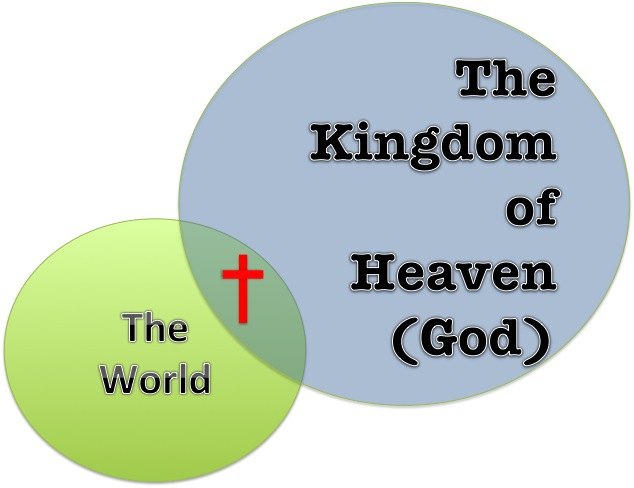
How, then, do the images of salt and light tie into the idea of the Kingdom of God that we have seen rests at the very heart of our understanding of the Sermon on the Mount?  As it turns out, they rest naturally and easily in the Kingdom that Jesus preached.  Remember that we have said that the Sermon on the Mount is a depiction of what the Kingdom of God life looks like lived out in the kingdom of the world.  We have been using this image to depict the breaking in of the Kingdom of God into the world:

worldkingdom

The Kingdom of God breaks into the world definitively in Jesus.  Jesus reigns in the hearts and minds of the crucified/resurrected community called the church.  This means that, today, the primary means by which the Kingdom of God is demonstrated before and enters into the world is through the born again lives of followers of Jesus.  And that means that the mores, values, ethics, truths, tenor, and tone of the Kingdom of God is lived out in the world in the lives of Jesus’ disciples.

With that crucial truth in mind, hear again the words of Jesus:

13 “You are the salt of the earth, but if salt has lost its taste, how shall its saltiness be restored? It is no longer good for anything except to be thrown out and trampled under people’s feet. 14 “You are the light of the world. A city set on a hill cannot be hidden. 15 Nor do people light a lamp and put it under a basket, but on a stand, and it gives light to all in the house. 16 In the same way, let your light shine before others, so that they may see your good works and give glory to your Father who is in heaven.

If Christians are to be agents of preservation and illumination in the dying, decaying world, that means that the nature of this salt and light are the Kingdom of God values that have been imparted to us in and through the indwelling Christ.  Salt and light must therefore be Kingdom of God salt and light.  To be salt and light must therefore mean that we are bringing the preserving and illuminating realities of the Kingdom of God into the decaying kingdom of the world as we follow King Jesus in the world.

Being salt and being light does not mean forceful overthrow or violent coercion.  It does not mean a siege mentality or power posturing.  It simply means that we live out the values of the Kingdom of God within the Kingdom of the world.  New Testament scholar Craig Blomberg put it like this:

We are not called to control secular power structures; neither are we promised that we Christianize the legislation and values of the world.  But we must remain active preservative agents, indeed irritants, in calling the world to heed God’s standards.[4]

Blomberg’s reference to salt and light as “irritants” is telling and, it seems to me, very important.  It is important because it reminds us that this application of salt to the decaying, dying world structure is not a welcome application.  The world sees it instead as a gross imposition and uncouth intrusion.

It is a sad thing when meat has decayed for so long that it views the decay as normal and desirable.  It is a sad thing when the agent of preservation is resented by the very object it is seeking to preserve.  However, we should remember that the world’s hostility to the intrusion of the Kingdom of God life is itself a result of the decay that we are seeking to combat.

II. The temptation to abandon what we are is really a temptation to abandon Christ.

This inevitable opposition to the intrusion of the Kingdom of God into the kingdom of the world (which we discussed at length last week in looking at the eighth Beatitude on persecution) presents the church today with a very real temptation:  the abandonment of our function as salt.  This can happen in many ways:  rank abandonment, subtle concealment, or redefinition.

The Christian who embraces rank abandonment simply refuses to be salt and light.  In this case, Christ is usually imprisoned in something we call “the spiritual realm” (which usually means church services and functions) and we live like the kingdom of the world in something we call “the secular realm.”  The spiritual/secular idea is perniciously brilliant because it allows us enough Jesus to comfort our hearts but not enough to bring us in conflict with the world.  I am thinking here of the person who says that Christianity is their personal faith but they don’t carry Jesus with them into the workplace or the voting booth.  It is as if life has been reconstructed as a house with many rooms.  Jesus lives in the religious room, our favorite candidate lives in the political room, our favorite team lives in the sports room, etc.

A few years ago one of the major news magazines interviewed the novelist Reynolds Price on the subject of Jesus.  I will never forget that Price said he was personally very impressed with Jesus.  In fact, he said he tried to follow Jesus and live the kind of life Jesus prescribed. He embraced all of Jesus’ teachings, he said, except one:  the Great Commission, Jesus’ call for His followers to go into the world making disciples.  He wanted Jesus.  He just didn’t want a Jesus who actually called him to conflict with the world.

The Christian who embraces the tactic of subtle concealment is the Christian who keeps Jesus around, even in the world, but allows the kingdom of the world to whittle down the sharper edges and more scandalous elements of the teachings of Christ.  It is all very subtle and all very nuanced.  It is also very effective.

I suspect this happens frequently with “cool Christians,” by which I mean Christians who never quite seem ever to have to disagree with the world.  These Christians are very good with words.  Using words, they can deflect the uncomfortable aspects of Jesus while maintaining a form of godliness and a kind of Christianity.  They can even put up a front of prophetic courage on certain issues about which the world already has some basic agreement of outrage:  say sex trafficking, racism, or political posturing.  We must oppose these things and I applaud all who oppose them.  But it does indeed goad a bit when one meets Christians whose only challenges are to those structures that it has become acceptable to challenge.

And, of course, some Christians simply redefine Jesus, the gospel, and the Kingdom of God so that there is no conflict at all.  This is the “Christianity” of the niche Jesus:  gay Jesus, environmentalist Jesus, feminist Jesus, New Age Jesus, white supremacist Jesus, black power Jesus, liberation theology Jesus, cult Jesus, vegetarian Jesus, cage fighting Jesus, etc. and etc.  The redefinition of the Kingdom of God so as to make it fit into our desired shape is a popular and devastating tragedy.  It requires the outright gutting of the Kingdom of God as presented in the Scriptures and the insertion in its place of a kingdom that, strangely, looks just like us.  When we complete this terrible revisionism, we do not end up with the Kingdom of God but rather the kingdom of __________ (insert your own name here).

All of these are ways that we abandon our calling to be salt and light, to be the living, breathing presence of the Kingdom of God in the fallen kingdom of the world.  What is really important to understand is that the temptation to abandon what we really are is actually a temptation to abandon Christ Himself.

We are to be Kingdom of God salt.  We are to be Kingdom of God light.  Jesus is the King of the Kingdom.  It is His.  To abandon our high calling and privilege of being salt and light is therefore to abandon the commission of our King, Jesus.  To abandon the commission of our King, Jesus, is to abandon our King.

Brothers and sisters, if you refuse to embrace your identity as salt and light, you are refusing to embrace the One who makes you salt and light.  It is not just a matter of not living up to your calling.  It is a matter of committing treason against our King.

If you have come to Christ, you have come to the King.

The King has commissioned His followers to illuminate the dark world with His light.

The King has commissioned His followers to preserve the dying world with His salt.

It is only through the salt and light of the Kingdom that the world can come to know the King that it does not know.

It is only through your life that they will come to know of Him at all.

13 “You are the salt of the earth, but if salt has lost its taste, how shall its saltiness be restored? It is no longer good for anything except to be thrown out and trampled under people’s feet. 14 “You are the light of the world. A city set on a hill cannot be hidden. 15 Nor do people light a lamp and put it under a basket, but on a stand, and it gives light to all in the house. 16 In the same way, let your light shine before others, so that they may see your good works and give glory to your Father who is in heaven.


[2] D.A. Carson, The Gospel According to Matthew.  The Pillar New Testament Commentary. Gen. Ed., D.A. Carson (Grand Rapids, MI: William B. Eerdmans Publishing Company, 1992), p.104.  For historical evidence of such, Daniel Harrington cites Pliny’s Natural History.  Daniel J. Harrington, S.J., The Gospel of Matthew.  Sacra Pagina Series. Vol.1 (Collegeville, MN: The Liturgical Press, 1991), p.80, n.13.

[3] https://www.desiringgod.org/resource-library/taste-see-articles/taking-the-swagger-out-of-christian-cultural-influence

[4] Craig L. Blomberg, Matthew. The New American Commentary. Vol.22 (Nashville, TN: Broadman Press, 1992), p.103.

Umberto Eco and Jean-Claude Carriere’s This is Not the End of the Book

If you are a bibliophile, you simply must read this book.  This is Not the End of the Book is a transcribed conversation between the great Italian novelist Umberto Eco and French writer and playwright Jean-Claude Carriere on books.  Yes, a book of two guys discussing books.  The two were interviewed by Jean-Philippe Da Tonnac on various questions concerning books, collecting books, whether or not books will survive the internet, the nature of libraries, threats to books, past, present, and future, and the history and future of books.  Eco and Carriere are both avid book collectors.  Eco estimates his collection to be around 80,000 volumes and Carrier, 50,000, many of which are antiquarian.

The conversation is enthralling.  I had a great deal of trouble putting the book down.  I mainly bought it because I try to read Eco whenever I can, but, in truth, Carriere’s comments were fascinating as well.  It is a dizzying, often humorous conversation filled with arcane and eclectic insights.  It is replete with fascinating anecdotal stories about the authors’ personal encounters with books.  It is also filled with references to the history of book making and the history of books in general.

It is hard to describe this book because it is so all over the place!  But if you think you would enjoy sitting in the corner of a room listening to two brilliant, eclectic minds discussing all things book related, you really should get a copy of this work.

Giorgio Agamben’s The Church and the Kingdom

It’s rare that I’ll pick up a book I do not know from an author I’ve never heard of from the Philosophy section of a Barnes & Noble, but that is precisely what I did with Italian philosopher Giorgio Agamben’s The Church and the Kingdom.  I did so because I have been thinking a great deal lately about precisely those realities (i.e., the church and the kingdom) and because I thought a different take on the question might be, at most, illuminating and/or, at least, interesting.  I’ve been thinking about these things lately because working through the Sermon on the Mount on Sunday mornings has (thankfully) forced me to do so.  It is not a new concern or a new question.  Indeed, for two millennia Christians have been discussing these questions:  What is the church?  What is the Kingdom of God?  How is the church to operate in the world?

What struck me about Agamben’s little book is that it is, ostensibly, from an outsider, yet it is from somebody who has obviously thought deeply about the question at hand.  Agamben is apparently one of a number of modern philosophers who are interacting with theology today.  It is an intriguing turn of events, and one about which I know very little as I do not read much in continental philosophy.  But it is, as I say, intriguing nonetheless.  I have long thought that we can learn a great deal by listening to how those outside of the church speak about the church, though there are obvious limitations to such observations as well.  That is precisely what Agamben is doing here.  (I should say that I do not know whether or not Agamben is a believer.)

This book consists simply of a sermon that Agamben delivered in Paris at Notre Dame Cathedral in March of 2009 in front of the Bishop of Paris and other church officials.  It has been translated into English by Leland De La Durantaye of Harvard University who also provides a helpful reflection on the sermon in an Afterword entitled, “On Method, the Messiah, Anarchy and Theocracy.”  Furthermore, the book is a beautiful little work consisting of compelling photographs by Alice Attie.

Agamben’s primary thesis is that the New Testament envisions the Church as abiding within “messianic time.”  Messianic time is not chronological time (i.e., historical time) and neither is it the time that begins at the consummation of all things.  Rather, it is the time between those two times.  It is a time within chronological time that began with the resurrection of all things.  It is Kingdom time, the Kingdom that Christ Jesus came to usher in.

Agamben is arguing that Paul did not see the Church as simply waiting within chronological time for the coming of the Kingdom at the end of all things, but rather that the Kingdom has come now and is coming yet (shades of George Eldon Ladd here).  That means that our very lives and vocations are revolutionized by the breaking in of Messianic time into chronos (Agamben does not use the chronos/kairos distinction, but it seems to be connected to what he is saying).

Let me suggest that Agamben has actually been a pretty faithful biblical interpreter in arguing this point, as I understand him.  The New Testament does indeed view the Kingdom as “already/not yet” and, I believe, does indeed view the current time of the pilgrim church as a kind of time within the times.  What is unclear about Agamben’s proposal is whether or not he has an overrealized eschatology, that is whether or not he is weighing the “already” so much more than the “not yet” that it lets the latter die the death of a thousand qualifications.  This is not necessarily the case, especially as Agamben does acknowledge the “not yet” aspect of the Kingdom.  On the other hand, in pointing to the linguistic commonalities between paroikousa (i.e., sojourners) and parousia (seeing the root of each as a call for immediacy and “nowness”), I do wonder if there is room in Agamben’s eschatology for the future, though imminent, return of Christ.  Regardless, the upshot of Agamben’s concerns is clear enough:  by losing a sense of Messianic time, the Church has become simply one of many institutions within chronological time.  The Church, then, has lost a sense of ultimate things and has become simply one more purveyor of temporal power.

Now, I rather suspect Agamben has a particular goal while speaking in a Roman Catholic Church to Catholic authorities, but as an American Protestant I see application as well.  Agamben is correct to suggest that the Church should not forsake its place in the Kingdom of God in order for inordinate fixations on the power structures of the kingdom of the world.  He is correct that if the Church diminishes itself to a merely human organization within mere chronological time, it is setting itself up to suffer the inevitable fate of all merely human organizations.  For me, Agamben’s cautions are worth heeding for those Christians who would like to see the Church become simply another political party.

Agamben’s primary concern may be political.  I do not know.  What I do know is that this Italian philosopher, believer or not, has (largely) correctly diagnosed a major malady in much ecclesial life today:  namely the abandonment of our Kingdom identity rooted in the time-altering act of the resurrection of Jesus Christ for the a paltry place at the table of modernity and its numerous special interest groups.

We are to be salt and light, showing the verities and values of a greater Kingdom.  That includes responsible citizenship and political involvement to be sure, but it is much, much more.

Job the Film: Well Worth Getting

When I first encountered John Piper’s poem on Job, I was blown away.  I found it beautiful, moving, insightful, and profoundly helpful, so much so that I bought an audio version for my mom for Mother’s Day a few years back.  I had my high school Bible class listen to the poem at Terrell Academy in Dawson, GA, a few years ago as well.  My dad brought that poem up to me earlier this week, saying how blessed he had been by it.  And tonight I see a tweet saying that they have produced a film version of the poem.  You can get it through iTunes or through other avenues (listed here).

This poem will be a blessing to you, I promise.  Check it out.  And here’s the trailer for the film:

Reflections on Orwell’s 1984 and Huxley’s Brave New World

I’ve fallen into the habit of listening to audio books as I drive (through the Audible app on my Kindle).  This is because I realize I will never be able to read all of the great books I’d like to read in my lifetime and, at the least, this gives me the opportunity to hear stories that I may be familiar with but have not actually read.  On a practical note, it has made driving a lot more enjoyable and informative!

The last three books I’ve listened to are Orwell’s Animal Farm and 1984 and Aldous Huxley’s Brave New World.  I’ve long been a sucker for the futuristic and apocalyptic genre, be it Miller’s A Canticle for Leibowitz or McCarthy’s The Road or Bradbury’s Fahrenheit 451 or others along those lines.  Viewing depictions of what the future might look like holds a fascination that, I trust, need not be explained.  What is striking is the shared note of pessimism among these works.  As I listened to 1984 and Brave New World in particular, I was struck by both the similarities and differences between the two books.

For instance, both books depict a terrifying version of the future consisting of totalitarian governments, the dehumanization of the populace, extreme social conditioning from on high, rigid, prescribed caste systems, and the obliteration of Christianity.  A kind of religion survives in Brave New World around Fordism, the worship of “Ford,” based on Henry Ford (thus, the triumph of consumerism and mechanization).  The old Christian crosses have had their tops sawed off, making them all into upper-case “T’s,” evoking, no doubt, the image of Ford’s Model-T.

In both stories there is a “hero” who gradually awakens to the horror of the society in which he finds himself.  In 1984, it’s Winston and Julia.  In Brave New World it’s John, “the savage,” and, to some extent, Bernard Marx and Helmholtz Watson.

John and Winston both feel the need for a sense of transcendence to help them escape the suffocating confines of State-sanctioned reality.  Winston says this to O’Brien, though he denies he believes in God.  Even so, he appeals to something more, the human spirit, he suggests, or something along those lines.  John, on the other hand, holds to the strange, syncretistic version of God he received on “the Savage Reservation.”  In both stories, the heroes feel that there must be more than State-constructed reality.  Yet in both stories the heroes end in despair and defeat, unable to change the social structure or see the victorious intrusion of greater transcendent reality into their bleak worlds.

In both stories, books are outlawed, individuality is suppressed, free thought is unacceptable, and a suffocating collectivism defined and controlled by the State is enforced.

The differences are striking too.  For instance, Orwell depicts a future of government-enforced sterility.  Sex is essentially outlawed and taboo.  Huxley, on the other hand, depicts a hyper-sexualized society in which sex has not been outlawed so much as desacralized.  Children’s erotic games are encouraged, monogamy and marriage are unheard of, and promiscuity is a virtue.  Sex is simply a mechanical diversion for the pleasure-seeking people.  In this, Huxley was certainly more prophetic than Orwell.

War is another difference.  Orwell depicts the future as one of constant if largely imaginary war.  War is always in the air as a means of keeping patriotic fervor at a fever pitch.  Not so in Huxley’s future.  There is no war and there are no conflicts.  Indeed, the masses are controlled by the euphoria-producing drug, soma, as well as constant tappings of the conditioning the brainwashed people have all undergone since birth.

Another difference is Orwell’s prolonged depiction of State-controlled historical rewriting.  In 1984, Big Brother is constantly rewriting history and controlling it.  Teams of workers, like Winston, spend their days rewriting bits of newspaper articles to make them fit more neatly into the State-approved version of reality.  In Brave New World, the story of the past is allowed to be what it is because the people have been conditioned to find it repulsive (i.e., that people used to born literally of their mothers ((and not in laboratories)) and live in families and marry a single person, etc.).

These two works have affected me pretty deeply, especially where they seem prophetic (which they frequently do).  The disintegration of the family, the conditioning of people to think certain ways, hatred of Christianity and what it stands for, the unquestioned orthodoxy of State-constructed and media-supported narratives of reality, the redefining of ethical mores, homogenous collectivism around, again, State-defined guidelines, political correctness, the dissolution of the Christian sexual ethic (in one way or another), the reduction of human beings to consumers, the redefining of words and language, etc.  It all has a too-close-for-comfort feel about it.

Let me quickly say that I am no Chicken Little.  I do not claim that we live in either Orwell’s or Huxley’s nightmarish visions at present, nor that we necessarily will.  I simply claim that there is an eerie familiarity to certain themes and imaginings that one finds in these books, especially when one compares these themes to certain trends in our country.  Regardless of their accuracy, these books are necessary if flawed warnings about what could be.

For this reason, if for no other, they should be taken seriously.

A Response to Dr. Rick Patrick on “Full Disclosure” and the ACP [Updated With A Response from Dr. Patrick]

Update: I have posted a response from Dr. Patrick at the end of my post (with his permission).


I don’t go over to SBC Today all that often, but a tweet referencing Ed Stetzer and the use of quotations from non-Southern Baptists in The Gospel Project curriculum caught my attention and led me there.  While there I saw the April 2 post, “Ten Traits of a Southern Baptist President,” by Dr. Rick Patrick.  In it, Dr. Patrick lists traits that he feels should be held by prospective Presidents of the Southern Baptist Convention.  I have no real beef with the list per se, except his fourth trait:

4. COOPERATIVE DISCLOSURE

His church submits a fully completed Annual Church Profile each year.Disclosure is very important to me since it clearly reveals that there is nothing to hide. One might compare the completion of a congregation’s Annual Church Profile with the completion of a citizen’s Annual Tax Return. It may be administratively challenging and even a bit unpleasant, but responsible and cooperative participants recognize the value in reporting such information. I want to vote for a president who willingly volunteers the kind of information denominational leaders track and report in order to assist our churches in the fulfillment of our Great Commission task. I do not value Lone Rangers, renegades or other non-conformists who offer the smokescreen of some lofty principle to avoid the accountability necessary to verify denominational support and involvement.

I disagree.

I strongly but respectfully disagree.

For many years now, I have refused to fill out one portion of the Annual Church Profile, only one:  the total membership section.  I gladly fill out the actual attendance, the Sunday School average, and all the rest, but not total membership.

I do not intend in this post to restate my reasons for not doing so since I have already done so here.  Suffice it to say that my not doing so has literally nothing to do with not wanting accountability.  If you were to read the ACP of Central Baptist Church you will get an accurate picture of what’s happening at our church.  In fact, it is precisely because I feel accountable to 400 years of Baptist witness in the world that I do not report that number.

I know not if Dr. Patrick’s allusion to those “who offer the smokescreen of some lofty principle to avoid the accountability necessary to verify denominational support and involvement” applies to people like me.  In truth, I rather suspect he is referring to guys who don’t report their Cooperative Program, Lottie Moon, or Annie Armstrong giving so as to avoid scrutiny.  If he is referring to that, I agree with him.  Those are actual numbers and should be reported.  But as he paints with a rather broad brush, insisting that all sections should be filled out, it applies to folks like me nonetheless.  So let me simply say this:

The principle of regenerate church membership predates the Annual Church Profile.  The principle of regenerate church membership has been cherished by the vast majority of Baptists for 400 years.  That principle has been abandoned to such a shocking extent that we now apply the term “member” to people to whom virtually no earlier generation of Baptists would have applied that term:  non-attending people who have no relationship with the church at all and, in many cases, have not had a relationship with the church for years.  Then, on the basis of grotesquely inflated and fictional numbers, we bear false witness to the world in reporting these inflated figures (i.e., “There are 16 million Southern Baptists!”).  Thus, to fill out that block when your total membership number is still largely fictional is to contribute to a dishonest reckoning.  (To those who would say, “Well, then, fix it!” I would only say that we reached this point of numerical inflation through a fairly slow process of denominational erosion, and there are numerous congregational realities that keep the rectifying of the problem from being simple and instantaneous.  That being said, many of us are on the long, slow journey of trying to build a culture that understands and reclaims regenerate church membership, but we would prefer not to destroy our churches through rash, sweeping changes in the process.  Thus, while on this journey, we prefer, at least, to do that which we can to protest our current church and denominational malaise regarding the concept of membership and the accounting thereof: namely, refuse to print a number with no integrity.)

I agree with Dr. Patrick that we should fill out the ACP, but I would add that we should do so only insofar as we do not violate the truth or our own consciences.

There is one thing I would value in a prospective President of the SBC more than his commitment to filling out the entirety of the ACP…namely, a commitment never to contribute to a numerical farce that violates the most cherished principles of Baptist congregational life and identity, never knowingly to prop up a failed and skewed system of numerical accounting by contributing to that system, and never to bear false witness to ourselves and the world by saying that we are more than we actually are.

For me to report to the world that we have over 1,000 “members” simply because that many names are on a roll is to violate the meaning of the word “membership” that would have been assumed and understood by the Baptist family throughout the world for the better part of our 400 year history.

The congregation that I pastor is free to make a motion and vote to include it.  Fine and good.  But I, personally, will not do so until/unless that happens…because I wish to be accountable.


A Response from Rick Patrick (posted with permission)

Wyman,

Thank you for your outstanding article. Yours is the most principled and compelling reason I have ever heard for not reporting fully on the ACP. As a matter of conscience, I would certainly not ask anyone to bear false witness. I join you in grieving the thousands of people who have given testimony of a relationship with Christ, but are either false professors or seriously disobedient in their sabbath observance. To call them church members may indeed be a stretch.

Your instincts are correct that my intention was to address those who fail to report out of a desire to avoid scrutiny. I appreciate and affirm that your principled explanation stems instead from a desire for greater accountability. Thank you for your post and for your courtesy in letting me know you had written it. Your approach in addressing our disagreement exemplifies the manner in which brothers in Christ should address their concerns. Thanks again for your helpful article and Christ-like exchange.

Blessings,

Rick

My Concluding Response

I’m grateful for Dr. Patrick’s generous and understanding response.  As the psalmist wrote in Psalm 133:1, “Behold, how good and pleasant it is when brothers dwell in unity!” 


Matthew 5:10-12

Matthew 5:10-12

10 “Blessed are those who are persecuted for righteousness’ sake, for theirs is the kingdom of heaven. 11 “Blessed are you when others revile you and persecute you and utter all kinds of evil against you falsely on my account. 12 Rejoice and be glad, for your reward is great in heaven, for so they persecuted the prophets who were before you.


I’d like you to meet Youcef Nadarkhani.  Youcef lives in Iran and is a Christian pastor.  He was arrested in December of 2006 for sharing the gospel with Muslims.  He was later released.  In 2009, he protested a policy saying that all children should be taught Islam in Iranian schools since the Iranian constitution technically allows for a measure of religious freedom.  He was arrested again, this time for protesting.  In June of 2010, his wife was arrested on the charge of apostasy, primarily, it is believed, in an effort to get Youcef to renounce Christianity.  She was held for four months in an Iranian prison.  Youcef was kept in prison and his charges were changed from protesting to apostasy and evangelism.

In September of 2010, Youcef was given the death sentence for apostasy.  He was put in a prison where he was not allowed to see his family or friends.  While in prison, he was given a number of chances to convert back to Islam.  He refused to do so every time.  In November of 2010, he was condemned to be hanged.  He was informed that should he recant Christianity and return to Islam, the sentence would be annulled.  He resolutely refused to abandon Jesus.

The case of Youcef Nadarkhani caught worldwide attention.  After great international pressure was brought to bear, Youcef was finally set free in September of last year.  He was re-arrested in December and set free again in January of this year.

Youcef was released due to international outrage at the injustice of his sentence.  Most persecuted Christians, however, are not so fortunate.  For most who are suffering today for their faith, there is very little international outrage at all.  In fact, there’s very little knowledge of such persecution in the first place.

For instance, probably none of us lost sleep last night over Mohommad, a young Iranian man who was delivered from drug addiction after he accepted Christ and become a Christian.  He says that he witnesses to everybody he meets and that he has led over 1,000 people have prayed to received Christ.  He was at the beach one day sharing the gospel when the police arrested him.  This is what he said:

“When they arrested me…I just knew that God was sending me to a place to witness…So I didn’t fight [or argue] so they would take me to the jail…They took me to jail, and I saw two people who were bound because their crimes were very serious.  When I came to those people I told them, ‘God has sent me to save you.’  By faith I believe that those who are around me God has sent for me to share the gospel.  So I shared the gospel very briefly, just about 15 minutes, and they…received Christ…I only had those 15 minutes to share the gospel because immediately after I shared the gospel the police came and said, ‘You have been very good and you shouldn’t be here.  You were very kind to us, and we want to release you…They opened the door and said I could go.  When they opened the door to release me, I hugged those two criminals and they were crying and hugging me really hard.  So the warden of the police was like, ‘You have only known these people for 15 minutes and they act like you are family.’”[1]

Persecuted, but to a glorious end.  However, not all who are persecuted are able to avoid pain and death like Mohommad did.  Mohommad has paid a price for his witness.  It is extremely likely that he will do so again.

Probably none of us lost sleep last night over Karim Siaghi, an Algerian Christian.  Karim went to a phone shop to buy minutes for his cell phone.  When he and the shop owner started talking about religion, Karim refused to cite the Muslim creed, “There is no God but Allah and Muhammad is his Prophet,” saying instead that he was a Christian.  The shop owner called the authorities, accused Karim of insulting Muhammed, and had him arrested.  Karim was recently sentenced to five years in prison and fined 200,000 Algerian Dinars even though his accuser brought no witnesses or evidence for the accusation.

Probably none of us lost sleep last night for Coptic Christian women and girls in Cairo, who are now being harassed in the women-only cars of the transit system by some Muslim women wearing the niqab covering.  The absence of the niqab covering for the Christian women makes them easily visible as non-Muslims.  Recently, two girls, aged 13 and 16, were assaulted and had their hair cut off by an angry mob.  A 30-year-old Christian woman broke her arm after a mob of women pushed her off the train onto a platform.

Probably none of us lost sleep last night over Pastor Samuel Kim of Jerusalem Prayer House in Kannur village of India.  Pastor Kim was hospitalized after being beaten unconscious on a road at night by Hindu extremists from the Bharatiya Janata Party.  While recovering from the beating, the extremists slipped into the hospital and tried, unsuccessfully, to slit the pastor’s throat to finish the job.

Probably none of us lost sleep last night over Mursal Isse Sia, aged 55, who was shot to death outside of his home in Beledweyne after receiving numerous death threats because he converted to Christianity.

Probably none of us lost sleep last night over the Christians of Chikkamatti, India, who were beaten recently by a mob of Hindu extremists because they were going to baptize forty new believers in Christ.

Probably none of us lost sleep last night over the persecuted Christians of Zanzibar.  After six extremists from the group Uamsho (“Awakening”) were arrested for shooting Fr. Ambrose Mkenda in the face, the group distributed leaflets around Zanzibar that read, “We now want the heads of all the church pastors in Zanzibar.”

And probably none of us lost sleep last night over the Christians of Sudan.  Touchstone magazine recently reported that the Christians in the Nuba Mountains of Sudan feel all alone and forgotten.  After Christian villages in the Sudanese state of South Kordofan were bombed last December, the Nuba Christians expressed surprise at the international silence.  One pastor who insisted on anonymity said, “We are surprised [that] the international community is so silent about the killing in South Kordofan.”[2]

No, most of us probably have not lost any sleep over these terrible situations, not, I think, because we do not care, but because we do not realize how much of this happening in the world today.  Regardless, one thing is for certain:  the Lord God knows and cares about His suffering people.  Interestingly, Jesus concludes the Beatitudes with a statement about persecution.

10 “Blessed are those who are persecuted for righteousness’ sake, for theirs is the kingdom of heaven. 11 “Blessed are you when others revile you and persecute you and utter all kinds of evil against you falsely on my account. 12 Rejoice and be glad, for your reward is great in heaven, for so they persecuted the prophets who were before you.

Persecution is a reality that Jesus, of course, recognized.  Most importantly, persecution is a reality that the Lord Jesus experienced.  He knows it from the inside.  Jesus knows and cares about His suffering people.  We would do well, then, to play close attention to what he says concerning this unfortunate but inevitable fact.

I. The Inevitable Clash of the Kingdoms: Jesus’ Assumption of Persecution

To begin, let us note that Jesus simply assumes the coming of persecution.  You will recall that we have been looking at the Beatitudes as progressive.  Each Beatitude grows naturally from the Beatitude that precedes it.  Thus, the Christian life begins with poverty of spirit, advancing through morning over our spiritual poverty, then meekness, etc.  The final Beatitude is persecution.  If nothing else, the natural progression we find in the Beatitudes leads us to the conclusion that those who live this kind of life will find persecution at some point along the journey.

The reason for this is that embracing and living the Kingdom-of-God-kind-of-life in the midst of the kingdom of the world inevitably brings conflict.  Perhaps you remember this image that I used to set the context for our journey through the Beatitudes in the initial sermon in this series.

worldkingdom

You will remember that we said that the Kingdom of God is “already” but “not yet,” to use George Eldon Ladd’s definition.  That means that the Kingdom of God is not a purely futuristic reality.  It is future, but it is also present.  How is it present?  It is present in the current reign of Jesus among His people.  It is present as the people of God live out the Kingdom of God in the world today.

Thus, the Kingdom of God is breaking into the world wherever and whenever the gospel is preached and the life of the Kingdom of God is lived by disciples of Jesus.  For our purposes this morning, I simply want to point out that the breaking of the Kingdom of God into the world is not a breaking in that is welcome by the world.  It is a point, on the contrary, of great and profound tension.  It is seen, in fact, as an intrusion by the world.

This tension is precisely what led to the crucifixion of Jesus.  The kingdom of the world hates the Kingdom of God.  Darkness hates light.  Thus, the entry of the Kingdom of God into the kingdom of the world through Christ’s reign among His people that is manifested in the transformed lives of disciples is most unwelcome by the world.

It is not welcome.

It is not liked.

It is not wanted.

It is deeply and profoundly resented.

“Persecution,” John Stott said, “is simply the clash between two irreconcilable value systems.”[3]

What this means is the more you live the life of the Kingdom of God within the kingdom of this world, the more the world will hate and despise that life.  In particular, Satan, the devil, hates this intrusion.  Thus, in 2 Corinthians 4:3-4, Paul writes this:

3 And even if our gospel is veiled, it is veiled to those who are perishing. 4 In their case the god of this world has blinded the minds of the unbelievers, to keep them from seeing the light of the gospel of the glory of Christ, who is the image of God.

Not only does the devil blind the minds of unbelievers, he stirs them to try to destroy this Kingdom-of-God-presence by destroying the followers of Jesus through whom the Kingdom of God is being demonstrated.  The crucial thing to understand is that this clash of kingdoms inevitably brings about persecution.  Now, this is not to say that every person is persecuted in the exact same way or to the exact same extent.  We live in a country that, thankfully, affords us great freedoms and great protections.  Nonetheless, to whatever extent it comes, and in whatever form it comes, following Jesus invites persecution.

Jesus says:

10 “Blessed are those who are persecuted for righteousness’ sake, for theirs is the kingdom of heaven. 11 “Blessed are you when others revile you and persecute you and utter all kinds of evil against you falsely on my account. 12 Rejoice and be glad, for your reward is great in heaven, for so they persecuted the prophets who were before you.

“When others revile you and persecute you and utter all kinds of evil against you falsely on my account.”

When.  It is inevitable that it will happen.  It is noteworthy that this is the only Beatitude of the eight that Jesus repeats.  He needs us to understand this:  persecution is inevitable.

In John 15 Jesus put it in terms so blunt that it leaves no room for confusion:

18 “If the world hates you, know that it has hated me before it hated you. 19 If you were of the world, the world would love you as its own; but because you are not of the world, but I chose you out of the world, therefore the world hates you. 20 Remember the word that I said to you: ‘A servant is not greater than his master.’ If they persecuted me, they will also persecute you. If they kept my word, they will also keep yours. 21 But all these things they will do to you on account of my name, because they do not know him who sent me.

Paul did the same in 2 Timothy 3:12 when he wrote, “Indeed, all who desire to live a godly life in Christ Jesus will be persecuted”

Let us come to terms, then, with this fact:  the clash between the Kingdom of God and the kingdom of the world will result in the world striking out against God’s people.  It is inevitable.  If you really try to follow Jesus, at some point, in some way, you will pay a price.

Itinerant speaker Richard Owen Roberts tells a story about an encounter he had with a person who did not believe this fact.  Once, after preaching on the inevitability of persecution, a gentleman came up to him and said, “You were wrong on that point. It’s not true that everyone who lives a godly life will suffer persecution. I’m the city attorney, and nobody persecutes the city attorney.

“Allow me to offer you a syllogism,” Mr. Roberts replied.

“Major premise: All who want to live a godly life in Christ Jesus shall suffer persecution.

Minor premise: The city attorney suffers no persecution.

Conclusion: The city lawyer does not want to live a godly life in Christ Jesus.”

II. The Nature of this Inevitable Persecution

What is the nature of this inevitable persecution?  The New Testament speaks in numerous ways about it, so let us take a moment to consider these texts and the descriptions of persecution that they offer.

Let us begin with our passage in Matthew 5.

10 “Blessed are those who are persecuted for righteousness’ sake, for theirs is the kingdom of heaven. 11 “Blessed are you when others revile you and persecute you and utter all kinds of evil against you falsely on my account. 12 Rejoice and be glad, for your reward is great in heaven, for so they persecuted the prophets who were before you.

Notice that Jesus begins by speaking of verbal persecution:  “Blessed are you when others revile you and persecute you and utter all kinds of evil against you falsely on my account.”  Being insulted is not a persecution unto death, though it can often lead to greater forms of persecution.  Regardless, this verbal persecution is a reality for which followers of Jesus should be prepared.

Consider how the media speaks about Christians.  Consider the inflammatory language, the insults, the slander, the whole barrage of Christian bashing.  I am not encouraging us to become whiney about these things.  On the contrary, Jesus tells us to rejoice when it happens.  But do note that Jesus foretells the verbal accosting of His people by the world.

Jesus also spoke of persecution in Matthew 10:

16 “Behold, I am sending you out as sheep in the midst of wolves, so be wise as serpents and innocent as doves. 17 Beware of men, for they will deliver you over to courts and flog you in their synagogues, 18 and you will be dragged before governors and kings for my sake, to bear witness before them and the Gentiles. 19 When they deliver you over, do not be anxious how you are to speak or what you are to say, for what you are to say will be given to you in that hour. 20 For it is not you who speak, but the Spirit of your Father speaking through you. 21 Brother will deliver brother over to death, and the father his child, and children will rise against parents and have them put to death, 22 and you will be hated by all for my name’s sake. But the one who endures to the end will be saved. 23 When they persecute you in one town, flee to the next, for truly, I say to you, you will not have gone through all the towns of Israel before the Son of Man comes.

In these words, we see persecution progressing past verbal to physical.  It moves from bad to worse.  Jesus told His initial followers that they would be drug before courts and flogged.  Even more chilling, family members would turn family members over to be killed for their faith in Christ:  “Brother will deliver brother over to death, and the father his child, and children will rise against parents and have them put to death, and you will be hated by all…”

This idea of the persecution of hatred is repeated by Jesus in John 15:

18 “If the world hates you, know that it has hated me before it hated you. 19 If you were of the world, the world would love you as its own; but because you are not of the world, but I chose you out of the world, therefore the world hates you.

Jesus says that we will be hated in the same way that He was hated.  And, I might add, we will be hated for the same reason:  because we are living the life of the Kingdom in the midst of a fallen world that does not want to hear it.

Paul knew the pains of persecution well.  In 1 Corinthians 4, Paul writes:

9 For I think that God has exhibited us apostles as last of all, like men sentenced to death, because we have become a spectacle to the world, to angels, and to men. 10 We are fools for Christ’s sake, but you are wise in Christ. We are weak, but you are strong. You are held in honor, but we in disrepute. 11 To the present hour we hunger and thirst, we are poorly dressed and buffeted and homeless, 12 and we labor, working with our own hands. When reviled, we bless; when persecuted, we endure; 13 when slandered, we entreat. We have become, and are still, like the scum of the world, the refuse of all things.

Paul and his companions underwent hunger, thirst, the wearing of rags, beatings, homelessness, revilings, and slander.  “We have become,” he says, “the scum of the world.”  This is a daunting list indeed!  But see how Paul lived out Jesus’ teachings in the Sermon on the Mount: “When reviled, we bless; when persecuted, we endure; when slandered we entreat.”  He does not begrudge the stripes he is honored to wear for Jesus…but he does have stripes to wear.

In 2 Corinthians 4, he wrote:

7 But we have this treasure in jars of clay, to show that the surpassing power belongs to God and not to us. 8 We are afflicted in every way, but not crushed; perplexed, but not driven to despair; 9 persecuted, but not forsaken; struck down, but not destroyed; 10 always carrying in the body the death of Jesus, so that the life of Jesus may also be manifested in our bodies. 11 For we who live are always being given over to death for Jesus’ sake, so that the life of Jesus also may be manifested in our mortal flesh.

“Afflicted.”  “Perplexed.”  “Persecuted.”  “Struck down.”  These are the verbs that Paul employed to describe his life and ministry, but he does not do so with a defeatist mentality.  He was honored to suffer for Jesus…but suffer he did.

If you would allow it, I would like to add another form of persecution to this list from scripture.  I believe it is a form of persecution that believers are most susceptible to in our country today: wealth, comfort, ease, and nominal Christianity.  This may sound odd, but I would like for you to consider this possibility:  persecution not only comes dressed in hard deprivation, it comes dressed as well in excessive plenty.

Could it be that the devil persecutes some by taking what they have and persecutes others by giving them more than they need?  Or perhaps he persecutes us by stirring our hearts to lust and greed over the good gifts God has given us?  Regardless, there are two ways to destroy a people:  crush them by causing them to despair or crush them by making them so wealthy they never have reason to despair.

And consider, too, the scourge of nominal Christianity.  By nominal Christianity I mean Christianity that is Christianity in name only.  I mean a deceptive Christianity that has the trappings of the faith but not the content.  I mean the name of Jesus but not the actual presence of Jesus.  I would like to propose that one of the ways we are being persecuted today is by the proliferation of groups that call themselves churches but do not have the gospel.  I am referring to churches across all denominational lines who give people a false assurance based on a false gospel that does conform to the truth of the gospel of Jesus Christ.  In truth, one of the most pernicious persecutions we face is the confusion and spiritual carnage that results when people who are still lost in their sins and trespasses are deceived by a form of godliness without true power.

There are many kinds of persecutions.  If we open our eyes to see the various ways that the people of God are harassed, we will see them all around us.  It may seem a daunting task, then, to follow Jesus.  However, in reality, those who suffer for Jesus tend to bear amazing fruit in winning the lost to Christ and in encouraging the church to follow more boldly.  Tertullian famously said, “The blood of the martyrs is the seed of the church.”  Paul Powell put it like this:  “The church is like a nail.  The harder you hit it, the deeper you drive it into the hearts of men and the soul of society.”[4]

III. The Persecuted Rewarded: Here and Hereafter

What is perhaps most significant about this Beatitude isn’t its expectation of persecution, but rather its teaching that we must rejoice in the face of such.

10 “Blessed are those who are persecuted for righteousness’ sake, for theirs is the kingdom of heaven. 11 “Blessed are you when others revile you and persecute you and utter all kinds of evil against you falsely on my account. 12 Rejoice and be glad, for your reward is great in heaven, for so they persecuted the prophets who were before you.

You are blessed if you are persecuted.  Why?  Because for one who truly loves Jesus like that, the kingdom of Heaven is theirs.  Those who are reviled and slandered should rejoice.  Why?  Because the reward you receive will outweigh the persecution you endure.  Furthermore, as Jesus says, you are in good company, “for so they persecuted the prophets who were before you.”

There is great reward in suffering for Jesus.  We must not think of this in an Islamic sense, as if martyrdom itself transports us straight to Heaven.  You will not enter Heaven through your suffering.  You will enter it only through Christ’s suffering.  No, when Christ speaks of the martyr’s reward, he is not speaking of the means of salvation but rather of the great honor of such an obedience for the saved.  It is an honor to suffer for Jesus.  It is an honor to die for Jesus.  The persecutor can take a life, but he cannot take from the life of the believer the Jesus who resides within him.

An Iranian man named Kambiz was recently interviewed by the [International] Campaign [for Human Rights in Iran] about a raid on his home by Intelligence agents.  His testimony is telling.

Between seven and eight in the morning, three undercover men from Intelligence, who to the best of my knowledge were unarmed, raided my home. . . . I asked them, “Why are you here?” He showed me the warrant—with the judge’s signature—that said they were allowed to enter my home. He told me, “We have this warrant to enter your home and take anything that is related to Christianity.” And as they confiscated all of my crosses, pictures, books, and CDs, throwing everything into a crate, I was right there standing over them. I told them, jokingly, “You forgot one cross.” Mr. Mousavi [an Intelligence officer] asked, “Where is it?” I answered, “In my heart,” and he replied, “I’ll rip your heart out, right out of your chest!”[5]

The persecutor may rip out a believer’s heart.  The persecutor cannot, however, rip Christ from the believer’s heart.  There is no shame in suffering for Jesus.  The reward for doing so is great indeed.  In truth, the only shame is in not being willing to suffer for the Jesus who suffered so very much for us.

Dr. Turner, the pastor of the American Church in Berlin before World War II, once visited Pastor Heinrich Niemoeller.  Henrich Niemoeller and his wife, Paula, were the parents of Martin Niemoeller, a Christian who was at that time suffering in a concentration camp for his opposition to Hitler and the Nazis.  In fact, Niemoeller would spend seven years in Nazi concentration camps, from 1938 to 1945.  Dr. Turner spoke with the Niemoellers about their amazing son and the suffering he was enduring for standing by his Christian convictions and opposing evil.  When they had finished visiting, Dr. Turner stood to go.  Niemoeller’s mother took him by the hand and his father said to him something he would never forget.  This is what he said:

When you go back to America, do not let anybody pity the father and mother of Martin Niemoeller.  Only pity any follower of Christ who does not know the joy that is set before those who endure the cross despising the shame.  Yes, it is a terrible thing to have a son in a concentration camp.  Paul here and I know that.  But there would be something more terrible for us:  if God had needed a faithful martyr, and our Martyn had been unwilling.[6]

Are you willing to be persecuted if the Lord asks it of you?  Are you living a life that is enough of a threat to the devil that he would want to destroy it?

May God find His church faithful, even to the point of death.

“Blessed are those who are persecuted for righteousness’ sake, for theirs is the kingdom of heaven.”


[1] P. Todd Nettleton, “Threat or Opportunity?” The Voice of the Martyrs (April 2013), p.3.

[2] All instances cited are taking from recent “The Suffering Church” columns from Touchstone magazine.

[3] John R.W. Stott, The Message of the Sermon on the Mount. (Downers Grove, IL: InterVarsity Press, 1978), p.52.

[4] Paul Powell, The Church (Dallas, TX:  The Annuity Board Press)

[5] https://www.iranhumanrights.org/wp-content/uploads/Christians-01142013-for-web.pdf

[6] Clarence Jordan, Sermon on the Mount. (Valley Forge, PA: Judson Press, 1952), p.25.