Ian Morgan Cron’s Chasing Francis

41d41DLmZwL._SY344_BO1,204,203,200_In Chasing Francis, Ian Morgan Cron has written an engaging and interesting consideration of the life of Francis of Assisi in the form of a novel about a successful pastor who undergoes a crisis of faith and then rediscovers his faith in Italy under the mentorship of his Franciscan uncle.  The pastor, Chase Falson, reaches a crisis point when the child of a woman in the church dies and his Evangelical faith has no answers to offer the grieving and angry mother or Chase himself.  But it isn’t just this. This crisis has been coming for some time as Chase increasingly feels that something significant is missing in his walk with Christ.  After a moment of brutal transparency with his congregation about his struggling faith, the church is thrown into turmoil and Chase goes off to see his uncle in Italy.  His uncle Kenny introduces him to numerous fascinating people, most of whom are connected with the Franciscan order.  While Chase begins to learn about Francis of Assisi in Italy, his church back home struggles with confusion, division, and increasingly aggressive maneuvering from one of the staff members who is angling for Chase’s job.  Eventually, the grieving mother flies to Italy, joins Chase in his journey, and, after she experiences the ways of Francis in Italy as well, the two of them return to America where Chase shares with the church his new vision of what he believes they need to become.  To find out the church’s response, you’ll have to read the book!

It is an interesting way to approach the life of Francis.  As far as novelistic approaches to Francis go, the gold standard remains, in my opinion, Nikos Kazantzakis’ beautiful novel, Saint Francis.  Cron’s work is engaging and through excerpts from Chase’s journal the reader will encounter a solid recounting of the details of Francis’ life.  Cron isn’t exactly Cormac McCarthy (who is?), but the story is told well and I suspect that somebody who is unfamiliar with the life of Francis would find this a helpful introduction

It is Chase’s (Cron’s) interpretation and application of the life of Francis to the church that muddles things up a bit.  Cron gets a great deal right:  Francis’ authenticity, his simplicity, his literal, simple, and beautiful biblical hermeneutic, his courage, his love for the poor, his nearness to the poor, his prophetic challenge to empty religiosity, etc.—all of these are spot on.  But there are times, especially in Chase’s words to his church upon returning, when things get murky.  In his final message to his church upon returning to the United States, Chase lays out his vision.  Presumably, Cron believes that the vision he communicates through Chase represents a faithful application of Franciscan principles to today’s church.

In this message, Chase calls the church to reflect the best of the Franciscan values:  transcendence, community, beauty, dignity, serving Jesus completely and unreservedly, and meaning.  These are indeed Franciscan ideals, but one does wonder if Cron has not baptized some of his interpretation of these ideas in the waters of post-modernity in such a way as to untether them from Francis’ original vision.  Take, for instance, this section of Chase’s message:

Francis’s vision of Christian community was pretty revolutionary for the times he lived in. He encouraged women to be in ministry and to follow his way of life. Women like Clare were his closest friends. He defied hundreds of years of church tradition by insisting members of his order live among the people instead of behind monastery walls. They didn’t make artificial distinctions between the sacred and the secular. Instead, they went into the marketplace to minister. (p.198)

Now, a modern church-going person who knows nothing of St. Francis is going to read this and immediately interpret it in terms of today’s conversations about “women in ministry” and make certain assumptions that truly do not fit the facts.  Yes, the relationship between Francis and Clare was beautiful and unique and worthy of pointing out, but it should be noted that once Claire submitted herself to his way of life, Francis immediately had her (and, in time, her followers) cloistered and, in essence, they never saw each other again until she was allowed to see the dying Francis’ in 1226.  This arrangement was not against Clare’s will, I hasten to add, and I am not at all trying to downplay a relationship that was beautiful and powerful in its own right, but the picture of a group of young men and women who lived and ministered together in an early display of gender egalitarianism is a bit misleading.  For instance, I would wager that no serious student of Francis (and Cron is certainly that) would suggest that Francis would have supported women priests (he would not have).  Even so, Chase’s words, read through the lens of the modern American ecclesial milieu would likely lead one to suspect that he did.

Chase also appears to be enamored with the sentiment behind the almost-certainly-apocryphal saying of Francis, “Preach the gospel all the time.  Use words only when necessary.”  I am not saying that Cron does not realize these words are apocryphal.  I am sure he does.  I am suggesting that he gets close to saying something similar when he has Chase say:

First, if Francis were around today, he’d say our church community relies too much on words to tell others about our faith. For Francis, the gathered community was as potent a form of witness as words. He was convinced that how we live together is what attracts people to faith. Rather than loading people up with books and words when they come seeking God, why don’t we just invite them into the community and say, ‘We’re all seeking God together — come join us. See how we relate to each other, to you, to the world. Experience God in our midst, and figure out if you want to be part of his family and what he’s doing in the world.’ It’s all about actions first, words second. (p.199)

In a sense, this is, of course, thoroughly Franciscan.  Francis did indeed believe that proclamation was more than words and there can also be no doubt that there is something endemic to perhaps especially non-liturgical Protestant culture that has hurt itself by not understanding that truth is communicated in many ways other than through verbal propositions.  Even so, I fear that a modern person who does not know the story of Francis’ life would be surprised in light of this statement to know that Francis sent his brothers out on preaching and evangelization missions and that Francis himself sought the conversion of Sultan Malek al-Kamil through verbal proclamation (including, yes, the quality of his own life and possibly even, if one believes all of the reports, miraculous demonstrations of God’s power and presence).

In other words, I suspect that Chase’s words say more than he intends to say.  Francis was a great proponent of preaching and words.  He would, I suspect, call for our lives to undergird our words, and he would be right to do so.  But Francis had deep theological convictions and did not hesitate to proclaim the content of the Christian message.  I have no reason to think that Cron would disagree with this if asked.  Again, my concern is the overall impression that such sentiments suggest to a modern readership who will almost certainly interpret such without the qualifying balance of other aspects of Francis’ life.

Chase rightly calls his congregation to forsake their materialism and to embrace peacemaking.  I think Francis would heartily applaud this statement:

Somewhere along the way we forgot that Jesus intended the Sermon on the Mount to be an actual, concrete program for living. He wanted us to actually live it, not just admire it as a nice but unrealistic ideal. (p.202)

However, near the conclusion of Chase’s message, he says something that I think modern left-leaning Christians would appreciate but Francis would find utterly odd:

For years I thought of the Bible not as a story but as a black-and-white photograph, something you could use in a court of law to prove that our doctrines and propositions were rational and true. Talk about trivializing and holding back the beauty of the Bible! Now I see the Story more like a painting filled with glory, poetry, and even blurry lines. Paintings are trickier than photos. They’re open to a wide variety of interpretation, depending on who’s looking at them and the situations those viewers live in. Seeing the Bible this way could lead to things getting messy from time to time — but the Word is living, not static. Our job is to invite people to inhabit our story, to be part of what God’s doing in history. And we don’t need to feel constant pressure to defend it against its critics. Truth doesn’t need defending. It is its own witness. (p.207)

This is, frankly, so much grist for the mill for the kind of Christian today who has, to borrow a phrase from Vance Havner, “developed the ability of almost saying something.”  Francis’ hermeneutic, as Cron recognizes earlier in his novel (and recognizes five pages earlier when he speaks of Francis’ approach to the Sermon on the Mount), was profoundly simple (without being simplistic), direct, and radical.  Francis did not read the Bible like Rob Bell appears to read the Bible.  He read it as a direct, largely clear, and authoritative word from God that called for immediate action. But that action does not arise out of the postmodern hermeneutic of uncertainty.  It arises from the exact opposite:  a belief that the ideational content of the scriptures on the main is perspicuous, clear, and largely settled.  I can see no other way to explain Francis’ actions arising from Francis’ interpretations.

This novel is a mixed bag.  I am not trying to be unjust to it.  I just wonder if, here and there, Cron has not demonstrated an unfortunate penchant for crafting modernistic non sequiturs that seek to link Francis to aspects of the church today that he would in some cases not understand and would in other cases outright reject.  Even so, on the whole, there is value in this work insofar as it offers (a) a pretty clear explanation of the life and mission of Francis and (b) one person’s attempt to think through the modern day implications of a most amazing life.
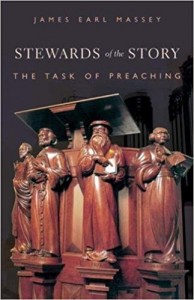
 

James Earl Massey’s Stewards of the Story: The Task of Preaching

51RpUquwqaL._SX321_BO1,204,203,200_I first met Dr. James Earl Massey while working on the Doctor of Ministry degree at the Beeson Divinity School in Birmingham, Alabama.  I was struck by Dr. Massey’s wisdom, his godly character, and his pulpit acumen, all of which have endeared Dr. Massey to his colleagues and many students throughout his storied ministry.  I recently had the opportunity to return to Dr. Massey’s ministry when I was asked to lead a preaching cohort for some Arkansas Baptist church plants.  When asked to choose a text I immediately thought of Dr. Massey’s wonderful volume, Stewards of the Story: The Task of Preaching, comprised of lectures Massey delivered in 2004 at Beeson for their William E. Conger Jr. Lectures on Biblical Preaching.  I remember listening to these lectures when first delivered but being able to revisit them and to read them carefully has been a true blessing indeed.  The volume is comprised of five chapters on the task of preaching and six chapters consisting of Dr. Massey’s sermons.

This is a slender volume but it presents the reader with a cogent, compelling, biblical, and powerfully articulated philosophy of preaching.  The overriding image is that of “steward,” which Massey defines as “someone who oversees, administers, [and] manages, under a commissioning trust that authorizes them to do so” (1).  That of which the preacher is a steward is “the story,” by which Massey means the gospel.  Massey argues that the stewardship to which we have been called and commissioned makes certain demands on our lives.

Since this commissioning trust was committed not only to Paul and successive generations of Christian preachers but also to us, our concern should be to live and labor honorably as “good stewards”…Being called a “steward” is not enough; one must be a steward.  It is not enough to be called a preacher; one must be a preacher.  And the true preacher, Paul tells us, honors the commission from God to handle and herald the divine “mysteries,” the startling, saving, sustaining truths of the gospel.  Stewards are highly privileged persons. (7)

Massey next turns to the stewardship of reciting, which Massey defines as “a mode of address that engages hearers through telling about something, calling attention to some event, and interpreting that event so that the telling influences the hearer’s belief and action.” (12)  This act of reciting involves how we present the story and Massey says that this presentation “can be as varied and multiform as the Scriptures themselves.” (15)  Massey interestingly argues that Protestant preaching has become particularly enslaved to logical propositions in its presentations.  Such does not honor the various genres and styles one finds in the Bible itself.  The content of our recital must be the content of scriptures, but particularly the cross of Christ:  “The center of our recital is the event of the cross dying on a cross.” (20)

Massey turns next to the issue of rhetoric.  Even here, Massey’s primary concern is not with style per se but with radical fidelity to the text of scripture.  One might say that the thread that runs throughout Massey’s book is faithfulness to scripture leading to a clear presentation of the gospel of Jesus Christ.  Yet presentation matters.  “The biblical word is given to us,” writes Massey, “but we must structure the sermon by which the textual message can be stated and applied to the lives of those who hear us.” (14)

Chapter 4 is entitled “The Steward and Ritual.”  By “ritual,” a word that has primarily negative connotations among Evangelicals, Massey points to the following:

  • “preaching is an authorized activity”
  • preaching and “sacred texts”
  • preaching and architectural spaces (i.e., sanctuaries) that have “ritualistic import” (35-37)

These are undeniable aspects of preaching, and the ritualistic dynamic of these components needs to be considered, but Massey hastens to add that while “preaching involves ritual” it involves “something more than ritual.” (38)  It involves the power of the story of which we are stewards, a power that must transform the life of the preacher who actually believes it is true and who yields himself to the full implications of its contents.

My favorite chapter was the last, “The Steward and Reality,” in which Massey drives home once again the fact that the preacher must believe the story is real and must reach people in their reality.  Preaching, that is, must be real proclamation of a real story by a real preacher to real people in the midst of real life.  In stressing this, Massey undercuts preaching as mere show or mere rhetoric.  We must preach about God in the exact same way that Jesus did, that is, as “the first of all facts.” (42)  I think I appreciated this chapter so much and found it so very convicting because there is so much posturing in modern ministry and there is a powerful temptation facing all ministers to do so:  to pretend to be more than what we are, to be fake, to be inauthentic.  Massey’s stress on reality is sorely need in our day of ministry in which image is threatening to eclipse content and character.

This is a powerful book.  It is not a meat-and-potatoes “how to” manual.  It is better than that.  It is a book that will leave the reader with a high sense of the great importance of preaching and will remind all who read it that our’s is a sacred stewardship indeed.

Mark 9:42-50

MarkSeriesTitleSlide1Mark 9

42 “Whoever causes one of these little ones who believe in me to sin, it would be better for him if a great millstone were hung around his neck and he were thrown into the sea. 43 And if your hand causes you to sin, cut it off. It is better for you to enter life crippled than with two hands to go to hell, to the unquenchable fire. [KJV – 44 Where their worm dieth not, and the fire is not quenched.] 45 And if your foot causes you to sin, cut it off. It is better for you to enter life lame than with two feet to be thrown into hell. [KJV – 46 Where their worm dieth not, and the fire is not quenched.] 47 And if your eye causes you to sin, tear it out. It is better for you to enter the kingdom of God with one eye than with two eyes to be thrown into hell, 48 ‘where their worm does not die and the fire is not quenched.’ 49 For everyone will be salted with fire. 50 Salt is good, but if the salt has lost its saltiness, how will you make it salty again? Have salt in yourselves, and be at peace with one another.”

Albert Camus’ The Plague is rightly considered a classic. It is the story of a plague that swept through the city of Oran and the various ways that different people responded to, interpreted, and/or sought to combat it. The plague itself is clearly metaphorical and has been interpreted in various ways. As the book appeared in French in 1947 then in English in 1948, it is widely held that the plague was intended, at least to some extent, to represent the Nazism and totalitarianism that had only recently thrown the entire world into such chaos. Even so, it is also believed that the plague represents the human condition itself or perhaps even the absurdity of life as so many see it.

I do not feel that it is at all inappropriate to suggest that the plague might also have been seen as the corruption of human nature, as sin, as that which is wrong and skewed within us. The book can certainly be read in this way. Consider, for instance, these words, spoken by the character Tarrou to Rieux in The Plague:

I know positively – yes, Rieux, I can say I know the world inside out, as you may see – that each of us has the plague within him; no one, no one on earth is free from it. And I know, too, that we must keep endless watch on ourselves lest in a careless moment we breathe in somebody’s face and fasten the infection on him. What’s natural is the microbe. All the rest – health, integrity, purity (if you like) – is a product of the human will, of a vigilance that must never falter. The good man, the man who infects hardly anyone, is the man who has the fewest lapses of attention. And it needs tremendous will-power, a never ending tension of the mind, to avoid such lapses. Yes, Rieux, it’s a wearying business, being plague-stricken. But it’s still more wearying to refuse to be it. That’s why everybody in the world today looks so tired; everyone is more or less sick of plague. But that is also why some of us, those who want to get the plague out of their systems, feel such desperate weariness, a weariness from which nothing remains to set us free except death.[1]

At the end of the book, a character says, “But what does it mean, the plague? It’s life, that’s all.”

We might be tempted to discard such as so much pessimism and despair. For Camus, there is not a wholly unjust projection, for Camus saw life as absurd, as having perhaps no ultimate meaning, but as the arena in which we must fight against the plague nonetheless. Christianity disagrees with Camus’ conclusion, but not with Camus’ notion of the plague. Christianity does not deny that something is deeply wrong with the world, that something is deeply wrong with us. Christianity looks that difficult truth square in the eye and calls it what it is: sin and the fall of man. But Christianity says something more. Christianity says that there is a cure for the plague, that there is meaning in life, that the absurd was given meaning by God Himself entering this dark and fallen world in the person of His Son, Jesus Christ, and by His self-sacrifice on the cross. Christianity says that the plague was cured by the only uninfected one taking the plague willingly into Himself so as to set free all who will come and accept the new life that He offers us.

This is the gospel. We must see Christ as the cure…but we must also see the plague from which He came to save us.

Continue reading

Larry Hurtado’s Why on Earth Did Anyone Become a Christian in the First Three Centuries?

314FacZGVzL._SY344_BO1,204,203,200_This little hardback contains Larry W. Hurtado’s 2016 Pere Marquette Lecture in Theology.  While the text itself is only a little over 120 pages (and the format of the book is small), it is a very insightful and very helpful work that considers the titular question with the skill of a trained and balanced historian.

Hurtado wants to know why it was that so many people joined the early Christian movement given the immense costs of doing so.  He groups these costs under the two general headings of “social costs” and “political/judicial costs” (p.48).  He makes the point that limiting a measurement of the cost of joining Christianity only to the number of those actually killed for joining the faith does not offer a true picture, for undoubtedly the greatest costs came through the numerous acts of social pressure and ostracization that would have arisen when Christian particularism clashed with the pervasiveness of the cultural acknowledgement of the Romans god that positively saturated nearly every aspect of Roman life.  Hurtado demonstrates this last point well by showing that paying homage to the gods was expected at almost every social, familial, governmental, and cultural event.  The primary point of tension, then, was the Christian refusal to offer this homage and the message that such a refusal sent not only to one’s family and social circles but to the state as well.  (Hurtado has dealt with this point more thoroughly in his work, Destroyer of the gods.)

Even so, Christianity exploded in terms of growth and this means that there was something in the movement that made these undoubtedly difficult costs worth paying in the minds of the early adherents.  Hurtado offers an interesting fly-over of some of the more popular approaches to figuring out just how numerically large Christianity became in the first three centuries.  He finally lands on a fairly agnostic position concerning that specific question but does say that by any measure the expansion of Christianity was impressive, “unique” (a word, he notes, that historians do not normally like to use), and, given the costs in question, surprising.

So how do we answer the question?  Why, in fact, did anybody on earth become a Christian in the first three centuries?  After surveying a couple of proposed answers and finding them lacking, Hurtado suggests that it was, in fact, largely the ideational content of the Christian message itself that made people think that the costs were worth it.  In particular, Hurtado points to two Christian beliefs:  a loving God and the promise of eternal life.

Concerning the former, Hurtado notes that the concept of a loving God was quite different from the theological conception of the gods held by the Romans.  In short, the idea of a God who actually loves people and invites them into relationship with Him represented a stark contrast to the theology of Roman paganism.  Concerning the latter, the same can be said.  The idea of hope beyond the grave, of eternal life, of life in Heaven with God, was quite different from the widely held Roman conception of death as the end of all things for the individual.  Hurtado points to the inscription one can find on Roman tombs that reads, “Non fui, fui, non sum, non curo” (“I was not, I was, I am not, I care not.”) as a fairly accurate indicator of how the Romans viewed death.  Against this, Christianity offered the hope of eternal life after the event of death.

Hurtado writes:

There must have been features of early Christian faith that made it not only distinguishable but also worth the consequences often involved in taking it up.  Those who joined Christian groups must have perceived some sort of “religious capital” (to use Bremmer’s expression) specific to Christianity that relativized radically the social disincentives of identifying themselves as adherents (p.131).

That is an interesting way of putting it and I think Hurtado is correct.  It was the content of the Christian confession as well as the realities that this confession opened up in the lives and experiences of early believers that outweighed “the social disincentives” of becoming a Christian.  So it was then.  So it is today.  The truthfulness of the Christian message must be grasped for the faith to be authentically embraced.

My one quibble with the lecture is the question of whether or not the forgiveness of sins through Christ’s death on the cross specifically should not have been mentioned alongside the love of God and the hope of eternal life.  Of course, the forgiveness of sins can rightly be seen as subsisting within both of those broad categories, but one does suspect that the scandal of the message of the cross, particularly in this Roman context, should have been mentioned.  For, as the Alexamanos graffito shows, this would have been one of the primary points at which social scorn would have been meted out.  There must have been something about the love God revealed through the work of Christ on the cross specifically that made the acceptance of social ostracization on that very same point worth it.

This is a very interesting and very careful little book.  Definitely worthy of consideration.

Mark 9:38-41

MarkSeriesTitleSlide1Mark 9

38 John said to him, “Teacher, we saw someone casting out demons in your name, and we tried to stop him, because he was not following us.” 39 But Jesus said, “Do not stop him, for no one who does a mighty work in my name will be able soon afterward to speak evil of me. 40 For the one who is not against us is for us. 41 For truly, I say to you, whoever gives you a cup of water to drink because you belong to Christ will by no means lose his reward.

First Things journal reported some years ago about an interesting proposal (or, as the Lutheran Church-Missouri Synod calls it, “Memorial”) submitted on the floor of their national convention.

The Lutheran Church-Missouri Synod (LCMS) goes back to 1847 and practices “close” communion (not, mind you, “closed” communion). The LCMS also has a more or less congregational polity, which means that any local church can submit memorials or proposals to the national convention. Grace Lutheran Church in Queens Village, New York, submitted the following to last summer’s convention.

Memorial 3.45 TO INCLUDE COMPANY OF HEAVEN IN COMMUNION FELLOWSHIP: Whereas, the LCMS only communes those who are members of the LCMS and are in fellowship with it; and Whereas, Jesus and many of the saints in heaven were on earth long before the establishment of the LCMS; and Whereas, during the Lord’s Supper we celebrate the holy meal “with angels and archangels & with all the company of heaven” (LW pp. 146-48); therefore be it RESOLVED, That we make all the company of heaven honorary members of the LCMS, even if they were not Lutheran in life, so that we are not breaking our own rules when we come to the Lord’s Table; and be it further RESOLVED, That we declare Jesus the Christ to be an honorary member of the LCMS so that in His second coming He will not be turned away from a Lutheran altar.

The memorial was not adopted. Moreover, it is reliably reported that many delegates made it emphatically clear that they were not amused.[1]

That is fantastic and I must say I immediately like whoever it was specifically who drafted that memorial. Why? Because the human desire to think that our group’s relationship with Jesus is more important and more authentic than the relationship with other groups’ relationships with Jesus is, at its core, absurd and injurious to the work of the Church around the world. Such is worthy of being sarcastically lampooned. Even so, this regrettable penchant was present even in the time of the disciples. This is precisely what Jesus addresses in Mark 9:38-41.

Continue reading

Mark 9:30-37

MarkSeriesTitleSlide1Mark 9

30 They went on from there and passed through Galilee. And he did not want anyone to know, 31 for he was teaching his disciples, saying to them, “The Son of Man is going to be delivered into the hands of men, and they will kill him. And when he is killed, after three days he will rise.” 32 But they did not understand the saying, and were afraid to ask him. 33 And they came to Capernaum. And when he was in the house he asked them, “What were you discussing on the way?” 34 But they kept silent, for on the way they had argued with one another about who was the greatest. 35 And he sat down and called the twelve. And he said to them, “If anyone would be first, he must be last of all and servant of all.” 36 And he took a child and put him in the midst of them, and taking him in his arms, he said to them, 37 “Whoever receives one such child in my name receives me, and whoever receives me, receives not me but him who sent me.”

Some years ago CBS showed a miniseries on Jesus. Networks do this from time to time, usually with less than impressive results. Even so, Shane Clairborne noticed an interesting example of artistic license that CBS indulged in, an example that, surprisingly, offered an interesting and even profound observation. Clairborne writes:

I really hate to allude to the CBS miniseries on Jesus…but there’s a fabulous scene in which the Tempter meets Jesus in the garden of Gethsemane just before he is about to be crucified. The devil tells him, “They do not understand your cross, Jesus. They will never understand your cross.”[1]

Continue reading

Mark 9:14-29

MarkSeriesTitleSlide1Mark 9

14 And when they came to the disciples, they saw a great crowd around them, and scribes arguing with them. 15 And immediately all the crowd, when they saw him, were greatly amazed and ran up to him and greeted him. 16 And he asked them, “What are you arguing about with them?” 17 And someone from the crowd answered him, “Teacher, I brought my son to you, for he has a spirit that makes him mute. 18 And whenever it seizes him, it throws him down, and he foams and grinds his teeth and becomes rigid. So I asked your disciples to cast it out, and they were not able.” 19 And he answered them, “O faithless generation, how long am I to be with you? How long am I to bear with you? Bring him to me.” 20 And they brought the boy to him. And when the spirit saw him, immediately it convulsed the boy, and he fell on the ground and rolled about, foaming at the mouth. 21 And Jesus asked his father, “How long has this been happening to him?” And he said, “From childhood. 22 And it has often cast him into fire and into water, to destroy him. But if you can do anything, have compassion on us and help us.” 23 And Jesus said to him, “‘If you can’! All things are possible for one who believes.” 24 Immediately the father of the child cried out and said, “I believe; help my unbelief!” 25 And when Jesus saw that a crowd came running together, he rebuked the unclean spirit, saying to it, “You mute and deaf spirit, I command you, come out of him and never enter him again.” 26 And after crying out and convulsing him terribly, it came out, and the boy was like a corpse, so that most of them said, “He is dead.” 27 But Jesus took him by the hand and lifted him up, and he arose. 28 And when he had entered the house, his disciples asked him privately, “Why could we not cast it out?” 29 And he said to them, “This kind cannot be driven out by anything but prayer.”

There is something within conservative church culture, within, that is, our culture, that makes raw honesty difficult to practice. Somehow we still act as if we must keep up our spiritual appearances, that we must act like we never waver, that we must pretend to be mighty oaks or immovable boulders. My experience as a pastor, however, shows that this really is not always the case. Sometimes our faith is strong and unwavering. Other times it is weak and fragile. I have lost count of the number of times that Christians who seem to have it all together, who seem to be models of spiritual stability, will admit, in private, to going through great periods of doubt and struggle.

Then there is my own walk with Jesus. It can be particularly tricky struggling with doubts as a pastor. For many, the pastor becomes a symbol of stalwart faith. He is not supposed to struggle. And, to some others, it seems to be assumed that a pastor is actually paid not to struggle! How foolish! Pastors, like all believers, are not averse to periods of struggle, of doubt, of questioning. Pastors too might go through what St. John of the Cross called “the dark night of the soul.”

I would like to offer this message to those who are struggling in their faith, to those who find themselves asking questions that they have been told “good Christians” should not ask, to those who have ever struggled with their own minds and hearts. I would like to offer this message to the weak of faith, the unsure, the vacillating, the despondent, the confused, and the uncertain. And in doing so, I would like to introduce you to a man who, perhaps like yourself, believed but also struggled to believe.

Continue reading

Mark 9:1-13

MarkSeriesTitleSlide1Mark 9

1 And he said to them, “Truly, I say to you, there are some standing here who will not taste death until they see the kingdom of God after it has come with power.” And after six days Jesus took with him Peter and James and John, and led them up a high mountain by themselves. And he was transfigured before them, and his clothes became radiant, intensely white, as no one on earth could bleach them. And there appeared to them Elijah with Moses, and they were talking with Jesus. And Peter said to Jesus, “Rabbi, it is good that we are here. Let us make three tents, one for you and one for Moses and one for Elijah.” For he did not know what to say, for they were terrified. And a cloud overshadowed them, and a voice came out of the cloud, “This is my beloved Son; listen to him.” And suddenly, looking around, they no longer saw anyone with them but Jesus only. And as they were coming down the mountain, he charged them to tell no one what they had seen, until the Son of Man had risen from the dead. 10 So they kept the matter to themselves, questioning what this rising from the dead might mean. 11 And they asked him, “Why do the scribes say that first Elijah must come?” 12 And he said to them, “Elijah does come first to restore all things. And how is it written of the Son of Man that he should suffer many things and be treated with contempt? 13 But I tell you that Elijah has come, and they did to him whatever they pleased, as it is written of him.”

Take a moment and think back to somebody you love who is no longer with you. Perhaps you are thinking of a grandparent or a parent. Perhaps you are thinking about somebody else. Now think about the most precious memories you have of your life with that person. I would be willing to bet that two or three memories come immediately to mind. Those memories you just recalled are important. They are likely your mountaintop moments with that person.

Would you like to know something amazing? In the two letters that Peter wrote (1 and 2 Peter) he only mentions one specific episode from all of his time with Jesus. Of all that Peter saw and experienced when he walked with Jesus, he only recalls for us one moment, and it is, literally, a mountaintop experience. He recounts it in the first chapter of 2 Peter.

16 For we did not follow cleverly devised myths when we made known to you the power and coming of our Lord Jesus Christ, but we were eyewitnesses of his majesty. 17 For when he received honor and glory from God the Father, and the voice was borne to him by the Majestic Glory, “This is my beloved Son, with whom I am well pleased,” 18 we ourselves heard this very voice borne from heaven, for we were with him on the holy mountain.

“We were with him on the holy mountain.” What is Peter talking about? He is talking about the scene that Mark describes in Mark 9:1-13. The fact that this is the one episode Peter recounts means it was very important to him. This means it should also be important to us.

As we approach the significance of this passage, we will do so from the angle of Peter’s reaction at the time to what he saw and, specifically, the mistakes that Peter’s reaction reveals. That is, we will start in the valley of error and work up to the mountaintop of transfiguration.

Continue reading

“And the Reaching of the Nations” (Part 4)

4canonsgears2016Luke 10

9 Heal the sick in it and say to them, ‘The kingdom of God has come near to you.’ 10 But whenever you enter a town and they do not receive you, go into its streets and say, 11 ‘Even the dust of your town that clings to our feet we wipe off against you. Nevertheless know this, that the kingdom of God has come near.’ 12 I tell you, it will be more bearable on that day for Sodom than for that town.

Richard John Neuhaus once received a promotional brochure about columbariums. What in the world is a columbarium? Neuhaus explains:

A company called Armento builds columbariums, a facility for the interment of the ashes of the cremated deceased. A promotional brochure includes this testimonial from St. Luke’s Episcopal Church in San Antonio, Texas: “The columbarium is one of the most significant actions in the history of our parish.”[1]

Neuhaus found that comment odd and so do I. One very much hopes that “one of the most significant actions in the history of” the church would not be the creative way in which it housed the remains of the dead but rather in the powerful way in which it emboldens the living. The church is not a container for the dead but rather a body for those made alive in Christ.

Of course, I am not speaking against a church having a literal cemetery or a columbarium. The point is that the church, if it is not careful, can itself become a tomb. It can become this when it ceases reaching the nations and when it fails to call its members to mission.

Christ Jesus sent His disciples on mission. Luke 10:1-12 is the account of His sending of the seventy (or seventy-two). Verses 9-12 give us two final insights into the nature of the church’s efforts to reach the nations.

Continue reading

Graham Greene’s The Power and the Glory

3690In the midst of a conversation about Shusaku Endo’s amazing novel Silence and Martin Scorsese’s film adaptation of it with Brandon O’Brien, dean of OBU&NLC (the Ouachita Baptist University satellite campus in Conway, AR, where I do some adjunct teaching each year), O’Brien mentioned that I should read Graham Greene’s The Power and the Glory.  As I feel like I’m barely keeping my head above water right now, I listened to it via Audible instead (and as I am perpetually conflicted over whether or not listening to a book is the same as reading a book, I do try, imperfectly to be sure, to mention here when I have listened to an audiobook).

I was struck, immediately, by the similarities between Silence and The Power and the Glory.  Endo was a huge fan of Greene and was considered by many to be the Graham Greene of the East.  George Bull has written a very interesting account of their relationship here.  It is not surprising, then, that Endo was greatly influenced by Greene in the writing of Silence.  I do want to be careful in saying this, but there were times when I felt the stories were too similar indeed.  Even so, I do very much want to stop short of accusing Endo of plagiarism.  For all of their similarities, they are also quite different stories in many ways as well.  I think the term “heavily influenced” is the most accurate to describe the relationship of Silence to The Power and the Glory.

The Power and the Glory is about a Mexican priest who did not flee the Mexican government’s oppressive measures against the Catholic church but who chose, instead, to stay.  Even so, he is a profoundly flawed priest and, by all traditional standards, a bad priest indeed.  For starters, he is called a “Whisky Priest” because of his alcoholism.  What is more, he fathered a child with a woman.  Thirdly, Graham presents him as cowardly, wavering, and hypocritical.

Even so, he stays and, in his own imperfect way, he keeps alive the presence of the Church in Mexico.  As in Silence, there is another priest who earlier apostatized and who lived with a wife in the area.  The Whisky Priest is aware of him and asks him to come hear his confession near the end, with a rather sad result.

The Whisky Priest is, in my opinion, never likable in the way that Silence‘s Rodriguez is, but the faint flame of faith never abandons him just as it never abandons Rodriguez.  There is a Kichijiro character in The Power and the Glory, though the priest knows immediately who he is and what he is about. There is also an Inquisitor character, the police chief who is hunting the Whisky Priest.

The overall effect of The Power and the Glory is somewhat similar to that of Silence.  It leaves the reader with profound questions:  was the priest a failure or was he (to use a word that Greene returns to time and again) a saint?  Is mustard seed faith not still faith and does anybody ever really have more than a mustard seed’s worth of faith?  Does the power of the gospel not transcend the flawed vessels in which it is carried? (This last question is one that the writings of Flannery O’Conner raises as well.)

I think that pastors must read these books in unique ways as well, for we know what we want to be and we know what, tragically, we so often are.  We feel the gulf between our desire to be men of God and the type of men we so often are.  So I listened to the Whiskey Priest’s reflections on his own failures with an interested and sympathetic ear.  I understand.  I get it.

While I very much hope that I do not live in such rank hypocrisy as the Whisky Priest, I am fully aware of the inner challenge of trying to serve God and of the awareness that, at the end of the day, we are but imperfect and cracked vessels.  In this regard, books like The Power and the Glory and Silence make a very valuable contribution not only to literature but to pastoral ministry and the Christian life in general.

This is a very interesting book.  Read it and read Endo’s Silence as well.