Mark 12:28-34

MarkSeriesTitleSlide1Mark 12

28 And one of the scribes came up and heard them disputing with one another, and seeing that he answered them well, asked him, “Which commandment is the most important of all?” 29 Jesus answered, “The most important is, ‘Hear, O Israel: The Lord our God, the Lord is one. 30 And you shall love the Lord your God with all your heart and with all your soul and with all your mind and with all your strength.’ 31 The second is this: ‘You shall love your neighbor as yourself.’ There is no other commandment greater than these.” 32 And the scribe said to him, “You are right, Teacher. You have truly said that he is one, and there is no other besides him. 33 And to love him with all the heart and with all the understanding and with all the strength, and to love one’s neighbor as oneself, is much more than all whole burnt offerings and sacrifices.” 34 And when Jesus saw that he answered wisely, he said to him, “You are not far from the kingdom of God.” And after that no one dared to ask him any more questions.

Many of you will no doubt remember the terrifying reign that Idi Amin held over Uganda throughout the 1970s. It is estimated that 300,000 people were killed in Uganda during that period. Amin made certain Christian communities the object of his wrath because of their support of the ruler who proceeded him. Many Christian leaders were also killed. Ronald Kernaghan passes on a story about one Christian leader’s response to Amin that is particularly powerful.

Festo Kivengere was the archbishop of Uganda during the awful days of Idi Amin. Idi Amin was one of the most savage tyrants in recent history. During a brutal reign from 1971 to 1979 the man who claimed to be “Lord of all the beasts of the earth and fishes of the sea” orchestrated the torture and execution of hundreds of thousands of people, many of whom belonged to the Anglican church that Bishop Kivengere led. Before Idi Amin was driven from power, Bishop Kivengere was asked what he would do if he found himself with a loaded gun in the presence of Idi Amin. The bishop replied. “I would hand the gun to the President and say, ‘I think this your weapon. It is not mine. My weapon is love.’”[1]

This is an amazing response and one that stops us in our tracks. In fact, Kivengere went on to publish a book in 1977 entitled I Love Idi Amin. Unbelievable.

What are we to make of this? The unduly and unjustly skeptical might simply accuse Kivengere of grandstanding, but, frankly, that makes no sense. Kivengere almost certainly frustrated some of his own friends by his refusal to blast the trumpet of hatred at Amin. And some might say that this kind of sentiment is actually wrong, that it is wrong to say you love somebody like Idi Amin. Yet there is another possibility and it is one upon which we should give serious reflection. It is this: Festo Kivengere had walked so long with Jesus and had become so filled with the love of Christ that he actually could not help but love his enemies. His life had become so filled with love that it actually spilled the banks and touched all those around him.

I consider this shocking possibility—shocking, because it is so very unusual—and I ask myself whether or not I might come to love like this as well?

In our text, Jesus is approached yet again by a religious leader who wants to ask him a question. Jesus’ answer points to the grand truth that Festo Kivengere actually dared to live out: the essence of life in and with God is radical love, for God first and for our neighbors second, and this is made possible by the fact that we have been loved by God.
Continue reading

Exodus 31:12-18

the-sabbathExodus 31

12 And the Lord said to Moses, 13 “You are to speak to the people of Israel and say, ‘Above all you shall keep my Sabbaths, for this is a sign between me and you throughout your generations, that you may know that I, the Lord, sanctify you. 14 You shall keep the Sabbath, because it is holy for you. Everyone who profanes it shall be put to death. Whoever does any work on it, that soul shall be cut off from among his people. 15 Six days shall work be done, but the seventh day is a Sabbath of solemn rest, holy to the Lord. Whoever does any work on the Sabbath day shall be put to death. 16 Therefore the people of Israel shall keep the Sabbath, observing the Sabbath throughout their generations, as a covenant forever. 17 It is a sign forever between me and the people of Israel that in six days the Lord made heaven and earth, and on the seventh day he rested and was refreshed.’” 18 And he gave to Moses, when he had finished speaking with him on Mount Sinai, the two tablets of the testimony, tablets of stone, written with the finger of God.

Earlier this year an effort was instigated by something called “the Sabbath Manifesto” that was quite interesting.

The National Day of Unplugging and its guiding project, the Sabbath Manifesto, invites us to join their eighth observance from sundown Friday, March 3 to sundown Saturday, March 4. Sabbath Manifesto’s aim is not just to promote one day of unplugging from technology, but a lifestyle change, explains spokesperson Tanya Schevitz.

“The expectation that you are always reachable, that you will respond immediately to those beeps, buzzes and rings coming from your phone—it’s created a society of people who are on edge, overwhelmed and disconnected from those around them,” says Schevitz. “It’s important that people take control of their technology so that it doesn’t control them.”

The National Day of Unplugging draws from the Jewish tradition of Sabbath rest and has resonated with people around the world. Individuals in more than 200 countries, including remote locations such as Bhutan, the Aaland Islands, and Mongolia, are signing up to unplug.

“Our hope is that by taking the time to pause and reflect on their use of digital devices such as phones and computers, people will be more aware of their impact and find a healthy balance,” says Schevitz. “We hope that with this new-found awareness, people will try to put their digital devices aside more regularly, for an hour, for the length of a family dinner or a romantic walk, for however long it takes to recharge themselves and to reconnect with those around them.”[1]

It is an interesting project and one that I suspect we all likely see the need for. It also has an intriguing name, the Sabbath Manifesto. Here is how they describe themselves:

Way back when, God said, “On the seventh day thou shalt rest.”  The meaning behind it was simple: Take a break. Call a timeout. Find some balance. Recharge.

Somewhere along the line, however, this mantra for living faded from modern consciousness. The idea of unplugging every seventh day now feels tragically close to impossible. Who has time to take time off? We need eight days a week to get tasks accomplished, not six.

The Sabbath Manifesto was developed in the same spirit as the Slow Movement, slow food, slow living, by a small group of artists, writers, filmmakers and media professionals who, while not particularly religious, felt a collective need to fight back against our increasingly fast-paced way of living. The idea is to take time off, deadlines and paperwork be damned.

In the Manifesto, we’ve adapted our ancestors’ rituals by carving out one day per week to unwind, unplug, relax, reflect, get outdoors, and get with loved ones. The ten principles are to be observed one day per week, from sunset to sunset. We invite you to practice, challenge and/or help shape what we’re creating.[2]

While Jewish in origin, the Sabbath Manifesto is apparently enjoying support from both religious and non-religious folks across the spectrum. That is most telling. Apparently many people have come to understand (a) that our lives have become too hectic and (b) that there is wisdom in making intentional efforts to have consistent Sabbath rest.

That, of course, makes sense since God instituted the Sabbath and since He did so knowing it was best for us. We were made to observe Sabbath rest. Put another way, if we consistently avoid observing Sabbath rest we will not live the kinds of lives we are supposed to live.

It is a bit disconcerting, however, that some in the church might actually need nonbelievers to remind them of the wisdom of this. It is disconcerting but also telling, for it speaks of the deeply intuitive nature of the Sabbath and the need we all know we have for some kind of intentional and consistent rest.

However, the Sabbath is more than mere rest. It is an act of worship. So the people of God should understand it more deeply than mere intuition can explain. We should understand its true nature and be able to explain its significance. When we ask why the Sabbath is there, why it is in the original week of creation, we can turn to texts like Exodus 31:12-18 for help and understanding.

Continue reading

Mark 12:18-27

MarkSeriesTitleSlide1Mark 12

18 And Sadducees came to him, who say that there is no resurrection. And they asked him a question, saying, 19 “Teacher, Moses wrote for us that if a man’s brother dies and leaves a wife, but leaves no child, the man must take the widow and raise up offspring for his brother. 20 There were seven brothers; the first took a wife, and when he died left no offspring. 21 And the second took her, and died, leaving no offspring. And the third likewise. 22 And the seven left no offspring. Last of all the woman also died. 23 In the resurrection, when they rise again, whose wife will she be? For the seven had her as wife.” 24 Jesus said to them, “Is this not the reason you are wrong, because you know neither the Scriptures nor the power of God? 25 For when they rise from the dead, they neither marry nor are given in marriage, but are like angels in heaven. 26 And as for the dead being raised, have you not read in the book of Moses, in the passage about the bush, how God spoke to him, saying, ‘I am the God of Abraham, and the God of Isaac, and the God of Jacob’? 27 He is not God of the dead, but of the living. You are quite wrong.”

It is astonishing what folks can make the Bible say when they really want to make it say something. Consider this article from a few years ago.

Dental Miracle Reports Draw Criticism

By James A. Beverly in Toronto
May 24, 1999

Is God miraculously transforming dental amalgam fillings into gold? John Arnott, senior pastor at the renowned Toronto Airport Christian Fellowship, told ct that “God is up to something new.”

Regular participants at TACF, formerly associated with the Vineyard, say attendance has picked up because of miraculous testimonies. TACF is the congregation where in 1994 the controversial Toronto Blessing began, a revival marked by “holy laughter.” Millions of Christians have visited since.

Several months ago, TACF produced a 30-minute video, Go for the Gold, in which Arnott announces to the crowd: “If you want God to touch your teeth, stand up and touch your face.”

The TACF Web site (www.tacf.org) quotes Psalm 81:10 (“Open wide your mouth, and I will fill it”) and declares that “the excitement here is electric.” TACF’s ministry team now carries flashlights in order to inspect for gold or silver.[1]

Well. It is most doubtful that the psalmists words in Psalm 81:10, “Open wide your mouth, and I will fill it,” refers to turning fillings into gold, especially as the context of that psalm is speaking of God providing for Israel’s needs after delivering them out of Egypt. He is going to fill their mouths with food and/or with praise for Him. That is what the psalmist is referring to. But here is the thing: when you really want the Bible to say something or not to say something it really is not that hard to add or remove what you do or do not like in order to make it happen. It has been happening since the beginning of God’s revelation of His word to man and it continues to our day.

In Mark 12:18-27, Jesus encounters a group of men named the Sadducees. It will be important for us to know who the Sadducees were so that we can understand what is happening here. Danny Akin has offered a nice summary of this group.

            A small sect of the priestly families, the Sadducees were wealthy aristocrats with significant political and temple influence. They dominated the Sanhedrin (Acts 5:17). They were sympathetic to Hellenism, the Herods, and Rome. They considered only the books of Moses (the Pentateuch) as authoritative. In a sense this made them theological conservatives. They also had a strong doctrine of human free will and did not believe in angels and demons (Acts 23:8). They did not believe in the immortality of the soul or in a future bodily resurrection. Josephus said, “The doctrine of the Sadducees is this: souls dies with bodies”…Because of their truncated Scriptures, they were not looking for a Messiah King from David’s line. With the total destruction of their center of power—Jerusalem and the temple (AD 70)—their political influence came to an end, and they vanished from history.[2]

Furthermore, David Garland writes of the Sadducees:

The Sadducees considered the Mosaic directives alone as binding and rejected what they perceived to be theological innovations. Consequently, they did not believe in a resurrection since it does not appear in the Pentateuch. Their attitude may be captured in the hymn to honor ancestors in Sirach 44:1-23: The only immortality one can hope for is having posterity and being remembered.[3]

So these men were accustomed to making the Bible say what it did not say and making the Bible not say what it did say. Foolishly, they too decide to take a shot at tripping up Jesus, this time using the Bible. Here is what they did:

18 And Sadducees came to him, who say that there is no resurrection. And they asked him a question, saying, 19 “Teacher, Moses wrote for us that if a man’s brother dies and leaves a wife, but leaves no child, the man must take the widow and raise up offspring for his brother. 20 There were seven brothers; the first took a wife, and when he died left no offspring. 21 And the second took her, and died, leaving no offspring. And the third likewise. 22 And the seven left no offspring. Last of all the woman also died. 23 In the resurrection, when they rise again, whose wife will she be? For the seven had her as wife.”

In short, they were trying to attack Jesus with (a) the Old Testament teaching of levirate marriage (which stated that if a man died and his wife had no child the man’s brother was to take her in as his own wife in the hope that she might have a child by him) and (b) Jesus’ own clear belief in life after death, a belief that the Sadducees rejected. It was, we might say, an ill-advised move on their part!

Continue reading

Exodus 31:1-11

Exodus 31

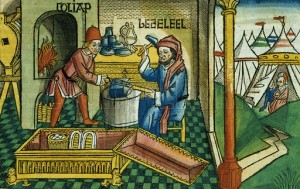
1 The Lord said to Moses, “See, I have called by name Bezalel the son of Uri, son of Hur, of the tribe of Judah, and I have filled him with the Spirit of God, with ability and intelligence, with knowledge and all craftsmanship, to devise artistic designs, to work in gold, silver, and bronze, in cutting stones for setting, and in carving wood, to work in every craft. And behold, I have appointed with him Oholiab, the son of Ahisamach, of the tribe of Dan. And I have given to all able men ability, that they may make all that I have commanded you: the tent of meeting, and the ark of the testimony, and the mercy seat that is on it, and all the furnishings of the tent, the table and its utensils, and the pure lampstand with all its utensils, and the altar of incense, and the altar of burnt offering with all its utensils, and the basin and its stand, 10 and the finely worked garments, the holy garments for Aaron the priest and the garments of his sons, for their service as priests, 11 and the anointing oil and the fragrant incense for the Holy Place. According to all that I have commanded you, they shall do.”

Christianity Today once published an anonymous poem that I thought made a pretty witty point about service.

There’s a clever young fellow named Somebody Else –

There’s nothing this fellow can’t do.

He’s busy from morning ’til late at night

Just substituting for you.

When asked to do this or asked to do that

So often you’re set to reply:

“Get Somebody Else, Mr. Chairman –

He’ll do it much better than I.”

There’s so much to do in our church;

So much, and the workers are few.

And Somebody Else gets weary and worn

Just substituting for you.

So next time you’re asked to do something worthwhile

Come up with this honest reply:

If Somebody Else can give time and support,

It’s obviously true, so can I.[1]

Whoever wrote this is correct: that “Somebody Else” is a popular fellow indeed! We all know him and we have all, if we are honest, appealed to him to do something that we do not really want to do. But in the Kingdom of God we cannot cross our fingers and hope that “Somebody Else” will somehow magically take care of what needs to be done. The people of God—all of us—are to be a servant and serving people.

Why, then, do many of us not serve? Perhaps sometimes it is for ignoble reasons: laziness, disinterestedness, etc. But I rather think that many times folks do not serve because they do not think they have anything to offer. But on this point we can simply cry, “False!” For the God who calls us to serve not only calls us to do so, He equips us to do so! More than that, he does not call only those who are viewed by people as exceptionally gifted. He calls us all, the extraordinary and the “ordinary.” But here we must recognize a very important truth: in the Kingdom of God, there is no ordinary! The ordinary is extraordinary in the hands of a great God!

Exodus 31 begins with an example of just this point.

Continue reading

Mark 12:13-17

MarkSeriesTitleSlide1Mark 12

13 And they sent to him some of the Pharisees and some of the Herodians, to trap him in his talk. 14 And they came and said to him, “Teacher, we know that you are true and do not care about anyone’s opinion. For you are not swayed by appearances, but truly teach the way of God. Is it lawful to pay taxes to Caesar, or not? Should we pay them, or should we not?” 15 But, knowing their hypocrisy, he said to them, “Why put me to the test? Bring me a denarius and let me look at it.” 16 And they brought one. And he said to them, “Whose likeness and inscription is this?” They said to him, “Caesar’s.” 17 Jesus said to them, “Render to Caesar the things that are Caesar’s, and to God the things that are God’s.” And they marveled at him.

In the US presidential elections of 2008, the United States Conference of Catholic Bishops made a comment in their election guide, entitled “Forming Consciences for Faithful Citizenship,” that was really and truly eyebrow-raising. Here is what they said:

[T]he political choices faced by citizens not only have an impact on general peace and prosperity but also may affect the individual’s salvation.[1]

When I first read that statement it struck me as manifestly absurd. And, truth be told, in the sense it which it is offered, it is absurd. Just imagine that after you die and stand before the Lord He pulls out a sheet of paper that lists how you voted in every presidential election. In the one hand is your list and in His other hand is His list! And imagine if your list does not match His list that you do not get to enter Heaven!

What a staggering thought!

Fortunately, we are not saved by the quality of our political votes. We are saved by the perfect righteousness of Jesus Christ as demonstrated in His life, His death, and His resurrection.

Even so, on a deeper sense (a sense, I hasten to add, that I do not think is intended by this statement) we might say that who we vote to be Lord of our lives does indeed affect our salvation! Who is King to you? Who is Lord to you? Who sits on the throne of your life?

In other words, there is a “political” aspect to salvation in the sense that your King determines your destiny. And, for believers in Christ, that King is Jesus Himself! If the self is King, we are doomed! If any other human being is King, we are doomed! Christ and allegiance to Christ is the way of salvation.

In Mark 12:13-17, a political trap is laid for Jesus. The question, in a nutshell, is this: must the people of God obey earthly kings? Jesus’ answer is brilliant and telling. Furthermore, it reveals fundamental truths about who is and who ought to be Lord of our lives.

Continue reading

Exodus 30:22-38

burnerExodus 30

22 The Lord said to Moses, 23 “Take the finest spices: of liquid myrrh 500 shekels, and of sweet-smelling cinnamon half as much, that is, 250, and 250 of aromatic cane, 24 and 500 of cassia, according to the shekel of the sanctuary, and a hin of olive oil. 25 And you shall make of these a sacred anointing oil blended as by the perfumer; it shall be a holy anointing oil. 26 With it you shall anoint the tent of meeting and the ark of the testimony, 27 and the table and all its utensils, and the lampstand and its utensils, and the altar of incense, 28 and the altar of burnt offering with all its utensils and the basin and its stand. 29 You shall consecrate them, that they may be most holy. Whatever touches them will become holy. 30 You shall anoint Aaron and his sons, and consecrate them, that they may serve me as priests. 31 And you shall say to the people of Israel, ‘This shall be my holy anointing oil throughout your generations. 32 It shall not be poured on the body of an ordinary person, and you shall make no other like it in composition. It is holy, and it shall be holy to you. 33 Whoever compounds any like it or whoever puts any of it on an outsider shall be cut off from his people.’” 34 The Lord said to Moses, “Take sweet spices, stacte, and onycha, and galbanum, sweet spices with pure frankincense (of each shall there be an equal part), 35 and make an incense blended as by the perfumer, seasoned with salt, pure and holy. 36 You shall beat some of it very small, and put part of it before the testimony in the tent of meeting where I shall meet with you. It shall be most holy for you. 37 And the incense that you shall make according to its composition, you shall not make for yourselves. It shall be for you holy to the Lord. 38 Whoever makes any like it to use as perfume shall be cut off from his people.”

I associate one of the most special churches in the world with the smell of skunks. That is a shocking thing to say, I know, but it is true. The first church I ever pastored was a small church in Jimtown, Oklahoma. I loved that church and love it still. I loved those people and love them still! Even so, when I picture that church mentally I immediately smell skunk.

Why? Because there were many, many Sundays when the sanctuary of that church smelled like skunk. A skunk would either get up under the sanctuary or had recently been around it. I do not know. Maybe it was a Baptist skunk. But the evidence of his presence was unmistakable.

Even so, and paradoxically, that church remains one of the sweetest “smelling” churches I have ever known, in a deeper sense. I am referring here to the faith, love, joy, and Christian witness of the people of Jimtown Baptist Church. Skunk or no skunk, the only aroma that really mattered was sweet and beautiful to be sure!

I have been in a few other churches, on the other hand, that smelled just fine…but did not smell right, if you know what I mean. I have been in churches that had beautiful facilities and if there were any skunks around them you sure could not tell. Even so, they did not “smell” right in the only sense that mattered. Something felt wrong. And, oftentimes, I would later discover that there were real problems in the church: infighting, conflict, etc.

In other words, when it comes to church there are things that smell worse than skunks.

Exodus 30 concludes with a fascinating section on the smells of worship. Specifically, the Lord gives instructions for sacred anointing oil and for sacred incense. But are described as having pleasing smells. Yet even here, the issue has less to do with the physical smell than the spiritual.

Continue reading

Mark 12:1-12

MarkSeriesTitleSlide1Mark 12

1 And he began to speak to them in parables. “A man planted a vineyard and put a fence around it and dug a pit for the winepress and built a tower, and leased it to tenants and went into another country. 2 When the season came, he sent a servant to the tenants to get from them some of the fruit of the vineyard. 3 And they took him and beat him and sent him away empty-handed. 4 Again he sent to them another servant, and they struck him on the head and treated him shamefully. 5 And he sent another, and him they killed. And so with many others: some they beat, and some they killed. 6 He had still one other, a beloved son. Finally he sent him to them, saying, ‘They will respect my son.’ 7 But those tenants said to one another, ‘This is the heir. Come, let us kill him, and the inheritance will be ours.’ 8 And they took him and killed him and threw him out of the vineyard. 9 What will the owner of the vineyard do? He will come and destroy the tenants and give the vineyard to others. 10 Have you not read this Scripture: “‘The stone that the builders rejected has become the cornerstone; 11 this was the Lord’s doing, and it is marvelous in our eyes’?” 12 And they were seeking to arrest him but feared the people, for they perceived that he had told the parable against them. So they left him and went away.

One of my favorite novels is Charles Frazier’s Cold Mountain. There is a very interesting scene in it in which a preacher, Monroe, attempts to win a man he considers to be a heathen, Esco, to faith in Christ.

So Monroe had gone visiting, Ada at his side. They’d sat together in the parlor, Esco humped forward as Monroe tried to engage him in a discussion of faith. But Esco gave up little of himself and his beliefs. Monroe found no evidence of religion other than a worship of animals and trees and rocks and weather. Esco was some old relic Celt was what Monroe concluded; what few thoughts Esco might have would more than likely be in Gaelic.

Seizing such a unique opportunity, Monroe attempted to explain the high points of true religion. When they got to the holy trinity Esco had perked up and said, Three into one. Like a turkey foot.

Then in awhile, convinced that Esco had indeed not yet got report of his culture’s central narrative, Monroe told the story of Christ from divine birth to bloody crucifixion. He included all the famous details and, while keeping it simple, he summoned all the eloquence he could. When he’d finished, he sat back waiting for a reaction.

Esco said, And you say this took place some time ago?

Monroe said, Two thousand years, if you consider that some time ago.

—Oh, I’d call that a stretch all right, Esco said. He looked at his hands where they hung from the wrists. He flexed the fingers and looked at them critically as if trying the fittings of a new implement. He thought on the story awhile and then said, And what this fellow come down for was to save us?

—Yes, Monroe said.

—From our own bad natures and the like?

—Yes.

—And they still done him like they did? Spiked him up and knifed him and all?

—Yes indeed, Monroe said.

—But you say this story’s been passed around some hundred-score years? Esco said.

—Nearly.

—So to say, a long time.

—A very long time.

Esco grinned as if he had solved a puzzle and stood up and slapped Monroe on the shoulder and said, Well, about all we can do is hope it ain’t so.[1]

Frasier goes on to say that Esco was a Baptist all along and was just pretending to be ignorant in order to have some fun with the preacher and his obvious assumption that Esco was ignorant! Even so, Esco’s final response might accurately be viewed as the hidden hope of many people living today: “Well, about all we can do is hope it ain’t so.”

The story that the Bible tells us is a story that many hope is not true for it is a story that threatens our idol of radical autonomy, of isolated self-determination, of ego, of pride, and of greed. Nonetheless, the story the Bible tells is the story of the world and is true whether we “hope it ain’t so” or not!

In our text, Jesus tells the story of the world by telling a story about a vineyard. I hasten to add that, in context, the story Jesus tells is clearly aimed at the religious elites with whom He has just clashed. It is, in the narrow sense that Jesus says it here, a story about how religious powerbrokers end up shutting God out of their lives and “ministries.” Yet, it is not inappropriate to apply this story to the world at large, for in it we find the broad strokes of the entire story of scripture. That is what we will do here. We will see in this story the story not only of the few who rejected Jesus at a particular time, but of the world’s rejection of Christ. The world at large rejected Jesus just as these religious leaders did. The story of the vineyard is therefore not only a story about priests and the temple. It is also a story about the world.

Continue reading

Exodus 30:17-21

8-3_laverExodus 30

17 The Lord said to Moses, 18 “You shall also make a basin of bronze, with its stand of bronze, for washing. You shall put it between the tent of meeting and the altar, and you shall put water in it, 19 with which Aaron and his sons shall wash their hands and their feet. 20 When they go into the tent of meeting, or when they come near the altar to minister, to burn a food offering to the Lord, they shall wash with water, so that they may not die. 21 They shall wash their hands and their feet, so that they may not die. It shall be a statute forever to them, even to him and to his offspring throughout their generations.”

Timothy George and John Woodbridge have written of the low view that many people have of ministers.

Most non-Christians are convinced that Christians are inveterate hypocrites. One cartoon in The New Yorker (January 26, 2004) cleverly exploits this widespread sentiment. The cartoon shows a prisoner in a cell turning to another who is sitting on a cot. The first prisoner has apparently just asked the second man why he is in jail. The second responds cryptically: “I’m between congregations.” With a deft touch, the cartoonist had scored Christians – in this instance, a hypocritical clergy member – for not practicing what they preach. What’s worse, the cartoonist assumed that the readers of The New Yorker, so aware of Christians’ flawed reputations, would not need a lengthy explanation to reveal the cartoon’s barb.[1]

It is indeed a damning indictment, and one that should give the church pause. Of course, we might allege that this is simply anti-Christian bias, and that would work if the history books and newspapers were not filled with enough examples of hypocritical and failed ministers to make us blush until kingdom come. No, in point of fact, ministers have usually not needed much help in discrediting themselves.

It is therefore interesting to note that the scriptures call for holy ministers from the very beginning of such a classification of people. Exodus 30:17-21 gives us one more example of how the need for holy ministers was communicated in the arrangement of the tabernacle.

Continue reading

Mark 11:27-33

MarkSeriesTitleSlide1Mark 11

27 And they came again to Jerusalem. And as he was walking in the temple, the chief priests and the scribes and the elders came to him, 28 and they said to him, “By what authority are you doing these things, or who gave you this authority to do them?” 29 Jesus said to them, “I will ask you one question; answer me, and I will tell you by what authority I do these things. 30 Was the baptism of John from heaven or from man? Answer me.” 31 And they discussed it with one another, saying, “If we say, ‘From heaven,’ he will say, ‘Why then did you not believe him?’ 32 But shall we say, ‘From man’?”—they were afraid of the people, for they all held that John really was a prophet. 33 So they answered Jesus, “We do not know.” And Jesus said to them, “Neither will I tell you by what authority I do these things.”

Upton Sinclair once wrote one of the most profound and insightful quotes I think I have ever heard. Here it is: “It is difficult to get a man to understand something when his salary depends upon his not understanding it.”[1] That is so very very true, is it not?

The term “inconvenient truths” has become popular in our day, but what of “vocation-destroying truths,” “ego-demolishing truths,” “assumption-destroying truths”? Well, in these cases, it is not enough for the threatened to ignore the truth, they must silence these threatening truths altogether as well as those who dare to say them.

As we approach the cross in our journey through the gospel of Mark, keep that in mind. Here, in Mark 11:27-33, we see the first real movements in the final stages of the escalating conflict that will culminate in the cross itself. Jesus is questioned by the bodies that make up the Sanhedrin, the high court of Jewish religious power. This questioning does not happen formally, but what happens is a definite harbinger of things to come.

As we watch this scene unfold, note the radical differences between Christ and the religious establishment, these men who do not want to hear truths that threaten all they have built.

Continue reading

**UPDATED** Sermon Outline for the Arkansas Baptist State Convention 2017 Dixie Jackson Offering Emphasis

UPDATE:  The state convention website has now linked to the much fuller outline here.

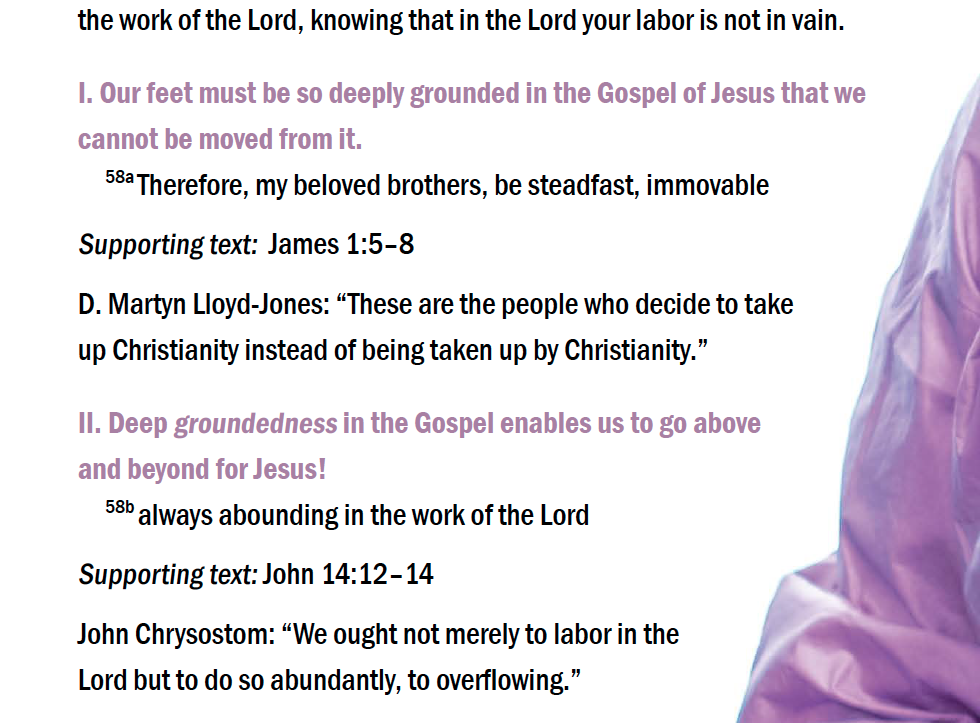
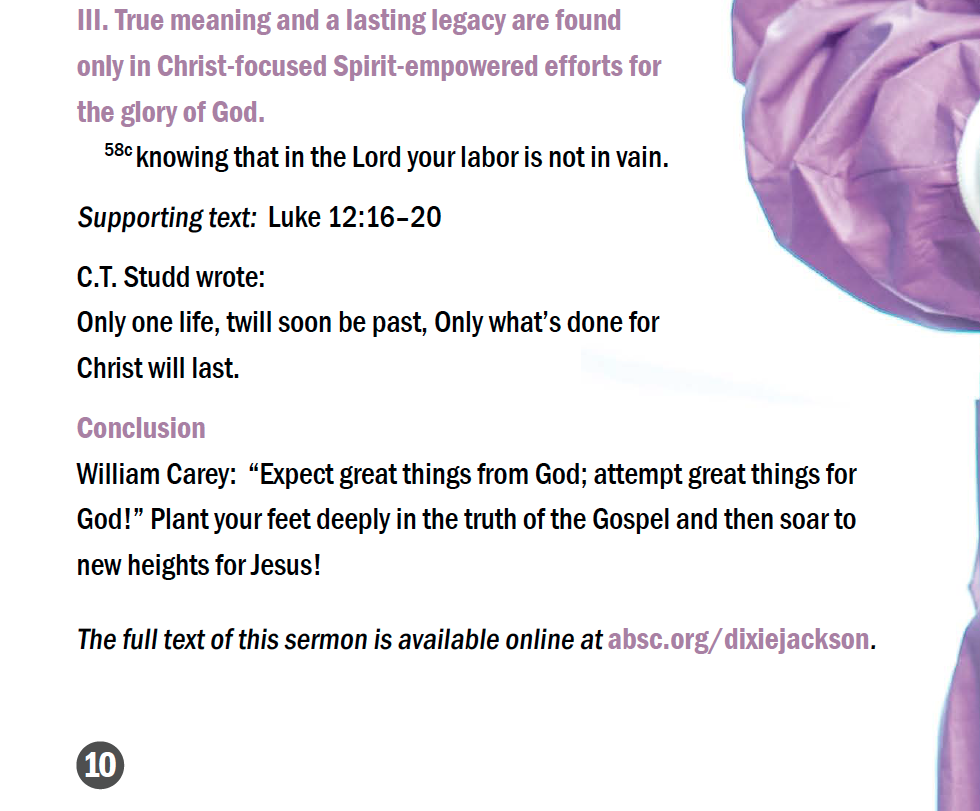
I was grateful to be asked to write a sermon outline for the Arkansas Baptist State Convention 2017 Dixie Jackson Offering emphasis.  Dixie Jackson is the yearly offering that helps to fund Arkansas ministry and missions efforts.  An abbreviated outline appears in the ABSC planning guide in their “Additional Resources” packet and the fuller version that I initially submitted will apparently be linked at the ABSC website.  Here are screenshots of the abbreviated outline:

1

2

3