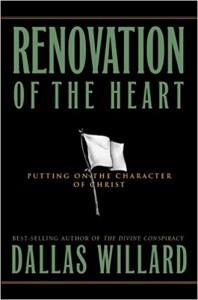
Dallas Willard’s Renovation of the Heart

41AuoLnO+XL._SX327_BO1,204,203,200_Dallas Willard’s Renovation of the Heart has been a very important book in my life for some years now.  While my first reading of it did not wallop me in quite the immediate and spectacular way that Willard’s Spirit of the Disciplines did when I read it over twenty years ago, it did occur to me, after first reading Renovation of the Heart, that here was a book with which I needed to grapple and which would be a very important tool in my life and ministry.  Indeed, since that time, I have taught the book to a small group at Central Baptist Church in North Little Rock (using the LifeSprings Church Resources video curriculum of the material), have used it in one-on-one personal counseling with a church member (who now is a big Willard fan because of how this book helped him), and used it as my text for teaching the theory, philosophy, and theology of spiritual formation to the Fall 2017 OBU@NLC freshman class.

In truth, I think that I have never encountered a book that offers such a well-reasoned, biblically-grounded, theologically-sound, and practical approach to the issue of how the soul is formed and what it looks like to follow Jesus.  Willard argues that we live from the inside-out and the spiritual formation does not happen through mere behavior modification (what he calls elsewhere “the gospel of sin management”), though all of us have been and constantly are being formed.  The heart must be changed, must be renovated, for Christian spiritual formation to unfold as it should.

As Willard unpacks what this means and what it looks like, the reader will be challenged to think much more deeply about discipleship and about the Christian life.  Willard does a phenomenal job of discussing the constituent parts of the self and how these varying aspects of the self work.  The reader will encounter helpful and thoughtful explorations of terms that he or she may think he or she knows well, but about which he or she has possibly never given serious and informed thought:  spirit, heart, will, choice, thought, feeling, soul, body, denial, ideas, information, images, pride, disciplines, character, duplicity, surrender, participation, contentment, abandonment, etc.  Willard is a masterful guide through these important terms and concepts.

Willard believes that the reason we are not seeing real and genuine change in the lives of Christians is because we have not thought well about these matters and, as a result, are not taking the steps that are necessary to lead to real change.  We are not, we might say, putting ourselves in a position where actual change is possible.

I suspect the key concept might be Willard’s concept of VIM:  Vision, Intention, Means.  I say I suspect this might be the key concept because there are truly so many revolutionary ideas here that it is hard to settle on one.  Even so, the idea of VIM, when embraced and prayerfully reflected upon, is a very helpful and, in one sense, “simple” way forward.  At the very least, VIM establishes a baseline for genuine change.  We will not change without a vision of what we would like to be, without an actual intention to do so at all costs, and without the employment of Christ-honoring means toward that end.

Willard’s idea of the stages of discipleship is very insightful:

  • surrender
  • abandonment
  • contentment
  • participation

His unpacking of this progression needs to be read, contemplated, and grasped.  It was, I thought, one of the more powerful sections of the book, and as I have shared this particular idea with others they have attested to its great usefulness as a way of thinking about where we are in our walks with Jesus.

Willard’s theology of the body is extremely helpful.  His concept of “assault/withdrawal” is a very effective way to understand the nature of human conflict and the ways that relationships disintegrate.

I could go on and on, but I hope that the above will give you a sense of what you’ll encounter in Renovation of the Heart.  The material is challenging.  This is a book that needs to be read slowly, carefully, and repeatedly.  I find something new each time I teach it.

I cannot recommend this book highly enough.  It is very near the top of my personal list of books that have had life-changing impact on me.  Yet it is also a continuing challenge for me, as I have certainly not lived out all of its concepts as I should.  I will return to Renovation of the Heart again.  In truth, it’s arguments and truths are never far from me.


Philip K. Dick’s Ubik

t100_novels_ubik1stLast Christmas my brother Condy and I purchased box sets of the writings of science fiction writer Philip K. Dick.  A friend tells me that this is the only science fiction writer to have his works published in the Library of America series, though I haven’t confirmed that.  Anyway, I have only just finished his novel, Ubik and I thought I would share just a few thoughts.  I don’t think I’ve ever used the word “trippy” in my life, but here goes:  this was one trippy read!  It was gloriously weird but also very interesting and well done.  It’s hard to describe, really, but I’ll give a few summary statements to (hopefully) give a sense of what Ubik is like.

In the future, there are companies that employ anti-psi’s who are hired to thwart the nefarious actions of those with psychic powers.  One such company, Runciter Associates, has its team of inertials (anti-psi’s) partially killed…or killed…or not killed…or seemingly killed…by Hollis who lures them into a deadly trap.  The uncertainty concerning death has to do with the fact that, in the future, if a person is put on cold-pac quickly enough they can be kept in a state of half-life for a time where they can still communicate with their loved ones or associates.

All of this is told engagingly and with fascinating precision.  Dick’s imagination really is a thing to behold!

As the story unfolds, it focuses in on the character of Joe Chip, a member of the Runciter Associates team who was one of the many targets of Hollis’ attack.  As Chip begins to observe very strange things happening around him, he has to come to terms with what has…or possibly has…or has not happened to him and what it means!  Throughout it all, the mysterious product “Ubik” keeps making appearance in the chapter headings in advertisement lingo heralding its marvels but also hinting at its dangers.

I’m not sure what to say next…this is really just an experience that needs to be had by the reader.  It does raise certain tantalizing philosophical, religious, and existential questions.  Theologically, we even see Molinism peek its head up above the surface. The vision it unfolds of the future is intriguing and also terrifying.  If you like good science fiction, and if you don’t mind just holding on for the ride without always knowing what’s happening, you’ll really like Ubik.  We did!

Barbara Kingsolver’s The Poisonwood Bible

51oyMKx1gmL._SX330_BO1,204,203,200_I have been wanting for some time to share some thoughts about Barbara Kingsolver’s amazing novel, The Poisonwood Bible.  I realize that I am very much late to the party in doing so as it was published over a decade ago and has been widely hailed as a modern classic for years.  But though I’m late to the party I did still want to show up for The Poisonwood Bible is one of the most remarkable novels I’ve ever read.  This is not to say that I did not find some aspects problematic.  Rather, I am saying that even in light of these areas I found this to be one of the most well-told, provocative, insightful, powerful, unsettling, and well-written books I’ve ever encountered.

The Poisonwood Bible is about a Baptist missionary family who is taken to Africa by their dominant and domineering preacher husband/father Nathan Price.  The story is told from the perspective of the Price women:  Nathan’s wife Orleanna and their daughters Rachel, Leah, Adah, and Ruth May.  We never hear Nathan in his own voice but we do hear Nathan a great deal and, likely, a great deal too much.

How to describe this story?  It is a story of one man’s descent into madness and the demons that drove him, of one woman’s story of survival in the face of her husband and the cultural and geopolitical quagmire that they encounter in Africa and, indeed, the world at large, and of four daughters’ experience of being children (of varying ages) in the midst of these powerful familial, religious, and cultural cross-currents.

Kingsolver’s decision to tell the story through the voices of the Price women turns out to be very effective.  The development of each of their unique characters was nothing short of enthralling.  By the end of the novel you feel that you know the quirks, the personalities, and the hysterical, irritating, and, at times, infuriating (i.e. Rachel) idiosyncrasies of each.  I was especially struck by the character Orleanna, who emerges as a bruised, wounded, but ultimately victorious picture of courage and sheer grit.

I am a Baptist pastor who believes in missions, so the book simultaneously challenged and  irritated me.  It irritated me to think that the character of Nathan will feed into and bolster the worst possible stereotypes that some have of missionaries and perhaps especially of Baptist missionaries.  I want very much to say that I have never met Nathan Price, though I offer two caveats:  (1) I have met people with certain of his traits and (2) I do not deny that creatures like him exist.  The history of missions is too clear to deny his appearance on the stage here and there.  But, in my experience as a Southern Baptist pastor pastoring conservative churches in the South, not only have I never met Nathan Price, but I consider him to be monstrous, I consider much of his theology to be blasphemous and absurd, and I could not personally be in the presence of such a person long without giving voice to this.  The people I know and go on the mission field with would say the very same.

Even so, there is Nathan Price in all of his offensive arrogance:  the complete lack of consideration of the culture in which he was, the thinly-veiled disdain for the people he was, in theory, trying to reach, the maddening belief (seemingly) in mechanical baptismal regeneration, the sanctimony, the stupidity, etc. etc.  I would say this to any who might come across this review after having read the book:  yes, in the two-thousand year history of the Church despicable characters like Nathan Price have emerged far too many times, but please know that most of us are not only not like him but we recoil in horror at the sight of him.  Furthermore, many missionaries over the years have done amazing work and been a great blessing to the lives of those to whom they have ministered.  (And I gather, thankfully, from some of Kingsolver’s interviews, that she would not dispute this.  She was herself the daughter of missionary parents and has made clear that this is not a story about them.)

Even so, I am glad that Kingsolver created Nathan Price.  He needs to be seen.  He is as much a walking cautionary tale as a walking contradiction.  He is religion at its worst.  He is, to put it mildly, anti-Christ, all the while claiming to be serving Christ.  And, on a personal level, the depiction of such a character challenged me to make sure that I never fall into the kind of obscene pitfalls into which he fell.  It also challenged me to try to view the missionary task through the eyes of those to whom we go and to ask, “What might I be doing that communicates disinterest in or disdain towards the actual lives of the people to whom I seek to minister?”  That is not an unimportant question.

There is so much more than could be said about this amazing book.  Its political message is worth hearing and its cultural insights are really fascinating.  But, for me, the characters make the book.  It is a story of a family.  It is a gripping tale.  It gets under your skin and stays with you.

This is a very very good book.  I would say it is also an important book.  In truth, I think it should be read in seminary missiology classes.  Regardless, you really should read The Poisonwood Bible.

Mark 13:28-37

MarkSeriesTitleSlide1Mark 13

28 “From the fig tree learn its lesson: as soon as its branch becomes tender and puts out its leaves, you know that summer is near. 29 So also, when you see these things taking place, you know that he is near, at the very gates. 30 Truly, I say to you, this generation will not pass away until all these things take place. 31 Heaven and earth will pass away, but my words will not pass away. 32 “But concerning that day or that hour, no one knows, not even the angels in heaven, nor the Son, but only the Father. 33 Be on guard, keep awake. For you do not know when the time will come. 34 It is like a man going on a journey, when he leaves home and puts his servants in charge, each with his work, and commands the doorkeeper to stay awake. 35 Therefore stay awake—for you do not know when the master of the house will come, in the evening, or at midnight, or when the rooster crows, or in the morning— 36 lest he come suddenly and find you asleep. 37 And what I say to you I say to all: Stay awake.”

What do the following dates have in common?

66-70 / 365 / 375-400 / 500 / April 6, 793 / 800 / 799-806 / 848 / 992-995 / January 1, 1000 / 1033 / 1200-1260 / 1284 / 1290-1335 / 1346-1351 / 1370 / 1378 / 1504 / February 1, 1524 / February 20, 1524 / 1524-1528 / May 27, 1528 / October 19, 1533 / April 5, 1534 / 1555 / 1585 / 1600 / February 1, 1624 / 1648 / 1651 / 1654 / 1656 / 1655-1657 / 1658 / 1660 / 1666 / 1673 / 1688 / 1689 / 1694 / 1697 / 1700 / 1705-1708 / 1716 / April 5, 1719 / 1700-1734 / October 16, 1736 / 1736 / 1757 / May 19, 1780 / November 19, 1795 / October 19, 1814 / April 28, 1843 / December 31, 1843 / March 21, 1844 / October 22, 1844 / August 7, 1847 / February 13, 1925 / September 1935 / December 21, 1954 / April 22, 1959 / February 4, 1962 / August 20, 1967 / 1967 / August 9, 1969 / 1969 / 1972 / January 1974 / 1975 / 1976 / 1977 / 1980 / 1981 / 1982 / April-June 1982 / March 10, 1982 / June 21, 1982 / 1985 / April 29, 1986 / August 17, 1987 / September 11-13, 1988 / October 3, 1988 / September 30, 1989 / April 23, 1990 / September 9, 1991 / 1991 / September 28, 1992 / October 28, 1992 / 1993 / May 2, 1994 / September 1994 June 29, 1994 / October 2, 1994 / March 31, 1995 / December 17, 1996 / March 26, 1997 / August 10, 1997 / October 23, 1997 / March 31, 1998 / July 1999 / August 18, 1999 / September 11, 1999 / 1999 / January 1, 2000 / April 6, 2000 / April 6, 2000 / May 5, 2000 / 2000 / 2001 / May 27, 2003 / October 30-November 29, 2003 / September 12, 2006 / April 29, 2007 / 2010 / May 21, 2011 / September 29, 2011 / October 21, 2011 / May 27, 2012 / June 30, 2012 / December 21, 2012 / August 23, 2013 / April 2014 / September 2015 / September 23, 2017 / October 21, 2017

If you guessed, “Those are years in which people predicted the world would end!” you are correct! In truth, this list is incomplete and other dates could be added. Furthermore, the list does not include future dates that have also been predicted. These are just the dates that have been predicted and have already passed.

When you look at that list it is hard not to think, “Why do we keep doing this? Why do we keep trying to predict when the world will end?” But we do indeed do it! Human beings just cannot help themselves.

For Christians, this is utterly inexcusable for Jesus specifically said that we cannot know the exact time of His return. We cannot know the exact time, but we can read the times and live in preparedness. It is very important that we get this right or else we can really get sidetracked, disillusioned, and do injury to our faith. Let us consider what Jesus says about the coming of the end.

Continue reading

Exodus 32:1-10

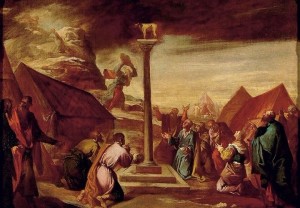
Sin-of-the-Golden-CalfExodus 32

1 When the people saw that Moses delayed to come down from the mountain, the people gathered themselves together to Aaron and said to him, “Up, make us gods who shall go before us. As for this Moses, the man who brought us up out of the land of Egypt, we do not know what has become of him.” 2 So Aaron said to them, “Take off the rings of gold that are in the ears of your wives, your sons, and your daughters, and bring them to me.” 3 So all the people took off the rings of gold that were in their ears and brought them to Aaron. 4 And he received the gold from their hand and fashioned it with a graving tool and made a golden calf. And they said, “These are your gods, O Israel, who brought you up out of the land of Egypt!” 5 When Aaron saw this, he built an altar before it. And Aaron made a proclamation and said, “Tomorrow shall be a feast to the Lord.” 6 And they rose up early the next day and offered burnt offerings and brought peace offerings. And the people sat down to eat and drink and rose up to play. 7 And the Lord said to Moses, “Go down, for your people, whom you brought up out of the land of Egypt, have corrupted themselves. 8 They have turned aside quickly out of the way that I commanded them. They have made for themselves a golden calf and have worshiped it and sacrificed to it and said, ‘These are your gods, O Israel, who brought you up out of the land of Egypt!’” 9 And the Lord said to Moses, “I have seen this people, and behold, it is a stiff-necked people. 10 Now therefore let me alone, that my wrath may burn hot against them and I may consume them, in order that I may make a great nation of you.”

Tony Merida has offered some noteworthy comments about the pervasiveness of idolatry in modern life and about the human propensity for idolatry in general.

A few of our pastors and interns took a trip to Boston recently to explore the idea of sending a church planting team to New England. The need for churches in the Northeast is great. One Christian leader there calls the area north of Boston “the desert.” Some estimate that it is currently 1-percent evangelical at best.

As our friends described their culture to us, they pointed out that people actually worship in the Northeast. Some people worship the Red Sox. Others, in the world of academia and research, are slaves to ambition. In Salem, Massachusetts, they statistically have more witches than Christians. The Northeast is really no different from anywhere else in the world. Left to ourselves, we will worship something other than the living God. To paraphrase Calvin, “The human heart is an idol factory.”

Because of this universal problem, we need to understand this subject. Os Guinness and John Seel comment on the how important this topic is: “Idolatry is the most discussed problem in the Bible…There can be no believing communities without an unswerving eye to the detection and destruction of idols”…[1]

He is right, of course. Human beings have always been drawn to idols, be they the Red Sox or the moon above. In fact, so prevalent is this tendency that we are right to return again to a consideration of why idolatry is so dangerous. And we are also right to ask whether or not Guinness and Seel, quoted by Merida above, are correct when they say that “believing communities” must have “an unswerving eye to the detection and destruction of idols.” Exodus 32:1-10 would answer, “Yes! They must!”

Continue reading

Mark 13:14-27

MarkSeriesTitleSlide1Mark 13

14 “But when you see the abomination of desolation standing where he ought not to be (let the reader understand), then let those who are in Judea flee to the mountains. 15 Let the one who is on the housetop not go down, nor enter his house, to take anything out, 16 and let the one who is in the field not turn back to take his cloak. 17 And alas for women who are pregnant and for those who are nursing infants in those days! 18 Pray that it may not happen in winter. 19 For in those days there will be such tribulation as has not been from the beginning of the creation that God created until now, and never will be. 20 And if the Lord had not cut short the days, no human being would be saved. But for the sake of the elect, whom he chose, he shortened the days. 21 And then if anyone says to you, ‘Look, here is the Christ!’ or ‘Look, there he is!’ do not believe it. 22 For false christs and false prophets will arise and perform signs and wonders, to lead astray, if possible, the elect. 23 But be on guard; I have told you all things beforehand. 24 “But in those days, after that tribulation, the sun will be darkened, and the moon will not give its light, 25 and the stars will be falling from heaven, and the powers in the heavens will be shaken. 26 And then they will see the Son of Man coming in clouds with great power and glory. 27 And then he will send out the angels and gather his elect from the four winds, from the ends of the earth to the ends of heaven.

As we approach the Table of the Lord this morning I am struck that our text is one of dark foreboding yet also exuberant joy. I am struck by this because, seen from a certain perspective, the symbols here on this table combine the very same elements: the dark foreboding of the violent death of Jesus on the cross at the hands of wicked men yet the exuberant joy that it was in this way that Christ won for us our salvation! Put another way, we are hereby reminded of the darkness of our sins and of the fallen world but only in order that we might proclaim the light of the coming of Jesus into the world and is death and resurrection.

Mark 13:14-27 is a text of darkness and light, of warning and hope, of bitter judgment and beautiful salvation. We have seen that the church stands in the time between the times: that time that is different from ordinary time because Christ has come and the Kingdom of God has broken into the world and is breaking into the world even now. This time between the times is the time between was has been and what will be. We live in the beginning of the end, a beginning end that might last another day or another two thousand years. We do not know. But something has changed now. The church has seen the glory come and coming. We await the coming of Christ who has come and will come again.

In our text, Jesus warns of greater darkness then heralds the victory of the light.

Continue reading

Mark 13:1-13

MarkSeriesTitleSlide1Mark 13

1 And as he came out of the temple, one of his disciples said to him, “Look, Teacher, what wonderful stones and what wonderful buildings!” And Jesus said to him, “Do you see these great buildings? There will not be left here one stone upon another that will not be thrown down.” And as he sat on the Mount of Olives opposite the temple, Peter and James and John and Andrew asked him privately, “Tell us, when will these things be, and what will be the sign when all these things are about to be accomplished?” And Jesus began to say to them, “See that no one leads you astray. Many will come in my name, saying, ‘I am he!’ and they will lead many astray. And when you hear of wars and rumors of wars, do not be alarmed. This must take place, but the end is not yet. For nation will rise against nation, and kingdom against kingdom. There will be earthquakes in various places; there will be famines. These are but the beginning of the birth pains. “But be on your guard. For they will deliver you over to councils, and you will be beaten in synagogues, and you will stand before governors and kings for my sake, to bear witness before them. 10 And the gospel must first be proclaimed to all nations. 11 And when they bring you to trial and deliver you over, do not be anxious beforehand what you are to say, but say whatever is given you in that hour, for it is not you who speak, but the Holy Spirit. 12 And brother will deliver brother over to death, and the father his child, and children will rise against parents and have them put to death. 13 And you will be hated by all for my name’s sake. But the one who endures to the end will be saved.

What would you do if you knew the world was about to end? Interestingly, there are numerous places online where some variation of this question has been asked. The comments are telling. Here’s a sampling:

I’d tell everyone who I know exactly how I feel about them. My crush, my brother, friends, everyone who I can contact within 24 hours

Play with my dog for as long as she wants to. Then pet her and hold her close.

I’m a man of simple tastes. I’d steal either a Nissan GT-R or a Porsche 911 Turbo.

I would drive away far away from the havoc that would definitely ensue with friends. I would chill with friends, kayak across that beautiful river I dreamed about kayaking on, hike on that mountain that looks like it has a beautiful view from the top, throw a party, spend the rest of my money on food, drinks and fun, get a bonfire going and chill with all the amazing people in my life and when the sun sets for the last time I’ll be watching it over the mountains with people I truly care about by my side.

Raid, pillage, and plunder to my hearts content. After all, only fools are certain.

get some beer, get some speakers, And sit on my roof drinking the lot whilst blasting out the AC-DC

I guess I’d do my laundry.

Make plans for the following day. Just in case.

And my favorite:

I would place my son in the specially-designed space capsule I have built ahead of time for just this occasion, even though the government and my peers thought me mad. My wife would wrap him in a red blanket with our family symbol on it. We would launch him toward a hospitable planet just as our planet exploded.

Ha! Somebody has seen Superman one too many times!

It is an interesting question, though, and one that is not without merit. What would you do if you knew the world was about to end?

Mark 13 is a chapter that has fascinated and perplexed interpreters over the years. It is a chapter in which Jesus talks about the end and instructs His disciples on how they, and we, should act in light of its approach.

Continue reading

Mark 12:38-44

MarkSeriesTitleSlide1Mark 12

38 And in his teaching he said, “Beware of the scribes, who like to walk around in long robes and like greetings in the marketplaces 39 and have the best seats in the synagogues and the places of honor at feasts, 40 who devour widows’ houses and for a pretense make long prayers. They will receive the greater condemnation.” 41 And he sat down opposite the treasury and watched the people putting money into the offering box. Many rich people put in large sums. 42 And a poor widow came and put in two small copper coins, which make a penny. 43 And he called his disciples to him and said to them, “Truly, I say to you, this poor widow has put in more than all those who are contributing to the offering box. 44 For they all contributed out of their abundance, but she out of her poverty has put in everything she had, all she had to live on.”

Adolf Hitler once complained that Germany was an ostensibly Christian nation as opposed to a nation holding to a different religion. Here is what he said:

It’s been our misfortune to have the wrong religion. Why didn’t we have the religion of the Japanese, who regard sacrifice for the Fatherland as the highest good? The Mohammedan religion too would have been much more compatible to us than Christianity. Why did it have to be Christianity with its meekness and flabbiness?[1]

That is telling. Hitler preferred Japan’s exaltation of sacrificing for your country. He even preferred Islam. There was obviously something about it that he appreciated. But Christianity he deplored. Why? Because of its “meekness and flabbiness.” Christianity, you see, exalts the lowly and the weak. Christianity makes much of the unfortunate and those who lack power and strength. But what Hitler wanted was the uberman, the strong man, the man who knew what power was, and the Ubermensch, the master race.

Of course, Hitler was in so many ways simply repeating the mantras of Friedrich Nietzsche who wrote, “Christianity has taken the part of all the weak, the low, the botched; it has made an ideal out of antagonism to all the self preservative instincts of sound life”

Men who like the currency of power, men who like the language of strength, men who act in the theater of the pompous, these men despise Christianity and the teachings of Jesus. In particular, they despise passages like Mark 12:38-44.

Continue reading

Mark 12:35-37

MarkSeriesTitleSlide1Mark 12

35 And as Jesus taught in the temple, he said, “How can the scribes say that the Christ is the son of David? 36 David himself, in the Holy Spirit, declared, “‘The Lord said to my Lord, “Sit at my right hand, until I put your enemies under your feet.”’ 37 David himself calls him Lord. So how is he his son?” And the great throng heard him gladly.

In December of 2004, Italian police took the image off of the famous “Shroud of Turin” (a burial clothe that some believe contains an image of the face of Jesus) and fed it into their computers in an effort to reconstruct what the face of a twelve-year-old Jesus would have looked like. Here is The New York Times’ explanation.

ROME, Dec. 25 – Using the same technology that adds wrinkles to the drawings of Mafia bosses to identify them after decades on the lam, the Italian police have shaved years, and a beard, off an image taken from the Shroud of Turin to create what newspapers here this week hailed as the very visage of a young Jesus.

“Here it is, the real face of the baby Jesus,” declared the front page of the newspaper Il Giornale. Italy’s largest newspaper, Corriere della Sera, ran a more cautious headline, “Here Is Jesus at Age 12 (According to a Computer).”…

The angelic face is reminiscent of the prayer cards sold in Vatican souvenir shops and of the New Age portraits displayed at Venice Beach. The image shows a 12-year-old boy with fair, smooth skin, glassy blue eyes, fleshy lips and waves of dirty blond hair streaked with just enough purple and pink to suggest a sprinkling of cosmic dust.

The scientific unit of Rome’s police force created the image at the behest of reporters of another investigative report about Jesus to be televised the night after Christmas. For that program, the police took photographs from the Shroud of Turin and subtracted about 20 years of aging.

“It came to us an illumination, maybe it was inspiration, What was his face like?” said Elena Guarnieri, the host of the news special. “If that is the face on the shroud, then this is the face of Jesus as a child.”

The Vatican refused to comment about the face of the 12-year-old Jesus, but Professor Damon expressed bewilderment. “The boy would not be blond,” he said…[1]

No, the boy likely would not have been blond. How interesting. After all of their supposedly objective and scientific work they produced a Jesus that looked just like an Italian twelve year old boy!

It is a desire that is 2,000 years old, this desire to know what Jesus actually looks like. But even before He came in flesh it was a desire of the Jews to know what the Messiah was going to look like. And, like the Italian police, or like us, many Jews, knowing that the Messiah would be a Jew, overemphasized the expected “us-ness” of the coming Messiah, that is, overemphasized the Jewishness of the coming Messiah to the extent that they had narrowed their understanding of what the Messiah would be to the size of their own borders of their own national identity. That is, the Jews, like the modern Italian police, fashioned the Messiah too much in their own image and, as a result, had developed certain misunderstandings about his person and work. For this reason, Jesus decided to address this issue in Mark 12:35-37 in order to stress the very important point that the He, Jesus, the Messiah, was greater than they realized and would accomplish more than they expected.

Jesus’ identity is greater than the religious authorities think it is.

Jesus first makes a point about His own identity. He does so this time not in response to a hostile question. Rather, He raises the issue Himself. It is as if He is saying, “I have answered your questions. Now you guys answer me!”

35 And as Jesus taught in the temple, he said, “How can the scribes say that the Christ is the son of David?

It is an interesting question. While the exact title “son of David” was not a popular Messianic title among the Jews of the Old Testament, the idea that He was a son of David was pervasive. It was understood that the coming Messiah would be in the lineage of the great King David. By the first century, the title had gained at least some traction as can be seen in examples of people using the title in the gospel accounts. Even so, by raising the question Jesus was clearly suggesting that the Jews had developed certain misunderstandings surrounding the title. He next moves to the heart of the issue:

36 David himself, in the Holy Spirit, declared, “‘The Lord said to my Lord, “Sit at my right hand, until I put your enemies under your feet.”’

What Jesus is doing here is quoting Psalm 110, which reads:

1 The Lord says to my Lord: “Sit at my right hand, until I make your enemies your footstool.” The Lord sends forth from Zion your mighty scepter. Rule in the midst of your enemies!

There are three characters presented in the first six words of Psalm 110:1. Here is how it should be read: “The Lord [God] says to my [David’s] Lord [the coming Messiah]…” In other words, God calls the coming Messiah “Lord”! This, of course, raises all kinds of interesting questions.

“[N]o father calls his own son ‘lord,’” writes Joel Marcus, “This would be especially true in the hierarchical Greco-Roman world, where ‘lord’ and “son’ were near opposites, the father being, so to speak, the lord of the son…”[2] That is true in our day as well. No parent (except certain very misguided parents who seem to worship their children!) would think of their child much less refer to their child as “Lord.” Yet God calls the Messiah “Lord.” Jesus asks the obvious question:

37 David himself calls him Lord. So how is he his son?” And the great throng heard him gladly.

We need to understand this rightly. Jesus has not rejected the title “son of David.” Rather, He is saying that they have become so comfortable with the title that they have reduced the true character of the Messiah from what He actually is to something that they want Him to be. The title “son of David” is not wrong, then, it is simply insufficient.

One of the things that was happening is that there had been a reductionism in many of the Jews’ understanding of the coming Messiah that was based on a faulty understanding of this title. First, they called Jesus “son of David.” Next, they interpreted it politically to mean that the coming Messiah would restore just government and establish a righteous rule over the Jews and also over the world. Finally, they also imported their prejudices to mean that this just rule would lead to the casting out of the Gentile Romans as well as a rejection of all Gentiles.

I do not say that all Jews did all of this, but this was the mindset of many in that time. In other words, the title “son of David” had come to mean that the coming Messiah would sit on a throne, protect Israel, and cast out the Gentiles. In other words, by “son of David” many had come to mean something like an “uber David.” To some it had come to mean something like an “uber politician and military leader.”

Thus, they had whittled the coming Messiah down into their own image! Jesus is therefore responding against this kind of fallacious view by pointing out that, according to Psalm 110, the coming Messiah was more than just a man, more than just a politician, more than just a military figure. Thus, God refers to Him as “Lord.” What an astonishing idea!

Jesus’ identity was greater than the religious authorities thought it was.

The coming Messiah was to have a righteous rule, it is true, but not in the way that many had come to think. He was greater than they imagined! No mere human gets called “Lord”!

“They did not understand that he was God,” wrote St. Augustine, “and on that ground also the Lord even of David.”[3] That is well said.

A few years ago I read a fascinating book entitled This is Not the End of the Book. The book was simply a conversation between two intellectuals, the late Italian writer Umberto Eco and the French novelist Jean-Claude Carrier. At a certain point in the book they discussed the problem of widespread ignorance concerning things that people should know. Here is the brief exchange:

Umberto Eco: A London study found that a quarter of the people surveyed thought that Winston Churchill and Charles Dickens were imaginary characters, whereas Robin Hood and Sherlock Holmes had really existed.

Jean-Claude Carriere: Ignorance is all around us, and often arrogant and proud. Evangelical, even.[4]

This is all pretty depressing. If people think Winston Churchill and Charles Dickens were imaginary but Robin Hood and Sherlock Holmes were real then we are in a bad way indeed! Yet lots of people fail to grasp reality when it comes to people. Lots of people fail to grasp the truth about people they claim to know a great deal about. The Jews did this with Jesus, but, in truth, so do a lot of us.

Let me ask you a question: have you whittled Jesus down into your own image? Have you forgotten that He is the great and mighty God who has come to us? Do you realize that when you look on the face of Christ you are looking on the face of God? Has your Jesus become too small? Are you seeking to force him into the cramped space of your own assumptions and prejudices?

Jesus cannot and will not be lessened! He is Lord! Honor Him as Lord!

Jesus’ work accomplishes more than the religious authorities think it will.

With a reduced understanding of His person came a reduced understanding of His work. Hear, again, Jesus’ words:

35 And as Jesus taught in the temple, he said, “How can the scribes say that the Christ is the son of David? 36 David himself, in the Holy Spirit, declared, “‘The Lord said to my Lord, “Sit at my right hand, until I put your enemies under your feet.”’ 37 David himself calls him Lord. So how is he his son?” And the great throng heard him gladly.

If we are not careful, we will miss something beautiful that is happening here. As we said, Jesus is quoting Psalm 110 when He says, “The Lord said to my Lord, ‘Sit at my right hand, until I put your enemies under your feet.’” But if you read that carefully you will notice that it is not an exact quotation. For Psalm 110 says:

1 The Lord says to my Lord: “Sit at my right hand, until I make your enemies your footstool.” The Lord sends forth from Zion your mighty scepter. Rule in the midst of your enemies!

Did you catch it? Compare:

Mark 12:36 – “until I put your enemies under your feet”

Psalm 110:1 – “until I make your enemies your footstool”

Well that is interesting. Some might say it is inconsequential since “under your feet” and “your footstool” are the same basic idea. It is indeed the same basic idea but it is not the same word. This gets even more interesting when we realize that the phrase Jesus uses is used in Psalm 8:

6 You have given him dominion over the works of your hands; you have put all

things under his feet

So compare once again:

Mark 12:36 – “until I put your enemies under your feet”

Psalm 110:1 – “until I make your enemies your footstool”

Psalm 8:6 – “you have put all things under his feet”

So Jesus pulls a phrase from Psalm 8 and brings it into His quotation of Psalm 110! This gets even more interesting when we realize that Psalm 110 is a Messianic psalm (i.e., it is about the coming Messiah) and Psalm 8 is an Adamic psalm (i.e., it is about the creation of human beings).

Put all of this together and you suddenly realize that Jesus combined the idea of Messiah with the idea of Adam. In doing so, Jesus was saying that His work will go beyond the merely ethnic and national. Rather, what He, Jesus, the Messiah, is going to accomplish affects the entirety of the human race! He is, in other words, Adam come again, the second Adam!

Paul will pick up this image and communicate it powerfully and beautifully in 1 Corinthians 15.

20 But in fact Christ has been raised from the dead, the firstfruits of those who have fallen asleep. 21 For as by a man came death, by a man has come also the resurrection of the dead. 22 For as in Adam all die, so also in Christ shall all be made alive. 23 But each in his own order: Christ the firstfruits, then at his coming those who belong to Christ. 24 Then comes the end, when he delivers the kingdom to God the Father after destroying every rule and every authority and power. 25 For he must reign until he has put all his enemies under his feet. 26 The last enemy to be destroyed is death. 27 For “God has put all things in subjection under his feet.” But when it says, “all things are put in subjection,” it is plain that he is excepted who put all things in subjection under him. 28 When all things are subjected to him, then the Son himself will also be subjected to him who put all things in subjection under him, that God may be all in all.

In Ephesians 1, Paul appears to likewise combine the “sit at my right hand” of Psalm 110 with the “under his feet” of Psalm 8.

20 that he worked in Christ when he raised him from the dead and seated him at his right hand in the heavenly places, 21 far above all rule and authority and power and dominion, and above every name that is named, not only in this age but also in the one to come. 22 And he put all things under his feet and gave him as head over all things to the church, 23 which is his body, the fullness of him who fills all in all.

Thus, the concept of “Messiah” and the concept of “Adam” are joined powerfully in Jesus!

Peter does the same in 1 Peter 3:

23d …Jesus Christ, 22 who has gone into heaven and is at the right hand of God, with angels, authorities, and powers having been subjected to him.

How beautiful! In Adam, all die, but through Christ, the second Adam, all can have life! He is not merely going to be a national hero of ethnic Israel. He is going to be the Savior of all mankind, Jew and Gentile alike! William Lane has poignantly written:

The point made is that David himself distinguished between his earthly, political sovereignty and the higher level of sovereignty assigned to the Messiah. The Messiah is not only “son of David”; he is also, and especially, his Lord. His role is not to restore on earth the Davidic kingdom or the sovereignty of Israel. He does not simply extend the work of David, but comes to establish a wholly different Kingdom, the throne of which is situated at God’s right hand. It is thus the question of another kind of fulfillment to the promise than that which contemporary Judaism expected. The political-nationalistic concept of the messianic mission supported by the scribes is simplistic.[5]

Do not reduce Jesus’ person and do not reduce Jesus’ work! He is more than a personal hero to you and He accomplishes more than the rectifying of your personal crises…though He is and does those things as well! He is not a life-coach or a some kind of Oprah for your own perceived felt needs. He does not come merely to patch things up for you. He is, rather, the divine second person of the Trinity who reigns in glory and power and who has come to bring resurrection to a dead world! He has not simply come to help Israel! He has come to lay down His life for the world!

Do not underestimate who Jesus is and what Jesus does! Do not misunderstand His person or His mission. He is the love of God enfleshed. He is the great “I AM!” He is the second Adam who comes to take us back to Eden! He is the Lamb of God who takes away the sin of the world!

He is no mere man, though He was a man. He is no mere “son of David” though it was through David’s lineage that He came. He has not come merely for Israel, though for Israel He did come. He defies the categories, shatters the assumptions, and frustrates the prejudices. He is who He is: Jesus the Christ! And He has done what He has done: lain down His life on the cross and then risen from the dead in victory over sin, death, and hell. And He is doing what He is doing: creating a people who demonstrate what the Kingdom of God is like and will be like!

Let us thank God for Jesus the Lord! Let us bow heart and mind and soul and strength and body and knee before Jesus the Lord!


[1] https://www.nytimes.com/2004/12/26/world/europe/italian-police-create-a-wanted-image-jesus-as-a-12yearold.html

[2] Joel Marcus, Mark 8-16. The Anchor Bible. Vol.27A (New Haven, CT: The Anchor Yale Bible, 2009), p.847.

[3] Thomas C. Oden and Christopher A. Hall, eds. Mark. Ancient Christian Commentary on Scripture. New Testament, Vol. II (Downers Grove, IL: InterVarsity Press, 1998), p.176.

[4] Jean-Claude Carriere and Umberto Eco. This is Not the End of the Book. (London: Harville Secker, 2011), p.311.

[5] William Lane, The Gospel According to Mark. The New International Commentary on the New Testament. Gen. Ed., Joel B. Green (Grand Rapids, MI: William B. Eerdmans Publishing Company, 1974), p.437-438.

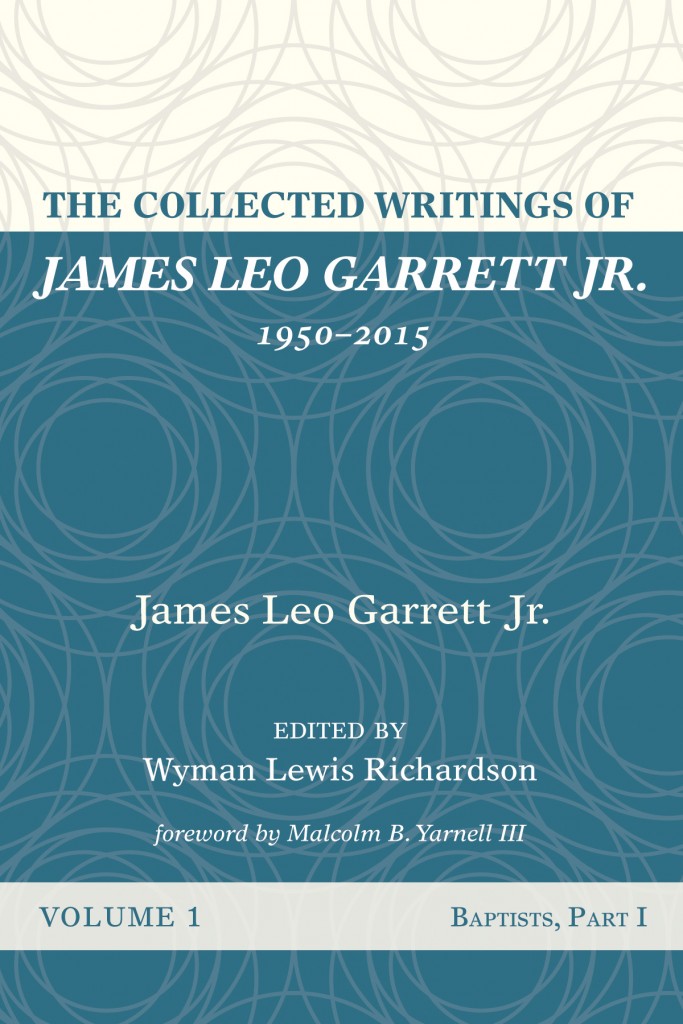
Now for sale: Volume 1, The Collected Writings of James Leo Garrett Jr., 1950-2015

It is a beautiful thing, after this many months of work, to finally see this become available.  I  thank the many people who made this possible in the acknowledgments of the book so I won’t do so here, but I do want to say that without a lot of help from a lot of folks this volume would not be appearing when it has.  My sincere prayer has always been that these volumes will further the great legacy of Dr. James Leo Garrett Jr.  You can order a copy here.

Print