Genesis 1:26-28

Genesis 1:26-28

26 Then God said, “Let us make man in our image, after our likeness. And let them have dominion over the fish of the sea and over the birds of the heavens and over the livestock and over all the earth and over every creeping thing that creeps on the earth.” 27 So God created man in his own image,
in the image of God he created him; male and female he created them. 28 And God blessed them. And God said to them, “Be fruitful and multiply and fill the earth and subdue it, and have dominion over the fish of the sea and over the birds of the heavens and over every living thing that moves on the earth.”


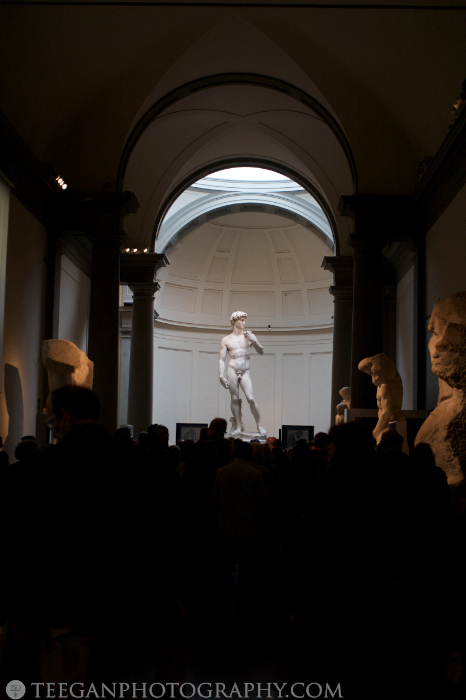
When I was in high school, my mom took a group of Latin students on a tour of some cities in Italy.  It was an amazing trip.  My favorite part, hands down, was getting to see Michelangelo’s statue of David in the Accademia di Belle Arti in Florence.  What an amazing piece of work!  Michaelangelo sculpted it from 1501 to 1504.  It stands seventeen feet high and, truly, must be seen to be believed.

You approach the statue by walking down a long corridor at the end of which is a dome under which the statue stands.  It amazed me when I saw it.  It amazes me still.  However, when I first saw it, what I was first struck by was not the statue itself but the other Michelangelo pieces lining the corridor on either side as you approach it.  On either side of the corridor are large pieces of marble out of which partially revealed figures appear to be straining to break free.  Here you see a leg, there an arm, there a torso and head.

They are still contained in the marble, but are partially freed from it.  Michelangelo was the liberator, as he saw it, of the figures who were already within the marble but who needed to be freed by a master sculptor.  He saw his job as removing the bonds of the marble around the figures so that they could exist unhindered.

Some see these as unfinished works of art.  Others suggest that Michelangelo knew exactly what he was doing in leaving them unfinished, that he was making a statement about the bondage of man and man’s struggle to be free, to exist.  Regardless, there can be no doubt that the contrast between Michelangelo’s “Prisoners” and Michelangelo’s David makes an amazing impact on the viewer.  At least it did on this viewer.
David-001

I think often of the haunting Prisoners in that hallway.  They strain against the marble that contains them to your left and your right as you walk down the corridor.  All the while, there stands the finished work, David, at the end.  It is almost as if the Prisoners are saying, “We could be more.  We might even be like David.  He too was once imprisoned in marble.  But we are still bound here, unfinished and unformed, slaves to the elements that entrap us.”

When thinking about the image of God, I thought about those statues and I thought about David.  There is a theological point in this.  We are like Michelangelo’s Prisoners:  we exist, we have potential, we have dignity, we have worth.  In part, that dignity and worth can still be seen.  We bear the image of a Master Sculptor.  We can see what we should be.  But we are bound by sin, but the elements of the world that enslave and entrap us.  We strain to be free.  And there is Jesus, the free man, the true man, man unbound by the Fall…a man, but also God.  We see Him in His perfection.  We bear the image of the Father who sent Him.  Yet we struggle here.  We bear the image, but it is oftentimes concealed by the elements to which we are enslaved.  We are the prisoners…but Christ came to make us free!

Let us tonight consider what it means to bear the image of God and how Christ comes to set us free.

I. Man Bears the Image of God (v.26a,27)

We begin with the basic biblical assertion that we do, in fact, bear the image of God.  We find it in Genesis 1.

26a Then God said, “Let us make man in our image, after our likeness…27 So God created man in his own image,
in the image of God he created him; male and female he created them.

What can this mean?  Let us first offer two things that it does not mean.

The “image of God” does not refer to physical likeness.  In John 4:24, Jesus said, “God is spirit, and those who worship him must worship in spirit and truth.”  God is non-corporeal.  He does not have flesh.  He has been revealed as “Father” in scripture.  We should defend the masculine pronoun.  However, He is not a physical man.  He is God!  Furthermore, let us note that both men and women were created in the image of God.  Thus, if “image” is taken to mean “physical likeness,” then we have some very big problems indeed!

Furthermore, the “image of God” does not refer to our bearing the image of God in the exact way that Jesus bore the image of God, thereby making us equal with Jesus.  There is a sense in which Christ is called “the image of God” in a way that we are not.  We find this in 2 Corinthians 4:4.

4 In their case the god of this world has blinded the minds of the unbelievers, to keep them from seeing the light of the gospel of the glory of Christ, who is the image of God.

Christ is the image of God in terms of equality with God.  The usage of the term in that context is quite distinct from how it is used of us.  We bear qualities that reflect God’s glory and creative power, but we ever remain the creature and God the Creator.  The Son bears the image of God in perfect unity and equality.  He is God.

What the image of God does refer to are those qualities stamped on humanity that reflect the glory of God and that are not and cannot be shared by animal life.  We see the image of God in humanity’s capacity for intelligence, abstract thought, communication, creative ability, selfless love, imagination, and wisdom.  Man is not divine, and it is wrong to suggest that he is, but he does indeed bear the mark of his divine Creator.

The fundamental implication of the image of God is that this image grants dignity, value, and worth to man.  It is important to remember that all human beings, all men and women, bear this image.  That image has been covered and clouded by the Fall, but it is still there and the evidence of it can still be seen.  In Genesis 9, the Lord said this in His covenant with Noah:

6 Whoever sheds the blood of man, by man shall his blood be shed,
for God made man in his own image.

The significance of that verse rests in the fact that it is said (a) of all human beings and (b) of fallen human beings.  There are no worthless human beings.  Man has dignity.  The image of God rests on all of humanity.  That image is not a saving image.  Fallen man bearing the marred image needs redemption.  But it means that even fallen, unredeemed man bears evidence that he was created by a mighty God.

Thus, all life is sacred.  All life has value.  Our value is not dependent upon our productivity or our social status.  Our value does not rest in what we own.  Our value is not a matter of race or nationality or gender.  Our value rests in this simple fact:  that man is unique and bears the image of God Himself.

There is a scene in William Faulkner’s novel, The Hamlet, in which some men sitting on a front porch observe a severely mentally disabled man shuffling down the street, dragging a wooden block in the dust behind him.  As they watch him pass, one of the men, Ratliff, comments on the disabled man with thinly disguised contempt and has a telling and tragic conversation with his friend, Bookwright.

Ratliff watched the creature as it went on – the thick thighs about to burst from the overalls, the mowing head turned backward over its shoulder, watching the dragging block.

“And yet they tell us we was all made in His image,” Ratliff said.

“From some of the things I see here and there, maybe he was,” Bookwright said.

“I don’t know as I would believe that, even if I knowed it was true,” Ratliff said.[1]

Yes it is true:  all mankind bears the image of God.  All mankind.  No man or woman has more value in the eyes of God than any other man or woman.  We are tempted to forget this fact when we demonize others or try to reduce their worth or see only their flaws and sins.  Joseph Ratzinger put it like this.

Indeed, it is hardly the case that we always and immediately see in the other the “noble form,” the image of God that is inscribed in him.  What first meets the eye is only the image of Adam, the image of man, who, though not totally corrupt, is nonetheless fallen.  We see the crust of dust and filth that has overlaid the image.  Thus, we all stand in need of the true sculptor who removes what distorts the image; we are in need of forgiveness, which is the heart of all true reform.[2]

We scoff at Michelangelo’s Prisoners because they do not yet look like David.  We scoff at the problems of others, dehumanizing them in the process, denying the image of God within them.  This is a great act of evil.  This is a great sin.  Everybody has value.  Everybody has worth.  Instead, we should see everybody as valuable and should pray that all people put themselves back in the hands of the Sculptor who can bring us back into being the masterpiece we were intended to be.

II. That Image Distinguishes Man from Animal Life (v.26,28)

Another clear implication of the image of God is that it distinguishes man from animal life.  This is clear in our text’s teaching that man has dominion over animal life.

26 Then God said, “Let us make man in our image, after our likeness. And let them have dominion over the fish of the sea and over the birds of the heavens and over the livestock and over all the earth and over every creeping thing that creeps on the earth.”…28 And God blessed them. And God said to them, “Be fruitful and multiply and fill the earth and subdue it, and have dominion over the fish of the sea and over the birds of the heavens and over every living thing that moves on the earth.”

Man’s dominion over animal life is not a boundless license allowing man to do whatever he wants.  For example, hunting animals for food would seem appropriate.  Senselessly butchering animals just to watch them die, however, is a sign of the Fall in the heart of man.  Man has dominion, but man still answers to God.

The value of human life over animal life needs to be stressed in our post-Darwinian culture.  In our culture, we are consistently taught that we are simply animals.  We are taught that we might be a higher form of animal life, to be sure, but we remain animals nonetheless.  This notion has the twin results of devaluing man and overvaluing animals.  Animals have been almost humanized in our culture and humans have been animalized.  We see this in a thousand different ways in popular culture and in the higher arts as well.

The attempt to reduce man to an animal stands in direct conflict with a truly biblical anthropology.  The Bible teaches that man is unique and valuable.  He must not be reduced to an animal.  Furthermore, he must not be reduced to anything less than man who bears the image of Almighty God.  Throughout human history there have been numerous attempts to reduce the dignity of man.

Dr. James Leo Garrett, Jr., the Emeritus Professor of Theology at Southwestern Baptist Theological Seminary in Fort Worth, TX, and my theology professor in seminary, wrote this in his Systematic Theology:

Once human beings are seen as being “in the image of God and after his likeness,” human beings find that the various reductionist views of human life are less convincing or less satisfying.  These include (1) Marxism’s view of man as an economic animal with class struggle, not God or man, as the basis for ethics; (2) Freud’s view of humans as primarily and essentially the product of sexual drives and as dominated by aberrant sexual activity; (3) totalitarianism’s view of human beings as the political tools of the omnicompetent civil state; (4) racism’s view that racial/ethnic differences and conflicts are a very important aspect of human life and that superior and inferior races are to be differentiated; (5) naturalism’s view that a human being is “the outcome of accidental collocations of atoms”; and (6) postmodernism’s denial of any absolute truth and of linguistic coherence.[3]

That is helpful.  It reminds us of the ways in which society has tried to strip man of the image of God.  But man is not an animal, nor does he occupy any of these lesser stations.  He is a human being, and his value rests in the fact that God Himself has created him in His image.

III.  That Image Means that We Only Have True Integrity When We Live in Union With the God Whose Image We Bear

There is a final implication to the image of God.  If God has made us, and if we bear His image, then that means we will never know true integrity and true inner peace unless and until we live in harmony with our God.  The hope of the gospel is that, through the salvation and life Christ gives us, the image of God can be restored as the Holy Spirit strips away those things that obscure it and tempt us to deny it.  In Romans 8, Paul put it like this.

29 For those whom he foreknew he also predestined to be conformed to the image of his Son, in order that he might be the firstborn among many brothers. 30 And those whom he predestined he also called, and those whom he called he also justified, and those whom he justified he also glorified.

Believers in Christ have been “predestined to be conformed to the image of his Son.”  He is making us into the image of Christ.  We are becoming more like Jesus, who Colossians 1:15 describes as “the image of the invisible God, the firstborn of all creation.”  What this means is that the image of God is restored in us as we walk with Jesus.  Paul described that process wonderfully in 2 Corinthians 3:

17 Now the Lord is the Spirit, and where the Spirit of the Lord is, there is freedom. 18 And we all, with unveiled face, beholding the glory of the Lord, are being transformed into the same image from one degree of glory to another. For this comes from the Lord who is the Spirit.

I love that:  “we…are being transformed into the same image from one degree of glory to another.”  The image of God is being daily restored in us.  We are becoming, in Christ, what we are intended to be.

Thomas Merton passed on the following story in his collection of sayings and stories from the desert fathers:

An elder was asked by a certain soldier if God would forgive a sinner.  And he said to him: Tell me, beloved, if your cloak is torn, will you throw it away?  The soldier replied and said:  No.  I will mend it and put it back on.  The elder said to him: If you take care of your cloak, will God not be merciful to His own image?[4]

Yes, God will indeed be merciful to His image.  Men and women bear that image.  He has given Christ so that His image-bearers can be saved, can be forgiven, can be born again to life anew and eternal.  The image has been distorted, but it has not been obliterated.  In Christ, it is restored and renewed.  In Christ we are able to come to the One whose image we bear as blood-bought sons and daughters.


[1] William Faulkner, The Hamlet. (New York, NY: Vintage Books, 1990).

[2] Benedict XVI, Called to Communion (San Francisco, CA: Ignatius Press, 1991), p.148.

[3] James Leo Garrett, Jr., Systematic Theology. Vol.1 (North Richland Hills, TX: Bibal Press, 2011), p.466-467.

[4] Thomas Merton, The Way of the Desert (New York, NY:  New Directions), p.76.

 

Matthew 7:13-14

Matthew 7:13-14

13 “Enter by the narrow gate. For the gate is wide and the way is easy that leads to destruction, and those who enter by it are many. 14 For the gate is narrow and the way is hard that leads to life, and those who find it are few.


Some years back we stopped at “Rock City” on Lookout Mountain in Georgia.  If you have driven around that area you know what I’m talking about:  endless “See Rock City” signs encouraging you to go to this rocky, mountain top, tourist attraction.  It was pretty neat, as far as tourist attractions go.

I remember one part of the path you take as you walk through Rock City that stands out.  They call it “Needle’s Eye.”

3105739536_81aee7dbd4_z

It is a very narrow portion of the trail that you might find a little trying if, like me, you are a bit claustrophobic.  At the time, I could get through Needle’s Eye, though I found the experience a little too close for comfort.  It’s a narrow path between two high walls of rock.  It was narrow, to say the least!

I thought of Needle’s Eye when working on our text for today, for that image is the kind of image Jesus evoked when He wanted to describe the nature of the Christian life.  This is what He said:

13 “Enter by the narrow gate. For the gate is wide and the way is easy that leads to destruction, and those who enter by it are many. 14 For the gate is narrow and the way is hard that leads to life, and those who find it are few.

I like John Stott’s summary of this text.  He put it like this:

…there are according to Jesus only two ways, hard and easy (there is no middle way), entered by two gates, broad and narrow (there is no other gate), trodden by two crowds, large and small (there is no neutral group), ending in two destinations, destruction and life (there is no third alternative).[1]

I am going to use those four divisions in looking at our text today:  two gates, two ways, two crowds, and two destinations.  They are the natural divisions within these words of Jesus, and each is important, communicating essential truths.

This text is a series of two’s.  It is fascinating to observe how often Scripture depicts the ultimate issues of salvation in terms of two’s.

See, I have set before you today life and good, death and evil. (Deuteronomy 30:15)

And if it is evil in your eyes to serve the Lord, choose this day whom you will serve, whether the gods your fathers served in the region beyond the River, or the gods of the Amorites in whose land you dwell. But as for me and my house, we will serve the Lord. (Joshua 24:15)

When the Son of Man comes in his glory, and all the angels with him, then he will sit on his glorious throne. Before him will be gathered all the nations, and he will separate people one from another as a shepherd separates the sheep from the goats. And he will place the sheep on his right, but the goats on the left. (Matthew 25:31-33)

He has delivered us from the domain of darkness and transferred us to the kingdom of his beloved Son (Colossians 1:13)

There is a basic dichotomy to life, a division between the things of God and the things that war against God.  This division presents itself to every human being, asking which we will choose:  life or death, forgiveness or condemnation, salvation or judgment, light or darkness?  We stand confronted by these two’s and we must make a decision.

I. Two Gates:  Narrow and Wide

The first of these two’s are the two gates.

13 “Enter by the narrow gate. For the gate is wide and the way is easy that leads to destruction, and those who enter by it are many. 14 For the gate is narrow and the way is hard that leads to life, and those who find it are few.

There is a narrow gate and there is a wide gate.  Interpreters often discuss what the gate is intended to be, but it would appear to be the entryway onto the two paths that lead either to salvation or destruction.  In other words, every human being is faced with the choice of going into one of two doors, or one of two gates.  Those gates ultimately lead to very different places.

But what is the narrow gate, the gate leading to life, and why is it narrow?  We find the answer to the identity of the gate in John 10:9.  There, Jesus said, “I am the door. If anyone enters by me, he will be saved and will go in and out and find pasture.”  Christ Jesus is the gate, the door.  The decision we make concerning Christ and whether or not to trust in Him will determine the direction of our lives.

Every human being stands before two gates.  One gate is the acceptance of Jesus and it leads to life.  The other gate is the rejection of Jesus and it leads to destruction.  What is telling is that Jesus says there are only two gates.  There is not a third.  In fact, in Revelation 3, Jesus expresses His contempt for third ways in general.  This is what He says to the church of Laodicea:

14 “And to the angel of the church in Laodicea write: ‘The words of the Amen, the faithful and true witness, the beginning of God’s creation. 15 “‘I know your works: you are neither cold nor hot. Would that you were either cold or hot! 16 So, because you are lukewarm, and neither hot nor cold, I will spit you out of my mouth. 17 For you say, I am rich, I have prospered, and I need nothing, not realizing that you are wretched, pitiable, poor, blind, and naked. 18 I counsel you to buy from me gold refined by fire, so that you may be rich, and white garments so that you may clothe yourself and the shame of your nakedness may not be seen, and salve to anoint your eyes, so that you may see. 19 Those whom I love, I reprove and discipline, so be zealous and repent. 20 Behold, I stand at the door and knock. If anyone hears my voice and opens the door, I will come in to him and eat with him, and he with me. 21 The one who conquers, I will grant him to sit with me on my throne, as I also conquered and sat down with my Father on his throne. 22 He who has an ear, let him hear what the Spirit says to the churches.’”

There is no third way.  There is no via media when it comes to Jesus.  You have not “kind of” accepted Christ.  You have not “kind of” rejected Jesus.  You have either accepted him or rejected Him.  He is either Lord to you or He is not.  This morning, right now, right here, right where you are sitting, you have either accepted Christ as Lord and Savior or you have rejected Jesus.  You may tell yourself that are still in the middle.  There is no middle!  Not to have accepted Him is to have rejected Him.

It is interesting to note that people are apparently less likely to accept Christ the older they get, according to some research done some years back, anyway.

The probability of people accepting Jesus Christ as their personal Savior drops off dramatically after age 14, a new study by the Barna Research Group has found.  Data from a nationwide sampling of more than 4,200 young people and adults indicate that youth from ages 5 through 13 have a 32 percent probability of accepting Christ as their Savior.  Young people from the ages of 14 through 18 have a 4 percent likelihood of making that choice, while adults ages 19 and older have a 6 percent probability of doing so.[2]

Perhaps this means that the longer you go on rejecting Christ, the harder your heart gets.  Obviously, this is not a hard and fast rule.  In this very church are numbers of people who were gloriously saved later in life.  Some of the greatest heroes of the faith were saved later in life.  If you are here today and you are hearing the gospel, it is not too late for you.  So long as you have breath in you it is not too late.  You can accept Jesus this very day.

There are two gates, but they are not the same size:  one is narrow and one is wide.

13 “Enter by the narrow gate. For the gate is wide and the way is easy that leads to destruction, and those who enter by it are many. 14 For the gate is narrow and the way is hard that leads to life, and those who find it are few.

Why is this so?  It is so because it seems that many more people reject Christ than accept Him. Even so, let no one say that the gate to glory is too narrow for them.  It is narrow, but it stands before every human being, and anybody who so desires can enter in.  If you desire to come to Jesus, you can.  If you desire to be saved, you will not find the narrow gate locked.  The key to the gate is the grace and mercy of Jesus.  We reach for the gate through the act of repentance and faith.

I have mentioned in the past how, as a kid, I went to Camp Ambassador on Lake Waccamaw in North Carolina.  While there, they gathered us all around the campfire one night where a wonderful, elderly lady who we all referred to as “Aunt Sarah” told us a story.  The story she told us was John Bunyan’s story Pilgrim’s Progress.  In the story, Christian is journeying to the Celestial City, but first, he must pass through what Bunyan called “the wicket gate.”  The wicket gate is a narrow gate, but it is the gate that opens to the path leading to eternal life.  Here is Bunyan’s description of Christian going through the narrow gate.

So, in process of time, Christian got up to the gate. Now, over the gate there was written, “Knock, and it shall be opened unto you.” Matthew 7:7

He knocked, therefore, more than once or twice, saying,

“May I now enter here? Will he within

Open to sorry me, though I have been

An undeserving rebel? Then shall I

Not fail to sing his lasting praise on high.”

At last there came a grave person to the gate, named Goodwill, who asked who was there, and whence he came, and what he would have.

Christian: Here is a poor burdened sinner. I come from the city of Destruction, but am going to Mount Zion, that I may be delivered from the wrath to come; I would therefore, sir, since I am informed that by this gate is the way thither, know if you are willing to let me in.

Goodwill: I am willing with all my heart, said he; and with that he opened the gate.[3]

There are two gates:  one narrow and one wide.  Have you passed through the narrow gate?  Have you trusted in Christ?

II. Two Ways:  Hard and Easy

There are also two ways:  one hard and one easy.  The hard way is the way to which the narrow gate opens.  The easy way is the way to which the wide gate opens.

13 “Enter by the narrow gate. For the gate is wide and the way is easy that leads to destruction, and those who enter by it are many. 14 For the gate is narrow and the way is hard that leads to life, and those who find it are few.

Now this is a fascinating thing for Jesus to say.  It also appears to be problematic, at first glance, because of something that Jesus said in Matthew 11.

28 Come to me, all who labor and are heavy laden, and I will give you rest. 29 Take my yoke upon you, and learn from me, for I am gentle and lowly in heart, and you will find rest for your souls. 30 For my yoke is easy, and my burden is light.”

What can this mean?  In our text Jesus says that “the gate is narrow and the way is hard that leads to life,” but in Matthew 11 He says, “My yoke is easy, and My burden is light.”  Which is it?  Is the way of Jesus easy or hard?

The answer to that question is, “Yes!”  That is to say, the yoke and way of Jesus is a paradox.  It is a blissful burden.  It is a freeing enslavement.  It is a light burden, but a burden nonetheless, as Jesus acknowledges.  All of this is to say that the way of Jesus is a path of joy but also a path of laying down our lives.  The way of Christ is a way of liberation, but it is a liberation from sin that constantly pesters and hinders us.

You will perhaps recall that I have earlier spoken of the Kingdom of God as the “already/not yet” Kingdom.  That is a well-known phrase that has great explanatory power.  The Kingdom of God is “already” in that it exists, it has a King, Jesus, and it has citizens, those who have come to the Father through the Son.  But the Kingdom of God is “not yet” in that we still struggle with sin, still see through a glass dimly, and are still in the difficult process of becoming what we need to become in Christ.  It is “already” in that we have been justified, declared free and forgiven in Christ.  It is “not yet” in that we still must confess our sins as we daily struggle.

We also see the “already/not yet” Kingdom in the way the Lord spoke of His path.  It is “already” in that it is easy:  we walk with Jesus in victory and a song fills our hearts.  It is “not yet” in that it is hard:  we struggle under the temptation to abandon the path, under the burden of having to learn to think and live differently, and under the strain of being rejected by the dominant systems of the world in which we live.

Indeed, there is a sense in which following Jesus is hard.  It is hard when it is contrasted with the infinitely easier though tragically deceitful path of simply thinking what everybody else thinks, doing what everybody else does, talking like everybody else talks, and believing as everybody else lives.

Discipleship is hard, brothers and sisters, but the yoke of Jesus is still easy.  What a beautiful privilege it is to be on this narrow, hard path!  What an honor to set our feet on this way!  It requires us to lay down our lives, but we lay them at the feet of the Jesus who loves us.  The martyrs all suffered and sealed their testimony with their blood, but they did so singing praises to the Savior Who first laid down His life for them.

III. Two Crowds:  Few and Many

There are also two crowds:  one large and one small.

13 “Enter by the narrow gate. For the gate is wide and the way is easy that leads to destruction, and those who enter by it are many. 14 For the gate is narrow and the way is hard that leads to life, and those who find it are few.

The large crowd passes through the wide gate onto the easy path.  The small crowd passes through the narrow gate onto the hard path.  Friends, most people will reject the path of life.  That means that, in most cases, the crowd will be wrong.

I think about this when I think about our kids at school.  Kids, when you are in the classroom or the cafeteria, and that topic of religion or right-and-wrong or truth comes up, and you realize that you are the only one at the table who holds the biblical position, the true position, take heart:  Jesus said that His people would almost always be in the minority.  The church is the minority in the world.  Those who have trusted in Christ are in the minority when compared to those who have rejected Him.

I take that to mean that the majority of viewpoints that I encounter on TV will likely be false.  I take that to mean that the majority of viewpoints I read online will likely be false.  I take that to mean that our calling is to uphold the minority, rejected, despised truth of the gospel in the dominant culture of darkness that has rejected it.  Indeed, I take that to mean that it is an honor to hold up the despised truth.  It is an honor to be the only one at the lunch table who speaks up, with love but with clarity, and says, “Guys, I’m a Christian, and, as a Christian, I do not agree with what you just said.  In fact, Jesus said…”  That, friends, is an honor!

It is also a calling and a burden.  If you do not speak the truth at that table, that table will not hear the truth.  If you do not speak the truth, adults, at that dinner party, that dinner party will not hear the truth.  If you do not speak the truth at that ballgame, the people at that ballgame will not hear the truth.

Dear Christian, I plead with you:  do not grow silent before the majority.  Jesus said the majority is on the path to destruction.  The few are on the path of life.  The few have come into the Kingdom and the few must represent the interests of their King.

Let me also say that this truth should motivate us to plead with the many to come to Christ.  The point of this teaching is not that we write the many off to destruction.  The point is that we should realize the reality of how the world is, but then embrace the challenge of calling the world to Christ.

IV. Two Destinations:  Life and Destruction

Jesus finally spoke of two destinations.

13 “Enter by the narrow gate. For the gate is wide and the way is easy that leads to destruction, and those who enter by it are many. 14 For the gate is narrow and the way is hard that leads to life, and those who find it are few.

The two paths, the easy and the hard one, end somewhere.  There are two final destinations to life.  Jesus referred to these two destinations as “life” and “destruction.”  One path leads to eternal life and the other leads to eternal destruction.  The path leading to eternal life is the path of Jesus.  The path leading to eternal destruction, eternal death, is the path of the world without Christ.

Jesus consistently spoke of people reaching either one of two final destinations.  For instance, in Matthew 25, Jesus gave this picture of the final judgment:

31 “When the Son of Man comes in his glory, and all the angels with him, then he will sit on his glorious throne. 32 Before him will be gathered all the nations, and he will separate people one from another as a shepherd separates the sheep from the goats. 33 And he will place the sheep on his right, but the goats on the left. 34 Then the King will say to those on his right, ‘Come, you who are blessed by my Father, inherit the kingdom prepared for you from the foundation of the world. 35 For I was hungry and you gave me food, I was thirsty and you gave me drink, I was a stranger and you welcomed me, 36 I was naked and you clothed me, I was sick and you visited me, I was in prison and you came to me.’ 37 Then the righteous will answer him, saying, ‘Lord, when did we see you hungry and feed you, or thirsty and give you drink? 38 And when did we see you a stranger and welcome you, or naked and clothe you? 39 And when did we see you sick or in prison and visit you?’ 40 And the King will answer them, ‘Truly, I say to you, as you did it to one of the least of these my brothers, you did it to me.’ 41 “Then he will say to those on his left, ‘Depart from me, you cursed, into the eternal fire prepared for the devil and his angels. 42 For I was hungry and you gave me no food, I was thirsty and you gave me no drink, 43 I was a stranger and you did not welcome me, naked and you did not clothe me, sick and in prison and you did not visit me.’ 44 Then they also will answer, saying, ‘Lord, when did we see you hungry or thirsty or a stranger or naked or sick or in prison, and did not minister to you?’ 45 Then he will answer them, saying, ‘Truly, I say to you, as you did not do it to one of the least of these, you did not do it to me.’ 46 And these will go away into eternal punishment, but the righteous into eternal life.”

Again, in Luke 14, he told a parable about a great banquet that ends in a simple division of people around two final destinations.

16 But he said to him, “A man once gave a great banquet and invited many. 17 And at the time for the banquet he sent his servant to say to those who had been invited, ‘Come, for everything is now ready.’ 18 But they all alike began to make excuses. The first said to him, ‘I have bought a field, and I must go out and see it. Please have me excused.’ 19 And another said, ‘I have bought five yoke of oxen, and I go to examine them. Please have me excused.’ 20 And another said, ‘I have married a wife, and therefore I cannot come.’ 21 So the servant came and reported these things to his master. Then the master of the house became angry and said to his servant, ‘Go out quickly to the streets and lanes of the city, and bring in the poor and crippled and blind and lame.’ 22 And the servant said, ‘Sir, what you commanded has been done, and still there is room.’ 23 And the master said to the servant, ‘Go out to the highways and hedges and compel people to come in, that my house may be filled. 24 For I tell you, none of those men who were invited shall taste my banquet.’”

One more example.  In Matthew 25, Jesus told a story about some virgins who go out with their lamps to meet the coming bridegroom.

1 “Then the kingdom of heaven will be like ten virgins who took their lamps and went to meet the bridegroom. 2 Five of them were foolish, and five were wise. 3 For when the foolish took their lamps, they took no oil with them, 4 but the wise took flasks of oil with their lamps. 5 As the bridegroom was delayed, they all became drowsy and slept. 6 But at midnight there was a cry, ‘Here is the bridegroom! Come out to meet him.’ 7 Then all those virgins rose and trimmed their lamps. 8 And the foolish said to the wise, ‘Give us some of your oil, for our lamps are going out.’ 9 But the wise answered, saying, ‘Since there will not be enough for us and for you, go rather to the dealers and buy for yourselves.’ 10 And while they were going to buy, the bridegroom came, and those who were ready went in with him to the marriage feast, and the door was shut. 11 Afterward the other virgins came also, saying, ‘Lord, lord, open to us.’ 12 But he answered, ‘Truly, I say to you, I do not know you.’ 13 Watch therefore, for you know neither the day nor the hour.

Do you see Jesus’ constant allusions to two final destinations?  One path ends in life and the other in destruction.  The sheep end in eternal life and the goats end in eternal destruction.  The later-invited guests end up in the banquet hall and the originally-invited guests end up outside the hall.  The wise virgins end up at the marriage feast and the foolish virgins end up on the wrong side of the shut door.

Let us be very clear about the fact that scripture is very clear:  every human being will end up in either an eternal heaven or an eternal hell, and the determining issue in that is whether or not we trust in Jesus and accept what He has done for us.  There is a heaven and there is a hell, and every person will find themselves in one or the other.

It is becoming increasingly unfashionable to speak of hell, though the Lord Jesus spoke of it in very clear terms.  There is a place of eternal torment reserved for those who reject the salvation that will keep us from that place.  I will simply point out that it makes no sense to say that Jesus came to save us and then to deny that from which He came to save us.  It makes no sense to say that Jesus laid down His life for our sins and then to deny that there is a price for our sins that we would otherwise have to pay.  It makes no sense to say that Jesus was tormented but that, ultimately, it would not have really mattered, since we would never have faced torment ourselves.

If you abandon hell, you gut the cross of meaning.  Jesus came to save us from something.

That early pastor and preacher, John Chrysostom, once commented on the fact that people find talk about hell to be unpleasant.  This is what he said:

And I know, indeed, that there is nothing less pleasant to you than these words.  But to me nothing is more pleasant…Let us, then, continually discuss these things.  For to remember hell prevents our falling into hell.[4]

Indeed, there is a benefit to being aware of hell.  Jesus came to save us from it.  Jesus is the only thing standing between us and hell.  Would you be saved?  Would you like for your path to end in life instead of destruction?  The decision is simple:  trust in Christ.  Jesus is the narrow gate leading to the path of life.  Paul put it like this in Romans 10:

9 because, if you confess with your mouth that Jesus is Lord and believe in your heart that God raised him from the dead, you will be saved. 10 For with the heart one believes and is justified, and with the mouth one confesses and is saved.

Have you trusted in Jesus?  Have you walked through that gate?

I pray that it is so.  I plead with you to trust in Christ today.


[1] John Stott, The Message of the Sermon on the Mount. (Downers Grove, IL: InterVarsity Press, 1978), p.196.

[2] RNS, “Probability of accepting Jesus drops dramatically after age 14,” The Christian Index (December 2, 1999), p.1.

[3] https://www.ccel.org/ccel/bunyan/pilgrim.iv.ii.html

[4] John Chrysostom, quoted in:  The Ancient Christian Commentary on Scripture; N.T. Vol. IX (Downers Grove, IL:  InterVarsity Press, 2000), p.104-105.


An Interesting Question on Books Written in the Voice of Jesus

A friend asked me a question recently that I thought was very interesting.  She has a popular devotional book written by the author in the voice of Jesus.  In other words, as I understand it, the devotional sessions read as if Jesus is addressing the reader directly, though it is the author writing it (i.e., it’s not simply a collection of New Testament statements of Jesus, though I’m sure it includes these as well).

My friend says that she has not encountered anything in the devotional that is objectionable or unbiblical.  However, she is curious to know if the devotional might not be violating Revelation 22:18-19.

18 I warn everyone who hears the words of the prophecy of this book: if anyone adds to them, God will add to him the plagues described in this book, 19 and if anyone takes away from the words of the book of this prophecy, God will take away his share in the tree of life and in the holy city, which are described in this book.

I’m grateful for the question.  It reflects a high view of Scripture and a genuine desire not to violate its precepts.  Furthermore, it reflects a high view of Christ and a desire not to see Him in any way diminished.

I suppose the first thing I would say is that the author’s approach is potentially dangerous, for reasons that should be obvious.  We dare not speak for Jesus.  We are not Jesus.  Tying ourselves to the text is an act of wisdom and an acknowledgment of our own tendencies towards sin.  I would imagine that writing a book like that might present certain very real and very subtle temptations to substitute my thoughts for Jesus’ thoughts, even if I am trying to be biblical.

On the other hand, potentially dangerous is not synonymous with clearly wrong.  For instance, I can imagine three scenarios in which most Christians tolerate this kind of exercise within certain parameters.  First:  films about Jesus.  Most films on the life of Christ imaginatively depict Christ saying words that are not in Scripture.  However, this is acceptable to most Christians so long as the words of Christ in the film do not violate the words or spirit or tone of Scripture.

Second:  preachers do this in sermons all the time.  Frequently in sermons Christian preachers with a high view of Scripture will do a kind of imaginative paraphrase of what Jesus was saying in the particular text they are preaching, stating in fuller terms what Jesus appears to be saying in the text.  We are not adding to God’s Word in doing so.  We are, instead, trying to flesh out more extensively the words of Jesus for the Church.

Third:  the entire, popular exercise of asking ourselves, “What Would Jesus Do?” involves a degree of imagining His words today in this or that particular situation that may not be explicitly addressed in Scripture.  I realize this is different insofar as it is usually personal and fairly insular.  Asking oneself this is different from publishing a book in the voice of Jesus.  But still, this mental, spiritual exercise is conceptually the same.  In both situations, we are being asked to considered what the Lord Jesus would say more fully to us today.

In short, it seems to me that there is a difference between an imaginative paraphrase and adding to God’s Word.  It seems to me that the key is this:  is the imaginative paraphrase tied to the content and voice of Scripture and is it allowing Scripture to drive it?  If so, it would seem to be appropriate.  If not, it would seem to be a sin.

In my opinion, based on what my friend tells me of this book, it does not sound like the author has done anything inappropriate.  Even so, we should ever be careful in diligent in reading such works, judging all by the clear testimony of God’s Word.


Exodus 13:1-16

Exodus 13:1-16

1 The Lord said to Moses, 2 “Consecrate to me all the firstborn. Whatever is the first to open the womb among the people of Israel, both of man and of beast, is mine.” 3 Then Moses said to the people, “Remember this day in which you came out from Egypt, out of the house of slavery, for by a strong hand the Lord brought you out from this place. No leavened bread shall be eaten. 4 Today, in the month of Abib, you are going out. 5 And when the Lord brings you into the land of the Canaanites, the Hittites, the Amorites, the Hivites, and the Jebusites, which he swore to your fathers to give you, a land flowing with milk and honey, you shall keep this service in this month. 6 Seven days you shall eat unleavened bread, and on the seventh day there shall be a feast to the Lord. 7 Unleavened bread shall be eaten for seven days; no leavened bread shall be seen with you, and no leaven shall be seen with you in all your territory. 8 You shall tell your son on that day, ‘It is because of what the Lord did for me when I came out of Egypt.’ 9 And it shall be to you as a sign on your hand and as a memorial between your eyes, that the law of the Lord may be in your mouth. For with a strong hand the Lord has brought you out of Egypt. 10 You shall therefore keep this statute at its appointed time from year to year. 11 “When the Lord brings you into the land of the Canaanites, as he swore to you and your fathers, and shall give it to you, 12 you shall set apart to the Lord all that first opens the womb. All the firstborn of your animals that are males shall be the Lord’s. 13 Every firstborn of a donkey you shall redeem with a lamb, or if you will not redeem it you shall break its neck. Every firstborn of man among your sons you shall redeem. 14 And when in time to come your son asks you, ‘What does this mean?’ you shall say to him, ‘By a strong hand the Lord brought us out of Egypt, from the house of slavery. 15 For when Pharaoh stubbornly refused to let us go, the Lord killed all the firstborn in the land of Egypt, both the firstborn of man and the firstborn of animals. Therefore I sacrifice to the Lord all the males that first open the womb, but all the firstborn of my sons I redeem.’ 16 It shall be as a mark on your hand or frontlets between your eyes, for by a strong hand the Lord brought us out of Egypt.”


Flannery O’Connor once said this about writing:

When you can assume that your audience holds the same beliefs as you do, you can relax a little and use more normal means of talking to it; when you have to assume that it does not, then you have to make your vision apparent by shock, to the hard of hearing you shout, and for the almost-blind, you draw large and startling figures.

That’s an interesting insight, and a true one.  “Making our vision apparent by shock” is something we all must do for those unaccustomed or unprepared to receive what we need to say and what they need to hear.  This may be especially true in the raising of children!  It is most certainly true in the way that the Lord God teaches us.  We are the hard of hearing who need a shout.  We are the almost-blind who need startling images drawn.

That is true of us and it was true of Israel as well.  Coming out of Egypt, the Lord needed to impress certain truths upon His children.  These truths were identity-forming and salvation-bringing insofar as they prepared the hearts of the people of God for the eventual coming of  the incarnate Christ.  They were truths that had to do with the reality of sin, forgiveness, deliverance, salvation, holiness, consecration, and community.

We have looked already at the institution of the rites of Passover and the Feast of Unleavened Bread.  In our text tonight we see another expression of the Feast of Unleavened Bread as well as instructions on the consecration of the firstborn sons of Israel.

I. The Divine Counterpart to the Divine Curse: The Firstborn of Israel (v.1-2,11-16)

Provocatively, our text begins and ends with instructions concerning the firstborn sons of Israel.

1 The Lord said to Moses, 2 “Consecrate to me all the firstborn. Whatever is the first to open the womb among the people of Israel, both of man and of beast, is mine.”

I say this is provocative because it clearly stands as a counterpart to the death of the firstborn sons of Egypt.  The firstborn sons of Egypt were killed whereas the firstborn sons of Israel would live lives consecrated to God.  The firstborn sons of Egypt were under a curse.  The firstborn sons of Israel were under the promise of salvation.

To consecrate is to set aside as holy.  Israel is told to consecrate to the Lord “all the firstborn” and “the first to open the womb…both man and beast.”  “They are mine!” declares the Lord.  The firstborn of Egypt were the Lord’s too, and were the objects of His wrath.  The firstborn of Israel were the Lord’s and were the objects of His special affection.  In truth, all the children of Israel were the Lord’s, set apart by Him and for Him.  In a general sense, of course, all the peoples of earth belong to the Lord insofar as He creates us all and we bear His image, marred by the Fall though it is.

This consecration of the firstborn sons of Israel was unique, though.  It highlighted the salvation that was Israel’s.  The consecration of the firstborn of Israel was a symbol of all of Israel’s consecration to God.  Speaking of the consecration of the livestock of Israel, Honeycutt suggests that “by the principle of ‘pars pro toto,’ the part may stand for the whole.  Offering the firstborn symbolized the effectual giving of the entire future offspring for man’s consumption.”[1]  The same principle would apply to the consecration of the firstborn child.  The firstborn stand for all.  Verse 11 and following revisits this consecration.

11 “When the Lord brings you into the land of the Canaanites, as he swore to you and your fathers, and shall give it to you, 12 you shall set apart to the Lord all that first opens the womb. All the firstborn of your animals that are males shall be the Lord’s. 13 Every firstborn of a donkey you shall redeem with a lamb, or if you will not redeem it you shall break its neck. Every firstborn of man among your sons you shall redeem.

In giving these instructions, the Lord is making His vision apparent by shock, to return to O’Connor’s phrase.  Essentially, the consecration of the firstborn went like this.  All the firstborn sons of the people and the firstborn of the animals were to be consecrated.  Those animals deemed clean were to be sacrificed to the Lord.  Unclean animals, of which the donkey is specified in our text, were to be redeemed.  That is, they were to be consecrated, but could be redeemed, bought back, for a price.  In this way, they would not be killed, and could be used again.  Thus, the unclean donkey would be consecrated, but not sacrificed.  The options for the donkey, as well as for all unclean animals, were two:  (a) they could be redeemed for a price or (b) they could be killed.  These were the only two options for unclean animals.  Thus, the consecrated donkey could be bought back or its neck could be broken.  In this way, God’s rights over the firstborn were acknowledged, either through the sacrifice of the consecrated clean animals, the redemption of the consecrated unclean animals, or the death of the consecrated unredeemed animals.  In any case, God’s sovereign rights were acknowledged.  The firstborn, in place of all, belonged to God.

Most interestingly, the Lord says that “every firstborn of man among your sons you shall redeem.”  This is as fascinating as it is telling.  In practice, the firstborn sons are placed in the same category as the donkey:  consecrated, unclean, and in need of redemption.  Child sacrifice was forbidden by the Lord, of course.  The Lord would not have His people kill their sons like they may have to kill their unredeemed donkeys.  No, the firstborn sons of Israel were to be redeemed.  The price of redeeming the firstborn son was five shekels.  We see Joseph and Mary honoring this law with Jesus in Luke 2.

22 And when the time came for their purification according to the Law of Moses, they brought him up to Jerusalem to present him to the Lord 23 (as it is written in the Law of the Lord, “Every male who first opens the womb shall be called holy to the Lord”)

Now, the Lord Jesus was without sin, but it was still important that He not be in violation of the Law.  So He was presented to the Lord.  But all the other firstborn sons of Israel needed to be redeemed because, like they donkey, they were unclean…which is to say – and this is key – we are unclean.

In other words, we see in these instructions the truth of human depravity.  We are unclean and in need of purification.  We are sinners in need of salvation.  Remember:  the firstborn sons of Israel stood for the whole of Israel, indeed, for the whole of humanity.  The theological importance of this will be immediately evident:  we are all unclean and we are all in need of redemption.  The options available to us are the same as the options available to unclean animals:  death or redemption.

Do you see the deep, ancient, theological seeds that were sown into the consciousness of these early Jews in order to prepare Israel and the world for the coming of Christ?  Lost, unclean man needs to be redeemed.  If he is not redeemed, he is condemned.  But who could pay the price of redemption for the sins of the world?  Who could offer redemption to all?  Is there a sacrifice that could accomplish this?  Is there a payment large enough for this price?

Praise God, church!  There is!  Jesus is the payment for our redemption, the perfect Lamb whose death and resurrection makes us unclean sons and daughters clean again.  We need not die!  We need not be judged!  We need not be condemned!  Our Jesus has paid the price for us!  For you!  For me!

Have you trusted in the Lamb who paid the redemption price for you?  Have you called on His name?  Can you say that you are His?

These truths we now know in full were previously presented in the startling image of consecration and redemption.  Israel was instructed to do these things so that their faith could be passed down.  We see this beginning in verse 14.

14 And when in time to come your son asks you, ‘What does this mean?’ you shall say to him, ‘By a strong hand the Lord brought us out of Egypt, from the house of slavery. 15 For when Pharaoh stubbornly refused to let us go, the Lord killed all the firstborn in the land of Egypt, both the firstborn of man and the firstborn of animals. Therefore I sacrifice to the Lord all the males that first open the womb, but all the firstborn of my sons I redeem.’

Do you see?  The consecration of the firstborn was established as an instrument by and through which the successive generations of Israel would learn of the events of the Exodus, particularly the events of the death of the firstborn sons of Egypt in the tenth plague.  They would learn of this tragedy by viewing its glorious counterpart:  the consecration and redemption of the firstborn sons of Israel.  So deliberate was this passing down of the faith that it was to be written upon their very lives.

16 It shall be as a mark on your hand or frontlets between your eyes, for by a strong hand the Lord brought us out of Egypt.”

These are highly-disputed words.  Were they intended literally or figuratively?  It is likely that this was a figurative expression intended to denote such intimate awareness with the truths of God that it is as if they were written on their very lives.  In time, the Jews came to take this literally, strapping phylacteries to their heads and to their hands.  Phylacteries are sacred little containers holding words from Scripture.  In Matthew 23, Jesus condemned the self-righteous use of such things by some of the Jews.

5 They do all their deeds to be seen by others. For they make their phylacteries broad and their fringes long, 6 and they love the place of honor at feasts and the best seats in the synagogues 7 and greetings in the marketplaces and being called rabbi by others.

No, the truth of God’s sovereign rule and His deliverance of Israel from bondage was to be passed down in purity and in truth, not with ostentation.  Why?  Because this truth was preparing Israel for the greater truth to which it pointed:  the coming of Christ.  The consecration of the firstborn sons was intended to point to the coming of the true firstborn Son, the only begotten Son, Jesus the Chrtist.  The church father Tertullian put it like this:

For who is really holy but the Son of God?  Who properly opened the womb but he who opened a closed one?  But it is marriage which opens the womb in all cases.  The Virgin’s womb, therefore, was especially opened, because it was especially closed.[2]

Christ was the firstborn Son for which the world was waiting.  The consecration of the firstborn sons of Israel was intended to prepare the people for and point them to Jesus.

II. The Symbols and the Passing Down of the Faith: Unleavened Bread (v.3-10)

In the middle of our text, in verses 3-10, we find another description of the Feast of Unleavened Bread.

3 Then Moses said to the people, “Remember this day in which you came out from Egypt, out of the house of slavery, for by a strong hand the Lord brought you out from this place. No leavened bread shall be eaten. 4 Today, in the month of Abib, you are going out.

The month of Abib “correspond[s] to our late March and early April.”[3]  Douglas Stuart says that “just as modern Westerners learn as little children that Christmas come only in the month of December, ancient Israelites learned early on, from this point in history forward, that the Feast of Unleavened Bread comes only in Abib.”[4]  This was to be a continual remembrance in Israel, a yearly reminder of Israel’s hasty exit from Egypt once the Lord opened the door of deliverance.

5 And when the Lord brings you into the land of the Canaanites, the Hittites, the Amorites, the Hivites, and the Jebusites, which he swore to your fathers to give you, a land flowing with milk and honey, you shall keep this service in this month. 6 Seven days you shall eat unleavened bread, and on the seventh day there shall be a feast to the Lord. 7 Unleavened bread shall be eaten for seven days; no leavened bread shall be seen with you, and no leaven shall be seen with you in all your territory. 8 You shall tell your son on that day, ‘It is because of what the Lord did for me when I came out of Egypt.’ 9 And it shall be to you as a sign on your hand and as a memorial between your eyes, that the law of the Lord may be in your mouth. For with a strong hand the Lord has brought you out of Egypt. 10 You shall therefore keep this statute at its appointed time from year to year.

We have discussed the Feast of Unleavened bread already and how the absence of leaven spoke of the purity and holiness of God’s people.  It was itself a symbol of consecration, a reminder that Israel belongs to God and not to Egypt or any other power.  In fact, it reminded Israel that they did not belong even to themselves.  They were God’s, and they were to walk in a pure love and relationship with their Deliverer God.

What is most interesting in our text is the repeated call for Israel to hold to these rites and symbols – Passover, Unleavened Bread, the consecration of the firstborn – as intentional efforts at faith transmission.  Terence Fretheim put it well when he said this about our verses:

            The basic rhythm of the text is thus not that of memory and hope but of memory and liturgical responsibility…As with passover (see 12:1-28), the concrete and replicative nature of each of the rituals indicates that they are vehicles in and through which God effects salvation for each new generation…The concern is not that God be properly thanked but that the redemptive experience be a living reality for each Israelite in every age.[5]

Yes, the redemptive experience does need to be a living reality for God’s people in every age.  That is why God gave Israel these remembrances.  This is also why you and I are to bring our children into consistent contact with the sacred remembrances of the church:  the preaching of the gospel, baptism, and the Lord’s Supper.

The sacred remembrances the Lord gave to Israel were intended to prepare God’s people for the actualization of that to which they pointed:  the coming of the Redeemer, the Lamb of God, the second and greater Moses who would lead His people out of sin, death, and Hell.  They were constant reminders that Israel had been liberated, freed from bondage in Egypt.  It was a reminder that they did not have to stay in Egypt.

The Lord Jesus stands today to say that we do not have to stay in the Egypt of sin, death, and Hell.  We can be free.  Israel’s hope is now our living and present reality.  Christ has come.  Christ reigns.  He has come to set us free.

Do not stay in Egypt.

You do not have to stay in Egypt.

The Savior, Jesus, has come to lead you home.

The Lamb of God has paid the redemption price for you.

Trust in Him and live.


[1] Roy L. Honeycutt, Jr. “Exodus.” The Broadman Bible Commentary. Vol.1, Revised (Nashville, TN: Broadman Press, 1969), p.362.

[2] Joseph T. Lienhard, ed., Exodus, Leviticus, Numbers, Deuteronomy. Ancient Christian Commentary on Scripture. Old Testament, vol.III. Thomas C. Oden, ed. (Downer’s Grove, IL: InterVarsity Press, 2001), p.70.

[3] Peter Enns, Exodus. The NIV Application Commentary (Grand Rapids, MI: Zondervan, 2000), p.252.

[4] Douglas K. Stuart, Exodus. Vol.2. The New American Commentary. New Testament, Vol.2 (Nashville, TN: Broadman and Holman, 2006), p.314.

[5] Terence Fretheim, Exodus. Interpretation. (Louisville, KY: Westminster John Knox Press, 2010), p.147.

Matthew 7:12

Matthew 7:12

12 So whatever you wish that others would do to you, do also to them, for this is the Law and the Prophets.


Around the year 20 B.C., somebody asked the Rabbi Hillel to stand on one leg and teach him the whole law.  The “stand on one leg” part had to do with seeing if the Rabbi could answer the profound question quickly and deftly, thinking on his foot as it were.  Hillel did so.  He stood on one leg and said, “What is hateful to you, do not do to anyone else.  This is the whole law; all the rest is only commentary.”[1]

That will likely sound very familiar to many of you:  “What is hateful to you, do not do to anyone else.  This is the whole law; all the rest is only commentary.”  It will sound familiar because it is so very similar to the words of Jesus in Matthew 7:12, words which we know as The Golden Rule.

12 So whatever you wish that others would do to you, do also to them, for this is the Law and the Prophets.

Yes, those are very similar sayings, and I should note that other sayings similar to the Golden Rule were said even earlier in history.  Even so, there is something unique about the Golden Rule.  It was said by Jesus Himself.  Like all of Jesus’ words, they have content and weight because of Jesus’ work on the cross and in the empty tomb.  What Jesus has done, in other words, makes His words unique, even if similar sayings were made by others.

The context of the Sermon on the Mount adds particular meaning to the Golden Rule as well.  If the Sermon on the Mount is a depiction of how citizens of the Kingdom of God who are current residents of the fallen kingdom of the world are to live (which it is), then this commandment is necessarily integral to our lives as followers of Jesus.  As such, I would like for us to consider two crucial truths about this important teaching.

I. The Golden Rule is NOT an Isolated, Humanistic Ethic of Kindness:  It Grows Out of the New Testament Vision of Who God Is.

One of the temptations we feel when approaching the Golden Rule is the temptation to remove it from its wider theological context and reduce it to an ethical maxim, thereby reducing it to a humanistic ethic of kindness.  In other words, there are those who take these words as the lowest common denominator of all religions and argue on that basis that this rule is all that really matters.  In this way of thinking, the Christian claims concerning the deity of Christ, His crucifixion, His resurrection, His ascension, and His promised return do not really matter.  All that matters are these words of His:  “So whatever you wish that others would do to you, do also to them, for this is the Law and the Prophets.”

Many people feel this way, religious and irreligious.  For instance, I recently saw where somebody had asked this question on “Yahoo! Answers”:  “What is the purpose of life?”  This posted response intrigued me.

The purpose of life is to learn to love yourself and others. The golden rule is all that matters and every religion has that. It’s also about learning and growing in knowledge and good character.[2]

That is a typical approach:  forget religious differences and focus on this one rule.  Even atheists have argued this.  In a debate with Rick Warren, the popular American atheist Sam Harris argued that the Golden Rule, which he calls “a wonderful moral precept,” is a good thing that anybody can follow “without lying to ourselves or our children about the origin of certain books or the virgin birth of certain people.”[3]

Do you see?  Sam Harris says we can forget God and forget even the supernatural so long as we hold to the ethic of the Golden Rule.  Furthermore, popular religion author, Karen Armstrong, was asked in an interview if all that mattered in religion was the Golden Rule.

Dave: That everything boils down to the Golden Rule.

Armstrong: I’m convinced of it. It’s in all the traditions, and it’s what the world needs now more than religious certainty, more than doctrinal statements or more rules about what people can do in the bedroom and who can get married and who can be bishops or priests. All this is like fiddling while Rome burns.[4]

So we do not even need religious certainty.  All we need is this Rule, interpreted generally to mean, “be nice.”  Of course, that raises the question of how we can be certain of even the Golden Rule if we cannot have religious certainty.  But many religious people seem to agree with this approach.  I do not normally quote Wikipedia, but the Wikipedia page noted this about The Golden Rule:

The “Declaration Toward a Global Ethic” from the Parliament of the World’s Religions (1993) proclaimed the Golden Rule (“We must treat others as we wish others to treat us”) as the common principle for many religions.  The Initial Declaration was signed by 143 respected leaders from all of the world’s major faiths, including Baha’i Faith, Brahmanism, Brahma Kumaris, Buddhism, Christianity, Hinduism, Indigenous, Interfaith, Islam, Jainism, Judaism, Native American, Neo-Pagan, Sikhism, Taoism, Theosophist, Unitarian Universalist and Zoroastrian.[5]

This, of course, appeals to the ecumenical and pluralistic spirit of the age.  After all, who would not love to see all religions get along?  Who would not love to see an end to religious strife?  So maybe this is the answer:  we should all agree on one common rule and disregard all of our differences as irrelevant religious details.

I would like to suggest that, though such an idea may be attractive to our modern, secular impulses, it is disastrous.  It should not be an attractive option for Christians, for whom the totality of Christ’s teachings and life is sacred.  In point of fact, the Golden Rule is not an isolated, humanistic ethic of kindness.  Instead, it grows out of the New Testament vision of who God is.  This means it must remain in its proper place precisely there:  in the center of all that Jesus taught and all that Jesus is.

Part of what tempts people to want to detach the Golden Rule from the whole counsel of God’s word is that it appears to be detached in its lack of an explicit reference to God.

12 So whatever you wish that others would do to you, do also to them, for this is the Law and the Prophets.

At first reading, the Gold Rule actually appears to reduce the essence of faith to treating people nicely.  However, two aspects of the Rule mitigate against such an idea.  The first is the word “so” in the ESV or “therefore” in the KJV.  That word is significant because it links the Golden Rule to that which was said just before it.  That may mean it is connected to the beginning of chapter 7 and the warning against sinfully judging others lest we be judged.  If it is connected to those words, it is a kind of concluding thought to, “Judge not, that you be not judged” (Matthew 7:1).  Put together, that would sound like this:  “Judge not, that you be not judged…So whatever you wish that others would do to you, do also to them, for this is the Law and the Prophets.”  But what is most significant is that Matthew 7:1 ties its warning to the reality of the final judgment of God.  In other words, we judge not because we realize that there is but one Judge capable of making true judgment:  the Lord God.

But if that “so” or “therefore” refers to what immediately precedes the Golden Rule, then it is linked to the teaching on prayer:  asking, seeking, and knocking.  In this sense, we should treat others with kindness not only because we wish to be treated with kindness, but because, as the text immediately preceding this says, we have been treated with kindness by our good God.

Either way, the first word of the Golden Rule harkens us back to the reality of God.  It is therefore theological, not ethical.  It cannot be reduced to a mere statement about how we should treat people.  Whatever the Golden Rule means, it means something about the life to which God, not human solidarity, calls us.

Furthermore, the concluding statement of the Golden Rule also keeps us from divorcing it from the other truths of God and reducing it to a relational rule.

12 So whatever you wish that others would do to you, do also to them, for this is the Law and the Prophets.

That statement is significant:  “for this is the Law and the Prophets.”  It is significant because we have heard Jesus say it before, and this other usage of the term helps us understand how He intends it here, because it is a fuller statement.  The shorter should be interpreted in light of the fuller.  The fuller usage of this phrase was used in Matthew 22

34 But when the Pharisees heard that he had silenced the Sadducees, they gathered together. 35 And one of them, a lawyer, asked him a question to test him. 36 “Teacher, which is the great commandment in the Law?” 37 And he said to him, “You shall love the Lord your God with all your heart and with all your soul and with all your mind. 38 This is the great and first commandment. 39 And a second is like it: You shall love your neighbor as yourself. 40 On these two commandments depend all the Law and the Prophets.”

Ah!  Now things become clearer.  In Matthew 22, Jesus defines the greatest commandment in a two-fold manner:  Love God and love your neighbor as yourself.  You will immediately note that loving our neighbor as ourselves is a shortened form of the Golden Rule:  do to others as you would have them do to you.

What this means, then, is that Matthew 7:12 must be interpreted in light of Matthew 22:40.  The grand motivation behind the practice of the Golden Rule is therefore love of God, the first part of the greatest commandment.  In truth, we are only able to love others as we love the Lord God.

The theological core of the Golden Rule is also evident, of course, in the fact that Jesus, in both Matthew 7:12 and 22:40, sees this as the essence of all that the Law and the Prophets sought to do.  The Law and the Prophets are, at heart, about the union of man with God.  Whatever the Law and the Prophets were about, they were not about some mere effort to get people to be nice to each other.  Thus, the Golden Rule cannot be just about having people be nice to each other, for the Law and the Prophets which it epitomizes were not merely about that.  They were about union with God.  This union with God is what lies behind the Golden Rule.  Stanley Hauerwas put it well when he said:

Oddly enough…when the rule is isolated from the eschatological context of the sermon, indeed when the rule is abstracted from Jesus’ ministry in order to ground ethics, it is made to serve a completely different narrative than the one called the kingdom of God…Jesus knows nothing of a realm that Kant called “ethics.”  That we are to do to others as we would have others do to us is not ethics.  According to Jesus it is the summation of the law and the prophets…Jesus calls us to live faithful to the particularity of Israel’s law and prophets.  Jesus does not say that now that we know the Gold Rule – the rule was known prior to Jesus – we no longer need to know the law and the prophets.  On the contrary, we must know the law and the prophets if we are to know how to act toward others.  Let us not forget that this is the same Jesus who told us earlier in the Sermon on the Mount that he has not come to abolish the law and the prophets, but to fulfill them.[6]

Is the essence of Christianity therefore simply being nice to people?  Clearly not!  That is not what Jesus intended.  Again, this Rule is given in the Sermon on the Mount.  It is a Rule for the redeemed, born again, blood bought people of God.  This is what life in the Kingdom of God looks like.  Therefore it is about that other-worldly kindness that grows out of redeemed hearts.

That raises an interesting question:  can a non-Christian really follow the Golden Rule?  Can a person whose heart has not been redeemed truly treat others as they wish to be treated?  In a surface sense, the answer is yes.  Non-Christians can be kind and, regrettably, Christians can be brutally and tragically unkind.  But in another sense, we must see that a heart that has been captivated and indwelt by the risen Son of God, Jesus Christ, has a depth of love and kindness and goodness and magnanimity that an unredeemed heart cannot understand.  Which is simply to say that the cross makes a difference in how people treat other people.  At least it should.  Christian cruelty to others is a violation of that most sacred core of our faith:  the cross and empty tomb.

Placed in the mouth of Jesus, the Golden Rule is a Rule for how followers of Christ live out His presence in kindness and goodness to others.  This comes from a heart that has been born again.  Billy Graham was recently asked the following question.

As far as I’m concerned the most important thing about religion is following the Golden Rule and treating people kindly. After all, isn’t that what Jesus told us to do? We’d have a lot fewer problems in the world if everyone did this, in my opinion. — W.W.

Graham’s answer was characteristically insightful.

Yes, the world certainly would be a better place if everyone put the Golden Rule (as it’s commonly called) into practice. Jesus’ words are just as relevant today as they were when He first spoke them: “In everything, do to others what you would have them do to you” (Matthew 7:12).

But why don’t we put it into practice? Why is there so much conflict and evil in the world? The problem isn’t ignorance; most people, I suspect, know they ought to treat people with respect and kindness, even if they can’t quote Jesus’ words exactly. And yet they fail to do it — and so do we.

The problem is far deeper: The problem is within our own hearts and minds. Down inside, we are selfish and demand our own way — and this brings us into conflict with others (who are just as selfish). Almost every headline bears witness to this truth. Jesus said, “For from within, out of men’s hearts, come evil thoughts, sexual immorality, theft, murder, adultery, greed, malice, deceit, lewdness, envy, slander, arrogance and folly” (Mark 7:21-22).

This is why we need Christ, for only He can take away our stubborn selfishness and replace it with His love and compassion. And He will, as we confess our sins to Him and submit our lives to His control. Don’t trust in your own goodness (which has its roots in pride — which is a sin). Instead, turn to Jesus and commit your life to Him today.[7]

I repeat:  the Golden Rule is not an isolated, humanistic ethic of kindness.  Instead, it grows out of the New Testament vision of who God is.  And the New Testament vision of who God is is a vision of His redeeming, forgiving, and declaring righteous lost humanity as it turns, repents, and receives His grace.

II.  The Golden Rule is a Practical Demonstration of Inner Transformation Through the Indwelling Presence of Christ.

It follows, then, that the Golden Rule is a practical demonstration of inner transformation through the indwelling presence of Christ.  It is, in other words, a Christian Rule.  It is the Rule of Jesus.  We do to others only that which we would have done to us because what has been done for us in Christ is so immeasurably infused with shocking love.  We love because we have been loved!

Living out the Golden Rule is therefore an act of mission.  It is an incarnation in our own treatment of others of the love that we have been shown by Christ.  We treat others as we would be treated.  We treat others as we have been treated.  The Golden Rule is unintelligible without the love of Christ.

In Dostoevsky’s The Idiot, Prince Myshkin makes the following observations about kindness and charity:

In scattering the seed, scattering your “charity,” your kind deeds, you are giving away, in one form or another, part of your personality, and taking into yourself part of another; you are in mutual communion with one another, a little more attention and you will be rewarded with the knowledge of the most unexpected discoveries.  You will come at last to look upon your work as a science; it will lay hold of all your life, and may fill up your whole life.  On the other hand, all your thoughts, all the seeds scattered by you, perhaps forgotten by you, will grow up and take form.  He who has received them from you will hand them on to another.  And how can you tell what part you may have in the future determination of the destinies of humanity?[8]

There is truth in this.  We do unto others as we would have done to us because of what Christ has done for us.  But in doing so we share the love of Christ with others, we share the presence of Christ with others through acts of love and kindness, effecting them in turn, leading them to contemplate this love that they have been shown and, behind it, the Lover who has shown us the love that makes our love possible.  Kindness, then, becomes a door for the gospel.  Love because an avenue for the cross.

12 So whatever you wish that others would do to you, do also to them, for this is the Law and the Prophets.

It is the Law and the Prophets for the Law and the Prophets both point to Christ and are both fulfilled in Christ.  To follow the Golden Rule, then, is to be Christ to others, to love with the love of Christ.  Practically speaking, then, the person who is indwelt by Christ will love like this.  The person who does not love like this, no matter what they may say of Christ, may, in fact, not be indwelt by Him at all.

Can you be cruel to others with no inner disturbance, no agitation of or by the Spirit of the living God?  Then perhaps you are not indwelt by Him.

Can you speak viciously to others without feeling as if you are betraying your King, Jesus?  Then maybe it is because you do not know Jesus the King.

Are you harsh, unforgiving, judgmental, bitter, and hateful?  If so, then can you say that Christ lives within you?

But do you treat others with love?  With mercy?  With compassion?  With understanding?  With grace?  With tenderness?  With kindness?  With love?  And do you do so because you yourself have been shown such love by Christ?  Do you act out of the storehouse of your own gratitude over the fact that you have received such love?

It must be so with followers of Jesus.  It must be so with citizens of the Kingdom of God.  It must be so with people who are indwelt by Christ and who are being slowly transformed by the indwelling presence of Christ.

Would you love like this?  Then trust in Jesus.  Repent of your sins and come to Jesus.  He will pour this kind of love into your heart.

Christian, are you not loving like this?  Then repent and return to your first love, Christ.


[1] John Stott, The Message of the Sermon on the Mount. (Downers Grove, IL: InterVarsity Press, 1978), p.190.

[2] https://in.answers.yahoo.com/question/index?qid=20120928092122AAkdenv

[3] Chad Meister, “God, Evil and Morality.” God Is Great, God Is Good: Why Believing in God Is Reasonable and Responsible.  Eds., William Lane Craig and Chad Meister. (Downers Grove, IL: Intervarsity Press, 2009), p.110-111.

[4] https://www.touchstonemag.com/blogarchive/2004_03_21_editors.html

[5] https://en.wikipedia.org/wiki/Golden_Rule

[6] Stanely Hauerwas, Matthew. (Grand Rapids, MI: Brazos Press, 2006), p.88-89.

[7] https://www.billygraham.org/articlepage.asp?articleid=7695

[8] Fyodor Dostoevsky. The Idiot. (New York:  Everyman’s Library), p. 385.

Matthew 7:7-11

Matthew 7:7-11

7 “Ask, and it will be given to you; seek, and you will find; knock, and it will be opened to you. 8 For everyone who asks receives, and the one who seeks finds, and to the one who knocks it will be opened. 9 Or which one of you, if his son asks him for bread, will give him a stone? 10 Or if he asks for a fish, will give him a serpent? 11 If you then, who are evil, know how to give good gifts to your children, how much more will your Father who is in heaven give good things to those who ask him!


The following article appeared in the June 4, 1899 edition of The New York Journal.

The lack of rain on Long Island has worried the farmers all month.  On Saturday, those living at Northport formed a committee, and calling on the pastors of all the churches, asked them to pray for showers.

The clergymen did as they were requested, and in a few hours a thunderstorm came.  There was a magnificent display of lightning and a heavy fall of thunderbolts.

The lightning did great damage.  The house and barn of George P. Lewis (who was a member of the committee who asked the pastors to pray for a storm) was struck; the barn and its contents were wholly destroyed.

At Bay Shore, where prayers were also said for rain, William Gunther’s carriage house was struck and burned.  George Tilley’s barn, at Jericho, was destroyed.

The same storm was felt at Spring Valley.  Farmer Benjamin Baker was burned out of house and home.  Lightning knocked him and his wife senseless.

Grace Episcopal church, at Nyack, was struck by lightning during Sunday Night’s services.

A house at Orangeburg, near Nyack, was destroyed.  Several houses, barns and trees in the vicinity also suffered.

This prayer thing is apparently dangerous business!  In all honesty, though this story strikes us as shocking and, in parts, perhaps even humorous, there is a powerful truth here, is there not?  Prayer is powerful.  Prayer can also be, from our perspective, frustrating.  Sometimes we pray and God answers in ways that we find pleasant and wonderful and, to our minds, timely.  Other times we pray and He does not appear to answer at all.  At yet other times, His answer is in forms that we could not foresee, like in the article mentioned above.

If you are like me, you struggle with prayer.  Sometimes I pray easily.  Sometimes it is work.  Usually I simply do not pray enough to put an adjective on it.

To be confessional for a moment, I often feel real frustration over my own prayer life.  I know it is valuable.  I know it should be the natural habit of the believer’s heart.  Yet I take comfort in the fact that Jesus had to teach His own disciples how to pray.  They, too, had to learn, and they walked with Jesus!

And then there are those times when I pray and become aware of the fact that my prayers sound so very consumeristic.  Try as I might to pray for others or, even better, simply to rejoice in the glory and sovereignty of God in prayer, I find that I keep asking for things…not material things, usually, but things nonetheless.

Of course, in our text this morning, Jesus tells us to ask, seek, and knock.  But for what?  If the entire Sermon on the Mount is a depiction of life in the Kingdom, it must mean that I am asking, seeking, and knocking for those things that advance the Kingdom.  Calvin Miller was right when he said, “the best of saints have seldom prayed to get stuff from God.  Instead, they are after union with Christ.”[1]

That is true, but then Jesus did instruct us to ask for “daily bread,” a material need.  So surely not all asking is selfish.  And, of course, asking for another’s good is an act of selflessness and care, indeed of Christlikeness.  So it would seem that there are things for which we should not ask and things for which we should ask.  It would also seem that God’s answers often come dressed in unexpected garb.

But what of our asking?  What of our praying?  I believe our text offers us the fundamental, theological truths to help us make sense of the great gift of prayer.

I. Prayer is to be active, diligent, and persistent (v.7-8)

To begin, there is much in this text about the quality of our prayers, the marks of biblical prayer.  Verses 7 and 8 are filled with verbs.  Let us listen.

7 “Ask, and it will be given to you; seek, and you will find; knock, and it will be opened to you. 8 For everyone who asks receives, and the one who seeks finds, and to the one who knocks it will be opened.

Ask.  Seek.  Knock.  Here is a charge to active, diligent, persistent prayer, the kind of prayer that never quits, that never stops, that never gives up.  This is the prayer of intensity, the prayer of utter abandonment to God, the prayer of principled devotion and trust.  These verbs are all present imperatives.  What they really say is this:  “Keep on asking…keep on seeking…keep on knocking.”  Don’t stop!  Don’t give up!  Don’t quit!

There is a purpose and a meaning to prayer.  Prayer matters.  There are people who do not think prayer matters.  They believe the universe operates by chance.  They would see any alleged answer to prayer as mere coincidence.  For my part, I rather like Bishop William Temple’s response to the charge of coincidence.  He once said, “When I pray, coincidences happen.  When I don’t pray, coincidences don’t happen.”[2]  Tongue planted firmly in cheek, what Bishop Temple was saying was this:  prayer matters.  We must continue to pray!

Jesus commends unceasing, unquitting, unreleting prayer.  In Luke 11, we find an interesting preface to our text this morning.

5 And he said to them, “Which of you who has a friend will go to him at midnight and say to him, ‘Friend, lend me three loaves, 6 for a friend of mine has arrived on a journey, and I have nothing to set before him’; 7 and he will answer from within, ‘Do not bother me; the door is now shut, and my children are with me in bed. I cannot get up and give you anything’? 8 I tell you, though he will not get up and give him anything because he is his friend, yet because of his impudence he will rise and give him whatever he needs. 9 And I tell you, ask, and it will be given to you; seek, and you will find; knock, and it will be opened to you. 10 For everyone who asks receives, and the one who seeks finds, and to the one who knocks it will be opened. 11 What father among you, if his son asks for a fish, will instead of a fish give him a serpent; 12 or if he asks for an egg, will give him a scorpion? 13 If you then, who are evil, know how to give good gifts to your children, how much more will the heavenly Father give the Holy Spirit to those who ask him!”

How fascinating!  We might almost call this impudent prayer, though, of course, we should not be impudent with God.  The friend keeps banging on the door until it is opened!  Jesus told a similar parable in Luke 18:

1 And he told them a parable to the effect that they ought always to pray and not lose heart. 2 He said, “In a certain city there was a judge who neither feared God nor respected man. 3 And there was a widow in that city who kept coming to him and saying, ‘Give me justice against my adversary.’ 4 For a while he refused, but afterward he said to himself, ‘Though I neither fear God nor respect man, 5 yet because this widow keeps bothering me, I will give her justice, so that she will not beat me down by her continual coming.’” 6 And the Lord said, “Hear what the unrighteous judge says. 7 And will not God give justice to his elect, who cry to him day and night? Will he delay long over them? 8 I tell you, he will give justice to them speedily. Nevertheless, when the Son of Man comes, will he find faith on earth?”

Be like the friend who will not stop knocking!  Be like the lady who will not stop coming before the judge!  The point of the latter parable is not that God is an unjust judge.  No, this is what’s called an a fortiori argument.  He is arguing from something lesser to something great.  His point is this:  if an unjust judge will relent before a persistent widow, how much more will a good God do so?

Oftentimes Christians struggle with the questions of why their persistent prayers are not answered.  As we will see, even these words are not a blank check for a selfish people’s consumer desires.  Even so, they do promise the answer of God.  Sometimes it does happen that Christians pour out their hearts in prayer and do not perceive that God has answered, and do not see the answer He has given.  That does not mean He has not answered, by the way.  We do, after all, see “in a mirror dimly” (1 Corinthians 13:12).  But sometimes we must wait for His answer.

That is true, but is it not more often the case that we are unable to perceive His answer, not because He has answered enigmatically, but because we have not prayed persistently?  Be truthful with yourself:  are you persistent and unyielding in prayer?  Do you storm the gates of Heaven in prayer?  Do you cry out, day after day, in prayer?  Or are you like Granny in William Faulkner’s The Unvanquished?

“And the mules,” Ringo said; “don’t forget them.  And dont yawl worry about Granny.  She cide what she want and then she kneel down about ten seconds and tell God what she aim to do and the she git up and do hit.  And them that dont like hit can git outen the way or git trompled.”[3]

Are you like that?  You get down for ten seconds and tell God what you aim to do?  The great heroes of the faith were heroes because they persisted in prayer.  They did…not…stop.

For instance, Daniel 6 records Daniel’s reaction when he heard that King Darius signed a proclamation decreeing that nobody could pray to any god other than himself:

10 When Daniel knew that the document had been signed, he went to his house where he had windows in his upper chamber open toward Jerusalem. He got down on his knees three times a day and prayed and gave thanks before his God, as he had done previously.

Daniel would not stop, even to save his own life.

Even children can learn to pray like this.  When Ludwig von Zinzendorf was six-years-old, he was sitting in his room in the Gross-Hennersdorf castle in Saxony reading his Bible and praying.  All of a sudden, the door burst open and a detachment of Swiss soldiers stormed into the room.  When they did so, young Zinzendorf glanced up at them for a moment and then returned to praying.  The soldiers stared at him for a moment then left.  When his grandmother, Baronness von Gersdorf, ran into the room a moment later with his Aunt Henriette in tow, they wanted to know what Zinzendorf had said to the soldiers.  They reported that the soldiers had left, saying that they could not ransack a castle that was so protected by God.  Zinzendorf replied, “Nothing.  I just kept praying.”

Do you pray persistently?  Do you pray with passion?  Do you pray unrelenting prayers?  It was said of Arsenius the Desert Father that he prayed so intensely that he appeared to be on fire.[4]  How do we appear when we pray?

II. Our Confidence in Prayer Rests in the Goodness of God (v.9-10)

It must be understood that persistence in prayer is not a mere act of mental or spiritual exertion.  On the contrary, it is grounded in the rock-solid verities of the character of God.  Specifically, we persist in prayer because God is good.  It is telling that Jesus follows His words about persistence with a theology of the goodness of God.

9 Or which one of you, if his son asks him for bread, will give him a stone? 10 Or if he asks for a fish, will give him a serpent?

There is a reason we keep praying:  the goodness of God.  There is a reason we persist:  the goodness of God.  There is a reason we go to the Lord time after time after time:  He is good!

If we persist in prayer because God is good, does that mean the opposite is true:  we are weak in prayer because we suspect He might not be?  Perhaps, at times, to our shame, that is the case.

Have you prayed for something that you believe is in His will?  Have you called out for a movement of His Spirit?  Does it seem that He is not listening, that He is not responding?  I assure you He is.  Listen:  do not stop!  Persist!  Ask!  Seek!  Knock!  The God to whom you are praying loves you more than you can know.  He seeks your good, not your ill.  He is your heavenly Father, the One who gave His Son for you.  Do not let doubts cripple your prayers!

Bill Hybels tells a fascinating story about a lady who learned this very lesson.

Some years ago we had a baptism Sunday where many people publicly affirmed their decision to follow Christ.  I thought my heart would explode for joy.  Afterward, in the stairwell, I bumped into a woman who was crying.  I couldn’t understand how anyone could weep after such a celebration, so I stopped and asked her if she was alright.

“No,” she said, “I’m struggling.  My mother was baptized today.”

This is a problem? I thought.

            “I prayed for her every day for twenty years,” the woman said, and then she started to cry again.

“You’re going to have to help me understand this,” I said.

            “I’m crying,” the woman replied, “because I came so close – so close – to giving up on her.  I mean, after five years I said, Who needs this? God isn’t listening.  After ten years I said, Why am I wasting my breath?  After fifteen years I said, This is absurd.  After nineteen years I said, I’m just a fool.  But I guess I just kept praying, even though my faith was weak.  I kept praying, and she gave her life to Christ, and she was baptized today.

            The woman paused and looked me in the eye.  “I will never doubt the power of prayer again,” she said.[5]

Ah, friends!  Don’t give up!  Those twenty, thirty, forty years of prayer are not wasted years.  God is not toying with you.  He is doing something within you as you pray for that other person, even as you pray for yourself.  He is at work in you.  He is building faith in you.  He is building trust in you.

III.  However, the Goodness of God Includes Both His “Yes!” and His “No!” (v.11)

Divorced from its wider context, we might conclude that Jesus is teaching a kind of “name-it-claim-it” theology whereby we ask and God must therefore give us what we want.  But that is not the case at all.  We just read verses in which the example of loving, earthly fathers was appealed to in an effort to demonstrate a larger truth about prayer.  Listen to those verses again, this time with Jesus’ conclusion in verse 11.

9 Or which one of you, if his son asks him for bread, will give him a stone? 10 Or if he asks for a fish, will give him a serpent? 11 If you then, who are evil, know how to give good gifts to your children, how much more will your Father who is in heaven give good things to those who ask him!

Ah!  So God promises to give us what is good.  However, it is often the case that what we think is good in a moment of prayer really is not good.  Have you ever, like Garth Brooks, thanked God for unanswered prayers?  Have you ever seen a request as a great good in the moment, only to see it months or years later as shortsighted and foolish?  I certainly have.

No, Jesus is not teaching a kind of divine blackmail whereby we pray, trap God, and He must do as He’s told or He’s broken His Word.  Instead, He is teaching that a good God gives good things to His children.  But do you know what those good things are?  Do I?  Paul answered that question beautifully and poignantly in Romans 8.

26 Likewise the Spirit helps us in our weakness. For we do not know what to pray for as we ought, but the Spirit himself intercedes for us with groanings too deep for words. 27 And he who searches hearts knows what is the mind of the Spirit, because the Spirit intercedes for the saints according to the will of God. 28 And we know that for those who love God all things work together for good, for those who are called according to his purpose.

We always complain about God’s answer without ever thinking carefully about our request.  “We do not know what to pray for as we ought!”  That is telling, and it puts certain qualifications on Jesus’ ask, seek, and knock.  It now means, in light of the full teaching of Christ, that we should ask, seek, and knock for God’s good will in our lives, knowing that He will give it.  We may, as faithful children, bring our specific requests in light of this, but we do so now humbly, carefully, understanding that we do not even know what those good things are much or even most of the time.

I do not know about you, but the fact of my ignorance does not break my spirit in prayer, it strengthens it.  It means that I can now view God not as a genie in a lamp who is enslaved to my own selfish caprice but as an all-knowing, all-loving Father who invites me to bring my feeble requests before Him but will do what is best nonetheless.  When I understand that, I now understand that prayer is a journey in which, through daily transformation to Christlikeness, I can align my own heart more and more closely to His.  Prayer is a recalibration of my own self-centeredness to Christlikeness.

Brothers, sisters:  let us pray like God’s children.  Let us come fervently, feverishly even, before the throne of grace, asking, seeking, and knocking for the good will of our Father.  Let us not be like the haoli.

R. Kent Hughes has noted the fact that visitors to Hawaii from the mainland are called haoli by the islanders.  He then passed on Alice Kaholuoluna’s explanation of the meaning of the term.

Before the missionaries came, my people used to sit outside their temples for a long time meditating and preparing themselves before entering.  Then they would virtually creep to the altar to offer their petition and afterwards would again sit a long time outside, this time to “breathe life” into their prayers.  The Christians, when they came, just got up, uttered a few sentences, said Amen and were done.  For that reason my people call them haolis, “without breath,” or those who fail to breathe life into their prayers.[6]

What an indictment!  What a tragedy!  What a shame!

May our prayers never be “without breath.”  May they instead be filled with the breath of the Spirit of God, working in us and through us to seek the Father’s will.


[1] Calvin Miller, The Path of Celtic Prayer: An Ancient Way to Everyday Joy (Downers Grove, Illinois: IVP Books, 2007), p.58.

[2] Bob Russell, When God Answers Prayer. (West Monroe, LA: Howard Publishing, 2003), p.23.

[3] William Faulkner.  The Unvanquished.  (New York:  Vintage Books, 1990), p.93.

[4] Janet and Geoff Benge, Count Zinzendorf. (Seattle, WA: WYAM Publishing, 2006), p.20.  Leif E. Vaage, Vincent L. Wimbush, eds. Asceticism and the New Testament. (New York, NY: Routledge, 1999), p.351, n.46.

[5] Bill Hybels, LaVonne Neff, Too Busy Not to Pray. (Downers Grove, IL: InterVarsity Press, 2008), p.120-121.

[6] R. Kent Hughes, The Sermon on the Mount. (Wheaton, IL: Crossway Books, 2001), p.161.


Exodus 12:29-50

Exodus 12:29-50

29 At midnight the Lord struck down all the firstborn in the land of Egypt, from the firstborn of Pharaoh who sat on his throne to the firstborn of the captive who was in the dungeon, and all the firstborn of the livestock. 30 And Pharaoh rose up in the night, he and all his servants and all the Egyptians. And there was a great cry in Egypt, for there was not a house where someone was not dead. 31 Then he summoned Moses and Aaron by night and said, “Up, go out from among my people, both you and the people of Israel; and go, serve the Lord, as you have said. 32 Take your flocks and your herds, as you have said, and be gone, and bless me also!” 33 The Egyptians were urgent with the people to send them out of the land in haste. For they said, “We shall all be dead.” 34 So the people took their dough before it was leavened, their kneading bowls being bound up in their cloaks on their shoulders. 35 The people of Israel had also done as Moses told them, for they had asked the Egyptians for silver and gold jewelry and for clothing. 36 And the Lord had given the people favor in the sight of the Egyptians, so that they let them have what they asked. Thus they plundered the Egyptians. 37 And the people of Israel journeyed from Rameses to Succoth, about six hundred thousand men on foot, besides women and children. 38 A mixed multitude also went up with them, and very much livestock, both flocks and herds. 39 And they baked unleavened cakes of the dough that they had brought out of Egypt, for it was not leavened, because they were thrust out of Egypt and could not wait, nor had they prepared any provisions for themselves. 40 The time that the people of Israel lived in Egypt was 430 years. 41 At the end of 430 years, on that very day, all the hosts of the Lord went out from the land of Egypt. 42 It was a night of watching by the Lord, to bring them out of the land of Egypt; so this same night is a night of watching kept to the Lord by all the people of Israel throughout their generations. 43 And the Lord said to Moses and Aaron, “This is the statute of the Passover: no foreigner shall eat of it, 44 but every slave that is bought for money may eat of it after you have circumcised him. 45 No foreigner or hired worker may eat of it. 46 It shall be eaten in one house; you shall not take any of the flesh outside the house, and you shall not break any of its bones. 47 All the congregation of Israel shall keep it. 48 If a stranger shall sojourn with you and would keep the Passover to the Lord, let all his males be circumcised. Then he may come near and keep it; he shall be as a native of the land. But no uncircumcised person shall eat of it. 49 There shall be one law for the native and for the stranger who sojourns among you.” 50 All the people of Israel did just as the Lord commanded Moses and Aaron. 51 And on that very day the Lord brought the people of Israel out of the land of Egypt by their hosts.


Samuel Rogers, the 18th/19th century poet, wrote these words in his poem, “The Death of the Firstborn.”

‘Tis midnight – ‘tis midnight o’er Egypt’s dark sky,

And in whirlwind and storm the sirocco sweeps by;

All arid and hot is its death-breathing blast, –

Each sleeper breathes thick, and each bosom beats fast.

And the young mother wakes, and arouses from rest,

And presses more closely her babe to her breast;

But the heart that she presses is deathlike and still,

And the lips that she kisses are breathless and chill.

And the young brother clings to the elder in fear,

As the gust falls so dirge-like and sad on his ear;

But that brother returns not the trembling embrace:

He speaks not – he breathes not – death lies in his place.

And the first-born of Egypt are dying around;

‘Tis a sigh – ‘tis a moan – and then slumber more sound:

They but wake from their sleep, and their spirits have fled –

They but wake into life, to repose with the dead.

And there lay the infant still smiling in death,

And scarce heaved its breast as it yielded its breath;

And there lay the boy, yet in youth’s budding bloom,

With the calmness of sleep – but the hue of the tomb!

And there fell the youth in the pride of his prime,

In the morning of life – in the springtide of crime;

And unnerved is that arm, and fast closed is that eye,

And cold is that bosom which once beat so high.

And the fond mother’s hope, and the fond father’s trust,

And the widow’s sole stay, are returning to dust;

Egypt has not a place where there is not one dead,

From the proud monarch’s palace to penury’s shed.

And the hearths of that country are desolate now.

And the crown of her glory is struck from her brow:

But while proud Egypt trembles, all Israel is free –

Unfettered – unbound, as the wave of the sea.[1]

That captures well the sense of terror and dread that gripped the Egyptians in the tenth plague.  The firstborn of all of Egypt are slain in every house whose door has not been marked by the blood of the Passover lamb.  Agonizing fear and grief grip Egypt and Israel begins the Exodus.

I.  The Tenth Plague:  Devastating Judgment and Initial Flight (v.29-33)

The actual execution of the plague is mentioned with startling bluntness.

29 At midnight the Lord struck down all the firstborn in the land of Egypt, from the firstborn of Pharaoh who sat on his throne to the firstborn of the captive who was in the dungeon, and all the firstborn of the livestock. 30 And Pharaoh rose up in the night, he and all his servants and all the Egyptians. And there was a great cry in Egypt, for there was not a house where someone was not dead.

The death of Egypt’s firstborn is, of course, a catastrophic event.  It is the judgment of God.  Of course, Egypt has assaulted God’s son, Israel, threatening it very survival.  Once again we remember that the eradication of Israel would mean the eradication of the people through whom the Savior of the world would come.  God’s deliverance of His people is therefore linked to God’s provision of a Deliverer.

It is interesting to see how many people have struggled with the ethics of the tenth plague.  It is, of course, understandable.  This is an extreme and terrifying act.  However, we must not judge the actions of God by our own perceptions of right and wrong, as if we are in any position to judge God at all!  Roy Honeycutt offers, in my opinion, an unfortunate example of this.  Listen closely to what he says about the tenth plague.

One should face realistically the moral problem raised by the assertion that the Lord smote all the firstborn.  The total witness of the biblical revelation concerning the nature and character of God suggests that while God may utilize fatal epidemics, or other catastrophes in nature, he hardly goes about slaying children.  Thus, either the nature and character of God has changed, or man’s comprehension of that nature has enlarged with the fuller appropriation of God’s self-revelation.[2]

Well, those are interesting options:  either God has changed or our comprehension of God’s nature has evolved.  What Honeycutt does not allow is that the text may mean exactly what it says and that we should accept that the actions of God are right because God did them.  The assumption that a plain reading of this text indicts God of evil (if, indeed, that is what Honeycutt is suggesting) is an assumption grounded in hubris.

The Lord strikes the firstborn of Egypt.  It is terrifying, but it is just.  As a result, Pharaoh and the people of Egypt plead with the Hebrews to leave.

31 Then he summoned Moses and Aaron by night and said, “Up, go out from among my people, both you and the people of Israel; and go, serve the Lord, as you have said. 32 Take your flocks and your herds, as you have said, and be gone, and bless me also!” 33 The Egyptians were urgent with the people to send them out of the land in haste. For they said, “We shall all be dead.”

It is fascinating to see that Pharaoh, after telling Moses to take the people and leave, actually asks for a blessing:  “be gone, and bless me also!”  Philip Ryken says that little scene reminds him of the scene in Fiddler on the Roof in which a young Russian Jew asks the rabbi if he can bless the czar.  The rabbi thinks about it and says, “May the Lord bless the tsar and keep him…far away from us!”  That is likely what Moses felt:  “I hope the Lord blesses you…over here…while we go over there!

The reaction of the Egyptians to the tenth plague reminds one of the story recorded in Matthew 8 of Jesus delivering two demon possessed men from demonic possession and casting the demons into the pigs of the country of the Gadarenes.  Do you remember the people’s reaction to this deliverance and the destruction of these pigs?  “And behold, all the city came out to meet Jesus, and when they saw him, they begged him to leave their region” (v.34).  It is interesting to observe that the Gedarenes reacted to an act of deliverance the same way that the Egyptians reacted to an act of judgment.  Both instances exhibited the power of Almighty God.  People cannot long stand to be in the presence of God’s power!

II. An Act of Unleavened Consecration and Purity (v.34-41)

We saw in the first half of chapter twelve that the Lord established the Passover feast and the Feast of Unleavened Bread as symbolic rituals and reminders of their deliverance from Israel.  The Feast of Unleavened Bread was to be observed at the conclusion of the Passover.  However, the people were unable to partake, so they took their dough with them to observe it along the way.

34 So the people took their dough before it was leavened, their kneading bowls being bound up in their cloaks on their shoulders. 35 The people of Israel had also done as Moses told them, for they had asked the Egyptians for silver and gold jewelry and for clothing. 36 And the Lord had given the people favor in the sight of the Egyptians, so that they let them have what they asked. Thus they plundered the Egyptians. 37 And the people of Israel journeyed from Rameses to Succoth, about six hundred thousand men on foot, besides women and children. 38 A mixed multitude also went up with them, and very much livestock, both flocks and herds.

Honeycutt proposes that the mixed multitude “was composed of Egyptians who had married Hebrews (cf. Lev. 24:10; also, Moses’ marriage to a non-Hebrew, Num. 12:1 f.), fragments of various ethnic groups who had migrated to Egypt just as had the Hebrews, and prisoners of war employed at forced labor.”[3]  Regardless, it is interesting to note that Israel does not go out alone.  As if, prophetically, to speak of the universal scope of the Savior who will come through Israel’s line, Israel goes with at least some from other nations with them.

It is also interesting to observe the reactions of modern and ancient commentators to Moses’ report that “about six hundred thousand men on foot, besides women and children” left Egypt.  That figure, including women and children, might be somewhere around two to three million.  Many modern commentators struggle before this number, pointing out the improbability of it and trying to figure out some way that that figure means something other than what it appears to mean.  Some ancient commentators, however, saw in that number evidence of the providence of God.  Thus, Gregory of Nazianzus, marveled at it.

Joseph came into Egypt alone, and soon thereafter six hundred thousand depart from Egypt.  What is more marvelous than this?  What greater proof of the generosity of God, when from persons without means he wills to supply the means for public affairs.[4]

It is indeed a marvel!  Israel has grown into a mighty nation, a numerous people.  They are emerging from the nightmare of bondage a powerful throng, a free people.  Their first act is to hold fast to the observance of unleavened bread.

39 And they baked unleavened cakes of the dough that they had brought out of Egypt, for it was not leavened, because they were thrust out of Egypt and could not wait, nor had they prepared any provisions for themselves. 40 The time that the people of Israel lived in Egypt was 430 years. 41 At the end of 430 years, on that very day, all the hosts of the Lord went out from the land of Egypt.

As we have seen, the absence of leaven speaks of the absence of impurities from the lives of God’s people.  They are a free people, and a people committed to God.  Their commitment will not remain pure, but it begins thus.  The eating of unleavened bread is an act of consecration and purity.  They are now a people set apart, a holy people, called out, redeemed, and delivered.

III. An Act of Covenant Identity and Solidarity (v.42-51)

Furthermore, God prescribes an act of covenant identity and solidarity.  The physical mark of covenant belonging is reasserted over Israel.  God reminds them that the Passover is for the His people, and His people are known by bearing the mark of covenant belonging in their flesh.

42 It was a night of watching by the Lord, to bring them out of the land of Egypt; so this same night is a night of watching kept to the Lord by all the people of Israel throughout their generations. 43 And the Lord said to Moses and Aaron, “This is the statute of the Passover: no foreigner shall eat of it, 44 but every slave that is bought for money may eat of it after you have circumcised him. 45 No foreigner or hired worker may eat of it. 46 It shall be eaten in one house; you shall not take any of the flesh outside the house, and you shall not break any of its bones. 47 All the congregation of Israel shall keep it. 48 If a stranger shall sojourn with you and would keep the Passover to the Lord, let all his males be circumcised. Then he may come near and keep it; he shall be as a native of the land. But no uncircumcised person shall eat of it. 49 There shall be one law for the native and for the stranger who sojourns among you.” 50 All the people of Israel did just as the Lord commanded Moses and Aaron. 51 And on that very day the Lord brought the people of Israel out of the land of Egypt by their hosts.

This may strike our modern ears as an odd prescription.  Is God xenophobic?  Does he have a fear of foreigners?  Why does He say that only those who have been circumcised can partake of the Passover?

There is, in fact, a deep and important truth here:  there are parameters to being the people of God.  There are boundaries.  As Thomas Oden once said, there can be no center without a circumference.

Almighty God knows that when His people become embroiled with people who do not share a common trust in Yahweh God, the convictions and identity of His people will become diluted.  This is why circumcision is necessary for those outside of Israel to partake in the Passover observance.

For the people of God today, the counterpart to Old Testament circumcision is repentance and faith, not baptism (as some allege).  We, too, have boundaries.  We, too, have parameters.  This is why Baptist Christians have historically practiced what is called “regenerate church membership.”  Membership in the body of Christ, the church, is open to all who have been circumcised of heart, who have repented and come to Christ in faith and trust.  This is the mark of covenant belonging and solidarity that is necessary today.

I have a friend who proposes that the body of Christ does not need boundaries, does not need a concept of membership as traditionally understood.  He says the church should be like a rancher who takes down his fences and digs a deep well.  The livestock, he says, do not need to be defined by a boundary, instead, they will be defined by the presence of life-giving water.  The well will keep them close.  They will not wander far from water.  They will, in other words, stay close to the source of life.

To be sure, the body of Christ must keep Christ at the center of its fellowship.  He is the source of life around which we gather and from which we dare not wander.  But it is a charming naivete that thinks the body of Christ does not need boundaries.  In point of fact, there are numbers of people who will draw near only to poison the well and kill the herd if there are not identity-defining boundaries.  Boundaries protect us, and the boundary for the church is repentance and faith.  The Church does not consist of perfect people, but it does consist of redeemed people who have bowed heart and knee to Christ.  We, too, have a defining boundary:  Christ Himself.  All who are in Christ are the Church.  Any who reject Christ are not.

Once again, we see in Israel the story of Christ and His church written in shadows and types.  There is more here than simply a story of historic deliverance.  There are principles here that, while clothed in strange and foreign elements, speak to the very heart of God that will be revealed definitively and most clearly in Christ Jesus.  In this sense, the Exodus is our story.  It is a preface to the gospel, a setting of the world stage for the eventual coming of Christ.

Let us thank God for the deliverance of His people.  Let us thank Him above all for the Deliverer who will come from this delivered people.


[1] George Alexander Kohut, ed., A Hebrew Anthology: Lyrical, Narrative and Devotional. (Cincinnati, OH: S. Bacharach, 1913), p.90.

[2] Roy L. Honeycutt, Jr. “Exodus.” The Broadman Bible Commentary. Vol.1, Revised (Nashville, TN: Broadman Press, 1969), p.348-349.

[3] Honeycutt, Jr., p.351.

[4] Joseph T. Lienhard, ed., Exodus, Leviticus, Numbers, Deuteronomy. Ancient Christian Commentary on Scripture. Old Testament, vol.III. Thomas C. Oden, ed. (Downer’s Grove, IL: InterVarsity Press, 2001), p.67.

Matthew 7:1-6

Matthew 7:1-6

1 “Judge not, that you be not judged. 2 For with the judgment you pronounce you will be judged, and with the measure you use it will be measured to you. 3 Why do you see the speck that is in your brother’s eye, but do not notice the log that is in your own eye? 4 Or how can you say to your brother, ‘Let me take the speck out of your eye,’ when there is the log in your own eye? 5 You hypocrite, first take the log out of your own eye, and then you will see clearly to take the speck out of your brother’s eye. 6 “Do not give dogs what is holy, and do not throw your pearls before pigs, lest they trample them underfoot and turn to attack you.


History is full of bad, uninformed, and downright silly judgments.  Consider:

  • In 1737, Johann Adolf Scheibe described Johann Sebastian Bach’s compositions as being “deprived of beauty, of harmony, and of clarity of method.”
  • Louis Spohr described Beethoven’s Fifth Symphony as “an orgy of vulgar noise.”
  • In 1833, Ludwig Rellstab said that Chopin was so talentless that, had he had a teacher, his teacher would have torn his music up and thrown it at his feet…or, said Rellstab, he would at least like to imagine that would have happened.
  • Emile Zola said that Paul Cezanne did not have the persistence to become a great painter.
  • In 1849, James Lorimer took consolation in the fact that, as he saw it, Emily Bronte’s Wuthering Heights would never be generally read.
  • In 1855, The London Critic opined that Walt Whitman was “as unacquainted with art as a hog is with mathematics.”
  • One critic said of George Orwell’s Animal Farm that, “it is impossible to sell animal stories in the U.S.A.”
  • A critic said of Anne Frank, after reading The Diary of Anne Frank, “This girl doesn’t, it seems to me, have a special perception or feeling which would lift that book above the ‘curiosity’ level.”
  • Edouard Manet said to Claude Monet that Renoir “has no talent at all, that boy.”
  • MGM’s Irving Thalberg suggested that the studio not buy the film rights to Gone With the Wind by saying, “No Civil War picture ever made a nickel.”
  • Gary Cooper, after he turned down the role of Rhett Butler, said, “I’m just glad it’ll be Clarke Gable who’s falling flat on his face and not Gary Cooper.”
  • An MGM executive wrote this after Fred Astaire’s 1928 screen test:  “Can’t act.  Can’t sing.  Balding.  Can dance a little.”[1]

These are all charming and silly simply because they are so manifestly wrongheaded, but what about judgments of a more serious nature, judgments about other people, their motives, their characters, their worth, their value?  It is one thing to think that Fred Astair could not dance.  That’s silly.  It is another thing to judge a man or woman’s character without all of the facts.  That is careless and harmful.  It is yet another thing to judge a person when you yourself are doing what that person is doing.  That is a gross sin.  It is even yet another thing to judge a child of God as worthless and meaningless.  That is demonic.

Of course, in our country we may face the opposite extreme more often:  the refusal to make necessary judgments.  To be sure, being judgmental is a sin, but so is, unfortunately, the inability to make a judgment when needed.  Gene Fant said this about an experience he had on jury duty.

Recently I opened a jury duty summons for one of our local courts. My report date hasn’t arrived quite yet, but I’m looking forward to the possibility of serving. I’ve only been empanelled once and it was a nightmare; I’m hoping for a better experience this time. The accused was clearly guilty; everyone identified him as the culprit (it was a robbery and stabbing), there were multiple witnesses, and the case was solid from start to finish. The accused even admitted that he had done it, but he claimed, with a straight face, to have stabbed the guy “accidentally” four, count ‘em, four times: once in the chest and three times in the back after he flipped the victim over. He threw the icepick (he claimed it was a meat thermometer) into a river, he said, while fleeing to another state because he was afraid that he would be charged with a crime.

Incredibly, we ended with a hung jury because one of my fellow jurors kept saying, “Who am I to judge this man?” It was a case of eleven angry men and women and one owner of a half-baked hermeneutical approach to Scripture, in this case Matthew 7:1-3, which she had denuded over and over in a refrain of its first two words: “Judge not.”[2]

Yes, here we see the opposite extreme.  Here we see a human being who honestly believed that literally all judgment was sin and that human beings have no right whatsoever under any circumstance at all to judge.

I say that we may encounter this extreme more frequently than the other (though, to be sure, the church, in many quarters, is brimming over with sinful judgmentalism), because our national mood is one in which judgments are not desired.  In short, we now have trouble saying of anything or anybody that it or he or she is wrong.  Ed Stetzer put it like this:

The reality is that sometimes we forget the worldview of the era in which we live. The world is not filled with people who are aware they are spiritually dead and looking for Jesus. Today, people think they are spiritually alive and are finding their own path to God. God is fine with however they wish to live because the only thing they know is that Jesus said, “Judge not, lest ye be judged.”[3]

That is true.  Matthew 7:1 may be the favorite verse of modern Americans because, twisted just a bit, it can be made to sound like we should never make moral judgments at all.  Theologian Roger Olson noted,

Even people who know very little about the Bible are usually familiar with Jesus’ saying “Judge not, that ye be not judged” (Matthew 7:1, KJV). This command is part of Jesus’ Sermon on the Mount; it is Jesus’ most popular saying because our culture values tolerance so highly.[4]

Perceptively, Jean Bethke Elshtain described judging as a modern phobia!

Judging has been in bad odor for quite some time in American culture. It is equated with being punitive, or with insensitivity, or with various “phobias” and “isms.” It is the mark of antiquated ways of thinking, feeling, and willing…Why is judging—what Arendt called the preeminent political faculty—at a nadir among us? Surely much of the explanation lies in the triumph of the ideology of victimization coupled with self-esteem mania.[5]

Maybe there is something to that:  the ideology of victimization and self-esteem mania.  We are a people that do not know how to approach judgment.  We either tend to judge haughtily, hypocritically, and arrogantly, or we do not judge at all, even when certain judgments are needed.

What are we to make, then of our text this morning?

1 “Judge not, that you be not judged. 2 For with the judgment you pronounce you will be judged, and with the measure you use it will be measured to you. 3 Why do you see the speck that is in your brother’s eye, but do not notice the log that is in your own eye? 4 Or how can you say to your brother, ‘Let me take the speck out of your eye,’ when there is the log in your own eye? 5 You hypocrite, first take the log out of your own eye, and then you will see clearly to take the speck out of your brother’s eye. 6 “Do not give dogs what is holy, and do not throw your pearls before pigs, lest they trample them underfoot and turn to attack you.

Yes, what are to make of this…or, more importantly, what is it to make of us?  After all, these are the words of Jesus.  We bow before them.  We do not make them bow before us.

Does Jesus mean that we should actually and literally never judge?  Is that what He is saying?  Or can we whittle this down to make it mean that we can judge freely and with impunity?  Certainly not!  Or could it be that there is a kind of judgment that is a sin and another kind that is not?  I would like to show you this morning that this is, in fact, the case.

I.  Followers of Jesus Must Not Indulge in Sinful Judgment:  Haughty, Arrogant, and Hypocritical (v.1-5)

Clearly, the focus of our text this morning is to reject a kind of judgment that is sinful and wrong and unbecoming for the children of God.

1 “Judge not, that you be not judged.

Here are the words that our culture knows so well.  These seven words have become a kind of modern mantra against moral judgments.  Regardless, even though these words have been abused, this is clearly a prohibition from Jesus against sinful judgment.  As disciples of Jesus, we must listen to the whole counsel of God, taking into account what else God has said on the matter (and we will do that today).  It is clear that there is a kind of judgment that is evil and wicked and should not be indulged in.

2 For with the judgment you pronounce you will be judged, and with the measure you use it will be measured to you.

This is a chilling word!  Would you like for God to judge you in the same way and with the same standard that you judge others?  I ask you:  are you hard on people?  Are you brutal on people?  Are you quick to see the faults of others, condemning them for their mistakes while giving your own a pass?  Do you forgive others as readily as you forgive yourself?  Would you like to stand before your own standard of judgment?

Furthermore, Jesus tells us that it is often the case that we judge hypocritically.

3 Why do you see the speck that is in your brother’s eye, but do not notice the log that is in your own eye? 4 Or how can you say to your brother, ‘Let me take the speck out of your eye,’ when there is the log in your own eye? 5 You hypocrite, first take the log out of your own eye, and then you will see clearly to take the speck out of your brother’s eye.

There is a simple logic to this, and one that shames us.  A man with a board in his eye should not condemn the speck in his brother’s.  That, friends, is hypocrisy.  That is the kind of absurd judgment that makes fools of us.  We Southern Baptists are particularly good at this:  condemning the sins of others when we have massive sins of our own.

There is a weird kind of blindness that comes with judgment.  Caught in the fervor of condemning another’s sin, we miss our own.  It is a strange and tragic state of affairs.  Paul put it like this in Romans 2:

1 Therefore you have no excuse, O man, every one of you who judges. For in passing judgment on another you condemn yourself, because you, the judge, practice the very same things. 2 We know that the judgment of God rightly falls on those who practice such things. 3 Do you suppose, O man—you who judge those who practice such things and yet do them yourself—that you will escape the judgment of God?

If you judge the sins of others while you yourself are in a state of sin, you will be judged by God.  The Lord will not tolerate such hypocrisy.  Thomas Merton has passed on the following story from the desert fathers.

Time and again we read of Abbots who refuse to join in a communal reproof of this or that delinquent, like Abbot Moses…who walked into the severe assembly with a basket of sand, letting the sand run our through many holes.  “My own sins are running out like this sand,” he said, “and yet I come to judge the sins of another.”[6]

Do you relish in finding out that your brother or sister has sinned?  Do you take perverse joy in the failings of others?  What of your own sins?  What of your failings?  Do you consider those?  That old adage about those who live in glass houses not throwing rocks is really quite wise.  Do you fear God so little that you would judge another while you yourself are in sin?

Furthermore, we should avoid sinful judgment because only God sees the full picture.  This is why only the judgment of God can be perfect and without error.  There is an interesting text in 1 Corinthians 4 in which Paul responded to the fact that he was being judged by his detractors in the church.

3 But with me it is a very small thing that I should be judged by you or by any human court. In fact, I do not even judge myself. 4 For I am not aware of anything against myself, but I am not thereby acquitted. It is the Lord who judges me. 5 Therefore do not pronounce judgment before the time, before the Lord comes, who will bring to light the things now hidden in darkness and will disclose the purposes of the heart. Then each one will receive his commendation from God.

God alone possesses the needed light by which to see situations clearly enough for pure judgment.  You are not God.  Neither am I.  At best we are operating on merely a part of the story.  We do not see all.  We must accept the limitations of our own knowledge.  James put it like this in James 4:

12 There is only one lawgiver and judge, he who is able to save and to destroy. But who are you to judge your neighbor?

Yes, who are we to judge our neighbor?  I know who we are not:  we are not God.

William Barclay told the story of Collie Knox and what happened to him and a friend of his in a London restaurant.  It beautifully illustrates the limitations of our own knowledge and how these limitations cloud our ability to judge.

Collie Knox tells of what happened to himself and a friend.  Collie Knox himself had been badly smashed up in a flying accident while he was serving in the Royal Flying Corps.  The friend had that very day been decorated for gallantry at Buckingham Palace.  They had changed from their service dress into civilian clothes, and they were lunching together at a famous London restaurant, when a girl came up to them and handed to each of them a white feather – the badge of cowardice.[7]

This ignorant girl called two men who bore wounds from their patriotic service cowards.  How embarrassing for her!  But she was operating on the limited knowledge she had.  The two men appeared to be living the high life when they should have been serving their country.  But that was a faulty appearance.  Her judgment was hindered by her ignorance.  Ours usually is too.

Brothers, beware of sinful judgment.  Sisters, beware of sinful judgment.  But that phrase, “sinful judgment,” raises an interesting question:  is all judgment sinful?  Was Jesus saying that there is never a situation in which we are to judge?

II. Followers of Jesus Must Carefully Practice Godly Judgment:  Loving, Reciprocal, Clear, and Careful (v.5-6)

Verses 5 and 6 are very interesting.  Jesus condemns the hypocrite who would scoff at his neighbor’s speck while giving his own plank a pass.  That is absurd!  That is hypocritical!  We dare not do that.  What He says afterward is telling.  Listen closely.

5 You hypocrite, first take the log out of your own eye, and then you will see clearly to take the speck out of your brother’s eye.

Now, it is not my intention to try to water down what Jesus is saying.  Not at all.  My intention is simply to listen to what Jesus, in fact, said.  In verse 5, He says that removing the plank from your eye will enable you to see clearly enough to help your brother.  Hear it again.

5 You hypocrite, first take the log out of your own eye, and then you will see clearly to take the speck out of your brother’s eye.

This is not a hall pass for judgment.  Not at all.  On the contrary, the man who has removed a plank from his own eye is going to be a very different kind of judge for having done so, is he not?  He is now humbled.  He is now broken.  He now knows the reality of his own sin.  He has been to the throne of grace.  Indeed, it is a very different thing when that man goes to his brother and says, “Friend, I need to talk to you as one sinner to another.”  He will not do so haughtily.  He will not do so hypocritically.  He will not do so in order to condemn.  He takes no perverse delight in doing so.  His own plank is fresh in his mind.  He comes now, after having removed the plank from his own eye, as a sinner to a sinner.

This is godly, careful, humble, loving judgment.  It is also reciprocal.  It acknowledges that we all stand under judgment for sin and that judgment cuts both ways.  The man who has removed, by God’s grace, the plank from his own eye understands that his life must be open to scrutiny as well.

Clearly this is a different kind of judgment than that which Jesus condemns.  Indeed, Jesus cannot mean that all judgments are sinful or that all judging is sinful, for the Word of God stands without contradiction.  In 1 Corinthians 5, Paul called upon the church to respond to a situation of grievous, open sin in their midst.  The words sound hard, but, again, they are addressing a flagrant instance of open rebellion that was known and unaddressed by the congregation; namely, a man was having a relationship with his own father’s wife.  Here is what Paul writes:

11 But now I am writing to you not to associate with anyone who bears the name of brother if he is guilty of sexual immorality or greed, or is an idolater, reviler, drunkard, or swindler—not even to eat with such a one. 12 For what have I to do with judging outsiders? Is it not those inside the church whom you are to judge? 13 God judges those outside. “Purge the evil person from among you.”

This is a helpful text, and a provocative one.  First, v.12 draws a distinction between judging the world (which Paul says he does not do) and judging fellow Christians (which Paul says we should do).  Now, clearly this does not mean the kind of judgment that Jesus forbids.  Paul and Jesus are not in conflict on this point.  Instead, they are talking about two very different things.  Jesus is condemning haughty, hypocritical, arrogant judgment.  Paul is commending careful, necessary, heart-broken judgment, born of love and seeking the restoration of one who has rebelled.  In point of fact, it is most unloving to stand idly by when an individual or a church destroys itself and make no judgment in situations that demand it.

There is a judgment to be avoided and a judgment that must carefully be taken up.  It is a dangerous business even then, and it is most telling that Scripture gives many more warnings against judgment than it does instances in which it is allowed, but sometimes it is allowed.

Furthermore, please take note of the last verse in our text this morning, Matthew 7:6.  It is a strange sounding verse, but a crucial one.

6 “Do not give dogs what is holy, and do not throw your pearls before pigs, lest they trample them underfoot and turn to attack you.

Well!  That is fascinating, especially where Jesus says this.  He says it immediately after condemning sinful judgment.  But what is most intriguing is that verse 6 involves divine judgment and also calls upon us to make a judgment.  “Do not give dogs what is holy, and do not throw your pearls before pigs.”

The meaning seems clear enough.  There are people who are so full of hatred, rancor, wickedness, and hostility, that you cannot reason with them about the gospel.  They are like wild dogs or ravenous pigs.  Paul used the same image in Philippians 3.

2 Look out for the dogs, look out for the evildoers, look out for those who mutilate the flesh.

What is evident in this text is that there are people who have so hardened their hearts against God that they will not hear the gospel.  All they desire is the death and destruction of God’s people.  These people, Jesus says, act like dogs and pigs, and the people of God must guard themselves against them.  These people would be analogous to those mentioned in Matthew 10:14.  In that verse, Jesus instructs His disciples concerning what to do when people reject them and the gospel:  “if anyone will not receive you or listen to your words, shake off the dust from your feet when you leave that house or town.”  Those before whom you would shake off the dust from your feet are like dogs and pigs.  They will not hear.  They do not want to hear.  They only desire the triumph of evil.

Why does Jesus insert this strange reference about dogs and pigs here?  Why does He say this immediately after warning against judgment?  Is it not because He understands the human penchant for extremes?  Is He not saying in our text this morning that there is a kind of judgment that is sinful and a kind is not?

Knowing that somebody is acting like a dog or a pig requires a kind of judgment.  Even here, though, extreme caution must be used.  We are not to go around assuming that people are pigs and dogs.  Jesus is addressing a very specific situation in verse 6 that He will make abundantly clear to His people at the appropriate time.

In our text this morning are six verses.  Five are cautioning us against hypocritical and arrogant judgment.  Only one allows for a kind of judgment.  That should tell us something.  It tells me that most times our judgments are flawed and possibly even sinful.  We are more apt to sinful judgment than non-sinful judgment.  We are more apt to fall in this area than to soar.

Let our dispositions toward one another be dispositions of love.  Let us assume the best about one another.  Let us refrain from judging unless and until we can go to a brother or sister carefully, in love, fully aware of our own sinfulness, having rejected that sin ourselves, and gently pleading for a wayward brother or sister to come home.

Above all, let us put on love towards one another.  It is a shame that 1 Corinthians 13 has been relegated primarily to weddings.  We need these words as a living presence in our midst today.

4 Love is patient and kind; love does not envy or boast; it is not arrogant 5 or rude. It does not insist on its own way; it is not irritable or resentful; 6 it does not rejoice at wrongdoing, but rejoices with the truth. 7 Love bears all things, believes all things, hopes all things, endures all things…13 So now faith, hope, and love abide, these three; but the greatest of these is love.

Amen, and amen.


[1] Umberto Eco, On Ugliness. (New York, NY: Rizzoli, 2007), p.393.

[2] https://firstthings.com/blogs/evangel/2009/12/no-justice-know-justice/

[3] https://www.christianitytoday.com/edstetzer/2012/april/monday-is-for-missiology-engaging-well-part-2.html

[4] https://www.christianitytoday.com/ct/2005/july/22.52.html

[5] https://www.firstthings.com/article/2007/01/judge-not-32

[6] Thomas Merton, The Way of the Desert (New York, NY:  New Directions), p.19.

[7] William Barclay, Gospel of Matthew. Vol.1. The Daily Study Bible (Edinburgh: The Saint Andrew Press, 1968), p.266.

Exodus 12:1-28

Exodus 12:1-28

1 The Lord said to Moses and Aaron in the land of Egypt, 2 “This month shall be for you the beginning of months. It shall be the first month of the year for you. 3 Tell all the congregation of Israel that on the tenth day of this month every man shall take a lamb according to their fathers’ houses, a lamb for a household. 4 And if the household is too small for a lamb, then he and his nearest neighbor shall take according to the number of persons; according to what each can eat you shall make your count for the lamb. 5 Your lamb shall be without blemish, a male a year old. You may take it from the sheep or from the goats, 6 and you shall keep it until the fourteenth day of this month, when the whole assembly of the congregation of Israel shall kill their lambs at twilight. 7 “Then they shall take some of the blood and put it on the two doorposts and the lintel of the houses in which they eat it. 8 They shall eat the flesh that night, roasted on the fire; with unleavened bread and bitter herbs they shall eat it. 9 Do not eat any of it raw or boiled in water, but roasted, its head with its legs and its inner parts. 10 And you shall let none of it remain until the morning; anything that remains until the morning you shall burn. 11 In this manner you shall eat it: with your belt fastened, your sandals on your feet, and your staff in your hand. And you shall eat it in haste. It is the Lord’s Passover. 12 For I will pass through the land of Egypt that night, and I will strike all the firstborn in the land of Egypt, both man and beast; and on all the gods of Egypt I will execute judgments: I am the Lord. 13 The blood shall be a sign for you, on the houses where you are. And when I see the blood, I will pass over you, and no plague will befall you to destroy you, when I strike the land of Egypt. 14 “This day shall be for you a memorial day, and you shall keep it as a feast to the Lord; throughout your generations, as a statute forever, you shall keep it as a feast. 15 Seven days you shall eat unleavened bread. On the first day you shall remove leaven out of your houses, for if anyone eats what is leavened, from the first day until the seventh day, that person shall be cut off from Israel. 16 On the first day you shall hold a holy assembly, and on the seventh day a holy assembly. No work shall be done on those days. But what everyone needs to eat, that alone may be prepared by you. 17 And you shall observe the Feast of Unleavened Bread, for on this very day I brought your hosts out of the land of Egypt. Therefore you shall observe this day, throughout your generations, as a statute forever. 18 In the first month, from the fourteenth day of the month at evening, you shall eat unleavened bread until the twenty-first day of the month at evening. 19 For seven days no leaven is to be found in your houses. If anyone eats what is leavened, that person will be cut off from the congregation of Israel, whether he is a sojourner or a native of the land. 20 You shall eat nothing leavened; in all your dwelling places you shall eat unleavened bread.” 21 Then Moses called all the elders of Israel and said to them, “Go and select lambs for yourselves according to your clans, and kill the Passover lamb. 22 Take a bunch of hyssop and dip it in the blood that is in the basin, and touch the lintel and the two doorposts with the blood that is in the basin. None of you shall go out of the door of his house until the morning. 23 For the Lord will pass through to strike the Egyptians, and when he sees the blood on the lintel and on the two doorposts, the Lord will pass over the door and will not allow the destroyer to enter your houses to strike you. 24 You shall observe this rite as a statute for you and for your sons forever. 25 And when you come to the land that the Lord will give you, as he has promised, you shall keep this service. 26 And when your children say to you, ‘What do you mean by this service?’ 27 you shall say, ‘It is the sacrifice of the Lord’s Passover, for he passed over the houses of the people of Israel in Egypt, when he struck the Egyptians but spared our houses.’” And the people bowed their heads and worshiped. 28 Then the people of Israel went and did so; as the Lord had commanded Moses and Aaron, so they did.


C.S. Lewis once asked his readers to imagine with him a woman who has been lowered into a deep pit.  The woman is expecting a child.  She gives birth to the child in the pit, and the child grows without ever having seen the outside world.  In the pit is paper and a pile of pencils.  As the child grows, the mother tries her best to draw pictures of the outside world so that her child can have some sense of what life outside of the pit looks like.  However, her drawings are very basic:  stick figures, simple trees, puffy clouds, a circle for the sun, etc.  These images are all the child knows of the world.

A decade goes by and finally the lady and her son are released.  They are raised, blinking, into the midday sun.  As their eyes adjust, the child sees around him real trees, real grass, real people, real birds, and a real sun.  Confused, the child looks up to his mother and asks, “Mommy, where are the lines?”

It is a fascinating little story that communicates a compelling truth:  human beings oftentimes have to learn profound truths in piecemeal and elementary fashions.  This is usually done through pictures and images.  If you think about it, we all spend a good bit of time drawing simple lines on paper for our children, preparing them for the raw truth to come.  We know that their minds and hearts must be prepared first.

So it is with God and us:  to prepare the world for Jesus, God first drew images, sometimes simple, sometimes complex, oftentimes startling, and always preparatory.  Here on the threshold of the Exodus, the Lord does precisely this with Israel, drawing images for them.  These images were codified in sacred religious observances, primarily in the observance of the Passover and the Feast of Unleavened Bread.  He did this to prepare them for the Exodus, but more so to prepare them and the generations to come for Christ Himself.

Let us consider the establishment in the life of Israel of these preparatory and heart-preparing images.

I. Passover: Sacrifice, Judgment, Salvation, and the Proto-Evangelium (v.1-13, 21-28)

Our text has three sections, the first and last dealing with Passover and the middle with the Feast of Unleavened Bread.  Consider, first, Passover.

1 The Lord said to Moses and Aaron in the land of Egypt, 2 “This month shall be for you the beginning of months. It shall be the first month of the year for you.

The Passover marks the beginning of a new era for Israel.  G. Henton Davies writes, “12.2 marks ‘this month,’ i.e. the month of the Passover…our March-April, the beginning of the year.[1]”  The great Baptist educator and exegete, B.H. Carroll, explained it like this:

In chapter 13 it says, “This day you go forth in the month of Abib,” and in other passages it is called the month of Nisan.  The two names correspond.  The time of the year was in the spring, when the firstfruits of the harvest were gathered.  This month now becomes an era.  In 12:2, it is said, “This month shall be the beginning of months unto you; it shall be the first month of the year to you.”  That means the ecclesiastical year.  They had a civil year, which commenced in the fall, but their ecclesiastical year commenced with that Passover…The time was then spring, Abib or Nisan, answering to our March or April, the lamb selected on the tenth day, to be slain on the fourteenth, at the going down of the sun.[2]

Carroll’s distinction between Israel’s civil year and ecclesiastical year is helpful.  “This month now becomes an era.”  Indeed.  It is intriguing to note that the truly great, epochal moments in salvation history tend to redefine time itself.  I am thinking of Passover, the birth of Christ, and the advent of the Lord’s Day at the Resurrection.  The Passover marks the deliverance of God’s people from bondage in Egypt.  That is, the Passover marks the survival of God’s people, the people through whom Christ Jesus would, in time, come.

The birth of Christ, likewise, changed time.  We now operate on a calendar that hinges on the startling events of Christmas.  Jesus split time itself into B.C. and A.D.  Even modern attempts to circumvent the Christological division of the Western calendar by using B.C.E. and C.E. still cannot change the fundamental division of human history into two facets:  time before the birth of Christ and time after.

And, of course, every Sunday we acknowledge another great shift in the way we see time.  The Christian shift from the Sabbath to the Lord’s Day, Sunday, is a direct result of the high water mark of salvation history:  the resurrection of Jesus.  We gather on Sunday’s because Christ rose on a Sunday.  We are here, now, today, because He came forth on this day.  Every Sunday, then, is Easter.  Every Sunday is resurrection day!

The Passover altered the way the Jews viewed time.  It was the beginning of their ecclesiastical year.  Even here, it was preparing them for even greater things to come.

3 Tell all the congregation of Israel that on the tenth day of this month every man shall take a lamb according to their fathers’ houses, a lamb for a household. 4 And if the household is too small for a lamb, then he and his nearest neighbor shall take according to the number of persons; according to what each can eat you shall make your count for the lamb. 5 Your lamb shall be without blemish, a male a year old. You may take it from the sheep or from the goats, 6 and you shall keep it until the fourteenth day of this month, when the whole assembly of the congregation of Israel shall kill their lambs at twilight. 7 “Then they shall take some of the blood and put it on the two doorposts and the lintel of the houses in which they eat it. 8 They shall eat the flesh that night, roasted on the fire; with unleavened bread and bitter herbs they shall eat it. 9 Do not eat any of it raw or boiled in water, but roasted, its head with its legs and its inner parts.

The preparation of the Passover lamb was critical.  It was to be an unblemished lamb, thoroughly roasted, with none of the blood consumed.  A.H. McNeile observes that the blood of the animal was not to be consumed because the blood was “regarded as the seat of the vital principle or the soul (nephesh), it was too sacred and mysterious to be used as human food; it must be offered to God before the flesh could be eaten.”  He then passed on three reasons why the meat had to be roasted and not boiled.

  • “to bring the flesh into contact with a foreign substance such as water, might be considered a defilement”
  • “it would be difficult to boil a whole lamb in any ordinary utensil, without cutting it into parts, or breaking its bones (cv. v.46)”
  • “it was prohibited, in the case of animals offered by fire, to eat the intestinal fat (xxix 13,22, Lev. iii. 3-5, iv. 8 ff., vii. 22-25; see RS2 379 f.); so in the present case the inwards are to be roasted, in order that the intestinal fat may drip down and be burnt in the fire.  The flesh is evidently to be roasted on a spit and not in an oven.”[3]

The purity of the lamb was critical, as we shall see.

10 And you shall let none of it remain until the morning; anything that remains until the morning you shall burn. 11 In this manner you shall eat it: with your belt fastened, your sandals on your feet, and your staff in your hand. And you shall eat it in haste. It is the Lord’s Passover. 12 For I will pass through the land of Egypt that night, and I will strike all the firstborn in the land of Egypt, both man and beast; and on all the gods of Egypt I will execute judgments: I am the Lord. 13 The blood shall be a sign for you, on the houses where you are. And when I see the blood, I will pass over you, and no plague will befall you to destroy you, when I strike the land of Egypt.

These are startling and unsettling words, to be sure.  They are repeated by Moses to the elders, beginning in verse 21.

21 Then Moses called all the elders of Israel and said to them, “Go and select lambs for yourselves according to your clans, and kill the Passover lamb. 22 Take a bunch of hyssop and dip it in the blood that is in the basin, and touch the lintel and the two doorposts with the blood that is in the basin. None of you shall go out of the door of his house until the morning. 23 For the Lord will pass through to strike the Egyptians, and when he sees the blood on the lintel and on the two doorposts, the Lord will pass over the door and will not allow the destroyer to enter your houses to strike you.

I began this sermon with a story about a mother in a pit trying to communicate the reality of the world outside through simple lines on a page.  I made the point that God, like that mother, prepared Israel and the world for the eventual coming of Christ through ceremonies and rituals that communicated the truths of Christ in simple, preparatory, rudimentary forms.

That is what is happening here.  We simply cannot read of the blood on the doorposts without realizing, on this side of the cross, what God was doing.  He was even now beginning to draw their minds and hearts toward certain images and concepts:  judgment, wrath, blood, blood covering, protection for those covered by the blood, etc.  Here is the gospel in signs and images and symbols.  Here is Christ writ in primal and basic ways.  Here, in the institution of the Passover, God is sowing seeds in the minds and hearts of His people.  They are seeds that He will confirm time and again through the tabernacle, then through Temple worship.  And all of these were leading and pointing to Jesus.

They needed the lines before they could see the reality.  That is why the Lord tells His people to use the Passover as a tool for teaching the generations to come the great truths inherent in this act.

24 You shall observe this rite as a statute for you and for your sons forever. 25 And when you come to the land that the Lord will give you, as he has promised, you shall keep this service. 26 And when your children say to you, ‘What do you mean by this service?’ 27 you shall say, ‘It is the sacrifice of the Lord’s Passover, for he passed over the houses of the people of Israel in Egypt, when he struck the Egyptians but spared our houses.’” And the people bowed their heads and worshiped. 28 Then the people of Israel went and did so; as the Lord had commanded Moses and Aaron, so they did.

Do you see what is happening?  The Lord has established in the Passover a means for current obedience as well as for future transference of the faith.  This is why the symbols we have been given are so very important, and why the too-frequent abandonment of these symbols by modern Christians is a great tragedy.  One of the beautiful things that happens when, for instance, we share the Lord’s Supper, is that our children observe what we are doing and ask, “Mommy, Daddy, why did you eat that bread and drink that juice?”  Likewise, with baptism, “Mommy, Daddy, why did the preacher put that man under the water and then bring him back up again?”

What beautiful teaching moments the sacred symbols of our faith present!  Israel was being introduced to the great themes that would prepare them to understand Jesus.  Imagine:  year after year after year, the people of God would kill a lamb and prepare it for the Passover feast.  Year after year after year, they turned to this act of remembrance, celebrating the power of God and recalling the deliverance of Israel from Egypt.  Then one day, after so many years of practicing the symbols, a strange man stands in the Jordan River and points to an even stranger young man.  He points to Him and shouts to the stunned onlookers:  ““Behold, the Lamb of God, who takes away the sin of the world!”

The observance of Passover was preparing Israel for that moment!  As such, it is the preface to the gospel, explaining in shadows what would soon happen in the broad light of day.

II. Unleavened Bread:  Purity, Haste, and Deliverance (v.14-20)

In the middle of our text we find another observance established by the Lord for His people, the Feast of Unleavened Bread.

14 “This day shall be for you a memorial day, and you shall keep it as a feast to the Lord; throughout your generations, as a statute forever, you shall keep it as a feast. 15 Seven days you shall eat unleavened bread. On the first day you shall remove leaven out of your houses, for if anyone eats what is leavened, from the first day until the seventh day, that person shall be cut off from Israel. 16 On the first day you shall hold a holy assembly, and on the seventh day a holy assembly. No work shall be done on those days. But what everyone needs to eat, that alone may be prepared by you. 17 And you shall observe the Feast of Unleavened Bread, for on this very day I brought your hosts out of the land of Egypt. Therefore you shall observe this day, throughout your generations, as a statute forever. 18 In the first month, from the fourteenth day of the month at evening, you shall eat unleavened bread until the twenty-first day of the month at evening. 19 For seven days no leaven is to be found in your houses. If anyone eats what is leavened, that person will be cut off from the congregation of Israel, whether he is a sojourner or a native of the land. 20 You shall eat nothing leavened; in all your dwelling places you shall eat unleavened bread.”

The Lord commands that His people eat unleavened bread for seven days, beginning at the conclusion of Passover.  Leaven is yeast, causing bread to rise and ferment.  Notably, it also causes bread to decay.  It is therefore significant that the Lord so stridently stresses the need for unleavened bread.  That is, it is significant that the Lord wants His people to remember their deliverance from bondage through the consumption of bread lacking decaying elements.

He is asking them for purity:  a pure remembrance symbolizing a pure people.  Because of this, leaven came to be a kind of bad word among the Jews, a word referring to godlessness and decay.  Thus, in Matthew 16:6, Jesus tells His disciples, “Watch and beware of the leaven of the Pharisees and Sadducees.”  By “leaven” He meant their false and dangerous teachings (16:12).

In 1 Corinthians 5, Paul exhorted the Corinthians believers to bring discipline against a member of the church who is living a scandalous, open lifestyle of sin.  Furthermore, he scolded the church for their arrogant acceptance of this man’s lifestyle.  This is what he says to that congregation:

6 Your boasting is not good. Do you not know that a little leaven leavens the whole lump? 7 Cleanse out the old leaven that you may be a new lump, as you really are unleavened. For Christ, our Passover lamb, has been sacrificed. 8 Let us therefore celebrate the festival, not with the old leaven, the leaven of malice and evil, but with the unleavened bread of sincerity and truth.

Paul is repeating to the church what God said to Israel:  “Cleanse out the old leaven.”  For Israel in the Exodus, this meant literally removing all leaven from their houses in preparation for the Feast of Unleavened Bread, but the intent had less to do with what kind of bread they were eating than with what kind of people God wanted them to be.  The intent was the symbolic affirmation of purity that was to give way to an actualized purity.

In the body of Christ, the challenge of unleavened bread is a personal one.  Yes, to be sure, there are times when it is corporate, as in 1 Corinthians 5.  There are tragically times when the body of Christ must remove harmful leaven.  I hasten to add that this does not mean the church is devoid of sinners.  We are all sinners.  But the church must respond to flagrant sin, to embraced leaven, that threatens the very identity of the followers of Jesus.

Personally, though, the challenge to be unleavened is a daily challenge, a moment-by-moment challenge.  Every day, every moment, I must ask myself whether or not there is leaven in my life.  I must daily ask the Lord to search my heart, to hold a candle up to the dark corners of my heart, making evident any agents of decay that threaten my relationship with Jesus.  That is what we must all daily do.

Brothers, sisters, I ask you:  is there leaven in your life of which you need to be rid?  Is there anything hindering you on this journey toward glory?

Fasten your belts.  Grab your walking sticks.  Make sure you are covered by the blood of the Lamb.  Reject the world’s leaven.  And let us follow our King.


[1] G. Henton Davies, Exodus. Torch Bible Commentaries (London: SCM Press LTD, 1973), p.109.

[2] B.H. Carroll, “Exodus, Leviticus.”  Genesis to Ruth. An Interpretation of the English Bible. Ed., J.B. Cranfill (Grand Rapids, MI: Baker Book House, 1948), p.70-71.

[3] A.H. McNeile, The Book of Exodus. (3rd Ed.) Westminster Commentaries (London: Methuen & Co., LTD., 1931), p.70, n.9.