Policy and the Southern Baptist Convention: Two Troubling Case Studies

element-of-confusion-teeI have never wanted this blog to be a criticism blog.  Overall, I think I have kept it from becoming one.  By and large, this site is simply the idiosyncratic theatre for my own largely banal meanderings.  But it is a creative outlet nonetheless and, though I am blogging less and less these days, I do enjoy using it as a tool for expressing thoughts as they come.

However, I would like to share some thoughts on an issue that is becoming increasingly troubling to me.  I do not claim to have exhaustive or authoritative information on either case study, so I offer these thoughts with this caveat:  they arise from my own impressions of what is going on, impressions that, while not authoritative or omniscient, are at least born out of some degree of close observation of the Southern Baptist family.  I would be happy to be corrected on these impressions if they are in error.

I am a Southern Baptist.  I attended a Southern Baptist school my first two years of college and received a Master of Divinity degree from a Southern Baptist seminary.  I have pastored four Southern Baptist churches in three different states.  I have served on the Executive Committees of two state conventions and have served in numerous Associational capacities.  I have attended the annual gathering of the Southern Baptist Convention for a number of years running now.  I vote.  I try to stay informed.  I care.  So when I offer these comments I offer them as a son of the Convention and not as a detractor.  I wish the Convention well.  This strange family is my family and I contribute to its strangeness in my own ways.  I have no doubt that I contribute to the weaknesses of the Convention and I pray that by God’s grace I have at times contributed to its strengths as well.  Which is simply to say that I see myself as a flawed human being who is part of the Southern Baptist family with all that that entails.

Two items this year have captured my attention.  They seem quite different but are, in fact, quite similar.

Item #1:  The Executive Committee of the Southern Baptist Convention will be proposing a change in the SBC Constitution stating that only those churches that are in agreement with the Baptist Faith and Message 2000 are “in friendly cooperation” with the SBC. (I posted earlier about this here.)

Item #2:  Paige Patterson, President of my alma mater, Southwestern Baptist Theological Seminary in Fort Worth, TX, has (apparently) admitted a practicing Muslim as a student in the PhD program of Southwestern Seminary against the stated admissions policies of the seminary. (Wade Burleson has written about this herehere, and here.)

What is the connection between these two items?  The connection is that in both cases there is a flawed and dangerous lapse in policy integrity on the parts of Convention leadership.  

Concerning the Executive Committee’s proposal to change the Convention Constitution, the flaw comes in the fact that passage of this proposal will declare over 50% of SBC churches to be not in good standing because Article VII of the Baptist Faith and Message (BF&M) 2000 calls for close/d communion and most Southern Baptists are not in compliance with this article.  Even so, overtures have been made that churches need not worry about this fact since, of course, the Convention would never actually enforce the policy on this particular issue as it would essentially destroy the Convention.  No, we are told that we need this change to put teeth into those aspects of the BF&M 2000 that we need to wield against the possible encroachment of things like gay marriage into Convention churches.  Note the example given in the proposal itself:

1. The Convention will only deem a church to be in friendly cooperation with the Convention, and sympathetic with its purposes and work (i.e., a “cooperating” church as that descriptive term is used in the Convention’s governing documents) which:

(1) Has not intentionally operated in any manner demonstrating opposition to the doctrine expressed in the Convention’s most recently adopted statement of faith. (By way of example, churches which act to affirm, approve, or endorse homosexual behavior would be deemed not to be in cooperation with the Convention.) [emphasis added]

The problem here is that the example could just as easily say this:  “By way of example, churches which practice open communion would be deemed not to be in cooperation with the Convention.”  But those proposing the new wording know that applying this in such a way would be disastrous.  In other words, we are being asked to implement a policy, the faithful and consistent application of which has been ruled out a priori since the faithful and consistent application of the policy would destroy the body that is being asked to approve it.  So we are being asked to approve a policy on the supposition that it will be selectively applied as a defense against pernicious forces and selectively ignored for the maintenance of peace in the Convention.

This is, by any reasonable standard, unwise, foolish, and simply not how policies should be approached.

In the case of Dr. Patterson and Southwestern Seminary, the sentiment seems to be that President Patterson’s violation of entity policy is justified because it opens the door for possible evangelization of non-Christians.  But no matter how commendable this is, who thinks that this is a good idea as a matter of precedence and of institutional management in one of the largest seminaries in the world?

In the former case, unenforceable policies are being proposed with an eye toward selective enforcement.  In the latter case, enforceable policies are being selectively ignored in the name of evangelization.  In both cases, precedents are being established which, if taken in undesirable directions, could prove profoundly injurious to the Convention and her entities.

Which is simply to say:  I am concerned.

One hopes that we are better than this kind of muddled thinking.


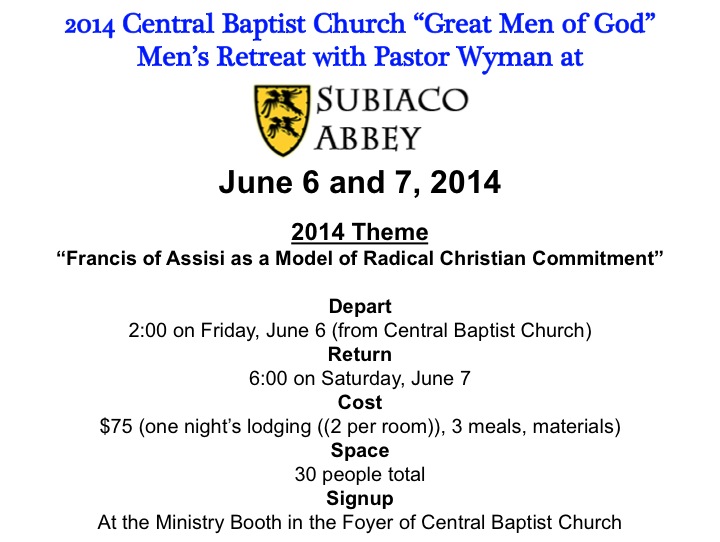
2014 (First Annual) Pastor-led “Great Men of God” Men’s Retreat at Subiaco Abbey

This retreat will mark the first annual Pastor-led “Great Men of God” Men’s Retreat at Central Baptist Church.  Each year we will consider the life of a great figure from Christian history and how that life can encourage us as we seek to walk more closely with Jesus.  The historical figures we will be considering will serve as springboards off of which we will jump into an intentional consideration of the Christian life in the modern world.


2014 “Great Men of God” Men’s Retreat

with Pastor Wyman at Subiaco Abbey

June 6 and 7, 2014

2014 Theme

“Francis of Assisi as a Model of Radical Christian Commitment”

Depart

2:00 on Friday, June 6 (from Central Baptist Church)

Return

6:00 on Saturday, June 7

Cost

$75 (includes one night’s lodging ((2 per room)), 3 meals, materials)

Deadline

Wednesday, May 21, 2014

Space

30 people total


A jpeg image to share:

2014CBCGreatMenofGodMensRetreat

Why I Will Be Voting Against the Proposed Revisions to Article III of the SBC Constitution

At the annual Convention gathering in Baltimore this coming June, SBC messengers will be asked to consider an Executive Committee proposal on revising Article III of the SBC Constitution.  The relevant details, along with some Q&A, can be read here.  For our purposes, let us consider the proposed wording here:

Proposed Article III, to be Considered in June

Article III. Composition: The Convention shall consist of messengers who are members of Baptist churches in cooperation with the Convention at levels which the Convention, from time to time, determines. The following subparagraphs describe the Convention’s current standards and method of determining the maximum number of messengers the Convention will recognize from each cooperating church to attend the Convention’s annual meeting.

1. The Convention will only deem a church to be in friendly cooperation with the Convention, and sympathetic with its purposes and work (i.e., a “cooperating” church as that descriptive term is used in the Convention’s governing documents) which:

    1. Has not intentionally operated in any manner demonstrating opposition to the doctrine expressed in the Convention’s most recently adopted statement of faith. (By way of example, churches which act to affirm, approve, or endorse homosexual behavior would be deemed not to be in cooperation with the Convention.)
    2. Has formally approved its intention to cooperate with the Southern Baptist Convention. (By way of example, the regular filing of the annual report requested by the Convention would be one indication of such cooperation.)
    3. Has made undesignated, financial contribution(s) through the Cooperative Program, and/or through the Convention’s Executive Committee for Convention causes, and/or to any Convention entity during the fiscal year preceding.

2. Under the terms above, the Convention will recognize to participate in its annual meeting two (2) messengers from each cooperating church, and such additional messengers as are permitted below.

3. The Convention will recognize one (1) additional messenger from each cooperating church for each full percent of the church’s undesignated receipts or for each six thousand dollars ($6,000), whichever is less, which the church contributed during the fiscal year preceding through the Cooperative Program, and/or through the Convention’s Executive Committee for Convention causes, and/or to any Convention entity.

4. The messengers shall be appointed and certified by their church to the Convention, but the Convention will not recognize more than twelve (12) from any cooperating church.

5. Each messenger shall be a member of the church by which he or she is appointed.

6. If a church experiences a natural disaster or calamitous event and, as a result, the church is not qualified to appoint as many messengers as the church could appoint for the Convention’s annual meeting immediately before the event, the church’s pastor or an authorized church representative may, for no more than the three (3) annual meetings after the event, certify the facts to the registration secretary and obtain the same number of messengers it could have certified for the Convention’s annual meeting immediately before the event.

I will be voting against this proposal because of the wording of 1(1):

1. The Convention will only deem a church to be in friendly cooperation with the Convention, and sympathetic with its purposes and work (i.e., a “cooperating” church as that descriptive term is used in the Convention’s governing documents) which:

1. Has not intentionally operated in any manner demonstrating opposition to the doctrine expressed in the Convention’s most recently adopted statement of faith. (By way of example, churches which act to affirm, approve, or endorse homosexual behavior would be deemed not to be in cooperation with the Convention.)

While the example of “churches which act to affirm, approve, or endorse homosexual behavior” is given, strategically, as an example of how this will be used, the following example could also be used:  “churches which act to affirm, approve, or endorse open communion.”

See?  The 2000 BF&M speaks against both.  It speaks rightly against gay marriage by defining marriage as being between a man and a woman in Article XVIII and wrongly against open communion in Article VII.  Both are disfellowshippable offenses, according to this proposed wording.

This sword cuts both ways.

Now, apparently over 50% of SBC churches practice some form of open communion in violation of Article VII of The Baptist Faith Message.  I have discussed this fact, as well as some possible resolutions, here, here, and here.  But what is important to understand is this:  if this proposal gains Convention approval, SBC churches that open the Lord’s Supper to infant baptized believers in Christ will, de facto, be “deemed” churches that are NOT “in friendly cooperation with the Convention, and sympathetic with its purposes and work.”

I repeat:  over 50% of our churches will be “deemed” churches that are NOT “in friendly cooperation with the Convention, and sympathetic with its purposes and work” if this passes.

Some have attempted to put our concerns at ease by saying, in essence, “Oh, don’t worry, of course open communion churches would not actually be disfellowshipped.  This is just a tool that enables us to disfellowship churches who have taken up truly grievous offenses.”  To which I say:

  • The insult is not in being actually disfellowshipped.  The insult is in being told you are right now disfellowshippable…and that is the status that approval of this proposal would confer.
  • Furthermore, as a matter of principle is it wise to adopt a policy which would literally disfellowship over 50% of SBC churches if consistently applied?  Is it wise to adopt a policy you cannot consistently apply without destroying the SBC?
  • Furthermore, forgive me if I am not comforted by assurances from on high that, “Oh, we won’t come for you.”  The very nature of fundamentalism is the elevation of secondary issues to primary status.  I would prefer not to be in the position of saying to a group of folks whose motives appear a bit unclear to me, “I’ll just put my head on the chopping block here trusting your word that the axe will not fall for me.” (Sorry for the hyperbole, but the analogy is apt.)
  • Furthermore, functionally speaking, if this passes, how is the BF&M not a creed?
  • Furthermore, surely supporters of this proposal can see the profound insult inherent in calling good SBC churches who work hard to support SBC causes and raise funds for SBC missions and ministry efforts NOT “in friendly cooperation with the Convention, and sympathetic with its purposes and work.”  Instead of telling me and the church I pastor that we are potentially disfellowshippable, how about just a, “Thank you guys for all you do,” instead, and drop this nonsense.

This is a very, very bad idea.

The suggestion has been made that Article VII of the BF&M will likely be revised in due time, thus solving the problem.  Sorry, no dice:  it does not solve the problem until it is revised and, until that time, the problem should not be unnecessarily brought into the SBC.  If the Executive Committee is proposing an idea that they know cannot be consistently carried out, then let the Executive Committee propose a revision to Article VII of the BF&M first so as to avoid this nonsense.

[A Rerun on the Eve of Lent] Should Baptist Christians Observe Lent?

Three years ago I ran the following post on an older version of this site.  The comment section became very interesting very quickly, though I have not transferred those comments from there to here.  Tomorrow is Ash Wednesday, so I’ve decided to rerun it here.


Last Sunday I mentioned to Central Baptist Church that this Wednesday, Ash Wednesday, marked the beginning of Lent.  I mentioned that we Baptists have traditionally observed portions of the Christian calendar while ignoring or rejecting other portions, but that there may be good reasons to observe some portions we have traditionally neglected.

Over the last couple of days, I’ve received comments ranging from appreciation, to curiosity, to questioning of Lent and my mentioning it from the pulpit.  So I thought I might just share a few thoughts on the question of whether or not Baptists should observe Lent.  In no particular order:

  • The short answer:  “Yes” if you find it helpful.  “No” if you don’t.
  • It is true that we do not find the observance of Lent in the New Testament, but neither do we find the observance of Christmas or one special annual day for Easter (every Sunday was an observance of Easter for the early believers!).
  • Concern is occasionally raised because Lent seems to be a Catholic observance.  Sure enough, Catholics observe Lent, but so do and so have many Protestants, albeit moreso in the Magesterial Protestant tradition. (Catholics also, by the way, observe Easter and Christmas, days I’d like to keep around!)
  • It is curious to me that Baptist Christians have more interest in the secular and political calendar than in the historic Christian calendar.  For instance, where in the New Testament do we see the early church observing something like Mother’s Day, Father’s Day, Veteran’s Day?
  • Sure, the liturgical calendar presents us with very interesting symbols that we do not see specifically in the Bible.  Tomorrow many Christians will be marked on the forehead with ashes for Ash Wednesday.  But why, praytell, does this raise eyebrows (when, at least, it has some biblical founding – ashes as a sign of humility and repentance) when our wholesale embrace of clearly non-biblical (not un-biblical, just non-biblical) symbols does not?  I speak, for instance, of the following symbols we embrace:  the American flag, the Christian flag, the iconic symbol of the cross, the symbol of the fish.  Moreso, we embrace culturally-defined symbols all the time:  wedding bands, sports symbols, the favorite chants, cheers, dances, motions of our favorite teams, etc.
  • View Lent as a running start to jump into Easter, if that helps.
  • The greatest irony in all of this is the current fad of observing “40 Days of _____” (fill-in-the-blank: Purpose, Prayer, Stewardship, etc.) in Baptist churches.  I mean, if we can observe 40 Days of Purpose for Rick Warren why can’t we observe the season of Lent, which has a grander historical pedigree, is, I dare say, even more biblically robust (NO knock on Rick Warren intended!), and has been a useful tool for Christians all over the world through the ages?  I’ll wager my left leg that if LifeWay took Lent, renamed it, put in a package, called it “40 Days of Repentance and Reflection”, and created a Leader’s Guide and student workbook, Baptists would gobble it up in droves, wear the pre-printed t-shirts, armbands, headbands, etc.  Meaning, if we can observe 40 days of kitsch, we can certainly observe 40 days of Lent.
  • NONE of this is to say you should or must observe Lent or you’re wrong if you don’t.  Again, if you find it helpful, do so.  If you don’t, don’t.  But it’s something to consider.
  • Just thinking aloud…

Thoughts on the William Lane Craig/Sean Carroll Debate

God-and-Cosmology-Carroll-vs-Craig

Last Friday, a few of us drove down to New Orleans for the 2014 Greer-Heard Point-Counterpoint Forum debate between Christian apologist, William Lane Craig, and atheist physicist Sean Carroll.  The debate was held at New Orleans Baptist Theological Seminary.  I am actually fairly skeptical of the effectiveness of these debates, but I consider Craig to be such a master of this particular approach to apologetic discourse that I decided to go see him.

It was a frustrating evening.

A lot was going on:  there was a degree of posturing on both sides, I think.  Craig was clearly trying to communicate that he has a good grasp of modern cosmology.  Sean Carroll was clearly trying to communicate that Craig has no such thing.  Craig was trying to show that the implications of modern cosmology affirm rather than deny certain conclusions that bolster the claims of theism.  In particular, Craig argued, modern cosmology has done nothing to dispense with the idea that the universe had a beginning.  Thus, appealing to the Kalam cosmological argument, if it had a beginning, it had a cause, a cause outside of the universe. Carroll, in response, swept away Craig’s entire argument by saying that the kind of thinking Craig was indulging in had merit 500 years ago, but not now, and that he was thinking about the entire issue all wrong and was therefore asking the wrong questions.  He asserted that (1) cosmologists have come up with nearly 20 models for an eternal, uncaused universe even though (2) none of the models have proven to solve the problem.  This was very frustrating.  Even more frustrating was Carroll’s dismissal of cause-and-effect reality on the basis that, to paraphrase, the universe itself is not like things in the universe.

Many specifics of the debate were mildly irritating.  Both men spoke on a level that they had to know would lose the vast majority of us in the audience.  Sean Carroll showed his lack of debating experience by offering smarmy facial expressions and head nodding behind Craig as he spoke.  Craig never did this when Carroll spoke.  Carroll’s final abandonment of the topic at hand to lecture the Christians present about the need to abandon their outdated views (i.e., “low hanging fruit” on “the tree of life”) and join him and the other intellectual elites in the upper branches of the tree of knowledge was smarmy and, again, revealed his lack of debating experience.  Carroll’s stupefyingly blind optimism in his own brand of fundamentalist scientism was too obvious to be concealed.  Does the idea of an eternal universe go against common sense and all that we know about causes and effects?  Sure, but the universe itself is different somehow and we’ll figure it out.  Are there any good models to explain the eternal universe?  No, but there are models that are trying to explain it and we’ll figure it out.

Carroll held his own against Craig, is confident and speaks clearly, and did not cower before the Christian apologist.  Craig’s central assertions, however, remain unrefuted, and cosmologists will have a long way to go if they really want to convince thoughtful people that nothing produced everything out of nothing on its own.

Liliana Cavani’s 1989 Film, “Francesco”: An Unusual Movie About Francis of Assisi

I was intrigued to discover that Mickey Rourke (yes, Mickey Rourke) played St. Francis in a 1989 film by Liliana Cavani.  (You will be pleased to know I discovered this fact by Googling “movies about St. Francis” and NOT “movies with Mickey Rourke”).  Helena Bonham Carter plays Claire in the film.  Furthermore, the soundtrack was done by Vangelis, he of “Blade Runner” soundtrack fame.  Despite, and perhaps because, of this very strange ensemble of people (did I mention that Mickey Rourke played St. Francis?!), I decided to check it out.  Fortunately, it was on YouTube in its entirety so I’ve provided it below.

Reading Francis biographies is a bit of a hobby of mine, and I am presently working on a project concerning his life and what Protestant Christians can learn from him.  Zeffirelli’s 1972 film, “Brother Son, Sister Moon,” remains, in my opinion, the best Francis movie, but this Cavani film has its moments.  In particular, it powerfully demonstrates Francis’ struggle with the growth, leadership, and management of his movement.  This is no doubt because of the fact that Francis neither sought nor wanted “a movement” at all.  The movie also demonstrates well the struggle Francis faced with holding to his gospel ideal in the face of calls for a “more realistic” approach to this life.  One feels for Francis in these moments.  Had he set out to put the mantle of his gospel ideal on others, one would be more understanding of the opposition he faced, but the fact that others came voluntarily to Francis and his lifestyle makes their complaints that much more frustrating.  Furthermore, believe it or not, Mickey Rourke’s performance is admirable, once you get used to seeing him in this roll.

**Warning:  This is a European film and there are a few scenes of nudity (stripped bodies after a battle, Francis’ disrobing and hurling of himself into the snow to battle lust, etc.).

Some Thoughts on Macklemore’s Song “Same Love”

“In regione caecorum rex est luscus.”

(“In the land of the blind the one-eyed man is king.”)

Desiderius Erasmus, Adagia, 1500
 

tumblr_static_imageI remarked to my daughter recently that her generation will grow up in an America that more closely resembles the ethics, morals, spiritual outlook, and overall milieu of the 1st century Roman Empire than any other generation in American history.  I did not mean the statement for shock value nor did I mean it as a romantic gloss on earlier periods of American history that, in their own way, resembled Rome here and there.  No, I actually and simply believe that to be the case.  Modern America is now decidedly post-Christian and is steering into heretofore uncharted waters spiritually and morally, at least in our own story as a nation.

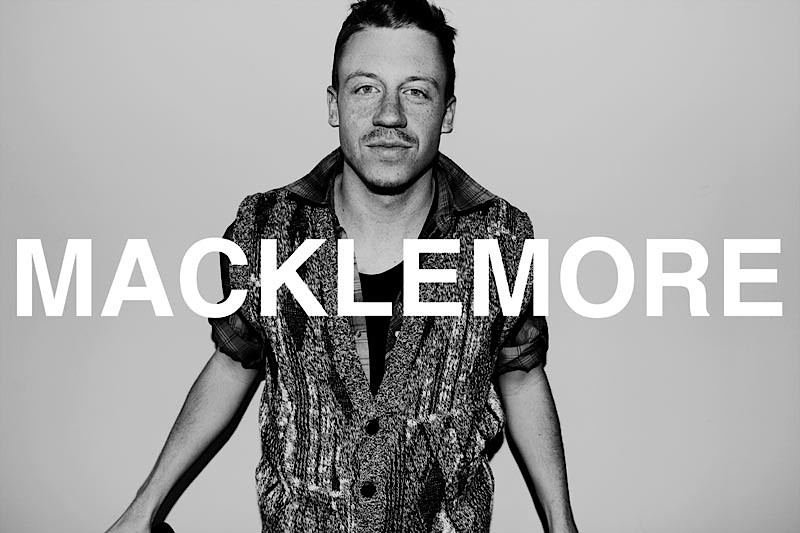
The moments where these things become most clear are in large public displays of the modern zeitgeist, such as award ceremonies like the Grammy’s, which aired on January 26.  I watched some of the Grammy’s and was able to see Macklemore’s performance of his pro-gay anthem, “Same Love.”  I had never heard of Macklemore or his song before last Sunday night.  The purpose of this post is not to critique the strange, Moonie-esque mass wedding of gay and straight couples that accompanied Macklemore’s performance and was “officiated” by Queen Latifah (with a dramatic appearance by Madonna to boot)…not that such a critique is not deserving.  In and of itself, the spectacle of this whole thing (Latifah’s intro, the church set, etc.) is worthy of consideration concerning what it reveals about where we currently are, and you can see it here if you would like:

But evaluating the spectacle is not my purpose in this post.  My purpose, rather, is to suggest that the lyrics to Macklemore’s gay rights anthem perfectly encapsulate the current worldview of modern America.  Let’s work through the lyrics.

The Predisposition Argument

When I was in the 3rd grade I thought that I was gay ’cause I could draw,
My uncle was and I kept my room straight
I told my mom, tears rushing down my face, she’s like,
“Ben you’ve loved girls since before pre-K”
Trippin’, yeah, I guess she had a point, didn’t she?
A bunch of stereotypes all in my head
I remember doing the math like “Yeah, I’m good a little league”
A pre-conceived idea of what it all meant
For those who like the same sex had the characteristics
The right-wing conservatives think its a decision
And you can be cured with some treatment and religion
Man-made, rewiring of a pre-disposition. Playing God
Ahh nah, here we go

It is not suprising that Macklemore offers this argument first.  It is a staple in pro-homosexual arguments and is to be expected.  It also rests on a terribly and, it turns out, simply flawed premise.  The premise behind the predisposition argument appears to be that innate desires, desires we are born with, are justifiable by virtue of being inherent.  If this is not the premise, I would love to be corrected.  That is because it is a demonstrably false and, if consistently followed, dangerous premise.

I rather suspect that the same people claiming that inherent predispositions are thereby justifiable predispositions do not really mean this.  We all know that many of us have dispositions towards this or that habit, desire, or action that we must war against: anger, lust, physical violence, alcoholism, etc.  Some people struggle with this predisposition and others struggle with that, but, again, I seriously doubt that anybody really believes in any consistent way that inherent desire is thereby justifiable desire.  It makes a nice mantra for modern sexual tolerance, but, here again, it cannot be consistently applied, unless, of course, we would like to say to incarcerated pedophiles who claim to have always had a predisposition for sexual attraction toward children that their desires are therefore justifiable since they are inherent.  Of course they are not justifiable.  Here is where the premise breaks down.

What is more, Macklemore’s oversimplified argument about “right wingers” thinking it is a choice is naive.  I, for one, have no problem believing those homosexuals who say that they have felt same-sex attraction from their youth.  I realize some Christians do, but it has been my experience that when you really talk to those who seek to deny this they usually reveal that they have not thought through their own Christian confession consistently enough.

What I mean is that it is a tenet of orthodox Christianity that human beings are born fallen, broken, and with our hearts turned from God.  In truth, those Christians who want to deny that some might be born with these inclinations are actually granting legitimacy to the faulty premise I just mentioned.  Orthodox Christian teaching would not say, “No, you cannot have been born with these desires.”  Orthodox Christian teaching would say, “Perhaps you were, perhaps not, but the Bible teaches that we are born fallen and that the inclinations of our hearts are evil from our youth.  If you were born with these desires, it neither validates the desires nor invalidates Christian truth, for Christian truth proclaims that we are born with our hearts innately predisposed to all kinds of wickedness.  Therefore, your argument in no way proves your premise and in no way disproves the Gospel.  Rather, it confirms it.  We are born sinners in need of forgiveness.”  (As an aside, I do wish  more Christians in America would think these issues through biblically.)

Macklemore and Scripture

America the brave
Still fears what we don’t know And God loves all his children it’s somehow forgotten
But we paraphrase a book written thirty-five hundred years ago
I don’t know

I will not deal with the cliche’d charge of homophobia (“America the brave still fears what we don’t know”) because it is so palpably unjust.  One does wish that gay activists would realize what I suspect, deep down, they know:  it is profoundly unhelpful to suggest that the options in the gay debate are (1) a modern education leading to knowledge that will inevitably lead the recipient to see the sterling beauty of homosexuality or (2) gross, backward, ignorance buttressed by fear and leading to hatred.  No, in point of fact, there are many people who have thought very deeply and very well on this issue and consider homosexuality to be morally deficient for precisely that reason.  But I digress.

When I heard Macklemore’s song on the Grammy’s, these lines about the Bible jumped out at me.  What is fascinating here is that Macklemore (1) makes a theological claim (i.e., “God loves all his children”) while (2) offering the typical Richard Dawkins-esque rejection of the veracity of scripture on the basis of its antiquity (“a book written thirty-five hundred years ago”).  The line about us “paraphrasing” the Bible, just before the line dismissing the Bible as ancient and irrelevant, is confusing.  Is he suggesting that those who view homosexuality as sinful have skipped the particulars of scripture in favor of a vague sentiment of condemnation?  Is this the paraphrase he sneers at?  That would seem odd since (a) a non-paraphrase approach to reading the Bible would lead to a more careful exegeting and interpreting of the text…a phenomenon that does not work well for the gay movement and (b) Macklemore’s maxim, “God loves all his children,” would seem to be a paraphrase itself, especially as it is eisegetically loaded up with a definition  of “love” drawn more from modern American sentimentalism and permissiveness than love biblically defined.  Which is to say that Macklemore seems to be the one who has paraphrased scripture towards his desired end, not those who take scripture at its words concerning the sinfulness of homosexual behavior.

In short, this is a profoundly muddled hermeneutic leading, understandably, to irretrievably muddled conclusions.  One could indeed use the lyrics of “Same Love” as a case study in the sheer chutzpah of the hermeneutics of modernity and the selective reading of a text for a desired and politically advantageous end.

Macklemore and Moral Reformation

And I can’t change
Even if I tried
Even if I wanted to
And I can’t change
Even if I tried
Even if I wanted to
My love, my love, my love
She keeps me warm
She keeps me warm
She keeps me warm
She keeps me warm

This cry of futility regarding change is telling.  Paul said essentially the same thing in Romans 7, with the very different conclusion that, while he could not change himself (“wretched man that I am”), Christ could indeed change him.  And Paul had seen Him change others, including homosexuals.  This is how Paul put it in 1 Corinthians 6:

9 Or do you not know that the unrighteous will not inherit the kingdom of God? Do not be deceived: neither the sexually immoral, nor idolaters, nor adulterers, nor men who practice homosexuality, 10 nor thieves, nor the greedy, nor drunkards, nor revilers, nor swindlers will inherit the kingdom of God. 11 And such were some of you. But you were washed, you were sanctified,you were justified in the name of the Lord Jesus Christ and by the Spirit of our God. [emphases mine]

If Macklemore wants a non-paraphrased Bible (a worthy desire to be sure), then perhaps he will reflect on these astounding verses.  Was Paul mistaken?  Was he lying?  Or had homosexuals not been freed by the blood of Christ?  What is more, the complete absence of the core of the gospel at this point is tragic.  There is no hint of that to which Paul points in v.11:  the power of Christ to free us and change us.  Finally, keep these words of Paul in mind, for Macklemore will conclude his song by quoting Paul.

The Charge of Hatred

Part and parcel of the gay assault on the biblical sexual ethic is the charge of hatred.  Macklemore does this effectively by lumping the church in with those who launch crude, verbal assaults against gays.

If I was gay I would think hip-hop hates me
Have you read the Youtube comments lately?
“Man, that’s gay” gets dropped on a daily
We’ve become so numb to what we’re sayin’
Our culture founded from oppression
Yeah, we don’t have acceptance for ’em
Call each other faggots behind the keys of a message board
A word rooted in hate, yet our genre still ignores it
‘Gay’ is synonymous with ‘the lesser’
It’s the same hate that’s caused wars from religion
Gender to skin color the complexion of your pigment
The same fight that led people to walk-outs and sit-ins,
It’s human rights for everybody
There is no difference
Live on! And be yourself!
When I was in church, they taught me something else
If you preach hate at the service, those words aren’t anointed
And that Holy Water that you soak in is then poisoned
When everyone else is more comfortable remaining voiceless
Rather than fighting for humans that have had their rights stolen
I might not be the same, but that’s not important
No freedom ’til we’re equal
Damn right I support it

I don’t know

And I can’t change
Even if I tried
Even if I wanted to
My love, my love, my love
She keeps me warm
She keeps me warm
She keeps me warm
She keeps me warm

Perhaps I can be excused for wanting a bit more definition on what Macklemore means by preaching “hate at the service.”  Does he mean the truly hateful rantings of somebody like Fred Phelps?  Or does he mean that a pastor like myself who would stand and preach faithfully the Word of God on this issue of homosexuality is being hateful?  It would be most helpful to see this distinction made, for it is a distinction born in reality.  Here is a key that gay advocates must come to terms with:  it is indeed possible to consider homosexuality sinful and not, in fact, hate homosexuals.  Indeed, if the Bible is right, the careful, redemptive call for homosexuals to repent is the ultimate act of love.

Is there hate preached from pulpits?  I have no doubt there is.  But the careful proclamation of the Word on these issues is decidedly not hate.  Even so, one looks in vain for any trace of this vital distinction in “Same Love.”

On the Notion of Progress

C.S. Lewis once spoke of modern humanity’s notion of progress as hopelessly and paradoxically backward.  What humanity often sees as progress is, in fact, usually a regress.  We see this same certainty in Macklemore’s next words.

We press play Don’t press pause
Progress, march on!
With a veil over our eyes
We turn our back on the cause
‘Till the day That my uncles can be united by law
Their kids are walkin’ around the hallway
Plagued by pain in their heart
A world so hateful, some would rather die than be who they are
And a certificate on paper
Isn’t gonna solve it all, but it’s a damn good place to start
No law’s gonna change us
We have to change us. Whatever God you believe in
We come from the same one
Strip away the fear
Underneath it’s all the same love
About time that we raised up

And I can’t change
Even if I tried
Even if I wanted to
And I can’t change
Even if I tried
Even if I wanted to
My love, my love, my love
She keeps me warm
She keeps me warm
She keeps me warm
She keeps me warm

I would simply point out that the advice to “press play” and “don’t press pause” is as apt a description of the current American tragedy as I have ever read.  In contrast, I am reminded of William F. Buckley, Jr.’s  desire to “stand athwart history and yell STOP!”  This dizzying charge into the future of sexual anarchy and moral redefinition is clearly not being accompanied by solid, careful thought, if Macklemore’s anthem is any indication, which, I suspect, it is.  It is all inertia, all momentum, all “press play.”  America is a nation that is being compelled forward by the impulsive glandular proclivities of an aggressive and hungry minority that will not stop until the old verities have been thoroughly discredited, besmirched, and, at least, obfuscated.  These lyrics capture that reality perfectly.

Macklemore and the Apostle Paul

Finally, in a move that is frankly stunning in its capacity to affect complete confusion concerning Macklemore’s hermeneutic and general epistemology, he quotes the words of Paul from 1 Corinthians 13…proclaiming that these words will now liberate him from ever having to feel guilty on a Sunday!

Love is patient, love is kind
Love is patient
Love is kind (Not crying on Sundays)
Love is patient,(Not crying on Sundays) love is kind (I’m not crying on Sundays)
Love is patient,(Not crying on Sundays) love is kind(I’m not crying on Sundays)
Love is patient, love is kind

This is staggering.  Is this quoting of Paul a vote of confidence by Macklemore?  Surely it cannot be for Paul speaks plainly of how homosexuality falls short of God’s design for us.  Will Macklemore at least have the honesty to let the author whose words he has lifted define love as he means it?  Not to do so is disingenious, for whatever Paul means by “love” he does not mean that state of mind and heart that looks upon sinful behavior as acceptable before God.  On the contrary, Paul’s writings suggest that he felt God’s love was such that it refused to leave us in our sins, and our own love should be such that it calls those who have turned from God, even in their sexual lives (1 Corinthians 5), to repent and come back home.

As I said:  we are living in a cultural milieu that is becoming increasingly pagan and muddled in its thinking.  We are morphing into an outright carnival of the absurd, both in our brazen rewriting of the moral code and in our shocking parading of that rewriting.  What is more, truth now seems to be a matter of emotionally-driven platitudes that borrow here and there from the sacred text, redefining as it goes, and castigating scripture at the same time.  In a world of biblical illiteracy this is shockingly easy to do, of course.  What is more, in a world that has forgotten how to think well and deeply, these mantra-driven assertions of modernity appear profoundly serious (note the deeply emotional reactions to this Grammy presentation online), when, in fact, they prove inevitably to be trite and vapid on closer examination.

Even so, “In the land of the blind the one-eyed man is king.”

May God give us the courage to speak truth in love against the new sexual orthodoxy.