Franz Kafka’s The Trial

5a1In Franz Kafka’s novel, The Trial, a man named Josef K. (referred to simply as “K.” throughout the book) is arrested on charges that are never explained to him by a court that is shrouded in mystery, presided over by judges that wield seemingly arbitrary power, and in which lawyers and agents of the court appear to be experts in obfuscation. K. attempts to live his life like normal in the midst of this odd ordeal, per the instructions of the court, but the ever-looming trial haunts and torments him, pulling him further and further into the depths of the system’s insanity.  Ultimately, K. is taken out by two agents of the court and executed with a knife.

This is a strange, frustrating, but intriguing and provocative tale.  The genius of Kafka was in creating mysterious, nightmarish tales that are open to various interpretations.  There is an absurdity about this story that is terrifying because it evokes the absurdity of life as we oftentimes actually encounter it.

The story left me with many questions.  What is the trial?  Is K. Kafka and is this a psychological or spiritual autobiography?  Is this a story about religion?  If Kafka saying that life itself is a strange trial the rules of which are never made clear to us, that God is the ominous Judge before whom we are somehow guilty and from whom we can never escape?  Is it a story about government, its power over man, its stifling and absurdist bureaucracy and labyrinthine red-tape, or is it simply a commentary on the suffocating, vicious underbelly of society and its power structures?  Is the trial more personal, a projection of Kafka’s own sense of being trapped in something he cannot possibly begin to understand, of being doomed by ominous forces outside of his control?  Is this an ode to existential despair, pessimism, nihilism even?

Is the key to the story to be found in the final words (or what appear to be the final words – Kafka never finished and polished the story, and fragments remain, but this appears to be the conclusion), K.’s final observation at the moment of his murder as the knife is plunged into him:  “Like a dog”?  Does that mean that Kafka’s tale is about how the maddening and nonsensical dynamics of life that we find ourselves trapped in eventually succeed in robbing us of our dignity and our humanity, that they reduce us to animals, “like a dog”?

There is a despair about this story that is unsettling, that somehow resonates with much that we experience in life.  It is reminiscent of Solomon’s more pessimistic musings in the book of Ecclesiastes, yet without the overarching hope of God’s deliverance.

This is a book to read more than once, but likely with some time in between.  I suppose the genius of Kafka is that he taps into the human sense of angst that all of us, at times feel.  I was drawn to and repelled by this story.

K.’s conversation with the priest in the cathedral had the most overtly theological (or theodical?) tone to it, and there I was close to concluding that this story is an accusation against God, that, in reality, The Trial is putting God on trial.  But I am not sure.  I fluctuated between thinking that and thinking that The Trial is simply life itself and its penchant for absurdist, inescapable dehumanization.  In that view, it is not unlike his story, The Metamorphosis [which I reviewed here].

I’m not sure what to say in terms of recommendation.  I can imagine many folks not liking this story at all.  But if you would like to see an attention-grabbing exercise in existential anxiety, and if you enjoy trying to decipher literary riddles, you should probably check this out.

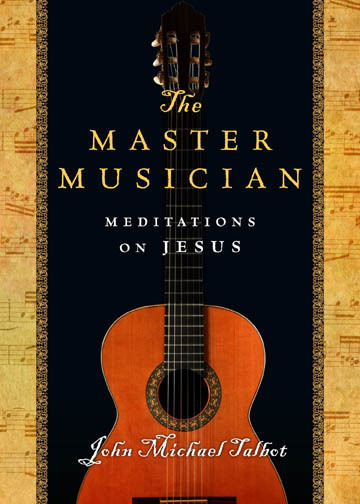
John Michael Talbot’s The Master Musician

The-Master-Music-Cover-Lo-Res

InterVarsity Press has republished musician John Michael Talbot’s book, The Master Musician, and I wanted to recommend it here as a nice, brief, but poignant devotional reflection on Christian growth both individually and corporately.  Talbot is a Franciscan monk based in Eureka Springs, Arkansas, whose music I have been listening to for over twenty years.  He has been writing and performing music on a very high level for a very long time, and his expertise will be evident as you read this book.

He establishes his operational premise at the outset of the book:

God is the Master Musician. We are his instruments. He gently plucks the strings of our lives to make a harmonious song for all creation. We are like a beautifully crafted guitar, formed, seasoned and brought to expression by the same hand. (Kindle Locations 30-32)

The remainder of the book is the fleshing out of this analogy.  Individually, he likens the Christian to a guitar and discusses the implications of a guitar’s creation and playing for the Christian life.  Corporately, he expands the analogy out to encompass various forms of musical expression:  choral, symphonic, ensembles, folk, rock, etc.  His ecclesiological and, specifically, ecumenical conclusions from this exercise are intriguing and thought-provoking.  He comes closing to pushing the analogy beyond the brink, but never quite does so.

In all, this is an accessible, creative, and helpful look at the Christian life through the eyes of a tremendous musician who is drawing on the world he knows best.  Highly recommended.

“Concerning the Church and Marriage”: A Last Minute Sermon Change

Marriage Heart HealthI’m not going to say much about this here.  I’ll just let the sermon speak for itself until I decide to address the issue further.  But, for numerous reasons, I did something yesterday (Saturday) that I almost never do.  I set aside the sermon I had worked on all week and wrote a new one in light of the recent Supreme Court decision concerning marriage.  I am not a political preacher.  I’m a Jesus preacher.  But I simply felt that I had a responsibility to speak from a gospel perspective to this issue.  I am grateful to pastor a church where I can simply share my heart on such controversial matters.  Here’s the sermon.

Exodus 17

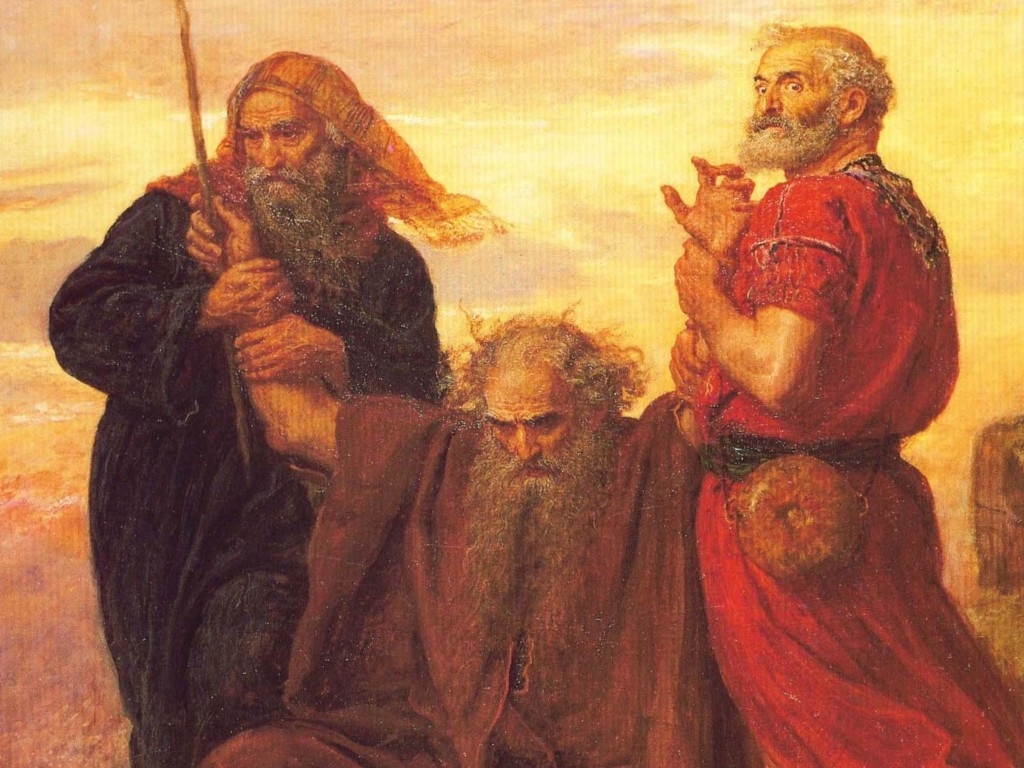
moses-holding-up-his-arms-during-the-battleExodus 17

1 All the congregation of the people of Israel moved on from the wilderness of Sin by stages, according to the commandment of the Lord, and camped at Rephidim, but there was no water for the people to drink. 2 Therefore the people quarreled with Moses and said, “Give us water to drink.” And Moses said to them, “Why do you quarrel with me? Why do you test the Lord?” 3 But the people thirsted there for water, and the people grumbled against Moses and said, “Why did you bring us up out of Egypt, to kill us and our children and our livestock with thirst?” 4 So Moses cried to the Lord, “What shall I do with this people? They are almost ready to stone me.” 5 And the Lord said to Moses, “Pass on before the people, taking with you some of the elders of Israel, and take in your hand the staff with which you struck the Nile, and go. 6 Behold, I will stand before you there on the rock at Horeb, and you shall strike the rock, and water shall come out of it, and the people will drink.” And Moses did so, in the sight of the elders of Israel. 7 And he called the name of the place Massah and Meribah, because of the quarreling of the people of Israel, and because they tested the Lord by saying, “Is the Lord among us or not?” 8 Then Amalek came and fought with Israel at Rephidim. 9 So Moses said to Joshua, “Choose for us men, and go out and fight with Amalek. Tomorrow I will stand on the top of the hill with the staff of God in my hand.” 10 So Joshua did as Moses told him, and fought with Amalek, while Moses, Aaron, and Hur went up to the top of the hill. 11 Whenever Moses held up his hand, Israel prevailed, and whenever he lowered his hand, Amalek prevailed. 12 But Moses’ hands grew weary, so they took a stone and put it under him, and he sat on it, while Aaron and Hur held up his hands, one on one side, and the other on the other side. So his hands were steady until the going down of the sun. 13 And Joshua overwhelmed Amalek and his people with the sword. 14 Then the Lord said to Moses, “Write this as a memorial in a book and recite it in the ears of Joshua, that I will utterly blot out the memory of Amalek from under heaven.” 15 And Moses built an altar and called the name of it, The Lord Is My Banner, 16 saying, “A hand upon the throne of the Lord! The Lord will have war with Amalek from generation to generation.”

There is a story behind the following picture that lends it more significance than we might otherwise imagine at first glance.
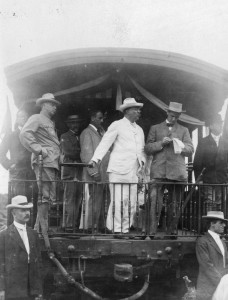
trpanamatrippictures7post

This is a picture of Theodore Roosevelt on the back of a train during his 1906 visit to the then-being-built Panama Canal. He had gone to Panama to see and inspect the work as well as to inspire the workers in their grueling and dangerous efforts to complete the canal. His visit was significant. It was the first time a sitting president of the United States had visited a foreign country while in office, so to say it created quite a stir would be an understatement.

In his amazing book, The Path Between the Seas, David McCullough writes of the effect that the sight of Roosevelt had upon many of those who saw him.

To the majority of those on the job his presence had been magical. Years afterward, the wife of one of the steam-shovel engineers, Mrs. Rose van Hardeveld, would recall, “We saw him . . . on the end of the train. Jan got small flags for the children, and told us about when the train would pass . . . Mr. Roosevelt flashed us one of his well-known toothy smiles and waved his hat at the children . . .” In an instant, she said, she understood her husband’s faith in the man.” And I was more certain than ever that we ourselves would not leave until it [the canal] was finished.” Two years before, they had been living in Wyoming on a lonely stop on the Union Pacific. When her husband heard of the work at Panama, he had immediately wanted to go, because, he told her, “With Teddy Roosevelt, anything is possible.” At the time neither of them had known quite where Panama was located.[1]

That strikes me as very interesting, perhaps because the modern American political landscape has engendered such skepticism among people that one wonders if the sight of any leader could actually inspire anything like hope in people today. It is also interesting because it points to, at least, the potential impact that a lone person can have on others. But even as I say that I realize it is too simplistic. What caused this wife to immediately take courage and have hope for the future was not Roosevelt per se, but what Roosevelt had come to represent: American ingenuity, resolve, determination, and strength. In other words, Roosevelt himself had become a symbol of greater realities, realities that contained what was necessary to lift embattled laborers out of despair and into new vistas of hope and optimism.

Symbols can do that. There mere sight of the right symbol can do that. I think we see this dynamic at work all throughout scripture. I believe we certainly see it at work in Exodus 17. The chapter contains two different stories that are united by common symbols: Moses and his hands and his staff. And, like all symbols, these encouraged the people by pointing to realities that far superseded a man and a staff.

God gave Israel a symbol that reminded them of past deliverance.

We begin, amazingly, with yet more complaints about water. Water has played a large part in the story of Exodus thus far, both on the far side of the Red Sea and, of course, through the Red Sea, and now on the promised land side as well.

1 All the congregation of the people of Israel moved on from the wilderness of Sin by stages, according to the commandment of the Lord, and camped at Rephidim, but there was no water for the people to drink. 2 Therefore the people quarreled with Moses and said, “Give us water to drink.” And Moses said to them, “Why do you quarrel with me? Why do you test the Lord?” 3 But the people thirsted there for water, and the people grumbled against Moses and said, “Why did you bring us up out of Egypt, to kill us and our children and our livestock with thirst?” 4 So Moses cried to the Lord, “What shall I do with this people? They are almost ready to stone me.” 5 And the Lord said to Moses, “Pass on before the people, taking with you some of the elders of Israel, and take in your hand the staff with which you struck the Nile, and go. 6 Behold, I will stand before you there on the rock at Horeb, and you shall strike the rock, and water shall come out of it, and the people will drink.” And Moses did so, in the sight of the elders of Israel. 7 And he called the name of the place Massah and Meribah, because of the quarreling of the people of Israel, and because they tested the Lord by saying, “Is the Lord among us or not?”

Yes, from the waters of the Nile, to the waters of the Red Sea, to the bitter waters of Marah, to the absence of water at Rephidim, water shows up again as both a necessity and a barrier. Above all, it (or its absence) shows up as an opportunity for the Lord God to prove once again his faithfulness.

The miracle at Rephidim is straight-forward enough: the children of Israel encamp, the children of Israel cry out for water, Moses, following the instructions of Yahweh God, strikes a rock and water gushes forth saving the life of God’s people yet again.

The IVP Bible Background Commentary rightly points out that “sedimentary rock is known to feature pockets where water can collect just below the surface. If there is some seepage, one can see where these pockets exist and by breaking through the surface can release the collected waters.” However, it also rightly goes on to say, “however, we are dealing with a quantity of water beyond what this explanation affords.”[2] We again see that naturalistic explanations will not work, even if God employed natural materials to work His wonders.

We see a pattern forming among the people of God: blessing – forgetfulness – complaint – rebuke – deliverance – blessing – etc. Time and time again we see this pattern or some variation of it. It is frustrating to observe, until, that is, we remember that we perpetuate this pattern in our own lives.

We are struck by the wonder of yet another miracle pointing to the glory of our great God. However, what stands out here is God’s instructions to Moses concerning how he was to approach the rock.

“Pass on before the people, taking with you some of the elders of Israel, and take in your hand the staff with which you struck the Nile, and go. 6 Behold, I will stand before you there on the rock at Horeb, and you shall strike the rock, and water shall come out of it, and the people will drink.”

There is an element of theater here that catches our attention. Moses is to (a) take his staff, (b) walk before the people, and (c) take with him some of the elders. He is then to (d) strike the rock with the same staff with which he had struck the Nile. This was also the same staff that Moses held over the waters of the Red Sea as God divided the waters and then returned the waters. We see this in Exodus 14.

15 The Lord said to Moses, “Why do you cry to me? Tell the people of Israel to go forward. 16 Lift up your staff, and stretch out your hand over the sea and divide it, that the people of Israel may go through the sea on dry ground.

21 Then Moses stretched out his hand over the sea, and the Lord drove the sea back by a strong east wind all night and made the sea dry land, and the waters were divided.

26 Then the Lord said to Moses, “Stretch out your hand over the sea, that the water may come back upon the Egyptians, upon their chariots, and upon their horsemen.” 27 So Moses stretched out his hand over the sea, and the sea returned to its normal course when the morning appeared. And as the Egyptians fled into it, the Lord threw the Egyptians into the midst of the sea. 28 The waters returned and covered the chariots and the horsemen; of all the host of Pharaoh that had followed them into the sea, not one of them remained. 29 But the people of Israel walked on dry ground through the sea, the waters being a wall to them on their right hand and on their left.

I am struck by these gestures that God repeatedly called upon Moses to employ and enact. After all, it was God working the miracle, not Moses, not his hands, and not his staff. So why ask Moses to act out these elements? There may be many reasons. Undoubtedly there is a certain element of leadership verification. God was thereby showing His own people that Moses was His divinely called instrument whom He was empowering to lead His children. Undoubtedly there was an element of clarification to Israel’s enemies as well. By allowing them to see that God was working through Moses, specifically, God was removing any temptation His enemies might have had of claiming that these events were simply freak occurrences.

There is something here about the abiding power of symbols and their importance in keeping God’s people focused and thinking clearly. At this point in the wilderness account, it is clear that Moses and his hands and staff had become symbols for the people of God. Simply put, they were symbols of God’s faithfulness, God’s might, God’s strength, and God’s love for His people.

Here at Rephidim, then, Moses walking before the people with his staff and his striking the rock was a way of reminding the people that the same God who turned the waters of the Nile to blood was the same God who divided the waters of Red Sea and was the same God who had turned the bitter waters of Marah sweet.

Thus, God was establishing among His people a symbol to remind them of past deliverance so that they would not lose heart in a time of present trial.

Of course, God has done the very same thing with His people today, the Church.

23 For I received from the Lord what I also delivered to you, that the Lord Jesus on the night when he was betrayed took bread, 24 and when he had given thanks, he broke it, and said, “This is my body which is for you. Do this in remembrance of me.” (1 Corinthians 11)

Bound up with all of this, of course, is the cross itself that the Church the world over has adopted as a symbol of the love and faithfulness of God.

God has left us physical symbols because Christians are not Gnostics. We do not consider all material creation to be evil. As physical beings, it is oftentimes through physical symbols that we are most helped to remember divine truths. Thus, the bread and the wine remind us, just as Moses and his staff reminded the Israelites, that God has not abandoned us, that God is with us, that God has not brought us into the wilderness to die of thirst, and that God will provide for His people.

Once again, God worked a miracle through Moses and his hands and his staff. At Rephidim, this miracle reminded the people. Then, on the heels of this great work, God called upon Moses and his hands and his staff to once more symbolize His divine power and majesty. This next miracle was occasioned by Israel’s first armed conflict since leaving Egypt.

God gave Israel a symbol that assured them of future victory.

Having provided miraculous waters, the Lord now moved to provide deliverance from an attacking army of Amalekites.

8 Then Amalek came and fought with Israel at Rephidim. 9 So Moses said to Joshua, “Choose for us men, and go out and fight with Amalek. Tomorrow I will stand on the top of the hill with the staff of God in my hand.”

The Amalekites were the descendants of Esau. They set upon the Israelites in the wilderness believing they could wipe out the wandering people. Of course, this was not to be. The Israelites were God’s people under divine commission to survive the wilderness and take back the land of promise. This meant that no army, be it the mighty army of Pharaoh or the undoubtedly less impressive but still dangerous army of the Amalekites, would conquer them. However, their victory still involved their obedience.

Moses called upon Joshua to act. This is the first time we meet Joshua. He was to play a crucial role in Israel’s eventual conquest of the land. Here, he is called upon to muster what troops he can to go and face the Amalekites. Tellingly, Moses said to him, “Tomorrow I will stand on the top of the hill with the staff of God in my hand.”

Here is the point of connection between the two stories: Moses, his hands, the staff, and the power of God. Tomorrow, Moses would once again be the instrument through which God would work. Peter Enns has pointed out something telling about the use of the word “tomorrow” in verse 9.

“Tomorrow” Moses will climb a “hill” with “the staff of God in [his] hand.”…Why wait until “tomorrow”? Throughout Exodus “tomorrow” represents the time in which God will act to punish Israel’s enemies. We saw this in the plague narrative (8:23,29; 9:5,18; 10:4). Most recently the word was used in 16:23 with respect to Israel’s gathering of bread on the sixth day in anticipation of the Sabbath. In other words, tomorrow is when something “big” happens. That the defeat of the Amalekites is to take place “tomorrow” signals to the reader that this is another redemptive event. It is a plague on another of Israel’s enemies.[3]

This is intriguing to be sure. Indeed, something “big” did happen on the morrow! Thus, Moses made preparations for the children of Israel to engage in its first war as a post-Egyptian-exile people. Old Testament scholar Douglas Stuart calls this conflict between Israel and the Amalekites “an example of Old Testament holy war.” He then offers twelve characteristics of holy war for Israel based on Deuteronomy 20:1-20 and other passages in the Old Testament. These characteristics are:

  1. No standing army was allowed.
  2. No pay for soldiers was permitted.
  3. No personal spoil/plunder could be taken.
  4. Holy war could be fought only for the conquest or defense of the promised land.
  5. Only at Yahweh’s call could holy war be launched.
  6. Solely through a prophet could that divine call come.
  7. Yahweh did the real fighting in holy war because the war was always His.
  8. Holy war was a religious undertaking, involving fasting, abstinence from sex, and/or other forms of self denial.
  9. A goal of holy war was the total annihilation of an evil culture.
  10. The violator of the rules of holy war became an enemy.
  11. Exceptions and mutations were possible, especially in the case of combat with those who were not original inhabitants of the promised land.
  12. Decisive, rapid victory characterized faithful holy war.[4]

These points describe the recurring pattern of Israel’s conflicts with it enemies in the wilderness wanderings and conquest, and deviations from these guidelines resulted in great catastrophe. But here Israel was faithful and the people of God were victorious and received God’s favor and blessings as our text recounts.

10 So Joshua did as Moses told him, and fought with Amalek, while Moses, Aaron, and Hur went up to the top of the hill. 11 Whenever Moses held up his hand, Israel prevailed, and whenever he lowered his hand, Amalek prevailed. 12 But Moses’ hands grew weary, so they took a stone and put it under him, and he sat on it, while Aaron and Hur held up his hands, one on one side, and the other on the other side. So his hands were steady until the going down of the sun. 13 And Joshua overwhelmed Amalek and his people with the sword. 14 Then the Lord said to Moses, “Write this as a memorial in a book and recite it in the ears of Joshua, that I will utterly blot out the memory of Amalek from under heaven.” 15 And Moses built an altar and called the name of it, The Lord Is My Banner, 16 saying, “A hand upon the throne of the Lord! The Lord will have war with Amalek from generation to generation.”

Moses, standing upon a hill, led the children to victory. When his hands were raised, Israel triumphed. When he lowered them, the Amalekites began to win. Therefore two men, Aaron and Hur, helped keep his hands up. In so doing, they demonstrated once again that while the victory was wholly God’s, the symbolic means through which God worked His wonders mattered greatly. The hands needed to be raised.

Thus, the symbol of remembrance before the rock gushing water became also a symbol of victory, present and future, here on the hill above the raging battle. The same symbol therefore pointed backward and forward. It reminded and it anticipated.

Earlier we pointed to the Lord’s Supper as God’s final symbol of remembrance for His people. At Rephidim, God had established a symbol of past deliverance for grumbling Israel, just as, in the Supper, Christ established a symbol of remembrance for His beleaguered Church. Interestingly, the Lord’s Supper, like Moses and his hands and his staff, is also a symbol of present and future victory. Notice the anticipatory element in the words of institution concerning the wine.

25 In the same way also he took the cup, after supper, saying, “This cup is the new covenant in my blood. Do this, as often as you drink it, in remembrance of me.” 26 For as often as you eat this bread and drink the cup, you proclaim the Lord’s death until he comes. (1 Corinthians 11)

The Lord’s Supper is a symbol that we do over and over again “until he comes.” It is an act of remembrance and anticipation. The Church needs ever and again to be reminded of her Champion.

Israel knew that God was with them when they saw Moses upon the hill with his arms upraised.

The Church knows that God is with us when we see Jesus with His arms outstretched.

Moses’ upraised arms meant victory by might was assured.

Jesus’ outstretched arms mean that victory is assured by love, by forgiveness, and by obedience.

The cross is the living symbol of God’s presence, God’s mercy, God’s love, and God’s faithfulness.

There on the hill we still see the symbol of life for us: the cross upon which Jesus died. And we also see the empty tomb, reminding us that Jesus has overcome sin, death, and hell.

The people of God still need reminders that we have a Champion and that His arms are raised forever for us.


[1] McCullough, David (2001-10-27). The Path Between the Seas: The Creation of the Panama Canal, 1870-1914 (pp. 499-500). Simon & Schuster. Kindle Edition.

[2] John H. Walton, Victor H. Matthews and Mark W. Chavalas, The IVP Bible Background Commentary: Old Testament. (Downers Grove, IL: InterVarsity Press, 2000), p.92.

[3] Peter Enns, Exodus. The NIV Application Commentary (Grand Rapids, MI: Zondervan, 2000), p.346.

[4] Douglas K. Stuart, Exodus. Vol.2. The New American Commentary. New Testament, Vol.2 (Nashville, TN: Broadman and Holman, 2006), p.395-397.


Apologia: A Sermon Series In Defense of the Faith, Part IIa – “Can We Trust the Bible?”

apologiaIf you grew up in church, it is likely that one of the first songs you ever sang as a child went like this:

Jesus loves me

This I know

For the Bible

Tells me so

Little ones

To Him belong

They are weak

But He is strong

Yes, Jesus loves me

Yes, Jesus loves me

Yes, Jesus loves me

The Bible tells me so

It is a sweet and, indeed, powerful little song…and it is gloriously true! The song makes a fundamental theological assertion: Jesus loves me. Then it twice gives the basis for our ability to know this fact: “the Bible tells me so.” This little song also points implicitly to a historical reality: the fact that the Church throughout time has stood confidently upon the claims of the Bible and what it says about God and us. But today that little statement, “the Bible tells me so,” is much more likely to be met with indifference or outright scorn than with confidence.

There can be no question that the major attacks on Christianity today are centered around the Bible. The average college student today or the average person with a normal amount of exposure to the major media outlets today will have heard numerous times that the Bible is unreliable, that it was written so far after the events that they purport to record that it cannot be trusted, that powerful leaders and churchmen altered the true message of the Bible to make it say what they wanted it to say, and that what we have is riddled with errors and contradictions and outright lies. In truth, the fundamental confidence in the Bible that many of you grew up feeling and seeing around you has largely been eroded in modern culture. More than that, any weight that the statement, “Because the Bible says so…” might have had at a certain point in our cultural history is by and large gone today.

Because of this, the Church needs to talk about how we got the Bible and the process of its formation. In truth, modern skepticism about the Bible presents the Church today with a unique opportunity to learn again the story that too many Christians today have never even heard, namely, the story of how the Bible came to be. It is, in fact, a truly amazing story and one that should engender faith and confidence in the Church. Young people in particular need to know that they can trust the Bible they hold in their hands, that they can have confidence that what they are reading is what was written, and that God speaks today through His word just as He has for two thousand years.

For our purposes today, I will be focusing on the New Testament in particular since that brings the topic into more manageable parameters in terms of size and since the New Testament in particular is the main point of the attack today for Christians. I am approaching this message with a particular premise in mind. That premise is this: the reliability of the New Testament is important as it is from the Bible that we learn information about the person of Jesus: who He is, why He came, and what He has done and is doing.

Let me also present three very basic facts related to the historical development of the Bible that will frame the presentation today.

  1. The books of the New Testament were written. The original manuscripts are called “the autographs.” The autographs were written between 50-100 AD. None of the autographs have yet been discovered.
  2. Immediately after the autographs were written, copies began to be made of the autographs and spread throughout the world. We refer to these as “the New Testament manuscripts.” We currently have around 5,800 Greek fragments, partial manuscripts, and complete manuscripts of the books of the New Testament. We have over 20,000 if we include manuscripts written in Latin and various other languages.
  3. In the year 367 AD, Athanasius, in his Festal Letter, provided the earliest known list of the 27 books of the New Testament as we know them.

These three basic facts will be important as we work through the issues surrounding the question of the reliability of the New Testament.

The Bible claims to have been inspired by God.

The most basic and fundamental fact is that the Bible claims divine inspiration for itself. That is, the writers of the Bible saw the Bible as having come from God, as having been inspired by God.

We find the key passage for this in 2 Timothy 3.

16 All Scripture is breathed out by God and profitable for teaching, for reproof, for correction, and for training in righteousness, 17 that the man of God may be complete, equipped for every good work.

The Greek word for “breathed out” is theopneustos. Theo = God, pneustos = breathed out. “All Scripture is theopneustos.” “All Scripture is God breathed.” Mark Strauss has offered some helpful insights on this word that provide a needed nuance to our understanding of it.

The Greek word translated “God-breathed” is theopneustos, a term possibly coined by Paul himself to express the nature of inspiration. The King James Version rendering, “inspired by God,” finds it roots in the Latin Vulgate (divinitus inspirata). Unfortunately “in-spired” might suggest that God “breathed into” Scripture its authority, while theopneustos more likely means that God “breathed out” Scripture. Inspiration does not mean divine validation of a human work, but God’s self-revelation of his own purpose and will.[1]

God, therefore, breathed out the scriptures. While it is true that “the scriptures” Paul would have been referencing in this particular verse would have been the Old Testament Scriptures (for the New Testament was obviously in the process of being written), it is clear that the New Testament writers saw their writings as being likewise scripture and therefore likewise God breathed. For instance, in 2 Peter 3, Peter referred to Paul’s writings as “scripture.”

15b just as our beloved brother Paul also wrote to you according to the wisdom given him, 16 as he does in all his letters when he speaks in them of these matters. There are some things in them that are hard to understand, which the ignorant and unstable twist to their own destruction, as they do the other Scriptures.

The Bible proclaims divine inspiration for itself. It sees itself as more than a collection of mere writings. It sees itself as God’s words to man mediated through inspired writers. For the skeptic, this will be an insufficient argument, for skeptics would simply point out that the Bible saying that the Bible is divinely inspired is a circular argument. But for the Church this is the first place to start: the Bible is God’s word.

The doctrine of inspiration, as in God’s inspiration of scripture, is closely related to a larger doctrine, the doctrine of revelation. Revelation refers to the broader idea of God’s disclosure of otherwise hidden truths. Thus, in the case of the Bible, God has revealed truth by inspiring men to write His word.

I believe the doctrine of revelation is ground zero in the battle for truth in the world today. When all is said and done, the first question that must be answered is the question that the serpent asked Eve in Genesis 3:1 in the garden of Eden: “Now the serpent was more crafty than any other beast of the field that the Lord God had made. He said to the woman, ‘Did God actually say…’” Along side the serpent’s question we should also put Pontius Pilate’s question from John 18:38, “What is truth?”

“Did God actually say?”

“What is truth?”

These two questions asked at two critical points in human history (the temptation of Eve and the crucifixion of Jesus) are still the questions being asked today. Has God actually spoken? Has God truly revealed anything about Himself? Does truth exist? How can we know it if it does? From where does truth come?

This is what is at stake in the modern world and, in truth, this is what has been at stake in every age of the world’s history: can we know the truth.

For Christians, the answer is a definitive, Yes! We know the truth because the Truth, Jesus, has come among us. “I am the way, the truth and the life” (John 14:6). Jesus is the apex, the summit of God’s revelation of Himself. But we know about Jesus through the scriptures that have been divinely inspired. Therefore, the Bible is not our object of worship. That would be idolatry. But the Bible does point toward the object of our worship, Jesus. To do so with any integrity, however, the Bible must be true and reliable and without error. And this is what the Bible is claiming for itself when it uses the word theopneustos, God breathed.

The writers of the Bible were aware of the need for accuracy and attested to the fact that they had been very careful in what they wrote.

The Bible is God’s word, but, again, it was mediated through men who were inspired by God to write the words. It is therefore profoundly significant that the writers of scripture gave testimony concerning the care they took with their writings. Consider, for instance, Luke’s preface to his book in Luke 1.

1 Inasmuch as many have undertaken to compile a narrative of the things that have been accomplished among us, 2 just as those who from the beginning were eyewitnesses and ministers of the word have delivered them to us, 3 it seemed good to me also, having followed all things closely for some time past, to write an orderly account for you, most excellent Theophilus, 4 that you may have certainty concerning the things you have been taught.

Luke acknowledges that many had written about the life of Christ and the beginnings of the Church, that these who had written had received and were now passing on the eyewitness accounts of those who saw and experienced the crucial events of the life of Christ, that he had closely studied the things that he was now writing, that he was structuring his letter in an orderly and careful way so that it would be accessible and understandable, and that the point of his gospel was that we “may have certainty concerning the things [we] have been taught.”

Certainty. This is what Luke felt the writings of the scripture could give us.

The point is that Luke makes a clear assertion of historical reliability and care with what he has written. Paul made the further point in 1 Corinthians 15 that the events described in his own teachings (and, by extension, his own writings) could be verified because many of the people who were hearing Paul were alive to witness the things about which he was teaching and writing.

3 For I delivered to you as of first importance what I also received: that Christ died for our sins in accordance with the Scriptures, 4 that he was buried, that he was raised on the third day in accordance with the Scriptures, 5 and that he appeared to Cephas, then to the twelve. 6 Then he appeared to more than five hundred brothers at one time, most of whom are still alive, though some have fallen asleep. 7 Then he appeared to James, then to all the apostles. 8 Last of all, as to one untimely born, he appeared also to me. 9 For I am the least of the apostles, unworthy to be called an apostle, because I persecuted the church of God. 10 But by the grace of God I am what I am, and his grace toward me was not in vain. On the contrary, I worked harder than any of them, though it was not I, but the grace of God that is with me. 11 Whether then it was I or they, so we preach and so you believed.

Paul therefore leaned heavily on the fact of eyewitness corroboration for his teachings. This emphasis on accuracy and reliability is telling. Paul was not trying to spin a yarn for money or fame. Rather, he was passing on a story that had been verified by many others and for which he was willing to die.

Peter made it very clear that accuracy and reliability were important to him as well. In 2 Peter 1, he wrote:

16 For we did not follow cleverly devised myths when we made known to you the power and coming of our Lord Jesus Christ, but we were eyewitnesses of his majesty.

Peter bases the accuracy of his writings on the fact that he was writing about things he had personally seen. He was an eyewitness. He was not making up a story. He was simply reporting the facts.

Church, if skeptics and critics wish to say that the biblical writers were intentionally and deliberately conspiring to mislead a gullible public, they can do so…but that is what they will, in fact, have to say. The writers of scripture were abundantly clear that they were passing on accurate and reliable information.

While the canon of the New Testament was not formally recognized until the late 4th century, the writings of the New Testament were being read and referred to by early Christian writers as early as the AD 90-110.

These writings, as we have said, were not formally codified until the 4th century. This fact has led some to the profoundly over-simplistic conclusion that there was no Bible for four hundred years. This is extremely bad thinking, however. What the Church did in the 4th century was finally and formally recognize the canon and establish the parameters of the definitive contents of the Bible, but in doing so they were not creating the Bible, they were simply and finally acknowledging what the Church had known for four hundred years already.

We know this because we have the writings of the church fathers, that is, the writings of those men who wrote immediately after the close of the canon. And guess what we find in the writings of the church fathers of the first three hundred years? A staggering number of references to the writings of the New Testament.

In his book, Is the New Testament Reliable? A Look at the Historical Evidence, Paul Barnett notes that three early Christian writers referenced the vast majority of the New Testament in their writings from 96-110 AD.

2

Clement, writing around 96 AD, references Matthew, Mark, Luke, Romans, 1 Corinthians, Ephesians, 1 Timothy, Titus, Hebrews, James, and 1 Peter.

3

Ignatius, writing around 108 AD, references Matthew, Mark, Luke, John, Acts, Romans, 1 Corinthians, 2 Corinthians, Galatians, Ephesians, Philippians, Colossians, 1 Thessalonians, 1 Timothy, 2 Timothy, Titus, Philemon, Hebrews, James, 1 Peter, 2 Peter, 1 John, 3 John, and Revelation.

4

Polycarp, writing around 110 AD, references Matthew, Mark, Luke, John, Acts, Romans, 1 Corinthians, 2 Corinthians, Galatians, Ephesians, Philippians, Colossians, 2 Thessalonians, 1 Timothy, 2 Timothy, Hebrews, 1 Peter, and 1 John.

Paul Barnett concludes that “on the basis of these three early Christian authors it can be stated that twenty-five pieces of the New Testament were definitely in circulation by about the year 100.”[2] This is compelling evidence of the early writing and accessibility of the New Testament that we have today.

In addition to these, the New Testament quotations of Justin Martyr, Irenaeus, Clement of Alexandria, Origen, Tertullian, Hippolytus, Eusebius have been counted and, in all, these early writers quote from or reference or paraphrase the gospels, the book of Acts, Paul’s letters, the general epistles, and Revelation 36,289 times. This evidence led famed Princeton scholar Bruce Metzger to write, “so extensive are these citations that if all other sources for our knowledge of the text of the New Testament were destroyed, they would be sufficient alone for the reconstruction of the entire New Testament.”

Dan Wallace, perhaps the leading evangelical New Testament scholar today, observes of these patristic allusions to the New Testament:

Commentaries, homilies, and other writings by ancient church leaders known as church fathers are so plentiful that if all the Greek and versional witnesses were destroyed, the text of the New Testament could be virtually reconstructed just from the data in these patristic writings.

The quotations of the New Testament by the fathers number well over a million. The fathers write as early as the late first century, with a steady stream through the thirteenth, making their value for determining the wording of the New Testament text extraordinary.[3]

Furthermore, Josh McDowell passes on this telling story:

Sir David Dalrymple was wondering about the preponderance of Scripture in early writing when someone asked him, “Suppose that the New Testament had been destroyed, and every copy of it lost by the end of the third century, could it have been collected together again from the writings of the Fathers of the second and third centuries?” After a great deal of investigation Dalrymple concluded: “Look at those books. You remember the question about the New Testament and the Fathers? That question roused my curiosity, and as I possessed all the existing works of the Fathers of the second and third centuries, I commenced to search, and up to this time I have found the entire New Testament, except eleven verses.”[4]

Even the physical forms of the writings we have bear testimony to the early Church’s acknowledgment of and dependence upon the writings of the New Testament. Paul Barnett explains:

Justin, a leader of Christianity in Rome in the middle of the second century, refers to the memoirs composed by the [apostles], which are called gospels, are read as long as time permits…Justin describes how the church leaders read and applied the message of the Gospels to the assembled believers each Sunday in every city. This is only one of numerous examples indicating that the Christians of the second century read the New Testament, as well as the Old Testament, in their Sunday-by-Sunday church gatherings. Consistent with this is the recovery in recent years of manuscripts of the New Testament texts. Significantly these papyrus records are written on both sides indicating that they were parts of books that scholars call codices. A scroll was usually written on only one side, but the codex, which consisted of separate sheets stitched together, was really an early form of a book. It seems that the Christians of the second century moved away from using scrolls (which were cumbersome) and (perhaps) pioneered the employment of the codex for its convenience for reading and teaching in the churches. As it happens we have the four Gospels and the Acts in a single codex (P45), Paul’s letters and Hebrews in a single codex (P46), and the Revelation in a single codex (P47). It is reasonably clear that these codices had been assembled for reading in churches and for instruction based on those readings. Many scholars date these three codices approximately to the end of the second century, though it is not possible to be absolutely precise. The critical observation is that the texts of the New Testament were thoroughly established within a century or so of the end of the era of the apostles.[5]

It is a beautiful thing to behold! Very early in the Church’s history we find her doing exactly what we are doing today: gathering together in worship around the written word of God and hearing what the Spirit was saying to the Church. They did so because they believed the scriptures to be God’s word and they believed them to be accurate and reliable.

So can we, to the praise and glory of God.


[1] Hays, J. Daniel; Duvall, J. Scott (2012-04-01). How the Bible Came to Be (Ebook Shorts) (Kindle Locations 82-89). Baker Publishing Group. Kindle Edition.

[2] Paul Barnett, Is the New Testament Reliable? (Downers Grove, IL: InterVarsity Press, 1986), p.39.

[3] Hays, J. Daniel; Duvall, J. Scott (2012-04-01). How the Bible Came to Be (Ebook Shorts) (Kindle Locations 535-539). Baker Publishing Group. Kindle Edition.

[4] Josh McDowell, The New Evidence That Demands a Verdict. (Nashville, TN: Thomas Nelson Publishers, 1999), p.43.

[5] (2013-07-01). In Defense of the Bible: A Comprehensive Apologetic for the Authority of Scripture (Kindle Locations 4827-4840). B&H Publishing Group. Kindle Edition.

“Charleston church victims’ families forgive suspect in court”

That’s the headline of this article.  It is worth reading and the videos embedded therein are worth viewing.

I am preaching a sermon series on apologetics right now…but this article provides more evidence for the truth of the gospel of Christ and what Jesus can do with a human heart than anything I could or will say.

Love and forgiveness are and will always be the greatest apologetic.

Pray for the suffering believers in Charleston.

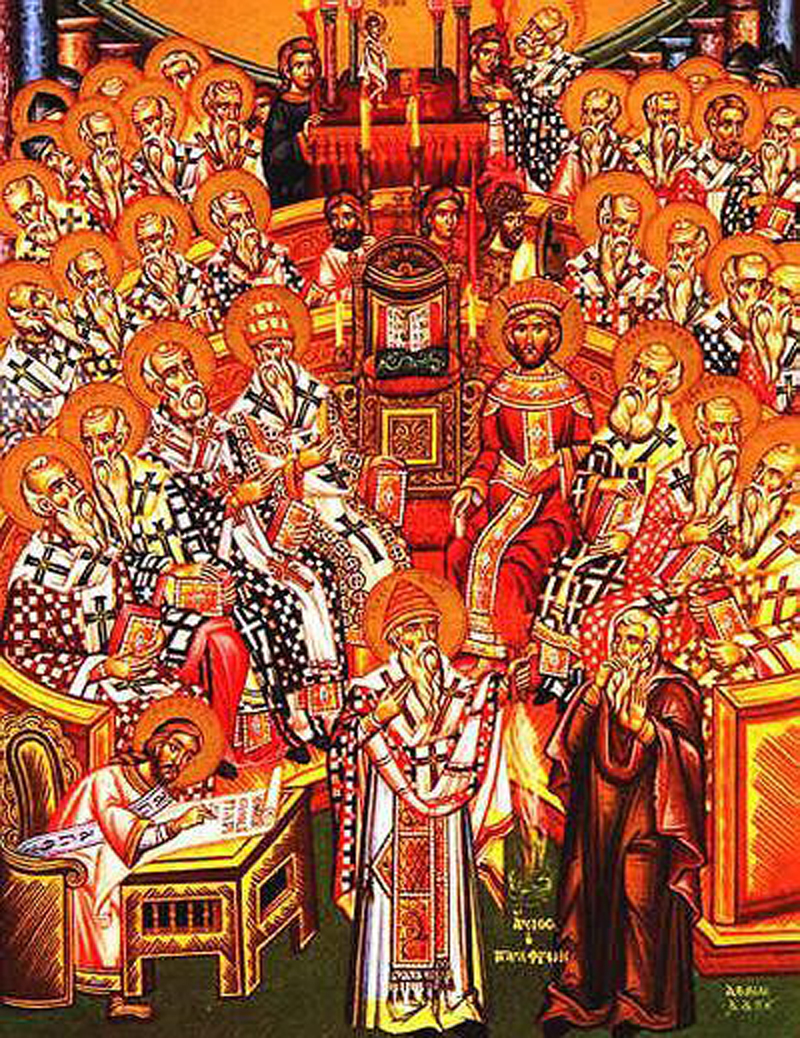
The Council of Nicaea, 325 AD (Patristic Summaries Series)

THE_FIRST_COUNCIL_OF_NICEAThe next number of posts in the Patristic Summaries Series will concern what is known as “The Seven Ecumenical Councils” of the Church.  In writing these posts, I am consulting (a) historical insights from Leo Donald Davis’ The First Seven Ecumenical Councils: Their History and Theology and Peter L’Huillier’s The Church of the Ancient Councils: The Disciplinary Work of the First Four Ecumenical Councils and (b) the primary sources surrounding each council (to the extent that we have them) in volume 14 of the post-nicene writings of Philip Schaff and Henry Wace’s (editors) 38 volume Nicene and Post Nicene Fathers (Second Series).

The Emperor Constantine convened the first great ecumenical council in 325 AD primarily to address the Arian attack on the full deity of Christ, though the council addressed many other issues as well.  The most significant contribution of the council was, of course, the Nicene Creed.

I believe in one God,
the Father Almighty,
maker of heaven and earth,
and of all things visible and invisible;

And in one Lord Jesus Christ,
the only begotten Son of God,
begotten of his Father before all worlds,
God of God, Light of Light,
very God of very God,
begotten, not made,
being of one substance with the Father;
by whom all things were made;
who for us men and for our salvation
came down from heaven,
and was incarnate by the Holy Ghost
of the Virgin Mary,
and was made man;
and was crucified also for us under Pontius Pilate;
he suffered and was buried;
and the third day he rose again
according to the Scriptures,
and ascended into heaven,
and sitteth on the right hand of the Father;
and he shall come again, with glory,
to judge both the quick and the dead;
whose kingdom shall have no end.

And I believe in the Holy Ghost the Lord, and Giver of Life,
who proceedeth from the Father [and the Son];
who with the Father and the Son together
is worshipped and glorified;
who spake by the Prophets.
And I believe one holy Catholic and Apostolic Church;
I acknowledge one baptism for the remission of sins;
and I look for the resurrection of the dead,
and the life of the world to come. AMEN.

Along with The Apostles’ Creed, The Nicene Creed is acknowledged to be one of the most substantive, concise, beautiful, and theologically rich statements on the essence of Chrisitianity ever written.  The creed was adopted with very little opposition and it should be rightly hailed as the seminal achievement of the Council of Nicaea.

Baptists are traditionally considered to be anti-creedal.  This is an oversimplification to be sure.  While Baptists unapologetically hold to the Reformation maxim sola scripture, we really mean by it suprema scripture.  That is, Baptists have never held that all creedal statements are utterly useless and wholly flawed.  On the contrary, Baptists have simply asserted that the witness of Scripture outweighs all other statements of man, no matter how revered, and should be granted preeminence and supremacy.  In point of fact, the 38th article of the 1679 General Baptist “Orthodox Creed” commends the Apostles’, Nicene, and Athanasian creeds to all Baptists as valuable and worthy of study and consideration.

The subtle but profound debates surrounding the terminology of the creed, particularly pertaining to Christology, are important but go far beyond the nature of these patristic summaries.  Suffice it to say, the language of the creed is in no way accidental.  Rather, it communicates biblical orthodoxy as agreed upon by conciliar consensus and establishes an orthodox line of demarcation against all inferior Christological assertions.

In addition to the creed, the Council of Nicaea approved a number of canons addressing various and sundry realities facing the church at that time.  For instance, the canons forbade those who mutilated themselves from holding ecclesial office, addressed the question of how the church should receive back repentant schismatic bishops, condemned usury, forbade the clergy from taking women disciples into their homes, addressed the issue of deaconesses, etc.  These canons are fascinating and insightful, and are still essentially binding to large segments of Christianity today.

The Council of Nicaea has been the subject of a great deal of misunderstanding.  On the popular level this is undoubtedly due to Dan Brown’s Da Vinci Code nonsense.  Wherever these misunderstands originate, it is almost a given today among those who have never studied what happened at Nicaea that the council was convened by a sinister Emperor who arbitrarily and almost single-handedly defined orthodoxy over against earlier and more appealing orthodoxies within early Christianity, that he used a structure of power to establish further structures of power in order to subjugate the people to oppressive systems of belief he himself proclaimed true and binding, and that Constantine chose at the Council which books would be included in the canon of scripture editing out those texts that challenged the increasingly narrow orthodoxy of institutional Christianity.  This last allegation is simply inexplicable since the Council said nothing about the canon of scripture in terms of what books should be included therein.  These readings of the Council are borne from ignorance at best and a modernistic agenda at worst.

That is not to say that the Council was perfect or infallible or devoid of politics or anything of the sort.  I am no apologist for any pronouncements of any gathering of Christians, no matter how august that gather might be.  Rather, it is simply to say that the Council articulated a vision of orthodoxy that has struck the vast majority of the Church as biblical and God-honoring and true for the vast majority of her history.  Baptist Christians should study the results of Nicaea with great appreciation and interest.  They will, however, along with many other believers, judge the fruits of even this amazing assembly by holy writ.

Roger Olson’s Proposal on How the Church in America Should Approach Marriage

I’m going to post this as simply a point of interest, though one I am very much still thinking through.  For some time I have heard conversations similar to this come up among pastors.  My only opinions at the moment are (a) that there likely needs to be a definitive break between the church and secular society on the question of marriage and (b) that such a break would indeed raise a number of difficult questions about how the church views marriage and, in particular, divorce that the church would really have to think through.  My interest in this is convictional:  I simply do believe that what the state says about marriage and what the church says about marriage are two very separate things except insofar as they conveniently overlap.  The recent social experiments are causing the church today to think through the lines of demarcation, and I think, on the whole, that is a positive thing.  More on these later, but, for now, check out Olson’s first post and then his second clarifying post.

Franz Kafka’s The Metamorphosis

the_metamorphosis_by_xmihax-d5k11yvFranz Kafka’s famous short story, “The Metamorphosis,” is an enigmatic and elusive tale about a salesman named Gregor Samsa who awakens one morning to find that he has been changed into a bug.  I should say instead that the tale is elusive in terms of its interpretation.  The story itself, on its surface, is rather straightforward.

Samsa wakes up to find that he is a bug.  His parents and his sister (all of whom he provides for and the last whom he adores) knock on the door in vain, as does a representative from his job who comes by to chastise him.  When they finally see Gregor, they are terrified and disgusted.  The remainder of the story involves the family’s failed attempts to come to terms with Gregor’s metamorphosis.  The most compassionate is his sister, Greta, who feeds Gregor by leaving food in his room while he hides under a couch.  Eventually, however, she too proclaims her disgust with Gregor and he dies brokenhearted.

What makes the story so intriguing is that it really does not tip its hand too much to possible meanings.  Some have seen it as Kafka’s story about his own self (notice the consistent consonant/vowel structure of the names:  Kafka – Samsa) and his sense of alienation from the world.  Others have surmised that it might be a statement on the dehumanizing and eventual destruction of the Jews (as represented by Gregor).

It’s hard to say, though I find myself drawn to a something like a class-structure interpretation.  Maybe.  It seems to me that Gregor, the worker, is dehumanized, is shown a measure of pity by those who cannot understand him, and is eventually abandoned by those with brighter prospects.  I am struck by the last sentence, which sees Greta stretching her blossoming body out after her parents, taking notice, reflect on the fact that they need to find her a suitable mate: “And it was like a confirmation of their new dreams and excellent intentions that at the end of their journey their daughter sprang to her feet and stretched her young body.”  Thus, the book begins with a downward metamorphoses:  that of a man into a bug.  It ends with an upward metamorphosis:  that of a girl into a beautiful young woman.  The downward metamorphosis ends in dehumanization, a loss of meaning and significance, and then a death that is welcomed by the others who were so burdened by his grotesque existence.  The upward metamorphoses ends in a humanization, the opening of prospects and a bright future, and a general sense of celebration by others who witness it.

On the other hand, I am struck by the note of existential despair in the story, Gregor’s horror at realizing that his very existence is a burden, that his presence is loathsome to those around him, and the utter futility of his life theretofore.  Who hasn’t at time felt a bit like Gregor:  alone, misunderstood, barely human?

It is a powerful little tale, and one that stays with you.  I suppose the brilliance of it is that different readers can see different aspects of their own lives in the tragedy of Gregor Samsa.  If you haven’t read it, you should.  It’s compelling, troubling, thought-provoking, and significant.

Ruth 4:1-12

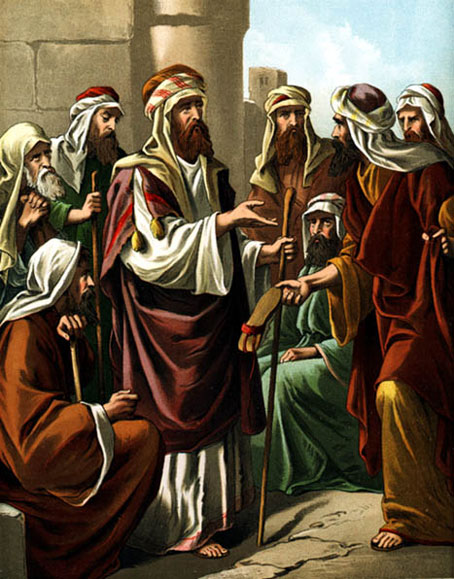
boazsandalRuth 4:1-12

1 Now Boaz had gone up to the gate and sat down there. And behold, the redeemer, of whom Boaz had spoken, came by. So Boaz said, “Turn aside, friend; sit down here.” And he turned aside and sat down. 2 And he took ten men of the elders of the city and said, “Sit down here.” So they sat down. 3 Then he said to the redeemer, “Naomi, who has come back from the country of Moab, is selling the parcel of land that belonged to our relative Elimelech. 4 So I thought I would tell you of it and say, ‘Buy it in the presence of those sitting here and in the presence of the elders of my people.’ If you will redeem it, redeem it. But if you will not, tell me, that I may know, for there is no one besides you to redeem it, and I come after you.” And he said, “I will redeem it.” 5 Then Boaz said, “The day you buy the field from the hand of Naomi, you also acquire Ruth the Moabite, the widow of the dead, in order to perpetuate the name of the dead in his inheritance.” 6 Then the redeemer said, “I cannot redeem it for myself, lest I impair my own inheritance. Take my right of redemption yourself, for I cannot redeem it.” 7 Now this was the custom in former times in Israel concerning redeeming and exchanging: to confirm a transaction, the one drew off his sandal and gave it to the other, and this was the manner of attesting in Israel. 8 So when the redeemer said to Boaz, “Buy it for yourself,” he drew off his sandal. 9 Then Boaz said to the elders and all the people, “You are witnesses this day that I have bought from the hand of Naomi all that belonged to Elimelech and all that belonged to Chilion and to Mahlon. 10 Also Ruth the Moabite, the widow of Mahlon, I have bought to be my wife, to perpetuate the name of the dead in his inheritance, that the name of the dead may not be cut off from among his brothers and from the gate of his native place. You are witnesses this day.” 11 Then all the people who were at the gate and the elders said, “We are witnesses. May the Lord make the woman, who is coming into your house, like Rachel and Leah, who together built up the house of Israel. May you act worthily in Ephrathah and be renowned in Bethlehem, 12 and may your house be like the house of Perez, whom Tamar bore to Judah, because of the offspring that the Lord will give you by this young woman.”

It is fitting that we are approaching the Lord’s Supper table on this day when we also approach Ruth 4:1-12. That is because these verses speak of a bridegroom’s redemption of his bride. That is also exactly what the Lord’s Supper speaks of as well: a Bridegroom’s redemption of His bride. As I hope to show, this text is where the bottom level story (the actual story of Boaz and Ruth) and the upper level story (the story of Christ and His Church) come closest to one another. As we read this text in preparation for the Lord’s Supper, I would like to consider the fact that Boaz’s purchase of his bride, Ruth, was eager, public, and legally binding. So is Jesus’ purchase of His bride.

Eager. Public. Legally binding.

Eager. Boaz was eager to secure Ruth as his bride.

1 Now Boaz had gone up to the gate and sat down there. And behold, the redeemer, of whom Boaz had spoken, came by. So Boaz said, “Turn aside, friend; sit down here.” And he turned aside and sat down.

Chapter 3 ended with the startling events on the threshing floor that saw Ruth pledge herself to Boaz and Boaz assure her that he would redeem and marry her if at all possible. There was one problem: there was a relative closer to Naomi and Ruth than Boaz was and, by law, that relative was given the first option of redemption. Boaz would only be able to redeem Ruth if this other relative chose not to.

Our chapter begins with Boaz eagerly seeking to redeem Ruth. He went to the place where such business was handled: the city gates. And when did he go? The next morning, the morning after Ruth came to him and lay at his feet on the threshing floor. The night before Boaz had said to Ruth, “Stay here for the night, and in the morning if he wants to do his duty as your guardian-redeemer, good; let him redeem you. But if he is not willing, as surely as the Lord lives I will do it. Lie here until morning” (v.13). Twice he mentioned the morning. He was eager for Ruth to be his bride. He would handle this as soon as humanly possible. Even Naomi knew that he would be eager to resolve this, for in verse 18 of Ruth 3 she had told Ruth, “Wait, my daughter, until you find out what happens. For the man will not rest until the matter is settled today.” And indeed he did not.

The redeemer was eager to redeem the one needing redemption. So it was with Boaz and Ruth. So it is with Jesus. In Luke 15:20 Jesus likened God to a patriarch who runs and embraces his prodigal son when he returns home. Eagerness. In 2 Peter 3:9, Peter writes, “The Lord is not slow to fulfill his promise as some count slowness, but is patient toward you, not wishing that any should perish, but that all should reach repentance.” The Father is eager to see people come to faith in Christ. He is, in fact, eager to see you come to the saving knowledge of Christ if you have not.

Boaz summoned the closer redeemer. Interestingly, he did not use his name. Some early Jewish commentators assumed the man’s name was Tob because of verse 3:13. In that verse, Boaz said to Ruth, “Remain tonight, and in the morning, if he will redeem you, good; let him do it.” The Hebrew word for “good” or “all right” is “tob,” so these commentators read that word as a name instead of an exclamation: “Tob, let him do it.” Clearly, however, that is not his actual name. Kiersten Nielson argues that “the author’s anonymization of the man must…be an expression of indirect condemnation of him as a man who refuses to safeguard the good name of the family for posterity. He deserves to remain nameless.”[1]

Boaz summoned this nameless redeemer and he did so eagerly!

And he did so publically, not secretly. Boaz went to the city gate through which the workers would pass as they returned in the morning from their labors. He had no intention of working a sly deal. On the contrary, this would be handled in the full light of day and in the sight of all.

2 And he took ten men of the elders of the city and said, “Sit down here.” So they sat down. 3 Then he said to the redeemer, “Naomi, who has come back from the country of Moab, is selling the parcel of land that belonged to our relative Elimelech. 4 So I thought I would tell you of it and say, ‘Buy it in the presence of those sitting here and in the presence of the elders of my people.’ If you will redeem it, redeem it. But if you will not, tell me, that I may know, for there is no one besides you to redeem it, and I come after you.” And he said, “I will redeem it.” 5 Then Boaz said, “The day you buy the field from the hand of Naomi, you also acquire Ruth the Moabite, the widow of the dead, in order to perpetuate the name of the dead in his inheritance.” 6 Then the redeemer said, “I cannot redeem it for myself, lest I impair my own inheritance. Take my right of redemption yourself, for I cannot redeem it.”

Boaz summoned ten men to serve as witnesses of what was about to happen. It is not terribly clear whether this number was particularly significant. Concerning the ten witnesses, Leon Morris writes

Obviously this could give a solid body of witness, but whether there was any legal requirement met by this number or not our information from antiquity does not reveal. In more recent times, ten, of course, is a significant number. Thus ten men are required for a synagogue service. Slotki sees in the number “The quorum required for the recital of the marriage benedictions. Boaz held them in readiness for the pending ceremony.” However, he cites no evidence that the custom is so old. The Midrash Rabbah regards this passage as giving justification for ten at ‘the blessing of the bridegroom’ (vii. 8).[2]

Perhaps, then, there is custom behind ten witnesses. Perhaps customs grew out of Boaz’s summoning of these ten. Regardless, notice that Boaz sought a public redemption of Ruth, one that could not be questioned, one that had witnesses.

The transaction went as follows: Boaz informed the unnamed redeemer that he, the redeemer, had first rights to redeem the late Elimelech’s land from Ruth. There is considerable discussion about what this means since land did not pass from husband to wife at that time. Regardless, the redeemer had first rights if he so desired. And he did so desire. He said in the presence of all that he wanted the land. Then Boaz added a caveat that changed everything. If he bought the land, he informed him, he also redeemed Elimelech’s Moabite daughter-in-law, Ruth. “I cannot redeem it for myself,” the man said in recanting his claim, “lest I impair my own inheritance. Take my right of redemption yourself, for I cannot redeem it.”

This is a very interesting thing for him to say: “lest I impair my own inheritance.” Daniel Block gives a helpful explanation of what the redeemer likely meant.

Given his own age and the age of Ruth, he might have thought she might bear him no more than one child. Since this child would be legally considered the heir and descendant of Elimelech, upon the death of the go’el he would inherit the property that had come into his hands through this present transaction as well as the go’el’s inherited holdings. Furthermore, since the name of Elimelech had been established/raised up through the child, the go’el’s entire estate would fall into the line of Elimelech, and his own name would disappear. Third, in view of Boaz’s introduction of Ruth as “the Moabitess,” he might have pondered the ethnic implication of the transaction, concluding that his patrimonial estate would not be jeopardized by falling in to the hands of one with Moabite blood in his veins.[3]

The obstacle to Boaz’s redemption of Ruth had been removed! He could now secure her and bring her into his home. And he had achieved this in the sight of all.

Jesus, too, achieved the redemption of His people in the sight of all and not on the sly. “Nevertheless,” Jesus said in Luke 13:33, “I must go on my way today and tomorrow and the day following, for it cannot be that a prophet should perish away from Jerusalem.” So Jesus went through the city gates of Jerusalem only to come out of them again carrying a cross. In the sight of God and man, Jesus redeemed His bride. He was suspended between heaven and earth on the cross, bidding all to bear witness that He was laying indisputable claim to His bride by paying the price for her.

Christ redeemed fallen man in the presence of all, and this act of redemption was legally binding. So too was Boaz’s redemption of Ruth.

7 Now this was the custom in former times in Israel concerning redeeming and exchanging: to confirm a transaction, the one drew off his sandal and gave it to the other, and this was the manner of attesting in Israel. 8 So when the redeemer said to Boaz, “Buy it for yourself,” he drew off his sandal. 9 Then Boaz said to the elders and all the people, “You are witnesses this day that I have bought from the hand of Naomi all that belonged to Elimelech and all that belonged to Chilion and to Mahlon. 10 Also Ruth the Moabite, the widow of Mahlon, I have bought to be my wife, to perpetuate the name of the dead in his inheritance, that the name of the dead may not be cut off from among his brothers and from the gate of his native place. You are witnesses this day.” 11 Then all the people who were at the gate and the elders said, “We are witnesses. May the Lord make the woman, who is coming into your house, like Rachel and Leah, who together built up the house of Israel. May you act worthily in Ephrathah and be renowned in Bethlehem, 12 and may your house be like the house of Perez, whom Tamar bore to Judah, because of the offspring that the Lord will give you by this young woman.”

It was an odd way to signify that the transaction was complete, official, binding. The redeemer took off his shoe and handed it to Boaz, signifying thereby that he was letting the right of redemption pass him by so that it could rest on eager Boaz. Thus, Boaz redeemed Naomi’s land and Naomi and Ruth.

But here there is something interesting in our text, something unexpected, something frankly unusual. There are two words that are used in this conversation between Boaz and the redeemer. The word for “redeem” is the Hebrew word ga’al and the word for “buy” or “acquire” is the Hebrew word qanah. You can see both at play in the heart of the conversation from verses 4-6.

4 So I thought I would tell you of it and say, ‘Buy it in the presence of those sitting here and in the presence of the elders of my people.’ If you will redeem it, redeem it. But if you will not, tell me, that I may know, for there is no one besides you to redeem it, and I come after you.” And he said, “I will redeem it.” 5 Then Boaz said, “The day you buy the field from the hand of Naomi, you also acquire Ruth the Moabite, the widow of the dead, in order to perpetuate the name of the dead in his inheritance.” 6 Then the redeemer said, “I cannot redeem it for myself, lest I impair my own inheritance. Take my right of redemption yourself, for I cannot redeem it.”

What is unusual about this is the word “buy.” In the legal requirements of the redeemer, the language was not of buying but of redeeming. And a redeemer certainly would not speak of buying or acquiring a person. It is very unusual that Boaz speaks of buying Ruth. Furthermore, it is very unusual to see these two words, redeem and acquire, used together to describe a human transaction.

In a fascinating article entitled “‘Redemption-Acquisition’: The Marriage of Ruth as a Theological Commentary on Yahweh and Yaweh’s People,” Brad Embry points out the heart of the issue.

While the two terms redeem and acquire are fairly common, their use together is not, only appearing explicitly in two other places apart from Ruth: Exod 15:13-15 and Ps 74:2…[T]he concept of “redeem-acquire” is implicit in two more selections: Deut 32:6 and Isa 11:11.
In the case of each of the other intertextual references (Exod 15:13-19; Ps 74:2; Deut 32:6; Isa 11:11), the complex “redeem-acquire” is employed exclusively to express an action undertaken by Yahweh on behalf of Israel and likely draws on the exodus tradition. In the story of Ruth, two things seem to fall under qualification for redemption-acquisition. The first is the land for sale by Naomi. The second is Ruth. As such, only in the book of Ruth is the complex “redeem-acquire” used to articulate the relationship between two human characters. In this way, the author of Ruth has constructed a story in which two of the primary characters, while functioning within an unfolding story of loss and restoration for a particular household, can also be emblematic of Yahweh’s actions on behalf of Israel.[4]

This is profoundly important. This is why I say that here the lower and upper levels of our story converge, for it is only in Yahweh’s redemption of His people that the “redeem-acquire” formula is used. For instance, in Exodus 15:13-16.

13  “You have led in your steadfast love the people whom you have redeemed; you have guided them by your strength to your holy abode. 14 The peoples have heard; they tremble; pangs have seized the inhabitants of Philistia. 15 Now are the chiefs of Edom dismayed; trembling seizes the leaders of Moab; all the inhabitants of Canaan have melted away. 16 Terror and dread fall upon them; because of the greatness of your arm, they are still as a stone, till your people, O Lord, pass by, till the people pass by whom you have purchased.

Furthermore, in Psalm 74 we find the same formula.

2 Remember your congregation, which you have purchased of old, which you have redeemed to be the tribe of your heritage! Remember Mount Zion, where you have dwelt.

Do you see why this matters? When Boaz used the formula “redeem-acquire” in talking to the redeemer about Ruth, he was using a formula that is only used to refer to God’s redemption of His people. Thus, when Boaz spoke of redeeming and buying Ruth, he was painting a picture that theretofore had only been painted to describe Yahweh God’s love for us. In this way, the lower level and the upper level converge: Boaz’s redemption and purchase of Ruth is a picture of God’s redemption and purchase of His people, then, now, and forever. It is how God loves us.

Does this language of purchase carry over into the New Testament? Indeed it does. In 1 Corinthians 6, Paul writes:

19 Or do you not know that your body is a temple of the Holy Spirit within you, whom you have from God? You are not your own, 20 for you were bought with a price. So glorify God in your body.

In Revelation 5, we read:

8 And when he had taken the scroll, the four living creatures and the twenty-four elders fell down before the Lamb, each holding a harp, and golden bowls full of incense, which are the prayers of the saints. 9 And they sang a new song, saying, “Worthy are you to take the scroll and to open its seals, for you were slain, and by your blood you ransomed people for God from every tribe and language and people and nation, 10 and you have made them a kingdom and priests to our God, and they shall reign on the earth.”

The word for “ransom” in verse 9 is the same word Paul uses in 1 Corinthians 6 for “bought.”

What a glorious, beautiful truth! The God who purchased His people out of slavery in Egypt is the same God who purchases His people through the blood of Christ our Redeemer. Jesus our Redeemer buys us on the cross. He lays down His life to purchase us by paying the debt we cannot pay, and the elements on this very table speak of that amazing purchase. The juice and the bread are symbols of the blood and body of Christ. They are the means by which He purchases all who will come to Him in faith and repentance, all who will lay themselves at His feet.

Behold the Lamb who was slain! Behold the God who purchases His bride! Behold the Redeemer who is eager to save!


[1] Kirsten Nielson, Ruth. The Old Testament Library. (Louisville, KY: Westminster John Knox Press, 1997), p.83,n.124.

[2] Arthur E. Cundall and Leon Morris (2008-09-19). TOTC Judges & Ruth (Tyndale Old Testament Commentaries) (Kindle Locations 4442-4447). Inter-Varsity Press. Kindle Edition.

[3] Daniel I. Block, Judges, Ruth. The New American Commentary. Vol. 6. Gen. Ed., E. Ray Clendenen. (Nashville, TN: B&H Publishing Group, 1999), p.660.

[4] Brad Embry. “‘Redemption-Acquisition’: The Marriage of Ruth as a Theological Commentary on Yahweh and Yaweh’s People.” Journal of Theological Interpretation. 7.2 (2013), p.258-259. This is a very insightful article that I find quite persuasive. Embry’s argument has strongly influenced my argument in this portion of the sermon.