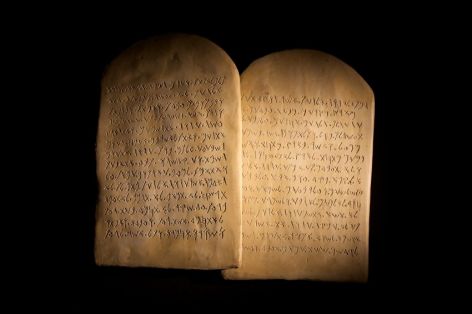
Exodus 20:7

what-are-ten-commandments_472_314_80Exodus 20

7 “You shall not take the name of the Lord your God in vain, for the Lord will not hold him guiltless who takes his name in vain.


Fred Craddock tells an interesting story from his childhood about the reverence for the name of God that his mother instilled in him at an early age.

            When I was a child, my mother would play word games with us in the evening by the fire. She taught us phonic spelling. If you can say it, you can spell it. And she led us into the deep waters of oviparous, ovoviviparous, and hypotenuse. I once knew how to pronounce and spell asafetida. But one word she never put on the list because she knew we were just children. She never put on the list God.[1]

There is something charming about this, and also something very important. We should instill within our children and within ourselves a deep reverence and love for the name of God. Unfortunately, we live in a church age in which reverence for the name of God seems to be lacking.

In his compelling book Requiem: A Lament in Three Movements, theologian Thomas Oden chronicles and bemoans the drift in modern theology away from serious reflection on the nature of God and into faddishness, silliness, and blasphemy. In particular, Oden complained about the lack of respect that many modern theologians show for the name of God and the ways in which theologians now use God’s name to justify their own interests in lesser pursuits. Oden writes:

When God’s name has been so dishonored and misplaced as to mean little more than weight loss, dream analysis, exotic vitamins, salesmanship, yoga, LSD, and psychodrama, then someone has been asleep at the wheel.[2]

That is well said. Our day is in desperate need of a serious reflection on the third commandment, to which we now turn.

God’s name is an expression of His character and His character is perfect holiness.

The third commandment prohibits taking God’s name in vain.

7 “You shall not take the name of the Lord your God in vain, for the Lord will not hold him guiltless who takes his name in vain.

One of the problems that we modern people face in trying to understand this is the way in which we view names. For us, a name is simply a word that was put on you when you were born. But the name of God is very different, of course, as was, it should be said, the children of Israel’s approach to names in general.

Nobody gave God His name. He has been God from eternity past. And His name, YHWH, the Tetragrammaton, is a reflection of His person and His character. Thus, God’s name is an expression of His character and His character is perfect holiness. As a result, it should only be used reverently and with a sense of awe.

Origen referred to “the name of God” as “the stamp of the personal character of God.”[3] That is a good way of thinking about it. God’s name must not be mouthed casually, cheaply, or frivolously, for there is a powerful connection between His name and His character. This is evident in Exodus 3, when Moses asked God for His name after God commissioned him to go to Egypt and liberate the children of Israel.

13 Then Moses said to God, “If I come to the people of Israel and say to them, ‘The God of your fathers has sent me to you,’ and they ask me, ‘What is his name?’ what shall I say to them?” 14 God said to Moses, “I am who I am.” And he said, “Say this to the people of Israel, ‘I am has sent me to you.’”

God’s name reflects God’s character. Thus, He could call Himself “I AM.” As a result, we must esteem highly and handle carefully the holy name of our great God. This is no less true for the Church than it was for Israel. In Matthew 6:9, Jesus said, “Pray then like this: ‘Our Father in heaven, hallowed be your name.’”

To hallow God’s name is to reverence God’s name and to refuse to use the name in vain is one step toward hallowing it. The Puritan, Thomas Watson, made the interesting and compelling point that while some of the petitions of the Lord’s Prayer will one day cease, the need to hallow God’s name never will.

When some of the other petitions shall be useless and out of date, as we shall not need to pray in heaven, “Give us our daily bread,” because there shall be no sin; nor, “Lead us not into temptation,” because the old serpent is not there to tempt: yet the hallowing of God’s name will be of great use and request in heaven; we shall be ever singing hallelujahs, which is nothing else but the hallowing of God’s name.[4]

We will be hallowing God’s name, reverencing God’s name, and refusing to use God’s name in vain for all eternity. We must begin now!

Taking God’s name in vain means using God’s name in any way that does not seek to magnify and celebrate His glory.

But what precisely does it mean to use God’s name “in vain”? Roy Honeycutt points out that the word “vain” (shawe’) “means emptiness, nothingness, or vanity, in the sense of being ineffective or lacking in purpose; emptiness of speech, and hence that which is false, whether of prophecy (Ezek. 12:24), or speech (Isa. 59:4); and worthlessness of conduct.” Honeycutt goes on to argue that the third commandment’s obvious proximity to the first two commandments suggests that it is saying something about the way we use God’s name in worship.

            The fact that the command appears at the center of those exhortations which sought to guarantee the proper worship of the Lord gives added weight to an interpretation of the commandment which stresses the negative use of the name in worship. The strong probability is that the writer sought to prohibit a semimagical or magical use of the Lord’s name…Members of the covenant community are warned against paganizing their faith by perverting it into no more than a restructured magic by which God may be coerced into fulfilling the worshiper’s will.[5]

The IVP Bible Background Commentary agrees and proposes a similar idea.

This commandment does not refer to blasphemy or foul language. Rather it is intended to prevent the exploitation of the name of Yahweh for magical purposes or hexing. It also continues the concerns of the second commandment in that someone’s name was believed to be intimately connected to that person’s being and essence. The giving of one’s name was an act of favor, trust and, in human terms, vulnerability. Israel was not to attempt to use Yahweh’s name in magical ways to manipulate him. The commandment was also intended to insure that the use of Yahweh’s name in oaths, vows and treaties was taken seriously.[6]

Undoubtedly there is something to these claims, though The IVP Bible Background Commentary almost certainly overstates the case when it says that “this commandment does not refer to blasphemy or foul language.” Victor Hamilton argues that the third commandment certainly applies to blasphemous and profane language that invokes God’s name.

In sum, the third commandment cautions against using the Lord’s name falsely to buttress a truth claim that is fabricated. By extension, it prohibits any use of the holy name that is without any real significance, any trivializing of the Tetragrammaton. I am not sure whether biblical Israel has any concept of “cussing” or using a collection of “four-letter words,” but it is not a misunderstanding of this commandment to bring it to bear on the pervasive use today of “O my God” in every imaginable situation.[7]

What is more, J.I. Packer sees three applications of the third commandment.

  1. irreverence
  2. bad language
  3. promise keeping[8]

Each of these commentators make a significant contribution to our understanding of this commandment, but I believe that Hamilton and Packer are correct in applying it to the way we talk outside of worship as well. Giving the third commandment a limited technical application restricted only to worship does not do justice to the full implications of this prohibition.

I very much include myself in what I am about to say and I say it to my own conviction: we truly need to return to a higher view of the name of God. Using the name of God for, say, comedic effect, or for the sake of emphasis, or as a vehicle to express our own anger is certainly included in the prohibition against taking God’s name “in vain.” Furthermore, we should stop using God’s name as an exclamation.

A good rule of thumb might be something like this: is my use of God’s name in this instance reverent, honoring, and worshipful? Is my use of God’s name in this instance going to make Him look glorious? Is it going to cause others to want to worship Him? Is it going to help draw people to serious consideration of the grandeur of God?

There is power in the name of God when rightly and worshipfully voiced because it is in and through hearts yielded to Him that God most powerfully works.

We would do well to remember that whereas a frivolous use of God’s name is a great sin, the worshipful and proper expression of God’s has great power. Please let me explain what I do not mean: I do mean that God’s name can be used as a talisman. The very thought is blasphemous! In truth, we should not speak at all of using God’s name. We may speak it, honor it, and proclaim it, but never use it as if we are seeking to manipulate the Lord God.

No, what I mean is there is power in the name of God when rightly and worshipfully voiced because it is in and through hearts yielded to Him that God most powerfully works. God’s name is bound to God’s character and, in His name, there is power! This helps us explain what we see throughout scripture. Let us focus particularly on the New Testament uses of Christ’s name to explore this point.

In Mark 9, Jesus acknowledged that mighty displays of kingdom power can only be done “in my name” and truly bring honor to Jesus.

38 John said to him, “Teacher, we saw someone casting out demons in your name, and we tried to stop him, because he was not following us.” 39 But Jesus said, “Do not stop him, for no one who does a mighty work in my name will be able soon afterward to speak evil of me. 40 For the one who is not against us is for us.”

In Acts 3:6, Peter demonstrated God’s healing power in the name of Jesus

But Peter said, “I have no silver and gold, but what I do have I give to you. In the name of Jesus Christ of Nazareth, rise up and walk!”

Furthermore, in 1 Corinthians 1:10, Paul called for unity in the divided church of Corinth in the name of Jesus.

I appeal to you, brothers, by the name of our Lord Jesus Christ, that all of you agree, and that there be no divisions among you, but that you be united in the same mind and the same judgment.

Bringing a divided church together in unity is one of the greatest displays of power we can ever see! The name of Jesus should bind the Church together in harmony and unity. Later in the same book, in 1 Corinthians 5:4, Paul appealed to the church of Corinth to speak a word of church discipline against an erring brother “in the name of the Lord Jesus.”

When you are assembled in the name of the Lord Jesus and my spirit is present, with the power of our Lord Jesus…

To gather in His name is to gather in His power. In Colossians 3:17, Paul called upon believers to live in the light of the name of Christ!

And whatever you do, in word or deed, do everything in the name of the Lord Jesus, giving thanks to God the Father through him.

Most powerfully of all, we are saved in the name of Christ. In Acts 2:38, Peter responded to the question of how we are to be saved by saying, “Repent and be baptized every one of you in the name of Jesus Christ for the forgiveness of your sins, and you will receive the gift of the Holy Spirit.”

It is undeniable that God’s name is used too flippantly in our day. Even so, the scriptures tell us that the day will come when everybody, at least once, will say the name of Christ rightly. In Philippians 2 we read:

9 Therefore God has highly exalted him and bestowed on him the name that is above every name, 10 so that at the name of Jesus every knee should bow, in heaven and on earth and under the earth, 11 and every tongue confess that Jesus Christ is Lord, to the glory of God the Father.

Every knee will bow “at the name of Jesus” and every tongue will confess the name as well. If this will happen at the gate of eternity, should it not happen now? Yes, it should. We should say now what we will say then: Jesus Christ is Lord. And we should honor the name now that we will honor then.

Do not take the name of the Lord in vain.


[1] Fred Craddock, Craddock Stories. (St. Louis, MO: Chalice Press, 2001), p.21-22.

[2] Thomas C. Oden, Requiem: A Lament in Three Movements (Nashville, TN: Abingdon Press, 1995), p.46.

[3] Joseph T. Lienhard, ed., Exodus, Leviticus, Numbers, Deuteronomy. Ancient Christian Commentary on Scripture. Old Testament, vol.III. Thomas C. Oden, ed. (Downer’s Grove, IL: InterVarsity Press, 2001), p.103.

[4] Quoted in Hank Hanegraaff. The Prayer of Jesus. (Nashville: Word Publishing, 2001), p.40.

[5] Roy L. Honeycutt, Jr. “Exodus.” The Broadman Bible Commentary. Vol.1, Revised (Nashville, TN: Broadman Press, 1969), p.396-397.

[6] John H. Walton, Victor H. Matthews, Mark W. Chavalas, The IVP Bible Background Commentary: Old Testament.(Downers Grove, IL: InterVarsity Press, 2000), p.95.

[7] Hamilton, Victor P. (2011-11-01). Exodus: An Exegetical Commentary (Kindle Locations 11053-11056). Baker Publishing Group. Kindle Edition.

[8] Packer, J. I. (2008-01-07). Keeping the Ten Commandments (Kindle Location 517-526). Crossway. Kindle Edition.

 

Apologia: A Sermon Series in Defense of the Faith – Part VI: “Did Jesus Rise From the Dead?”

apologiaA few weeks ago my parents were in Athens, Greece. My father shared with me that he climbed up to the Acropolis and was standing there looking at the Parthenon and the other ruins. His guide told him to look down at this little jut of rock and then revealed that that small rocky formation was Mars Hill.

Mars Hill is most well known to us today because it was on that site that the Apostle Paul was laughed at by the Athenians. Why was he laughed at? He was laughed at because of a sermon he preached. He was not laughed at for the whole sermon but just for the conclusion of it. At the end of his sermon, Paul said something that made many in the audience laugh and mock him.

My father tells me that he mentioned this fact to the tour guide and that he, my father, began to quote some of Pauls’ sermon on Mars Hill to the gentleman. To his surprise, the tour guide said he was well aware of it and recited some of the sermon himself. As my dad climbed down to Mars Hill he said he could not help but think of Paul and his sermon and the reaction to it so many years ago.

What was it that Paul had said that was so funny? In truth, he did not say anything funny, but what he said was considered funny by the Athenians.

The sermon is recorded in Acts 17. I will share with you the beginning and the end of it. First, the beginning.

22 So Paul, standing in the midst of the Areopagus, said: “Men of Athens, I perceive that in every way you are very religious. 23 For as I passed along and observed the objects of your worship, I found also an altar with this inscription, ‘To the unknown god.’ What therefore you worship as unknown, this I proclaim to you.

In this famous introduction, Paul connected to the Athenians by noting how very religious they were. He then announced that he was going to reveal to them the true nature of God, the God that they had unknowingly created an altar to and inscribed with the words, “To the unknown God.” So then Paul began to tell them about this God, how He is the creator and Lord of all. It is a well done sermon, and one worthy of serious consideration. In fact, Paul seemed to have carried their attention all the way up until the end. Let us see what he said that was so amazing to the people of Athens.

30 The times of ignorance God overlooked, but now he commands all people everywhere to repent, 31 because he has fixed a day on which he will judge the world in righteousness by a man whom he has appointed; and of this he has given assurance to all by raising him from the dead.” 32 Now when they heard of the resurrection of the dead, some mocked. But others said, “We will hear you again about this.” 33 So Paul went out from their midst. 34 But some men joined him and believed, among whom also were Dionysius the Areopagite and a woman named Damaris and others with them.

Paul mentioned the resurrection of Jesus, the fact that Jesus had risen from the dead. His doing so was electric and immediately controversial. “Some mocked” and “others said, ‘We will hear you again about this.’”

Why was this so scandalous, this mention of the resurrection? It was scandalous because, to the Greeks, resurrection was simply something that did not happen and was not ever going to happen. Dead men did not rise nor where they ever going to. And Paul certainly knew this fact. He knew that he would be mocked and ridiculed. So why did he say it? Why did Paul mention the resurrection of Jesus when He knew that doing so would invite the disdain of a large part of his audience?

He did so because he believed that the resurrection was true, that it had actually happened, and that it was the key to understanding the good news about Jesus.

We must have the same confidence as Paul. Why? Because the resurrection of Jesus from the dead is the very heartbeat of the Church. It is the great divine act of confirmation, or proof that Jesus is who He said He is. The Church must decide today whether or not it is willing to be laughed at for the resurrection of Jesus, whether or not we really believe this is true. I would like to argue that it is true, and propose that Jesus actually rising from the dead is the best explanation for what happened two thousand years ago and for what continues to happen to this very day.

First, consider this description of the first Easter morning that we find in Matthew 28. Let us allow the text to speak of the grand truth of the resurrection once again.

1 Now after the Sabbath, toward the dawn of the first day of the week, Mary Magdalene and the other Mary went to see the tomb. 2 And behold, there was a great earthquake, for an angel of the Lord descended from heaven and came and rolled back the stone and sat on it. 3 His appearance was like lightning, and his clothing white as snow. 4 And for fear of him the guards trembled and became like dead men. 5 But the angel said to the women, “Do not be afraid, for I know that you seek Jesus who was crucified. 6 He is not here, for he has risen, as he said. Come, see the place where he lay. 7 Then go quickly and tell his disciples that he has risen from the dead, and behold, he is going before you to Galilee; there you will see him. See, I have told you.” 8 So they departed quickly from the tomb with fear and great joy, and ran to tell his disciples. 9 And behold, Jesus met them and said, “Greetings!” And they came up and took hold of his feet and worshiped him. 10 Then Jesus said to them, “Do not be afraid; go and tell my brothers to go to Galilee, and there they will see me.”

Let us now consider whether or not there are reasons to believe that this actually happened.

Jesus rising from the dead is the best explanation for a large number of first century Jews proclaiming and being willing to die for resurrection beliefs that were unheard of within first century Judaism.

Our apologetic for the historicity of the resurrection will begin with the fact that Jesus rising from the dead is the best explanation for a large number of first century Jews proclaiming and being willing to die for resurrection beliefs that were unheard of within first century Judaism. In other words, the first believers were mainly Jews, and what they said about the resurrection of Jesus was something that no Jewish person of the first century would have said or would have imagined about the Messiah. Were they making up the idea that Jesus was the Messiah, they would have spoken in terms that would have resonated with the Jewish conception of resurrection and the Jewish conception of Messiah. In fact, what they argued was something unheard of, something no Jew, much less large numbers of Jews, would have conceived of unless what they were saying had actually happened.

What is more, first century Greeks, as we have already seen in the reaction of the Greek crowd to Paul on Mars Hill, would have had no conception of what the early Christians were saying about resurrection, and would have found the idea laughable, yet many of them came to believe and proclaim this resurrection as well.

In their book, Raised? Doubting the Resurrection, Jonathan Dodson and Brad Watson summarize this point nicely.

Resurrection wasn’t a category for the Greeks nor was it desirable…For Jews, it was unthinkable that resurrection could occur in the middle of history, apart from worldwide renewal. Even more unthinkable was the idea that an individual would be resurrected and not all humanity at once. So for the Jews and Greeks of Paul’s day, the resurrection was implausible.

They then quote N.T. Wright as saying:

The ancient world was thus divided into those who said that the resurrection couldn’t happen, though they might have wanted it to, and those who said they didn’t want it to happen, knowing that it couldn’t happen anyway.[1]

Speaking of N.T. Wright, on May 15, 2007, this famed New Testament scholar delivered a lecture entitled, “Can a Scientist Believe the Resurrection?” at Babbage Lecture Theatre in Cambridge. In that lecture, Wright highlighted the very unlikely idea of first century Jews simply making up what these early Christians were saying about the resurrection. Wright pointed to seven mutations in the first century Jewish understanding of resurrection that the early followers of Jesus introduced.

  1. “The first modification is that there is virtually no spectrum of belief within early Christianity.” By this, Wright means that beliefs about the idea of resurrection were very different among Jewish groups and subgroups. There was a lot of variety, a lot of variance. The Jews were not agreed at all on whether resurrection existed or what it was or what it would look like if it happened. But these early Jewish followers of Jesus were suddenly and, outside of the resurrection actually happening, inexplicably saying the exact same thing about what had happened to Jesus three days after the crucifixion. They had solidarity around a shocking set of claims. So their agreement was a mutation in first century Jewish resurrection theology.
  2. “In second-Temple Judaism, resurrection is important but not that important. Lots of lengthy works never mention the question, let alone this answer. It is still difficult to be sure what the Dead Sea Scrolls thought on the topic. But in early Christianity resurrection has moved from the circumference to the centre…Take away the stories of Jesus’ birth, and all you lose is four chapters of the gospels. Take away the resurrection and you lose the entire New Testament, and most of the second century fathers as well.”
  3. “In Judaism it is usually left vague as to what sort of a body the resurrected will possess; some see it as a resuscitated but basically identical body, while others think of it as a shining star. But from the start the early Christians believed that the resurrection body, though it would certainly be a body in the sense of a physical object, would be a transformed body, a body whose material, created from the old material, would have new properties.”
  4. “The fourth surprising mutation within the early Christian resurrection belief is that ‘the resurrection’, as an event, has split into two. No first-century Jew, prior to Easter, expected ‘the resurrection’ to be anything other than a large-scale event happening to all God’s people, or perhaps to the entire human race, at the very end. There were, of course, other Jewish movements which held some kind of inaugurated eschatology. But we never find outside Christianity what becomes a central feature within it: the belief that the resurrection itself has happened to one person in the middle of history, anticipating and guaranteeing the final resurrection of his people at the end of history.”
  5. “Because the early Christians believed that ‘resurrection’ had begun with Jesus and would be completed in the great final resurrection on the last day, they believed also that God had called them to work with him, in the power of the Spirit, to implement the achievement of Jesus and thereby to anticipate the final resurrection, in personal and political life, in mission and holiness.” This, Wright tells us, is an idea that is foreign to Judaism.
  6. “The sixth mutation within the Jewish belief is the new metaphorical use of ‘resurrection’…Basically, in the Old Testament ‘resurrection’ functions once, famously, as a metaphor for return from exile (Ezekiel 37). In the New Testament that has disappeared, and a new metaphorical use has emerged, with ‘resurrection’ used in relation to baptism and holiness (Romans 6, Colossians 2—3), though without, importantly, affecting the concrete referent of a future resurrection itself (Romans 8).”
  7. “The seventh and final mutation from within the Jewish resurrection belief was its association with Messiahship. Nobody in Judaism had expected the Messiah to die, and therefore naturally nobody had imagined the Messiah rising from the dead. This leads us to the remarkable modification not just of resurrection belief but of Messianic belief itself. Where messianic speculations…the Messiah was supposed to fight God’s victorious battle against the wicked pagans; to rebuild or cleanse the Temple; and to bring God’s justice to the world. Jesus, it appeared, had done none of these things. No Jew with any idea of how the language of Messiahship worked at the time could have possibly imagined, after his crucifixion, that Jesus of Nazareth was indeed the Lord’s anointed. But from very early on, as witnessed by what may be pre-Pauline fragments of early creedal belief such as Romans 1.3f., the Christians affirmed that Jesus was indeed the Messiah, precisely because of his resurrection.”[2]

The early Christian pronouncement of the resurrection of Jesus, which, in its earliest stages, was primarily Jewish, did not seem to be taking existing Jewish ideas of (a) resurrection and (b) Messiah and applying them to Jesus. Had they done so their preaching and witnessing would have looked very different than it did. They were, instead, proclaiming something that had not been heard before, and proclaiming it with a uniformity and a fervency that is hard to describe if the events they were heralding did not actually happen.

Jesus rising from the dead is the best explanation for Paul’s audacious acknowledgement of a very large number of people who would all attest to the same experience with the resurrected Christ and who were still living at the time he wrote.

We also find the first century Jew, Paul, doing something that would be inexplicable if the resurrection had not actually happened. In 1 Corinthians 15, Paul argued that a very large number of people had seen Jesus alive after His death and burial, and Paul did so by naming some of these people then identifying other groups as well.

1 Now I would remind you, brothers, of the gospel I preached to you, which you received, in which you stand, 2 and by which you are being saved, if you hold fast to the word I preached to you—unless you believed in vain. 3 For I delivered to you as of first importance what I also received: that Christ died for our sins in accordance with the Scriptures, 4 that he was buried, that he was raised on the third day in accordance with the Scriptures, 5 and that he appeared to Cephas, then to the twelve. 6 Then he appeared to more than five hundred brothers at one time, most of whom are still alive, though some have fallen asleep. 7 Then he appeared to James, then to all the apostles. 8 Last of all, as to one untimely born, he appeared also to me. 9 For I am the least of the apostles, unworthy to be called an apostle, because I persecuted the church of God. 10 But by the grace of God I am what I am, and his grace toward me was not in vain. On the contrary, I worked harder than any of them, though it was not I, but the grace of God that is with me. 11 Whether then it was I or they, so we preach and so you believed. 12 Now if Christ is proclaimed as raised from the dead, how can some of you say that there is no resurrection of the dead?

One may hear Paul’s exasperation in that final rhetorical question: “How can some of you say that there is no resurrection of the dead?” Their skepticism was outlandish to Paul in the face of so many living witnesses.

Consider with me how unbelievably foolish and reckless and dangerous Paul’s words in the beginning of 1 Corinthians 15 are if, in fact, he was part of a conspiracy or was propagating some false teaching! He was literally challenging the critics of the resurrection to go and talk to any of the hundreds of people who actually saw the resurrected Jesus alive. If Paul was not sure that they would all say the exact same thing and all firmly believed what they were saying, why on earth would he risk having this many people interviewed?

But perhaps all of these people to whom Jesus appeared were in on the scam together. Perhaps they were intentionally deceiving others. Or perhaps they really believed that Jesus was alive again but were deceiving themselves. Perhaps in their grief they experienced a mass hallucination because they wanted so badly to believe that Jesus was still alive. After all, many of the followers of Jesus had a strong psychological desire for Jesus to still be alive (though, it should be pointed out, many who came to believe that Jesus had risen from the dead had no psychological reason for wanting to do so at all!).

Warner Wallace is a cold case detective who wrote a little book on the resurrection in which he applied the techniques of cold case detectives (i.e., abductive reasoning) to the case of Jesus’ death and resurrection. He makes a very interesting statement concerning this idea of mass self-delusion.

As a detective, I frequently encounter witnesses who are related in some way to the victim in my case. These witnesses are often profoundly impacted by their grief following the murder. As a result, some allow their sorrow to impact what they remember about the victim. They may, for example, suppress all the negative characteristics of the victim’s personality and amplify all the victim’s virtues. Let’s face it, we all have a tendency to think the best of people once they have died. But these imaginings are typically limited to the nature of the victim’s character and not the elaborate and detailed events that involved the victim in the past. Those closest to the victim may be mistaken about his or her character, but I’ve never encountered loved ones who have collectively imagined an identical set of fictional events involving the victim. It’s one thing to remember someone with fondness; it’s another to imagine an elaborate and detailed history that didn’t even occur.

Based on these experiences as a detective, there are other reasonable concerns when considering the explanation that the disciples hallucinated or imagined the resurrection:

1. While individuals have hallucinations, there are no examples of large groups of people having the exact same hallucination.

2. While a short, momentary group hallucination may seem reasonable, long, sustained, and detailed hallucinations are unsupported historically and intuitively unreasonable.

3. The risen Christ was reportedly seen on more than one occasion and by a number of different groups (and subsets of groups). These diverse sightings would have to be additional group hallucinations of one nature or another.

4. Not all the disciples were inclined favorably toward such a hallucination. The disciples included people like Thomas, who was skeptical and did not expect Jesus to come back to life.

5. If the resurrection were simply a hallucination, what became of Jesus’s corpse? The absence of the body is unexplainable under this scenario.[3]

Wallace is qualified to speak of what the grieving often do in the face of incomprehensible loss. His rejection of the idea of mass hallucination is noteworthy and solid and reasonable.

Furthermore, one does not get the feeling when reading Paul’s list of witnesses in 1 Corinthians 15 that we are dealing with mass psychosis. Rather, one gets the feeling that these hundreds of people really did see and experience what they claimed to have seen and experienced and that they were more than willing to speak of it and suffer for it.

Jesus rising from the dead is the best explanation for aspects of the story of the resurrection that are in the gospels that should not be present if the story was made up and for aspects of the story of the resurrection that are not in the gospels that should be present if the story was made up.

There are things in the gospel accounts of the resurrection that we would not expect to be there if the story was invented, but that are there. We have already mentioned one of these things: the idea of a resurrected Messiah, in time, before the end of all things. That was not an idea that the Jews had of the Messiah and it is hard to imagine why this particular description of the resurrection was articulated if this particular description is not what actually happened.

There is, surprisingly, a gender argument as well. If the story of the resurrection was a fiction concocted by well-meaning but mistaken or deluded followers of Jesus, it is inexplicable that (a) Jesus would first appear to women, (b) that Jesus would tell women to go inform His hiding male followers that He was alive, and (c) that these women would have to reveal to the skeptical male followers that they were mistaken and that Jesus had, in fact arisen.

Why should this not have been present if the story was made up? Because the words of Jewish women in the first century were considered so worthless that they were not even able to testify in court. This is actually reflected in Luke’s account of the resurrection in Luke 24.

10 Now it was Mary Magdalene and Joanna and Mary the mother of James and the other women with them who told these things to the apostles, 11 but these words seemed to them an idle tale, and they did not believe them. 12 But Peter rose and ran to the tomb; stooping and looking in, he saw the linen cloths by themselves; and he went home marveling at what had happened.

Imagine that you are wanting to start a movement in a first century Jewish patriarchal society. Why on earth would you surround the single most important belief in that movement with the words of those you know would be rejected outright by the vast majority of the people you were trying to convince? Why would you make the women of Easter morning the first proclaimers of the gospel and not the men? Why would the men who are writing these things allow themselves to be depicted as having to be convinced by women concerning this most important belief?

That should not be in this story if the story is not real…but there it is! Christ appeared to the women and He sent the women to inform the men that He was alive!

Jesus rising from the dead is the best explanation for aspects of the story of the resurrection that are in the gospels that should not be present if the story was made up.

Also, Jesus rising from the dead is the best explanation for aspects of the story of the resurrection that are not in the gospels that should be present if the story was made up. Here I am speaking of the absence of the kind of dramatic embellishments we would expect to find in the story if the story of the resurrection were made up. William Lane Craig illustrates this point well by looking at later embellished accounts of the resurrection found in spurious apocryphal writings and comparing them with the resurrection account found in Mark.

You don’t have in the Markan account the sort of theological and apologetical motifs that would characterize a later legendary account. It is lacking any sort of theological or apologetical reflection. The best way to appreciate this is to simply read the Markan account in contrast to the accounts of the resurrection found in the later apocryphal gospels. These were forgeries from the second century and later. For example, in the so-called Gospel of Peter, which is a forgery from the second half of the second century after Christ, the tomb is surrounded by a Roman guard – and it is explicitly identified as Roman! No doubt here now, this is a Roman guard according to the Gospel of Peter. Moreover, the guard is not set on Saturday; it is set on Friday – that ensures that no one could have had any hanky-panky going on Friday night before the tomb was guarded on Saturday as Matthew records. That apologetical gap has been closed now by the Gospel of Peter. The guard is set immediately, and it is a Roman guard. Moreover, the tomb is surrounded by all of the chief priests and the Pharisees, who are watching the tomb, and there is a huge crowd from the surrounding countryside who have all come to watch to tomb. So you have all the official witnesses there, not unqualified women. You have the Jewish leadership watching the tomb.

Now what happens? In the night, a voice rings out from heaven, and the stone over the door of the tomb rolls back by itself. Then two men descend from heaven and go into the tomb. And then a moment later three men come out of the tomb. The heads of the two men reach up to the clouds, but the head of the third man, who is apparently sitting on the shoulders of the other two – he is being supported by the other two, as they bring him out – his head overpasses the clouds! Then a cross comes out of the tomb, and a voice from heaven asks, “Hast thou preached to them that sleep?” and the cross answers, “Yea.” See, these are how real legends look! They are filled with all sorts of apologetical and theological motifs that are starkly absent from the Markan account, which is just remarkable in its simplicity. It is a bare-boned account that suggests this is not the product of legend.[4]

In the gospel accounts, the ladies go to the tomb, the stone is rolled away, the angel is there, and they are informed that Jesus is no longer there, that Jesus is alive. There are no large crowds of qualified male witnesses, no floating crosses, and no Jesus emerging like Notre Dame Rudy at the end of that movie on the shoulders of men whose heads reach up to the clouds while his own head reaches above the clouds. The gospel accounts lack these kind of shocking embellishments. Rather, they read like what they are: straight forward accounts of something shocking that actually happened.

Jesus rising from the dead is the best explanation for the simultaneous and radical transformation in the lives of a large number of people who claimed to have seen the same things and who were immediately ready to die for what they claimed to have seen…both then and now.

There is another argument for the historicity of the resurrection of Jesus. It is, in my opinion, the most important and significant argument of all. I am speaking here of the simultaneous and radical transformation in the lives of a large number of people who claimed to have seen the same things and who were immediately ready to die for what they claimed to have seen…both then and now.

In other words, the existence of the Church is the greatest apologetic for the resurrection of Jesus. The fact that these men and women two thousand years ago were suddenly willing to suffer and die for the claim that Jesus is alive and the fact that their lives were changed forever by having encountered the risen Christ…this is significant. Does this prove the resurrection in the way that we can prove that 2+2=4? No, but it is a stunning piece of evidence among the many other pieces of evidence, and the historicity of the resurrection is the only satisfactory response. We will allow our cold case detective, J. Warner Wallace, to speak once more.

In my years working robberies, I had the opportunity to investigate (and break) a number of conspiracy efforts, and I learned about the nature of successful conspiracies. I am hesitant to embrace any theory that requires the conspiratorial effort of a large number of people over a significant period of time when they personally gain little or nothing by their effort. This theory requires us to believe that the apostles were transformed and emboldened not by the miraculous appearance of the resurrected Jesus but by elaborate lies created without any benefit to those who were perpetuating the hoax.[5]

I am sorry, but such a notion defies belief. This early band of followers were not delusional and they did not have a suicidal death wish. Quite simply, they had actually encountered something that instantly and radically changed everything they thought they knew about reality.

And the truth of the matter is that this phenomenon continues to this very day. For two thousand years people have been encountering the risen Christ in ways that defy explanation and with the result that their lives are forever changed.

If you are here today and are a follower of Christ you could stand up and say that you too have had an encounter with the resurrected Jesus that changed everything!

I can say the same! The power of Christ overwhelmed me when I accepted Him and it overwhelms me even now! This church is filled with evidences for the resurrection. The resurrection still rests at the heart of the gospel and in the hearts of all who come to Jesus. The words of Romans 10 still stand.

9 because, if you confess with your mouth that Jesus is Lord and believe in your heart that God raised him from the dead, you will be saved. 10 For with the heart one believes and is justified, and with the mouth one confesses and is saved. 11 For the Scripture says, “Everyone who believes in him will not be put to shame.”

“Believe in your heart that God raised him from the dead.”

Believe! Believe! He is alive now and forevermore!

“You will be saved.” Believe in the crucified and risen Jesus and you will be saved!

And then this promise: “Everyone who believes in him will not be put to shame.”

And the gathered church says, Amen!


[1] Dodson, Jonathan K. and Brad Watson. Raised? Doubting the Resurrection. (Kindle Locations 217,219). GCD Books. Kindle Edition.

[2] https://www.faraday.st-edmunds.cam.ac.uk/CIS/Wright/lecture.htm

[3] Wallace, J. Warner (2014-03-01). Alive: A Cold-Case Approach to the Resurrection (Kindle Locations 175-192). David C. Cook. Kindle Edition.

[4] https://www.reasonablefaith.org/defenders-2-podcast/transcript/s6-19#ixzz3hKxklGzz

[5] Wallace, J. Warner, Kindle Locations 158-162.

Exodus 20:4-6

what-are-ten-commandments_472_314_80Exodus 20

4 “You shall not make for yourself a carved image, or any likeness of anything that is in heaven above, or that is in the earth beneath, or that is in the water under the earth. 5 You shall not bow down to them or serve them, for I the Lord your God am a jealous God, visiting the iniquity of the fathers on the children to the third and the fourth generation of those who hate me, 6 but showing steadfast love to thousands of those who love me and keep my commandments.

William F. Buckley Jr. once repeated an old story he had heard about the second commandment.

The old chestnut tells of the husband leaving the church service after hearing the rousing sermon on the Ten Commandments with downcast countenance. Suddenly he takes heart. “I never,” he taps his wife on the arm, “made any graven images!”[1]

It is a humorous image, this man cheering himself with the thought that at least he had never carved an idol! It is humorous because it is so very like human beings. We all take a desperate kind of joy in finding the one thing we have not done wrong despite the nine that we have.

Even so, we should probably be careful in assuming we have never made an idol, for idols come in many shapes and sizes and forms. The second commandment is as needed today as it was when it was first given, for the second commandment tells us certain crucial things about our great God.

The second commandment forbids the creation of idols as well as the creation of images of God.

I am going to contend that the second commandment is prohibiting (a) the creation of idols of false gods and (b) the creation of any image of the one true God. First, let us read the text.

4 “You shall not make for yourself a carved image, or any likeness of anything that is in heaven above, or that is in the earth beneath, or that is in the water under the earth. 5 You shall not bow down to them or serve them, for I the Lord your God am a jealous God, visiting the iniquity of the fathers on the children to the third and the fourth generation of those who hate me, 6 but showing steadfast love to thousands of those who love me and keep my commandments.

The argument that this commandment is approaching two actions is not agreed upon by all. There is no widespread agreement as to whether it is addressing both of these ideas or whether it is simply forbidding creating any image of God (whereas the first commandment would ostensibly cover the creation of any idols to false gods).

Victor Hamilton raises the possibility that both realities are being addressed here and that, in fact, the first two commandments are connected in covering both of these.

Are the proscribed idols/ images those connected with the other gods of the previous commandment? That is, “You shall have no other gods or even any images portraying those gods.” Or are the proscribed idols images of Yahweh?… One might assume that v. 4 prohibits the representation of the Lord by images, for representation and worship of other deities have already been precluded in the first commandment. It is unlikely that the first commandment prohibits having other gods but forgets to say anything about also not having any physical representations of those deities… However, it seems that it would be images of other gods rather than images of himself that would provoke the Lord’s jealousy. Note that the antecedent of the plural “them” in v. 5 (“ neither pay them homage nor serve them”) is the singular “idol/pesel” of v. 4.[2]

What is more, Deuteronomy 4 contains a sermon from Moses that is widely considered to be commenting on the second commandment. Moses’ words would appear to be addressing both realities: the creation of images of the one, true God as well as idols to false gods.

15 “Therefore watch yourselves very carefully. Since you saw no form on the day that the Lord spoke to you at Horeb out of the midst of the fire, 16 beware lest you act corruptly by making a carved image for yourselves, in the form of any figure, the likeness of male or female, 17 the likeness of any animal that is on the earth, the likeness of any winged bird that flies in the air, 18 the likeness of anything that creeps on the ground, the likeness of any fish that is in the water under the earth. 19 And beware lest you raise your eyes to heaven, and when you see the sun and the moon and the stars, all the host of heaven, you be drawn away and bow down to them and serve them, things that the Lord your God has allotted to all the peoples under the whole heaven. 20 But the Lord has taken you and brought you out of the iron furnace, out of Egypt, to be a people of his own inheritance, as you are this day. 21 Furthermore, the Lord was angry with me because of you, and he swore that I should not cross the Jordan, and that I should not enter the good land that the Lord your God is giving you for an inheritance. 22 For I must die in this land; I must not go over the Jordan. But you shall go over and take possession of that good land. 23 Take care, lest you forget the covenant of the Lord your God, which he made with you, and make a carved image, the form of anything that the Lord your God has forbidden you. 24 For the Lord your God is a consuming fire, a jealous God.

Moses appears to address the creation of images of God, but he also appears to address the false worship of entities that would pull the children of Israel away from the worship of the Lord God. His acknowledgment of both in a sermon addressing the second commandment is significant.

The common factor in both of these prohibitions is the dilution of true worship. There are those who, missing this point, read certain wooden legalisms into the second commandment. For instance, G. Campbell Morgan writes:

I have known Christian folk who, because of this commandment, would not have their photographs taken, and who refused to have a picture in their houses! This, however, could not have been the Divine intention…Man was not forbidden to make a representation of anything: he is forbidden to use the representation as an aid to worship.

In Westminster Abbey, today, there may be seen a great many vacant niches where images once stood. They were removed not because they were statues, but because lamps were burned in front of them, and worshippers knelt before them. That was essentially a violation of this commandment.[3]

We might say, then, that any object that would call us from the worship of the one true God, who is Spirit, or who might tempt us to offer devotional reverence to it is forbidden by the second commandment. That being said, we will consider primarily the commandment’s prohibition of the creation of images of God in our consideration of the text.

Images of God are prohibited because the creation of such inevitably (a) exalts man and (b) reduces God.

Human efforts to create images of God tend to magnify man and reduce God. They magnify man by allowing his imagination to presume to depict the invisible God. They reduce the glory of God (not, of course, in reality, for nothing can do that, but in our own minds and hearts) by inevitably making less of Him than is His due. The basic theological truth behind this commandment is the fact that no man can see God and that God is spirit.

In Exodus 33 Moses actually asked God to allow him to see Him. The Lord made an astonishing concession by allowing Moses to see part of Him.

18 Moses said, “Please show me your glory.” 19 And he said, “I will make all my goodness pass before you and will proclaim before you my name ‘The Lord.’ And I will be gracious to whom I will be gracious, and will show mercy on whom I will show mercy. 20 But,” he said, “you cannot see my face, for man shall not see me and live.” 21 And the Lord said, “Behold, there is a place by me where you shall stand on the rock, 22 and while my glory passes by I will put you in a cleft of the rock, and I will cover you with my hand until I have passed by. 23 Then I will take away my hand, and you shall see my back, but my face shall not be seen.”

Notice that even though the scriptures employ the anthropomorphic language of God’s “back” and God’s “face” (that is, language that attributes to God physical characteristics), what Moses actually is allowed to see is God’s “goodness” and God’s “glory.” Furthermore, the Lord communicates that man cannot see Him and that, in fact, “man shall not see me and live.”

Why? Because God is utterly and perfectly holy, ineffable, and other. He reveals of Himself what He will, but His self-revelation should not lead us to think that we have a right or an ability to see God outside of what He reveals.

The New Testament further teaches the “unseeability” of God. In John 4:24, Jesus said, “God is spirit, and those who worship him must worship in spirit and truth.” Later, in 1 John 4:12, John writes, “No one has ever seen God.” Here we see the foundation of the prohibition against images of the divine. We should steadfastly refuse to create images of the Father simply because we are unable to see God and it is an act of great arrogance for us to think we can.

I have been in the Sistine Chapel and stared up with wonder at Michaelangelo’s amazing painting of God reaching to Adam. We give a kind of theological pass to such things, but it should be noted that we truly ought not make such images. J.I. Packer writes, “No statement starting, ‘This is how I like to think of God’ should ever be trusted.”[4] This includes images that are revered as great achievements of Western culture.

The old joke about the little girl who informed her Sunday School teacher that she was drawing a picture of God has some profound truth in it. “But,” her teacher responded to the news, “nobody knows what God looks like.” To which the child retorted, “They will when I’m finished.”

We laugh because it is charming. Even so, the child’s answer reveals a significant truth: man-made images of the Father are necessarily impositions of our own imagination onto the divine. They necessarily are misrepresentations. They necessarily are incapable of accurately relay truth about God.

God has revealed His image in Jesus, and this should be sufficient for us.

However, there is an image of God that is sanctioned by God, sent by God, and Who possesses the blessing of the Father. I am speaking of the second person of the Trinity, the God-man Jesus. In John 1, John put it beautifully when he wrote:

14 And the Word became flesh and dwelt among us, and we have seen his glory, glory as of the only Son from the Father, full of grace and truth. 15 (John bore witness about him, and cried out, “This was he of whom I said, ‘He who comes after me ranks before me, because he was before me.’”) 16 For from his fullness we have all received, grace upon grace. 17 For the law was given through Moses; grace and truth came through Jesus Christ. 18 No one has ever seen God; the only God, who is at the Father’s side, he has made him known.

Recall that it was God’s goodness and God’s glory that Moses had asked to see in Exodus 33. In John 1, John tells us that this is precisely what we do now see: “We have seen his glory.” Where do we see God’s glory? “Glory as of the only Son from the Father, full of grace and truth…No one has ever seen God; the only God, who is at the Father’s side, he has made him known.”

How utterly astounding! Christ is the image that reveals the face of God. Would you see God? Look at Jesus. “Whoever has seen me has seen the Father” (John 14:9). Paul says the same in Colossians 1.

15 He is the image of the invisible God, the firstborn of all creation. 16 For by him all things were created, in heaven and on earth, visible and invisible, whether thrones or dominions or rulers or authorities—all things were created through him and for him. 17 And he is before all things, and in him all things hold together. 18 And he is the head of the body, the church. He is the beginning, the firstborn from the dead, that in everything he might be preeminent. 19 For in him all the fullness of God was pleased to dwell, 20 and through him to reconcile to himself all things, whether on earth or in heaven, making peace by the blood of his cross.

Jesus is “the image of the invisible God.” Here is another reason why we should not seek to create with our own hands images of the Father: because the eternal image of the Father, Jesus Christ, His only begotten Son, has come and been seen. Patrick Miller put it well when he wrote:

The prohibition of idol making, therefore, clearly rests on an understanding that the Lord does not appear in any concrete visible form. So no human being may seek to represent the Lord in such a way. Human-made images of the Lord in any form imaginable are forever excluded. The Lord chooses the manner of divine revelation and appearance.[5]

Indeed He does and indeed He has! He has chosen “the manner of divine revelation and appearance,” and it was a revelation and appearance that the world could not have imagined: God born of a virgin in Bethlehem, God with and among us, God crucified on the cross by and for us, and God rising from the dead. This is the image of God: Jesus!

It is occasionally asked whether or not images of the Son are forbidden just as images of the Father are. I can only share my opinion here. In my opinion, images of the Son are allowable so long as those images are not allowed to be made into idols, for the Son came to be seen and beheld. The barrier to creating images of the Son is the same barrier we face in depicting anything from the two millennia ago, namely cultural and historical distance. But so long as they are respectful depictions of the life and person of Christ, it is hard to imagine how such could be violations of the second commandment given the physical attribution of the Son’s incarnation, that is, given His visibility.

The appearance of the Son, however, does not cheapen the awesome transcendence and ineffability of God. Instead, it heightens our amazement at it. For who could have imagined that when the unseeable God would choose to be seen, would choose to imaged, that He would choose to reveal Himself like this? Christ reveals to us the heart of the Father, and it is a beautiful sight to behold! He reveals that the heart of the Father is one of love and mercy and grace. He reveals that the heart of the Father is one of light, and truth, and forgiveness, and compassion.

We dare not make any feeble image of the Father, for His image has already come: Jesus, the Lamb of God. Let us behold the face of God in the face of the Lord Jesus!

In the presence of the Lamb who has come, how could we ever need some mere idol? He has thrown wide the door of Heaven for all who will come and see. Come to the Father through the Son by the power of the Spirit. Come and behold the God who cannot be contained in images and idols, but who has been gloriously revealed in the Son!


[1] William F. Buckley, Jr. Let Us Talk of Many Things. (Roseville, CA: Forum Prima, 2000), p.471.

[2] Hamilton, Victor P. (2011-11-01). Exodus: An Exegetical Commentary (Kindle Locations 10879-10881,10885-10895). Baker Publishing Group. Kindle Edition.

[3] Morgan, G. Campbell (2010-07-21). The Ten Commandments (p. 26). Kindle Edition.

[4] Packer, J. I. (2008-01-07). Keeping the Ten Commandments (Kindle Location 467). Crossway. Kindle Edition.

[5] Miller, Patrick D. (2009-08-06). The Ten Commandments: Interpretation: Resources for the Use of Scripture in the Church (Kindle Locations 1113-1115). Presbyterian Publishing Corporation. Kindle Edition.

A Devotional Delivered to the Georgia House of Representatives

DandPI recently noticed again a little booklet on my shelf that was an in-house publication of The Office of the Clerk of the House of Representatives for the state of Georgia.  In January of 2009 I delivered the devotional before that body.  I do not remember much about it other than that I was nervous giving it and that I wanted above all else to present the gospel in doing so.  Re-reading it brought back good memories of an interesting experience.  I actually delivered the devotional on two occasions, though I don’t have the booklet for the first occasion.  Anyway, I thought I would provide it here for any who might be bored enough to read it.  Click here to read it.

J. Warner Wallace’s Alive: A Cold-Case Approach to the Resurrection

51PXZXe4tWL._SX331_BO1,204,203,200_J. Warner Wallace is a cold-case detective and apologetics professor who applies the method of abductive reasoning that he uses as a detective to the resurrection in his booklet Alive.  The result is an engaging if (too) brief work of apologetics that would be ideal to give someone who is a spiritual seeker or who is just beginning to explore Christianity or who is a new Christian.  Wallace evaluates the common arguments against the resurrection of Jesus and concludes that the best evidence would suggest that Jesus really did rise from the dead.  He does assert that the supernatural must be accepted to embrace this, but that there are good reasons for believing the early church’s report that Jesus, who died on the cross, rose again.  The book is too general and brief to be considered a valuable contribution to the kind of high-level contribution to resurrection apologetics that we find in, say, N.T. Wright or William Lane Craig, but as an introduction and a primer and summary presented in a creative way from somebody who brings a unique life-experience angle to the topic it has value.

Apologia: A Sermon Series in Defense of the Faith – Part V: “If hell is real is God just?”

apologiaIf hell is real is God just?

It is a question that has often been asked by believers and nonbelievers alike. Actually, that question is not really even asked that often. More than likely the person who would ask it has already determined that if hell is real God truly is not just.

For instance, David Jenkins, the former Anglican Bishop of Durham, said that he considered the idea of eternal torment “pretty pathological” and said that “if there is such a god, he is a small, cultic deity who is so bad tempered that the sooner we forget him the better.” Indeed, says Jenkins, “there can be no hell for eternity – our God could not be so cruel.”[1]

Victor Hugo was even more blunt when he wrote, “Hell is an outrage on humanity. When you tell me that your deity made you in his image, I reply that he must have been very ugly.”[2]

While some Christians may resonate with these sentiments on an emotional level, we find within ourselves a conflicting emotion as well. This conflicting emotion arises from the facts that Jesus spoke frequently of the reality of hell, that the rest of the New Testament writers did so as well, and that Jesus’ embrace of the horrors of the crucifixion would certainly suggest that He came to save us from something terrible.

You can see these conflicting emotions as far back as the 4th century where we find John Chrysostom saying this to his congregation:

I know, indeed, that there is nothing less pleasant to you than these words. But to me nothing is more pleasant…Let us, then, continually discuss these things. For to remember hell prevents our falling into hell.[3]

So how are we to answer this question? If hell is real is God just?

The question, “If hell is real is God just?” wrongly assumes that we understand justice and eternity enough to judge the matter rightly.

We should first acknowledge that there is a premise behind the question, “If hell is real is God just?” that is highly dubious to put it mildly. In point of fact, if we are honest we should all acknowledge that we do not understand justice or eternity enough to answer this question in any definitive sense or even to comprehend the answer were we to be confronted with it.

The question assumes that we can see, know, understand, and then, ultimately, judge the mind and heart of God. But the authors of scripture rightly point out the folly of such a notion. For instance, in Isaiah 55 we read:

8 For my thoughts are not your thoughts, neither are your ways my ways, declares the Lord. 9 For as the heavens are higher than the earth, so are my ways higher than your ways and my thoughts than your thoughts.

Furthermore, in Job 38, after Job finally launches his complaint against what he sees as the possible injustice of God, God highlights the fundamental difference between Himself and human beings in His overwhelming.

1 Then the Lord answered Job out of the whirlwind and said: 2 “Who is this that darkens counsel by words without knowledge? 3 Dress for action like a man; I will question you, and you make it known to me. 4 “Where were you when I laid the foundation of the earth? Tell me, if you have understanding. 5 Who determined its measurements—surely you know! Or who stretched the line upon it? 6 On what were its bases sunk, or who laid its cornerstone, 7 when the morning stars sang together and all the sons of God shouted for joy?

Then, in Job 40, the Lord moves to a denunciation of the very idea that He can be judged by man.

1 And the Lord said to Job: 2 “Shall a faultfinder contend with the Almighty? He who argues with God, let him answer it.” 3 Then Job answered the Lord and said: 4 “Behold, I am of small account; what shall I answer you? I lay my hand on my mouth. 5 I have spoken once, and I will not answer; twice, but I will proceed no further.” 6 Then the Lord answered Job out of the whirlwind and said: 7 “Dress for action like a man; I will question you, and you make it known to me. 8 Will you even put me in the wrong? Will you condemn me that you may be in the right?

Church, we should approach all questions concerning eternal matters with this chasm between our finite and limited perspectives and the eternal heart of God. Seen in this light, our objections to what the Lord reveals about Himself actually serve to reveal a basic trait about our own selves: arrogance.

Consider, for instance, this diatribe from the famed agnostic Robert Ingersoll.

If there is a God who will damn his children forever, I would rather go to hell than to go to heaven and keep the society of such an infamous tyrant. … I do not believe this doctrine; neither do you. If you did, you could not sleep one moment. Any man who believes it, and has within his breast a decent, throbbing heart, will go insane. A man who believes that doctrine and does not go insane has the heart of a snake, and the conscience of a hyena.[4]

What is lacking in Ingersoll’s strong language is any acknowledgement of the fact that he and all of the rest of us only see reality in a very limited and hazy way, “through a glass darkly” as Paul said in 1 Corinthians 13:12 (KJV). In truth, to be able to judge God in such a way would require that we ourselves are at least equal to God, which is a patently absurd notion.

Jesus taught that God is just and that hell is real.

When we ask the question, “If hell is real is God just,” we must acknowledge the verifiable fact that Jesus taught (a) that God is just and (b) that hell is real. Francis Chan notes:

Jesus uses the word gehenna (translated as “hell”) twelve times in the Gospels. He also uses images of fire and darkness in contexts where punishment after judgment is in view. A quick look at these statements shows that Jesus believed, like His Jewish contemporaries, that a horrific place of punishment awaits the wicked on judgment day.[5]

Many examples can be mustered. First, concerning the fact that God is just, Jesus told a parable in Luke 18 that teaches precisely this.

1 And he told them a parable to the effect that they ought always to pray and not lose heart. 2 He said, “In a certain city there was a judge who neither feared God nor respected man. 3 And there was a widow in that city who kept coming to him and saying, ‘Give me justice against my adversary.’ 4 For a while he refused, but afterward he said to himself, ‘Though I neither fear God nor respect man, 5 yet because this widow keeps bothering me, I will give her justice, so that she will not beat me down by her continual coming.’” 6 And the Lord said, “Hear what the unrighteous judge says. 7 And will not God give justice to his elect, who cry to him day and night? Will he delay long over them? 8 I tell you, he will give justice to them speedily. Nevertheless, when the Son of Man comes, will he find faith on earth?”

The question is rhetorical: “Will not God give justice to his elect?” While the parable is partly about the need for persistence in prayer, it also clearly and creatively asserts the fundamental justice of the character of God.

Yet, Jesus also taught that hell exists. In Matthew 5:22, Jesus says, “I say to you that everyone who is angry with his brother will be liable to judgment; whoever insults his brother will be liable to the council; and whoever says, ‘You fool!’ will be liable to the hell of fire.”

Shortly after saying this, He says in Matthew 5:29, “If your right eye causes you to sin, tear it out and throw it away. For it is better that you lose one of your members than that your whole body be thrown into hell.”

Finally, in Matthew 10:28, Jesus warns His hearers, “do not fear those who kill the body but cannot kill the soul. Rather fear him who can destroy both soul and body in hell.”

These are just a few examples, but they confirm a very basic and very important point: Jesus believed (a) that hell exists and (b) that God is just.

The reality of hell does not make God unjust if we are indeed guilty.

There is another assertion the Bible makes, and that is that all of humanity is guilty of rebellion against God, and that this rebellion is deserving of punishment. In Psalm 53, the psalmist writes:

2 God looks down from heaven on the children of man to see if there are any who understand, who seek after God. 3 They have all fallen away; together they have become corrupt; there is none who does good, not even one.

“There is none who does good, not even one.” One wonders if much of the modern objection to the doctrine of hell walks hand-in-hand with a naively optimistic view of human nature, a view that does not see human nature as fallen and rebellious like the scriptures do. We are quick to excuse our rebellions, but Jesus clearly saw the wickedness of man as having consequences that go beyond the grave. We can see this, for instance, in His condemnation of the scribes and Pharisees in Matthew 23. Listen closely to His language.

29 “Woe to you, scribes and Pharisees, hypocrites! For you build the tombs of the prophets and decorate the monuments of the righteous, 30 saying, ‘If we had lived in the days of our fathers, we would not have taken part with them in shedding the blood of the prophets.’ 31 Thus you witness against yourselves that you are sons of those who murdered the prophets. 32 Fill up, then, the measure of your fathers. 33 You serpents, you brood of vipers, how are you to escape being sentenced to hell?

The words of Jesus assume the justice of hell on the basis of the wickedness of the scribes and Pharisees. In fact, He suggests that their escaping hell would be an injustice.

At this point many object that the eternality of hell is what renders it unjust. That is, we might grant a temporal hell for sins committed, but how can an eternal hell be just? This objection seems to rest on the assumption that those who are in hell are, in fact, repentant. But why should we think this? Russell Moore offers a helpful insight into this question.

The sinner in hell does not become morally neutral upon his sentence to hell. We must not imagine the damned displaying gospel repentance and longing for the presence of Christ. They do indeed, as in the story of the rich man and Lazarus, seek for an escape from punishment, but they are not new creations. They do not in hell love the Lord their God with heart, mind, soul, and strength.

Instead, in hell, one is now handed over to the full display of his nature apart from grace. And this nature is seen to be satanic (Jn. 8:44). The condemnation continues forever and ever, because the sin does too. Hell is the final “handing over” (Rom. 1) of the rebel to who he wants to be, and it’s awful.[6]

This is helpful, for if in hell “one is now handed over to the full display of his nature apart from grace” then that means the guilt of the person is eternally stoked thereby inviting more punishment.

In his very interesting debate with Ray Bradley on the question, “Can a loving God send people to hell?” William Lane Craig made the same point when he responded to the objection “that God is unjust because the punishment doesn’t fit the crime.” Craig countered:

But is the objection itself persuasive? I think not:

1) The objection equivocates between every sin which we commit and all the sins which we commit. We can agree that every individual sin which a person commits deserves only a finite punishment. But it doesn’t follow from this that all of a person’s sins taken together as a whole deserve only a finite punishment. If a person commits an infinite number of sins, then the sum total of all such sins deserves infinite punishment. Now, of course, nobody commits an infinite number of sins in the earthly life. But what about in the afterlife? Insofar as the inhabitants of hell continue to hate God and reject Him, they continue to sin and so accrue to themselves more guilt and more punishment. In a real sense, then, hell is self-perpetuating. In such a case, every sin has a finite punishment, but because sinning goes on forever, so does the punishment.

2) Why think that every sin does have only a finite punishment? We could agree that sins like theft, lying, adultery, and so forth, are only of finite consequence and so only deserve a finite punishment. But, in a sense, these sins are not what serves to separate someone from God. For Christ has died for those sins. The penalty for those sins has been paid. One has only to accept Christ as Savior to be completely free and clean of those sins. But the refusal to accept Christ and his sacrifice seems to be a sin of a different order altogether. For this sin decisively separates one from God and His salvation. To reject Christ is to reject God Himself. And this is a sin of infinite gravity and proportion and therefore deserves infinite punishment. We ought not, therefore, to think of hell primarily as punishment for the array of sins of finite consequence which we have committed, but as the just due for a sin of infinite consequence, namely the rejection of God Himself.

3) Finally, it’s possible that God would permit the damned to leave hell and go to heaven but that they freely refuse to do so. It is possible that persons in hell grow only more implacable in their hatred of God as time goes on. Rather than repent and ask God for forgiveness, they continue to curse Him and reject Him. God thus has no choice but to leave them where they are. In such a case, the door to hell is locked, as John Paul Sartre said, from the inside. The damned thus choose eternal separation from God. So, again, so as long as any of these scenarios is even possible, it invalidates the objection that God’s perfect justice is incompatible with everlasting separation from God.[7]

I am not sure that the possibility Craig outlines in his third point should be granted, but his point stands: we put ourselves in hell. Furthermore, we have no solid reason for assuming that the inhabitants of hell are repentant.

The guilt of mankind must be grasped or the doctrine of hell will indeed seem monstrous. Of course, the guilt and sinfulness of mankind is an observable reality. We see it in others and, most difficult of all, we see it likewise in ourselves. It can be a helpful exercise to speak of hell and justice less in theoretical terms than in personal terms. In other words, it might be helpful to ask, “Do I deserve hell?” instead of asking, “Do people deserve hell?” If we are honest with ourselves, we will indeed have to admit that there is much in us that is deserving of judgment.

The reality of hell does not make God unjust if Jesus laid down His life to save us from it and if Jesus has sent His Church into the world to proclaim the way out of it.

But all of these points miss the primary point: that Jesus has come, that Jesus has embraced the cruelties of the cross, that Jesus has come forth from the grave in resurrection power, that Jesus stands ready and willing to forgive us and show us grace, and that Jesus has entrusted the saving message of the gospel to the church for us to proclaim throughout the world precisely so that men and women need not go to hell. To speak of the pains of hell without speaking of the pains of the cross that secured our salvation from it is to tell only part of the story, and not the best part at that.

Consider how the New Testament speaks of the saving work of Christ in terms of rescue and ransom. In Matthew 20:28 Jesus says that “the Son of Man came not to be served but to serve, and to give his life as a ransom for many.” The same image is used by Paul in 1 Timothy 2.

5 For there is one God, and there is one mediator between God and men, the man Christ Jesus, 6 who gave himself as a ransom for all, which is the testimony given at the proper time.

In other words, Jesus willingly chose to pay the ransom price to save us from the ravages of sin, death, and hell. And oh what a price He paid! He emptied Himself in the incarnation, lived among us, then submitted to the agonies and tortures of His scourging and crucifixion. Most devastating of all, He endured a separation from His Father on the cross and bore the full brunt of hell itself.

And why? Why did he do it? He did it to save all who would come to Him in repentance and faith! He did it so that none need be damned in hell! Paul speaks of the glories of Christ in Colossians 1:11-14 and uses powerful imagery for what Christ has accomplished for us.

11 May you be strengthened with all power, according to his glorious might, for all endurance and patience with joy, 12 giving thanks to the Father, who has qualified you to share in the inheritance of the saints in light. 13 He has delivered us from the domain of darkness and transferred us to the kingdom of his beloved Son, 14 in whom we have redemption, the forgiveness of sins.

God in Christ delivered us from the domain of darkness! He transferred us to the kingdom of his beloved Son! This is the message of the gospel. The gospel proclaims that there is something greater than hell, namely, the love of God! The love of God is brighter than the agonies of hell are dark. The love of God is stronger than the flames of hell are hot. The love of God is a delivering love, a freeing love, a saving love.

And this gospel of love and deliverance has been given to the Church. It is ours to proclaim, and hell cannot abide it or withstand it! In Matthew 16, Jesus says something quite astounding in His response to Peter’s proclamation of who Christ is.

16 Simon Peter replied, “You are the Christ, the Son of the living God.” 17 And Jesus answered him, “Blessed are you, Simon Bar-Jonah! For flesh and blood has not revealed this to you, but my Father who is in heaven.18 And I tell you, you are Peter, and on this rock I will build my church, and the gates of hell shall not prevail against it.

Did you see that? “The gates of hell shall not prevail against it!” There is a way out! There is no need to go there! Christ is the conqueror, the hero, the champion Who shatters the gates of hell for all who will come to Him.

That is why the Church must go and tell people. The greatest injustice is not the reality of hell but rather the fact that we will not go and tell people how to escape it! What a tragedy! What a crime against humanity a silent Church is. The great Charles Spurgeon powerfully appealed to his congregation in these terms:

If sinners will be damned, at least let them leap to hell over our bodies. And if they will perish, let them perish with our arms about their knees, imploring them to stay. If hell must be filled, at least let it be filled in the teeth of our exertions, and let not one go there unwarned and unprayed for.[8]

Amen and amen!

Do I like the doctrine of hell? No.

Do I believe the doctrine of hell? Yes.

Why? Because I have never found Jesus to be a liar. He always tells the truth. And He has told us that this hell exists. But He has done more. He has called us to go and proclaim freedom and salvation and forgiveness and joy!

Does the thought of somebody going to hell trouble you? Good! It should! Then go and tell them how to avoid it. Go and tell them of the Christ who conquers and saves!

Do you fear that you yourself are heading for hell? Then cry out to Christ and know that He is quick to forgive and save!


[1] “There Goes Hell & The Second Coming,” New Oxford Review, p.18. https://www.newoxfordreview.org/article.jsp?did=0394-montgomery

[2] Quoted in Jones, Brian (2011-08-01). Hell Is Real (But I Hate to Admit It) (p. 21). David C. Cook. Kindle Edition.

[3] John Chrysostom, quoted in: The Ancient Christian Commentary on Scripture; N.T. Vol. IX (Downers Grove, IL: InterVarsity Press, 2000), p.104-105.

[4] Jones, Brian, p. 37.

[5] Chan, Francis; Sprinkle, Preston (2011-07-01). Erasing Hell: What God Said about Eternity, and the Things We’ve Made Up (p. 74). David C. Cook. Kindle Edition.

[6] https://www.russellmoore.com/2011/03/21/why-is-hell-forever/

[7] https://www.reasonablefaith.org/can-a-loving-god-send-people-to-hell-the-craig-bradley-debate

[8] Spurgeon At His Best, compiled by Tom Carter, (Grand Rapids, MI: Baker Book House, 1991 reprinted edition, first published 1988), 67.

Francis Chan and Preston Sprinkle’s Erasing Hell

erasing_hell_coverIn Erasing Hell, Chan and Sprinkle have written an engaging primer on the doctrine of hell.  The book first appeared in 2011 as an evangelical response to Rob Bell’s controversial Love Wins, the conclusions of which Chan and Sprinkle ultimately reject.  Even so, it is respectful in tone and measured in its criticisms of Bell’s arguments.

In Erasing Hell, the authors consider the various biblical teachings on the subject from both the Old and New Testaments, as well the theological implications of this doctrine and the emotional and psychological difficulties that it presents.  Certain key historical figures, like Origen, are considered as well.

Chan writes openly of his own struggles with the doctrine of hell but then concludes that the witness of scripture and of Christ is simply too clear for him to accept universalism.  Chan does an admirable job of not allowing the conversation to become theoretical, reminding us time and again that these are very real people we are speaking of when we speak of the potential inhabitants of hell.  Thus, the Church most be diligent and passionate in its proclamation of the gospel, the good news that Christ has come to free us from sin, death, and hell.

I was somewhat surprised to see an honest struggle in this book over the question of the duration of hell.  The authors argue that hell clearly exists and is taught in scripture but that some passages speak of it as destruction (possibly implying something like annihilationism) whereas other passages speak of it as ongoing and eternal.  Again, I was a bit surprised by this, but then I read that Preston Sprinkle, Chan’s coauthor, appears to be leaning now toward annihilationism, so it is likely that the hesitation on this topic found in the book can be attributed to Sprinkle’s own struggles over this question.  Who knows?

Even so, this is a thoughtful and helpful book on a difficult but important topic.

Exodus 20:1-3

what-are-ten-commandments_472_314_80Exodus 20

1 And God spoke all these words, saying,“I am the Lord your God, who brought you out of the land of Egypt, out of the house of slavery.“You shall have no other gods before me.”

In November of 2014, the Richard Dawkins Foundation website ran an article entitled, “$10,000 ReThink Prize Announced to Crowdsource Secular Alternatives to the Ten Commandments.”

The ReThink Prize is a competition to publicly crowdsource a modern alternative to the Ten Commandments, with prizes totaling $10,000. Prominent thought leaders on the diverse judging panel will include a popular TV personality, a National Medal of Science Winner, a Harvard University Chaplain, and the Executive Director of The Richard Dawkins Foundation for Reason & Science. The goal is for the competition to spark a national dialogue around a question as simple and personal as: “What do you believe?”

Anyone can vote or submit their beliefs through the website www.TheReThinkPrize.com.

The contest will run through November 30th. A panel of 12 judges will review the submissions and choose the ten beliefs they feel best address our lives today. The panel includes:

Adam Savage from the Discovery Channel’s “Mythbusters”

National Medal of Science recipient, Gordon Bower

Harvard University’s Humanist Chaplain, Greg Epstein

Executive Director of the Richard Dawkins Foundation, Robyn Blumner, and

Chief Executive of the British Humanist Association, Andrew Copson

The competition is being run in association with the American Humanist Association, the Secular Student Alliance, the Richard Dawkins Foundation, and the Global Secular Humanist Movement, among other organizations.

The results of the Prize will be announced on December 17th.[1]

If this was not so tragically wrong-headed it might actually be humorous. How very like modern people to propose new commandments and then approve them by a panel vote.   I suppose this is something like divine truth meets America’s Got Talent. Anyway, on December 17th, the winning entries for the new ten commandments were announced. Here they are:

  1. Be open-minded and be willing to alter your beliefs with new evidence.
  2. Strive to understand what is most likely to be true, not to believe what you wish to be true.
  3. The scientific method is the most reliable way of understanding the natural world.
  4. Every person has the right to control over their body.
  5. God is not necessary to be a good person or to live a full and meaningful life.
  6. Be mindful of the consequences of all your actions and recognize that you must take responsibility for them.
  7. Treat others as you would want them to treat you, and can reasonably expect them to want to be treated. Think about their perspective.
  8. We have the responsibility to consider others, including future generations.
  9. There is no one right way to live.
  10. Leave the world a better place than you found it.[2]

Color me unimpressed. These do not represent a step forward theologically or ethically, but, as evidence of the current zeitgeist, they do have some limited value.

This is not the first time that a rewriting of the commandments has been proposed. Ted Turner wrote his version of the ten commandments in 1990 and called them, in good modern fashion, the “Ten Voluntary Initiatives.” He unveiled them before the fortunate souls at the 1990 American Humanist Association’s annual convention in Orlando, Florida, where he was named “Humanist of the Year.” Ted’s ten are as follows:

  1. I love and respect planet Earth and all living things thereon, especially my fellow species, mankind.
  2. I promise to treat all persons everywhere with dignity, respect and friendliness.
  3. I promise to have no more than two children, or no more than my nation suggests.
  4. I promise to use my best efforts to help save what is left of our natural world in an untouched state and to restore damaged or destroyed areas where practical.
  5. I pledge to use as little non-renewable resources as possible.
  6. I pledge to use as little toxic chemicals, pesticides and other poisons as possible.
  7. I promise to contribute to those less fortunate than myself to help them become self-sufficient and enjoy the benefits of a decent life, including clean air and water, adequate food, health care, housing, education and individual rights.
  8. I reject the use of force, in particular military force, and back United Nations arbitration of international disputes.
  9. I support the total elimination of all nuclear, chemical and biological weapons, and, in time, the total elimination of all weapons of mass destruction.
  10. I support the United Nations in its efforts to collectively improve the conditions of the planet.[3]

Well.

Those are not really even commandments per se, but they certainly evidence of a high degree of dependence on the United Nations.

One suspects that these modern efforts at rewriting the commandments may be misunderstanding just how important the commandments are to the modern church anyway. After all, there is not an abundance of evidence to suggest that modern Christians are even all that familiar with the ten commandments. Thus, J.I. Packer, writing in 1994, wrote:

And here I pause to ask my readers: do you know the Ten Commandments? My guess is that if you are over forty you do, but if you are under forty you don’t. About half a century ago churches generally ceased teaching the Commandments, either from the pulpit or in Sunday school or anywhere else. I do not mean that none of the moral and spiritual principles of the Decalogue were taught in any way at all (though it is beyond dispute that churches that have remained strong on the gospel have been comparatively week on ethics). I mean only that as a unified code of conduct and a grid for behavior the Decalogue dropped out. So I ask: could you repeat the Ten Commandments from memory?[4]

One wonders if Packer’s forty-year-old standard still applies? It could be argued that very few people in Christian churches today could recite the ten commandments from memory regardless of their age.

Patrick Miller quotes Reinhard Hütter as saying, “It is a matter of fact that in mainline liturgies across the board ecumenically, the Ten Commandments have ceased to be a regular component of Christian worship on the Lord’s day.” Miller himself concludes, “Perhaps we should go back to the early Anglican tradition in this country, following the Canons of 1604, according to which the Ten Commandments were to be ‘set up on the East end of every Church and Chapel, where the people may best see and read the same.’”[5]

Perhaps we should. Regardless of how it is done, the commandments do indeed need to take up residency in the hearts and minds of believers today as they once did. Ignorance of them is a scandal and is both a factor in and a result of a weakening church age.

The ten commandments are detailed explanations of what Jesus called the greatest commandments: love of God and love of neighbor.

We will begin by noting that we read the commandments from this side of the cross. We read them through the lens of the cross and through the interpretation of Jesus. When we do so, we notice that Jesus offered a profound summary of the commandments in His response to a question concerning the greatest commandment in Matthew 22.

34 But when the Pharisees heard that he had silenced the Sadducees, they gathered together. 35 And one of them, a lawyer, asked him a question to test him. 36 “Teacher, which is the great commandment in the Law?” 37 And he said to him, “You shall love the Lord your God with all your heart and with all your soul and with all your mind. 38 This is the great and first commandment. 39 And a second is like it: You shall love your neighbor as yourself. 40 On these two commandments depend all the Law and the Prophets.”

The whole of the ten commandments are summarized in these two great commandments: love God and love your neighbor. The first of these summarizes the first four of the ten commandments and the second of these summarizes the last six of the ten commandments. The 5th/6th century church father, Caesarius of Arles, rightly observed, “We should also know that the ten commandments of the law are also fulfilled by the two gospel precepts, love of God and love of neighbor.”[6]

There is a vertical/horizontal pattern here that can be consistently seen throughout scripture. By vertical I mean the relationship between God and man and by horizontal I mean the relationship between man and his fellow man. The two greatest commandments that Jesus expressed in Matthew 22 include both of these in this particular order: vertical then horizontal.

Vertical

37 And he said to him, “You shall love the Lord your God with all your heart and with all your soul and with all your mind.”

Horizontal

39 And a second is like it: You shall love your neighbor as yourself.

We see the same order in the ten commandments.

Vertical

3 “You shall have no other gods before me.

4 “You shall not make for yourself a carved image, or any likeness of anything that is in heaven above, or that is in the earth beneath, or that is in the water under the earth.

5 You shall not bow down to them or serve them, for I the Lord your God am a jealous God, visiting the iniquity of the fathers on the children to the third and the fourth generation of those who hate me, 6 but showing steadfast love to thousands of those who love me and keep my commandments.

7 “You shall not take the name of the Lord your God in vain, for the Lord will not hold him guiltless who takes his name in vain. 8 “Remember the Sabbath day, to keep it holy.

Horizontal

12 “Honor your father and your mother, that your days may be long in the land that the Lord your God is giving you.

13 “You shall not murder.

14 “You shall not commit adultery.

15 “You shall not steal.

16 “You shall not bear false witness against your neighbor.

17 “You shall not covet your neighbor’s house; you shall not covet your neighbor’s wife, or his male servant, or his female servant, or his ox, or his donkey, or anything that is your neighbor’s.”

It has been noted that when you converge the vertical with the horizontal you end with the cross. This makes sense, for it was on the cross that that Christ brought fallen man to a holy God.

What is abundantly clear is this: Jesus did not see the ten commandments as old or dated or useless. On the contrary, in Matthew 5 Jesus said:

17 “Do not think that I have come to abolish the Law or the Prophets; I have not come to abolish them but to fulfill them. 18 For truly, I say to you, until heaven and earth pass away, not an iota, not a dot, will pass from the Law until all is accomplished. 19 Therefore whoever relaxes one of the least of these commandments and teaches others to do the same will be called least in the kingdom of heaven, but whoever does them and teaches them will be called great in the kingdom of heaven. 20 For I tell you, unless your righteousness exceeds that of the scribes and Pharisees, you will never enter the kingdom of heaven.

He would then go on, in Matthew 22, to summarize the ten commandments in the two greatest commandments, as we have already seen. In other words, Jesus both summarized and fulfilled the law. He went to the heart of the matter and He fulfilled the heart of the matter in His life and death and resurrection. We therefore find the fulfillment of the ten commandments in the perfection of Christ and, as Christ takes up residence in our hearts, we are freed now to obey God’s law.

The ten commandments are universal truths but can best be understood and only truly obeyed from within the context of a loving relationship with God.

Turning to Exodus 20, we see that the prefatory first two verses establish the context in which the commandments can be understood and obeyed: a loving relationship with God. Notice the increasingly specific elements of God’s relationship with His people in these two verses.

1 And God spoke all these words, saying,“I am the Lord your God, who brought you out of the land of Egypt, out of the house of slavery.

Here is the progression:

  • “And God spoke all these words…”
  • “I am the Lord your God…”
  • “…who brought you out of the land of Egypt, out of the house of slavery”

We see (1) that God speaks, (2) that the God who speaks is Israel’s God, and (3) that Israel’s God is the God who saves His people. In other words, the commandments were not delivered within an impersonal context of arbitrary legislation from on high. They were delivered by the saving God to His redeemed people. What is more, William Propp points out that, “although English cannot convey the distinction, ‘your’ is singular; the Decalog addresses each Israelite individually.”[7] This heightens the relational context of the commandments even more. The commandments are give to you.

We are not to think, then, of Zeus thundering on high. Nor are we to think of Allah, shrouded in transcendent, inapproachable power. We are to think of the one, true God, clothed in majesty and power and might, Who yet comes to us, saves us, redeems us, and shows us the way. The giving of the ten commandments, then, was not mere legislation, it was loving communication. It was an act of divine self-disclosure intended to lead to life.

Again, on this side of the cross, we know that the law serves to highlight our great need for mercy and forgiveness, for “the law was our schoolmaster to bring us unto Christ, that we might be justified by faith,” to use Paul’s memorable words from Galatians 3:24 as translated by the King James Bible. But even this revelation of our own inadequacy that the law ushers in is an act of love. It does not render the law cruel to say that the law condemns. Rather, it means that the law casts a needed spotlight on our own pretensions to self-righteousness and shows us the folly of our own conceits.

The law is true for all but can only be approached by a redeemed people who see and understand the heart of God. An unregenerate person will hate the law and chafe under it. A redeemed person has been brought low by the law then raised up by the mercies of Christ. The book of Psalms begins with this basic affirmation.

1 Blessed is the man who walks not in the counsel of the wicked, nor stands in the way of sinners, nor sits in the seat of scoffers; but his delight is in the law of the Lord, and on his law he meditates day and night. He is like a tree planted by streams of water that yields its fruit in its season, and its leaf does not wither. In all that he does, he prospers. The wicked are not so, but are like chaff that the wind drives away. Therefore the wicked will not stand in the judgment, nor sinners in the congregation of the righteous; for the Lord knows the way of the righteous, but the way of the wicked will perish.

Obedience should be a delight for the people of God to whom He has revealed His commandments.

All obedience is directly linked to a radical and undivided allegiance to God and God alone.

A right relationship with God hinges upon a radical commitment of undivided allegiance to the King of Kings. The person who would see the beauty of the law is the person who knows that God is without equal, that He alone is Lord.

“You shall have no other gods before me.”

Gregory of Nyssa paraphrased this first commandment as, “You shall never worship a strange god,” and then defined the “strange god” as “he who is alien from the nature of the true God.”[8] We must purge all other gods from our hearts. It raises the question, however, of whether or not there truly are other gods that can be purged. In other words, is there an implicit acknowledgment of polytheism in this reference to “other gods”?

Douglas Stuart makes an interesting translation insight when he suggests that this phrase should best be rendered, “You must have no other gods over against me,” or, “You must have no other gods in distinction to me.” As to the question of who these other gods are, Stuart explains:

Why, then, did God not just say, “I am the only God. Don’t believe in any others”? The answer is, as previously noted, to be found in the range of meaning of the term ‘elohim (here “gods”). The word ‘elohim carries the connotation of “supernatural beings,” including angels. Accordingly, this first word/commandment implicitly acknowledges that there are many “gods” (nonhuman, nonearthly beings) in the same sense that Ps 82 does (or that Jesus does in John 10:34-36) but at the same time demands that only Yahweh be worshiped as the sole divinity, or God. All other “gods” (supernatural beings such as angels) are to be understood and appreciated for their roles in the universe, but only Yahweh is divine.[9]

That is helpful, for it keeps us from thinking of “gods” only in the terms of, say, the Greek gods or, in our time, the gods of Hinduism. Certainly it includes this idea, but it also includes any powers to which we might be tempted to turn.

There is something else, though. There are the internal gods that tempt us to devotion. J.I. Packer writes, “Your god is what you love, seek, worship, serve, and allow to control you.”[10] If that is so (and I would content that is a great definition of a “god”), then we suddenly realize we cannot let ourselves off the hook, as it were, by pointing out that we are not Hindus or Muslims or pagans. In fact, most modern Americans are much less likely to worship the gods of Olympus than they are the gods of their own hearts, minds, and egos. But these are gods as well, and they are equally false and malicious.

With all due respect to Shakespeare, “To thine own self be true” is terrible advice. Nobody can deceive us better than our own minds and hearts. We are forever refusing to see the reality of what is happening in our own beings. We tell ourselves that we are devoted to Christ and Him alone, then we run after the gods of ego, of upward mobility, of material success, of self-sufficiency, of wealth, of power, of lust, of success.

These are gods, church, as much as the gods that populate the roadside altars of India. These are the gods of our land, and it is against these gods that the Lord God of Heaven and earth says, “You shall have no other gods before me.”

There must be no other gods in our lives. We must smash the altars and silence the priests that call us to this or that deity, be it Baal or Wall Street. These are pernicious gods, damning gods, and gods that corrupt us, mind, body, and soul.

“You shall have no other gods before me.”

None.

Search your hearts, church. Are there other gods there? Then by the power of Christ drive them out! Turn over the tables and cleanse the temples and let the one, true God reign.

He awaits your allegiance so that He can transform you from the inside out.

He is here, and His name is Jesus.


[1] https://richarddawkins.net/2014/11/10000-rethink-prize-announced-to-crowdsource-secular-alternatives-to-the-ten-commandments/

[2] https://www.atheistmindhumanistheart.com/winners/

[3] https://articles.latimes.com/1990-05-04/news/vw-404_1_ted-turner

[4] Packer, J. I. (2008-01-07). Keeping the Ten Commandments (Kindle Locations 136-140). Crossway. Kindle Edition.

[5] Quoted in Miller, Patrick D. (2009-08-06). The Ten Commandments: Interpretation: Resources for the Use of Scripture in the Church (Kindle Locations 370-372,396-397). Presbyterian Publishing Corporation. Kindle Edition.

[6] Joseph T. Lienhard, ed., Exodus, Leviticus, Numbers, Deuteronomy. Ancient Christian Commentary on Scripture. Old Testament, vol.III. Thomas C. Oden, ed. (Downer’s Grove, IL: InterVarsity Press, 2001), p.101.

[7] William H.C. Propp, Exodus 19-40. The Anchor Bible. Vol.2A. (New York, NY: Doubleday, 2006), p.167.

[8] Joseph T. Lienhard, p.102.

[9] Douglas K. Stuart, Exodus. Vol.2. The New American Commentary (Nashville, TN: B&H Publishing Group, 2006), p.449.

[10] Packer, J. I., Kindle Locations 402-403.

Apologia: A Sermon Series in Defense of the Faith – Part IV: “Is Jesus the Only Way?”

I would be willing to wager that most of you have seen this on a bumper sticker or t-shirt or sign somewhere in the last few years.

coexist

The image was designed by a Polish graphic designer named Piotr Mlodozeniec in 2001. In Mlodozeniec’s original design, the only letters that had religious symbols were the “c” the “x” and the “t” in order to represent Islam, Judaism, and Christianity, the three great monotheistic religions, as they are called. It was later altered by a company in Indiana who took it, added other symbols to it, marketed it, trademarked it, and began threatening lawsuits against those who sold the image without paying for it. Needless to say, this made Mlodozeniec unhappy and he has publicly said that the Coexist company postures as idealists but are really just seeking money. Perhaps the person to make it most famous was Bono, the lead singer of U2, who has used the image in his concerts. Mlodozeniec is generally ok with U2 using it, but has said that his efforts to speak with U2’s people have been unsuccessful and he does think they should give him credit for the original design.[1]

I mention those details mainly to point out that the primary players around the Coexist movement seem to be having some difficulty…well…coexisting.

The image is, on the surface, fairly obvious and compelling. It spells out the word “Coexist” using various symbols, mainly, but not only, religious in nature. The message, ostensibly, is that the various religions of the world need to learn to coexist peacefully and in understanding with one another.

In other words, “Coexist” is an acknowledgement of what we today would call pluralism, which is the recognition that numerous religions, worldviews, and philosophies exist side-by-side in the world today (as, I should point out, has always been the case in the world). Pluralism seeks to acknowledge this reality and, in general, it seeks to call for understanding.

On the surface, of course, this is understandable. If on your street you live beside Muslims and Jews and Hindus and Buddhists, of course you should seek to coexist peacefully. Simply following the commands of Jesus and loving our neighbors as ourselves should lead to this without the help of a bumper sticker.

So that is one form of pluralism: acknowledging that many viewpoints exist in our country and striving for peaceful coexistence. Fine and good. I completely agree.

But modern pluralism in the West tends to go deeper than this and is in fact buttressed by certain other ideas. Specifically, modern pluralism tends be colored today by relativism, the idea that there is no absolute truth, and universalism, the idea, among those who believe in an afterlife anyway, that all will be ultimately saved, that it does not matter what religion you adhere to, and that, in the end, all religions are just shots in the dark that lead equally and eventually to some sort of blissful eternity.

In this version of pluralism, that I am going to call pluralistic universalism, there is a dark side. This version of pluralism does not call for us merely to understand, it calls for us to reject any exclusive claims to truth and to believe that all religions are equally true. Consequently, it calls for us to view any claims of actual truthfulness on the parts of one religion as arrogant, intolerant, foolish, and, indeed, imperialistic, that is, having an inherent desire to denigrate and destroy other faiths. Perhaps the greatest offense to a modern pluralistic society is the Christian attempt to see people convert to Christianity. Brad Wheeler has called “conversion” the new dirty word.

Conversion is a dirty word. It’s scandalous in today’s pluralistic and relativistic world to contend for one religious truth over and against another. It smacks of pride, arrogance, disrespect, perhaps hatred, maybe even violence. This is the consensus among many of the secular elite.

Wheeler goes on to quote a letter written to the Pope John Paul II from Hindu scholar Swami Dayananda Saraswati in which the Swami warns that “religious conversion destroys centuries-old communities and incites communal violence. It is violence and it breeds violence.” [2] Do note his wording: “It is violence and it breeds violence.”

This modern pluralistic universalism is aggressive and is being aggressively promoted, especially among the young. Our children will graduate college having been taught with all sincerity that if they actually believe that Jesus is the way, the truth, and the life, they are indulging in arrogance, folly, and even a kind of violence against those who disagree, for, in modern America anyway, it appears to be the case that simple disagreement is now a form of violence.

It is this modern version of pluralism and all of its implications that I wish to address today. Specifically, I wish to address it as it relates to the question, “Is Jesus the only way?” Christians have historically believed that Jesus is the only way to the Father. This was clearly the view of Jesus, of the apostles, of the early church, and of the Church in the main throughout the last two thousand years.

However, this assertion of exclusivity is now considered rude and possibly even dangerous. So the question is, is it true? Is it true and should we still hold to the belief that Jesus is the way and the only way to the Father? And does holding to a belief in the supreme truthfulness of Jesus Christ and His gospel above all rival claims render us somehow dangerous, intolerant, and arrogant?

The gospel that Jesus preached was universal in its invitation but exclusive in its content.

The question before all other questions is this: did Jesus teach that He was the only way? In other words, did Jesus believe that Jesus was the only way?

The primary text for our consideration is found in John 14. In this chapter, Jesus is comforting His disciples and preparing them for His eventual ascension to heaven.

1 “Let not your hearts be troubled. Believe in God; believe also in me. 2 In my Father’s house are many rooms. If it were not so, would I have told you that I go to prepare a place for you? 3 And if I go and prepare a place for you, I will come again and will take you to myself, that where I am you may be also. 4 And you know the way to where I am going.” 5 Thomas said to him, “Lord, we do not know where you are going. How can we know the way?”

Thomas’ question revealed that the answer Jesus felt the disciples should know was not one that they did in fact know. “Lord, we do not know where you are going. How can we know the way?” Jesus’ response is most telling.

6 Jesus said to him, “I am the way, and the truth, and the life. No one comes to the Father except through me.”

The article that Jesus uses is significant: “the.” “I am the way, and the truth, and the life.” And then notice the assertion of exclusivity: “No one comes to the Father except through me.”

Against all sentimental fuzziness and all ecumenical universalism and all universalistic pluralism, Jesus pronounces a most jarring truth: there is only one way and that way is Jesus.

I once preached on this verse and was somewhat surprised to receive an angry letter from a church member concerning the implications I drew from it. I had preached then as I am preaching now that Jesus and Jesus alone is the way to the Father. In this church member’s letter to me he expressed great disappointment at this narrow message I was preaching and expressed that he did not want to be a part of a church that would dare pronounce that we alone were ultimately right. He then (inexplicably) wrote that the Constitution of the United States insured religious liberty for its citizens to believe whatever they want. I say “inexplicably” because I of course realize and agree with that latter fact. I never have thought that citizenship should be tied to theological truth. I am not in favor of forced conversions. But, for the Church, we must continue to proclaim what the Church at her best has always proclaimed: that Jesus and Jesus alone is the way, the truth, and the life.

The exclusivity of the content of the gospel does not negate the universality of the invitation of Christianity. Christ alone saves, but we call upon all people everywhere to come to the Christ who alone saves.

You can see this dynamic between exclusive content and universal appeal in the words of Jesus from Matthew 11.

27 All things have been handed over to me by my Father, and no one knows the Son except the Father, and no one knows the Father except the Son and anyone to whom the Son chooses to reveal him. 28 Come to me, all who labor and are heavy laden, and I will give you rest. 29 Take my yoke upon you, and learn from me, for I am gentle and lowly in heart, and you will find rest for your souls. 30 For my yoke is easy, and my burden is light.”

Do you see?

The exclusivity of the content: “no one knows the Son except the Father, and no one knows the Father except the Son and anyone to whom the Son chooses to reveal him.”

The universality of the invitation: “Come to me, all who labor and are heavy laden, and I will give you rest.”

The Church must hold to both of these realities.

The saving work that Jesus accomplished leaves no room for other alleged saving works.

What is more, the saving work that Jesus accomplished leaves no room for other alleged saving works. In short, what Christ did, He said He was doing for the world. The words of John 3:16 speak to this clearly: “For God so loved the world, that he gave his only Son, that whoever believes in him should not perish but have eternal life.”

Who does God love? The world. For whom did God send His only begotten Son? The world.

The saving work of Christ is directed toward and opens the door for the whole world, that is, for all who will come to Him in repentance and faith. In 1 Corinthians 15, Paul makes a further claim about the saving work of Christ that likewise involves the whole world.

21 For as by a man came death, by a man has come also the resurrection of the dead. 22 For as in Adam all die, so also in Christ shall all be made alive.

By depicting Christ as the second Adam who undoes what Adam has done, Paul was making a claim about the worldwide scope of Christ’s saving work. Thus, Jesus did not lay down his life for a localized tribe but rather for all the peoples of the world. In so doing, He left no room for competing saviors. He alone is Savior.

David Lynch is a fascinating and eclectic movie and TV director who is perhaps most well known for his hit series “Twin Peaks” from the early 1990’s. A former Presbyterian, he appears to have a deep interest in spirituality. He said, “I sort of think that the great religions are like rivers. Each one is beautiful and they all flow into one ocean.”

Now this is a very modern thing to say, and, on the surface, it sounds so very nice. But please note that the only way that sentiment is true is if Jesus’ claims of laying down His life for the whole world are false. Meaning, if Christ Jesus truly was nailed to the cross for the sins of the world and then rose victorious over sin, death, and hell, in what possible way is that “river” flowing to the same place as the “river” that says He did none of these things?

A dose of basic logic might help us here. Mutually contradictory statements cannot both be true. Christianity says that Jesus laid down His life for the sins of the world. Islam, for example, says clearly that He did not. Logically, both of these assertions might be false, or one might be true and the other false, but what clearly cannot be the case is that both be true. Yet it is this idea that many in the world have seized upon: that they as well as all other competing claims are all true!

Understand that if you indulge in this kind of pluralistic universalism you must either deny or shrink the saving work of Christ. However, in doing so, you will be denying what Jesus said was so: “For God so love the world that He gave His only begotten Son…”

The missionary mandate that Jesus gave to His Church assumes the exclusive truth of the gospel.

There is also the matter of the missionary mandate that Jesus gave His Church. In Matthew 28, Jesus calls upon His followers to go into the whole world, taking the gospel with them, and making disciples.

18 And Jesus came and said to them, “All authority in heaven and on earth has been given to me. 19 Go therefore and make disciples of all nations, baptizing them in the name of the Father and of the Son and of the Holy Spirit, 20 teaching them to observe all that I have commanded you. And behold, I am with you always, to the end of the age.”

Jesus clearly did not see this as an arrogant thing to command or an imperialistic or colonial thing to command. He clearly saw evangelism as an act of love. But it being love flows the premise that the gospel is true. In other words, if the gospel is true and Jesus is the only way to the Father then it is love to advance the gospel throughout the world and it is cruelty not to do so.

It is profoundly difficult to harmonize pluralistic universalism with Christ’s call to world missions. Many have stumbled over just this call.

For instance, on December 6, 1999, Time magazine decided to put Jesus on its end-of-the-year cover, as many of these magazines often do around Christmas. Furthermore, they asked the famed novelist Reynolds Price to write a major piece reflecting on who Jesus Christ was and is and what He has meant for the world. It was a very well written and fascinating article in which Reynolds Price spoke of his own faith in and appreciation for Jesus Christ.

But something surprising happened at the end of the article, something tragic. As Reynolds Price concluded his article, he spoke of the great difference that Jesus can make in our lives and in the world. Then he said that even though he personally believed in Jesus, He found that he could not follow Jesus in one particular area. Listen to what this area is.

            Yet a person who shares Jesus’ belief in himself may feel what I cannot – that one must accept his final instruction to the disciples at the end of Matthew: “All authority in heaven and on earth has been given to me. Go then and make disciples of all nations, baptizing them in the name of the father and of the Son and of the Holy Spirit, teaching them to observe all that I have commanded you; and see, I am with you all the days to the end of the age.”

He then went on to say that too many people have done too much harm in the world in the name of the Great Commission and that he chooses not to listen to Jesus in this area. It is a frustrating thing to read, but a profoundly honest one as well. Regardless, a refusal to follow Jesus’ command to take the gospel to the nations is a palpably modern kind of refusal. One wonders if Price really has refused to do so because of the sins of Christians in the past or because doing so flies very much in the face of pluralistic universalism.

Again, the Swami who I quoted earlier plainly asserted his conviction that conversion is violence. In the modern paradigm, it is easy to understand how it is viewed thus, because in the modern paradigm there is really no such thing as truth at all. Thus, (a) assertions that one has the truth and (b) appeals for others to abandon what they think is true and adopt the truth above all other truths are repugnant notions.

Let us be sure of this, however: a person who professes to be a believer but who does not believe that Jesus Christ is the only way to the Father is not going to pour heart, mind, body, and soul into the mission field. On the other, a person who professes to be a believer but does indeed believe that Jesus is the only way will be unable to be silent.

The exclusivity of Jesus Christ and the commission to take the gospel to the nations walk hand-in-hand.

Concluding Thoughts on Responding to Pluralistic Universalism

I would finally like to offer some random observations about pluralistic universalism that I think should be taken into consideration.

  • We must remember that pluralistic universalism is a theological claim arising out of modern sentimentalism whereas the exclusivity of Jesus Christ is a theological claim derived from Jesus’ on words and actions.

One of the many modern maladies we face is the world today is the malady of groupthink, the malady of the pressure to believe something is true or to see something as wise simply because many people are saying that it is so. When one is caught up in groupthink, one fails to evaluate the origins of ideas. But asking where an idea came from can go a long way in helping us to see an idea for what it truly is.

For instance, pluralistic universalism is a theological claim emanating from modern sentimentalism. It is not borne of rigorous thought or even of a love for the truth. It is borne of a modern sentimentalism that cannot bring itself to believe that truth exists or that truth may be situated in a single source. Modern sentimentalism cannot bear to say, “You are wrong.” Modern sentimentalism cannot bear to say, “You are mistaken.”

But where does the idea that Christ is the only way come from? It comes from Jesus Himself, the Son of God, who came to proclaim freedom and liberation and forgiveness and eternal life! I ask you: with whom would you rather cast your lot? A modern society that does not seem to know up from down or Jesus?

  • We must remember that pluralistic universalism is not opposed to Christian truth per se. It is really opposed to truth itself.

One of the other dangers of groupthink is that its saccharine exterior blinds us to the truly pernicious implications of what it asserts and the truly dark regions from whence it emanates. For example, we can get so caught up in the modern call for a leveling of all theological differences and for a rejection of all exclusive truth claims that we fail to realize that pluralistic universalism does not only undermine Christian exclusivism, it undermines truth itself. The primary objection of pluralistic universalism is not really that Jesus is the only way, it is that there is a way at all. It is built on a premise of hyper-skepticism and it is truly claiming that no man can know any truth definitively at all.

Thus, pluralistic universalism is selling more than it pretends to be selling…and what it is selling is outright anarchy.

  • We must remember that pluralistic universalism is self-defeating. If it is true that no theological claims can be considered ultimately true, then the theological claim that no theological claims can be considered ultimately true is also untrue.

But it does not come right out and say this. Instead, pluralistic universalism actually does claim to know one essential truth: its own claim of pluralistic universalism. But surely this is nonsensical. Just think about it: pluralistic universalism claims that no theological statement can be known with certainty. However, pluralistic universalism is itself a theological statement. It is as much a statement as the statement, “God is love,” or, “Jesus is Lord.” The statement of pluralistic universalism is, “No theological statements can be considered ultimately true or should be privileged over other theological statements.” But if that is true then the statement, “No theological statements can be considered ultimately true or should be privileged over other theological statements,” likewise cannot be known to be true and likewise should not be privileged.

In other words, if the premise of pluralistic universalism is true then pluralistic universalism is itself unknowable and, for all we know, false. If it is true, then we indeed cannot know anything…including pluralistic universalism.

  • The fact that Christianity is the one and only truth does not mean we cannot find points of commonality in other religions to help us begin our evangelistic conversations.

C.S. Lewis wrote in Mere Christianity, “If you are a Christian you do not have to believe that all the other religions are simply wrong all through.” By which he meant that there are usually certain ethical agreements among religions, and, on these commonalities, we can make points of connection. Modern pluralistic universalism would tell us to make the connection, then stop and simply celebrate the connection forever. Christianity says on the contrary that we should make points of connection in order to advance the gospel in the world.

For instance, if your Muslim neighbor tells you that Islam teaches that we should be honest and upright in our dealings with men, you should acknowledge that as a truth that is shared between the two religions. However, you should then ask, “Why do you think we should be honest and upright?” It is quite possible when you do so that you will be told by the Muslim that we should be honest and upright so that Allah might be pleased with us and welcome us in eternity. But that introduces a significant difference between the two faiths: the idea of works righteousness or the idea of somehow earning our way to heaven. And, at that point, the Christian can begin to speak in response of man’s inability to ever be honest or upright enough and of God’s loving solution to man’s predicament in the sending of Christ.

I would contend that Paul did precisely this in Acts 17 when he was in Athens, Greece. Notice how he found a point of commonality and then used that point of commonality to advance toward the gospel.

22 So Paul, standing in the midst of the Areopagus, said: “Men of Athens, I perceive that in every way you are very religious. 23 For as I passed along and observed the objects of your worship, I found also an altar with this inscription, ‘To the unknown god.’ What therefore you worship as unknown, this I proclaim to you. 24 The God who made the world and everything in it, being Lord of heaven and earth, does not live in temples made by man, 25 nor is he served by human hands, as though he needed anything, since he himself gives to all mankind life and breath and everything. 26 And he made from one man every nation of mankind to live on all the face of the earth, having determined allotted periods and the boundaries of their dwelling place, 27 that they should seek God, and perhaps feel their way toward him and find him. Yet he is actually not far from each one of us

The point of commonality was worship. The Athenians were a worshiping people. So are Christians. Paul seizes upon this. He notes their religious nature and establishes a point of contact. But Paul, not being a modern American pluralistic universalist, was not content to stop there. He moved from the common experience of worship to tell them that their conception of God was woefully inadequate, that God is knowable and irreducible and that God has come to us and we can now come to Him.

This is a beautiful model, church!

We should seize upon points of agreement between the religions, but then we should move on to the heart of the gospel: Jesus Christ.

  • The fact that the gospel is an offense does not give us a mandate to be needlessly offensive. We should be fiercely convictional in the truth and clear and loving in how we proclaim the truth.

Lastly, though I would hope I do not actually need to point this out, let me remind us that the fact that the exclusivity of the gospel is inherently offensive to modern man does not mean that we should therefore strive to be needlessly offensive ourselves. If we are going to offend, let the gospel do it. We are call by Jesus to be salt and light (Matthew 5:13-16), and not a blowtorch and sandpaper. We should emanate the sweet aroma of Christ, not the stench of anger, belligerence, and irritation.

Your non-Christian friend is a human being. He or she needs to see that Jesus is glorious, not that you are angry. He or she needs to see that Christ is quick to save, not that you are quick to belittle or dismiss. They need to see that Christ is moving towards them, not that you are moving away from them.

We should, Church, run to the world with the light of the gospel, the light of peace, hope, glory, and joy!

Is Jesus the only way? Yes! Yes He is!

And what a glorious way He is!


[1] See https://www.thedailybeast.com/articles/2014/12/21/coexist-s-bonehead-bumper-sticker-politics.html and https://www.atu2.com/news/cant-we-all-just-coexist.html

[2] Brad Wheeler, “One of the Dirtiest Words Today: C——–n.” Nine Marks eJournal. (November-December 2006), www.9marks.org

W. Stephen Gunter’s Arminius and His Declaration of Sentiments: An Annotated Translation with Introduction and Theological Commentary

51t2cVAJrHL._SY344_BO1,204,203,200_Dr. W. Stephen Gunter, Associate Dean for Methodist Studies and Research Professor of Evangelism and Wesleyan Studies at Duke Divinity School, has made a significant contribution to the study of historical theology and the study of theology itself with his Arminius and His Declaration of Sentiments: An Annotated Translation with Introduction and Theological Commentary. In 1608, Arminius delivered his Sentiments before the States of Holland in response to a growing controversy surrounding the theology professor and his soteriological views.

I have blogged about Arminius before and have interviewed one contemporary Arminius scholar already on this site.  I hope to bring an interview of Dr. Gunter soon.

There would indeed appear to be something of a modern renaissance in Arminian studies. It is interesting to theorize about why this might be.  Undoubtedly the rise of a neo-Calvinism that can, at times, be pretty aggressive has played a part in this.  But there is also something about the neglect of Arminius as well as, most tragically, the caricaturing of him among many today that calls for a just setting straight of the record.  Gunter has taken  his place among those who are currently doing just that.  In so doing, he has helped to right a very real wrong.

Gunter’s translation of Arminius’ Declaration of Sentiments is the first from the original Dutch.  It is an engaging, insightful, and accessible translation that certainly reads much better than the one currently available in the three-volume Works of Arminius by Nichols and Bagnall.  Gunter offers a number of needed corrections to Nichols’ translation.  What is more, he provides a very helpful history and biography of Arminius in the first third of the book as well as an illuminating theological unpacking of the Sentiments in the last third (with the Sentiments themselves comprising the middle section).

In all, this work gives a great overview of Arminius and Arminianism, the man and the theology.  A careful reading of this work should definitively end the stereotype of Arminius as a Pelagian, an anti-Calvinist, and a champion of the modern notion of libertarian free will.  In point of fact, Arminius stood within the Reformed tradition and was simply seeking (a) to push back against the more extreme forms of Calvinistic extremism (i.e., the doctrine of reprobation in particular), (b) to defend the character of God against a theology that he felt necessarily made God the author of evil, and (c) to perform theological triage (to use the language of Al Mohler) and show that speculative theologies concerning the mysteries of predestination should not be elevated to the position of first order.  In a sense, Arminius was calling for theological prioritization, the distinguishing of the core of the gospel from speculative theorization, and appropriate tolerance on these secondary issues among Christians of good will.

Apart from the particulars of the theological debate, Arminius provides us with an interesting model of theological conflict management that would be useful for us to consider today.  Arminius sounds like a “mere Christian” before “mere Christianity,” as we know it today, had come on the scene, and his appeal for toleration, calm, reasonable discussion, and fair treatment in the midst of debate are as needed today as they were then.

This is a very interesting book, and very well done.