“The Best of Enemies”: A Fascinating Biographical and Political Documentary

best-of-enemies-2-790x445I had the chance the other day to view the documentary, “The Best of Enemies.”  Absolutely enthralling!  The documentary looks at the ten televised debates between William F. Buckley, Jr. and Gore Vidal that were held at the 1968 Republican National Convention in Miami and then the Democratic National Convention in Chicago.  These debates, televised on ABC, caught the attention of the nation and forever changed both television as well as Buckley and Vidal.

The debates are most well known for the infamous moment in which Buckley exploded in rage at Vidal’s accusation that Buckley was a “crypto-Nazi” and in which Buckley countered by calling Vidal “queer” and threatened to “punch you in the —— face and you’ll stay plastered” on national television.

The result was an increase in the acrimony and hostility between the two men (which seems barely possible, by the way, given the animus between the two that existed before these debates) and eventual lawsuits between the two as well.  Culturally, the result was a change in the way that network television covered national conventions and, more substantially, a change in the way that television allowed, then welcomed, and now encourages such raucous exchanges.

In 1968, however, such things did not happen, and the infamous clash was a very big deal, to be sure.

The stage was set for conflict from the very beginning.  Buckley was the patron saint of conservatism and founder of National Review magazine.  Vidal was a celebrity of the left and the author of the highly controversial ode to sexual libertinism, the novel Myra Breckinridge.  Buckley considered Vidal a pornographer and dangerously radical leftist.  Vidal considered Buckley an absolute dinosaur and totalitarian buffoon.  Both were aristocrats.  Both were highly intelligent.  Both loathed the other.

The ten debates were filled with ad hominem invective from the get-go.  The mutual disdain was palpable.  Buckley’s notorious paroxysm was just one of the more dramatic and shocking salvos in a long catalogue of such barbs.

The documentary is very well done.  It sets the stage admirably on what was going on in the parties and in the culture at large.  It also paints very helpful pictures of Buckley and Vidal that help explain some of the psychology at play.

I was fascinated to see how Buckley’s outburst haunted him for the remainder of his days.  I had naively thought, based on some of his later self-effacing allusions to the incident, that he wore it as a badge of honor.  He did not.  He was mortified by it and deeply regretted it.  He was also somewhat obsessed with it in the aftermath, writing and commenting on it at great length.

Vidal saw it as a great triumph in which he finally exposed Buckley for the vile creature Vidal thought him to be.  However, Buckley’s deft declaration of victory in the aftermath of his lawsuit against Esquire and Vidal (itself in the aftermath of Vidal’s response in that magazine to Buckley’s earlier examination of the whole episode in the same) grated on Vidal.  After Buckley’s death, Vidal publicly bid him, “RIP WFB…in Hell.”

There’s a lot to see here and a lot to ponder.  The power of ego.  The power of hatred.  The clash of worldviews.  The power of a single instance to redefine whole media of communication.  The concentration of wider cultural movements in figurehead celebrities.  The insatiable human desire to have the last word.  The haunting failure of allowing one’s carefully-crafted image to drop for a moment of raw, regrettable emotion.  The role of television in the cultural discourse and the etiquette thereof.  Etc. etc.

This is a cautionary tell, well told and enthrallingly depicted in “The Best of Enemies.”  It’s political theater at its best and its most troubling.  It’s also a strange and telling little episode in American political history, this fracas between Buckley and Vidal, but one worthy of consideration.  And, in that regard, one can do much worse than this documentary.

Eric Metaxas’ Miracles

miracles_cover-smallThroughout this year, the staff of Central Baptist Church has been working through Eric Metaxas’ Miracles: What They Are, Why They Happen, and How They Can Change Your Life.  Like so many others, I was interested to see what Metaxas would do to follow up his enormously successful and insightful Bonhoeffer: Pastor, Martyr, Prophet, Spy.  The result, Miracles, proved to be, in my estimation, and, if I may say so, in the estimation of the CBC staff, an interesting if uneven book.  In truth, I would almost call this book a curiosity, and one that I do not quite know how to summarize.

The book consists of two parts.  Part one, “The Question of Miracles,” was, in my opinion, the best section of the book.  Here, Metaxas turns his undeniably perceptive mind and effective writing skills toward an apologetic for miracles.  These first one-hundred-and-eleven pages provide a very accessible, very balanced, and very helpful summary of what miracles are and why we are justified in believing that miracles occur.  The section ends with the most powerful and significant miracle of all:  the resurrection of Jesus.  To be honest, this first section would make a nice stand-alone booklet on the topic that I think would be very useful to the Church today.

The second part of the book is entitled “The Miracles Stories.”  Here, Metaxas simply passes on miracles stories as they were told to him by people he knows personally.  This is an engaging approach, to be sure, as one would expect miracle stories to be.  Even so, this section was simply odd at points.  Sometimes the miracle stories seem to end abruptly at points that catch the reader off guard.  Sometimes the miracle stories raise more questions than they answer.  Some aspect are troubling, such as the occasional presence of preachers and ministries in the stories that are rightly considered borderline heterodox by most in the Church today.  Sometimes one cannot help but ask if the story recounted was even really a miracle.

It is a mixed bag.  Many of these stories are profoundly inspirational.  Some are odd.  Some are confusing.  Some fall flat.  All of this is, of course, highly subjective.  You may read these stories and disagree completely.  But I guess that is the beauty of personal narratives:  they hit all of us in different ways.

To be sure, the idiosyncratic, eclectic, and uneven nature of the second part of the book in no way detracts from the strength of the whole or dilutes the central contention of the book.  I would say instead that it rather bolsters it.  Even so, I personally could not help but feel that perhaps the book could have been a good thirty pages shorter with a few of the more questionable stories left out.

Regardless, that is Metaxas’ call, thank goodness, and not mine.  The book seems to be a real encouragement to folks, and I’m certainly glad I read it.  It was an intriguing and occasionally odd exercise, but one that is worth checking out.

Exodus 20:13

what-are-ten-commandments_472_314_80Exodus 20

13 You shall not murder.

We come now to a commandment that serves as one of the fundamental building blocks of all just societies. This commandment undergirds the law codes of many lands and its violation consumes the courts of our own lands day in and day out in countless cases. We are speaking of the sixth commandment, most well known in the words of the King James Version, “Thou shalt not kill.”

In his novel The Unvanquished, William Faulkner writes of this commandment.

…if there was anything at all in the Book, anything of hope and peace for His blind and bewildered spawn which He had chosen above all others to offer immortality, Thou shalt not kill must be it.[1]

To be sure, there is much more of hope and peace in the Book than this, but Faulkner is correct that this commandment against killing is a foundational tenet of any society in which men and women have any hope of living together in peace and happiness.

Yet, what does it mean? “Thou shalt not kill,” sounds so very simple, but the moment we begin to get at its meaning or the moment we even ponder its application questions arise. Is it a ban literally on any and all forms of killing? Does the prohibition against killing include animals? Are there exceptions? What if I must kill to stop somebody else from killing? Can the state kill? Are soldiers violating the command in wartime.

On and on the questions go. Let us explore, then, this most crucial commandment.

Concerning the meaning of the “kill”: unlawful killing.

I am tipping my hand a bit at one of the issues surrounding this verse by quoting the English Standard Version translation.

13 You shall not murder.

Before we can get at what the commandment means, we need to understand exactly what the commandment actually says. In point of fact, it is not quite so simple as saying that the commandment means “you are never to kill.”

Philip Ryken points out that “the Hebrew language has at least eight different words for killing” and that the word used in Exodus 20:13, ratzach, refers to “the unjust killing of a legally innocent life.” Ryken translates the commandment as, “You shall not kill unlawfully.”[2]

William Propp argues that the translation, “Thou shalt not kill,” is “misleading” and “far too broad.” He points out that the verb rasah “means illegally to kill a human being” and translates the phrase, “Don’t murder.”[3]

Finally, Douglas Stuart says the word “kill” is “specific to putting to death improperly, for selfish reasons rather than with authorization (as killing in the administration of justice or killing in divinely ordained holy war would be)” and translates this commandment, “Never murder.”[4]

It is important to understand that these commentators are not hedging their bets, looking for some sort of loophole. They are actually trying to offer an honest translation based on how the Old Testament itself speaks of killing. And this much seems true: the Hebrew is not offering us a wooden, blanket ban on all killing in every circumstance.

The moment one says this today one is confronted with a very uncomfortable situation. Namely, those who do interpret this commandment as a blanket and simple prohibition against literally all killing tend to taunt those who argue for nuance in the text as being somehow secretly desirous of upholding structures of killing, almost as if those who argue against such a wooden translation somehow deep down very much want to kill or allow killing to satisfy some sort of primal bloodlust.

Speaking only for myself, I can clearly say that this is not the case. One may readily admit that the vast majority of killing in the world today and throughout human history has been a violation of the sixth commandment and yet hold that the sixth commandment does not actually forbid all killing in every case. That is certainly my position. I deplore the violence in the world today, even violence that purports not to be violating this commandment. In truth, almost all of it is in violation of this commandment. But that does not mean that all killing necessarily is so. 

In the 2014 Irish film “Calvary,” the following conversation takes place between the priest and one of his parishioners.

Father James Lavelle: I’ve always felt there’s something inherently psychopathic about joining the army in peacetime. As far as I’m concerned, people join the army to find out what its like to kill someone. I hardly think that’s an inclination that should be encouraged in modern society, do you? Jesus Christ didn’t think so, either. And the commandment “Thou shalt not kill” does not have an asterisk beside it, referring you to the bottom of the page where you find a list of instances where it’s okay to kill people.

Milo Herlihy: What about self defense?

Father James Lavelle: That’s a tricky one, all right. But we’re hardly being invaded, though, are we?

While Father James hints in the end that there might theoretically be some kind of exceptions, his take on the sixth commandment represents the kind of oversimplified interpretation I am speaking of: “’Thou shalt not kill’ does not have an asterisk beside it, referring you to the bottom of the page where you find a list of instances where it’s okay to kill people.”

But there are two problems with this way of approaching this commandment. First, as we have already seen, there is a linguistic problem. Namely, the Hebrew word used is more akin to the word “murder” than to the word “kill.” Second, the Lord Himself commanded His people to kill others at times. And third, there appear to be passages of scripture that allow and even call for killing in certain circumstances.

I say this in all honesty: I have long been attracted to the tenets of pacifism and absolute, across the board non-violence. I really am drawn to this. I very much want, and have long tried to figure out a way to say, that I am opposed to all war in every circumstance and to all killing in every circumstance. Regrettably, I cannot say that, and, it is on the basis of God’s Word that I cannot. Tragically, in our fallen world, sometimes killing is the most just thing to do, the thing that must be done in order to save those who are being ravaged by the violence of tyrants, and even occasionally the most necessary thing to do to insure peace.

But this much is clear: the exceptions are limited and our world appears at times to be nearly drowning in violence and killing. This commandment forbids the unlawful, unjustified taking of human life, and it simply must be reclaimed for our day.

Human life, bearing the image of God, is sacred, and the taking of it is only and ever justified when it is God who takes it or when it is taken in strict harmony with divine principles of justice.

It must be understood that the prohibition against murder does not arise in a vacuum or as some kind of mere anthropological necessity or sociological principle. No, it is given by God. Specifically, it is given by the God of Israel. In other words, it is given by the God in whose image all men and women are created.

Behind the sixth commandment is the biblical teaching of the uniqueness of man as a being bearing God’s image and as a being into whom God breathes life. In Genesis 1, we find the foundation of for this truth.

26 Then God said, “Let us make man in our image, after our likeness. And let them have dominion over the fish of the sea and over the birds of the heavens and over the livestock and over all the earth and over every creeping thing that creeps on the earth.” 27 So God created man in his own image, in the image of God he created him; male and female he created them.

Similarly, in Genesis 2, God breathes life into man.

7 then the Lord God formed the man of dust from the ground and breathed into his nostrils the breath of life, and the man became a living creature.

Why is this significant? It is significant because it means that God holds the ownership papers for humanity, that man is uniquely special among all creation, and that the taking of human life is a very serious thing. In fact, only God can rightly take life or dictate the just taking of it.

This means that there is a powerful and terrifying statement of self-deification in all acts of murder and unlawful killing. In taking another life, the killer is essentially asserting that he is God in that moment. This can be seen in the words of the notorious serial killer Pee Wee Gaskins, who told a reporter this while he awaited execution on death row in South Carolina.

No one, and nobody, and no thing can ever touch me.

I have walked the same path as God.

By taking lives and making others fear me, I become God’s equal. Through killing others, I become my own Master.

Through my own power I come to my own redemption.

Once I seen the miracle light, I didn’t ever again have to fear or obey the Rules of no Man or no God.[5]

How terrifying: “By taking lives and making others fear me, I become God’s equal.” That is indeed what is behind all unjust taking of life.

The man who murders another man does so because, in that moment, he believes he has the right to do so. But that right belongs only and ultimately to God. Thus, the first crime in all acts of murder is the crime of blasphemy.

When the rich murder the poor by robbing them of life, they are asserting that they have a divine right to do so.

When the powerful murder the weak through violence or neglect, they are asserting that they can be God in that moment.

It was Pope John Paul II who made the phrase “the culture of death” famous, and now it is used widely to describe modern man. We are indeed a culture of death. From the ravages of the industrial war machine to the ravages of abortion to the violence of our entertainment culture, we are awash in death.

“You shall not murder.”

Jesus said we could violate this commandment without every actually touching another person.

Even so, it is easy for us to tell ourselves that we are not personally part of the culture of death, that we are not personally guilty of such atrocities.

“I have never murdered somebody,” we are tempted to say. “I have never taken a life.”

Would that it was that easy. Would that we could so simply sidestep the charge of guilt in regards to murder. And, if Jesus had not delivered the Sermon on the Mount, perhaps we could. But he did deliver the Sermon on the Mount and, in it, He said something very telling about this commandment. We read this in Matthew 5.

21 “You have heard that it was said to those of old, ‘You shall not murder; and whoever murders will be liable to judgment.’ 22 But I say to you that everyone who is angry with his brother will be liable to judgment; whoever insults his brother will be liable to the council; and whoever says, ‘You fool!’ will be liable to the hell of fire.

As He does throughout the Sermon on the Mount, Jesus raised the stakes on the commandments by internalizing them, by showing us that we could actually violate them inwardly without ever having physically touched another person. Specifically, Jesus says that we can be guilty of murder by being angry with another and by insulting and cursing another.

And how can that be? It can be because murderous rage and insults are seeking to do the same thing that murder itself is seeking to do: diminish and ultimately destroy another human being. At least there is an end to murder. You can only literally murder a person once. But it is possible to murder the character of a person time and time again.

And behind such rage and insults is the same blasphemous mindset that is behind murder. To insult another is not only to tear them down but to exalt yourself upwards. To rage against another is to presume that you are so much better than they are they have offended your delusions of deity. The opposite of, “You are a fool!” is, “But I am God.”

How easily we traffic in murder.

How easily we murder even in the house of God.

Consider the spiritual reality of what is at stake when you debase another, destroying their name, their character, and their reputation. There are many ways to kill a man, and the most common and vicious is through words.

“You shall not murder,” the Lord says to us. The opposite is also true: “You shall honor. You shall love. You shall esteem.”

“Do nothing from selfish ambition or conceit,” Paul writes in Philippians 2:3, “but in humility count others more significant than yourselves.” There is the cure for the murderous spirit: humility for yourself and value for others.

Is this not what Christ has done for us: humility for Himself and value for others? Yet Christ would have been and would be justified in punishing us all as murderers. He could have come to us in wrath and vengeance, and He would have been right to do so. Instead, He humbled Himself, even to the point of death on a cross, and lay down His life so that He could lift us up.

We are all forgiven murderers in Christ. In truth, He submitted Himself to our own murderous hands to redeem us from the punishment we rightly deserve. He paid the price for us.

“You shall not murder.”

By action.

By word.

By thought.

“You shall not murder.”

Value human life. Love human beings. Even the guilty ones, for we are all guilty. Even the unlovable ones, for we are all unlovable. Even the rebellious ones, for we are all rebels.

Love one another.


[1] William Faulkner. The Unvanquished. (New York: Vintage Books, 1990), p.216.

[2] Philip Graham Ryken, Exodus. Preaching the Word (Wheaton, IL: Crossway Books, 2005), p.616.

[3] William H.C. Propp, Exodus 19-40. The Anchor Bible. Vol.2A. (New York, NY: Doubleday, 2006), p.179.

[4] Douglas K. Stuart, Exodus. Vol.2. The New American Commentary (Nashville, TN: B&H Publishing Group, 2006), p.462.

[5] Donald Gaskins and Wilton Earle. Final Truth: The Autobiography of a Serial Killer. (Starr, South Carolina: Adept Publishers, 1999), p.229.

Another Devotion Delivered Before the Georgia House of Representatives

I earlier posted a devotion I delivered before the Georgia House of Representatives in Atlanta in January of 2009.  I remembered speaking there for the first time some years before then but I did not have the book for that earlier devotion that the Clerk of the House publishes each year.  So I wrote the Clerk a letter a couple of weeks back and, to my surprise, the book of devotions for 2003 showed up today.  I would have been the pastor of First Baptist Dawson, Georgia, for less than a year on January 28, 2003, when I delivered this devotion.  Anyway, here it is if anybody is interested.

Apologia: Sermons Preached in Defense of the Christian Faith (the book version)

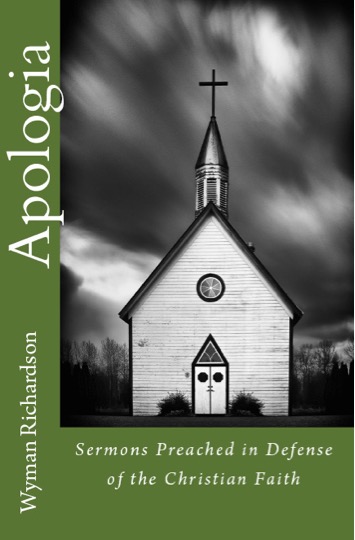
ApologiafrontcoverThis summer I preached seven apologetic sermons focusing on six common challenges to the Christian faith.  As I did so, a number of members of Central Baptist Church asked to have the sermons in written form.  After looking first at publishing them in-house on our own equipment, I decided the easiest way to do this was to self-publish them through an online print-on-demand site.  So that’s what we’ve done.

The book is now available through Amazon.  Please note that I set the royalty rate as low as Create Space, one of Amazon’s self-publishers, would allow me (bringing the cost to $3.59).  My intent here is not to profit, but simply to make these messages available in as affordable and accessible a medium as possible.  The audio and manuscripts are already available here on the site, but, if you would like a copy in book form, feel free to get a copy.

The Apologia Sermon Series

Here are audio and manuscript links for the Apologia sermons preached this summer.

Does God Exist? [audio / manuscript]

Is the Bible Reliable? (Part 1) [audio / manuscript]

Is the Bible Reliable? (Part 2) [audio / manuscript]

Has Christianity Been Good for the World? [audio / manuscript]

Is Jesus Really the Only Way to God? [audio / manuscript]

If Hell is Real is God Just? [audio / manuscript]

Did Jesus Rise From the Dead? [audio / manuscript]

Exodus 20:12

what-are-ten-commandments_472_314_80Exodus 20

12 “Honor your father and your mother, so that you may live long in the land the Lord your God is giving you.

In his novel East of Eden, John Steinbeck wrote about the ways in which children often become disillusioned with their parents as they get older.

When a child first catches adults out – when it first walks into his grave little head that adults do not have divine intelligence, that their judgments are not always wise, their thinking true, their sentences just – his world falls into panic desolation. The gods are fallen and all safety gone. And there is one sure thing about the fall of gods: they do not fall a little; they crash and shatter or sink deeply into green muck. It is a tedious job to guild them up again; they never quite shine. And the child’s world is never quite whole again. It is an aching kind of growing.[1]

There is truth in those observations. Part of growing older is coming to terms with the humanity of our parents. Of course, while that is happening, your parents are trying to come to terms with the humanity of their children. We all must come to terms with our imperfections: parents with their children’s and children with their parent’s.

In popular culture, you can find this sentiment in Crosby, Stills, Nash, and Young’s classic song, “Teach Your Children,” in which the singers encourage parents to be understanding with their children but also children to be understanding with their parents.

You, who are on the road must have a code that you can live by.

And so become yourself because the past is just a good bye.

Teach your children well, their father’s hell did slowly go by,

And feed them on your dreams, the one they fix, the one you’ll know by.

Don’t you ever ask them why, if they told you, you would cry,

So just look at them and sigh and know they love you.

And you, of the tender years can’t know the fears that your elders grew by,

And so please help them with your youth, they seek the truth before they can die.

Teach your parents well, their children’s hell will slowly go by,

And feed them on your dreams, the one they fix, the one you’ll know by.

Don’t you ever ask them why, if they told you, you would cry,

So just look at them and sigh and know they love you.

Yes, we are all human and none of us are perfect. Parents must be patient and understanding with their children. Children must be patient and understanding with their parents. Even so, there is a divine order to the family, and that divine order says that parents, while imperfect, are still parents, and children, while imperfect, are children. Thus, our equal standing as sinners does not negate the God-ordained structure of the family. That structure and the integrity of the family is acknowledged and safe-guarded in many ways, not the least of which is the fifth commandment’s call for children to honor their parents.

The honoring of parents is essential to our personal and corporate survival and flourishing.

The wording of the commandment is fairly straight-forward.

12 Honor your father and your mother, so that you may live long in the land the Lord your God is giving you.

There does not seem to be much controversy on the basic meaning of honoring your parents. “The Hebrew of the text is clear,” writes Patrick Miller, “and the translations agree on its meaning. In Hebrew, “honor” (kabbēd) seems to carry the freight it carries in English.”[2] Thus, to honor is to esteem, duly respect, and behave toward our parents in ways consonant with these attitudes. It is something profound and something significant.

To honor is not merely to act nicely. In Intruder in the Dust, William Faulkner has a character say, “After all a man ought to be kind even to his parents now and then.”[3] The fifth commandment says decidedly more than that. It is not talking about occasional niceness. It is talking about something much deeper, something God-honoring, parent-honoring, and people-sustaining.

Victor Hamilton helps us get at the meaning of “honor” by pointing to the biblical antithesis of honoring.

The command to “show respect to/ honor” one’s parents has its negative counterpart in Lev. 20: 9, “If anyone curses [better, “dishonors”] his father or mother, he must be put to death.” The verbs “honor/ kābēd” and “curse, dishonor/ qālal” are opposites. This can be observed by the fact that kābēd means “be heavy” and “honor,” while qālal means “be light” and “dishonor.” These two verbs occur in the same verse to describe the polar opposites of how one responds to the Lord: “Those who honor me I will honor [both times kābēd], but those who despise me will be disdained/ dishonored [qālal]” (1 Sam. 2: 30).[4]

To honor, then, is to do the opposite of disdaining. It is a substantive respecting, appreciating, and uplifting of our parents. We might ask why this commandment is the first commandment of the second table of commandments. Why is honoring our parents listed before, say, the command not to murder?

There are many reasons why, and our curiosity on this point reveals how little we understand the crucial and fundamental nature of the family to the survival of a people. We are commanded to honor our parents so that God’s gift of parents is rightly acknowledged, so that a sense of gratitude is rightly maintained, and so that the people of God can flourish through the survival of the institution of the family.

Many argue that the fifth commandment is actually a bridging commandment that connects the first four commandments dealing with our relationship with God and the five that follow this commandment dealing with our relationship with our fellow man. In other words, the fifth commandment has one foot in the four that precede it and another foot in the five that follow it. There is a theological component to honoring our parents. Namely, in honoring them we honor the God who gave them to us. Furthermore, in honoring them we are expressing gratitude for the good gifts of God.

What is more, the honoring of parents serves as a kind of glue or adhesive that keeps the basic unit of society, the family, in tact and that, in turn, keeps all of these units, all of these families, in harmony one with another. The rejection of our parents results in societal fragmentation and, eventually, the weakening and destruction of the people of God. This is why the Bible so frequently calls for parents to raise their children in the Lord and calls for children to honor their parents. What is more, this is why the Bible so often pronounces truly dire warnings upon those who would harm or neglect their parents.

Jesus called for and demonstrated the honoring of parents.

One of the ways we can approach the meaning of the fifth commandment is through observing how Jesus, in fact, honored it. He did so in a number of unique and telling ways.

Jesus condemned the ways that the Pharisees were leading others to neglect their parents.

In Matthew 15:3-9, Jesus responded to a challenge from the scribes and Pharisees concerning His disciples’ failure to observe certain of the traditions surrounding hand washing by offering His own challenge surrounding the fifth commandment.

3 He answered them, “And why do you break the commandment of God for the sake of your tradition? 4 For God commanded, ‘Honor your father and your mother,’ and, ‘Whoever reviles father or mother must surely die.’ 5 But you say, ‘If anyone tells his father or his mother, “What you would have gained from me is given to God,” 6 he need not honor his father.’ So for the sake of your tradition you have made void the word of God. 7 You hypocrites! Well did Isaiah prophesy of you, when he said: 8 “‘This people honors me with their lips, but their heart is far from me; 9 in vain do they worship me, teaching as doctrines the commandments of men.’”

What Jesus was condemning was a loophole developed by the religious elites whereby grown children could avoid materially supporting their parents by pronouncing that they were giving their goods to God instead of to their parents. In this way, in the name of God, they were harming their parents. Interestingly, in doing so, they were violating both tables of commandments, the vertical and the horizontal. This practice was condemned in Proverbs 28:24, “Whoever robs his father or his mother and says, ‘That is no transgression,’ is a companion to a man who destroys.”

Specifically, Jesus was calling the Pharisees out for a practice that was hypocritical and wicked. Generally, however, in so doing, Jesus was pronouncing judgment on all who would seek to find ways around honoring their parents as they should.

Jesus honored His parents by refusing to elevate them above the Father.

Jesus also honored His parents in ways that we might find surprising. For instance, as a boy, He once ultimately honored them by doing something that caused them anxiety. We find this fascinating episode in Luke 2.

41 Now his parents went to Jerusalem every year at the Feast of the Passover. 42 And when he was twelve years old, they went up according to custom. 43 And when the feast was ended, as they were returning, the boy Jesus stayed behind in Jerusalem. His parents did not know it, 44 but supposing him to be in the group they went a day’s journey, but then they began to search for him among their relatives and acquaintances, 45 and when they did not find him, they returned to Jerusalem, searching for him. 46 After three days they found him in the temple, sitting among the teachers, listening to them and asking them questions. 47 And all who heard him were amazed at his understanding and his answers. 48 And when his parents saw him, they were astonished. And his mother said to him, “Son, why have you treated us so? Behold, your father and I have been searching for you in great distress.” 49 And he said to them, “Why were you looking for me? Did you not know that I must be in my Father’s house?” 50 And they did not understand the saying that he spoke to them. 51 And he went down with them and came to Nazareth and was submissive to them. And his mother treasured up all these things in her heart.

Notice that Mary moved from worry to a sense of wonder. She “treasured up all these things in her heart.” What was Jesus doing in this instance? He was honoring His parents by honoring God more than His parents.

Many people think their children should honor them by idolizing them, by elevating them above everything else, potentially even above God. By staying behind in Jerusalem, Jesus caused His parents to worry, but He did so in service of a greater good: He showed that God alone is the object of our ultimate affections.

The same dynamic can be seen in Matthew 12.

46 While he was still speaking to the people, behold, his mother and his brothers stood outside, asking to speak to him. 48 But he replied to the man who told him, “Who is my mother, and who are my brothers?” 49 And stretching out his hand toward his disciples, he said, “Here are my mother and my brothers! 50 For whoever does the will of my Father in heaven is my brother and sister and mother.”

Once again, Jesus does something that undoubtedly caused His mother a measure of anxiety and possibly even pain, but He did so in order to once again stress the appropriate order of our affections. In doing so, He was ultimately honoring His mother. He honored her by putting her second to the Kingdom of God.

While in neither of these instances was Jesus having to refuse to do something sinful that His parents were asking Him to do, the principle nonetheless applies to these unfortunate possibilities. Put another way, Christ’s prioritizing of the Father over His earthly parents certainly establishes the principle that we must always obey God over man, even over our own parents.

In other words, if our parents ever ask us to rebel against God, to do something ungodly, or to indulge in God-dishonoring behavior, we must refuse. In other words, “honor” does not always mean “obey,” if obedience to our parents results in disobedience to God. Like Jesus, we honor our parents most when we refuse to elevate them above God.

Jesus honored His parents by offering practical provisions for His mother.

Practically speaking, Jesus also obeyed the fifth commandment by making provisions for the care of His mother. He did this while on the cross. His words in John 19 reflect one of the “seven last words from the cross.”

26 When Jesus saw his mother and the disciple whom he loved standing nearby, he said to his mother, “Woman, behold, your son!” 27 Then he said to the disciple, “Behold, your mother!” And from that hour the disciple took her to his own home.

What was Jesus doing in saying this to John and to His mother? He was providing a home for His mother. He was making sure that she, Mary, was going to be ok. He honored His mother by doing this.

While children are called to honor parents whether or not their parents “deserve” honor, parents are likewise enjoined to strive to be parents who do, in fact, deserve it.

It is clear that we should honor our parents whether they “deserve” it or not. But it is also clear that parents should strive to be parents who do, in fact, deserve it. The Bible says many things to parents in this regard. In Ephesians 6, however, Paul articulates a challenge to parents fast on the heels of quoting the fifth commandment.

1 Children, obey your parents in the Lord, for this is right. 2 “Honor your father and mother” (this is the first commandment with a promise), 3 “that it may go well with you and that you may live long in the land.” 4 Fathers, do not provoke your children to anger, but bring them up in the discipline and instruction of the Lord.

Here, Paul challenges fathers (and mothers, by extension) not to “provoke your children to anger.” There are many ways that parents can do this. First, parents can provoke their children to wrath by being neglectful, abusive, and poor parents. Even parents in the Church can fall into this category. Philip Yancey points to Ernest Hemingway as an example of this.

Hemingway knew about the ungrace of families.  His devout parents – Hemingway’s grandparents had attended evangelical Wheaton College – detested Hemingway’s libertine life, and after a time his mother refused to allow him in her presence.  One year for his birthday, she mailed him a cake along with the gun his father had used to kill himself.  Another year she wrote him a letter explaining that a mother’s life is like a bank.  “Every child that is born to her enters the world with a large and prosperous bank account, seemingly inexhaustible.”  The child, she continued, makes withdrawals but no deposits during all the early years.  Later, when the child grows up, it is his responsibility to replenish the supply he has drawn down.  Hemingway’s mother then proceeded to spell out all the specific ways in which Ernest should be making “deposits to keep the account in good standing”:  flowers, fruit or candy, a surreptitious paying of Mother’s bills, and above all a determination to stop “neglecting your duties to God and your Savious, Jesus Christ.”  Hemingway never got over his hatred for his mother or for her Saviour.[5]

There can be no wonder why Hemingway hated his mother and her Savior, given her harshness and manipulative ways. Another example is the hatred that Evelyn Waugh managed to distill in his son through various acts of selfishness and cruelty. The following is from his grandson, Alexander Waugh, who is reflecting on his father’s feelings about the death of Evelyn Waugh.

If Papa’s autobiographical account is to be trusted, the news of his own father’s death, on Easter Sunday 1966, came to him as a relief: “Just as school holidays had been happier and more carefree when my father was away, so his death lifted a great brooding awareness not only from the house but from the whole of existence.” He was actually grateful to his father for going when he did. “It is the duty of all good parents to die young,” he used to tell us. “Nobody is completely grown up until both his parents are gone.” Samuel Butler believed that every son is given a new lease of life on the death of his father.

Of his own father [Samuel] Butler wrote: “He never liked me, nor I him; from my earliest recollections I can recall no time when I did not fear and dislike him. Over and over again I relented towards him and said to myself that he was a good fellow after all; but I had hardly done so when he would go for me in some way or other which soured me again.”[6]

Yes, there is seemingly no end to the examples of fathers who drove their children to wrath. Here is famed author Pat Conroy writing about his father (around whom he framed the novel The Great Santini) in Atlanta magazine after his father’s death. The bitterness is palpable:

I have never met anyone who hated his father as much as I did mine, although the landscape of America is piled high with the stories of boys undone by the reckless ineptitude of men who were recently just boys themselves. The word “father” remains one of the darkest, bitterest words I employ in my work, and I have yet to write about a good one. The two most frightening words I carry from my childhood come back to me trilled by my sister Carol’s voice: “Dad’s home”…I did not believe a single one of his children would choose to attend his funeral. I used to dream of spitting on his body in the funeral home, spitting into the center of his dead, embalmed face again and again, until my mouth was dry. These were the happy daydreams of my childhood.[7]

Fathers and mothers, we are imperfect, to be sure. We should admit such and not be afraid to admit such to our children. But may we never treat our children in such a way that they fantasize about our deaths or, even more tragically, that they do not feel led to the Lord God because of our failed witness.

Another way we can drive our children to wrath is by suffocating them, by being what we call today “helicopter parents.” Al Mohler put it like this:

Coddled by a generation of baby boomers, today’s parents have turned into hyperprotectors…As one college student lamented to his counselor, “I wish my parents had some hobby other than me.”[8]

Perhaps you are aware of this phenomenon: stifling, suffocating parents who absolutely dominates every single aspect of the lives of their children. Educators are increasingly speaking about this. There is even a phenomenon now of parents going to college with their children, getting apartments near their child’s school so that he or she can come home every night to mom and dad. Professors increasingly complain of children who expect them to speak to their parents on cell phones about issues that, in the past, the student would have been expected to navigate.

As a pastor, I have seen this happen too many times, and it grieves me deeply. I have seen children flee overbearing parents enough to know that that very real damage can be done if we do not appropriately prepare our children for adulthood.

These are but two examples of the ways in which we can drive our children to wrath and cause them to be disillusioned. Again, no parent is perfect, and the fifth commandment does not hinge upon a parent being so. Even so, the harmonious fulfillment of it does hinge upon it. We should strive to live our lives in such a way that our children do indeed want to honor us!

Children, honor your parents.

Parents, be the type of people your children want to honor.


[1] John Steinbeck. East of Eden (New York, NY: Penguin Books, 2002), 20.

[2] Miller, Patrick D. (2009-08-06). The Ten Commandments: Interpretation: Resources for the Use of Scripture in the Church (Kindle Locations 3493-3494). Presbyterian Publishing Corporation. Kindle Edition.

[3] William Faulkner. Intruder in the Dust. (New York: Vintage Books, 1991), p.32.

[4] Hamilton, Victor P. (2011-11-01). Exodus: An Exegetical Commentary (Kindle Locations 11163-11171). Baker Publishing Group. Kindle Edition.

[5] Philip Yancey.  What’s So Amazing About Grace.  (Grand Rapids:  Zondervan Publishing House, 1997), p.38.

[6] Alexander Waugh, Fathers and Sons: The Autobiography of a Family. (Kindle Location 324-332,370-373) Kindle Edition.

[7] Atlanta, June 1999, p.72-73; 139-143.

[8] R. Albert Mohler, Jr., Culture Shift: Engaging Current Issues With Timeless Truth (Colorado Springs, CO: Multnomah Books, 2008), p.82,86.


John 3:25-30 and Luke 7:28

2John 3

25 Now a discussion arose between some of John’s disciples and a Jew over purification. 26 And they came to John and said to him, “Rabbi, he who was with you across the Jordan, to whom you bore witness—look, he is baptizing, and all are going to him.” 27 John answered, “A person cannot receive even one thing unless it is given him from heaven. 28 You yourselves bear me witness, that I said, ‘I am not the Christ, but I have been sent before him.’ 29 The one who has the bride is the bridegroom. The friend of the bridegroom, who stands and hears him, rejoices greatly at the bridegroom’s voice. Therefore this joy of mine is now complete. 30 He must increase, but I must decrease.”

Luke 7

28 I tell you, among those born of women none is greater than John. Yet the one who is least in the kingdom of God is greater than he.”

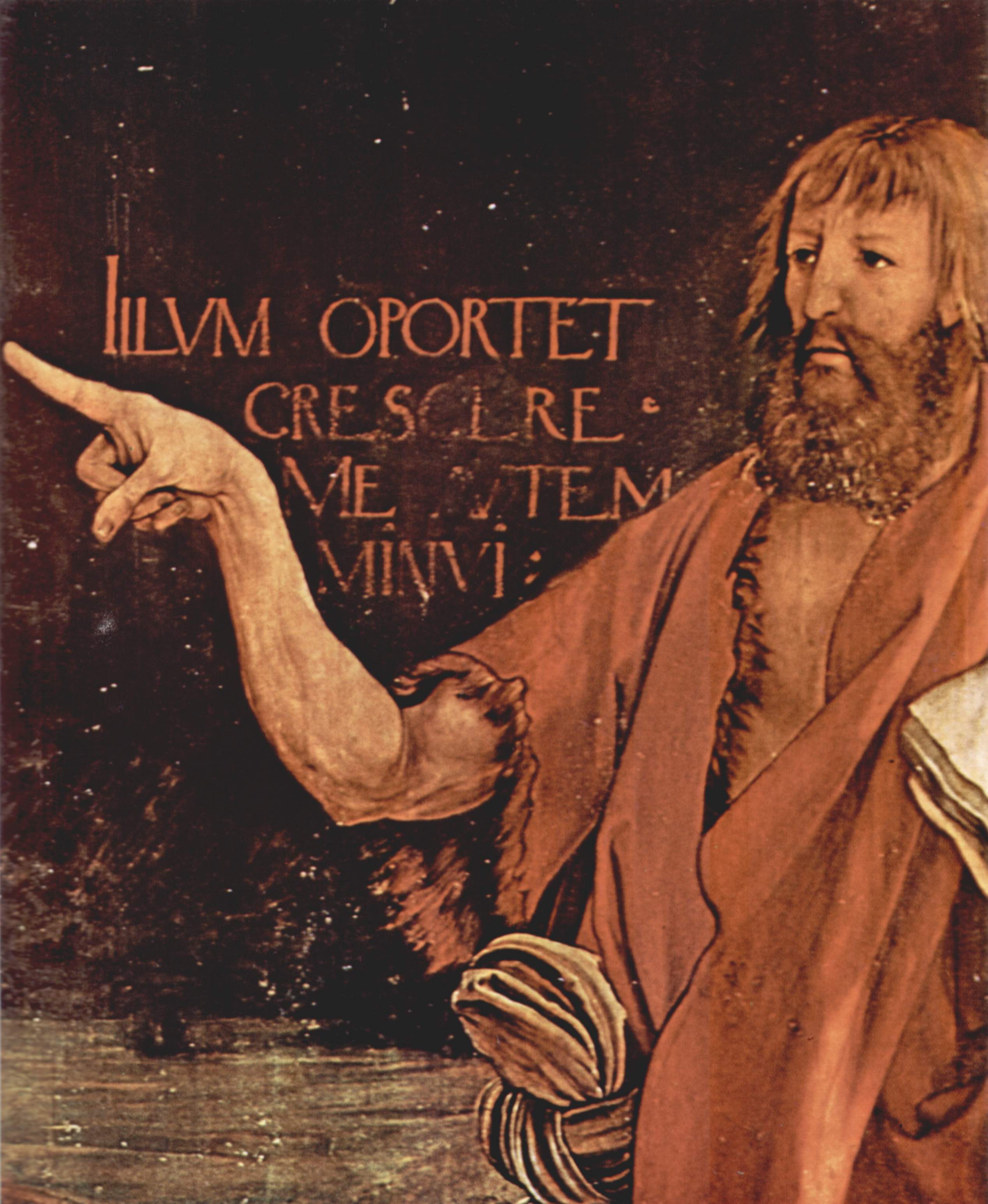
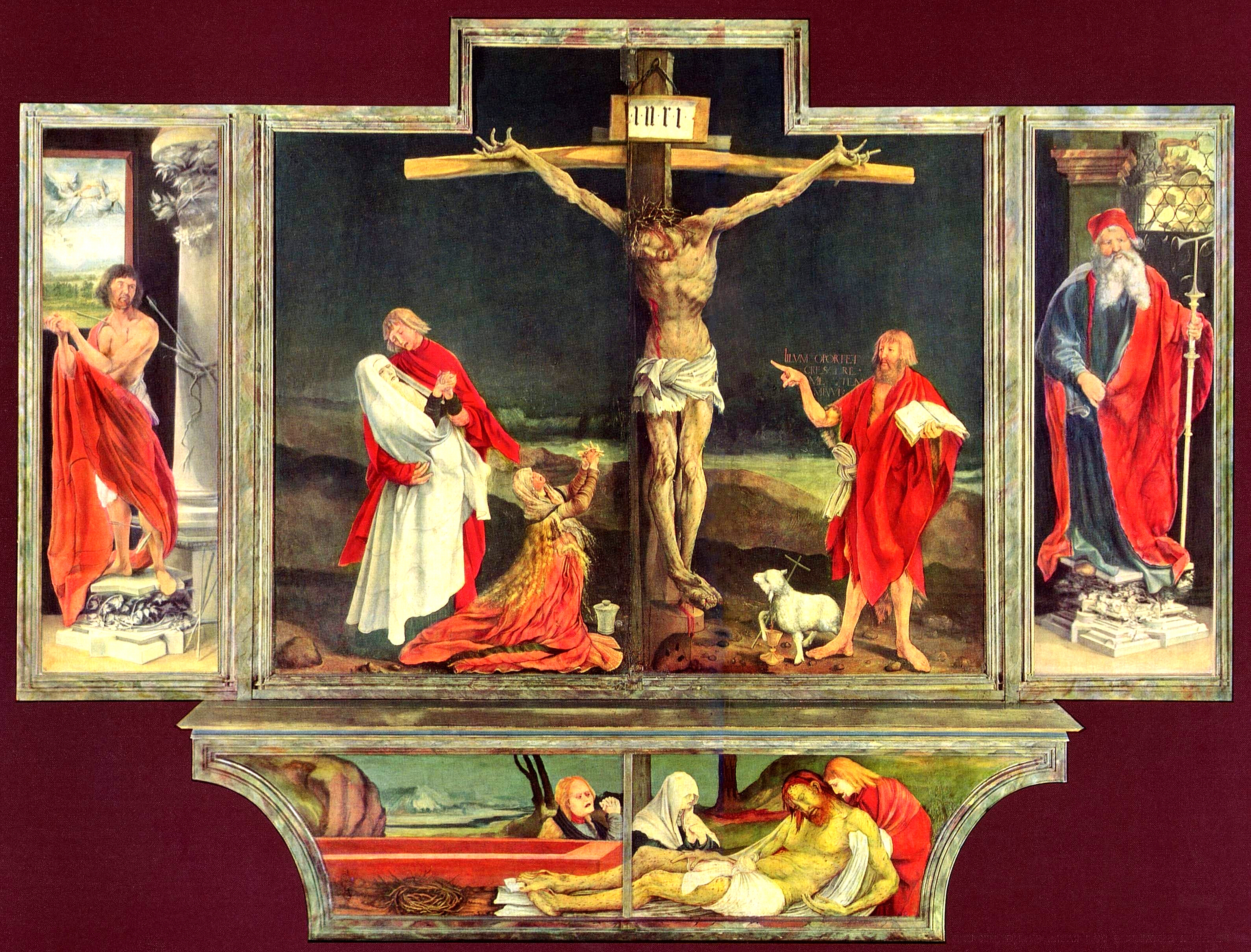
From 1512-1516, The Isenheim Altarpiece was sculpted by Niclaus of Haguenau and painted by Matthias Grunewald, a German Renaissance painter. It is an arresting piece of work.

1

It was painted for the Monastery of Saint Anthony, a monastery that was especially involved in the care of the sick. Many of the monks cared for those suffering the effects of plague, particularly in their skin. This is why Jesus’ skin looks diseased in the painting. Karl Barth, the famed theologian, had a copy of Grunewald’s painting in his office and used to spend a great deal of time contemplating it.

You can see the crucifixion scene prominently displayed here in the centerpiece, but when you come in close to John the Baptist you can also see an interesting detail that Grunewald added. The words above John the Baptist’s arm are, “Illum oportet crescere, me autem minui.” That is Latin for, “He must increase, but I must decrease.” These are the words of John the Baptist in response to the news that Jesus’ ministry and fame was expanding greater than John’s own. Instead of responding with jealousy or scorn, John famously said, “He must increase, but I must decrease.”

This is one of those verses that has an immediate and, simultaneously, a greater meaning. In the immediate context, John’s words were a declaration that Jesus’ fame and ministry and following should grow while his own decreased. But, in the broader sense, John the Baptist was articulating the very essence of the Christian life: “He must increase, but I must decrease.”

Anthony Esolen has quoted Tertullians’ famous words that “the blood of the martyrs is the seed of the Church.” He then went on to propose an opposite truth. If the blood of the martyrs is the seed of the church, then that means, Esolen writes, “that the sweat of the antimartyr[s] is poison for the Church.” By “antimartyr” Esolen meant this:

The antimartyr is what we are all in danger of becoming, when we forget the devastating and wholly salutary words of the Baptist, “He must increase, and I must decrease.” The antimartyr is not necessarily someone who hates the Church, or who seeks to spread paganism across the land. He is one, as I see it, who testifies to himself – one for whom the Church has become a means for the aggrandizement of himself.[1]

I think that is a helpful concept, antimartyrdom. If martyrs are those who have achieved the ultimate emptying of themselves by dying for Christ, then antimartyrs are those who have achieved the opposite: the ultimate exaltation of themselves.

Where are you on that spectrum? Where am I? It is a painful question.

Confining ourselves to John the Baptist’s categories, we must admit that either we are increasing or Jesus is increasing. If Jesus is not growing larger in our lives, then we are growing larger in our own lives. John knew this, and he knew which reality he had embraced.

Let us consider the meaning of his words.

Complete joy comes only in the consistent lessening and death of self for Christ.

I am struck first by what John said immediately before his famous words about increase and decrease. We find the details of the situation that gave rise to these words in John 3.

25 Now a discussion arose between some of John’s disciples and a Jew over purification. 26 And they came to John and said to him, “Rabbi, he who was with you across the Jordan, to whom you bore witness—look, he is baptizing, and all are going to him.”

John’s disciples, no doubt well intentioned, actually tempted John to jealousy over the ever-increasing fame of Jesus. Their protest was twofold: (1) Jesus was baptizing more people and (2) Jesus was drawing bigger crowds.

In truth, there is not a single Southern Baptist preacher that these words would not have worked on. “Look! The pastor down the street keeps baptizing people and drawing huge crowds!” To any other pastor, this would incite jealousy, but not John. John surprised his disciples by answering with an analogy. He used the analogy of a wedding.

27 John answered, “A person cannot receive even one thing unless it is given him from heaven. 28 You yourselves bear me witness, that I said, ‘I am not the Christ, but I have been sent before him.’ 29 The one who has the bride is the bridegroom. The friend of the bridegroom, who stands and hears him, rejoices greatly at the bridegroom’s voice.

Translation: “Guys, I am the best man, not the groom. Any best man who would be angry that the bride walks to the groom instead of to him is a sorry best man indeed! In fact, the best man should be happy that the bride goes to the groom.” That is a paraphrase, but that is the essence of what John the Baptist is saying. Then he says this:

29b Therefore this joy of mine is now complete. 30 He must increase, but I must decrease.”

It is a stunning statement. It has traditionally, and rightly, been viewed as a summation of the very essence of the Christian life: we must decrease and Jesus must increase. That is, we must consistently die to self and Christ must grow larger in our lives. Put another way, our own glory (which is really just a self-deception anyway) should lesson while Christ’s glory increases.

It is indeed a stunning statement. It is also a painful one. It is painful because it strikes at the very heart of our favorite idol: the self. The statement seems to recognize the perils of ego and self-exaltation. Did John not feel a pang of ego when he heard that Jesus was getting larger crowds? Maybe for a moment he did. Regardless, he immediately subjugated it to the greater glory of God in Christ.

Take a moment and ask yourself whether or not Christ is increasing or you are increasing in your life? There are a few areas where we can actually measure who is increasing and who is decreasing in our lives.

Ambition

Consider your own sense of ambition, your own desire to be greater, to be more successful, to be stronger, more powerful, more attractive. Consider how none of us have to be taught to exalt our own selves. Richard John Neuhaus has pointed out that you can see the rise of ambition in the ministry by looking at the increasingly grand titles that Protestant ministers are claiming for themselves.

Something odd is happening in Protestant groups that used to be strongly opposed to bishops, according to a story in the Atlanta Constitution. Once it was “Mister,” then “Reverend,” then “Doctor,” and now it is “Bishop.” Or more. The Rev. Miles Fowler of Big Miller Grove Baptist Church is now Bishop Miles Fowler. The popular television preacher is Bishop T. D. Jakes. Earl Paulk of the International Communion of Charismatic Churches is nothing less than Archbishop Paulk. Not to be outdone, Jamie Pleasant of Kingdom Builders Christian Center in Norcross, Georgia, is Apostle Pleasant. The way this is going, we may yet see a return to the time of anti–popes.[2]

Ambition is a powerful drug! We are born hardwired to want to be more, and, preferably, to want to be more than our neighbors. Ultimately, if we are honest with ourselves, we deep down want to be God. That was the first temptation of Eden and it is the very root of all sin.

Jealousy

Closely connected with personal ambition is jealousy, a deep resentment over the advancement or increase of others instead of ourselves. Our jealousies reveal how much we want to increase. This, as we have already seen, was the instinct that John’s disciples appealed to when they pointed out the growing fame of Jesus. Fortunately, John suppressed jealousy. It is hard to do, but it must be done. In fact, Christ will not increase in our lives so long as we harbor jealousy over the successes of others. R. Kent and Barbara Hughes pass on a story from yesteryear that poignantly demonstrates the power of jealousy.

An ancient story from the fourth century tells of inexperienced demons finding great difficulty in tempting a godly hermit. They lured him with every manner of temptation, but he could not be enticed. Frustrated, the imps returned to Satan and recited their plight. He responded that they had been far too hard on the monk. “Send him a message,” he said, “that his brother has just been made bishop of Antioch. Bring him good news.” Mystified by the devils advice, the demons nevertheless returned and dutifully reported the wonderful news to the hermit. And, in that very instant, he fell – into deep, wicked jealousy.[3]

A person whose heart is filled with jealousy can never really decrease. In turn, Christ cannot increase in such a heart.

Posturing on Social Media

The next evidence that we are not decreasing is evidence emerging from the modern age. It will perhaps sound humorous, but I assure you it is not. I am speaking of the subtle and not-so-subtle ways that we are tempted to posture on social media. Ours is the day of the selfie. More than that, ours is the day of the hundred selfies, ninety-nine of which will be discarded in favor of the one that looks the best. Ours is the day of the online update that makes us look just a little bit happier than we really are, just a little bit more successful than we really are, and just a little bit more together than we really are.

Lest you think I am throwing the baby out with the bathwater, hear me: in and of itself, social media is morally neutral, can be used for great good, and oftentimes is. I am not setting up a social-media-equals-bad formula. I, in fact, do not think that is the case. What I think, though, is that we are tempted all the time to increase ourselves on social media, to posture, to pose, to project an image that is oftentimes fictitious so that we will be more highly esteemed by others.

I would simply ask you to ask yourself this question: do your social media habits feed into the increase of your own image or do they magnify Christ?

Control

Another measurement of whether we are increasing or decreasing is in the area of control. Are you one of those people who simply must control events and people? Do you find within yourself an almost insatiable desire to be in the driver’s seat, to have your hand on the wheel, to be in the know, to have power, to make sure that things happen as you want? Are you a controller? I am not talking about being a good planner or organizer, I am talking about a spirit of control that borders on dominance, even if it is manifested in subtle ways.

Oftentimes there is something sinister behind our desires to control, especially our desires to control others, to have others do as we want and be what we think they must be. What lurks behind that is the idea that you and you alone have the template for reality, that you and you alone are capable of knowing how things must be. In the process, controllers tend to increase while Christ decreases, to grow larger on their own horizons while Christ is diminished in their own hearts.

Ego

Of course, the greatest measurement of how we are doing is an honest assessment of our own egos. We are enslaved to our own egos. It is something we must be broken of, and only Christ can break us of it. The first thing that must die at the foot of the cross is the ego. The temptations to ego-inflation, to the inflation of self, to our own increase are manifold. Robert Rayburn tells of one such story, again from the ministry.

Jean Massillon [was a] great French preacher. After a service in which he had preached one of his characteristically eloquent and powerful sermons, a woman lavished praise on him. “Madam,” he said, “the Devil has already said that to me and much more eloquently than you.”[4]

Beware the dangers of ego! The ego calls us to increase while everything around us decreases. St. Augustine gave a chilling warning in this regard.

            Will you glory in yourself? You will grow; but you will grow worse in your evil. For whoever grows worse is justly decreased. Let God, then, who is ever perfect, grow and grow in you. For the more you understand God and apprehend him, he seems to be growing in you; but in himself he does not grow, being always perfect.[5]

Amen and amen!

This lessening of self truly only happens when, conversely, there is a magnification of Christ.

Let us note that the lessening of self only happens when there is a magnification of Christ.

30 He must increase, but I must decrease.”

Literally, John says that Christ must “go on growing” while he, John, must “go on decreasing.” There must be a continuation of the increase of Christ and of the decrease of self. The two stand hand in hand: we are lessened and Christ is magnified.

It must be understood, when we say this, that we do not mean Christ Jesus actually and literally increases in His own essence and being. Such an idea is blasphemous and it is not what John meant. The Lord Jesus is perfectly God, complete in all His attributes, and exhaustive in His glory. The very notion that God could actually increase and that such an increase would somehow be tied to our actions is absurd.

No, John the Baptist is not speaking of an essential increase of the person of Christ, he is speaking of the increasing magnification of Christ in his life and in the world. There is a sense, of course, in which Christ appears to be growing larger as we grow smaller, but that is not a literal increase of Christ, that is simply what happens when our hearts are increasingly able to see Him as He is!

In the 5th century Saint Cyril of Alexandria wrote the following concerning John’s words.

The marvel over his deeds will not be limited, he says, nor will he exceed my honor merely because more people are baptized by him. Instead, he will ascend to a measure of glory that befits God. He must enter into an “increase” of glory and…bound ever upwards to the greater and shine more brightly to the world…[A]s he ascends to ever-increasing glory, I decrease to the extent that he rushes past me.[6]

The quotations around “increase” our significant. Jesus is not growing into His deity. He is fully divine. However, there is a sense of increase when He “bounds ever upwards to the greater and shines more brightly to the world,” when he, in Cyril’s words, “rushes past me.” We perceive this increase as we experience our own decrease. R. Kent and Barbara Hughes have passed on a beautiful example of what this dynamic looks like.

            Is such a life possible today? Of course! Just as it was for Charles Simeon, the great preacher of Kings’ College and Holy Trinity Church, Cambridge. Hugh Evan Hopkins, his biographer, tells that:

When in 1808 Simeon’s health broke down and he had to spend some eight months recuperating on the Isle of Wight, it fell to Thomason to step into the gap and preach as many as five times on a Sunday in Trinity Church and Stapleford. He surprised himself and everyone else by developing a preaching ability almost equal to his vicar’s, at which Simeon, totally free from any suggestion of professional jealousy, greatly rejoiced. He quoted the Scripture, “He must increase; but I must decrease,” and told a friend, “Now I see why I have been laid aside. I bless God for it.”[7]

There it is! There it is! Christ became bigger in that situation because Charles Simeon was willing to become less. Jesus did not literally grow, but I daresay that He never seemed bigger to Charles Simeon than when he determined to set ego, ambition, and jealousy aside and rejoice in the success of this other preacher. As such, Christ became bigger to Charles Simeon. He must become bigger to us as well!

Paradoxically the abandonment of the search for personal greatness and an embrace of the lessening of self and magnification of Christ results in true greatness.

At the heart of all of this there is a paradox. It is this: as we decrease and as Christ increases we are finally able to achieve true greatness. Paradoxically, we become more by becoming less. How do we know this? We know this because of what Jesus said about John the Baptist in Luke 7. As you hear these words, remember the words of John: “He must increase, but I must decrease.” Here is what Jesus said.

28 I tell you, among those born of women none is greater than John. Yet the one who is least in the kingdom of God is greater than he.

Utterly astounding! Do you see, church? Jesus said that John is the greatest “among those born of women.” He said this because John realized that Jesus was truly the greatest. We truly only live when we die. We are only truly great when we are willing to become nothing for the greatness of King Jesus! This is why Jesus offered that provocative follow-up statement: “Yet the one who is least in the kingdom of God is greater than he.” That is, our greatness increases as our lessening increases! Imagine it! The less we make of ourselves, the more Jesus makes of us! Oh what a grand miracle! Oh what an upside-down truth! At least it appears upside-down in our upside-down world! In the world we cannot see this. We think that greatness comes as we make more of ourselves. But in the Kingdom of God it is the opposite: greatness comes as we make less of ourselves and more of Jesus!

Max Anders writes:

It is said of the pioneer missionary, William Carey, that when he was close to death he turned to a friend and said, “When I am gone, don’t talk about William Carey; talk about William Carey’s Savior. I desire that Christ alone might be magnified.”[8]

Oh, church, may we say the same! May we same the same!

He must increase, but we must decrease!


[1] https://touchstonemag.com/merecomments/2010/09/the-inverse-martyr-rule/

[2] RJN, “While We’re At It,” First Things. June/July 200

[3] R. Kent and Barbara Hughes, Liberating Ministry From The Success Syndrome (Wheaton, IL: Crossway Books, 2008, p.100.

[4] Robert Rayburn, “Taking Our Proper Place.” https://www.faithtacoma.org/ sermons/I.Corinthians/1Cor_12.1-31.Nov3.02.htm

[5] Joel C. Elowsky, ed. John 1-10. Ancient Christian Commentary on Scripture. New Testament IVa. Gen. Ed., Thomas C. Oden (Downers Grove, IL: InterVarsity Press, 2006), p.136.

[6] Cyril of Alexandria, Commentary on John. Vol.1. Trans., David Maxwell. Ed., Joel C. Elowsky. Ancient Christian Texts. Series eds., Thomas C. Oden and Gerald L. Bray (Downers Grove, IL: InterVarsity Press, 2013), p.106-107.

[7] R. Kent and Barbara Hughes, p.102.

[8] Kenneth O. Gangel, John. Holman New Testament Commentary. Gen Ed. Max Anders (Nashville, TN: B&H Publishing Group, 2000), p.59.

Exodus 20:8-11

what-are-ten-commandments_472_314_80Exodus 20

8 “Remember the Sabbath day, to keep it holy. 9 Six days you shall labor, and do all your work, 10 but the seventh day is a Sabbath to the Lord your God. On it you shall not do any work, you, or your son, or your daughter, your male servant, or your female servant, or your livestock, or the sojourner who is within your gates. 11 For in six days the Lord made heaven and earth, the sea, and all that is in them, and rested on the seventh day. Therefore the Lord blessed the Sabbath day and made it holy.

The fourth commandment is one with which many Christians have an uneasy relationship. We know it is in God’s word and we know it is a commandment, yet must of us know that (a) Sunday is more of a Sabbath for us than Saturday, the seventh day of the week, was and is for the Jews and (b) even at that, we do not really honor the Sabbath on Sunday either! To put it simply, most Christians today do not really know quite what to do with the commandment, “Remember the Sabbath day, to keep it holy.”

What is the Sabbath? Before we begin, let us try to construct a basic definition based on the text.

The Hebrew word šābat literally means “stop.” So we should stop something on the Sabbath. We also know that the Sabbath is a day: “Remember the Sabbath day…” So, at a minimum, we know that there is a day in which we stop. Stop what? Verse 9 tells us: “work.” We should stop work on the Sabbath. That is what we should give up. But there also appears to be an idea of taking something up. First, we should take up rest. Second, we should take up activities that honor the holiness of the day, for “the Lord blessed the Sabbath day and made it holy.” The primary activity that would lead us into rest and the sanctifying of the Sabbath day would appear to be worship. We should worship God on the Sabbath.

This is a very basic definition, and one that may raise more questions than it answers. Even so, let us begin with it and then move forward into a deeper consideration of the text and the implications of Sabbath rest.

Sabbath observance honors God and imitates the pattern of His creative work and rest.

We first notice that the fourth commandment calls us to an act of imitation and, specifically, to an imitation of a pattern and rhythm.

8 “Remember the Sabbath day, to keep it holy. 9 Six days you shall labor, and do all your work, 10 but the seventh day is a Sabbath to the Lord your God. On it you shall not do any work, you, or your son, or your daughter, your male servant, or your female servant, or your livestock, or the sojourner who is within your gates. 11 For in six days the Lord made heaven and earth, the sea, and all that is in them, and rested on the seventh day. Therefore the Lord blessed the Sabbath day and made it holy.

We are called to imitate God. The key here is verse 11: “For in six days the Lord made heaven and earth, the sea, and all that is in them, and rested on the seventh day. Therefore the Lord blessed the Sabbath day and made it holy.” The implication is clear: we should “remember the Sabbath day to keep it holy” because this is what God did in the act of creation. We should imitate what God did. Victor Hamilton writes:

Nowhere in the Bible is the concept of imitatio dei as transparent as it is here. Leviticus 19:2b is another classic imitatio dei verse, “You shall be holy, for I the LORD your God am holy,” but nowhere does Lev. 19 spell out anything God is or does that identifies him as holy and that we can do too. God was not a workaholic. Don’t you be one, says this fourth commandment.[1]

That is humorously put, but well said: “God was not a workaholic. Don’t you be one, says this fourth commandment.” So we are called to imitation: imitation of God. Specifically, we are called to a particular pattern and rhythm of life, the rhythm we find in Genesis: six days labor followed by one day of holy rest.

8 “Remember the Sabbath day, to keep it holy. 9 Six days you shall labor, and do all your work, 10 but the seventh day is a Sabbath to the Lord your God. On it you shall not do any work, you, or your son, or your daughter, your male servant, or your female servant, or your livestock, or the sojourner who is within your gates. 11 For in six days the Lord made heaven and earth, the sea, and all that is in them, and rested on the seventh day. Therefore the Lord blessed the Sabbath day and made it holy.

Six days work.

One day rest.

Six days work.

One day rest.

This is the basic pattern of life.

Set aside, for a moment, the thousand questions that come to mind when hearing about this rhythm. Most of them are borne of legalism and basically miss the whole point. The main point, for now, is that God, in creation, demonstrated a rhythm that we are called likewise to follow: six days work and one day rest.

If we are commanded to follow this pattern, and if God Himself followed this pattern, then how important do you think this is? It is apparently very important.

Again, setting aside our legalistic parsing of these verses, let me ask you to take a moment, step back from this text, look at it, look at the current rhythm of your life, and see how they match up. In other words, in terms of the broad strokes of our text, is your life following this kind of rhythm, this kind of pattern, this kind of divine example?

If your life is not following this rhythm, let me ask you another question: how are you doing right now? Are you happy? Healthy? Whole? Content? At peace?

I daresay that most of us are not following this pattern. Our society is not structured to honor this Sabbath rhythm. We are doing too much, though, paradoxically, it feels like we are accomplishing less. The regular week for most of us feels like we are in a Nascar race, but we are tied to the roof of the car and not driving it. Even the way we rest is exhausting. Much of our rest consists of diversions that cost money and take energy from us. It is not true rest.

Sabbath observance should include rest and worship.

And, at the end of the day, for many of us, worship does not fit very prominently into our patterns and rhythms, if it is present at all. But note that the Sabbath day is holy. It is not a day of laziness. It is a day of holy, God-honoring, worshipful rest.

8 “Remember the Sabbath day, to keep it holy. 9 Six days you shall labor, and do all your work, 10 but the seventh day is a Sabbath to the Lord your God. On it you shall not do any work, you, or your son, or your daughter, your male servant, or your female servant, or your livestock, or the sojourner who is within your gates. 11 For in six days the Lord made heaven and earth, the sea, and all that is in them, and rested on the seventh day. Therefore the Lord blessed the Sabbath day and made it holy.

Abraham Heschel has helpfully called the Sabbath “a sanctuary in time” (Sabbath).[2] That is a beautiful way to think about it. Furthermore, Patrick Miller has pointed out that God granting His people Sabbath rest is the antithesis of the cruel response of Pharaoh to the Israelites when they appealed to him for an opportunity to worship.

When Israelite slaves in Egypt sought time off to worship the Lord their God, when the people sought release from the service of the Pharaoh for the service of God, the forces of human tyranny and oppressive economic exploitation of slave labor were set against this request for time that is sacred and holy and restful, demanding for more work. Pharaoh said: “They cry, ‘Let us go and offer sacrifice to our God.’ Let heavier work be laid on them” (5:8–9). The service of God is rejected in behalf of a secular exploitation of human life and human work. That is what triggered the Lord’s gift of the Sabbath. What is required is what is needed to make and to keep human life human— and not inhumane, as it was in Egypt.[3]

The Sabbath is a gift. It is a gift from God. It is therefore amazing and sad that we approach the topic of the Sabbath begrudgingly wondering how an observance of this sacred day will potentially disrupt our routines instead of approaching it joyfully and with gratitude. Do you see how God, unlike Pharaoh, wanted to bless His people by drawing them into His presence in a special way on this special day? The Sabbath reveals the kindness and mercy of God.

We should want to worship on the Sabbath! That is what the Jews asked of Pharaoh:   “Let us worship our God!” This was rest, true, but it was worshipful rest. “There really is a difference,” Patrick Miller writes, “between taking a day off and taking a day off and sanctifying it to the Lord.”[4] J.I. Packer has likewise offered some helpful insights into the nature of what we set aside and what we take up on the Sabbath.

Third, the ethical problem: if the Lord’s day is the Christian Sabbath, how do we keep it holy? Answer—by behaving as Jesus did. His Sabbaths were days not for idle amusement, but for worshiping God and doing good—what the Shorter Catechism calls “works of necessity and mercy” (see Luke 4:16; 13:10–17; 14:1–6). Freedom from secular chores secures freedom to serve the Lord on his own day. Matthew Henry says that the Sabbath was made a day of holy rest so that it might be a day of holy work. From this holy work, in our sedentary and lonely world, physical recreation and family fun will not be excluded, but worship and Christian fellowship will come first.[5]

Matthew Henry’s words stand out: “the Sabbath was made a day of holy rest so that it might be a day of holy work.” This “holy work” is worship and praise with the assembly of God’s people.

Dear church, honor our times of corporate worship. They are food for our souls. The rhythm of consistent gathering and consistent praise is what we need to remain human in a dehumanizing world and to remain Christian in a world that is anti-Christ.

My father is a hardware salesman. He has worked hard his entire life. When I was growing up he would be gone a night or two every week out on the road traveling and selling hardware. But he honored the sacredness of worship. It always made an impression on me.

I recall one Wednesday night when our Minister of Youth was out of town and we had to go to the prayer meeting in the sanctuary. I am ashamed to say that this was not an exciting prospect for me! But I went. I remember sitting over to the side with a few other kids trying not to look as bored as I felt. My dad had been out of town working. Our mom had brought us to church, if I recall. So we sat there through the whole service. There were only about five to ten minutes left when the back doors opened and I saw my father, looking tired and worn, come in and sit down in the back.

He had rushed in for the last few minutes of worship instead of just going home.

I do not know that I have ever told him just what kind of impression that made on me. I do not recall what was said from the platform that night, but I do recall what my dad was saying just by walking through that door: “This matters to me. This is important. The corporate gathering of the church should be kept sacred.”

Father and mothers: let us let our children see us valuing and honoring worship! Let us let them see that it matters to us. If they see it matters to us then it will likewise matter to them.

Honor the twin Sabbath privileges of rest and worship.

Sabbath observance for the Church is bound to the liberation and rest we find in the resurrected Jesus.

We know the call to Sabbath observance is binding and we know that it is important. Yet we meet on Sundays. How can this be? Are we violating the Sabbath by meeting on Sunday for worship instead of Saturday?

For the early Church, the resurrection was a paradigm-shifting act of redefinition. The resurrection of Jesus from the dead did not obliterate the Sabbath, but it did situate it in the person and work of Christ, who, I will remind us, referred to Himself as “Lord of the Sabbath” (Matthew 12:8).

The resurrection, of course, happened on the first day of the week. In Mark 16:2 we read, “And very early on the first day of the week, when the sun had risen, they went to the tomb.” As a result, the Church began to meet on the first day of the week, the Lord’s day. Thus, in Acts 20:7 we find this: “On the first day of the week, when we were gathered together to break bread, Paul talked with them, intending to depart on the next day, and he prolonged his speech until midnight.” Furthermore, In Revelation 1:10 John writes of this day as a settled and recognized day in the life of the Church: “I was in the Spirit on the Lord’s day, and I heard behind me a loud voice like a trumpet.”

The resurrection of Jesus therefore redefined the Sabbath and situated it on the first day of the week. The Westminster Shorter Catechism says:

From the beginning of the world to the resurrection of Christ, God appointed the seventh day of the week to be a weekly Sabbath; and the first day of the week ever since…which is the Christian Sabbath.[6]

For Christians, the Lord’s day is our Sabbath day. That is because Jesus, Lord of the Sabbath, who conquered death on Easter Sunday, is Himself the fulfillment of all that the Sabbath was intended to be. It gives new meaning to His beautiful words in Matthew 11:28: “Come to me, all who labor and are heavy laden, and I will give you rest.”

He is our rest. Jesus is our Sabbath rest. He is our cessation from toil and our holy work of worship. But there is more. He is also our Jubilee, our release from bondage and debt and enslavement. David VanDrunen has offered a fascinating argument concerning the ways in which Sunday, the eighth day, was hinted at in the Old Testament as a day of special favor, a day in which God would do something extraordinary and liberating for His people. In other words, the Old Testament itself alluded to a unique outpouring of divine favor on Sunday that anticipated the resurrection of Christ and the coming sacredness of the first day of the week.

One way in which the Old Testament pointed them to the coming of Christ was by giving them a second kind of Sabbath that was different from the ordinary weekly Sabbaths. For a couple of special occasions God gave Israel the equivalent of an eighth day rest—or, a rest on the first day of the week (see Lev. 23:15–16, 21; 25:8–12; see vv. 1–12). Leviticus 23 teaches about the Feast of Weeks and commands a rest on the fiftieth day (a Sunday), following seven cycles of seven-day weeks. Leviticus 25 speaks about a Sabbath year, the Year of Jubilee, a time when people were released from their debts and restored to their inheritance. This Year of Jubilee took place on the fiftieth year, the year after “seven times seven years,” that is, seven squared, the perfect number of ordinary cycles of years. Liberty was to be proclaimed throughout the land (25:8,10). This was the year for showcasing the grace of God that conquers all evil. This practice of celebrating a Sabbath on the fiftieth day/year must have been wonderful for the Old Testament Israelites, but a little confusing nonetheless. The ordinary weekly Sabbath was about working first and only then taking a rest. But here they were instructed to rest at the beginning of the cycle of time, before the period for work. What was the meaning of this different kind of Old Testament Sabbath? It pointed ahead to the resurrection of the Lord Jesus Christ. During his earthly ministry Jesus announced on a Sabbath day (Saturday) the fulfillment of the proclamation of liberty, “the year of the Lord’s favor” (Luke 4:19; see vv. 16–21). Jesus pointed Israel to himself as the one who brings the true and ultimate Jubilee for his people. How exactly did he bring the final and greatest liberty to them, a liberty that far surpasses a (temporary) return to an earthly plot of land? He did it through the resurrection. Jesus rose “after the Sabbath” (Matt. 28:1; Mark 16:1), on the “first day of the week” (Luke 24:1; John 20:1)—Sunday. The timing is truly amazing. The day that Jesus lay dead in the tomb turned out to be the last Sabbath of the Old Testament era (for after his resurrection the old covenant was no more). Remember that the Old Testament Year of Jubilee had occurred on the fiftieth year—that is, the year immediately after the “perfect” number of Sabbath years (7 × 7 = 49). And thus Jesus rose from the dead on the day immediately after the number of Old Testament seventh-day Sabbaths had reached their complete and perfect number! His resurrection was the true Year of Jubilee. The weekly Old Testament Sabbath had looked back to God’s work of creation (Ex. 20:8–11) and reminded God’s people of the first Adam’s original obligation to work perfectly in this world and then to attain his rest. The resurrection now announces that Jesus, as the last Adam, has completed the task of the first Adam and has attained his reward of rest in the world-to-come.[7]

It would seem, then, that the consecration of the first day of the week is not, after all, so utterly alien to the Jewish Sabbath. Built into the rhythms of the life of Israel were these curious and provocative periodic hallowings of Sunday, of the beginning of the week, of the beginning of a new cycle of years. There is therefore precedence for seeing the eighth day as the day in which God does certain highly unusual and highly wonderful things! And it was on one eighth day in particular, the Sunday after the crucifixion, that God raised Jesus from the dead!

We live in the shadow of the cross and before the mouth of the open tomb. We live now – right now! – in the Jubilee of Christ Jesus: His setting free of those ensnared by sin, death, and hell! Our Sabbath is still a day, but it is now more: it is a person! It is Jesus, the lamb of God, the conquering King, the Shepherd who knows His sheep and calls us home!

Remember the Sabbath day, to keep it holy.


[1] Hamilton, Victor P. (2011-11-01). Exodus: An Exegetical Commentary (Kindle Locations 11132-11136). Baker Publishing Group. Kindle Edition.

[2] Miller, Patrick D. (2009-08-06). The Ten Commandments: Interpretation: Resources for the Use of Scripture in the Church (Kindle Locations 2675-2676). Presbyterian Publishing Corporation. Kindle Edition.

[3] Miller, Patrick D., Kindle Locations 2648-2654.

[4] Miller, Patrick D., Kindle Locations 2686-2687.

[5] Packer, J. I. (2008-01-07). Keeping the Ten Commandments (Kindle Locations 570-575). Crossway. Kindle Edition.

[6] Packer, J. I., Kindle Locations 562-563.

[7] VanDrunen, David (2010-10-15). Living in God’s Two Kingdoms (p. 138-139). Good News Publishers. Kindle Edition.