I’m not a fan of James White. I don’t know that that comment needs a real explanation. It is what it is. But I will qualify it a bit. I don’t hate James White or loathe him or anything of the sort. It’s just that certain of his theological positions are troubling to me and at times I find his approach on some issues to be grating. Other aspects of his ministry I’m deeply grateful for. For instance, James White of Alpha and Omega Ministries has been throwing down some very helpful, very balanced, and very wise counsel concerning how we speak about Islam. Case in point, consider the first 45 minutes of this video in which he responds to Robert Jeffress’ outlandish comments from the pulpit of First Baptist Dallas. Well done Dr. White. Here’s the video…
Category Archives: Blog
A One Year Reading Plan for Karl Barth’s Church Dogmatics
I do better with structure, especially when it comes to reading large works. Barth’s Dogmatics is considered the most significant theological work of the twentieth century and one of the most substantial theological works ever written. I have been thinking of reading through the Dogmatics next year and finally, a few days back, sat down and worked through the table of contents and developed a plan. I’ve tried to add extra days when the sections are larger. I’ll be working through the Hendrickson set available through Christian Book Distributors here (though it should be noted that T&T Clark has republished the Dogmatics here in paperback with translations of all foreign-language terms [also available here via Logos]). Come along for the journey! Here’s the reading plan…
| 2016 Reading Plan for Karl Barth’s Church Dogmatics | |
| Volume I.1 | |
| 1-Jan | 1.1 The Church, Theology, Science |
| 2-Jan | 1.2 Dogmatics as an Enquiry |
| 3-Jan | 1.3 Dogmatics as an Act of Faith |
| 4-Jan | 2.1 The Necessity of Dogmatic Prolegomena |
| 5-Jan | 2.2 The Possibility of Dogmatic Prolegomena |
| 6-Jan | 3.1 Talk about God and Church Proclamation |
| 7-Jan | |
| 8-Jan | 3.2 Dogmatics and Church Proclamation |
| 9-Jan | 4.1 The Word of God Preached |
| 10-Jan | 4.2 The Word of God Written |
| 11-Jan | 4.3 The Word of God Revealed |
| 12-Jan | 4.4 The Unity of the Word of God |
| 13-Jan | 5.1 The Question of the Nature of the Word of God |
| 14-Jan | 5.2 The Word of God as the Speech of God |
| 15-Jan | 5.3 The Speech of God as the Act of God |
| 16-Jan | 5.4 The Speech of God as the Mystery of God |
| 17-Jan | 6.1 The Question of the Knowability of the Word of God |
| 18-Jan | 6.2 The Word of God and Man |
| 19-Jan | 6.3 The Word of God and Experience |
| 20-Jan | |
| 21-Jan | 6.4 The Word of God and Faith |
| 22-Jan | 7.1 The problem of Dogmatics |
| 23-Jan | |
| 24-Jan | 7.2 Dogmatics as a Science |
| 25-Jan | 7.3 The Problem of Dogmatic Prolegomena |
| 26-Jan | 8.1 The Place of the Doctrine of the Trinity in Dogmatics |
| 27-Jan | 8.2 The Root of the Doctrine of the Trinity |
| 28-Jan | |
| 29-Jan | 8.3 Vestigium Trinitatis |
| 30-Jan | 9.1 Unity in Trinity |
| 31-Jan | 9.2 Trinity in Unity |
| 1-Feb | 9.3 Triunity |
| 2-Feb | 9.4 The Meaning of the Doctrine of the Trinity |
| 3-Feb | 10.1 God as Creator |
| 4-Feb | 10.2 The Eternal Father |
| 5-Feb | 11.1 God as Reconciler |
| 6-Feb | 11.2 The Eternal Son |
| 7-Feb | 12.1 God as Redeemer |
| 8-Feb | 12.2 The Eternal Spirit |
| 9-Feb | |
| Volume I.2 | |
| 10-Feb | 13.1 Jesus Christ as the Objective Reality of Revelation |
| 11-Feb | |
| 12-Feb | 13.2 Jesus Christ the Objective Possibility of Revelation |
| 13-Feb | |
| 14-Feb | 14.1 God’s Time and our Time |
| 15-Feb | |
| 16-Feb | 14.2 The Time of Expectation |
| 17-Feb | |
| 18-Feb | 14.3 The Time of Recollection |
| 19-Feb | |
| 20-Feb | 15.1 The Problem of Christology |
| 21-Feb | 15.2 Very God and Very Man |
| 22-Feb | |
| 23-Feb | 15.3 The Miracle of Christmas |
| 24-Feb | |
| 25-Feb | 16.1 The Holy Spirit the Subjective Reality of Revelation |
| 26-Feb | |
| 27-Feb | 16.2 The Holy Spirit the Subjective Possibility of Revelation |
| 28-Feb | |
| 29-Feb | 17.1 The Problem of Religion in Theology |
| 1-Mar | 17.2 Religion as Unbelief |
| 2-Mar | |
| 3-Mar | 17.3 True Religion |
| 4-Mar | |
| 5-Mar | 18.1 Man as a Doer of the Word |
| 6-Mar | 18.2 The Love of God |
| 7-Mar | |
| 8-Mar | 18.3 The Praise of God |
| 9-Mar | |
| 10-Mar | |
| 11-Mar | 19.1 Scripture as a Witness to Divine Revelation |
| 12-Mar | |
| 13-Mar | 19.2 Scripture as the Word of God |
| 14-Mar | |
| 15-Mar | |
| 16-Mar | 20.1 The Authority of the Word |
| 17-Mar | |
| 18-Mar | |
| 19-Mar | 20.2 Authority under the Word |
| 20-Mar | |
| 21-Mar | |
| 22-Mar | |
| 23-Mar | 21.1 The Freedom of the Word |
| 24-Mar | |
| 25-Mar | |
| 26-Mar | 21.2 Freedom under the Word |
| 27-Mar | |
| 28-Mar | 22.1 The Word of God and the Word of Man in Christian Preaching |
| 29-Mar | 22.2 Pure Doctrine as the Problem of Dogmatics |
| 30-Mar | |
| 31-Mar | 22.3 Dogmatics as Ethics |
| 1-Apr | 23.1 The Formal Task of Dogmatics |
| 2-Apr | 23.2 The Dogmatic Norm |
| 3-Apr | |
| 4-Apr | 24.1 The Material Task of Dogmatics |
| 5-Apr | 24.2 The Dogmatic Method |
| 6-Apr | |
| 7-Apr | Volume II.1 |
| 8-Apr | 25.1 Man before God |
| 9-Apr | |
| 10-Apr | 25.2 God before Man |
| 11-Apr | |
| 12-Apr | 26.1 The Readiness of God |
| 13-Apr | |
| 14-Apr | |
| 15-Apr | 26.2 The Readiness of Man |
| 16-Apr | |
| 17-Apr | 27.1 The Hiddeness of God |
| 18-Apr | |
| 19-Apr | 27.2 The Veracity of Man’s Knowledge of God |
| 20-Apr | |
| 21-Apr | 28.1 The Being of God in Act |
| 22-Apr | |
| 23-Apr | 28.2 The Being of God as the One who loves |
| 24-Apr | |
| 25-Apr | 28.3 The Being of God in Freedom |
| 26-Apr | |
| 27-Apr | 29 The Perfections of God |
| 28-Apr | |
| 29-Apr | 30.1 The Grace and Holiness of God |
| 30-Apr | 30.2 The Mercy and Righteousness of God |
| 1-May | |
| 2-May | 30.3 The Patience and Wisdom of God |
| 3-May | |
| 4-May | 31.1 The Unity and Omnipresence of God |
| 5-May | |
| 6-May | 31.2 The Constancy and Omnipotence of God |
| 7-May | |
| 8-May | |
| 9-May | |
| 10-May | |
| 11-May | 31.3 The Eternity and Glory of God |
| 12-May | |
| 13-May | |
| 14-May | |
| Volume II.2 | |
| 15-May | 32.1 The Orientation of the Doctrine |
| 16-May | 32.2 The Foundation of the Doctrine |
| 17-May | 32.3 The Place of the Doctrine in Dogmatics |
| 18-May | 33.1 Jesus Christ, Electing and Elected |
| 19-May | |
| 20-May | 33.2 Th Eternal Will of God in the Election of Jesus Christ |
| 21-May | |
| 22-May | 34.1 Israel and the Church |
| 23-May | 34.2 The Judgment and the Mercy of God |
| 24-May | 34.3 The Promise of God Heard and Believed |
| 25-May | 34.4 The Passing and the Coming Man |
| 26-May | |
| 27-May | 35.1 Jesus Christ, the Promise and its Recipient |
| 28-May | |
| 29-May | 35.2 The Elect and the Rejected |
| 30-May | |
| 31-May | |
| 1-Jun | 35.3 The Determination of the Elect |
| 2-Jun | |
| 3-Jun | 35.4 The Determination of the Rejected |
| 4-Jun | |
| 5-Jun | |
| 6-Jun | 36.1 The Command of God and the Ethical Problem |
| 7-Jun | |
| 8-Jun | 36.2 The Way of Theological Ethics |
| 9-Jun | 37.1 The Basis of the Divine Claim |
| 10-Jun | 37.2 The Content of the Divine Claim |
| 11-Jun | 37.3 The Form of the Divine Claim |
| 12-Jun | |
| 13-Jun | 38.1 The Sovereignty of the Divine Decision |
| 14-Jun | 38.2 Th eDefiniteness of the Divine Decision |
| 15-Jun | 38.3 The Goodness of the Divine Decision |
| 16-Jun | 39.1 The Presupposition of the Divine Judgment |
| 17-Jun | 39.2 The Execution of the Divine Judgment |
| 18-Jun | 39.3 The Purpose of the Divine Judgment |
| 19-Jun | |
| Volume III.1 | |
| 20-Jun | 40 Faith in God the Creator |
| 21-Jun | 41.1 Creation, History and Creation History |
| 22-Jun | |
| 23-Jun | 41.2 Creation as the External Basis of the Covenant |
| 24-Jun | |
| 25-Jun | |
| 26-Jun | |
| 27-Jun | 41.3 The Covenant as the Internal Basis of Creation |
| 28-Jun | |
| 29-Jun | |
| 30-Jun | |
| 1-Jul | 42.1 Creation as Benefit |
| 2-Jul | 42.2 Creation as Actualisation |
| 3-Jul | 42.3 Creation as Justification |
| 4-Jul | |
| Volume III.2 | |
| 5-Jul | 43.1 Man in the Cosmos |
| 6-Jul | 43.2 Man as an Object of Theological Knowledge |
| 7-Jul | |
| 8-Jul | 44.1 Jesus, Man for God |
| 9-Jul | 44.2 Phenomena of the Human |
| 10-Jul | |
| 11-Jul | 44.3 Real Man |
| 12-Jul | |
| 13-Jul | 45.1 Jesus, Man for other Men |
| 14-Jul | 45.2 The Basic Form of Humanity |
| 15-Jul | |
| 16-Jul | 45.3 Humanity as Likeness and Hope |
| 17-Jul | |
| 18-Jul | 46.1 Jesus, Whole Man |
| 19-Jul | 46.2 The Spirit as Basis of Soul and Body |
| 20-Jul | 46.3 Soul and Body in their Interconnexion |
| 21-Jul | 46.4 Soul and Body in their Particularity |
| 22-Jul | 46.5 Soul and Body in their Order |
| 23-Jul | 47.1 Jesus, Lord of Time |
| 24-Jul | |
| 25-Jul | 47.2 Given Time |
| 26-Jul | |
| 27-Jul | 47.3 Allotted Time |
| 28-Jul | 47.4 Beginning Time |
| 29-Jul | 47.5 Ending Time |
| 30-Jul | |
| Volume III.3 | |
| 31-Jul | 48.1 The Concept of Divine Providence |
| 1-Aug | 48.2 The Christian Belief in Providence |
| 2-Aug | 48.3 The Christian Doctrine of Providence |
| 3-Aug | 49.1 The Divine Preserving |
| 4-Aug | |
| 5-Aug | 49.2 The Divine Accompanying |
| 6-Aug | |
| 7-Aug | 49.3 The Divine Ruling |
| 8-Aug | |
| 9-Aug | |
| 10-Aug | 49.4 The Christian under the Universal Lordship of God the Father |
| 11-Aug | |
| 12-Aug | 50.1 The Problem of Nothingness |
| 13-Aug | 50.2 The Misconception of Nothingness |
| 14-Aug | 50.3 The Knowledge of Nothingness |
| 15-Aug | |
| 16-Aug | 50.4 The Reality of Nothingness |
| 17-Aug | 51.1 The Limits of Angelology |
| 18-Aug | |
| 19-Aug | 51.2 The Kingdom of Heaven |
| 20-Aug | |
| 21-Aug | 51.3 The Ambassadors of God and their Opponents |
| 22-Aug | |
| Volume III.4 | |
| 23-Aug | 52.1 The Problem of Special Ethics |
| 24-Aug | 52.2 God the Creator as Commander |
| 25-Aug | 53.1 The Holy Day |
| 26-Aug | 53.2 Confession |
| 27-Aug | 53.3 Prayer |
| 28-Aug | |
| 29-Aug | 54.1 Man and Woman |
| 30-Aug | |
| 31-Aug | |
| 1-Sep | 54.2 Parents and Children |
| 2-Sep | 54.3 Near and Distant Neighbors |
| 3-Sep | 55.1 Respect for Life |
| 4-Sep | |
| 5-Sep | 55.2 The Protection of Life |
| 6-Sep | |
| 7-Sep | 55.3 The Active Life |
| 8-Sep | |
| 9-Sep | |
| 10-Sep | 56.1 The Unique Opportunity |
| 11-Sep | 56.2 Vocation |
| 12-Sep | |
| 13-Sep | 56.3 Honour |
| Volume IV.1 | |
| 14-Sep | 57.1 God with Us |
| 15-Sep | 57.2 The Covenant as the Presupposition of Reconciliation |
| 16-Sep | |
| 17-Sep | 57.3 The Fulfilment of the Broken Covenant |
| 18-Sep | 58.1 The Grace of God in Jesus Christ |
| 19-Sep | 58.2 The Being of Man in Jesus Christ |
| 20-Sep | 58.3 Jesus Christ the Mediator |
| 21-Sep | 58.4 The Three Forms of the Doctrine of Reconciliation |
| 22-Sep | 59.1 The Way of the Son of God into the Far Country |
| 23-Sep | |
| 24-Sep | 59.2 The Judge Judged in our Place |
| 25-Sep | |
| 26-Sep | |
| 27-Sep | 59.3 The Verdict of the Father |
| 28-Sep | |
| 29-Sep | |
| 30-Sep | 60.1 The Man of Sin in the Light of the Obedience of the Son of God |
| 1-Oct | |
| 2-Oct | 60.2 The Pride of Man |
| 3-Oct | |
| 4-Oct | 60.3 The Fall of Man |
| 5-Oct | 61.1 The Problem of the Doctrine of Justification |
| 6-Oct | 61.2 The Judgment of God |
| 7-Oct | 61.3 The Pardon of Man |
| 8-Oct | |
| 9-Oct | 61.4 Justification by Faith Alone |
| 10-Oct | 62.1 The Word of the Holy Spirit |
| 11-Oct | 62.2 The Being of the Community |
| 12-Oct | |
| 13-Oct | 62.3 The Time of the Community |
| 14-Oct | 63.1 Faith and its Object |
| 15-Oct | 63.2 The Act of Faith |
| 16-Oct | |
| 17-Oct | |
| 18-Oct | |
| Volume IV.2 | |
| 19-Oct | 64.1 The Second Problem of the Doctrine of Reconciliation |
| 20-Oct | 64.2 The Homecoming of the Son of Man |
| 21-Oct | |
| 22-Oct | |
| 23-Oct | 64.3 The Royal Man |
| 24-Oct | |
| 25-Oct | |
| 26-Oct | 64.4 The Direction of the Son |
| 27-Oct | |
| 28-Oct | 65.1 The Man of Sin in the Light of the Lordship of the Son of Man |
| 29-Oct | 65.2 The Sloth of Man |
| 30-Oct | |
| 31-Oct | |
| 1-Nov | 65.3 The Misery of Man |
| 2-Nov | 66.1 Justification and Sanctification |
| 3-Nov | |
| 4-Nov | 66.2 The Holy One and the Saints |
| 5-Nov | 66.3 The Call to Discipleship |
| 6-Nov | 66.4 The Awakening to Conversion |
| 7-Nov | |
| 8-Nov | 66.5 The Praise of Works |
| 9-Nov | 66.6 The Dignity of the Cross |
| 10-Nov | 67.1 The True Church |
| 11-Nov | 67.2 The Growth of the Community |
| 12-Nov | 67.3 The Upholding of the Community |
| 13-Nov | 67.4 The Order of the Community |
| 14-Nov | |
| 15-Nov | 68.1 The Problem of Christian Love |
| 16-Nov | 68.2 The Basis of Love |
| 17-Nov | 68.3 The Act of Love |
| 18-Nov | |
| 19-Nov | 68.4 The Manner of Love |
| 20-Nov | |
| 21-Nov | |
| 22-Nov | |
| 23-Nov | |
| Volume IV.3.1 | |
| 24-Nov | 69.1 The Third Problem of the Doctrine of Reconciliation |
| 25-Nov | 69.2 The Light of Life |
| 26-Nov | |
| 27-Nov | |
| 28-Nov | 69.3 Jesus is Victor |
| 29-Nov | |
| 30-Nov | |
| 1-Dec | 69.4 The Promise of the Spirit |
| 2-Dec | |
| 3-Dec | 70.1 The True Witness |
| 4-Dec | 70.2 The Falsehood of Man |
| 5-Dec | 70.3 The Condemnation of Man |
| 6-Dec | |
| Volume IV.3.2 | |
| 7-Dec | 71.1 Man in the Light of Life |
| 8-Dec | 71.2 The Event of Vocation |
| 9-Dec | 71.3 The Goal of Vocation |
| 10-Dec | 71.4 The Christian as Witness |
| 11-Dec | |
| 12-Dec | 71.5 The Christian in Affliction |
| 13-Dec | 71.6 The Liberation of the Christian |
| 14-Dec | |
| 15-Dec | 72.1 The People of God in World-Occurrence |
| 16-Dec | 72.2 The Community for the World |
| 17-Dec | |
| 18-Dec | 72.3 The Task of the Community |
| 19-Dec | 72.4 The Ministry of the Community |
| 20-Dec | |
| 21-Dec | 73.1 The Subject of Hope and Hope |
| 22-Dec | 73.2 Life in Hope |
| 23-Dec | |
| 24-Dec | |
| Volume IV.4 | |
| 25-Dec | 1. Baptism with the Holy Spirit |
| 26-Dec | 2. Baptism with Water |
| 27-Dec | |
| 28-Dec | |
| 29-Dec | |
| 30-Dec | |
| 31-Dec | |
Just a quote to ponder as we approach Christmas…
On the Unique Ministry of Curt Cloninger
I was recently reminded once again of the profoundly unique and effective ministry of Curt Cloninger. Curt is an actor who does dramatic monologues, oftentimes for the Church. You can get a sense of the range of things he has done by visiting his website here. I’ll be using a few things from Curt’s dvd, “Celebrate the Child,” over the next week and while I was working through his dvd I was struck once again by just what a talented guy he is. Check him out. Here’s the kind of thing he does:
The Robert E. Webber Center for an Ancient Evangelical Future
I was doing some research on Thomas C. Oden recently when I came across a video he did for a conference at The Robert E. Webber Center for an Ancient Evangelical Future, a center of which I had never heard. I was familiar with Robert Webber, the author of Ancient Future Faith: Rethinking Evangelicalism for a Postmodern World and the other books in that series. Robert Webber’s basic agenda essentially paralleled that of Tom Oden: allowing the voice of the Great Tradition to inform our evangelical identity and mission. The website has a lot of good resources, not the least of which is media from the three annual conferences they have held thus far. Check it out!
Concerning Kent Dobson’s Resignation and the Zeitgeist
Every now and again, somebody hits the bullseye. I mean they just absolutely nail it. Such was the case recently when Dustin Messer wrote an article for Reformation21 evaluating Ken Dobson’s resignation from the pastorate of Mars Hill Bible Church. I do not know Kent Dobson and I do not know Dustin Messer, but I do know that the latter’s evaluation of the former’s resignation is as spot-on a critique of the zeitgeist of left-leaning hip Evangelicalism as one is likely to find. Check it out: “Following Rob Bell: The Edges of Orthodoxy and the Center of the Zeitgeist.”
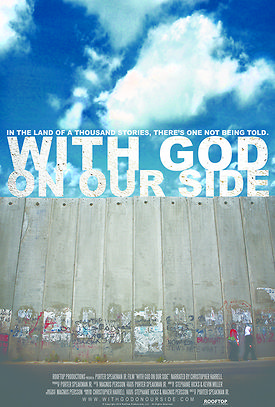
“With God on Our Side” – A Documentary That Should Be Considered
I love documentaries. I always have. A well-done documentary can entertain and educate. Honestly, it seems like we are living in a golden age of documentary making at present. There are a number of fascinating ones out there, and it seems as if the bar has been raised in terms of quality and the ability to engage and hold the viewer’s attention. I recently saw one that has stayed with me and continues to cause me to think and chew on its central thesis, not least because it is one that I have experienced and, to some extent, still do. It is called, “With God On Our Side.”
Porter Speakman, Jr.’s “With God On Our Side” is a consideration of Christian Zionism. Specifically it is a consideration of the kind of approach seen in someone like John Hagee (who figures prominently in the film). In short, Christian Zionism is the idea that the covenant God made with Israel in Genesis applies to the modern state of Israel. Therefore, to stand with the modern state of Israel is to stand with God. Conversely, to fail to stand with Israel, or to stand against them, is to stand against God. This is why you see a heavy focus on Israel in certain segments of Evangelical Protestantism today along with a seeming inability to critique any of Israel’s actions. This kind of thinking usually goes hand-in-hand with premillennial dispensationalism and its emphasis on the reestablishment of Israel as a fulfillment of prophecy.
That summary is woefully inadequate, to be sure, but I think that’s a fairly faithful articulation of the gist of Zionism. I should know. I was exposed to a pretty heavy dose of this kind of thinking as a kid, primarily through the Scofield Reference Bible and the general church culture in which I grew up. What is more, it is fairly pervasive in conservative Protestantism, perhaps especially in the South.
I should perhaps go ahead and share where I currently am on the issue. In short, I am somewhat conflicted. Paul speaks of a “partial hardening” of Israel in Romans 11:25, a term that would seem to suggest that the Jews will indeed experience a revival at some point in the future. This idea being presented by an apostle is significant, because it means there is still a significant place for national Israel. What is more, the question of the continuing and literal fulfillment of the covenants with Israel, particularly regarding the land, is an interesting and intriguing one, especially in the light of Christ as the fulfillment of the promises made to Israel. I do not claim to have all of this figured out, but I can say I have an instinctive reaction against anything that would dilute this fact: the covenants reach their fulfillment in Christ.
All of this is a much bigger issue than this post can tackle, but I raise these considerations simply to say that I, along with many others, stand in a position of respect and admiration for the Jewish people without adopting the approach of some of the more radical expressions of Christian Zionism. By “radical” I am referring to a mentality that seems incapable of critiquing the actions of modern Israel and that thinks the Church should be supportive of Israel in whatever she does. On the other hand, I should say that the left’s demagoguery concerning Israel (see Noam Chomsky, among others) and its labeling of anything Israel does as “terrorism,” even acts meant to defend itself against terrorism, strikes me as naive and overly simplistic. In short, I try to be objective and biblical, though the issues can be murky and muddled at times when we view the modern situation.
Christian Zionism is the focus of “With God On Our Side.” It is seeking to show that this kind of thinking has led some evangelicals to minimize, overlook, or even be incapable of seeing some of the actions of modern Israel as questionable or wrong. What is more, and most tragically, it prizes national Israel over segments of the Church, particularly the Church in modern day Palestine.
I suppose this last point is what has affected me most. I have long thought about the fact that there are Christians, that there is an expression of the Church, on the other side of the wall. Furthermore, I have often wondered what Palestinian Christians must think of Western Zionism. The thought has long troubled me, and I have long thought that, whatever our position as Christians on modern Israel and the Israeli-Palestinian conflict might be, I am first and foremost bound in solidarity by the blood of Christ to Christians on either side of that conflict. Put another way, the cross of Christ means that I have more in common with a Palestinian Christian than I do with a non-Christian Israeli.
This not a geo-political position per se. It is a theological position. But it is a theological position that must inform my politics.
The documentary does a fantastic job of exposing some of the blind spots and muddled thinking of Christian Zionism in the West, particularly in the way that it keeps us from standing with the Christians in the region. The filmmakers interview Palestinian pastors and church leaders and let us hear their voices. It is a painful thing to hear. For instance, it is staggering to hear a Palestinian pastor speak of being invited to a Dallas, TX, church and of having a man pull away his hand and turn from him in disgust when the man realized that the pastor was a Palestinian Christian and not a Jewish Christian. That is simply unbelievable. It is devastatingly wrong.
I repeat: this documentary should be seen.
Has it answered all of my questions? No. But has it given a critical and seldom-heard voice to a neglected part of the Church of the Lord Jesus? Absolutely it has. And it has left this viewer with a powerful reminder: whatever our politics may be, if it leads us to turn a blind eye to suffering followers of Jesus, it cannot be right.
Now, is it possible to have a fundamental respect for Israel and even to stand with Israel and yet not neglect the suffering people of Palestine (Christian or not, I should add)? It is indeed. But that cannot be done with the type of overly-simplistic and highly-naive thinking that categorizes a great deal of the conservative Protestant world that I call my home.
Matthew 27:45-49
45 Now from the sixth hour there was darkness over all the land until the ninth hour. 46 And about the ninth hour Jesus cried out with a loud voice, saying, “Eli, Eli, lema sabachthani?” that is, “My God, my God, why have you forsaken me?” 47 And some of the bystanders, hearing it, said, “This man is calling Elijah.” 48 And one of them at once ran and took a sponge, filled it with sour wine, and put it on a reed and gave it to him to drink. 49 But the others said, “Wait, let us see whether Elijah will come to save him.”
When the late Richard John Neuhaus pastored in Brooklyn, a 12-year-old inner city kid named Michael commented on Christ’s death on the cross by saying, “I don’t say it wasn’t real bad, but he did what he wanted to do, didn’t he?”[1]
That is a very interesting thing to say, and no doubt the young man who said it did not mean anything particularly sinister by it. However, it could almost be read to mean that while the horrors of the cross were indeed horrific, they were at least lessoned a bit by the fact that Jesus willingly entered into them, that Jesus was presumably still in control, and that Jesus knew that in the end He would emerge victorious in the resurrection. Again, it is very unlikely that Michael was trying to lessen the very real agonies of the cross, but it is a bit of a qualification nonetheless that carries with it some potentially unhelpful notions.
I do not deny that there is a kind of logic to that statement. I would simply point out that it is a logic bound to the finitude of our own understandings. I would further point out that the reality of what was happening on the cross was a deeper reality on a higher plain of understanding than any of us can reach this side of heaven. Thankfully, the scriptures have revealed much about what was happening there, but it is nonetheless the case that human reasoning always stumbles over the cross.
In particular, the fourth word from the cross, “My God, my God, why have you forsaken me,” is problematic for our own minds. Stanley Hauerwas, speaking of the fourth word, wrote this:
Our temptation is to try to explain, to protect Jesus from this abject cry of abandonment…We seek to explain these words of dereliction, to save and protect God from making a fool out of being God, but our attempts to protect God reveal how frightening the God of Jesus Christ is. That God rightly frightens us.[2]
That is well, if provocatively, said. As a result of this “embarrassment,” many people have tried to explain away the fourth word from the cross. For instance, Craig Blomberg mentions “the docetic or Gnostic view that Jesus’ divine nature actually departed at this time because God could in no way suffer (found as early as mid-second century in the apocryphal Gospel of Peter).”[3] This type of aberrant theology is clearly assumption-driven instead of text-driven.
A.T. Robertson, speaking of the darkness that verse 45 tells us fell upon the land at the crucifixion, wrote, “One need not be disturbed if nature showed its sympathy with the tragedy of the dying of the Creator on the Cross (Rom. 8:22), groaning and travailing until now.”[4] Indeed. And neither does one need to be disturbed at the fourth word from the cross for its refusal to fit nicely into our theological categories. We should be disturbed about what the fourth word reveals concerning our own sinfulness, but we should see the first word as an opportunity for us to grow deeper in our understanding of the nature of the Father and the Son and the reality of what was happening on the cross. We will do this by consider three grammatical components of the fourth word and what they mean for us.
A proper noun that reveals a suffering, abiding hope.
A proper noun is repeated at the beginning of the fourth word, and it is a noun with great significance.
“My God, my God, why have you forsaken me?”
The fact that Jesus refers to His Father as “God” instead of “Father” in the fourth word is striking for two reasons. First, it is striking that He says “God” instead of “Father” in the fourth word when, in the first word, He said, “Father forgive them…” Does this shift in how Jesus addresses the Father suggest the struggle and agony of the cross? Perhaps it does.
On the other hand, the second striking aspect of this terminology is that it is a direct quotation of scripture, specifically Psalm 22. This is significant. For one thing, Jesus’ quoting of this psalm may suggest that the cry of dereliction is actually a cry of victory, for the psalm goes on to proclaim precisely that. Consider the entirety of Psalm 22.
1 My God, my God, why have you forsaken me? Why are you so far from saving me, so far from my cries of anguish? 2 My God, I cry out by day, but you do not answer, by night, but I find no rest. 3 Yet you are enthroned as the Holy One; you are the one Israel praises. 4 In you our ancestors put their trust; they trusted and you delivered them. 5 To you they cried out and were saved; in you they trusted and were not put to shame. 6 But I am a worm and not a man, scorned by everyone, despised by the people. 7 All who see me mock me; they hurl insults, shaking their heads. 8 “He trusts in the Lord,” they say, “let the Lord rescue him. Let him deliver him, since he delights in him.” 9 Yet you brought me out of the womb; you made me trust in you, even at my mother’s breast. 10 From birth I was cast on you; from my mother’s womb you have been my God. 11 Do not be far from me, for trouble is near and there is no one to help. 12 Many bulls surround me; strong bulls of Bashan encircle me. 13 Roaring lions that tear their prey open their mouths wide against me. 14 I am poured out like water, and all my bones are out of joint. My heart has turned to wax; it has melted within me. 15 My mouth is dried up like a potsherd, and my tongue sticks to the roof of my mouth; you lay me in the dust of death. 16 Dogs surround me, a pack of villains encircles me; they pierce my hands and my feet. 17 All my bones are on display; people stare and gloat over me. 18 They divide my clothes among them and cast lots for my garment. 19 But you, Lord, do not be far from me. You are my strength; come quickly to help me. 20 Deliver me from the sword, my precious life from the power of the dogs. 21 Rescue me from the mouth of the lions; save me from the horns of the wild oxen. 22 I will declare your name to my people; in the assembly I will praise you. 23 You who fear the Lord, praise him! All you descendants of Jacob, honor him! Revere him, all you descendants of Israel! 24 For he has not despised or scorned the suffering of the afflicted one; he has not hidden his face from him but has listened to his cry for help. 25 From you comes the theme of my praise in the great assembly; before those who fear you I will fulfill my vows. 26 The poor will eat and be satisfied; those who seek the Lord will praise him—may your hearts live forever! 27 All the ends of the earth will remember and turn to the Lord, and all the families of the nations will bow down before him, 28 for dominion belongs to the Lord and he rules over the nations. 29 All the rich of the earth will feast and worship; all who go down to the dust will kneel before him—those who cannot keep themselves alive. 30 Posterity will serve him; future generations will be told about the Lord. 31 They will proclaim his righteousness, declaring to a people yet unborn: He has done it!
Any reading of this text will have to conclude that it begins with a cry of dereliction but ends with hope and trust in the goodness and faithfulness of God. Was Jesus, in quoting the first words of this psalm, speaking of the whole? Was He seeking to commend the entirety of the psalm to the watching crowds (then and now) in an effort to say that God had indeed not abandoned Him.
That is an attractive thought. First of all, it is indeed very important that Jesus, in quoting these specific words, is quoting from a psalm of ultimate victory. Of all the psalms He could have quoted, He quoted Psalm 22. Second, if this is what Jesus is doing, it removes the awkwardness of having the second Person of the Trinity asking the first Person of the Trinity why He had forsaken Him for, in this way of thinking, the words Jesus said were really a nod to a much larger statement, namely, the remainder of Psalm 22.
Even so, while acknowledging that this may be what is happening in the fourth word from the cross, there are reasons to be cautious. For one thing, Jesus could have just easily quoted a portion of the psalm that spoke of victory, but He did not. It is true that He specifically quoted from Psalm 22, but it also true that He specifically quoted the first verse: “My God, my God, why have you forsaken me?”
William Barclay has offered another caution against reading the fourth word as a somewhat veiled suggestion of victory.
That is an attractive suggestion; but on a cross a man does not repeat poetry to himself, even the poetry of a psalm; and besides that, the whole atmosphere of the darkened world is the atmosphere of unrelieved tragedy.[5]
Indeed, the physical manifestation of darkness coupled with the cry of dereliction does suggest agony at that point, not victory. Regardless of how we choose to understand Jesus’ quotation of Psalm 22, it should not be employed as a way to minimize the agony and horror of the moment.
It is telling that this word is so very enigmatic, so very difficult to understand, for we are specifically told that the gathered crowd misunderstood it as well.
47 And some of the bystanders, hearing it, said, “This man is calling Elijah.” 48 And one of them at once ran and took a sponge, filled it with sour wine, and put it on a reed and gave it to him to drink. 49 But the others said, “Wait, let us see whether Elijah will come to save him.”
Craig Keener points out that watching, misunderstanding crowd “knew that rabbis in distress sometimes looked to Elijah for help (as in b. ‘Aboda Zara 17b; p. Ketubot 12:3, 6).”[6] That is interesting, but, for our purposes, it is also interesting to note that the fourth word from the cross remains the most difficult to understand. To this day, we struggle to understand this word.
But something else needs to be seen in these opening words of the fourth words. We see the proper noun “God” and all that it potentially means in this moment, but we also see the pronoun preceding it, “My.”
“My God, my God…”
It is a suffering hope, but it remains an abiding hope! Jesus speaks of God as “My God.” Whatever distance He might feel in the moment, He knows that He still stands in relationship with the Father.
A verb that reveals a separating horror.
The most unsettling word of the fourth word, however, is “forsaken.”
“My God, my God, why have you forsaken me?”
To begin to understand what is happening here, we must come to terms with two very uncomfortable truths about what was happening on the cross and our own sin. The first of these truths is that on the cross Christ became our sin. That is a most unpleasant thought, to be sure, for all of us know at least something of the ugliness of our own sins and all of us know at least something of the pervasiveness of sin in the world at large. We know also the Bible’s clear proclamation that “all have sinned.” Thus, in some sense, Christ becomes the sin of the world on the cross. Paul said precisely this in 2 Corinthians 5.
21 For our sake he made him to be sin who knew no sin, so that in him we might become the righteousness of God.
The clear implications are unnerving but also awe-inspiring. On the cross, Christ becomes the sin of the world. He took onto Himself every sinful act, every sinful word, and every sinful thought that humanity had or would commit, speak, or think. Every act of greed, every act of lust, every act of violence, every profane word, every profane thought, every act of child abuse, every act of spousal abuse, every act of theft, every punch ever thrown in anger, every word ever used like a dagger, every act of betrayal, every act of adultery, every act of fornication, every lie ever told, every crude joke every told, every act of self-righteousness, every act of hypocrisy, every act born out of self-serving ego: Christ took all of this upon Himself on the cross!
The second uncomfortable truth arises naturally from the first: that in becoming our sin Christ became cursed. He was cursed in the moment of receiving our sin because God will not abide sin. So in taking our sin, Christ took the curse that came with it. Thus, in Galatians 3 we read:
13 Christ redeemed us from the curse of the law by becoming a curse for us—for it is written, “Cursed is everyone who is hanged on a tree”
Let us be very clear: whatever is meant by the verb “forsaken” in, “My God, my God, why have you forsaken me,” it is somehow bound up with the fact that at that moment Christ Himself took human sinfulness upon Himself. Traditionally, this had lead Christians to conclude that the fourth word from the cross coupled with the darkness that fell upon the land at this point means that God the Father “turned His back” on God the Son.
Perhaps that can be said if it is properly defined and nuanced, but the simplistic way that people often say that is profoundly problematic and it is doubtful that this is a helpful way of speaking of it. I say this for a few reasons.
First, Jesus quotes from Psalm 22, a chapter that includes these words:
24 For he has not despised or scorned the suffering of the afflicted one; he has not hidden his face from him but has listened to his cry for help.
Most Protestant Christians today tend to speak of the Father “turning His back” or “turning His face away” at this point. This, then, is seen to be the explanation of the verb “forsaken.” Yet it must be recognized that the psalm Jesus quotes explicitly says that God “has not hidden his face from him but has listened to his cry for help.” Perhaps it could be argued that verse 24 is speaking of the resurrection of Jesus and the fact that God did not forsake Him indefinitely. Perhaps, but the psalm’s rejection of the idea of God turning His face away should at least give us pause.
Furthermore, we should be careful that we do not define “forsaken” in such a way that it suggests a reality that would challenge God’s omnipresence. However we understand “forsaken,” we must remember that God is indeed everywhere. In Psalm 139:8, the psalmist writes, “If I ascend to heaven, you are there! If I make my bed in Sheol, you are there!” If by “God turned His back” we mean that the Father somehow spatially separated Himself from the Son, we should think long and hard about what such an idea would truly mean concerning the immutable character of God.
What is more, we must remember that the Father sent the Son for precisely this moment and that, in a very real sense, this moment on the cross is the moment in which the Son fulfills His difficult calling. In so doing, He stands in the very center of the Father’s will at this moment particularly. Frank Stagg put it nicely when he wrote:
God did not turn his back on Jesus, as some theology has it. God was never nearer than at Golgotha as Jesus gave himself in full obedience to the Father’s will…God was there! “God was in Christ reconciling the world to himself” (2 Cor. 5:19).[7]
I do not say this in an effort to explain the fourth word or the difficult verb “forsaken.” I am merely saying that we should be careful in reaching our conclusions.
But what of that verb? What does it mean? I think that two further truths will be helpful here.
The first is that Christ had two natures, divine and human, in one person. There are times when it seems that Jesus speaks out of His human nature, speaks, that is, as a man. Perhaps in the agony of this moment this is what we are seeing: Jesus the man speaking. If this is the case, then He is crying the cry of all suffering human beings who wonder, in their moments of greatest agony, where God is. Seen in this light, the cry of dereliction is a powerful example of substitution, of Christ offering our cry for us.
And the second truth is bound up with those two uncomfortable truths mentioned earlier. While we certainly must be careful with our language of God “turning His back” or “turning His face away,” it is undeniable that sin does indeed bring a rupture or a fissure in our relationship with God. Sin is an agent of division between us and God. It does create a chasm, a gulf between us in terms of our relationship.
Surely this horrifying moment when Jesus became our sin and became our curse carried with it a kind of rupture in the perfectly harmonious relationship between the Father and the Son. I would propose that our finite minds cannot begin to grasp much less explain this, but it seems clear enough that something like this happened. Thus, the cry of dereliction is the cry of agony and horror in the moment when Christ opened Himself to receive our curse-bringing sin onto Himself.
A pronoun that reveals forgiveness and life eternal.
These are difficult and painful things to ponder, for we cannot ponder them dispassionately or theoretically. We are speaking, after all, of our sin and of our Savior, Jesus. As a result, this “forsakenness” cuts us to the quick. Yet the fourth word ends with a word that gives us hope. I am speaking of the pronoun “me.”
“My God, my God, why have you forsaken me?”
Here we approach a truth that is as sublime as it is flabbergasting. The sin, the curse, the forsakenness were all willingly embraced by Christ Jesus. That sin, that curse, that forsakenness was by all rights and accounts my sin, my curse, and my forsakenness. It certainly was not naturally His! It was mine! My sin! My curse! My forsakenness!
Yet Jesus cries out, “My God, my God, why have you forsaken me?” And, in truth, we cry out the same! “My God, my God, why have you forsaken Him?! He has done no wrong! The sin is not His! The curse is not His! The forsakenness is not His! It is mine, mine, mine! I committed the sin! I committed the crime! The curse should fall upon me! My God, my God, why have you forsaken Him?!”
To which the word of God comes to us in the beautiful truth of the gospel: “Because, my child, this is why I sent Him and this is why He came. He came to bear your sin, your curse, your forsakenness. And He came to do this because you are loved by the Father and the Son and the Spirit. You are loved! And now you are forgiven! You are forgiven because He was forsaken. He took the curse. You get the grace. This is why He came.”
Our hearts and minds reel at such a display of love!
I earlier quoted Stanley Hauerwas’ observation that there is something in us that is embarrassed by the fourth word from the cross. Let me share the rest of his thought.
Our temptation is to try to explain, to protect Jesus from this abject cry of abandonment…We seek to explain these words of dereliction, to save and protect God from making a fool out of being God, but our attempts to protect God reveal how frightening the God of Jesus Christ is. That God rightly frightens us. Yet God is most revealed when he seems to us the most hidden: “Christ’s moment of most absolute particularity – the absolute dereliction of the cross – is the moment in which the glory of God, his power to be where and when he will be, is displayed before the eyes of the world” ([David Bentley] Hart)…Hear these words, “My God, my God, why have you forsaken me?” and know that the Son of God has taken our place, become for us the abandonment that our sin produces, so that we may live confident that the world has been redeemed by this cross.[8]
Yes! Yes! God has taken our place! Richard John Neuhaus has aptly expressed what this means for us.
God is present in his apparent absence…God is present in the forsaken so that nobody – nobody ever, nobody anywhere at any time under any circumstance – is forsaken.[9]
Do you see? The fourth word from the cross is the very heart of the gospel: Jesus was cursed in our stead. Jesus paid the price for my sin and your sin and the sins of the whole world. Jesus took the suffering and gave us instead eternal life.
The cry of dereliction is really the cry of salvation. It is the cry of our only hope. And it is a beautiful hope indeed.
Have you come to the Son who died in your place?
If not, would you come now? He is waiting with open arms.
[1] Richard John Neuhaus, Death on a Friday Afternoon. (New York, NY: Basic Books, 2000), p.124.
[2] Stanley Hauerwas, Matthew. Brazos Theological Commentary on the Bible (Grand Rapids, MI: Brazos Press, 2006), p.240-241.
[3] Craig Blomberg, Matthew. The New American Commentary. New Testament, Vol. 22 (Nashville, TN: Broadman Press, 1992), p.419.
[4] A.T. Robertson, Word Pictures in the New Testament. Vol. II (Nashville, TN: Broadman Press, 1930), p.234.
[5] William Barclay, Gospel of Matthew. Vol.2. The Daily Study Bible (Edinburgh: The Saint Andrew Press, 1967), p.406-407.
[6] Craig S. Keener, Matthew. The IVP New Testament Commentary Series. Vol.1 (Downers Grove, IL: InterVarsity Press, 1997), p.390.
[7] Frank Stagg, “Matthew.” The Broadman Bible Commentary. Gen.Ed., Clifton J. Allen. Vol.8 (Nashville, TN: Broadman Press, 1969), p.246.
[8] Stanley Hauerwas, p.240-241.
[9] Richard John Neuhaus, p.142.
John 19:25-27
25 but standing by the cross of Jesus were his mother and his mother’s sister, Mary the wife of Clopas, and Mary Magdalene. 26 When Jesus saw his mother and the disciple whom he loved standing nearby, he said to his mother, “Woman, behold, your son!” 27 Then he said to the disciple, “Behold, your mother!” And from that hour the disciple took her to his own home.
In June of this year, NBC Chicago ran a story about a shooting that occurred in South Chicago.
A 21-year-old man died Saturday after throwing himself in front of open gunfire in an attempt to shield his mother from the bullets, according to family members.
James Jones and his mother, Alicia Jones, were on their front porch Saturday afternoon in South Chicago when a man walked out of a gangway and fired in their direction, police said.
That is when the 21-year-old made the ultimate sacrifice to protect his mother, throwing himself in front of her, saving her life by shielding her from the array of bullets headed in her direction. By saving her life, he lost his own.
“My sister just so happened to be coming out the front door,” said Dietra Luckett, Jones’ aunt. “He took his body and put it on top of her body. He covered her body.”
Alicia Jones, 46, was critically wounded but survived. She underwent surgery at Advocate Christ Medical Center. James was dead at the scene, according to Chicago Police and the Cook County medical examiner’s office.
She knows her son saved her life, Luckett said, but doesn’t know he’s gone. Her sister said she’s been asking for him, saying, “Where’s James?”[1]
The mother was still struck by the bullet, but her son’s body kept it from killing her, though it killed him. They had not told her that her son was dead at the time of the writing of the article, because they did not want to upset her as she was recovering in the hospital.
It is an unsettling story. The young man who died had his own criminal background, the article went on to say, and the entire incident was gang related. Even so, there is a beauty to a son’s instinctive desire to protect his mother, to die in her place, to give her life through his death. And there is, simultaneously, a grueling heartbreak about a mother being hit with the staggering reality that her son has died.
There are radical dissimilarities between what happened in June of 2015 on the south side of Chicago and what happened in the first century just outside of Jerusalem, but there are similarities as well. The dissimilarity, of course, is that Jesus was sinless and perfectly righteous and that He knowingly embraced death from eternity past, intending to lay down His life and die as a substitute for lost humanity. The young man in Chicago was, like all of us, a sinner who did not know he would die. Even so, in both situations, a son died as a substitute and a mother had to come to terms with her loss.
Of course, there is yet another radical dissimilarity. Jesus was able to accomplish through His death what no other person could accomplish through his or her death, no matter how nobly a person might die or how selflessly to save the life of another. Jesus died to open the very door of Heaven to us, and only He, the God-man, could do so. For this reason, the last words of Christ on the cross are most powerful and most instructive, and, in this this word from the cross, Jesus acknowledges His mother who has come to watch her Son die.
The third word from the cross reveals the love of the Son for His mother.
At its most basic level, that is the point: the third word from the cross reveals the love of the Son for His mother. Mary and the women with her had come to be with Him as He died.
25 but standing by the cross of Jesus were his mother and his mother’s sister, Mary the wife of Clopas, and Mary Magdalene.
The very first words of verse 25 are poignant with meaning: “but standing by the cross of Jesus were his mother…” D.A. Carson suggests that the Greek wording of verse 25 “suggests a contrast between the soldiers…and the women here introduced” and translates the beginning of the verse as, “So the soldiers, on the one hand, did these things; on the other hand, there stood near the cross of Jesus…”[2] It is a stark contrast indeed, and one filled with feeling and power. Jesus hangs on the cross, the soldiers gamble for His clothes, and His mother is there with Him. Richard John Neuhaus notes something interesting about most of the painted depictions of this scene.
[B]eginning in the Middle Ages, artists would depict a very tall cross, with Mary and the others far below at its foot. But historians believe that the cross was probably about seven feet tall. They were face to face. The sweat, the blood, the tearing tendons, the twitching, the wrenching, the bulging eyes – she would have seen it all quite clearly, as clearly as she saw him so long ago when she held him safely to her breast.[3]
Mary and the women were there and being there brought a pain to Mary that was indescribable. Do you remember the strange words of Simeon when he held the baby Jesus in Jerusalem? They are recorded in Luke 2.
34 And Simeon blessed them and said to Mary his mother, “Behold, this child is appointed for the fall and rising of many in Israel, and for a sign that is opposed 35 (and a sword will pierce through your own soul also), so that thoughts from many hearts may be revealed.”
Whatever else this prophesied piercing meant, it certainly must have included this moment of excruciating pain. Mary watches her son there on the cross. Perhaps the 13th century hymn, “Stabat Mater,” comes closest to honoring her pain in that moment.
At the Cross her station keeping,
stood the mournful Mother weeping,
close to her Son to the last.
Through her heart, His sorrow sharing,
all His bitter anguish bearing,
now at length the sword has passed.
O how sad and sore distressed
was that Mother, highly blest,
of the sole-begotten One.
Christ above in torment hangs,
she beneath beholds the pangs
of her dying glorious Son.
Is there one who would not weep,
whelmed in miseries so deep,
Christ’s dear Mother to behold?
Can the human heart refrain
from partaking in her pain,
in that Mother’s pain untold?
For the sins of His own nation,
She saw Jesus wracked with torment,
All with scourges rent:
She beheld her tender Child,
Saw Him hang in desolation,
Till His spirit forth He sent.
Mary beholds her son and, in this third word, Mary’s son beholds her. He sees her. She is standing there with “the disciple whom he loved.” Traditionally this is thought to be John, though the text does not actually say so. I will stay with that traditional interpretation here. Jesus sees Mary and John standing together and Jesus speaks.
26 When Jesus saw his mother and the disciple whom he loved standing nearby, he said to his mother, “Woman, behold, your son!” 27 Then he said to the disciple, “Behold, your mother!” And from that hour the disciple took her to his own home.
I agree with commentators who say that what is happening here goes beyond the mere temporal provision of a mother by her son. Indeed it does. Something much deeper than that is happening here. However, a son’s provision for His mother is happening. This word suggests more than mere earthly provision for Mary, but it does not suggest less. It seems to me that we miss something profoundly significant when we glide pass this first meaning and move on to the other meanings, for surely it is no small thing that the Son of God while dying for the sins of the world sees, addresses, and provides for His mother.
This third word is a word of a son’s love. Jesus loved His mother. Jesus took care of His mother. Whatever else is happening here, if it does not lead us to care for our parents, we have misunderstood something most obvious.
The third word from the cross reveals a people who continue the life of Jesus on the earth.
But it also says something about the nature of discipleship, does it not? In saying, “Woman, behold your son!” Jesus was saying that John would now care and provide for her. In saying, “Behold, your mother!” Jesus was telling John that he was now to provide the duties of a son to Mary. And John did precisely this. R. Kent Hughes points out the traditions that grew around John’s provisions of Mary.
One extra-Biblical account says John owned a home in Jerusalem at the foot of Zion, Mary stayed there eleven years, and only after her death did John go out to preach the Gospel to the Gentile world. Another report says that Mary died in the city of Ephesus while sharing in John’s missionary ministry.[4]
Jesus is calling upon John to take care of His mother. And yet, in principle, Jesus’ command to John was saying something more as well, for in so saying Jesus was establishing not merely the particulars for His mother’s care but the principle that His followers from that point onward are to continue in their lives the life that Christ had lived in His incarnate state on the earth.
Craig Keener writes that Jesus’ actions show “how true disciples adopt the concerns of Jesus as their own and follow in his steps.”[5] This is true. John was to care for Mary because John was now to live the life of the Son upon the earth after the Son would rise from the dead and ascend to heaven. The point is that John’s call to take upon himself the life and actions and responsibilities of Jesus extends beyond John to all of Jesus’ disciples throughout the ages.
John was to be a son to Mary. We, the Church, are to be the son to the world. Not, I should add, ontologically. Not essentially. We cannot literally be Christ. We remain the creation and He remains forever the sovereign Creator. Not essentially, but functionally, in our lives, we are to hear and heed and act upon the very same call that Jesus offered John. We too are to continue the life of Jesus in the world.
While we are not literally Christ, our continuation of His life and ministry upon the earth, in His name and through the enabling power of the Spirit, is so identified with Christ that Paul, in Ephesians 5:23, wrote, “Christ is the head of the church, his body, and is himself its Savior,” and in Colossians 1:24 wrote, “in my flesh I am filling up what is lacking in Christ’s afflictions for the sake of his body, that is, the church,” and in 1 Corinthians 12:27 wrote, “Now you are the body of Christ and individually members of it.”
In other words, just as John would now in the particular situation of caring for Mary be the body of Christ to her, so too the Church will now, in our global situation, be the body of Christ to the world. The Dutch theologian and New Testament scholar Herman Ridderbos put this dynamic nicely when he argued that “it is doubtful…that the meaning of this narrative is limited to this personal dimension…The Evangelist’s focus is elsewhere.” Ridderbos then explained:
For in the relationship that the dying Jesus establishes between these two persons, who of all of them were the closest to him, he paradigmatically contracts the image of the coming community that he is leaving behind on earth, but also bringing under the care that in his time on earth he has provided, and through which in the new dispensation after his death he himself will continue his work…Mary will from this moment on step back as his mother and uniquely reflect the image of the community that remains behind on earth. The disciple whom Jesus loves no less significantly represents those whom Jesus has bound to himself from the beginning to be his witnesses and to continue his work on earth.[6]
Hear then, Church, the third word from the cross to you: “behold, the Son.” As John was to continue the duties, responsibilities, and life of the Son for Mary, we are to continue the very same for the world.
The third word from the cross reveals a new family on the earth.
There is something else. There is also a note about what the internal life of this Christ-continuing fellowship of disciples is to look like. Namely, it is to look like a family.
If you step back and look at this scene, you will notice something interesting. Jesus, understandably, makes provisions for His mother because Jesus was the eldest son of the family. However, Jesus was not the only son in the family. We see in the New Testament that after the virgin birth of Christ, Mary and Joseph commenced normal marital relations and Mary had other children. Thus, Jesus had half-brothers and sisters for they shared a common mother but not a common father.
Why, then, did the eldest son, Jesus, not entrust the care of His mother to the next eldest son, one of his half-brothers? The answer to that is found in John 7:5, a very short verse that reads, “For not even his brothers believed in him.” In other words, Jesus could have appealed to the more natural responsibility of the next oldest son to care for Mary, but in doing so He would have been entrusting His mother to the care of a non-believer. Put another way, Jesus chose to entrust the care of His mother to a follower of Jesus who was not her son instead of to a denier of Jesus who was her son. In time, His brothers would come to believe, but they did not yet, so Jesus calls upon John to fulfill the role of a son.
What is happening here? What is happening is that in calling upon believing John to care for His mother instead of upon one of His unbelieving half-brothers, Jesus was demonstrating that His cross and empty tomb now creates a new family dynamic that is grounded not in the biology of relational blood but in the new creation of the Lamb’s blood.
Church, this is a staggering development!
Craig Keener argues that “Jesus’ entrusting his mother to a disciple rather than to unbelieving siblings…suggests that the ties of the believing community must be stronger than natural familial bonds.”[7] James Montgomery Boice puts it even more poignantly when he writes, “we sense that the Lord is here bringing into existence a new family based on his atonement.”[8] Put most basically, this means that the gospel redefines and changes how we define the word “family.”
Stanley Hauerwas has provocatively said that “it must be admitted that none of the Gospels portray Jesus as family-friendly.”[9] In a sense, Hauerwas has a point. For starters, Jesus said some rather astounding things about families that really are quite shocking, even when properly understood! For instance, in Luke 9, we read this:
59 To another he said, “Follow me.” But he said, “Lord, let me first go and bury my father.” 60 And Jesus said to him, “Leave the dead to bury their own dead. But as for you, go and proclaim the kingdom of God.” 61 Yet another said, “I will follow you, Lord, but let me first say farewell to those at my home.” 62 Jesus said to him, “No one who puts his hand to the plow and looks back is fit for the kingdom of God.”
Again, on the surface, this does not seem very sensitive to the relational dynamics, not to say the responsibilities, one naturally feels toward one’s biological family. Even more unsettling, in Luke 14, we find this:
25 Now great crowds accompanied him, and he turned and said to them, 26 “If anyone comes to me and does not hate his own father and mother and wife and children and brothers and sisters, yes, and even his own life, he cannot be my disciple. 27 Whoever does not bear his own cross and come after me cannot be my disciple.
This is not the place for a detailed examination of these passages other than to say that Jesus was speaking in the vain of prophetic hyperbole in order to make a significant point about the priorities of our affections. Clearly He was not calling upon us to sin by literally hating our families and clearly He did not hate His own family. The third word from the cross clearly establishes that fact. But to offer these initial interpretations is not to attempt to lessen the shock of Jesus’ words, for even rightly understood they remain somewhat disquieting and require us to trust His wisdom more than our own understandings of “family.” They are revolutionary words, transformative words. They inform us that the coming of Christ forever alters what we think we know about the nature of families.
Jesus had already suggested this reality in an earlier episode in Mark 3:31-35 when His “biological” (so to speak) family came to launch something of an intervention with Him.
31 And his mother and his brothers came, and standing outside they sent to him and called him. 32 And a crowd was sitting around him, and they said to him, “Your mother and your brothers are outside, seeking you.” 33 And he answered them, “Who are my mother and my brothers?” 34 And looking about at those who sat around him, he said, “Here are my mother and my brothers! 35 For whoever does the will of God, he is my brother and sister and mother.”
I would propose that this particular text is key to our understanding the new family that Christ came to form. Here, Jesus defines family as “whoever does the will of God,” by which He means the will of His Father as He demonstrated, taught, modeled, and then fulfilled it. That is to say, our first family is now the gathered and redeemed people of God the world over.
The New Testament speaks more than once of the creation of a new people in and through Christ. The classic text for this is found in 1 Peter 2.
9 But you are a chosen race, a royal priesthood, a holy nation, a people for his own possession, that you may proclaim the excellencies of him who called you out of darkness into his marvelous light. 10 Once you were not a people, but now you are God’s people; once you had not received mercy, but now you have received mercy.
Jesus Christ came to establish a new people. He came to establish a priestly people, a chosen people, a royal people, a people who used to be on the outside but are not on the inside. Alongside this, we know that the New Testament often speaks of the Church as a household. For instance, we see this in Ephesians 2.
19 So then you are no longer strangers and aliens, but you are fellow citizens with the saints and members of the household of God, 20 built on the foundation of the apostles and prophets, Christ Jesus himself being the cornerstone, 21 in whom the whole structure, being joined together, grows into a holy temple in the Lord. 22 In him you also are being built together into a dwelling place for God by the Spirit.
God has called a people together. God has brought them under a common roof in a common household. Christ Jesus is the cornerstone and the foundation of the house. The house is intended to grow together. And, most amazing of all, God dwells among us through His Spirit.
This is what we mean when we say that much more is happening in this third word than simple provision by the Son for His mother. That is happening, but in this word Jesus also revealed that all He had hinted at before was now, through His work on the cross, coming to fruition: we are now a new people, a new family, under a common roof, living and doing life together. Who is? The people who are gathered at the foot of the cross: followers of Jesus, disciples, the Church.
This third word becomes therefore the word that reveals the reality of the gathered Church. “Woman, behold your son! Son, behold your mother! World, behold the Church! I am now present among you through my people, my bride, and my body: the Church!”
Church, may God have mercy upon us if we do not continue the life of Christ, for it is mercy we will need if we abandon this high privilege offered to us through Jesus.
[1] https://www.nbcchicago.com/news/local/Son-Shields-Mom-From-Gunfire-Dies-Saving-Her-in-South-Chicago-308843771.html
[2] D.A. Carson, The Gospel According to John. The Pillar New Testament Commentary (Grand Rapids, MI: William B. Eerdmans Publishing Company, 1991), p.615.
[3] Richard John Neuhaus, Death on a Friday Afternoon. (New York, NY: Basic Books, 2000), p.82.
[4] R. Kent Hughes, John. (Wheaton, IL: Crossway Books, 1999), p.446.
[5] Craig S. Keener, The Gospel of John. Vol. 2 (Peabody, MA: Hendrickson Publishers, 2003), p.1144.
[6] Herman Ridderbos, The Gospel of John. (Grand Rapids, MI: Eerdmans Publishing Company, 1992), p.612-613.
[7] Craig S. Keener, p.1145.
[8] James Montgomery Boice, The Gospel of John. Vol.5 (Grand Rapids, MI: Baker Books, 1999), p.1518.
[9] Stanley Hauerwas, Cross-Shattered Christ. (Grand Rapids, MI: Brazos Press, 2004), p.50.

Exodus 22:1-15
1 “If a man steals an ox or a sheep, and kills it or sells it, he shall repay five oxen for an ox, and four sheep for a sheep. 2 If a thief is found breaking in and is struck so that he dies, there shall be no bloodguilt for him, 3 but if the sun has risen on him, there shall be bloodguilt for him. He shall surely pay. If he has nothing, then he shall be sold for his theft. 4 If the stolen beast is found alive in his possession, whether it is an ox or a donkey or a sheep, he shall pay double. 5 “If a man causes a field or vineyard to be grazed over, or lets his beast loose and it feeds in another man’s field, he shall make restitution from the best in his own field and in his own vineyard. 6 “If fire breaks out and catches in thorns so that the stacked grain or the standing grain or the field is consumed, he who started the fire shall make full restitution. 7 “If a man gives to his neighbor money or goods to keep safe, and it is stolen from the man’s house, then, if the thief is found, he shall pay double. 8 If the thief is not found, the owner of the house shall come near to God to show whether or not he has put his hand to his neighbor’s property. 9 For every breach of trust, whether it is for an ox, for a donkey, for a sheep, for a cloak, or for any kind of lost thing, of which one says, ‘This is it,’ the case of both parties shall come before God. The one whom God condemns shall pay double to his neighbor. 10 “If a man gives to his neighbor a donkey or an ox or a sheep or any beast to keep safe, and it dies or is injured or is driven away, without anyone seeing it, 11 an oath by the Lord shall be between them both to see whether or not he has put his hand to his neighbor’s property. The owner shall accept the oath, and he shall not make restitution. 12 But if it is stolen from him, he shall make restitution to its owner. 13 If it is torn by beasts, let him bring it as evidence. He shall not make restitution for what has been torn. 14 “If a man borrows anything of his neighbor, and it is injured or dies, the owner not being with it, he shall make full restitution. 15 If the owner was with it, he shall not make restitution; if it was hired, it came for its hiring fee.
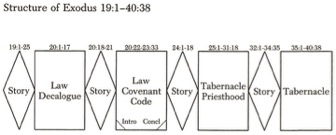
We are in a section of the book of Exodus that, at times, can feel a bit overwhelming with its legal codes and discussions of societal justice. Specifically, we are currently studying a section of the book of Exodus known as “the covenant codes” or “The Book of the Covenant.” In an effort to offer some perspective and context, let me show a diagram that was developed by Terence E. Fretheim.
Fretheim offers a number of reasons why this story-law-story-law-story structure is important. Among the reasons are these:
- “God is the subject in both law and narrative. God is the giver of the law and the chief actor in the narrative.”
- “Law is more clearly seen a gift of God’s graciousness when tied to story.”
- “Narrative keeps the personal character of the law front and center.”
- “This integration keeps divine action and human response closely related to each other.”
- “The motivation given for obedience to law is contained in the narrative: you were slaves in the land of Egypt, therefore you are to shape your lives toward the disadvantaged in ways both compassionate and just (22:21-17; 23:9).
- “Tradition has given the word Torah to both law and narrative genres. The force of this is that the Pentateuch is instruction…in both its laws and its stories.”[1]
Perhaps that is helpful. It shows us, when we are tempted to get frustrated with the details, many of the particulars of which are bound to a particular time and place, that there is a rhyme and reason for the structure of the book. Most significantly, the weaving of these law sections into the story do keep them from drifting into the merely theoretical or even the merely legal. On the contrary, these laws represent the gracious gift of God to an ancient people who needed to maintain a just societal order and life together just as we do today.
Our text is dealing specifically with the principle of private property and the right handling of it. Furthermore it outlines what should happen when this right is violated.
The right of private property should be honored and appropriate restitution should be paid when it is violated.
I am not, of course, trying to project our modern capitalistic society onto ancient Israel when I refer to “the right of private property.” Even so, wherever there are prohibitions against theft, there is an implicit acknowledgment of the rights of property owners not to have their property stolen by those who do not own it. It is easy to see how such a recognition is critical to maintaining social order, for if one may simply take whatever one wants from whomever one wants to steal from, chaos will soon ensue.
1 “If a man steals an ox or a sheep, and kills it or sells it, he shall repay five oxen for an ox, and four sheep for a sheep. 2 If a thief is found breaking in and is struck so that he dies, there shall be no bloodguilt for him, 3 but if the sun has risen on him, there shall be bloodguilt for him. He shall surely pay. If he has nothing, then he shall be sold for his theft.
If you steal an ox, you must repay five oxen. The text immediately preceding this sought to establish the principle of proportionate response in its articulation of lex talionis (“an eye for an eye, a tooth for a tooth”). Even so, it is necessary to establish a reasonable deterrent for the stealing of property. After all, stealing an ox in an agrarian society is never merely stealing an ox. Rather, it is stealing the ox, diminishing the owner’s ability to complete as much work as he could with the ox, and, ultimately, taking food out of the mouths of the owner’s family as well as money from him if he sells some of his produce or hires the ox out for building or labor projects. In other words, to steal an ox is to threaten, in a very real way, the security of a family. Thus, if you steal an ox or a sheep, you must repay five oxen or four sheep.
Verse 2 and 3 suggests that a man may rightly protect his family from a thief breaking in at night. Verse 3, however, is very interesting and is somewhat difficult to interpret. William H.C. Propp of the University of California has proposed that the text can be interpreted either spatially (“the text might be differentiating between robbing an open-air enclosure as opposed to a roofed domicile”) or temporally (“it could be a simple day vs. night distinction”). If it is spatial, it could simply be saying that “a man breaking into a house may be presumed to be a murderer” but “a man breaking out has already shown his milder intentions.” If this is the correct interpretation, it would suggest that you cannot kill a man as he is fleeing your property, even if he has stolen. He obviously is not there to take a life.
Propp, however, argues for a temporal interpretation, which means that the text could refer to sunrise (“if a day has passed, then to kill the burglar would be a crime of cold blood not self-defense”) or it could mean “by day.” Propp explains:
Job 24:13-17 associates the nighttime with nefarious deeds in general, including housebreaking (vv 14,16)…It makes sense to be more cautious at night. By day, a thief might assume that a home is empty; at night, his assumption would be that it is occupied. Moreover, by night there can be no testimony as to the thief’s identity, nor can he be easily tracked…Decisive are the parallels from other cultures that permit a man to defend his property to the utmost – but only at night.[2]
There is wisdom here, though the wording of our text is perhaps too ambiguous for us to be dogmatic on any one of the proposed interpretations. Regardless, this much seems to be the case with any of these proposals: you cannot set up a mechanistic cause-and-effect scenario whereby you have the right to kill a person simply because he has broken into your home. It also seems clear that a person breaking in at night would seem to suggest at least the possibility of more nefarious motives, thereby justifying a more severe response, than would a person breaking in during the day or a person fleeing your house into the light of day. In offering this qualification, the right to protect one’s family is safeguarded while parameters are put into place to keep bloodshed from happening if it can be reasonably established that the thief is not there to kill those in the home.
4 If the stolen beast is found alive in his possession, whether it is an ox or a donkey or a sheep, he shall pay double. 5 “If a man causes a field or vineyard to be grazed over, or lets his beast loose and it feeds in another man’s field, he shall make restitution from the best in his own field and in his own vineyard. 6 “If fire breaks out and catches in thorns so that the stacked grain or the standing grain or the field is consumed, he who started the fire shall make full restitution.
Here again, appropriate restitution is required when the property of another is destroyed through either malevolent intent or carelessness.
It should be pointed out that there is another way that we can sin against one another through property. In the 6th century, Gregory the Great pointed out that it is also possible to be guilty of harming another by withholding one’s goods from those in need, a point on which, Gregory argued, the New Testament is actually more stringent than the Old.
Some people consider the commandments of the Old Testament stricter than those of the New, but they are deceived by a shortsighted interpretation. In the Old Testament, theft, not miserliness, is punished: wrongful taking of property is punished by fourfold restitution. In the New Testament the rich man is not censured for having taken away someone else’s property but for not having given away his own. He is not said to have forcibly wronged anyone but to have prided himself on what he received.[3]
Gregory was speaking of the parable of the rich man and Lazarus (Luke 16:19-31), the former of whom went to hades when he died and the latter of whom went to Abraham’s bosom. In truth, he could also have been speaking of the rich young ruler (Mark 10:17-22), who only lacked one thing: to sell all he had and give it to the poor. In other words, it is sinful for a man to take what does not belong to him, but it can also be sinful for a man not to give what does belong to him if others are suffering without.
I would like to add that the story of history shows that governments seeking to force this kind of charity by simply confiscating all private property usually end up becoming monstrous and bloody entities of persecution themselves. The story of communism, for instance, is not a pretty story. Even so, most just societies see the need for some kind of reasonable regulations and protections for the poor. At its healthiest, what this looks like is the wealthy freely and generously giving to the poor, though history also shows that this does not happen as frequently as it should. Regardless, it should happen among the people of God.
The degree of guilt is justly less when the right of private property is unintentionally violated than when it is intentionally violated.
Laws need to be clear in a just society, but the circumstances to which laws apply oftentimes are anything but. For instance, it can and sometimes does happen that the property of another is destroyed either carelessly or accidentally. Such a situation is clearly different than a person who sets out with the intent to steal and take from another. Our text acknowledges this reality.
7 “If a man gives to his neighbor money or goods to keep safe, and it is stolen from the man’s house, then, if the thief is found, he shall pay double. 8 If the thief is not found, the owner of the house shall come near to God to show whether or not he has put his hand to his neighbor’s property. 9 For every breach of trust, whether it is for an ox, for a donkey, for a sheep, for a cloak, or for any kind of lost thing, of which one says, ‘This is it,’ the case of both parties shall come before God. The one whom God condemns shall pay double to his neighbor. 10 “If a man gives to his neighbor a donkey or an ox or a sheep or any beast to keep safe, and it dies or is injured or is driven away, without anyone seeing it, 11 an oath by the Lord shall be between them both to see whether or not he has put his hand to his neighbor’s property. The owner shall accept the oath, and he shall not make restitution. 12 But if it is stolen from him, he shall make restitution to its owner. 13 If it is torn by beasts, let him bring it as evidence. He shall not make restitution for what has been torn. 14 “If a man borrows anything of his neighbor, and it is injured or dies, the owner not being with it, he shall make full restitution. 15 If the owner was with it, he shall not make restitution; if it was hired, it came for its hiring fee.
This offers an important nuance to the law, a nuance that offered some protection to the one in whose care the property of another was placed but who did not steal the property or damage it willfully or even knowingly. There is also a strong note of divine arbitration in this text. For instance, consider verse 9:
9 For every breach of trust, whether it is for an ox, for a donkey, for a sheep, for a cloak, or for any kind of lost thing, of which one says, ‘This is it,’ the case of both parties shall come before God. The one whom God condemns shall pay double to his neighbor.
Two things should be said about this. First, the need to appeal to the Lord suggests that many situations are not terribly clear-cut regarding who exactly is at fault and what the penalty should be. This should be kept in mind. There are situations the reality of which only God knows and only God can decide. Furthermore, these situations would presumably need the mediation of the people of God unless God makes it clear directly to the hearts and minds of the parties what the reality is. In the age of the Church, this will likely result in something like the mediation of wise and trusted Christian friends who are capable of being objective and judicious in disputes between members. This is what Paul called for in 1 Corinthians 6.
1 When one of you has a grievance against another, does he dare go to law before the unrighteous instead of the saints? 2 Or do you not know that the saints will judge the world? And if the world is to be judged by you, are you incompetent to try trivial cases? 3 Do you not know that we are to judge angels? How much more, then, matters pertaining to this life! 4 So if you have such cases, why do you lay them before those who have no standing in the church? 5 I say this to your shame. Can it be that there is no one among you wise enough to settle a dispute between the brothers, 6 but brother goes to law against brother, and that before unbelievers? 7 To have lawsuits at all with one another is already a defeat for you. Why not rather suffer wrong? Why not rather be defrauded? 8 But you yourselves wrong and defraud—even your own brothers!
The Lord may yet speak directly in such matters, but it would seem that He normally speaks through the Church. In our highly individualistic day in which ecclesiology is weakened by a heightened since of isolation, humanity, and detachment from the community of God, such an appeal to and acceptance of the wisdom of our brothers and sisters in Christ will feel odd at first, but it may just be that we are missing a great blessing by not asking trusted followers of Jesus to help us in our disputes (with other Christians) over property and the like.
Within the church, we should seek to live honestly and uprightly with one another, offering restitution when we have wronged another, yet striving to show Christ-like compassion and Kingdom priorities when we are the one who is wronged.
As with all of these laws, we must ask how we should follow them in a day in which the cultural particulars are in many ways quite different than the particulars of ancient Israel. To begin with, we should perhaps question whether or not our day really is all that different. After all, disputes concerning property are as old as humanity itself, and in our materialistic age, when we have more than any people before us have ever had, they are very common indeed.
Concerning the basic principle of restitution, we see it honored in the New Testament. Consider the story of Zacchaeus in Luke 19.
1 He entered Jericho and was passing through. 2 And behold, there was a man named Zacchaeus. He was a chief tax collector and was rich. 3 And he was seeking to see who Jesus was, but on account of the crowd he could not, because he was small in stature. 4 So he ran on ahead and climbed up into a sycamore tree to see him, for he was about to pass that way. 5 And when Jesus came to the place, he looked up and said to him, “Zacchaeus, hurry and come down, for I must stay at your house today.” 6 So he hurried and came down and received him joyfully. 7 And when they saw it, they all grumbled, “He has gone in to be the guest of a man who is a sinner.” 8 And Zacchaeus stood and said to the Lord, “Behold, Lord, the half of my goods I give to the poor. And if I have defrauded anyone of anything, I restore it fourfold.” 9 And Jesus said to him, “Today salvation has come to this house, since he also is a son of Abraham. 10 For the Son of Man came to seek and to save the lost.”
Zacchaeus’ statement that he would give half his goods to the poor and “fourfold” to anyone who he defrauded shows a basic resonance with the principles of Old Testament law. The difference, of course, is that Zacchaeus was standing before Jesus. This means he offered restitution freely, gladly, and out of a since of gratitude for the greater gift he had been giving. For Zacchaeus, this was not about “obeying the law,” this was about honoring Jesus Christ and living the new life to which he had been called in Christ.
So should it ever be with us. We read these laws with gracious hearts because they reveal to us the heart of God. In Jesus, we find a motivation than transcends mere fear (though fear yet has its place). In Jesus we find the motivation of love. We refuse to steal because we love God and love our neighbor. We refuse to defraud because to do so dishonors the great gift that has been given to us through Christ.
Yet there is another truth about the Christian’s approach to property and theft and restitution, and it is a painful but necessary truth. It is this: for the Christian, getting back what was taken is no longer the greatest good or the highest priority. Desiring as we should for all men to come to Jesus, exacting justice upon a thief and reclaiming what was ours can no longer be the end-all-be-all for us. Instead, the salvation of the thief must matter to us more. I think this helps us understand what is happening in Matthew 5.
38 “You have heard that it was said, ‘An eye for an eye and a tooth for a tooth.’ 39 But I say to you, Do not resist the one who is evil. But if anyone slaps you on the right cheek, turn to him the other also. 40 And if anyone would sue you and take your tunic, let him have your cloak as well. 41 And if anyone forces you to go one mile, go with him two miles. 42 Give to the one who begs from you, and do not refuse the one who would borrow from you.
What we see here is Jesus (a) acknowledging that certain things are ours (“your tunic…your cloak”) but (b) asking us to prize and value something more than what we own: our own souls and the soul of the one who is taking from us. He is asking us to value our own souls by not allowing ourselves to be so bound to temporal goods that we cannot simply let them go. He is asking us to value the soul of the one taking from us by stepping outside of the arena of pure justice and instead infusing the situation with the grace that forgiveness brings.
In truth, there is one thing that goes much further than prison or a fine in rehabilitating the heart of a thief, and that is forgiveness and grace. That is a scary prospect for us. After all, we want to get back that which was stolen. But the point is this: would you have greater joy in regaining a temporal good or in gaining a brother or sister in Christ? In James 5, James wrote:
19 My brothers, if anyone among you wanders from the truth and someone brings him back, 20 let him know that whoever brings back a sinner from his wandering will save his soul from death and will cover a multitude of sins.
In Matthew 18, Jesus put it like this:
15 If your brother sins against you, go and tell him his fault, between you and him alone. If he listens to you, you have gained your brother.
“Gaining your brother” and “bringing back a sinner from his wandering” should be the greatest goal of the follow of Jesus. What if your simply giving the item to the thief would move him to repentance? What if your refusing to press charges would show him the better way of grace?
To do so is to risk, but not really. If the thief does not repent, we are left with the good pleasure of the Father who sees us trying to bless and love our enemies. If the thief does repent, we receive the good pleasure of the Father and win a brother or sister as well.
In 2007, WMC-TV in Memphis ran a report about a ninety-two year old woman from Dyersburg, Tennessee, who got into her car in a Wal-Mart parking lot only to have an armed robber get into her car as well and demand all of her money. She refused, informing the man that were he to shoot her she would immediately go to heaven with Jesus whereas he would go to hell! She then shared the gospel with the man for ten minutes, at the conclusion of which, the robber began to cry, told her he would not rob her, informed her that he needed to go pray, and then kissed her on the cheek. In turn, she freely gave him all the money she had, which was ten dollars.[4]
To be sure, such courage and bold witnessing will not always be met with tears and repentance. It may very well be met with violence and even death. Even so, this lady’s amazing actions stand as a stark reminder that we should value the thief’s soul more than we value either our property or our lives. Perhaps the example of this dear lady can remind us of this fact.
Church, there are things more important than property.
Surely Jesus has taught us that? Let us choose the way that is better than vengeance or a blind demand for justice at any and all costs.
[1] Terence E. Fretheim, Exodus. Interpretation (Louisville, KY: Westminster John Knox Press, 2010), p.201-207.
[2] William H.C. Propp, Exodus 19-40. The Anchor Bible. Vol.2A. (New York, NY: Doubleday, 2006), p.240-241.
[3] Joseph T. Lienhard, ed., Exodus, Leviticus, Numbers, Deuteronomy. Ancient Christian Commentary on Scripture. Old Testament, Vol.III (Downers Grove, IL: InterVarsity Press, 2001), p.114.
[4] https://www.youtube.com/watch?v=fDmp967UMds