Galatians 6:14-16

Screen Shot 2015-08-27 at 3.08.11 PMGalatians 6

14 But far be it from me to boast except in the cross of our Lord Jesus Christ, by which the world has been crucified to me, and I to the world. 15 For neither circumcision counts for anything, nor uncircumcision, but a new creation. 16 And as for all who walk by this rule, peace and mercy be upon them, and upon the Israel of God.

Ours is a day that is conspicuously lacking in peace of mind and heart. It is a shiftless day, a day of anxiety and worry. Many people in the world today feel an inner sense of tension and a loss of spiritual equilibrium. This sense of despair was powerfully captured by T.S. Eliot in his 1925 poem “The Hollow Men.”

Mistah Kurtz—he dead.

A penny for the Old Guy

I

We are the hollow men

We are the stuffed men

Leaning together

Headpiece filled with straw. Alas!

Our dried voices, when

We whisper together

Are quiet and meaningless

As wind in dry grass

Or rats’ feet over broken glass

In our dry cellar

Shape without form, shade without colour,

Paralysed force, gesture without motion;

Those who have crossed

With direct eyes, to death’s other Kingdom

Remember us—if at all—not as lost

Violent souls, but only

As the hollow men

The stuffed men.

II

Eyes I dare not meet in dreams

In death’s dream kingdom

These do not appear:

There, the eyes are

Sunlight on a broken column

There, is a tree swinging

And voices are

In the wind’s singing

More distant and more solemn

Than a fading star.

Let me be no nearer

In death’s dream kingdom

Let me also wear

Such deliberate disguises

Rat’s coat, crowskin, crossed staves

In a field

Behaving as the wind behaves

No nearer—

Not that final meeting

In the twilight kingdom

III

This is the dead land

This is cactus land

Here the stone images

Are raised, here they receive

The supplication of a dead man’s hand

Under the twinkle of a fading star.

Is it like this

In death’s other kingdom

Waking alone

At the hour when we are

Trembling with tenderness

Lips that would kiss

Form prayers to broken stone.

IV

The eyes are not here

There are no eyes here

In this valley of dying stars

In this hollow valley

This broken jaw of our lost kingdoms

In this last of meeting places

We grope together

And avoid speech

Gathered on this beach of the tumid river

Sightless, unless

The eyes reappear

As the perpetual star

Multifoliate rose

Of death’s twilight kingdom

The hope only

Of empty men.

V

Here we go round the prickly pear

Prickly pear prickly pear

Here we go round the prickly pear

At five o’clock in the morning.

Between the idea

And the reality

Between the motion

And the act

Falls the Shadow

For Thine is the Kingdom

Between the conception

And the creation

Between the emotion

And the response

Falls the Shadow

Life is very long

Between the desire

And the spasm

Between the potency

And the existence

Between the essence

And the descent

Falls the Shadow

For Thine is the Kingdom

For Thine is

Life is

For Thine is the

This is the way the world ends

This is the way the world ends

This is the way the world ends

Not with a bang but a whimper.

What a devastating portrait of modern man, man without hope, man lost in a cycle of despair. I would argue that this sense of hopelessness has taken hold of many today. Alongside this, ours is the age of comparative religions, when religion is seen as a human construct, a psychological attempt to trick ourselves into thinking that there is some sort of transcendence in the world and that it might somehow be available to us. The reduction of religion to such an idea relativizes all faiths and allows us to take sanctuary in none of them.

However, in the midst of this morass, and over and against this morass, stands the cross of Jesus Christ in all of its concrete and bloody historicity, its raw reality and rebuke of all attempts to say that this symbol is just one of many, or that it is a symbol at all. The cross is no mere symbol, no matter what the strange and ironic turns of our own fashion industry might try to tell us. It is not decoration. The cross is not embellishment. The cross is an event that happened in space and time. There was a time when the Son of God hung there. There was a time when the lamb of God was sacrificed there. There was a time when the real Jesus was nailed there with real nails and bled real blood so that you and I might be saved!

The questions naturally arises, “So what? What does this mean? What does it mean and what does it matter that Jesus died on a cross?” It is this that Paul addressed in Galatians 6:14-16. According to our brother Paul, the cross has won a great deal for us indeed.

Because of the cross of Christ, we are now freed from the tyranny of being controlled by the world and the things of it.

The cross represents for all who will embrace it a radical change in the fundamental relationship that we have with this world.

14 But far be it from me to boast except in the cross of our Lord Jesus Christ, by which the world has been crucified to me, and I to the world.

First, we note with amazement that Paul proclaims his intention to boast only in the cross of Jesus. This, it should be remembered, is an amazing thing for somebody in the first century to say! “Paul,” writes Timothy George, “chose something utterly despicable, contemptible, and valueless as the basis of his own boasting – the cross of Christ.” George then goes on to quote Clarence Jordan’s paraphrase of Galatians 6:14. It will help to remember that Clarence Jordan wrote these words in the deep South in the midst of the violent racial tumult of the mid-1960’s. Here is how Jordan paraphrased the verse: “God forbid that I should ever take pride in anything, except in the lynching of our Lord Jesus Christ.”[1]

That had to be a jarring thing to read when Jordan wrote and where Jordan wrote it. What I like about that is this gives the type of jolt that first century readers and hearers of Paul would have felt upon hearing the statement that Paul refused “to boast except in the cross of our Lord Jesus Christ.”

To boast in a cross in the Roman culture of the first century was to risk being called a madman. The cross was a crude but necessary part of life, the Romans thought, but it certainly was not something to be talked about in polite society. And it certainly was not something to be boasted of! Yet Paul boasted in it. Why?

Paul says that he boasted in the cross because by it “the world has been crucified to me, and I to the world.” What an astounding thing to say! Because Paul had embraced the crucified cross, the world no longer had a hold on him nor was he any longer beholden to the world.

Paul was free.

Walter Hansen has beautifully written, “absolute renunciation of all prideful boasting because of total identification with the crucified Messiah is the aspiration of every true believer.”[2] This is so very true. This is precisely what Paul was saying he had done or he was striving to do and this is precisely what we must do as well.

The crucified and risen Christ meant and means that we no longer have to live our lives under the tyranny of the world’s expectations or even the rhythms of the world’s discordant song. We no longer have to dance to the song the world plays. Why? Because we have heard a sweeter music and we can never go back.

Christ, the Lamb that was slain, reorients us to see rightly so that we might live rightly in a world that has forgotten which direction is up and which direction is down. The cross is the North Star. We calibrate our compasses to it and its unbelievable implications for our lives. It shows us that this way is the way of true life as opposed to the way that the world presents to us.

So, for followers of Jesus, the cross gives us permission to step out of the herd, to go against the tide, to not have to do and think what everybody else is thinking. In point of fact, the cross does not allow us to do this because the cross shows us that it is only when we die to self that we truly live. The world, of course, says the exact opposite. The world says that above all else we must hold onto our lives as we have defined it and we must, in fact, better our lives by our own efforts to meet standards that we ourselves have constructed.

The world is the antithesis of the cross, but the world is saved only through the cross. The cross, then, presents humanity with a choice: either we walk the way of death leading to life or the way of supposed life that really leads to death. Paul saw the choice clearly, and, having chosen, he was free from the tyranny of the world and its claims and assumptions.

Because of the cross of Christ, we are now a new creation.

One of the reasons why Paul was free from the tyranny of the world was the fact that, through the crucified Christ, he had become and was becoming something new. Here is how he put it:

15 For neither circumcision counts for anything, nor uncircumcision, but a new creation.

Some historical background is necessary at this point. The reason why Paul mentions circumcision is that the Judaizers were plaguing the church of Galatia with the idea that, in order to be truly complete, they needed Jesus plus circumcision. That is, they needed Jesus plus they needed to adhere to the law. They needed Christ and also the physical sign of covenant belonging.

These were not people who were denying Christ. These were people who were functionally denying the sufficiency of Christ alone to save. So circumcision was added to faith.

For Paul, the cross of Christ was the death knell of this kind of thinking. Either Christ had accomplished all that needed to be accomplished on the cross, or Christ had not. That was the issue at stake in the Galatian circumcision debate, and Paul clearly announced that Christ was enough.

Moreso, Paul was saying in verse 15 that what we need is not a patching up of old humanity but actually a death and resurrection of the self into a new creation through Christ Jesus. Thus, “neither circumcision counts for anything, nor uncircumcision.” It does matter how your body is marked or not marked. It matters only whether or not you have died to self and risen with Christ, whether or not you have become and are becoming a new creation.

What this means is that the gospel of Christ, the good news of salvation, has less to do with renewal and reformation than it has to do with resurrection. Jesus does not come to fix up the old you. He comes to create a new you.

Consider, for instance, the beautiful image of Revelation 21.

1 Then I saw a new heaven and a new earth, for the first heaven and the first earth had passed away, and the sea was no more. 2 And I saw the holy city, new Jerusalem, coming down out of heaven from God, prepared as a bride adorned for her husband. 3 And I heard a loud voice from the throne saying, “Behold, the dwelling place of God is with man. He will dwell with them, and they will be his people, and God himself will be with them as their God. 4 He will wipe away every tear from their eyes, and death shall be no more, neither shall there be mourning, nor crying, nor pain anymore, for the former things have passed away.” 5 And he who was seated on the throne said, “Behold, I am making all things new.” Also he said, “Write this down, for these words are trustworthy and true.” 6 And he said to me, “It is done! I am the Alpha and the Omega, the beginning and the end. To the thirsty I will give from the spring of the water of life without payment. 7 The one who conquers will have this heritage, and I will be his God and he will be my son.

Christ is the beginning and the end and He creates for us a new beginning! “Behold, I am making all things new!”

Paul put it like this in 2 Corinthians 5:

17 Therefore, if anyone is in Christ, he is a new creation. The old has passed away; behold, the new has come.

This is why the world was crucified to Paul and Paul to the world: his old life was no more. Therefore, in Christ, there was nothing now for the world take hold of in his life! It could no longer get a foothold. That life had died and buried. The life that Paul was now living he was living as a new creation in Jesus!

This is precisely what is offered to you and to me in Christ at this very moment: new life and new creation!

Because of the cross of Christ, we now have peace and mercy and can now offer peace and mercy.

There is more. Paul also proclaimed that, as a result of the cross, we can now have peace and mercy.

16 And as for all who walk by this rule, peace and mercy be upon them, and upon the Israel of God.

What is “this rule” that Paul says we should “walk by”? In context it is the rule of exalting Christ as enough, as sufficient to save in and of Himself. This is the only rule whereby we can have peace. And this makes sense. To add anything to Christ is to say that Christ is not enough, and if Christ is not enough then what exactly must we add for it to be enough?

The Stoic philosopher Epictetus once said:

While the emperor may give peace from war on land and sea, he is unable to give peace from passion, grief, and envy. He cannot give peace of heart for which man yearns more than even for outward peace.[3]

How very true! Man does indeed yearn for peace of heart “more than even for outward peace.” And, true enough, “the emporer…cannot give peace of heart.”

But Christ can.

This rule still applies: true peace of mind and heart can only come through absolute dependence on Jesus Christ and on Christ alone. This rule provides peace and it also provides mercy, for Christ alone is able to give mercy. D. Martyn Lloyd Jones put it like this:

You will never have true peace until your mind is satisfied. If you merely get some emotional or psychological experience it may keep you quiet and give you rest for a while, but sooner or later a problem will arise, a situation will confront you, a question will come to your mind, perhaps through reading a book or in a conversation, and you will not be able to answer, and so you will lose your peace. There is no true peace with God until the mind has seen and grasped and taken hold of this blessed doctrine [peace through Christ alone], and so finds itself at rest.[4]

Look to Christ crucified and you will see the source of all peace, for Christ on the cross has abolished the stranglehold of sin. Look to Christ crucified and you will see the source of all mercy, for it is through His death on the cross that Christ offers us forgiveness and gives us grace. Then, when this happens, we are able to become instruments through which peace and mercy come to others, for we become heralds of the gospel of Christ, we bear witness to the peace-giving, mercy-giving cross through which we are saved.

Church, we have nothing to boast in but the cross of Christ!

We have nothing to proclaim but the cross of Christ!

We have nothing in which to place our hope but Christ and Him crucified.

And, thanks be to God, it is enough! It is enough!


[1] Timothy George, Galatians. The New American Commentary. New Testament. Vol.30 (Nashville, TN: Broadman & Holman Publisher, 1994), p.436.

[2] G. Walter Hansen, Galatians. The IVP New Testament Commentary Series. Vol.9 (Downers Grove, IL: InterVarsity Press, 1994), p.200.

[3] Warren W. Wiersbe, The Bible Exposition Commentary, “An exposition of the New Testament comprising the entire ‘BE’ series” (Wheaton, Ill.: Victor Books, 1996, c1989).

[4] Martin Lloyd Jones, “Peace with God and False Peace.” https://www.peacemakers.net/ unity/ mljromans5-1-2-c02.htm

Summary Thoughts During a Year Long Journey Through Barth’s Dogmatics [Updated Throughout the Year]

I earlier posted a one year reading plan for Karl Barth’s Church Dogmatics.  As I journey this important work, I’m going to offer cursory and occasional comments and observations as I feel led to do so and as time allows.

564426

2-Feb 9.4 The Meaning of the Doctrine of the Trinity

  • “the biblical root of the doctrine of the Trinity”
  • Barth argues that there is no reason other than skepticism to think that the modern Church is wildly different than the ancient Church on the question of the Trinity.  I appreciated this point greatly for reasons I don’t quite understand.
  • “There seem to be no compelling reasons why we should so distrust the Church of the 4th century and its dogma that we abandon the question as to the meaning of this dogma.”
  • “every baptism validly performed in our churches at least confronts us with the problem of the doctrine of the Trinity”
  • Barth concludes with a strong statement on the authority of scripture in the Church.

1-Feb 9.3 Triunity

  • Barth speaks favorably of the Greek concept of perichoresis and offers a helpful explanation of it.
  • He traces it to John of Damascus.
  • What we know of God through scripture is His acts, not His essence.

31-Jan 9.2 Trinity in Unity

  • Barth gives an extended discussion of the word “person.”
  • He argues that the word belongs to another era and that for it to be used today it has to be defined along the ancient understanding of that era.
  • Barth prefers “mode of being” to “person.”
  • God has “specific, different, and always very distinctive modes of being” (i.e., three persons).
  • “We are dealing with God’s modes of beings, with God’s threefold otherness.”
  • “No attribute, no act of God is not in the same way the attribute or act of the Father, the Son, and the Holy Spirit.”
  • “Reason is naught” concerning the Trinity.
  • The Trinity is biblical even it is not understandable on rationalistic terms.

30-Jan 9.1 Unity in Trinity

  • Baptism is in the “name” of the Father, Son, and Holy Ghost, not the “names.”
  • God is one.
  • The word “person” in the classical doctrine of the Trinity does not refer to “personalities.”
  • Good:  “But in it we are speaking not of three divine I’s, but thrice of the one divine I.”

29-Jan 8.3 Vestigium Trinitatis

  • Vestigium Trinitatis refers to the idea that we see the Trinity present analogically in nature
  • Barth allows some room for this so long as it does not collapse into general revelation or natural theology (he seems to say).
  • As simple illustrations of what has been revealed, perhaps it has some merit, but Barth wonders if such illustrations really have any at all.
  • Should we not just proclaim the revelation and do not illustrations necessarily reduce the Word of God and lift up the illustrator.
  • Barth gives a very helpful overview of some of these numerous examples.

27-Jan 8.2 The Root of the Doctrine of the Trinity

28-Jan 

  • The doctrine of the Trinity is rooted in God’s revelation.
  • “Generally and provisionally we mean by the doctrine of the Trinity the proposition that he whom the Christian Church calls God and proclaims as God, the God who has revealed Himself according to the witness of Scripture, is the same in unimpaired unity and yet also the same thrice in different ways in unimpaired distinction.”
  • Barth argues that the absence of the classical terminology re:the Trinity in the Bible does not make the doctrine unbiblical. The Trinity is in scripture even if our terminology and exact categories for describing it are not.
  • Dogma rightly interprets scripture.
  • Dogma must be rooted in scripture.
  • We begin to see here’s Barth’s high view of the Bible in practice regardless of his theories of it.
  • Barth gives a good summary of the primary Trinitarian texts in the Bible.
  • “God’s presence is always God’s decision to be present.”
  • Barth speaks on the holiness of God.
  • A problematic statement:  “Historical does not mean historically demonstrable or historically demonstrated.  Hence it does not mean what is normally called historical.”
  • We will have to see how Barth fleshes this out.
  • But Barth does object to the language of “myth.”

26-Jan 8.1 The Place of the Doctrine of the Trinity in Dogmatics

  • Barth argues that rational articulations of dogma are inevitable and appropriate given the proper understanding of the Word of God and revelation that he has previously articulated.
  • “The first question that must be answered is: Who is it that reveals Himself here?  Who is God here?  and then we must ask what He does and thirdly what He effects, accomplishes, creates and gives in His revelation.”
  • “The Bible certainly tells us who the God is whom it attests as self-revealing.”
  • Barth argues that theology must begin with the Trinity even though, historically, this has not been the majority approach.
  • Key:  “What we are trying to bring to practical recognition by putting it first is something which has not been concealed in the history of dogmatics and which has often enough been stated very strongly, namely, that this is the point where the basic decision is made whether what is in every respect the very important term “God” is used in Church proclamation in a manner appropriate to the object which is also its norm.”
  • Barth offers helpful quotes from others who do see the importance of the Trinity.
  • Summary:  The Trinity should come first because we must know the nature of the God of whom we are speaking.

25-Jan 7.3 The Problem of Dogmatic Prolegomena

  • “We then saw that God’s Word concretely confronts Church proclamation in the form of Holy Scripture as the witness to God’s revelation given to the Church.  Church proclamation in agreement with Scripture is the fulfillment of the concept of dogma which dogmatics is concerned to know.”
  • Barth announces that “an explicit doctrine of Holy Scripture” is now needed.
  • Agreed.
  • “the fact that the Bible and proclamation are or can become God’s Word.”  The wording there is very important:  “or can become”
  • “The concept of revelation will have to show us how far the Bible and proclamation are to be understood as God’s Word.”

24-Jan 7.2 Dogmatics as a Science

  • Dogmatics is a science along its own internal criterion.
  • “It understands and describes itself as a science because it has no interest in de-facto self-segregation from the other human efforts at knowledge that bear this name…”
  • Theology being produced today does not compare “with the achievements of mediaeval and post-Reformation dogmatics…”
  • Regular dogmatics = studied, intentional dogmatics / Irregular dogmatics = occasional, popular, non-systematic dogmatics
  • One is not better than the other.
  • Most of church history likely reflects irregular dogmatics.
  • But regular dogmatics is indeed needed.
  • “It is certainly as well to reflect that at any moment it is possible that the question of dogma may be put and answered much more seriously and fruitfully in the unassuming Bible class of unknown country parson than in the most exact academic discussion imaginable.” / That is a wise and true acknowledgment.
  • Dogmatics must stand in harmony with and be judged by scripture to be true.
  • Tremendous statement:  “The time has come to lodge a protest in the name of purity and propriety against the corruption of theology which has now been in full swing so long and which has been brought about by trying to understand and treat it simply as a branch of the humanities in general…Scripture should thus be and become and remain the master in theology’s house.”
  • Barth goes on to give a very strong statement on scripture as the standard and criterion by which all dogmatic assertions must be judged.

22-Jan7.1 The problem of Dogmatics

23-Jan

  • The job of dogmatics is to assess whether or not the Church’s proclamation is in harmony with the Word of God.
  • Another stinging attack on liberalism:  they made “cultural awareness” the criterion for dogmatics instead of the Word of God.
  • Barth also indicts the palsied response of the ecclesial power structures to this liberalism and said that it itself is part of the problem (i.e., its instinctive conservativsm).
  • “The Church lived on because the Bible was preserved for it…”
  • This section is definitely the strongest section heretofore on the Bible.
  • The Bible is God’s Word when it becomes God Word.
  • Regardless, its being there is a sign pointing to the supremacy of God’s Word.
  • “…God in fact has spoken and will speak the Word to us in the Bible.”
  • Barth attacks the Catholic positioning of the Word within the Church throughout.
  • “The Bible found a voice and finds a voice in the Church. Hence the possibility is not ruled out that it may also find a voice over against the Church.”
  • This is key to understanding Barth on the Bible:  “As this event takes place according to the promise, as the Church will be the Church of Jesus Christ, the Bible will be heard as God’s Word.”
  • But the Bible cannot simply be equated itself as God’s Word, according to Barth.
  • “Dogma is the agreement of Church proclamation with the revelation attested in Holy Scripture.”
  • True dogma, dogma consistent with the Word, judges all other dogmas.

21-Jan 6.4 The Word of God and Faith

  • This continues, again, somewhat repetitively, the theme of the last section.
  • Man’s faith does not come from him but is created in his encounter with the Word of God.
  • “One is not to seek this capability among the stock of his own possibilities.”
  • “From above, not from below!”  This is Barth in a microcosm.
  • “He has not created his own faith; the Word has created it.”
  • This sounds like a discussion of the order salutes. In essence, it is.
19-Jan 6.3 The Word of God and Experience
20-Jan
  • This was a fairly laborious and pretty repetitive section.
  • The basic idea is that the Word of God can be experienced.
  • However, it is experienced as it gives itself to be experienced.
  • It is not, again, experienced because of some general anthropological principle concerning human religiosity.
  • Neither is it experienced because man has some power of self-determination beyond divine enabling.
  • Barth sounds profoundly Calvinistic here.
  • He also shoots down what we might see as prevenient grace or an attempt to say that man has an ability to experience the Word of God but that even this ability is itself a gift of God.
  • Barth sees this as semi-Cartesianism that inevitably ends up in full-blown Cartesianism.
  • Man can experience God’s Word only as an act of grace that enables faith.
  • “The possibility of knowledge of God’s Word lies in God’s Word and nowhere else.”
18-Jan 6.2 The Word of God and Man
  • The knowability of the Word of God is (a) only properly discussed in relation to the Church (as opposed to man in general) and (b) only properly positioned in the Word of God itself and not in some general anthropological principle of human knowledge.
  • Barth again swipes at liberal theology that makes anthropology the basis for understanding theology.
  • In particular, Barth swipes at the heirs of Descartes who apply the Carthesian idea of reality as rooted in the man’s knowing of himself.
  • Man can know the Word of God as the Word of God makes itself known.
  • Those who harp on the deficiencies of this view “ought not so stubbornly to hear only the No in what has been said.”
  • Again, one feels classic Protestant and Reformed emphases on original sin and election in Barth’s epistemology.
17-Jan 6.1 The Question of the Knowability of the Word of God
  • This is a very short section in which Barth says that the Word of God is indeed knowable.
  • If the Word of God is not knowable then it would have to be called “a figment of the imagination.”
  • This is certainly a key issue and it will be interesting to see how Barth unpacks this in what follows.
16-Jan 5.4 The Speech of God as the Mystery of God
  • God’s Word is mystery.
  • Barth gives a very interesting excursus on what he sees as a dangerous over-optimism and overconfidence among those doing theology in his day.  He calls for a sense of humility in the handling of theological terminology and concepts.
  • “Mystery thus denotes the divine givenness of the Word of God which also fixes our own limits and by which it distinguishes itself from everything that is given otherwise.”
  • “The veil is thick.” This is a key statement summarizing Barth’s view concerning our inability to have direct access to the Word of God.
  • The Word has one content and another form.
  • The form is necessarily fallen as it exists in the fallen world.
  • We cannot receive direct speech from God.
  • If He spoke directly to us we would cease to be.
  • Barth speaks of the total secularity of the Word (in form?).
  • Barth discusses the Word of God as veiled and unveiled in terminology that is paradoxical.
  • Barth defines mysticism and distinguishes it from faith.
  • “The Lord of speech is also the Lord of our hearing.”
  • “Hearing God’s Word is faith and faith is the work of the Holy Spirit.”
15-Jan 5.3 The Speech of God as the Act of God
  • This was a tough section.
  • God’s Word is God’s act.
  • Barth appeals to Luther: “The speech doth it.”
  • The hearing of God’s Word brings man under judgment.
  • Barth speaks of election.
  • At times it sounds like classic Reformed theology.
  • Man being a believer or unbeliever is a divine act.
  • Yet Barth seems to be saying too that there is an authentic decision here.
  • I almost think he is saying that inherent in the divine act of the Word is the authentic choice of man.
  • The Word of God is true for the whole world.
  • The Church and the World do not live in different spheres.
  • The Church therefore cannot take the world seriously in its rebellion.
  • This is a very interesting idea, and fundamentally true:  God’s Word is truth for everybody, even those who reject it.
  • The world will never find its way to the Word of God via natural theology.
14-Jan 5.2 The Word of God as the Speech of God
  • “God’s Word means that God speaks.”
  • Contra Tillich, Barth argues that “speaking is not a ‘symbol.'”
  • He draws a basic analogy between God’s speaking and all speaking.
  • Interesting section on physicality:  “there is no Word of God without a physical event.”
  • Preaching and sacrament are physical events.
  • So is Jesus.
  • “The Word of God…is a rational and not an irrational event.”
  • Barth pushes against collapsing the “true” into the “real” or reducing the “spiritual” to the “natural.”
  • He does not spend great time on this, but this is very dangerous ground and, despite Barth’s pushing against liberalism, it is almost textbook liberalism as it is briefly mentioned here.
  • Jesus is the Word and His being the Word should keep us from reducing the Bible to “a fixed sum of revealed propositions which can be systematized like the section of a corpus of law.”
  • Yet, Barth argues, this does not open the door to irrationality.
  • This is problematic.  In the margin I wrote, “Barth trying to have his cake and eat it too?”
  • Again, if the Bible becomes the Word as God speaks through it, how do we know when that happens?
  • Barth says that God is not bound by the Bible:  “He has free control over the wording of Holy Scripture.  He can use it or not use it.  He can use it in this way or in that way.  He can choose a new wording beyond that of Holy Scripture.”
  • This, of course, raises all kinds of questions, most of which I have mentioned all other.
  • How would Barth view the idea of the canon being “closed”?
  • He writes a beautiful section on God not needing man or the world in order to be God or in order to know love since He experiences loving relationship in the Trinity.
  • God’s Word is power.
  • God’s Word is renewal.
13-Jan 5.1 The Question of the Nature of the Word of God
  • Here, Barth gives a lengthy explanation of why the new edition of Dogmatics is different than the first.
  • He has apparently dropped a section or two.
  • Much of his explanation has to dow with a prolonged response to an initial critique by Gogarten.
  • Gogarten’s criticism seemed to be that Barth offered no true anthropology somehow related to man’s existential understanding of God’s Word.
  • Barth seems stun by Gogarten’s criticism and then says that what Gogarten faults him for actually points out a deeper fault, namely that Barth’s original but now deleted section/s were trending toward an anthropology.
  • Barth wants none of that.
  • Barth then rebukes Gogarten for wanting an anthropological basis (even a Christological one) while simultaneously rejecting natural theology.
  • Barth wants to know how you can one want while criticizing the other, for one seems to lead to the other.
12-Jan 4.4 The Unity of the Word of God
  • there are “three different forms of the Word of God”: revelation, Bible, proclamation
  • “As the Bible and proclamation become God’s Word in virtue of the actuality of revelation they are God’s Word: the one Word of God within which there can be neither a more nor a less.”
  • The analogy = the Trinity.  Father, Son, Spirit analogous to revelation, Bible, proclamation.
  • Barth suggests that Luther had a similar view to an extent and that this analogy is therefore not new.
11-Jan 4.3 The Word of God Revealed
  • Basically a repetition of 4.2, but with some further analogies.
  • Barth likens the Bible to the Pool of Bethesda:  it is just water, but when God acts upon it it becomes healing water.  Thus, the Bible is a human word, but when God speaks through it it becomes revelation.
  • The Bible is like John the Baptist, pointing to Jesus.
  • All of this raises the inevitable question:  can we trust what the Bible actually says?  Is the engendering of the Bible as the Word of God in the moment utterly devoid of the truthfulness of the text itself.
10-Jan 4.2 The Word of God Written
  • In many ways Barth’s doctrine of scripture sounds like classic Reformation thought
  • The Bible is “the past revelation of God that we have to recollect”
  • It is the canon simply because it asserts itself as such.
  • It consists of “the working instructions or marching orders by which not just the Church’s proclamation but the very Church itself stands or falls, which are not in any circumstances, not even hypothetically, to be lost to view, and which are not in any circumstances, not even hypothetically, to be regarded as replaced by others, if proclamation and the Church itself are not to be lost to view.”
  • Holy Scripture has “supremacy” and “absolutely constitutive significance” over “present-day proclamation.”
  • Barth seems to suggest that apostolic succession does indeed happen, but through the scriptures, not through an ongoing Petrine office.
  • “The apostolic succession of the Church must mean that it is guided by the Canon, that is, by the prophetic and apostolic word as the necessary rule of every word that is valid in the Church.”
  • Barth bemoans the liberal rejection of the Bible as inferior to the modern voice of the Church.
  • The Church’s job is “to let the text speak.”
  • On the crucial question of whether scripture can itself be called “God’s Word”:  “The Bible is God’s Word to the extent that God causes it to be His Word, to the extent that He speaks through it.”
  • God’s Word, Barth seems to be saying, speaks through the “human word” of the Bible when God speaks through these words.
  • “The Bible, then, becomes God’s Word in this event, and in the statement that the Bible is God’s Word the little word “is” refers to its being in this becoming.”
  • It does not, then, bear inherent authority once and for all.  It is a human word that can become God’s Word when God confronts us through it.
  • This raises many questions, to say the least.
9-Jan 4.1 The Word of God Preached
  • The two forms of proclamation are word and sacrament.
  • Preaching has validity insofar as it preaches the Word of God.
  • Preaching viewed as a necessary or inevitable anthropological reality arising from the religious impulse or, more generally, the desire of man to communicate and to know moves into into the sphere of the other sciences.
  • It is not that preaching as an event that proclaims God’s Word cannot use these foreign elements, but it cannot derive its validity from such.
  • What, then, is the criterion for preaching?
  • God’s Word.
  • But God’s word cannot be “handled.”
  • Barth launches a critique of Catholic ecclesiology and specifically apostolic succession (it being one attempt to establish a criterion).
  • I am grateful that the section on the Word written is next.
  • The tension I feel is the tension I have felt heretofore throughout:  granting the need for epistemological humility and granting that preaching only has validity inso far as it speaks in harmony with God’s Word, has Barth not pressed this issue so far that he has made God’s Word unknowable?
8-Jan 3.2 Dogmatics and Church Proclamation
  • The Church must refuse to allow its proclamation to be judged by any criteria other than the Word of God.
  • Barth critiques Socialism, humanism, and Bolshevism as inferior alternatives to the Church.
  • These and other threats are only really threats when the central and only true threat – the threat of God – has been ignored or turned away from.  This is a great point.
  • “The Church should fear God and not fear the world. But only if and as it fears God need it cease to fear the world.”
  • Barth critiques the modernism of Tillich.
  • Barth offers a stinging critique to a Church culture that neglects theology as unimportant or as less useful than action or as the comfortable toy of knowledge elites.
  • Barth attacks theology as mere speculation.
  • Oft repeated phrase:  “Church proclamation is the raw material of dogmatics.”
  • Dogmatics “tests the orthodoxy of the contemporary kerygma.”
6-Jan 3.1 Talk about God and Church Proclamation
7-Jan  
  • In this section, Barth is speaking of the challenge of genuine proclamation about God given the fallen nature of man.
  • “The one who is awakened and gathered to being in the Church has every cause for the full assurance of faith, but none at all for certainty or over-confidence.”
  • This is a line Barth consistently walks, and not without reason, but I want to distinguish between “certainty” (which surely we can have in Christ) and “over-confidence” (which I would take to mean arrogant flippancy concerning our pronouncements).
  • I do not feel, though, that Barth’s usage of those words mean that.
  • That being said, epistemological humility, even about our speech, as absolutely necessary.
  • But surely our age is on the other end of that spectrum and does not feel that it can say anything.
  • “If the being of the Church, Jesus Christ as the acting person of God, sanctifies the being of man in the visible sphere of human occurrence as being in the Church, then He also sanctifies its talk as talk about God taking place in the Church.”
  • That is well said.
  • Barth distinguishes between theology and proclamation:  “theology as such is not proclamation, but science, instruction and investigation.”
  • Barth’s definition of proclamation:  “Proclamation is human speech in and by which God Himself speaks like a king through the mouth of his herald, and which is meant to be heard and accepted as speech in and by which God Himself speaks, and therefore heard and accepted in faith as divine decision concerning life and death, as divine judgment and pardon, eternal Law and eternal Gospel both together.”
  • That is excellent.
  • Proclamation can be other than preaching.  It can be sacrifice, worship, praise.
  • The Church has a twofold proclamation:  (1) preaching and (2) sacrament.
  • homily:  “discourse which as the exposition of Scripture is controlled and guided.”
  • “the decisive definitions of the concept of preaching”:  (1) calling, (2) promise, (3) exposition of Scripture, (4) actuality
  • As best I can tell at this point, Barth would say that the Scriptures attest to the Word but are not the Word (the Word being Christ).
  • But does he see this as trustworthy attestation.
  • He seems to in practice.
  • Proclamation “has to be the action demanded and controlled by the biblical witness.”
  • On page 62 and onward, Barth launches the most devastating critique of liberal preaching that I’ve ever read.
  • Whatever misgivings Evangelicals have about Barth, they should not be about his critique of liberalism.  He is almost merciless in his attack and is also profoundly insightful.
  • Liberal preaching is the preaching preaching to himself.
  • Barth says that silence would be preferable to anthropocentric preaching:  “Why proclamation at all?  Why symbols at all?  Why not better be silent?”
  • Barth argues that the Roman Catholic approach to the sacraments pushes out actual preaching.
5-Jan 2.2 The Possibility of Dogmatic Prolegomena
  • An amazing section!
  • Barth articulates and eschews the modernist notion that situates dogmatic prolegomena in the event of faith as an anthropological reality.
  • This view predicates dogma upon anthropology and, as a result, subjugates the dogmatic task to the assertions of the sciences as such.
  • Furthermore, it effectively positions dogma as a human task that can be evaluated from without.
  • The progression goes like this:  “1. Anthropological possibility, 2. historico-pschological reality and 3. method.”
  • But the question is “whether there really is a nexus of being superior to the being of the Church and consequently a nexus of scientific problems superior to dogmatics.”
  • That would be the logical terminus of the anthropological view.
  • Barth is critique the idea of “the presupposition of an anthropological prius of faith.”
  • Roman Catholicism’s situates dogmatics in ecclesiology.
  • Barth’s thesis:  “the place from which the way of dogmatic knowledge is to be seen and understood can be neither a prior anthropological possibility nor a subsequent ecclesiastical reality, but only the present moment of the speaking and hearing of Jesus Christ Himself, the divine creation of light in our hearts.”
  • Fine and good, but how do we know of Jesus?
  • FINALLY, Barth says that he is simply being a good Protestant and that “the theme of dogmatics” is the scriptures.
  • Agreed!
  • However, we need to understand Holy Scripture and “the Word of God.”
  • Agreed!
  • Fascinating and very helpful stuff here.
  • A powerful critique of modernism.
4-Jan 2.1 The Necessity of Dogmatic Prolegomena
  • Prolegomena is “the introductory part of dogmatics in which our concern is to understand its particular way of knowledge.”
  • Barth critiques Brunner’s “point of contact” with the world “which is so important to him.” (natural theology)
  • Barth levels a broadside against “all planned apologetics and polemics”
  • He seems to feel that theology is inherently apologetic in its proclamation of the truth.
  • “Theology is genuinely and effectively apologetic and polemical to the extent that its proper work, which cannot be done except at the heart of the conflict between faith and unbelief, is recognized, empowered and blessed by God as the witness of faith, but not to the extent that it adopts particular forms in which it finally becomes only too clear to the opposing partner that it is either deceiving him when it proposes to deal with him on the ground of common presuppositions, or that it is not quite sure of its own cause in doing so.”
  • Luther is quoted to the effect that simple reaching of the gospel is apologetics.
  • Faith is in conflict with itself in the sense that it is conflict with other claims of faith which make it nonsensical.  This is the reality of heresy.
  • The disappearance of heresy as a category shows a weakening in our appreciation of the seriousness of theology.
  • True peace becomes impossible when heresy is no longer possible, when the conflict is simply denied.
  • Evangelical faith is in conflict with two heresies:  Roman Catholicism and Protestant modernism.
3-Jan 1.3 Dogmatics as an Act of Faith
  • Dogmatics “demands Christian faith.”
  • This is because the revelation of God is given to the Church in Christ.
  • “But there is no possibility of dogmatics at all outside the Church.”
  • Christ calls those in the Church – the Church responds in obedience – this obedience is faith.
  • Thus, without faith, without the calling of God in Christ, one cannot do dogmatics.
  • “In faith, and only in faith, human action is related to the being of the Church, to the action of God in revelation and reconciliation.”
  • “Without faith [dogmatics] would be irrelevant and meaningless.”
  • “It always rests with God and not with us whether our hearing is real hearing and our obedience real obedience, whether our dogmatics is blessed and sanctified as knowledge of the true content of Christian utterance or whether it is idle speculation.”
  • Again, where does the Bible fit into this?
  • This faith that is necessary to the task of dogmatics is most readily seen in prayer which is “the attitude without which there can be no dogmatic work.”
  • I certainly agree that faith is necessary for the theological task to have integrity and that all human utterances are necessarily incomplete.  Again, though, I am left to wonder: does Barth’s view of Scripture allow for the thought that in the inspired scriptures God has spoken?
2-Jan 1.2 Dogmatics as an Enquiry
  • Typed an entire summary for this section but lost it in my attempt to update the post.   Not going to retype all of it here.  Just a few quick thoughts.
  • 1.2 deals with the need for epistemological humility on the basis of the fact that dogmatics is a human enterprise, the second act, whereas the first act is God’s own being and revelation.
  • As such, we proceed with faith, but it is faith in a definite object. So there should not be despair.
  • Barth says our job is not simply to repeat what the apostles and prophets have said, but to say what we must say today on the basis of the apostles and prophets.
  • But of course that requires knowing what they said and seeing it as authoritative.
  • The question of inspiration looms large here.
  • Barth’s view of inspiration is controverted.
  • He is right to call for humility and an avoidance of cheap triumphalism, but the question is this:  can we know the revelation of God in the Bible?
  • Certainly agree that Jesus is the definitive revelation.
  • Has Barth pushed beyond humility to despair?  We will have to let Barth speak.
  • Seems to me that this is the crucial issue for our day as well.
  • Ok.  That’s a recap of my longer post that it just lost.  (Grrrr…)
1-Jan 1.1 The Church, Theology, Science
  • “Dogmatics is the scientific self-examination of the Christian Church with respect to the content of its distinctive talk about God.
  • The Church confesses God (1) in the lives of individual Christians, (2) through the life of the Church, and (3) as a “science” as the “measure taken by the Church in relation to the vulnerability and responsibility of its utterance.”
  • Theology is true insofar as it leads to Jesus Christ.
  • There is no reason not to call theology a science, though definitions of science emanating from within an essentially pagan or human-centered construct should not be imposed on theology, thereby invalidating its own claim to be a science properly understood.
  • Theology “does not have to justify itself before them, least of all by submitting to the demands of a concept of science which accidentally or not claims general validity.”
  • Barth reviews certain philosophies of science, some of which theologians have embraced, and finds them lacking and not applicable to the science of theology.
  • “The only way which theology has of proving its scientific character is to devote itself to the task of knowledge as determined by its actual theme and thus to show what it means by true science.”
  • “Three practical reasons why we should quietly insist on describing theology as a science.”: (1) “In so doing, theology brings itself in line.” (2) “…it makes a necessary protest against a general concept of science which is admittedly pagan.” (3) In doing so, “theology shows that it does not take the heathenism of their understanding seriously enough to separate itself under another name, but that it reckons them as part of the Church in spite of their refusal of the theological task and their adoption of a concept of science which is so intolerable to theology.”
  • Very much appreciate the Christocentrism of Barth’s approach to true theology.
  • Also appreciate the push back against the arrogant assertion of what science and the scientific method must be.

Job 3 and 4

Job_and_his_wife_01Job 3

1 After this Job opened his mouth and cursed the day of his birth.And Job said:“Let the day perish on which I was born, and the night that said, ‘A man is conceived.’Let that day be darkness! May God above not seek it, nor light shine upon it.Let gloom and deep darkness claim it. Let clouds dwell upon it; let the blackness of the day terrify it.That night—let thick darkness seize it! Let it not rejoice among the days of the year; let it not come into the number of the months.Behold, let that night be barren; let no joyful cry enter it.Let those curse it who curse the day, who are ready to rouse up Leviathan.Let the stars of its dawn be dark; let it hope for light, but have none, nor see the eyelids of the morning, 10 because it did not shut the doors of my mother’s womb, nor hide trouble from my eyes. 11 “Why did I not die at birth, come out from the womb and expire? 12 Why did the knees receive me? Or why the breasts, that I should nurse? 13 For then I would have lain down and been quiet; I would have slept; then I would have been at rest, 14 with kings and counselors of the earth who rebuilt ruins for themselves, 15 or with princes who had gold, who filled their houses with silver. 16 Or why was I not as a hidden stillborn child, as infants who never see the light? 17 There the wicked cease from troubling, and there the weary are at rest. 18 There the prisoners are at ease together; they hear not the voice of the taskmaster. 19 The small and the great are there, and the slave is free from his master. 20 “Why is light given to him who is in misery, and life to the bitter in soul, 21 who long for death, but it comes not, and dig for it more than for hidden treasures, 22 who rejoice exceedingly and are glad when they find the grave? 23 Why is light given to a man whose way is hidden, whom God has hedged in? 24 For my sighing comes instead of my bread, and my groanings are poured out like water. 25 For the thing that I fear comes upon me, and what I dread befalls me. 26 I am not at ease, nor am I quiet; I have no rest, but trouble comes.”

Job 4

1 Then Eliphaz the Temanite answered and said: 2 “If one ventures a word with you, will you be impatient? Yet who can keep from speaking? 3 Behold, you have instructed many, and you have strengthened the weak hands. 4 Your words have upheld him who was stumbling, and you have made firm the feeble knees. 5 But now it has come to you, and you are impatient; it touches you, and you are dismayed. 6 Is not your fear of God your confidence, and the integrity of your ways your hope? 7 “Remember: who that was innocent ever perished? Or where were the upright cut off? 8 As I have seen, those who plow iniquity and sow trouble reap the same. 9 By the breath of God they perish, and by the blast of his anger they are consumed. 10 The roar of the lion, the voice of the fierce lion, the teeth of the young lions are broken. 11 The strong lion perishes for lack of prey, and the cubs of the lioness are scattered. 12 “Now a word was brought to me stealthily; my ear received the whisper of it. 13 Amid thoughts from visions of the night, when deep sleep falls on men 14 dread came upon me, and trembling, which made all my bones shake. 15 A spirit glided past my face; the hair of my flesh stood up. 16 It stood still, but I could not discern its appearance. A form was before my eyes; there was silence, then I heard a voice: 17 ‘Can mortal man be in the right before God? Can a man be pure before his Maker? 18 Even in his servants he puts no trust, and his angels he charges with error; 19 how much more those who dwell in houses of clay, whose foundation is in the dust, who are crushed like the moth. 20 Between morning and evening they are beaten to pieces; they perish forever without anyone regarding it. 21 Is not their tent-cord plucked up within them, do they not die, and that without wisdom?’

The following came in the mail this past week on a glossy flier from the Pruet School of Religion at Ouachita Baptist University:

6th Annual Conference on Issues in Christian Counseling

2016 Topic: Depression

Minister’s Banquet – Thursday, February 25 – 6 p.m.

Counseling Conference – Friday, February 26

The titles of the breakout sessions are telling:

Depression: Illness or Choice

Cultural and Social Construct Influences on Depression and Individual Responses

Pharmacotherapeutic Management of Depression

Dark Nights and Depression: Exploring Salutary Depression for Believers

Pastoral Care of Depressed Persons

Test Everything and Hold Onto What is Good: Using Christian Cognitive Therapy for Treating Depression in Teens

Ministry Skills for Youth Ministers[1]

It strikes me as interesting that there is an entire conference on handling depression through Christian counseling. The breakout session titles hint at the complexity of the issues involved and the wide range of focus hints at the number of people who are affected by depression. Depression is a powerful thing and a pervasive thing. If the depressed person cannot pull free from its grasp, it can end in a sense of ultimate and crippling despair.

Stephen Lawson has passed along a fascinating story told by the great German reformer Martin Luther.

            Martin Luther told a parable in which the devil was listening to his demons report their progress in destroying the souls of men. One evil spirit said, “There was a company of Christians crossing the desert, and I loosed the lions upon them. Soon the sands of the desert were strewn with their mangled corpses.”

            “But what good is that?” barked Satan. “The lions destroyed their bodies, but their souls were saved. It is their souls I am after.”

            Then another unclean spirit gave his evil report: “There was a company of Christian pilgrims sailing through the sea on a vessel. I sent a great wind which drove the ship on the rocks, and every Christian aboard was drowned.”

            But Satan retorted, “What good is that? Their bodies were drowned in the sea, but their souls were saved. It is their souls I am after.”

            Then a third fallen angel stepped forward to give his fiendish report: “For ten years I have been trying to cast one particular Christian into a deep despair and depression. At last, I have succeeded.” And with that report, the corridors of hell rang with shouts of triumph. The sinister mission had been accomplished. The soul of a believer had been defeated.[2]

I do not share this story to suggest that those who are depressed are somehow possessed by the devil. Rather, I share it to make the simple and fairly obvious point that the depression is a weapon the devil often uses to drive people to utter despair.

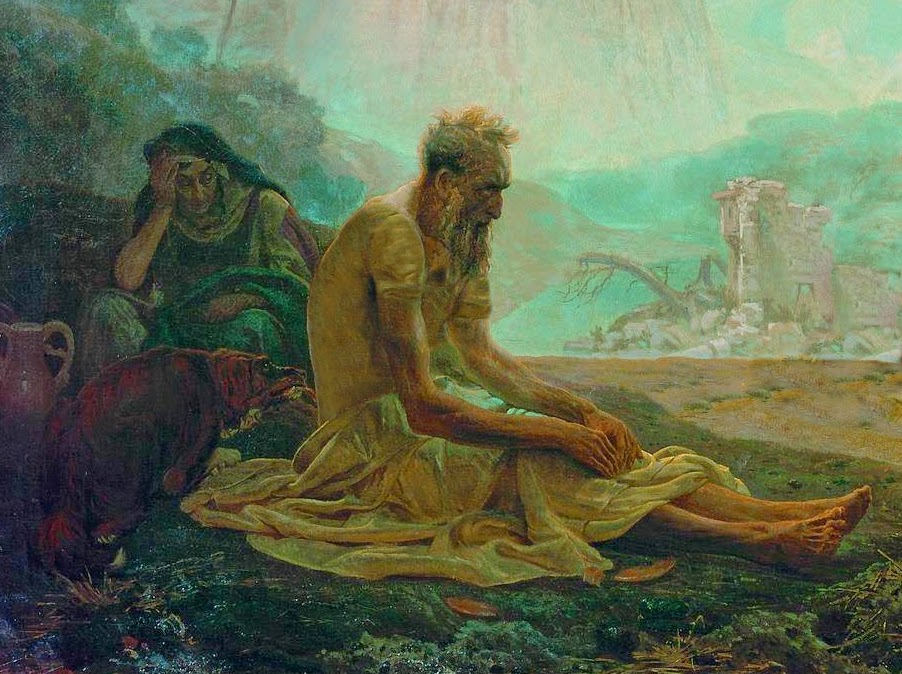
Job 3 represents, I believe, a classic statement out of the depths of depression and despair. In it, Job, sitting in the ruins of his life, finally speaks, and his words are dark and painful words.

Job announces that it would be better for him if (a) he had not been born or (b) he could go ahead and die, both of which are realities that belong in the hands of God.

In chapter 3, Job openly laments his very existence. He does so before his watching friends after they have all sat silently for seven days. It is hard to imagine a much more painful outburst than what we witness here.

1 After this Job opened his mouth and cursed the day of his birth.And Job said:“Let the day perish on which I was born, and the night that said, ‘A man is conceived.’Let that day be darkness! May God above not seek it, nor light shine upon it.Let gloom and deep darkness claim it. Let clouds dwell upon it; let the blackness of the day terrify it.That night—let thick darkness seize it! Let it not rejoice among the days of the year; let it not come into the number of the months.Behold, let that night be barren; let no joyful cry enter it.Let those curse it who curse the day, who are ready to rouse up Leviathan.Let the stars of its dawn be dark; let it hope for light, but have none, nor see the eyelids of the morning, 10 because it did not shut the doors of my mother’s womb, nor hide trouble from my eyes. 11 “Why did I not die at birth, come out from the womb and expire? 12 Why did the knees receive me? Or why the breasts, that I should nurse? 13 For then I would have lain down and been quiet; I would have slept; then I would have been at rest, 14 with kings and counselors of the earth who rebuilt ruins for themselves, 15 or with princes who had gold, who filled their houses with silver. 16 Or why was I not as a hidden stillborn child, as infants who never see the light? 17 There the wicked cease from troubling, and there the weary are at rest. 18 There the prisoners are at ease together; they hear not the voice of the taskmaster. 19 The small and the great are there, and the slave is free from his master. 20 “Why is light given to him who is in misery, and life to the bitter in soul, 21 who long for death, but it comes not, and dig for it more than for hidden treasures, 22 who rejoice exceedingly and are glad when they find the grave? 23 Why is light given to a man whose way is hidden, whom God has hedged in? 24 For my sighing comes instead of my bread, and my groanings are poured out like water. 25 For the thing that I fear comes upon me, and what I dread befalls me. 26 I am not at ease, nor am I quiet; I have no rest, but trouble comes.”

I wish I had never been born! Truth be told, this may be a thought that many folks, at one time or another, have had. Job proclaims this, but he actually proclaims even more than this. J. Gerald Janzen points out that in verses 3-10, Job’s curses move from the day of his birth backwards to the night of his conception and in verses 11-16, Job moves from the idea of his dying in childbirth backwards to his dying in the womb before birth.[3]

It is not only that Job wishes he had never been born, it is also that he wishes he had never been conceived. It is not only that Job wishes he had died in childbirth, it is also that he wishes he had died before childbirth, died in the womb. This is a powerful statement arising from deep anguish of the soul.

There is also a theological component in Job’s complaint, a kind of parodying of creation itself. Steven Chase points out that whereas God in Genesis 1 said, “Let there be light!” Job in Job 3 said, “Let there be darkness!”[4] What is more, as Janzen notes, the creation account of Genesis begins with “let there be light” and ends with the giving of rest. Job 3 begins with “let there be darkness” and ends in verse 26 with, “I have no rest.”

This raises the question of whether or not Job sins in chapter 3, whether or not Job curses God in chapter 3. Truth be told, it is hard to say. The parodying of Genesis 1 comes closest to suggesting that he did, but it should be observed that Job never actually curses God Himself. True, he curses his own conception and birth, but he does stop short of cursing God.

To curse one’s conception and birth is indeed a serious thing, for, in so doing, one is cursing what God called good. More than that, in questioning why he had not been allowed to die, Job was questioning yet another reality that should reside only in the hands of God.

Even so, it must be kept in mind that grief and anguish are messy things, that people grieve differently, that our theology in the crucible of pain has sharper edges than our theology in the green fields of ease, and that no man or woman of God should be judged solely and wholly by what they say when they are hurting in profound ways.

This should be kept in mind within the Church. We should show grace and mercy to those who are in pain. We often give vent to the most unsettling questions when we are suffering. Some do not. Some do. It seems like an injustice to parse the anguished exclamations of a broken heart from a safe distance when one has never walked the particular path of suffering that another is walking.

I have learned this in my own ministry: your presence is of more value than your words. As we will see, Job’s friends miss this point, and worse, but we must not. Simply being near, being patient, refusing to judge the anguished cries of the suffering, and loving the suffering friend with a deep sense of understanding and grace is the calling of the people of God. There will come a time for talking, but even then it must be careful.

We should be careful with Job 3. Any of us might sound like this at any time. It does not mean that the one who speaks such in the midst of pain has abandoned Jesus. It may only mean that they are trying to hold on as best they can in the midst of a catastrophic tragedy by shouting a theology devoid of nuance and dispassion.

Eliphaz counters that Job simply must have sinned. In so doing, Eliphaz upheld the faulty formula and showed a lack of sympathy for a genuinely grieving friend.

Of all the pain Job endured, the pain of prying and unsympathetic friends may have been the worst. In the aftermath of his cry of agony, Eliphaz speaks. In doing so, Eliphaz demonstrates the power of the old and faulty formula that the book of Job is seeking to shatter.

1 Then Eliphaz the Temanite answered and said: 2 “If one ventures a word with you, will you be impatient? Yet who can keep from speaking? 3 Behold, you have instructed many, and you have strengthened the weak hands. 4 Your words have upheld him who was stumbling, and you have made firm the feeble knees. 5 But now it has come to you, and you are impatient; it touches you, and you are dismayed. 6 Is not your fear of God your confidence, and the integrity of your ways your hope? 7 “Remember: who that was innocent ever perished? Or where were the upright cut off? 8 As I have seen, those who plow iniquity and sow trouble reap the same. 9 By the breath of God they perish, and by the blast of his anger they are consumed. 10 The roar of the lion, the voice of the fierce lion, the teeth of the young lions are broken. 11 The strong lion perishes for lack of prey, and the cubs of the lioness are scattered. 12 “Now a word was brought to me stealthily; my ear received the whisper of it. 13 Amid thoughts from visions of the night, when deep sleep falls on men 14 dread came upon me, and trembling, which made all my bones shake. 15 A spirit glided past my face; the hair of my flesh stood up. 16 It stood still, but I could not discern its appearance. A form was before my eyes; there was silence, then I heard a voice: 17 ‘Can mortal man be in the right before God? Can a man be pure before his Maker? 18 Even in his servants he puts no trust, and his angels he charges with error; 19 how much more those who dwell in houses of clay, whose foundation is in the dust, who are crushed like the moth. 20 Between morning and evening they are beaten to pieces; they perish forever without anyone regarding it. 21 Is not their tent-cord plucked up within them, do they not die, and that without wisdom?’

Steven Chase points out that Eliphaz is appealing to “the ancient concept of justice” or “the doctrine of retributive justice” that says “the righteous will be blessed and the evil will be punished by God in this life; and conversely…if one is blessed he or she must be righteous, and if one is punished he or she must be evil.”[5] That is what I am calling the “faulty formula” to which Eliphaz adheres. It is a critical mistake.

One of the most pernicious effects of the faulty formula is that it short-circuits actual care and compassion and causes those who should be comforting a suffering friend to diagnose a cause instead. Conversely, one of the liberating things about realizing how faulty the old formula is is that we are thereby liberated from the need to assess and are freed to be for our friend what we need to be. Jettisoning this overly-simplistic approach to suffering allows us to come down from our judge’s chair and simply be a friend.

Eliphaz, however, is still in the clutches of this unfortunate way of thinking and it manifests itself in his approach to Job. After reminding Job that he, Job, had himself offered words to those who were struggling, Eliphaz commences to dispense some of his own verbal medicine. When one watches the flow of Eliphaz’s thoughts, however, it is evident that he is bent on forcing Job into the pre-fabricated template of retributive justice. So, for instance:

  • In verse 6 Eliphaz explicitly ties Job’s confidence in his own integrity, thereby insinuating that if his confidence now fails him it must be because his integrity does not, in fact, remain unblemished. Job, in other words, must have sinned to be struck thus by God.
  • In verses 7-11, Eliphaz waxes eloquent on the faulty formula by reminding Job that the wicked are punished and the good are blessed. The uncomfortable and profoundly unhelpful conclusion could hardly have been missed by Job.
  • In verses 12-21, Eliphaz next waxes mystical, telling Job that he has had a most unsettling vision in which “a spirit” came by him and implicated all of creation of sin. In saying this, Eliphaz not only attempted to make himself an actual oracle for allegedly divine truth, but he seemed to be trying to prod Job into a confession of his sin by reminding him that, after all, everybody sins.

The upshot of these components of Eliphaz’s speech is that Job was deprived on the comfort he so desperately needed and was subjected instead to a less-than-subtle suggestion that Job had, in the end, brought his deplorable state upon himself. Put another way, Eliphaz foisted his pre-fabricated and highly deficient theology of suffering of poor Job. In this way, Eliphaz was implicitly using Job’s own suffering to buttress his, Eliphaz’s, own notions of the way that reality works.

It is a powerful temptation, this desire to be judge and jury over life’s calamities. It is also a profoundly insulting thing to do. Perhaps we play the part of Eliphaz the Temanite because we realize that if we were to jettison our nice, neat explanations for suffering, we might have to accept that there is indeed some mystery about these things, that we might not have God pinned down in quite the way we want, that His ways might indeed be mysterious and even perplexing, and that we might have to learn to trust more deeply in the deep providences of the God who sometimes allows His beloved children to suffer.

Nothing so frightens the erstwhile theologian like the possibility that – gasp! – he might not actually know it all. I hope I can be forgiven for suggesting that Eliphaz sounds like somebody who has just graduated from seminary and who, fortified with their newly minted diploma that says “Master of Divinity,” sets out to explain the deep things of God to those mired in ignorance. In truth, Eliphaz felt that he had mastered divinity, and in lecturing suffering Job, he actually seemed to think that he was doing him a favor.

Hear me: when your friend is suffering, he does not need a master, he needs a friend. Your suffering friend does not need your hypotheses on why, he simply needs you to be near and to love him. When your friend is in the pit of anguish, she does not need your judgment, she needs your understanding and your grace.

Beware the temptation to explain!

Beware the temptation to fix!

Beware the temptation to diagnose!

Beware the temptation to probe!

Christian friend, it is in suffering that we are most privileged to be the hands and feet and voice of Christ to those in need. For it is in the sufferings of Christ that we find the only true safe harbor for the weary and weeping soul.

Do not give your suffering friend your wisdom. Give your suffering friend the cross of Christ that reminds them that there is One who is wise enough to speak and One who has hurt enough to sympathize and One who has emerged victorious in order to carry us through the valley of the shadow of death.

Give them Jesus, friends. Give them Jesus.


[1] https://www.obu.edu/christianstudies/files/2016/01/2016-ICCC-BROCHURE.pdf

[2] Steven J. Lawson, Job. Holman Old Testament Commentary. Vo.10 (Nashville, TN: Holman Reference, 2004), p.33-34.

[3] J. Gerald Janzen, Job. Interpretation. (Louisville, KY: Westminster John Knox Press, 1985), p.64.

[4] Steven Chase, Job. Belief. (Louisville, KY: Westminster John Knox Press, 2013), p.31.

[5] Steven Chase, p.40.

Job 2

Job_and_his_wife_01Job 2

1 Again there was a day when the sons of God came to present themselves before the Lord, and Satan also came among them to present himself before the Lord. 2 And the Lord said to Satan, “From where have you come?” Satan answered the Lord and said, “From going to and fro on the earth, and from walking up and down on it.” 3 And the Lord said to Satan, “Have you considered my servant Job, that there is none like him on the earth, a blameless and upright man, who fears God and turns away from evil? He still holds fast his integrity, although you incited me against him to destroy him without reason.” 4 Then Satan answered the Lord and said, “Skin for skin! All that a man has he will give for his life. 5 But stretch out your hand and touch his bone and his flesh, and he will curse you to your face.” 6 And the Lord said to Satan, “Behold, he is in your hand; only spare his life.” 7 So Satan went out from the presence of the Lord and struck Job with loathsome sores from the sole of his foot to the crown of his head. 8 And he took a piece of broken pottery with which to scrape himself while he sat in the ashes. 9 Then his wife said to him, “Do you still hold fast your integrity? Curse God and die.” 10 But he said to her, “You speak as one of the foolish women would speak. Shall we receive good from God, and shall we not receive evil?” In all this Job did not sin with his lips. 11 Now when Job’s three friends heard of all this evil that had come upon him, they came each from his own place, Eliphaz the Temanite, Bildad the Shuhite, and Zophar the Naamathite. They made an appointment together to come to show him sympathy and comfort him. 12 And when they saw him from a distance, they did not recognize him. And they raised their voices and wept, and they tore their robes and sprinkled dust on their heads toward heaven. 13 And they sat with him on the ground seven days and seven nights, and no one spoke a word to him, for they saw that his suffering was very great.

Stephen Crane, the author of The Red Badge of Courage, had numerous Methodist pastors in his family tree. Even so, he lived a rough and free life and, in many of his poems, expressed his anger at God and perception of God’s cruelty to man. For instance, here is his 12th poem from The Black Riders and Other Lines (he included the verse at the beginning of the poem).

“And the sins of the fathers shall be visited upon the heads of the children, even unto the third and fourth generation of them that hate me.”

Well, then, I hate Thee, unrighteous picture;

Wicked image, I hate Thee;

So, strike with Thy vengeance

The heads of those little men

Who come blindly.

It will be a brave thing.[1]

And again, in his 19th poem:

A god in wrath

Was beating a man;

He cuffed him loudly

With thunderous blows

That rang and rolled over the earth.

All people came running.

The man screamed and struggled,

And bit madly at the feet of the god.

The people cried,

“Ah, what a wicked man!”

And –

“Ah, what a redoubtable god!”[2]

At the heart both protests is his perception of God as beating man and treating man cruelly. Then, to, Crane’s amazement, men still persisted in worshipping this God.

It is an interesting and very real question: is God worthy of worship if men suffer? Perhaps that is another way of putting the central question of Job.

Interestingly, another famous poet, Alfred Lord Tennyson, called the book of Job “the greatest poem of ancient and modern times.”[3] I suspect that is true. Job, as we have said, remains tethered to current human experience by the timelessness of suffering and man’s need to understand this in the light of the presence and goodness of God. As Susan E. Schreiner has written:

A pawn in a contest about which he knew nothing, the beneficiary of ‘friendly’ advice he refused to accept, the target of suffering he could not understand, and a victim in a universe that threatened to overwhelm him, Job has been a man for all ages. Ever since the biblical era…[Job’s story] has forced its readers to wrestle with the most painful realities of human existence.[4]

This theme of suffering was introduced in the first chapter of Job, but it is heightened in the second chapter when the intensity of the conflict is ratcheted up by God’s further permission for Satan to strike Job more directly.

The book of Job takes us deep into the conflict that caused Stephen Crane and many others to curse God but caused Job and numerous others to refuse to do so. Both of these realities are present in Job 2.

The perseverance or lack thereof of God’s people in the midst of suffering speaks to the reality of our relationship with God.

We should recognize at the beginning of chapter 2 that our response to suffering reflects upon the reality of our relationship with God.

1 Again there was a day when the sons of God came to present themselves before the Lord, and Satan also came among them to present himself before the Lord. 2 And the Lord said to Satan, “From where have you come?” Satan answered the Lord and said, “From going to and fro on the earth, and from walking up and down on it.” 3 And the Lord said to Satan, “Have you considered my servant Job, that there is none like him on the earth, a blameless and upright man, who fears God and turns away from evil? He still holds fast his integrity, although you incited me against him to destroy him without reason.”

In this fascinating second conversation between God and Satan in the throne room of Heaven, we note that God points joyfully to the quality of Job’s relationship with Him and the fact that Job remains “a blameless and upright man who fears God and turns away from evil” and who “holds fast his integrity.” Job’s faithfulness in the face of suffering is used by God as a rebuke to the devil. We have no reason to think that such is not the case even today.

We must approach this idea carefully, however. We must not take this to mean that genuine human struggling with pain and suffering and loss and grief means in and of itself that one does not truly love God. We must not take this to mean that God expects a kind of extra-human stoicism and lack of struggle in His people else Satan gets the glory.

Against this idea I will remind us that the Lord Jesus sweated agonizing drops of blood in Gethsemane and did not sin. The Lord Jesus asked if the cup of the cross might pass Him by and did not sin in doing so. We have no reason whatsoever to believe that Christ’s agony in Gethsemane in any way diminished the glory of God or disappointed God or gave the Devil props. Why, because at the end of His agony Christ yet said, “Nevertheless, not my will but thy will be done.”

It is Job’s ultimate faithfulness in the face of the initial assault and even his grieving faithfulness in the midst of the second assault to which God points and of which God speaks. It is not the absence of struggle or grief but the refusal, ultimately, to abandon our faith that God uses to rebuke the devil.

The fact that God does so should give us pause. If the scenes in Job 1 and 2 are considered normative, then we must realize that our walk with God is likewise being pointed to by the Devil and by God. Approached form a different angle, ask yourself this: if God and Satan were to discuss your walk right now, what would that conversation sound like? Could God point to you as he pointed to Job and say, “See? He has remained faithful? She has remained faithful?”

What about our church? If God and Satan were to discuss the reality of Central Baptist Church, what would they say? Would God say, “See? Central Baptist Church has remained faithful? Have you considered Central Baptist Church?”

May we live in such a way that our testimonies provide further ammunition for the arsenal of God against the wicked intent of the Devil.

Satan assumes that while a man may endure the loss of all he has, he will not endure an attack upon himself. Thus, Satan may attack what we have, but it is us that he ultimately wants.

Again, God pointed out Job’s faithfulness and again Satan asked permission to strike. And again, God granted the permission, this time for Satan to strike Job deliberately so long as he did not kill Job.

Then Satan answered the Lord and said, “Skin for skin! All that a man has he will give for his life. 5 But stretch out your hand and touch his bone and his flesh, and he will curse you to your face.” 6 And the Lord said to Satan, “Behold, he is in your hand; only spare his life.” 7 So Satan went out from the presence of the Lord and struck Job with loathsome sores from the sole of his foot to the crown of his head.

Here we see the brutal nature of Satan’s second attack. Job is struck and wounded and marred with disease. Didymus the Blind, the fourth century Alexandrian commentator, memorably referred to Job as “an expression and image of perseverance – like a marked pillar.”[5] He was a pillar, but he was indeed a marked one.

Job’s body is covered with sores. The wording suggests something like boils. The exact nature of this illness is a mystery. Some have traced the symptoms of Job’s illness throughout the book to try to figure out what the disease was. When you do so, you find the following marks of the disease:

  • Breeding of worms, 7:5
  • Horrible dreams, 7:14
  • Sensation of choking, 7:15
  • Fetid breath, 19:17
  • Corrosion of the bones, 30:17
  • Blackening and falling off of the skin, 30:30[6]

In the ninth century, the bishop of Hedatta, Isho’Dad of Merv, said that Job’s disease was elephantiasis, a disease which “when it strikes someone, his whole body putrefies, his flesh melts away, the features of his face decompose, his nostrils disappear, and a filthy, sour and corrosive pus constantly oozes from his body.”[7] Others have opted to say that precisely identifying this disease misses the point and that Job may very well have been struck with something the exact nature of which the medical books have never seen. Regardless, he was struck.

The idea behind Satan’s request to strike Job is interesting. Satan’s eruption, “Skin for skin!” is notoriously difficult to understand. Some interesting proposals have been put forward as to its meaning.

  • Some translate it as “skin after skin,” suggesting that Job’s outer skin was his possessions and family but his inner skin is his actual life. In this translation, Satan is asking to “get under Job’s skin.”
  • Some liken it to the lex talionis, “an eye for an eye and a tooth for a tooth.” “That is, the accuser believed that Job would give another person’s skin (his servants and children) in exchange for his own.”
  • Yet another view proposes that the saying, “Skin for skin!” “does not look back and compare the first and second test but rather looks forward and states that if Job’s skin is harmed, then Job will be after Yahweh’s skin.”[8]

Whatever its exact meaning, it clearly rests at the heart of Satan’s challenge and must in some sense mean that the striking of Job’s own skin and life will break Job and destroy his trust in God. Thus, Satan assumes that while a man may endure the loss of all he has, he will not endure an attack upon himself. Thus, Satan may attack what we have, but it is us that he ultimately wants.

Whether or not Satan’s assumption is correct is beside the point. For the record, I suspect Satan’s assumption is not correct. Ask anybody who has lost a child or a spouse if they would not willingly choose to suffer if by so doing it would bring their child back or their spouse back. I suspect that most people would say their personal sufferings could never match the suffering they felt when losing a loved one.

Even so, the truthfulness of the assumption is beside the point because, at least in Job 2, this seems to be Satan’s assumption: that people’s faith can survive the loss of their loved ones but their faith cannot survive the loss of their own health and peace and comfort. As a result, Satan is ever and always wanting to strike us directly and as deeply as possible.

Satan wants our skin.

There is a saying in our culture that seems to apply. We might say of somebody, “He’s got no skin in the game.” That phrase seems to be linked to Warren Buffett and it refers to a person who has no personal monetary risk in an investment or financial venture. Thus, they have nothing personally to lose. They have no skin in the game.

This seems to be what Satan is saying. He is saying that Job has no skin in the game. If Job had skin in the game, then it would really matter to him. So Satan asks permission to strike Job’s skin and the Lord grants that permission.

Job’s view of God did not allow only for blessing and he rejected the assertion that it should as foolish.

Permission is granted and Job’s skin is struck.

8 And he took a piece of broken pottery with which to scrape himself while he sat in the ashes. 9 Then his wife said to him, “Do you still hold fast your integrity? Curse God and die.” 10 But he said to her, “You speak as one of the foolish women would speak. Shall we receive good from God, and shall we not receive evil?” In all this Job did not sin with his lips. 11 Now when Job’s three friends heard of all this evil that had come upon him, they came each from his own place, Eliphaz the Temanite, Bildad the Shuhite, and Zophar the Naamathite. They made an appointment together to come to show him sympathy and comfort him. 12 And when they saw him from a distance, they did not recognize him. And they raised their voices and wept, and they tore their robes and sprinkled dust on their heads toward heaven. 13 And they sat with him on the ground seven days and seven nights, and no one spoke a word to him, for they saw that his suffering was very great.

Yes, Job’s skin is struck, but obviously not just his skin. The words of Job’s wife strike deeper than his diseased skin. “Do you still hold fast your integrity?” she asks. “Curse God and die.” What a blow. What a devastating blow.

We know very little about Job’s wife. It has been suggested that Job’s wife (who Jewish tradition knows as Dinah or Sitis) was offering Job “a theological way of committing suicide” by suggesting to Job that he should curse God and let God kill him as a result.[9] St. Augustine referred to Job’s wife as diabolic adjutrix (the Devil’s advocate), John Chyrostom called her “the Devil’s best scourge,” and John Calvin called her organum Satani (the instrument of Satan).[10] In 25:1-8 of the 1st century BC or AD apocryphal work, The Testament of Job, Job’s wife is depicted as lamenting her situation.

Who is not amazed that this is Sitis, the wife of Job?
Who used to have fourteen draperies sheltering her chamber and a door within doors, so that one was considered quite worthy merely to gain admission to her presence:
Now she exchanges her hair for loaves!
Whose camels, loaded with good things, used to go off into the regions of the poor:
Now she exchanges her hair for loaves!
Look at her who used to keep seven tables reserved at her house, at which the poor and the alien used to eat:
Now she sells outright her hair for loaves!
See one who used to have a foot basin o f gold and silver, and now she goes along by foot:
Even her hair she gives in exchange for loaves!
Observe, this is she who used to have clothing woven from linen with gold: But now she bears rags and gives her hair in exchange for loaves!
See her who used to own couches of gold and silver:
But now she sells her hair for loaves![11]

That is fascinating in the way that legendary apocryphal works often are, but one does rather suspect that Job’s wife’s anger is linked not to her personal loss of social status but to the devastating blow of having lost all of her children. She spoke therefore out of a broken heart. She spoke out of her pain and she challenged Job’s faith depicting it as absurd. Job’s response was powerful.

10 But he said to her, “You speak as one of the foolish women would speak. Shall we receive good from God, and shall we not receive evil?” In all this Job did not sin with his lips.

Job’s wife calls him foolish. Job, in turn, calls her foolish. Then he offers his critically important insight: “Shall we receive good from God, and shall we not receive evil?” In saying this, Job was not calling God evil. That is not what he says. He is simply saying that God is ultimately sovereign and thus all things happen either directly from Him or because He allows it, even evil things. That is clearly the intent of chapters 1 and 2 and it would seem that Job understood this point. So Job trusted in God and refused to allow the presence of evil and suffering to obliterate his faith.

“In all this,” the author of Job writes, “Job did not sin with his lips.”

Amazingly, some have viewed the wording of verse 10 as a subtle suggestion that Job sinned inwardly but not outwardly. The Rabbi Rashi, “following the Talmud, said, ‘But in his heart he sinned.’”[12]

It is admittedly difficult for us to understand how Job could actually have held firm to his faith at this point, but it should be noted that reading secret sin into Job on the basis of that verse makes us no better than his friends at their worst. True, Job will indeed break beneath the pressure and not always remain a marked pillar, but there is no evidence that here he did so. Here, Job trusted yet in God. He trusted in God because he rejected any theology that only had room for blessing and not for cursing.

For our purposes, despite the fact that we have not (and cannot) answer all of the questions surrounding human suffering, is it not enough for us to see that the goodness of God is not assailed because He allows evil to happen or because He does not stop all evil from happening? Can we not see even here that God, while allowing Job to experience suffering, does indeed keep Satan from taking his life, that God still puts a limit on the Devil even while allowing the Devil to strike?

Emotionally, we struggle to understand, but please note that Job yet trusted God.

We point often to this text, but it seems appropriate once again to remember the amazing story in Mark 9 of the man with the demon possessed son.

20 And they brought the boy to him. And when the spirit saw him, immediately it convulsed the boy, and he fell on the ground and rolled about, foaming at the mouth. 21 And Jesus asked his father, “How long has this been happening to him?” And he said, “From childhood. 22 And it has often cast him into fire and into water, to destroy him. But if you can do anything, have compassion on us and help us.” 23 And Jesus said to him, “‘If you can’! All things are possible for one who believes.” 24 Immediately the father of the child cried out and said, “I believe; help my unbelief!” 25 And when Jesus saw that a crowd came running together, he rebuked the unclean spirit, saying to it, “You mute and deaf spirit, I command you, come out of him and never enter him again.”

“I believe; help my unbelief!”

This man is the patron saint of all who suffer yet believe and his statement is the creed of all who suffer but refuse to abandon their faith. Most gloriously, Jesus does not begrudge his struggling confession, but rather receives it, blesses it, then delivers his son.

Do not let go, dear friends. Do not let go of the loving hand of God. Even through your tears and pain and questions and doubts, do not let go. Even by the graveside or the hospital bed or the tragedy that has knocked you flat. Do not let go.

Do not let go.

Jesus has not let go of you.

Jesus will never let go of you.


[1] Stephen Crane. Stories and Collected Poems. (New York: Quality Paperback Book Club, 1997), p.14.

[2] Stephen Crane, p.21.

[3] G. Henton Davies, Alan Richardson, Charles L. Wallis, eds., Twentieth Century Bible Commentary. (New York, NY: Harper & Brothers, Publishers, 1955), p.229.

[4] Quoted in Steven Chase, Job. Belief: A Theological Commentary on the Bible. (Louisville, KY: Westminster John Knox Press, 2013), p.23.

[5] Manlio Simonetti and Marco Conti, eds. Job. Ancient Christian Commentary on Scripture: Old Testament. Vol. VI. Thomas C. Oden, Gen. Ed. (Downers Grove, IL: InterVarsity, 2006), p.12.

[6] John D.W. Watts, John Joseph Owens, Marvin E. Tate, Jr., “Job.” The Broadman Bible Commentary. Vol. 4 (Nashville, TN: Broadman Press, 1971), p.41.

[7] Manlio Simonetti and Marco Conti, eds., p.12.

[8] Tremper Longman III, Job. Baker Commentary on the Old Testament. (Grand Rapids, MI: Baker Academic, 2012), p.88.

[9] John D.W. Watts, John Joseph Owens, Marvin E. Tate, Jr., p.41-42.

[10] Francis I. Andersen, Job. Tyndale Old Testament Commentaries. 14 (Downers Grove, IL: InterVarsity Press Academic, 2008), p.97.

[11] E.O. Gravett, “Biblical Responses: Past and Present Retellings of the Enigmatic Mrs. Job.” Biblical Interpretation 20 (2012), p.113.

[12] Francis I. Andersen, p.99.

Luke 23:46

Screen Shot 2015-08-27 at 3.08.11 PMLuke 23

46 Then Jesus, calling out with a loud voice, said, “Father, into your hands I commit my spirit!” And having said this he breathed his last.

We come now to the seventh word from the cross, the last word. It is a beautiful word. It is a powerful word. When we think of the cross, we think naturally of the hands of Christ. But here in this last word, Jesus draws our attention to the hands of the Father. Our hope is in the pierced hands of Jesus. Jesus’ hope was in the sovereign hands of the Father.

Barrie Shepherd has written a beautiful poem entitled, “Father, Into Thy Hands.” In it, he imagines what Jesus was saying in this moment.

“Father, into thy hands I commit my spirit.”

Into thy hands, Father, into thine,
for these hands that have been mine
are just too broken now to hold it any longer. They have served well for thirty years and more, these hands you gave me.

…..

The hands you gave me, Lord, have done their task—complete—
and now can do no more. This spirit they have held and worked for, expressed in countless loving ways, is ready to return. Into thy hands, then,
O Father, thy hands that have been ever under mine, thy hands that have supported, guided every move and every moment, into thy hands I commit my

soul,
my self; knowing that the hands that have
so tended me in grace will not forsake me now, will never let me go, but will embrace me
in eternal love from this day’s ending
onward even to forever.

Father, into thy hands I commit my spirit. [1]

That is a poignant way of imagining what Jesus was saying in the seventh word, “Father, into your hands I commit my spirit.” I suspect this seventh word might hit us all in different ways. In truth, I suspect it hit the original hearers in different ways. It certainly was saying something to people right where they were then and right where they are now. Let us consider how the different groups could have or, at least, should have heard this word.

A statement to the pagan Romans: He Who Has Seen the Son Has Seen the Father.

One thing we might miss when we read this seventh word is the unique meaning and significance it likely had for the Romans standing nearby. To understand this, you need to understand the death and funerary customs of the ancient Romans. Specifically, there was a custom among the Romans “in which the nearest of kin receives the dying person’s breath in his own mouth, ensuring the spirit’s survival.”[2] This is attested to in ancient literature and seems to have been a kind of folk belief of the time: that you should try to catch the dying person’s last breath in your own mouth. Put another way, dying Romans were understood to commit their spirits to their closest kin standing nearby. In so doing, the soul of the deceased would survive.

Clearly this is not a Christian belief, but it is indeed intriguing to think, in light of that custom, how the Romans, and, specifically, the Roman soldiers, would have interpreted the seventh word.

46 Then Jesus, calling out with a loud voice, said, “Father, into your hands I commit my spirit!” And having said this he breathed his last.

The fact that Jesus commits his spirit to God as His closest kin would have undoubtedly had a powerful impact on the Romans standing nearby. If God is Christ’s nearest kin, and if He entrusts His spirit to God the Father, and if the Father, presumably, caught the spirit of Christ, does that not say something astounding about who exactly this Jesus is?

It is most likely that the Romans who heard this would have instinctively interpreted it in the light of their own customs and would have been amazed at the possible implications. Perhaps this helps us understand the very next verse:

47 Now when the centurion saw what had taken place, he praised God, saying, “Certainly this man was innocent!”

Thus, to the pagan world, “Into your hands I commit my spirit,” was a cry of Christ’s innocence because it was proof of Christ’s oneness with the Father and therefore evidence that what Jesus said and did was indeed of God.

A statement to the watching Jews: Christ is the sacrificial Lamb who takes away the sin of the world.

If the seventh word might have hit the Romans in a particular way, it likely hit some of the Jews standing by in yet another way. To understand this, we need to understand that Jesus once again quotes the Old Testament in this word. In particular, he is quoting Psalm 31.

1 In you, O Lord, do I take refuge; let me never be put to shame; in your righteousness deliver me!

2 Incline your ear to me; rescue me speedily! Be a rock of refuge for me, a strong fortress to save me!

3 For you are my rock and my fortress; and for your name’s sake you lead me and guide me;

4 you take me out of the net they have hidden for me, for you are my refuge.

5 Into your hand I commit my spirit; you have redeemed me, O Lord, faithful God.

6 I hate those who pay regard to worthless idols, but I trust in the Lord.

7 I will rejoice and be glad in your steadfast love, because you have seen my affliction; you have known the distress of my soul,

8 and you have not delivered me into the hand of the enemy; you have set my feet in a broad place.

Why is this interesting? It is interesting because, as Craig Keener notes, “this line from Psalm 31:5 is said to have often been recited at the period of the evening offering – about the time of Jesus’ death.”[3] Of what is Dr. Keener speaking?

Keener is speaking about something known as the perpetual sacrifice, the Tamid. The instructions for this sacrifice are found in Exodus 29.

38 “Now this is what you shall offer on the altar: two lambs a year old day by day regularly. 39 One lamb you shall offer in the morning, and the other lamb you shall offer at twilight. 40 And with the first lamb a tenth measure of fine flour mingled with a fourth of a hin of beaten oil, and a fourth of a hin of wine for a drink offering. 41 The other lamb you shall offer at twilight, and shall offer with it a grain offering and its drink offering, as in the morning, for a pleasing aroma, a food offering to the Lord. 42 It shall be a regular burnt offering throughout your generations at the entrance of the tent of meeting before the Lord, where I will meet with you, to speak to you there.

In Exodus 29, we find that there are to be two sacrifices of lambs every day, a perpetual sacrifice. It should be noted that the offerings were also accompanied by a wine and grain offering. Jewish tradition tells us that the Tamid was offered at 9 a.m. and at 3 p.m., that is, in the morning and in later afternoon.

Now why is that interesting? It is interesting because, when Jesus comes onto the scene, John the Baptist says this of Him in John 1:

29 The next day he saw Jesus coming toward him, and said, “Behold, the Lamb of God, who takes away the sin of the world!”

So John the Baptist called Jesus the lamb who would take away the sins of the world. And this lamb is sacrificed, He is crucified on the cross. In Mark 15 we read:

25 And it was the third hour when they crucified him.

And then later in the same chapter we read:

34 And at the ninth hour Jesus cried with a loud voice, “Eloi, Eloi, lema sabachthani?” which means, “My God, my God, why have you forsaken me?”

37 And Jesus uttered a loud cry and breathed his last.

So Jesus was crucified at the third hour, or 9 a.m., and Jesus died at the ninth hour, or 3 p.m. In other words, Jesus was offered as a sacrifice when the morning Tamid lamb was offered and then died on the cross in the late afternoon when the evening lamb was offered. How do we know that the evening Tamid lamb was offered at 3 p.m., the ninth hour? Because in Acts 3 we read this:

1 Now Peter and John were going up to the temple at the hour of prayer, the ninth hour.

The hour or prayer was the hour in which the evening lamb was offered. This was the hour of prayer. This was the hour when Peter and John would later go up to the temple. This was the hour when Jesus died on the cross. And this was the hour when Psalm 31:5 was quoted by the priest: “Into your hand I commit my spirit; you have redeemed me, O Lord, faithful God.”

In quoting Psalm 31:5, Jesus aligned Himself with the sacrificial lamb at the very moment when the sacrificial lamb was being offered up in the temple.

“Behold the lamb of God who takes away the sin of the world!”

Sacrificial lamb imagery is all over Jesus and all over the crucifixion of Jesus. Outside of the parallels with the Tamid is the fact that Jesus is sacrificed at Passover, when, of course, the Jews offered a Passover lamb to commemorate Israel’s deliverance from Egypt and when they remembered and celebrated the sovereignty and faithfulness of God. There is a great deal of debate surrounding the claim that is often made that Jesus died at precisely the moment when the Passover lamb was killed. Even so, the exact moment is irrelevant. They certainly went up to Jerusalem at Passover and so the crucifixion is linked to that observance regardless of exact timing. Furthermore, Paul specifically calls Jesus the Passover lamb in 1 Corinthians 5.

7b For Christ, our Passover lamb, has been sacrificed.

Jesus, then, is the Passover lamb, the lamb whose blood, if sprinkled on our hearts, will save us from judgment and death just as the blood of the Passover lamb did for Israel in Egypt.

“Father, into your hands I commit my spirit.” The words of the priest over the sacrifice, and, on the cross, the words of the sacrifice over the priests. One cannot help but believe that at least some of the Jews, and, specifically, some of the Jewish authorities, would have noted the poignancy of these particular words at that particular time from the lips of this particular crucified man.

Christ has come to be our sacrificial lamb. The Lord Jesus has given His life so that we might know forgiveness and so that we might have life. Most gloriously, Jesus has done this for you! Have you accepted the sacrifice that Jesus made on your behalf?

A statement to all of hurting humanity: We can trust our Father in Heaven with all that we have and are.

There is yet one more thing about Jesus quoting Psalm 31:5. William Barclay points out that Psalm 31:5 “was the first prayer that every Jewish mother taught her child to say last thing at night.” In quoting it and adding the word “Father” to it, “Jesus,” Barclay writes, “died like a child falling asleep in his father’s arms.”[4]

What a beautiful image. The Lord Jesus demonstrated His trust in the Father by offering the words of a child’s bedtime prayer: “Father, into your hands I commit my spirit.” In truth, this is not very different than the prayer we teach our children: “Now I lay me down to sleep. I pray the Lord my soul to keep. If I should die before I wake. I pray the Lord my soul to take.”

Quoting a child’s bedtime prayer did not mean, I should point out, that this was a “Precious Moments” scene of porcelain sweetness. This was a beautiful statement of trust, true, but it was a statement born of struggle and pain. Wesley Hill writes that, “‘Into your hands I commit my spirit’…is not a Pollyannaish serenity talking but is rather a trust born out of the struggle of Gethsemane.”[5]

“The ultimate question,” wrote Patrick Henry abut the seventh word from the cross, “is not ‘What happens when I die?’ but ‘In whom can I trust to the end?’”[6] That is very true. In saying what He said, Jesus was showing who He could trust to the end.

In His moment of greatest agony, Jesus prayed, “Father, into your hands I commit my spirit.” At the end of the day, when you are weak and spent, when life is at an end, it is the only prayer that the people of God can offer: “Into your hands I commit my spirit.”

This explains why these words in particular have been so often quoted and prayed by men and women of God in their moments of martyrdom. Hezekiah Butterworth has pointed out that these words or some form of them have been expressed in the dying moments of numerous great heroes of the faith. In addition, of course, to the Lord Jesus, these were the dying words of St. Stephen “the proto-martyr,” “of Polycarp, of Basil, of Bernard, of Huss, of Luther and Melancthon…of Columbus and Silvio Pellico.”

“Lord Jesus, receive my spirit,” prayed Knox…

“O God, my heavenly Father, receive my spirit,” [John of Barneveld] prayed at the block.

“Lord Jesus, receive my spirit,” prayed Bishop Hooper.

[Thomas] Cramner, putting his right hand that had signed the recantation into the flame, and saying, “This unworthy right hand,” uttered the same prayer, as did Latimer, Patrick Hamilton, and Rowland Taylor, in the flames.

“O Lord, into thy hands I commit my spirit, for thou has redeemed my soul, O Lord God of truth,” prayed the young Scottish martyr, Hugh M’Kail.

Margaret Wilson, bound to the stake at the low-water mark in the Bay of Wigton, saw the advancing tide. It rose slowly, until it reached her throat, when she prayed, “Lord Jesus, receive my spirit.”

Lord Harant, a Protestant martyr of Bohemia, prayed, kneeling by the block, “Into thy hands, O Lord, I commend my spirit: in thee have I always trusted: receive me, my blessed Redeemer.”

Lord Otto, another Bohemian martyr, prayed, “Almighty God, to thee I commend my spirit; receive it for the sake of Christ, and admit it to the glory of thy presence.”

“Miseree mei, Deus,” said Henry Gray, Duke of Suffolk, holding up his hands, and looking up to heaven. He then said, “Into thy hands, O Lord, I commend my spirit,” and made the sign to the executioner.

“Lord, into thy hands I commend my spirit,” prayed Lady Jane Gray, at the block.[7]

Time and time again throughout history, men and women who paid for their faith in Jesus with their lives prayed this prayer. Why? Because it is a statement of simple and beautiful trust. It was Jesus’ way of saying, “I know that Your hands will not fail me. I know that You will receive my Spirit. I know that I will have ultimate victory in You!”

There is an old sermon illustration, at least as old as the mid 1800’s, about a botanist in the highlands of Scotland who spotted a rare and highly prized plant far below the cliff where he stood on a little embankment jutting out from the sheer cliff face. As he stood there contemplating how he could get down to the embankment to retrieve the plant, a little Scottish boy came walking along.

The botanist stopped the boy, pointed to the plant far below, and explained the situation. “I wonder,” he asked the boy, “if you will allow me to tie my rope around your waste and lower you down to the plant? I promise I will not let you go.”

The boy heard the proposal, paused, looked back over the edge of the cliff, and said, “No.”

As he turned to go, the now frantic botanist called for the boy to stop, produced his wallet, and offered the boy an impressive sum of money. “I will pay you,” he said, “if you will let me lower you down.”

The boy paused again.   He looked at the money, looked back over the cliff edge at the plant far below, looked back at the man, thought for a bit, and then said, “I’ll tell you what, mister. I don’t want your money. And I’m not going to let you lower me down there. But I will do it for free if you meet one demand.”

“Anything,” the botanist said.

“I will do it,” replied the boy, “if my father can hold the rope.”

“Father, into your hands I commit my spirit.”

Trust.

Trust in the Father who loves us.

“Into thy hands I commit my spirit.”

Have you committed your spirit to God through Jesus Christ?

Oh why?

Why would you wait?

Commit it to him today.


[1] J. Barrie Shepherd, “Father, into Thy Hands.” Christian Century. (February 27, 1985), p. 205.

[2] Keener, p.255. See also Valerie Hope, Death in Ancient Rome. (New York, NY: Routledge, 2007), p. 93-94.

[3] Craig Keener, The IVP Bible Background Commentary: New Testament. (Downers Grove, IL: InterVarsity Press, 1993), p.255.

[4] William Barclay, The Gospel of Luke. The Daily Study Bible (Edinburgh: The Saint Andrew Press, 1970), p.301-302.

[5] https://www.firstthings.com/blogs/firstthoughts/2013/03/the-agony-of-a-steadily-trusting-faith

[6] Patrick Henry, “The Last Word: Good Friday Meditation on Luke 23:46.” Christian Century. (April 8, 1981), p. 385-387.

[7] Hezekiah Butterworth, “A Wonderful Prayer.” The Christian Treasury Containing From Ministers and Member of Various Evangelical Denominations. (Edinburgh: Johnstone, Hunter, and Co., Melbourne Place, 1879), p. 117.

Job 1

book_of_Job-570x377Job 1

1 There was a man in the land of Uz whose name was Job, and that man was blameless and upright, one who feared God and turned away from evil. 2 There were born to him seven sons and three daughters. 3 He possessed 7,000 sheep, 3,000 camels, 500 yoke of oxen, and 500 female donkeys, and very many servants, so that this man was the greatest of all the people of the east. 4 His sons used to go and hold a feast in the house of each one on his day, and they would send and invite their three sisters to eat and drink with them. 5 And when the days of the feast had run their course, Job would send and consecrate them, and he would rise early in the morning and offer burnt offerings according to the number of them all. For Job said, “It may be that my children have sinned, and cursed God in their hearts.” Thus Job did continually. 6 Now there was a day when the sons of God came to present themselves before the Lord, and Satan also came among them. 7 The Lord said to Satan, “From where have you come?” Satan answered the Lord and said, “From going to and fro on the earth, and from walking up and down on it.” 8 And the Lord said to Satan, “Have you considered my servant Job, that there is none like him on the earth, a blameless and upright man, who fears God and turns away from evil?” 9 Then Satan answered the Lord and said, “Does Job fear God for no reason? 10 Have you not put a hedge around him and his house and all that he has, on every side? You have blessed the work of his hands, and his possessions have increased in the land. 11 But stretch out your hand and touch all that he has, and he will curse you to your face.” 12 And the Lord said to Satan, “Behold, all that he has is in your hand. Only against him do not stretch out your hand.” So Satan went out from the presence of the Lord. 13 Now there was a day when his sons and daughters were eating and drinking wine in their oldest brother’s house, 14 and there came a messenger to Job and said, “The oxen were plowing and the donkeys feeding beside them, 15 and the Sabeans fell upon them and took them and struck down the servants with the edge of the sword, and I alone have escaped to tell you.” 16 While he was yet speaking, there came another and said, “The fire of God fell from heaven and burned up the sheep and the servants and consumed them, and I alone have escaped to tell you.” 17 While he was yet speaking, there came another and said, “The Chaldeans formed three groups and made a raid on the camels and took them and struck down the servants with the edge of the sword, and I alone have escaped to tell you.” 18 While he was yet speaking, there came another and said, “Your sons and daughters were eating and drinking wine in their oldest brother’s house, 19 and behold, a great wind came across the wilderness and struck the four corners of the house, and it fell upon the young people, and they are dead, and I alone have escaped to tell you.” 20 Then Job arose and tore his robe and shaved his head and fell on the ground and worshiped. 21 And he said, “Naked I came from my mother’s womb, and naked shall I return. The Lord gave, and the Lord has taken away; blessed be the name of the Lord.” 22 In all this Job did not sin or charge God with wrong.

The name of Job is one of those names that is well known even outside of the Church today. It is known through things like the popular saying, “the patience of Job,” which is almost a colloquialism today that speaks generally of endurance or patience in the face of suffering. Another reason why Job is so well known is that the experience of Job is so well known, namely, the experience of suffering.

In his novel Intruder in the Dust, William Faulkner wrote that “the whole chronicle of man’s immortality is in the suffering he has endured, his struggle toward the stars in the stepping-stones of his expiations.”[1] Is that an overstatement? Certainly those who have known real suffering would say that it is not, and even those who have not known real suffering would have to agree that suffering is one of the true constants of the human story and human experience.

This is the case to the extent that one cannot imagine a time in which the story of Job might become unfashionable, for that would require a very long period of time devoid of suffering. The world has yet to know such a period.

Job is likely here to stay. This is a good thing, for this is a profoundly and uniquely powerful text, a text that seeks to grapple with the reality of pain and misfortune. Job may or may not give one answers that will satiate our intellectual and emotional questions in the exact ways that we want, but if one grapples with this amazing book, one will be forced to consider the dynamics of suffering in ways that go well beyond surface considerations. More than that, the book leads one into the presence of God, a presence that is greater than suffering and the only presence in which suffering can be rightly approached.

The first chapter of Job is a truly astonishing chapter and one that sets the stage for the rest of the book.

The question of Job is the question of how to understand the existence of evil in light of the goodness of God and the absence of perceivable reasons for it.

The first chapter of Job makes two crucial points for helping us understand what is happening in this book and what is being said. It makes a theological statement and a personal statement. Theologically, it asserts that God is good, sovereign, and worthy of worship. On a personal level, it speaks of the uprightness of Job.

1 There was a man in the land of Uz whose name was Job, and that man was blameless and upright, one who feared God and turned away from evil. 2 There were born to him seven sons and three daughters. 3 He possessed 7,000 sheep, 3,000 camels, 500 yoke of oxen, and 500 female donkeys, and very many servants, so that this man was the greatest of all the people of the east. 4 His sons used to go and hold a feast in the house of each one on his day, and they would send and invite their three sisters to eat and drink with them. 5 And when the days of the feast had run their course, Job would send and consecrate them, and he would rise early in the morning and offer burnt offerings according to the number of them all. For Job said, “It may be that my children have sinned, and cursed God in their hearts.” Thus Job did continually.

The name Job has often be translated with the idea of “to be hostile to,” “object of enmity,” the assailed.” W.F. Albright, however, “connects the name Job with a larger form in northwest Semitic names which means ‘Where is my Father?”[2] Whichever of these translations is correct, the name speaks of some kind of struggle and some type of broken relationship. This strife and this broken relationship will be seen in the unfolding of Job’s story.

The story begins, however, with a dramatic demonstration of Job’s righteous and blessed state. This can be seen for instance in Job’s great material wealth. The IVP Bible Background Commentary notes that “the size of Job’s herds was enormous,” especially in light of the fact that Aristotle claimed “the Arabs” as a whole had 3,000 camels, even though “the ratio of small animals to large in Job’s herd is fairly typical.”[3] Yet Job’s greatest wealth was the richness of his character and his relationship with God. Hesychius of Jerusalem, the 5th century Bible commentator, observed of Job:

You see the greatness of Job’s external wealth; but his internal wealth was even greater. The visible riches were splendid, but the invisible riches were even more splendid because they last; visible riches grow old, lose their value and continually collapse into the most pitiful corruption.[4]

This is true. Job “feared God” and Job worshipped God. He was also concerned about his children’s relationship with God as can be seen in his sacrifices on their behalf.

We might take pause at the idea of Job as blameless. Are not all people sinners? Indeed they are. It needs to be understood, however, that the first chapter is trying to establish the point that the trials of Job cannot be linked to some sort of antecedent wrongdoing. Job is certainly aware of the reality of human sinfulness as can be seen in his sensitivity concerning his children possibly sinning against God.

Even so, the book of Job, and Job 1 in particular, is trying to strike against a particular and pernicious assumption that people have always had. The assumption is that good people have good things happen to them and bad people have bad things happen to them. This assumption effectively becomes a template that we then seek to put over each and every situation, even if the situation does not fit. Thus, if a person you thought was good has bad things happen to them, it likely means that they actually are bad and you just did not know it. So, in this scheme, bad things can be explained as the result of wickedness, and, in the case of people who appear to be good but have bad things happen to them nonetheless, the bad things that happen must be explained by secret sins. In other words, they must be forced to fit into the template.

This is an ancient idea, and a modern one. It is a very simple and very seductive idea. It can be seen in John 9:2 in the question that was asked about the man born blind: “Rabbi, who sinned, this man or his parents, that he was born blind?” Today it can be seen in certain heretical strands of Christianity in which it is asserted that a person who truly believes and is truly obedient will be blessed by God with wealth and health and a person who is not blessed with wealth and health must not truly believe or be being truly obedient.

We once took a visiting family to lunch after they visited church. The wife was of a particular camp within this strand of false teaching and she boldly asserted that a person who is truly following Jesus will never get sick. To my amazement, and to the amazement of my family, this lady was being completely serious as she went on to demonstrate in our conversation. Needless to say, the conversation went south quickly.

The first chapter of Job is seeking to remove this faulty assumption from the problem it is considering. The question of Job is the question of how to understand the existence of evil in light of the goodness of God and the absence of perceivable reasons for it.

The scene in heaven establishes (a) that God has ultimate sovereignty over what happens on the earth and (b) that there exists an active agent of evil in the world who God allows to inflict harm without this allowance impugning the character of God.

To help us move to the central problem of the book, we are next taken to the throne room of God.

6 Now there was a day when the sons of God came to present themselves before the Lord, and Satan also came among them. 7 The Lord said to Satan, “From where have you come?” Satan answered the Lord and said, “From going to and fro on the earth, and from walking up and down on it.” 8 And the Lord said to Satan, “Have you considered my servant Job, that there is none like him on the earth, a blameless and upright man, who fears God and turns away from evil?” 9 Then Satan answered the Lord and said, “Does Job fear God for no reason? 10 Have you not put a hedge around him and his house and all that he has, on every side? You have blessed the work of his hands, and his possessions have increased in the land. 11 But stretch out your hand and touch all that he has, and he will curse you to your face.” 12 And the Lord said to Satan, “Behold, all that he has is in your hand. Only against him do not stretch out your hand.” So Satan went out from the presence of the Lord.

This fascinating scene is seeking to establish two truths: (a) that God has ultimate sovereignty over what happens on the earth and (b) that there exists an active agent of evil in the world who God allows to inflict harm without this allowance impugning his character. God’s ultimate sovereignty is seen in the fact that Satan had to present himself before God and had to get permission from God before he could strike.

Satan’s answer to God’s initial question about his previous whereabouts is telling. “From going to and fro on the earth, and from walking up and down on it.” This is consistent with Peter’s idea in 1 Peter 5:8 that “the devil prowls around like a roaring lion, seeking someone to devour.” While it is the devil who is the pernicious force of evil in this situation, certain realities should be acknowledged about God’s role in the story of Job:

  • It is God who points Job out to Satan in verse 8: “Have you considered my servant Job…”
  • It is God who takes the leash off of Satan so that he can strike.

This raises difficult questions, questions, in our minds at least, of culpability, of blame, of responsibility. If Satan strikes a righteous man and his family but only after being allowed to do so by God, does that not make God ultimately the cause of evil and suffering? We teach our children to pray, “God is great, God is good,” but is that true?

Three things must be said about this. The first is that the biblical witness as a whole, and Job included, clearly proclaims the goodness of God. “Give thanks to the LORD, for he is good” (Psalm 136:1). “The LORD is good” (Psalm 100:5). In fact, Mark 10:18, Jesus proclaimed that only God is good: “Why do you call me good? No one is good except God alone.” The Bible is filled with such assertions.

Secondly, the first chapter of Job is seeking to convey the goodness of God even alongside God’s ultimate allowance of Satan’s attack. The pronouns related to the word “hand” in verses 11 and 12 are most intriguing.

11 But stretch out your hand and touch all that he has, and he will curse you to your face.” 12 And the Lord said to Satan, “Behold, all that he has is in your hand. Only against him do not stretch out your hand.” So Satan went out from the presence of the Lord.

Satan tells God, “Stretch out your hand and touch all that he has…” The Lord responds with, “all that he has is in your hand. Only against him do not stretch out your hand.” I believe this is the author’s way of communicating that though God allows evil this does not make Him the author of evil, much less evil Himself. It is still Satan’s hand that strikes though it was God’s hand that loosed.

Thirdly, there is a deep element of mystery and even paradox involved in this dynamic of the goodness of God alongside God’s allowance of evil that arises necessarily from His ultimate sovereignty. This is the mystery and the tension with which the book of Job grapples, as we will see. I believe it is not sinful to feel the weight of this tension. It is a tension with which we as the people of God must live.

One may deeply worship while one yet deeply grieves.

Even so, Job 1 shows us that the tension is not merely something we must grit our teeth and endure. On the contrary, our trust in the goodness and mercy and love of God can grow even as we grapple with suffering and even as we grieve. Put another way, one may deeply worship while one yet deeply grieves. The last chapter of Job 1 demonstrates this in a most striking way.

13 Now there was a day when his sons and daughters were eating and drinking wine in their oldest brother’s house, 14 and there came a messenger to Job and said, “The oxen were plowing and the donkeys feeding beside them, 15 and the Sabeans fell upon them and took them and struck down the servants with the edge of the sword, and I alone have escaped to tell you.” 16 While he was yet speaking, there came another and said, “The fire of God fell from heaven and burned up the sheep and the servants and consumed them, and I alone have escaped to tell you.” 17 While he was yet speaking, there came another and said, “The Chaldeans formed three groups and made a raid on the camels and took them and struck down the servants with the edge of the sword, and I alone have escaped to tell you.” 18 While he was yet speaking, there came another and said, “Your sons and daughters were eating and drinking wine in their oldest brother’s house, 19 and behold, a great wind came across the wilderness and struck the four corners of the house, and it fell upon the young people, and they are dead, and I alone have escaped to tell you.”

In essence, Job loses it all. What, then, will he do? How will he respond?

20 Then Job arose and tore his robe and shaved his head and fell on the ground and worshiped. 21 And he said, “Naked I came from my mother’s womb, and naked shall I return. The Lord gave, and the Lord has taken away; blessed be the name of the Lord.” 22 In all this Job did not sin or charge God with wrong.

Is this not one of the astonishing and humbling texts in all of Scripture? Stricken, wounded, grieving Job “worshiped” and praised and “did not sin or charge God with wrong.”

Simply amazing.

This shows us that worship is possible in the midst of deep suffering. Against all odds, against the protests of those who do not know God and His goodness, against the critics who seize upon instances of suffering to level their charges against the character of God, the people of God yet trust and trust even more that God knows exactly what God is doing.

Mark Dever has proposed that the book of Job can be understood in terms of these three truths:

  1. we often suffer
  2. we sometimes understand
  3. we can always trust[5]

Indeed we can!

For followers of Jesus, this is because, in addition to the proclaimed and revealed goodness of God throughout the life of Israel and the patriarchs and the prophets, we see the goodness of God and the reality of suffering comingle on the cross. At the center of our faith is a sign of suffering, and that sign is the ultimate evidence of the goodness of God. So suffering and goodness collide in Christ for us on the cross. That makes all the difference! It makes such a difference that, though we feel the tension that such suffering brings to our faith and trust, we nonetheless reject all efforts to use suffering as an accusation against God’s goodness.

Of Francis of Assisi, Bonaventure, his early biographer, wrote:

Once when he was suffering more intensely than usual, a certain friar in his simplicity told him: “Brother, pray to the Lord that he treat you more mildly, for he seems to have laid his hand on you more heavily than he should.” At these words, the holy man wailed and cried out: “If I did not know your simplicity and sincerity, then I would from now on shrink from your company because you dared to call into judgment God’s judgments upon me.” Even though he was completely worn out by his prolonged and serious illness, he threw himself on the ground, bruising his weakened bones in the hard fall. Kissing the ground, he said: “I thank you, Lord God, for all these sufferings; and I ask you, my Lord, to increase them a hundredfold if it pleases you, for it will be most acceptable to me. ‘Afflict me with suffering and do not spare me’ (Job 6:10), since to do your will is an overflowing consolation for me.”[6]

It is an amazing thing, this praise comingled with suffering, but the latter need not blot out the former, for Christ has come and Christ has suffered for us and in Him we find our healing.


[1] William Faulkner. Intruder in the Dust. (New York: Vintage Books, 1991), p.151.

[2] John D.W. Watts, John Joseph Owens, Marvin E. Tate, Jr., “Job.” The Broadman Bible Commentary. Vol. 4 (Nashville, TN: Broadman Press, 1971), p.35.

[3] John H. Walton, Victor H. Matthews, Mark W. Chavalas, The IVP Bible Background Commentary: Old Testament. (Downers Grove, IL: InterVarsity Press, 2000), p.495.

[4] Manlio Simonetti and Marco Conti, eds. Job. Ancient Christian Commentary on Scripture: Old Testament. Vol. VI. Thomas C. Oden, Gen. Ed. (Downers Grove, IL: InterVarsity, 2006), p.2

[5] Mark Dever, The Message of the Old Testament. (Wheaton, IL: Crossway Books, 2006), p. 469.

[6] Bonaventure, The Life of St. Francis (San Fancisco, CA: HarperSanFrancisco, 2005), p.152.

John 19:30

Screen Shot 2015-08-27 at 3.08.11 PMJohn 19

30 When Jesus had received the sour wine, he said, “It is finished,” and he bowed his head and gave up his spirit.

In 1970, Alexander Solzhenitsyn was awarded the Nobel Prize in Literature. Near the end of his speech, Solzhenitsyn made a most remarkable statement: “One word of truth shall outweigh the whole world.”[1] In his speech, he was calling on writers and artists to speak truth and to speak it against a world full of lies. We should not despair, Solzhenitsyn argued, because truth is weightier than falsehood. Thus, his statement.

It is the kind of statement that stays with you: “One word of truth shall outweigh the whole world.”

I think there is great wisdom there. One single word that is true has more substance, more weight, than an entire world of falsehood. There is great power in a single word of truth.

The sixth word from the cross is a single word. It is a single word of truth, and it outweighs the whole world. That word, in the Greek of the New Testament, is this: tetelestai. Most of our English translations translate it as, “It is finished.”

Tetelestai.

It is finished.

One word of truth shall outweigh the whole world.

An ocean of ink has been spilt trying to explain this one word of truth.

For instance, the great Southern Baptist Greek scholar A.T. Robertson calls it “a cry of victory in the hour of defeat.”[2] The Dutch New Testament scholar Herman Ridderbos said that “this cry indicated for [Jesus] not only the end of the road that he had to travel but also the completed work of salvation that he had accomplished for his own as the new foundation laid once for all for the life of the world.”[3] The Australian commentator Francis Moloney says the sixth word means that “the task given to him by the Father…has now been consummately brought to a conclusion.”[4] And the American Baptist John MacArthur says it means that “sin was atoned for…Satan was defeated and rendered powerless…Every requirement of God’s righteous law had been satisfied; God’s holy wrath against sin had been appeased…every prophecy had been fulfilled.”[5]

What an amazing word, tetelestai. We will approach it by considering what each of the three words in our English translation suggests.

“It”: The Enabling of Our Salvation

It is finished.”

What is it?

“It” is the task for which Jesus came, the commission He received and accepted from the Father. “It” is the reason why Jesus came. “It” is the great work of salvation that culminated in the cross and then the resurrection.

“It is finished. I have completed the task. I have done what I came to do.”

N.T. Wright points out that there is a series of six miracles that frame the gospel of John. For instance, John explains the changing of water into wine in John 2:11 with these words: “This, the first of his signs, Jesus did at Cana in Galilee, and manifested his glory. And his disciples believed in him.” It was the first of six signs. The six, Wright argues, are these:

The first sign: the changing of water into wine (John 2)

The second sign: the healing of the nobleman’s son at Capernaum (John 4:46-54)

The third sign: the healing of the paralyzed man at the pool (John 5:1-9)

The fourth sign: the multiplication of loaves and fishes (6:1-14)

The fifth sign: the healing of the man born blind (John 9:1-12)

The sixth sign: the raising of Lazarus (John 11:1-44)

Wright goes on to argue that “John cannot have intended the sequence to stop at six.” This is because John alludes to Genesis 1 throughout the book therefore necessitating a total of seven signs “completing the accomplishment of the new creation.”[6] If this is the case, then the cross would be the seventh sign, the sign of culmination. On the cross Jesus proclaims, “It is finished,” meaning that His great work is now complete.

But if “it” is finished, then “it” has enabled our salvation, for this was the reason why He came. “For the Son of Man came to seek and to save the lost” (Luke 19:10). “It is finished. I have now made a way for the lost to be saved.”

And if “it” refers to Christ’s finished work and the enabling of our salvation, then that means “it” also refers to the ending of the reign of the devil, the ending of the brutal tyranny of the one Paul referred to as “the prince of the power of the air, the spirit that is now at work in the sons of disobedience” in Ephesians 2:2. This likely explains what is happening in Luke 10 when Jesus rejoices over the triumphant report of those he sent out two by two to preach the Kingdom. In verse 18-19, Jesus responded by saying, “I saw Satan fall like lightning from heaven. Behold, I have given you authority to tread on serpents and scorpions, and over all the power of the enemy, and nothing shall hurt you.” In other words, the proclamation of the life-giving gospel of Christ goes hand in hand with the end of the devil’s reign of terror.

In the mid-1700’s, the great Charles Wesley wrote the amazing hymn, “’Tis Finished! The Messiah Dies.” It was one of his favorites, and he was still editing it on his deathbed. It reads:

’Tis finished! The Messiah dies,

Cut off for sins, but not His own:

Accomplished is the sacrifice,

The great redeeming work is done!

’Tis finished! all the debt is paid;

Justice divine is satisfied;

The grand and full atonement made;

God for a guilty world hath died.

The veil is rent in Christ alone;

The living way to Heaven is seen;

The middle wall is broken down,

And all mankind may enter in.

The types and figures are fulfilled;

Exacted is the legal pain;

The precious promises are sealed;

The spotless Lamb of God is slain.

The reign of sin and death is o’er,

And all may live from sin set free;

Satan hath lost his mortal power;

’Tis swallowed up in victory.

Saved from the legal curse I am,

My Savior hangs on yonder tree:

See there the meek, expiring Lamb!

’Tis finished! He expires for me.

Accepted in the Well-beloved,

And clothed in righteousness divine,

I see the bar to heaven removed;

And all Thy merits, Lord, are mine.

Death, hell, and sin are now subdued;

All grace is now to sinners given;

And lo, I plead the atoning blood,

And in Thy right I claim Thy Heaven!

Tetelestai.

“It is finished!”

Heaven is now opened and no one ever need go to hell! The devil has been served his papers and you can now live in triumph over him.

“Is”: The Certainty of Our Salvation

And then there is an amazing word of certainty. “It is finished!”

Christ’s work is finished.

The death-bringing curse of sin is finished.

Your guilty verdict is finished.

Craig Keener translates tetelestai as “it has been completed” and points out that “the perfect tense most likely connotes action finished in the past with continuing effects in the present.”[7] That is an important point, for “It is finished!” does indeed reverberate onward and onward. Richard John Neuhaus writes, “‘It is finished.’ But it is not over. It will not be over until every knee shall bow and every tongue confess that Jesus Christ is Lord.”[8]

For instance, the work of Christ on the cross marked the end of the devil’s reign for those who are in Christ, but the devil will not ultimately be vanquished until the end. So his reign is “finished” positionally, for those who are in Christ, but, experientially, the devil still bites at us and harasses us. This means “It is finished!” is our daily bread. We should daily remind ourselves of this most crucial truth.

The same dynamic is at work in salvation. “It is finished!” means that the work of Christ is complete and cannot be added to. Thus, our salvation is secure. Even so, Paul could write in Philippians 2:

12 Therefore, my beloved, as you have always obeyed, so now, not only as in my presence but much more in my absence, work out your own salvation with fear and trembling.

What is he doing here? Well he is certainly not trying to sow the seeds of doubt. Instead, he is recognizing that though our salvation is secure because “It is finished!” we nonetheless need to (a) make sure that we have truly trusted Christ and (b) walk in such a way as to honor the fact that we have been saved. So “It is finished!” but we should grow in our confidence in this fact by living consistently with that great truth. We need to grow into tetelestai.

“It is finished!”

It is!

The inability to grasp this “is” is at the heart of a lot of Christians’ unhappiness today. We say “It is finished!” but we seem so very unsure. As a result, many have no confidence and no joy. The late Christian counselor David Seamands remarked:

            Many years ago I was driven to the conclusion that the two major causes of most emotional problems among evangelical Christians are these: the failure to understand, receive, and live out God’s unconditional grace and forgiveness; and the failure to give out that unconditional love, forgiveness, and grace to other people…We read, we hear, we believe a good theology of grace. But that’s not the way we live. The good news of the Gospel of grace has not penetrated the level of our emotions.[9]

That is a great way to put it: “The good news of the Gospel of grace has not penetrated the level of our emotions.” Our inability to accept that we have been forgiven and tha we are loved is an inability to accept Jesus’ tetelestai.

I ask you: do you really believe that you are indeed forgiven, that it is in fact finished? Do you truly believe that Christ has set you free, that you have been forgiven, that the devil no longer has mastery over you? This is what tetelestai is calling us to, this kind of trust and faith and certainty.

“Finished”: The Basis for Our Current Peace

What this means is that we can now live in the light of tetelestai. We can now proclaim, “It is finished!” In so proclaiming, we are set free from a legion of tyrannies that seek to erode our confidence and joy.

N.T. Wright translates tetelestai as “It’s all done!” and notes that the word is “the word that people would write on a bill in the ancient world after it had been paid.”[10] What a beautiful image!

I believe we should go about writing tetelestai on all of our anxieties, on all of our fears, on all of our irrational worries, on all of our rational worries, on our crippling insecurities, on our temptations to anger and rage, on our desires for vengeance, on our lusts and our greed, on our obsessive need to be accepted, on our insecure longing to be number one!

On all of these, Tetelestai!

Over the accusations of the devil we should shout, Tetelestai!

Over our fears that erode faith, over our successes that erode humility, over our failings that erode our grasp of God’s love for us, over our sins that plague us, our addictions that harass us, and our needs that consume us: Tetelestai!

Christ, suspended between Heaven and earth, shouts, Tetelestai!

What a wonderful work He has done!

What a wonderful Savior He is!

What a beautiful cross we gather around!

Tetelestai! It is finished!


[1] www.nobelprize.org/nobel_prizes/literature/laureates/1970/solzhenitsyn-lecture.html

[2] A.T. Robertson, Word Pictures in the New Testament. Vol.V (Nashville, TN: Broadman Press, 1960), p.304

[3] Herman Ridderbos, The Gospel of John. (Grand Rapids, MI: William B. Eerdmans Publishing Company, 1992), p.618.

[4] Francis J. Moloney, S.D.B., The Gospel of John. Sacra Pagina. Vol. 4 (Collegeville, MN: The Liturgical Press, 1998), p.504.

[5] John MacArthur, John 12-21. The MacArthur New Testament Commentary (Chicago, IL: Moody Press, 2008), p.356.

[6] N.T. Wright, John for Everyone. Part Two (Louisville, KY: Westminster John Knox Press, 2004), p.130-131.

[7] Craig Keener, The Gospel of John. Vol. 2 (Peabody, MA: Hendrickson Publishers, 2003), p.1147.

[8] Richard John Neuhaus, Death on a Friday Afternoon. (New York, NY: Basic Books, 2000), p.205.

[9] Philip Yancey. What’s So Amazing About Grace. (Grand Rapids: Zondervan Publishing House, 1997), p.15.

[10] N.T. Wright, p.131.

John 19:28

Screen Shot 2015-08-27 at 3.08.11 PMJohn 19

28 After this, Jesus, knowing that all was now finished, said (to fulfill the Scripture), “I thirst.”

There is a very famous statement that is often attributed to St. Francis of Assisi. It goes like this: “Preach the gospel all the time. Use words only when necessary.” As it turns out, Francis almost certainly never said that, but it is a powerful sentiment, in my opinion. It has its critics, to be sure, but the point of it is clear enough: our lives preach the gospel more powerfully than our words. Critics of the statement point out that the actual content of the gospel must be clearly preached for it to be grasped. I agree completely. But the point of the saying stands: our words, while necessary, do not carry as much weight as our actions.

I think we can see this reality playing out on the cross. The gospel was being displayed in the suffering and death of Christ. He suffering was His sermon and His words were few. But He did find some words necessary; seven, to be exact. This fifth word from the cross, “I thirst,” is a very short word. In it we see that Jesus was using words only when necessary. But this short word is not an easy word. It is certainly not a cheap word. It, too, contains the gospel. So on the cross the gospel was preached in action and preached in words, and here it is preached in the words, “I thirst.”

The fifth word from the cross presents us with an illuminating irony that highlights the agony of the cross and the mystery of the incarnation.

There is an illuminating irony in the words, “I thirst,” particularly since they appear in John’s gospel. Jesus has spoken of water before in John’s gospel. The irony has to do with the water as well as with the idea of a cup.

Do you remember Jesus’ conversation with the woman at the well? In John 4, Jesus passes through Samaria. He disciples find convenient excuses to be elsewhere. So Jesus comes alone to a well and there he meets a Samaritan woman.

7 A woman from Samaria came to draw water. Jesus said to her, “Give me a drink.” 8 (For his disciples had gone away into the city to buy food.) 9 The Samaritan woman said to him, “How is it that you, a Jew, ask for a drink from me, a woman of Samaria?” (For Jews have no dealings with Samaritans.) 10 Jesus answered her, “If you knew the gift of God, and who it is that is saying to you, ‘Give me a drink,’ you would have asked him, and he would have given you living water.” 11 The woman said to him, “Sir, you have nothing to draw water with, and the well is deep. Where do you get that living water? 12 Are you greater than our father Jacob? He gave us the well and drank from it himself, as did his sons and his livestock.” 13 Jesus said to her, “Everyone who drinks of this water will be thirsty again, 14 but whoever drinks of the water that I will give him will never be thirsty again. The water that I will give him will become in him a spring of water welling up to eternal life.” 15 The woman said to him, “Sir, give me this water, so that I will not be thirsty or have to come here to draw water.”

When one puts the statement, “whoever drinks of the water that I will give him will never be thirsty again,” beside the statement, “I thirst,” all one can do is marvel. How can the source of a water that quenches all thirst forever say, “I thirst”? How can the spring of eternal life be dry? And let us make no mistake: Jesus is, in Himself, the spring of eternal water. In John 7, we read:

37 On the last day of the feast, the great day, Jesus stood up and cried out, “If anyone thirsts, let him come to me and drink. 38 Whoever believes in me, as the Scripture has said, ‘Out of his heart will flow rivers of living water.’”

We come and drink from Christ…and now this Christ says, “I thirst.” There is only one inescapable conclusion: something terrible happened on the cross. To be sure, the gospel tells us that something indescribably beautiful happened on the cross as well, but, first, something terrible: the spring of living water, the source of that nourishment that banishes all thirst cries out, “I thirst!”

What is more, there is another image that comes to mind at this point with the full force of irony. I am speaking of the image of the cup. In the garden of Gethsemane, when Jesus goes to pray, He prays about a cup. We find this in Matthew 26.

36 Then Jesus went with them to a place called Gethsemane, and he said to his disciples, “Sit here, while I go over there and pray.” 37 And taking with him Peter and the two sons of Zebedee, he began to be sorrowful and troubled. 38 Then he said to them, “My soul is very sorrowful, even to death; remain here, and watch with me.” 39 And going a little farther he fell on his face and prayed, saying, “My Father, if it be possible, let this cup pass from me; nevertheless, not as I will, but as you will.” 40 And he came to the disciples and found them sleeping. And he said to Peter, “So, could you not watch with me one hour? 41 Watch and pray that you may not enter into temptation. The spirit indeed is willing, but the flesh is weak.” 42 Again, for the second time, he went away and prayed, “My Father, if this cannot pass unless I drink it, your will be done.”

Jesus prays that the cup might pass, but only if it be the Father’s will. The cup can be understood in many ways. It may refer to the Father’s wrath, as it did often throughout the Old Testament. It may also be seen as an image for the painful task that lay before Jesus. In this sense, the cup is the cross. Regardless, Christ pays, “My Father, if it be possible, let this cup pass from me…”

It is an intriguing image, this cup, for the Father does not let it pass and Jesus drinks it. But in so drinking, He thirsts. The irony is in this fact: Jesus thirsts while yet drinking the cup the Father gives Him. But this cup of the cross is not a nourishing cup for Jesus. It is a cup of pain. It is a cup of agony, to the extent that the fount of all living water, while drinking it, thirsts and cries out.

The fifth word from the cross presents us with a painful fulfillment of a prophesied suffering.

Of course, John himself gives us some help in understanding this word from the cross.

28 After this, Jesus, knowing that all was now finished, said (to fulfill the Scripture), “I thirst.”

That parenthesis is important: “to fulfill the Scripture.” In other words, the cry of thirst fulfilled Old Testament prophecies about the suffering servant. James Montgomery Boice proposes that Jesus was thinking of all the Old Testament prophecies that needed to be fulfilled, realized that one had not, and so cried out on that basis.

Apparently his mind had also run over other prophecies, almost, it would seem, checking them off to assure himself that everything prophesied concerning his life had been accomplished. Was there anything in Genesis that had been left undone? No. Exodus? No. Deuteronomy? No. At last he reached Psalm 69 where it is said in verse 21, “They put gall in my food and gave me vinegar for my thirst.” Already they had offered him gall to deaden his pain…but there had been no offer of vinegar for his thirst. Therefore, he calls out “I thirst” that this might be completed.[1]

While I appreciate the emphasis on Christ knowing that all prophecy needed to be fulfilled, there is something clinical and mechanistic about Boice’s idea. In fairness, Boice is simply appealing to an image to help us understand, but it almost runs the danger of depicting Jesus as “tacking on” this fifth word to make sure all the boxes were checked.

No, He actually did thirst, and, in so doing, He fulfilled the scriptures. But what scriptures specifically? It should be noted that John does not actually say. Many point to Psalm 22.

14 I am poured out like water, and all my bones are out of joint; my heart is like wax; it is melted within my breast; 15 my strength is dried up like a potsherd, and my tongue sticks to my jaws; you lay me in the dust of death.

This is quite possible. The imagery works and is a more than fitting picture of what Christ was suffering on the cross. “My tongue sticks to my jaws; you lay me in the dust of death,” is a profoundly jarring and memorable picture of the agonies of Christ on the cross. Even so, the majority view appears to be that Jesus was referring to Psalm 69.

19 You know my reproach, and my shame and my dishonor; my foes are all known to you. 20 Reproaches have broken my heart, so that I am in despair. I looked for pity, but there was none, and for comforters, but I found none. 21 They gave me poison for food, and for my thirst they gave me sour wine to drink.

This psalm mentions thirst as well as the fact that the suffering servant was given “sour wine” to drink. This matches well the words that follow the fifth word from the cross, John 19:29.

29 A jar full of sour wine stood there, so they put a sponge full of the sour wine on a hyssop branch and held it to his mouth.

Perhaps the most powerful aspect of Psalm 69, however, is the suffering servant’s declaration that His heart has been broken. Surely this is speaking of the deep wells of pain that Christ experienced in His soul on the cross and, specifically, the amazing moment when Christ became cursed for us.

I do not deny that Psalm 22 and 69 are almost certainly what is being alluded to, but Psalm 42 should also be considered. Again, John does not name the specific text that is being fulfilled, and some argue that the parenthetical reference to fulfillment is speaking of all the Old Testament texts that speak of the agony of the Son. Regardless, there is another thirst spoken of in Psalm 22 that brings a helpful nuance to this fifth word.

1 As a deer pants for flowing streams, so pants my soul for you, O God. 2 My soul thirsts for God, for the living God. When shall I come and appear before God? 3 My tears have been my food day and night, while they say to me all the day long, “Where is your God?” 4 These things I remember, as I pour out my soul: how I would go with the throng and lead them in procession to the house of God with glad shouts and songs of praise, a multitude keeping festival. 5 Why are you cast down, O my soul, and why are you in turmoil within me? Hope in God; for I shall again praise him, my salvation 6 and my God.

This, too, fits well the scene of the cross. It also potentially helps us understand further the cry, “My God, my God, why has thou forsaken me?” In Psalm 22 the suffering, lonely servant thirsts for God and thirsts for the day when He will stand again before the God. This speaks of a fracture in their relationship that will be overcome in time. There is a note of hoped-for completion in this depiction. There is also a note of victory:

5 Why are you cast down, O my soul, and why are you in turmoil within me? Hope in God; for I shall again praise him, my salvation 6 and my God.

The fifth word from the cross presents us with a despair-destroying solidarity and a life-granting substitution.

But what of the actual meaning of, “I thirst”? What does it mean for us? I would propose that it is a statement of solidarity from Jesus that drives away despair. It also highlights Christ’s substitutionary work.

There is a fascinating and beautiful picture in Revelation 7 that speaks of the significance of the fifth word.

13 Then one of the elders addressed me, saying, “Who are these, clothed in white robes, and from where have they come?” 14 I said to him, “Sir, you know.” And he said to me, “These are the ones coming out of the great tribulation. They have washed their robes and made them white in the blood of the Lamb. 15 “Therefore they are before the throne of God, and serve him day and night in his temple; and he who sits on the throne will shelter them with his presence. 16 They shall hunger no more, neither thirst anymore; the sun shall not strike them, nor any scorching heat. 17 For the Lamb in the midst of the throne will be their shepherd, and he will guide them to springs of living water, and God will wipe away every tear from their eyes.”

“They shall…neither thirst anymore.” Why? “The Lamb in the midst of the throne will be their shepherd, and he will guide them to springs of living water, and God will wipe away every tear from their eyes.” The significance of this lies in the fact that it points to what the thirst of Christ has won for us. In short, Christ thirsts so that we will inherit a Kingdom in which there is no thirst at all. He thirsts in order that our thirsts might be quenched.

This means that suffering humanity can draw strength and courage from the fifth word from the cross. Those who are thirsty today can look to the cross and see that Christ understands their thirst, has taken their thirst upon Himself, and has forever quenched the thirsty souls of man. Herman Ridderbos put it beautifully, when he wrote:

“I thirst” is…a lament wrung from him out of the depth of his suffering in which his solidarity with those who had lamented their suffering in Scripture consists above all in the fact that he and they took their suffering to God and laid it out before him…That Jesus knew…that in his suffering he was fulfilling a divine calling…in no way detracts from the deep reality of his suffering and solidarity with his own.[2]

Yes, the thirsting Christ stands in despair-destroying solidarity with all hurting humanity. But there is one more dynamic that needs to be considered.

I mentioned earlier that part of the significance of “I thirst” is that it is situated in John’s gospel and that Jesus speaks of thirsting and water in fascinating ways in John. Specifically, we need to revisit John 2 at this point.

1 On the third day there was a wedding at Cana in Galilee, and the mother of Jesus was there. 2 Jesus also was invited to the wedding with his disciples. 3 When the wine ran out, the mother of Jesus said to him, “They have no wine.” 4 And Jesus said to her, “Woman, what does this have to do with me? My hour has not yet come.” 5 His mother said to the servants, “Do whatever he tells you.” 6 Now there were six stone water jars there for the Jewish rites of purification, each holding twenty or thirty gallons. 7 Jesus said to the servants, “Fill the jars with water.” And they filled them up to the brim. 8 And he said to them, “Now draw some out and take it to the master of the feast.” So they took it. 9 When the master of the feast tasted the water now become wine, and did not know where it came from (though the servants who had drawn the water knew), the master of the feast called the bridegroom 10 and said to him, “Everyone serves the good wine first, and when people have drunk freely, then the poor wine. But you have kept the good wine until now.” 11 This, the first of his signs, Jesus did at Cana in Galilee, and manifested his glory. And his disciples believed in him.

Now here is a fascinating thing indeed. In Jesus’ first miracle in John’s gospel he (a) turns water into wine and (b) turns this water into high quality wine. Thus, Jesus’ ministry begins with Him providing good wine for others.

But here, at the end of His life, Jesus asks for water and is given “sour wine” (v.29). “Here is Jesus, thirsty” remarks N.T. Wright, “and they give him the low-grade sour wine that the soldiers used. He gave others the best wine, so good that people remarked on it. He himself, at his moment of agony, has the cheap stuff that the lower ranks in the army drank when on duty.”[3]

Here we see again the substitutionary nature of the atonement. Jesus provides good wine for others, but, for Himself, there is only sour wine. He gives us what is sweet and generous and remarkable. He takes upon Himself what is sour and poor and wretched. He freely gives bountifully out of His abundance, but for Himself there is only the stingy and mocking offering of a humanity that does not know up from down.

Christ gives good wine.

Christ is given gutter wine.

This is the cross: Christ putting Himself in our place and taking upon Himself our curse. He thirsts so that we can be filled. He is stripped and exposed so that we can be clothed and protected. He is mocked and beaten so that we can be healed and blessed. He is tormented so that we can be saved.

“I thirst…so that you will not have to.”

Behold the Lamb of God who takes away the sin of the world!


[1] James Montgomery Boice, The Gospel of John. Vol. 5 (Grand Rapids, MI: Baker Books, 1999), 1523-1524.

[2] Herman Ridderbos, The Gospel of John. (Grand Rapids, MI: William B. Eerdmans Publishing Company, 1992), p.616-617.

[3] N.T. Wright, John for Everyone: Part Two. (Louiville, KY: Westminster John Knox Press, 2004), p.130.