
Matthew 6:10

Matthew 6:10

10 Your kingdom come,
your will be done,
on earth as it is in heaven.


I have always been fascinated by cultural faux pas.  Cultural faux pas refer to those sometimes-funny and sometimes-offensive mistakes people inadvertently make when they visit a culture with which they are not familiar.  For instance, Richard Nixon once insulted the entire country of Brazil from the steps of Air Force One when he a made a hand gesture that here is positive and affirming but there is insulting and demeaning.  It happens all of the time in politics and it is a really big deal in international business.  Many an international business deal has fallen apart because somebody did not know the unspoken rules and customs of the culture with which they were dealing.  And, truthfully, if you’re not taught what is and is not rude in a culture, how will you know?  For instance, consider this list of cultural faux pas:

  • If you’re ever in Southeast Asia, never point at somebody using your feet.
  • In some parts of Asia, it is very demeaning to pat somebody on the head.
  • In Fiji, a quick-release after a handshake can be deemed an insult.  Some handshakes in Fiji don’t end until after the conversation has ended.
  • Never step over somebody in Nepal.
  • Never shake hands across the threshold of a door in Russia.
  • In some parts of India, people express affection by pressing their tongues between their teeth and swatting at the air over another person’s head.
  • If you ever flash the peace sign in Australia or Africa, make sure your palm is out and not in.  An inward-palmed peace sign is very insulting to many people in these places.
  • Don’t just say “Hello” to somebody and keep walking in Morocco.  That’s rude.
  • In Bulgaria, the headshakes are reversed.  A left-to-right headshake means “yes.”  An up-and-down headshake means “no.”
  • Never give somebody the thumbs-up sign in Iran.  Just don’t.
  • In some parts of Asia, placing your chopsticks upright in your bowl is offensive because that is normally done at funerals.
  • Do not try to take chewing gum into Singapore.
  • Never give somebody an even number of flowers in Russia.  Even numbers of flowers are reserved for funerals.
  • If you’re ever eating a meal in Indonesia, keep both hands above the table at all times.[1]

These are all interesting and, at times, amusing, but they highlight an even more general phenomenon:  cultural disconnect.  It is an undeniable fact that there are distances between cultures that must simply be learned.  To understand one culture is not to understand every culture.

Cultural disconnect is very real.  So is kingdom disconnect.  We have seen repeatedly in our journey through the Sermon on the Mount that Jesus is teaching His followers what life is like in the Kingdom of God.  He is teaching us that, while, yes, we are in the kingdom of the world, through His saving work on the cross and the resurrection, we are not of it.  We are now of the Kingdom of God while living in the kingdom of the world.

We are in an interesting position indeed, for having been born into the fallen kingdom of the world, we are naturally acclimated to its fallen tendencies.  We understand the fallen kingdom of the world.  It is in our bones.  We are born as citizens of this dead and dying world.  We are born thinking like the world, talking like the world, and living life on the world’s terms.

But, then, if you’re a follower of Jesus this morning, something happened to you.  You were saved.  You repented of your sins and placed your faith in the crucified and risen Christ.  And when that happened, your citizenship changed.  When you were born again you were born into the Kingdom of God by grace through faith.  Paul put it like this in Colossians 1:

13 He has delivered us from the domain of darkness and transferred us to the kingdom of his beloved Son, 14 in whom we have redemption, the forgiveness of sins.

So if you are a believer this morning, you are now a citizen of the eternal, living, victorious Kingdom of God but you are yet living in the fallen, decaying kingdom of the world.  This is why Paul called Christians “ambassadors” (2 Corinthians 5:20).  In 1 Peter 2:11, Peter calls us “sojourners and exiles.”

Ambassadors.  Sojourners.  Exiles.

Brothers and sisters, we are in this kingdom, but we are of another Kingdom.  What does this mean?  It means many things, to be sure, not the least of which is this:  that we desire and yearn for the coming of the Kingdom of God into this fallen kingdom of the world.  It means that the second petition of the Lord’s prayer must be meaningful and crucial to us:  “Your kingdom come,
your will be done,
on earth as it is in heaven.”

We should desire the coming of the Kingdom of God.  This is the Kingdom that Jesus came preaching.  In Matthew 4:17, we find Jesus’ first sermon:  “Repent, for the kingdom of heaven is at hand.”

In Jesus, the Kingdom of God came into conflict with the kingdom of the world, as we see, for instance, in Jesus’ exchange with Pontius Pilate in John 18

33 So Pilate entered his headquarters again and called Jesus and said to him, “Are you the King of the Jews?” 34 Jesus answered, “Do you say this of your own accord, or did others say it to you about me?” 35 Pilate answered, “Am I a Jew? Your own nation and the chief priests have delivered you over to me. What have you done?” 36 Jesus answered, “My kingdom is not of this world. If my kingdom were of this world, my servants would have been fighting, that I might not be delivered over to the Jews. But my kingdom is not from the world.”

After the resurrection of Jesus, before His ascension, we find Jesus speaking of the Kingdom:

He presented himself alive to them after his suffering by many proofs, appearing to them during forty days and speaking about the kingdom of God. (Acts 1:3)

Yes, we simply must be about the business of Jesus, which was the proclamation of the having-come but still-coming Kingdom of God.  We must be about the business of living the Kingdom-of-God-life in the midst of this fallen world.  Karl Barth put it like this:

Homeless in this world, not yet at home in the next, we human beings are wanderers between two worlds. But precisely as wanderers we are also children of God in Christ. The mystery of our life is God’s mystery. Moved by him, we must sigh, be ashamed of ourselves, be shocked, and die. Moved by him, we may be joyful and courageous, hope and live. He is the origin. Therefore we persist in the movement, and we call, “Hallowed be Thy name. Thy kingdom come, Thy will be done on earth as it is in heaven.”[2]

When we pray, “Thy Kingdom come,” what do we mean?  How does the Kingdom come?

I. The Kingdom Comes in the Sharing of the Gospel

In one sense the Kingdom comes as we invite people into the Kingdom by sharing the gospel with them.  In this sense, praying for the Kingdom to come means praying for the Kingdom to grow as new citizens are added to it.  They are added as they trust in Christ.  They trust in Christ as we take the gospel to them.  In Matthew 4:23, Matthew links the Kingdom of God with the proclamation of the gospel.

And he went throughout all Galilee, teaching in their synagogues and proclaiming the gospel of the kingdom and healing every disease and every affliction among the people.

Did you hear that?  “The gospel of the kingdom.”  The gospel is the proclamation of the Kingdom come and coming.  Jesus Himself said this in Matthew 24:14.

And this gospel of the kingdom will be proclaimed throughout the whole world as a testimony to all nations, and then the end will come.

In Mark 10:15, Jesus uses this terminology to describe the moment when people trust in Jesus.

Truly, I say to you, whoever does not receive the kingdom of God like a child shall not enter it.

So when we are saved, we “receive the kingdom.”  We are, in other words, made citizens of that Kingdom.  So as people trust in Jesus, the Kingdom of God grows.  This means the Kingdom comes.  Jesus spoke of the Kingdom coming in Luke 11:20.

But if it is by the finger of God that I cast out demons, then the kingdom of God has come upon you.

To pray, “Thy Kingdom come,” is to pray that the Kingdom would expand as more and more people come to Jesus.  This helps us understand Jesus’ fascinating comment to one of the scribes in Mark 12:

28 And one of the scribes came up and heard them disputing with one another, and seeing that he answered them well, asked him, “Which commandment is the most important of all?” 29 Jesus answered, “The most important is, ‘Hear, O Israel: The Lord our God, the Lord is one. 30 And you shall love the Lord your God with all your heart and with all your soul and with all your mind and with all your strength.’ 31 The second is this: ‘You shall love your neighbor as yourself.’ There is no other commandment greater than these.” 32 And the scribe said to him, “You are right, Teacher. You have truly said that he is one, and there is no other besides him. 33 And to love him with all the heart and with all the understanding and with all the strength, and to love one’s neighbor as oneself, is much more than all whole burnt offerings and sacrifices.” 34 And when Jesus saw that he answered wisely, he said to him, “You are not far from the kingdom of God.” And after that no one dared to ask him any more questions.

Amazing!  “You are not far from the kingdom of God.”  The scribe was getting close to embracing Jesus.  He was beginning to see.  The Kingdom was near him.  If he would just trust in Christ, he would enter that Kingdom.

That is true for us as well.  If we will trust in Christ, we will enter the Kingdom.  Have you done so?  Have you trusted in Christ?

Christian, when you pray for the Kingdom to come, you are praying that more and more people would come to know Jesus.  Do you see, then, how absurd it is to pray for the coming of the Kingdom while you are not sharing the gospel?  You should love the Kingdom of God and desire to see more and more people come into it.  Clarence Jordan put it like this:

True citizens passionately long for their country’s success.  They believe in it and want to see it grow and spread.  They zealously advocate its ideals and rejoice when others accept them.  And so it is with kingdom citizens.  They know that their citizenship is in heaven, but they are not content that it could remain in storage there.  They want others to share in it, to come into the fellowship, to be children of God in the Father’s family.  Though their citizenship in the kingdom is to them the pearl of great price, a treasure hid in the field, it never becomes a gem to be hoarded but rather it is yeast to be multiplied and salt to be shared.  They are eternally restless until Christ’s kingdom comes upon earth – the whole earth.[3]

II. The Kingdom Comes in the Lives of Jesus’ Followers

There is another way that the Kingdom comes.  It also comes in the lives of Jesus’ followers.  It comes, in other words, through us.  In Romans 14:17, Paul writes:

For the kingdom of God is not a matter of eating and drinking but of righteousness and peace and joy in the Holy Spirit.

This is clearly a reference to the lives of Christians in the world today.  We should be people of righteousness, peace, and joy in the Holy Spirit.  As we live lives of righteousness, peace, and joy, the Kingdom comes.  It comes in and through us.

This is perhaps stated nowhere more clearly than in Luke 17.

20 Being asked by the Pharisees when the kingdom of God would come, he answered them, “The kingdom of God is not coming in ways that can be observed, 21 nor will they say, ‘Look, here it is!’ or ‘There!’ for behold, the kingdom of God is in the midst of you.”

That is intriguing:  “the kingdom of God is in the midst of you.”  Do you know how the King James Version translates that?  “The Kingdom of God is within you.”  What a staggering thought!  “The Kingdom of God is within us.”  Its mores, values, customs, ways of living, thinking, and acting:  all of these things are within us as we learn to follow our King, Jesus.

This makes the second petition of the Lord’s Prayer an amazing challenge and opportunity, for when we pray, “Thy Kingdom come, Thy will be done,” what we are praying is, “Thy Kingdom come in me.  Thy will be done in me.  Let them see the Kingdom in me!”

When you are at work and everybody is mocking a certain person behind his back, and you refrain on the basis that a child of God should not do such a thing, there the Kingdom has come!  When your marriage is breaking down because you and your wife have both built walls of pride and stubbornness, but you finally embrace repentance and humility, apologizing to and humbling yourself before your wife, there the Kingdom has come!  When that pretty girl at work who is so nice to you invites you to a private lunch, and you begin to justify it on the basis that, after all, it’s just lunch, the kingdom comes when you catch yourself and politely decline, pointing out that you are happily married.  That’s how the Kingdom comes.

That is immediate and personal!  “The Kingdom of God is within you.”  And it is within you when you obey your King.  Dallas Willard said this about praying, “Thy Kingdom come, thy will be done.

            We are thinking here of the places we spend our lives:  of homes, playgrounds, city streets, workplaces, schools, and so forth.  These are the places we have in mind, and they are where we are asking for the kingdom, God’s rule, to come, to be in effect.[4]

Stanley Hauerwas rightly says that Christians “pray that the kingdom come because they have become part of that coming.”[5]

III. The Kingdom Will Come in Power at the Return of Jesus Christ

So the Kingdom comes as we lead people to Jesus, and the Kingdom comes as we live out the life of the Kingdom of God here in the kingdom of the world.  This is true, but this is not the totality of the truth.  For to pray for the Kingdom to come and for the will of God to be ultimately done is to pray for something that not only has come but that is still yet to come, that is coming.  In a definitive sense, the Kingdom of God comes in the second coming of Jesus Christ.  The Kingdom comes when the King comes.

In Matthew 13, Jesus told a parable about a man who sowed seed in his field, but found himself with a weed problem.

24 He put another parable before them, saying, “The kingdom of heaven may be compared to a man who sowed good seed in his field, 25 but while his men were sleeping, his enemy came and sowed weeds among the wheat and went away. 26 So when the plants came up and bore grain, then the weeds appeared also. 27 And the servants of the master of the house came and said to him, ‘Master, did you not sow good seed in your field? How then does it have weeds?’ 28 He said to them, ‘An enemy has done this.’ So the servants said to him, ‘Then do you want us to go and gather them?’ 29 But he said, ‘No, lest in gathering the weeds you root up the wheat along with them. 30 Let both grow together until the harvest, and at harvest time I will tell the reapers, Gather the weeds first and bind them in bundles to be burned, but gather the wheat into my barn.’”

When Jesus explained this parable, He showed that it was really about the Kingdom of God.

36 Then he left the crowds and went into the house. And his disciples came to him, saying, “Explain to us the parable of the weeds of the field.” 37 He answered, “The one who sows the good seed is the Son of Man. 38 The field is the world, and the good seed is the sons of the kingdom. The weeds are the sons of the evil one, 39 and the enemy who sowed them is the devil. The harvest is the end of the age, and the reapers are angels. 40 Just as the weeds are gathered and burned with fire, so will it be at the end of the age. 41 The Son of Man will send his angels, and they will gather out of his kingdom all causes of sin and all law-breakers, 42 and throw them into the fiery furnace. In that place there will be weeping and gnashing of teeth. 43 Then the righteous will shine like the sun in the kingdom of their Father. He who has ears, let him hear.

Do you see?  The Kingdoms grow side by side for a while, but the time will come when the Kingdom of God will break into humanity and will no longer compete with the kingdom of the world.  The King will come again, and, when He does, judgment will befall those who have rejected Him.  All who have rejected Christ will be, as Jesus put it, “gathered out of his kingdom.”  For the Kingdom of God is not a mixed Kingdom.  It consists only of those who have bent their hearts and knees before the King of Kings and Lord of Lords.

To pray for the Kingdom to come, then, is to pray for the King to come.  It is to pray for Christ to come.  While we dare not wish for anybody to perish, and while we must be busy calling lost people into the Kingdom, we yet still pray that the King would return!  We yearn for our King to return!  In 1 Corinthians 16, Paul put it like this;

21 I, Paul, write this greeting with my own hand. 22 If anyone has no love for the Lord, let him be accursed. Our Lord, come!

Scripture ends with a similar call for the Lord to come.  We find this in Revelation 22:

20 He who testifies to these things says, “Surely I am coming soon.” Amen. Come, Lord Jesus! 21 The grace of the Lord Jesus be with all. Amen.

There it is:  “Amen.  Come, Lord Jesus!”  The Kingdom comes with the King.  Our hearts’ desire is to see our King, to see our Savior.

I ask you:  can you honestly pray, “Thy Kingdom come, thy will be done”?  Is your walk with Jesus such that people can see the Kingdom in you?  Is your witness such that the Kingdom is growing as you lead people to Christ?  And do you desire the coming of Christ?  Do you desire to see our King?


[1] https://list25.com/25-cultural-faux-pas-you-dont-want-to-commit-while-traveling/ https://getlostmag.tumblr.com/post/15660466361/top-twenty-cultural-faux-pas

[2] https://www.firstthings.com/blogs/firstthoughts/2013/03/22/homosexuality-and-impatience-for-joy/

[3] Clarence Jordan, Sermon on the Mount. (Valley Forge, PA: Judson Press, 1952), p.64.

[4] Dallas Willard, The Divine Conspiracy. (San Francisco, CA: HarperSanFrancisco, 1998), p.260.

[5] Stanley Hauerwas, Matthew. Brazos Theological Commentary on the Bible (Grand Rapids, MI: Brazos Press, 2006), p.78.
Exodus 7:14-25

Exodus 7:14-25

14 Then the Lord said to Moses, “Pharaoh’s heart is hardened; he refuses to let the people go. 15 Go to Pharaoh in the morning, as he is going out to the water. Stand on the bank of the Nile to meet him, and take in your hand the staff that turned into a serpent. 16 And you shall say to him, ‘The Lord, the God of the Hebrews, sent me to you, saying, “Let my people go, that they may serve me in the wilderness.” But so far, you have not obeyed. 17 Thus says the Lord, “By this you shall know that I am the Lord: behold, with the staff that is in my hand I will strike the water that is in the Nile, and it shall turn into blood. 18 The fish in the Nile shall die, and the Nile will stink, and the Egyptians will grow weary of drinking water from the Nile.”’” 19 And the Lord said to Moses, “Say to Aaron, ‘Take your staff and stretch out your hand over the waters of Egypt, over their rivers, their canals, and their ponds, and all their pools of water, so that they may become blood, and there shall be blood throughout all the land of Egypt, even in vessels of wood and in vessels of stone.’” 20 Moses and Aaron did as the Lord commanded. In the sight of Pharaoh and in the sight of his servants he lifted up the staff and struck the water in the Nile, and all the water in the Nile turned into blood. 21 And the fish in the Nile died, and the Nile stank, so that the Egyptians could not drink water from the Nile. There was blood throughout all the land of Egypt. 22 But the magicians of Egypt did the same by their secret arts. So Pharaoh’s heart remained hardened, and he would not listen to them, as the Lord had said. 23 Pharaoh turned and went into his house, and he did not take even this to heart. 24 And all the Egyptians dug along the Nile for water to drink, for they could not drink the water of the Nile. 25 Seven full days passed after the Lord had struck the Nile.


I was really surprised last Monday to see this news headline:  “’No Nile, no Egypt’, Cairo warns over Ethiopia dam.”[1]  That comment was made by the Egyptian foreign minister, Mohamed Kamel Amr, to reporters just last week.  He was talking about Egypt’s displeasure over the building of the $4.7 billion Grand Renaissance Dam in Ethiopia.

“No Nile, no Egypt.”  It is a fascinating statement, and one that is pretty much true:  the Nile River is the life-source of Egypt and without it Egypt would crumble.  That statement is true today and that statement was true thousands of years ago when Moses and Aaron stood before stubborn Pharaoh calling for him to release the Israelites from their bondage.  Pharaoh steadfastly refused.  Thus, the Lord struck Egypt with a series of curses.  And the first way that the Lord struck Egypt was by striking the Nile.

“No Nile, no Egypt.”  The Lord would remind them of that fact.

I. The Theological Foundation of the Plagues:  The Utter Sovereignty of God (v.14-18)

As always, the acts of God in the Exodus are only intelligible from the vantage point of a robust theology of who God is.  The Lord has given Moses many theological lessons already.  Now, He does so again, here on the threshold of the ten terrible plagues.

14 Then the Lord said to Moses, “Pharaoh’s heart is hardened; he refuses to let the people go. 15 Go to Pharaoh in the morning, as he is going out to the water. Stand on the bank of the Nile to meet him, and take in your hand the staff that turned into a serpent. 16 And you shall say to him, ‘The Lord, the God of the Hebrews, sent me to you, saying, “Let my people go, that they may serve me in the wilderness.” But so far, you have not obeyed. 17 Thus says the Lord, “By this you shall know that I am the Lord: behold, with the staff that is in my hand I will strike the water that is in the Nile, and it shall turn into blood. 18 The fish in the Nile shall die, and the Nile will stink, and the Egyptians will grow weary of drinking water from the Nile.”’”

God has been teaching Moses, but, through Moses and Aaron, the Lord will now teach Pharaoh.  The key statement is this:  “By this you shall know that I am the Lord.”  Do you see?  The Exodus is theology in practice.  The Exodus is not primarily a story of liberation.  It is a story of glorification through liberation.  God reveals Himself to Moses, Aaron, the Israelites, and the Egyptians as the one true God.  He is able!  “By this you shall know that I am the Lord!”  In many ways, then, the point of the Exodus is to teach, to inform, to instruct:  “By this you shall know…”

We have seen this “I am” before.  Do you remember?  Back in Exodus 3, Moses questioned God concerning His name and concerning what he, Moses, was to say to the Israelites when questioned:

13 Then Moses said to God, “If I come to the people of Israel and say to them, ‘The God of your fathers has sent me to you,’ and they ask me, ‘What is his name?’ what shall I say to them?” 14 God said to Moses, “I am who I am.” And he said, “Say this to the people of Israel, ‘I am has sent me to you.’” 15 God also said to Moses, “Say this to the people of Israel, ‘The Lord, the God of your fathers, the God of Abraham, the God of Isaac, and the God of Jacob, has sent me to you.’ This is my name forever, and thus I am to be remembered throughout all generations.

Only God can say, “I am!”  God is sovereign in Himself.  He is pure being, undiluted by sin or imperfection.  Neither you nor I can say, “I am!”  We can only say, “I need to be…” or “I hope to become…”  But God is God:  the unchanging, immutable, holy, sovereign One.  He can say, “I am.”

Even that word “I” is significant.  Roy Honeycutt quotes Stauffer’s powerful observation that Yahweh’s “I” statements mean that God is always the subject and can never be the object.   Furthermore, this “I” saying means that “God will not tolerate any second subject, any other God.”[2]  I like that.  God is always the subject and never the object.  God acts.  He is not acted upon.  He is the first mover, the great King of Heaven and Earth.  He is the definite and definitive “I.”

II. The Spiritual Significance of the First Plague:  The Nile as Life (v.19-21)

So God, the eternal subject, acts.  In acting, He strikes first the heart of Egypt:  the Nile River.

19 And the Lord said to Moses, “Say to Aaron, ‘Take your staff and stretch out your hand over the waters of Egypt, over their rivers, their canals, and their ponds, and all their pools of water, so that they may become blood, and there shall be blood throughout all the land of Egypt, even in vessels of wood and in vessels of stone.’” 20 Moses and Aaron did as the Lord commanded. In the sight of Pharaoh and in the sight of his servants he lifted up the staff and struck the water in the Nile, and all the water in the Nile turned into blood. 21 And the fish in the Nile died, and the Nile stank, so that the Egyptians could not drink water from the Nile. There was blood throughout all the land of Egypt.

“No Nile, No Egypt.”  The Lord turns the water of Egypt into blood:  a startling, unsettling plague indeed!  He did not turn only the water of the Nile to blood.  He turned even the water “in vessels of wood and in vessels of stone” to blood.  The Hebrew word translated “vessels” is not actually in the text.  It has been assumed that the reference to “wood” and “stone” refers to wood and stone vessels, and that may very well be the case.  Some Old Testament scholars, however, suggest that “wood” refers to tree sap and “stone” refers to springs of water.[3]  Regardless, this is a picture of the totality of the plague.  The befouling of the Nile was a great tragedy for Egypt.

Roy Honeycutt points out that Egypt “was essentially rainless” and that “the Nile…made life possible in the midst of the wastes of sand and rock.”  Furthermore, the Nile had theological significance.  Honeycutt notes that “in the days when the Egyptian language was forming, and before the emergence of formulated theology in Egypt, the Nile River apparently had theological priority over the sun.”[4]  This did not the remain the case, as the sun came to be seen as more powerful than the Nile, but there can be no doubt that the Nile River held a more-than-important place in Egyptian theology, psychology, and society.

The Nile was also worshipped as a deity in the form of the Egyptian god Hapi.  Peter Enns says that “an attack on the Nile is in effect an attack on Egypt’s gods.”[5]  Once again, the Exodus teems with theological insights.  The one true God strikes the watery god of Egypt, the Nile.  God is a jealous God.  He will not long tolerate rival claims to deity.  He alone is God.  Thus, the striking of the Nile was a natural catastrophe for Egypt only secondarily.  Primarily, it was a spiritual catastrophe for Egypt.  God was striking one of the primary sources of their power, as they saw it, by striking the Nile.

There is further theological significance to this plague.  The 6th century believer, Cassiodorus, saw the turning of the Nile into blood as a kind of opposite to Jesus’ miracle at the wedding of Cana.[6]  In Egypt, God turned water to blood before which the people cowered in revulsion.  In Cana, Jesus turned water into wine to which the people flocked.

That is an interesting observation, but more interesting still is the theological significance of blood.  Israel would learn the great truth that “without the shedding of blood there is no forgiveness of sins” (Hebrews 9:22).  The Jews would learn the saving power of blood in Egypt, as the angel of death passed over their blood stained doors.  They would learn it in the sacrifices and offerings of blood they would make to the Lord God.  And the world would learn it definitively in the person and work of Jesus Christ, whose blood is the fulfillment of all lesser sacrifices.

Given the saving importance of shed blood in scripture, it is therefore poignant and startling that the bloody Nile would be a sign of judgment and the anger of God.  The blood of the Nile meant that God’s wrath had come to Egypt.  The blood of Christ means that God’s love has reached to the world.  The blood of the Nile meant death and destruction.  The blood of Christ means life and forgiveness.

To reject the blood of Christ is to come under the judgment of God.  To accept it is to be saved.  Egypt had rejected the one true God and persecuted His people.  Thus, He turns their watery hope to blood, telling them thereby that they were under His just and wrathful hand.

III. The Spiritual Opposition of the Magicians:  The Mocking Satan (v.22-25)

Once again, however, the Egyptian magicians, fueled by demonic power, imitate and mock the people of God.

22 But the magicians of Egypt did the same by their secret arts. So Pharaoh’s heart remained hardened, and he would not listen to them, as the Lord had said. 23 Pharaoh turned and went into his house, and he did not take even this to heart. 24 And all the Egyptians dug along the Nile for water to drink, for they could not drink the water of the Nile. 25 Seven full days passed after the Lord had struck the Nile.

Concerning how the Egyptian magicians had un-bloodied water with which to work their own magic, a few proposals have been put forth.  St. Augustine suggested that they either had sea water brought to them or, “what is more likely,” they had un-bloodied water “because in that part of the country where the children of Israel were those plagues did not take place.”[7]  To support this theory, Augustine pointed out that many passages suggest that Israel was spared the plagues themselves.  For instance, in Exodus 8:22, the Lord says this about the fourth plague, the plague of flies:

22 But on that day I will set apart the land of Goshen, where my people dwell, so that no swarms of flies shall be there, that you may know that I am the Lord in the midst of the earth.

And in Exodus 9:4, the Lord says this about the fifth plague, the death of the cattle:

4 But the Lord will make a distinction between the livestock of Israel and the livestock of Egypt, so that nothing of all that belongs to the people of Israel shall die.

We see the same phenomenon in Exodus 10:23 concerning the ninth plague, darkness:

23 They did not see one another, nor did anyone rise from his place for three days, but all the people of Israel had light where they lived.

And, of course, the firstborn sons of Israel were spared the terrible plague of death.  So this is a real possibility:  that the water of the Israelites was unaffected and could have been used by the magicians.

It has also been suggested in a more provocative proposal that the first plague “was immediately reversed,” that the Lord turned the water to blood and then back to water.  Then, in imitation of this, the Egyptian magicians did the same, but that the Lord allowed their curse to linger, bringing devastating effects.  In this scenario, as Terence Fretheim put it, “ironically, it is the effect of their [the Egyptian magicians’] work that makes for continuing problems (7:24).”[8]  I do not find this proposal persuasive, personally, but it is an intriguing thought.  At the least it does justice to the idea that the Egyptian magicians did exactly as Moses and Aaron had done:  they turned the Nile to blood, which would necessitate an un-bloodied Nile for them to turn to blood.

Regardless of how this happened, the point is that, once again, the devil works his powers of imitation and mockery.  Again, in the conflicting power struggle between Moses, Aaron, and the Egyptian magicians, we are seeing the cosmic battle between the forces of the Devil and the Lord God in a microcosm.

In Revelation 12:9, we find this description of Satan:

9 And the great dragon was thrown down, that ancient serpent, who is called the devil and Satan, the deceiver of the whole world—he was thrown down to the earth, and his angels were thrown down with him.

Satan is “the deceiver of the whole world.”  He remains so today.  One of the crucial lessons for us to learn at this point in the Exodus story is that we must not be swayed by false powers that threaten to deceive us.  The Devil is a liar and a thief and a deceiver.  To this day his magicians work wonders that cause people to marvel and shudder with fear.  That is why discernment is needed, and a careful eye.  In 1 John 4, John wrote:

1 Beloved, do not believe every spirit, but test the spirits to see whether they are from God, for many false prophets have gone out into the world. 2 By this you know the Spirit of God: every spirit that confesses that Jesus Christ has come in the flesh is from God, 3 and every spirit that does not confess Jesus is not from God. This is the spirit of the antichrist, which you heard was coming and now is in the world already.

Had the Egyptians tested the spirits, they would not have been duped by these wonder-workers and charlatans.  Had they tested the spirits behind this magic, they would have seen that any magic that operates against the will of almighty God is always and ever from Satan himself.  And we must heed this truth as well.  When you find something startling or impressive or persuasive, you must ask, “Does what I am seeing here uphold the truth of the gospel?  Does it conflict with anything the Lord Jesus has said?  Does it fit in with the truth of the gospel, or does it distort or tempt me away from gospel truth?”

Here in this first plague, the magicians are still able to mimic and impress.  But this will not last long.  The tricks of the devil cannot long keep pace with the power of a holy God.  Again, we must remember this as well.  If the great thrills of your life are derived from unholy sources, they will, no matter how much they entice you right now, end in disaster and judgment.

Take comfort in the true power of the true King.

Shun the false powers of the enemy.


[1] https://www.reuters.com/article/2013/06/09/us-ethiopia-egypt-nile-idUSBRE9580AT20130609

[2] Honeycutt, p.336.

[3] Honeycutt, p.337.

[4] Roy L. Honeycutt, Jr. “Exodus.” General Articles, Genesis-Exodus. The Broadman Bible Commentary.  Vol.1. Revised (Nashville, TN: Broadman Press, 1969), p.334.

[5] Peter Enns, Exodus. NIV Application Commentary (Grand Rapids, MI: Zondervan, 2000), p.200, n.16.

[6] Joseph T. Lienhard, ed., Exodus, Leviticus, Numbers, Deuteronomy. Ancient Christian Commentary on Scripture. Old Testament, vol.III. Thomas C. Oden, ed. (Downer’s Grove, IL: InterVarsity Press, 2001), p.43-44.

[7] Lienhard, p.44.

[8] Terence E. Fretheim, Exodus. Interpretation (Louisville, KY: Westminster John Knox Press, 2010), p.115.

Matthew 6:9

Matthew 6:9

9 Pray then like this: “Our Father in heaven,
hallowed be your name.


Now we approach the Lord’s Prayer, that beautiful model prayer that Jesus gave us.  It is a prayer that has nurtured the Christian church for two millennia and that is justly seen as the absolutely essential first step for all prayer.  Martin Luther said this about the Lord’s Prayer:

To this day I suckle at the Lord’s Prayer like a child, and as an old man eat and drink from it and never get my fill.  It is the very best prayer, even better than the psalter, which is so very dear to me.  It is surely evident that a real master composed and taught it.  What a great pity that the prayer of such a master is prattled and chattered so irreverently all over the world!  How many pray the Lord’s Prayer several thousand times in the course of a year, and if they were to keep on doing so for a thousand years they would not have tasted nor prayed one iota, one jot, of it!  In a word, the Lord’s Prayer is the greatest martyr on earth…  Everybody tortures and abuses it; few take comfort and joy in its proper use.[1]

That is said with that kind of jarring imagery that only a Luther could muster!  “The Lord’s Prayer is the greatest martyr on earth!”  Perhaps he’s right.  But, if it is, I can’t blame other people for making a martyr of it.  I must first blame myself.

Can you?  Has prayer, even this prayer, become an empty exercise in repetition to you?  Have you martyred it on the stake of your own indifference?  When you pray, do you consider the great miracle that you have been invited to do something utterly startling, to talk to the God of the universe?  Has it occurred to you that prayer should be the secret delight of your soul?

Let us consider this startling prayer.  We will begin doing so by considering the first verse, verse 9.  That is an amazing little verse containing Jesus’ model introduction to pray.  It is packed with theological content.  Meaning, it is packed with basic ideas about God that are crucial to our understanding of who He is and how we should pray to Him.  Let us, then, is consider three theological foundations of prayer presented in Matthew 6:9.

I. The First Theological Foundation of Prayer:  God’s Fatherhood

What is immediately striking about the Lord’s Prayer is the title Jesus employs to speak of God.  Furthermore, it is the title He instructs us to use as well:  “Our Father.”  It has been observed that a first century Jew would have found this language provocative indeed, for while the Jews did indeed have a concept of the Fatherhood of God, referring to God as Father was not a normal part of their prayer life.  What is more, Jesus used the Aramaic term abba, a term that denotes intimacy.  That was the word that children used when referring to their fathers, and it is the word that Jesus used to speak of God.  It is the word we must use as well.

Mary Ann Bird wrote this in The Whisper Test:

I grew up knowing I was different and I hated it. I was born with a cleft palate and when I started school, my classmates made it clear to me how I looked to others: a little girl with a misshapen lip, crooked nose, lopsided teeth and garbled speech.

When schoolmates asked, “What happened to your lip?” I’d tell them I’d fallen and cut it on a piece of glass. Somehow it seemed more acceptable to have suffered an accident than to have been born different. I was convinced that no one outside my family could love me. There was, however, a teacher in the second grade whom we all adored — Mrs. Leonard by name. She was short, round, happy — a sparking lady.

Annually we had a hearing test … Mrs. Leonard gave the test to everyone in the class, and finally it was my turn. I knew from past years that we stood against the door and covered one ear, the teacher sitting at her desk would whisper something, and we would have to repeat it back — things like, “The sky is blue.” or “Do you have new shoes?” I waited there for those words. God must have put into her mouth, those seven words that changed my life, Mrs. Leonard said, in her whisper: “I wish you were my little girl.”

Here is a beautiful picture of God as abba!  Mrs. Leonard was indeed modeling the heart of God, for God leans down to us in our imperfections and weakness and sin and lostness and whispers something to us that we cannot dare to imagine on our own:  “I wish you were my little girl.  I wish you were my little boy.”  And, through Jesus, we can be.

It has also been suggested that, in the Lord’s Prayer, Jesus was likely taking and altering the traditional Jewish synagogue prayer known as the Kaddish.  The earliest form of this prayer that was likely prayed in the synagogues at the time of Jesus went like this:

Exalted and hallowed be his great name in the world which he created according to his will.  May he let his kingdom rule in your lifetime and in your days and in the lifetime of the whole house of Israel, speedily and soon.  And to this, say: amen.[2]

You will notice the similarities between the Kaddish and the Lord’s Prayer:  both hallow the name of God, both ask for God’s glory to be seen in the world, and both reference the Kingdom of God.  But you will also notice a striking difference.  The Kaddish begins, “Exalted and hallowed be His great name in the world…”  The Lord’s Prayer begins, “Our Father…”

This is remarkable, for in using that term Jesus was saying a lot with a little!  To call God “Father” is to speak of relationship.  God is not, therefore, distant and removed.  He is immanent.  God is near to us.  God loves us.  The Father loves His children.  As it speaks of our family relationship with God, it also speaks of the fact that we are an authentic family before Him, because if God is “our Father” then you are “my brother” and “my sister” as well.

That little word “Father” communicates a great deal indeed!  John Chrysostom observed that the mere act of calling God Father communicates “remission of sins, and taking away of punishment, and righteousness, and sanctification, and redemption, and adoption, and inheritance, and brotherhood with the Only-Begotten, and the supply of the Spirit.”[3]  Chrysostom was right!  It does indeed speak of forgiveness and redemption and all of these things, for God is our Father only insofar as we stand in right relationship with Him, and we stand in right relationship with Him only on the basis of the blood of Christ that redeems us.

That means that the word “our” is also very important.  Jesus taught us to pray, “Our Father…”  Who is the “our”?  Clearly it is those who know God as Father through the redemption and salvation offered through and by the Son.  The “our” means “God’s children.”  The “our” means, “those who have been adopted into the family of God.”  He is “our” Father.  We have been brought near by the blood of Christ and we can call Him “Father”!

Like the Prodigal Son in the pigsty, we tell ourselves that we would be content to be one of the Father’s slaves or servants, just so long as He will let us come home.  But God the Father will have none of that.  He does not accept us into the Kingdom as groveling, fearful servants.  He insists upon wrapping us in a cloak and robe and calling for a feast!  Why?  Because we, His sons and daughters, who were dead in their sins, have now come home!  “For you did not receive the spirit of slavery to fall back into fear, but you have received the Spirit of adoption as sons, by whom we cry, ‘Abba! Father!’” (Romans 8:15)

May we never cease marveling at the amazing miracle that we are privileged to call God “Father”!  May we never grow used to this startling and unsettling fact:  we who were dead in our sins, we who were at enmity with God, we who had the devil as our father in our sinfulness and rebellion against God, have, by God’s grace, been brought into the position of sons and daughters!  We are enemies no more!  We have now been welcomed home!

R. Kent Hughes has passed on the story of missionary Everett Fullam, who made contact with and brought the gospel to an isolated tribe in inner Nigeria.  Fuller recounted that the tribe was profoundly primitive and pagan.  They knew nothing of the outside world or of science or technology or any of the things we take for granted.  When Fullam pointed to the moon and told the chief that two people had recently walked on it, the chief grew angry and said, “There’s nobody up there!  Besides, it is not big enough for two people to stand on.”  That was the challenge that Fullam faced.

But Fullam brought the gospel to those people, and some of them believed and trusted in Jesus Christ as Lord and Savior.  They came to know God as their Father, and it revolutionized their minds and hearts.  Listen to Fullam’s description of the baptism he performed for three of the tribe’s people:

There were two men and one woman.  We stood on the banks of a muddy river, wet and happy.  I had never seen three more joyful people.  “What is the best thing about this experience?” I asked.  All three continued to smile, the glistening water emphasizing the brightness of their dark-skinned faces; but only one spoke, in clear, deliberate English:  “Behind this universe stands one God, not a great number of warring spirits, as we had always believed, but one God.  And that God loves me.”[4]

The Fatherhood of God was the source of this people’s greatest joy!  Is that the case with you?

II. The Second Theological Foundation of Prayer:  God’s Transcendence

I said that the Fatherhood of God speaks of God’s immanence, His nearness.  But Christian theology has always held, on the basis of the witness of Scripture, that God’s immanence must be held beside His transcendence, His otherness.  Meaning, God is indeed near to us in loving relationship (“Our Father…”) but He remains the transcendent God who cannot be captured and contained by us (“…in heaven…”)

This use of the phrase “in heaven” is a spatial image intended to communicate that God is enthroned above all creation and cannot be contained in it.  Even to His children, who He holds in His very heart, He remains utterly holy.

It is very important that we not read “in heaven” to mean, “sitting up on a throne somewhere up there,” in a crude, localized sense.  The intent of the image is not to localize God within some spatial parameter.  Augustine rather humorously said that the fact that God is our Father in Heaven does not mean that “the Lord is closer to tall people” or “nearer to those who live on higher hills.”  On the contrary, Augustine pointed to Psalm 34:18, that reads:  “The Lord is near to the brokenhearted
and saves the crushed in spirit.”[5]

Indeed, God is omnipresent.  There is nowhere where God is not!  In Psalm 139, David said this:

7 Where shall I go from your Spirit?
 Or where shall I flee from your presence?

8 If I ascend to heaven, you are there! 
If I make my bed in Sheol, you are there!

9 If I take the wings of the morning
and dwell in the uttermost parts of the sea,

10 even there your hand shall lead me,
and your right hand shall hold me.

11 If I say, “Surely the darkness shall cover me,
 and the light about me be night,”

12 even the darkness is not dark to you;
the night is bright as the day, 
for darkness is as light with you.

No, “in heaven” does not mean “contained.”  It is rather intended to remind us that the Lord God is enthroned on high, and that the earth is His footstool.  He is exalted and mighty and powerful!

Both of these truths are needed for us to think rightly and to approach God rightly:  “Our Father” and “in heaven.”  “Our Father”:  we come as a child to his father and we come to the tender heart of our great God.  “In heaven”:  but we do indeed come before Almighty God, who spoke Heaven and Earth into existence, and who holds the universe on the tip of his tiniest finger.  “Our Father”:  we come with no fear, boldly to the throne of grace.  “In Heaven”:  yet we tremble before the throne of our majestic Lord of Heaven and Earth.

It seems to me that we misstep if we throw off the biblical balance between immanence and transcendence, between his nearness and his otherness.  He is your Father, but He is not your pet.  He is your mighty God, but He is not a distant deity.  He is – in that amazing paradox that only the gospel could make possible – the King who we dare call “Father”!

If you stress God’s otherness to the neglect of His nearness, you end up with an unknowable God.  Richard John Neuhaus put it like this:

The transcendence of God has been excitedly seized upon by the ringmasters of the circus that is theology today…God, they tell us, is so transcendently transcendent, so ineffably ineffable, so utterly utter, that no words, no creeds, no liturgies, no gestures can possibly claim to speak the “truth” about God.  (It is a significant sign of our time that so many put truth in quotation marks.)[6]

If you stress God’s immanence without His transcendence, however, you end up with a domesticated God lacking power.  When I read a well-known author saying that he thinks of “cuddling” with God, I get the feeling that he needs to remember that God, while Father, is yet God in Heaven.

III. The Third Theological Foundation of Prayer:  God’s Holiness

Thirdly, we begin our prayers with a plea for God to hallow, to make holy and glorious, his own name:  “…hallowed be your name.”  It is interesting to see how various translations have handled this verse.

“Our Father in heaven,
Your name be honored as holy.” (Holman Christian Standard Bible)

“Our Heavenly Father, may your name be honoured” (J.B. Phillips New Testament)

“Our Father in heaven,
Reveal who you are.” (The Message)

“Our Father in heaven, may your name be kept holy.” (New Living Translation)

Herein we see various attempts to encapsulate this plea:  Oh God!  Make your name holy!  Make your name glorious!  Make your name powerful!  Make your name majestic!  Hallowed be Thy name!  Immanence, transcendence, and holiness:  the theological foundation of all prayer.  God is near to us in Christ, but God is enthroned on high.  And our heart’s desire must be to see God’s name made holy!

To desire the hallowing of God’s name is to see it as holy yourself and to refuse to use it disrespectfully or in cheap ways.  Fred Craddock once noted that, as a boy, he and his siblings would sit around the fire and practice phonic spelling, spelling words the way they sound.  He said that his mother led them in this, providing them with a list of such words.  He said that, as a boy, he learned to spell words like oviparous, ovoviviparous, and hypotenuse.  “I once knew how to pronounce and spell asafetida,” he writes.  Then he says this:  “But one word she never put on the list because she knew we were just children.  She never put on the list God.”[7]

Do you see?  Craddock’s mother did not want her children to view the word “God” as just one more word on a list.  There is something distinct about this word.  It’s distinctiveness lies in the fact that it is not just a word.  It is a name.  It is the name of God.  And for that reason, it is hallowed.  And for that reason, we should desire to see it hallowed, made holy.

R.C. Sproul has made a helpful observation about the holiness of God.

Only once in sacred Scripture is an attribute of God elevated to the third degree.  Only once is a characteristic of God mentioned three times in succession.  The Bible says that God is holy, holy, holy.  Not that He is merely holy, or even holy, holy.  He is holy, holy, holy.  The Bible never says that God is love, love, love; or mercy, mercy, mercy; or wrath, wrath, wrath; or justice, justice, justice.  It does say that He is holy, holy, holy, that the whole earth is full of His glory.[8]

Yes!  We should join with the Bible’s emphasis on the holiness of God:  holy, holy, holy!  When we pray the Lord’s Prayer rightly, we are praying that God’s name would be made holy in the earth!  How?  In many ways, to be sure, but ways that must certainly include our own lives!  The whole heartbeat of the Sermon on the Mount might be summarized as the manifestation of the glory and holiness of God revealed through the outworking of the Kingdom of God in the lives of disciples of Jesus.  Our lives should be about the holiness of God!

In June of 2011, Roni and I attended the Southern Baptist Convention Annual Meeting in Phoenix, AZ.  While there, we heard John Piper preach.  Interestingly, Piper decided to preach on this phrase:  “hallowed be thy name.”  He told us that the year before, during a sabbatical he took to take stock of his soul, his marriage, and his ministry, this phrase came to have a special meaning to him.  It occurred to Piper that he had long misunderstood the nature of this petition.

I grew up thinking this was an acclamation, not a petition—like I was saying, “Praise God! Your name is hallowed.” For years it never occurred to me that I was asking God to do something…[T]he verb hagiastheto is a third person imperative…It’s the same form as the verb for “baptize” in Acts 2:38 (baptistheto): “Let each of you be baptized in the name of Jesus.” This is not an acclamation. It’s not about giving permission or allowing. This is a command. What should you do in response to the gospel that Peter has just preached? Act. Repent and be baptized. It’s an imperative.

And so is hagiastheto in the Lord’s prayer. Father in heaven, act! See to it God! See to it that your name is hallowed. Cause your name to be hallowed in my life, and my family, and my ministry, and in this world. Cause you name to be hallowed among millions of Muslims and Hindus and Buddhists and Jews and animists and post-Christian secular Westerners.

This is a startling thought!  We are pleading with God to hallow, to make holy and glorious, His own name!  Piper said that previously he had seen the Lord’s Prayer as simply a series of petitions, but that, on this sabbatical, when he was calling out to God to help him as a disciple and husband and pastor, it occurred to him that this first petition, “hallowed be thy name,” was actually different from the rest and that, in fact, all of the petitions that follow this one in the prayer relate back to it.  In other words, every petition of the Lord’s Prayer is dependent upon the hallowing of God’s name.  He then told us this:

So on October 9 last year during my leave of absence while I was pondering these things, I wrote in my journal:

My ONE Great Passion!

Nothing is more clear and unshakeable to me than that the purpose of the universe is for the hallowing of God’s name.
 His kingdom comes for THAT.
 His will is done for THAT.
 Humans have bread-sustained life for THAT.
 Sins are forgiven for THAT.
 Temptation is escaped for THAT.

And then on the next day, October 10, I wrote:

Lord, grant that I would, in all my weaknesses and limitations, remain close to the one clear, grand theme of my life: Your magnificence.[9]

As I we sat there listening to this sermon, that struck me as true and as significant:  that the hallowing of the name of God is indeed a fundamental, foundational petition that should come to define who we are.  When the glory of God’s name becomes the preeminent concern of our lives, we are able to become the people we should become, and we are able to pray as we should pray, and we are able to see God move in mighty ways.  On the other hand, insofar as the hallowing of God’s name is not the most important aspect of our lives, the rest of this prayer becomes unintelligible.  If God’s name is not the most beautiful thing in the world to us, we will not desire to see His Kingdom come, or His will be done.  We will not know from whence daily bread comes, nor will we see the need to cry out to God for forgiveness of deliverance from temptation.

Do you see?  The desiring of the hallowing of God’s name reveals that we are truly His!  Stanley Hauerwas put it beautifully when he wrote:

We are commissioned to live lives that make visible to the world that the holy God, the same God before whom Moses hid his face when he was told God’s name (Exod. 3:6) reigns…God has regained his territory from the enemy.  God’s newly won territory is those who pray, “Hallowed by thy name.”[10]

I like that!  God’s great victory is that now, in this fallen world, there exists a people whose hearts have been washed in the blood of the Lamb, and who, despite their pasts, dare to breath out these words:  “Our Father in heaven, hallowed be your name!”


[1] Martin Luther.  A Simple Way to Pray.  (Louisville:  Westminster John Knox Press, 2000), p.34.

[2] Charles Quarles, The Sermon on the Mount. NAC Studies in Bible & Theology. Vol. 11 (Nashville, TN: B&H Academic, 2011), p.192.

[3] John Chrysostom, Homilies on the Gospel of St. Matthew. Nicene and Post-Nicene Fathers. Vol.10. First Series. Ed., Philip Schaff (Peabody, MA: Hendrickson Publishers, 2004), p.134.

[4] R. Kent Hughes, The Sermon on the Mount. (Wheaton, IL: Crossway Books, 2001), p.157.

[5] Manlio Simonetti, ed. Matthew 1-13. Ancient Christian Commentary on Scripture. New Testament, vol.Ia. Thomas C. Oden, ed. (Downer’s Grove, IL: InterVarsity Press, 2001), p.71-78.

[6] Thomas C. Oden, Requiem: A Lament in Three Movements (Nashville, TN: Abingdon Press, 1995), p.11.

[7] Fred Craddock, Craddock Stories. (St. Louis, MO: Chalice Press, 2001), p.21-22.

[8] R.C. Sproul, Holiness (Carol Stream, IL: Tyndale House Publishers, Inc., 1998), p.26.

[10] Stanely Hauerwas, Matthew. Brazos Theological Commentary on the Bible (Grand Rapids, MI: Brazos Press, 2006), p.77-78.

Reflections on the 2013 SBC Annual Meeting in Houston

Roni and I returned last night from the 2013 SBC Annual Meeting in Houston, TX, tired but happy.  It was, all in all, a good Convention that was encouraging in many ways.  I think I’ll just sum up my thoughts with some random bullet-point observations, in no particular order.

  • Discussion panels have now officially become a fad.  Strangely, they seem to work well in smaller breakout sessions like the Baptist21 luncheon and Gospel Project breakfast, but not so well in the main hall, as in the discussion of ministry and family life in the Pastor’s Conference.  That’s my opinion, anyway, and the opinion of a brother I met in the exhibit hall who likewise decided to take a walk after hearing a bit of that particular panel.  (To be fair, however, my wife stayed and really enjoyed it, and I would definitely trust her opinion over my own.)
  • I agree with whoever it was who tweeted that the Baptist21 lunch panel consistently creates the most interesting forum for the exchange of ideas at the SBC Annual meetings.  (I say “whoever” because I don’t want to point out the somewhat embarrassing fact that the one who tweeted it was one of the panel members.)
  • Even so, a little diversity in the whole Mohler-Akin-Platt-etc. lineup wouldn’t be the worst thing in the world.
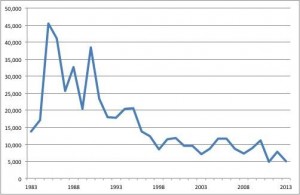
  • This Convention felt small, with just over 5,000 messengers in attendance (Barely up from just over 4,800 last year).  Here’s the breakdown by state, per BP:  Alabama, 258; Alaska, 12; Arizona, 186; Arkansas, 186; California, 112; Colorado, 41; Connecticut, 2; Delaware, 3; Florida, 256; Georgia, 311; Hawaii, 12; Idaho, 8; Illinois, 7; Indiana, 63; Iowa, 7; Kansas, 39; Kentucky, 226; Louisiana, 383; Maine, 1; Maryland, 66; Massachusetts, 3; Michigan, 10; Minnesota, 6; Mississippi, 293; Missouri, 181; Montana, 2; North Carolina, 276; Nevada, 30; New Hampshire, 1; New Jersey, 17; New Mexico, 45; New York, 28; Ohio, 71; Oklahoma, 195; Oregon, 2; Pennsylvania, 17; Puerto Rico 3; South Carolina, 144; South Dakota, 5; Tennessee, 379; Texas, 1,026; Utah, 9; Virginia, 173; Washington, 12; Washington, D.C., 11; West Virginia 15; Wisconsin, 5; Wyoming, 11. There were 24 messengers that were approved through the credentials process but were unaffiliated with a state convention.
  • Want a little perspective on what that means?  Here’s the Annual Meeting attendance over the last 30 years:

BMka90HCYAESSK5.jpg-large

  • We were told numerous times and in numerous ways that SBC churches are in decline.  We are now baptizing at 1948 levels, when the Convention was half its size.  I kept thinking, though, that given the difference between membership rolls and actual attendees in Southern Baptist churches (as evidenced in the disparity in ACP reports) we are, in reality, half our size right now, so maybe 1948 levels is about right for the reality of how big we truly are.
  • A friend emailed me playfully and said (he really was playing, by the way):  “So, you guys hate the Boy Scouts now?”  No doubt that is how this will be portrayed, though the actual discussion on that resolution reflected anything but such a caricature.  In fact, it seems to me that reading the actual resolution might be helpful for everybody, so here it is.  Please note what it does and does not say.

ON THE CHANGE OF MEMBERSHIP POLICY OF THE BOY SCOUTS OF AMERICA

WHEREAS, For more than a century, the Boy Scouts of America (BSA) has been a values-based boys organization designed to “prepare young people for a lifetime of character and leadership,” equipping them “to make ethical and moral choices over their lifetimes by instilling in them the values of the Scout Oath and Law”; and

WHEREAS, The Scout Oath contains language that is consistent with belief in God and biblical precepts that serve as the basis for Christian
faith: “On my honor I will do my best to do my duty to God and my country and to obey the Scout Law; to help other people at all times; to keep myself physically strong, mentally awake, and morally straight”; and

WHEREAS, The leadership of the Boy Scouts throughout its history has restricted from membership and leadership those persons who would affect the group’s ability to advocate its viewpoints in regard to belief in God and His moral precepts; and

WHEREAS, In 1992, and again in 2000, the Southern Baptist Convention adopted resolutions affirming the Boy Scouts in their stand that homosexual conduct is inconsistent with the obligations of the Scout Oath, encouraging the BSA “to maintain its historic commitments” (1992) and “to hold fast to its traditional ideals” (2000); and

WHEREAS, The United States Supreme Court ruled in 2000 that the constitutional right to freedom of association allows a private organization, as part of its “expressive message,” to exclude a person from membership when “the presence of that person affects in a significant way the group’s ability to advocate public or private viewpoints” and that allowing homosexuals as adult leaders would interfere with that message (Boy Scouts of America et al. v. Dale); and

WHEREAS, In 2004, the Boy Scouts adopted a policy statement that said, in part, “Boy Scouts of America believes that homosexual conduct is inconsistent with the obligations in the Scout Oath and Scout Law to be morally straight and clean in thought, word, and deed”; and

WHEREAS, In 2012, an eleven-person committee appointed by the
National Council of the Boy Scouts completed a two-year study and reported its unanimous decision that the Boy Scouts retain the current policy as outlined above; and

WHEREAS, NBC News reported in breaking news on January 28, 2013, that the BSA executive leadership, in concert with certain members of the BSAboard of directors, was poised to change the Scouts’ historic policy at its February 4–5 board meeting the following week to allow avowed homosexuals into membership and leadership positions within the Boy Scouts of America; and

WHEREAS, During the week between when news broke of this proposed policy change and the February board meeting, the Boy Scouts received an outpouring of feedback from Scouts, Scouting families, sponsoring organizations, and the American public; and

WHEREAS, On February 6, 2013, the BSA board determined that, “due to the complexity of this issue, the organization needs time for a deliberate review of its membership policy”; and

WHEREAS, The National Council of the Boy Scouts voted on May 23,
2013, to approve new membership guidelines that state, “no youth may be denied membership in the Boy Scouts of America on the basis of sexual orientation or preference alone”; and

WHEREAS, While those who embrace a biblical worldview are grateful that the leadership policy of the BSA remains unchanged, the executive leadership and certain members of the Boy Scouts board clearly signaled their desire to change both the membership and leadership policies of the BSA; and

WHEREAS, This decision of the BSA is viewed by many homosexual activists as merely the first step in a process that will fundamentally change the BSA, putting the Scouts at odds with a consistent biblical worldview on matters of human sexuality; and

WHEREAS, This decision has the potential to complicate basic understandings of male friendships, needlessly politicize human sexuality, and heighten sexual tensions within the Boy Scouts; and

WHEREAS, Many Southern Baptist churches sponsor Boy Scout troops and many Southern Baptists are involved in Scouting; and

WHEREAS, The Baptist Faith and Message states that “Christians should oppose . . . all forms of sexual immorality, including adultery, homosexuality, and pornography,” and Southern Baptists consistently have expressed their opposition to the normalization of homosexual behavior in American culture through more than a dozen resolutions over the past thirty years; now, therefore, be it

RESOLVED, That the messengers to the Southern Baptist Convention meeting in Houston, Texas, June 11–12, 2013, express our continued opposition to and disappointment in the decision of the Boy Scouts of
America to change its membership policy; and be it further

RESOLVED, That we express our gratitude for the thousands of individuals within the Scouting family and the culture at large who expressed their opposition to the BSA executive leadership’s intent to change its membership and leadership policies in regard to homosexuality, leading to the compromise recommendation it presented to the BSA National
Council; and be it further

RESOLVED, That we express our gratitude to each voting member of the National Council who voted in opposition to the policy change for membership; and be it further

RESOLVED, That we express our well-founded concern that the current executive leadership of the BSA, along with certain board members, may utilize this membership policy change as merely the first step toward future approval of homosexual leaders in the Scouts; and be it further

RESOLVED, That we call on the Boy Scouts to remove from executive and board leadership those individuals who, earlier this year, sought to change both the membership and leadership policy of the Scouts without seeking input from the full range of the Scouting family; and be it further

RESOLVED, That we affirm the right of all families and churches prayerfully to assess their continued relationship with the BSA, expressing our support for those churches and families that as a matter of conscience can no longer be part of the Scouting family; and be it further

RESOLVED, That we encourage churches and families that remain in the Boy Scouts to seek to impact as many boys as possible with the life-changing Gospel of Jesus Christ, to work toward the reversal of this new membership policy, and to advocate against any future change in leadership and membership policy that normalizes sexual conduct opposed to the biblical standard; and be it further

RESOLVED, That we encourage churches that choose to sever ties with the Boy Scouts not to abandon their ministry to boys but consider expanding their Royal Ambassadors ministry, a distinctively Southern
Baptist missions organization to develop godly young men; and be it finally

RESOLVED, That we declare our love in Christ for all young people regardless of their perceived sexual orientation, praying that
God will bring all youth into a saving knowledge of our Lord
Jesus Christ.

  • At the Gospel Project breakfast, I was surprised by my own unease over the fact that nobody on the panel discussing Christ-centered preaching was over 50.  The hermeneutical issues surrounding typology could have used the wisdom of an older scholar.
  • I thought the discussion on the mental health motion was balanced and refreshing, and I was pleased to see the messengers vote down amendments that would, in the words of one messenger, set us on the path to becoming Christian Scientists.
  • I am always struck, at these Conventions, by the fact that mega-church pastors are not used to being told no.
  • There is a way to sound self-important in just the way one presents his or her name at a microphone.
  • President Fred Luter did a good job, and it was great to be present at the historic moment when an African American Baptist moderated an SBC Annual Meeting.
  • A Presbyterian friend of mine who was visiting noted that the exhibit hall was “a bazaar…that was bizarre.”  Touche!
  • Thank the Lord for local church autonomy, that great distinctive that makes some parts of these Annual Meetings bearable.
  • So great to see so many good friends!
  • Again, those looking for a mega-fracas over Calvinism in the Convention were probably really disappointed by this gathering.  It seems that cooler heads are prevailing, and we may thank God for that.  A friend from my former church, after reading the report of the Calvinism advisory committee, emailed and suggested that the bottom line, as he saw it, was “Play nice.”  That’s about right.
  • The Pastor’s Conference this year…meh.
  • Houston is a HOT town.  This was my third trip to Houston, and I knew that, but my it can get muggy there!
  • Finally, a prediction:  if no controversy rears its head between now and next June, the 2014 Annual Meeting in Baltimore will be 4,500 or less.

Matthew 6:1-8

Matthew 6:1-8

1 “Beware of practicing your righteousness before other people in order to be seen by them, for then you will have no reward from your Father who is in heaven. 2 “Thus, when you give to the needy, sound no trumpet before you, as the hypocrites do in the synagogues and in the streets, that they may be praised by others. Truly, I say to you, they have received their reward. 3 But when you give to the needy, do not let your left hand know what your right hand is doing, 4 so that your giving may be in secret. And your Father who sees in secret will reward you. 5 “And when you pray, you must not be like the hypocrites. For they love to stand and pray in the synagogues and at the street corners, that they may be seen by others. Truly, I say to you, they have received their reward. 6 But when you pray, go into your room and shut the door and pray to your Father who is in secret. And your Father who sees in secret will reward you. 7 “And when you pray, do not heap up empty phrases as the Gentiles do, for they think that they will be heard for their many words. 8 Do not be like them, for your Father knows what you need before you ask him.


I will not soon forget one of the more embarrassing moments of my life.  I speak of it now only with a sense of shame.  Some years ago I was in a small village in Honduras with a team of pastors, doctors, dentists, builders, and others.  On one particular day, I was with a group of four or five others in a truck.  We were driving around the area, giving bags of rice and beans to the poor.

We stopped in front of one house.  A little Honduran lady emerged from her little house.  I can close my eyes right now and see that road and that house and that lady.  We introduced ourselves and I handed her a bag of rice and a bag of beans.  One member of the team was shooting video of this so that, after the trip, he could put together a presentation to use as a tool for encouraging others to go on these mission trips.  In truth, I didn’t give much thought to it, though it was a little uncomfortable having all of this caught on camera.

So I gave the lady her rice and beans and, after visiting a moment, we turned to go.  “Wait just a minute,” the cameraman said.  “My camera failed to record.  Let’s do it again.”  And, before I knew what was happening, another member of the team had taken the rice and beans back from the poor, bewildered lady and had given them to me to re-give to her.  I do recall protesting with nervous laughter that this made me very uncomfortable, but I certainly should’ve protested even more.  I was embarrassed for the lady and, in truth, for myself as well.  But I gave her the rice and beans again.  This time it was all caught on tape.  The good deed recorded, we left.

As I gave the lady the rice and beans for a second time, I thought of the words of the Lord Jesus that we are considering this morning.

1 “Beware of practicing your righteousness before other people in order to be seen by them, for then you will have no reward from your Father who is in heaven.

I felt dirtied by what I had done and I told myself I would never again consent to such a deliberate staging of a good deed.  As citizens of the Kingdom of God, as followers of Jesus, we are not to indulge in cheap religious showmanship and posturing.  To do so is to reveal a heart beset by false and ignoble motives.  The entire Sermon on the Mount is about bringing the human heart in line with the truths of the Kingdom of God.  That day, my heart was not in line, and I still cringe at it.

In our text this morning, Jesus is speaking about that vice that John Chrysostom called “the most tyrannical passion of all, the rage and madness with respect to vainglory, which springs up in them that do right.”[1]  Vainglory refers to the selfish manipulation of others through our own posturing with an eye towards receiving their praise.  It is religious showmanship.  It is ostentatious and arrogant showiness that Jesus is speaking against in our text.  The Jews had their ways of doing this.  So do we.

In an 1803 booklet that John Hancock wrote to the Quakers, he complained of the Christian tendency to repeat the errors of the Jews that Jesus was addressing in our text.  After noting that Jesus came to found “a religion of practice, instead of one consisting in exterior shews and ceremonies, as it was then practiced,” Hancock wrote this:

This outward shew of religion has been too generally substituted by many of his professed followers in the place of that which He taught:  so that, comparing what passes with many for the Christian religion, with the former modes, which it appeared to supplant, we can say little more, only that there has been a change of name, and some little diversity in the ceremonies, while the radical principle of an ostentatious, showy religion still remains.[2]

To the extent that this ostentatious, showy religion does indeed still remain (and who can deny that it does?) we really do need to tend again to the warnings of Jesus in this regard.

I. Religious showiness and posturing is a sin. (v.1-2,5)

Let us begin with a basic assertion:  religious showiness and posturing is a sin.

1 “Beware of practicing your righteousness before other people in order to be seen by them, for then you will have no reward from your Father who is in heaven.

Jesus is not condemning righteousness, or practicing your righteousness, or even practicing your righteousness in public per se.  After all, we must live in public and one hopes that Christians are righteous in public.  In fact, we are commanded to live righteous lives in public.  Remember that earlier in chapter 5, Jesus said this:

14 “You are the light of the world. A city set on a hill cannot be hidden. 15 Nor do people light a lamp and put it under a basket, but on a stand, and it gives light to all in the house. 16 In the same way, let your light shine before others, so that they may see your good works and give glory to your Father who is in heaven.

Placed beside each other, these verses and our text this morning present a fascinating idea:  works of righteousness arising naturally from a heart transformed by the indwelling Christ should and must be done before men, for, in that case, the believer isn’t deliberately calculating his actions.  In that case, the believer is simply living outwardly the reality of Christ who dwells within him or her.  This we must do!  In fact, we are wrong to conceal Christ in us.

No, Jesus is not condemning public righteousness.  What He is condemning is practicing your righteousness before other people to be seen by them.  This is a reference to arrogant intent in the practice of righteousness.  This is a reference to doing holy things precisely so that people will see you.  The issue is showing off.  The issue is doing things with the intention of receiving praise.[3]

The phrase, “to be seen,” is a translation of the Greek word theathenai.  Our word “theater” or “theatrical” comes from this.  There were those in Jesus’ day who made a theatrical display of their righteousness.  “Look at me!” they seemed to say.  “Look at how holy I am!”

The result is that the one doing this “will have no reward from your Father who is in heaven.”  “From your Father” is literally translated “beside your Father.”  A.T. Robertson gives it the sense of “standing by [God’s] side, as He looks at it.”[4]  When God looks at the intent behind your righteousness, what does He see?  Purity of heart or the desire for applause?  And how does the idea of standing beside God as He looks at your heart make you feel?

Why do we do what we do?  Jesus offers us an illustration of impure motivation.

2 “Thus, when you give to the needy, sound no trumpet before you, as the hypocrites do in the synagogues and in the streets, that they may be praised by others. Truly, I say to you, they have received their reward.

There is no record of anybody literally blowing trumpets in the synagogues and streets to announce their own righteousness.  This appears to be a figure of speech that Jesus is employing.  However, there were very close parallels to this idea.  Clarence Jordan has passed on an example cited by E.M. Ligon.

It was customary for a Jew who wanted an unusual portion of God’s blessing or forgiveness for some sin, to do penance in the form of almsgiving.  One of the customary ways was to buy a skin of water and give it to the poor.  Water was scarce in Palestine, and usually obtainable only from a water-carrier.  Then the carrier would stand in the street with the giver beside him and sound a trumpet and shout, “O thirsty, come for drink offering.”  The poor who accepted this charity paid for it by good wishes to the giver, such as, “God forgive thy sins, O giver of drink.”  In this way the giver obtained considerable free advertising, and supposedly some forgiveness.[5]

This is an example of religious showmanship, of ostentatious, spiritual arrogance.  We need not blow a literal trumpet to be guilty of this.  The anonymous 5th century commentary on Matthew, the Opus Imperfectum, defines the trumpet as “every act of deed through which boasting about the deed is made known.”[6]  That seems true enough.  We blow our own trumpets whenever we do what we do to be seen by others.  This is hypocrisy, as Jesus put it, because a heart that wants to be seen and complimented by others is not a heart that is truly God’s.

We can do this in the way we give money, the way we serve, the way we talk, and the way we act in church.  We can also do this in the way we pray.

5 “And when you pray, you must not be like the hypocrites. For they love to stand and pray in the synagogues and at the street corners, that they may be seen by others. Truly, I say to you, they have received their reward.

Here again is the charge of hypocrisy:  it is hypocritical to pray as if you are really praying to God when, in reality, you simply want your prayers to be noticed.  There is great danger in long, public prayers.  The danger is that our prayers can become shows in which we try to prove our own righteousness to others.  We want others to say, “My, how spiritual he must be!”  We want others to say, “Did you hear her prayer?  What a great woman of God!”  And so we are tempted to show off when we pray.

The church has often battled with the temptation to pray in a showy manner.  Barclay notes that “in 18th century worship in Scotland length meant devotion.”  He quotes W.D. Maxwell as saying that “the efficacy of prayer was measure by its ardour and its fluency, and not least by its fervid lengthiness.”  Furthermore, a Rabbi Levi said, “Whoever is long in prayer is heard.”  Another saying was, “Whenever the righteous make their prayer long, their prayer is heard.”  Finally, he notes the words of one preacher who described a particularly long and flowery prayer offered in a Boston church as “the most eloquent prayer ever offered to a Boston audience.”  Meaning, of course, that the one praying was doing so for effect and not truly to God.[7]

This, brothers, is a sin.  This, sisters, is a sin.  Religious posturing reveals a heart that has yet to be turned over fully to Jesus Christ.

II. The Christ-saturated heart is content with the secret blessing of God. (3-4,6-8)

What, then, is the answer to these empty acts of religiosity?  The answer, once again, as in every area of the Sermon on the Mount, is to have the human heart so captivated by Jesus Christ that there is no room in it for these selfish desires to be entertained.  Jesus demonstrates this in the examples of almsgiving and prayer.

3 But when you give to the needy, do not let your left hand know what your right hand is doing, 4 so that your giving may be in secret. And your Father who sees in secret will reward you.

This is an amazing figure of speech, apparently invented by Jesus:  “Do not let your left hand know what your right hand is doing, so that your giving may be in secret.”  We are not to do things for the Lord to be seen by others.  Apparently there is a sense in which even we ourselves do not need to dwell long on what we are doing.  And this makes perfect sense.  The more we ponder having our works seen, either by others or by our own selves, the more we will be tempted to perform.  But as we have seen time and again, the Kingdom life which we should model is not a matter of performance.  We should simply act out of the inclinations of hearts that have been redeemed by the Lord.  So give in secret and give before the King.

So, too, with the way we pray.

6 But when you pray, go into your room and shut the door and pray to your Father who is in secret. And your Father who sees in secret will reward you. 7 “And when you pray, do not heap up empty phrases as the Gentiles do, for they think that they will be heard for their many words. 8 Do not be like them, for your Father knows what you need before you ask him.

To pray in secret does not mean that we should not pray publicly.  Indeed, it would be strange for the people of God to gather together in worship and not pray!  Here again, Jesus is less concerned with the literal location of our prayers than He is with the intentions of our hearts when we pray.  Having a secret place to pray is a safeguard against our own pride and desire to be seen and heard.  If you pray in secret it means that you likely are really praying and that the Lord God is truly your only concern.

This should be our great desire in our acts of obedience, charity, and prayer:  to please an audience of one consisting of the Lord God of Heaven and Earth.  In point of fact, it is manifestly silly to want the applause of anybody but God!  That fascinating 4th century saint, John Chrysostom, painted a poignant picture of the absurdity of choosing the applause of men over the applause of God.

And let me add, even were there no penalty, it were not meet for him who desires glory, to let go this our theatre, and take in exchange that of men.  For who is there so wretched, as that when the king was hastening to come and see his achievements, he would let him go, and make up his assembly of spectators of poor men and beggars?  For this cause then, He not only commands to make no display, but even to take pains to be concealed:  it not being at all the same, not to strive for publicity, and to strive for concealment.[8]

Whose approval could ever mean more to us than God’s?  Whose joy could ever be as valuable to us?  Whose “Well done!” should we truly want?

Jesus repeats this phrase twice in our text this morning:  “And your Father who sees in secret will reward you.”  I ask you:  is that not enough?  Is it enough for us to be seen and rewarded by God?

In truth, the motivations behind our actions are wonderfully accurate revealers of our true spiritual condition.  When you do something for another, do you have ways of letting other people know?  When you give a great gift, is it important to you that people be made aware of it?  What reward are you seeking?  Whose approval do you most desire?


[1] John Chrysostom, Homilies on the Gospel of St. Matthew. Nicene and Post-Nicene Fathers. Vol.10. First Series. Ed., Philip Schaff (Peabody, MA: Hendrickson Publishers, 2004), p.130.

[2] John Hancock, Thoughts on the Abuse of Figurative Language as Applied to Religious Subjects. (Belfast: J. Smyth, D. & S. Lyons, 1803), p.45.

[3] “But notice he did not say only ‘before people,’ but added, ‘in order to be seen by them.’  Therefore whoever does not do it to be seen by people, even if he did it before people, nonetheless appears not to have done it before people.  Therefore, if it is not possible to give alms in such a way that nobody sees or perceives it, it is possible to do it with the intention that we are not seen by people…Therefore the alms that are seen by people are not displeasing to God, but only those that have been given in order to be seen by people.” Thomas C. Oden, ed., James Kellerman, trans., Incomplete Commentary on Matthew (Opus imperfectum). vol.1. Ancient Christian Texts. Thomas C. Oden and Gerald L. Bray, eds. (Downers Grove, IL: IVP Academic, 2010), p.113-114.  “Wherefore it is not simply the thing, but the intent, which He both punishes and rewards.” Chrysostom, p.131.

[4] A.T. Robertson, Word Pictures in the New Testament. Vol.I (Nashville, TN: Broadman Press, 1930), p.50.

[5] Clarence Jordan, Sermon on the Mount. (Valley Forge, PA: Judson Press, 1952), p.53.

[6] Oden, ed., p.83-84.

[7] William Barclay, Gospel of Matthew. Vol.1. The Daily Study Bible (Edinburgh: The Saint Andrew Press, 1968), p.194-195,197.

[8] Chrysostom, p.132.

Calvinists, Arminians, and the Southern Baptist Convention: Reflections on the “Calvinism Advisory Committee” Report

I was interested to see that the Calvinism Advisory Committee issued it’s report, “Truth, Trust, and Testimony in a Time of Tension,” here just days before the Southern Baptist Convention Annual Meeting in Houston.  I’m pasting the report in its entirety on my blog (a) because I do not think doing so violates any restrictions and (b) because I assume the committee would like to have as wide a readership as they possibly can.  While my little website boasts no great numbers, it is undeniable that the less clicking folks have to do, the better.  So here it is (and here it is at its original home, SBC Life):


TRUTH, TRUST, and TESTIMONY in a TIME of TENSION

A Statement from the Calvinism Advisory Committee

Southern Baptists are Great Commission people. We are also a doctrinal people, and those doctrinal convictions undergird our Great Commission vision and passion. We are a confessional people, who stand together upon the doctrines most vital to us all, confessed together in The Baptist Faith and Message.

Within this common confession, we sometimes disagree over certain theological issues that should not threaten our Great Commission cooperation. We recognize that significant theological disagreement on such issues has occurred with respect to Calvinism. It is, therefore, our responsibility to come together with open hearts and minds in order to speak truthfully, honestly, and respectfully about these theological and doctrinal issues that concern us, threaten to divide us, and compel us into conversation. Such engagement is appropriate at every level of Southern Baptist life including local congregations, associations, state conventions, and the Southern Baptist Convention.

This spirit of conversation has been the hallmark of the meetings of the Calvinism Advisory Committee. We have spent hours together in fruitful, respectful, and candid conversation. We entered these conversations as brothers and sisters in Christ and as faithful and thankful Southern Baptists. Our purpose was neither to resolve centuries of doctrinal disagreement nor to consume ourselves with doctrinal debate. Our purpose was to suggest a course for moving forward together while taking seriously and representing fairly the theological diversity that exists in and has been the strength of Southern Baptist life.

Four central issues have become clear to us as we have met together. We affirm together that Southern Baptists must stand without apology upon truth; that we do indeed have some challenging but not insurmountable points of tension; that we must work together with trust; and that we must encourage one another to testimony.

TRUTH

The Bible
We affirm that the Holy Scriptures are the inerrant, infallible, and totally trustworthy Word of God and our supreme authority on all matters of truth. We affirm that the Gospel of Jesus Christ is the great theme of all Scripture and that the Bible is sufficient to reveal all we need to know concerning God’s purpose to save sinners.

We deny that any human system of thought or any theological tradition can assume supreme authority or be allowed to supplant dependence upon the Bible and all that it reveals. Neither Calvinism nor non-Calvinism ought to be equated exclusively with sound Southern Baptist doctrine nor be considered inconsistent with it.

The Lostness of Humanity
We affirm that all have sinned and fall short of the glory of God and that the universal condition of humanity is lostness, as every single human being, Jesus alone excepted, is a sinner whose only hope of salvation is the Gospel of Jesus Christ.

We deny that any human being is without need of salvation through faith in Jesus Christ, and we deny any teaching that minimizes the truth about sin and the need of all persons to repent and believe in the Lord Jesus Christ.

The Power of the Gospel
We affirm that our Lord is mighty to save and that He saves to the uttermost. We affirm the power of the Gospel to redeem every single human being through the death, burial, and resurrection of Jesus Christ, whom the Father has now declared to be both Lord and Christ, the Savior of the world.

We deny that the Gospel is without power to save anyone who repents and believes in Jesus Christ. We also deny that the Gospel as revealed in Scripture lacks anything needful for our salvation.

The Offer of the Gospel
We affirm that the Gospel is to be made known freely to all in the good faith offer that if anyone confesses that Jesus Christ is Lord and believes in his heart that God has raised Christ from the dead, he will be saved.

We deny that the Gospel lacks any power to save anyone who believes in Christ and receives Him as Savior and Lord. Anyone who understands the Gospel through the power of the Holy Spirit may, in prayer and petition, trust Christ through repentance and faith, and we should plead with all sinners to do so.

The Exclusivity of the Gospel
We affirm that salvation is found in the name of Christ and in no other name. We affirm that Jesus Christ is the Way, the Truth, and the Life and that no one can come to the Father but by Him. We affirm the exclusivity of the Gospel of Christ as the only message of salvation.

We deny that salvation can come to any sinner by any other gospel, any other system of faith and practice, or by any name other than Jesus Christ.

The Atonement of Jesus Christ
We affirm that the death of Jesus Christ on the cross was both penal and substitutionary and that the atonement He accomplished was sufficient for the sins of the entire world.

We deny that there is anything lacking in the atonement of Christ to provide for the salvation of anyone.

The Reality of Heaven and Hell
We affirm that all who come to Christ by faith will be with Him forever in heaven, which He has prepared for the saints. We affirm that all who reject Christ and do not come to Him by faith will spend eternity in hell, a place of eternal punishment.

We deny that there is any opportunity for salvation after the point of death, when all humanity will face the judgment of God.

The Necessity of Conversion
We affirm that salvation involves the conversion of the sinner, whereby the sinner consciously clings to Christ by faith, repents of sin, believes the promises of the Gospel, and publicly professes faith in Christ. We affirm the necessity of conversion and the truth that conversion involves the will of the believer as well as the will of God.

We deny that salvation comes to anyone who has not experienced conversion. We also deny that salvation comes to any sinner who does not will to believe and receive Christ.

The Great Commission
We affirm the church’s duty to obey Christ by preaching the Gospel to all the nations and by making disciples who obey all that Christ has commanded. We affirm every believer’s responsibility to tell anyone and everyone about Jesus and the responsibility of every congregation to be a sending, going, and giving assembly of believers.

We deny that missions and evangelism can be neglected without denying the power of the Gospel; that any church can be faithful without a missionary urgency; and that any believer can be obedient without telling others about Jesus. We deny that evangelism can exist apart from the call to make disciples. Every sinner should be implored to trust Christ by calling on Him through repentance and faith, and every convert should be discipled toward maturity, commitment to the church, and passion for the lost.

TENSIONS

Although we are committed to these central truths, we recognize that within them there are tensions:

  • God desires for all to come to repentance, yet not all do.
  • Humans are ruined by the Fall, yet required to respond in faith.
  • God is sovereign in salvation, yet individuals are still held responsible for their reception or rejection of the Gospel.
  • Southern Baptist identity has often been connected to Calvinism, yet has often significantly modified it.

These are just a few of the dynamics at work in Southern Baptist faith and practice. While these tensions can be a source of frustration, especially when we are uncharitable toward those with whom we disagree, they have also been a great benefit to us, reminding us that God’s ways are higher than ours, that no systematic construct can ever contain the fullness of Scriptural truth, that it is we and not the Bible who are subject to error, that we should approach the Word with both fidelity to the past and readiness for further reformation, and that it is better to live in the tensions of unanswered questions than to ignore or adjust some part of the whole counsel of God.

With a full recognition of the limitless wisdom of God’s Word and the limited wisdom of ourselves, we urge Southern Baptists to grant one another liberty in those areas within The Baptist Faith and Message where differences in interpretation cause us to disagree. For instance,

  • We agree that God loves everyone and desires to save everyone, but we differ as to why only some are ultimately saved.
  • While we all heartily affirm the article on election in The Baptist Faith and Message (Article V), we differ as to whether the response of faith plays a role in one’s election.
  • We agree that the penal and substitutionary death of Christ was sufficient for the sins of the entire world, but we differ as to whether Jesus actually substituted for the sins of all people or only the elect.
  • We agree that the Gospel should be proclaimed to everyone, but we differ as to whether or how every hearer will be enabled to respond.
  • We agree that everyone has inherited Adam’s hopelessly fallen sin nature, but we differ as to whether we also inherit his guilt.
  • We agree that men and women are sinners, but we differ about the effects of sin on the mind and the will.
  • We recognize the differences among us between those who believe that sin nullifies freedom to respond to the Gospel and those who believe that freedom to respond to the Gospel is marred but not nullified.
  • We agree that God is absolutely sovereign in initiating salvation, uniting the believer to Himself, and preserving the believer to the end, but we differ as to how God expresses His sovereignty with respect to human freedom.
  • We agree that the Holy Spirit working through the Gospel enables sinners to be saved, but we differ as to whether this grace is resistible or irresistible.
  • We agree on the necessity of regeneration that results in God-ordained, Christ-centered, Spirit-empowered obedience from the heart, but differ as to whether faith precedes regeneration or regeneration precedes faith.
  • We agree that most Southern Baptists believe that those who die before they are capable of moral action go to heaven through the grace of God and the atonement of Christ, even as they differ as to why this is so.

These differences should spur us to search the Scriptures more dutifully, to engage in lively interaction for mutual sharpening and collective Gospel effectiveness, and to give thanks that what we hold in common far surpasses that on which we disagree. But these particular differences do not constitute a sufficient basis for division and must not be allowed to hamper the truly crucial cooperative effort of taking the Gospel to a waiting world. Southern Baptists who stand on either side of these issues should celebrate the freedom to hold their views with passion while granting others the freedom to do the same.

TRUST

Cooperation
We affirm that Southern Baptists stand together in a commitment to cooperate in Great Commission ministries. We affirm that, from the very beginning of our denominational life, Calvinists and non­Calvinists have cooperated together. We affirm that these differences should not threaten our eager cooperation in Great Commission ministries.

We deny that the issues now discussed among us should in any way undermine or hamper our work together if we grant one another liberty and extend to one another charity in these differences. Neither those insisting that Calvinism should dominate Southern Baptist identity nor those who call for its elimination should set the course for our life together.

Confession
We affirm that The Baptist Faith and Message, as adopted by the Southern Baptist Convention in 2000, stands as a sufficient and truthful statement of those doctrines most certainly held among us. We affirm that this confession of faith is to serve as the doctrinal basis for our cooperation in Great Commission ministry.

We deny that any human statement stands above Holy Scripture as our authority. We also deny that The Baptist Faith and Message is insufficient as the doctrinal basis for our cooperation. Other Baptist Confessions are not to be lenses through which The Baptist Faith and Message is to be read. The Baptist Faith and Message alone is our expression of common belief.

Friendship
We affirm the responsibility of every Southern Baptist to be a friend to all Southern Baptists, so long as we all stand within The Baptist Faith and Message. We affirm that Southern Baptists must avoid the development of a party spirit amongst us, with friendships and trust extended only to those who are in agreement with us.

We deny that issues related to Calvinism or non-Calvinism should alienate or estrange Southern Baptists from each other. Instead, we will extend to one another the mutual respect befitting the bonds of fellowship that hold us together.

Conversation
We affirm the responsibility of all Southern Baptists to guard our conversation so that we do not speak untruthfully, irresponsibly, harshly, or unkindly to or about any other Southern Baptist. This negativity is especially prevalent in the use of social media, and we encourage the exercise of much greater care in that context.

We deny that our cooperation can be long sustained if our conversation becomes untruthful, uncharitable, or irresponsible.

TESTIMONY

We affirm the responsibility and privilege of every Southern Baptist to advocate his or her doctrinal convictions. We affirm that theology should be honored and privileged in our conversations and cooperation. We also affirm that theological and doctrinal debate can be a sign of great health within a denomination that is devoted to truth and is characterized by trust.

We deny that the main purpose of the Southern Baptist Convention is theological debate. We further deny that theological discussion can be healthy if our primary aim is to win an argument, to triumph in a debate, or to draw every denominational meeting into a conversation over conflicted issues. Of more significance to our life together than any allegiance to Calvinism or non-Calvinism should be our shared identity as Southern Baptists.

Most importantly, we affirm together that our testimony to the world must be the message of the Gospel of Jesus Christ—and that Southern Baptists must stand together in the testimony that, while we were yet sinners, Christ died for us. We stand together to declare that salvation comes to all who call upon the name of the Lord, and that God’s desire is for the salvation of sinners and the reaching of the nations.

MOVING FORWARD

Where do we go from here? We must celebrate the unity we share together in our common Great Commission purpose, while acknowledging and celebrating variety among us. We must clarify the parameters of our cooperation where necessary but stand together without dispute.

We should be thankful that these are the issues Southern Baptists are now discussing, even as liberal denominations are debating the full abdication of biblical morality and allowing the denial of central doctrines. We are, seen in this light, blessed by the discussions that come to Southern Baptists who want to affirm the fullness of the faith, not its reduction.

We should call upon all Southern Baptists to promote the unity we share within The Baptist Faith and Message and, while recognizing that most Southern Baptists will believe and teach more than what that confession contains, we must never believe or teach less.

We should expect all leaders in the Southern Baptist Convention and all entities serving our denomination to affirm, to respect, and to represent all Southern Baptists of good faith and to serve the great unity of our Convention. No entity should be promoting Calvinism or non-Calvinism to the exclusion of the other. Our entities should be places where any Southern Baptist who stands within the boundaries ofThe Baptist Faith and Message should be welcomed and affirmed as they have opportunities to benefit from, participate in, and provide leadership for those entities.

In order to prevent the rising incidence of theological conflict in the churches, we should expect all candidates for ministry positions in the local church to be fully candid and forthcoming about all matters of faith and doctrine, even as we call upon pulpit and staff search committees to be fully candid and forthcoming about their congregation and its expectations.

We must do all within our power to avoid the development of partisan divisions among Southern Baptists.

We must not only acknowledge but celebrate the distinctive contributions made by the multiple streams of our Southern Baptist heritage. These streams include both Charleston and Sandy Creek, the Reformers and many of the advocates of the Radical Reformation, confessional evangelicalism and passionate revivalism. These streams and their tributaries nourish us still.

We must also remember that labels, though often necessary, are often misleading and unfair. They must be used with care and assigned with charity. The use of the words “Calvinist” and “Calvinism” can be both revealing and misleading, since individuals may hold to any number of variants on doctrinal points. Similarly non-Calvinists, who may resist even that designation, will cover an even larger landscape of positions. Labels like these often fail us.

We must stand together in rejecting any form of hyper-Calvinism that denies the mandate to present the offer of the Gospel to all sinners or that denies the necessity of a human response to the Gospel that involves the human will. Similarly, we must reject any form of Arminianism that elevates the human will above the divine will or that denies that those who come to faith in Christ are kept by the power of God. How do we know that these positions are to be excluded from our midst? Each includes beliefs that directly deny what The Baptist Faith and Message expressly affirms.

We must remember that the diversity we celebrate is already honored in the names we revere—theological statesmen such as James P. Boyce and B. H. Carroll, E. Y. Mullins and W. T. Conner; missionary heroes and martyrs such as Lottie Moon and Bill Wallace; scholars such as A. T. Robertson and Robert Baker, educators such as Lee Scarborough and John Sampey; evangelists and preachers like George W. Truett and W. A. Criswell, R. G. Lee and Adrian Rogers; and pastor-theologians like Herschel Hobbs. Where would we be today if we attempted to divide these heroes and heroines of the faith by the issue of Calvinism? We would cut ourselves off from our own heritage.

We must also remember that a rising young generation of Southern Baptists is watching and listening, looking to see if this denomination is going to be a bold movement of churches on mission or merely a debating society.

Beyond them stands a world desperately in need of the Gospel. Will we distract ourselves in an unnecessary debate while the world is perishing in need of the Gospel?

If we stand together in truth, we can trust one another in truth, even as we experience tension. We can talk like brothers and sisters in Christ, and we can work urgently and eagerly together.

We have learned that we can have just this kind of conversation together, and we invite all Southern Baptists to join together in this worthy spirit of conversation. But let us not neglect the task we are assigned. The world desperately needs to hear the promise of the Gospel.

Respectfully submitted,
The Calvinism Advisory Committee


Calvinism Advisory Group Unanimously Affirms its EC Advisory Report

For several years, Southern Baptists have been asking important questions about our identity and our future. At times we have struggled with trying to grasp the breadth of our doctrinal and historical differences, particularly related to matters such as Calvinism. What has been needed is a new consensus that will help point us toward a new sense of cooperation and renewal for the sake of the Gospel. It is our hope thatTruth, Trust, and Testimony in a Time of Tension, while not a perfect statement, will, nevertheless, provide a significant and positive step in that direction. The statement reflects the efforts of many diverse voices who have attempted to speak as one with a sense of convictional civility and Spirit-enabled charity toward and with one another. We pray that these efforts will enable us to serve collaboratively and work faithfully, while offering a joyful and Gospel-focused witness to a lost and needy world.
David S. Dockery, chairman; president, Union University, Jackson, Tennessee

Truth, Trust, and Testimony provides a unified witness across the spectrum of Southern Baptist life that we hold much in common concerning what we believe and how we should live. We do have differences that are significant but they are not so great as to keep us from working side by side and hand in hand to fulfill the Great Commission and reach the nations with the Gospel of Jesus Christ. I believe this statement provides a way forward. It is time to unite behind King Jesus and take up the sword of an inerrant Bible and engage our real enemies of Satan, sin, death, and hell.
Danny Akin, president, Southeastern Baptist Theological Seminary, Wake Forest, North Carolina

I affirm the Calvinism Advisory Committee Statement for four reasons: 1) it strikes a good balance as a consensus statement; 2) it stakes out the ground where we can stand together on the issues; 3) it stipulates some of our key theological differences without being polemical; and 4) it steers a good course for continued future discussion.
David Allen, dean, School of Theology, Southwestern Baptist Theological Seminary, Fort Worth, Texas

Southern Baptists are a doctrinally diverse group who, by God’s grace, agree on the essentials of the faith. As this consensus document affirms, we can no longer afford to allow our doctrinal differences to obscure our substantive and vital areas of agreement. It is my prayer that as we move forward we will do so joyfully acknowledging our unity in Christ and humbly engaging areas of doctrinal disagreements while focusing our energies and passion on spreading the glorious Gospel of our crucified and risen Lord to a lost and dying world.
Tom Ascol, pastor, Grace Baptist Church, Cape Coral, Florida

I am happy to support Christians laboring together for the Gospel. I’ve appreciated the leadership that Frank Page, David Dockery, Eric Hankins, Al Mohler, and others have given on encouraging cooperation for the Gospel in our discussions.
Mark Dever, senior pastor, Capitol Hill Baptist Church, Washington, DC

I affirm this statement, the conversation, and the men and women who participated in this process. May The Lord guide Southern Baptists to pursue biblical truth and the oneness that Jesus prayed for so the world may know Him (John 17:23).
Leo Endel, executive director, Minnesota-Wisconsin Baptist Convention, Rochester, Minnesota

It is an honor to be a member of the Calvinism Advisory Committee and I stand ready and willing to work for the advancement of the Gospel-centered principles outlined in our statement. I fully affirm every aspect of Truth, Trust, and Testimony in a Time of Tension. The statement reflects the kind of biblically informed wisdom needed for such a time as this. May our Lord Jesus Christ be pleased and glorified above all.
Ken Fentress, senior pastor, Montrose Baptist Church, Rockville, Maryland

I am pleased to endorse Truth, Trust, and Testimony in a Time of Tension. It is a very good effort and I trust will contribute to a way forward that honors Jesus Christ. This document is a model of charitable truth-telling among convictional Baptists over issues that have long roiled Bible-believing Christians. May God use this document to move us closer to Christ and closer to one another—to the end that God will be glorified in ever-increasing measure.
Timothy George, dean, Beeson Divinity School of Samford University, Birmingham, Alabama

I am excited and honored to present Southern Baptists with a consensus statement driven by the things we hold so dear: the Word, the Spirit, mission, cooperation, and freedom. I believe it effectively articulates and models the way forward, taking seriously both our theological unity and diversity as a truly positive component of our “one sacred effort.”
Eric Hankins, senior pastor, First Baptist Church, Oxford, Mississippi

I am totally satisfied with the fairness of this document, which does a magnificent job of articulating our shared belief. I wholeheartedly add my full support to this document. I am grateful to each person that has worked so hard to help us speak with Christ-honoring clarity.
Johnny Hunt, pastor, First Baptist Church, Woodstock, Georgia

I am totally supportive of the statement. I believe history teaches us there is room for various shades of thought on this topic. I’m praying we will joyfully coexist and the Gospel will go forth in greater power because of our unity!
David Landrith, senior pastor, Long Hollow Baptist Church, Hendersonville, Tennessee

Prior to our first meeting, I sought input from a variety of lay people as to what they felt our focus should be on an obviously hot topic. Top on the list was an appeal for civility—pleading that we simply learn how to engage the issue of Calvinism respectfully and stop the name calling and rude behavior. I was thrilled that so much of our discussion addressed this problem and bore fruit as our respect grew for one another. Secondly, our appeal for honesty regarding doctrinal convictions on the part of candidates interviewing with churches is, in my mind, the key to solving deep divisions that have arisen in churches that feel betrayed. Churches and ministerial candidates must show integrity in the search process as to who they are and what they believe. I pray Southern Baptists will do three things: stop talking so much about that which they have overheard but not personally studied or verified; actually read our report before judging it; and show up in Houston to witness during Crossover block parties where we demonstrate what we claim to be our priority of pleading with sinners to believe in Christ, confessing to others that “our Lord is mighty to save and that He saves to the uttermost.”
Tammi Ledbetter, homemaker and journalist; member Inglewood Baptist Church, Grand Prairie, Texas

For Christians to work together cooperatively requires broad doctrinal agreement, although not agreement in every point of detail. This statement underlines the broad areas of doctrine upon which the overwhelming majority of us as Southern Baptists agree. It outlines the basis on which we can continue working together cooperatively and constructively for the cause of Christ.
Steve Lemke, provost and director of the Baptist Center for Theology and Ministry, New Orleans Baptist Theological Seminary, New Orleans, Louisiana

As SBC President I want to thank our chief encouraging officer Dr. Frank Page for his efforts in calling together and meeting with the Calvinism Advisory Group. This group had the difficult task of dealing with a subject that many Southern Baptists have very strong opinions about. My personal prayer is that this report will be an example of how believers can come together to impact the Kingdom of God and not personal agendas.
Fred Luter, president of the Southern Baptist Convention; senior pastor, Franklin Avenue Baptist Church, New Orleans, Louisiana

There is little that I will sign in the way of corporate statements. My love for the unity in essentials among Southern Baptists for the purpose of getting the Gospel to every human on earth has wrung my signature on this document from my heart. The most important aspect to me is the provision for honesty and integrity for all. God grant that it be so.
Paige Patterson, president, Southwestern Baptist Theological Seminary, Fort Worth, Texas

This statement speaks volumes about the ability of all Southern Baptists of good faith and good will to work together eagerly and enthusiastically. As the statement affirms, these tensions have been present within the Southern Baptist Convention from the very beginning of our life and work together. We are people who take theology seriously. But we are also people who take seriously our joy and privilege in working together in service to the Great Commission. We also made a bold statement of support for and agreement in The Baptist Faith and Message. We are a confessional people, gladly affirming together the faith once for all delivered to the saints. I am thankful for every member of this task force and for the privilege of working together in this process and on this historic and timely statement.
R. Albert Mohler Jr., president, Southern Baptist Theological Seminary, Louisville, Kentucky

I enthusiastically affirm the statement of our committee. While it candidly acknowledges differences Southern Baptists have, it’s a powerful reminder that we stand together on essential doctrines such as the inerrancy of Scripture, the free offer of salvation through Jesus Christ alone, and the universal sufficiency of Christ’s work on the cross. I’m thankful that the statement encourages all Southern Baptists—wherever we may stand with respect to Calvinism—to be gracious and constructive as we serve the Lord together.
Stephen Rummage, senior pastor, Bell Shoals Baptist Church, Brandon, Florida

I am in full agreement with the Truth, Trust, and Testimony document. It is the product of a very candid yet respectful dialogue regarding theological issues, attitudes, and practices. While it is understandable that each side would prefer stronger support for its views, the fact is that this document establishes fair parameters for understanding and collaboration and is unequivocal regarding its affirmation ofThe Baptist Faith and Message and its commitment to the Great Commission. My prayer is that this document will pave the way for all Southern Baptists to make an even stronger commitment to win North America and the rest of the world for Christ.
Daniel Sanchez, associate dean, professor of missions, and director of the Scarborough Institute of Church Planting & Growth, Southwestern Baptist Theological Seminary, Fort Worth, Texas

I gratefully and gladly affirm this fine statement because it focuses our unity in the Gospel, in our Baptist heritage, in The Baptist Faith and Message, and in the Great Commission of our Lord Jesus Christ.
Jimmy Scroggins, senior pastor, First Baptist Church, West Palm Beach, Florida

I would simply like to say, now that I have had a chance to read the statement, that I find this to be an honest, careful, helpful, and refreshing piece of work.  It does not downplay the real differences between Calvinists and, as it puts it, “non-Calvinists,” but it does point to the unifying core of our faith that should hold us together.

In reality, this statement will be welcomed by the majority of Southern Baptists who dwell somewhere in the theological middle on these contested issues.  For those on the radical extremes of either position, neither this statement nor any other will ever suffice.

Above all, it is to be hoped that this statement may engender a virtue that is strangely absent in theological debate, and, specifically, in this particular theological debate:  humility.  I’ve had my own journey on these issues, as have we all.  My current conclusion is that, at the end of the day, if Jesus Christ does not appear more glorious, and if the gospel does not appear more amazing, and if we in our finite grasps of God’s great truths do not find ourselves more humbled but the vast storehouse of the wisdom of God, then our theology is suspect, to say the least.

It seems to me that Southern Baptists of good will can applaud this effort.

I certainly do.

Exodus 7:1-13

Exodus 7:1-13

1 And the Lord said to Moses, “See, I have made you like God to Pharaoh, and your brother Aaron shall be your prophet. 2 You shall speak all that I command you, and your brother Aaron shall tell Pharaoh to let the people of Israel go out of his land. 3 But I will harden Pharaoh’s heart, and though I multiply my signs and wonders in the land of Egypt, 4 Pharaoh will not listen to you. Then I will lay my hand on Egypt and bring my hosts, my people the children of Israel, out of the land of Egypt by great acts of judgment. 5 The Egyptians shall know that I am the Lord, when I stretch out my hand against Egypt and bring out the people of Israel from among them.” 6 Moses and Aaron did so; they did just as the Lord commanded them. 7 Now Moses was eighty years old, and Aaron eighty-three years old, when they spoke to Pharaoh. 8 Then the Lord said to Moses and Aaron, 9 “When Pharaoh says to you, ‘Prove yourselves by working a miracle,’ then you shall say to Aaron, ‘Take your staff and cast it down before Pharaoh, that it may become a serpent.’” 10 So Moses and Aaron went to Pharaoh and did just as the Lord commanded. Aaron cast down his staff before Pharaoh and his servants, and it became a serpent. 11 Then Pharaoh summoned the wise men and the sorcerers, and they, the magicians of Egypt, also did the same by their secret arts. 12 For each man cast down his staff, and they became serpents. But Aaron’s staff swallowed up their staffs. 13 Still Pharaoh’s heart was hardened, and he would not listen to them, as the Lord had said.


The tension has built to a crescendo.  Moses and Aaron, still stinging from Pharaoh’s cavalier dismissal of their initial efforts to call for Israel’s release as well as from Israel’s fury at the increased misery of their situation after that first effort, dare to believe again that God will indeed do as God promised He would.  Even though they will have to walk a painful path, and even though obedience was not the nice, clean, simple cause-and-effect relationship that they assumed it might be, they dare to believe and will come to see that God is faithful even when obedience isn’t easy.

Their belief and willingness to try again is predicated on a renewed, divine expression of God’s sovereign plan and authority in this difficult situation.

I. God’s Call to Act is God’s Permission to Speak With His Authority. (v.1-5)

The Lord begins this reassertion of His saving plan by saying something very interesting to Moses.

1 And the Lord said to Moses, “See, I have made you like God to Pharaoh, and your brother Aaron shall be your prophet. 2 You shall speak all that I command you, and your brother Aaron shall tell Pharaoh to let the people of Israel go out of his land.

What does this mean, Moses will be “like God to Pharaoh”?  It certainly does not mean that the Lord has somehow deified Moses.  Moses is not God and that is not the intent of the saying.  What it means is that Moses will be God’s representative before Pharaoh.  But it means even more than that.  It means that, as God’s representative, and as Moses speaks the words of God, Moses will indeed speak with the authority of God.  This is why we see the link between “I have made you like God to Pharaoh” in v.1 and “you shall speak all that I command you” in v.2.  That is a vital connection.  Moses will be like God only insofar as He speaks God’s Word.

It is an important truth that Moses and that we need to understand:  when we speak the truth of God we speak with the authority of God.  In an interesting way, there is a kind of parallel between this passage and Jesus’ words in Matthew 18 about the church’s authority to bind and loose:

18 Truly, I say to you, whatever you bind on earth shall be bound in heaven, and whatever you loose on earth shall be loosed in heaven. 19 Again I say to you, if two of you agree on earth about anything they ask, it will be done for them by my Father in heaven. 20 For where two or three are gathered in my name, there am I among them.”

These have sometimes seemed like difficult verses for Protestants to interpret.  How are we to understand them?  To be sure, we do not see any inherent authority within the church to bind and loose, to proclaim either forgiveness or condemnation.  Yet Jesus does position this authority in the church.  But we must understand (against some faulty understandings that seem to grant the church these powers innately) that the church only has the power to bind and loose as it binds and looses in harmony with the reality of God’s own binding and loosing.  In other words, when the church, like Moses, speaks the truth of God to a person, be it a word of forgiveness or condemnation (depending on the other’s posture towards the gospel) it, too, speaks with the authority of God.

It is an amazing and humbling thought.  No doubt it was humbling to Moses and Aaron.  It is also amazing to hear the sovereign certainty of the Lord’s revelation concerning what is about to happen.

3 But I will harden Pharaoh’s heart, and though I multiply my signs and wonders in the land of Egypt, 4 Pharaoh will not listen to you. Then I will lay my hand on Egypt and bring my hosts, my people the children of Israel, out of the land of Egypt by great acts of judgment. 5 The Egyptians shall know that I am the Lord, when I stretch out my hand against Egypt and bring out the people of Israel from among them.”

We have already addressed the issue of God’s hardening of Pharaoh’s heart.  It bears repeating, however, that Exodus speaks of two realities:  Pharaoh’s hardening of his own heart and God’s hardening of Pharaoh’s heart.  Some have suggested that the latter is simply a euphemism for the former, but it seems that more is happening here than just that.  The Lord indeed hardens Pharaoh’s heart.  God is sovereign and can do as He intends for the furtherance of His own glory.  Even so, it cannot be denied that this divine hardening is somehow connected to Pharaoh’s own sin and Pharaoh’s hardening of his own heart.

Regardless of how it is understood, the justice and goodness of God cannot be impugned.  God is just in what He does, and the sinfulness of Pharaoh, like our own sinfulness, deserves divine justice.  It is this fact that makes the grace we receive through Jesus Christ so very amazing indeed.

II. God’s Call to Act Must, Sooner or Later, Be Embraced or Rejected. (v.6-7)

There is a subtle but powerful statement at the beginning of v.6:

6 Moses and Aaron did so; they did just as the Lord commanded them.

“Moses and Aaron did so.”  Despite all of Moses’ protests, despite all of Moses’ fears, despite Moses’ debilitating lack of confidence, he did so.  He did what God called him to do.  Friends, God’s call to act must, sooner or later, be embraced or rejected.  You cannot forever argue with the Lord.  We must either walk in His will or walk away…and, as His children, the choice must be that walk in His will.

Moses also offers an interesting biographical detail about himself and Aaron.

7 Now Moses was eighty years old, and Aaron eighty-three years old, when they spoke to Pharaoh.

This stating of their ages is intentional.  The significance of having an 80 and 83-year-old undertake this arduous task cannot be lessoned or diluted with some appeal to the old ages to which many ancient people lived, for Moses only lived to be 120.  This means that, while 80 at that time admittedly did not directly parallel our 80, it was still a significantly advanced age that was worthy of note.  I agree with A.W. Pink’s observation that this reference to the ages of Moses and Aaron was “brought in here in order to magnify the power and grace of Jehovah.  He was pleased to employ two aged men as His instruments.”[1]

One of the great tragedies of modern American society is the subtle and not-so-subtle way that our culture communicates an almost expected insignificance for the elderly.  Even the retirement culture contains a debilitating idea:  that the retired should content themselves with games and diversions and that the crux of their great contribution to society is finished.  This false notion is also sometimes communicated by churches as well, though nothing could be further from the truth.

It is important that we think biblically about aging and about the contours of life as a whole.  An anonymous person has penned the following charming little tale about the length of man’s days:

God created the mule, and told him:  “You will be a Mule, working constantly from dusk to dawn, carrying heavy loads on your back. You will eat grass and you will lack intelligence. You will live for 50  years.”

The mule answered: “To live like this for 50 years is too much. Please, give me no more than 30.” And it was so.

Then God created the dog, and told him:  “You will hold vigilance over the dwellings of Man, to whom you will be his greatest companion.  You will eat his table scraps and live for 25 years.”

And the dog responded: “Lord, to live 25 years as a dog is too much.  Please, no more than 10 years.”  And it was so.

God then created the monkey, and told him:  “You are a Monkey. You will swing from tree to tree, acting like an idiot. You will be funny, and you shall live for 20 years.”

And the monkey responded: “Lord, to live 20 years as the clown of the world is too much.  Please, Lord, give me no more than 10 years.”  And it was so.

Finally, God created Man and told him:  “You are Man, the only rational being that walks the earth.  You will use your intelligence to have mastery over the creatures of the world.  You will dominate  the earth and live for 20 years.”

And the man responded: “Lord, to be Man for only 20 years is too little. Please, Lord, give me the 20 years the mule refused, the 15 years the dog refused, and the ten years the monkey rejected.” And it was so.

And so God made Man to live 20 years as a man, then marry and live 20 years like a mule working and carrying heavy loads on his back. Then, he is to have children and live 15 years as a dog, guarding his house and eating the leftovers after they empty the pantry; then, in his old age, to live 10 years as a monkey, acting like a fool to amuse his grandchildren.

And it was so.

Well, that’s humorous in its way, and it causes us to chuckle, but it should also cause us to shudder.  Surely the Lord God did not intend for us to end our days as a monkey, amusing and acting clownish before our grandchildren.  But our culture almost expects such nonsense.  Neither are you a mule, a dog, or a monkey.  You are a child of the living God and you have work to do for the Kingdom!

Brothers and sisters, it is never to late to be of service to your King!  It is never too late to try to accomplish great things for the Kingdom!  Paul Dekar has pointed to the example Louis Lyautey as encouragement not to quit attempting great things because of old age.

Having retired to a farm, [Louis Hubert Lyautey] was into his eighties when he approached his gardener about planting an orchard.  “But,” protested the gardener, “the trees will not bear fruit for twenty years.”  Lyautey responded, “Then we must begin planting at once.”[2]

We should die in the midst of attempting great things for God.  Moses was 80.  Aaron was 83.  What are you attempting for your King?  Have you embraced a mission that will transcend your earthly years?  We must, or we are not attempting enough for the Lord!

III. The Path of Obedience is Surrounded by Opposing Powers, but None as Strong as the Power of God. (v.8-13)

So Moses and Aaron act, and, in doing so, they face great opposition.

8 Then the Lord said to Moses and Aaron, 9 “When Pharaoh says to you, ‘Prove yourselves by working a miracle,’ then you shall say to Aaron, ‘Take your staff and cast it down before Pharaoh, that it may become a serpent.’” 10 So Moses and Aaron went to Pharaoh and did just as the Lord commanded. Aaron cast down his staff before Pharaoh and his servants, and it became a serpent. 11 Then Pharaoh summoned the wise men and the sorcerers, and they, the magicians of Egypt, also did the same by their secret arts. 12 For each man cast down his staff, and they became serpents. But Aaron’s staff swallowed up their staffs. 13 Still Pharaoh’s heart was hardened, and he would not listen to them, as the Lord had said.

This episode has led to no small degree of comment.  The miraculous transformation of Aaron’s staff into a snake is less difficult than the magical transformation of the Egyptian magicians’ staffs.  Some try to explain their magic away on rationalistic grounds, suggesting that this was a mere parlor trick or illusion.  I have read a fascinating theory that there is a way to paralyze a cobra, making it go rigid like a staff, then to revive it again.  Apparently you can see this trick performed in Egypt to this very day.  It has been suggested that this is what is happening here and that there is no real power being demonstrated.

Personally, I disagree with this.  For one thing, there is nothing in the way this is written to suggest that the magicians of Egypt were practicing some mere slight of hand.  On the contrary, it sounds as if actual power is being demonstrated here.  But how can this be?  It can be because, though limited and always existing only insofar as God allows it, the devil does indeed have power.  This is why we are warned to avoid occultic practices, because there really are diabolical powers at work.

What we see in the conflict between Moses and Pharaoh is, in reality, a microcosm of the great conflict between the Lord God and Satan.  The magicians are reflecting the devil’s power.  But what is truly noteworthy is the fact that though Moses and Aaron face these hostile powers, they are nonetheless inferior powers that they face.  The power of Satan is no match for the power of God.  Thus, the Lord’s serpent eats the magicians’ serpents.

The magicians do have a kind of power, but it is merely a mimicking power posturing to convince Moses and Aaron that they were more powerful than they really were.  Interestingly, Paul gives us the names of the two magicians who opposed Moses and Aaron in 2 Timothy 3, and he does so to make a particular point.

1 But understand this, that in the last days there will come times of difficulty. 2 For people will be lovers of self, lovers of money, proud, arrogant, abusive, disobedient to their parents, ungrateful, unholy, 3 heartless, unappeasable, slanderous, without self-control, brutal, not loving good, 4 treacherous, reckless, swollen with conceit, lovers of pleasure rather than lovers of God, 5 having the appearance of godliness, but denying its power. Avoid such people. 6 For among them are those who creep into households and capture weak women, burdened with sins and led astray by various passions, 7 always learning and never able to arrive at a knowledge of the truth. 8 Just as Jannes and Jambres opposed Moses, so these men also oppose the truth, men corrupted in mind and disqualified regarding the faith. 9 But they will not get very far, for their folly will be plain to all, as was that of those two men.

Paul uses the example of the Egyptian magicians, Jannes and Jambres, to speak of people who pose as authentic believers but who really are not.  These are people who have a type of power, but not the genuine power of God.  He is warning that people like this will come into the church, pretending, like the magicians, to be more than they are.  In commenting on this passage, Charles Henry Mackintosh made this observation:

There is nothing which so tends to deaden the power of the truth as the fact that persons who are not under its influences at all do the self-same things as those who are.  This is Satan’s agency just now.  He seeks to have all regarded as Christians.[3]

There have always been people like Jannes and Jambres.  They can impress with their tricks, convincing the gullible that they have real power, but they are not of God.  Even so, these magicians do have limited power, though it fails to match the true power of God.  “But Aaron’s staff,” we are told, “swallowed up their staffs.”  This is a powerful moment, this devouring of Pharaoh’s serpents.  It is a statement of the superiority of God, but probably in more ways than we realize.

Philip Ryken has offered some interesting insights into the Egyptians’ fascination with snakes.

            The Egyptians were fascinated with snakes, partly because they were so afraid of them.  Many of them carried amulets to protect them from Apophis, the serpent-god who personified evil.  Egyptian literature contains various spells and incantations to afford protection from snakebite.  It was this fear of snakes that led Pharaoh to use the serpent as the symbol of his royal authority.  His ceremonial headdress – like the famous death mask of Tutankhamen – was crested with a fierce female cobra.  The idea was that Pharaoh would terrorize his enemies the way a cobra strikes fear into her prey.  This is how a relief at Karnak describes one of Shoshenk’s victories in battle:  “Thy war-mace, it struck down thy foes…thy serpent crest was mighty among them.”

            Despite their fear of snakes, the ancient Egyptians nevertheless were drawn to worship them.  This is how Satan generally operates, using fear to gain power.  Serpent worship was particularly strong in the Nile Delta, where the Hebrews lived.  There the Egyptians built a temple in honor of the snake-goddess Wadjet, who was represented by the hieroglyphic sign of the cobra.  Some of the Pharaohs believed that she had brought them to the throne and invested them with her divine powers.  Others considered her to be their protector.  In an inscription found at Tanis, Pharaoh Taharqa claimed, “I had taken the diadems of Re, and I had assumed the double serpent-crest…as the protection of my limbs.”  According to another ancient text, “His gods are over him; His uraeus-serpents are over his head.”  After surveying this and other evidence, John Currid concludes, “the serpent-crested diadem of Pharaoh symbolized all the power, sovereignty, and magic with which the gods endued the king.”

            By finding his security in the serpent-god, Pharaoh was actually making an alliance with Satan.  The ancient manuscripts are explicit about this.  When Pharaoh first ascended the throne of Egypt, he would take the royal crown and say,

O Great One, O Magician, O Fiery Snake!

Let there be terror of me like the terror of thee.

Let there be fear of me like the fear of thee.

Let there be awe of me like the awe of thee.

Let me rule, a leader of the living.

Let me be powerful, a leader of spirits.[4]

This helps us see what exactly the Lord is saying to Pharaoh, as well as the fascinating way in which He chooses to say it.  The Egyptians feared and worshipped the serpent.  It was the symbol of Pharaoh’s power and his kingdom.  Thus, the transformation of the staff into a serpent and, even more so, the single serpent of God eating the serpents of Pharaoh, was a provocative act filled with symbolic importance.  It was a blatant statement to Pharaoh that the source of his strength and the source of his power, as he and the Egyptians’ perceived it, was nothing to God.  These serpents before whom Egypt trembled and worshipped were mere puppets in the hand of the one true God.

What we see in all of this background, and in God’s dramatic statement to Pharaoh through the obedience of His servants, Moses and Aaron, is simply an Old Testament demonstration of the beautiful truth communicated by John in 1 John 4:4, “Little children, you are from God and have overcome them, for he who is in you is greater than he who is in the world.”

Yes, obey the Lord in a fallen culture and you will face the spiritual opposition of the devil.  But be encouraged!  The powers of darkness do not match the powers of light.  The power of the devil does not compare to the power of God.  He is not an equal opposite.  He is but a creation whose time draws near.  He has the power to frustrate us, to be sure, but he cannot overcome the Jesus to whom we have pledged allegiance and who dwells within us.

Take courage!  The staff of a living God is mightier than the staff of the devil.  There is no comparison.  We can therefore obey in the steady confidence that our God is indeed God!  Our God reigns.  He has never been defeated.  He never will be.

May we, like Moses and Aaron, stand in the halls and arenas of this fallen world order and announce the liberation we have through Jesus Christ, knowing in doing so that we speak God’s truth with God’s blessing and authority.

He is for us.

Who could be against us?


[1] A.W. Pink, Gleanings in Exodus. (Chicago, IL: Moody Publishers, 1981), p.56.

[2] Paul R. Dekar, Community of the Transfiguration. (Eugene, OR: Cascade Books, 2008), p.122.

[3] Charles Henry Mackintosh, Notes on the Book of Exodus. (New York, NY: Loizeaux Brothers, 1862), p.104.

[4] Philip Graham Ryken, Exodus. (Wheaton, IL: Crossway Books, 2005), p.206-207.


Matthew 5:38-48

Matthew 5:38-48

38 “You have heard that it was said, ‘An eye for an eye and a tooth for a tooth.’ 39 But I say to you, Do not resist the one who is evil. But if anyone slaps you on the right cheek, turn to him the other also. 40 And if anyone would sue you and take your tunic, let him have your cloak as well. 41 And if anyone forces you to go one mile, go with him two miles. 42 Give to the one who begs from you, and do not refuse the one who would borrow from you. 43 “You have heard that it was said, ‘You shall love your neighbor and hate your enemy.’ 44 But I say to you, Love your enemies and pray for those who persecute you, 45 so that you may be sons of your Father who is in heaven. For he makes his sun rise on the evil and on the good, and sends rain on the just and on the unjust. 46 For if you love those who love you, what reward do you have? Do not even the tax collectors do the same? 47 And if you greet only your brothers, what more are you doing than others? Do not even the Gentiles do the same? 48 You therefore must be perfect, as your heavenly Father is perfect.


A few years ago there was a full-page advertisement in the Chicago Sun-Times promoting Steve Munsey’s “Jesus of Nazareth” at the Family Christian Center in Muncie, Indiana.  The advertisement announced a “Revised Script,” “Waterfalls,” “1000 Cast Members,” and “Camels, Horses, Sheep.” It also contained this tagline:  “Discover how God can heal you, extend your life, and destroy your enemies!”[1]

Well!  I don’t really remember that part of the Christmas story, but who doesn’t like the thought of seeing their enemies destroyed?  The late Christian musician, Rich Mullins, used to say, jokingly, “I know, “‘Vengeance is mine,’ saith the Lord,’” but I just want to be about the Father’s business”[2]  Indeed!

We laugh, but not in ignorance.  In truth, we laugh because we get the punch line perfectly well.  It is in our DNA to want to see those who hurt us hurt, to want to see our enemies destroyed.  Vengeance and retaliation are received into us with mother’s milk.  Nobody has to be taught to strike back, to return hurt for hurt.  “An eye for an eye and a tooth for a tooth” may be one of the more instinctive impulses in the life of fallen humanity.

But therein lies the problem:  the instinctive impulse to retaliate is part of the fallen world order.  As we have seen and as we have said time and again, the Sermon on the Mount is presenting an alternative ethic and an alternative way of life:  the Kingdom of God life.  In this sermon, Jesus is highlighting the disastrous consequences of life lived by innate impulse.  He has shown us that the impulse to lust is actually adultery, the impulse to insult is actually murder, the impulse to treat our marriages as disposable is actually a very destructive impulse, and the impulse to distort language so as to cover our own hides is a blasphemous distortion.  So He has enjoined us to a new way of living life and, indeed, a new way of looking at life.

And, again, as we have also said, He has done so because, in Christ, we really are citizens of the Kingdom of God.  Our residency is not our citizenship.  This is something we must understand.  We are in the world but not of it.  So the privilege and challenge of the Christian is to learn the language of the Kingdom of God so we may speak it here and to learn the life of the Kingdom of God so we may live it here.  This will mean warring against our impulses and natural proclivities, taming our world-tainted hearts, and fighting against our need to justify ourselves, to preserve ourselves, and to reward ourselves.

This is especially the case in the area of retaliation.  In our text this morning, Jesus is going to show us that Kingdom citizens, followers of Jesus, need not respond to personal wrongs as if those wrongs are reality-defining events for us.  This is because, as Christians, we should view everything that happens to us through the lens of our life in the Kingdom of God.  We do not possess the right or privilege of acting as if this fallen world is all there is…and we may thank  God for it.

What this means for personal retaliation is most important, and, in my opinion, has been summed up well by Dallas Willard.

…[W]hen we are personally injured our world does not suddenly become our injury.  We have a larger view of our life and our place in God’s world.  We see God; we see ourselves in his hands.  And we see our injurer as more than that one who was imposed on us or hurt us.  We recognize his humanity, his pitiful limitations (shared with us), and we also see him under God.  This vision, and the grace that comes with it, enables the prayer:  “Father forgive them, for they do not really understand what they are doing.”  And in fact they don’t, as Jesus well knew when he prayed this prayer over his murderers.[3]

Yes, the only way that these words of Jesus will make sense to us is if we understand that He is speaking to us from a different perspective, the perspective of the Kingdom of God, a perspective that simply must become our own if we are to be disciples and followers of Jesus Christ.

Listen again to our text:

38 “You have heard that it was said, ‘An eye for an eye and a tooth for a tooth.’ 39 But I say to you, Do not resist the one who is evil. But if anyone slaps you on the right cheek, turn to him the other also. 40 And if anyone would sue you and take your tunic, let him have your cloak as well. 41 And if anyone forces you to go one mile, go with him two miles. 42 Give to the one who begs from you, and do not refuse the one who would borrow from you. 43 “You have heard that it was said, ‘You shall love your neighbor and hate your enemy.’ 44 But I say to you, Love your enemies and pray for those who persecute you, 45 so that you may be sons of your Father who is in heaven. For he makes his sun rise on the evil and on the good, and sends rain on the just and on the unjust. 46 For if you love those who love you, what reward do you have? Do not even the tax collectors do the same? 47 And if you greet only your brothers, what more are you doing than others? Do not even the Gentiles do the same? 48 You therefore must be perfect, as your heavenly Father is perfect.

When we listen to these strange words, what we are hearing is the Lord Jesus’ blueprint for subversive Kingdom behavior.  That is, we are hearing how to live so as not to become tainted by the world and so as not to allow the world to live its own delusions at it observes the alternative Kingdom evident in our own lives.  These delusions that govern the world (and this is critical!) cannot be defeated on their own terms.  Evil is not defeated by evil.  Rather, it is undermined and defeated ultimately by the subversive, undermining behaviors of the Kingdom of God that, while difficult, demonstrate the absurdity of this upside down world and call all people to a higher life.

I. The Subversive Act of Non-Retaliation. (v.38-42)

First, Jesus calls us to the subversive act of non-retaliation.  Clarence Jordan has pointed out that there have been and are four approaches to retaliation:  unlimited retaliation, limited retaliation, limited love, and unlimited love.[4]  Unlimited retaliation refers to causing greater harm to the one who has harmed you than the one who has harmed you has caused you.  The idea of unlimited retaliation might be summed up in Jimmy Malone’s words to Elliot Ness in the movie “The Untouchables.”

Malone: You wanna know how to get Capone? They pull a knife, you pull a gun. He sends one of yours to the hospital, you send one of his to the morgue. That’s the Chicago way! And that’s how you get Capone. Now do you want to do that? Are you ready to do that? I’m offering you a deal. Do you want this deal?

Ness: I have sworn to capture this man with all legal powers at my disposal and I will do so.

Malone: Well, the Lord hates a coward.

That’s unlimited retaliation.  Hurt them more than they hurt you.  Slightly better than this is limited retaliation.  We can see this in the ancient lex talionis which Jesus quotes in v.38:  “You have heard that it was said, ‘An eye for an eye and a tooth for a tooth.’”  That’s lex talionis, the law of retaliation, and it means that your response to a wrong suffered should be equal to that wrong.  In this approach, you don’t hurt the person who has hurt you more than they have hurt you, but you do hurt them as much.  It is quid pro quo justice at its finest.

In v.43, Jesus also quotes a statement summing up what Clarence Jordan called limited love:  “You have heard that it was said, ‘You shall love your neighbor and hate your enemy.’”  Do you see?  That’s limited love.  “I will love my family members, neighbors, and friends, but not my enemies.”  On that basis, you can retaliate against your enemies but show greater understanding to your friends.

But what Jesus is arguing for in our text is unlimited love.

38 “You have heard that it was said, ‘An eye for an eye and a tooth for a tooth.’ 39 But I say to you, Do not resist the one who is evil. But if anyone slaps you on the right cheek, turn to him the other also. 40 And if anyone would sue you and take your tunic, let him have your cloak as well. 41 And if anyone forces you to go one mile, go with him two miles. 42 Give to the one who begs from you, and do not refuse the one who would borrow from you.

To be sure, this is a very difficult calling.  It is made even more difficult when we realize what Jesus is actually asking us to do.

Charles Quarles notes that, since most first-century Jews were right-handed, a slap to a person’s right check would necessarily be a back-handed slap.  He points to rabbinic teaching demonstrating the Jews acknowledgment of the double-insult involved in a back-handed slap.  Because of that, the Rabbis declared that a back-handed slap deserved a double-fine.

If he slapped him he must pay him 200 zuz.  If he struck him with the back of his hand he must pay him 400 zuz.  If he tore his ear, plucked his hair, spat and his spittle touched him, or pulled his cloak from him, or loosed a woman’s hair in the street, he must pay 400 zuz.[5]

What Jesus is saying, then, is that citizens of the Kingdom of Heaven should not respond to personal insult with personal insult.  Let me quickly address an initial question that many Christians have about this passage and one that has given rise to various positions within the church:  namely, does this teaching meaning that there are never situations to oppose violence, even with violence?

In fact, there are very good reasons for seeing this teaching as a personal injunction.  It involves you, personally, and how you react to personal wrongs.  Nations and communities must, unfortunately, have armed forces and police forces in this fallen world of ours.  While this is an interesting subject about which much could be said, let me simply point out that the Lord Jesus never condemned military service per se, even though he had ample opportunity to.  The New Testament, in fact, upholds the rights of governments and courts to exercise just authority before God (Romans 13:1-7).  The question of what constitutes “just authority” is perhaps another question for another day, but let us note that the Lord God does not appear to apply this personal ethic to larger entities, though, obviously, nations and governments may sin as well and they should indeed consider the ethics of the Sermon on the Mount.

Furthermore, the New Testament certainly upholds the responsibility of parents to love and care for their children and for the people of God to love and care for the weak, the poor, and the oppressed.  Turning the other church cannot biblically be a blanket injunction for us passively to turn the cheek of others who should be under our protection.  To stand idly by while others are abused, injured, and killed under the guise of “turning the other cheek” is not to honor God.

Finally, it has been noted that the life of Jesus is the ultimate commentary on the Sermon on the Mount.  In that vein, it is interesting to note that Jesus did not allow Himself to be killed before His time had come (Luke 4:30).  Similarly, Paul protested unjust treatment by appealing to his Roman citizenship (Acts 22:25).  Turning the other cheek when slapped is not necessarily passive acceptance of lethal action.  The believer is being insulted, not murdered.  To read this as a blanket prohibition against protecting yourself is a mistake and is unwarranted in light of the whole witness of Scripture.  Jesus is not forbidding protection of oneself.  He is forbidding a spirit of retaliation, evil for evil.  Even here, however, it must be noted that there may indeed come times, and, in Christian history, there have often been times, when believers were given the high honor of martyrdom.  So this teaching also should not be read to mean that the believer must always preserve his life.  If the Spirit makes it clear that a follower of Jesus is being called to lay down his or her life for his King, he or she should embrace this, but this is not the same as saying that followers of Jesus must never protect themselves or others.

None of these examples are intended to argue against Jesus’ teachings.  Instead, they are intended to help us understand what, in fact, Jesus is teaching.  He is not establishing a simplistic, wooden law.  Again, we must not reduce the Sermon on the Mount to a checklist for righteousness.  Instead, He is demonstrating how citizens of the Kingdom of God live.  And, in this case, He is showing us that, unless other action is required by other Kingdom values, our greatest victory in the face of personal injury is not retaliation but the subversive act of non-retaliation in demonstration of the fact that the injurer has no real power over us, the people of God.

Even given the qualifications I mentioned above, this remains a very difficult word.  And, frankly, it is a word that some in the church have flatly rejected.  For instance, some years ago Philip Yancey expressed genuine and legitimate concern about one prominent Christian’s rejection of Jesus’ teaching:

I grow alarmed when I hear the National Secretary for the Moral Majority praying for the death of his opponents, and saying, “We’re tired of turning the other cheek…good heavens, that’s all that we have done.”[6]

Even more blatant are the words of Christian Reconstructionist Gary North.

“…turning the other cheek is a bribe.  It is a valid form of action for only so long as the Christian is impotent politically or militarily.  By turning the other cheek, the Christian provides the evil coercer with more peace and less temporal danger than he deserves.  By any economic definition, such an act involves a gift:  it is an extra bonus to the coercing individual that is given only in respect of his power.  Remove his power, and the battered Christian should either bust him in the chops or haul him before the magistrate, and possibly both.”[7]

What we see in these two examples is not merely a rejection of the teachings of Jesus.  They are, in fact, capitulations to the spirit of the age and the ways of the fallen world order.  They are a rejection of the life to which we have been called as citizens of the Kingdom.

Jesus says that we live out our subversive practices by turning the other church when struck, by giving more than a person who sues us is asking, and by voluntarily carrying a forced load two miles instead of one.  This last example alludes to “the Roman law of impressment,” a law stating that a Roman soldier could legally require somebody to carry a burden for one mile.  Michael Card sees this law reflected in the soldier’s demand that Simon of Cyrene carry the cross of Jesus.[8]

The great questions, of course, are “Why?” and “What on earth does it prove?”  In fact, it proves a great deal on earth!  What does non-retaliation accomplish?  Consider:

  • It short-circuits the inherently escalating cycle of violence that continues if we return violence with violence.
  • It demonstrates to the one who has hurt us that their injury is not the sum total or even the core of our existence, that life, for us, is more than our life.
  • It sometimes disarms the wrongdoer.
  • It sometimes shames the wrongdoer into repentance.
  • It leaves open the possibility of winning the wrongdoer to Christ when we suffer before the wrongdoer like Christ.
  • It demonstrates, in dramatic ways, the posture of Jesus before His accusers at the crucifixion.

Yes, it does indeed accomplish many things.  On the other hand, the value of non-retaliation must not be judged by what it accomplishes.  On the face of it, in the world’s terms, it is an absurd thing to do.  No, the value of it lies in the fact that our King has called us to this life and that this life marks the reality of the Kingdom of God.  Even so, it can have powerful results.

I once heard Andy Stanley talk about the tumultuous first years of his father Charles Stanley’s pastorate at First Baptist Atlanta.  Dr. Stanley had much opposition in those years and a great deal of it seemed to concentrate in the person of one particular man in the church.  Andy Stanley, a boy at the time, says he will never forget in one particularly rancorous business meeting that this powerful layman confronted his father in the pulpit, on the platform, in front of the entire church.  There on that stage the man slapped Charles Stanley in the face.  What impacted Andy and the rest of the church the most was what Charles Stanley did in return:  nothing.  He did nothing.  He just received the man’s blow without retaliation.

Now what made that right?  It was right because he was obeying Jesus.  And what did it accomplish?  Well, it effectively ended the major opposition he had from that party, for they were ashamed of their behavior, and it rallied the core of the church to Stanley.  Why?  Because, in that instance, Stanley modeled the values of the Kingdom of God and this other man modeled the values of the fallen world.  Furthermore, it forever impacted his son, who to this day mentions that episode as a crucial moment in his own life.  What a wonderful lesson Charles Stanley taught his son and his church.

I think as well of Mother Theresa, who once visited a wealthy businessman in India to ask for money for an orphanage.  As she held out her hand, the man contemptuously spat into it.  She looked at her hand, closed it into a fist and said, “That is for me.  Now, how about something for my children?”  And then she held out her other hand.

I think of Calvin Miller, who told me once how, as a pastor in Omaha, Nebraska, he was visiting the home of a man who was living a godless life and was setting a terrible example for his children.  Dr. Miller told me that he confronted the man, standing there in his living room, and told the man that he would answer to God for the destructive example he was setting for his children.  The next thing he knew, he was lying on his back looking at that man’s ceiling.  When he sat up, he could feel the blood in his beard.  The man had struck him in anger.  Miller’s response?  Nothing.  He simply and calmly left.

Why was that valuable?  It was valuable because Jesus suffered and, in that moment, Calvin Miller was drawn into the sufferings of Christ.  He was suffering for telling the Kingdom truth.  And what was the result?  In this case, the result was that the man was shamed into conviction by Dr. Miller’s non-retaliation.  He came under conviction, gave his life to Christ, and became a stalwart member of that church.

Do you see?  Do you see how non-retaliation is actually a powerful, prophetic act through which God can accomplish great things?

I ask you:  are you the type of person who has to get revenge?  Are you the type of person who must be right?  Are you the type of person who practices an eye for an eye?

If so, how is that working out for you?  Is the path of vengeance nurturing your soul?  Is retaliation helping you to become more like Jesus?  I assure you it is not.

The refusal to retaliate is the first, great subversive act when you have been wronged.

II. The Subversive Act of Praying for Our Enemies (v.43,44b)

There is another:  praying for our enemies.

43 “You have heard that it was said, ‘You shall love your neighbor and hate your enemy.’ 44b But I say to you…pray for those who persecute you

The natural desire is to love our friends and hate our enemies.  It is hard to overstate how engrained within us this innate sense of justice is.  We essentially excuse our hatred of our enemies on the basis that we show love to others.  Way may rightly hate some, we tell ourselves, because we don’t hate all.

Jesus presents another way:  “pray for those who persecute you.”  We must pray for those who hate us and wish us wrong.  Again, given what has been said before, there may be situations in which prayer for them also includes stopping them.  Or it may mean praying for them while laying down our lives.  Let us remember that this is precisely what Jesus did on the cross:  “Father, forgive them, for they know not what they do” (Luke 23:34).  Jesus prayed for those who were taking His life.

To pray for your enemies is to undermine your own ability to hate them and to open your heart to desire their greater good:  their salvation.  To pray for your enemies is to beseech that the Spirit will soften and change their hearts, a hope you cannot partake in when you have filled your heart with hate.  To pray for your enemies is to fight against the degeneration of your own soul by refusing to allow vengeance to define who you are.

This is not an arbitrary law Jesus is giving us.  It is, like all the other aspects of the Sermon on the Mount, a simple description of what people whose hearts have been filled with the peace and joy of Christ live like.  We must become the type of people for whom the thought of praying for our enemies is natural.  To this end, the following Orthodox prayer for enemies might be helpful:

Lord Jesus Christ, Who didst command us to love our enemies, and those who defame and injure us, and to pray for them and forgive them; Who Thyself didst pray for Thine enemies, who crucified thee: grant us, we pray, the spirit of Christian reconciliation and meekness, that we may heartily forgive every injury and be reconciled with our enemies. Grant us to overcome the malevolence and offences of people with Christian meekness and true love of our neighbor. We further beseech Thee, O Lord, to grant to our enemies true peace and forgiveness of sins; and do not allow them to leave this life without true faith and sincere conversion. And help us repay evil with goodness, and to remain safe from the temptations of the devil and from all the perils which threaten us, in the form of visible and invisible enemies. Amen.

III. The Subversive Act of Loving Our Enemies (v.43-48)

Above these specific acts of subversion (non-retaliation and prayer) is the subversive act of love.  The call to love our enemies is a foundational call.  It makes all other redemptive actions towards our enemies possible.  Listen:

43 “You have heard that it was said, ‘You shall love your neighbor and hate your enemy.’ 44 But I say to you, Love your enemies and pray for those who persecute you, 45 so that you may be sons of your Father who is in heaven. For he makes his sun rise on the evil and on the good, and sends rain on the just and on the unjust. 46 For if you love those who love you, what reward do you have? Do not even the tax collectors do the same? 47 And if you greet only your brothers, what more are you doing than others? Do not even the Gentiles do the same? 48 You therefore must be perfect, as your heavenly Father is perfect.

“Love your enemies.”

Here is where we see and feel the disconnect between our hearts as we known them naturally and our hearts as God intends them to be.  It is a stunning thought.  It is, from our perspective, almost impossible.

How are we to do this?  How are we to love our enemies?

The answer, I believe, is found in understanding the deceitful assumption we have perhaps all felt when considering these words:  the assumption that, in Jesus’ scenario here, we are the wronged party and somebody else is the enemy.  Of course, in a sense, this is the wooden meaning of the words.  Jesus is, in fact, teaching us to love our enemies.  But we deceive ourselves if we do not see in Scripture that there is another truth at work here as well.  Undergirding this teaching is the unnerving but undeniable fact that, oftentimes, we are the enemy that needs to be forgiven.  Most of all, the grand truth that makes this idea conceivable is this startling fact:  we are the enemies of God against whom He has not retaliated and for whom He has prayed and whom He loves.

How can we love our enemies?  By realizing that we are the enemies who have been loved.  S.M. Hutchens put it beautifully when he wrote this:

I chuckle when I think of all the preachers I have heard trying to help us squirm out from under what we find [in these verses]. It is ironic while they are trying to relieve us of the burden of taking these admonitions literally, the only thing that keeps us from being put into hell this very minute is that God himself takes them exactly as they read.

Things become clearer if we can manage to stop thinking of the commands to turn the other cheek, and so forth, in fear of the advantage bad or pathologically dependent people would take of us if we did, and instead place ourselves where we belong in the scenario. We, you see, are the enemies, from whom he could extract eyes, teeth and everything else, and yet doesn’t. We are the ones who have demanded his coat, and received his cloak a well. We are the ones who beg from him, and who are not refused; we are the ones who ask him to go a mile with us, and then find (frequently to our annoyance) that he has decided to accompany us two. If we would be like him, we must do the same for others.[9]

Yes, we can love our enemies because we, by nature enemies of God, have been loved.  We can turn the other cheek because the God whom we have wronged has turned the other cheek in Christ.  We can pray for our enemies because the Jesus we crucified prayed, “Father forgive them.”

May we do likewise.


[1] RJN, “While We’re At It,” First Things.  December 2005.

[2] Shane Clairborne, The Irresistible Revolution (Grand Rapids, MI: Zondervan, 2006), p.248.

[3] Dallas Willard, The Divine Conspiracy. (San Francisco, CA: HarperSanFrancisco, 1998), p.176.

[4] Clarence Jordan, Sermon on the Mount (Valley Forge, PA: Judson Press, 1952), p.45-50.

[5] Charles Quarles, The Sermon on the Mount. NAC Studies in Bible & Theology. Vol. 11 (Nashville, TN: Broadman & Holman Academic, 2011), p.149, n.186.

[6] Philip Yancey.  What’s So Amazing About Grace.  (Grand Rapids, MI:  Zondervan Publishing House, 1997), p.235.

[7] Gary North, “In Defense of Biblical Bribery,” in R.J. Rushdoony, The Institutes of Biblical Law (Nutley, NJ: Craig Press, 1973), p.846 as quoted in The Door (January/February, 1999), p.42.

[8] Michael Card, Matthew. (Downers Grove, IL: InterVarsity Books, 2013), p.59.

Exodus 6

Exodus 6

1 But the Lord said to Moses, “Now you shall see what I will do to Pharaoh; for with a strong hand he will send them out, and with a strong hand he will drive them out of his land.” 2 God spoke to Moses and said to him, “I am the Lord. 3 I appeared to Abraham, to Isaac, and to Jacob, as God Almighty, but by my name the Lord I did not make myself known to them. 4 I also established my covenant with them to give them the land of Canaan, the land in which they lived as sojourners. 5 Moreover, I have heard the groaning of the people of Israel whom the Egyptians hold as slaves, and I have remembered my covenant. 6 Say therefore to the people of Israel, ‘I am the Lord, and I will bring you out from under the burdens of the Egyptians, and I will deliver you from slavery to them, and I will redeem you with an outstretched arm and with great acts of judgment. 7 I will take you to be my people, and I will be your God, and you shall know that I am the Lord your God, who has brought you out from under the burdens of the Egyptians. 8 I will bring you into the land that I swore to give to Abraham, to Isaac, and to Jacob. I will give it to you for a possession. I am the Lord.’” 9 Moses spoke thus to the people of Israel, but they did not listen to Moses, because of their broken spirit and harsh slavery. 10 So the Lord said to Moses, 11 “Go in, tell Pharaoh king of Egypt to let the people of Israel go out of his land.” 12 But Moses said to the Lord, “Behold, the people of Israel have not listened to me. How then shall Pharaoh listen to me, for I am of uncircumcised lips?” 13 But the Lord spoke to Moses and Aaron and gave them a charge about the people of Israel and about Pharaoh king of Egypt: to bring the people of Israel out of the land of Egypt. 14 These are the heads of their fathers’ houses: the sons of Reuben, the firstborn of Israel: Hanoch, Pallu, Hezron, and Carmi; these are the clans of Reuben. 15 The sons of Simeon: Jemuel, Jamin, Ohad, Jachin, Zohar, and Shaul, the son of a Canaanite woman; these are the clans of Simeon. 16 These are the names of the sons of Levi according to their generations: Gershon, Kohath, and Merari, the years of the life of Levi being 137 years. 17 The sons of Gershon: Libni and Shimei, by their clans. 18 The sons of Kohath: Amram, Izhar, Hebron, and Uzziel, the years of the life of Kohath being 133 years. 19 The sons of Merari: Mahli and Mushi. These are the clans of the Levites according to their generations. 20 Amram took as his wife Jochebed his father’s sister, and she bore him Aaron and Moses, the years of the life of Amram being 137 years. 21 The sons of Izhar: Korah, Nepheg, and Zichri. 22 The sons of Uzziel: Mishael, Elzaphan, and Sithri. 23 Aaron took as his wife Elisheba, the daughter of Amminadab and the sister of Nahshon, and she bore him Nadab, Abihu, Eleazar, and Ithamar. 24 The sons of Korah: Assir, Elkanah, and Abiasaph; these are the clans of the Korahites. 25 Eleazar, Aaron’s son, took as his wife one of the daughters of Putiel, and she bore him Phinehas. These are the heads of the fathers’ houses of the Levites by their clans. 26 These are the Aaron and Moses to whom the Lord said: “Bring out the people of Israel from the land of Egypt by their hosts.” 27 It was they who spoke to Pharaoh king of Egypt about bringing out the people of Israel from Egypt, this Moses and this Aaron. 28 On the day when the Lord spoke to Moses in the land of Egypt, 29 the Lord said to Moses, “I am the Lord; tell Pharaoh king of Egypt all that I say to you.” 30 But Moses said to the Lord, “Behold, I am of uncircumcised lips. How will Pharaoh listen to me?”

It was Dietrich Bonhoeffer who famously said, “When Christ calls a man, He bids him come and die.”  That is a powerful statement with two possible meanings.  The primary meaning (and the one I think was Bonhoeffer’s intended meaning) was that life in Christ means death to self and new life in Christ.  But it also means that the path of obedience is not always easy and may indeed demand the laying down of one’s life in a literal sense.

It is a lesson we must learn.  It was a lesson Moses had to learn as well.  When we meet him here in the sixth chapter, he is learning it.  He has obeyed God in coming back to Egypt.  He has obeyed God by announcing coming freedom to the Hebrews.  He has obeyed God by confronting Pharaoh.  He has obeyed, and, from his perspective at this point, it has all blown up in his face.

Moses had to be reeling.  We know he was.  At the end of chapter 5 he blames and accuses God of negligence, of not accomplishing what He said He would accomplish.  The Jews are mad at Moses and Aaron.  Moses is mad at God.  Now, God speaks again.

This is a chapter in which we see Moses growing in his faith.  He has come to see the challenges to faith.  He will now be reminded of the true foundations of faith.  It is not only Moses’ journey; it is also Israel’s journey.  It is also our journey.

Let us consider the nature of faith.

I. The three foundations of faith: God’s Name, God’s Promise, God’s Remembrance (v.1-8)

The Lord begins by reasserting who He is and what He intended to do.

1 But the Lord said to Moses, “Now you shall see what I will do to Pharaoh; for with a strong hand he will send them out, and with a strong hand he will drive them out of his land.” 2 God spoke to Moses and said to him, “I am the Lord. 3 I appeared to Abraham, to Isaac, and to Jacob, as God Almighty, but by my name the Lord I did not make myself known to them.

This last statement is a strange statement:  “but by my name the Lord I did not make myself known to them.”  What does this mean?  It is perhaps best to see this as meaning that the Lord God would reveal something about Himself to Moses and the Exodus generation that He had never revealed to the earlier generations.  He had revealed much to the patriarchs, but they could not fathom what they were about to see.  Peter Enns has suggested that verse 3 might be faithfully paraphrased like this:

I appeared to Abraham, Isaac, and Jacob, but only partially – in the capacity of El Shaddai.  But who I am fully, which is what my name Yahweh captures, I did not make myself known to them.  This is made known first only now, to you, the Exodus generation, who will witness my mighty saving power.[1]

At every great epochal moment in salvation history, God reveals something about Himself that would have been largely incomprehensible to preceding generations.  We see this definitively in the coming of Christ, which is the apex of all the epochal moments that preceded it.  Everything before the coming of Christ was preparing the hearts of God’s people for that grand moment and that staggering revelation of all revelations.  We can perhaps see this in the introductory statement to Isaiah’s amazing prophecy of the Messiah in Isaiah 53:  “Who has believed what he has heard from us?”

Who indeed?  And, before the Exodus, who could have believed that God would bring Israel out of Egypt in the way that He did?

God reveals His name to the Exodus generation in ways that were utterly unique.  God’s name is therefore the first foundation of faith.  We dare to believe because we know who this God is and what His name means.  And we are even more privileged than the Exodus Jews, for we have seen and heard the most unexpected name of God:  Jesus.  In Jesus, God has come to us in a way we never could have imagined.

But our faith is not only founded on God’s name.  It is also founded on the solidity of his promise and the constancy of His remembrance.  The Lord continues:

4 I also established my covenant with them to give them the land of Canaan, the land in which they lived as sojourners. 5 Moreover, I have heard the groaning of the people of Israel whom the Egyptians hold as slaves, and I have remembered my covenant.

Here we see God’s promise (His covenant with Israel) and God’s remembrance (“I have heard the groaning of the people of Israel…and I have remembered my covenant.”).  The Lord’s Word is good.  The Lord’s Word is solid.  His covenants stand.  He hears the groaning of His people and He will act.

On the basis of His name, promise, and remembrance, God calls Moses to speak again.

6 Say therefore to the people of Israel, ‘I am the Lord, and I will bring you out from under the burdens of the Egyptians, and I will deliver you from slavery to them, and I will redeem you with an outstretched arm and with great acts of judgment. 7 I will take you to be my people, and I will be your God, and you shall know that I am the Lord your God, who has brought you out from under the burdens of the Egyptians. 8 I will bring you into the land that I swore to give to Abraham, to Isaac, and to Jacob. I will give it to you for a possession. I am the Lord.’”

This is the promise repeated:  God will do what God has said He will do.  Indeed, the path will be a painful path, but the Lord does not speak of it.  In this, His response to Moses is much like His response to Job, who came to God wanting an answer concerning the reality of suffering but was given instead a reassertion of the greatness and goodness of God.  A.W. Pink has noted the significance of the fact that the Lord speaks of ultimate victory without dwelling on the difficulties they would have to endure on the way to this victory.

There is much for us to learn in this.  We defeat ourselves by being occupied with the difficulties of the way.  God has made known to us the triumphant outcome of good over evil, and instead of being harassed by the fiery darts which the Evil One now hurls against us, we ought to rest on the assuring promise that “the God of peace shall bruise Satan under your feet shortly” (Rom. 16:20).[2]

It is enough to know that God will ultimately lead us home.  This fact makes the trials of the journey on the way bearable if not understandable.  Pink also made an interesting observation about the number of promises in verses 6-8.  Each promise is introduced with an, “I will.”  Count them:

  • I will bring you out from under the burdens of the Egyptians
  • I will deliver you from slavery to them
  • I will redeem you with an outstretched arm and with great acts of judgment
  • I will take you to be my people
  • I will be your God
  • I will bring you into the land that I swore to give to Abraham, to Isaac, and to Jacob
  • I will give it to you for a possession

How many are there?  There are seven.  While I think we must be very cautious with issues of numerology, that is a significant fact.  Seven is commonly called a holy number, a number of completion, and it does have a long and storied history in the Bible.  For our purposes, it should be noted that the Lord’s seven-fold promise dramatically highlights and reasserts the certainty of the divine promise made.  God will accomplish what He says He will do, and this fact must undergird our weary faith.

II. The three threats to faith: Skepticism, Suffering, and Fear (v.9-30)

Yet faith does have its challenges.  Preeminent among these challenges, for Moses, for Israel, and for us, are skepticism, suffering, and fear.  When we suffer, we sometimes grow skeptical that God will actually accomplish what He says.  This leads to fear that blinds us to the reality of God’s presence and promise.

Perhaps you have experienced this.  Israel certainly did:

9 Moses spoke thus to the people of Israel, but they did not listen to Moses, because of their broken spirit and harsh slavery. 10 So the Lord said to Moses, 11 “Go in, tell Pharaoh king of Egypt to let the people of Israel go out of his land.” 12 But Moses said to the Lord, “Behold, the people of Israel have not listened to me. How then shall Pharaoh listen to me, for I am of uncircumcised lips?” 13 But the Lord spoke to Moses and Aaron and gave them a charge about the people of Israel and about Pharaoh king of Egypt: to bring the people of Israel out of the land of Egypt.

Everybody is hurt!  Everybody is suffering!  You can almost see the battle within Moses’ soul.  Will he dare to believe?  Will he, as a popular Christian song puts it, “trust and obey”?

Moses argues with God.  His words are interesting:  “I am of uncircumcised lips.”  This is a euphemism intended to refer, once again, to Moses’ inability to speak well.  In saying this, he is again stressing the fact that he is not qualified to be God’s mouthpiece.  It is possible that he may be saying even more than this.  Do you remember that odd scene in chapter 4 when the Lord moves against Moses to kill him because Moses had not yet circumcised his son?

24 At a lodging place on the way the Lord met him and sought to put him to death. 25 Then Zipporah took a flint and cut off her son’s foreskin and touched Moses’ feet with it and said, “Surely you are a bridegroom of blood to me!” 26 So he let him alone. It was then that she said, “A bridegroom of blood,” because of the circumcision.

Here, the Lord nearly kills Moses because Moses sets his feet on the path of radical obedience to God when He has yet to obey Him in the basic issue of circumcising his own son.  Moses nearly dies over the uncircumcision of his son.  Is it not possible, then, that in calling his lips “uncircumcised,” Moses is essentially saying something like, “Lord, I would rather you kill me than ask me to do this thing again!  I would rather die!”

Here we see the depths of Moses’ anguish and struggle to believe.  It is at this seemingly unlikely point that we find a genealogy involving Aaron.

14 These are the heads of their fathers’ houses: the sons of Reuben, the firstborn of Israel: Hanoch, Pallu, Hezron, and Carmi; these are the clans of Reuben. 15 The sons of Simeon: Jemuel, Jamin, Ohad, Jachin, Zohar, and Shaul, the son of a Canaanite woman; these are the clans of Simeon. 16 These are the names of the sons of Levi according to their generations: Gershon, Kohath, and Merari, the years of the life of Levi being 137 years. 17 The sons of Gershon: Libni and Shimei, by their clans. 18 The sons of Kohath: Amram, Izhar, Hebron, and Uzziel, the years of the life of Kohath being 133 years. 19 The sons of Merari: Mahli and Mushi. These are the clans of the Levites according to their generations. 20 Amram took as his wife Jochebed his father’s sister, and she bore him Aaron and Moses, the years of the life of Amram being 137 years. 21 The sons of Izhar: Korah, Nepheg, and Zichri. 22 The sons of Uzziel: Mishael, Elzaphan, and Sithri. 23 Aaron took as his wife Elisheba, the daughter of Amminadab and the sister of Nahshon, and she bore him Nadab, Abihu, Eleazar, and Ithamar. 24 The sons of Korah: Assir, Elkanah, and Abiasaph; these are the clans of the Korahites. 25 Eleazar, Aaron’s son, took as his wife one of the daughters of Putiel, and she bore him Phinehas. These are the heads of the fathers’ houses of the Levites by their clans.

Why a genealogy and why here?  You will notice, first of all, that this genealogy seems to focus primarily on Aaron.  It is likely that the legitimacy of Aaron as Moses’ helper and mouthpiece is being established.  Also, the genealogy is stressing the Levitical, priestly, line.  Perhaps it is also intended to highlight the mediatorial, priestly role that Aaron and Moses are playing in their roles in this chapter of Israel’s story.

Furthermore, you will note that the genealogy precedes and goes beyond Aaron and Moses by showing Aaron’s grandson, Phinehas.  By doing this, we have a reminder, here in one of the darker chapters of this story, that God, in fact, does deliver Israel from bondage.  Perhaps it is the equivalent of stopping in the middle of scary story to remind the listeners that, in the end, right and good wins out.  Aaron will not die in Egypt.  He will have grandchildren and more.  The Lord will win.  Even so, the chapter ends with a repeated note of struggle:

26 These are the Aaron and Moses to whom the Lord said: “Bring out the people of Israel from the land of Egypt by their hosts.” 27 It was they who spoke to Pharaoh king of Egypt about bringing out the people of Israel from Egypt, this Moses and this Aaron. 28 On the day when the Lord spoke to Moses in the land of Egypt, 29 the Lord said to Moses, “I am the Lord; tell Pharaoh king of Egypt all that I say to you.” 30 But Moses said to the Lord, “Behold, I am of uncircumcised lips. How will Pharaoh listen to me?”

Maybe the great significance of a chapter like this is to remind us that the great heroes of our faith struggled just as we do.  Perhaps this humanizing portrait of Moses can serve as a comfort to us.  He believes, but he is struggling to believe.  Even so, he was mighty weapon in the hand of God.

God uses his struggling people to do great things.

Dare to trust, even when you struggle.


[1] Peter Enns, Exodus. The NIV Application Commentary (Grand Rapids, MI: Zondervan, 2000), p.174.

[2] Arthur W. Pink, Gleanings in Exodus. (Chicago, IL: Moody Publishers, 1981), p.49.