Justin Martyr’s On the Sole Government of God

justin_martyr_iconOn the Sole Government of God is a classic example of a Christian apologist seeking to point people to divine truth through the usage of culturally known pagan texts.  It is, in other words, a 2nd century example of contextualization.  In this work, Justin is essentially modeling Paul’s approach in Acts 17:28 where Paul quoted the Phaenomena of Aratus in his speech before the Athenians.

Justin is seeking to demonstrate that the great Greek writers and philosophers themselves bore witness to the fact that there is a powerful God above all others, that we are accountable to this God, that we should reject false gods, and that we should seek righteousness.

Thus, to prove the unity of God, Justin appeals to Aeschylus, Sophocles, Philemon, and Orpheus.  Concerning the reality of a future judgment, Justin quotes Sophocles.  Concerning the need for righteousness, Just appeals to Philemon and Plato.  Concerning false gods, he quotes Menander, Hippolytus, Ion, Archelaus, Bellerophon, Piscatores, Fratres, Tibicinae, Phrixus, Philoctetes, and Hecuba.  Concerning the need to acknowledge only one God, Justin appeals to Homer.

This is an engaging little work that is basically an anthology of ancient writers addressing theological themes and reality.  The most significant element in all of this for our day is the fact that Justin, a Christian, engages his audience with these texts.  Of course, he could not do so unless he himself had engaged these texts.  If nothing else, Justin’s impressive grasp of pagan writings and the able way that he employs them in his apologetic task should challenge us to escape the Christian ghetto in which only explicitly Christian texts are read.  Justin has shown us a better model:  careful, critical engagement with a culture’s texts for the purpose of understanding and engaging that culture with the truth of the gospel.  It should also be noted that such an approach to such writings does not rule out the simple enjoyment of the writings or the appreciation of them as works of art.

Lastly, it should not be missed that Justin does not actually argue for the reality of Christ in this work, only for the reality of a theism that is consistent with Christian theism.  In this we may see the limitations of general revelation.  The pagan world, as Paul acknowledged in Romans 1, has a general knowledge of God, but it cannot deduce the gospel from nature or from an observance of the human heart.  What it can deduce, however, is what Justin argues for here:  the reality and presence of a God above all others before Whom we are accountable.  This means that a culture’s texts may include insights that can be used to argue for theism and for some aspects of Christian theism, but explicitly Christian truth will eventually need to be employed if the gospel is going to be advanced.

Justin Martyr’s Dialogue With Trypho (The Patristic Summaries Series)

justin_martyr_iconJustin Martyr’s Dialogue With Trypho is a fascinating patristic text.  In it, Justin engages a Jewish man named Trypho and his friends in a lengthy conversation about the nature of Christianity and its relationship with Judaism.  It is an early example of a Christian apologetic specifically regarding Judaism.

There are many interesting elements to the text, not the least of which is Justin’s account of his conversion.  He shares how he was schooled in the schools of philosophy but was challenged by an elderly man on the sea shore to consider the claims of Christ.  While the encounter is not couched in the decision language that modern Protestants might like to see, it is nonetheless a powerful example of early evangelism as the elderly man calls upon the very bright younger man to consider the limitations of earthly philosophy and to consider instead the claims of Christianity.

The bulk of the work consists of Justin’s actual words to Trypho and his companions.  Essentially, Justin’s approach is to show through Old Testament texts that (a) the Law is limited in what it can accomplish and (b) Christ is the rightful object and fulfillment of the Old Testament scriptures.  Justin’s hermeneutic is uneven.  He helpful leans heavily on the Messianic passages of Isaiah to demonstrate that Christ is the Messiah.  However, he occasionally lapses into an allegorical reading of the Old Testament that, at times, seems quite strained.

Some of Justin’s words to Trypho will strike the modern reader as possibly anti-semitic.  For instance, Justin more than once informs Trypho that the reason the Jews are experiencing so much heartache in human history is because they crucified Christ and rejected God’s truth.  On this side of the Holocaust, we are likely going to be sensitive to how this kind of reasoning can be easily perverted in the hands of men with nefarious intentions concerning the Jews as a people.  Furthermore, Justin, at times, speaks with sweeping generalities of the wickedness of the Jews as a people.  Notwithstanding, he holds out the hope of salvation to the Jews, calling Trypho and his companions to embrace Christ.

The book is impressive in its serious engagement with the Old Testament, even though we might disagree with Justin’s handling at this or that point.  There is an interesting if somewhat complicated discussion of the nature of Christ’s deity in the text demonstrating Justin’s high Christology.  It is also intriguing to see Justin offer a moderate response to Trypho’s question about whether or not Christians who seek to observe the external rites of Judaism can be saved.  Justin says that, in his opinion, they can be so long as they do not attempt to put other Christians under the yoke of such observances.  He goes on to say that others in the Church disagree with him, but that he thinks they are wrong.  This was an insightful glimpse into the attitude of those within the Church toward Jewish converts.

The Dialogue With Trypho is certainly worthy of consideration.  Flawed though it is, it is an impressive work and a helpful look at the ways in which the early Christians worked out their defenses of the faith.

Raw Audio of our 2014 Rooted Pastor-Student Retreat Worship Times

rootedOn Friday through Sunday, September 19-21, about 50 students and chaperones traveled to Shepherd of the Ozarks camp in Harriet, Arkansas, for our third annual Rooted pastor-student conference.  I began this three years ago as an effort to have a yearly time to spend with our youth and discuss issues, often of an apologetic nature.  The original idea was to help our kids think through issues they were likely to be challenged on in college and beyond, as well as in their current contexts.  This year’s them was “Resurrection.”  Below are audio links for the Friday night, Saturday morning, and Saturday evening worship times.

Note that the audio is raw and unedited:  it includes the music, prayer times, and speaking times.  The audio is not great, but is good enough.

2014 Rooted MP3’s

Friday Night, September 19, 2014

Saturday Morning, September 20, 2014

Saturday Night, September 20, 2014

Acts 9:32-43

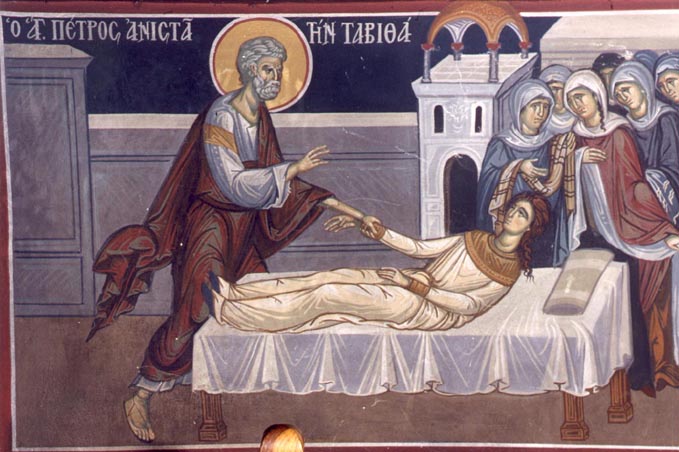
AgiaTabitha02Acts 9:32-43

32 Now as Peter went here and there among them all, he came down also to the saints who lived at Lydda. 33 There he found a man named Aeneas, bedridden for eight years, who was paralyzed. 34 And Peter said to him, “Aeneas, Jesus Christ heals you; rise and make your bed.” And immediately he rose. 35 And all the residents of Lydda and Sharon saw him, and they turned to the Lord. 36 Now there was in Joppa a disciple named Tabitha, which, translated, means Dorcas. She was full of good works and acts of charity. 37 In those days she became ill and died, and when they had washed her, they laid her in an upper room. 38 Since Lydda was near Joppa, the disciples, hearing that Peter was there, sent two men to him, urging him, “Please come to us without delay.” 39 So Peter rose and went with them. And when he arrived, they took him to the upper room. All the widows stood beside him weeping and showing tunics and other garments that Dorcas made while she was with them. 40 But Peter put them all outside, and knelt down and prayed; and turning to the body he said, “Tabitha, arise.” And she opened her eyes, and when she saw Peter she sat up. 41 And he gave her his hand and raised her up. Then calling the saints and widows, he presented her alive. 42 And it became known throughout all Joppa, and many believed in the Lord. 43 And he stayed in Joppa for many days with one Simon, a tanner.

There is something in the human condition that simply does not want to acknowledge the miraculous power of God in the world.  Some years ago, for instance, I clipped the following article from The Washington Times.

Study: Red Sea parting was possible

ST. PETERSBURG, Russia, Jan. 21 (UPI) — Russian mathematicians have determined the legendary parting of the Red Sea that let the Jews flee Egypt was possible, the Moscow Times reported.

The study, published in the Bulletin of the Russian Academy of Sciences, focused on a reef that runs from the documented spot where the Jews escaped Egypt, which in Biblical times, was much closer to the surface, according to Naum Volzinger, a senior researcher at St. Petersburg’s Institute of Oceanology, and a colleague based in Hamburg, Alexei Androsov.

The mathematicians calculated the “strong east wind that blew all that night” mentioned in the Bible needed to blow at a speed of 67 miles per hour to make the reef, said Volzinger, who specializes in ocean phenomena, flooding and tidal waves.

“It would take the Jews — there were 600,000 of them — four hours to cross the 4.2-mile reef that runs from one coast to another. Then, in half an hour, the waters would come back,” he said.

The Egyptian army that followed them drowned in the sea.

“I am convinced that God rules the Earth through the laws of physics,” Volzinger told the Times.[i]

So there you have it!  Or consider this article from Live Science.

Jesus Could Have Walked on Ice, Scientist Says

Rare conditions could have conspired to create hard-to-see ice on the Sea of Galilee that a person could have walked on back when Jesus is said to have walked on water, a scientist said today.

The study, which examines a combination of favorable water and environmental conditions, proposes that Jesus could have walked on an isolated patch of floating ice on what is now known as Lake Kinneret in northern Israel.

Looking at temperature records of the Mediterranean Sea surface and using analytical ice and statistical models, scientists considered a small section of the cold freshwater surface of the lake. The area studied, about 10,000 square feet, was near salty springs that empty into it.

The results suggest temperatures dropped to 25 degrees Fahrenheit (-4 degrees Celsius) during one of the two cold periods 2,500 –1,500 years ago for up to two days, the same decades during which Jesus lived.

With such conditions, a floating patch of ice could develop above the plumes resulting from the salty springs along the lake’s western shore in Tabgha. Tabgha is the town where many archeological findings related to Jesus have been found.

“We simply explain that unique freezing processes probably happened in that region only a handful of times during the last 12,000 years,” said Doron Nof, a Florida State University Professor of Oceanography. “We leave to others the question of whether or not our research explains the biblical account.”

Nof figures that in the last 120 centuries, the odds of such conditions on the low latitude Lake Kinneret are most likely 1-in-1,000. But during the time period when Jesus lived, such “spring ice” may have formed once every 30 to 60 years.

Such floating ice in the unfrozen waters of the lake would be hard to spot, especially if rain had smoothed its surface.

“In today’s climate, the chance of springs ice forming in northern Israel is effectively zero, or about once in more than 10,000 years,” Nof said.

The findings are detailed in the April 2006 Journal of Paleolimnology.[ii]

Well how about that!  Jesus walked on the Sea of Galilee by walking on ice patches!  Who knew!

Yes, there is something in the human condition that want to explain away the miraculous.  This is somewhat understandable.  After all, miracles are miracles!  By definition, then, they are unusual, strange, and defy explanation.  As a result, the human mind desperately wants to figure out some way to make sense of these things, to explain them.

The early Church had a very different approach to the miraculous.  They were, no doubt, initially no less shocked by miracles than anybody else was.  However, as they grew in their journey with Jesus and came to see just who He is and how powerful He is and all that He can accomplish in the world, they embraced these mighty acts of God for what they are:  powerful evidences of the presence of God in the world and powerful tools in the hands of God to advance the Kingdom in the world.

Let us consider the two miracles in the latter half of Acts 9.  Let us consider how the Church viewed these miracles.  Let us also consider how both miracle accounts having wording connections with Gospel miracle accounts that heighten the reality of what was happening in these two cases.

The early Church saw itself as representing Jesus through works of power.

Somewhat surprisingly, the story now shifts from Paul back to Peter.

32 Now as Peter went here and there among them all, he came down also to the saints who lived at Lydda. 33 There he found a man named Aeneas, bedridden for eight years, who was paralyzed. 34 And Peter said to him, “Aeneas, Jesus Christ heals you; rise and make your bed.” And immediately he rose.

This is a shorter miracle account, but a profoundly significant one.  Peter comes to the town of Lydda and there encounters a paralytic named Aeneas.  The poor man had been “bedridden for eight years” as a result of his paralysis.  Peter says to Aeneas, “Aeneas, Jesus Christ heals you; rise and make your bed.”  And “immediately” he is healed.

Note first that Peter boldly proclaims to Aeneas that “Jesus Christ heals you.”  But was it not Peter who was speaking to him?  Yes, it was, but Peter was simply the tool in the hands of God.  More than that, though:  Peter was a representative of God on earth.

It is a teaching we probably neglect, but it is a crucial teaching:  when the Church speaks in harmony with God the Church speaks with the voice of God.  The Church is the body of Christ.  When Paul was persecuting the Church he was persecuting Christ.  When Peter, representing the Church, spoke healing power over the man, it was Christ who was speaking healing power over the man.  Let us be clear:  the Church is not Christ, but the Church represents Christ in powerful ways.

This reality of the Church’s representation of Christ can help us understand what is happening with the dynamic of “the keys” that Christ spoke of in Matthew 16.

18 And I tell you, you are Peter, and on this rock I will build my church, and the gates of hell shall not prevail against it. 19 I will give you the keys of the kingdom of heaven, and whatever you bind on earth shall be bound in heaven, and whatever you loose on earth shall be loosed in heaven.”

This binding and loosing power only exists because God is present in and with His Church.  It does not render the Church infallible and the keys are not detached from the One who grants them.  Rather, it is a powerful reminder of an essential truth:  the Church represents her Lord when the Church is faithful to her Lord.

There is a second component in this brief miracle account that should not be missed, and that is Peter’s concluding wording, “rise and make your bed.”  Jesus heals the paralytic through Peter and Peter tells him to “rise and make your bed.”  Perhaps this sounds familiar to you.  Listen to the following story from Mark 2 of Jesus healing a paralyzed man.

1 And when he returned to Capernaum after some days, it was reported that he was at home. 2 And many were gathered together, so that there was no more room, not even at the door. And he was preaching the word to them. 3 And they came, bringing to him a paralytic carried by four men. 4 And when they could not get near him because of the crowd, they removed the roof above him, and when they had made an opening, they let down the bed on which the paralytic lay. 5 And when Jesus saw their faith, he said to the paralytic, “Son, your sins are forgiven.” 6 Now some of the scribes were sitting there, questioning in their hearts, 7 “Why does this man speak like that? He is blaspheming! Who can forgive sins but God alone?” 8 And immediately Jesus, perceiving in his spirit that they thus questioned within themselves, said to them, “Why do you question these things in your hearts? 9 Which is easier, to say to the paralytic, ‘Your sins are forgiven,’ or to say, ‘Rise, take up your bed and walk’? 10 But that you may know that the Son of Man has authority on earth to forgive sins”—he said to the paralytic— 11 “I say to you, rise, pick up your bed, and go home.” 12 And he rose and immediately picked up his bed and went out before them all, so that they were all amazed and glorified God, saying, “We never saw anything like this!”

Did you see that?  “Rise, pick up your bed,” Jesus says.  “Rise and make your bed,” Peter says.  We have seen before, in the martyrdom of Stephen, that the people of God so identified with Christ that they began to speak His words and live His life.  They began, in other words, to look like Jesus.

Here we see it again.  Peter is essentially replicating an earlier miracle of Jesus, right down to the words Jesus used.  This is neither accidental or coincidental.  It is utterly predictable.  As Peter associates with Christ more and more, Peter looks and sounds like Christ.  Seen from the other side, as Christ works through His Church, the Church takes on the actions and words of Christ.

These works of power with evidence of Christ’s presence in His Church.

The early Church spread the gospel through works of power.

The same dynamic can be seen in Joppa in even more dramatic fashion.

35 And all the residents of Lydda and Sharon saw him, and they turned to the Lord. 36 Now there was in Joppa a disciple named Tabitha, which, translated, means Dorcas. She was full of good works and acts of charity. 37 In those days she became ill and died, and when they had washed her, they laid her in an upper room. 38 Since Lydda was near Joppa, the disciples, hearing that Peter was there, sent two men to him, urging him, “Please come to us without delay.” 39 So Peter rose and went with them. And when he arrived, they took him to the upper room. All the widows stood beside him weeping and showing tunics and other garments that Dorcas made while she was with them. 40 But Peter put them all outside, and knelt down and prayed; and turning to the body he said, “Tabitha, arise.” And she opened her eyes, and when she saw Peter she sat up. 41 And he gave her his hand and raised her up. Then calling the saints and widows, he presented her alive. 42 And it became known throughout all Joppa, and many believed in the Lord. 43 And he stayed in Joppa for many days with one Simon, a tanner.

What an utterly dumbfounding story!  Dorcas had died.  Peter comes and speaks to her.  Now Dorcas lived.  There is an unsettling simplicity about all of this.  Will Willimon said it well:

            Luke explains nothing in these stories, nor can you or I as interpreters.  How God’s agents wrench life from death is not something so trivial as to be explained.  The stories can only be told and heard, asserted, inserted into life as they are thrust into the flow of Acts.  It is not Peter who turns our history inside out but the story, the story which proclaims that our history is not closed and that there is someone, some subversive reality, there for the widows of this world.[iii]

The resurrected Christ is Lord over even death.  As death could not hold Jesus, neither can it hold whomever Jesus touches.  What is an occasion of great grief for Dorcas’ friends is simply an opportunity for Kingdom expansion and life transformation for Jesus.

This Dorcas was a godly lady and a good lady.  She worked great works of charity.  She made clothes and blessed others through the industrious and loving use of her talents.  This is no small thing.  She did this for the glory of God and the building up of the Church.  She was a servant and a hard worker and she was held in high esteem by the people of the Church.

Her loss was a great loss for the Church, but the Lord decided that it would not be a loss.  Peter comes in gospel power and the dead live again!  As a result, “many believed in the Lord.”

Let us recognize in this that the miraculous works of power in the life of the early Church were not miracles for miracles’ sake.  They were, instead, miracles for the sake of the harvest.  Unlike some modern TV alleged miracle workers, Peter did not pass an offering plate after working works of power.  He did not work this to his own advantage.  He did not use this to get a name for himself.

On the contrary, the only name Peter wanted to get more attention was Jesus’ name.  The only payment Peter wanted was to see more people come to Christ.  “Many believed in the Lord.”  Not in Peter.  In the Lord.  And the Church grew through these divine manifestations of power.

Just as in the healing of Aeneas in Lydda, there is a connecting point in this account with one of Jesus’ miracles in the gospels.  In Mark 5 we find the amazing account of Jesus’ healing of Jairus’ daughter.  Listen carefully.

21 And when Jesus had crossed again in the boat to the other side, a great crowd gathered about him, and he was beside the sea. 22 Then came one of the rulers of the synagogue, Jairus by name, and seeing him, he fell at his feet 23 and implored him earnestly, saying, “My little daughter is at the point of death. Come and lay your hands on her, so that she may be made well and live.” 24 And he went with him. And a great crowd followed him and thronged about him.

35 While he was still speaking, there came from the ruler’s house some who said, “Your daughter is dead. Why trouble the Teacher any further?” 36 But overhearing what they said, Jesus said to the ruler of the synagogue, “Do not fear, only believe.” 37 And he allowed no one to follow him except Peter and James and John the brother of James. 38 They came to the house of the ruler of the synagogue, and Jesus saw a commotion, people weeping and wailing loudly. 39 And when he had entered, he said to them, “Why are you making a commotion and weeping? The child is not dead but sleeping.” 40 And they laughed at him. But he put them all outside and took the child’s father and mother and those who were with him and went in where the child was. 41 Taking her by the hand he said to her, “Talitha cumi,” which means, “Little girl, I say to you, arise.” 42 And immediately the girl got up and began walking (for she was twelve years of age), and they were immediately overcome with amazement. 43 And he strictly charged them that no one should know this, and told them to give her something to eat.

Here we have a similar story.  Word is sent to Jesus that somebody is dying.  Jesus comes.  The child is dead.  Jesus speaks to her and she rises.

In addition to the similarities of the stories, there is a particular phonetic similarity that is likely intended to connect the two.  Jarsolav Pelikan points out the phonetic similarities between the Aramaic pronouncement of Jesus over the daughter of Jairus – talitha – and Peter’s usage of Dorcas’ name, Tabitha, to suggest that it is “possible that Luke was engaging wordplay” to highlight the Church’s carrying on of the work of Christ in the world.[iv]

“Talitha, cumi!” Jesus commands.

“Tabitha, arise!” Peter commands.

Once again, the Church looks and sounds like Jesus…and so it should!  Christ is Lord of His Church.  As the Church walks with Jesus the Church looks more and more like Jesus.  The result?  Men and women are called to Jesus through various means and ways, not the least of which are dynamic works of miraculous power.

There is controversy surrounding this today.  Have these works of power ceased?  For myself, I can see no scriptural warrant to suggest that we must say answer that in the affirmative.  At the very least, even if a person leans towards believing that miracles have ceased, can we not affirm that God is still God and that if works of power were used in the first century to demonstrate God’s presence with and through His Church and to reach the lost for Christ that they might just be used by God in a similar fashion today as well?

Behold the wonder working God, who invades our bleak existence with love, and peace, and joy, and astonishing works of life-changing power


[i] The Washington Times. Category: Category 1
Date: 5/02/04
Time: 09:53:56
Remote Name: 210.246.38.97

[ii] https://www.livescience.com/othernews/060404_jesus_ice.html

[iii] Quoted in William H. Willimon, Acts. Interpretation. (Louisville, KY: John Knox Press, 1988), p.85.

[iv] Jaroslav Pelikan, Acts. Brazos Theological Commentary on the Bible. (Grand Rapids, MI: Brazos Press, 2005), p.127.

Acts 9:19b-31

Apostle-PaulActs 9:19b-31

19b For some days he was with the disciples at Damascus. 20 And immediately he proclaimed Jesus in the synagogues, saying, “He is the Son of God.” 21 And all who heard him were amazed and said, “Is not this the man who made havoc in Jerusalem of those who called upon this name? And has he not come here for this purpose, to bring them bound before the chief priests?” 22 But Saul increased all the more in strength, and confounded the Jews who lived in Damascus by proving that Jesus was the Christ. 23 When many days had passed, the Jews plotted to kill him, 24 but their plot became known to Saul. They were watching the gates day and night in order to kill him, 25 but his disciples took him by night and let him down through an opening in the wall, lowering him in a basket. 26 And when he had come to Jerusalem, he attempted to join the disciples. And they were all afraid of him, for they did not believe that he was a disciple. 27 But Barnabas took him and brought him to the apostles and declared to them how on the road he had seen the Lord, who spoke to him, and how at Damascus he had preached boldly in the name of Jesus. 28 So he went in and out among them at Jerusalem, preaching boldly in the name of the Lord. 29 And he spoke and disputed against the Hellenists. But they were seeking to kill him. 30 And when the brothers learned this, they brought him down to Caesarea and sent him off to Tarsus. 31 So the church throughout all Judea and Galilee and Samaria had peace and was being built up. And walking in the fear of the Lord and in the comfort of the Holy Spirit, it multiplied.

R. Kent Hughes tells of a time when he learned a valuable lesson about famous converts.

            A number of years ago, when I was a youth pastor, word came to me from one of the large churches in my area that the last living member of the Bonnie and Clyde gang, Big Jim Harrington, had been giving his testimony to standing-room-only crowds with amazing results.  So I made the arrangements for him to speak at our church.  I arranged for special music, had several thousand handbills printed and distributed at the local high schools, and enlisted counselors.  The night arrived, and it went beyond our expectations – a sea of teenagers.

            Big Jim was unbelievable – an imposing man about eighty years old with tattoos on the back of his hands and an indentation atop his bald head from an old bullet wound.  For two hours he regaled us with powerful stories of his wasted life with Clyde Barrow.  He poignantly exhorted us not to waste our youth and urged us to commit our lives to Christ.  Everyone was thrilled.  The elders who had been reticent congratulated us on the service.  I was very satisfied and a little smug – until two days later when I received a call from Big Jim’s agent, who told me he had just learned that Big Jim was an imposter, that in fact he was a well-meaning alcoholic who lived with his daughter out in the desert and suffered delusions about his uneventful past.  Gulp!  I learned a major lesson from that experience![1]

Perhaps there should be a word for “conversion skepticism,” the state of cynicism concerning famous or infamous converts.  I have unfortunately learned to be skeptical as well.

Do you remember Mike Warnke?  In the 80’s Mike Warnke was making the Christian speaking circuit with his fascinating and macabre tales of his life as a former Satanist.  As a boy I remember sitting in the Civic Center of Sumter, SC, listening with rapt attention and no small degree of amazement to Warnke’s stories of black masses, child sacrifice, and other things I was amazed I was allowed to hear about as a child.  Imagine my shock, then, when some years later I read an expose in a Christian magazine from some people who began to notice holes and inconsistencies in his story.  As it turned out, Warnke had greatly exaggerated his story and outright fabricated certain parts of it.  I should say that Warnke appears to have repented and is trying now to do well for the cause of Christ, but this was my first experience with conversion skepticism and it has made me perhaps too cynical ever since.

One cannot help but wonder if the early church felt the same about Paul?  Talk about an unlikely conversion story!  One day Paul is breathing murder and hatred against the Church and the next day he is preaching Christ in the synagogues of Damascus.  How was the Church to understand this?  How was the Church to believe this?  Were they really supposed to accept this guy who had the blood of one of their friend’s, Stephen, on his hands?  Were they really supposed to throw open the doors to this one who had caused so much pain and misery for the Church?

The conversion of Paul was as scandalous as it was unlikely.  It was also amazing.  It was amazing because it revealed just how very real the grace and power of Jesus Christ is.  Let us consider the results of Paul’s conversion and the challenge it presented to the Church.

Paul’s conversion resulted in a complete change of heart that led him to call his friends to come to Jesus.

To begin, it must be acknowledged that Paul’s conversion was marked by astonishing, visible fruit.

19b For some days he was with the disciples at Damascus.

Luke tells us that he was with the disciples “for some days.”  When reading the account of the days immediately following his conversion, we need to remember Paul’s fuller account from Galatians.  In Galatians 1 he writes:

15 But when he who had set me apart before I was born, and who called me by his grace, 16 was pleased to reveal his Son to me, in order that I might preach him among the Gentiles, I did not immediately consult with anyone; 17 nor did I go up to Jerusalem to those who were apostles before me, but I went away into Arabia, and returned again to Damascus.

When we harmonize these passages, we see the more complete picture of Paul’s conversion, his receiving of the Holy Spirit in Damascus, his retreat “into Arabia,” his return to Damascus, then his eventual journey to Jerusalem.  Let us note Paul’s activity in Damascus upon his return.

20 And immediately he proclaimed Jesus in the synagogues, saying, “He is the Son of God.” 21 And all who heard him were amazed and said, “Is not this the man who made havoc in Jerusalem of those who called upon this name? And has he not come here for this purpose, to bring them bound before the chief priests?” 22 But Saul increased all the more in strength, and confounded the Jews who lived in Damascus by proving that Jesus was the Christ.

I was once invited to offer the prayer at a city council meeting in a small town in South Georgia.  After I prayed I stayed for the meeting.  I will never forget how hard it was not to laugh when I heard a local government employee note with glee that the city “had made a complete 360 degree turnaround.”  Unfortunately, that’s the kind of turnaround many Christians make.  They end up right where they started with no lasting change.

Not Paul.  Paul made a 180 degree turn.  He went from attacking the Church to helping the Church grow.  He went from persecuting Christ to proclaiming Christ.  He went from hostility against the Church to solidarity with it.

The most concrete evidence of a person’s conversion is their willingness to share with others what has happened to them.  Paul did this with a passion that never left him throughout the remainder of his fascinating life.  He “immediately…proclaimed Jesus in the synagogues.”  This is astounding not only because of the content of Paul’s message but also because of the location of it.  He (a) preaches Jesus and (b) preaches him in the synagogues.

We must remember that these synagogue officials would have seen Paul’s entry into their midst as a welcome relief that this Pharisee of Pharisees was going to round up and remove these rabble rousing followers of Jesus.  Imagine their shock when they heard Paul stand in their midst and call people to Jesus instead!  Who could have seen this coming!

It is commonplace to hear Christians say today that your friends and family are the hardest to evangelize.  Not so with Paul.  He went immediately to his old friends and colleagues and announced his new message!  He wanted those with whom he was previously allied to understand what had happened to him.  He had seen and been touched by the risen Christ, and that had changed everything!

Paul’s conversion resulted in the anger of his former friends and their attempt to kill him.

Understandably, his friends were not pleased.

23 When many days had passed, the Jews plotted to kill him, 24 but their plot became known to Saul. They were watching the gates day and night in order to kill him, 25 but his disciples took him by night and let him down through an opening in the wall, lowering him in a basket.

So complete was Paul’s conversion, and so incendiary, that his former friends now desired to kill.  Luke tells us this twice:  “the Jews plotted to kill him” and “they were watching the gates day and night in order to kill him.”

As an aside, note that “his disciples” saved his life by lowering him out of the city in a basket.  “His disciples.”  Who’s disciples?  Paul’s disciples!  Not only was Paul now boldly preaching Jesus, he was also showing others how to follow Jesus.  He had his own disciples who were seeking to learn from and emulate his devotion to Christ.  But his former friends wanted to kill him.

It is interesting to see how angry one’s former friends can become when one allows Christ to change his or her heart.  Peter spoke of this reality in 1 Peter 4.

3 For the time that is past suffices for doing what the Gentiles want to do, living in sensuality, passions, drunkenness, orgies, drinking parties, and lawless idolatry. 4 With respect to this they are surprised when you do not join them in the same flood of debauchery, and they malign you; 5 but they will give account to him who is ready to judge the living and the dead.

Yes, they are indeed “surprised when you do not join them” in the life you used to live.  Be it a life of debauchery or, in Paul’s case, self-righteous legalism.  The lost do not understand when the saved throw off the life they once lived.

I once had a young man come to me for counsel.  He struggled with alcohol and partying and neglecting his wife and children.  He would come to me when he hit bottom or when his wife was especially angry.  He would appear to repent and then he would leave and the same cycle would start all over again.  Finally, one day, sitting in my office, I asked him about his friends.  “They are not good friends,” he told me.  “They drag me down and are bad influences on me.”  He told me of his “best friend” and how the relationship was not a healthy one at all.

So I proposed to him that perhaps he should call his friend right then and there on my phone and tell him that he could no longer hang out with him if they were going to do the kinds of things they were doing.  He agreed.  So with trembling voice he picked up the phone in my presence, called his friend, and told him.  I could hear his friend’s angry voice on the other end of the phone.  I heard him curse and swear in anger.  To my amazement, some weeks later, they were back to partying and wild living.

Perhaps it seems a hard thing to be very clear with your friends about your changed life, but if you do not you will always leave open a small door through which you can fall back into what you were.  More important than this caution, however, is the fact that if Christ has truly saved us we should want our friends to know him as well.

Paul went to the synagogues and told his peers about Jesus.  Have you?  Surely this is one of the indispensible marks of a genuine conversion.

Paul’s conversion resulted in a spiritual struggle within the Church that ended in growth and the Church’s acceptance of their former enemy.

If Paul’s former friends reacted with rage, His potential new set of friends acted with skepticism, fear, and hesitation.

26 And when he had come to Jerusalem, he attempted to join the disciples. And they were all afraid of him, for they did not believe that he was a disciple.

Let us be careful of rushing to judgment.  After all, how would you and I have reacted?  Again, this man had caused untold pain in the Church.  This was no easy situation.  And so, for a moment, Paul felt like a man without a country.  His former friends were gone.  His new family shrunk back from him in fear.

What was the solution?  The solution, as it turns out, was a man in the Church who was willing to set aside his fear, sit in the shadow of the cross, and think for a moment.  If indeed the gospel they were all preaching was true, how could it not apply even to Paul?  And so this man decided to break down the wall separating Paul from the Church.  This man’s name was Barnabas, “the son of encouragement.”

27 But Barnabas took him and brought him to the apostles and declared to them how on the road he had seen the Lord, who spoke to him, and how at Damascus he had preached boldly in the name of Jesus. 28 So he went in and out among them at Jerusalem, preaching boldly in the name of the Lord. 29 And he spoke and disputed against the Hellenists. But they were seeking to kill him. 30 And when the brothers learned this, they brought him down to Caesarea and sent him off to Tarsus. 31 So the church throughout all Judea and Galilee and Samaria had peace and was being built up. And walking in the fear of the Lord and in the comfort of the Holy Spirit, it multiplied.

That is all it took:  one man who was willing to live out even the uncomfortable implications of the gospel!  Barnabas puts his arm around Paul and says, “If Christ truly died for all, that includes this guy as well.”  Thus, Barnabas became a friend to and advocate for Paul.  As a result, the Church welcomed Paul and sought to protect him against the murderous intent of the Jews by sending him to Tarsus.

One may be tempted to ask why this awkward introduction into the Church was even necessary.  Why could God not have used Paul as something of a free-range, unaffiliated Christian?  Simply put, because there is no such thing as an unaffiliated Christian.  Not really.  When you come to Christ, you become part of the Church.  The right thing to do, then, is to live that out publically by associating with a local congregation.  But more important than this, however, is the fact that Paul needed the Church if he was truly going to grow in the grace of Jesus Christ.  Sociologists Berger and Luckmann put it beautifully when they said:

To have a conversion experience is nothing much.  The real thing is to be able to keep on taking it seriously; to retain a sense of its plausibility.  This is where the religious community comes in.  It provides the indispensable plausibility structure of the new reality.  In other words, Saul may have become Paul in the aloneness of religious ecstasy, but he could remain Paul only in the context of the Christian community.[2]

So Paul needed the Church to grow.  However, the Church also needed Paul if it was going to grow!  See how the Church expanded in its understanding of what grace and forgiveness really is!  Paul was a test containing only one question:  did the Church really believe that Christ could reach anybody?

Have you ever struggled to welcome into the family of God somebody against whom you have a complaint?  The Church has always had to deal with this.  Corrie Ten Boom spent time in a concentration camp after her family was discovered harboring and hiding Jews during World War II.  Before her death in the early 1980’s, she had an amazing ministry of speaking about the experiences of her life and how God blessed her through all of the hard times she and her family suffered.  Here she tells of a time when she too had to come to terms with the uncomfortably realities of forgiveness.

It was at a church service in Munich that I saw him, the former SS man who had stood guard at the shower room door in the processing centre at Ravensbruck. He was the first of our actual jailers that I had seen since that time. And suddenly it was all there – the roomful of mocking men, the heaps of clothing, Betsie’s [her sister’s] pain-blanched face.

He came up to me as the church was emptying, beaming and bowing. “How grateful I am for your message Fräulein”, he said “To think that, as you say, He has washed my sins away!”

His hand was thrust out to shake mine. And I, who had preached so often to the people in Bloemendaal the need to forgive, kept my hand at my side.

Even as the angry, vengeful thoughts boiled through me, I saw the sin of them. Jesus Christ had died for this man; was I going to ask for more? Lord Jesus, I prayed, forgive me and help me to forgive him.

I tried to smile, I struggled to raise my hand. I could not. I felt nothing, not the slightest spark of warmth or charity. And so again I breathed a silent prayer. Jesus, I cannot forgive him. Give me Your Forgiveness.

As I took his hand the most incredible thing happened. From my shoulder along my arm and through my hand a current seemed to pass from me to him, while into my heart sprang a love for this stranger that almost overwhelmed me.

And so I discovered that it is not on our forgiveness any more than on our goodness that the world’s healing hinges, but on His. When He tells us to love our enemies, He gives, along with the command, the love itself.

Yes.  “He gives, along with the command, the love itself.”

Corrie Ten Boom had to learn this.

The early Church had to learn this.

You and I must learn this.

Church, it is an amazing thing to be entrusted with the gospel that can reach, break, and heal the hardest of hearts.  And it is an honor to be presented with the painful opportunity to learn to love as Jesus loves.

We must do this.

We must do this.


[1] R. Kent Hughes, Acts. (Wheaton, IL: Crossway Books, 1996), p.135.

[2] Quoted in William H. Willimon, Acts. Interpretation. (Louisville, KY: John Knox Press, 1988), p.82.

Nikos Kazantzakis’ Saint Francis

9781476706832_p0_v1_s260x420I heard of Nikos Kazantzakis’ novel, Saint Francis, through Cook and Herzman’s course on Francis in the “Great Courses” series.  I was surprised to learn about this book.  Kazantzakis is the author of The Last Temptation of Christ and is considered to be theologically heterodox.  Thus, I approached the novel with a certain degree of skepticism.

I was not only pleasantly surprised by the novel but also deeply moved.  (I was initially comforted, I should point out, by the fact that John Michael Talbot wrote the Foreword for the edition I read.)  Kazantzakis’ portrait of Francis is profoundly respectful, admiring, and inspirational.  While he obviously takes artistic liberties here and there, I was surprised by how closely the novel actually follows the events of Francis life.  In fact, with proper caveats and cautions issued beforehand, this would not be a bad place for a person to start in their journey of learning about Francis.  The book would obviously need to be followed by good histories of Francis’ life, but the tenor and spirit of this novel are both in harmony with Francis’ actual life.

It is a long novel, and, at times, somewhat slow.  Even so, the overall impression of this reader anyway is that Kazantzakis did his homework and crafted a truly admirable work of art in this novel.  Kazantzakis’ imagination does not run so wild that Francis is lost in the telling.  The conversations and specific scenarios that he imagines and depicts fit nicely into what we know of Francis.  Some of the theological pronouncements that Kazantzakis imagines Francis saying are eyebrow raising, and a few I personally have a hard time thinking of Francis saying, but, taken as a whole, Kazantzakis gets very close to the right theological tone as well.

Francis of Assisi lends himself well to fictional depictions.  So many fascinating things happened in his life, and there are so many intriguing lacunae in his story that artists have repeatedly been tempted to imagine what he would have done and said in this or that situation.  Among these efforts, Kazantzakis’ stands strong as an exemplary example.

A great read!  Highly recommended.

Acts 9:1-19

conversion-of-st-paulActs 9:1-19

1 But Saul, still breathing threats and murder against the disciples of the Lord, went to the high priest 2 and asked him for letters to the synagogues at Damascus, so that if he found any belonging to the Way, men or women, he might bring them bound to Jerusalem. 3 Now as he went on his way, he approached Damascus, and suddenly a light from heaven shone around him. 4 And falling to the ground he heard a voice saying to him, “Saul, Saul, why are you persecuting me?” 5 And he said, “Who are you, Lord?” And he said, “I am Jesus, whom you are persecuting. 6 But rise and enter the city, and you will be told what you are to do.” 7 The men who were traveling with him stood speechless, hearing the voice but seeing no one. 8 Saul rose from the ground, and although his eyes were opened, he saw nothing. So they led him by the hand and brought him into Damascus. 9 And for three days he was without sight, and neither ate nor drank. 10 Now there was a disciple at Damascus named Ananias. The Lord said to him in a vision, “Ananias.” And he said, “Here I am, Lord.” 11 And the Lord said to him, “Rise and go to the street called Straight, and at the house of Judas look for a man of Tarsus named Saul, for behold, he is praying, 12 and he has seen in a vision a man named Ananias come in and lay his hands on him so that he might regain his sight.” 13 But Ananias answered, “Lord, I have heard from many about this man, how much evil he has done to your saints at Jerusalem. 14 And here he has authority from the chief priests to bind all who call on your name.” 15 But the Lord said to him, “Go, for he is a chosen instrument of mine to carry my name before the Gentiles and kings and the children of Israel. 16 For I will show him how much he must suffer for the sake of my name.” 17 So Ananias departed and entered the house. And laying his hands on him he said, “Brother Saul, the Lord Jesus who appeared to you on the road by which you came has sent me so that you may regain your sight and be filled with the Holy Spirit.” 18 And immediately something like scales fell from his eyes, and he regained his sight. Then he rose and was baptized; 19 and taking food, he was strengthened.

In a fascinating February 2014 article in Christianity Today entitled, “Road to Damascus Wasn’t Enough: Apostle Paul Questions Nearly Get Christian Deported,” Sarah Eekhoff Zylstra reported that Chang Qiang Zhu, a Chinese Christian seeking asylum in the United States, was initially refused entry by an immigration judge after Zhu could not answer specific questions about Christianity.  Apparently judges have begun asking these specific questions of those seeking asylum for stated reasons of religious persecution in their homeland after discovering that some who want entry into the United States lie about being religious or have been coached on how to sound Christian though they are not.  These specific questions are therefore intended to reveal whether or not the asylum seeker is indeed actually a Christian in need of help.

The article was discussing the legalities of these approaches by the court and reveals that this tactic is being criticized for numerous reasons.  Regardless, the nature of the specific questions asked of Chang Qiang Zhu struck me as fascinating.

A Chinese Christian’s hopes for asylum in America now have new life, after an appellate court overturned a denial from a judge who found that the applicant’s answers to questions about Christianity were “hesitant” and “evasive.”

The case is the latest example of how immigration boards often deny refugees claiming persecution for not knowing enough about their religion—and how courts continue to reverse such rulings.

Chang Qiang Zhu’s behavior began to suffer only after the immigration judge asked him specific questions, such as what form of persecution the Apostle Paul used against Christians and what year Paul converted to Christianity, the Second Circuit Court of Appeals recently ruled. [Paul is currently the featured subject of the world’s largest Bible class, hosted by Harvard University.][i]

Zhu grew “hesitant” and “evasive” when the judge asked him “what form of persecution the Apostle Paul used against Christians” and “what year Paul converted to Christianity.”  It raises an interesting question:  would you grow hesitant and evasive before the same questions?  (As an aside, the exact year of Paul’s conversion is actually hard to know!)

I have serious questions about the validity of this judge’s approach in these situations, but I will give him this:  somebody professing to be a follower of Christ should indeed have at least some knowledge of the amazing story of Paul’s conversion and former life.  It is an astounding fact that over half of the New Testament was penned by a man who previously sought to destroy the Christian church!  Paul’s conversion remains one of the most “unlikely” in all of human history, and, as such, it is a story of great hope and possibility for all of us.

Paul’s conversion was at the initiative of a sovereign God.

We previously saw how an angel sent Philip to preach to the Ethiopian eunuch.  In so doing, we saw that human beings are the normal instruments of God’s missionary purposes.  He normally uses His church to go and tell.  But here, immediately on the heals of that story – a story, by the way, that has certain interesting parallels to this story – God Himself initially foregoes human instrumentality and approaches Paul directly.  At this point, Paul still goes by the name Saul.

1 But Saul, still breathing threats and murder against the disciples of the Lord, went to the high priest

Note the intense hatred Paul had for the Church!  A.T. Robertson has powerfully described the implications of the Greek wording for “breathing threats and murder.”

Not “breathing out,” but “breathing in” (inhaling) as in Aeschylus and Plato or “breathing on” (from Homer on).  The partitive genitive of apeiles and phonou means that the threatening and slaughter had come to be the very breath that Saul breathed, like a warhorse who sniffed the smell of battle.  He breathed on the remaining disciples the murder that he had already breathed in from the death of the others.  He exhaled what he inhaled…The taste of blood in the death of Stephen was pleasing to young Saul (8:1) and now he reveled in the slaughter of the saints both men and women.[ii]

His hatred had therefore become a part of his very being, and he moved with steps calculated to inflict maximal damage upon the Christian Church.  Ever a man for keeping the letter of the law, he sought proper authority from the religious establishment for his actions.

2 and asked him for letters to the synagogues at Damascus, so that if he found any belonging to the Way, men or women, he might bring them bound to Jerusalem. 3 Now as he went on his way, he approached Damascus, and suddenly a light from heaven shone around him. 4 And falling to the ground he heard a voice saying to him, “Saul, Saul, why are you persecuting me?”

A sudden burst of light and a confronting voice knock Paul to the ground!  The voice demands to know why Paul is persecuting Him.  St. Augustine saw in these words evidence for the omnipresence of God.

How can we show that he is there and that he is also here?  Let Paul answer for us, who was previously Saul…First of all, the Lord’s own voice from heaven shows this:  “Saul, Saul, why are you persecuting me?”  Had Paul climbed up to heaven then?  Had Paul even thrown a stone at heaven?  It was Christians he was persecuting, them he was tying up, them he was dragging off to be put to death, them he was everywhere hunting out of their hiding places and never sparing when he found them.  To him the Lord said, “Saul, Saul.”  Where is he crying out from?  Heaven.  So he’s up above.  “Why are you persecuting me?”  So he’s down below.[iii]

Yes, He is above and below!  In addition to omnipresence, there is also here a most telling note about Christ’s amazing solidarity and identification with His Church.  To strike the Church is to strike Christ.  This does not mean that the Church is Christ, but it does mean that Christ so identifies with His Church through His indwelling presence that the Church truly can be called “the body of Christ” (1 Corinthians 12:27).

Paul’s response to Jesus is most revealing.

5 And he said, “Who are you, Lord?” And he said, “I am Jesus, whom you are persecuting.

How astonishing it is to see this Pharisee of the Pharisees, this law keeper, this scholar of the scriptures, this undeniably brilliant man, this religious professional who was so jealous for the name of God respond with, “Who are you, Lord?” when he found Himself in the very presence of God!  Here is a testimony to the self-deluding power of self-righteousness:  in the very presence of God, Paul does not recognize Him.  How often is it that those who think of themselves as close to God are actually very far from Him?  What a bitter and cautionary irony this is!

6 But rise and enter the city, and you will be told what you are to do.” 7 The men who were traveling with him stood speechless, hearing the voice but seeing no one. 8 Saul rose from the ground, and although his eyes were opened, he saw nothing. So they led him by the hand and brought him into Damascus. 9 And for three days he was without sight, and neither ate nor drank.

What one must be initially struck by in this encounter is the sovereign initiative of God in coming to Paul.  Simply put, God did it!  In point of fact, God always does it, but here we see His divine prerogative unveiled in a single act of startling, loving confrontation.

See here the pursuing, loving, jealous God who desires for all men to be saved!  See here the heart of God who sees a champion where everybody else sees a rogue!  See here the strong hand of God that is able to soften the hardest of hearts and drive the proudest man to His knees!  This is the God that is pursuing you!

Francis Thompson understood this well when he penned his beautiful poem, “The Hound of Heaven.”  Consider the opening and closing stanzas of that amazing poem.

I FLED Him, down the nights and down the days;

  I fled Him, down the arches of the years;

I fled Him, down the labyrinthine ways

    Of my own mind; and in the mist of tears

I hid from Him, and under running laughter.


      Up vistaed hopes I sped;

      And shot, precipitated,

Adown Titanic glooms of chasmèd fears,

  From those strong Feet that followed, followed after.

      But with unhurrying chase,


      And unperturbèd pace,

Deliberate speed, majestic instancy,

      They beat—and a Voice beat

      More instant than the Feet—

‘All things betray thee, who betrayest Me.’


      Now of that long pursuit


    Comes on at hand the bruit;

  That Voice is round me like a bursting sea:

    ‘And is thy earth so marred,

    Shattered in shard on shard?

  Lo, all things fly thee, for thou fliest Me!


  Strange, piteous, futile thing!

Wherefore should any set thee love apart?

Seeing none but I makes much of naught’ (He said),

‘And human love needs human meriting:

  How hast thou merited—


Of all man’s clotted clay the dingiest clot?

  Alack, thou knowest not

How little worthy of any love thou art!

Whom wilt thou find to love ignoble thee,

  Save Me, save only Me?


All which I took from thee I did but take,

  Not for thy harms,

But just that thou might’st seek it in My arms.

  All which thy child’s mistake

Fancies as lost, I have stored for thee at home:


  Rise, clasp My hand, and come!’

  Halts by me that footfall:

  Is my gloom, after all,

Shade of His hand, outstretched caressingly?

  ‘Ah, fondest, blindest, weakest,


  I am He Whom thou seekest!

Thou dravest love from thee, who dravest Me.’


The Hound of Heaven pursues us!  He pursued Paul and caught Him on the Damascus road.

Paul’s conversion challenged not only Paul’s understanding of God’s grace, but the church’s as well.

But such a conversion is not without its challenges.  It challenged Paul but it also challenged the Church.

10 Now there was a disciple at Damascus named Ananias. The Lord said to him in a vision, “Ananias.” And he said, “Here I am, Lord.” 11 And the Lord said to him, “Rise and go to the street called Straight, and at the house of Judas look for a man of Tarsus named Saul, for behold, he is praying, 12 and he has seen in a vision a man named Ananias come in and lay his hands on him so that he might regain his sight.” 13 But Ananias answered, “Lord, I have heard from many about this man, how much evil he has done to your saints at Jerusalem. 14 And here he has authority from the chief priests to bind all who call on your name.” 15 But the Lord said to him, “Go, for he is a chosen instrument of mine to carry my name before the Gentiles and kings and the children of Israel. 16 For I will show him how much he must suffer for the sake of my name.”

The Lord approached Paul directly on the road to Damascus, but He now sends a member of the Church to Paul.  He sends a man named Ananias, a believer, to reach out to Paul and to be the means through which Paul would receive the Holy Spirit and recover his sight.  Not surprisingly, Ananias is hesitant when God calls.  Why?  Because Paul was not only a man with blood on his hands, he was a man with the blood of Ananias’ friends on his hands.

From a human perspective, what God asks here is most audacious.  It is one thing for Him to ask us to present the gospel to a stranger, but quite another when He asks us to present it to somebody who has just recently been attempting to kill us.

But here is the amazing thing about God’s grace:  what seems audacious to us is normal for Him.  In fact, the very definition of grace embraces those who do not deserve it!  Undoubtedly Paul’s mind was reeling at this point in his journey, but so too was the Church’s.  The Church was now having to consider the amazing lengths to which God’s grace would go.  It was now having to consider just what it meant for Christ to lay down His life on the cross.  Grace truly was now being seen for the scandalous and amazing thing it is!

Perhaps you have witnessed this as well:  the shock of realizing that that person you considered too far from God to ever be reached really was not too far after all!  Here is the truth about grace:  it can reach anybody anywhere!  It is limitless and boundless and cannot be contained!

The challenge for Ananias is the challenge for us all:  to calibrate our conception of grace to God’s.  This is not always an easy thing to do, but it must be done if we are truly to be His people.

The conversion of the lost presents the Church with a holy inconvenience that helps conform us into the image of Christ.

There are two crucial responses in this text:  Paul’s response to the Lord and Ananias’ response to the Lord.  Paul’s response was vital to the course of his life and life-to-come.  Ananias’ response was crucial to the church’s willingness to embrace the breadth of God’s grace.  In short, how Ananias responded would either distance him from the heart of God in Christ or further conform him to the image of Christ and would either set a good example for the Church or a prohibitive one that would undermine the Church’s missionary task.

17 So Ananias departed and entered the house. And laying his hands on him he said, “Brother Saul, the Lord Jesus who appeared to you on the road by which you came has sent me so that you may regain your sight and be filled with the Holy Spirit.” 18 And immediately something like scales fell from his eyes, and he regained his sight. Then he rose and was baptized; 19 and taking food, he was strengthened.

Ananias’ response showed that he was willing to embrace the image of Christ no matter how inconvenient.  The action verbs in verse 17 are filled with theological significance.

  • “So Ananias departed and entered the house”
  • “And laying his hands on him.”
  • “he said, ‘Brother Saul…’”

Ananias moves from hesitation, fear, and suspicion to a full embrace of Paul as his brother.  In embracing Paul, Ananias was really embracing Christ, for Paul was the ultimate evidence of the radical nature of the love and mercy of Jesus.

In going to Paul, Ananias was reflecting the fact that Christ had already gone to Paul.  In laying hands of forgiveness on Paul, Ananias was reflecting the fact that Christ Himself had already laid forgiving hands on Paul.   And in calling Paul “brother,” Ananias was reflecting the fact that Christ had already proclaimed Paul part of the family of God.

The conversion of Paul was crucial not only because is signaled a cataclysmic change in one man, but also because it signaled the maturation of the body of Christ.  The Church would now be open not only to Samaritans and, soon, Gentiles as well, but also to notorious sinners, people otherwise considered to be beyond hope.

And here is the great good news of the story of Paul’s conversion:  nobody is beyond hope.

Whatever Damascus road you are on, whatever rebellion you might be involved in or headed toward, there is mercy to be found if you will but turn to Christ.  He is still in the business of taking us off the road of our own destruction and placing us in


[i] https://www.christianitytoday.com/gleanings/2014/february/road-to-damascus-wasnt-enough-apostle-paul-chinese-asylum.html

[ii] A.T. Robertson, Acts. Word Pictures in the New Testament. Vol.III (Nashville, TN: Broadman Press, 1930), p.113.

[iii] Francis Martin, ed. Acts. Ancient Christian Commentary on Scripture. New Testament, vol.V. Thomas C. Oden, gen. ed. (Downers Grove, IL: InterVarsity Press, 2006), p.103.

Acts 8:26-40

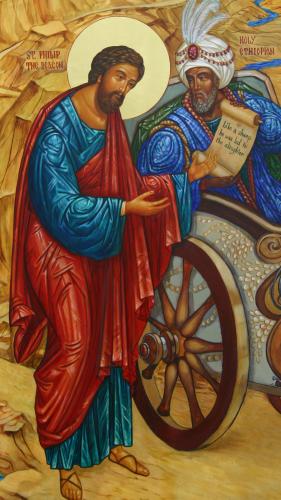
Icon_PhilipActs 8:26-40

26 Now an angel of the Lord said to Philip, “Rise and go toward the south to the road that goes down from Jerusalem to Gaza.” This is a desert place. 27 And he rose and went. And there was an Ethiopian, a eunuch, a court official of Candace, queen of the Ethiopians, who was in charge of all her treasure. He had come to Jerusalem to worship 28 and was returning, seated in his chariot, and he was reading the prophet Isaiah. 29 And the Spirit said to Philip, “Go over and join this chariot.” 30 So Philip ran to him and heard him reading Isaiah the prophet and asked, “Do you understand what you are reading?” 31 And he said, “How can I, unless someone guides me?” And he invited Philip to come up and sit with him. 32 Now the passage of the Scripture that he was reading was this: “Like a sheep he was led to the slaughter
and like a lamb before its shearer is silent,
so he opens not his mouth. 33 In his humiliation justice was denied him.
Who can describe his generation?
For his life is taken away from the earth.” 34 And the eunuch said to Philip, “About whom, I ask you, does the prophet say this, about himself or about someone else?” 35 Then Philip opened his mouth, and beginning with this Scripture he told him the good news about Jesus. 36 And as they were going along the road they came to some water, and the eunuch said, “See, here is water! What prevents me from being baptized?” [KJV: 37 And Philip said, If thou believest with all thine heart, thou mayest. And he answered and said, I believe that Jesus Christ is the Son of God.] 38 And he commanded the chariot to stop, and they both went down into the water, Philip and the eunuch, and he baptized him. 39 And when they came up out of the water, the Spirit of the Lord carried Philip away, and the eunuch saw him no more, and went on his way rejoicing. 40 But Philip found himself at Azotus, and as he passed through he preached the gospel to all the towns until he came to Caesarea.

I was speaking with a friend recently who shared with me something that has troubled my soul since I heard it.  He was telling me of a recent conversation he had with a man on his wife’s side of the family.  This man was quite irate and frustrated.  The cause:  his granddaughter had announced that she felt called to go to the mission field.  This fact had upset her grandfather because, as he put it, a person of her gifts and skills should commit to a business and set about making a living for herself.  He shared with my friend that he viewed this desire to go to the mission field as irresponsible and foolish.  In fact, he said that it was wasteful.  Most troubling of all is the fact that the grandfather saying this calls himself a Christian and has long held leadership positions in his local church.

As a Christian, I was and am deeply troubled by this.  Frankly, I hope that you are as well.  I suppose I am troubled because of the fact that God the Father has such a missionary heart and it seems incomprehensible that His children would not have the same.  How, for instance, can one read the book of Acts and dare say that missions efforts are wasteful and irresponsible?  To the lost person they may seem such, but how can they appear that way to one who says he is saved?

The story of Acts is the story of a missionary God sending a missionary Church to reach the nations with good news.  We have seen over these last eight chapters of Acts an expansion of the gospel to the world.  It has now moved from Jerusalem to Samaria.  This morning we will see that God begins to advance the gospel past Samaria to the far reaches of civilization.  This is evident in our text this morning, in the amazing and intriguing story of Philip and the Ethiopian eunuch.

We have seen already Philip’s missionary heart in his outreach efforts in Samaria.  Indeed, God used Philip to transform that region and the gospel came to Samaria with power through this faithful servant’s witness.  Now, God has a special task for Philip.  He will once again be used in a mighty way by a mighty God.  As such, Philip serves as a moving example of what we should and can become for the Kingdom of God.

Consider the marks of Philip as they become evident in this morning’s text.

Philip had made himself available to God and man.

26 Now an angel of the Lord said to Philip, “Rise and go toward the south to the road that goes down from Jerusalem to Gaza.” This is a desert place.

It has been noted that God, in His wisdom, took a man from a successful ministry in Samaria and sent him on a surprising task to reach one person.  An angel comes and commissions Philip to go.  This is a striking occurrence.  John Chrysostom, in the 4th century, said to his congregation, “Look how the angels are assisting the preaching:  they themselves do not preach but call these [to the work].”  John Calvin, in the 16th century, rhetorically asked “what was the purpose of this roundabout process” and exclaimed, “It is certainly no ordinary recommendation of outward preaching that the voice of God sounds on the lips of people, while the angels keep silence.”[i]

Indeed, it is an honor to see that God’s normal means for reaching the nations is through human instrumentality.  We are the primary missionary vehicle for the Spirit of God.  Why did not the angel simply go to the Ethiopian Eunuch?  Because that is our task.  Note the obedience of Philip:

27 And he rose and went. And there was an Ethiopian, a eunuch, a court official of Candace, queen of the Ethiopians, who was in charge of all her treasure. He had come to Jerusalem to worship 28 and was returning, seated in his chariot, and he was reading the prophet Isaiah. 29 And the Spirit said to Philip, “Go over and join this chariot.” 30a So Philip ran to him

The “Ethiopia” referred to in our text “is not to be confused with modern Ethiopia.”  Rather, it is likely a reference to “the ancient kingdom of Meroe,” the Old Testament “kingdom of Cush” whose “population consisted of blacks.”[ii]  Thus, this man was likely a black man from ancient Cush.  Furthermore, he is a eunuch.  While this word can have different meanings (i.e., it may at times simply refer to a court official), it likely means in this case that this man had been physically dismembered, castrated.  Eunuch’s oftentimes achieved positions of great prominence, at the Ethiopian Eunuch was clearly one of these people.  Luke tells us that “he was in charge” of the Queen’s treasure.

One anecdotal piece of evidence for this is the fact that he possesses a scroll of Isaiah.  Scrolls were not cheap.  They were, of course, handmade and difficult to acquire, but he had done so, obviously out of the abundance of the Queen’s treasury.  But what is more important about the fact that he owns and is reading a copy of Isaiah is what it reveals about his spiritual condition.  He is a God-seeker and a God-fearer.  He is searching for God.  For whatever other reasons he might have come to Jerusalem, Luke tells us that he had come to worship.  We will discuss later some of the dynamics surrounding this fact, but for our purposes at this point, let us simply say this:  the Ethiopian Eunuch had come and Philip went to him.

Philip was a mighty tool in the hand of God because Philip had made himself available to God and man.  His availability to God is evident in the fact that he did not protest God’s call to go.  God called.  Philip went.  There is an inspiring and convicting simplicity in that transaction.  God brings the call and Philip brings obedience.

His availability to man is evident in the enthusiasm with which he approached the Ethiopian Eunuch.  There is something beautiful about verse 30a: “So Philip ran to him.”

Behold the missionary heart of a child of God!  He was ready to go and he was eager to go!

How about you?

How about me?

Why are we so reticent?  So timid?  So tepid in our witness bearing?

The world was changed forever because people like Philip ran into the darkness with the light!  There was no slouching here.  There was no hesitation.  There was no calculation.  There was, instead, raw, passionate obedience to the call of his King!

Philip was well grounded in the Scriptures.

But Philip does not merely go.  He goes as a man who is prepared and mighty in the scriptures.  This is vitally important, for the Ethiopian was reading scripture when Philip approached.

30 So Philip ran to him and heard him reading Isaiah the prophet and asked, “Do you understand what you are reading?” 31 And he said, “How can I, unless someone guides me?” And he invited Philip to come up and sit with him.

Let me stop for a moment and draw your attention to the fact that the Ethiopian needed somebody to help him understand the Bible.  It is true that the Bible is understandable to all who read it with the Spirit’s guidance, but may we note that the Bible was given not only to individuals but also to the Church?  We read it best when we read it together, helping one another to understand as we go.

32 Now the passage of the Scripture that he was reading was this: “Like a sheep he was led to the slaughter and like a lamb before its shearer is silent, so he opens not his mouth. 33 In his humiliation justice was denied him. Who can describe his generation? For his life is taken away from the earth.” 34 And the eunuch said to Philip, “About whom, I ask you, does the prophet say this, about himself or about someone else?”

The Eunuch is reading from Isaiah 53, the great Messianic prophecy.  He is wanting to know who this suffering servant who laid down His life was.  He asks a reasonable question:  is Isaiah talking about himself or somebody else.

35 Then Philip opened his mouth, and beginning with this Scripture he told him the good news about Jesus.

My, what a word!  Philip opened his mouth and explained the scriptures to him.  How could he do that?  He could do it because he had immersed himself in the Word and knew what it was about and to whom it pointed!  He had allowed scripture to take root in his life and, as a result, God could use him in amazing ways!

Do you understand how badly you limit yourself as an instrument of God when you ignore scripture?

R. Kent Hughes tells a story of a time when Ian Thomas boarded a plane in a state of exhaustion.  As he shut his eyes and tried to go to sleep, he heard a voice calling to him:  “pssst.”  Then it called again:  “pssst!”  He turned to look at a man who was sitting there with his Bible open.  The man said, “I am reading in the Bible about Nicodemus in John 3, and I do not understand it.  Do you know anything about the Bible?”[iii]

Church, what are you going to do when this happens to you?  When you are on that plane and the person next to you asks you to help them understand, what are you going to say?  “I’ll call my preacher when we land?”  But what if the plane goes down?  That person does not need to be stalled, they need to be engaged!  They do not need to be put off, they need you to know the Bible!

If human beings are the normal instrumentation for God’s missionary purposes, then the Bible is his normal source for spiritual illumination.  In the scriptures we learn of Jesus and are able to point people to Jesus through them!  The Bible is powerful because God is powerful.

One of the most notorious Roman Emporers was Julian the Apostate, a young man who served as Emporer from 361 to 363 AD.  He is called “the Apostate” because he presented himself earlier in his life as a Christian, but then came to reject the faith.  In fact, he persecuted the Christian Church and tried to launch a revival of the old Roman religions.

Julian once wrote a book against the Christians, a book that has not survived.  In response to this book, a Christian leader named Apollinarius penned a response, a rebuttal, a defense of the Christian faith.  When Julian read this response, he mouthed his famous words about his opinion of Christianity and the Christian writings:  “Anegnon, egnon, kategnon.”  Translated, this means, “I have read it, understood it, and condemn it.”  Another Christian leader, St. Basil, responded to Julian’s infamous comment with these words:  “Anegnos all ouk egnos: ei gar egnos ouk an kategnos.”  Translated, this means, “Thou hast read it, but hast not understood it; for hadst thou done so, thou wouldst not have condemned it.”

Yes, to understand the scriptures is to open your heart to the life-changing power of God!  To read with an open heart is to move from condemnation to awe and acceptance.  The Ethiopian Eunuch experienced this.  So can people all around us…but not if we are not prepared to help them understand!

Philip understood and lived out the full, radical implications of the gospel.

There is more here.  The fact that this man is a eunuch is actually critically important to understanding what is happening.

36 And as they were going along the road they came to some water, and the eunuch said, “See, here is water! What prevents me from being baptized?” [KJV: 37 And Philip said, If thou believest with all thine heart, thou mayest. And he answered and said, I believe that Jesus Christ is the Son of God.] 38 And he commanded the chariot to stop, and they both went down into the water, Philip and the eunuch, and he baptized him. 39 And when they came up out of the water, the Spirit of the Lord carried Philip away, and the eunuch saw him no more, and went on his way rejoicing. 40 But Philip found himself at Azotus, and as he passed through he preached the gospel to all the towns until he came to Caesarea.

That question, “What prevents me from being baptized?” is a question with a lot of pain behind it.  As a matter of fact, this eunuch, though a man of some position and prominence, had experienced the feeling of being prevented from doing a great many things.  He had been prevented from having a wife and fathering children.  He had been prevented from being a “normal” part of society.  With all of his responsibilities and status, he was still viewed as not really a man at all.

Tellingly, as one who had recently been up to the Temple to worship, he had experienced prevention as well:  he had been prevented from every truly being a full member of the covenant community of the Jews.

Deuteronomy 23:1 offers a strong impediment to a eunuch’s full entry into the family of the Jews.

No one whose testicles are crushed or whose male organ is cut off shall enter the assembly of the Lord.

What is more, the sentiments of Josephus offer us a clue into how eunuch’s were viewed by the Jews.

Let those that have made themselves eunuchs be had in detestation; and do you avoid any conversation with them who have deprived themselves of their manhood, and of that fruit of generation which God has given to men for the increase of their kind; let such be driven away, as if they had killed their children, since they beforehand have lost what should procure them; for evident it is, that while their soul is become effeminate, they have withal transfused that effeminacy to their body also.  In like manner to you treat all that is of monstrous nature when it is looked on; nor it is lawful to geld man or any other animals.[iv]

While Josephus is speaking of those “that have made themselves eunuchs,” this gives us a good insight into the kind of mindset this man likely encountered among the Jews.  Thus, as you can see, his question, “What prevents me?” is a powerful question and one likely asked with a growing sense of amazing possibility.

It is fascinating to note that in Isaiah 56, just three chapters after the chapter he is reading when Philip comes to him, Isaiah offers a promise of future hope to eunuchs.

3 Let not the foreigner who has joined himself to the Lord say, “The Lord will surely separate me from his people”; and let not the eunuch say, “Behold, I am a dry tree.” 4 For thus says the Lord: “To the eunuchs who keep my Sabbaths, who choose the things that please me and hold fast my covenant, 5 I will give in my house and within my walls a monument and a name better than sons and daughters; I will give them an everlasting name that shall not be cut off. 6 “And the foreigners who join themselves to the Lord, to minister to him, to love the name of the Lord, and to be his servants, everyone who keeps the Sabbath and does not profane it, and holds fast my covenant—7 these I will bring to my holy mountain, and make them joyful in my house of prayer; their burnt offerings and their sacrifices will be accepted on my altar; for my house shall be called a house of prayer for all peoples.” 8 The Lord God, who gathers the outcasts of Israel, declares, “I will gather yet others to him besides those already gathered.”

Had he skipped ahead and read this already?  Is this why he purchased a copy of Isaiah in particular?  Had he heard that this prophet actually dared to offer hope of inclusion in the family of God, and was he seeking this text out?  We do not know.

Regardless, a thought had been slowly dawning in his mind, a thought that seemed almost too good to be true.  The thought was this:  “Maybe there is hope even for me.  Maybe I too can find a place.”  And then he reads Isaiah 53, about this mysterious One who came and suffered and was wounded and killed so that we might have life.

Then Philip comes.  Philip comes and tells him that the One to whom Isaiah was pointing was none other than Jesus.  Jesus is the one who suffered so that we could be healed.  Jesus is the one who was wounded for our transgressions.  Jesus is the one who experienced pain so that we could experience peace.  Jesus is the one who came so that lost, broken, scarred, wounded, despised, outcast humanity could have life!

And when the eunuch hears it he asks with trembling lips:  “What prevents me?  What about me?  Does this mean that there is hope for me?  Does this mean that even I, a eunuch, can be saved?”

And Philip answers, “Do you believe?  Do you trust?  Do you receive this Jesus?”

And he does!  The Ethiopian eunuch believes.  And guess what?  Nothing prevents him from coming to Christ.  Nothing.

There is therefore now no condemnation for those who are in Christ Jesus. (Romans 8:1)

No condemnation.

No condemnation.

You are not scarred beyond the point of acceptance into the Kingdom of God.  There is no wound Jesus cannot heal.  There is no sin Jesus cannot forgive and cover with His blood.  There is no distance beyond His reach.  There is no darkness too strong for His illuminating power.

You can come.  You can come.  We outcasts can come to Jesus!


[i] Francis Martin, ed. Acts. Ancient Christian Commentary on Scripture. New Testament, vol.V. Thomas C. Oden, gen. ed. (Downers Grove, IL: InterVarsity Press, 2006), p.97. Esther Chung-Kim and Todd R. Hains, eds. Acts. Reformation Commentary on Scripture. New Testament, vol.VI. Timothy George, gen. ed. (Downers Grove, IL: InterVarsity Press, 2014), p.115.

[ii] Polhill, Acts, p.117. Robertson, Acts, p.36. Ben Witherington III, The Acts of the Apostles: A Socio-Rhetorical Commentary. (Grand Rapids, MI: William B. Eerdmans Publishing Company, 1998), p.223.

[iii] R. Kent Hughes, Acts. (Wheaton, IL: Crossway Books, 1996), p.120.

[iv] Clinton E. Arnold, “Acts.” Zondervan Illustrated Bible Backgrounds Commentary. Vol.2. Clinton E. Arnold, gen. ed. (Grand Rapids, MI: Zondervan, 2002), p.286.

Acts 8:9-25

Nucci,_Avanzino_-_Petrus'_Auseinandersetzung_mit_Simon_Magus_-_1620Acts 8:9-25

9 But there was a man named Simon, who had previously practiced magic in the city and amazed the people of Samaria, saying that he himself was somebody great. 10 They all paid attention to him, from the least to the greatest, saying, “This man is the power of God that is called Great.” 11 And they paid attention to him because for a long time he had amazed them with his magic. 12 But when they believed Philip as he preached good news about the kingdom of God and the name of Jesus Christ, they were baptized, both men and women. 13 Even Simon himself believed, and after being baptized he continued with Philip. And seeing signs and great miracles performed, he was amazed. 14 Now when the apostles at Jerusalem heard that Samaria had received the word of God, they sent to them Peter and John, 15 who came down and prayed for them that they might receive the Holy Spirit, 16 for he had not yet fallen on any of them, but they had only been baptized in the name of the Lord Jesus. 17 Then they laid their hands on them and they received the Holy Spirit. 18 Now when Simon saw that the Spirit was given through the laying on of the apostles’ hands, he offered them money, 19 saying, “Give me this power also, so that anyone on whom I lay my hands may receive the Holy Spirit.” 20 But Peter said to him, “May your silver perish with you, because you thought you could obtain the gift of God with money! 21 You have neither part nor lot in this matter, for your heart is not right before God. 22 Repent, therefore, of this wickedness of yours, and pray to the Lord that, if possible, the intent of your heart may be forgiven you. 23 For I see that you are in the gall of bitterness and in the bond of iniquity.” 24 And Simon answered, “Pray for me to the Lord, that nothing of what you have said may come upon me.” 25 Now when they had testified and spoken the word of the Lord, they returned to Jerusalem, preaching the gospel to many villages of the Samaritans.

The Oxford Dictionary of the Christian Church is a fascinating resource and a valuable one.  It is a great big book that contains helpful articles on various issues related to Christianity and the Christian Church.  One of the entries in the book describes a particular crime that became widespread pretty early on in Christian history and against which the Church has had to fight in many different places and in many different ways.  The crime I am speaking of is what is referred to as “simony.”  Here is what The Oxford Dictionary of the Church  says about simony.

The term …denotes the purchase or sale of spiritual things…[S]imony became frequent in the Christian Church after the age of the persecutions.  The Council of Chalcedon (451) forbade ordination to any order for money.  St. Gregory the Great later vigorously denounced the same evil.  It came to be very widespread in the Middle Ages, esp. in its form of traffic in ecclesiastical preferment, which was frequently forbidden, e.g. by the Third Lateran Council (1179).  It was treated in detail by St. Thomas Aquinas and again strenuously opposed by the Council of Trent…In post-Reformation England the English Canons of 1604 exacted an oath from all ordinands and recipients of benefices to the effect that their offices had not been obtained by simoniacal transactions.[1]

This offense, simony, is still forbidden today.  Why is it called simony?  It is called simony because of a gentleman we are going to meet tonight:  Simon Magus, or Simon the Magician.  What Simon did in the passage we will now consider was so shameful and so wrongheaded that has name is now affixed to the ugly act of attempting to purchase a position in the Church.

We have seen that the martyrdom of Stephen unleashed a persecution that led to the scattering of the Church and the spread of the gospel, for as the Church scattered, it preached.  One such person was Philip the deacon who traveled to a city in Samaria and was doing great things there.  As Philip grew in fame and in the respect of the people, he caught the attention of another man, Simon, who was likewise famous in the region, but for very different reason.

To get at that strange episode of Simon the Magician, let us consider two essential truths.

It is possible for a person to want the gifts of Christ more than Christ and then to mistake this desire for gifts as genuine belief.

The story of Simon is a strange one, and a significant one.  It serves as a cautionary tale against all who would attempt to reduce spiritual matters to commodities.

9 But there was a man named Simon, who had previously practiced magic in the city and amazed the people of Samaria, saying that he himself was somebody great. 10 They all paid attention to him, from the least to the greatest, saying, “This man is the power of God that is called Great.” 11 And they paid attention to him because for a long time he had amazed them with his magic.

It needs to be understood that a magician in the first century was not like a magician in our day.  In our day, all but the gullible watch magicians knowing that it is a trick.  Our response to a magician is, “How did he do that?”  In the first century a magician was considered to be a man with real spiritual power.  Likely, he did have a kind of power, though, of course, we would see that power as emanating from the kingdom of darkness and not from God.

Clinton Arnold notes that “although no hard examples of first-century Samaritan practices of magic survive today, over 230 papyrus documents have been discovered illustrating the practice of magic generally for the Greco-Roman period.”  He then quotes an example from “a Greek magical papyrus discovered in Egypt and now housed in the British Museum in London.”

Come to me, spirit that flies in the air, called with secret codes and unutterable names, at this lamp divination which I perform, and enter into the boy’s soul, that he may receive the immortal form in mighty and incorruptible light, because while chanting, I call, “IAO ELOAI MARMACHADA MENEPHO MERMAI IEOR AIEO EREPHIE PHEREPHIO CHANDOUCH AMON EREPNEU ZONOR AKLEUA MENETHONI KADALAPEU IO PLAITINE RE [an additional seventeen magical names are called upon].”[2]

This gives us a bit of a sense of the kinds of things Simon Magus was likely doing.  He was likely invoking spiritual powers that had bound him and were binding others in spiritual darkness.  It is into this charged atmosphere that Philip comes with the gospel.

12 But when they believed Philip as he preached good news about the kingdom of God and the name of Jesus Christ, they were baptized, both men and women. 13 Even Simon himself believed, and after being baptized he continued with Philip. And seeing signs and great miracles performed, he was amazed.

“The light shines in the darkness,” John writes in John 1:5, “and the darkness has not overcome it.”  He wrote this of Christ, and it is true of the incarnate Christ as well as the proclaimed Christ.  Wherever the gospel is preached darkness is dispelled.  So Philip preaches and the people believe.  We are told that “even Simon himself believed” and he was baptized.  Interestingly, Luke immediately informs us that Simon “was amazed” by the signs that God was working through Philip.  This is significant.  It gives us a glimpse into Simon’s spiritual constitution:  he was a man fascinated by signs of power.  To a great extent, Simon had yet to repudiate his magician mindset.

Before we continue with the story of Simon, however, we need to consider the fascinating and strange fact that though the Samaritans believed, the Spirit did not come until Peter and John journeyed to them from Jerusalem.

14 Now when the apostles at Jerusalem heard that Samaria had received the word of God, they sent to them Peter and John, 15 who came down and prayed for them that they might receive the Holy Spirit, 16 for he had not yet fallen on any of them, but they had only been baptized in the name of the Lord Jesus. 17 Then they laid their hands on them and they received the Holy Spirit.

This is a most controversial passage and it has been debated throughout the history of the Church as to its meaning and implications.  For our purposes, let me simply say that there are numerous reasons to believe that what we are seeing here is something exceptional and not normative.  Another way to understand this might be by employing the prescriptive/descriptive distinction.  Not everything that is described in the Bible is necessarily prescribed.  Sometimes we are simply privileged to hear an account of something that happened while the events that happened are not being taught as normative for the Church.

This seems to be the case in this instance.  Contrary to what some have deduced from this passage, the New Testament does not depict salvation as a two-staged process of (a) belief and (b) the baptism of the Holy Spirit.  Instead, the normal model is of belief and the reception of the Spirit at that moment.

F.F. Bruce has marshaled some very helpful evidence for why this delay of the Spirit’s reception until the laying on of apostolic hands should not be seen as normative for the Church today.

If confirmation by an apostle were necessary for the reception of the Spirit, one might have expected this to be stated more explicitly in one or more of the relevant New Testament passages. But no such thing is hinted at, even in passages where it would certainly be introduced if there were any substance in it. It is not suggested by Paul when he speaks in 2 Cor. 1:21–22 of Christians’ being anointed, sealed, and given the Spirit in their hearts as a guarantee; he does not include the power of thus imparting the Spirit among the spiritual gifts listed in 1 Cor. 12:4–11, and when he thanks God that he did not baptize more than a handful of his Corinthian converts (1 Cor. 1:14–16) the whole force of his argument would disappear if we had to suppose that, even so, he confirmed them all. In other places in Acts, too, there is no hint that apostolic hands were laid on converts before they received the Spirit. Nothing is said about this being done to the Pentecostal believers at Jerusalem (2:38–42) or, later, to the household of Cornelius at Caesarea (10:44–48). The only near parallel to the present occasion is the exceptional case of the Ephesian disciples in 19:1–7. In general, it seems to be assumed throughout the New Testament that those who believe and are baptized have also the Spirit of God.[3]

What, then, is happening here?  It will be helpful for us to realize that the preaching of the gospel in Samaria represents the first formal expansion of the Church outside of Jerusalem.  On top of that, it signaled the expansion of the gospel into Samaria, of all places.  This is significant because Jews despised Samaritans and vice versa.  The Samaritans, to put it simply, represented a kind of halfway step towards the Gentiles.  They were not really Jews or Gentiles and would have been crudely seen as “half-breeds” by the Jews of the time.  You will remember, for instance, the disciples discomfort at Jesus venturing into Samaria for His meeting with the woman at the well in John 4.

Thus, it is profoundly fascinating to see Philip take the gospel to the Samaritans.  Perhaps, as a Hellenistic Jew, Philip understood what it felt like to be viewed with suspicion by the hometown Jews of Jerusalem.  Who knows?  Regardless, that is where he goes.  He goes and he preaches and the people believe.  They believe and are baptized but they do not receive the Spirit.  So Peter and John come to see what has happened and lay hands on them.

Why?  Because if the gospel was going to advance around the globe as God intended, the earlier rift between the Jews and the Samaritans needed to be healed.  There needed to be no question whatsoever in the minds of the apostles that these Samaritans were indeed in the family of God and had received the Spirit.  If they did not witness this, and if the Samaritans did not receive this blessing through the hands of the apostles, Christianity may have splintered from the very beginning.

The journey of Peter and John to Samaria and the laying on of their hands brought healing to the Samaritans as well as to Peter and John.  Let us remember that in Luke 9, John asked Jesus if he could pray down divine fire onto the Samaritans!

51 When the days drew near for him to be taken up, he set his face to go to Jerusalem. 52 And he sent messengers ahead of him, who went and entered a village of the Samaritans, to make preparations for him. 53 But the people did not receive him, because his face was set toward Jerusalem. 54 And when his disciples James and John saw it, they said, “Lord, do you want us to tell fire to come down from heaven and consume them?” 55 But he turned and rebuked them. 56 And they went on to another village.

Amazing!  The last time John was in Samaria he wanted God to burn it to the ground.  Now he is laying hands on the new believers!  What has happened?  Jesus has happened.  The gospel of Christ, when properly understood, heals old divisions and brings formerly hostile parties together in unity and peace!  How beautiful that Peter and John traveled to Samaria to find brothers and sisters there where once there had only been enmity and strife.

Michael Green put it beautifully when he argued that this delay of the giving of the Spirit was “a divine veto on schism in the infant church, a schism which could have slipped almost unnoticed into the Christian fellowship, as converts from the two  sides of the ‘Samaritan curtain’ found Christ without finding each other. That would have been the denial of the one baptism and all it stood for.”[4]

There is one more way we might look at this delay of the giving of the Spirit.  It was an initial step towards the apostles’ and the Church’s ability to fathom and accept the eventual taking of the gospel to the Gentile world.  It is almost as if God is easing them into the full implications of the gospel so that when they see it all they can begin to handle it.  The Church would go on to struggle with the full implications of the gospel, even as it does today, but this step was crucial to preparing the minds and hearts of God’s people for exactly what it was that He was going to do through them.

Simon the Magician was struck by this laying on of hands and coming of the Spirit, but for different reasons.  He was impressed by the power of it all.

18 Now when Simon saw that the Spirit was given through the laying on of the apostles’ hands, he offered them money, 19 saying, “Give me this power also, so that anyone on whom I lay my hands may receive the Holy Spirit.” 20 But Peter said to him, “May your silver perish with you, because you thought you could obtain the gift of God with money! 21 You have neither part nor lot in this matter, for your heart is not right before God.

Here, Church, we see the first act of simony in the history of the Church.  Simon attempts to buy divine power from Peter.  Peter, in turn, offers him a scathing and withering rebuke!  Why?  Because it is clear that Simon loved the gifts of Christ more than Christ Himself and had mistaken his belief in the gifts for belief in Christ!  I am trying to be careful at this point on offering an opinion about whether or not Simon was truly saved at all.  That is a contentious issue, and one that we should leave to God.  However, he is truly acting like a lost person here and Peter addresses him, apparently, as such.

In the religious marketplace that is modern America, we are especially prone to this error:  loving the gifts more than the Giver.  We may see this in peoples’ fascination with TV preachers who promise them wealth and goods if only they will truly believe.  We see this in the idea of financial seed sowing in which viewers are told that if they sow a seed of, say, fifty dollars, God may just give them a harvest of one thousand dollars!

Dear friends, please make sure that it is Christ whom you love and not the gifts of Christ!  Make sure it is Christ that you want and not what you think you will get from Him!  Beware the trap of Simon who saw the faith as a means to an end of personal betterment.  Beware the example of Simon who sought to import into the faith the values he held before he claimed to believe.

This consumer approach to Christ keeps an actual relationship with Christ from developing.

What is the great danger of the sin of Simon?  The great danger of desiring the gifts more than the One who gives them is that this approach keeps an actual relationship from forming.  We can see this in Peter’s continued rebuke and in Simon’s pitiful response.

22 Repent, therefore, of this wickedness of yours, and pray to the Lord that, if possible, the intent of your heart may be forgiven you. 23 For I see that you are in the gall of bitterness and in the bond of iniquity.”

Peter’s call for Simon to repent was nothing less than a call for Simon to allow his belief to move from his mind into his heart and take root there.  Repentance is what keeps us from trafficking in empty confessions.  It is what makes our professed belief in Christ real, or, rather, it is what reveals that our professed belief in Christ is, in fact, real.  Repentance is the hammer which God uses to smash our pretensions and our religious games.  It is the tool by which we are brought to the end of our ownselves.

Simon is told to do two things:  repent and pray.  His response, as I mentioned, was most pitiful:

24 And Simon answered, “Pray for me to the Lord, that nothing of what you have said may come upon me.” 25 Now when they had testified and spoken the word of the Lord, they returned to Jerusalem, preaching the gospel to many villages of the Samaritans.

Did you notice that Simon does not pray?  He asks Peter to do so for him.  What does this means?  It means two things.  First, it means that Simon has no real relationship with Christ.  He has professed belief but does he really know Christ?  The evidence would suggest that he does not.  And it also means that he is still thinking in terms of spiritual power belong in the hands of the few at the top.  As a magician, he exercised a kind of power in this role.  Now, claiming to have trusted in Christ, he reveals that this mindset still has a hold on him.  It is heartbreaking.  So Simon disappears from the story and the text tells us that Peter and John return to Jerusalem, preaching as they go.

Friends, the gospel is not a good to be consumed.  The gospel is a person:  Jesus.  It is a call to a relationship.  It does not seek personal advancement.  It seeks God.  It is offered freely to all, and it promises the Spirit to all.  It smashes the old order of things and removes the supposed hierarchies that are so precious to us.  It levels the playing field.  The ground at the cross is level.

Poor Simon.  He loved the gifts more than the Giver.  The faith to him was a fascinating show and he wanted to be at the heart of it.  But the gospel is not a show.  It is an invitation.  It is an invitation to the end of ourselves and a new life in Christ.


[1] F.L. Cross and E.A. Livingston, eds. The Oxford Dictionary of the Christian Church. Third Edition Revised (Oxford: Oxford University Press, 2005), p.1514.

[2] Clinton E. Arnold, “Acts.” Zondervan Illustrated Bible Backgrounds Commentary. Vol.2. Clinton E. Arnold, gen. ed. (Grand Rapids, MI: Zondervan, 2002), p.238.

[3] Bruce, F.F. (1988-06-30). The Book of Acts (New International Commentary on the New Testament) (p. 169). Eerdmans Publishing Co – A. Kindle Edition.

[4] Stott, John (2014-04-02). The Message of Acts (The Bible Speaks Today Series) (Kindle Locations 2794-2795). InterVarsity Press. Kindle Edition.

Acts 8:1-8

the-persecuted-churchActs 8

1 And there arose on that day a great persecution against the church in Jerusalem, and they were all scattered throughout the regions of Judea and Samaria, except the apostles. 2 Devout men buried Stephen and made great lamentation over him. 3 But Saul was ravaging the church, and entering house after house, he dragged off men and women and committed them to prison. 4 Now those who were scattered went about preaching the word. 5 Philip went down to the city of Samaria and proclaimed to them the Christ. 6 And the crowds with one accord paid attention to what was being said by Philip when they heard him and saw the signs that he did. 7 For unclean spirits, crying out with a loud voice, came out of many who had them, and many who were paralyzed or lame were healed. 8 So there was much joy in that city.

Last year, Candida Moss published a controversial book entitled The Myth of Persecution: How Early Christians Invented a Story of Martyrdom.  As the title suggests, Moss argues that the alleged persecution of the early Christians was greatly exaggerated and has been greatly overplayed.  This plays well into charges that modern Christians are also exaggerating claims of present-day persecution.

The book has been taken apart by more than a few critics, but Michael Bird has offered one of the more insightful and powerful responses to Candida Moss.

I’ve taught Christians from persecuted churches in Pakistan, Indonesia, Malaysia, Sudan, China, and Egypt. Persecution is no myth. These Christians, average men and women like you and I, have either seen or experienced some of the most unspeakable and inhumane evils one could mention. There is no myth here, only a cold and brutal evil that is faced by innocents.

Moss is obviously a religious academic superstar in the making…The Yanks will love her pommy accent. However, I can’t help but think that a few weeks visiting churches in Juba, Karcachi, Alexandria, or Lebanon might give her some life experience to better inform her own career for a life in academics and the media. It’s one thing to write about the myth of persecution from the safety of a professorial chair with minions chanting for more tweets to bash the religious right; but it might be a harder myth to perpetuate after listening to a mother in Juba telling you what a Muslim mob did to her eighteen-month year old son.[1]

Michael Bird has a point, and one that should be heeded by those who would deny the reality of the persecution of the Church throughout the ages.  The fact is that people of God have been attacked from the very beginning, and they are being attacked in our day as well.  One of the sobering but encouraging insights of the books of Acts is how the Church, though persecuted, stayed faithful to its task of bearing witness to the risen Christ.  We may see that truth in our text today.

The murder of Stephen created opposite reactions:  the persecution of the Church and the advance of the Church.

There is something paradoxical about efforts to eradicate the Church, and that is that these efforts oftentimes advance the mission of the Church even as they strike out against this mission.  We can see this dynamic in play in the beginning of Acts 8.

1 And there arose on that day a great persecution against the church in Jerusalem, and they were all scattered throughout the regions of Judea and Samaria, except the apostles. 2 Devout men buried Stephen and made great lamentation over him. 3 But Saul was ravaging the church, and entering house after house, he dragged off men and women and committed them to prison.

There are some fascinating insights into the nature of this persecution in these verses.  First, the killing of Stephen acted like the pulling of the pin on the hand grenade of the Devil’s wrath against God and His Church.  It was “on that day,” the day of Stephen’s death, that Satan was allowed to give full vent to his anger, such that “there arose…a great persecution against the church in Jerusalem.”  The practical result of this persecution was that the believers “were all scattered throughout the regions of Judea and Samaria.”  Interestingly, Luke informs us that the believers were scattered, “except the apostles.”  They stood their ground.  This does not mean that those who were scattered were cowards in contrast to the apostles.  Rather, it means that the apostles saw their mission at that time as being centered in and emanating out from Jerusalem.  They stayed on board like ship captains who refuse to get in the lifeboats until everybody else is safe.

We also see that Stephen, the first martyr, is buried and is deeply mourned.  Furthermore, Luke begins his portrait of Saul’s life.  Saul “was ravaging the church.”  That verb “ravaging” is the Greek word lymainomai, which is used in other ancient writings “to describe a person torn up by wild animals, such as lions, wild pigs, leopards, and wolves.”[2]  Thus, Saul, at this point in his life, is the deadly tool in the hands of Satan.  He is striking out and tearing at the Bride of Christ, the Church.  Luke tells us he was “entering house after house” and “he dragged off men and women and committed them to prison.”

Church, please understand that this reality is the reality being lived by many Christians the world over right now.  Literally.  Today.  Today.

You may right now turn on the news or go online and see the images of Christian refugees fleeing the wrath of Isis in the Iraq.  You may read the horrible stories of the terrible atrocities being committed against ancient Christian communities in the Middle East.  You may read of beheadings and torture and rape and murder being inflicted upon the Body of Christ in that area of the world and others as well.  You will remember, I hope, how just a few weeks ago we put an image of the sign, the Arabic letter “N”, that was being painted on the homes of Christians in Mosul by Isis, marking these as the homes of “Nazarenes,” Christians.

This is not ancient history.  In William Faulkner’s novel, Requiem for a Nun, he penned this famous line:  “The past is never dead. It’s not even past.”  Indeed it is not.  We are part of an ongoing story.  We may read here of early chapters of the story, but it is still our story.  The Church was persecuted then.  In many parts of the world it is persecuted today as well.

Even so, may I show you a beautiful verse?  As dark and bleak and violent and oppressive and nightmarish and painful as verses 1-3 are, hear now verse 4.

4 Now those who were scattered went about preaching the word.

Can you believe this?

They were beaten, but they kept preaching.

They were robbed, but they kept preaching.

They were imprisoned, but they kept preaching.

They were lied about and slandered, but they kept preaching.

They were flogged, but they kept preaching.

They were stoned to death, but they kept preaching.

The murder of Stephen created opposite reactions:  the persecution of the Church and the advance of the Church.

4 Now those who were scattered went about preaching the word.

James Montgomery Boice has pointed out something interesting about this word “scattered” in verse 4.

            There are different words for “scattered” in Greek.  One means dispersed so that the item is gone from that point on, like scattering a person’s ashes on the ocean’s waves.  That is not the word used here in verses 1 and 4.  The word used here means scattered in order to be planted.  It is exactly like the Hebrew word jezreel, meaning “scattered” but also “planted.”[3]

How beautiful.  They were “scattered in order to be planted.”  As John Chrysostom put it, “[The persecution] dispersed the teachers, so that the discipleship became greater.”[4]

So it was, and so it ever should be with the people of God when they are persecuted.  These trials do not break the Church.  The Church belongs to God!  No, these trials spread the Church abroad so that the gospel may increase!

Amazingly, Paul, named Saul here in our text, would become a great hero of the faith who would himself suffer persecution.  In one particular imprisonment, Paul demonstrated how he too used his suffering for the spread of the gospel.  Hear his words from the first chapter of Philippians when he tells the Philippian Christians not to worry on his account.

12 I want you to know, brothers, that what has happened to me has really served to advance the gospel, 13 so that it has become known throughout the whole imperial guard and to all the rest that my imprisonment is for Christ. 14 And most of the brothers, having become confident in the Lord by my imprisonment, are much more bold to speak the word without fear. 15 Some indeed preach Christ from envy and rivalry, but others from good will. 16 The latter do it out of love, knowing that I am put here for the defense of the gospel. 17 The former proclaim Christ out of selfish ambition, not sincerely but thinking to afflict me in my imprisonment. 18 What then? Only that in every way, whether in pretense or in truth, Christ is proclaimed, and in that I rejoice.

“What has happened to me has really served to advance the gospel.”  This was Paul’s mindset when he suffered and this was the mindset of the early Church in Acts 8 when it suffered.  You may drive the Church from one locale to another, but you cannot destroy it!

The reactions were opposite, but not equal:  God’s advancement of His Kingdom is always greater than Satan’s attempt to destroy it.

Yes, we see that the murder of Stephen brought opposition reactions:  the persecution of the Church and the advance of the Church.  But may we note today that these reactions, while opposite, were not equal.  Friends, the wrath of the Devil is no match for the power of the gospel of Jesus Christ.  Satan cannot hate as deeply as God loves, and the Devil’s wounds are never as great as the Lord’s healing.  Listen to verses 5-8.

5 Philip went down to the city of Samaria and proclaimed to them the Christ. 6 And the crowds with one accord paid attention to what was being said by Philip when they heard him and saw the signs that he did. 7 For unclean spirits, crying out with a loud voice, came out of many who had them, and many who were paralyzed or lame were healed. 8 So there was much joy in that city.

It is most significant that God once again uses an early deacon to work His works of power.  Stephen is killed so God now uses Philip.  You cannot stop the power of God!  His mission can never be ultimately thwarted!

Philip goes to Samaria and preaches Christ and works miracles.  As a result, the city in which he was ministering was revolutionized.  He preached, cast out demons, and healed the sick, the paralyzed, and the lame.  The result:  “So there was much joy in that city.”

I cannot help but notice the two contrasting statements of emotion in our text.

2 Devout men buried Stephen and made great lamentation over him.

8 So there was much joy in that city.

The Church weeps.  The Church rejoices.

The Church suffers.  The Church advances.

The Church buries.  The Church watches as Christ resurrects.

The Church knows pain.  The Church knows joy.

Here is the lot and the nature of the Church on this side of glory.  The pilgrim Church of Christ must suffer, but it must never be defeated.  And in this, it just like its Lord Jesus.  Jesus suffered, but He was not defeated.

Paul Powell writes, “The church is like a nail.  The harder you hit it, the deeper you drive it into the hearts of men and the soul of society.”[5]

Amen.  And Amen.


[1] https://www.firstthings.com/blogs/firstthoughts/2013/10/academic-review-of-moss-myth-of-persecution

[2] Clinton E. Arnold, “Acts.” Zondervan Illustrated Bible Backgrounds Commentary. Vol.2. Clinton E. Arnold, gen. ed. (Grand Rapids, MI: Zondervan, 2002), p.278.

[3] James Montgomery Boice, Acts. (Grand Rapids, MI: Baker Books, 1997), p.133.

[4] Francis Martin, ed. Acts. Ancient Christian Commentary on Scripture. New Testament, vol.V. Thomas C. Oden, gen. ed. (Downers Grove, IL: InterVarsity Press, 2006), p.28.

[5] Paul Powell, The Church (Dallas, TX:  The Annuity Board Press)