The Salem Witch Trials, The Clergy, and Their Families: A Fascinating Infographic

Malcolm Yarnell tweeted today a link to a fascinating Oxford University Press blog post concerning the Salem Witch Trials  The post was discussing Emerson W. Baker’s A Storm of Witchcraft: The Salem Trials and the American Experience.  It provided a fascinating infographic on the witch trials that includes an interesting statistic on the number of clergy or families of clergy who were accused of witchcraft.  The idea that Baker appears to be suggesting is that this reflects the larger culture’s move away from the church and its leadership and may also reflect the reality of the dysfunction within the churches of that time.  It is an interesting thought, and one worthy of consideration.

Here’s the infographic:
CF_SalemWitchinfographic_091514_final

Acts 12:6-25

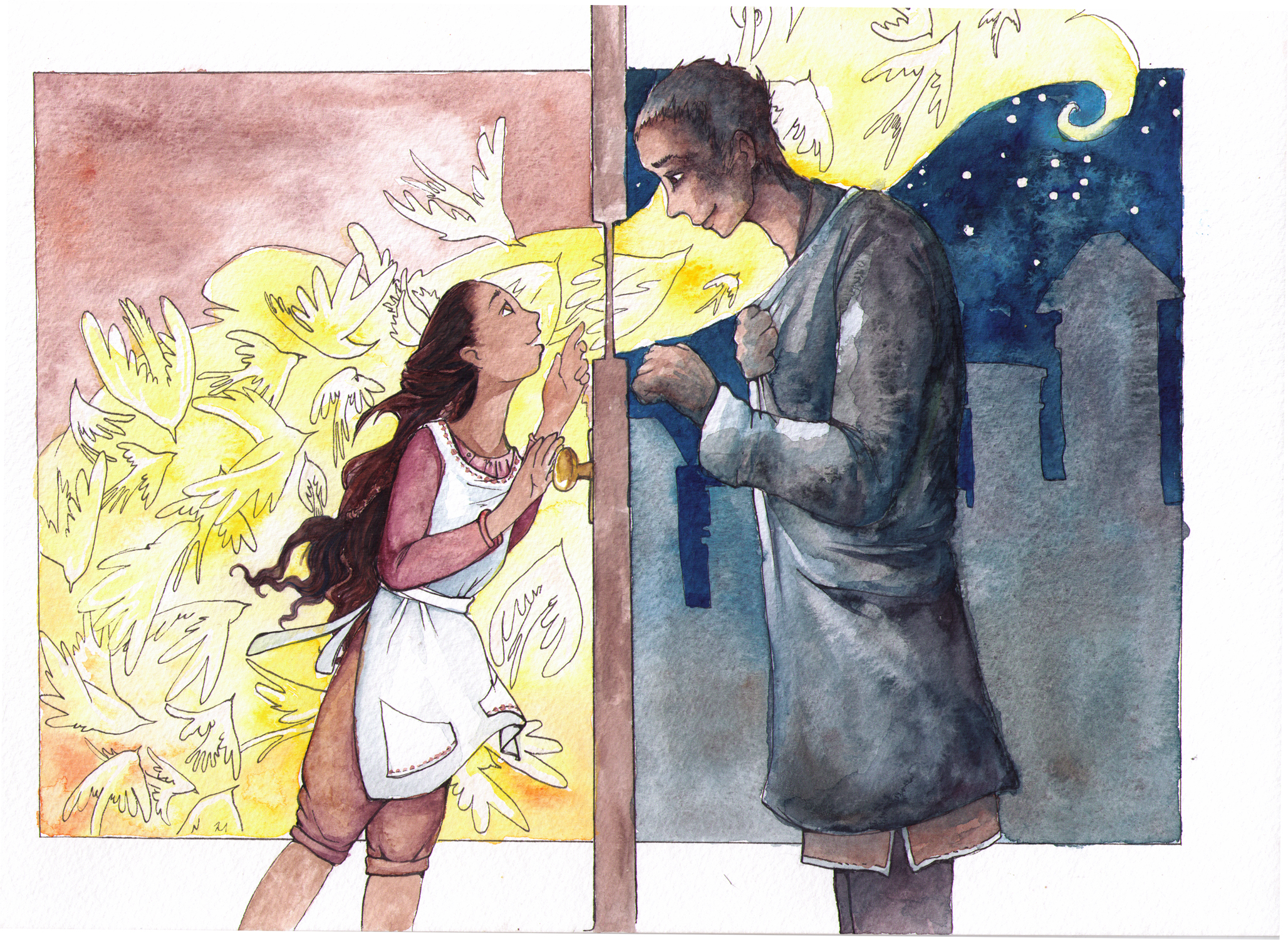
peter-and-rhodaActs 12:6-25

Now when Herod was about to bring him out, on that very night, Peter was sleeping between two soldiers, bound with two chains, and sentries before the door were guarding the prison.And behold, an angel of the Lord stood next to him, and a light shone in the cell. He struck Peter on the side and woke him, saying, “Get up quickly.” And the chains fell off his hands. And the angel said to him, “Dress yourself and put on your sandals.” And he did so. And he said to him, “Wrap your cloak around you and follow me.”And he went out and followed him. He did not know that what was being done by the angel was real, but thought he was seeing a vision. 10 When they had passed the first and the second guard, they came to the iron gate leading into the city. It opened for them of its own accord, and they went out and went along one street, and immediately the angel left him. 11 When Peter came to himself, he said, “Now I am sure that the Lord has sent his angel and rescued me from the hand of Herod and from all that the Jewish people were expecting.” 12 When he realized this, he went to the house of Mary, the mother of John whose other name was Mark, where many were gathered together and were praying. 13 And when he knocked at the door of the gateway, a servant girl named Rhoda came to answer. 14 Recognizing Peter’s voice, in her joy she did not open the gate but ran in and reported that Peter was standing at the gate. 15 They said to her, “You are out of your mind.” But she kept insisting that it was so, and they kept saying, “It is his angel!” 16 But Peter continued knocking, and when they opened, they saw him and were amazed. 17 But motioning to them with his hand to be silent, he described to them how the Lord had brought him out of the prison. And he said, “Tell these things to James and to the brothers.” Then he departed and went to another place. 18 Now when day came, there was no little disturbance among the soldiers over what had become of Peter. 19 And after Herod searched for him and did not find him, he examined the sentries and ordered that they should be put to death. Then he went down from Judea to Caesarea and spent time there.  20 Now Herod was angry with the people of Tyre and Sidon, and they came to him with one accord, and having persuaded Blastus, the king’s chamberlain, they asked for peace, because their country depended on the king’s country for food. 21 On an appointed day Herod put on his royal robes, took his seat upon the throne, and delivered an oration to them. 22 And the people were shouting, “The voice of a god, and not of a man!” 23 Immediately an angel of the Lord struck him down, because he did not give God the glory, and he was eaten by worms and breathed his last. 24 But the word of God increased and multiplied. 25 And Barnabas and Saul returned from Jerusalem when they had completed their service, bringing with them John, whose other name was Mark.

This is college football season, which means that many of us are living vicariously through the lives of young men who do not even know we exist.  But we get caught up in it because it is fun or because we have an allegiance to this or that school as alumni, or because it is a matter of state pride.  Truth be told, college football probably serves the same purpose for many men that soap operas serve for women:  an external emotional and psychological stimuli in which we immerse ourselves in a larger drama that, in truth, could take us or leave us.  But we watch and we cheer and we cry and we rage because, for whatever psychological reasons, these things matter to us.

Technology has helped the experience a bit because now, through the miracle of the internet or of DVR, we have the ability to watch the live broadcast tied in emotional knots then, afterward, to watch the recorded and replayed broadcast in a much more calm manner.  Why is this?  Because in the first instance we do not know what is going to happen.  In the second, for good or for ill, we do.

Watching replays of games is especially fun if you win a close game or come from behind and win.  In the replay experience you do not develop ulcers or nervous disorders no matter how far you are behind at the beginning of the fourth quarter because you know you are going to win!  When watching a replay of a come-from-behind victory, for instance, you are at peace, telling yourself, “I know we’ll win in the end.”

I would like to suggest that the Church throughout the ages has been in a similar boat.  No matter how dire things look, no matter how bleak our circumstances appear, and no matter how victorious the forces of darkness appear, we know we win in the end.  The first viewing of the story can be emotionally and psychologically grueling, to be sure.  There are times when we are tempted to think we might lose and the enemy might win, but the hope of the gospel reminds us time and time again that this is not so:  Christ our King has secured the victory!

Even so, it can be tough going.  Acts 12 is a chapter in which we can see this phenomenon at work:  the Church struggling to believe that it will win.  We see two players in this chapter, the struggling Church and the despotic King Herod.  It sets up perfectly as a contest between two forces, the one apparently weak and lowly and the other apparently strong and mighty.  John Stott summarized this chapter nicely.

Here then were two communities, the world and the church, arrayed against one another, each wielding an appropriate weapon. On the one side was the authority of Herod, the power of the sword and the security of the prison. On the other side, the church turned to prayer, which is the only power which the powerless possess.[1]

Let us watch this fascinating contest.  You will be encouraged by this!  Everybody loves an unlikely victory!

The Church thought their leader was dead, but God said, “Not yet!”

The early Church had seen some amazing highs and some heartbreaking lows, but this was one of their toughest seasons yet.  James had been beheaded and Peter was imprisoned awaiting, undoubtedly, the same fate.  The Church, then, can perhaps be forgiven for assuming that their earthly leader, Peter, was as good as dead.  Even so, God said, “Not yet!”

Now when Herod was about to bring him out, on that very night, Peter was sleeping between two soldiers, bound with two chains, and sentries before the door were guarding the prison.And behold, an angel of the Lord stood next to him, and a light shone in the cell. He struck Peter on the side and woke him, saying, “Get up quickly.” And the chains fell off his hands. And the angel said to him, “Dress yourself and put on your sandals.” And he did so. And he said to him, “Wrap your cloak around you and follow me.”And he went out and followed him. He did not know that what was being done by the angel was real, but thought he was seeing a vision.

The angel has to wake Peter up in a rather persuasive manner! Parents of teenage children will understand the feeling.  “He struck Peter on the side” and led him out of the prison.  Interestingly, Luke tells us that Peter assumed he was having a vision.  This is understandable, of course, because Peter had recently received his amazing vision of the lowered sheet and the unclean animals.  This current situation had to seem as unusual as that, so he assumes that he is seeing a vision.  But he is not.

10 When they had passed the first and the second guard, they came to the iron gate leading into the city. It opened for them of its own accord, and they went out and went along one street, and immediately the angel left him. 11 When Peter came to himself, he said, “Now I am sure that the Lord has sent his angel and rescued me from the hand of Herod and from all that the Jewish people were expecting.” 12 When he realized this, he went to the house of Mary, the mother of John whose other name was Mark, where many were gathered together and were praying. 13 And when he knocked at the door of the gateway, a servant girl named Rhoda came to answer. 14 Recognizing Peter’s voice, in her joy she did not open the gate but ran in and reported that Peter was standing at the gate. 15 They said to her, “You are out of your mind.” But she kept insisting that it was so, and they kept saying, “It is his angel!” 16 But Peter continued knocking, and when they opened, they saw him and were amazed. 17 But motioning to them with his hand to be silent, he described to them how the Lord had brought him out of the prison. And he said, “Tell these things to James and to the brothers.” Then he departed and went to another place. 18 Now when day came, there was no little disturbance among the soldiers over what had become of Peter. 19 And after Herod searched for him and did not find him, he examined the sentries and ordered that they should be put to death. Then he went down from Judea to Caesarea and spent time there.

Peter goes to a house where he knows the gathered church is praying intensely for him.  Stott notes that, “Luke uses the adverb ektenōs (JB, ‘unremittingly’; NEB, ‘fervently’), which he has previously applied to Jesus’ intense agony in Gethsemane.”[2]  This was likely a prayer mixed with cries of deliverance and protection.  They were praying for Peter to be delivered, but one wonders if they did not feel a measure of skepticism perhaps.  After all, James had been beheaded and Peter was surely going to face the same fate.  We may see a measure of this uncertainty in the fact that they cannot bring themselves to believe that Peter is actually standing at the gate outside of the house.

There is a note of humor here.  The servant girl Rhoda runs to the gate.  She is so stunned at the sight of Peter that she runs back in the house rejoicing…but leaving Peter still outside!  One cannot help but chuckle imagining Peter in this episode.  After all, he would very much like to get inside the house, especially given that he is a recently escaped fugitive!  The humor is intensified by irony when the gathered church, praying for Peter’s deliverance, refuses to believe that Peter has been delivered!  We must admit that it really was a rather abrupt answer to their prayer!

So they tell poor Rhoda that she must be mistaken or that it is Peter’s angel.  They may mean by that that it is Peter’s spirit or soul, assuming that he had been executed.  That, however, would be an odd usage of the word “angel.”  They more likely mean that it is Peter’s guardian angel or something along those lines.  Regardless, they cannot bring themselves to believe that this is so.

I am struck by this.  It does seem that the darkness is sometimes so dark that we have trouble believing that the light can break through…even as we are calling on God to let the light break through!  They cry out for God to save Peter but cannot bring themselves to accept that God had saved Peter.

Have you ever felt like this?  Have you even been so distraught that even as you pray you cannot bring yourself to believe that He might actually answer your prayers?  Something like this phenomenon was going on in the church in this episode.

The darkness and evil of the world can be suffocating.  It can disorient us.  Even those of us who know in the middle of the contest who wins in the end can have trouble really believing it.  Thus, the early Church had seemingly resigned itself to the inevitably of their earthly leader’s demise, but God said, “Not yet!”  Indeed, Peter would die a martyr’s death, but not yet!

There is a parallel to the resurrection account in this passage, and it is not difficult to see.  In both cases the struggling Church was gathered together under a sense of doom when they were caught off guard and shocked by resurrection:  the Lord Jesus’ from the dead and Peter’s from prison.  It seems that God is always catching His church off guard with resurrection, is He not?

This unlikely deliverance of Peter from a sentence of death was a reminder to the Church then and now that we are not allowed to despair, to give up hope.  We must believe that our God is the God who still speaks light in the darkness.

Perhaps another, more recent example will help.  The great New Testament scholar F.F. Bruce, in commenting on the deliverance of Peter from prison in Acts 12, pointed to the example of the Indian Christian and missionary, Sundar Singh, as a parallel to our text.

By order of the chief lama of a Tibetan community [Sundar Singh] was thrown into a dry well, the cover of which was securely locked. Here he was left to die, like many others before him, whose bones and rotting flesh lay at the bottom of the well. On the third night, when he had been calling to God in prayer, he heard someone unlocking the cover of the well and removing it. Then a voice spoke, telling him to take hold of the rope that was being lowered. He did so, and was glad to find a loop at the bottom of the rope in which he could place his foot, for his arm had been injured before he was thrown down. He was then drawn up, the cover was replaced and locked, but when he looked around to thank his rescuer, he could find no trace of him. The fresh air revived him, and his injured arm felt whole again. When morning came, he returned to the place where he had been arrested, and resumed preaching. News was brought to the chief lama that the man who had been thrown into the execution well had been liberated and was preaching again. Sundar Singh was brought before him and questioned, and told the story of his release. The lama declared that someone must have got hold of the key and let him out, but when search was made for the key, it was found attached to the lama’s own girdle.[3]

Yes, God is the God who speaks light into darkness and still says, “Not yet!” when things look most hopeless.

The world thought their leader was a god, but God said, “No!”

If the Church sometimes assumes less of the Lord God than we should, the world, conversely, assumes more of its leaders than it should.  The Church thought their leader was dead but he was not.  The world, however, proclaims their leader to be a god, but God decides to show them otherwise.  Here we see the demise of wicked Herod.

20 Now Herod was angry with the people of Tyre and Sidon, and they came to him with one accord, and having persuaded Blastus, the king’s chamberlain, they asked for peace, because their country depended on the king’s country for food. 21 On an appointed day Herod put on his royal robes, took his seat upon the throne, and delivered an oration to them. 22 And the people were shouting, “The voice of a god, and not of a man!” 23 Immediately an angel of the Lord struck him down, because he did not give God the glory, and he was eaten by worms and breathed his last. 24 But the word of God increased and multiplied. 25 And Barnabas and Saul returned from Jerusalem when they had completed their service, bringing with them John, whose other name was Mark.

What a startling scene!  It is as startling in its terror as Peter’s deliverance was startling in its beauty.  The people shout out and proclaim Herod a god.  Josephus wrote that Herod looked godlike in this scene because of the sun reflecting off of his silver armor.[4]  God, however, does not share His glory and He strikes Herod down in a way that is jarring and unsettling.  “An angel of the Lord struck him down…and he was eaten by worms and breathed his last.”  Why?  “Because he did not give God the glory.”

Herod made the fatal mistake of believing and embracing his own blasphemous press.  Leaders are wont to do such, and history is full of kings who came to believe that they were gods.  This scene reminded Jaroslav Pelikan of what John Dryden said of Alexander the Great:

With ravished ears,

The monarch hears;

Assumes the god,

Affects to nod,

And seems to shake the spheres.[5]

They seem to shake the spheres, but they actually have no power that is not granted them from on high.  If the Church needed to be lifted out of its despondency by an amazing display of God’s grace, the world needed to be humbled by an unforgettable display of God’s wrath.  While it seems as if the trajectory of the world is toward the victory of the fallen structures of the world and the continued diminishment of the life of the Church, this story reminds us that this is not ultimately so.  God wins!  Darkness is not destined to have victory.  Wicked kings do not get to play God forever and persecuted believers are not forever destined to die martyrs’ deaths.

Which is simply to say that, in the end, the kings of the earth will be brought low and the lowly Church of Christ will be exalted.

T.R. Glover, in commenting on Nero having the Apostle Paul executed, famously noted that the day would come when men would call their dogs Nero and their sons Paul.  And precisely this has come to pass as Christianity has advanced in the world.  Where is Nero?  He has been cast onto the trash heap of history.  And Paul and Peter and the apostles?  We continue the message that Christ bequeathed to them to this very day.  We stand with the cloud of witnesses who have refused to abandon the light for darkness and who have dared to believe the heralded message of the inevitable victory of Christ!


[1] Stott, John (2014-04-02). The Message of Acts (The Bible Speaks Today Series) (Kindle Locations 3704-3706). InterVarsity Press. Kindle Edition.

[2] Sott, Kindle Locations 3700-3702

[3] Bruce, F.F. (1988-06-30). The Book of Acts (New International Commentary on the New Testament) (p. 236-237). Eerdmans Publishing Co – A. Kindle Edition.

[4] William H. Willimon, Acts. Interpretation. (Louisville, KY: John Knox Press, 1988), p.40.

[5] Jaroslav Pelikan, Acts. Brazos Theological Commentary on the Bible. (Grand Rapids, MI: Brazos Press, 2005), p.150-151.

Acts 12:1-5

giacomopiazzetta_martyrdomofstjamesActs 12:1-5

1 About that time Herod the king laid violent hands on some who belonged to the church. 2 He killed James the brother of John with the sword, 3 and when he saw that it pleased the Jews, he proceeded to arrest Peter also. This was during the days of Unleavened Bread. 4 And when he had seized him, he put him in prison, delivering him over to four squads of soldiers to guard him, intending after the Passover to bring him out to the people. 5 So Peter was kept in prison, but earnest prayer for him was made to God by the church.

Johann Spangenberg, a lesser known reformer, once pointed to the weather as an analogy for the way that persecutions come and go in the life of the early Church.

Christianity is like April weather, which is erratic and changes nearly every hour:  now it is snowing, soon it begins to rain, now the sun is shining, but then it is cloudy.  So it went in the early church:  Christ preached in Judea and Galilee in good peace for a season, then came a storm.  Christ was imprisoned, crucified and killed.  But this storm dissipated quickly, Christ arose from the dead, ascended to heaven, sent his Holy Spirit.  Whenever the dear Son shone, the Christians rejoiced, but before they could look around, it thundered and there was lightning again!  But this thunder and lightning also had an end; the dear Son broke out again.[1]

I daresay we might extend this analogy to our own day as well.  Honestly, which of us does not turn on the news with some hesitation these days, praying that we do not see yet another person in an orange jump suit on their knees beside a knife-wielding member of Isis?  Some of these men are journalists, of course, but many of them have been Christians, and there can be no doubt that the Church has been the special object of Isis’ murderous rage.

The early Church experienced the same unsettling dynamic.  They knew not what would come from one day to the next, so they rooted and grounded themselves in the changeless person of Christ Jesus the Lord.  There were periods of suffering.  There were periods of peace.  But the secret of the Church was that it transcended these temporal things and took its hope from the very throne of Heaven, at the right hand of which Christ was interceding for His people.

The Church suffers as a result of the political calculations of wicked men.

There is a uniquely political element in the persecution described in Acts 12, an element that mirrors the dynamics surrounding the trial of Jesus.

1 About that time Herod the king laid violent hands on some who belonged to the church.

Here we find yet another Herod breathing out yet more murder and hatred against Christ and His followers.  This Herod is not the Herod who sat on the throne at the birth of Christ.  This is his grandson.  Let us consider some interesting and helpful information about this Herod.  We will begin with some insights from A.T. Robertson.

Herod Agrippa I, grandson of Herod the Great, was King of Palestine A.D. 42-44; only for these three years was a Herod king over Palestine since the death of Herod the Great and never afterwards…Herod Agrippa I was an Idumean through his grandfather Herod the Great and a grandson of Mariamne the Maccabean princess.  He was a favourite of Caligula the Roman Emporer and was anxious to placate his Jewish subjects while retaining the favour of the Romans.  So he built theatres and held games for the Romans and Greeks and slew the Christians to please the Jews.[2]

Robertson hit on the key political dynamic at this point in the story by pointing out that Herod “was anxious to placate his Jewish subjects while retaining the favour of the Romans.”  R. Kent Hughes has passed on even more fascinating background information:

His father, Aristobulus, had been murdered by his own father, Herod the Great, the ruler who had ordered the slaughter of innocent babies at Christ’s birth.  After the death of Aristobulus, the Herod of Acts 12 was sent to Rome to be educated, and there he grew up as a close friend of the imperial family.  He was something of a playboy, and in A.D. 23 he fled to Palestine to escape his creditors.  In Palestine he lived in humility and poverty under his uncle, Herod Antipas.

            Upon his return to Rome, he was imprisoned by the Emperor Tiberius for some critical remarks he had made.  His life had hit bottom.  But then Tiberius died, and Herod’s childhood friend, Caligula, came to power – not only freeing him from prison, but giving him a gold chain weighing as much as his iron fetters in prison.  Soon Herod was named ruler of some Palestinian provinces.  When another childhood friend, Claudius, succeeded Caligula, Herod became ruler of Judea and Samaria.  Murder and intrigue had been the currency of his entire life.

            Herod was preeminently a politician.  When he was with the Romans he did as the Romans did.  Though he was Jewish only by race and not by conviction, when he was with the Jews he acted like a Jew.  The Mishnah records that during the annual procession bearing the first fruits to the temple, “when they reached the temple Mount, Agrippa the king [Herod] would take his basket on his shoulder and enter as far as the Temple Court.”  He would do anything to maintain his popularity with the Jewish people.[3]

The picture that emerges is one of a conniving, posturing opportunist who came from a wicked, pernicious family and whose primary interest was the securing of his own comfort and favor in the eyes of even more powerful men.  This is our Herod.  He was a Jew when he needed to be and a Roman when he needed to be.  Like Herod, he found himself faced with an opportunity to placate his Jewish subjects and to endear himself to his Roman overlords.  The opportunity came in the form of the new Jesus movement that was unsettling the Jews and, as a result, the Romans as well.

Thus, Herod strikes out, laying “violent hands” on the Church.  This is a stark contrast to the merciful hands of Christ, the saving hands of Christ.  Herod’s hands bore murder and mayhem.  Christ’s hands bear life and peace.

We should not miss, however, that the Church suffers as a result of the political calculations of wicked men.  Herod, like Pilate, strikes out at Christ with his own security in mind.  In so doing, he was striking out against the Lord of life.  There is a bitter irony here:  in seeking to secure himself, he undid himself, for Christ will not be conquered by anybody, much less by wicked kings.  David said as much in Psalm 2.

1 Why do the nations rage and the peoples plot in vain?

2 The kings of the earth set themselves, and the rulers take counsel together, against the Lord and against his Anointed, saying,

3 “Let us burst their bonds apart and cast away their cords from us.”

4 He who sits in the heavens laughs; the Lord holds them in derision.

5 Then he will speak to them in his wrath, and terrify them in his fury, saying,

6 “As for me, I have set my King on Zion, my holy hill.”

7 I will tell of the decree: The Lord said to me, “You are my Son; today I have begotten you.

8 Ask of me, and I will make the nations your heritage, and the ends of the earth your possession.

9 You shall break them with a rod of iron and dash them in pieces like a potter’s vessel.”

10 Now therefore, O kings, be wise; be warned, O rulers of the earth.

11 Serve the Lord with fear, and rejoice with trembling.

12 Kiss the Son, lest he be angry, and you perish in the way, for his wrath is quickly kindled. Blessed are all who take refuge in him.

Herod refused to “kiss the Son.”  Instead, he struck out at the Son.  As a result, he would pay a terrible price, but not before the Church suffered as a result of his demonic arrogance.

Some are killed and some suffer, but the Church rallies in prayer.

The specific objects of Herod’s persecution are James and Peter.

2 He killed James the brother of John with the sword, 3 and when he saw that it pleased the Jews, he proceeded to arrest Peter also. This was during the days of Unleavened Bread. 4 And when he had seized him, he put him in prison, delivering him over to four squads of soldiers to guard him, intending after the Passover to bring him out to the people. 5 So Peter was kept in prison, but earnest prayer for him was made to God by the church.

Peter is imprisoned because they cannot kill him immediately due to the holy days of the Jewish Passover.  We will deal more with Peter in the verses to come, but let us consider the heartbreaking words of verse 2:  “He killed James the brother of John with the sword.”  This is  almost certainly a way of describing beheading.

This James is not James, the brother of Jesus.  This is the disciple James, the brother of John.  In Mark 3:17 we see James and John referenced as “James the son of Zebedee and John the brother of James (to whom he gave the name Boanerges, that is, Sons of Thunder).”

I am struck by the understated nature of Luke’s description of his martyrdom.  We do not get the full and detailed account that we get in the martyrdom of Stephen.  Here the words are as bare and simple as a knife thrust.  They unsettle us.

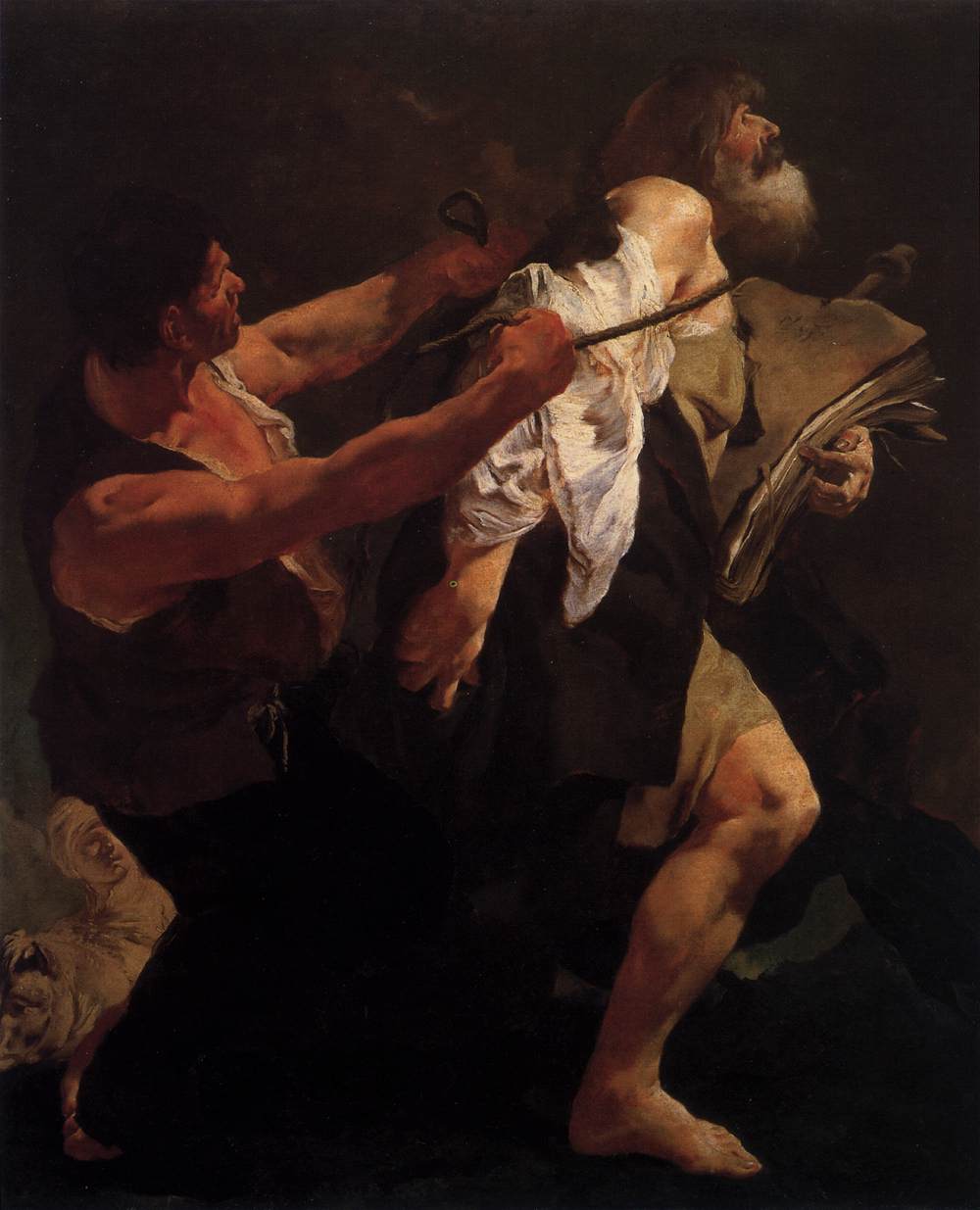
There is a 1722 painting, “Martyrdom of St James” by Giacomo Piazzetta, that captures well the martyrdom of James.  In the painting, James is being restrained by a rope that is held by his persecutor.  He is being bound for his martyrdom, his execution.  As I look at this painting, I cannot help but think of an earlier scene involving James.  It is in Matthew 20 and, initially, it does not cast James or his brother John in a good light.  But read in the knowledge of what we know happens in Acts 12:1, there is something powerful about this.

20 Then the mother of the sons of Zebedee came up to him with her sons, and kneeling before him she asked him for something. 21 And he said to her, “What do you want?” She said to him, “Say that these two sons of mine are to sit, one at your right hand and one at your left, in your kingdom.” 22 Jesus answered, “You do not know what you are asking. Are you able to drink the cup that I am to drink?” They said to him, “We are able.” 23 He said to them, “You will drink my cup, but to sit at my right hand and at my left is not mine to grant, but it is for those for whom it has been prepared by my Father.”

The mother of the Sons of Thunder, apparently with their agreement, asks for positions of authority and favor for her sons.  Jesus dismisses the request but asks a deeper more probing question of the James and John:  “Are you able to drink the cup that I am to drink?”  “We are able,” they respond.

“Can you really suffer as I am going to suffer,” Christ asks?

“I can,” James responds.

At the time, he could have had no real idea what he was saying, but in Acts 12:1 he did.  And we can be sure that the immature James of Matthew 20 had grown a great deal before he became the martyr James of Acts 12.

Did he remember the question Jesus had asked him when they put the sword to his neck?  Did he perhaps repeat his answer again?  “We are able.  We are able.”

James did indeed take the cup of suffering, and, in so doing, he sealed his testimony with his blood.  He identified with Christ in that powerful way that only a martyr can understand.  He drank the cup to the full and bled for the truth of the gospel.

The Church’s reaction was telling.  They prayed.  They did not protest.  They prayed.  John Chrysostom noted that “they did not divide into factions or make an uproar but turned to prayer, that true alliance which is invincible.  In this they sought refuge.”[4]

This truly is the great refuge of the Church:  prayer.  This is not passivity.  It is anything but.  This is a weapon against the darkness.  Prayer beseeches the throne of Heaven to hear and act.  Prayer is the heart’s cry of the people of God for God to rise up and vindicate His name on the earth.

The devil wounded the Church, but Christ would yet crush the devil’s head.  Johann Spangenberg put it succinctly and well.

The more Christians are persecuted and slaughtered, the more Christians are born…And in Christians’ blood the devil must be drowned.[5]

Amen and amen.


[1] Esther Chung-Kim and Todd R. Hains, eds. Acts. Reformation Commentary on Scripture. New Testament, vol.VI. Timothy George, gen. ed. (Downers Grove, IL: InterVarsity Press, 2014), p.160.

[2] A.T. Robertson, Acts. Word Pictures in the New Testament. Vol.III (Nashville, TN: Broadman Press, 1930), p.163-164.

[3] R. Kent Hughes, Acts. (Wheaton, IL: Crossway Books, 1996), p.164.

[4] Francis Martin, ed. Acts. Ancient Christian Commentary on Scripture. New Testament, vol.V. Thomas C. Oden, gen. ed. (Downers Grove, IL: InterVarsity Press, 2006), p.152.

[5] Esther Chung-Kim and Tood R. Hains, p.155.

Acts 11

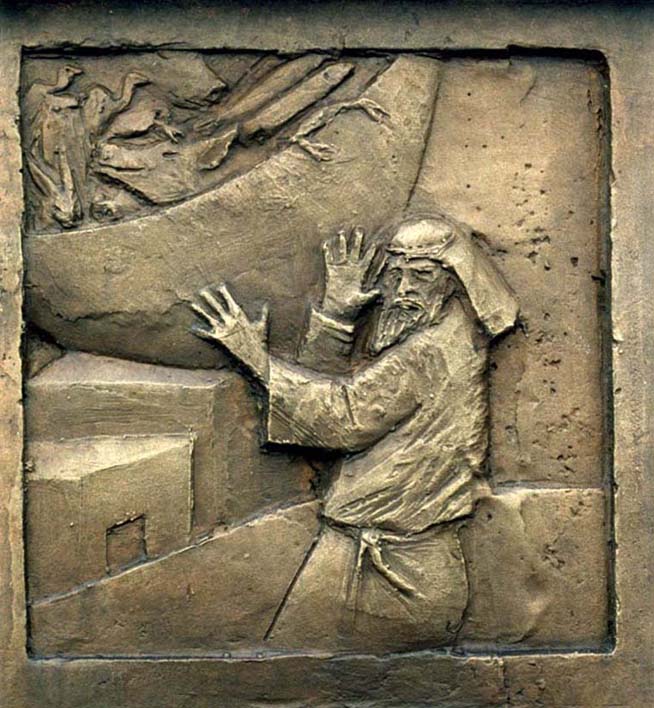
200_19Acts 11

1 Now the apostles and the brothers who were throughout Judea heard that the Gentiles also had received the word of God. 2 So when Peter went up to Jerusalem, the circumcision party criticized him, saying, 3 “You went to uncircumcised men and ate with them.” 4 But Peter began and explained it to them in order: 5 “I was in the city of Joppa praying, and in a trance I saw a vision, something like a great sheet descending, being let down from heaven by its four corners, and it came down to me. 6 Looking at it closely, I observed animals and beasts of prey and reptiles and birds of the air. 7 And I heard a voice saying to me, ‘Rise, Peter; kill and eat.’ 8 But I said, ‘By no means, Lord; for nothing common or unclean has ever entered my mouth.’ 9 But the voice answered a second time from heaven, ‘What God has made clean, do not call common.’ 10 This happened three times, and all was drawn up again into heaven. 11 And behold, at that very moment three men arrived at the house in which we were, sent to me from Caesarea. 12 And the Spirit told me to go with them, making no distinction. These six brothers also accompanied me, and we entered the man’s house. 13 And he told us how he had seen the angel stand in his house and say, ‘Send to Joppa and bring Simon who is called Peter; 14 he will declare to you a message by which you will be saved, you and all your household.’ 15 As I began to speak, the Holy Spirit fell on them just as on us at the beginning. 16 And I remembered the word of the Lord, how he said, ‘John baptized with water, but you will be baptized with the Holy Spirit.’ 17 If then God gave the same gift to them as he gave to us when we believed in the Lord Jesus Christ, who was I that I could stand in God’s way?” 18 When they heard these things they fell silent. And they glorified God, saying, “Then to the Gentiles also God has granted repentance that leads to life.” 19 Now those who were scattered because of the persecution that arose over Stephen traveled as far as Phoenicia and Cyprus and Antioch, speaking the word to no one except Jews. 20 But there were some of them, men of Cyprus and Cyrene, who on coming to Antioch spoke to the Hellenists also, preaching the Lord Jesus. 21 And the hand of the Lord was with them, and a great number who believed turned to the Lord. 22 The report of this came to the ears of the church in Jerusalem, and they sent Barnabas to Antioch. 23 When he came and saw the grace of God, he was glad, and he exhorted them all to remain faithful to the Lord with steadfast purpose, 24 for he was a good man, full of the Holy Spirit and of faith. And a great many people were added to the Lord. 25 So Barnabas went to Tarsus to look for Saul, 26 and when he had found him, he brought him to Antioch. For a whole year they met with the church and taught a great many people. And in Antioch the disciples were first called Christians. 27 Now in these days prophets came down from Jerusalem to Antioch. 28 And one of them named Agabus stood up and foretold by the Spirit that there would be a great famine over all the world (this took place in the days of Claudius). 29 So the disciples determined, every one according to his ability, to send relief to the brothers living in Judea. 30 And they did so, sending it to the elders by the hand of Barnabas and Saul.

Some years ago a friend of mine asked me to take a ride with him.  He took me to an old, largely empty house in this small rural town in South Georgia.  Inside the house there were a number of boxes containing books.  He informed me that he wanted me to look through the books, taking whichever titles I wanted.  As it turned out, my friend had been the pastor of the man who lived in this house and had become the executor of the man’s estate before his passing.  The man had no family to speak of and so the books were at my friend’s disposal.

As I looked through the boxes I was immediately struck by the weight of the titles and subjects.  Many were books on philosophy and many on theology and church history and biblical studies.  Curious, I asked my friend who exactly this man had been.  He explained to me that he had taught philosophy at a small liberal arts college in an adjoining town and had also spent some time as a pastor.  He went on to tell me a story that struck me then and now as tragic and deeply saddening.

The man whose books I was perusing had served as the pastor of a small, rural Southern Baptist church not too far from the church I was pastoring at that time.  My friend told me that in 1956 his friend had gone into the pulpit of that church and preached a message on the practical implications of the cross, one of which being that all people of all races who came to Christ were now part of one family and one Church.  As such, he informed his church, no church should bar anyone entry into membership on the basis of skin color.  This was, as you might imagine, a very controversial sentiment for a pastor to make in the Deep South in the 1950’s.

My friend went on to inform me that after the service the pastor went to lunch and out visiting.  When he returned for the evening service, all of his furniture had been moved out into the front yard and he was handed his last check along with the news that he was no longer the pastor of that church.

My friend told me that the gentleman never preached again.

I keep this man’s books on my shelves.  They have an added meaning to me.  They stand now not only as books but also as living memorials to the convictions of a man who dared to think through what it meant that Christ laid down His life and rose from the grave.  The consistency and courage of his convictions cost him a job, but won him, I am convinced, the favor of the Father.  Surely the Father is pleased when one of His ministers speaks the truth of the gospel to a Church culture that refuses to follow her King into the uncomfortable places.

In every one of this man’s books I put a sticker briefly recounting his story.  That is so I will not forget.  That is so the next guy who is one day thumbing through my box of books asking, “Who was this guy?” will not forget.

I know very little else about the man whose books I now own, but this I know:  he understood Jesus, he understood the cross, and he understood the seismic shift that had to happen in the minds of the first Jewish converts for them to be able to receive into the fellowship of the faith those whom they had been conditioned to view as unwelcomed outsiders and strangers.

There will often be opposition to the extent of God’s grace within the Church.

As we approach Acts 11, let us look at an unpleasant truth square in the face:  there will often be opposition to the extent of God’s grace within the Church.  Remember that in chapter 10, God had brought Peter together with the Gentile God-fearer Cornelius.  God there taught Peter a lesson:  Christ has opened the door for all to come in, even the Gentiles.  Furthermore, it was no longer appropriate for the Jewish believers to view the Gentile believers as unclean or unworthy.  On the contrary, the same Spirit comes to all through Christ, and the Church is therefore charged with the task of incarnating that oneness.

Peter learned this, but the Church at large had not yet learned this.  Thus, when Peter goes back to the mother church in Jerusalem, he finds a people who are none too pleased.

1 Now the apostles and the brothers who were throughout Judea heard that the Gentiles also had received the word of God. 2 So when Peter went up to Jerusalem, the circumcision party criticized him, saying, 3 “You went to uncircumcised men and ate with them.”

Ah!  We see the rub:  Peter had dared to eat with Gentiles.  John Chrysostom pointed out to his congregation that the Jewish Christians in Jerusalem did not ask, “Why did you preach to them?” but asked “Why did you eat with them?”[1]  This was a scandal!  In eating with the Gentiles he had done what no good Jew would do.  He had sullied himself, dirtied himself in table fellowship with the unclean, outsider Gentiles.  This was unacceptable!  We must remember that while these dear people who are questioning Peter had indeed accepted Christ, they had not yet fully thought the matter through.

Peter’s response is rich with pastoral gentleness and wisdom.  He decides that there is nothing to do but tell the incensed brothers and sisters the story of what happened.

4 But Peter began and explained it to them in order: 5 “I was in the city of Joppa praying, and in a trance I saw a vision, something like a great sheet descending, being let down from heaven by its four corners, and it came down to me. 6 Looking at it closely, I observed animals and beasts of prey and reptiles and birds of the air. 7 And I heard a voice saying to me, ‘Rise, Peter; kill and eat.’ 8 But I said, ‘By no means, Lord; for nothing common or unclean has ever entered my mouth.’ 9 But the voice answered a second time from heaven, ‘What God has made clean, do not call common.’ 10 This happened three times, and all was drawn up again into heaven. 11 And behold, at that very moment three men arrived at the house in which we were, sent to me from Caesarea. 12 And the Spirit told me to go with them, making no distinction. These six brothers also accompanied me, and we entered the man’s house. 13 And he told us how he had seen the angel stand in his house and say, ‘Send to Joppa and bring Simon who is called Peter; 14 he will declare to you a message by which you will be saved, you and all your household.’ 15 As I began to speak, the Holy Spirit fell on them just as on us at the beginning. 16 And I remembered the word of the Lord, how he said, ‘John baptized with water, but you will be baptized with the Holy Spirit.’ 17 If then God gave the same gift to them as he gave to us when we believed in the Lord Jesus Christ, who was I that I could stand in God’s way?”

It is an amazing story, and one that needed to be told.  It is the story we read in Acts 10, the previous chapter.  William Barclay noted the significance of the fact that Luke devoted so much space to telling and then retelling this story of Peter and Cornelius.  Barclay concludes, “Luke was right.  We usually do not realize how near Christianity was to becoming only another kind of Judaism.”[2]

This cannot be overstated:  everything hinged on these early Jewish converts coming to understand what was meant by the gospel.  What was at question here was whether or not Christ and Christ alone was sufficient.  What was at question was whether or not believers in Christ also needed to be circumcised and keep the dietary laws, that is, whether or not believers in Christ also needed to be Jews.  It is a question that haunted the early church and it would dominate the writings of Paul.

Again, these were not evil men questioning Peter.  These were followers of Jesus.  However, they were followers of Jesus who were struggling to take on the mind of Christ.  They were growing up in the gospel.  Peter had to do it first, then Peter helped them to do it.  The response of the gathered Church was amazing.

18 When they heard these things they fell silent. And they glorified God, saying, “Then to the Gentiles also God has granted repentance that leads to life.”

They fell silent, pondering these things.  Then they rejoiced!  “Well, it looks like the Gentiles get to come in too!”

What an amazing, beautiful scene!  The gospel breaks through!  They decide to embrace the radical conclusions of the gospel in action and open their arms to the Gentiles.  This will be a slow and painful process as there was much that had to be undone in their own assumptions, but it had to be done.

The missional life of the Church should be as wide as God’s mercy.

In the light of Peter’s sermon, there was only one unescapable conclusion:  the missional life of the Church should be as wide as God’s mercy.  Who the Lord God invites should be invited…and He invites all! 

19 Now those who were scattered because of the persecution that arose over Stephen traveled as far as Phoenicia and Cyprus and Antioch, speaking the word to no one except Jews.

Here we see that the maturation of the Church on these questions was slow and, in a sense, in stages.  At this point we have essentially two factions in the Church:  those Jewish converts who still felt that one had to be a good Jew in addition to accepting Christ and those who understood that Christ was Himself the fulfillment of the law and the prophets, and that, in Him, we are rendered clean and righteous and right.  So some continue to preach only to the Jews, but others step out further.

20 But there were some of them, men of Cyprus and Cyrene, who on coming to Antioch spoke to the Hellenists also, preaching the Lord Jesus. 21 And the hand of the Lord was with them, and a great number who believed turned to the Lord.

Let us notice that “the hand of the Lord” was with the men and women who took the gospel outside of their comfort zones and proclaimed it to the Gentiles, to outsiders.  This is not to suggest that there were not genuine conversions as a result of the preaching of the group who went only to the Jews, but it is almost certain that this is Luke’s way of highlighting the critical fact that those who made their preaching as wide as the mercy of God were those who held the special blessing of God.  They preached no stunted gospel.  They preached the full, robust, radical, paradigm-shattering gospel of Christ to all!

They preached it in the city of Antioch.  John Polhill calls Antioch “a natural setting for the Gentile missions,” pointing out that Antioch “was the third largest city in the Roman empire” with a “population of some 500,000 to 800,000” which made it third to Rome and Alexandria.[3]  It was therefore a critical population center and a strategic one.  They preached boldly and passionately in this great city.  As a result, many are saved…and as a result of that, the Church once again has to think through what to do.  So they send a representative.  This is not unusual.  They did the same when Philip took the gospel to the Samaritans.  But who they sent is most telling.

22 The report of this came to the ears of the church in Jerusalem, and they sent Barnabas to Antioch. 23 When he came and saw the grace of God, he was glad, and he exhorted them all to remain faithful to the Lord with steadfast purpose, 24 for he was a good man, full of the Holy Spirit and of faith. And a great many people were added to the Lord. 25 So Barnabas went to Tarsus to look for Saul, 26a-b and when he had found him, he brought him to Antioch. For a whole year they met with the church and taught a great many people.

They send Barnabas.  Why?  Because this great man had already demonstrated a capacity to take his cross well beyond the comfort zone into the unsettling but exhilarating fields of the grace of God.  He had done this earlier by putting his arm around Paul while everybody else was shrinking away in fear.  He was a man who embraced when others were tempted to shun.  But Barnabas’ embrace was not one of mere sentimentality.  It was one of rock solid conviction.  It was because he understood Jesus that Barnabas embraced Paul and helped bring him into the church.  It was because he understood Jesus that Barnabas was now sent to Antioch to embrace this most unexpected Gentile believer.

Tellingly, upon seeing what had happened in Antioch, Paul went and brought the one person who could also understand:  Paul.  How unbelievably beautiful!  This former Pharisee of the Pharisees understood better than most what it was to be an unlikely convert.  He had experienced the awkwardness of the suspicious eyes of the Church.  He knew what it was to be drawn to a Church that did not quite know what to make of his presence.

So these two champions go to Antioch.  They go and they stay and they live and they teach and they grow together in the grace of the Lord Jesus!

26c And in Antioch the disciples were first called Christians. 27 Now in these days prophets came down from Jerusalem to Antioch. 28 And one of them named Agabus stood up and foretold by the Spirit that there would be a great famine over all the world (this took place in the days of Claudius). 29 So the disciples determined, every one according to his ability, to send relief to the brothers living in Judea. 30 And they did so, sending it to the elders by the hand of Barnabas and Saul.

In Antioch, they are first called Christians.  The believers were called “Christiani” in Antioch.  Barclay points out that “-iani” means “belonging to the party of” and that the name Christiani would have meant something like “These Christ-folk.”[4]  It was not, initially, a compliment.  It was almost certainly a slight from outsiders.  Tellingly, however, the Church embraced the name seeing in it a more than apt description of who they were.

For our purposes, it is noteworthy to consider how the name “Christian” itself helped to break down the divisions between the Jewish believers and the Gentile believers.  It did so by removing the front-end qualifier and grounding the Church’s identity in Christian alone.  “These Christ-folk” were no longer Jewish Christ-folk or Gentile Christ-folk.  They were just Christ-folk.

It is possible that in so calling the believers Christians, the outside world inadvertently helped them embrace the only path to unity available to them.  They were now simply Jesus people, and, in Christ, the old distinctions melt away.  Paul would later put it beautifully in Galatians 3:28 when he would write, “There is neither Jew nor Greek, there is neither slave nor free, there is no male and female, for you are all one in Christ Jesus.”

You are all one.

We are all one.

A great Christian from yesteryear, Gregory of Nyssa, once powerfully spoke of the reality of the leveling effect of everybody being called “Christian.”

Our good Master, Jesus Christ, bestowed on us a partnership in his revered name, so that we get our name from no other person connected with us, and if one happens to be rich and well-born or of lowly origin and poor, or if one has some distinction from his business or position, all such conditions are of no avail because the one authoritative name for those believing in him is that of Christian.[5]

“All such conditions are of no avail.”

Why?

Because Christ has triumphed not only over sin, death, and hell…but also over our divisions.

We are one in Christ.

Be one in Christ.


[1] Francis Martin, ed. Acts. Ancient Christian Commentary on Scripture. New Testament, vol.V. Thomas C. Oden, gen. ed. (Downers Grove, IL: InterVarsity Press, 2006), p.142.

[2] William Barclay, Acts. The Daily Study Bible. (Edinburgh: The Saint Andrew Press, 1969), p.50.

[3] John B. Polhill, Acts. The New American Commentary. Vol.26. David Dockery, gen. ed. (Nashville, TN: Broadman Press, 1992), p.268.

[4] Barclay, p.95.

[5] Martin, p.148.

Irenaeus’ Against Heresies – Book I (Patristic Summaries Series)

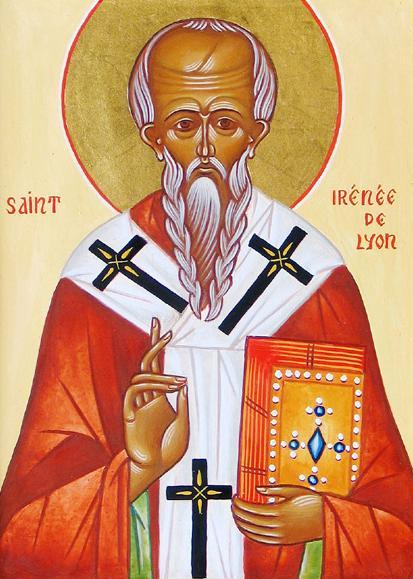
saint_irenaeus_oflyonsIrenaeus was a brilliant 2nd century churchman and bishop of Lyon whose major contribution to the Church is his five-book-work, Against Heresies.  Book I is a dizzying and seemingly exhaustive account of the false teachings of the gnostics, particularly of Valentinianism.  Irenaeus researched and wrote the book in order to provide the Church a clear understanding and refutation of the gnostic heresies.

Throughout Book I, Irenaeus essentially lets the gnostics speak for themselves.  Again, it is astonishing the amount of detail he provides in doing this.  The reader may find himself growing numb at the long descriptions of gnostic eisegesis, numerology, mythology, and symbolism.  Irenaeus is nearly encyclopedic in his chronicle, and the thoroughness with which he approached his task cannot help but impress.

I was struck throughout by a sense of the importance of Irenaeus’ example for Christian apologists and, indeed, for all Christians today.  He does not appear to be attempting to caricature his opponents, whether or not his descriptions were completely accurate.  He provides more than ample space for his description of their views.  This, it seems to me, is admirable.  The work does not read like a modern hatchet job.  It reads almost like a dispassionate description (in his descriptions of the gnostic beliefs, anyway), though it is anything but.  Even so, here we find a model for the quality of effort we should make to understand that about which we are speaking.

In contrast to the gnostic heresies, Irenaeus makes some powerful statements about Christian truth and offers some notable summaries of such.  For instance:

The Church, though dispersed through our the whole world, even to the ends of the earth, has received from the apostles and their disciples this faith: [She believes] in one God, the Father Almighty, Maker of heaven, and earth, and the sea, and all things that are in them; and in one Christ Jesus, the Son of God, who became incarnate for our salvation; and in the Holy Spirit, who proclaimed through the prophets the dispensations of God, and the advents, and the birth from a virgin, and the passion, and the resurrection from the dead, and the ascension into heaven in the flesh of the beloved Christ Jesus, our Lord, and His [future] manifestation from heaven in the glory of the Father “to gather all things in one,” and to raise up anew all flesh of the whole human race, in order that to Christ Jesus, our Lord, and God, and Saviour, and King, according to the will of the invisible Father, “every knee should bow, of things in heaven, and things in earth, and things under the earth, and that every tongue should confess” to Him, and that He should execute just judgment towards all; that He may send “spiritual wickednesses,” and the angels who transgressed and became apostates, together with the ungodly, and unrighteous, and wicked, and profane among men, into everlasting fire; but may, in the exercise of His grace, confer immortality on the righteous, and holy, and those who have kept His commandments, and have persevered in His love, some from the beginning [of their Christian course], and others from [the date of] their repentance, and may surround them with everlasting glory.

[The Church Fathers (2014-06-12). The Complete Ante-Nicene & Nicene and Post-Nicene Church Fathers Collection (Kindle Locations 11938-11949). Catholic Way Publishing. Kindle Edition.]

Furthermore, I was struck by Irenaeus’ strong biblicism.  Here is one of his criticisms of the gnostics:  “They gather their views from other sources than the Scriptures” (Kindle Location 11792).  Furthermore, Book I is replete with biblical citations as well as examples of passages that the gnostics twist to their own ends.

I suppose what I found most refreshing and convicting, however, was Irenaeus’ conviction that Christianity does have a doctrinal core and content that is not open to editing.  On this basis, he confidently argues for an existing catholicity of doctrine around the world.

For the Churches which have been planted in Germany do not believe or hand down anything different, nor do those in Spain, nor those in Gaul, nor those in the East, nor those in Egypt, nor those in Libya, nor those which have been established in the central regions of the world. But as the sun, that creature of God, is one and the same throughout the whole world, so also the preaching of the truth shineth everywhere, and enlightens all men that are willing to come to a knowledge of the truth (Kindle Locations 11953-11956).

In a day in which the very definition of Christianity is consistently undermined by those who appear to believe that the word “Christian” means whatever a given individual or group wants it to mean, it is refreshing to see such a clear and robust defense of the idea of the faith once for all delivered to the saints.

Finally, one cannot help but be struck by the courage and passion of Irenaeus himself.  Simply put, one would not want to be on the receiving end of his critical attention.  Irenaeus clearly had a deep, abiding love for the truth of the gospel and felt a personal responsibility to stop the spread of heresies in the life of the Church.  As such, he stands even today as a champion of biblical, orthodox belief.

Personal Reflections on the Film “Calvary”

calvary-movie-2014There are films that catch you off guard, that overwhelm you with unexpected beauty or agony or power or some combination thereof.  “Calvary” is one such film.  In a day in which our cinematic choices are increasingly formulaic and uncreative, it is rare to encounter a film that you might call truly unique and, indeed, a work of art.

This is an Irish film about a priest, Father James, who is informed by a parishioner in the confessional in the opening scene of the movie that he is going to kill Father James one week from that day, on a Sunday on the beach.  The reason is because he wants Father James to pay for the sins of the priests who have sexually abused countless children over the years, of which he, the man making the threat, was one.  It is a chilling opening, and one that jars the viewer from the very beginning.

In the week that follows we are able to see the various colorful and often disturbing characters that live in the beautiful village where Father James lives.  Through these characters, director John Michael McDonagh offers a panoply of embodied accusations against the Church and the clergy on various fronts:  (most notably) sexual abuse, the Church’s wealth, and the Church’s abuse of the poor in the overseas missions.  Furthermore, some characters embody doubts about or challenges to the Church’s theology of God.  This is done through the character of an atheist doctor as well as a doubting priest.

Through this fascinating and often disturbing assemblage of eclectic but poignant personalities, Father James walks with wisdom, a sharp mind, a strong but sensitive faith, and an increasing awareness of the burden that he, who is seen as a representative of the Church, bears.  As a pastor I resonated with his obvious sense of belonging without ever really belonging, of being a part while all the while being an outsider.  Even so, the people of his parish are drawn to him even while most of them have strong misgivings about the Catholic faith and, in part, about him.

There are parts of the movie that are profoundly thought provoking.  Father James’ relationship with his daughter (he was married and his wife died before he entered the priesthood) who had recently attempted suicide is handled with beauty and a sense of pathos, but ultimately with a note of redemption.  Father James’ courage at confronting the violence within his own parish bolsters the sense of this man as a man of integrity and courage.  The grace with which he handles the threat of murder as well as his ultimate decision not to flee evokes Gathsemanean overtones that will not be lost on the viewer.  The pure, faith-building, empathetic relationship he has with the wife of a man killed in a car accident offers the viewer a respite from the otherwise tendentious relationship that he often has with his parishioners.  The pained look on his face when, after exchanging brief pleasantries with a girl he encounters on a road while walking, the girl’s father pulls up in his car, hops out, and angrily and accusatorially tells the priest not to speak to his child is a deeply saddening moment and one in which the devastating effects of the Church’s crimes are fully realized by Father James.

I suppose what struck me above all else was the way the film unflinchingly looked at the deep, deep damage caused by the wickedness of pedophile priests without dispensing with the Church and priests at large.  In this, the film avoided a caricature that would have been very easy to embrace.  It is almost as if McDonagh is trying to say, “The Church has done great harm, and harm for which it is rightfully accountable, but there might yet be a beautiful and necessary truth in the heart of the Church, despite her grotesque failings, with which we had best not dispense.”

I will not reveal the conclusion of the movie.  I will only say that it is memorable and will stay with the viewer for some time.  I will conclude by offering one caution:  this is not a “Christian movie” in the way that American evangelicals have come to think of such.  This was not produced by a church or a denomination.  There are some rough scenes and, of course, rough language.  Furthermore, the specter of sexual abuse hangs over the entire movie as the primary crime of the Church, so there are obviously adult themes and conversations throughout.  Even so, the movie presents Christian themes through the person of Father James in ways that are deeply and profoundly moving and effective.

Lastly, the cinematography and soundtrack for this film are beautiful.  I actually am close to believing that this is, overall, the most beautiful soundtrack I’ve ever heard.  I was thrilled to see that the entire soundtrack has now been made available on YouTube.  Here it is.

Acts 10:24-48

St._Peter_Preaching_at_PentecostActs 10:24-48

24 And on the following day they entered Caesarea. Cornelius was expecting them and had called together his relatives and close friends. 25 When Peter entered, Cornelius met him and fell down at his feet and worshiped him. 26 But Peter lifted him up, saying, “Stand up; I too am a man.” 27 And as he talked with him, he went in and found many persons gathered. 28 And he said to them, “You yourselves know how unlawful it is for a Jew to associate with or to visit anyone of another nation, but God has shown me that I should not call any person common or unclean. 29 So when I was sent for, I came without objection. I ask then why you sent for me.” 30 And Cornelius said, “Four days ago, about this hour, I was praying in my house at the ninth hour, and behold, a man stood before me in bright clothing 31 and said, ‘Cornelius, your prayer has been heard and your alms have been remembered before God. 32 Send therefore to Joppa and ask for Simon who is called Peter. He is lodging in the house of Simon, a tanner, by the sea.’ 33 So I sent for you at once, and you have been kind enough to come. Now therefore we are all here in the presence of God to hear all that you have been commanded by the Lord.” 34 So Peter opened his mouth and said: “Truly I understand that God shows no partiality, 35 but in every nation anyone who fears him and does what is right is acceptable to him. 36 As for the word that he sent to Israel, preaching good news of peace through Jesus Christ (he is Lord of all), 37 you yourselves know what happened throughout all Judea, beginning from Galilee after the baptism that John proclaimed: 38 how God anointed Jesus of Nazareth with the Holy Spirit and with power. He went about doing good and healing all who were oppressed by the devil, for God was with him. 39 And we are witnesses of all that he did both in the country of the Jews and in Jerusalem. They put him to death by hanging him on a tree, 40 but God raised him on the third day and made him to appear, 41 not to all the people but to us who had been chosen by God as witnesses, who ate and drank with him after he rose from the dead. 42 And he commanded us to preach to the people and to testify that he is the one appointed by God to be judge of the living and the dead. 43 To him all the prophets bear witness that everyone who believes in him receives forgiveness of sins through his name.” 44 While Peter was still saying these things, the Holy Spirit fell on all who heard the word. 45 And the believers from among the circumcised who had come with Peter were amazed, because the gift of the Holy Spirit was poured out even on the Gentiles. 46 For they were hearing them speaking in tongues and extolling God. Then Peter declared, 47 “Can anyone withhold water for baptizing these people, who have received the Holy Spirit just as we have?” 48 And he commanded them to be baptized in the name of Jesus Christ. Then they asked him to remain for some days.

I used to live near a very elderly man who was, to put it mildly, a colorful character.  He was a member of another church in the town where I pastored but I would go by from time to time and talk with him.  The rumor was that he had once killed a black man and gotten away with it.  His manners did not do much to render that rumor unlikely, but I never asked him if that was so.  What he did volunteer to me one day, however, has troubled me ever since.  I was asking him about his church involvement and he shared with me that he was indeed a member of a local church and used to be quite involved.  He then excitedly went on to tell me with great pride that he had spear-headed the effort to keep blacks from coming into the church and he had been most successful in his efforts.  It struck me then as now as a chilling and pitiful thing to be proud of.

Not too far from where we lived at that time was Koinonia Farms, the experimental Christian community founded in the 1950’s in South Georgia by Southern Baptist minister Clarence Jordan.  You have perhaps heard of The Cotton Patch Gospel.  Clarence Jordan wrote that retelling of the gospels, setting them in 1950’s Georgia in an effort to show how the events of the gospel would play out in their own day and time.  Koinonia was controversial at the time and, in truth, I met with some controversy and confusion about it even when I lived near it not too long ago.  It was most controversial because of the way in which blacks were welcomed and treated as equals there.  Jordan paid all the farmers the same, black or white.  This led to boycotts in neighboring Americus, Georgia, as well as in the community being shot at and firebombed by the Ku Klux Klan.

One of the early residents there was Millard Fuller, the founder of Habitat for Humanity.  Fuller once spoke of the early days of Koinonia and the trials they faced.  They told of how the pastor of a local white church had come to have lunch with them one day.  As he left, he said to the assembled group, “We have a Christmas musical tonight.  Y’all come on out and see us!”  So many from the community decided to do so.  Included in the group was a black resident of Koinonia.

They went to the church, entered it, and sat in the back.  The moment the young black man sat down, an usher ran to him and told him he had to leave, that he was not welcome there.  This caused quite a stir as the man and many of his friends were ushered out.  Fuller says he can still remember when it happened.  As it happened, he recalled, the congregation was singing, “Joy to the World!”

What a tragic irony.

Brothers.  Sisters.  This should not be.

But the Church has had its divisions throughout time and has had from the very beginning to come to terms with what it means that Christ came to create a single people out of many peoples.

We saw in the first half of Acts 10 that God began moving the Jewish Christians and the Gentiles toward each other through the persons of Peter and Cornelius.  Cornelius sent for Peter and Peter came.  Now we are privileged to see the unfolding of this most unlikely meeting.

Peter and Cornelius both grow in their understanding of God and man.

This was an initially awkward meeting to be sure.  Both Peter and Cornelius had to grow in their understandings of God and man.  We can see this in our text.

24 And on the following day they entered Caesarea. Cornelius was expecting them and had called together his relatives and close friends. 25 When Peter entered, Cornelius met him and fell down at his feet and worshiped him. 26 But Peter lifted him up, saying, “Stand up; I too am a man.” 27 And as he talked with him, he went in and found many persons gathered.

The eagerness with which Cornelius receives Peter as well as his having assembled his friends and family is demonstrative of his intense search for the truth.  We would do well to notice that Cornelius is not shy about his faith even when he is not terribly certain of exactly what his faith is!  Even so, we see the deficiencies of his faith in the fact that he falls at Peter’s feet to worship him.  Clearly he saw Peter as a kind of divine messenger.  Peter is quick to correct him.  Thus, we see that Cornelius has to grow in his understanding of God and man but not falling at the feet of Peter as if he were more than a man.

But Peter also had to grow in his understanding of God and man.

28 And he said to them, “You yourselves know how unlawful it is for a Jew to associate with or to visit anyone of another nation, but God has shown me that I should not call any person common or unclean. 29 So when I was sent for, I came without objection. I ask then why you sent for me.” 30 And Cornelius said, “Four days ago, about this hour, I was praying in my house at the ninth hour, and behold, a man stood before me in bright clothing 31 and said, ‘Cornelius, your prayer has been heard and your alms have been remembered before God. 32 Send therefore to Joppa and ask for Simon who is called Peter. He is lodging in the house of Simon, a tanner, by the sea.’ 33 So I sent for you at once, and you have been kind enough to come. Now therefore we are all here in the presence of God to hear all that you have been commanded by the Lord.” 34 So Peter opened his mouth and said: “Truly I understand that God shows no partiality, 35 but in every nation anyone who fears him and does what is right is acceptable to him.

We must not miss how unbelievable it is that Peter (a) goes to this Gentile home and (b) enters this Gentile home.  Peter is a follower of Jesus, but he is still in the process of learning exactly what that means, particularly as it relates to people he previously considered unclean and untouchable.

Therefore he points out to them that Jews do not normally enter the house of Gentiles.  The Mishnah says, “The dwelling-places of Gentiles are unclean.”[i]  Peter knew this as an observant first century Jew.  However, the gospel of Christ is not pushing against what he thinks he knows and he is, again, growing up.

Peter makes two beautiful statements that reveal this growth.  The first is in verse 28:  “but God has shown me that I should not call any person common or unclean.”  The second is in verse 34:  “Truly I understand that God shows no partiality, but in every nation anyone who fears him and does what is right is acceptable to him.”

John Polhill points out that “the Greek word used for favoritism (v.34) is constructed on a Hebrew idiom meaning to lift a face.”  Thus, Polhill interprets Peter’s statement to mean that “Peter saw that God does not discriminate on the basis of race, or ethnic background, looking up to some and down on others.”[ii]

If Cornelius had to learn that no man should be lifted up above humanity, Peter had to learn that no people should be debased beneath humanity.  To put it simply, both sides had to learn that there are only people.  People are people and God is God.  There is a liberating simplicity about this!  It is the theological and anthropological foundation on which the gospel works:  people are people and God is God.

If the early believers did not come to learn this, they would not have preached the gospel to the nations.  If early Gentiles did not learn this, they would not have dared to approach.

Even though Cornelius is a virtuous man with some sense of who God is, he and his family still need to know and embrace the gospel.

Cornelius also had to grown in his understanding of divine truth.  Clearly he understood something of divine truth.  He knew there was a God and he knew that he was accountable to this God and he knew that his life should reflect the fact that he was accountable to this God.  But what he did not know was the actual gospel of Jesus Christ that saves.  Thus, Peter proclaims it to those assembled in his house.

36 As for the word that he sent to Israel, preaching good news of peace through Jesus Christ (he is Lord of all), 37 you yourselves know what happened throughout all Judea, beginning from Galilee after the baptism that John proclaimed: 38 how God anointed Jesus of Nazareth with the Holy Spirit and with power. He went about doing good and healing all who were oppressed by the devil, for God was with him. 39 And we are witnesses of all that he did both in the country of the Jews and in Jerusalem. They put him to death by hanging him on a tree, 40 but God raised him on the third day and made him to appear, 41 not to all the people but to us who had been chosen by God as witnesses, who ate and drank with him after he rose from the dead. 42 And he commanded us to preach to the people and to testify that he is the one appointed by God to be judge of the living and the dead. 43 To him all the prophets bear witness that everyone who believes in him receives forgiveness of sins through his name.”

Peter preaches the life, the death, and the resurrection of Jesus.  He preaches the ongoing life of Christ in and through the Church.  Then he makes an appeal:  “everyone who believes in him receives forgiveness of sins through his name.”

Let us simply note that Peter is not content to leave Cornelius and his friends with a vague sense of God.  It is not enough for Peter that Cornelius believes something.  No, as a witness to the risen Christ, Peter wants Cornelius to believe in Christ.

In our day the following statement has become almost formulaic, especially among celebrities:  “I am spiritual but not religious.”  Often what one discovers when they hear this idea unpacked is that those saying it are at peace with a general notion of God or of a spirit world or of some sense of transcendence.  But this is not enough!  People need to embrace the actual gospel of the actual Christ.

In Romans 1 Paul spoke of the general knowledge of God that all people have through nature.  Tellingly, he notes that this general revelation only succeeds in condemning us, not saving us.

18 For the wrath of God is revealed from heaven against all ungodliness and unrighteousness of men, who by their unrighteousness suppress the truth. 19 For what can be known about God is plain to them, because God has shown it to them. 20 For his invisible attributes, namely, his eternal power and divine nature, have been clearly perceived, ever since the creation of the world, in the things that have been made. So they are without excuse. 21 For although they knew God, they did not honor him as God or give thanks to him, but they became futile in their thinking, and their foolish hearts were darkened. 22 Claiming to be wise, they became fools, 23 and exchanged the glory of the immortal God for images resembling mortal man and birds and animals and creeping things.

Man thus rejects what little he can know of God.  Even if, in the case of Cornelius, he responds as virtuously as he can, he still has a deficient knowledge and understanding of the truth of God.

Men and women need Christ.  Peter knew this and was therefore unwilling to leave Cornelius in his ignorance.  We, too, should feel such a discontent that we speak the name of Christ to those who are otherwise “spiritual.”

The Gentiles receive the Holy Spirit and baptism when they receive Christ.

As Peter preaches and the people listen, something most startling happens in the room.

44 While Peter was still saying these things, the Holy Spirit fell on all who heard the word. 45 And the believers from among the circumcised who had come with Peter were amazed, because the gift of the Holy Spirit was poured out even on the Gentiles. 46 For they were hearing them speaking in tongues and extolling God. Then Peter declared, 47 “Can anyone withhold water for baptizing these people, who have received the Holy Spirit just as we have?” 48 And he commanded them to be baptized in the name of Jesus Christ. Then they asked him to remain for some days.

Yes, the Spirit falls even upon the Gentiles!  Here it is!  Peter’s eyes are now fully opened as are the eyes of those who have accompanied them.  God’s great lesson was not merely that the Gentiles should not be despised as unclean.  No, God’s lesson was that the Gentiles, the entire world, could likewise enter the Kingdom of God through the cross and the resurrection of Christ.  Jesus was the way, the truth, and the life for all!

We can sense Peter’s stunned amazement!  As the Spirit falls and the Gentiles speak in tongues and worship, Peter speaks this to his Jewish-Christian friends:  “Can anyone withhold water for baptizing these people who have received the Holy Spirit just as we have?”  It is as if they are huddling up to confer and agree upon the inevitable implications of what they have just seen!

These too can be baptized!

These too can come home!

These too can be saved!

These too are our brothers and sisters!

These too are the Church!

Church family, we dare not, dare not miss this!  The Gospel is for all!  All may come!  What a tragedy when we allow racial or ethnic or socio-economic divisions to enter the Church of the risen Christ who laid down His life for all!

R. Kent Hughes has pointed to an episode in the life of Mahatma Gandhi that painfully illustrates how the Church throughout time has struggled to come to terms with the radical implications of the gospel.

            Mahatma Gandhi shares in his autobiography that in his student days in England he was deeply touched by reading the Gospels and seriously considered becoming a convert to Christianity, which seemed to offer a real solution to the caste system that divided the people of India.  One Sunday he attended church services and decided to ask the minister for enlightenment on salvation and other doctrines.  But when Gandhi entered the sanctuary, the ushers refused to give him a seat and suggested that he go elsewhere to worship with his own people.  He left and never came back.  “If Christians have caste differences also,” he said to himself, “I might as well remain a Hindu!”[iii]

Ah!  How badly we want to say to Gandhi, were it not too late, and to that church:  “There is no caste system in Christianity!  The old divisions are no more!  Christ is making a people from all the peoples of the earth!  All may come!  All m


[i] Clinton E. Arnold, “Acts.” Zondervan Illustrated Bible Backgrounds Commentary. Vol.2. Clinton E. Arnold, gen. ed. (Grand Rapids, MI: Zondervan, 2002), p.311.

[ii] John B. Polhill, Acts. The New American Commentary. Vol.26. David Dockery, gen. ed. (Nashville, TN: Broadman Press, 1992), p.260.

[iii] R. Kent Hughes, Acts. (Wheaton, IL: Crossway Books, 1996), p.149.

Acts 10:1-23

200_19Acts 10:1-23

1 At Caesarea there was a man named Cornelius, a centurion of what was known as the Italian Cohort, 2 a devout man who feared God with all his household, gave alms generously to the people, and prayed continually to God. 3 About the ninth hour of the day he saw clearly in a vision an angel of God come in and say to him, “Cornelius.” 4 And he stared at him in terror and said, “What is it, Lord?” And he said to him, “Your prayers and your alms have ascended as a memorial before God. 5 And now send men to Joppa and bring one Simon who is called Peter. 6 He is lodging with one Simon, a tanner, whose house is by the sea.” 7 When the angel who spoke to him had departed, he called two of his servants and a devout soldier from among those who attended him, 8 and having related everything to them, he sent them to Joppa. 9 The next day, as they were on their journey and approaching the city, Peter went up on the housetop about the sixth hour to pray. 10 And he became hungry and wanted something to eat, but while they were preparing it, he fell into a trance 11 and saw the heavens opened and something like a great sheet descending, being let down by its four corners upon the earth. 12 In it were all kinds of animals and reptiles and birds of the air. 13 And there came a voice to him: “Rise, Peter; kill and eat.” 14 But Peter said, “By no means, Lord; for I have never eaten anything that is common or unclean.” 15 And the voice came to him again a second time, “What God has made clean, do not call common.” 16 This happened three times, and the thing was taken up at once to heaven. 17 Now while Peter was inwardly perplexed as to what the vision that he had seen might mean, behold, the men who were sent by Cornelius, having made inquiry for Simon’s house, stood at the gate 18 and called out to ask whether Simon who was called Peter was lodging there. 19 And while Peter was pondering the vision, the Spirit said to him, “Behold, three men are looking for you. 20 Rise and go down and accompany them without hesitation, for I have sent them.” 21 And Peter went down to the men and said, “I am the one you are looking for. What is the reason for your coming?” 22 And they said, “Cornelius, a centurion, an upright and God-fearing man, who is well spoken of by the whole Jewish nation, was directed by a holy angel to send for you to come to his house and to hear what you have to say.” 23 So he invited them in to be his guests. The next day he rose and went away with them, and some of the brothers from Joppa accompanied him.

As we approach the tenth chapter of Acts, it will become clear to us that in the first ten chapters of the book we seek the advance of the gospel through the geographical parameters prescribed by Jesus for His Church in Acts 1:8.

But you will receive power when the Holy Spirit has come upon you, and you will be my witnesses in Jerusalem and in all Judea and Samaria, and to the end of the earth.

We have seen Jerusalem become “home base” for the Church with the coming of the Spirit at Pentecost and the initial proclamation of the gospel and beginnings of the mother church.  We have seen it expand beyond Jerusalem to wider Judea and Samaria through the scattering of the believers as a result of the persecution following Stephen’s martyrdom.  We witnessed Philip’s surprising and amazing missionary work in Samaria and then the coming of the Spirit upon the Samaritans when Peter and John arrived and prayed for the new converts.  We saw hints of the further expansion of the gospel through the conversion of the Ethiopian Eunuch.  And now, in the tenth chapter, we see the official beginnings of the spread of the gospel among the Gentiles.

We think of Paul as the great missionary to the Gentiles.  This is an apt description, but let us recognize two truths:  (1) Paul always started with the synagogues in his missionary work and (2) the gospel officially came to the Gentiles through the ministry of Peter, not Paul.  This is helpful for it allows us to see that the Church was of one mind about the worldwide implications of the gospel.

This is not to say that there was not a maturation process that had to happen first.  There certainly was, and we will see it in our text today.  We are going to see in a microcosm the movement of Jewish believers towards Gentile believers and vice versa in the persons of Peter and a Gentile named Cornelius.  We will approach this critical text with two truths in mind:  the gospel promises outsiders that they are welcome to enter in through Christ and the gospel compels insiders to reach further out through Christ.

The gospel promises outsiders that they are welcome to enter in through Christ.

The first movement we will consider is the movement of those outside toward the gospel and the family of God.

1 At Caesarea there was a man named Cornelius, a centurion of what was known as the Italian Cohort, 2 a devout man who feared God with all his household, gave alms generously to the people, and prayed continually to God.

Clinton Arnold has provided some fascinating historical background on Roman centurions and on the type of man Cornelius likely was.

Cornelius may have been a descendant of one of the ten thousand slaves freed by the Roman general L. Cornelius Sulla Felix in 82 B.C.  It is not uncommon for freedmen to take on the family name (gens) of their emancipator.  On the other hand, “Cornelius” was a rather common Latin name.

He was a fairly wealthy man of status living in a beautiful city.  Evidently he has been stationed in Caesarea for a long period of time because he possesses a home, his family is with him, and he has been there long enough to perform many generous deeds for the Jewish community.

“The financial attraction of the centurionate, however, was that the pay was probably some sixteen times that of the basic legionary salary”…The historian Polybius (1st cent. B.C.) says of centurions: “They wish centurions not so much to be venturesome and daredevil as natural leaders, of a steady and sedate spirit.  They do not desire them so much to be men who will initiate attacks and open the battle, but men who will hold their ground when worsted and hard pressed and be ready to die at their post.”[1]

There is therefore some legitimate basis for us to think that Cornelius is a responsible person and a person who held the respect of his peers.  Socially, he was obviously fairly well off, a person of some means.  Luke also tells us that he was a godly man, a God fearer, a person with some knowledge of God who felt an accountability before God.  Of course, he did not know the gospel, but he was looking.  He prayed and he feared God and he led his family to do the same.

It is convicting to think that Cornelius did more with the partial light he had at this point than many who profess to know Christ do in terms of devotion and practice.  How many who profess Christ fail to commit acts of charity and lead their households to the family altar.  But Cornelius does precisely this.  He is seeking God.  Then, in God’s perfect timing, He moves to bring Cornelius further in.

3 About the ninth hour of the day he saw clearly in a vision an angel of God come in and say to him, “Cornelius.” 4 And he stared at him in terror and said, “What is it, Lord?” And he said to him, “Your prayers and your alms have ascended as a memorial before God. 5 And now send men to Joppa and bring one Simon who is called Peter. 6 He is lodging with one Simon, a tanner, whose house is by the sea.” 7 When the angel who spoke to him had departed, he called two of his servants and a devout soldier from among those who attended him, 8 and having related everything to them, he sent them to Joppa.

Here we see again the sovereign initiative of the God who loves the nations to open the door to those who previously were considered outside.  An angel of the Lord comes to Cornelius and instructs him on how to get Peter in his home.  Though he initially is fearfully, he trusts and he obeys and sends his men to Joppa to seek out Peter.

The significant point that must not be missed is that God comes to this outsider and invites him to a meeting in which not only his life and the life of his family will be forever altered, but the lives of the nations as well.  Indeed, we should look at this episode with great interest, for Cornelius’ invitation is likewise our invitation.  We are here, today, worshipping the Lord only because God in His mercy came to Cornelius.  It is a humbling thought!  The story of Cornelius is one about which we dare not be dispassionate, for his story is our story.

The gospel compels insiders to reach further out through Christ.

It should also not be missed that God instructs Cornelius to send men to bring Peter to him.  Why is this significant?  Because it was not enough for the Gentiles to move toward the gospel that these Jewish converts had.  The Jewish converts likewise needed to move toward these Gentiles if the gospel was going to be what it was intended to be.  So we see in our text a move towards one another on the parts of Peter and Cornelius, and, in seeing these, we are seeing the dissolution of a long-established barrier.

For this to happen, however, the Jews would have to learn to think differently.  In fact, they would have to dare to believe the unbelievable:  that the people they considered unclean were also welcome to come to Jesus and, in so doing, were as much a part of the family of God as they were.

9 The next day, as they were on their journey and approaching the city, Peter went up on the housetop about the sixth hour to pray. 10 And he became hungry and wanted something to eat, but while they were preparing it, he fell into a trance 11 and saw the heavens opened and something like a great sheet descending, being let down by its four corners upon the earth. 12 In it were all kinds of animals and reptiles and birds of the air. 13 And there came a voice to him: “Rise, Peter; kill and eat.” 14 But Peter said, “By no means, Lord; for I have never eaten anything that is common or unclean.”

You may think that you have had confusing dreams before, but I can assure you that none of your dreams have confused you the way that Peter’s vision confused him.  He sees a sheet lowering, and on that sheet are animals that no pious Jew would dare eat for they were forbidden, unclean foods.  In and of itself, the unclean animals on the sheet are merely disturbing and grotesque.  What makes this utterly confounding are God’s instructions:  “Rise, Peter; kill and eat.”  In Peter’s mind, he cannot kill these animals because he could not even touch them!  But the thought of eating them was outright repellant to him.  We can see this in his reaction:  “By no means, Lord!”

Poor Peter, in a state of confused piety, tells God no on the basis that God did not want him to do what God had just then commanded him to do!  What a predicament!  We dare not judge Peter too harshly.  After all, how was this man who was raised as a Jew to all of a sudden think differently about an issue as fundamental as dietary laws and keeping kosher?  If the Jews knew anything they knew that the physical sign of covenant membership was circumcision and one of the critical ongoing physical acts of obedience and belonging was keeping kosher and steering clear of forbidden foods.

Philip Yancey once tried to imagine a situation in our day that would rival the shock and outrage Peter must have felt at the divine instruction to kill and eat.  What he came up with was the thought of a fully stocked bar being lowered at a Southern Baptist Convention gathering in Texas along with instructions that everybody was to come up to the bar and get a drink!  That is a scandalous thought indeed, but even that pales in comparison to what Peter felt here.

God’s response to Peter’s outrage was crucial to Peter’s spiritual growth and willingness to take the gospel to the nations.

15 And the voice came to him again a second time, “What God has made clean, do not call common.” 16 This happened three times, and the thing was taken up at once to heaven.

Behold the beauty of the gospel:  “What God has made clean, do not call common.”  Now we begin to understand:  this vision is not even primarily about food, it is about people.  Peter will soon make this connection.

17 Now while Peter was inwardly perplexed as to what the vision that he had seen might mean, behold, the men who were sent by Cornelius, having made inquiry for Simon’s house, stood at the gate 18 and called out to ask whether Simon who was called Peter was lodging there. 19 And while Peter was pondering the vision, the Spirit said to him, “Behold, three men are looking for you. 20 Rise and go down and accompany them without hesitation, for I have sent them.” 21 And Peter went down to the men and said, “I am the one you are looking for. What is the reason for your coming?” 22 And they said, “Cornelius, a centurion, an upright and God-fearing man, who is well spoken of by the whole Jewish nation, was directed by a holy angel to send for you to come to his house and to hear what you have to say.” 23 So he invited them in to be his guests. The next day he rose and went away with them, and some of the brothers from Joppa accompanied him.

Here the truth begins to dawn on Peter through the association of two unlikely events:  the unclean food lowered before him and an invitation from an unclean people standing before him.  God is showing Peter that these people should not be considered unclean and should not be rejected.  They are now welcomed in, and he, Peter, will be the initial human instrument through which God welcomes them.

How much Peter understood at this point is hard to guess, but clearly the truth of the matter was beginning to dawn on him.  We know this because he receives the servants and the soldier sent by Cornelius and agrees to go with them.  Peter’s going with the messengers represents an epic movement of the Jews and Gentiles toward one another through the new reality that Christ was making.  Erasmus beautifully put it this way:  Cornelius had “a glowing eagerness for the grace of the gospel” and Peter had “an alacrity and promptitude” as he “thirsted for the salvation of all races.”[2]

In the verses to follow we will see the exact content of Peter’s conversation with Cornelius and those within his house, but for our purposes at this point it is enough to note that the world-altering power of the gospel needed first to be acknowledged and released within the Church before it could be embraced by the world.  God’s setting of the stage for this was amazing.  He moved one who was outside further in.  He compelled one who was inside to reach out.  So it ever must be with the Church.

The Southern Baptist Convention was founded in 1845 at least in part to allow slave holding Baptists in the South to uphold the astounding notion that there was no fundamental disconnect between owning an African slave as property while simultaneously sending Christian missionaries to Africa to preach the gospel.  This was an absurd idea, of course, and one that the Southern Baptist Convention has since formally acknowledged as wrong.  Even so, it is sobering for us to realize that in our own history we have struggled to live out and embrace the full, radical implications of the gospel.  We too have had to grow up and realize what it means for our view of God and man that Christ died on the cross and rose from the dead.

Indeed, it would seem that every group, every race, every people has another group, race, or people that they struggle to see as fully equal to themselves, as deserving of their sincerest efforts to bring into the family of God as co-heirs with Christ.  The Church began with this struggle and it has continued with this struggle.  But it is a struggle we must not abandoned.  We dare not call common or unclean what God in Christ has called clean.  We dare not treat as less than brothers and sisters those who, through Christ’s blood, are or can be our brothers and sisters!

In her book Out of the Saltshaker and Into the World, Rebecca Pippert shares a story that helpfully illustrates how one church had to likewise grow up in this area.

When I first came to Portland, Oregon, I met a student on one of the campuses where I worked. He was brilliant and looked like he was always pondering the esoteric. His hair was always mussy, and in the entire time I knew him, I never once saw him wear a pair of shoes. Rain, sleet or snow, Bill was always barefoot. While he was attending college, he had become a Christian.

At this time a well-dressed, middle-class church across the street from the campus wanted to develop more of a ministry to the students. They were not sure how to go about it, but they tried to make them feel welcome. One day Bill decided to worship there. He walked into this church, wearing his blue jeans, T-shirt and of course no shoes. People looked a bit uncomfortable, but no one said anything. So Bill began walking down the aisle looking for a seat. The church was quite crowded that Sunday, so as he got down to the front pew and realized that there were no seats, he just squatted on the carpet–perfectly acceptable behavior at a college fellowship, but perhaps unnerving for a church congregation. The tension in the air became so thick one could slice it.

Suddenly an elderly man began walking down the aisle toward the boy. Was he going to scold Bill? My friends who saw him approaching said they thought, you can’t blame him. He’d never guess Bill is a Christian. And his world is too distant from Bill’s to understand. You can’t blame him for what he’s going to do.

As the man kept walking slowly down the aisle, the church became utterly silent, all eyes were focused on him, you could not hear anyone breathe. When the man reached Bill, with some difficulty he lowered himself and sat down next to him on the carpet. He and Bill worshiped together on the floor that Sunday. I was told there was not a dry eye in the congregation.

The irony is that probably the only one who failed to see how great the giving had been that Sunday was Bill. But grace is always that way. It gives without the receiver realizing how great the gift really is.

As this man walked alongside of his brother and loved him with all that he had received from Christ’s love, so must we. This man was the good Samaritan. He made Bill feel welcome, feel as if he had a home. So he also knew the secret of the parable of the prodigal son: there finally is a homecoming, because we really have a home to come to.[3]

There it is!  The welcoming hand of the gospel extended to one who previously a church might have looked at askance or with a dismissive air.  May we become this kind of people!  May we love as Christ loves.


[1] Clinton E. Arnold, “Acts.” Zondervan Illustrated Bible Backgrounds Commentary. Vol.2. Clinton E. Arnold, gen. ed. (Grand Rapids, MI: Zondervan, 2002), p.303-304.

[2] Esther Chung-Kim and Todd R. Hains, eds. Acts. Reformation Commentary on Scripture. New Testament, vol.VI. Timothy George, gen. ed. (Downers Grove, IL: InterVarsity Press, 2014), p.138.

[3] Rebecca Pippert, Out of the Salt Shaker and Into the World. (Downers Grove, IL: InterVarsity Press, 1999), p.260.


The Martyrdom of the Holy Martyrs Justin, Chariton, Charites, Paeon, and Liberianus, Who Suffered at Rome

justin_trial-e1338565866755This is a short and fairly straight-foward work chronicling the martyrdom of Justin and his friends before Rusticus, the prefect of Rome.  In essence, Justin and the others refuse Rusticus’ command, “Obey the gods at once, and submit to the kings.”  Justin asserts that he will obey “our Saviour Jesus Christ.”  When quizzed on the doctrinal content of Christianity, Justin informs him that God is “one from the beginning,” that He is “the maker and fashioner of the whole creation,” and that they worship “the Lord Jesus Christ, the Son of God…the herald of salvation and teacher of good disciples.”  He boldly proclaims the “boundless divinity” of Christ as well.

The prefect then quizzes Justin and his friends on where they worship and how they became Christians.  Just played a role in many of his friends becoming Christians, as they testified, though, for some of them, they came to know Christ under the tutelage of their parents.  Many of these others are apparently young people as Rusticus asks them where their parents are.  Interestingly, there is a gloss on this martyrology in later editions stating that Justin was forced to drink hemlock.  This is apocryphal, of course, though the reason for the addition is clear enough:  to draw a comparison between Justin and Socrates.  In its original form, however, this work lacks embellishments and is therefore all the more sobering and powerful an account.

Fragments of the Lost Work of Justin on the Resurrection and Other Fragments from the Lost Writings of Justin (The Patristic Summaries Series)

justin_martyr_iconI will here deal with these two fragmentary works in one post.  The first is Justin’s apology for the resurrection of the dead against various arguments opposing this idea.  For instance, against those who argue that a resurrection of the body would necessarily mean a resurrection as well of the body’s sinful passions, Justin points to biblical passages showing that the New Testament idea of the glorified resurrected body has both continuities and discontinuities with our earthly bodies.  In doing so, he rejects the rather silly premise behind this argument and shows that though our bodies will be resurrected, we will not, for instance, be married or engage in sexual relations.  He similarly waves off the argument that a resurrected body would have the same physical infirmities it had before death.  (Thus, in this way of thinking, a blind man would be resurrected as a blind man.)  Here Justin points to the healing miracles of Jesus as having eschatological import and as pointing to the fact that we will be raised in a healed body.  It is also nice to see Justin giving a nod to the goodness of creation in this treatise.  Furthermore, he laughs off the suggestion that resurrection is simply impossible by pointing to the omnipotence of God.  Finally, Justin points to the resurrection of Jesus as a sign that we too will rise.

In the Other Fragments from the Lost Writings of Justin we are given a collection of quotations from Justin’s writings that we do not have.  These are quotations from other writers who are alluding to Justin and these lost writings.  Oftentimes these are simply snippets.  There are some intriguing thoughts here, such as the idea that Satan did not understand that he would be condemned to hell until after the coming of Christ since the prophets only spoke in shadows of his punishment.  He intimates that the devil’s fury against the Church is related to his now-increased knowledge of his coming punishment.  In another fragment, Methodius interestingly refers to Justin as “a man who was not far separated from the apostles either in age or excellence.”  This is an interesting little work that reminded me a bit of Luther’s Table Talk.