Acts 18:18-28

paul-apollosActs 18:18-28

18 After this, Paul stayed many days longer and then took leave of the brothers and set sail for Syria, and with him Priscilla and Aquila. At Cenchreae he had cut his hair, for he was under a vow. 19 And they came to Ephesus, and he left them there, but he himself went into the synagogue and reasoned with the Jews. 20 When they asked him to stay for a longer period, he declined. 21 But on taking leave of them he said, “I will return to you if God wills,” and he set sail from Ephesus. 22 When he had landed at Caesarea, he went up and greeted the church, and then went down to Antioch. 23 After spending some time there, he departed and went from one place to the next through the region of Galatia and Phrygia, strengthening all the disciples. 24 Now a Jew named Apollos, a native of Alexandria, came to Ephesus. He was an eloquent man, competent in the Scriptures. 25 He had been instructed in the way of the Lord. And being fervent in spirit, he spoke and taught accurately the things concerning Jesus, though he knew only the baptism of John. 26 He began to speak boldly in the synagogue, but when Priscilla and Aquila heard him, they took him aside and explained to him the way of God more accurately. 27 And when he wished to cross to Achaia, the brothers encouraged him and wrote to the disciples to welcome him. When he arrived, he greatly helped those who through grace had believed, 28 for he powerfully refuted the Jews in public, showing by the Scriptures that the Christ was Jesus.

Let us begin our consideration of this amazing passage of scripture by looking at a fairly dense but profound statement from Dietrich Bonhoeffer’s 1927 doctoral dissertation, Sanctorum Communio. This is admittedly pretty heavy stuff and will require some slow and careful consideration, but I think Bonhoeffer is hitting on something here that is key to our understanding of what happened in the life of the early church and what should happen in the life of the church today.

Thus the essence of community is not ‘commonality’ – although formally every community has this. Rather, reciprocal will constitutes community. Communities that are really founded only on formal agreement, on commonality (lecture halls, etc.), are not communities of will, but should be considered under the sociological category of the mass, or public…’Unity’ of will thus signifies an identity of content in what is intended and willed. Here a further distinction must be made. ‘Unity’ must exist absolutely in the willing of the community, that is, as formal unity in the sense of ‘agreement’ above. At first it will also exist as absolute unity in regard to content, namely the purpose that is apart from the pure will to community. But in the historical development of every community, differences of opinion arise about the realization of the aim. These often lead to substantive differences in the conception of the purpose itself, so that the unity of content can only be described as relative. Thus even the formally absolute unity of the empirical community of the church…is only relative unity as regards content…

Wills can will ‘together’, ‘beside’, and ‘against’ one another. Only the first leads to empirical social formation. The second is sociologically irrelevant…The third, when developed in completely pure form, does create real social vitality, but remains unable to create social form.[i]

I share this with us because I think the distinction between “commonality” and “reciprocal will” to be a significant and helpful one. As Bonhoeffer says, true community cannot be built on mere commonality. If you look around, you will see numerous commonalities that we all share, and they are essentially external though not exclusively so. For instance, we are all inside this building and we are all observing together what is happening on the platform. Furthermore, most of us in this room live in this area and most of us in this room are Americans. We could list others, but these are commonalities. They are not insignificant, but they do not, in and of themselves, build community.

Bonhoeffer argued that community is constituted of “reciprocal will,” that is of a people who have come to will together a common thing. I believe he is right to say this. Our church, for instance, will not become a true family until we are united by the Spirit in the common cause of wishing to see God’s glory magnified through the expansion of the Kingdom of God by means of the bold proclamation of the gospel and the conversion of the lost. When we will together a core belief, in other words, something deep and community-shaping happens: we become a church.

I would urge us to consider this truth this morning: community cannot be built on mere commonality. Merely showing up and observing or consuming religious goods offered by a paid staff does not a church make! But being on mission together and willing together to see Christ made much of in the world…that will build community!

Willing together does something else as well: it allows us to appreciate the unique points on our shared pilgrimage that each of us occupy and it frees us to help each other grow as followers of Jesus. We are not all at the same place in our journeys. Some of you, for instance, need to learn how to say “no.” You are doing everything and you are racing toward burnout! Some of you, on the other hand, need to learn how to say “yes.” You have been inactive for too long and now need to go deeper in your commitment and in joint ministry with this church. Some of you are hurting and need healing. Some of you are bored and need a fresh vision for what God is doing in the world. Some of you are skeptical. Some of you are thrilled! Some of you are nervous. Some of you are content. On and on it goes.

Willing together for the cause of Christ in the world allows us to take each other where we are and help each other move forward. Nowhere is the power of such reciprocal willing more evident than in the account of the early church in Acts. What I love about our text today is that it shows what I am going to call three “groups” in the Church and how they helped each other by willing together for the same thing.

Paul: Recommitment, Regrouping, and Renewing

The first group is represented by Paul. In our text, Paul represents those in need of recommitment, regrouping, and renewal. As we pick up the story in Acts 18:18, we find Paul concluding the second missionary journey and preparing for the third. In this transition period, Paul does something quite interesting as evidence by a specific verbal clue that Luke leaves for us.

18 After this, Paul stayed many days longer and then took leave of the brothers and set sail for Syria, and with him Priscilla and Aquila. At Cenchreae he had cut his hair, for he was under a vow. 19 And they came to Ephesus, and he left them there, but he himself went into the synagogue and reasoned with the Jews. 20 When they asked him to stay for a longer period, he declined. 21 But on taking leave of them he said, “I will return to you if God wills,” and he set sail from Ephesus. 22 When he had landed at Caesarea, he went up and greeted the church, and then went down to Antioch. 23 After spending some time there, he departed and went from one place to the next through the region of Galatia and Phrygia, strengthening all the disciples.

Paul ends his second missionary journey in Ephesus, bids adieu to Priscilla, Aquila, and the other believers and then turns toward Jerusalem. Before doing so, however, Luke tells us that, “At Cenchreae he had cut his hair, for he was under a vow.”

At first glance, Luke almost seems to slip this into the story as almost a throwaway comment, but clearly it is not. It is significant enough for Luke to mention and, in fact, it reveals something quite interesting about Paul’s walk as a Christian.

Why does Paul cut his hair at Cenchreae? To help us get at what is happening, we should consider the words of Numbers 6.

1 The Lord said to Moses, 2 “Speak to the Israelites and say to them: ‘If a man or woman wants to make a special vow, a vow of dedication to the Lord as a Nazirite, 3 they must abstain from wine and other fermented drink and must not drink vinegar made from wine or other fermented drink. They must not drink grape juice or eat grapes or raisins. 4 As long as they remain under their Nazirite vow, they must not eat anything that comes from the grapevine, not even the seeds or skins. 5 “‘During the entire period of their Nazirite vow, no razor may be used on their head. They must be holy until the period of their dedication to the Lord is over; they must let their hair grow long. 6 “‘Throughout the period of their dedication to the Lord, the Nazirite must not go near a dead body. 7 Even if their own father or mother or brother or sister dies, they must not make themselves ceremonially unclean on account of them, because the symbol of their dedication to God is on their head. 8 Throughout the period of their dedication, they are consecrated to the Lord. 9 “‘If someone dies suddenly in the Nazirite’s presence, thus defiling the hair that symbolizes their dedication, they must shave their head on the seventh day—the day of their cleansing. 10 Then on the eighth day they must bring two doves or two young pigeons to the priest at the entrance to the tent of meeting. 11 The priest is to offer one as a sin offering[a] and the other as a burnt offering to make atonement for the Nazirite because they sinned by being in the presence of the dead body. That same day they are to consecrate their head again. 12 They must rededicate themselves to the Lord for the same period of dedication and must bring a year-old male lamb as a guilt offering. The previous days do not count, because they became defiled during their period of dedication. 13 “‘Now this is the law of the Nazirite when the period of their dedication is over. They are to be brought to the entrance to the tent of meeting. 14 There they are to present their offerings to the Lord: a year-old male lamb without defect for a burnt offering, a year-old ewe lamb without defect for a sin offering, a ram without defect for a fellowship offering, 15 together with their grain offerings and drink offerings, and a basket of bread made with the finest flour and without yeast—thick loaves with olive oil mixed in, and thin loaves brushed with olive oil. 16 “‘The priest is to present all these before the Lord and make the sin offering and the burnt offering. 17 He is to present the basket of unleavened bread and is to sacrifice the ram as a fellowship offering to the Lord, together with its grain offering and drink offering. 18 “‘Then at the entrance to the tent of meeting, the Nazirite must shave off the hair that symbolizes their dedication. They are to take the hair and put it in the fire that is under the sacrifice of the fellowship offering. 19 “‘After the Nazirite has shaved off the hair that symbolizes their dedication, the priest is to place in their hands a boiled shoulder of the ram, and one thick loaf and one thin loaf from the basket, both made without yeast. 20 The priest shall then wave these before the Lord as a wave offering; they are holy and belong to the priest, together with the breast that was waved and the thigh that was presented. After that, the Nazirite may drink wine. 21 “‘This is the law of the Nazirite who vows offerings to the Lord in accordance with their dedication, in addition to whatever else they can afford. They must fulfill the vows they have made, according to the law of the Nazirite.’”

Paul has almost certainly taken a Nazirite vow of the kind described in that passage as he concludes this second missionary journey.   Why would he do such a thing? William Barclay explains:

When a Jew specially wished to thank God for some blessing or some deliverance he took the Nazirite vow (Numbers 6:1-12). If that vow was carried out in full it meant that for thirty days he neither ate meat nor drank wine; and he allowed his hair to grow. At the end of the thirty days he made certain offerings in the Temple; his head was shorn and the hair was burned on the altar as an offering to God. No doubt Paul was thinking of all God’s goodness to him in Corinth and took this vow to show his gratitude.[ii]

There is a note of gratitude, then, in such an act, but notice also how Numbers reveals that those who take such a vow are doing it to express dedication to God or a spirit of rededication. Thus, this is a sign of recommitment, regrouping, and renewing. This is what Paul is apparently doing in our text.

So at Cenchreae Paul cuts his hair. John Polhill suggests that “the reference to his having cut his hair at this point presents some difficulty” because Jews taking a Nazarite vow typically cut their hair at the end of the vow and not at the beginning. When the hair was cut, it was to be offered on the altar at the Temple. So did Paul cut his hair at the beginning of the vow with plans to present it at the Temple when he arrived in Jerusalem? Polhill notes that the grammar suggests that he had already taken the vow, thus this cutting of the hair was the completion of it. The solution might be found in Josephus’ observation that some Jews cut their hair outside of Jerusalem and then carried it with them to offer with sacrifices at the Temple later when they arrived in the city.[iii]

So Paul likely took his vow 30 days before arriving in Cenchreae in anticipation of the conclusion of this second missionary journey. Then he saved his hair and went to Jerusalem. This is alluded to by Luke’s usage of the phrase “the church” in, “When he had landed at Caesarea, he went up and greeted the church…” “The church” refers to the Jerusalem church. Thus, between landing at Caesarea and going to Antioch, Paul went to Jerusalem to mother church. We can also reasonably assume that he went to the Temple to offer his cut hair in sacrifice in fulfillment of his Nazirite vow.

This, I would submit to you, is a beautiful picture. Paul is completing another journey. He has worked hard. He has been through a lot. He has reasoned in the synagogues and planted churches. He has faced opposition and persecution. He has seen the power of God in action. He has made new friends and he now also has new enemies. In short, he has labored hard in the fields of the Lord.

And now, as this journey ends, in the precious few moments of rest he has, he takes a vow of rededication, of recommitment, of renewal. He takes a vow that he concludes by cutting his hair. He offers it at the Temple and he visits the church at Jerusalem. In other words, he realizes that the only thing that can keep him going like this is to walk honestly and humbly and with complete devotion before God. And because Paul and the believers in Jerusalem are practicing reciprocal will, are willing together the same thing, they can be for each other what they need to be: Paul can be the source of inspiration for the Church that he was and the Church can encourage and strengthen Paul as they no doubt did.

W.A. Sessions, in his introduction to Flannery O’Connor’s prayer journal, referred to “her outlandish hope, at least in the twentieth century, for total commitment to God.”[iv] But I wonder how “outlandish” such a hope really is and what the fact that she had this hope in “the twentieth century” has to do with anything? From a human perspective, total commitment to God is indeed outlandish, but it should not appear such to the people of God in the world today. Total commitment should comprise our daily lives together as the Church. It will not do so, however, without periodic and, indeed, daily rededications of ourselves to God.

Maybe you are in this group. Maybe it is time for you to come before the Lord and remember what it is that we are doing together as a body of believers. Maybe it is time for your to make your own vow of dedication and total commitment, no matter what that looks like.

Priscilla and Aquila: The Identification, Mentoring and Encouragement of Leadership

Paul was at a place where he needed to stop and rededicate his life to the Lord and the mission that God had given him. Priscilla and Aquila, however, were at another place. In Ephesus, this amazing couple met a powerful preacher named Apollos. And in their encounter with him they saw an opportunity to help him come to understand better that which they needed to all be willing together: the gospel of Christ and its spread throughout the world. Apollos comes to Ephesus and Priscilla and Aquila hear him preach. We will skip down to verse 26 and see their reaction to this.

26 He began to speak boldly in the synagogue, but when Priscilla and Aquila heard him, they took him aside and explained to him the way of God more accurately. 27a And when he wished to cross to Achaia, the brothers encouraged him and wrote to the disciples to welcome him.

As we will see, Apollos was a great man who loved the Lord. However, his knowledge of the gospel was not complete. All he knew, Luke will tell us, was the baptism of John the Baptist. Presumably, then, he did not know all that he needed to know about the Christ to whom John the Baptist pointed. So he was preaching not a false gospel but an incomplete gospel.

Upon hearing him and, obviously, upon seeing his giftedness, Priscilla and Aquila “took him aside and explained to him the way of God more accurately.” This is telling. We notice, for instance, that they do not go off and talk about Apollos’ deficiencies behind his back. They do not have “roast preacher” for lunch. They do not smile and shake his hand only to dismantle him over the lunch table. On the contrary, because they see that they are all willing the same thing (to make Christ known in the world) and because they know the importance of that which they are willing together, they pull him aside and lovingly help him grow in understanding.

I do not know how well you know preachers, but I can promise you that this whole situation is most unusual. They love him enough to help him and he loves the Lord enough to submit himself humbly to their counsel. What was it, then, that allowed them to set aside their own egos and agendas and freed them to help each other in this way? It was the fact that they were in the same community of reciprocal will: they were all pulling for the same thing in the same direction. As a result, they were more concerned with their higher shared values than with their lower individual egos.

Have you ever experienced the joy of encouraging somebody to grow in the gifts that God had given him or her? It is an awesome thing! Priscilla and Aquila did this with Apollos. He obviously received their instruction well, for he grew in his knowledge and eventually moved on with letters of recommendation from the believers in Ephesus. Richard Longenecker suggests that the letter of recommendation from the believers in Ephesus to those in Achaia was probably written by Priscilla and Aquila.[v] We do not know this for sure, but it is quite possible and is a beautiful thought.

Perhaps you are in this group: you need to exercise the gifts of encouragement and mentoring. You need to help believers in their ministries, investing your own life into theirs. This requires time and effort, but it is one of the kindest things we can do for one another!

Apollos: Raw Enthusiasm Willing to Be Humbled Beneath Needed Instruction

And then there is Apollos. He will represent for us the group of those Christians who are filled with raw enthusiasm but need to grow in their knowledge of Christ. This group will need to exercise humility and receive the sound instruction they are given. This is precisely what Apollos did. Let us go back up and begin at verse 24.

24 Now a Jew named Apollos, a native of Alexandria, came to Ephesus. He was an eloquent man, competent in the Scriptures. 25 He had been instructed in the way of the Lord. And being fervent in spirit, he spoke and taught accurately the things concerning Jesus, though he knew only the baptism of John. 26 He began to speak boldly in the synagogue, but when Priscilla and Aquila heard him, they took him aside and explained to him the way of God more accurately. 27 And when he wished to cross to Achaia, the brothers encouraged him and wrote to the disciples to welcome him. When he arrived, he greatly helped those who through grace had believed, 28 for he powerfully refuted the Jews in public, showing by the Scriptures that the Christ was Jesus.

What do we know about Apollos? He was from Alexandria. He was a good speaker. He was well versed in scripture. He was passionate about the things of God and wanted others to know the Lord. He had a limited knowledge of Jesus and knew more about John the Baptist’s message than about the gospel itself. It is hard to know how much he knew about Jesus, but it seems clear that he had not yet come to grasp the full beauty of the gospel. So he was teaching a baptism of repentance but he was not teaching the full story of the coming of Christ, Christ’s work on the cross, and the empty tomb. Thus, his message was not false or heretical, it was simply incomplete and needed to be filled in.

This was apparent to Priscilla and Aquila. So they approached Apollos, asked to speak with him, and helped him understand that Christ Jesus was the One to whom John the Baptist was pointing and the One to whom Apollos needed to point as well. After all, that is what John the Baptist would have wanted Apollos to do anyway, for John came to prepare the way for Christ.

This was undoubtedly one need in Apollos life: the need to understand the gospel more fully. John Polhill has further pointed out that Apollos was from Alexandria where the main method of interpreting scripture was allegorical. This was a way of reading the Bible that downplayed the plain meaning of the text and saw instead various spiritual lessons in all of the details and minutia of scripture. This approach to scripture often meant that the interpreter ended up reading his own views into the minutia of scripture instead of simply stating what scripture says. Obviously, such an approach has real limitations. Polhill writes that “it is tempting to see Apollos as being steeped in such methods, but this is not explicit in Luke’s description.”[vi]

It is tempting and it is also possible that this was part of the issue. Who knows? Regardless, Apollos was a man who had more enthusiasm than knowledge and who needed to grow more deeply in the things of Christ. And, beautifully, he did just that. He receives instruction and continues his preaching ministry this time armed with what Paul Harvey famously called “the rest of the story.”

Apollos would become a great leader in the Church. Paul will praise him for his great ministry. Later in history, Martin Luther will wonder aloud if Apollos might not have even been the author of the book of Hebrews.[vii] We will never know that on this side of heaven, but the fact that Luther would propose it shows the abiding power of Apollos’ ministry and character.

But note this: none of this would have happened if Apollos had not coupled his zeal and enthusiasm with deeper knowledge and growth in the content of the faith. And that would not have happened if Priscilla and Aquila had not encountered him in Ephesus and cared enough to invest in him. And that would not have happened if Paul would not have loved Priscilla and Aquila enough to share a joint ministry with them, carry them to Ephesus, and then know that they needed to stay there while he moved on.

And none of that would have happened if all of the characters in our story had not joined together in a mutual act of reciprocal will and solidarity and commitment to be the body of Christ around the gospel of Christ for the glory of God in Christ!

We have one body composed of many parts…but we should have one will and that should be focused Godward and led by the Spirit and bathed in the blood of the Lamb.


[i] Dietrich Bonhoeffer. Sanctorum Communio: A Theological Study of the Sociology of the Church. Dietrich Bonhoeffer Works, vol.1 (Minneapolis, MN: Fortress Press, 1998), p.83-84,88.

[ii] William Barclay, Acts. The Daily Study Bible. (Edinburgh: The Saint Andrew Press, 1969), p.149.

[iii] John B. Polhill, Acts. The New American Commentary. Vol.26. David Dockery, gen. ed. (Nashville, TN: Broadman Press, 1992), p.390.

[iv] Flannery O’Connor, A Prayer Journal. (New York, NY: Farrar, Straus and Giroux, 2013), p.xi.

[v] Richard Longenecker, “Acts.” The Expositor’s Bible Commentary: New Testament. (Abridged Edition) Eds., Kenneth L. Barker and John R. Kohlenberger III (Grand Rapids, MI: Zondervan, 1994), p.483.

[vi] Polhill, p.396,n.4.

[vii] Stott, John (2014-04-02). The Message of Acts (The Bible Speaks Today Series) (Kindle Locations 5497). InterVarsity Press. Kindle Edition.
Acts 18:1-17

apostle-paul-liturgicalActs 18:1-17

1 After this Paul left Athens and went to Corinth. 2 And he found a Jew named Aquila, a native of Pontus, recently come from Italy with his wife Priscilla, because Claudius had commanded all the Jews to leave Rome. And he went to see them, 3 and because he was of the same trade he stayed with them and worked, for they were tentmakers by trade. 4 And he reasoned in the synagogue every Sabbath, and tried to persuade Jews and Greeks. 5 When Silas and Timothy arrived from Macedonia, Paul was occupied with the word, testifying to the Jews that the Christ was Jesus. 6 And when they opposed and reviled him, he shook out his garments and said to them, “Your blood be on your own heads! I am innocent. From now on I will go to the Gentiles.” 7 And he left there and went to the house of a man named Titius Justus, a worshiper of God. His house was next door to the synagogue. 8 Crispus, the ruler of the synagogue, believed in the Lord, together with his entire household. And many of the Corinthians hearing Paul believed and were baptized. 9 And the Lord said to Paul one night in a vision, “Do not be afraid, but go on speaking and do not be silent, 10 for I am with you, and no one will attack you to harm you, for I have many in this city who are my people.” 11 And he stayed a year and six months, teaching the word of God among them. 12 But when Gallio was proconsul of Achaia, the Jews made a united attack on Paul and brought him before the tribunal, 13 saying, “This man is persuading people to worship God contrary to the law.” 14 But when Paul was about to open his mouth, Gallio said to the Jews, “If it were a matter of wrongdoing or vicious crime, O Jews, I would have reason to accept your complaint. 15 But since it is a matter of questions about words and names and your own law, see to it yourselves. I refuse to be a judge of these things.” 16 And he drove them from the tribunal. 17 And they all seized Sosthenes, the ruler of the synagogue, and beat him in front of the tribunal. But Gallio paid no attention to any of this.

Paul now moves from Athens to Corinth. The city of Corinth was the Las Vegas of the day. It was a place of libertinism though much of it came dressed in the guise of spirituality. There was a temple to Aphrodite there. She was the goddess of love and pleasure. The Romans knew Aphrodite by the name Venus. The reformer Johann Spangenberg pointed out that “there was a temple of the goddess Venus [in Corinth], in which more than a thousand women, fashioned in the image of Venus, lived in open sin. Satan led the Corinthians into such blindness that they considered rampant shame a service to God.” It should be pointed out that the phrase Spangenberg used – “a thousand women, fashioned in the image of Venus” – was a thinly veiled reference to sexually promiscuous women. The Latin adjectival form of Venus was venerius which is the root for the English word venereal.[1]

That should give you some insight into exactly what kind of place this city of Corinth was. But it is here that Paul goes next, and he goes with the same broken and burdened heart that he had in Athens.

Paul saw the act of witnessing as a responsibility for which he would be held accountable if he failed to do it.

Paul’s behavior at this point is completely predictable. He goes first to the synagogue. While there, he faces opposition and, in his response, he makes a most interesting comment. Let’s watch the story develop.

1 After this Paul left Athens and went to Corinth. 2 And he found a Jew named Aquila, a native of Pontus, recently come from Italy with his wife Priscilla, because Claudius had commanded all the Jews to leave Rome. And he went to see them, 3 and because he was of the same trade he stayed with them and worked, for they were tentmakers by trade. 4 And he reasoned in the synagogue every Sabbath, and tried to persuade Jews and Greeks.

Paul comes to Athens and makes the acquaintance of two followers of Christ, Aquila and Priscilla. John Polhill has pointed out something interesting in the way Paul and Luke refer to this couple and others.

Paul and Luke always mentioned them together, never separately. Paul referred to the wife as Prisca, which was her formal name. Luke’s “Priscilla” was a diminutive, less formal designation, the form that would be used among acquaintances. Luke often used the more “familiar” form of a name. Compare his “Silas” with Silvanus. “Aquila” is a Latin name and derives from the word for “eagle.”[2]

So Paul takes up with his new friends, Prisca and Aquila. They have two things I common. The most important is a shared devotion to Jesus. The second is skill tent making. So Paul and Aquila and Priscilla make tents and Paul continues his evangelistic ministry.

The church father Origen compared Paul’s tent making to Peter and Andrew and the sons of Zebedee’s fishing and said that “just as they were turned from fishermen into fishers of men, so [Paul] was moved from making earthly tents to building heavenly tents.” Origen went on to argue that Paul made “heavenly tents” (1) by teaching the path of salvation and “showing the way of the blessed dwellings in the heavens” and (2) by establishing churches.[3] While that is a kind of allegorical interpretation we normally do not use today, it seems fitting here. Paul was indeed making both earthly and heavenly tents.

But his efforts were not, of course, without resistance.

5 When Silas and Timothy arrived from Macedonia, Paul was occupied with the word, testifying to the Jews that the Christ was Jesus. 6 And when they opposed and reviled him, he shook out his garments and said to them, “Your blood be on your own heads! I am innocent. From now on I will go to the Gentiles.”

The Jews “opposed and reviled him.” There must have been something particular intense about this opposition. Some have surmised that it was perhaps blasphemous against Jesus. Whatever they did and said, they managed to incense Paul. And it is here that Paul makes his jarring statement: “Your blood be on your own heads! I am innocent. From now on I will go to the Gentiles.”

There are really three statements here:

  • “Your blood be on your own heads!”
  • “I am innocent.”
  • “From now on I will go to the Gentiles.”

The first, “Your blood be on your own heads,” clearly means that in rejecting the gospel and in refusing to heed Paul’s warning, they were inviting destruction upon themselves. They were bringing their own blood on their own heads. This, of course, was a devastating tragedy.

But if they brought their own blood on their own heads, that means that Paul was not guilty of their blood. Why? Because he had shown them the way of salvation, had warned them of the coming judgment, and had called them to accept Christ and be saved. It will be helpful at this point to hear the words of Ezekiel 33, for it is possible that Paul had just this very passage in mind when he said what he said. Regardless, he was communicating the same truth. Listen:

1 The word of the Lord came to me: 2 “Son of man, speak to your people and say to them, If I bring the sword upon a land, and the people of the land take a man from among them, and make him their watchman, 3 and if he sees the sword coming upon the land and blows the trumpet and warns the people, 4 then if anyone who hears the sound of the trumpet does not take warning, and the sword comes and takes him away, his blood shall be upon his own head. 5 He heard the sound of the trumpet and did not take warning; his blood shall be upon himself. But if he had taken warning, he would have saved his life. 6 But if the watchman sees the sword coming and does not blow the trumpet, so that the people are not warned, and the sword comes and takes any one of them, that person is taken away in his iniquity, but his blood I will require at the watchman’s hand. 7 “So you, son of man, I have made a watchman for the house of Israel. Whenever you hear a word from my mouth, you shall give them warning from me. 8 If I say to the wicked, O wicked one, you shall surely die, and you do not speak to warn the wicked to turn from his way, that wicked person shall die in his iniquity, but his blood I will require at your hand. 9 But if you warn the wicked to turn from his way, and he does not turn from his way, that person shall die in his iniquity, but you will have delivered your soul.

The Lord could not be clearer. If a watchman blows the trumpet of warning and the people refuse to prepare themselves for the danger they have been warned about, they in effect invite their own destruction. Thus, their blood is on their own heads. If, however, the watchman fails to blow the horn of warning and destruction befalls the people, then truly their blood is on his hands for he failed to warn them.

Paul is the watchmen, as are all witnesses for Christ. If we fail to warn the world of coming judgment and fail to tell everybody how they can be saved, then their blood is on our hands. If, however, we do warn and do tell and those we warn and tell reject our warning, then their blood is on their own heads.

The 5th century commentator, Ammonius, explained this in powerful terms when he wrote the following:

“Your blood be on your own heads.” These words are obscure, but I think they mean this: Whoever does not believe in Christ, who is life, seems to kill himself by passing from life to death and shedding, as it were, his own blood through is self-inflicted death. Therefore he means that when you kill yourselves through disbelief, you receive the punishment of murder, so I am innocent. Following this train of thought it may be also said that he who kills himself is punished by God as a murderer. Similarly if a person is the reason why someone kills himself, he will be guilty in the same way.[4]

Church, we must be watchmen and witnesses. It is our responsibility to warn of coming judgment and herald the way home. If we do not do so, who will? If the Church grows silent, how will the world here?

Paul saw the act of witnessing as a responsibility for which he would be held accountable if he failed to do it. We must see it in the same way.

Paul received much-needed encouragement from God which inspired him to persist and which resulted in many coming to know Christ.

Such opposition can take a toll, even on a stalwart champion like Paul. Having told the Jews that he would now turn to the Gentiles, he does so.

7 And he left there and went to the house of a man named Titius Justus, a worshiper of God. His house was next door to the synagogue. 8 Crispus, the ruler of the synagogue, believed in the Lord, together with his entire household. And many of the Corinthians hearing Paul believed and were baptized.

It is a bit humorous that he goes literally next door to the home of Titius Justus! That could not have endeared his opponents to him. And to make matters worse, Luke informs us that Crispus, the ruler of the synagogue, believes in Christ along with his whole household.

In the midst of such successes, Paul still faces discouragement. Thus, the Lord comes to him and comforts him.

9 And the Lord said to Paul one night in a vision, “Do not be afraid, but go on speaking and do not be silent, 10 for I am with you, and no one will attack you to harm you, for I have many in this city who are my people.” 11 And he stayed a year and six months, teaching the word of God among them.

There is something powerful about the transition from verses 9-10 to verse 11. The Lord encourages Paul. “Don’t give up! Don’t be afraid! I am with you! I will not abandon you!” The result? “He stayed a year and six months, teaching the word of God among them.”

Is it not amazing how God always seems to show up at our lowest points keeping us from despair? Even a Paul needed encouragement and assurance that everything was going to be ok. Even a hero like Paul could get discouraged. It is interesting to note that Paul will later have to encourage young Timothy, telling him not to be discouraged and not to quite, reminding Timothy that God was with him. But here the encourager is the encouraged.

So Paul stays. He stays 18 months. As a result, many come to know Christ. John Calvin commented on how amazing it was that God worked so powerfully through Paul in Corinth.

When Paul goes into it, what hope, I ask you, can he have in his mind? He is an unknown, little man, lacking eloquence or brilliance, making no show of wealthy or power. From the fact that this huge whirlpool did not swallow up his confidence and his eagerness for spreading the gospel, we gather that he was equipped with the extraordinary power of the Spirit of God, and at the same time that God operated through his agency in a heavenly, and in no human, fashion. Accordingly it is not for nothing that he boasts that the Corinthians are “the seal of his apostleship.”[5]

It is indeed a marvel “that this huge whirlpool did not swallow up his confidence and his eagerness for spreading the gospel.” By any human reckoning it certainly should have. But Paul had the King of Kings on his side, and that made all the difference in the world!

God was true to His promise to Paul and protected him from being pushed past his personal point of breaking.

What is more, God was true to His word, even when it appeared that persecution was coming upon Paul yet again.

12 But when Gallio was proconsul of Achaia, the Jews made a united attack on Paul and brought him before the tribunal, 13 saying, “This man is persuading people to worship God contrary to the law.”

Paul knew the promise of God, that God would protect him, but he must have thought at this point, “Well, here we go again!” Thus, he naturally prepares to plead his case. Before he can do so, however, something most interesting happens.

14 But when Paul was about to open his mouth, Gallio said to the Jews, “If it were a matter of wrongdoing or vicious crime, O Jews, I would have reason to accept your complaint. 15 But since it is a matter of questions about words and names and your own law, see to it yourselves. I refuse to be a judge of these things.” 16 And he drove them from the tribunal.

Before Paul can plead his case, the proconsul Gallio essentially dismisses the entire situation as one in which he is simply not interested. He sees it as a squabble among the Jews and likely considers the Christian movement to be just a Jewish sect. Even so, he is doing much more that he realizes here, for he is essentially fulfilling the promise of God to protect Paul. He did not know he was doing this, of course, but God can turn the hearts of pagan rulers to his own purposes, and He often does so.

Clinton Arnold has pointed out that “at this point Christianity is judged to be a sect within Judaism and, therefore, a legal religion (religio licita) by a Roman governor with expertise as a jurist.”[6] In other words, not only does Gallio help fulfill God’s promise of protecting Paul, he actually grants a measure of protection to the Christians by saying that the state will not rule against this new movement.

Of course, Gallio is still a pagan, as is evidenced by his indifference to the Jews violent reaction to his decision. Knowing they cannot harm Paul, they strike out at one of his prominent converts.

17 And they all seized Sosthenes, the ruler of the synagogue, and beat him in front of the tribunal. But Gallio paid no attention to any of this.

Gallio’s indifference is a hidden blessing for Paul, but it is a two-edged sword. The other side of it means that Sosthenes is beaten. Why does God allow Sosthenes to be beaten? We do not know? Presumably it is because God knew that Sosthenes could handle it. We can be sure that God’s grace was as sufficient for Sosthenes in his moment of pain as it was Paul in his many persecutions before and after this episode.

Regardless, God was with His people and He was with his missionary, Paul. As a result, Corinth was revolutionized by the gospel. The 16th century Swiss Reformed preacher Rudolf Gwalther wrote these moving words about Paul in Corinth:

But the thing that seems ridiculous in the judgment of the flesh does not lack a most prosperous success given by the Lord. For within a year and a half, by the preaching of the gospel, with the Spirit of Christ working there, Paul set a new face on this city and publicly reformed it: a thing which no lawmaker, no matter how great of an authority, could have been able to have persuaded them.[7]

We must not forget what God can do through a church wholly yielded to Him, a church that refuses to quit, a church that throws itself on the mercies and renewing grace of God in the midst of discouragement and frustration, and church that resolves to do whatever it must do to take the gospel to its city.


[1] Esther Chung-Kim and Todd R. Hains, eds. Acts. Reformation Commentary on Scripture. New Testament, vol.VI. Timothy George, gen. ed. (Downers Grove, IL: InterVarsity Press, 2014), p.251-252.

[2] John B. Polhill, Acts. The New American Commentary. Vol.26. David Dockery, gen. ed. (Nashville, TN: Broadman Press, 1992), p.382.

[3] Francis Martin, ed. Acts. Ancient Christian Commentary on Scripture. New Testament, vol.V. Thomas C. Oden, gen. ed. (Downers Grove, IL: InterVarsity Press, 2006), p.97.

[4] Francis Martin, ed., p.97.

[5] Esther Chung-Kim and Todd R. Hains, eds., p.252.

[6] Clinton E. Arnold, “Acts.” Zondervan Illustrated Bible Backgrounds Commentary. Vol.2. Clinton E. Arnold, gen. ed. (Grand Rapids, MI: Zondervan, 2002), p.401.

[7] Esther Chung-Kim and Todd R. Hains, eds., p.253.

Acts 17:16-34

56715_389250Acts 17:16-34

16 Now while Paul was waiting for them at Athens, his spirit was provoked within him as he saw that the city was full of idols. 17 So he reasoned in the synagogue with the Jews and the devout persons, and in the marketplace every day with those who happened to be there. 18 Some of the Epicurean and Stoic philosophers also conversed with him. And some said, “What does this babbler wish to say?” Others said, “He seems to be a preacher of foreign divinities”—because he was preaching Jesus and the resurrection. 19 And they took him and brought him to the Areopagus, saying, “May we know what this new teaching is that you are presenting? 20 For you bring some strange things to our ears. We wish to know therefore what these things mean.” 21 Now all the Athenians and the foreigners who lived there would spend their time in nothing except telling or hearing something new. 22 So Paul, standing in the midst of the Areopagus, said: “Men of Athens, I perceive that in every way you are very religious. 23 For as I passed along and observed the objects of your worship, I found also an altar with this inscription, ‘To the unknown god.’ What therefore you worship as unknown, this I proclaim to you. 24 The God who made the world and everything in it, being Lord of heaven and earth, does not live in temples made by man, 25 nor is he served by human hands, as though he needed anything, since he himself gives to all mankind life and breath and everything. 26 And he made from one man every nation of mankind to live on all the face of the earth, having determined allotted periods and the boundaries of their dwelling place, 27 that they should seek God, and perhaps feel their way toward him and find him. Yet he is actually not far from each one of us, 28 for “‘In him we live and move and have our being’; as even some of your own poets have said, “‘For we are indeed his offspring.’ 29 Being then God’s offspring, we ought not to think that the divine being is like gold or silver or stone, an image formed by the art and imagination of man. 30 The times of ignorance God overlooked, but now he commands all people everywhere to repent, 31 because he has fixed a day on which he will judge the world in righteousness by a man whom he has appointed; and of this he has given assurance to all by raising him from the dead.” 32 Now when they heard of the resurrection of the dead, some mocked. But others said, “We will hear you again about this.” 33 So Paul went out from their midst. 34 But some men joined him and believed, among whom also were Dionysius the Areopagite and a woman named Damaris and others with them.

It is amazing how we human beings have the capacity to get used to very serious, very sacred things.

I had a dear friend who was a game warden in Georgia. He passed away a few years ago and I miss him deeply. He was one of the godliest men I had ever known, and he was what I would call a pastor’s best friend, if that makes sense.

He told me once about a painful memory of his that still seemed to haunt him a bit. He told me about his years as a game warden and he became accustomed to seeing some terrible things. One instance, however, shocked him out of his own numbness, and it was an instance of his own callousness.

He shared with me that he and the other game wardens and law enforcement officers would work the boating accidents on the lake during the summers. This, tragically, would mean having to work scenes of fatal accidents and drownings. He told me that he personally oversaw the extraction of numerous bodies from the lakes of Georgia. And he told me that, amazingly, he actually became somewhat used to this macabre responsibility.

He shared with me how, on one occasion, there had been an accident on the lake resulting in a couple of people drowning. He said that they had been out in the lake most of the night trying to find and extract the bodies. They had located one of the bodies, pulled it from the lake, put it in a body bag, and placed the body in the back of a truck.

He shared with me that he and his men were tired, filthy, covered in mud and dirt, and were mentally and physically drained. Around lunch they were still working so he called one of his men over and told him to get everybody some hamburgers so they could take a break and eat. He then shared that, after the man returned with lunch, he leaned on the truck bed in the back of which was one of the bodies, unwrapped the hamburger there over the body and began to eat. He said that he was so accustomed to bodies and tragedy that he did not even stop to think that he was casually eating a hamburger while leaning over a body bag. And he may not have thought of it at all on this occasion, he said, had he not happened to look up to see the wife and children of the dead man staring at him in disbelief some distance away.

My friend was shocked out of his complacency by seeing himself through the eyes of the deceased man’s family and seeing just how utterly calloused and indifferent he must have appeared. He then realized that he had come to forget the seriousness of what he was doing and indeed the sacredness of it. He did not like the image of himself that he saw, and worked again to respect these powerful if tragic moments.

That story stays with me. I respected my friend’s candor in sharing it and I think it taught me a powerful lesson: we really can become so calloused that we treat extremely important matters with flippant indifference.

If you will receive it, I cannot help but feel that the Church needs just such a moment of awakening. We have been guilty of the same error as my friend. We have eaten burgers over corpses oblivious to the sacredness and urgency of the moment. And the eyes of Heaven are watching us. The eyes of Jesus Himself. We need desperately to see ourselves as He sees us and to realize that our petty distractions, our silly agendas, and our futile exercises in missing the point reveal a certain tragic detachment about us.

We have forgotten, Church, that life and death are at stake in what we are doing, that the souls of men and women hang in the balance. We simply can no longer operate as if these things are not the critically important, life-defining truths that they are.

I thank God, then, for the passion and resolve of men like our brother Paul, who saw the seriousness of the moment and whose heart burned with holy fire. Paul’s time in Athens bears ample illustration of this very point. Let us consider Paul in Athens.

Paul’s mission was driven by a broken heart that was moved to action.

We now join Paul in the great city of Athens, Greece, the intellectual center of the world at this time. He is there waiting for his partners Silas and Timothy to join him. And while waiting, he begins to look around. What he finds in that city disturbs him greatly.

16 Now while Paul was waiting for them at Athens, his spirit was provoked within him as he saw that the city was full of idols. 17 So he reasoned in the synagogue with the Jews and the devout persons, and in the marketplace every day with those who happened to be there. 18 Some of the Epicurean and Stoic philosophers also conversed with him. And some said, “What does this babbler wish to say?” Others said, “He seems to be a preacher of foreign divinities”—because he was preaching Jesus and the resurrection. 19 And they took him and brought him to the Areopagus, saying, “May we know what this new teaching is that you are presenting? 20 For you bring some strange things to our ears. We wish to know therefore what these things mean.” 21 Now all the Athenians and the foreigners who lived there would spend their time in nothing except telling or hearing something new.

What is it that so upsets Paul? It was the idols in the city. R. Kent Hughes passes on the word of Pausanius, who was in Athens fifty years after the events of our text, to the effect that one was more likely to meet a god or goddess in Athens than a man. This was because there were about 10,000 people in Athens at this time and 30,000 statues of gods.[1] And this fact disturbs Paul deeply. The language Luke uses to say “his spirit was provoked” is intense language indeed and suggests that Paul was highly agitated.

He is so agitated that he decides not to use his “free time” waiting for Silas to Timothy distracting himself with the sites. Paul was a man on mission and he had no time to waste. The idols of the city spoke to him of spiritual darkness and he was a witness bearer to the light. So, Luke tells us, he began to preach the gospels to the Jews and Greeks alike. In fact, he was so passionate about it that he drew the attention of two philosophical schools: the Epicureans and the Stoics.

These two groups had numerous adherents and held to beliefs that were in no way consistent with Christian truth. Here is a brief summary of their beliefs:

Epicureans: there are gods but they do not interfere in the affairs of man (outsiders called the Epicureans “atheists” because they had so little to say about the gods) / the soul is tied to the body and does not exist without a body / there is no sin / the goal of life is to live in accord with nature which means pursuing pleasure / there is no afterlife / there is no resurrection / there is no Heaven or Hell

Stoics: they are pantheists (god is in everything) / there is no sin / life should be spent pursuing virtue and to live harmoniously with reason / “Individual human souls will ultimately be absorbed into the basic elements in periodic cosmic conflagrations.” / there is no Heaven or Hell[2]

I was fascinated when, a little over a week ago, a member of our church sent me the text of a presentation delivered last year by a young Cornell University professor named Michael Fontaine entitled “On Religious and Psychiatric Atheism: The Success of Epicurus, the Failure of Thomas Szasz.” Dr. Fontaine delivered the address to the 167th annual meeting of the American Psychiatric Association in New York City.[3]

I only mention this paper because, in it, Dr. Fontaine was arguing for a kind of measured return to modern day Epicureanism. I emailed him this week and pointed out that I would be preaching on this passage and mentioning the Epicureans. He responded and shared with me, among other things, that a man in Chicago has just started a society called the Society of Friends of Epicurus and then shared that this group is apparently growing quite quickly.

Epicureanism, then, would appear to be somewhat on the rise. And this makes sense, for the tenets of this philosophy would seem to fit with the beliefs of many Americans today. For instance, consider the famous motto of the Epicurean Diogenes who, writing around the year 200 A.D., wrote, “Nothing to fear in God; Nothing to feel in death; Good [pleasure] can be attained; Evil [pain] can be endured.”[4]

Well, Paul heard all of this and more, and he saw the idols, and he watched the people in their blind religious devotions…and his heart could not stand it! Paul’s mission was driven by a broken heart that was moved to action.

Friends, hear me: all great Christian advances in the world have arisen from broken hearts moved to action, from people who looked at the world, saw the spiritual darkness of people, and cared enough to cry out to God for their salvation. We may see this throughout the Bible’s record of the people of God.

For instance, in Genesis 18, Abraham pleads with God for mercy over Sodom.

22 So the men turned from there and went toward Sodom, but Abraham still stood before the Lord. 23 Then Abraham drew near and said, “Will you indeed sweep away the righteous with the wicked? 24 Suppose there are fifty righteous within the city. Will you then sweep away the place and not spare it for the fifty righteous who are in it? 25 Far be it from you to do such a thing, to put the righteous to death with the wicked, so that the righteous fare as the wicked! Far be that from you! Shall not the Judge of all the earth do what is just?” 26 And the Lord said, “If I find at Sodom fifty righteous in the city, I will spare the whole place for their sake.” 27 Abraham answered and said, “Behold, I have undertaken to speak to the Lord, I who am but dust and ashes. 28 Suppose five of the fifty righteous are lacking. Will you destroy the whole city for lack of five?” And he said, “I will not destroy it if I find forty-five there.” 29 Again he spoke to him and said, “Suppose forty are found there.” He answered, “For the sake of forty I will not do it.” 30 Then he said, “Oh let not the Lord be angry, and I will speak. Suppose thirty are found there.” He answered, “I will not do it, if I find thirty there.” 31 He said, “Behold, I have undertaken to speak to the Lord. Suppose twenty are found there.” He answered, “For the sake of twenty I will not destroy it.” 32 Then he said, “Oh let not the Lord be angry, and I will speak again but this once. Suppose ten are found there.” He answered, “For the sake of ten I will not destroy it.” 33 And the Lord went his way, when he had finished speaking to Abraham, and Abraham returned to his place.

Abraham looked at Sodom, his heart broke, and he pleaded with God for their salvation! In Genesis 32, after the children of Israel make the idolatrous golden calf, Moses is broken-hearted and begs God for mercy, even being willing to be damned himself if need be so that God will show compassion.

30 The next day Moses said to the people, “You have sinned a great sin. And now I will go up to the Lord; perhaps I can make atonement for your sin.” 31 So Moses returned to the Lord and said, “Alas, this people has sinned a great sin. They have made for themselves gods of gold. 32 But now, if you will forgive their sin—but if not, please blot me out of your book that you have written.”

In Romans 9, Paul makes one of the most impassioned pleas for the salvation of the Jews in all of scripture:

1 I am speaking the truth in Christ—I am not lying; my conscience bears me witness in the Holy Spirit— 2 that I have great sorrow and unceasing anguish in my heart. 3 For I could wish that I myself were accursed and cut off from Christ for the sake of my brothers, my kinsmen according to the flesh. 4 They are Israelites, and to them belong the adoption, the glory, the covenants, the giving of the law, the worship, and the promises. 5 To them belong the patriarchs, and from their race, according to the flesh, is the Christ, who is God over all, blessed forever. Amen.

And above all else is the Lord Jesus who, in Matthew 23, weeps over Jerusalem:

37 “O Jerusalem, Jerusalem, the city that kills the prophets and stones those who are sent to it! How often would I have gathered your children together as a hen gathers her brood under her wings, and you were not willing! 38 See, your house is left to you desolate. 39 For I tell you, you will not see me again, until you say, ‘Blessed is he who comes in the name of the Lord.’”

An honest question for an honest people: has your heart been broken and moved to action? When you look around you and see the spiritual lostness of people, do you care? Do you? Do we? Do I?

Paul did, as have all great men and women of God.

Paul’s mission was driven by a singular conviction that the gospel of Christ really was THE truth above all other rival religious or spiritual claims.

And behind this broken-heartedness lay a conviction: the gospel of Christ really is THE truth above all other rival religious or spiritual claims. The Athenians take him up to the Areopagus to hear what he has to say. Notice the conviction of his words. Notice the certainty of his words.

22 So Paul, standing in the midst of the Areopagus, said: “Men of Athens, I perceive that in every way you are very religious. 23 For as I passed along and observed the objects of your worship, I found also an altar with this inscription, ‘To the unknown god.’ What therefore you worship as unknown, this I proclaim to you. 24 The God who made the world and everything in it, being Lord of heaven and earth, does not live in temples made by man, 25 nor is he served by human hands, as though he needed anything, since he himself gives to all mankind life and breath and everything.

Paul begins strategically, telling the Athenians that he had noticed an altar with the words “To the unknown god” on it. He then announced he would now tell them about this God of whom they were ignorant. This kind of talk may sound arrogant to our modern ears, ears accustomed to being told that nobody can really know THE truth. But Paul believed that Jesus was THE truth and that the Athenians needed desperately to know Him.

So he begins to tell them about this God. He informs them that God is not confined to a temple. He informs them that God is not a needy idol that needs people to bring Him things. On the contrary, he says that it is God who gives us everything. He is not a greedy, petty god caught in an idol in a temple. He is the life-giving God of all.

Jaroslav Pelikan pointed out that Paul mainly used what theologians refer to as “apophatic language” to describe God in this sermon. The idea behind apophatic language is that all positive assertions about God inevitably fail to capture the true essence of who God is. Thus, it is sometimes most effective to speak apophatically, or negatively, about what God is not. This way of speaking about God is especially common among Greek Orthodox theologians.[5] So when Paul says that God is not bound to a temple and is not served by human hands, this is what he is doing: he is getting at the truth of who God is by asserting what God is not.

Please note what is happening here: Paul, a follower of Jesus, is standing in the most religiously diverse city in the world, amidst 30,000 altars to even more alleged gods, amidst countless temples and altars and idols, and before an Athenian audience comprised of a hodgepodge of complete philosophical and theological schools of thoughts and consisting of people who made a sport of trading and arguing opinions. And it is in this context that Paul dares to raise his voice and say to them, “You people have been worshiping in ignorance. You do not know the truth of God. But I do. And I will now tell you about Him.”

Again, this kind of boldness only happens when the person speaking believes in his or her heart of hearts that Jesus Christ is THE truth.

I ask you: are you absolutely convinced that Jesus Christ is THE truth, the truth above all other claims? If you are not so convinced, you will not be a bold witness bearer.

Paul’s mission was driven by an urgency arising from the recognition that we are running out of time.

So Paul has a broken heart moved to action and Paul has fierce convictions, but there is something else. There is also a sense of astounding urgency. Why? Because Paul believed that the human race is running out of time and that, when time ran out, the judgment of God was waiting. Listen:

26 And he made from one man every nation of mankind to live on all the face of the earth, having determined allotted periods and the boundaries of their dwelling place, 27 that they should seek God, and perhaps feel their way toward him and find him. Yet he is actually not far from each one of us, 28 for “‘In him we live and move and have our being’; as even some of your own poets have said, “‘For we are indeed his offspring.’ 29 Being then God’s offspring, we ought not to think that the divine being is like gold or silver or stone, an image formed by the art and imagination of man. 30 The times of ignorance God overlooked, but now he commands all people everywhere to repent, 31 because he has fixed a day on which he will judge the world in righteousness by a man whom he has appointed; and of this he has given assurance to all by raising him from the dead.”

Amazing! Paul tells the audience that they have been walking in ignorance, and that God had been merciful, but that now it was time for the Athenians to repent and to believe in God, to trust in the One Who God had sent and Who had been raised from the dead. He then told them that there was a fixed day, a day of judgment that was waiting for all of us. Thus, the people needed to hear him and respond and repent and trust in the true God!

These final words from Paul elicited quite a reaction from the crowd.

32 Now when they heard of the resurrection of the dead, some mocked. But others said, “We will hear you again about this.” 33 So Paul went out from their midst. 34 But some men joined him and believed, among whom also were Dionysius the Areopagite and a woman named Damaris and others with them.

Some laughed, some mocked, some jeered, some were merely curious, but a few believed! What a brilliant sermon! What courage! What bravery! What conviction!

Paul was a man who had not grown flippant about serious things, who had not grown accustomed to matters of life and death. He was a man who always kept before his eyes what mattered and why it mattered. His heart broke for the lostness of man and, as a result, he went to them and pleaded with them to believe in Jesus Christ.

Oh Church: we must love like this, go like this, speak like this, reach like this, grieve like this, and be bold like this! C.H. Spurgeon, the great preacher from yesteryear through whom God did such mighty things, said this:

If sinners be dammed, at least let them leap to Hell over our bodies. If they will perish, let them perish with our arms about their knees. Let no one go there UNWARNED and UNPRAYED for.

That is it! That is it! May it be so!


[1] R. Kent Hughes, Acts. (Wheaton, IL: Crossway Books, 1996), p.230.

[2] Clinton E. Arnold, “Acts.” Zondervan Illustrated Bible Backgrounds Commentary. Vol.2. Clinton E. Arnold, gen. ed. (Grand Rapids, MI: Zondervan, 2002), p.388-389.

[3] https://www.madinamerica.com/2014/08/religious-psychiatric-atheism-success-epicurus-failure-thomas-szasz/

[4] Ben Witherington III, The Acts of the Apostles: A Socio-Rhetorical Commentary. (Grand Rapids, MI: William B. Eerdmans Publishing Company, 1998), p.514.

[5] Pelikan’s observations on apophatic language and Paul’s use of it is well worth considering. Jaroslav Pelikan, Acts. Brazos Theological Commentary on the Bible. (Grand Rapids, MI: Brazos Press, 2005), p.193-196.

Acts 17:1-15

berea-greeceActs 17:1-15

1 Now when they had passed through Amphipolis and Apollonia, they came to Thessalonica, where there was a synagogue of the Jews. 2 And Paul went in, as was his custom, and on three Sabbath days he reasoned with them from the Scriptures, 3 explaining and proving that it was necessary for the Christ to suffer and to rise from the dead, and saying, “This Jesus, whom I proclaim to you, is the Christ.” 4 And some of them were persuaded and joined Paul and Silas, as did a great many of the devout Greeks and not a few of the leading women. 5 But the Jews were jealous, and taking some wicked men of the rabble, they formed a mob, set the city in an uproar, and attacked the house of Jason, seeking to bring them out to the crowd. 6 And when they could not find them, they dragged Jason and some of the brothers before the city authorities, shouting, “These men who have turned the world upside down have come here also, 7 and Jason has received them, and they are all acting against the decrees of Caesar, saying that there is another king, Jesus.” 8 And the people and the city authorities were disturbed when they heard these things. 9 And when they had taken money as security from Jason and the rest, they let them go. 10 The brothers immediately sent Paul and Silas away by night to Berea, and when they arrived they went into the Jewish synagogue. 11 Now these Jews were more noble than those in Thessalonica; they received the word with all eagerness, examining the Scriptures daily to see if these things were so. 12 Many of them therefore believed, with not a few Greek women of high standing as well as men. 13 But when the Jews from Thessalonica learned that the word of God was proclaimed by Paul at Berea also, they came there too, agitating and stirring up the crowds. 14 Then the brothers immediately sent Paul off on his way to the sea, but Silas and Timothy remained there. 15 Those who conducted Paul brought him as far as Athens, and after receiving a command for Silas and Timothy to come to him as soon as possible, they departed.

Jim Elliot, writing in his journal on June 23, 1947, said the following:

Missionaries are very human folks, just doing what they are asked. Simply a bunch of nobodies trying to exalt Somebody.[i]

I like that. There is a gloriously understated feeling about it, yet something razor-sharp-accurate as well: “a bunch of nobodies trying to exalt Somebody.” How very true! It has always been so throughout the history of the Church. God takes a bunch of nobodies and lets them tell others about Somebody: Jesus. This was precisely what Paul and his amazing team did, and oh the adventures they had!

In the first fifteen verses of Acts 17 we continue this missionary team’s story as they go to Thessalonica and then to Berea. Their first stop is difficult and challenging. Their second stop is sweet. Even so, their approach was the same, and that is telling. They had a commission, a calling, and their calling was the same regardless of whether the waters were rough or smooth. This team had in fact by now developed certain missionary habits, and they are evidenced in our text. The habits of Paul’s missionary team were:

  1. They went to the lost and did not expect the lost to come to them.
  2. They were well grounded in the scripture.
  3. They experienced both acceptance and rejection, but pressed on regardless.

Let us consider how these play out in the verses before us. We will do so by jumping about in our text and seeing these habits acted out.

They went to the lost and did not expect the lost to come to them.

Let us first observe that in both Thessalonica and Berea, these early missionaries went to the lost and did not expect the lost to come to them.

1 Now when they had passed through Amphipolis and Apollonia, they came to Thessalonica, where there was a synagogue of the Jews. 2a And Paul went in, as was his custom

10 The brothers immediately sent Paul and Silas away by night to Berea, and when they arrived they went into the Jewish synagogue.

These two phrases – “And Paul went in, as was his custom” and “when they arrived they went into the Jewish synagogue” – should be emblazoned on our hearts. They reveal the method and the mindset of Paul. They went to those who needed the name of Jesus, not vice versa.

It is always a joy and pleasure when those who do not know the Lord come to church. This is a good thing! We should indeed invite those who are not believers to come with us to God’s house. More than that, when the lost come they should hear the gospel. But let us not deceive ourselves: many who are lost never have and never will step foot in a local church. The question is will we go them?

In their book Missional Essentials, Brad Brisco and Lance Ford draw a distinction between the “attractional” church model and the “missional” church model. The attractional model attempts to attract people on the outside to come in. The missional model sees the church going to where people are to reach them. They argue persuasively that the New Testament vision of the Church is missional rather than attractional, and say:

…the attractional posture of most churches requires those outside the reach of the church to do the crosscultural work to find Jesus. In other words, we are asking those who are far away from God to become like missionaries and cross over the cultural barriers to come to us. But it is the church that comprises the missionary people of God. We are the ones who are sent![ii]

That is a brilliant and painful insight: we are essentially requiring the lost to be missionaries (i.e., expecting them to come to us) if we do not go to them. But the gospel challenge is not for the lost to seek the Lord; it is for the saved to go to the lost and tell them about Jesus.

In a practical sense, do you live this out? Would you say that your life is marked by a knowing, intentional effort to reach lost people where they are? If not, why not?

They were well grounded in the scriptures.

It is also noteworthy and convicting to see the extensive, careful, impactful usage of scripture that these early missionaries made.

2 And Paul went in, as was his custom, and on three Sabbath days he reasoned with them from the Scriptures, 3 explaining and proving that it was necessary for the Christ to suffer and to rise from the dead, and saying, “This Jesus, whom I proclaim to you, is the Christ.”

10 The brothers immediately sent Paul and Silas away by night to Berea, and when they arrived they went into the Jewish synagogue. 11 Now these Jews were more noble than those in Thessalonica; they received the word with all eagerness, examining the Scriptures daily to see if these things were so.

In Thessalonica, Paul “reasoned with them from the Scriptures.” That is no token engagement with God’s Word. This is a deep and meaningful grasp of the Word and utilization of it for the task of leading people to Christ. Furthermore, they do the same in Berea. When we are told that the Bereans “examined the Scriptures daily to see if these things were so” we can be sure that Paul was there with them in the process. For one thing, they were certainly responding to biblical arguments from Paul. For another, this likely included an element of dialogue between the Bereans and Paul. John Stott has made some interesting observations about Paul, the Bereans, and the role that scripture played in their conversion.

What is impressive is that neither speaker nor hearers used Scripture in a superficial, unintelligent or proof-texting way. On the contrary, Paul ‘argued’ out of the Scriptures and the Bereans ‘examined’ them to see if his arguments were cogent. And we may be sure that Paul welcomed and encouraged this thoughtful response. He believed in doctrine (his message had theological content), but not in indoctrination (tyrannical instruction demanding uncritical acceptance). As Bengel wrote about verse 11, ‘a characteristic of the true religion is that it suffers itself to be examined into, and its claims to be so decided upon’. Thus Paul’s arguments and his hearers’ studies went hand in hand. I do not doubt that he also bathed both in prayer, asking the Holy Spirit of truth to open his mouth to explain, and his hearers’ minds to grasp, the good news of salvation in Christ.[iii]

Indeed, there truly was no “superficial, unintelligent or proof-texting” approach to scripture in Paul’s ministry. Everything we read in our text suggests careful, reasoned intentionality and even intensity. Ajith Fernando lists six words from our passage that “describe the evangelism of Paul and Silas” along with accompanying explanations of these words.

  1. Paul “reasoned” (dialegomai) in the synagogues (v. 2).
  2. How the reasoning that constituted apologetics was done is explained in verse 3 with two more key words: “explaining” (dianoigo) and “proving” (paratithemi). Dianoigo literally means to open, and the idea behind this word is well expressed in Luke 24: 32: “Were not our hearts burning within us while he talked with us on the road and opened the Scriptures to us?”
  3. Thus, to the exposition Paul added “proving” (paratithemi), which means he carefully answered questions posed to him, responded to their objections, and demonstrated the validity of his claims.
  4. Paul “proclaimed” (katangello) a clear message about Jesus Christ to the Thessalonians (v. 3b).
  5. The next two words, “persuaded” and “joined” (v. 4), describe the response to the message. The aim of apologetics is not simply discussion so that we can know what each other believes. Rather, it is to “persuade” (peitho).
  6. Conversion is also implied in the word translated “joined” (proskleroo), which appears only here in the New Testament.[iv]

The Thessalonians were less open to the gospel than were the Bereans, but Paul’s approach remained the same. He opened the Word of God and spoke it. He was well grounded in it. He knew it well enough to lead people to Christ through it.

It begs the question: can you and I do the same? Are you well grounded enough in scripture that you could take a Bible, open it, and lead somebody to Christ? Can you? More than that, if you are challenged from scripture, do you know it well enough to reason in the scriptures with somebody who may have questions?

When all is said in done, history will record that one of the greatest tragedies of our church age was biblical illiteracy. At the exact same time that radical, aggressive atheism seems to be spreading around the world, Christians seem to be less and less engaged in the serious business of Bible study. This simply cannot stand. If nothing else, the clear example of these early missionaries should challenge and sufficiently rebuke us. They knew the Word and could reason from it!

They experienced both acceptance and rejection, but pressed on regardless.

There is also a refreshing degree of resiliency and resolve in these brothers. They experienced both acceptance and rejection, but they pressed on regardless. You can see these dynamics at work in both Thessalonica and Berea.

4 And some of them were persuaded and joined Paul and Silas, as did a great many of the devout Greeks and not a few of the leading women. 5 But the Jews were jealous, and taking some wicked men of the rabble, they formed a mob, set the city in an uproar, and attacked the house of Jason, seeking to bring them out to the crowd. 6 And when they could not find them, they dragged Jason and some of the brothers before the city authorities, shouting, “These men who have turned the world upside down have come here also, 7 and Jason has received them, and they are all acting against the decrees of Caesar, saying that there is another king, Jesus.” 8 And the people and the city authorities were disturbed when they heard these things. 9 And when they had taken money as security from Jason and the rest, they let them go.

11 Now these Jews were more noble than those in Thessalonica; they received the word with all eagerness, examining the Scriptures daily to see if these things were so. 12 Many of them therefore believed, with not a few Greek women of high standing as well as men. 13 But when the Jews from Thessalonica learned that the word of God was proclaimed by Paul at Berea also, they came there too, agitating and stirring up the crowds. 14 Then the brothers immediately sent Paul off on his way to the sea, but Silas and Timothy remained there. 15 Those who conducted Paul brought him as far as Athens, and after receiving a command for Silas and Timothy to come to him as soon as possible, they departed.

Notice that in both places some believed but many did not. And in both cases, they were eventually driven out by an angry mob. We would do well to take note of this: not all or even most of those to whom we reach out with the gospel will be receptive. To bear witness is to receive rejection. That is a given.

But what of those who receive the truth and are saved? Are they worth it? Paul and Silas and the others clearly thought so. We should remember that they were willing to take beatings and imprisonments and all manner of degrading reactions to their efforts so long as the few who would believe would do so.

Most of us are familiar with the book or the movie versions of “True Grit.” The title comes from Mattie telling Rooster Cogburn that has true grit, by which she means courage and resolve and endurance. It is probably the case that the Church today needs to gain a sense of such grit. We have, to put it mildly, become somewhat soft. We complain of any hint of persecution and, in truth, we rarely bare witness with such boldness that invites persecution.

Whether we realize it or not, we are fighting now for the future of the Church. We are fighting for the Church that our children and grandchildren will inherit. What we do know – how well we ground ourselves in the Bible and how courageously we bear witness – will be passed on to generations to come.

My prayer is that the example of this early missionary team will spur us on to boldness and to resolve. We are a people in desperate need of reclaiming our backbones. We are here because brave men and women before us did not quit, did not give up, and felt that it was a privilege to take the light into the darkness. We must go and do likewise.


[i] Daniel L. Akin, Five Who Changed the World (Wake Forest, NC: Southeastern Baptist Theological Seminary, 2008), 94.

[ii] Brad Brisco and Lance Ford. Missional Essentials. (Kansas City, MO: The House Studio, 2012), p.13.

[iii] Stott, John (2014-04-02). The Message of Acts (The Bible Speaks Today Series) (Kindle Locations 4971-4977). InterVarsity Press. Kindle Edition.
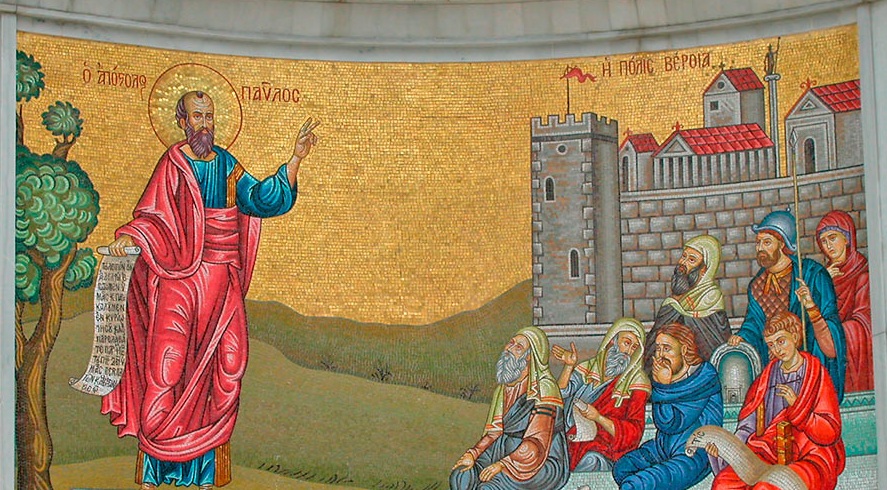
[iv] Fernando, Ajith (2010-12-21). Acts (The NIV Application Commentary) (p. 412-414). Zondervan. Kindle Edition.

Acts 16:25-40

illus-43Acts 16:25-40

25 About midnight Paul and Silas were praying and singing hymns to God, and the prisoners were listening to them, 26 and suddenly there was a great earthquake, so that the foundations of the prison were shaken. And immediately all the doors were opened, and everyone’s bonds were unfastened. 27 When the jailer woke and saw that the prison doors were open, he drew his sword and was about to kill himself, supposing that the prisoners had escaped. 28 But Paul cried with a loud voice, “Do not harm yourself, for we are all here.” 29 And the jailer called for lights and rushed in, and trembling with fear he fell down before Paul and Silas. 30 Then he brought them out and said, “Sirs, what must I do to be saved?” 31 And they said, “Believe in the Lord Jesus, and you will be saved, you and your household.” 32 And they spoke the word of the Lord to him and to all who were in his house. 33 And he took them the same hour of the night and washed their wounds; and he was baptized at once, he and all his family. 34 Then he brought them up into his house and set food before them. And he rejoiced along with his entire household that he had believed in God. 35 But when it was day, the magistrates sent the police, saying, “Let those men go.” 36 And the jailer reported these words to Paul, saying, “The magistrates have sent to let you go. Therefore come out now and go in peace.” 37 But Paul said to them, “They have beaten us publicly, uncondemned, men who are Roman citizens, and have thrown us into prison; and do they now throw us out secretly? No! Let them come themselves and take us out.” 38 The police reported these words to the magistrates, and they were afraid when they heard that they were Roman citizens. 39 So they came and apologized to them. And they took them out and asked them to leave the city. 40 So they went out of the prison and visited Lydia. And when they had seen the brothers, they encouraged them and departed.

Let me introduce you to James Ireland, a great Baptist preacher from yesteryear. (William Grady has written a nice summary of Ireland’s life so we will use some portions of his summary for our consideration of the man.)

While on a recent Baptist history tour in the South, the Lord afforded me one of the more unusual speaking opportunities of my ministry. As the Holy Ghost bore witness, I preached the Word of God to over forty pastors and laymen assembled in a cow pasture! What sanctified our otherwise unorthodox sanctuary was a lone grave marker that read:

IN MEMORY OF JAMES IRELAND

1748 – 1806

MINISTER OF THE GOSPEL

The stone went on to inform that Ireland, an “ORGANIZER OF BAPTIST CHURCHES”, was “IMPRISONED AT CULPEPER, VA. FOR PREACHING THE GOSPEL.” In the fall of 1769, Pastor James Ireland was arrested at a preaching service during his own closing prayer by two officials who seized him by the collar before he could even open his eyes. When he appeared in court to answer their charge of “preaching without proper credentials,” the quorum of eleven magistrates declared that they would have no more of his “vile, pernicious, abhorrent [sic], detestable, diabolical doctrines” as they “were nauseous [sic] to the whole court.” The convicted pastor spent his first night of confinement in a cell full of drunks. In the morning, he was informed by the avaricious jailer, a certain Mr. Steward (who was also the local tavern keeper), that any visitors he might receive would have to pay a “fee” of four shillings and eight pence.

Apparently, it was going to be a long six months. Because of the immense crowds that were assembling to hear Ireland preach through the grates (the iron bars in his cell window), a number of plots were set in motion against him. A bomb was planted in his quarters, which “went off with a considerable noise,” but the preacher was miraculously spared, testifying, “I was singing a hymn at the time the explosion went off, and continued singing until I finished it.” On another occasion, his captors attempted to smother him by burning pods of Indian peppers filled with brimstone near the bottom of his cell door. Stating that the “whole jail would be filled with the killing smoke,” Ireland recounted that the threatening situation would “oblige me to go to cracks, and put my mouth to them to prevent suffocation.” A scheme between the jailer and a certain doctor to poison the preacher also met with failure. (However, three years later another attempt to poison Ireland at his home left one of his precious children dead.) Despite these many hardships, the man of God testified:

“My prison was a place in which I enjoyed much of the divine presence; a day seldom passed without some signal token and manifestation of the divine goodness towards me, which generally led me to subscribe my letters, to whom I wrote them, in these words, ‘From my Palace in Culpeper‘.”…

While some of his enemies were laid low, others were brought under deep conviction. After doing everything to disrupt Ireland’s services, from having horses ridden at a gallop over those in attendance, to the securing of vile persons who “made their water in his face” while he was preaching, the exasperated jailer succumbed to the kindness of his captive…[1]

It is a powerful and memorable story: a jailed preacher of the gospel who used his otherwise deplorable circumstances for Kingdom impact, to the inspiration of all who would later consider him. There is something otherworldly about the behavior of James Ireland in his Culpeper prison. It is certainly not the normal course of behavior for a wrongfully imprisoned man! What is most fascinating about it, though, is that Ireland’s shocking prison behavior is actually situated in a long line of similar examples, stretching all the way back to the early Church. Consider our text, Acts 16:25-40, and the story it tells of Paul and Silas’ imprisonment in Philippi. Let us do so not from the perspective of the imprisoned preachers, but rather from the perspective of their jailor, the Philippian jailor, who marveled at what he saw in the two men.

The Philippian jailor was stunned by and attracted to the otherworldly values of the imprisoned believers.

Immediately preceding our text, we saw that Paul and Silas were beaten and thrown into a Philippian prison. This was because they cast a demon out of a little possessed slave girl who was making her owners quite a good bit of money as an oracle for the spirits. Thus, the exorcism that Paul conducted on this girl was costly to her owners who, as a result, went and stirred up opposition against the missionaries. So they were thrown into prison, which, I will remind you, was no easy thing back in that day. While there, something shocking happens.

25 About midnight Paul and Silas were praying and singing hymns to God, and the prisoners were listening to them, 26 and suddenly there was a great earthquake, so that the foundations of the prison were shaken. And immediately all the doors were opened, and everyone’s bonds were unfastened. 27 When the jailer woke and saw that the prison doors were open, he drew his sword and was about to kill himself, supposing that the prisoners had escaped. 28 But Paul cried with a loud voice, “Do not harm yourself, for we are all here.” 29 And the jailer called for lights and rushed in, and trembling with fear he fell down before Paul and Silas. 30 Then he brought them out and said, “Sirs, what must I do to be saved?”

What an amazing scene! Paul and Silas are worshipping God, an earthquake comes, their chains are loosed and the prison doors are flung open. The jailor, assuming that all the prisoners have fled, prepares to kill himself (for death would be the penalty for his losing a prison full of inmates anyway), but Paul informs him that they are, in fact, still there. Amazed, the jailor asks, “Sirs, what must I do to be saved?”

In other words, in a very short period of time, the jailor moves from thoughts of suicide to thoughts of salvation. Why? Because of the otherworldly values that he saw demonstrated by Paul and Silas. There was something in their behavior that absolutely stunned and shocked him. It also attracted him to their lifestyle. He wanted to know what it was that they had. He wanted it for himself. Thus, “Sirs, what must I do to be saved?”

What were these otherworldly values? If you look at our text, you will see two things in particular that stand out: (1) joyful worship in the midst of suffering and (2) a refusal to seize an opportunity for self-preservation.

First, the jailor was no doubt amazed at the joyful worship Paul and Silas were engaged in in the midst of suffering.

25 About midnight Paul and Silas were praying and singing hymns to God, and the prisoners were listening to them

I realize that the jailor is awakened by the earthquake, but there is no reason to think that he had not heard them worshipping before he went to bed or that he was not generally aware of it in waking moments throughout the night. He was no doubt already struck by the radical incongruity between their imprisonment and their general postures of praise. Apparently everybody in the prison was so struck for Luke tells us that “the prisoners were listening to them.”

Brothers and sisters, here is a fact: nothing will so capture the attention of those who are watching you as an attitude of worship when everything is going wrong for you. Make no mistake, how you handle misfortune will say more to those around you about your walk with Jesus than mere words every will. This jailor was no doubt amazed by the overall demeanor of these Christian prisoners, and it played no small part in opening his heart to the gospel.

So it was and so it ever will be. Jim Belcher has written of the behavior of the Lutheran pastor Dietrich Bonhoeffer when he was thrown into Tegel prison as a result of his part in a plot to assassinate Adolf Hitler. Belcher writes of how Bonhoeffer’s behavior impressed both the prisoners and the guards who watched him.

But he did not just sit around. As soon as the authorities returned his Bible, which they had confiscated on the first day, each day he rose early to pray, to sing the psalms and read Scripture. He meditated on a verse of the Bible for thirty minutes. He interceded for others, lifting up his friends and relatives, his former students, some who were in prison or in concentration camps. He prayed for the Jews, who were suffering so much. He prayed for his new friends, both prisoners and guards, at Tegel. His daily liturgy gave him strength. In spite of the isolation, the dark thoughts at night, the constant homesickness, and the fear of torture and execution, Bonhoeffer began to build a life in prison. For hours each day he studied, wrote letters and continued his scholarship.

            His strong, optimistic outlook began to win over many guards. Impressed by his strength through trial, his good cheer to all, the guards started to bring their own problems to him, looking for advice or wisdom from this famous prisoner. In return for his counsel, they, at great danger to themselves, smuggled out his letters to Bethge, which years later would bring him great fame. Prisoners also sought his counsel, knowing that he was someone they could talk to, a person who would understand them. Since he was one of the few people that truly cared for others, and not just for himself, fellow prisoners wanted to be close to him.

Christian History magazine has provided a few other interesting insights into Bonhoeffer’s prison behavior and its results.

During Allied bombing raids over Berlin, Bonhoeffer’s calm deeply impressed his fellow prisoners at Tegel Prison. Prisoners and even guards used all kinds of tricks to get near him and find the comfort of exchanging a few words with him.

The majority of Bonhoeffer’s classic Letters and Papers from Prison was smuggled out by guards who chose to assist Bonhoeffer.

Bonhoeffer could have escaped from prison but chose not to for the sake of others. He had prepared to escape with one of the guards when he learned that his brother Klaus had been arrested. Fearing reprisals against his brother and his family if he escaped, Bonhoeffer stayed in prison.[2]

How the people of God respond to severe trials can either draw people to or repel people from the God we claim to worship. But this fact is no less true for the smaller trials as well. The truth of the matter is that most of us will likely never be in a situation to worship God from the inside of a prison cell. We will, however, be given multiple opportunities this year to worship God when things do not go our way at work, at school, at home, and even at church.

How do you respond to adversity? Are you known around the water cooler as the man or woman who is unflappable in the midst of trials, who continues to worship the Lord God even when things go wrong for you? Let us please consider the amazing missionary opportunity in the ways we respond to suffering.

Let us also consider how our refusal to seize opportunities for self-preservation can further our witness for Christ. This is precisely what Paul and Silas did.

27 When the jailer woke and saw that the prison doors were open, he drew his sword and was about to kill himself, supposing that the prisoners had escaped. 28 But Paul cried with a loud voice, “Do not harm yourself, for we are all here.” 29 And the jailer called for lights and rushed in, and trembling with fear he fell down before Paul and Silas. 30 Then he brought them out and said, “Sirs, what must I do to be saved?”

They could have fled, but they did not! This seems to be the major factor in leading the jailor to call for salvation. Why? Because nothing is so counterintuitive as refusing to seize an opportunity for self-preservation.

Nobody has to teach human beings to assert their instinct for survival. We are born wanting to live, to survive, to avoid danger, to flee hardship. More than that, we are born wanting to assert our rights (as soon as we understand them). I repeat: self-preservation does not have to be taught! We understand this, especially as Americans. We are a people who are quick to assert our rights, especially if doing so can remove us from potential calamity.

But Paul and Silas do not do so. They do not flee the prison. They do not remove themselves from danger. Why? Because somehow and in some way the Lord God had convicted their hearts that staying was more beneficial to the Kingdom than fleeing. And so it turned out to be: the jailor is so amazed that they stayed that it opens his heart to wanting to know what kind of God it is that could make men like this.

Do you want to draw people to Christ? Then do not be the first in line for the safety train, for the advancement train, for the “saving your own hide” train. Learn to look at situations for their potential Kingdom impact instead of for what impact they may have for you personally. Ajith Fernando has given an interesting historical example of this very phenomenon.

Western powers crushed the Boxer uprising of 1900 in China, in which approximately 30,000 Chinese Christians died. The Chinese were forced by the Western powers into agreeing to pay high compensation for losses. Hudson Taylor’s China Inland Mission and several other Christians refused this compensation in accordance with the spirit of Christ.

Faced with an opportunity for personal profit, personal advancement, and, indeed, a measure of vengeance, the great missionary society China Inland Mission said “no” to the money. Why? Not because they did not need it or could not use it, but because they perceived that there was greater Kingdom impact to be had if they said “no.” So they said no. The result, according to Arthur Glasser, was as follows:

The Chinese were amazed. In Shanshi province a government proclamation was posted far and wide extolling Jesus Christ and his principles of forbearance and forgiveness…This official endorsement served to diminish the antiforeign spirit of the people and contributed not a little to the growth of the church in China in the years that followed.[3]

Because China Inland Mission took the surprising step of refusing an opportunity for self-preservation, a Chinese province, in amazement, officially posted a proclamation “extolling Jesus Christ and his principles of forbearance and forgiveness”!

Amazing! Absolutely amazing!

Church: we should be modeling otherworldly values, values that catch the fallen world off guard.

When you should complain, worship! When you have an opportunity to preserve or advance your own interests, consider the interests of the lost people around you! We should be shocking the world with the way we live!

The Philippian jailor moved from curiosity to belonging as a result of the example and witness of Paul and Silas.

As a result of Paul and Silas’ behavior, the jailor says, “Sirs, what must I do to be saved?” In other words, how do I get what you two have got? How do I become a part of this? In so asking, he was moving from curiosity about these men to belonging to the life to which they were bearing witness. Notice their response.

31 And they said, “Believe in the Lord Jesus, and you will be saved, you and your household.” 32 And they spoke the word of the Lord to him and to all who were in his house. 33 And he took them the same hour of the night and washed their wounds; and he was baptized at once, he and all his family. 34 Then he brought them up into his house and set food before them. And he rejoiced along with his entire household that he had believed in God. 35 But when it was day, the magistrates sent the police, saying, “Let those men go.” 36 And the jailer reported these words to Paul, saying, “The magistrates have sent to let you go. Therefore come out now and go in peace.” 37 But Paul said to them, “They have beaten us publicly, uncondemned, men who are Roman citizens, and have thrown us into prison; and do they now throw us out secretly? No! Let them come themselves and take us out.” 38 The police reported these words to the magistrates, and they were afraid when they heard that they were Roman citizens. 39 So they came and apologized to them. And they took them out and asked them to leave the city. 40 So they went out of the prison and visited Lydia. And when they had seen the brothers, they encouraged them and departed.

Paul and Silas tell him the way of salvation: “Believe in the Lord Jesus, and you will be saved, you and your household.” How simple. How beautiful! They do go on to instruct him further: “And they spoke the word of the Lord to him and to all who were in his house.” But whatever else they said (likely explaining the need for repentance and the reality of the cross and resurrection), they gave them the core: “Believe in the Lord Jesus, and you will be saved, you and your household.”

James Montgomery Boice helpful observes concerning Paul and Silas’ response to the jailor:

Notice that Paul did not suggest counseling…He did not give a lecture on theology. He did not explore the significance of the jailer’s religious terms. He did not talk about the sacraments. He did not even talk about the church. Those things could be dealt with in time, but this was not the time. The man was asking about salvation, and the apostle replied directly: “Believe in the Lord Jesus, and you will be saved – you and your household.”[4]

They call on him to embrace Christ, and he and his household do so. They trust in Christ and are baptized and they too begin to worship and to praise God! They also immediately begin to live out their new life in Christ by feeding Paul and Silas and washing their wounds. How glorious! How wonderful this is! The Venerable Bede called this “a beautiful exchange,” noting that “for them [the jailor] washed the wounds from their blows, and through them he was relieved of the wounds of his own guilty acts.”[5]

Both were bathed: Paul and Silas had their wounds bathed and the jailor and his household had their hearts bathed in the blood of Christ!

Our text concludes with the officials calling for Paul and Silas to be released and with Paul insisting that these officials come themselves and release them since they had wrongfully persecuted a Roman citizen. F.F. Bruce explains:

By a series of Valerian and Porcian laws enacted between the beginning of the Roman Republic and the early second century B.C. Roman citizens were exempted from degrading forms of punishment and had certain valued rights established for them in relation to the law. These privileges had been more recently reaffirmed under the empire by a Julian law dealing with public disorder.

What this meant was that any Roman citizen needing to claim the protection of his legal status would simply proclaim ciuis Romanus sum, “I am a Roman citizen.”[6] This is what Paul does. Why? We can be sure it was not an effort to be petty or vengeful. Rather, he was almost certainly seeking to establish some degree of protection for the newly founded church in Philippi. He likely reasoned that his actions here would remind the authorities that the one who planted this church was a Roman citizen who they had wronged and probably concluded that having the authorities recognize their mistake would lead them to be more favorably disposed toward the Christians they would leave behind.

Regardless, Paul and Silas had an amazing impact on Philippi! They led Lydia to the Lord. They conducted an exorcism that led to the freeing and the salvation of a possessed slave girl. They bore amazing witness to Christ while imprisoned resulting in the salvation of the jailor and his family (at least). And they took steps to extend some protections to the church they were leaving behind as they moved on.

I ask you: what are you going to do this year? How are you going to respond to adversities and to trials? Will you worship God in the dark times? Will you worship him in such a way that people want to follow Him with you?

Let it be so! Let it be so!


[1] https://www.wilderness-cry.net/bible_study/articles/licensed.html

[2] Jim Belcher, “The Secret of Finkenwalde.” Bonhoeffer, Christ and Culture. Eds., Keith L. Johnson, Timothy Larsen (Downers Grove, IL: InterVarsity Press, 2013), p.196. https://www.christianhistoryinstitute.org/magazine/article/dietrich-bonhoeffer-did-you-know/

[3] Fernando, Ajith (2010-12-21). Acts (The NIV Application Commentary) (p. 404). Zondervan. Kindle Edition.

[4] James Montgomery Boice, Acts. (Grand Rapids, MI: Baker Books, 1997), p.283.

[5] Francis Martin, ed. Acts. Ancient Christian Commentary on Scripture. New Testament, vol.V. Thomas C. Oden, gen. ed. (Downers Grove, IL: InterVarsity Press, 2006), p.209.

[6] Bruce, F.F. (1988-06-30). The Book of Acts (New International Commentary on the New Testament) (p.319-320). Eerdmans Publishing Co – A. Kindle Edition.

Acts 16:16-24

8409Acts 16:16-24

16 As we were going to the place of prayer, we were met by a slave girl who had a spirit of divination and brought her owners much gain by fortune-telling. 17 She followed Paul and us, crying out, “These men are servants of the Most High God, who proclaim to you the way of salvation.” 18 And this she kept doing for many days. Paul, having become greatly annoyed, turned and said to the spirit, “I command you in the name of Jesus Christ to come out of her.” And it came out that very hour. 19 But when her owners saw that their hope of gain was gone, they seized Paul and Silas and dragged them into the marketplace before the rulers. 20 And when they had brought them to the magistrates, they said, “These men are Jews, and they are disturbing our city. 21 They advocate customs that are not lawful for us as Romans to accept or practice.” 22 The crowd joined in attacking them, and the magistrates tore the garments off them and gave orders to beat them with rods. 23 And when they had inflicted many blows upon them, they threw them into prison, ordering the jailer to keep them safely. 24 Having received this order, he put them into the inner prison and fastened their feet in the stocks.

It was C.S. Lewis who said that there are two equal but opposite errors Christians can commit when thinking about the devil.  The first is to think too little of the devil:  to remain blissfully ignorant of his schemes and tactics, to fail to realize that he is crafty and scheming, to fail to consider carefully all that scripture says about our adversary.  This error leaves us an easy target and unprepared to withstand the devil’s schemes.  The other error is to think too much of the devil:  to fixate on him, to ascribe to him too much power, to fail to realize the victory that Christ has won and is winning for us, to see him literally everywhere and in everything.  This error can make us obsessive and can paralyze us with fear.  Most tragically, it downplays the power and authority and victory of Christ.

Our text will help us avoid both areas.  It shows us how very dangerous and crafty the devil truly is.  However, it also dramatically demonstrates the ultimate authority of Christ over the devil and his minions.

The devil is crafty and may attack the Church through confusing, disruptive followership. (v.16-18a)

Let us first consider the craftiness of the devil.  Paul and his team are in Philippi.  They begin to be followed by a slave girl whose behavior becomes increasingly disruptive.

16 As we were going to the place of prayer, we were met by a slave girl who had a spirit of divination and brought her owners much gain by fortune-telling. 17 She followed Paul and us, crying out, “These men are servants of the Most High God, who proclaim to you the way of salvation.” 18 And this she kept doing for many days.

Who was this girl?  Clinton Arnold has offered some fascinating background information about who she likely was as well as a very interesting insight into Luke’s description of her.

This young girl receives her inspiration from what Luke literally calls a “python spirit” (pneuma python).  The Python dragon or serpent was associated with the oracle sanctuary at Delphi, about eighty miles northwest of Athens.  In the story of the origin of the cult, Apollo killed this large snake that was guarding the entrance to the oracle cave.  Apollo then became the guardian and patron of this sanctuary, which was an entrance to the underworld.  During the Greco-Roman era, people came from all over the Mediterranean world to consult the priestesses of Apollo (called pythia) for advice.  The Pythia descended into the oracle grotto to seek inspiration from the god by allowing herself to be possessed by a spirit.  She then arose and uttered the god’s instructions to the inquirer – first in an ecstatic, gibberish speech and then typically in the form of Greek verse.  The first-century writer Plutarch, himself a priest of the Delphic god, refers to the priestesses as engastrimythoi (“belly talkers”) because of the sound of their voices as the god or spirit spoke through them.[1]

This girl, then, would be connected in the minds of the people with the python spirit, a spirit that was not considered to be malevolent by the Greeks.  However, Christians do not accept that there are such harmless spirits that we can or should consult.  We believe that the Holy Spirit is the Spirit that has been given to lead us into all truth, and not a spirit of divination.

What is confusing here, though, is what the girl says.  “These men are servants of the Most High God, who proclaim to you the way of salvation.”  Why is this confusing?  It is confusing because the demon within her is actually speaking the truth.  They were indeed “servants of the Most High God” and they did indeed “proclaim…the way of salvation.”

What is happening here?  For starters, there is the divine title that the demon uses:  “the Most High God.”  It could be that this is something of an offensive maneuver against the apostles.  That is, it could be that the demon was using the name of God in an almost mocking way or a way that demonstrated presumption on the devil’s part, though this would not have been apparent to those who heard her using the divine title.  The name of God is holy and sacred and is not to be used in vain or arrogantly or with any intention other than genuine worship.  Whatever is happening here, we can be sure that the devil is not using God’s name with worshipful intent.

You may note certain similarities between this scene and Jesus’ encounter with the Garasene demoniac in Luke 8.  Listen closely:

26 Then they sailed to the country of the Gerasenes, which is opposite Galilee. 27 When Jesus had stepped out on land, there met him a man from the city who had demons. For a long time he had worn no clothes, and he had not lived in a house but among the tombs. 28 When he saw Jesus, he cried out and fell down before him and said with a loud voice, “What have you to do with me, Jesus, Son of the Most High God? I beg you, do not torment me.” 29 For he had commanded the unclean spirit to come out of the man. (For many a time it had seized him. He was kept under guard and bound with chains and shackles, but he would break the bonds and be driven by the demon into the desert.) 30 Jesus then asked him, “What is your name?” And he said, “Legion,” for many demons had entered him. 31 And they begged him not to command them to depart into the abyss. 32 Now a large herd of pigs was feeding there on the hillside, and they begged him to let them enter these. So he gave them permission. 33 Then the demons came out of the man and entered the pigs, and the herd rushed down the steep bank into the lake and drowned.

You will notice that here too the devil uses the title “the Most High God.”  Why, then, does Paul cast the demon out?  Why silence a demon that is, in fact, speaking truth?  The 15th century German Reformed Hebraist Konrad Pellikan argued that behind the actual words of the demon were nefarious motivations aiming ultimately at deceiving those who listened.

[I]t is the deceitful genius of Satan, that he is the father of lies, not only because he always speaks through manifest lies but because he also misuses the manifest truth to convince people of lies for the purpose of deceiving them, so that in the end, by the appearance of truth, he convinces people of falsehood.  Satan’s cleverness and trickery are of no use to him against Christ, for Christ also cast out demons of this sort and forbade them to speak.  In fact, here Paul orders the demon to be silent in the name of Christ, and it departs from the girl.  It was an unmistakable sign indicating that, even if Satan speaks the truth from time to time, nevertheless he does so to deceive.  Therefore we must close our ears to Satan’s voice whether he speaks factually or not, lest we are seduced to the lies of Satan by some version of the truth.[2]

Origen said that in casting the demon out, Paul was imitating Christ who “does not accept witness from demons” and that Paul “considered testimony given by the spirit of Python unworthy of his message.”  Chrysostom argued that Paul cast the demon out because he “did not want to make him believable” and went on to say that “if Paul had admitted his testimony, the demon would have deceived many of the believers.”  He further said that the demon was using “agreement for the purpose of destruction.”[3]

There is wisdom here, but the very fact that we are having to try to figure out exactly what is happening here is evidence of the devil’s craftiness.  The devil is crafty and may attack the Church through confusing, disruptive followership.  He appears here to be a member of the Church, advancing and proclaiming the name of Christ.  However, Paul saw it for what it was:  a subtle attempt by Satan to deceive by masquerading as a worshipper of God.

Be careful!  Not all who use the language of the faith have the heart of the faith.  Such was the case with this demon possessed slave girl.

The devil is also adaptable and may, when confusing attempts fail, attack the Church through inciting anger fueled by ignorance. (v.19-24)

But what happens when the devil’s craftier attempts fail?  Consider what he does to Paul and Silas.

19 But when her owners saw that their hope of gain was gone, they seized Paul and Silas and dragged them into the marketplace before the rulers. 20 And when they had brought them to the magistrates, they said, “These men are Jews, and they are disturbing our city. 21 They advocate customs that are not lawful for us as Romans to accept or practice.” 22 The crowd joined in attacking them, and the magistrates tore the garments off them and gave orders to beat them with rods. 23 And when they had inflicted many blows upon them, they threw them into prison, ordering the jailer to keep them safely. 24 Having received this order, he put them into the inner prison and fastened their feet in the stocks.

Failing to deceive through his more subtle efforts, the devil next turns to a frontal attack.  When Paul cast the demon out, he lost the girl’s owners a great deal of money.  People would pay her owners to hear what the python spirit would say through her.  Paul ended that.  You will also see another parallel here between this story and that of the Gerasene demoniac:  the casting out of the demons in both stories cost somebody money and this leads to great displeasure.

So the devil now works through the anger of the people as they appeal to the authorities for help.  He appears to do so through what were likely some anti-semitic sentiments in Philippi, or at least xenophobic (fear of foreigners) sentiments.  Remember that there were not enough Jews in this area even to have a synagogue, so he is playing on the fears of the people concerning this largely unknown group:  “These men are Jews.”

Furthermore, they allege that Paul and Silas are fostering civil unrest and even illegal activities.  In doing so, you can see shades of the tactics of the Jews before Pilate when they were seeking Roman involvement in their efforts to rid themselves of Jesus.  They played the politics card:  “These guys are upsetting the people and causing trouble and encouraging illegal behavior in our town!”  This, of course, got the attention of the authorities and leads to direct persecution:  beatings and imprisonment and the stocks.

For our purposes, let us notice the progression in Satan’s tactics:  (1) subtle attempts to deceive and (2) blatant efforts to persecute.  The devil does not move to his more nakedly aggressive efforts until his more subtle efforts are sniffed out.  When it is clear that the little demon possessed girl cannot derail the missionary team, then and only then does he turn to outright persecution.

There is a disturbing lesson in this for us:  what might it say about us that the devil so rarely has to resort to outright persecution against us?  What might it say that he never has to move toward his “Plan B” of oppression?  Might it not mean that he has no need to do so since we are so rarely able to get past his “Plan A”?

In other words, he rarely has to persecute us outright because he is so effective at tripping us up with his subtle, crafty efforts.

Would that we followed the Lord Jesus closely enough and carefully enough that the devil had to make more blatant efforts to eradicate us.  As it stands, he does not need to eradicate us because he has so effectively distracted us.

Live in such a way that the devil has to go to “Plan B” against you!  Do not give him the satisfaction of being able to sideline you with little girls being annoying!  Make him bring out the big guns!

But the devil is always a creature and can never withstand the authority of the Creator. (v.18b-c)

These satanic efforts must regrettably be understood.  They must be appreciated so that the devil can be effectively guarded against.  But in all of this talk about the devil and his wiles, we would be blasphemously mistaken if we did not end with this crucial point:  the devil is always a creature and can never withstand the authority of the Creator.  He is crafty, but he is not God.  This is evident when we go back to the actual moment of exorcism in verse 18.

18b-c Paul, having become greatly annoyed, turned and said to the spirit, “I command you in the name of Jesus Christ to come out of her.” And it came out that very hour.

Clinton Arnold points out that it would have been considered “unusual” for somebody to cast out a Python spirit “which was thought to be a good and helpful spirit, not a malevolent one.”[4]  But out this spirit must come!  Why?  Because we know that if a spirit is not from God it is from the devil himself.

Paul turns to the girl, rebukes the spirit, and, Luke tells us, “it came out that very hour.”

There is something theologically profound in the lack of elaboration in this.  Paul commands an exit “in the name of Jesus Christ” and the devil must flee!  How beautiful!  How powerful!  How very important for us to remember!

The devil may attack, but he is a defeated attacker.  He may discourage, but he is a defeated discourager.  He may persecute, but he is a defeated persecutor.

What we are experiencing on this side of heaven is simply the last, desperate thrashings of an enemy who knows his days are number.  He has been defeated, but he has simply not yet been destroyed.  We live between his defeat and his destruction and, as a result, we are the objects of his dark rage.  But the light shines in the darkness and the light is Christ!

Church:  the devil is no match for the Lord Jesus!  He cannot withstand the Lamb Who was slain and risen, Who has ascended but Who is coming again!

He cannot withstand the strong name of Jesus.

He quakes in fear before the Lamb who conquers.

He shudders in dread.

As Luther reminds us in his beautiful hymn, “A Mighty Fortress is Our God”:

And though this world, with devils filled,

Should threaten to undo us,

We will not fear, for God hath willed

His truth to triumph through us:

The Prince of Darkness grim,

We tremble not for him;

His rage we can endure,

For lo! his doom is sure,

One little word shall fell him.

Amen, and amen.


[1] Clinton E. Arnold, “Acts.” Zondervan Illustrated Bible Backgrounds Commentary. Vol.2. Clinton E. Arnold, gen. ed. (Grand Rapids, MI: Zondervan, 2002), p.374.

[2] Esther Chung-Kim and Todd R. Hains, eds. Acts. Reformation Commentary on Scripture. New Testament, vol.VI. Timothy George, gen. ed. (Downers Grove, IL: InterVarsity Press, 2014), p.232.

[3] Francis Martin, ed. Acts. Ancient Christian Commentary on Scripture. New Testament, vol.V. Thomas C. Oden, gen. ed. (Downers Grove, IL: InterVarsity Press, 2006), p.202-203.

[4] Clinton E. Arnold, p.375.

Acts 16:6-15

???????????????????????????????Acts 16:6-15

6 And they went through the region of Phrygia and Galatia, having been forbidden by the Holy Spirit to speak the word in Asia. 7 And when they had come up to Mysia, they attempted to go into Bithynia, but the Spirit of Jesus did not allow them. 8 So, passing by Mysia, they went down to Troas. 9 And a vision appeared to Paul in the night: a man of Macedonia was standing there, urging him and saying, “Come over to Macedonia and help us.” 10 And when Paul had seen the vision, immediately we sought to go on into Macedonia, concluding that God had called us to preach the gospel to them. 11 So, setting sail from Troas, we made a direct voyage to Samothrace, and the following day to Neapolis, 12 and from there to Philippi, which is a leading city of the district of Macedonia and a Roman colony. We remained in this city some days. 13 And on the Sabbath day we went outside the gate to the riverside, where we supposed there was a place of prayer, and we sat down and spoke to the women who had come together. 14 One who heard us was a woman named Lydia, from the city of Thyatira, a seller of purple goods, who was a worshiper of God. The Lord opened her heart to pay attention to what was said by Paul. 15 And after she was baptized, and her household as well, she urged us, saying, “If you have judged me to be faithful to the Lord, come to my house and stay.” And she prevailed upon us.

Acts is a book filled with memorable characters.  Of course there are the towering personalities of the Church:  restored and emboldened Peter, the courageous martyr Stephen, the inspiring missionary Philip, the radically converted and radically missional Paul, peacemaking Barnabas, tempestuous John Mark, and young Timothy.  Then there are the bad guys:  the persecuting Sanhedrin, the greedy Simon Magus, the blasphemous (and wormy!) Herod Agrippa.  And these are just a few of the colorful characters of this fascinating book.

But there is one character that stands above them all.  In fact, He is such a dominant character that some, like John Chrysostom, actually referred to the book of Acts by His name.  I am talking about the Holy Spirit.  He is on every page of this book.  John Chrysostom called the book of Acts, “The Gospel of the Holy Spirit.”  I love that!

The story of Acts truly is the story of the Holy Spirit.  Let me explain.  Before Jesus ascended to the Father in Heaven He promised us that He would send the Spirit of God, the Holy Spirit, to take up residence in His people.  And, of course, in Acts 2 we see that happen.  Jesus ascends to the right hand of the Father and the Holy Spirit descends upon the Church.  That means that the chronicle of Acts is a chronicle of the Holy Spirit’s leading of the Church in and throughout the world to further the reach of the Kingdom of God.  Thus, this book really is “The Gospel of the Holy Spirit.”

But even that is not enough to say.  It must also be said and noted that what happened to the early Church way back then was intended to be normative for all Christians throughout the ages and all over the world.  In other words, the Holy Spirit was likewise promised to you.

When you accept Christ, He gives you His Spirit to take up residence within you.  The Holy Spirit then guides and leads and directs and informs and illuminates and convicts and reveals and teaches you as you too move throughout life.  That is critically important to understand because that means that your life individually and our life as a Church corporately is a continuation of the story of Acts!  The story of the Church and the Spirit’s leading of the Church therefore continues in and through us.

This is what makes the current neglect of the Holy Spirit in many of our churches so very, very tragic!  When we fail to teach and understand and, most of all, experience and walk with the Holy Spirit, we fail to appreciate the One who was given to lead us throughout life itself.  Yet, many of us do neglect the Holy Spirit and do not think often of Him.

In his wonderful book on the Holy Spirit, tellingly entitled Forgotten God, Francis Chan said this:

The benchmark of success in church services has become more about attendance than the movement of the Holy Spirit. The “entertainment” model of church was largely adopted in the 1980s and ’90s, and while it alleviated some of our boredom for a couple of hours a week, it filled our churches with self-focused consumers rather than self-sacrificing servants attuned to the Holy Spirit.  Perhaps we’re too familiar and comfortable with the current state of the church to feel the weight of the problem. But what if you grew up on a desert island with nothing but the Bible to read? Imagine being rescued after twenty years and then attending a typical evangelical church. Chances are you’d be shocked (for a whole lot of reasons, but that is another story). Having read the Scriptures outside the context of contemporary church culture, you would be convinced that the Holy Spirit is as essential to a believer’s existence as air is to staying alive. You would know that the Spirit led the first Christians to do unexplainable things, to live lives that didn’t make sense to the culture around them, and ultimately to spread the story of God’s grace around the world.

There is a big gap between what we read in Scripture about the Holy Spirit and how most believers and churches operate today.  In many modern churches, you would be stunned by the apparent absence of the Spirit in any manifest way. And this, I believe, is the crux of the problem.

If I were Satan and my ultimate goal was to thwart God’s kingdom and purposes, one of my main strategies would be to get churchgoers to ignore the Holy Spirit. The degree to which this has happened (and I would argue that it is a prolific disease in the body of Christ) is directly connected to the dissatisfaction most of us feel with and in the church. We understand something very important is missing. The feeling is so strong that some have run away from the church and God’s Word completely.

I believe that this missing something is actually a missing Someone-namely, the Holy Spirit. Without Him, people operate in their own strength and only accomplish human-size results. The world is not moved by love or actions that are of human creation.  And the church is not empowered to live differently from any other gathering of people without the Holy Spirit. But when believers live in the power of the Spirit, the evidence in their lives is supernatural.  The church cannot help but be different, and the world cannot help but notice…

The church becomes irrelevant when it becomes purely a human creation. We are not all we were made to be when everything in our lives and churches can be explained apart from the work and presence of the Spirit of God…

Given our talent set, experience, and education, many of us are fairly capable of living rather successfully (according to the world’s standards) without any strength from the Holy Spirit.

Even our church growth can happen without Him. Let’s be honest: If you combine a charismatic speaker, a talented worship band, and some hip, creative events, people will attend your church.  Yet this does not mean that the Holy Spirit of God is actively working and moving in the lives of the people who are coming. It simply means that you have created a space that is appealing enough to draw  people in for an hour or two on Sunday.[1]

What challenging and, frankly, terrifying words these are!  But how very, very true.  We dare not operate without the Spirit of God!  We cannot operate in the will of God without the Spirit of God!  But, foolishly, we attempt to do this very thing.

Let me ask you:  when you look back over the last twelve months, would you say that they were marked by a radical dependence upon the Spirit of God?  Would you say that you sought the Spirit’s leading, the Spirit’s guidance, and what the Spirit was saying to you?  Or did you attempt to live your life on your own terms?  If so, how did that work out for you?

To remedy this, and to prepare us for the coming year, let us consider how the Spirit led Paul and his team in Acts 16.  Here we read of the second missionary journey of Paul.  The way that Luke describes the Spirit’s activity is most helpful and teaches us a great deal about how we should learn to think of and understand the Spirit.  We will consider our text under the banner of four lessons we must learn about the Spirit’s guidance.

Learn to see the Holy Spirit’s “No’s” as “Yes’s” that are about to be revealed. (v.6-8)

Let us first notice something interesting about Luke’s record of Paul’s initial travel efforts at the beginning of the second missionary journey.

6 And they went through the region of Phrygia and Galatia, having been forbidden by the Holy Spirit to speak the word in Asia. 7 And when they had come up to Mysia, they attempted to go into Bithynia, but the Spirit of Jesus did not allow them. 8 So, passing by Mysia, they went down to Troas.

What appears to have happened is this:  Paul and his team set out for the region called “Asia” which lay due west of the city of Lystra where he had picked up Timothy.  He likely was intending to go the city of Ephesus which was in Asia.  But, Luke tells us, the Holy Spirit forbade it.  Thus, Paul sets his eyes north to the region of Bithynia and starts that way.  Luke tells us that “they attempted to go into Bithynia, but the Spirit of Jesus did not allow them.”

Some have noted that Luke refers to “the Holy Spirit” in verse 6 and “the Spirit of Jesus” in verse 7.  There is, of course, no question that both of these are referring to the same Holy Spirit, but some have wondered that the subtle shift in designation may reference the way in which the Spirit communicated to them.  Who knows?  Rather, it is important for us to note that, in the New Testament, the Holy Spirit is indeed the Spirit of Jesus and the Spirit from the Father.  There are significant implications here for our doctrine of the Trinity:  God is Father, Son, and Spirit.  We see that reality played out throughout the New Testament.

For our purposes, however, let us note the fascinating fact that the Holy Spirit says “No!” to Paul and his team twice here at the beginning of their second missionary journey.  He says “No!” to what they want to do.

But here is the crux of the matter:  His “No!” is simply a “Yes!” that is about to be revealed.

John Stott mentions a fascinating idea from A.T. Pierson concerning how the Spirit leads us in life.

A. T. Pierson in his The Acts of the Holy Spirit drew attention to what he called ‘the double guidance of the apostle and his companions’, namely, ‘on the one hand prohibition and restraint, on the other permission and constraint. They are forbidden in one direction, invited in another; one way the Spirit says “go not”; the other he calls “Come”.’ Pierson went on to give some later examples from the history of missions of this same ‘double guidance’: Livingstone tried to go to China, but God sent him to Africa instead. Before him, Carey planned to go to Polynesia in the South Seas, but God guided him to India. Judson went to India first, but was driven on to Burma. We too in our day, Pierson concludes, ‘need to trust him for guidance and rejoice equally in his restraints and constraints’.[2]

That is so well said!  “The double guidance” from the Holy Spirit:  prohibition and permission.

But here is the problem:  we, as modern spoiled Americans, have such a sense of selfish entitlement that we are too busy pouting about the prohibitions of the Spirit to see the permissions that are within them.  We are so busy sitting in the corner stewing over His “no’s” that we cannot see His “yes’s.”  And this is a great tragedy, for a willingness to see the Spirit working in the “no’s” as well as the “yes’s” is profoundly liberating.  It frees us to see God-ordained Kingdom opportunities in the otherwise unpleasant happenings in life:  demotions and cars breaking down and missed flights and hospital visits.  It frees us to see that all of these are but divine “yes’s” hidden in what we see as inconveniences and setbacks and even tragedies.

Learn to see God’s “yes’s” hidden in God’s “no’s.”

Learn to see the Holy Spirit’s guidance in both the normal decisions and the miraculous revelations. (v.9)

We must also learn to see the Spirit’s guidance in both the mundane and the spectacular.  Having just led Paul and his team through largely unspecified but apparently fairly ordinary means, the Spirit now speaks to him in a surprising way.

9 And a vision appeared to Paul in the night: a man of Macedonia was standing there, urging him and saying, “Come over to Macedonia and help us.”

The Spirit now speaks through a vision.  Paul sees a man saying, “Come over to Macedonia and help us.”  This is anything but ordinary.  However, it immediately follows the Spirit’s ordinary leading.

If you step back and look at verses 6-10, you will see the two general ways that the Spirit speaks:  through normal decisions and through miraculous revelations.  The danger for us as Christians comes in forgetting that He uses both, and He seems to use the former primarily.  If a believer believes that the Spirit must speak only through dreams and visions and miraculous signs, he will attempt to manipulate the Spirit or others by unduly reading the miraculous into the ordinary or, even worse, by claiming to see the miraculous when he or she really does not.  This turns us into manipulators and consumers of the spectacular, demanding all along that the Spirit speak in shocking ways.  If, however, a person limits the Spirit to the ordinary (which, we should remember, is never merely the ordinary anyway), then he or she refuses to believe that the Spirit may yet speak through signs and wonders and visions.  This, obviously, is unfortunate for the Spirit may indeed choose to speak in such a way.

This is why it is so very refreshing to see the Holy Spirit speaking in both ways to Paul and his team.  Learn to see the Holy Spirit’s guidance in both the normal decisions and the miraculous revelations.

Learn to obey the Holy Spirit promptly and with complete commitment. (v.10-12)

And what of our response to the Spirit’s leading?  May this early missionary team’s response serve as a model to us.

10 And when Paul had seen the vision, immediately we sought to go on into Macedonia, concluding that God had called us to preach the gospel to them. 11 So, setting sail from Troas, we made a direct voyage to Samothrace, and the following day to Neapolis, 12 and from there to Philippi, which is a leading city of the district of Macedonia and a Roman colony. We remained in this city some days.

“Immediately we sought to go into Macedonia.”

Immediately.

Church family, have you, like Paul, resolved to go wherever the Spirit leads you?  Have you made a prior commitment, like Paul, to do as He asks without question or delay?  Amazing adventures lay before us if we will dare to put our hands to the plow with resolute courage and refuse to look back.  If He calls you, will you go?

Let us remember that our preset plans may hinder us if we elevate them above the Spirit’s leading.  There is something sad about saying, “I will live right here all my life.  I will live on this street and no other.  I will live in this town and no other.  I will not leave my parents.  My children will not leave me.  Here I stand and here I’ll die!”

But what of the Spirit’s leading?  What if He calls you to leave and to go?  What if His adventure for your life is greater than your plans and assumptions?  I ask you:  if He calls you will you go?  Will you go anywhere?

My mother and father are here this morning.  I love my parents.  They are wonderful parents.  They live in South Carolina and I live in Arkansas.  It is not easy to leave one’s parents.  I love my mom.  My mom loves me.  But I’ll tell you the greatest gift my mom ever gave me.  She told me that when I was a baby she looked at me and prayed to God and said, “He’s yours.  Do with him whatever you need to do with him.”

I grew up hearing and knowing that.  My parents set me free to follow the Lord.  I thank them for that today.

Have you done the same?  I am not saying that being a Christian means you will leave your hometown or even your street.  Not necessarily.  The Lord in His wisdom may choose for you to stay right where you are.  And, if you want to stay right where you are too, then how wonderful is that?  But what if He does not?  What if He desires you to go to Macedonia?  What if the Spirit calls and says, “Come over here!”  Will you go?

Learn to obey immediately.

Learn to see the great adventure hidden in the Holy Spirit’s “ordinary” callings. (v.13-15)

And finally, learn to see the great adventure hidden in the Holy Spirit’s “ordinary” callings.  So the Spirit shuts the door on Asia and on Bithynia.  Why?  What does the Lord have in store that is so important?  A city greater than Ephesus?  A region more strategic than Bythinia?  Let us see.

13 And on the Sabbath day we went outside the gate to the riverside, where we supposed there was a place of prayer, and we sat down and spoke to the women who had come together. 14 One who heard us was a woman named Lydia, from the city of Thyatira, a seller of purple goods, who was a worshiper of God. The Lord opened her heart to pay attention to what was said by Paul. 15 And after she was baptized, and her household as well, she urged us, saying, “If you have judged me to be faithful to the Lord, come to my house and stay.” And she prevailed upon us.

Paul and his team come upon a group of ladies sitting by the river.  The fact that they come here on the Sabbath is significant, as F.F. Bruce explains:

At Philippi…there does not appear to have been a regular synagogue. That can only mean that there were very few resident Jews; had there been ten Jewish men, they would have sufficed to constitute a synagogue. No number of women could compensate for the absence of even one man necessary to make up the quorum of ten. There was, however, a place outside the city where a number of women—either of Jewish birth or Gentiles who worshiped the God of Israel—met to go through the appointed Jewish service of prayer for the sabbath day, even if they could not constitute a valid synagogue congregation. Paul and his companions found this place, by the bank of the  river Gangites, and sat down with the women and told them the story of Jesus.[3]

The picture gets clearer.  Philippi was apparently a place with such a small Jewish population that they do not even have a synagogue.  But Paul’s custom, of course, was to go first to the synagogues.  So in the absence of a synagogue they looked for a place of prayer.  They found it.  Some ladies were there, including a lady named Lydia.  John Stott has offered some interesting insights into her name:

One of the women, named Lydia, came from Thyatira which was situated by the Hermus Valley on the other side of the Aegean, within provincial Asia. Because that area was previously the ancient kingdom of Lydia, it is possible that ‘Lydia’ was not so much her personal name as her trade name; she may have been known as ‘the Lydian lady’. Thyatira had been famed for centuries for its dyes, and an early inscription refers to a guild of dyers in the town. Lydia herself specialized in cloth treated with an expensive purple dye, and was presumably the Macedonian agent of a Thyatiran manufacturer.[4]

So the Lord opens the heart of Lydia (this “Lydian lady”) so that she can hear and receive the gospel.  She does so, is saved, and she and her family are baptized.  This is, of course, a wonderful occurrence, but I cannot help but marvel at how God’s plans deviate from the supposed sense of our own.  Meaning, if one of our missionaries were to bypass populous areas in order to go to lead one woman to the Lord, would not part of our coldly analytical minds question the wisdom of this?  Why bypass Ephesus to see this lady?  Why bypass Bithynia to see this lady?  Why bypass the big crowds to come to a place that did not even have a synagogue?

Why?  Because God gets to write the story and God gets to determine the adventure whether or not it makes sense to us.  I’ll tell you who it did make sense to:  Lydia.  She and her family believed and passed from death to life.  The Spirit sent Paul to her.  There is something so gloriously crazy about this whole story!  That God would lead Paul here…to her!  Why?  We know not, other than that God wanted it so and Lydia had her part to play in the story as well.

Do you see how the Holy Spirit leads us in surprising ways to surprising places for surprising reasons?  Do you see how Paul’s willingness to trust God led to this amazing scene of salvation?  Do you see now the folly of operating on a purely rationalistic basis and not leaving room for the Spirit’s surprise callings?

John MacArthur, Jr. summarized our text by concluding “God uses people with the right passion and the right priority, with the right personnel taking the right precautions, to make the right presentation in the right place.”[5]

Indeed!  Indeed He does!

Do not begrudge the Holy Spirit’s leading in your life.  He has amazing things He wants to do through you!


[1] Francis Chan, Forgotten God: Reversing Our Tragic Neglect of the Holy Spirit.  Kindle Loc. 42-58,70-71, 164-168.

[2] Stott, John (2014-04-02). The Message of Acts (The Bible Speaks Today Series) (Kindle Locations 4680-4686). InterVarsity Press. Kindle Edition.
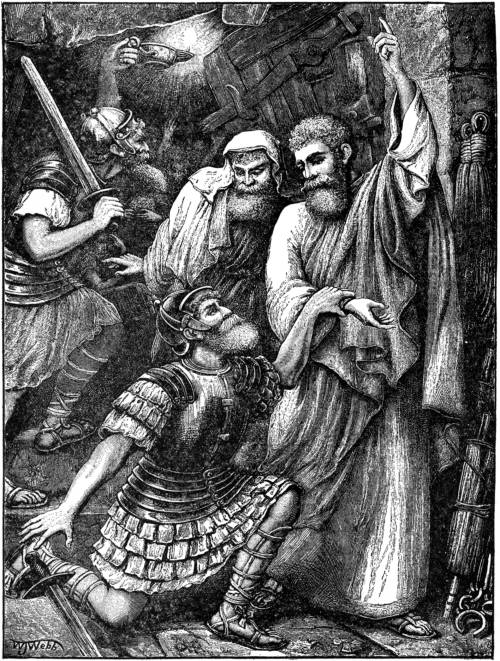
[3] Bruce, F.F. (1988-06-30). The Book of Acts (New International Commentary on the New Testament) (pp. 310-311). Eerdmans Publishing Co – A. Kindle Edition.

[4] Stott, John (2014-04-02). The Message of Acts (The Bible Speaks Today Series) (Kindle Locations 4720-4724). InterVarsity Press. Kindle Edition.
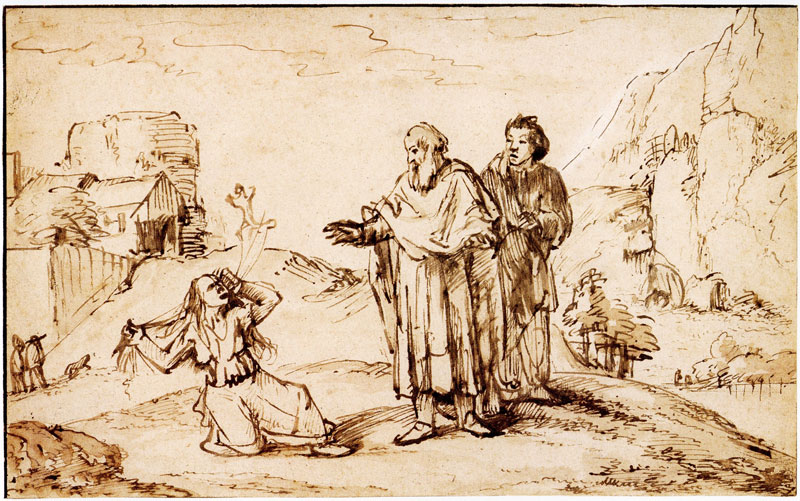
[5] John MacArthur, Jr. Acts 13-28. The MacArthur New Testament Commentary. (Chicago, IL: Moody Press, 1996), p.87.

Some Thoughts On A Fascinating and Powerful Christmas Image: Eve Meeting Mary

Somebody posted this on Twitter yesterday and I thought it particularly moving and powerful.  It is an image of Eve meeting a pregnant Virgin Mary.  A few things stand out.  First, the expressions on their faces:  Eve looking shamed and distraught, holding the apple, yet hopeful and awestruck with raised eyebrows as she puts her hand on Mary’s stomach.  And Mary looks understanding and consoling, putting a hand of comfort on Eve’s cheek.  Then as you look at their feet:  the serpent has Eve in its coils signifying his grasp on the sons of man and the death that he brings, yet his head is under Mary’s heel.  I saw one comment on Twitter bemoan this depiction by rightly pointing out that it is Jesus, not Mary, who crushes the serpent’s head.  But I would counter that by saying that the entire focus of this powerful image is on the coming baby.  I take the crushed head to mean that through the baby that is coming, the devil will be defeated.  Christmas does indeed signal the beginning of the end for the devil, and it was through Mary that the King of all Kings comes.

Check it out.  A truly moving idea for a Christmas image.

B5gWnUwIAAIq4jo

An Infographic Comparing Honduras to the UK

I’ve been to Honduras six times now.  A team from Central Baptist Church will be returning in February of next year and then again in May of 2016.  We travel under the auspices of Baptist Medical Dental Mission International.  Honduras is a special place with special people.  It is also a place, like every place, that needs Jesus.

I saw yesterday the following infographic comparing Honduras and the UK in The Daily Telegraph.  I’m posting the infographic here because it illustrates the current situation in Honduras in a pretty compelling way.  (You can go here to read the Telegraph article.)

Kenco_infographic__3101189a

Paul and BarnabasActs 15:36-16:5

36 And after some days Paul said to Barnabas, “Let us return and visit the brothers in every city where we proclaimed the word of the Lord, and see how they are.” 37 Now Barnabas wanted to take with them John called Mark. 38 But Paul thought best not to take with them one who had withdrawn from them in Pamphylia and had not gone with them to the work. 39 And there arose a sharp disagreement, so that they separated from each other. Barnabas took Mark with him and sailed away to Cyprus, 40 but Paul chose Silas and departed, having been commended by the brothers to the grace of the Lord. 41 And he went through Syria and Cilicia, strengthening the churches. 1 Paul came also to Derbe and to Lystra. A disciple was there, named Timothy, the son of a Jewish woman who was a believer, but his father was a Greek. 2 He was well spoken of by the brothers at Lystra and Iconium. 3 Paul wanted Timothy to accompany him, and he took him and circumcised him because of the Jews who were in those places, for they all knew that his father was a Greek. 4 As they went on their way through the cities, they delivered to them for observance the decisions that had been reached by the apostles and elders who were in Jerusalem. 5 So the churches were strengthened in the faith, and they increased in numbers daily.

It is one of the truly ironic developments of the story of the early Church that immediately upon the heels of the masterful display of careful, reasoned, biblical conflict resolution demonstrated in the Jerusalem Council, two of the Church’s leading luminaries would have a personal falling out that would lead to them going separate ways!  It is also oddly refreshing, for it humanizes these great men and reminds us that they were just that:  men.  It also provides us an opportunity to see how two committed followers of Jesus handled a division resulting from a conflict that they simply could not figure out how to resolve in the immediate.

In other words, while the ideal is and ever will be the visible unity of the Church, we must unfortunately also consider how Christians who are going to divide should do so with as little damage caused as possible.  Such division is never desirable, of course, but it is likely sometimes unavoidable.  Thus, while we should bemoan that Paul and Barnabas parted ways at the beginning of the second missionary journey, even here we can benefit from how they do so.

It is possible to disagree and even (unfortunately) to move on to separate ministries without wishing each other ill.

The first missionary journey ended with Paul and Barnabas returning to Antioch, then being sent to Jerusalem for the Jerusalem Council, then returning again to Antioch.  It is here, in the undoubtedly heady days of the Church’s official embrace of Gentile believers that Paul proposes the next chapter of his teams missionary story.

36 And after some days Paul said to Barnabas, “Let us return and visit the brothers in every city where we proclaimed the word of the Lord, and see how they are.” 37 Now Barnabas wanted to take with them John called Mark. 38 But Paul thought best not to take with them one who had withdrawn from them in Pamphylia and had not gone with them to the work. 39a And there arose a sharp disagreement, so that they separated from each other.

What has happened here?  Paul and Barnabas have “a sharp disagreement.”  Clinton Arnold points out that “the word translated ‘sharp disagreement’ (paroxysmos) is a rare and colorful word” that “is used only twice in the Greek Old Testament – in both instances to express ‘the furious anger’ of God.”[1]  Obviously, something has happened and something not good at all!

The roots of the problem can be traced to John Mark leaving the team in the first missionary journey.  We read of this in Acts 13.

13 Now Paul and his companions set sail from Paphos and came to Perga in Pamphylia. And John left them and returned to Jerusalem, 14 but they went on from Perga and came to Antioch in Pisidia.

“And John left them and returned to Jerusalem.”  He “withdrew” from them, Luke tells us in Acts 15:38.  Why?  We cannot know for certain, but, as was mentioned earlier, there may a clue in Luke’s reordering of the names in Acts 13.  In Acts 13:2, the Holy Spirit said to the Church, “Set apart for me Barnabas and Saul for the work to which I have called them.”  So originally the order was (1) Barnabas then (2) Paul.  And this makes sense.  Barnabas was a respected Christian leader, had been a Christian longer than Paul, had a track record of high Christian character, and actually was instrumental in getting the Church to accept Paul as a brother.  So this ordering of words did not mean that Barnabas was more important than Paul.  It just meant that Barnabas was the natural leader of this early missionary team.

But later in Acts 13:13, at the beginning of the verse in which we learn of John Mark’s abandonment of the team, we notice that the order has changed:  “Now Paul and his companions set sail from Paphos…”  While we should not read too much into this, it is significant and almost certainly signifies that somewhere along the way Paul assumed leadership of the team instead of Barnabas.  There is no reason at all to think that this signifies a problem between Paul and Barnabas.  For all we know, Barnabas, recognizing Paul’s amazing giftedness, might have even recommended that Paul take the lead.  Or maybe it did bother Barnabas a bit.  Who knows?  All we know is that there is no evidence that it did, or that Barnabas took issue with it, or that he opposed it.  Paul simply came to be acknowledged as the captain of the team, and that for good reason.  But it was certainly no slight against Barnabas!

What is interesting to see, however, is that immediately after the order of the names changes, John Mark leaves the team and goes back to Jerusalem.  Why is this interesting?  Because John Mark and Barnabas were cousins.  Many have theorized, on that basis, that John Mark took issue with Paul becoming the leader instead of Barnabas remaining the leader.  Let us quickly acknowledge that we cannot know this for certain.  What we do know is that Luke changes the order of the names, Paul is established as the key leader of the early missionary endeavor, John Mark leaves the team and goes back to Jerusalem, and this action irritated Paul to, obviously, a pretty significant degree.

There is no doubt that Paul saw John Mark as having needlessly abandoned the team.  Thus, when Barnabas informed Paul that he wanted his cousin to rejoin the team, Paul had none of it.  This gave rise to an intense disagreement that, in turn, gave rise to the two men going separate ways.

Who was right and who was wrong?  Who knows?  Likely they both had a point.  Paul undoubtedly was hesitant to take back on board a man he perceived to be waffling in his commitment or maybe a man who had a personal issue with Paul.  In Paul’s defense, let us remember that this was dangerous and potentially deadly work that required complete commitment and resolve.  Paul was not being petty.  Paul knew what lay before them.  He himself had already been stoned almost to death.  Could he really be expected to take along with him a man who might still be unsure of his or of Paul’s position on the team?

And what of Barnabas’ position?  Had Barnabas not shown amazing grace to Paul and opened a door for him to be accepted by the Church after the early Church recoiled from him in uncertainty and fear?  If Barnabas had given Paul a chance, why could Paul not give John Mark a chance?  Did Paul not know what it was to have a significant change of heart?  Could John Mark not have had a similar change of heart?  Could Paul not have been more understanding, more compassionate of John Mark’s struggles, whatever they were?  In discussing this, my wife reminded me that Jesus had reinstated Peter after his denials, so why could Paul not reinstate John Mark after his desertion?  These are all good questions.

A.T. Robertson has offered a nice summary.  After pointing out that “Paul felt a lively realization of the problem of having a quitter on his hands,” Robertson said this:

No one can rightly blame Barnabas for giving his cousin John Mark a second chance nor Paul for fearing to risk him again.  One’s judgment may go with Paul, but one’s heart goes with Barnabas.[2]

That is a nice way of putting it, and Robertson is likely correct:  most of us can probably see some truth on both sides.  Even so, Paul and Barnabas conflict and they conflict in no small way.  The conflict so much that they separate.  What is interesting, however, is what Luke tells us about their separation.

39b Barnabas took Mark with him and sailed away to Cyprus, 40 but Paul chose Silas and departed, having been commended by the brothers to the grace of the Lord. 41 And he went through Syria and Cilicia, strengthening the churches.

They separate, but their (now) respective ministries move forward for Kingdom advancement.  There is no evidence here or elsewhere that Paul or Barnabas wished each other ill or harm.  On the contrary, it is almost certainly the case that two men wished each other all the best.  They simply did so after concluding that they could no longer work together.  This is sad, but not as sad as it could be.  It was unfortunate, but it did not turn vicious and ugly.

There is a point here for us:  if you must part ways with another believer over an issue that appears unresolvable, do so in the best good will possible, cheering one another on as you go.  God, who is always able to bring some good out of bad situations, appears to have used the division for the furtherance of the gospel throughout the world as the two teams went in separate ways.

We would be remiss, however, if we did not mention a very important fact.  Later on in his life, Paul, in 2 Timothy 4, says something very telling to Timothy.

9 Do your best to come to me soon. 10 For Demas, in love with this present world, has deserted me and gone to Thessalonica. Crescens has gone to Galatia, Titus to Dalmatia. 11 Luke alone is with me. Get Mark and bring him with you, for he is very useful to me for ministry.

Did you catch it?  “Get Mark and bring him with you, for he is very useful to me for ministry.”  Beautiful!  Here we see the reconciliation of Paul and John Mark.  We should not miss this.  It is a critical fact:  the division was not permanent.  It did end.  They separated for a season but not forever.  In the end, they came back together.

Perhaps you have seen this before in your own life.  Perhaps you have had to part ways with a brother or sister in Christ for a season. But then God brought you back together.  You had both grown to the point where you could again work together.  Do not act in the moment in such a way that future reconciliation will be highly unlikely!  Do not burn bridges!  Always remember that your immediate division need not be a permanent division.  Keep ever before you the words of David in Psalm 133:

1 Behold, how good and pleasant it is
when brothers dwell in unity!

2 It is like the precious oil on the head,
running down on the beard,
on the beard of Aaron,
running down on the collar of his robes!

3 It is like the dew of Hermon,
which falls on the mountains of Zion!
For there the Lord has commanded the blessing,
life forevermore.

If handled rightly, temporal divisions in ministry do not have to mean that the ministries fail to prosper, grow, and advance the Kingdom.

After this unfortunate division, we see Paul and Barnabas move on with their new teams.  We do not hear about Barnabas’, but we do get a glimpse of Paul’s.  It is a picture of continued effective and strategic ministry.

1 Paul came also to Derbe and to Lystra. A disciple was there, named Timothy, the son of a Jewish woman who was a believer, but his father was a Greek. 2 He was well spoken of by the brothers at Lystra and Iconium. 3 Paul wanted Timothy to accompany him, and he took him and circumcised him because of the Jews who were in those places, for they all knew that his father was a Greek. 4 As they went on their way through the cities, they delivered to them for observance the decisions that had been reached by the apostles and elders who were in Jerusalem.

Paul picks up Timothy in his travels.  This would be one of the most significant relationships in both men’s lives.  Interestingly, Paul circumcises Timothy.  This may strike us as odd, occurring as it did in the immediate aftermath of the Jerusalem Council’s decision not to require such external observances for a person to be saved.  However, Paul did not circumcise Timothy in order to secure his salvation.  On the contrary, Luke tells us that Paul circumcised Timothy “because of the Jews who were in those places, for they all knew that his father was a Greek.”

In other words, Paul did not circumcise Timothy with the traditionalist Jewish converts to Christianity in mind.  He circumcised him with the non-Christian Jews whose synagogues he hoped to enter and to whom he hoped to preach the gospel in mind.  Though Timothy would have been considered Jewish because his mother was Jewish, he would not have been considered anything like a faithful or good or devout Jew because, undoubtedly under his father’s Greek influence, he had not been circumcised.  And if a failure to be circumcised was a problem for some Jewish converts to Christianity to handle, how much more so for non-Christian Jews!  His lack of circumcision would therefore be a huge impediment to the missionary task, and so Paul had him circumcised.  Paul would lay out his philosophy of avoiding offense in missions work in 1 Corinthians 10:

23 “All things are lawful,” but not all things are helpful. “All things are lawful,” but not all things build up. 24 Let no one seek his own good, but the good of his neighbor. 25 Eat whatever is sold in the meat market without raising any question on the ground of conscience. 26 For “the earth is the Lord’s, and the fullness thereof.” 27 If one of the unbelievers invites you to dinner and you are disposed to go, eat whatever is set before you without raising any question on the ground of conscience. 28 But if someone says to you, “This has been offered in sacrifice,” then do not eat it, for the sake of the one who informed you, and for the sake of conscience— 29 I do not mean your conscience, but his. For why should my liberty be determined by someone else’s conscience? 30 If I partake with thankfulness, why am I denounced because of that for which I give thanks? 31 So, whether you eat or drink, or whatever you do, do all to the glory of God. 32 Give no offense to Jews or to Greeks or to the church of God, 33 just as I try to please everyone in everything I do, not seeking my own advantage, but that of many, that they may be saved.

Seeing the Jews saved was Paul’s great passion in life.  So he removed a possible offense by having Timothy circumcised.  Then, they pressed on.  They ministered in the synagogues and proclaimed the gospel.  They also reached out to the existing churches, informing them of the Jerusalem Council’s decisions.

Our text ends on an encouraging note:

5 So the churches were strengthened in the faith, and they increased in numbers daily.

Sometimes divisions happen.  It is unfortunate when they do!  But the presence of a division does not necessarily have to mean the derailing of ministry if all involved commits themselves to not seeking to destroy each other in the process.  We do not know a whole lot about the division between Paul and Barnabas.  We have clues, but that is all.  What we do know, however, is that they proved that principle that divisions, if handled rightly, do not have to mean that the ministries fail to prosper, grow, and advance the Kingdom.

Fight for unity!

Fight for peace!

Fight for visible unity and peace!

But if, in the course of your journey, you and another Christian must part ways, do so firmly committed to lifting up the other, to guarding the unity of the Church, and to not attacking one another as enemies.  And do so ever hopeful for a reunion one day.  For whether we reunite here or in glory, we will be together again.

Let us strive to live out that glorious fact here and now.


[1] Clinton E. Arnold, “Acts.” Zondervan Illustrated Bible Backgrounds Commentary. Vol.2. Clinton E. Arnold, gen. ed. (Grand Rapids, MI: Zondervan, 2002), p.364.

[2] A.T. Robertson, Acts. Word Pictures in the New Testament. Vol.III (Nashville, TN: Broadman Press, 1930), p.240-241.