
Apologia: A Sermon Series in Defense of the Faith – Part V: “If hell is real is God just?”

apologiaIf hell is real is God just?

It is a question that has often been asked by believers and nonbelievers alike. Actually, that question is not really even asked that often. More than likely the person who would ask it has already determined that if hell is real God truly is not just.

For instance, David Jenkins, the former Anglican Bishop of Durham, said that he considered the idea of eternal torment “pretty pathological” and said that “if there is such a god, he is a small, cultic deity who is so bad tempered that the sooner we forget him the better.” Indeed, says Jenkins, “there can be no hell for eternity – our God could not be so cruel.”[1]

Victor Hugo was even more blunt when he wrote, “Hell is an outrage on humanity. When you tell me that your deity made you in his image, I reply that he must have been very ugly.”[2]

While some Christians may resonate with these sentiments on an emotional level, we find within ourselves a conflicting emotion as well. This conflicting emotion arises from the facts that Jesus spoke frequently of the reality of hell, that the rest of the New Testament writers did so as well, and that Jesus’ embrace of the horrors of the crucifixion would certainly suggest that He came to save us from something terrible.

You can see these conflicting emotions as far back as the 4th century where we find John Chrysostom saying this to his congregation:

I know, indeed, that there is nothing less pleasant to you than these words. But to me nothing is more pleasant…Let us, then, continually discuss these things. For to remember hell prevents our falling into hell.[3]

So how are we to answer this question? If hell is real is God just?

The question, “If hell is real is God just?” wrongly assumes that we understand justice and eternity enough to judge the matter rightly.

We should first acknowledge that there is a premise behind the question, “If hell is real is God just?” that is highly dubious to put it mildly. In point of fact, if we are honest we should all acknowledge that we do not understand justice or eternity enough to answer this question in any definitive sense or even to comprehend the answer were we to be confronted with it.

The question assumes that we can see, know, understand, and then, ultimately, judge the mind and heart of God. But the authors of scripture rightly point out the folly of such a notion. For instance, in Isaiah 55 we read:

8 For my thoughts are not your thoughts, neither are your ways my ways, declares the Lord. 9 For as the heavens are higher than the earth, so are my ways higher than your ways and my thoughts than your thoughts.

Furthermore, in Job 38, after Job finally launches his complaint against what he sees as the possible injustice of God, God highlights the fundamental difference between Himself and human beings in His overwhelming.

1 Then the Lord answered Job out of the whirlwind and said: 2 “Who is this that darkens counsel by words without knowledge? 3 Dress for action like a man; I will question you, and you make it known to me. 4 “Where were you when I laid the foundation of the earth? Tell me, if you have understanding. 5 Who determined its measurements—surely you know! Or who stretched the line upon it? 6 On what were its bases sunk, or who laid its cornerstone, 7 when the morning stars sang together and all the sons of God shouted for joy?

Then, in Job 40, the Lord moves to a denunciation of the very idea that He can be judged by man.

1 And the Lord said to Job: 2 “Shall a faultfinder contend with the Almighty? He who argues with God, let him answer it.” 3 Then Job answered the Lord and said: 4 “Behold, I am of small account; what shall I answer you? I lay my hand on my mouth. 5 I have spoken once, and I will not answer; twice, but I will proceed no further.” 6 Then the Lord answered Job out of the whirlwind and said: 7 “Dress for action like a man; I will question you, and you make it known to me. 8 Will you even put me in the wrong? Will you condemn me that you may be in the right?

Church, we should approach all questions concerning eternal matters with this chasm between our finite and limited perspectives and the eternal heart of God. Seen in this light, our objections to what the Lord reveals about Himself actually serve to reveal a basic trait about our own selves: arrogance.

Consider, for instance, this diatribe from the famed agnostic Robert Ingersoll.

If there is a God who will damn his children forever, I would rather go to hell than to go to heaven and keep the society of such an infamous tyrant. … I do not believe this doctrine; neither do you. If you did, you could not sleep one moment. Any man who believes it, and has within his breast a decent, throbbing heart, will go insane. A man who believes that doctrine and does not go insane has the heart of a snake, and the conscience of a hyena.[4]

What is lacking in Ingersoll’s strong language is any acknowledgement of the fact that he and all of the rest of us only see reality in a very limited and hazy way, “through a glass darkly” as Paul said in 1 Corinthians 13:12 (KJV). In truth, to be able to judge God in such a way would require that we ourselves are at least equal to God, which is a patently absurd notion.

Jesus taught that God is just and that hell is real.

When we ask the question, “If hell is real is God just,” we must acknowledge the verifiable fact that Jesus taught (a) that God is just and (b) that hell is real. Francis Chan notes:

Jesus uses the word gehenna (translated as “hell”) twelve times in the Gospels. He also uses images of fire and darkness in contexts where punishment after judgment is in view. A quick look at these statements shows that Jesus believed, like His Jewish contemporaries, that a horrific place of punishment awaits the wicked on judgment day.[5]

Many examples can be mustered. First, concerning the fact that God is just, Jesus told a parable in Luke 18 that teaches precisely this.

1 And he told them a parable to the effect that they ought always to pray and not lose heart. 2 He said, “In a certain city there was a judge who neither feared God nor respected man. 3 And there was a widow in that city who kept coming to him and saying, ‘Give me justice against my adversary.’ 4 For a while he refused, but afterward he said to himself, ‘Though I neither fear God nor respect man, 5 yet because this widow keeps bothering me, I will give her justice, so that she will not beat me down by her continual coming.’” 6 And the Lord said, “Hear what the unrighteous judge says. 7 And will not God give justice to his elect, who cry to him day and night? Will he delay long over them? 8 I tell you, he will give justice to them speedily. Nevertheless, when the Son of Man comes, will he find faith on earth?”

The question is rhetorical: “Will not God give justice to his elect?” While the parable is partly about the need for persistence in prayer, it also clearly and creatively asserts the fundamental justice of the character of God.

Yet, Jesus also taught that hell exists. In Matthew 5:22, Jesus says, “I say to you that everyone who is angry with his brother will be liable to judgment; whoever insults his brother will be liable to the council; and whoever says, ‘You fool!’ will be liable to the hell of fire.”

Shortly after saying this, He says in Matthew 5:29, “If your right eye causes you to sin, tear it out and throw it away. For it is better that you lose one of your members than that your whole body be thrown into hell.”

Finally, in Matthew 10:28, Jesus warns His hearers, “do not fear those who kill the body but cannot kill the soul. Rather fear him who can destroy both soul and body in hell.”

These are just a few examples, but they confirm a very basic and very important point: Jesus believed (a) that hell exists and (b) that God is just.

The reality of hell does not make God unjust if we are indeed guilty.

There is another assertion the Bible makes, and that is that all of humanity is guilty of rebellion against God, and that this rebellion is deserving of punishment. In Psalm 53, the psalmist writes:

2 God looks down from heaven on the children of man to see if there are any who understand, who seek after God. 3 They have all fallen away; together they have become corrupt; there is none who does good, not even one.

“There is none who does good, not even one.” One wonders if much of the modern objection to the doctrine of hell walks hand-in-hand with a naively optimistic view of human nature, a view that does not see human nature as fallen and rebellious like the scriptures do. We are quick to excuse our rebellions, but Jesus clearly saw the wickedness of man as having consequences that go beyond the grave. We can see this, for instance, in His condemnation of the scribes and Pharisees in Matthew 23. Listen closely to His language.

29 “Woe to you, scribes and Pharisees, hypocrites! For you build the tombs of the prophets and decorate the monuments of the righteous, 30 saying, ‘If we had lived in the days of our fathers, we would not have taken part with them in shedding the blood of the prophets.’ 31 Thus you witness against yourselves that you are sons of those who murdered the prophets. 32 Fill up, then, the measure of your fathers. 33 You serpents, you brood of vipers, how are you to escape being sentenced to hell?

The words of Jesus assume the justice of hell on the basis of the wickedness of the scribes and Pharisees. In fact, He suggests that their escaping hell would be an injustice.

At this point many object that the eternality of hell is what renders it unjust. That is, we might grant a temporal hell for sins committed, but how can an eternal hell be just? This objection seems to rest on the assumption that those who are in hell are, in fact, repentant. But why should we think this? Russell Moore offers a helpful insight into this question.

The sinner in hell does not become morally neutral upon his sentence to hell. We must not imagine the damned displaying gospel repentance and longing for the presence of Christ. They do indeed, as in the story of the rich man and Lazarus, seek for an escape from punishment, but they are not new creations. They do not in hell love the Lord their God with heart, mind, soul, and strength.

Instead, in hell, one is now handed over to the full display of his nature apart from grace. And this nature is seen to be satanic (Jn. 8:44). The condemnation continues forever and ever, because the sin does too. Hell is the final “handing over” (Rom. 1) of the rebel to who he wants to be, and it’s awful.[6]

This is helpful, for if in hell “one is now handed over to the full display of his nature apart from grace” then that means the guilt of the person is eternally stoked thereby inviting more punishment.

In his very interesting debate with Ray Bradley on the question, “Can a loving God send people to hell?” William Lane Craig made the same point when he responded to the objection “that God is unjust because the punishment doesn’t fit the crime.” Craig countered:

But is the objection itself persuasive? I think not:

1) The objection equivocates between every sin which we commit and all the sins which we commit. We can agree that every individual sin which a person commits deserves only a finite punishment. But it doesn’t follow from this that all of a person’s sins taken together as a whole deserve only a finite punishment. If a person commits an infinite number of sins, then the sum total of all such sins deserves infinite punishment. Now, of course, nobody commits an infinite number of sins in the earthly life. But what about in the afterlife? Insofar as the inhabitants of hell continue to hate God and reject Him, they continue to sin and so accrue to themselves more guilt and more punishment. In a real sense, then, hell is self-perpetuating. In such a case, every sin has a finite punishment, but because sinning goes on forever, so does the punishment.

2) Why think that every sin does have only a finite punishment? We could agree that sins like theft, lying, adultery, and so forth, are only of finite consequence and so only deserve a finite punishment. But, in a sense, these sins are not what serves to separate someone from God. For Christ has died for those sins. The penalty for those sins has been paid. One has only to accept Christ as Savior to be completely free and clean of those sins. But the refusal to accept Christ and his sacrifice seems to be a sin of a different order altogether. For this sin decisively separates one from God and His salvation. To reject Christ is to reject God Himself. And this is a sin of infinite gravity and proportion and therefore deserves infinite punishment. We ought not, therefore, to think of hell primarily as punishment for the array of sins of finite consequence which we have committed, but as the just due for a sin of infinite consequence, namely the rejection of God Himself.

3) Finally, it’s possible that God would permit the damned to leave hell and go to heaven but that they freely refuse to do so. It is possible that persons in hell grow only more implacable in their hatred of God as time goes on. Rather than repent and ask God for forgiveness, they continue to curse Him and reject Him. God thus has no choice but to leave them where they are. In such a case, the door to hell is locked, as John Paul Sartre said, from the inside. The damned thus choose eternal separation from God. So, again, so as long as any of these scenarios is even possible, it invalidates the objection that God’s perfect justice is incompatible with everlasting separation from God.[7]

I am not sure that the possibility Craig outlines in his third point should be granted, but his point stands: we put ourselves in hell. Furthermore, we have no solid reason for assuming that the inhabitants of hell are repentant.

The guilt of mankind must be grasped or the doctrine of hell will indeed seem monstrous. Of course, the guilt and sinfulness of mankind is an observable reality. We see it in others and, most difficult of all, we see it likewise in ourselves. It can be a helpful exercise to speak of hell and justice less in theoretical terms than in personal terms. In other words, it might be helpful to ask, “Do I deserve hell?” instead of asking, “Do people deserve hell?” If we are honest with ourselves, we will indeed have to admit that there is much in us that is deserving of judgment.

The reality of hell does not make God unjust if Jesus laid down His life to save us from it and if Jesus has sent His Church into the world to proclaim the way out of it.

But all of these points miss the primary point: that Jesus has come, that Jesus has embraced the cruelties of the cross, that Jesus has come forth from the grave in resurrection power, that Jesus stands ready and willing to forgive us and show us grace, and that Jesus has entrusted the saving message of the gospel to the church for us to proclaim throughout the world precisely so that men and women need not go to hell. To speak of the pains of hell without speaking of the pains of the cross that secured our salvation from it is to tell only part of the story, and not the best part at that.

Consider how the New Testament speaks of the saving work of Christ in terms of rescue and ransom. In Matthew 20:28 Jesus says that “the Son of Man came not to be served but to serve, and to give his life as a ransom for many.” The same image is used by Paul in 1 Timothy 2.

5 For there is one God, and there is one mediator between God and men, the man Christ Jesus, 6 who gave himself as a ransom for all, which is the testimony given at the proper time.

In other words, Jesus willingly chose to pay the ransom price to save us from the ravages of sin, death, and hell. And oh what a price He paid! He emptied Himself in the incarnation, lived among us, then submitted to the agonies and tortures of His scourging and crucifixion. Most devastating of all, He endured a separation from His Father on the cross and bore the full brunt of hell itself.

And why? Why did he do it? He did it to save all who would come to Him in repentance and faith! He did it so that none need be damned in hell! Paul speaks of the glories of Christ in Colossians 1:11-14 and uses powerful imagery for what Christ has accomplished for us.

11 May you be strengthened with all power, according to his glorious might, for all endurance and patience with joy, 12 giving thanks to the Father, who has qualified you to share in the inheritance of the saints in light. 13 He has delivered us from the domain of darkness and transferred us to the kingdom of his beloved Son, 14 in whom we have redemption, the forgiveness of sins.

God in Christ delivered us from the domain of darkness! He transferred us to the kingdom of his beloved Son! This is the message of the gospel. The gospel proclaims that there is something greater than hell, namely, the love of God! The love of God is brighter than the agonies of hell are dark. The love of God is stronger than the flames of hell are hot. The love of God is a delivering love, a freeing love, a saving love.

And this gospel of love and deliverance has been given to the Church. It is ours to proclaim, and hell cannot abide it or withstand it! In Matthew 16, Jesus says something quite astounding in His response to Peter’s proclamation of who Christ is.

16 Simon Peter replied, “You are the Christ, the Son of the living God.” 17 And Jesus answered him, “Blessed are you, Simon Bar-Jonah! For flesh and blood has not revealed this to you, but my Father who is in heaven.18 And I tell you, you are Peter, and on this rock I will build my church, and the gates of hell shall not prevail against it.

Did you see that? “The gates of hell shall not prevail against it!” There is a way out! There is no need to go there! Christ is the conqueror, the hero, the champion Who shatters the gates of hell for all who will come to Him.

That is why the Church must go and tell people. The greatest injustice is not the reality of hell but rather the fact that we will not go and tell people how to escape it! What a tragedy! What a crime against humanity a silent Church is. The great Charles Spurgeon powerfully appealed to his congregation in these terms:

If sinners will be damned, at least let them leap to hell over our bodies. And if they will perish, let them perish with our arms about their knees, imploring them to stay. If hell must be filled, at least let it be filled in the teeth of our exertions, and let not one go there unwarned and unprayed for.[8]

Amen and amen!

Do I like the doctrine of hell? No.

Do I believe the doctrine of hell? Yes.

Why? Because I have never found Jesus to be a liar. He always tells the truth. And He has told us that this hell exists. But He has done more. He has called us to go and proclaim freedom and salvation and forgiveness and joy!

Does the thought of somebody going to hell trouble you? Good! It should! Then go and tell them how to avoid it. Go and tell them of the Christ who conquers and saves!

Do you fear that you yourself are heading for hell? Then cry out to Christ and know that He is quick to forgive and save!


[1] “There Goes Hell & The Second Coming,” New Oxford Review, p.18. https://www.newoxfordreview.org/article.jsp?did=0394-montgomery

[2] Quoted in Jones, Brian (2011-08-01). Hell Is Real (But I Hate to Admit It) (p. 21). David C. Cook. Kindle Edition.

[3] John Chrysostom, quoted in: The Ancient Christian Commentary on Scripture; N.T. Vol. IX (Downers Grove, IL: InterVarsity Press, 2000), p.104-105.

[4] Jones, Brian, p. 37.

[5] Chan, Francis; Sprinkle, Preston (2011-07-01). Erasing Hell: What God Said about Eternity, and the Things We’ve Made Up (p. 74). David C. Cook. Kindle Edition.

[6] https://www.russellmoore.com/2011/03/21/why-is-hell-forever/

[7] https://www.reasonablefaith.org/can-a-loving-god-send-people-to-hell-the-craig-bradley-debate

[8] Spurgeon At His Best, compiled by Tom Carter, (Grand Rapids, MI: Baker Book House, 1991 reprinted edition, first published 1988), 67.

Francis Chan and Preston Sprinkle’s Erasing Hell

erasing_hell_coverIn Erasing Hell, Chan and Sprinkle have written an engaging primer on the doctrine of hell.  The book first appeared in 2011 as an evangelical response to Rob Bell’s controversial Love Wins, the conclusions of which Chan and Sprinkle ultimately reject.  Even so, it is respectful in tone and measured in its criticisms of Bell’s arguments.

In Erasing Hell, the authors consider the various biblical teachings on the subject from both the Old and New Testaments, as well the theological implications of this doctrine and the emotional and psychological difficulties that it presents.  Certain key historical figures, like Origen, are considered as well.

Chan writes openly of his own struggles with the doctrine of hell but then concludes that the witness of scripture and of Christ is simply too clear for him to accept universalism.  Chan does an admirable job of not allowing the conversation to become theoretical, reminding us time and again that these are very real people we are speaking of when we speak of the potential inhabitants of hell.  Thus, the Church most be diligent and passionate in its proclamation of the gospel, the good news that Christ has come to free us from sin, death, and hell.

I was somewhat surprised to see an honest struggle in this book over the question of the duration of hell.  The authors argue that hell clearly exists and is taught in scripture but that some passages speak of it as destruction (possibly implying something like annihilationism) whereas other passages speak of it as ongoing and eternal.  Again, I was a bit surprised by this, but then I read that Preston Sprinkle, Chan’s coauthor, appears to be leaning now toward annihilationism, so it is likely that the hesitation on this topic found in the book can be attributed to Sprinkle’s own struggles over this question.  Who knows?

Even so, this is a thoughtful and helpful book on a difficult but important topic.

Exodus 20:1-3

what-are-ten-commandments_472_314_80Exodus 20

1 And God spoke all these words, saying,“I am the Lord your God, who brought you out of the land of Egypt, out of the house of slavery.“You shall have no other gods before me.”

In November of 2014, the Richard Dawkins Foundation website ran an article entitled, “$10,000 ReThink Prize Announced to Crowdsource Secular Alternatives to the Ten Commandments.”

The ReThink Prize is a competition to publicly crowdsource a modern alternative to the Ten Commandments, with prizes totaling $10,000. Prominent thought leaders on the diverse judging panel will include a popular TV personality, a National Medal of Science Winner, a Harvard University Chaplain, and the Executive Director of The Richard Dawkins Foundation for Reason & Science. The goal is for the competition to spark a national dialogue around a question as simple and personal as: “What do you believe?”

Anyone can vote or submit their beliefs through the website www.TheReThinkPrize.com.

The contest will run through November 30th. A panel of 12 judges will review the submissions and choose the ten beliefs they feel best address our lives today. The panel includes:

Adam Savage from the Discovery Channel’s “Mythbusters”

National Medal of Science recipient, Gordon Bower

Harvard University’s Humanist Chaplain, Greg Epstein

Executive Director of the Richard Dawkins Foundation, Robyn Blumner, and

Chief Executive of the British Humanist Association, Andrew Copson

The competition is being run in association with the American Humanist Association, the Secular Student Alliance, the Richard Dawkins Foundation, and the Global Secular Humanist Movement, among other organizations.

The results of the Prize will be announced on December 17th.[1]

If this was not so tragically wrong-headed it might actually be humorous. How very like modern people to propose new commandments and then approve them by a panel vote.   I suppose this is something like divine truth meets America’s Got Talent. Anyway, on December 17th, the winning entries for the new ten commandments were announced. Here they are:

  1. Be open-minded and be willing to alter your beliefs with new evidence.
  2. Strive to understand what is most likely to be true, not to believe what you wish to be true.
  3. The scientific method is the most reliable way of understanding the natural world.
  4. Every person has the right to control over their body.
  5. God is not necessary to be a good person or to live a full and meaningful life.
  6. Be mindful of the consequences of all your actions and recognize that you must take responsibility for them.
  7. Treat others as you would want them to treat you, and can reasonably expect them to want to be treated. Think about their perspective.
  8. We have the responsibility to consider others, including future generations.
  9. There is no one right way to live.
  10. Leave the world a better place than you found it.[2]

Color me unimpressed. These do not represent a step forward theologically or ethically, but, as evidence of the current zeitgeist, they do have some limited value.

This is not the first time that a rewriting of the commandments has been proposed. Ted Turner wrote his version of the ten commandments in 1990 and called them, in good modern fashion, the “Ten Voluntary Initiatives.” He unveiled them before the fortunate souls at the 1990 American Humanist Association’s annual convention in Orlando, Florida, where he was named “Humanist of the Year.” Ted’s ten are as follows:

  1. I love and respect planet Earth and all living things thereon, especially my fellow species, mankind.
  2. I promise to treat all persons everywhere with dignity, respect and friendliness.
  3. I promise to have no more than two children, or no more than my nation suggests.
  4. I promise to use my best efforts to help save what is left of our natural world in an untouched state and to restore damaged or destroyed areas where practical.
  5. I pledge to use as little non-renewable resources as possible.
  6. I pledge to use as little toxic chemicals, pesticides and other poisons as possible.
  7. I promise to contribute to those less fortunate than myself to help them become self-sufficient and enjoy the benefits of a decent life, including clean air and water, adequate food, health care, housing, education and individual rights.
  8. I reject the use of force, in particular military force, and back United Nations arbitration of international disputes.
  9. I support the total elimination of all nuclear, chemical and biological weapons, and, in time, the total elimination of all weapons of mass destruction.
  10. I support the United Nations in its efforts to collectively improve the conditions of the planet.[3]

Well.

Those are not really even commandments per se, but they certainly evidence of a high degree of dependence on the United Nations.

One suspects that these modern efforts at rewriting the commandments may be misunderstanding just how important the commandments are to the modern church anyway. After all, there is not an abundance of evidence to suggest that modern Christians are even all that familiar with the ten commandments. Thus, J.I. Packer, writing in 1994, wrote:

And here I pause to ask my readers: do you know the Ten Commandments? My guess is that if you are over forty you do, but if you are under forty you don’t. About half a century ago churches generally ceased teaching the Commandments, either from the pulpit or in Sunday school or anywhere else. I do not mean that none of the moral and spiritual principles of the Decalogue were taught in any way at all (though it is beyond dispute that churches that have remained strong on the gospel have been comparatively week on ethics). I mean only that as a unified code of conduct and a grid for behavior the Decalogue dropped out. So I ask: could you repeat the Ten Commandments from memory?[4]

One wonders if Packer’s forty-year-old standard still applies? It could be argued that very few people in Christian churches today could recite the ten commandments from memory regardless of their age.

Patrick Miller quotes Reinhard Hütter as saying, “It is a matter of fact that in mainline liturgies across the board ecumenically, the Ten Commandments have ceased to be a regular component of Christian worship on the Lord’s day.” Miller himself concludes, “Perhaps we should go back to the early Anglican tradition in this country, following the Canons of 1604, according to which the Ten Commandments were to be ‘set up on the East end of every Church and Chapel, where the people may best see and read the same.’”[5]

Perhaps we should. Regardless of how it is done, the commandments do indeed need to take up residency in the hearts and minds of believers today as they once did. Ignorance of them is a scandal and is both a factor in and a result of a weakening church age.

The ten commandments are detailed explanations of what Jesus called the greatest commandments: love of God and love of neighbor.

We will begin by noting that we read the commandments from this side of the cross. We read them through the lens of the cross and through the interpretation of Jesus. When we do so, we notice that Jesus offered a profound summary of the commandments in His response to a question concerning the greatest commandment in Matthew 22.

34 But when the Pharisees heard that he had silenced the Sadducees, they gathered together. 35 And one of them, a lawyer, asked him a question to test him. 36 “Teacher, which is the great commandment in the Law?” 37 And he said to him, “You shall love the Lord your God with all your heart and with all your soul and with all your mind. 38 This is the great and first commandment. 39 And a second is like it: You shall love your neighbor as yourself. 40 On these two commandments depend all the Law and the Prophets.”

The whole of the ten commandments are summarized in these two great commandments: love God and love your neighbor. The first of these summarizes the first four of the ten commandments and the second of these summarizes the last six of the ten commandments. The 5th/6th century church father, Caesarius of Arles, rightly observed, “We should also know that the ten commandments of the law are also fulfilled by the two gospel precepts, love of God and love of neighbor.”[6]

There is a vertical/horizontal pattern here that can be consistently seen throughout scripture. By vertical I mean the relationship between God and man and by horizontal I mean the relationship between man and his fellow man. The two greatest commandments that Jesus expressed in Matthew 22 include both of these in this particular order: vertical then horizontal.

Vertical

37 And he said to him, “You shall love the Lord your God with all your heart and with all your soul and with all your mind.”

Horizontal

39 And a second is like it: You shall love your neighbor as yourself.

We see the same order in the ten commandments.

Vertical

3 “You shall have no other gods before me.

4 “You shall not make for yourself a carved image, or any likeness of anything that is in heaven above, or that is in the earth beneath, or that is in the water under the earth.

5 You shall not bow down to them or serve them, for I the Lord your God am a jealous God, visiting the iniquity of the fathers on the children to the third and the fourth generation of those who hate me, 6 but showing steadfast love to thousands of those who love me and keep my commandments.

7 “You shall not take the name of the Lord your God in vain, for the Lord will not hold him guiltless who takes his name in vain. 8 “Remember the Sabbath day, to keep it holy.

Horizontal

12 “Honor your father and your mother, that your days may be long in the land that the Lord your God is giving you.

13 “You shall not murder.

14 “You shall not commit adultery.

15 “You shall not steal.

16 “You shall not bear false witness against your neighbor.

17 “You shall not covet your neighbor’s house; you shall not covet your neighbor’s wife, or his male servant, or his female servant, or his ox, or his donkey, or anything that is your neighbor’s.”

It has been noted that when you converge the vertical with the horizontal you end with the cross. This makes sense, for it was on the cross that that Christ brought fallen man to a holy God.

What is abundantly clear is this: Jesus did not see the ten commandments as old or dated or useless. On the contrary, in Matthew 5 Jesus said:

17 “Do not think that I have come to abolish the Law or the Prophets; I have not come to abolish them but to fulfill them. 18 For truly, I say to you, until heaven and earth pass away, not an iota, not a dot, will pass from the Law until all is accomplished. 19 Therefore whoever relaxes one of the least of these commandments and teaches others to do the same will be called least in the kingdom of heaven, but whoever does them and teaches them will be called great in the kingdom of heaven. 20 For I tell you, unless your righteousness exceeds that of the scribes and Pharisees, you will never enter the kingdom of heaven.

He would then go on, in Matthew 22, to summarize the ten commandments in the two greatest commandments, as we have already seen. In other words, Jesus both summarized and fulfilled the law. He went to the heart of the matter and He fulfilled the heart of the matter in His life and death and resurrection. We therefore find the fulfillment of the ten commandments in the perfection of Christ and, as Christ takes up residence in our hearts, we are freed now to obey God’s law.

The ten commandments are universal truths but can best be understood and only truly obeyed from within the context of a loving relationship with God.

Turning to Exodus 20, we see that the prefatory first two verses establish the context in which the commandments can be understood and obeyed: a loving relationship with God. Notice the increasingly specific elements of God’s relationship with His people in these two verses.

1 And God spoke all these words, saying,“I am the Lord your God, who brought you out of the land of Egypt, out of the house of slavery.

Here is the progression:

  • “And God spoke all these words…”
  • “I am the Lord your God…”
  • “…who brought you out of the land of Egypt, out of the house of slavery”

We see (1) that God speaks, (2) that the God who speaks is Israel’s God, and (3) that Israel’s God is the God who saves His people. In other words, the commandments were not delivered within an impersonal context of arbitrary legislation from on high. They were delivered by the saving God to His redeemed people. What is more, William Propp points out that, “although English cannot convey the distinction, ‘your’ is singular; the Decalog addresses each Israelite individually.”[7] This heightens the relational context of the commandments even more. The commandments are give to you.

We are not to think, then, of Zeus thundering on high. Nor are we to think of Allah, shrouded in transcendent, inapproachable power. We are to think of the one, true God, clothed in majesty and power and might, Who yet comes to us, saves us, redeems us, and shows us the way. The giving of the ten commandments, then, was not mere legislation, it was loving communication. It was an act of divine self-disclosure intended to lead to life.

Again, on this side of the cross, we know that the law serves to highlight our great need for mercy and forgiveness, for “the law was our schoolmaster to bring us unto Christ, that we might be justified by faith,” to use Paul’s memorable words from Galatians 3:24 as translated by the King James Bible. But even this revelation of our own inadequacy that the law ushers in is an act of love. It does not render the law cruel to say that the law condemns. Rather, it means that the law casts a needed spotlight on our own pretensions to self-righteousness and shows us the folly of our own conceits.

The law is true for all but can only be approached by a redeemed people who see and understand the heart of God. An unregenerate person will hate the law and chafe under it. A redeemed person has been brought low by the law then raised up by the mercies of Christ. The book of Psalms begins with this basic affirmation.

1 Blessed is the man who walks not in the counsel of the wicked, nor stands in the way of sinners, nor sits in the seat of scoffers; but his delight is in the law of the Lord, and on his law he meditates day and night. He is like a tree planted by streams of water that yields its fruit in its season, and its leaf does not wither. In all that he does, he prospers. The wicked are not so, but are like chaff that the wind drives away. Therefore the wicked will not stand in the judgment, nor sinners in the congregation of the righteous; for the Lord knows the way of the righteous, but the way of the wicked will perish.

Obedience should be a delight for the people of God to whom He has revealed His commandments.

All obedience is directly linked to a radical and undivided allegiance to God and God alone.

A right relationship with God hinges upon a radical commitment of undivided allegiance to the King of Kings. The person who would see the beauty of the law is the person who knows that God is without equal, that He alone is Lord.

“You shall have no other gods before me.”

Gregory of Nyssa paraphrased this first commandment as, “You shall never worship a strange god,” and then defined the “strange god” as “he who is alien from the nature of the true God.”[8] We must purge all other gods from our hearts. It raises the question, however, of whether or not there truly are other gods that can be purged. In other words, is there an implicit acknowledgment of polytheism in this reference to “other gods”?

Douglas Stuart makes an interesting translation insight when he suggests that this phrase should best be rendered, “You must have no other gods over against me,” or, “You must have no other gods in distinction to me.” As to the question of who these other gods are, Stuart explains:

Why, then, did God not just say, “I am the only God. Don’t believe in any others”? The answer is, as previously noted, to be found in the range of meaning of the term ‘elohim (here “gods”). The word ‘elohim carries the connotation of “supernatural beings,” including angels. Accordingly, this first word/commandment implicitly acknowledges that there are many “gods” (nonhuman, nonearthly beings) in the same sense that Ps 82 does (or that Jesus does in John 10:34-36) but at the same time demands that only Yahweh be worshiped as the sole divinity, or God. All other “gods” (supernatural beings such as angels) are to be understood and appreciated for their roles in the universe, but only Yahweh is divine.[9]

That is helpful, for it keeps us from thinking of “gods” only in the terms of, say, the Greek gods or, in our time, the gods of Hinduism. Certainly it includes this idea, but it also includes any powers to which we might be tempted to turn.

There is something else, though. There are the internal gods that tempt us to devotion. J.I. Packer writes, “Your god is what you love, seek, worship, serve, and allow to control you.”[10] If that is so (and I would content that is a great definition of a “god”), then we suddenly realize we cannot let ourselves off the hook, as it were, by pointing out that we are not Hindus or Muslims or pagans. In fact, most modern Americans are much less likely to worship the gods of Olympus than they are the gods of their own hearts, minds, and egos. But these are gods as well, and they are equally false and malicious.

With all due respect to Shakespeare, “To thine own self be true” is terrible advice. Nobody can deceive us better than our own minds and hearts. We are forever refusing to see the reality of what is happening in our own beings. We tell ourselves that we are devoted to Christ and Him alone, then we run after the gods of ego, of upward mobility, of material success, of self-sufficiency, of wealth, of power, of lust, of success.

These are gods, church, as much as the gods that populate the roadside altars of India. These are the gods of our land, and it is against these gods that the Lord God of Heaven and earth says, “You shall have no other gods before me.”

There must be no other gods in our lives. We must smash the altars and silence the priests that call us to this or that deity, be it Baal or Wall Street. These are pernicious gods, damning gods, and gods that corrupt us, mind, body, and soul.

“You shall have no other gods before me.”

None.

Search your hearts, church. Are there other gods there? Then by the power of Christ drive them out! Turn over the tables and cleanse the temples and let the one, true God reign.

He awaits your allegiance so that He can transform you from the inside out.

He is here, and His name is Jesus.


[1] https://richarddawkins.net/2014/11/10000-rethink-prize-announced-to-crowdsource-secular-alternatives-to-the-ten-commandments/

[2] https://www.atheistmindhumanistheart.com/winners/

[3] https://articles.latimes.com/1990-05-04/news/vw-404_1_ted-turner

[4] Packer, J. I. (2008-01-07). Keeping the Ten Commandments (Kindle Locations 136-140). Crossway. Kindle Edition.

[5] Quoted in Miller, Patrick D. (2009-08-06). The Ten Commandments: Interpretation: Resources for the Use of Scripture in the Church (Kindle Locations 370-372,396-397). Presbyterian Publishing Corporation. Kindle Edition.

[6] Joseph T. Lienhard, ed., Exodus, Leviticus, Numbers, Deuteronomy. Ancient Christian Commentary on Scripture. Old Testament, vol.III. Thomas C. Oden, ed. (Downer’s Grove, IL: InterVarsity Press, 2001), p.101.

[7] William H.C. Propp, Exodus 19-40. The Anchor Bible. Vol.2A. (New York, NY: Doubleday, 2006), p.167.

[8] Joseph T. Lienhard, p.102.

[9] Douglas K. Stuart, Exodus. Vol.2. The New American Commentary (Nashville, TN: B&H Publishing Group, 2006), p.449.

[10] Packer, J. I., Kindle Locations 402-403.

Apologia: A Sermon Series in Defense of the Faith – Part IV: “Is Jesus the Only Way?”

I would be willing to wager that most of you have seen this on a bumper sticker or t-shirt or sign somewhere in the last few years.

coexist

The image was designed by a Polish graphic designer named Piotr Mlodozeniec in 2001. In Mlodozeniec’s original design, the only letters that had religious symbols were the “c” the “x” and the “t” in order to represent Islam, Judaism, and Christianity, the three great monotheistic religions, as they are called. It was later altered by a company in Indiana who took it, added other symbols to it, marketed it, trademarked it, and began threatening lawsuits against those who sold the image without paying for it. Needless to say, this made Mlodozeniec unhappy and he has publicly said that the Coexist company postures as idealists but are really just seeking money. Perhaps the person to make it most famous was Bono, the lead singer of U2, who has used the image in his concerts. Mlodozeniec is generally ok with U2 using it, but has said that his efforts to speak with U2’s people have been unsuccessful and he does think they should give him credit for the original design.[1]

I mention those details mainly to point out that the primary players around the Coexist movement seem to be having some difficulty…well…coexisting.

The image is, on the surface, fairly obvious and compelling. It spells out the word “Coexist” using various symbols, mainly, but not only, religious in nature. The message, ostensibly, is that the various religions of the world need to learn to coexist peacefully and in understanding with one another.

In other words, “Coexist” is an acknowledgement of what we today would call pluralism, which is the recognition that numerous religions, worldviews, and philosophies exist side-by-side in the world today (as, I should point out, has always been the case in the world). Pluralism seeks to acknowledge this reality and, in general, it seeks to call for understanding.

On the surface, of course, this is understandable. If on your street you live beside Muslims and Jews and Hindus and Buddhists, of course you should seek to coexist peacefully. Simply following the commands of Jesus and loving our neighbors as ourselves should lead to this without the help of a bumper sticker.

So that is one form of pluralism: acknowledging that many viewpoints exist in our country and striving for peaceful coexistence. Fine and good. I completely agree.

But modern pluralism in the West tends to go deeper than this and is in fact buttressed by certain other ideas. Specifically, modern pluralism tends be colored today by relativism, the idea that there is no absolute truth, and universalism, the idea, among those who believe in an afterlife anyway, that all will be ultimately saved, that it does not matter what religion you adhere to, and that, in the end, all religions are just shots in the dark that lead equally and eventually to some sort of blissful eternity.

In this version of pluralism, that I am going to call pluralistic universalism, there is a dark side. This version of pluralism does not call for us merely to understand, it calls for us to reject any exclusive claims to truth and to believe that all religions are equally true. Consequently, it calls for us to view any claims of actual truthfulness on the parts of one religion as arrogant, intolerant, foolish, and, indeed, imperialistic, that is, having an inherent desire to denigrate and destroy other faiths. Perhaps the greatest offense to a modern pluralistic society is the Christian attempt to see people convert to Christianity. Brad Wheeler has called “conversion” the new dirty word.

Conversion is a dirty word. It’s scandalous in today’s pluralistic and relativistic world to contend for one religious truth over and against another. It smacks of pride, arrogance, disrespect, perhaps hatred, maybe even violence. This is the consensus among many of the secular elite.

Wheeler goes on to quote a letter written to the Pope John Paul II from Hindu scholar Swami Dayananda Saraswati in which the Swami warns that “religious conversion destroys centuries-old communities and incites communal violence. It is violence and it breeds violence.” [2] Do note his wording: “It is violence and it breeds violence.”

This modern pluralistic universalism is aggressive and is being aggressively promoted, especially among the young. Our children will graduate college having been taught with all sincerity that if they actually believe that Jesus is the way, the truth, and the life, they are indulging in arrogance, folly, and even a kind of violence against those who disagree, for, in modern America anyway, it appears to be the case that simple disagreement is now a form of violence.

It is this modern version of pluralism and all of its implications that I wish to address today. Specifically, I wish to address it as it relates to the question, “Is Jesus the only way?” Christians have historically believed that Jesus is the only way to the Father. This was clearly the view of Jesus, of the apostles, of the early church, and of the Church in the main throughout the last two thousand years.

However, this assertion of exclusivity is now considered rude and possibly even dangerous. So the question is, is it true? Is it true and should we still hold to the belief that Jesus is the way and the only way to the Father? And does holding to a belief in the supreme truthfulness of Jesus Christ and His gospel above all rival claims render us somehow dangerous, intolerant, and arrogant?

The gospel that Jesus preached was universal in its invitation but exclusive in its content.

The question before all other questions is this: did Jesus teach that He was the only way? In other words, did Jesus believe that Jesus was the only way?

The primary text for our consideration is found in John 14. In this chapter, Jesus is comforting His disciples and preparing them for His eventual ascension to heaven.

1 “Let not your hearts be troubled. Believe in God; believe also in me. 2 In my Father’s house are many rooms. If it were not so, would I have told you that I go to prepare a place for you? 3 And if I go and prepare a place for you, I will come again and will take you to myself, that where I am you may be also. 4 And you know the way to where I am going.” 5 Thomas said to him, “Lord, we do not know where you are going. How can we know the way?”

Thomas’ question revealed that the answer Jesus felt the disciples should know was not one that they did in fact know. “Lord, we do not know where you are going. How can we know the way?” Jesus’ response is most telling.

6 Jesus said to him, “I am the way, and the truth, and the life. No one comes to the Father except through me.”

The article that Jesus uses is significant: “the.” “I am the way, and the truth, and the life.” And then notice the assertion of exclusivity: “No one comes to the Father except through me.”

Against all sentimental fuzziness and all ecumenical universalism and all universalistic pluralism, Jesus pronounces a most jarring truth: there is only one way and that way is Jesus.

I once preached on this verse and was somewhat surprised to receive an angry letter from a church member concerning the implications I drew from it. I had preached then as I am preaching now that Jesus and Jesus alone is the way to the Father. In this church member’s letter to me he expressed great disappointment at this narrow message I was preaching and expressed that he did not want to be a part of a church that would dare pronounce that we alone were ultimately right. He then (inexplicably) wrote that the Constitution of the United States insured religious liberty for its citizens to believe whatever they want. I say “inexplicably” because I of course realize and agree with that latter fact. I never have thought that citizenship should be tied to theological truth. I am not in favor of forced conversions. But, for the Church, we must continue to proclaim what the Church at her best has always proclaimed: that Jesus and Jesus alone is the way, the truth, and the life.

The exclusivity of the content of the gospel does not negate the universality of the invitation of Christianity. Christ alone saves, but we call upon all people everywhere to come to the Christ who alone saves.

You can see this dynamic between exclusive content and universal appeal in the words of Jesus from Matthew 11.

27 All things have been handed over to me by my Father, and no one knows the Son except the Father, and no one knows the Father except the Son and anyone to whom the Son chooses to reveal him. 28 Come to me, all who labor and are heavy laden, and I will give you rest. 29 Take my yoke upon you, and learn from me, for I am gentle and lowly in heart, and you will find rest for your souls. 30 For my yoke is easy, and my burden is light.”

Do you see?

The exclusivity of the content: “no one knows the Son except the Father, and no one knows the Father except the Son and anyone to whom the Son chooses to reveal him.”

The universality of the invitation: “Come to me, all who labor and are heavy laden, and I will give you rest.”

The Church must hold to both of these realities.

The saving work that Jesus accomplished leaves no room for other alleged saving works.

What is more, the saving work that Jesus accomplished leaves no room for other alleged saving works. In short, what Christ did, He said He was doing for the world. The words of John 3:16 speak to this clearly: “For God so loved the world, that he gave his only Son, that whoever believes in him should not perish but have eternal life.”

Who does God love? The world. For whom did God send His only begotten Son? The world.

The saving work of Christ is directed toward and opens the door for the whole world, that is, for all who will come to Him in repentance and faith. In 1 Corinthians 15, Paul makes a further claim about the saving work of Christ that likewise involves the whole world.

21 For as by a man came death, by a man has come also the resurrection of the dead. 22 For as in Adam all die, so also in Christ shall all be made alive.

By depicting Christ as the second Adam who undoes what Adam has done, Paul was making a claim about the worldwide scope of Christ’s saving work. Thus, Jesus did not lay down his life for a localized tribe but rather for all the peoples of the world. In so doing, He left no room for competing saviors. He alone is Savior.

David Lynch is a fascinating and eclectic movie and TV director who is perhaps most well known for his hit series “Twin Peaks” from the early 1990’s. A former Presbyterian, he appears to have a deep interest in spirituality. He said, “I sort of think that the great religions are like rivers. Each one is beautiful and they all flow into one ocean.”

Now this is a very modern thing to say, and, on the surface, it sounds so very nice. But please note that the only way that sentiment is true is if Jesus’ claims of laying down His life for the whole world are false. Meaning, if Christ Jesus truly was nailed to the cross for the sins of the world and then rose victorious over sin, death, and hell, in what possible way is that “river” flowing to the same place as the “river” that says He did none of these things?

A dose of basic logic might help us here. Mutually contradictory statements cannot both be true. Christianity says that Jesus laid down His life for the sins of the world. Islam, for example, says clearly that He did not. Logically, both of these assertions might be false, or one might be true and the other false, but what clearly cannot be the case is that both be true. Yet it is this idea that many in the world have seized upon: that they as well as all other competing claims are all true!

Understand that if you indulge in this kind of pluralistic universalism you must either deny or shrink the saving work of Christ. However, in doing so, you will be denying what Jesus said was so: “For God so love the world that He gave His only begotten Son…”

The missionary mandate that Jesus gave to His Church assumes the exclusive truth of the gospel.

There is also the matter of the missionary mandate that Jesus gave His Church. In Matthew 28, Jesus calls upon His followers to go into the whole world, taking the gospel with them, and making disciples.

18 And Jesus came and said to them, “All authority in heaven and on earth has been given to me. 19 Go therefore and make disciples of all nations, baptizing them in the name of the Father and of the Son and of the Holy Spirit, 20 teaching them to observe all that I have commanded you. And behold, I am with you always, to the end of the age.”

Jesus clearly did not see this as an arrogant thing to command or an imperialistic or colonial thing to command. He clearly saw evangelism as an act of love. But it being love flows the premise that the gospel is true. In other words, if the gospel is true and Jesus is the only way to the Father then it is love to advance the gospel throughout the world and it is cruelty not to do so.

It is profoundly difficult to harmonize pluralistic universalism with Christ’s call to world missions. Many have stumbled over just this call.

For instance, on December 6, 1999, Time magazine decided to put Jesus on its end-of-the-year cover, as many of these magazines often do around Christmas. Furthermore, they asked the famed novelist Reynolds Price to write a major piece reflecting on who Jesus Christ was and is and what He has meant for the world. It was a very well written and fascinating article in which Reynolds Price spoke of his own faith in and appreciation for Jesus Christ.

But something surprising happened at the end of the article, something tragic. As Reynolds Price concluded his article, he spoke of the great difference that Jesus can make in our lives and in the world. Then he said that even though he personally believed in Jesus, He found that he could not follow Jesus in one particular area. Listen to what this area is.

            Yet a person who shares Jesus’ belief in himself may feel what I cannot – that one must accept his final instruction to the disciples at the end of Matthew: “All authority in heaven and on earth has been given to me. Go then and make disciples of all nations, baptizing them in the name of the father and of the Son and of the Holy Spirit, teaching them to observe all that I have commanded you; and see, I am with you all the days to the end of the age.”

He then went on to say that too many people have done too much harm in the world in the name of the Great Commission and that he chooses not to listen to Jesus in this area. It is a frustrating thing to read, but a profoundly honest one as well. Regardless, a refusal to follow Jesus’ command to take the gospel to the nations is a palpably modern kind of refusal. One wonders if Price really has refused to do so because of the sins of Christians in the past or because doing so flies very much in the face of pluralistic universalism.

Again, the Swami who I quoted earlier plainly asserted his conviction that conversion is violence. In the modern paradigm, it is easy to understand how it is viewed thus, because in the modern paradigm there is really no such thing as truth at all. Thus, (a) assertions that one has the truth and (b) appeals for others to abandon what they think is true and adopt the truth above all other truths are repugnant notions.

Let us be sure of this, however: a person who professes to be a believer but who does not believe that Jesus Christ is the only way to the Father is not going to pour heart, mind, body, and soul into the mission field. On the other, a person who professes to be a believer but does indeed believe that Jesus is the only way will be unable to be silent.

The exclusivity of Jesus Christ and the commission to take the gospel to the nations walk hand-in-hand.

Concluding Thoughts on Responding to Pluralistic Universalism

I would finally like to offer some random observations about pluralistic universalism that I think should be taken into consideration.

  • We must remember that pluralistic universalism is a theological claim arising out of modern sentimentalism whereas the exclusivity of Jesus Christ is a theological claim derived from Jesus’ on words and actions.

One of the many modern maladies we face is the world today is the malady of groupthink, the malady of the pressure to believe something is true or to see something as wise simply because many people are saying that it is so. When one is caught up in groupthink, one fails to evaluate the origins of ideas. But asking where an idea came from can go a long way in helping us to see an idea for what it truly is.

For instance, pluralistic universalism is a theological claim emanating from modern sentimentalism. It is not borne of rigorous thought or even of a love for the truth. It is borne of a modern sentimentalism that cannot bring itself to believe that truth exists or that truth may be situated in a single source. Modern sentimentalism cannot bear to say, “You are wrong.” Modern sentimentalism cannot bear to say, “You are mistaken.”

But where does the idea that Christ is the only way come from? It comes from Jesus Himself, the Son of God, who came to proclaim freedom and liberation and forgiveness and eternal life! I ask you: with whom would you rather cast your lot? A modern society that does not seem to know up from down or Jesus?

  • We must remember that pluralistic universalism is not opposed to Christian truth per se. It is really opposed to truth itself.

One of the other dangers of groupthink is that its saccharine exterior blinds us to the truly pernicious implications of what it asserts and the truly dark regions from whence it emanates. For example, we can get so caught up in the modern call for a leveling of all theological differences and for a rejection of all exclusive truth claims that we fail to realize that pluralistic universalism does not only undermine Christian exclusivism, it undermines truth itself. The primary objection of pluralistic universalism is not really that Jesus is the only way, it is that there is a way at all. It is built on a premise of hyper-skepticism and it is truly claiming that no man can know any truth definitively at all.

Thus, pluralistic universalism is selling more than it pretends to be selling…and what it is selling is outright anarchy.

  • We must remember that pluralistic universalism is self-defeating. If it is true that no theological claims can be considered ultimately true, then the theological claim that no theological claims can be considered ultimately true is also untrue.

But it does not come right out and say this. Instead, pluralistic universalism actually does claim to know one essential truth: its own claim of pluralistic universalism. But surely this is nonsensical. Just think about it: pluralistic universalism claims that no theological statement can be known with certainty. However, pluralistic universalism is itself a theological statement. It is as much a statement as the statement, “God is love,” or, “Jesus is Lord.” The statement of pluralistic universalism is, “No theological statements can be considered ultimately true or should be privileged over other theological statements.” But if that is true then the statement, “No theological statements can be considered ultimately true or should be privileged over other theological statements,” likewise cannot be known to be true and likewise should not be privileged.

In other words, if the premise of pluralistic universalism is true then pluralistic universalism is itself unknowable and, for all we know, false. If it is true, then we indeed cannot know anything…including pluralistic universalism.

  • The fact that Christianity is the one and only truth does not mean we cannot find points of commonality in other religions to help us begin our evangelistic conversations.

C.S. Lewis wrote in Mere Christianity, “If you are a Christian you do not have to believe that all the other religions are simply wrong all through.” By which he meant that there are usually certain ethical agreements among religions, and, on these commonalities, we can make points of connection. Modern pluralistic universalism would tell us to make the connection, then stop and simply celebrate the connection forever. Christianity says on the contrary that we should make points of connection in order to advance the gospel in the world.

For instance, if your Muslim neighbor tells you that Islam teaches that we should be honest and upright in our dealings with men, you should acknowledge that as a truth that is shared between the two religions. However, you should then ask, “Why do you think we should be honest and upright?” It is quite possible when you do so that you will be told by the Muslim that we should be honest and upright so that Allah might be pleased with us and welcome us in eternity. But that introduces a significant difference between the two faiths: the idea of works righteousness or the idea of somehow earning our way to heaven. And, at that point, the Christian can begin to speak in response of man’s inability to ever be honest or upright enough and of God’s loving solution to man’s predicament in the sending of Christ.

I would contend that Paul did precisely this in Acts 17 when he was in Athens, Greece. Notice how he found a point of commonality and then used that point of commonality to advance toward the gospel.

22 So Paul, standing in the midst of the Areopagus, said: “Men of Athens, I perceive that in every way you are very religious. 23 For as I passed along and observed the objects of your worship, I found also an altar with this inscription, ‘To the unknown god.’ What therefore you worship as unknown, this I proclaim to you. 24 The God who made the world and everything in it, being Lord of heaven and earth, does not live in temples made by man, 25 nor is he served by human hands, as though he needed anything, since he himself gives to all mankind life and breath and everything. 26 And he made from one man every nation of mankind to live on all the face of the earth, having determined allotted periods and the boundaries of their dwelling place, 27 that they should seek God, and perhaps feel their way toward him and find him. Yet he is actually not far from each one of us

The point of commonality was worship. The Athenians were a worshiping people. So are Christians. Paul seizes upon this. He notes their religious nature and establishes a point of contact. But Paul, not being a modern American pluralistic universalist, was not content to stop there. He moved from the common experience of worship to tell them that their conception of God was woefully inadequate, that God is knowable and irreducible and that God has come to us and we can now come to Him.

This is a beautiful model, church!

We should seize upon points of agreement between the religions, but then we should move on to the heart of the gospel: Jesus Christ.

  • The fact that the gospel is an offense does not give us a mandate to be needlessly offensive. We should be fiercely convictional in the truth and clear and loving in how we proclaim the truth.

Lastly, though I would hope I do not actually need to point this out, let me remind us that the fact that the exclusivity of the gospel is inherently offensive to modern man does not mean that we should therefore strive to be needlessly offensive ourselves. If we are going to offend, let the gospel do it. We are call by Jesus to be salt and light (Matthew 5:13-16), and not a blowtorch and sandpaper. We should emanate the sweet aroma of Christ, not the stench of anger, belligerence, and irritation.

Your non-Christian friend is a human being. He or she needs to see that Jesus is glorious, not that you are angry. He or she needs to see that Christ is quick to save, not that you are quick to belittle or dismiss. They need to see that Christ is moving towards them, not that you are moving away from them.

We should, Church, run to the world with the light of the gospel, the light of peace, hope, glory, and joy!

Is Jesus the only way? Yes! Yes He is!

And what a glorious way He is!


[1] See https://www.thedailybeast.com/articles/2014/12/21/coexist-s-bonehead-bumper-sticker-politics.html and https://www.atu2.com/news/cant-we-all-just-coexist.html

[2] Brad Wheeler, “One of the Dirtiest Words Today: C——–n.” Nine Marks eJournal. (November-December 2006), www.9marks.org

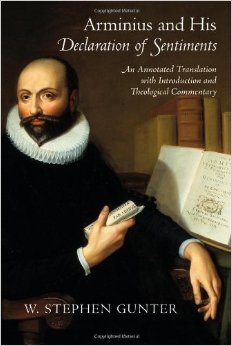
W. Stephen Gunter’s Arminius and His Declaration of Sentiments: An Annotated Translation with Introduction and Theological Commentary

51t2cVAJrHL._SY344_BO1,204,203,200_Dr. W. Stephen Gunter, Associate Dean for Methodist Studies and Research Professor of Evangelism and Wesleyan Studies at Duke Divinity School, has made a significant contribution to the study of historical theology and the study of theology itself with his Arminius and His Declaration of Sentiments: An Annotated Translation with Introduction and Theological Commentary. In 1608, Arminius delivered his Sentiments before the States of Holland in response to a growing controversy surrounding the theology professor and his soteriological views.

I have blogged about Arminius before and have interviewed one contemporary Arminius scholar already on this site.  I hope to bring an interview of Dr. Gunter soon.

There would indeed appear to be something of a modern renaissance in Arminian studies. It is interesting to theorize about why this might be.  Undoubtedly the rise of a neo-Calvinism that can, at times, be pretty aggressive has played a part in this.  But there is also something about the neglect of Arminius as well as, most tragically, the caricaturing of him among many today that calls for a just setting straight of the record.  Gunter has taken  his place among those who are currently doing just that.  In so doing, he has helped to right a very real wrong.

Gunter’s translation of Arminius’ Declaration of Sentiments is the first from the original Dutch.  It is an engaging, insightful, and accessible translation that certainly reads much better than the one currently available in the three-volume Works of Arminius by Nichols and Bagnall.  Gunter offers a number of needed corrections to Nichols’ translation.  What is more, he provides a very helpful history and biography of Arminius in the first third of the book as well as an illuminating theological unpacking of the Sentiments in the last third (with the Sentiments themselves comprising the middle section).

In all, this work gives a great overview of Arminius and Arminianism, the man and the theology.  A careful reading of this work should definitively end the stereotype of Arminius as a Pelagian, an anti-Calvinist, and a champion of the modern notion of libertarian free will.  In point of fact, Arminius stood within the Reformed tradition and was simply seeking (a) to push back against the more extreme forms of Calvinistic extremism (i.e., the doctrine of reprobation in particular), (b) to defend the character of God against a theology that he felt necessarily made God the author of evil, and (c) to perform theological triage (to use the language of Al Mohler) and show that speculative theologies concerning the mysteries of predestination should not be elevated to the position of first order.  In a sense, Arminius was calling for theological prioritization, the distinguishing of the core of the gospel from speculative theorization, and appropriate tolerance on these secondary issues among Christians of good will.

Apart from the particulars of the theological debate, Arminius provides us with an interesting model of theological conflict management that would be useful for us to consider today.  Arminius sounds like a “mere Christian” before “mere Christianity,” as we know it today, had come on the scene, and his appeal for toleration, calm, reasonable discussion, and fair treatment in the midst of debate are as needed today as they were then.

This is a very interesting book, and very well done.

G.K. Chesterton’s References to and Drawing of C.H. Spurgeon

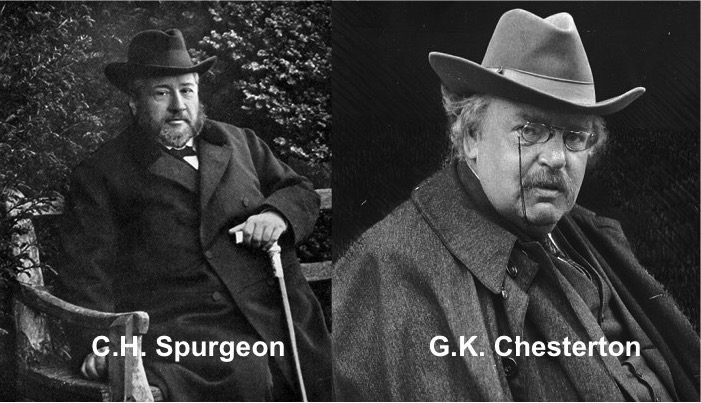
thechesterspurgeonAs a fan of both Chesterton and Spurgeon, I was curious to know whether or not the former ever mentioned the latter.  As it turns out, he did so twice, and even drew a picture of Spurgeon.

C.H. Spurgeon (1834-1892) was forty years old when G.K. Chesterton (1874-1936) was born.  Chesterton was eighteen when Spurgeon died.  That means that Chesterton was certainly aware of Spurgeon, though, again, in his voluminous writings, he apparently only mentions Spurgeon twice.

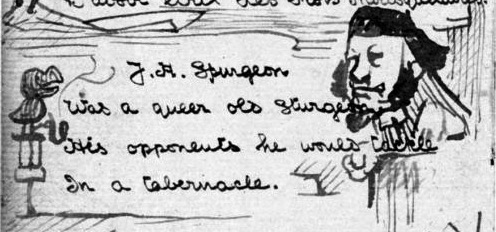
The first reference appears in one of Chesterton’s clerihews (a four line biographical poem).  It can be found in Part 2 of Volume X of The Collected Works of G.K. Chesterton, edited by Denis Conlon.  It should be noted that Chesterton collaborated with friends on these clerihews.  This clerihew is signed “ECB & GKC, EC, WPHd’A.”

This reference is interesting because Chesterton made a mistake on Spurgeon’s initials.  Here is what he wrote:

J.H. Spurgeon

Was a queer old sturgeon.

His opponents he would tackle

In a tabernacle.

In his footnote on this clerihew, Conlon writes:

Presumably C.H. Spurgeon (1834-1892) who was an English Baptist preacher of strong convictions.

This volume of Chesterton’s poetry also includes a facsimile reproduction of the clerihews as well as Chesterton’s accompany drawings.  Here is Chesterton’s Spurgeon drawing:

ChestertonsSpurgeonDrawing

We do not know the exact date of this clerihew, but it was before 1900.  This is an interesting depiction, and it cannot be called a complimentary one.  In the four lines and the drawing, Chesterton alludes to Spurgeon’s alleged oddness, bellicosity, and coarseness (“sturgeon”), and likely what Chesterton would have seen as his violent sectarianism (“His opponents he would tackle in a tabernacle.”).

A second reference to Spurgeon can be found in Chesterton’s 1903 essay, “The Return of Angels.” In this essay, Chesterton assembles a panoply of quite unlikely allies in an effort to demonstrate how otherwise disjoined personages are all in agreement on the existence of “the spiritual life.” Thus, “That Marcus Aurelius and the Red Indians, that Hindu sages and Italian brigands and Mr. Spurgeon and Sir William Crookes should all by various roads come to this conclusion, this is an important thing.”

Here Chesterton’s employment of Spurgeon’s name is purely utilitarian and is obviously intended to highlight the likelihood of the existence of the soul by pointing to the agreement on this point among such a disparate and unlikely lot.

In conclusion, Chesterton was clearly aware of Spurgeon and appears to have viewed him the way that a Catholic of the time would have:  an interesting but somewhat unpleasant sectarian oddity.  Thus, Chesterton’s depictions of Spurgeon would indeed appear to be unjust, or, at least, inaccurate, but likely not malicious.  They arise almost certainly more from a stereotype than actual knowledge of Spurgeon’s amazing ministry.

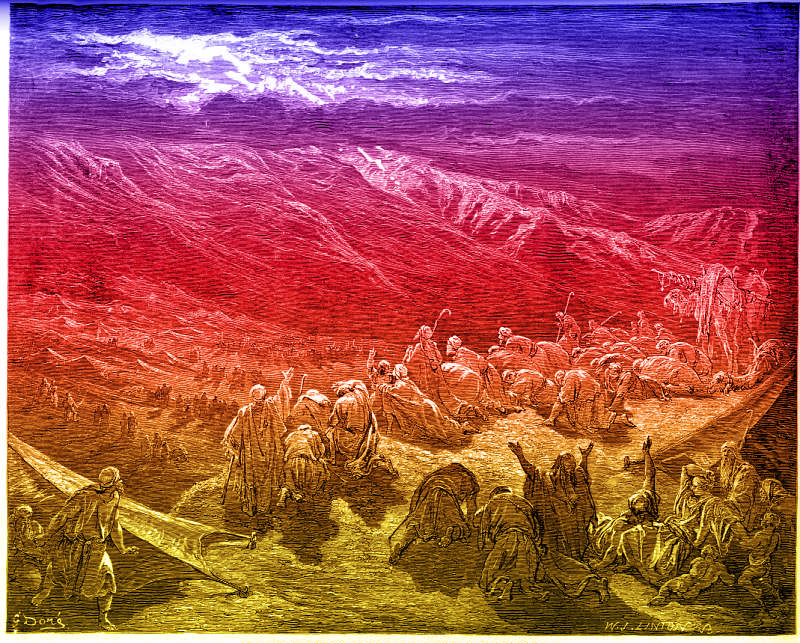
Exodus 19

Exodus-Chapter-19-The-Giving-of-the-Law-on-Mount-SinaiExodus 19 

1 On the first day of the third month after the Israelites left Egypt—on that very day—they came to the Desert of Sinai. 2 After they set out from Rephidim, they entered the Desert of Sinai, and Israel camped there in the desert in front of the mountain. 3 Then Moses went up to God, and the Lord called to him from the mountain and said, “This is what you are to say to the descendants of Jacob and what you are to tell the people of Israel: 4 ‘You yourselves have seen what I did to Egypt, and how I carried you on eagles’ wings and brought you to myself. 5 Now if you obey me fully and keep my covenant, then out of all nations you will be my treasured possession. Although the whole earth is mine, 6 you will be for me a kingdom of priests and a holy nation.’ These are the words you are to speak to the Israelites.” 7 So Moses went back and summoned the elders of the people and set before them all the words the Lord had commanded him to speak. 8 The people all responded together, “We will do everything the Lord has said.” So Moses brought their answer back to the Lord. 9 The Lord said to Moses, “I am going to come to you in a dense cloud, so that the people will hear me speaking with you and will always put their trust in you.” Then Moses told the Lord what the people had said. 10 And the Lord said to Moses, “Go to the people and consecrate them today and tomorrow. Have them wash their clothes 11 and be ready by the third day, because on that day the Lord will come down on Mount Sinai in the sight of all the people. 12 Put limits for the people around the mountain and tell them, ‘Be careful that you do not approach the mountain or touch the foot of it. Whoever touches the mountain is to be put to death. 13 They are to be stoned or shot with arrows; not a hand is to be laid on them. No person or animal shall be permitted to live.’ Only when the ram’s horn sounds a long blast may they approach the mountain.” 14 After Moses had gone down the mountain to the people, he consecrated them, and they washed their clothes. 15 Then he said to the people, “Prepare yourselves for the third day. Abstain from sexual relations.” 16 On the morning of the third day there was thunder and lightning, with a thick cloud over the mountain, and a very loud trumpet blast. Everyone in the camp trembled. 17 Then Moses led the people out of the camp to meet with God, and they stood at the foot of the mountain. 18 Mount Sinai was covered with smoke, because the Lord descended on it in fire. The smoke billowed up from it like smoke from a furnace, and the whole mountain trembled violently. 19 As the sound of the trumpet grew louder and louder, Moses spoke and the voice of God answered him. 20 The Lord descended to the top of Mount Sinai and called Moses to the top of the mountain. So Moses went up 21 and the Lord said to him, “Go down and warn the people so they do not force their way through to see the Lord and many of them perish. 22 Even the priests, who approach the Lord, must consecrate themselves, or the Lord will break out against them.” 23 Moses said to the Lord, “The people cannot come up Mount Sinai, because you yourself warned us, ‘Put limits around the mountain and set it apart as holy.’” 24 The Lord replied, “Go down and bring Aaron up with you. But the priests and the people must not force their way through to come up to the Lord, or he will break out against them.” 25 So Moses went down to the people and told them.

In Cormac McCarthy’s novel Blood Meridian, the ominous character known only as the Judge expresses his brutal and nihilistic philosophy of life by asking this question: “If God meant to interfere in the degeneracy of mankind would he not have done so by now?”[1] The premise behind the Judge’s question is that man is on his own, that there likely is no God, that, if there is a God, He is a deistic God watching indifferently from a distance, and that we look to the heavens for help in vain.

Of course, such a sentiment flies in the very face of the Christian religion, which holds at its core the conviction that God has indeed come to lost humanity. He has come definitively in Christ Jesus, but He began to reveal Himself before the incarnation of Christ. He did so, for instance, at Sinai through the giving of the law. This was an amazing act of generosity, God’s revelation of Himself. In so doing, God brought us out of darkness into the light of His own truth.

In Exodus 19, the Lord is preparing His children for the giving of the law. In so doing, the Lord offered the answer to the Judge’s question. In point of fact, the Lord God has “interfered in the degeneracy of mankind.” He has given His law and he has given His Son to save us from the law’s condemning sentence.

The giving of the law emanates from the awesome holiness of God, as is evident when we consider our text.

Obedience enables us to receive and enjoy God’s loving desire for union and relationship.

Foundational to the giving of the law is the truth that obedience enables us to receive and enjoy God’s loving desire for union and relationship. Sin disrupts our relationship with God. Obedience allows us to see and enjoy God.

1 On the first day of the third month after the Israelites left Egypt—on that very day—they came to the Desert of Sinai. 2 After they set out from Rephidim, they entered the Desert of Sinai, and Israel camped there in the desert in front of the mountain. 3 Then Moses went up to God, and the Lord called to him from the mountain and said, “This is what you are to say to the descendants of Jacob and what you are to tell the people of Israel: 4 ‘You yourselves have seen what I did to Egypt, and how I carried you on eagles’ wings and brought you to myself. 5 Now if you obey me fully and keep my covenant, then out of all nations you will be my treasured possession. Although the whole earth is mine, 6 you will be for me a kingdom of priests and a holy nation.’ These are the words you are to speak to the Israelites.” 7 So Moses went back and summoned the elders of the people and set before them all the words the Lord had commanded him to speak. 8 The people all responded together, “We will do everything the Lord has said.” So Moses brought their answer back to the Lord.

As the Lord set the stage for His self-revelation at Sinai, He named His stated desire for doing so: “you will be my treasured possession. Although the whole earth is mine, you will be for me a kingdom of priests and a holy nation.” This will perhaps sound familiar to you. Peter says something very similar to the Church in 1 Peter 2:9.

But you are a chosen race, a royal priesthood, a holy nation, a people for his own possession, that you may proclaim the excellencies of him who called you out of darkness into his marvelous light.

Behold the unchanging heart of God! It is the same in the Old Testament as in the New. He desires for His people to live in loving relationship with Him as a treasured possession and kingdom of priests! The IVP Bible Background Commentary offers an interesting insight into this first image.

The phrase “treasured possession” uses a word common in other languages of the ancient Near East to describe accumulated assets, whether through division of spoils or inheritance from estate. That people can be so described is evident in a royal seal from Alalakh, where the king identifies himself as the “treasured possession” of the god Hadad. Likewise in a Ugaritic text the king of Ugarit’s favored status as a vassal is noted by naming him a “treasured possession” of his Hittite overlord.[2]

What the pagan king Alalakh dares to proclaim for himself, the Lord God says of His own people: we are his treasured possession. God does not desire groveling subjects, He desires a restored and exalted people who bare witness to His own glory. That cannot happen without obedience, as His words make clear. To be all that God wants us to be and to see of God all that He desires for us to see of Him, we must be obedient.

The first question in the Westminster Catechism is significant in this regard.

Question 1: What is the chief and highest end of man?

Answer: Man’s chief and highest end is to glorify God, and fully to enjoy him forever.

That is famously and well said: to glorify God, and fully to enjoy him forever. But that enjoyment cannot take place within one who is rebelling against the Lord God. There is an inviolable link between our trusting and obeying God and our being able to see, know, and enjoy Him.

Tragically, many do not understand this. For instance, Time magazine columnist Roger Rosenblatt wrote an article entitled “God is Not On My Side. Or Yours.” In this column, he spoke of how he viewed God. He made a rather amazing statement in this regard: “So indefinite is my idea of God that I do not even connect it to morality…”[3]

This is not the God of Sinai. This is not the God of Bethlehem. The God of scripture, the God revealed in the law and the prophets then, definitively and ultimately, in Christ is no vague deity who is disconnected from the lives of His people. Rather, He is the God who is known through the path of trust, faith, and obedience.

God is other, transcendent, and holy…but has drawn near and revealed Himself.

And He is the God who is other, transcendent, and holy, yet inviting, and welcoming. Both of these realities can be seen in God’s instructions concerning His appearance.

9 The Lord said to Moses, “I am going to come to you in a dense cloud, so that the people will hear me speaking with you and will always put their trust in you.” Then Moses told the Lord what the people had said. 10 And the Lord said to Moses, “Go to the people and consecrate them today and tomorrow. Have them wash their clothes 11 and be ready by the third day, because on that day the Lord will come down on Mount Sinai in the sight of all the people. 12 Put limits for the people around the mountain and tell them, ‘Be careful that you do not approach the mountain or touch the foot of it. Whoever touches the mountain is to be put to death. 13 They are to be stoned or shot with arrows; not a hand is to be laid on them. No person or animal shall be permitted to live.’ Only when the ram’s horn sounds a long blast may they approach the mountain.”

Eusebius argued that the one who came to Moses in the cloud was not the Father but rather “the One whom we name as the Word of God, the Christ who was seen for the sake of the multitude of Moses and the people in a pillar of cloud, because it was not possible for them to see him like their fathers in human shape.”[4] Eusebius argued that what we see in Exodus 19 is a Christophany, an Old Testament appearance of Christ.

Perhaps. Regardless, the Lord foretells that He will descend in awesome power. He would come, He said, in a cloud on the mountain. Roy Honeycutt’s explanation of the physical dynamics of this divine manifestation is unfortunately unsatisfactory and reductionist.

That the mysterious forces of storm, fire, and earthquake were equated with the presence of God should occasion no surprise. One would expect ancient men to equate the powerful and the mysterious with the divine to a degree seldom approximated in a scientifically oriented age.

            The Lord revealed himself to ancient Israelites in keeping with their own patterns of thought, as, in this instance, the belief that God was present in the storm and fire.

            In viewing ancient media of revelation one would do well to remember that the validity of revelation does not depend upon the media used. Legitimate revelation may come through a succession of physical and psychically conditioned media which are part of the temporary thought processes of a culture, without adversely affecting the validity of the revelation.[5]

Honeycutt appears to be suggesting that the details of this account are possibly just projections of the ancient mindset onto a dynamic they could not otherwise explain. Frankly, this is not how the account reads. It reads as if God indeed came in cloud and fire onto the mountain. As a result of His holy presence, any who came unbidden to the mountain would be executed, but executed in a way that did not involve direct physical contact; they would be stoned or shot with arrows.

Here we see the awesome power of God. The dire consequences of touching the mountain highlight that we are not dealing here with an earthly entity. We are dealing with something other, a power that can be neither comprehended nor contained. We are dealing with the holiness of God. R.C. Sproul has offered the following perceptive insights into the holiness of God.

Only once in sacred Scripture is an attribute of God elevated to the third degree. Only once is a characteristic of God mentioned three times in succession. The Bible says that God is holy, holy, holy. Not that He is merely holy, or even holy, holy. He is holy, holy, holy. The Bible never says that God is love, love, love; or mercy, mercy, mercy; or wrath, wrath, wrath; or justice, justice, justice. It does say that He is holy, holy, holy, that the whole earth is full of His glory.[6]

Yes! “Holy, holy, holy!” Seeing and honoring the holiness of God is absolutely essential to grasping an accurate picture of who He is. The divine cautions of Exodus 19 make this clear. But note: He is holy, but He still invites us to come. They are not to touch the mountain, but they are to approach it, they are to come to it. They are to come to it because God has come to it.

Our chapter therefore presents us with two realities: the unapproachable holiness and power and otherness of God and the loving, invitation of this holy God for us to come near. God cannot be seized by fallen man, but He can be approached, for He has invited us to come.

It strikes me that if either of these truths are neglected, it leads to a tragic distortion. If God’s transcendence and otherness are stressed without His inviting self-revelation, God remains an unknowable mystery, a deistic deity that cannot be approached or understood. Richard John Neuhaus described this mistaken view.

            The transcendence of God has been excitedly seized upon by the ringmasters of the circus that is theology today…God, they tell us, is so transcendently transcendent, so ineffably ineffable, so utterly utter, that no words, no creeds, no liturgies, no gestures can possibly claim to speak the “truth” about God. (It is a significant sign of our time that so many put truth in quotation marks.)[7]

On the other hand, if the invitation, the “knowability,” and the welcome are stressed to the exclusion of God’s holiness, transcendence, and otherness, we end up with a reduced deity who is unable to inspire awe. The solution to both of these distortions is the picture of God we find in our text: holy and other but self-revealing and inviting. These balancing realities must be held together.

We are privileged to come to God, but we should come reverently and in full awareness of His holiness and awesome power.

This means that we are welcome to come, but we should come reverently and in full awareness of His holiness and awesome power.

14 After Moses had gone down the mountain to the people, he consecrated them, and they washed their clothes. 15 Then he said to the people, “Prepare yourselves for the third day. Abstain from sexual relations.” 16 On the morning of the third day there was thunder and lightning, with a thick cloud over the mountain, and a very loud trumpet blast. Everyone in the camp trembled. 17 Then Moses led the people out of the camp to meet with God, and they stood at the foot of the mountain. 18 Mount Sinai was covered with smoke, because the Lord descended on it in fire. The smoke billowed up from it like smoke from a furnace, and the whole mountain trembled violently. 19 As the sound of the trumpet grew louder and louder, Moses spoke and the voice of God answered him. 20 The Lord descended to the top of Mount Sinai and called Moses to the top of the mountain. So Moses went up 21 and the Lord said to him, “Go down and warn the people so they do not force their way through to see the Lord and many of them perish. 22 Even the priests, who approach the Lord, must consecrate themselves, or the Lord will break out against them.” 23 Moses said to the Lord, “The people cannot come up Mount Sinai, because you yourself warned us, ‘Put limits around the mountain and set it apart as holy.’” 24 The Lord replied, “Go down and bring Aaron up with you. But the priests and the people must not force their way through to come up to the Lord, or he will break out against them.” 25 So Moses went down to the people and told them.

The people were called to approach, but they were called to approach carefully and reverently after careful preparations. They were to wash their clothes and refrain from sexual relations for three days. They were to come to the Lord, but they were to remember that it was the Lord to Whom they were coming.

One wonders if the modern Church has a high enough view of the character and majesty of God to tremble before His glory? Do we even feel any need to prepare ourselves at all? We have such a very casual approach to worship, do we not? We tend to stand around shaking hands and laughing or talking about the ballgame or the latest news or what the person over there chose to wear to church today, only to stop at the appointed time and take our (normally) accustomed pew to start worship. How very different this seems from God’s instructions to His people in Exodus 19! In Exodus 19 they come before His holy mountain, but they come with awe and a keen awareness of God’s power and glory and majesty.

A clear awareness of the sovereign majesty of God makes His invitation for us to come that much more awe inspiring and it should inspire us to come with a sense of awe. In her prayer journal, a young Flannery O’Connor wrote, “It’s a moth who would be king, a stupid slothful thing, a foolish thing, who wants God, who made the earth, to be its Lover. Immediately.”[8]

Indeed, there is something foolish and audacious about wanting to be in a loving relationship with such a power God. Yet, this God, this God of Exodus 19, calls for us to come. Even more astonishing is this: the God of Exodus 19 – the God of quaking mountains, of cloud and fire, of storm, the God of holy power and transcendent awe – this God is the God who humbled Himself to be born of the Virgin Mary, to come among us preaching the Kingdom and offering love and mercy and grace. The God of Exodus 19 is the God Who lays down His life on the cross, Who bares the sins of all mankind, Who pays the price for our rebellion, and Who then rises in victory over sin, death, and hell.

That is, the God who bids us come is the God who has Himself come to us. It is a staggering truth! He has come to us in Jesus because He knows that we will in fact never be able to make ourselves holy enough to come to Him. We can never bathe enough, fast enough, abstain enough, or purify enough to become holy as He is holy. Therefore, out of the storehouses of His own grace and mercy, He who bids us come to His mountain in Exodus 19 comes to us in Jesus so that He might make us worthy through the blood of His Son to draw near. For “in Christ God was reconciling the world to himself, not counting their trespasses against them, and entrusting to us the message of reconciliation” (2 Corinthians 5:19).

Would you come before a holy God? You can only come to Him through Jesus. Jesus has made a way. Jesus offers the necessary purification through His own shed blood. This God is one and the same.

This is the immutable God of Sinai and Bethlehem, of holy fire and a baby’s cry, of the quaking mountain and the swaddled cloths. Behold our God: awesome in power and tender in mercy, the thundering God of law and the forgiving God of grace.

Our God is one, unchanging and perfect.

Let us come to His holy mountain.

Let us worship His great name.


[1] McCarthy, Cormac (2010-08-11). Blood Meridian: Or the Evening Redness in the West (Vintage International) (p. 141). Knopf Doubleday Publishing Group. Kindle Edition.

[2] John H. Walton, Victor H. Matthews, Mark W. Chavalas, The IVP Bible Background Commentary: Old Testament. (Downers Grove, IL: InterVarsity Press, 2000), p.94.

[3] National Liberty Journal, February 2002, p.23

[4] Joseph T. Lienhard, ed., Exodus, Leviticus, Numbers, Deuteronomy. Ancient Christian Commentary on Scripture. Old Testament, vol.III. Thomas C. Oden, ed. (Downer’s Grove, IL: InterVarsity Press, 2001), p.96.

[5] Roy L. Honeycutt, Jr. “Exodus.” The Broadman Bible Commentary. Vol.1, Revised (Nashville, TN: Broadman Press, 1969), p.345-346.

[6] R.C. Sproul, Holiness (Carol Stream, IL: Tyndale House Publishers, Inc., 1998), p.26.

[7] Thomas C. Oden, Requiem: A Lament in Three Movements (Nashville, TN: Abingdon Press, 1995), p.11.

[8] Flannery O’Connor, A Prayer Journal. (New York, NY: Farrar, Straus and Giroux, 2013), p.38-39.

Apologia: A Sermon Series in Defense of the Faith – Part III: “Has Christianity Been Good For the World?”

apologiaIn 2007, the late Christopher Hitchens published his bestselling book, god is Not Great. As you might imagine the book was not a love letter to the Lord. Hitchens, an atheist, launched his complaint against religion in this book and his message was enthusiastically received by the many people who agreed with him. What is particularly telling about the book is the subtitle: “How Religion Poisons Everything.”

That is certainly an extreme opinion, and, again, it is one that is shared by many today. In fact, that premise (that religion poisons everything) has become almost an assumption among many modern people. But is it true? Specifically, is it true of Christianity, a religion that Hitchens had especial disdain for?

Put another way, has Christianity been good for the world or has it been bad for the world?

In exploring this question I want to offer two prefatory remarks. First, it needs to be understood that the truthfulness of Christianity and the truthfulness of the gospel of C hrist does not hinge upon the behavior of His followers. This is not a cop-out. This is simple logic, especially when we consider that one of the tenets of Christianity is the fallenness and sinfulness of all people.

This is not to say, of course, that the behavior of Christians is unimportant. That would be an absurd thing to say and even a blasphemous thing to say. How we act and how we as a Church have acted is extremely important. It plays a large part in the willingness of people to hear what we have to say. But the fact that Christian behavior is very important does not mean that Christian behavior has the power to falsify what Jesus said about Himself and the Father. Our failure to follow Jesus makes us tragic hypocrites, to be sure, but it does not make Jesus a liar.

Secondly, I want to acknowledge up front that, yes, Christians have done many bad and evil and regrettable and unChristlike things over the last 2,000 years. This is to our shame. I am therefore not trying to create a romantic picture of the past or present.

What I want to do, instead, is this: I want to say that those who depict Christianity itself as evil or as a poison or a force for bad can only do so by (a) grossly overplaying Christianity’s alleged crimes and (b) grossly downplaying Christianity’s virtues.

In short, Hitchens’ subtitle, “How Religion Poisons Everything,” is absurd if he was speaking of Christianity, which, in part, he certainly was. In point of fact, Christianity, even with its glaring faults, has indeed done amazing things in the world.

The coming of Jesus brought a sense of dignity and worth and value to mankind that the pagan cultures did not share.

The first thing we must realize is that inherent within the gospel, the central message of Christianity, are the theological and philosophical ingredients for a revolution that swept and is continuing to sweep the world. Those ingredients are the following four doctrines: the imago Dei, the love of God, the incarnation, and the call to incarnate ministry.

The imago Dei

The imago Dei is “the image of God.” Genesis 1 provides us with the foundational text.

26 Then God said, “Let us make mankind in our image, in our likeness, so that they may rule over the fish in the sea and the birds in the sky, over the livestock and all the wild animals, and over all the creatures that move along the ground.” 27 So God created mankind in his own image, in the image of God he created them; male and female he created them.

The doctrine of the image of God means that men and women have inherent worth and dignity and value because humanity is not an accident and does not consist of mere animals. Rather, humanity is made up of image bearers who reflect the character of God. We are fallen, of course, and the image of God in us is marred and covered by our own rebellion and sinfulness, but we still bear the image.

The love of God

Along with the imago Dei is the doctrine of the love of God. To call this a doctrine seems coldly reductive, for the love of God is the very heartbeat of the gospel and stretches over the scriptures like a canopy from Genesis to Revelation. In John 3 we read:

16 “For God so loved the world, that he gave his only Son, that whoever believes in him should not perish but have eternal life. 17 For God did not send his Son into the world to condemn the world, but in order that the world might be saved through him.

Christianity therefore asserts (1) that human beings bear the image of God and (2) that God loves human beings. But Christianity also teaches that the world is fallen. Even so, God’s love still stands. In fact. It was out of love that God sent His Son to us.

The incarnation

The incarnation refers to God taking on human flesh and being born of the Virgin Mary. It refers to God coming to mankind, reaching to lost men and women in and through Jesus. Thus, in John 1 we read:

14 The Word became flesh and made his dwelling among us. We have seen his glory, the glory of the one and only Son, who came from the Father, full of grace and truth.

So God comes to us in our lostness, and redeems through Christ all who will come to Him in faith and repentance. In Christ, then, God has redeemed and created a people for Himself. Not only has He redeemed us, He has called us to be the body of Christ. That is, He has called us to incarnate ministry.

The call to incarnate ministry

God calls the Church to live out the life of Christ, to reach out to the world with the same heart of love that our Lord Jesus has. We are called to incarnate ministry in Philippians 2.

5 Have this mind among yourselves, which is yours in Christ Jesus, 6 who, though he was in the form of God, did not count equality with God a thing to be grasped, 7 but emptied himself, by taking the form of a servant, being born in the likeness of men. 8 And being found in human form, he humbled himself by becoming obedient to the point of death, even death on a cross.

This is most significant: we are called to do today what Christ has done. We are called to love with God’s love, to go as Christ came, and to help people return to the God in Who’s image they are made.

These four theological ingredients – the image of God, the love of God, the incarnation, and the call to incarnate ministry – come together in the Christian movement in such a way as to grant a dignity to mankind and a framework in which the early Church, and the Church today, could love with absolute reckless abandon all of humanity. These four doctrines converge in Christ to create an incendiary revolution of love and care and compassion.

One beautiful expression of this comes from the novel Doctor Zhivago in which the character Nikolai Nikolaievich records the following thoughts about what Christianity brought into the world in his diary:

Rome was a flea market of borrowed gods and conquered peoples, a bargain basement on two floors, earth and heaven, a mass of filth convoluted in a triple knot as in an intestinal obstruction. Dacians, Herulians, Scythians, Sarmatians, Gyperboreans, heavy wheels without spokes, eyes sunk in fat, sodomy, double chins, illiterate emperors, fish fed on the flesh of learned slaves. There were more people in the world than there have ever been since, all crammed into the passages of the Coliseum, and all wretched.

And then, into this tasteless heap of gold and marble, He came, light and clothed in an aura, emphatically human, deliberately provincial, Galilean, and at that moment gods and nations ceased to be and man came into being – man the carpenter, man the plowman, man the shepherd with his flock of sheep at sunset, man who does not sound in the least proud, man thankfully celebrated in all the cradle songs of mothers and in all the picture galleries the world over.”[1]

Nikolaievich is right. The greatest good that Christianity has brought into the world is the gospel, the liberating, humbling, empowering gospel of Jesus.

Christianity is a revolution that has sought to alleviate suffering and evil in the world in a way that is truly astonishing.

This theological foundation gave rise to an amazing revolution of love and compassion and mercy. In short, the Christian Church immediately made amazing strides in alleviate suffering and combating evil in the world.

Greek Orthodox philosopher and theologian David Bentley Hart has written of “Christianity’s twenty centuries of unprecedented and still unmatched moral triumphs – its care of widows and orphans, its almshouses, houses, hospitals, foundling homes, schools, shelters, relief organizations, soup kitchens, medical missions, charitable aid societies.”[2] Hart went on to give numerous examples of Christian charity, including the fact that “during the Middle Ages, the Benedictines alone were responsible for more than two thousand hospitals in Western Europe.”[3]

That is but one small example out of many. In a very insightful article entitled, “A New Era in Roman Healthcare,” Professor Gary Ferngren of Oregon State University wrote of Christianity’s revolutionary and attention-grabbing care for the poor in the Roman Empire. After observing that, “compassion was not a well-developed virtue among the pagan Romans; mercy was discouraged, as it only helped those too weak to contribute to society,” Ferngren offered some examples of how Christianity changed this unfortunate reality. Consider:

  • “Church leaders encouraged all Christians to visit the sick and help the poor, and each congregation also established an organized ministry of mercy. Presbyters (priests) and deacons added benevolent ministry to their sacramental roles.”
  • “By the third century the number of those receiving aid from the hands of the church had grown considerably, especially in large cities. Congregations created additional minor clerical orders, such as subdeacons and acolytes, to assist deacons in benevolence as well as liturgy.”
  • “Altogether the church in Rome ministered to 1,500 widows and others in need. It has been estimated that the Roman church spent annually between 500,000 and 1,000,000 sesterces—an enormous sum—on benevolent work.”
  • Concerning the 251 AD plague in Carthage, North Africa: “Carthage’s bishop, Cyprian, enjoined the city’s Christians to give aid to their persecutors and to care for the sick. He urged the rich to donate funds and the poor to volunteer their service for relief efforts, making no distinction between believers and pagans. Under Cyprian’s direction, Christians buried the dead left in the streets and cared for the sick and dying. For five years he stood in the breach, organizing relief efforts, until he was forced into exile.”
  • Concerning the 416 AD plague in Alexandria, Egypt: “the Christian patriarch of that city organized a corps of men recruited from the poor classes to transport and nurse the sick. They were called the parabalani, the “reckless ones,” because they risked their lives by exposing themselves to contagion while assisting the sick.”
  • “In the early fourth century, lay Christian orders began to appear in the large cities of the Eastern Roman Empire. The two best known were the spoudaioi (“the zealous ones”) and (in Egypt) the philoponoi (“lovers of labor”). The mission of these groups, drawn mostly from the lower classes, was to reach out to the indigent sick in cities such as Alexandria and Antioch. These cities had a large population of homeless sick and dying on the streets. The philoponoi would distribute food and money to them and take them to the public baths, where their basic hygienic needs could be met and they could find warmth in winter. None had medical training, but they were motivated by compassionate concern.”[4]

The old canard about the Church exhibiting two thousand years worth of cruelty, indifference, and violence has become so commonplace that the average person today is most unlikely to have heard much if anything about the amazing things that God has done through the Church throughout her history. In truth, honest observers, whether Christian or not, have marveled at the kindness that the Church has shown throughout history. The Swiss historian of medicine and Professor of the History of Medicine at The Johns Hopkins University, Henry Sigerist wrote that Christianity introduced the “most revolutionary and decisive change in the attitude of society toward the sick.” He continued:

Christianity came into the world as the religion of healing, of the joyful gospel of the Redeemer and of Redemption. It addressed itself to the disinherited, to the sick and afflicted, and promised them healing, a restoration of both spiritual and physical…it became the duty of the Christian to attend to the sick and poor of the community…the social position of the sick man thus became fundamentally different from what it had been before. He assumed a preferential treatment which has been his ever since.[5]

Even more striking is to hear an acknowledgement of Christianity’s kindness and works of mercy from an ardent opponent of the faith. Julian the Apostate, in the early 360’s AD, was a Roman emperor who sough the eradication of the early Christian movement and worked towards a revival of the old pagan religions. The problem was that the paganism he was seeking to revive was failing to exhibit the kind of benevolence for mankind that the Christians he was seeking to thwart were exhibiting. Julian wrote a famous letter to Arsacius, high pagan priest of Galatia, in which he said the following:

Why do we not observe that it is their [the Christians’] benevolence to strangers, their care for the graves of the dead, and the pretended holiness of their lives that have done most to increase atheism [unbelief of the pagan gods]?…For it is disgraceful that, when no Jew ever has to beg, and the impious Galileans [Christians] support not only their own poor but ours as well, all men see that our people lack aid from us. Teach those of the Hellenic faith to contribute to public service of this sort.[6]

Amazing! Here we see a pagan emperor instructing his pagan priests to study Christianity so that they could learn how to be loving and kind and merciful to others. That is quite an endorsement!

Contrary to the consistent charge of bloodshed, Christianity is not a primary cause for war.

Having shown evidence of the great good that Christianity has done, I would like now to refute a popular claim that simply needs to be refuted, namely, the charge that Christianity is a bloody, violent religion that has been a primary cause of war in the world. For one example of this charge, consider the following statement that was sent in an email to one of our church members from one of his friends.

[I] believe that organized religion is the cause of wars, hate, bigotry, non-acceptance and cruelty. History proves that, the very words in the Bible proves it, the recent past & present proves it.

Another example can be seen in the words of Robert Green Ingersoll, who wrote:

Religion makes enemies instead of friends. That one word, “religion,” covers all the horizon of memory with visions of war, of outrage, of persecution, of tyranny, and death. . . . Although they have been preaching universal love, the Christian nations are the warlike nations of the world.[7]

Well. That is quite a stunning accusation. But is it true? In his amazing book Atheist Delusions, David Bentley Hart writes of his frustration with this particular accusation.

[I]t is sometimes difficult, frankly, to be perfectly generous in one’s response to the sort of invective currently fashionable among the devoutly undevout, or to the sort of historical misrepresentations it typically involves. Take for instance Peter Watson, author of a diverting little bagatelle of a book on the history of invention, who, when asked not long ago by the New York Times to name humanity’s worst invention, blandly replied, “Without question, ethical monotheism…. This has been responsible for most of the wars and bigotry in history.”‘

After touching briefly on some of the reasons why wars have actually been fought, Hart concludes:

By contrast, the number of wars that one could plausibly say have actually been fought on behalf of anything one might call “ethical monotheism” is so vanishingly small that such wars certainly qualify as exceptions to the historical rule.[8]

These are two very different statements indeed! Who is right? Has Christianity, and, for that matter, religion in general, been the primary cause of war in the world or has it not.

In his book, The Irrational Atheist, Vox Day writes of his own examination of history’s wars and their causes.

A more systematic review of the 489 wars listed in Wikipedia’s list of military conflicts, from Julius Caesar’s Gallic Wars to the 1969 Football War between Honduras and El Salvador, shows that only fifty-three of these wars—10.8 percent—can reasonably be described as having a religious aspect, even if one counts each of the ten Crusades separately.

Day next goes on to cite the three-volume Encyclopedia of Wars, an exhaustive scholarly work of over 1,500 pages that looks at over 1,763 wars. Of those 1,763 wars, the authors concluded that 123 wars could be said to be religious in nature. Vox Day explains:

That is 123 wars in all, which sounds as if it would support the case of the New Atheists, until one recalls that these 123 wars represent only 6.98 percent of all the wars recorded in the encyclopedia…It’s also interesting to note that more than half of these religious wars, sixty-six in all, were waged by Islamic nations, which is rather more than might be statistically expected considering that the first war in which Islam was involved took place almost three millennia after the first war chronicled in the encyclopedia, Akkad’s conquest of Sumer in 2325 B.C. In light of this evidence, the fact that a specific religion is currently sparking a great deal of conflict around the globe cannot reasonably be used to indict all religious faith, especially when one considers that removing that single religion from the equation means that all of the other religious faiths combined only account for 3.23 percent of humanity’s wars. The historical evidence is conclusive. Religion is not a primary cause of war.[9]

I repeat what I said earlier: Christianity has committed some heinous crimes over the years and the Church’s betrayals should not be excused. But I would simply like to point out that the charge of Christianity’s warlike nature is simply a slander, a gross misrepresentation of the actual historical record. I do not think such a charge should be allowed to stand unchallenged.

Christians could begin here and now to reclaim and live out once again the revolutionary nature of the message of the cross and empty tomb, and, in so doing, capture the attention and curiosity of the watching world as it once did.

All of this raises an interesting question: could Christianity, which, today, is tragically anemic, regain its revolutionary reputation through amazing acts of transformative benevolence, love, and compassion? Indeed. Indeed we could.

In fact, wherever Christianity is actually lived out, people still marvel at it. Case in point: on December 27, 2008, The Times of London published an article by Matthew Parris entitled “As an atheist, I truly believe Africa needs God.”

Before Christmas I returned, after 45 years, to the country that as a boy I knew as Nyasaland. Today it’s Malawi, and The Times Christmas Appeal includes a small British charity working there. Pump Aid helps rural communities to install a simple pump, letting people keep their village wells sealed and clean. I went to see this work.

It inspired me, renewing my flagging faith in development charities. But travelling in Malawi refreshed another belief, too: one I’ve been trying to banish all my life, but an observation I’ve been unable to avoid since my African childhood. It confounds my ideological beliefs, stubbornly refuses to fit my world view, and has embarrassed my growing belief that there is no God.

Now a confirmed atheist, I’ve become convinced of the enormous contribution that Christian evangelism makes in Africa: sharply distinct from the work of secular NGOs, government projects and international aid efforts. These alone will not do. Education and training alone will not do. In Africa Christianity changes people’s hearts. It brings a spiritual transformation. The rebirth is real. The change is good.

I used to avoid this truth by applauding – as you can – the practical work of mission churches in Africa. It’s a pity, I would say, that salvation is part of the package, but Christians black and white, working in Africa, do heal the sick, do teach people to read and write; and only the severest kind of secularist could see a mission hospital or school and say the world would be better without it. I would allow that if faith was needed to motivate missionaries to help, then, fine: but what counted was the help, not the faith.

But this doesn’t fit the facts. Faith does more than support the missionary; it is also transferred to his flock. This is the effect that matters so immensely, and which I cannot help observing.[10]

Oh church, do you see? The unbelieving world is watching. Will we be a revolution again, a Jesus revolution? In Revelation 3, Jesus calls us to return to Him.

1 “To the angel of the church in Sardis write: These are the words of him who holds the seven spirits of God and the seven stars. I know your deeds; you have a reputation of being alive, but you are dead. 2 Wake up! Strengthen what remains and is about to die, for I have found your deeds unfinished in the sight of my God. 3 Remember, therefore, what you have received and heard; hold it fast, and repent. But if you do not wake up, I will come like a thief, and you will not know at what time I will come to you.

Church, let us wake up and live again! Let us live in such a way that the world marvels at us, and, more importantly, at our King, Jesus.

The fact of the matter is, the revolutionary spirit of early Christianity is still alive and well in the lives of many Christians today. And that makes sense. If we have been born again, we possess the Spirit of the living God through the saving work of Jesus Christ our Lord. The Lord Jesus has never changed. The Spirit of God today is the same Spirit Who led men and women to turn the world upside down with astounding acts of compassion in the first century. That is why even today, amidst all the failures of the Church, we see amazing glimpses of the Kingdom of God, living and active and still revolutionary.

How else to describe the behavior of the members of Emanuel African Methodist Episcopal Church in Charleston, South Carolina, who responded to Dylann Roof’s murder of nine church members (because he said he wanted to start a race war) by forgiving him?

“I’m reminded of some news media persons that wondered why the nine families all spoke of forgiveness and didn’t have malice in their heart,” [Rev. Norvel] Goff said during the Sunday service. “It’s that the nine families got it,” he said, reminding worshippers that members’ unwavering faith in God shows how to “love our neighbors as we love ourselves.”[11]

They “got it.”

And we “got it.”

And we need to live it.

Has Christianity been good for world? Indeed it has. It has had its failures, to be sure, but it has also succeeded in truly amazing ways, bringing light and life and hope and transformation to the world.

May it do so again, and may it do so with us.


[1] Boris Pasternak. Doctor Zhivago. (New York, N.Y.: Pantheon Books, Inc., 1958), p. 43.

[2] David Bentley Hart. Atheist Delusions: The Christian Revolution and Its Fashionable Enemies (Kindle Locations 184-185). Kindle Edition.

[3] David Bentley Hart. Kindle Location 434.

[4] https://www.christianhistoryinstitute.org/magazine/article/new-era-in-roman-healthcare/

[5] Darrel W. Amundsen and Gary B. Ferngren, “Virtue and Medicine from Early Christianity through the Sixteenth Century.” Virtue and Medicine: Explorations in the Character of Medicine. Volume 1. Earl E. Shelp, ed., Philosophy and Medicine. 17 (D. Reidel Publishing Company, 1985), p.50.

[6] https://www.milestonedocuments.com/documents/view/julian-the-apostate-letter-to-arsacius/text

[7] Quoted in Day, Vox (2008-02-01). The Irrational Atheist: Dissecting the Unholy Trinity of Dawkins, Harris, And Hitchens (p. 97). Perseus Books Group. Kindle Edition.

[8] David Bentley Hart. Kindle Locations 116-126.

[9] Day, Vox, p.103, 105-106.

[10] https://www.thetimes.co.uk/tto/opinion/columnists/matthewparris/article2044345.ece

[11] https://www.cnn.com/2015/06/21/us/charleston-church-shooting-main/