The Apologia Sermon Series

Here are audio and manuscript links for the Apologia sermons preached this summer.

Does God Exist? [audio / manuscript]

Is the Bible Reliable? (Part 1) [audio / manuscript]

Is the Bible Reliable? (Part 2) [audio / manuscript]

Has Christianity Been Good for the World? [audio / manuscript]

Is Jesus Really the Only Way to God? [audio / manuscript]

If Hell is Real is God Just? [audio / manuscript]

Did Jesus Rise From the Dead? [audio / manuscript]

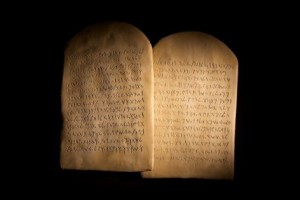
Exodus 20:12

what-are-ten-commandments_472_314_80Exodus 20

12 “Honor your father and your mother, so that you may live long in the land the Lord your God is giving you.

In his novel East of Eden, John Steinbeck wrote about the ways in which children often become disillusioned with their parents as they get older.

When a child first catches adults out – when it first walks into his grave little head that adults do not have divine intelligence, that their judgments are not always wise, their thinking true, their sentences just – his world falls into panic desolation. The gods are fallen and all safety gone. And there is one sure thing about the fall of gods: they do not fall a little; they crash and shatter or sink deeply into green muck. It is a tedious job to guild them up again; they never quite shine. And the child’s world is never quite whole again. It is an aching kind of growing.[1]

There is truth in those observations. Part of growing older is coming to terms with the humanity of our parents. Of course, while that is happening, your parents are trying to come to terms with the humanity of their children. We all must come to terms with our imperfections: parents with their children’s and children with their parent’s.

In popular culture, you can find this sentiment in Crosby, Stills, Nash, and Young’s classic song, “Teach Your Children,” in which the singers encourage parents to be understanding with their children but also children to be understanding with their parents.

You, who are on the road must have a code that you can live by.

And so become yourself because the past is just a good bye.

Teach your children well, their father’s hell did slowly go by,

And feed them on your dreams, the one they fix, the one you’ll know by.

Don’t you ever ask them why, if they told you, you would cry,

So just look at them and sigh and know they love you.

And you, of the tender years can’t know the fears that your elders grew by,

And so please help them with your youth, they seek the truth before they can die.

Teach your parents well, their children’s hell will slowly go by,

And feed them on your dreams, the one they fix, the one you’ll know by.

Don’t you ever ask them why, if they told you, you would cry,

So just look at them and sigh and know they love you.

Yes, we are all human and none of us are perfect. Parents must be patient and understanding with their children. Children must be patient and understanding with their parents. Even so, there is a divine order to the family, and that divine order says that parents, while imperfect, are still parents, and children, while imperfect, are children. Thus, our equal standing as sinners does not negate the God-ordained structure of the family. That structure and the integrity of the family is acknowledged and safe-guarded in many ways, not the least of which is the fifth commandment’s call for children to honor their parents.

The honoring of parents is essential to our personal and corporate survival and flourishing.

The wording of the commandment is fairly straight-forward.

12 Honor your father and your mother, so that you may live long in the land the Lord your God is giving you.

There does not seem to be much controversy on the basic meaning of honoring your parents. “The Hebrew of the text is clear,” writes Patrick Miller, “and the translations agree on its meaning. In Hebrew, “honor” (kabbēd) seems to carry the freight it carries in English.”[2] Thus, to honor is to esteem, duly respect, and behave toward our parents in ways consonant with these attitudes. It is something profound and something significant.

To honor is not merely to act nicely. In Intruder in the Dust, William Faulkner has a character say, “After all a man ought to be kind even to his parents now and then.”[3] The fifth commandment says decidedly more than that. It is not talking about occasional niceness. It is talking about something much deeper, something God-honoring, parent-honoring, and people-sustaining.

Victor Hamilton helps us get at the meaning of “honor” by pointing to the biblical antithesis of honoring.

The command to “show respect to/ honor” one’s parents has its negative counterpart in Lev. 20: 9, “If anyone curses [better, “dishonors”] his father or mother, he must be put to death.” The verbs “honor/ kābēd” and “curse, dishonor/ qālal” are opposites. This can be observed by the fact that kābēd means “be heavy” and “honor,” while qālal means “be light” and “dishonor.” These two verbs occur in the same verse to describe the polar opposites of how one responds to the Lord: “Those who honor me I will honor [both times kābēd], but those who despise me will be disdained/ dishonored [qālal]” (1 Sam. 2: 30).[4]

To honor, then, is to do the opposite of disdaining. It is a substantive respecting, appreciating, and uplifting of our parents. We might ask why this commandment is the first commandment of the second table of commandments. Why is honoring our parents listed before, say, the command not to murder?

There are many reasons why, and our curiosity on this point reveals how little we understand the crucial and fundamental nature of the family to the survival of a people. We are commanded to honor our parents so that God’s gift of parents is rightly acknowledged, so that a sense of gratitude is rightly maintained, and so that the people of God can flourish through the survival of the institution of the family.

Many argue that the fifth commandment is actually a bridging commandment that connects the first four commandments dealing with our relationship with God and the five that follow this commandment dealing with our relationship with our fellow man. In other words, the fifth commandment has one foot in the four that precede it and another foot in the five that follow it. There is a theological component to honoring our parents. Namely, in honoring them we honor the God who gave them to us. Furthermore, in honoring them we are expressing gratitude for the good gifts of God.

What is more, the honoring of parents serves as a kind of glue or adhesive that keeps the basic unit of society, the family, in tact and that, in turn, keeps all of these units, all of these families, in harmony one with another. The rejection of our parents results in societal fragmentation and, eventually, the weakening and destruction of the people of God. This is why the Bible so frequently calls for parents to raise their children in the Lord and calls for children to honor their parents. What is more, this is why the Bible so often pronounces truly dire warnings upon those who would harm or neglect their parents.

Jesus called for and demonstrated the honoring of parents.

One of the ways we can approach the meaning of the fifth commandment is through observing how Jesus, in fact, honored it. He did so in a number of unique and telling ways.

Jesus condemned the ways that the Pharisees were leading others to neglect their parents.

In Matthew 15:3-9, Jesus responded to a challenge from the scribes and Pharisees concerning His disciples’ failure to observe certain of the traditions surrounding hand washing by offering His own challenge surrounding the fifth commandment.

3 He answered them, “And why do you break the commandment of God for the sake of your tradition? 4 For God commanded, ‘Honor your father and your mother,’ and, ‘Whoever reviles father or mother must surely die.’ 5 But you say, ‘If anyone tells his father or his mother, “What you would have gained from me is given to God,” 6 he need not honor his father.’ So for the sake of your tradition you have made void the word of God. 7 You hypocrites! Well did Isaiah prophesy of you, when he said: 8 “‘This people honors me with their lips, but their heart is far from me; 9 in vain do they worship me, teaching as doctrines the commandments of men.’”

What Jesus was condemning was a loophole developed by the religious elites whereby grown children could avoid materially supporting their parents by pronouncing that they were giving their goods to God instead of to their parents. In this way, in the name of God, they were harming their parents. Interestingly, in doing so, they were violating both tables of commandments, the vertical and the horizontal. This practice was condemned in Proverbs 28:24, “Whoever robs his father or his mother and says, ‘That is no transgression,’ is a companion to a man who destroys.”

Specifically, Jesus was calling the Pharisees out for a practice that was hypocritical and wicked. Generally, however, in so doing, Jesus was pronouncing judgment on all who would seek to find ways around honoring their parents as they should.

Jesus honored His parents by refusing to elevate them above the Father.

Jesus also honored His parents in ways that we might find surprising. For instance, as a boy, He once ultimately honored them by doing something that caused them anxiety. We find this fascinating episode in Luke 2.

41 Now his parents went to Jerusalem every year at the Feast of the Passover. 42 And when he was twelve years old, they went up according to custom. 43 And when the feast was ended, as they were returning, the boy Jesus stayed behind in Jerusalem. His parents did not know it, 44 but supposing him to be in the group they went a day’s journey, but then they began to search for him among their relatives and acquaintances, 45 and when they did not find him, they returned to Jerusalem, searching for him. 46 After three days they found him in the temple, sitting among the teachers, listening to them and asking them questions. 47 And all who heard him were amazed at his understanding and his answers. 48 And when his parents saw him, they were astonished. And his mother said to him, “Son, why have you treated us so? Behold, your father and I have been searching for you in great distress.” 49 And he said to them, “Why were you looking for me? Did you not know that I must be in my Father’s house?” 50 And they did not understand the saying that he spoke to them. 51 And he went down with them and came to Nazareth and was submissive to them. And his mother treasured up all these things in her heart.

Notice that Mary moved from worry to a sense of wonder. She “treasured up all these things in her heart.” What was Jesus doing in this instance? He was honoring His parents by honoring God more than His parents.

Many people think their children should honor them by idolizing them, by elevating them above everything else, potentially even above God. By staying behind in Jerusalem, Jesus caused His parents to worry, but He did so in service of a greater good: He showed that God alone is the object of our ultimate affections.

The same dynamic can be seen in Matthew 12.

46 While he was still speaking to the people, behold, his mother and his brothers stood outside, asking to speak to him. 48 But he replied to the man who told him, “Who is my mother, and who are my brothers?” 49 And stretching out his hand toward his disciples, he said, “Here are my mother and my brothers! 50 For whoever does the will of my Father in heaven is my brother and sister and mother.”

Once again, Jesus does something that undoubtedly caused His mother a measure of anxiety and possibly even pain, but He did so in order to once again stress the appropriate order of our affections. In doing so, He was ultimately honoring His mother. He honored her by putting her second to the Kingdom of God.

While in neither of these instances was Jesus having to refuse to do something sinful that His parents were asking Him to do, the principle nonetheless applies to these unfortunate possibilities. Put another way, Christ’s prioritizing of the Father over His earthly parents certainly establishes the principle that we must always obey God over man, even over our own parents.

In other words, if our parents ever ask us to rebel against God, to do something ungodly, or to indulge in God-dishonoring behavior, we must refuse. In other words, “honor” does not always mean “obey,” if obedience to our parents results in disobedience to God. Like Jesus, we honor our parents most when we refuse to elevate them above God.

Jesus honored His parents by offering practical provisions for His mother.

Practically speaking, Jesus also obeyed the fifth commandment by making provisions for the care of His mother. He did this while on the cross. His words in John 19 reflect one of the “seven last words from the cross.”

26 When Jesus saw his mother and the disciple whom he loved standing nearby, he said to his mother, “Woman, behold, your son!” 27 Then he said to the disciple, “Behold, your mother!” And from that hour the disciple took her to his own home.

What was Jesus doing in saying this to John and to His mother? He was providing a home for His mother. He was making sure that she, Mary, was going to be ok. He honored His mother by doing this.

While children are called to honor parents whether or not their parents “deserve” honor, parents are likewise enjoined to strive to be parents who do, in fact, deserve it.

It is clear that we should honor our parents whether they “deserve” it or not. But it is also clear that parents should strive to be parents who do, in fact, deserve it. The Bible says many things to parents in this regard. In Ephesians 6, however, Paul articulates a challenge to parents fast on the heels of quoting the fifth commandment.

1 Children, obey your parents in the Lord, for this is right. 2 “Honor your father and mother” (this is the first commandment with a promise), 3 “that it may go well with you and that you may live long in the land.” 4 Fathers, do not provoke your children to anger, but bring them up in the discipline and instruction of the Lord.

Here, Paul challenges fathers (and mothers, by extension) not to “provoke your children to anger.” There are many ways that parents can do this. First, parents can provoke their children to wrath by being neglectful, abusive, and poor parents. Even parents in the Church can fall into this category. Philip Yancey points to Ernest Hemingway as an example of this.

Hemingway knew about the ungrace of families.  His devout parents – Hemingway’s grandparents had attended evangelical Wheaton College – detested Hemingway’s libertine life, and after a time his mother refused to allow him in her presence.  One year for his birthday, she mailed him a cake along with the gun his father had used to kill himself.  Another year she wrote him a letter explaining that a mother’s life is like a bank.  “Every child that is born to her enters the world with a large and prosperous bank account, seemingly inexhaustible.”  The child, she continued, makes withdrawals but no deposits during all the early years.  Later, when the child grows up, it is his responsibility to replenish the supply he has drawn down.  Hemingway’s mother then proceeded to spell out all the specific ways in which Ernest should be making “deposits to keep the account in good standing”:  flowers, fruit or candy, a surreptitious paying of Mother’s bills, and above all a determination to stop “neglecting your duties to God and your Savious, Jesus Christ.”  Hemingway never got over his hatred for his mother or for her Saviour.[5]

There can be no wonder why Hemingway hated his mother and her Savior, given her harshness and manipulative ways. Another example is the hatred that Evelyn Waugh managed to distill in his son through various acts of selfishness and cruelty. The following is from his grandson, Alexander Waugh, who is reflecting on his father’s feelings about the death of Evelyn Waugh.

If Papa’s autobiographical account is to be trusted, the news of his own father’s death, on Easter Sunday 1966, came to him as a relief: “Just as school holidays had been happier and more carefree when my father was away, so his death lifted a great brooding awareness not only from the house but from the whole of existence.” He was actually grateful to his father for going when he did. “It is the duty of all good parents to die young,” he used to tell us. “Nobody is completely grown up until both his parents are gone.” Samuel Butler believed that every son is given a new lease of life on the death of his father.

Of his own father [Samuel] Butler wrote: “He never liked me, nor I him; from my earliest recollections I can recall no time when I did not fear and dislike him. Over and over again I relented towards him and said to myself that he was a good fellow after all; but I had hardly done so when he would go for me in some way or other which soured me again.”[6]

Yes, there is seemingly no end to the examples of fathers who drove their children to wrath. Here is famed author Pat Conroy writing about his father (around whom he framed the novel The Great Santini) in Atlanta magazine after his father’s death. The bitterness is palpable:

I have never met anyone who hated his father as much as I did mine, although the landscape of America is piled high with the stories of boys undone by the reckless ineptitude of men who were recently just boys themselves. The word “father” remains one of the darkest, bitterest words I employ in my work, and I have yet to write about a good one. The two most frightening words I carry from my childhood come back to me trilled by my sister Carol’s voice: “Dad’s home”…I did not believe a single one of his children would choose to attend his funeral. I used to dream of spitting on his body in the funeral home, spitting into the center of his dead, embalmed face again and again, until my mouth was dry. These were the happy daydreams of my childhood.[7]

Fathers and mothers, we are imperfect, to be sure. We should admit such and not be afraid to admit such to our children. But may we never treat our children in such a way that they fantasize about our deaths or, even more tragically, that they do not feel led to the Lord God because of our failed witness.

Another way we can drive our children to wrath is by suffocating them, by being what we call today “helicopter parents.” Al Mohler put it like this:

Coddled by a generation of baby boomers, today’s parents have turned into hyperprotectors…As one college student lamented to his counselor, “I wish my parents had some hobby other than me.”[8]

Perhaps you are aware of this phenomenon: stifling, suffocating parents who absolutely dominates every single aspect of the lives of their children. Educators are increasingly speaking about this. There is even a phenomenon now of parents going to college with their children, getting apartments near their child’s school so that he or she can come home every night to mom and dad. Professors increasingly complain of children who expect them to speak to their parents on cell phones about issues that, in the past, the student would have been expected to navigate.

As a pastor, I have seen this happen too many times, and it grieves me deeply. I have seen children flee overbearing parents enough to know that that very real damage can be done if we do not appropriately prepare our children for adulthood.

These are but two examples of the ways in which we can drive our children to wrath and cause them to be disillusioned. Again, no parent is perfect, and the fifth commandment does not hinge upon a parent being so. Even so, the harmonious fulfillment of it does hinge upon it. We should strive to live our lives in such a way that our children do indeed want to honor us!

Children, honor your parents.

Parents, be the type of people your children want to honor.


[1] John Steinbeck. East of Eden (New York, NY: Penguin Books, 2002), 20.

[2] Miller, Patrick D. (2009-08-06). The Ten Commandments: Interpretation: Resources for the Use of Scripture in the Church (Kindle Locations 3493-3494). Presbyterian Publishing Corporation. Kindle Edition.

[3] William Faulkner. Intruder in the Dust. (New York: Vintage Books, 1991), p.32.

[4] Hamilton, Victor P. (2011-11-01). Exodus: An Exegetical Commentary (Kindle Locations 11163-11171). Baker Publishing Group. Kindle Edition.

[5] Philip Yancey.  What’s So Amazing About Grace.  (Grand Rapids:  Zondervan Publishing House, 1997), p.38.

[6] Alexander Waugh, Fathers and Sons: The Autobiography of a Family. (Kindle Location 324-332,370-373) Kindle Edition.

[7] Atlanta, June 1999, p.72-73; 139-143.

[8] R. Albert Mohler, Jr., Culture Shift: Engaging Current Issues With Timeless Truth (Colorado Springs, CO: Multnomah Books, 2008), p.82,86.

John 3:25-30 and Luke 7:28

2John 3

25 Now a discussion arose between some of John’s disciples and a Jew over purification. 26 And they came to John and said to him, “Rabbi, he who was with you across the Jordan, to whom you bore witness—look, he is baptizing, and all are going to him.” 27 John answered, “A person cannot receive even one thing unless it is given him from heaven. 28 You yourselves bear me witness, that I said, ‘I am not the Christ, but I have been sent before him.’ 29 The one who has the bride is the bridegroom. The friend of the bridegroom, who stands and hears him, rejoices greatly at the bridegroom’s voice. Therefore this joy of mine is now complete. 30 He must increase, but I must decrease.”

Luke 7

28 I tell you, among those born of women none is greater than John. Yet the one who is least in the kingdom of God is greater than he.”

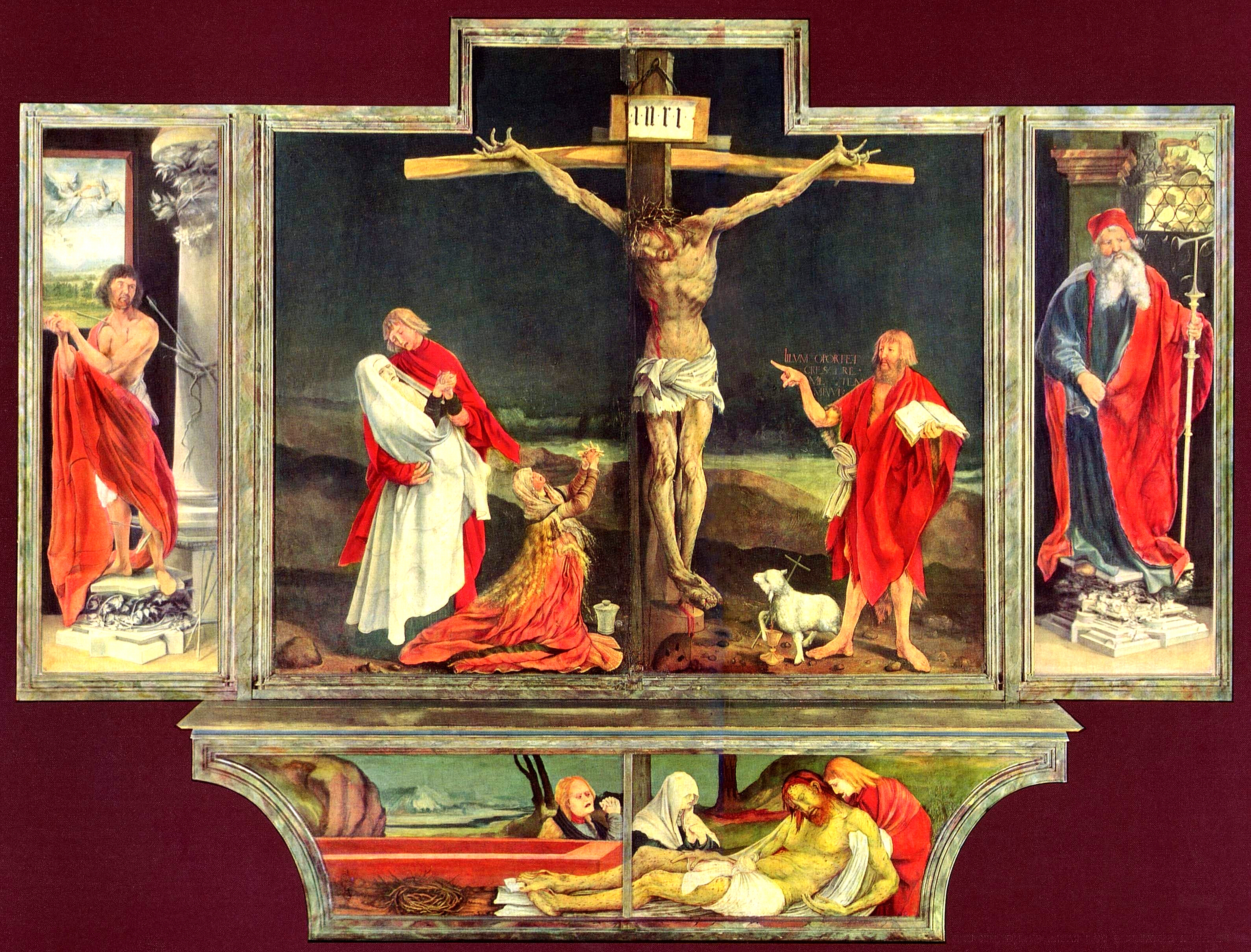
From 1512-1516, The Isenheim Altarpiece was sculpted by Niclaus of Haguenau and painted by Matthias Grunewald, a German Renaissance painter. It is an arresting piece of work.

1

It was painted for the Monastery of Saint Anthony, a monastery that was especially involved in the care of the sick. Many of the monks cared for those suffering the effects of plague, particularly in their skin. This is why Jesus’ skin looks diseased in the painting. Karl Barth, the famed theologian, had a copy of Grunewald’s painting in his office and used to spend a great deal of time contemplating it.

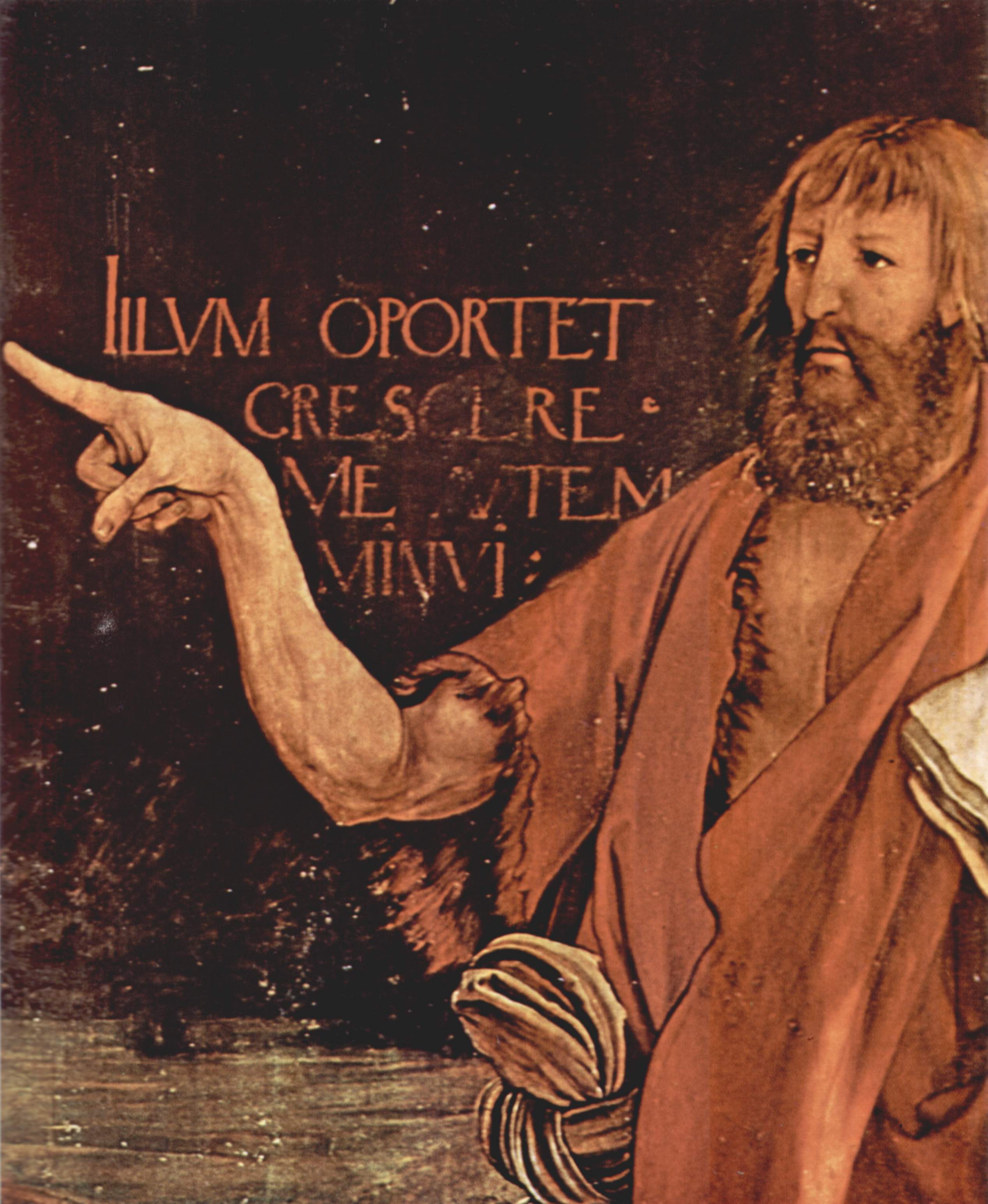
You can see the crucifixion scene prominently displayed here in the centerpiece, but when you come in close to John the Baptist you can also see an interesting detail that Grunewald added. The words above John the Baptist’s arm are, “Illum oportet crescere, me autem minui.” That is Latin for, “He must increase, but I must decrease.” These are the words of John the Baptist in response to the news that Jesus’ ministry and fame was expanding greater than John’s own. Instead of responding with jealousy or scorn, John famously said, “He must increase, but I must decrease.”

This is one of those verses that has an immediate and, simultaneously, a greater meaning. In the immediate context, John’s words were a declaration that Jesus’ fame and ministry and following should grow while his own decreased. But, in the broader sense, John the Baptist was articulating the very essence of the Christian life: “He must increase, but I must decrease.”

Anthony Esolen has quoted Tertullians’ famous words that “the blood of the martyrs is the seed of the Church.” He then went on to propose an opposite truth. If the blood of the martyrs is the seed of the church, then that means, Esolen writes, “that the sweat of the antimartyr[s] is poison for the Church.” By “antimartyr” Esolen meant this:

The antimartyr is what we are all in danger of becoming, when we forget the devastating and wholly salutary words of the Baptist, “He must increase, and I must decrease.” The antimartyr is not necessarily someone who hates the Church, or who seeks to spread paganism across the land. He is one, as I see it, who testifies to himself – one for whom the Church has become a means for the aggrandizement of himself.[1]

I think that is a helpful concept, antimartyrdom. If martyrs are those who have achieved the ultimate emptying of themselves by dying for Christ, then antimartyrs are those who have achieved the opposite: the ultimate exaltation of themselves.

Where are you on that spectrum? Where am I? It is a painful question.

Confining ourselves to John the Baptist’s categories, we must admit that either we are increasing or Jesus is increasing. If Jesus is not growing larger in our lives, then we are growing larger in our own lives. John knew this, and he knew which reality he had embraced.

Let us consider the meaning of his words.

Complete joy comes only in the consistent lessening and death of self for Christ.

I am struck first by what John said immediately before his famous words about increase and decrease. We find the details of the situation that gave rise to these words in John 3.

25 Now a discussion arose between some of John’s disciples and a Jew over purification. 26 And they came to John and said to him, “Rabbi, he who was with you across the Jordan, to whom you bore witness—look, he is baptizing, and all are going to him.”

John’s disciples, no doubt well intentioned, actually tempted John to jealousy over the ever-increasing fame of Jesus. Their protest was twofold: (1) Jesus was baptizing more people and (2) Jesus was drawing bigger crowds.

In truth, there is not a single Southern Baptist preacher that these words would not have worked on. “Look! The pastor down the street keeps baptizing people and drawing huge crowds!” To any other pastor, this would incite jealousy, but not John. John surprised his disciples by answering with an analogy. He used the analogy of a wedding.

27 John answered, “A person cannot receive even one thing unless it is given him from heaven. 28 You yourselves bear me witness, that I said, ‘I am not the Christ, but I have been sent before him.’ 29 The one who has the bride is the bridegroom. The friend of the bridegroom, who stands and hears him, rejoices greatly at the bridegroom’s voice.

Translation: “Guys, I am the best man, not the groom. Any best man who would be angry that the bride walks to the groom instead of to him is a sorry best man indeed! In fact, the best man should be happy that the bride goes to the groom.” That is a paraphrase, but that is the essence of what John the Baptist is saying. Then he says this:

29b Therefore this joy of mine is now complete. 30 He must increase, but I must decrease.”

It is a stunning statement. It has traditionally, and rightly, been viewed as a summation of the very essence of the Christian life: we must decrease and Jesus must increase. That is, we must consistently die to self and Christ must grow larger in our lives. Put another way, our own glory (which is really just a self-deception anyway) should lesson while Christ’s glory increases.

It is indeed a stunning statement. It is also a painful one. It is painful because it strikes at the very heart of our favorite idol: the self. The statement seems to recognize the perils of ego and self-exaltation. Did John not feel a pang of ego when he heard that Jesus was getting larger crowds? Maybe for a moment he did. Regardless, he immediately subjugated it to the greater glory of God in Christ.

Take a moment and ask yourself whether or not Christ is increasing or you are increasing in your life? There are a few areas where we can actually measure who is increasing and who is decreasing in our lives.

Ambition

Consider your own sense of ambition, your own desire to be greater, to be more successful, to be stronger, more powerful, more attractive. Consider how none of us have to be taught to exalt our own selves. Richard John Neuhaus has pointed out that you can see the rise of ambition in the ministry by looking at the increasingly grand titles that Protestant ministers are claiming for themselves.

Something odd is happening in Protestant groups that used to be strongly opposed to bishops, according to a story in the Atlanta Constitution. Once it was “Mister,” then “Reverend,” then “Doctor,” and now it is “Bishop.” Or more. The Rev. Miles Fowler of Big Miller Grove Baptist Church is now Bishop Miles Fowler. The popular television preacher is Bishop T. D. Jakes. Earl Paulk of the International Communion of Charismatic Churches is nothing less than Archbishop Paulk. Not to be outdone, Jamie Pleasant of Kingdom Builders Christian Center in Norcross, Georgia, is Apostle Pleasant. The way this is going, we may yet see a return to the time of anti–popes.[2]

Ambition is a powerful drug! We are born hardwired to want to be more, and, preferably, to want to be more than our neighbors. Ultimately, if we are honest with ourselves, we deep down want to be God. That was the first temptation of Eden and it is the very root of all sin.

Jealousy

Closely connected with personal ambition is jealousy, a deep resentment over the advancement or increase of others instead of ourselves. Our jealousies reveal how much we want to increase. This, as we have already seen, was the instinct that John’s disciples appealed to when they pointed out the growing fame of Jesus. Fortunately, John suppressed jealousy. It is hard to do, but it must be done. In fact, Christ will not increase in our lives so long as we harbor jealousy over the successes of others. R. Kent and Barbara Hughes pass on a story from yesteryear that poignantly demonstrates the power of jealousy.

An ancient story from the fourth century tells of inexperienced demons finding great difficulty in tempting a godly hermit. They lured him with every manner of temptation, but he could not be enticed. Frustrated, the imps returned to Satan and recited their plight. He responded that they had been far too hard on the monk. “Send him a message,” he said, “that his brother has just been made bishop of Antioch. Bring him good news.” Mystified by the devils advice, the demons nevertheless returned and dutifully reported the wonderful news to the hermit. And, in that very instant, he fell – into deep, wicked jealousy.[3]

A person whose heart is filled with jealousy can never really decrease. In turn, Christ cannot increase in such a heart.

Posturing on Social Media

The next evidence that we are not decreasing is evidence emerging from the modern age. It will perhaps sound humorous, but I assure you it is not. I am speaking of the subtle and not-so-subtle ways that we are tempted to posture on social media. Ours is the day of the selfie. More than that, ours is the day of the hundred selfies, ninety-nine of which will be discarded in favor of the one that looks the best. Ours is the day of the online update that makes us look just a little bit happier than we really are, just a little bit more successful than we really are, and just a little bit more together than we really are.

Lest you think I am throwing the baby out with the bathwater, hear me: in and of itself, social media is morally neutral, can be used for great good, and oftentimes is. I am not setting up a social-media-equals-bad formula. I, in fact, do not think that is the case. What I think, though, is that we are tempted all the time to increase ourselves on social media, to posture, to pose, to project an image that is oftentimes fictitious so that we will be more highly esteemed by others.

I would simply ask you to ask yourself this question: do your social media habits feed into the increase of your own image or do they magnify Christ?

Control

Another measurement of whether we are increasing or decreasing is in the area of control. Are you one of those people who simply must control events and people? Do you find within yourself an almost insatiable desire to be in the driver’s seat, to have your hand on the wheel, to be in the know, to have power, to make sure that things happen as you want? Are you a controller? I am not talking about being a good planner or organizer, I am talking about a spirit of control that borders on dominance, even if it is manifested in subtle ways.

Oftentimes there is something sinister behind our desires to control, especially our desires to control others, to have others do as we want and be what we think they must be. What lurks behind that is the idea that you and you alone have the template for reality, that you and you alone are capable of knowing how things must be. In the process, controllers tend to increase while Christ decreases, to grow larger on their own horizons while Christ is diminished in their own hearts.

Ego

Of course, the greatest measurement of how we are doing is an honest assessment of our own egos. We are enslaved to our own egos. It is something we must be broken of, and only Christ can break us of it. The first thing that must die at the foot of the cross is the ego. The temptations to ego-inflation, to the inflation of self, to our own increase are manifold. Robert Rayburn tells of one such story, again from the ministry.

Jean Massillon [was a] great French preacher. After a service in which he had preached one of his characteristically eloquent and powerful sermons, a woman lavished praise on him. “Madam,” he said, “the Devil has already said that to me and much more eloquently than you.”[4]

Beware the dangers of ego! The ego calls us to increase while everything around us decreases. St. Augustine gave a chilling warning in this regard.

            Will you glory in yourself? You will grow; but you will grow worse in your evil. For whoever grows worse is justly decreased. Let God, then, who is ever perfect, grow and grow in you. For the more you understand God and apprehend him, he seems to be growing in you; but in himself he does not grow, being always perfect.[5]

Amen and amen!

This lessening of self truly only happens when, conversely, there is a magnification of Christ.

Let us note that the lessening of self only happens when there is a magnification of Christ.

30 He must increase, but I must decrease.”

Literally, John says that Christ must “go on growing” while he, John, must “go on decreasing.” There must be a continuation of the increase of Christ and of the decrease of self. The two stand hand in hand: we are lessened and Christ is magnified.

It must be understood, when we say this, that we do not mean Christ Jesus actually and literally increases in His own essence and being. Such an idea is blasphemous and it is not what John meant. The Lord Jesus is perfectly God, complete in all His attributes, and exhaustive in His glory. The very notion that God could actually increase and that such an increase would somehow be tied to our actions is absurd.

No, John the Baptist is not speaking of an essential increase of the person of Christ, he is speaking of the increasing magnification of Christ in his life and in the world. There is a sense, of course, in which Christ appears to be growing larger as we grow smaller, but that is not a literal increase of Christ, that is simply what happens when our hearts are increasingly able to see Him as He is!

In the 5th century Saint Cyril of Alexandria wrote the following concerning John’s words.

The marvel over his deeds will not be limited, he says, nor will he exceed my honor merely because more people are baptized by him. Instead, he will ascend to a measure of glory that befits God. He must enter into an “increase” of glory and…bound ever upwards to the greater and shine more brightly to the world…[A]s he ascends to ever-increasing glory, I decrease to the extent that he rushes past me.[6]

The quotations around “increase” our significant. Jesus is not growing into His deity. He is fully divine. However, there is a sense of increase when He “bounds ever upwards to the greater and shines more brightly to the world,” when he, in Cyril’s words, “rushes past me.” We perceive this increase as we experience our own decrease. R. Kent and Barbara Hughes have passed on a beautiful example of what this dynamic looks like.

            Is such a life possible today? Of course! Just as it was for Charles Simeon, the great preacher of Kings’ College and Holy Trinity Church, Cambridge. Hugh Evan Hopkins, his biographer, tells that:

When in 1808 Simeon’s health broke down and he had to spend some eight months recuperating on the Isle of Wight, it fell to Thomason to step into the gap and preach as many as five times on a Sunday in Trinity Church and Stapleford. He surprised himself and everyone else by developing a preaching ability almost equal to his vicar’s, at which Simeon, totally free from any suggestion of professional jealousy, greatly rejoiced. He quoted the Scripture, “He must increase; but I must decrease,” and told a friend, “Now I see why I have been laid aside. I bless God for it.”[7]

There it is! There it is! Christ became bigger in that situation because Charles Simeon was willing to become less. Jesus did not literally grow, but I daresay that He never seemed bigger to Charles Simeon than when he determined to set ego, ambition, and jealousy aside and rejoice in the success of this other preacher. As such, Christ became bigger to Charles Simeon. He must become bigger to us as well!

Paradoxically the abandonment of the search for personal greatness and an embrace of the lessening of self and magnification of Christ results in true greatness.

At the heart of all of this there is a paradox. It is this: as we decrease and as Christ increases we are finally able to achieve true greatness. Paradoxically, we become more by becoming less. How do we know this? We know this because of what Jesus said about John the Baptist in Luke 7. As you hear these words, remember the words of John: “He must increase, but I must decrease.” Here is what Jesus said.

28 I tell you, among those born of women none is greater than John. Yet the one who is least in the kingdom of God is greater than he.

Utterly astounding! Do you see, church? Jesus said that John is the greatest “among those born of women.” He said this because John realized that Jesus was truly the greatest. We truly only live when we die. We are only truly great when we are willing to become nothing for the greatness of King Jesus! This is why Jesus offered that provocative follow-up statement: “Yet the one who is least in the kingdom of God is greater than he.” That is, our greatness increases as our lessening increases! Imagine it! The less we make of ourselves, the more Jesus makes of us! Oh what a grand miracle! Oh what an upside-down truth! At least it appears upside-down in our upside-down world! In the world we cannot see this. We think that greatness comes as we make more of ourselves. But in the Kingdom of God it is the opposite: greatness comes as we make less of ourselves and more of Jesus!

Max Anders writes:

It is said of the pioneer missionary, William Carey, that when he was close to death he turned to a friend and said, “When I am gone, don’t talk about William Carey; talk about William Carey’s Savior. I desire that Christ alone might be magnified.”[8]

Oh, church, may we say the same! May we same the same!

He must increase, but we must decrease!


[1] https://touchstonemag.com/merecomments/2010/09/the-inverse-martyr-rule/

[2] RJN, “While We’re At It,” First Things. June/July 200

[3] R. Kent and Barbara Hughes, Liberating Ministry From The Success Syndrome (Wheaton, IL: Crossway Books, 2008, p.100.

[4] Robert Rayburn, “Taking Our Proper Place.” https://www.faithtacoma.org/ sermons/I.Corinthians/1Cor_12.1-31.Nov3.02.htm

[5] Joel C. Elowsky, ed. John 1-10. Ancient Christian Commentary on Scripture. New Testament IVa. Gen. Ed., Thomas C. Oden (Downers Grove, IL: InterVarsity Press, 2006), p.136.

[6] Cyril of Alexandria, Commentary on John. Vol.1. Trans., David Maxwell. Ed., Joel C. Elowsky. Ancient Christian Texts. Series eds., Thomas C. Oden and Gerald L. Bray (Downers Grove, IL: InterVarsity Press, 2013), p.106-107.

[7] R. Kent and Barbara Hughes, p.102.

[8] Kenneth O. Gangel, John. Holman New Testament Commentary. Gen Ed. Max Anders (Nashville, TN: B&H Publishing Group, 2000), p.59.

Exodus 20:8-11

what-are-ten-commandments_472_314_80Exodus 20

8 “Remember the Sabbath day, to keep it holy. 9 Six days you shall labor, and do all your work, 10 but the seventh day is a Sabbath to the Lord your God. On it you shall not do any work, you, or your son, or your daughter, your male servant, or your female servant, or your livestock, or the sojourner who is within your gates. 11 For in six days the Lord made heaven and earth, the sea, and all that is in them, and rested on the seventh day. Therefore the Lord blessed the Sabbath day and made it holy.

The fourth commandment is one with which many Christians have an uneasy relationship. We know it is in God’s word and we know it is a commandment, yet must of us know that (a) Sunday is more of a Sabbath for us than Saturday, the seventh day of the week, was and is for the Jews and (b) even at that, we do not really honor the Sabbath on Sunday either! To put it simply, most Christians today do not really know quite what to do with the commandment, “Remember the Sabbath day, to keep it holy.”

What is the Sabbath? Before we begin, let us try to construct a basic definition based on the text.

The Hebrew word šābat literally means “stop.” So we should stop something on the Sabbath. We also know that the Sabbath is a day: “Remember the Sabbath day…” So, at a minimum, we know that there is a day in which we stop. Stop what? Verse 9 tells us: “work.” We should stop work on the Sabbath. That is what we should give up. But there also appears to be an idea of taking something up. First, we should take up rest. Second, we should take up activities that honor the holiness of the day, for “the Lord blessed the Sabbath day and made it holy.” The primary activity that would lead us into rest and the sanctifying of the Sabbath day would appear to be worship. We should worship God on the Sabbath.

This is a very basic definition, and one that may raise more questions than it answers. Even so, let us begin with it and then move forward into a deeper consideration of the text and the implications of Sabbath rest.

Sabbath observance honors God and imitates the pattern of His creative work and rest.

We first notice that the fourth commandment calls us to an act of imitation and, specifically, to an imitation of a pattern and rhythm.

8 “Remember the Sabbath day, to keep it holy. 9 Six days you shall labor, and do all your work, 10 but the seventh day is a Sabbath to the Lord your God. On it you shall not do any work, you, or your son, or your daughter, your male servant, or your female servant, or your livestock, or the sojourner who is within your gates. 11 For in six days the Lord made heaven and earth, the sea, and all that is in them, and rested on the seventh day. Therefore the Lord blessed the Sabbath day and made it holy.

We are called to imitate God. The key here is verse 11: “For in six days the Lord made heaven and earth, the sea, and all that is in them, and rested on the seventh day. Therefore the Lord blessed the Sabbath day and made it holy.” The implication is clear: we should “remember the Sabbath day to keep it holy” because this is what God did in the act of creation. We should imitate what God did. Victor Hamilton writes:

Nowhere in the Bible is the concept of imitatio dei as transparent as it is here. Leviticus 19:2b is another classic imitatio dei verse, “You shall be holy, for I the LORD your God am holy,” but nowhere does Lev. 19 spell out anything God is or does that identifies him as holy and that we can do too. God was not a workaholic. Don’t you be one, says this fourth commandment.[1]

That is humorously put, but well said: “God was not a workaholic. Don’t you be one, says this fourth commandment.” So we are called to imitation: imitation of God. Specifically, we are called to a particular pattern and rhythm of life, the rhythm we find in Genesis: six days labor followed by one day of holy rest.

8 “Remember the Sabbath day, to keep it holy. 9 Six days you shall labor, and do all your work, 10 but the seventh day is a Sabbath to the Lord your God. On it you shall not do any work, you, or your son, or your daughter, your male servant, or your female servant, or your livestock, or the sojourner who is within your gates. 11 For in six days the Lord made heaven and earth, the sea, and all that is in them, and rested on the seventh day. Therefore the Lord blessed the Sabbath day and made it holy.

Six days work.

One day rest.

Six days work.

One day rest.

This is the basic pattern of life.

Set aside, for a moment, the thousand questions that come to mind when hearing about this rhythm. Most of them are borne of legalism and basically miss the whole point. The main point, for now, is that God, in creation, demonstrated a rhythm that we are called likewise to follow: six days work and one day rest.

If we are commanded to follow this pattern, and if God Himself followed this pattern, then how important do you think this is? It is apparently very important.

Again, setting aside our legalistic parsing of these verses, let me ask you to take a moment, step back from this text, look at it, look at the current rhythm of your life, and see how they match up. In other words, in terms of the broad strokes of our text, is your life following this kind of rhythm, this kind of pattern, this kind of divine example?

If your life is not following this rhythm, let me ask you another question: how are you doing right now? Are you happy? Healthy? Whole? Content? At peace?

I daresay that most of us are not following this pattern. Our society is not structured to honor this Sabbath rhythm. We are doing too much, though, paradoxically, it feels like we are accomplishing less. The regular week for most of us feels like we are in a Nascar race, but we are tied to the roof of the car and not driving it. Even the way we rest is exhausting. Much of our rest consists of diversions that cost money and take energy from us. It is not true rest.

Sabbath observance should include rest and worship.

And, at the end of the day, for many of us, worship does not fit very prominently into our patterns and rhythms, if it is present at all. But note that the Sabbath day is holy. It is not a day of laziness. It is a day of holy, God-honoring, worshipful rest.

8 “Remember the Sabbath day, to keep it holy. 9 Six days you shall labor, and do all your work, 10 but the seventh day is a Sabbath to the Lord your God. On it you shall not do any work, you, or your son, or your daughter, your male servant, or your female servant, or your livestock, or the sojourner who is within your gates. 11 For in six days the Lord made heaven and earth, the sea, and all that is in them, and rested on the seventh day. Therefore the Lord blessed the Sabbath day and made it holy.

Abraham Heschel has helpfully called the Sabbath “a sanctuary in time” (Sabbath).[2] That is a beautiful way to think about it. Furthermore, Patrick Miller has pointed out that God granting His people Sabbath rest is the antithesis of the cruel response of Pharaoh to the Israelites when they appealed to him for an opportunity to worship.

When Israelite slaves in Egypt sought time off to worship the Lord their God, when the people sought release from the service of the Pharaoh for the service of God, the forces of human tyranny and oppressive economic exploitation of slave labor were set against this request for time that is sacred and holy and restful, demanding for more work. Pharaoh said: “They cry, ‘Let us go and offer sacrifice to our God.’ Let heavier work be laid on them” (5:8–9). The service of God is rejected in behalf of a secular exploitation of human life and human work. That is what triggered the Lord’s gift of the Sabbath. What is required is what is needed to make and to keep human life human— and not inhumane, as it was in Egypt.[3]

The Sabbath is a gift. It is a gift from God. It is therefore amazing and sad that we approach the topic of the Sabbath begrudgingly wondering how an observance of this sacred day will potentially disrupt our routines instead of approaching it joyfully and with gratitude. Do you see how God, unlike Pharaoh, wanted to bless His people by drawing them into His presence in a special way on this special day? The Sabbath reveals the kindness and mercy of God.

We should want to worship on the Sabbath! That is what the Jews asked of Pharaoh:   “Let us worship our God!” This was rest, true, but it was worshipful rest. “There really is a difference,” Patrick Miller writes, “between taking a day off and taking a day off and sanctifying it to the Lord.”[4] J.I. Packer has likewise offered some helpful insights into the nature of what we set aside and what we take up on the Sabbath.

Third, the ethical problem: if the Lord’s day is the Christian Sabbath, how do we keep it holy? Answer—by behaving as Jesus did. His Sabbaths were days not for idle amusement, but for worshiping God and doing good—what the Shorter Catechism calls “works of necessity and mercy” (see Luke 4:16; 13:10–17; 14:1–6). Freedom from secular chores secures freedom to serve the Lord on his own day. Matthew Henry says that the Sabbath was made a day of holy rest so that it might be a day of holy work. From this holy work, in our sedentary and lonely world, physical recreation and family fun will not be excluded, but worship and Christian fellowship will come first.[5]

Matthew Henry’s words stand out: “the Sabbath was made a day of holy rest so that it might be a day of holy work.” This “holy work” is worship and praise with the assembly of God’s people.

Dear church, honor our times of corporate worship. They are food for our souls. The rhythm of consistent gathering and consistent praise is what we need to remain human in a dehumanizing world and to remain Christian in a world that is anti-Christ.

My father is a hardware salesman. He has worked hard his entire life. When I was growing up he would be gone a night or two every week out on the road traveling and selling hardware. But he honored the sacredness of worship. It always made an impression on me.

I recall one Wednesday night when our Minister of Youth was out of town and we had to go to the prayer meeting in the sanctuary. I am ashamed to say that this was not an exciting prospect for me! But I went. I remember sitting over to the side with a few other kids trying not to look as bored as I felt. My dad had been out of town working. Our mom had brought us to church, if I recall. So we sat there through the whole service. There were only about five to ten minutes left when the back doors opened and I saw my father, looking tired and worn, come in and sit down in the back.

He had rushed in for the last few minutes of worship instead of just going home.

I do not know that I have ever told him just what kind of impression that made on me. I do not recall what was said from the platform that night, but I do recall what my dad was saying just by walking through that door: “This matters to me. This is important. The corporate gathering of the church should be kept sacred.”

Father and mothers: let us let our children see us valuing and honoring worship! Let us let them see that it matters to us. If they see it matters to us then it will likewise matter to them.

Honor the twin Sabbath privileges of rest and worship.

Sabbath observance for the Church is bound to the liberation and rest we find in the resurrected Jesus.

We know the call to Sabbath observance is binding and we know that it is important. Yet we meet on Sundays. How can this be? Are we violating the Sabbath by meeting on Sunday for worship instead of Saturday?

For the early Church, the resurrection was a paradigm-shifting act of redefinition. The resurrection of Jesus from the dead did not obliterate the Sabbath, but it did situate it in the person and work of Christ, who, I will remind us, referred to Himself as “Lord of the Sabbath” (Matthew 12:8).

The resurrection, of course, happened on the first day of the week. In Mark 16:2 we read, “And very early on the first day of the week, when the sun had risen, they went to the tomb.” As a result, the Church began to meet on the first day of the week, the Lord’s day. Thus, in Acts 20:7 we find this: “On the first day of the week, when we were gathered together to break bread, Paul talked with them, intending to depart on the next day, and he prolonged his speech until midnight.” Furthermore, In Revelation 1:10 John writes of this day as a settled and recognized day in the life of the Church: “I was in the Spirit on the Lord’s day, and I heard behind me a loud voice like a trumpet.”

The resurrection of Jesus therefore redefined the Sabbath and situated it on the first day of the week. The Westminster Shorter Catechism says:

From the beginning of the world to the resurrection of Christ, God appointed the seventh day of the week to be a weekly Sabbath; and the first day of the week ever since…which is the Christian Sabbath.[6]

For Christians, the Lord’s day is our Sabbath day. That is because Jesus, Lord of the Sabbath, who conquered death on Easter Sunday, is Himself the fulfillment of all that the Sabbath was intended to be. It gives new meaning to His beautiful words in Matthew 11:28: “Come to me, all who labor and are heavy laden, and I will give you rest.”

He is our rest. Jesus is our Sabbath rest. He is our cessation from toil and our holy work of worship. But there is more. He is also our Jubilee, our release from bondage and debt and enslavement. David VanDrunen has offered a fascinating argument concerning the ways in which Sunday, the eighth day, was hinted at in the Old Testament as a day of special favor, a day in which God would do something extraordinary and liberating for His people. In other words, the Old Testament itself alluded to a unique outpouring of divine favor on Sunday that anticipated the resurrection of Christ and the coming sacredness of the first day of the week.

One way in which the Old Testament pointed them to the coming of Christ was by giving them a second kind of Sabbath that was different from the ordinary weekly Sabbaths. For a couple of special occasions God gave Israel the equivalent of an eighth day rest—or, a rest on the first day of the week (see Lev. 23:15–16, 21; 25:8–12; see vv. 1–12). Leviticus 23 teaches about the Feast of Weeks and commands a rest on the fiftieth day (a Sunday), following seven cycles of seven-day weeks. Leviticus 25 speaks about a Sabbath year, the Year of Jubilee, a time when people were released from their debts and restored to their inheritance. This Year of Jubilee took place on the fiftieth year, the year after “seven times seven years,” that is, seven squared, the perfect number of ordinary cycles of years. Liberty was to be proclaimed throughout the land (25:8,10). This was the year for showcasing the grace of God that conquers all evil. This practice of celebrating a Sabbath on the fiftieth day/year must have been wonderful for the Old Testament Israelites, but a little confusing nonetheless. The ordinary weekly Sabbath was about working first and only then taking a rest. But here they were instructed to rest at the beginning of the cycle of time, before the period for work. What was the meaning of this different kind of Old Testament Sabbath? It pointed ahead to the resurrection of the Lord Jesus Christ. During his earthly ministry Jesus announced on a Sabbath day (Saturday) the fulfillment of the proclamation of liberty, “the year of the Lord’s favor” (Luke 4:19; see vv. 16–21). Jesus pointed Israel to himself as the one who brings the true and ultimate Jubilee for his people. How exactly did he bring the final and greatest liberty to them, a liberty that far surpasses a (temporary) return to an earthly plot of land? He did it through the resurrection. Jesus rose “after the Sabbath” (Matt. 28:1; Mark 16:1), on the “first day of the week” (Luke 24:1; John 20:1)—Sunday. The timing is truly amazing. The day that Jesus lay dead in the tomb turned out to be the last Sabbath of the Old Testament era (for after his resurrection the old covenant was no more). Remember that the Old Testament Year of Jubilee had occurred on the fiftieth year—that is, the year immediately after the “perfect” number of Sabbath years (7 × 7 = 49). And thus Jesus rose from the dead on the day immediately after the number of Old Testament seventh-day Sabbaths had reached their complete and perfect number! His resurrection was the true Year of Jubilee. The weekly Old Testament Sabbath had looked back to God’s work of creation (Ex. 20:8–11) and reminded God’s people of the first Adam’s original obligation to work perfectly in this world and then to attain his rest. The resurrection now announces that Jesus, as the last Adam, has completed the task of the first Adam and has attained his reward of rest in the world-to-come.[7]

It would seem, then, that the consecration of the first day of the week is not, after all, so utterly alien to the Jewish Sabbath. Built into the rhythms of the life of Israel were these curious and provocative periodic hallowings of Sunday, of the beginning of the week, of the beginning of a new cycle of years. There is therefore precedence for seeing the eighth day as the day in which God does certain highly unusual and highly wonderful things! And it was on one eighth day in particular, the Sunday after the crucifixion, that God raised Jesus from the dead!

We live in the shadow of the cross and before the mouth of the open tomb. We live now – right now! – in the Jubilee of Christ Jesus: His setting free of those ensnared by sin, death, and hell! Our Sabbath is still a day, but it is now more: it is a person! It is Jesus, the lamb of God, the conquering King, the Shepherd who knows His sheep and calls us home!

Remember the Sabbath day, to keep it holy.


[1] Hamilton, Victor P. (2011-11-01). Exodus: An Exegetical Commentary (Kindle Locations 11132-11136). Baker Publishing Group. Kindle Edition.

[2] Miller, Patrick D. (2009-08-06). The Ten Commandments: Interpretation: Resources for the Use of Scripture in the Church (Kindle Locations 2675-2676). Presbyterian Publishing Corporation. Kindle Edition.

[3] Miller, Patrick D., Kindle Locations 2648-2654.

[4] Miller, Patrick D., Kindle Locations 2686-2687.

[5] Packer, J. I. (2008-01-07). Keeping the Ten Commandments (Kindle Locations 570-575). Crossway. Kindle Edition.

[6] Packer, J. I., Kindle Locations 562-563.

[7] VanDrunen, David (2010-10-15). Living in God’s Two Kingdoms (p. 138-139). Good News Publishers. Kindle Edition.


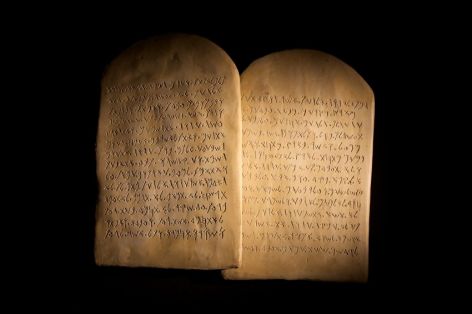
Exodus 20:7

what-are-ten-commandments_472_314_80Exodus 20

7 “You shall not take the name of the Lord your God in vain, for the Lord will not hold him guiltless who takes his name in vain.


Fred Craddock tells an interesting story from his childhood about the reverence for the name of God that his mother instilled in him at an early age.

            When I was a child, my mother would play word games with us in the evening by the fire. She taught us phonic spelling. If you can say it, you can spell it. And she led us into the deep waters of oviparous, ovoviviparous, and hypotenuse. I once knew how to pronounce and spell asafetida. But one word she never put on the list because she knew we were just children. She never put on the list God.[1]

There is something charming about this, and also something very important. We should instill within our children and within ourselves a deep reverence and love for the name of God. Unfortunately, we live in a church age in which reverence for the name of God seems to be lacking.

In his compelling book Requiem: A Lament in Three Movements, theologian Thomas Oden chronicles and bemoans the drift in modern theology away from serious reflection on the nature of God and into faddishness, silliness, and blasphemy. In particular, Oden complained about the lack of respect that many modern theologians show for the name of God and the ways in which theologians now use God’s name to justify their own interests in lesser pursuits. Oden writes:

When God’s name has been so dishonored and misplaced as to mean little more than weight loss, dream analysis, exotic vitamins, salesmanship, yoga, LSD, and psychodrama, then someone has been asleep at the wheel.[2]

That is well said. Our day is in desperate need of a serious reflection on the third commandment, to which we now turn.

God’s name is an expression of His character and His character is perfect holiness.

The third commandment prohibits taking God’s name in vain.

7 “You shall not take the name of the Lord your God in vain, for the Lord will not hold him guiltless who takes his name in vain.

One of the problems that we modern people face in trying to understand this is the way in which we view names. For us, a name is simply a word that was put on you when you were born. But the name of God is very different, of course, as was, it should be said, the children of Israel’s approach to names in general.

Nobody gave God His name. He has been God from eternity past. And His name, YHWH, the Tetragrammaton, is a reflection of His person and His character. Thus, God’s name is an expression of His character and His character is perfect holiness. As a result, it should only be used reverently and with a sense of awe.

Origen referred to “the name of God” as “the stamp of the personal character of God.”[3] That is a good way of thinking about it. God’s name must not be mouthed casually, cheaply, or frivolously, for there is a powerful connection between His name and His character. This is evident in Exodus 3, when Moses asked God for His name after God commissioned him to go to Egypt and liberate the children of Israel.

13 Then Moses said to God, “If I come to the people of Israel and say to them, ‘The God of your fathers has sent me to you,’ and they ask me, ‘What is his name?’ what shall I say to them?” 14 God said to Moses, “I am who I am.” And he said, “Say this to the people of Israel, ‘I am has sent me to you.’”

God’s name reflects God’s character. Thus, He could call Himself “I AM.” As a result, we must esteem highly and handle carefully the holy name of our great God. This is no less true for the Church than it was for Israel. In Matthew 6:9, Jesus said, “Pray then like this: ‘Our Father in heaven, hallowed be your name.’”

To hallow God’s name is to reverence God’s name and to refuse to use the name in vain is one step toward hallowing it. The Puritan, Thomas Watson, made the interesting and compelling point that while some of the petitions of the Lord’s Prayer will one day cease, the need to hallow God’s name never will.

When some of the other petitions shall be useless and out of date, as we shall not need to pray in heaven, “Give us our daily bread,” because there shall be no sin; nor, “Lead us not into temptation,” because the old serpent is not there to tempt: yet the hallowing of God’s name will be of great use and request in heaven; we shall be ever singing hallelujahs, which is nothing else but the hallowing of God’s name.[4]

We will be hallowing God’s name, reverencing God’s name, and refusing to use God’s name in vain for all eternity. We must begin now!

Taking God’s name in vain means using God’s name in any way that does not seek to magnify and celebrate His glory.

But what precisely does it mean to use God’s name “in vain”? Roy Honeycutt points out that the word “vain” (shawe’) “means emptiness, nothingness, or vanity, in the sense of being ineffective or lacking in purpose; emptiness of speech, and hence that which is false, whether of prophecy (Ezek. 12:24), or speech (Isa. 59:4); and worthlessness of conduct.” Honeycutt goes on to argue that the third commandment’s obvious proximity to the first two commandments suggests that it is saying something about the way we use God’s name in worship.

            The fact that the command appears at the center of those exhortations which sought to guarantee the proper worship of the Lord gives added weight to an interpretation of the commandment which stresses the negative use of the name in worship. The strong probability is that the writer sought to prohibit a semimagical or magical use of the Lord’s name…Members of the covenant community are warned against paganizing their faith by perverting it into no more than a restructured magic by which God may be coerced into fulfilling the worshiper’s will.[5]

The IVP Bible Background Commentary agrees and proposes a similar idea.

This commandment does not refer to blasphemy or foul language. Rather it is intended to prevent the exploitation of the name of Yahweh for magical purposes or hexing. It also continues the concerns of the second commandment in that someone’s name was believed to be intimately connected to that person’s being and essence. The giving of one’s name was an act of favor, trust and, in human terms, vulnerability. Israel was not to attempt to use Yahweh’s name in magical ways to manipulate him. The commandment was also intended to insure that the use of Yahweh’s name in oaths, vows and treaties was taken seriously.[6]

Undoubtedly there is something to these claims, though The IVP Bible Background Commentary almost certainly overstates the case when it says that “this commandment does not refer to blasphemy or foul language.” Victor Hamilton argues that the third commandment certainly applies to blasphemous and profane language that invokes God’s name.

In sum, the third commandment cautions against using the Lord’s name falsely to buttress a truth claim that is fabricated. By extension, it prohibits any use of the holy name that is without any real significance, any trivializing of the Tetragrammaton. I am not sure whether biblical Israel has any concept of “cussing” or using a collection of “four-letter words,” but it is not a misunderstanding of this commandment to bring it to bear on the pervasive use today of “O my God” in every imaginable situation.[7]

What is more, J.I. Packer sees three applications of the third commandment.

  1. irreverence
  2. bad language
  3. promise keeping[8]

Each of these commentators make a significant contribution to our understanding of this commandment, but I believe that Hamilton and Packer are correct in applying it to the way we talk outside of worship as well. Giving the third commandment a limited technical application restricted only to worship does not do justice to the full implications of this prohibition.

I very much include myself in what I am about to say and I say it to my own conviction: we truly need to return to a higher view of the name of God. Using the name of God for, say, comedic effect, or for the sake of emphasis, or as a vehicle to express our own anger is certainly included in the prohibition against taking God’s name “in vain.” Furthermore, we should stop using God’s name as an exclamation.

A good rule of thumb might be something like this: is my use of God’s name in this instance reverent, honoring, and worshipful? Is my use of God’s name in this instance going to make Him look glorious? Is it going to cause others to want to worship Him? Is it going to help draw people to serious consideration of the grandeur of God?

There is power in the name of God when rightly and worshipfully voiced because it is in and through hearts yielded to Him that God most powerfully works.

We would do well to remember that whereas a frivolous use of God’s name is a great sin, the worshipful and proper expression of God’s has great power. Please let me explain what I do not mean: I do mean that God’s name can be used as a talisman. The very thought is blasphemous! In truth, we should not speak at all of using God’s name. We may speak it, honor it, and proclaim it, but never use it as if we are seeking to manipulate the Lord God.

No, what I mean is there is power in the name of God when rightly and worshipfully voiced because it is in and through hearts yielded to Him that God most powerfully works. God’s name is bound to God’s character and, in His name, there is power! This helps us explain what we see throughout scripture. Let us focus particularly on the New Testament uses of Christ’s name to explore this point.

In Mark 9, Jesus acknowledged that mighty displays of kingdom power can only be done “in my name” and truly bring honor to Jesus.

38 John said to him, “Teacher, we saw someone casting out demons in your name, and we tried to stop him, because he was not following us.” 39 But Jesus said, “Do not stop him, for no one who does a mighty work in my name will be able soon afterward to speak evil of me. 40 For the one who is not against us is for us.”

In Acts 3:6, Peter demonstrated God’s healing power in the name of Jesus

But Peter said, “I have no silver and gold, but what I do have I give to you. In the name of Jesus Christ of Nazareth, rise up and walk!”

Furthermore, in 1 Corinthians 1:10, Paul called for unity in the divided church of Corinth in the name of Jesus.

I appeal to you, brothers, by the name of our Lord Jesus Christ, that all of you agree, and that there be no divisions among you, but that you be united in the same mind and the same judgment.

Bringing a divided church together in unity is one of the greatest displays of power we can ever see! The name of Jesus should bind the Church together in harmony and unity. Later in the same book, in 1 Corinthians 5:4, Paul appealed to the church of Corinth to speak a word of church discipline against an erring brother “in the name of the Lord Jesus.”

When you are assembled in the name of the Lord Jesus and my spirit is present, with the power of our Lord Jesus…

To gather in His name is to gather in His power. In Colossians 3:17, Paul called upon believers to live in the light of the name of Christ!

And whatever you do, in word or deed, do everything in the name of the Lord Jesus, giving thanks to God the Father through him.

Most powerfully of all, we are saved in the name of Christ. In Acts 2:38, Peter responded to the question of how we are to be saved by saying, “Repent and be baptized every one of you in the name of Jesus Christ for the forgiveness of your sins, and you will receive the gift of the Holy Spirit.”

It is undeniable that God’s name is used too flippantly in our day. Even so, the scriptures tell us that the day will come when everybody, at least once, will say the name of Christ rightly. In Philippians 2 we read:

9 Therefore God has highly exalted him and bestowed on him the name that is above every name, 10 so that at the name of Jesus every knee should bow, in heaven and on earth and under the earth, 11 and every tongue confess that Jesus Christ is Lord, to the glory of God the Father.

Every knee will bow “at the name of Jesus” and every tongue will confess the name as well. If this will happen at the gate of eternity, should it not happen now? Yes, it should. We should say now what we will say then: Jesus Christ is Lord. And we should honor the name now that we will honor then.

Do not take the name of the Lord in vain.


[1] Fred Craddock, Craddock Stories. (St. Louis, MO: Chalice Press, 2001), p.21-22.

[2] Thomas C. Oden, Requiem: A Lament in Three Movements (Nashville, TN: Abingdon Press, 1995), p.46.

[3] Joseph T. Lienhard, ed., Exodus, Leviticus, Numbers, Deuteronomy. Ancient Christian Commentary on Scripture. Old Testament, vol.III. Thomas C. Oden, ed. (Downer’s Grove, IL: InterVarsity Press, 2001), p.103.

[4] Quoted in Hank Hanegraaff. The Prayer of Jesus. (Nashville: Word Publishing, 2001), p.40.

[5] Roy L. Honeycutt, Jr. “Exodus.” The Broadman Bible Commentary. Vol.1, Revised (Nashville, TN: Broadman Press, 1969), p.396-397.

[6] John H. Walton, Victor H. Matthews, Mark W. Chavalas, The IVP Bible Background Commentary: Old Testament.(Downers Grove, IL: InterVarsity Press, 2000), p.95.

[7] Hamilton, Victor P. (2011-11-01). Exodus: An Exegetical Commentary (Kindle Locations 11053-11056). Baker Publishing Group. Kindle Edition.

[8] Packer, J. I. (2008-01-07). Keeping the Ten Commandments (Kindle Location 517-526). Crossway. Kindle Edition.


Apologia: A Sermon Series in Defense of the Faith – Part VI: “Did Jesus Rise From the Dead?”

apologiaA few weeks ago my parents were in Athens, Greece. My father shared with me that he climbed up to the Acropolis and was standing there looking at the Parthenon and the other ruins. His guide told him to look down at this little jut of rock and then revealed that that small rocky formation was Mars Hill.

Mars Hill is most well known to us today because it was on that site that the Apostle Paul was laughed at by the Athenians. Why was he laughed at? He was laughed at because of a sermon he preached. He was not laughed at for the whole sermon but just for the conclusion of it. At the end of his sermon, Paul said something that made many in the audience laugh and mock him.

My father tells me that he mentioned this fact to the tour guide and that he, my father, began to quote some of Pauls’ sermon on Mars Hill to the gentleman. To his surprise, the tour guide said he was well aware of it and recited some of the sermon himself. As my dad climbed down to Mars Hill he said he could not help but think of Paul and his sermon and the reaction to it so many years ago.

What was it that Paul had said that was so funny? In truth, he did not say anything funny, but what he said was considered funny by the Athenians.

The sermon is recorded in Acts 17. I will share with you the beginning and the end of it. First, the beginning.

22 So Paul, standing in the midst of the Areopagus, said: “Men of Athens, I perceive that in every way you are very religious. 23 For as I passed along and observed the objects of your worship, I found also an altar with this inscription, ‘To the unknown god.’ What therefore you worship as unknown, this I proclaim to you.

In this famous introduction, Paul connected to the Athenians by noting how very religious they were. He then announced that he was going to reveal to them the true nature of God, the God that they had unknowingly created an altar to and inscribed with the words, “To the unknown God.” So then Paul began to tell them about this God, how He is the creator and Lord of all. It is a well done sermon, and one worthy of serious consideration. In fact, Paul seemed to have carried their attention all the way up until the end. Let us see what he said that was so amazing to the people of Athens.

30 The times of ignorance God overlooked, but now he commands all people everywhere to repent, 31 because he has fixed a day on which he will judge the world in righteousness by a man whom he has appointed; and of this he has given assurance to all by raising him from the dead.” 32 Now when they heard of the resurrection of the dead, some mocked. But others said, “We will hear you again about this.” 33 So Paul went out from their midst. 34 But some men joined him and believed, among whom also were Dionysius the Areopagite and a woman named Damaris and others with them.

Paul mentioned the resurrection of Jesus, the fact that Jesus had risen from the dead. His doing so was electric and immediately controversial. “Some mocked” and “others said, ‘We will hear you again about this.’”

Why was this so scandalous, this mention of the resurrection? It was scandalous because, to the Greeks, resurrection was simply something that did not happen and was not ever going to happen. Dead men did not rise nor where they ever going to. And Paul certainly knew this fact. He knew that he would be mocked and ridiculed. So why did he say it? Why did Paul mention the resurrection of Jesus when He knew that doing so would invite the disdain of a large part of his audience?

He did so because he believed that the resurrection was true, that it had actually happened, and that it was the key to understanding the good news about Jesus.

We must have the same confidence as Paul. Why? Because the resurrection of Jesus from the dead is the very heartbeat of the Church. It is the great divine act of confirmation, or proof that Jesus is who He said He is. The Church must decide today whether or not it is willing to be laughed at for the resurrection of Jesus, whether or not we really believe this is true. I would like to argue that it is true, and propose that Jesus actually rising from the dead is the best explanation for what happened two thousand years ago and for what continues to happen to this very day.

First, consider this description of the first Easter morning that we find in Matthew 28. Let us allow the text to speak of the grand truth of the resurrection once again.

1 Now after the Sabbath, toward the dawn of the first day of the week, Mary Magdalene and the other Mary went to see the tomb. 2 And behold, there was a great earthquake, for an angel of the Lord descended from heaven and came and rolled back the stone and sat on it. 3 His appearance was like lightning, and his clothing white as snow. 4 And for fear of him the guards trembled and became like dead men. 5 But the angel said to the women, “Do not be afraid, for I know that you seek Jesus who was crucified. 6 He is not here, for he has risen, as he said. Come, see the place where he lay. 7 Then go quickly and tell his disciples that he has risen from the dead, and behold, he is going before you to Galilee; there you will see him. See, I have told you.” 8 So they departed quickly from the tomb with fear and great joy, and ran to tell his disciples. 9 And behold, Jesus met them and said, “Greetings!” And they came up and took hold of his feet and worshiped him. 10 Then Jesus said to them, “Do not be afraid; go and tell my brothers to go to Galilee, and there they will see me.”

Let us now consider whether or not there are reasons to believe that this actually happened.

Jesus rising from the dead is the best explanation for a large number of first century Jews proclaiming and being willing to die for resurrection beliefs that were unheard of within first century Judaism.

Our apologetic for the historicity of the resurrection will begin with the fact that Jesus rising from the dead is the best explanation for a large number of first century Jews proclaiming and being willing to die for resurrection beliefs that were unheard of within first century Judaism. In other words, the first believers were mainly Jews, and what they said about the resurrection of Jesus was something that no Jewish person of the first century would have said or would have imagined about the Messiah. Were they making up the idea that Jesus was the Messiah, they would have spoken in terms that would have resonated with the Jewish conception of resurrection and the Jewish conception of Messiah. In fact, what they argued was something unheard of, something no Jew, much less large numbers of Jews, would have conceived of unless what they were saying had actually happened.

What is more, first century Greeks, as we have already seen in the reaction of the Greek crowd to Paul on Mars Hill, would have had no conception of what the early Christians were saying about resurrection, and would have found the idea laughable, yet many of them came to believe and proclaim this resurrection as well.

In their book, Raised? Doubting the Resurrection, Jonathan Dodson and Brad Watson summarize this point nicely.

Resurrection wasn’t a category for the Greeks nor was it desirable…For Jews, it was unthinkable that resurrection could occur in the middle of history, apart from worldwide renewal. Even more unthinkable was the idea that an individual would be resurrected and not all humanity at once. So for the Jews and Greeks of Paul’s day, the resurrection was implausible.

They then quote N.T. Wright as saying:

The ancient world was thus divided into those who said that the resurrection couldn’t happen, though they might have wanted it to, and those who said they didn’t want it to happen, knowing that it couldn’t happen anyway.[1]

Speaking of N.T. Wright, on May 15, 2007, this famed New Testament scholar delivered a lecture entitled, “Can a Scientist Believe the Resurrection?” at Babbage Lecture Theatre in Cambridge. In that lecture, Wright highlighted the very unlikely idea of first century Jews simply making up what these early Christians were saying about the resurrection. Wright pointed to seven mutations in the first century Jewish understanding of resurrection that the early followers of Jesus introduced.

  1. “The first modification is that there is virtually no spectrum of belief within early Christianity.” By this, Wright means that beliefs about the idea of resurrection were very different among Jewish groups and subgroups. There was a lot of variety, a lot of variance. The Jews were not agreed at all on whether resurrection existed or what it was or what it would look like if it happened. But these early Jewish followers of Jesus were suddenly and, outside of the resurrection actually happening, inexplicably saying the exact same thing about what had happened to Jesus three days after the crucifixion. They had solidarity around a shocking set of claims. So their agreement was a mutation in first century Jewish resurrection theology.
  2. “In second-Temple Judaism, resurrection is important but not that important. Lots of lengthy works never mention the question, let alone this answer. It is still difficult to be sure what the Dead Sea Scrolls thought on the topic. But in early Christianity resurrection has moved from the circumference to the centre…Take away the stories of Jesus’ birth, and all you lose is four chapters of the gospels. Take away the resurrection and you lose the entire New Testament, and most of the second century fathers as well.”
  3. “In Judaism it is usually left vague as to what sort of a body the resurrected will possess; some see it as a resuscitated but basically identical body, while others think of it as a shining star. But from the start the early Christians believed that the resurrection body, though it would certainly be a body in the sense of a physical object, would be a transformed body, a body whose material, created from the old material, would have new properties.”
  4. “The fourth surprising mutation within the early Christian resurrection belief is that ‘the resurrection’, as an event, has split into two. No first-century Jew, prior to Easter, expected ‘the resurrection’ to be anything other than a large-scale event happening to all God’s people, or perhaps to the entire human race, at the very end. There were, of course, other Jewish movements which held some kind of inaugurated eschatology. But we never find outside Christianity what becomes a central feature within it: the belief that the resurrection itself has happened to one person in the middle of history, anticipating and guaranteeing the final resurrection of his people at the end of history.”
  5. “Because the early Christians believed that ‘resurrection’ had begun with Jesus and would be completed in the great final resurrection on the last day, they believed also that God had called them to work with him, in the power of the Spirit, to implement the achievement of Jesus and thereby to anticipate the final resurrection, in personal and political life, in mission and holiness.” This, Wright tells us, is an idea that is foreign to Judaism.
  6. “The sixth mutation within the Jewish belief is the new metaphorical use of ‘resurrection’…Basically, in the Old Testament ‘resurrection’ functions once, famously, as a metaphor for return from exile (Ezekiel 37). In the New Testament that has disappeared, and a new metaphorical use has emerged, with ‘resurrection’ used in relation to baptism and holiness (Romans 6, Colossians 2—3), though without, importantly, affecting the concrete referent of a future resurrection itself (Romans 8).”
  7. “The seventh and final mutation from within the Jewish resurrection belief was its association with Messiahship. Nobody in Judaism had expected the Messiah to die, and therefore naturally nobody had imagined the Messiah rising from the dead. This leads us to the remarkable modification not just of resurrection belief but of Messianic belief itself. Where messianic speculations…the Messiah was supposed to fight God’s victorious battle against the wicked pagans; to rebuild or cleanse the Temple; and to bring God’s justice to the world. Jesus, it appeared, had done none of these things. No Jew with any idea of how the language of Messiahship worked at the time could have possibly imagined, after his crucifixion, that Jesus of Nazareth was indeed the Lord’s anointed. But from very early on, as witnessed by what may be pre-Pauline fragments of early creedal belief such as Romans 1.3f., the Christians affirmed that Jesus was indeed the Messiah, precisely because of his resurrection.”[2]

The early Christian pronouncement of the resurrection of Jesus, which, in its earliest stages, was primarily Jewish, did not seem to be taking existing Jewish ideas of (a) resurrection and (b) Messiah and applying them to Jesus. Had they done so their preaching and witnessing would have looked very different than it did. They were, instead, proclaiming something that had not been heard before, and proclaiming it with a uniformity and a fervency that is hard to describe if the events they were heralding did not actually happen.

Jesus rising from the dead is the best explanation for Paul’s audacious acknowledgement of a very large number of people who would all attest to the same experience with the resurrected Christ and who were still living at the time he wrote.

We also find the first century Jew, Paul, doing something that would be inexplicable if the resurrection had not actually happened. In 1 Corinthians 15, Paul argued that a very large number of people had seen Jesus alive after His death and burial, and Paul did so by naming some of these people then identifying other groups as well.

1 Now I would remind you, brothers, of the gospel I preached to you, which you received, in which you stand, 2 and by which you are being saved, if you hold fast to the word I preached to you—unless you believed in vain. 3 For I delivered to you as of first importance what I also received: that Christ died for our sins in accordance with the Scriptures, 4 that he was buried, that he was raised on the third day in accordance with the Scriptures, 5 and that he appeared to Cephas, then to the twelve. 6 Then he appeared to more than five hundred brothers at one time, most of whom are still alive, though some have fallen asleep. 7 Then he appeared to James, then to all the apostles. 8 Last of all, as to one untimely born, he appeared also to me. 9 For I am the least of the apostles, unworthy to be called an apostle, because I persecuted the church of God. 10 But by the grace of God I am what I am, and his grace toward me was not in vain. On the contrary, I worked harder than any of them, though it was not I, but the grace of God that is with me. 11 Whether then it was I or they, so we preach and so you believed. 12 Now if Christ is proclaimed as raised from the dead, how can some of you say that there is no resurrection of the dead?

One may hear Paul’s exasperation in that final rhetorical question: “How can some of you say that there is no resurrection of the dead?” Their skepticism was outlandish to Paul in the face of so many living witnesses.

Consider with me how unbelievably foolish and reckless and dangerous Paul’s words in the beginning of 1 Corinthians 15 are if, in fact, he was part of a conspiracy or was propagating some false teaching! He was literally challenging the critics of the resurrection to go and talk to any of the hundreds of people who actually saw the resurrected Jesus alive. If Paul was not sure that they would all say the exact same thing and all firmly believed what they were saying, why on earth would he risk having this many people interviewed?

But perhaps all of these people to whom Jesus appeared were in on the scam together. Perhaps they were intentionally deceiving others. Or perhaps they really believed that Jesus was alive again but were deceiving themselves. Perhaps in their grief they experienced a mass hallucination because they wanted so badly to believe that Jesus was still alive. After all, many of the followers of Jesus had a strong psychological desire for Jesus to still be alive (though, it should be pointed out, many who came to believe that Jesus had risen from the dead had no psychological reason for wanting to do so at all!).

Warner Wallace is a cold case detective who wrote a little book on the resurrection in which he applied the techniques of cold case detectives (i.e., abductive reasoning) to the case of Jesus’ death and resurrection. He makes a very interesting statement concerning this idea of mass self-delusion.

As a detective, I frequently encounter witnesses who are related in some way to the victim in my case. These witnesses are often profoundly impacted by their grief following the murder. As a result, some allow their sorrow to impact what they remember about the victim. They may, for example, suppress all the negative characteristics of the victim’s personality and amplify all the victim’s virtues. Let’s face it, we all have a tendency to think the best of people once they have died. But these imaginings are typically limited to the nature of the victim’s character and not the elaborate and detailed events that involved the victim in the past. Those closest to the victim may be mistaken about his or her character, but I’ve never encountered loved ones who have collectively imagined an identical set of fictional events involving the victim. It’s one thing to remember someone with fondness; it’s another to imagine an elaborate and detailed history that didn’t even occur.

Based on these experiences as a detective, there are other reasonable concerns when considering the explanation that the disciples hallucinated or imagined the resurrection:

1. While individuals have hallucinations, there are no examples of large groups of people having the exact same hallucination.

2. While a short, momentary group hallucination may seem reasonable, long, sustained, and detailed hallucinations are unsupported historically and intuitively unreasonable.

3. The risen Christ was reportedly seen on more than one occasion and by a number of different groups (and subsets of groups). These diverse sightings would have to be additional group hallucinations of one nature or another.

4. Not all the disciples were inclined favorably toward such a hallucination. The disciples included people like Thomas, who was skeptical and did not expect Jesus to come back to life.

5. If the resurrection were simply a hallucination, what became of Jesus’s corpse? The absence of the body is unexplainable under this scenario.[3]

Wallace is qualified to speak of what the grieving often do in the face of incomprehensible loss. His rejection of the idea of mass hallucination is noteworthy and solid and reasonable.

Furthermore, one does not get the feeling when reading Paul’s list of witnesses in 1 Corinthians 15 that we are dealing with mass psychosis. Rather, one gets the feeling that these hundreds of people really did see and experience what they claimed to have seen and experienced and that they were more than willing to speak of it and suffer for it.

Jesus rising from the dead is the best explanation for aspects of the story of the resurrection that are in the gospels that should not be present if the story was made up and for aspects of the story of the resurrection that are not in the gospels that should be present if the story was made up.

There are things in the gospel accounts of the resurrection that we would not expect to be there if the story was invented, but that are there. We have already mentioned one of these things: the idea of a resurrected Messiah, in time, before the end of all things. That was not an idea that the Jews had of the Messiah and it is hard to imagine why this particular description of the resurrection was articulated if this particular description is not what actually happened.

There is, surprisingly, a gender argument as well. If the story of the resurrection was a fiction concocted by well-meaning but mistaken or deluded followers of Jesus, it is inexplicable that (a) Jesus would first appear to women, (b) that Jesus would tell women to go inform His hiding male followers that He was alive, and (c) that these women would have to reveal to the skeptical male followers that they were mistaken and that Jesus had, in fact arisen.

Why should this not have been present if the story was made up? Because the words of Jewish women in the first century were considered so worthless that they were not even able to testify in court. This is actually reflected in Luke’s account of the resurrection in Luke 24.

10 Now it was Mary Magdalene and Joanna and Mary the mother of James and the other women with them who told these things to the apostles, 11 but these words seemed to them an idle tale, and they did not believe them. 12 But Peter rose and ran to the tomb; stooping and looking in, he saw the linen cloths by themselves; and he went home marveling at what had happened.

Imagine that you are wanting to start a movement in a first century Jewish patriarchal society. Why on earth would you surround the single most important belief in that movement with the words of those you know would be rejected outright by the vast majority of the people you were trying to convince? Why would you make the women of Easter morning the first proclaimers of the gospel and not the men? Why would the men who are writing these things allow themselves to be depicted as having to be convinced by women concerning this most important belief?

That should not be in this story if the story is not real…but there it is! Christ appeared to the women and He sent the women to inform the men that He was alive!

Jesus rising from the dead is the best explanation for aspects of the story of the resurrection that are in the gospels that should not be present if the story was made up.

Also, Jesus rising from the dead is the best explanation for aspects of the story of the resurrection that are not in the gospels that should be present if the story was made up. Here I am speaking of the absence of the kind of dramatic embellishments we would expect to find in the story if the story of the resurrection were made up. William Lane Craig illustrates this point well by looking at later embellished accounts of the resurrection found in spurious apocryphal writings and comparing them with the resurrection account found in Mark.

You don’t have in the Markan account the sort of theological and apologetical motifs that would characterize a later legendary account. It is lacking any sort of theological or apologetical reflection. The best way to appreciate this is to simply read the Markan account in contrast to the accounts of the resurrection found in the later apocryphal gospels. These were forgeries from the second century and later. For example, in the so-called Gospel of Peter, which is a forgery from the second half of the second century after Christ, the tomb is surrounded by a Roman guard – and it is explicitly identified as Roman! No doubt here now, this is a Roman guard according to the Gospel of Peter. Moreover, the guard is not set on Saturday; it is set on Friday – that ensures that no one could have had any hanky-panky going on Friday night before the tomb was guarded on Saturday as Matthew records. That apologetical gap has been closed now by the Gospel of Peter. The guard is set immediately, and it is a Roman guard. Moreover, the tomb is surrounded by all of the chief priests and the Pharisees, who are watching the tomb, and there is a huge crowd from the surrounding countryside who have all come to watch to tomb. So you have all the official witnesses there, not unqualified women. You have the Jewish leadership watching the tomb.

Now what happens? In the night, a voice rings out from heaven, and the stone over the door of the tomb rolls back by itself. Then two men descend from heaven and go into the tomb. And then a moment later three men come out of the tomb. The heads of the two men reach up to the clouds, but the head of the third man, who is apparently sitting on the shoulders of the other two – he is being supported by the other two, as they bring him out – his head overpasses the clouds! Then a cross comes out of the tomb, and a voice from heaven asks, “Hast thou preached to them that sleep?” and the cross answers, “Yea.” See, these are how real legends look! They are filled with all sorts of apologetical and theological motifs that are starkly absent from the Markan account, which is just remarkable in its simplicity. It is a bare-boned account that suggests this is not the product of legend.[4]

In the gospel accounts, the ladies go to the tomb, the stone is rolled away, the angel is there, and they are informed that Jesus is no longer there, that Jesus is alive. There are no large crowds of qualified male witnesses, no floating crosses, and no Jesus emerging like Notre Dame Rudy at the end of that movie on the shoulders of men whose heads reach up to the clouds while his own head reaches above the clouds. The gospel accounts lack these kind of shocking embellishments. Rather, they read like what they are: straight forward accounts of something shocking that actually happened.

Jesus rising from the dead is the best explanation for the simultaneous and radical transformation in the lives of a large number of people who claimed to have seen the same things and who were immediately ready to die for what they claimed to have seen…both then and now.

There is another argument for the historicity of the resurrection of Jesus. It is, in my opinion, the most important and significant argument of all. I am speaking here of the simultaneous and radical transformation in the lives of a large number of people who claimed to have seen the same things and who were immediately ready to die for what they claimed to have seen…both then and now.

In other words, the existence of the Church is the greatest apologetic for the resurrection of Jesus. The fact that these men and women two thousand years ago were suddenly willing to suffer and die for the claim that Jesus is alive and the fact that their lives were changed forever by having encountered the risen Christ…this is significant. Does this prove the resurrection in the way that we can prove that 2+2=4? No, but it is a stunning piece of evidence among the many other pieces of evidence, and the historicity of the resurrection is the only satisfactory response. We will allow our cold case detective, J. Warner Wallace, to speak once more.

In my years working robberies, I had the opportunity to investigate (and break) a number of conspiracy efforts, and I learned about the nature of successful conspiracies. I am hesitant to embrace any theory that requires the conspiratorial effort of a large number of people over a significant period of time when they personally gain little or nothing by their effort. This theory requires us to believe that the apostles were transformed and emboldened not by the miraculous appearance of the resurrected Jesus but by elaborate lies created without any benefit to those who were perpetuating the hoax.[5]

I am sorry, but such a notion defies belief. This early band of followers were not delusional and they did not have a suicidal death wish. Quite simply, they had actually encountered something that instantly and radically changed everything they thought they knew about reality.

And the truth of the matter is that this phenomenon continues to this very day. For two thousand years people have been encountering the risen Christ in ways that defy explanation and with the result that their lives are forever changed.

If you are here today and are a follower of Christ you could stand up and say that you too have had an encounter with the resurrected Jesus that changed everything!

I can say the same! The power of Christ overwhelmed me when I accepted Him and it overwhelms me even now! This church is filled with evidences for the resurrection. The resurrection still rests at the heart of the gospel and in the hearts of all who come to Jesus. The words of Romans 10 still stand.

9 because, if you confess with your mouth that Jesus is Lord and believe in your heart that God raised him from the dead, you will be saved. 10 For with the heart one believes and is justified, and with the mouth one confesses and is saved. 11 For the Scripture says, “Everyone who believes in him will not be put to shame.”

“Believe in your heart that God raised him from the dead.”

Believe! Believe! He is alive now and forevermore!

“You will be saved.” Believe in the crucified and risen Jesus and you will be saved!

And then this promise: “Everyone who believes in him will not be put to shame.”

And the gathered church says, Amen!


[1] Dodson, Jonathan K. and Brad Watson. Raised? Doubting the Resurrection. (Kindle Locations 217,219). GCD Books. Kindle Edition.

[2] https://www.faraday.st-edmunds.cam.ac.uk/CIS/Wright/lecture.htm

[3] Wallace, J. Warner (2014-03-01). Alive: A Cold-Case Approach to the Resurrection (Kindle Locations 175-192). David C. Cook. Kindle Edition.

[4] https://www.reasonablefaith.org/defenders-2-podcast/transcript/s6-19#ixzz3hKxklGzz

[5] Wallace, J. Warner, Kindle Locations 158-162.

Exodus 20:4-6

what-are-ten-commandments_472_314_80Exodus 20

4 “You shall not make for yourself a carved image, or any likeness of anything that is in heaven above, or that is in the earth beneath, or that is in the water under the earth. 5 You shall not bow down to them or serve them, for I the Lord your God am a jealous God, visiting the iniquity of the fathers on the children to the third and the fourth generation of those who hate me, 6 but showing steadfast love to thousands of those who love me and keep my commandments.

William F. Buckley Jr. once repeated an old story he had heard about the second commandment.

The old chestnut tells of the husband leaving the church service after hearing the rousing sermon on the Ten Commandments with downcast countenance. Suddenly he takes heart. “I never,” he taps his wife on the arm, “made any graven images!”[1]

It is a humorous image, this man cheering himself with the thought that at least he had never carved an idol! It is humorous because it is so very like human beings. We all take a desperate kind of joy in finding the one thing we have not done wrong despite the nine that we have.

Even so, we should probably be careful in assuming we have never made an idol, for idols come in many shapes and sizes and forms. The second commandment is as needed today as it was when it was first given, for the second commandment tells us certain crucial things about our great God.

The second commandment forbids the creation of idols as well as the creation of images of God.

I am going to contend that the second commandment is prohibiting (a) the creation of idols of false gods and (b) the creation of any image of the one true God. First, let us read the text.

4 “You shall not make for yourself a carved image, or any likeness of anything that is in heaven above, or that is in the earth beneath, or that is in the water under the earth. 5 You shall not bow down to them or serve them, for I the Lord your God am a jealous God, visiting the iniquity of the fathers on the children to the third and the fourth generation of those who hate me, 6 but showing steadfast love to thousands of those who love me and keep my commandments.

The argument that this commandment is approaching two actions is not agreed upon by all. There is no widespread agreement as to whether it is addressing both of these ideas or whether it is simply forbidding creating any image of God (whereas the first commandment would ostensibly cover the creation of any idols to false gods).

Victor Hamilton raises the possibility that both realities are being addressed here and that, in fact, the first two commandments are connected in covering both of these.

Are the proscribed idols/ images those connected with the other gods of the previous commandment? That is, “You shall have no other gods or even any images portraying those gods.” Or are the proscribed idols images of Yahweh?… One might assume that v. 4 prohibits the representation of the Lord by images, for representation and worship of other deities have already been precluded in the first commandment. It is unlikely that the first commandment prohibits having other gods but forgets to say anything about also not having any physical representations of those deities… However, it seems that it would be images of other gods rather than images of himself that would provoke the Lord’s jealousy. Note that the antecedent of the plural “them” in v. 5 (“ neither pay them homage nor serve them”) is the singular “idol/pesel” of v. 4.[2]

What is more, Deuteronomy 4 contains a sermon from Moses that is widely considered to be commenting on the second commandment. Moses’ words would appear to be addressing both realities: the creation of images of the one, true God as well as idols to false gods.

15 “Therefore watch yourselves very carefully. Since you saw no form on the day that the Lord spoke to you at Horeb out of the midst of the fire, 16 beware lest you act corruptly by making a carved image for yourselves, in the form of any figure, the likeness of male or female, 17 the likeness of any animal that is on the earth, the likeness of any winged bird that flies in the air, 18 the likeness of anything that creeps on the ground, the likeness of any fish that is in the water under the earth. 19 And beware lest you raise your eyes to heaven, and when you see the sun and the moon and the stars, all the host of heaven, you be drawn away and bow down to them and serve them, things that the Lord your God has allotted to all the peoples under the whole heaven. 20 But the Lord has taken you and brought you out of the iron furnace, out of Egypt, to be a people of his own inheritance, as you are this day. 21 Furthermore, the Lord was angry with me because of you, and he swore that I should not cross the Jordan, and that I should not enter the good land that the Lord your God is giving you for an inheritance. 22 For I must die in this land; I must not go over the Jordan. But you shall go over and take possession of that good land. 23 Take care, lest you forget the covenant of the Lord your God, which he made with you, and make a carved image, the form of anything that the Lord your God has forbidden you. 24 For the Lord your God is a consuming fire, a jealous God.

Moses appears to address the creation of images of God, but he also appears to address the false worship of entities that would pull the children of Israel away from the worship of the Lord God. His acknowledgment of both in a sermon addressing the second commandment is significant.

The common factor in both of these prohibitions is the dilution of true worship. There are those who, missing this point, read certain wooden legalisms into the second commandment. For instance, G. Campbell Morgan writes:

I have known Christian folk who, because of this commandment, would not have their photographs taken, and who refused to have a picture in their houses! This, however, could not have been the Divine intention…Man was not forbidden to make a representation of anything: he is forbidden to use the representation as an aid to worship.

In Westminster Abbey, today, there may be seen a great many vacant niches where images once stood. They were removed not because they were statues, but because lamps were burned in front of them, and worshippers knelt before them. That was essentially a violation of this commandment.[3]

We might say, then, that any object that would call us from the worship of the one true God, who is Spirit, or who might tempt us to offer devotional reverence to it is forbidden by the second commandment. That being said, we will consider primarily the commandment’s prohibition of the creation of images of God in our consideration of the text.

Images of God are prohibited because the creation of such inevitably (a) exalts man and (b) reduces God.

Human efforts to create images of God tend to magnify man and reduce God. They magnify man by allowing his imagination to presume to depict the invisible God. They reduce the glory of God (not, of course, in reality, for nothing can do that, but in our own minds and hearts) by inevitably making less of Him than is His due. The basic theological truth behind this commandment is the fact that no man can see God and that God is spirit.

In Exodus 33 Moses actually asked God to allow him to see Him. The Lord made an astonishing concession by allowing Moses to see part of Him.

18 Moses said, “Please show me your glory.” 19 And he said, “I will make all my goodness pass before you and will proclaim before you my name ‘The Lord.’ And I will be gracious to whom I will be gracious, and will show mercy on whom I will show mercy. 20 But,” he said, “you cannot see my face, for man shall not see me and live.” 21 And the Lord said, “Behold, there is a place by me where you shall stand on the rock, 22 and while my glory passes by I will put you in a cleft of the rock, and I will cover you with my hand until I have passed by. 23 Then I will take away my hand, and you shall see my back, but my face shall not be seen.”

Notice that even though the scriptures employ the anthropomorphic language of God’s “back” and God’s “face” (that is, language that attributes to God physical characteristics), what Moses actually is allowed to see is God’s “goodness” and God’s “glory.” Furthermore, the Lord communicates that man cannot see Him and that, in fact, “man shall not see me and live.”

Why? Because God is utterly and perfectly holy, ineffable, and other. He reveals of Himself what He will, but His self-revelation should not lead us to think that we have a right or an ability to see God outside of what He reveals.

The New Testament further teaches the “unseeability” of God. In John 4:24, Jesus said, “God is spirit, and those who worship him must worship in spirit and truth.” Later, in 1 John 4:12, John writes, “No one has ever seen God.” Here we see the foundation of the prohibition against images of the divine. We should steadfastly refuse to create images of the Father simply because we are unable to see God and it is an act of great arrogance for us to think we can.

I have been in the Sistine Chapel and stared up with wonder at Michaelangelo’s amazing painting of God reaching to Adam. We give a kind of theological pass to such things, but it should be noted that we truly ought not make such images. J.I. Packer writes, “No statement starting, ‘This is how I like to think of God’ should ever be trusted.”[4] This includes images that are revered as great achievements of Western culture.

The old joke about the little girl who informed her Sunday School teacher that she was drawing a picture of God has some profound truth in it. “But,” her teacher responded to the news, “nobody knows what God looks like.” To which the child retorted, “They will when I’m finished.”

We laugh because it is charming. Even so, the child’s answer reveals a significant truth: man-made images of the Father are necessarily impositions of our own imagination onto the divine. They necessarily are misrepresentations. They necessarily are incapable of accurately relay truth about God.

God has revealed His image in Jesus, and this should be sufficient for us.

However, there is an image of God that is sanctioned by God, sent by God, and Who possesses the blessing of the Father. I am speaking of the second person of the Trinity, the God-man Jesus. In John 1, John put it beautifully when he wrote:

14 And the Word became flesh and dwelt among us, and we have seen his glory, glory as of the only Son from the Father, full of grace and truth. 15 (John bore witness about him, and cried out, “This was he of whom I said, ‘He who comes after me ranks before me, because he was before me.’”) 16 For from his fullness we have all received, grace upon grace. 17 For the law was given through Moses; grace and truth came through Jesus Christ. 18 No one has ever seen God; the only God, who is at the Father’s side, he has made him known.

Recall that it was God’s goodness and God’s glory that Moses had asked to see in Exodus 33. In John 1, John tells us that this is precisely what we do now see: “We have seen his glory.” Where do we see God’s glory? “Glory as of the only Son from the Father, full of grace and truth…No one has ever seen God; the only God, who is at the Father’s side, he has made him known.”

How utterly astounding! Christ is the image that reveals the face of God. Would you see God? Look at Jesus. “Whoever has seen me has seen the Father” (John 14:9). Paul says the same in Colossians 1.

15 He is the image of the invisible God, the firstborn of all creation. 16 For by him all things were created, in heaven and on earth, visible and invisible, whether thrones or dominions or rulers or authorities—all things were created through him and for him. 17 And he is before all things, and in him all things hold together. 18 And he is the head of the body, the church. He is the beginning, the firstborn from the dead, that in everything he might be preeminent. 19 For in him all the fullness of God was pleased to dwell, 20 and through him to reconcile to himself all things, whether on earth or in heaven, making peace by the blood of his cross.

Jesus is “the image of the invisible God.” Here is another reason why we should not seek to create with our own hands images of the Father: because the eternal image of the Father, Jesus Christ, His only begotten Son, has come and been seen. Patrick Miller put it well when he wrote:

The prohibition of idol making, therefore, clearly rests on an understanding that the Lord does not appear in any concrete visible form. So no human being may seek to represent the Lord in such a way. Human-made images of the Lord in any form imaginable are forever excluded. The Lord chooses the manner of divine revelation and appearance.[5]

Indeed He does and indeed He has! He has chosen “the manner of divine revelation and appearance,” and it was a revelation and appearance that the world could not have imagined: God born of a virgin in Bethlehem, God with and among us, God crucified on the cross by and for us, and God rising from the dead. This is the image of God: Jesus!

It is occasionally asked whether or not images of the Son are forbidden just as images of the Father are. I can only share my opinion here. In my opinion, images of the Son are allowable so long as those images are not allowed to be made into idols, for the Son came to be seen and beheld. The barrier to creating images of the Son is the same barrier we face in depicting anything from the two millennia ago, namely cultural and historical distance. But so long as they are respectful depictions of the life and person of Christ, it is hard to imagine how such could be violations of the second commandment given the physical attribution of the Son’s incarnation, that is, given His visibility.

The appearance of the Son, however, does not cheapen the awesome transcendence and ineffability of God. Instead, it heightens our amazement at it. For who could have imagined that when the unseeable God would choose to be seen, would choose to imaged, that He would choose to reveal Himself like this? Christ reveals to us the heart of the Father, and it is a beautiful sight to behold! He reveals that the heart of the Father is one of love and mercy and grace. He reveals that the heart of the Father is one of light, and truth, and forgiveness, and compassion.

We dare not make any feeble image of the Father, for His image has already come: Jesus, the Lamb of God. Let us behold the face of God in the face of the Lord Jesus!

In the presence of the Lamb who has come, how could we ever need some mere idol? He has thrown wide the door of Heaven for all who will come and see. Come to the Father through the Son by the power of the Spirit. Come and behold the God who cannot be contained in images and idols, but who has been gloriously revealed in the Son!


[1] William F. Buckley, Jr. Let Us Talk of Many Things. (Roseville, CA: Forum Prima, 2000), p.471.

[2] Hamilton, Victor P. (2011-11-01). Exodus: An Exegetical Commentary (Kindle Locations 10879-10881,10885-10895). Baker Publishing Group. Kindle Edition.

[3] Morgan, G. Campbell (2010-07-21). The Ten Commandments (p. 26). Kindle Edition.

[4] Packer, J. I. (2008-01-07). Keeping the Ten Commandments (Kindle Location 467). Crossway. Kindle Edition.

[5] Miller, Patrick D. (2009-08-06). The Ten Commandments: Interpretation: Resources for the Use of Scripture in the Church (Kindle Locations 1113-1115). Presbyterian Publishing Corporation. Kindle Edition.

A Devotional Delivered to the Georgia House of Representatives

DandPI recently noticed again a little booklet on my shelf that was an in-house publication of The Office of the Clerk of the House of Representatives for the state of Georgia.  In January of 2009 I delivered the devotional before that body.  I do not remember much about it other than that I was nervous giving it and that I wanted above all else to present the gospel in doing so.  Re-reading it brought back good memories of an interesting experience.  I actually delivered the devotional on two occasions, though I don’t have the booklet for the first occasion.  Anyway, I thought I would provide it here for any who might be bored enough to read it.  Click here to read it.

J. Warner Wallace’s Alive: A Cold-Case Approach to the Resurrection

51PXZXe4tWL._SX331_BO1,204,203,200_J. Warner Wallace is a cold-case detective and apologetics professor who applies the method of abductive reasoning that he uses as a detective to the resurrection in his booklet Alive.  The result is an engaging if (too) brief work of apologetics that would be ideal to give someone who is a spiritual seeker or who is just beginning to explore Christianity or who is a new Christian.  Wallace evaluates the common arguments against the resurrection of Jesus and concludes that the best evidence would suggest that Jesus really did rise from the dead.  He does assert that the supernatural must be accepted to embrace this, but that there are good reasons for believing the early church’s report that Jesus, who died on the cross, rose again.  The book is too general and brief to be considered a valuable contribution to the kind of high-level contribution to resurrection apologetics that we find in, say, N.T. Wright or William Lane Craig, but as an introduction and a primer and summary presented in a creative way from somebody who brings a unique life-experience angle to the topic it has value.