This is vintage Hauerwas: provocative, insightful, thought provoking, eclectic, curious, frustrating, erudite, funny, and Christian. Check it out:
Stanley Hauerwas’ “Church Matters” Lecture
Reply

This is vintage Hauerwas: provocative, insightful, thought provoking, eclectic, curious, frustrating, erudite, funny, and Christian. Check it out:
 1 Corinthians 1
14 I thank God that I baptized none of you except Crispus and Gaius, 15 lest anyone should say that I had baptized in my own name. 16 Yes, I also baptized the household of Stephanas. Besides, I do not know whether I baptized any other. 17 For Christ did not send me to baptize, but to preach the gospel, not with wisdom of words, lest the cross of Christ should be made of no effect. 18 For the message of the cross is foolishness to those who are perishing, but to us who are being saved it is the power of God. 19 For it is written: “I will destroy the wisdom of the wise, And bring to nothing the understanding of the prudent.” 20 Where is the wise? Where is the scribe? Where is the disputer of this age? Has not God made foolish the wisdom of this world? 21 For since, in the wisdom of God, the world through wisdom did not know God, it pleased God through the foolishness of the message preached to save those who believe. 22 For Jews request a sign, and Greeks seek after wisdom; 23 but we preach Christ crucified, to the Jews a stumbling block and to the Greeks foolishness, 24 but to those who are called, both Jews and Greeks, Christ the power of God and the wisdom of God. 25 Because the foolishness of God is wiser than men, and the weakness of God is stronger than men.
On August 25, 2003, The New York Times ran a story by Andrea Elliott entitled, “Thieves Take Figure of Jesus, but Not the Cross.”
Who made off with Jesus?
The question hung in the air of the Church of the Holy Cross in Midtown Manhattan on Sunday after caretakers noticed that a 200-pound plaster rendering of Christ had been removed from a wooden cross near the church’s entrance.
Three weeks after a metal money box disappeared from a votive candle rack at the church, the fact that a statue was stolen was less surprising than how it was stolen.
”They just decided, ‘We’re going to leave the cross and take Jesus,’ ” said David St. James, 49, a caretaker who helps maintain the sacristy of the church, on 42nd Street between Eighth and Ninth Avenues. ”We don’t know why they took just him. We figure if you want the whole crucifix, you take the whole crucifix.”[1]
I recall reading that headline when it first appeared and be struck by the eerie similarity between that crime and what happens in many churches today…between that crime and what I often see in my own life.
I have been guilty of taking Jesus but leaving the cross. Perhaps we all have been at times.
I will offer an explanation for that confession in the form of a thesis. My thesis is this: most Christians want the cross for the benefits we receive through it but do not want the cross as a lifestyle of sacrifice to God and death to self. Put another way, we like the cross when Jesus is carrying it, we just do not want to carry it ourselves.
In this way, the cross morphs into a kind of ATM machine. We go to it to withdraw salvation but we do not go to it to learn how to live. But Jesus said, “If anyone would come after me, let him deny himself and take up his cross and follow me” (Matthew 16:24). American Christianity bears all the marks of not having really considered what it means to take up our cross. Calvin Miller put it like this:
I’m but a cash-card saint in celluloid.
Can I afford to call this Jesus, King?
I’d like to follow him and yet avoid
Cross lugging and a naked death. I sing
Therefore to harmonize and think of all
I’ll eat when singing’s over with. Born twice,
By hundreds, then, we gather at the mall
And bless the church, or clap, or criticize.
Grace by installment – total faith – and we
Can spot a bargain when there’s one in town –
The maximum of everything that’s free –
With nothing but the minimum paid down.
It makes his love so interest-free! Not hard!
Like taking up your cross by Mastercard.[2]
Wilbur Rees approached the same reality from a different angle by professing his desire “to buy $3 worth of God, please.”
I would like to buy $3 worth of God, please.
Not enough to explode my soul or disturb my sleep,
But just enough to equal a cup of warm milk or a snooze in the sunshine.
I don’t want enough of God to make me love a black man
Or pick beets with a migrant.
I want ecstasy, not transformation.
I want the warmth of the womb, not a new birth.
I want a pound of the Eternal in a paper sack.
I would like to buy $3 worth of God, please.
Against all such distortions of what Christ intends for His Church stands the cross. In a day in which it seems that the Church is trying to figure out what she needs to be in a world that seems to be increasingly chaotic, the cross beckons to us. Our greatest need today is the need to return to the cross, to consider what it means, and to be willing to take it up and follow our King.
The message of the cross must be the central message of the Church and anything that would obscure the reality of the cross must be done away with so that it might have its full effect.
The cross stands at the heart of the gospel. As such, it must be the central message of the Church. Furthermore, Paul argued that anything that would obscure the reality of the cross must be done away with so that that the cross might have its full effect.
14 I thank God that I baptized none of you except Crispus and Gaius, 15 lest anyone should say that I had baptized in my own name. 16 Yes, I also baptized the household of Stephanas. Besides, I do not know whether I baptized any other. 17 For Christ did not send me to baptize, but to preach the gospel, not with wisdom of words, lest the cross of Christ should be made of no effect.
Paul begins by pointing out that there were two potential obstacles in his own ministry to the cross having its full effect. The first potential obstacle was the obstacle of his own name, of him creating, inadvertently or not, disciples who followed him instead of Jesus. This is what is behind Paul’s unusual words about thanking God that he had not baptized very many of them. The thought appears to be that had Paul baptized many of them, he would have created a party of Paul whether he wanted to or not. It was likely that those baptized by the famed apostle would have taken an inordinate pride in that fact and would have worn it as a personal badge of honor. In this way, Paul’s name would have been elevated, potentially above Christ’s own name. This thought was horrifying to Paul.
Immediately preceding our verses, Paul wrote:
10 I appeal to you, brothers, by the name of our Lord Jesus Christ, that all of you agree, and that there be no divisions among you, but that you be united in the same mind and the same judgment. 11 For it has been reported to me by Chloe’s people that there is quarreling among you, my brothers. 12 What I mean is that each one of you says, “I follow Paul,” or “I follow Apollos,” or “I follow Cephas,” or “I follow Christ.” 13 Is Christ divided? Was Paul crucified for you? Or were you baptized in the name of Paul?
Here, Paul acknowledged the propensity of the Corinthian Christians, and, indeed, of all Christians, to divide themselves into camps around prominent personalities. Secondly, he called for the Church to be united around only one name: “the name of our Lord Jesus Christ.”
Paul wanted no part of fostering these kinds of divisions, and for that reason he publicly thanked God that he did not have his name personally attached to the baptisms of very many of them.
The second potential impediment to the cross having its full effect was Paul’s preaching ministry. Had Paul been a phenomenal preacher, a powerful orator, a suave pulpiteer, then any growth or success the church might have had, not to mention the growth of the individual believers in that church, might have been attributed by people to Paul’s wisdom. For this reason, Paul pointed out that not only had he not baptized many of them, but his preaching could not be called polished or having “wisdom of words.”
17 For Christ did not send me to baptize, but to preach the gospel, not with wisdom of words, lest the cross of Christ should be made of no effect.
What is most telling are the last words of verse 17: “lest the cross of Christ should be made of no effect.”
Paul said that the cross of Christ has an effect. And what is its effect? Its effect is revealing to humanity that it is lost in its sin and under the just judgment of God but also revealing to humanity that God loves the world and has given His Son to lay down His life so that lost human beings could be saved. The cross says all of that mankind: you are a sinner…but you are loved this much!
That is the message of the cross. This is the message of the gospel. And this is why Paul told the Corinthians that absolutely nothing should be allowed to obscure this message. In 1 Corinthians 2, Paul wrote:
1 And I, when I came to you, brothers, did not come proclaiming to you the testimony of God with lofty speech or wisdom. 2 For I decided to know nothing among you except Jesus Christ and him crucified.
Nothing.
I decided to know nothing among you except Jesus Christ and him crucified.
The gospel is all we have.
The cross is our greatest offering to the world, for it is the way of life and salvation.
The Church much proclaim Christ crucified. The cross must remain its central place.
George MacLeod argued that the cross must be the center of our proclamation and the center of our lives. It must be proclaimed here, but it must also be proclaimed out there.
I simply argue that the cross be raised again at the center of the market place as well as on the steeple of the church, I am recovering the claim that Jesus was not crucified in a cathedral between two candles, but on a cross between two thieves; on a town garbage heap; at a crossroad of politics so cosmopolitan that they had to write His title in Hebrew and in Latin and in Greek … and at the kind of place where cynics talk smut, and thieves curse and soldiers gamble. Because that is where He died, and that is what He died about. And that is where Christ’s men ought to be, and what church people ought to be about.[3]
Amen and amen!
The message of the cross is a message of scandal and paradox: that God in Christ submitted Himself to death and that His embrace of death is His greatest demonstration of power and our only hope.
What is the message of the cross? What does Christ crucified say about us and about God?
18 For the message of the cross is foolishness to those who are perishing, but to us who are being saved it is the power of God.
Paul begins his exploration of the message of the cross by noting that it is seen in two quite distinct and, in fact, contradictory ways by two different peoples within the world. The first group is defined as “those who are perishing.” To these, says Paul, “the cross is foolishness.”
Why? Why is it foolish? It is foolish because, to human reason, it is utterly absurd! The very notion that almighty God would be born of a virgin, would live among His own creation, and would then submit Himself to be killed by His own creation in order to save His rebellious creation through this horrific death and, then, resurrection is a notion that, by any reasonable human standard and reckoning, is abjectly abhorrent. Were the natural human mind to concoct a God, he would not concoct this! No, he would concoct Zeus! He would concoct a God with lightning bolts at his disposal who would hurl them wherever we pointed. And he would give us things. The God we would create would be willing to give us riches and kill our enemies but otherwise leave us be!
But the cross?! The cross is foolishness to the carnal mind! This is not what we would have imagined…but it is exactly how God has come to us!
Paul defined this second group as “us who are being saved.” This is a reference to the Church, those who have bowed heart and knee to Jesus Christ in repentance and faith. And how does the cross appear to us? To us “it is the power of God”!
Thus, what the world finds scandalous and shocking and detestable, the Church finds beautiful and saving and true: the cross! The cross is life to us! The cross is power to us! Yet even the Church struggles at times to fully embrace the cross of Christ. Even so, we must!
Stanley Hauerwas once opened one of his classes at Duke Divinity with this prayer.
Bloody Lord, you are just too real. Blood is sticky, repulsive, frightening. We do not want to be stuck with a sacrificial God who bleeds. We want a spiritual faith about spiritual things, things bloodless and abstract. We want sacrificial spirits, not sacrificed bodies. But you have bloodied us with your people Israel and your Son, Jesus. We fear that by being Jesus’ people we too might have to bleed. If such is our destiny, we pray that your will, not ours, be done. Amen.[4]
Yes, we shrink from the cross even as we need the cross. But, once embraced, the cross is our salvation before God and our life before men. We must embrace it and we must live it. It is the door, but it is also the path.
The way that these two groups (“those who are perishing” and “us who are being saved”) view the cross in such contrasting and conflicting ways leads to one inevitable conclusion: what the world calls wisdom is really foolishness and what the world calls foolishness is really wisdom. Paul put it like this:
19 For it is written: “I will destroy the wisdom of the wise, And bring to nothing the understanding of the prudent.” 20 Where is the wise? Where is the scribe? Where is the disputer of this age? Has not God made foolish the wisdom of this world? 21 For since, in the wisdom of God, the world through wisdom did not know God, it pleased God through the foolishness of the message preached to save those who believe.
Paul practically mocks the alleged wisdom of the world in light of its rejection of the cross. What the world has rejected as foolish, God has called wise: the cross. What the world has called absurd, God has called saving: the cross. The cross is the dividing point between the world’s view of reality and the reality of the Kingdom of God. The cross therefore exposes the world’s so-called wisdom for what it is: foolishness.
In this way, the scandal of the cross becomes the only hope for the world. What is more, there is a paradox in the cross. The cross, a staggering display of weakness and death in the eyes of the world, is, in reality, the most majestic display of the power of God.
22 For Jews request a sign, and Greeks seek after wisdom; 23 but we preach Christ crucified, to the Jews a stumbling block and to the Greeks foolishness, 24 but to those who are called, both Jews and Greeks, Christ the power of God and the wisdom of God. 25 Because the foolishness of God is wiser than men, and the weakness of God is stronger than men.
What an astounding statement! “The weakness of God is stronger than men.”
Where do we see the weakness of God? On the cross. It was there that God-in-flesh submitted Himself to the agony and horror of the cross. It was there that God submitted Himself to the torture of scourging and the bloodiness of the crown of thorns. It was there that He gasped for breath, uttered his seven last brief statements, and then ultimately died.
The cross. The weakness of God!
And yet…the cross is the power of God, Paul says. How so? How so?
It is power because only one with unlimited power could be willing to set aside majesty, submit Himself to agony, and endure the curse of the cross willingly without snapping, without calling down avenging angels of wrath, without calling it all off and engulfing creation in furious flame!
Power is the ability to set aside power. Strength is the ability to set aside strength.
And this is what Christ did on the cross. He set aside power and embraced the cross. He set aside strength and embraced the cursed tree.
This is what God has done in Christ: embraced the cross. And this is what we must do through the power of the indwelling Spirit: embrace the cross.
What the world rejects, we must embrace.
What the world despises, we must love.
What the world calls foolish, we must call wise.
What the world calls weak, we must see as strong.
The cross! The cross! We must return to the cross and not be ashamed.
In 1857, a man named Raffaelle Garrucci was working in the ruins of the Domus Gelotiana of the Imperial Palace of Rome. While there, he noticed something chiseled into the wall. He studied it. He photographed it. He then took rubbing paper and created a rubbing of it. Here is what he found.
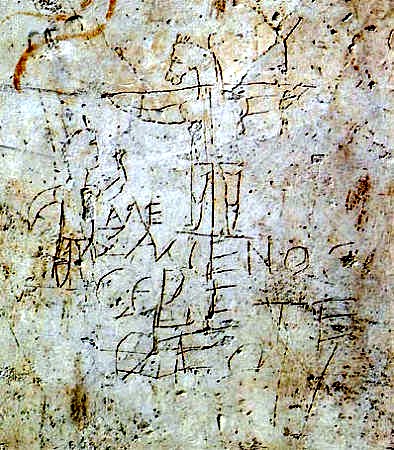
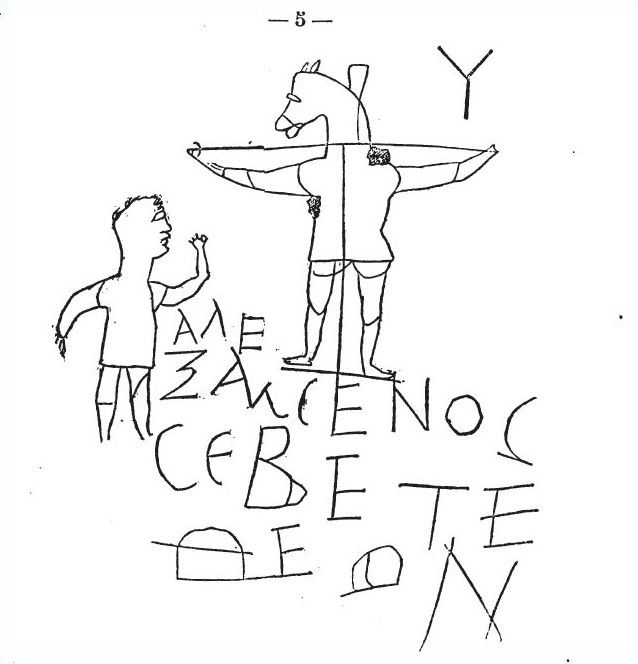
This image is now known as “the Alexameno graffito.” Ronald Huggins explains what we are seeing in this image.
So far as I know, no one has seriously doubted the authenticity of the Alexamenos graffito…The image in question consists of an amateurish drawing of a donkey-headed man, crucified, along with the picture of a boy (or perhaps a man) worshipping it. Accompanying the image are the crudely scrawled words in Greek “Alexamenos worships god” (alexamenos sebete [= sebetai] theon). This graffito is usually dated to around the beginning of the third century and is almost universally interpreted today along the lines suggested by the plaque that accompanies it in the Museo Palatino, or Palatine Antiquarium, in Rome, where it is currently housed: “Graffito con Crocifisso Blasfemo con scritta in greco: ‘Alexamenos adora dio.’” It was probably produced, in other words, as blasphemous mockery of a Christian named Alexamenos along with the object of his worship, Jesus.
This is utterly staggering, and it illustrates Paul’s point perfectly. This image is the earliest “artistic” depiction of the crucifixion of Jesus…and it is blasphemous anti-Christian graffiti. There is a story here the details of which we wish we knew. Who was this (presumably) young man, Alexamenos? Who were these boys who were mocking him?
We know that many critics of early Christianity mocked the believers of that time as those who worshipped a man with the head of an ass. This ugly slur was their way of blaspheming Christ and mocking what Christians held most dear: Christ crucified.
How badly did this sting Alexamenos, this bullying, this mockery, this cruelty? Did he cry himself to sleep while the boys in the next room laughed? Did he have any friends? Was he all alone? How long did he endure such taunting, such jeering, such belittling?
Who knows? Regardless, thirteen years after the discovery of the Alexamenos graffito, something else was spotted in a different room. Huggins explains:
In 1870 Visconti discovered the inscription, Alexamenos Fidelis (“Alexamenos is Faithful”) in another room in the Domus Gelotiana.5
God be praised! Alexamenos is mocked, but Alexamenos is faithful. Alexamenos is ridiculed, but Alexamenos is faithful. Alexamenos is laughed at, but Alexamenos is faithful.
Alexamenos may have stood without a friend…but not really. Alexamenos stood with Jesus. He stood with Christ crucified, Christ on the cross, Christ risen again, Christ ascended to the right hand of the Father, Christ is coming again!
Alexamenos fidelis, Church! Alexamenos was faithful! Faithful!
Will we be faithful?
Are we faithful?
Will we stand with the Lamb who was slain?
[1] https://www.nytimes.com/2003/08/25/nyregion/thieves-take-figure-of-jesus-but-not-the-cross.html
[2] Calvin Miller, The Unfinished Soul (Nashville, TN: Broadman & Holman)
[3] Cited in Charles R. Swindoll’s The Tale of the Tardy Oxcart as George MacLeod, Focal Point (January-March), 1981.
[4] Stanley Hauerwas, Prayers Plainly Spoken (Downers Grove, IL: InterVarsity Press, 1999), p.90.
5 https://ronaldvhuggins.blogspot.com/2013/03/a-place-for-alexamenos-palatine.html
 Exodus 20
14 You shall not commit adultery.
Have you heard of “The Wicked Bible”? Here’s a nice summary from Wikipedia:
The Wicked Bible, sometimes called Adulterous Bible or Sinners’ Bible, is the Bible published in 1631 by Robert Barker and Martin Lucas, the royal printers in London, which was meant to be a reprint of the King James Bible. The name is derived from a mistake made by the compositors: in the Ten Commandments (Exodus 20:14), the word not in the sentence “Thou shalt not commit adultery” was omitted, thus changing the sentence into “Thou shalt commit adultery.” This blunder was spread in a number of copies. About a year later, the publishers of the Wicked Bible were called to the Star Chamber and fined £300 (£44,614 as of 2015) and deprived of their printing license. The fact that this edition of the Bible contained such a flagrant mistake outraged Charles I and George Abbot, the Archbishop of Canterbury, who said then:
I knew the time when great care was had about printing, the Bibles especially, good compositors and the best correctors were gotten being grave and learned men, the paper and the letter rare, and faire every way of the best, but now the paper is nought, the composers boys, and the correctors unlearned.[1]
Now that is a mistake! Never say that one word does not matter. One word can change everything! No, the commandment says, “You shall not commit adultery.” This commandment is vitally important, especially in our day. In our day, the violation of this commandment is outright encouraged in many quarters, or at least the violation of it is seen as possibly helpful for relationships.
On June 30, 2011, The New York Times Magazine ran a story by Mark Oppenheimer entitled, “Married, With Infidelities.”
…[Dan] Savage has for 20 years been saying monogamy is harder than we admit and articulating a sexual ethic that he thinks honors the reality, rather than the romantic ideal, of marriage. In Savage Love, his weekly column, he inveighs against the American obsession with strict fidelity. In its place he proposes a sensibility that we might call American Gay Male, after that community’s tolerance for pornography, fetishes and a variety of partnered arrangements, from strict monogamy to wide openness.
Savage believes monogamy is right for many couples. But he believes that our discourse about it, and about sexuality more generally, is dishonest. Some people need more than one partner, he writes, just as some people need flirting, others need to be whipped, others need lovers of both sexes. We can’t help our urges, and we should not lie to our partners about them. In some marriages, talking honestly about our needs will forestall or obviate affairs; in other marriages, the conversation may lead to an affair, but with permission. In both cases, honesty is the best policy.
“I acknowledge the advantages of monogamy,” Savage told me, “when it comes to sexual safety, infections, emotional safety, paternity assurances. But people in monogamous relationships have to be willing to meet me a quarter of the way and acknowledge the drawbacks of monogamy around boredom, despair, lack of variety, sexual death and being taken for granted.”[2]
That is a very interesting thing for Savage to say. To cure “boredom, despair, lack of variety, sexual death, and being taken for granted,” one should be allowed to indulge in violations of a marriage that are, ideally, blessed by the other member of the marriage.
It is a profoundly modern thing to say, which is to say, it is a profoundly selfish thing to say. Yet many people agree with Savage, amazingly, and would even call such council “wise.” The Lord would not, and that is why He has given us the seventh commandment, “You shall not commit adultery.”
What does that mean, and why is it important?
Adultery is any act (primarily, but not exclusively, sexual in nature) that violates the marriage bond of either party involved.
It must be recognized that the earliest interpretations of this commandment likely saw the commandment as aimed at males, married or not, who were tempted to have a sexual relationship with the wife of another Israelite. Roy Honeycutt, Jr. explains.
Within the context of Old Testament cultural patterns, adultery involved extramarital sexual relations between a male Israelite, whether married or single, and the wife of a fellow Israelite…It is doubtful that the Old Testament would have viewed sexual intercourse between a married man and a woman as adultery, unless the woman was married.
Adultery was primarily a crime against the husband of the woman involved, rather than the woman herself. Legal sections of the Old Testament concerning sexual violations were grounded in the protection of the man’s rights and gave little consideration to the wrong done the assaulted woman. For example, in the case of the assault of a betrothed virgin, the death penalty was passed (Deut. 22:22-25), but if the virgin was not betrothed, the death sentence was not passed. Thus, the severity of the penalty rested in the violation of the man to whom the virgin was betrothed, not the virgin herself. Should one violate a virgin not betrothed to a man, a fine (indemnification) was paid to the father. The father had been wronged, for the assault of his daughter jeopardized the possibility of her future marriage, to say nothing of the loss of dowry.[3]
Patrick Miller generally agrees with this, but he notes that there are two reasons to believe that the early Jews would have seen this as applying likewise to women.
Although the primary or starting point of reference seems to be the activity of a man in violating the marriage of another man by having intercourse with his wife, in the trajectory of the commandment through the law and elsewhere, it does not stay so strictly confined. As with the commandments having to do with killing and stealing, one can identify a specific and confined focus that opens up rather quickly to a wider frame of reference. In this instance, there are two indicators of the wider applicability of the commandment. One is the formulation of the commandment itself. As others have noted, the common expression for sexual intercourse is “lie with” (šākab) + preposition + object (“ her,” “a woman,” and the like; e.g., Gen. 19: 32– 34; 39: 7– 14; Exod. 22: 15). There are other expressions as well, such as “take” (her; e.g., Gen. 34: 2; 38: 2), and “come to/ cohabit with” (her; e.g., Gen. 38: 2, 15– 16). All of these, however, regularly take an object, and it is female. The commandment itself uses a verb that is less common in these situations, nāap, “commit adultery.” It is a more general term and can stand without an object, thus leaving the possible object of the act of adultery open, relative to whether it is with a wife or a husband…[T]he statute in Leviticus 20:10 [“If a man commits adultery with the wife of his neighbor, both the adulterer and the adulteress shall surely be put to death.”] prohibiting adultery says that the woman as well as the man shall be put to death. Both persons are seen as having violated the commandment/ statute and are subject to its sanctions. Furthermore, both the man and the woman are called “adulterers” (the man, nōēp; the woman, nōāpet).[4]
While the history of interpreting this commandment is indeed unique, it would appear that it is most wise to interpret adultery as any act (primarily, but not exclusively, sexual in nature) that violates the marriage bond of either party involved. J.I. Packer gives a nice summary of the implications of the commandment.
[W]hat the words “you shall not commit adultery” call us to face is, first, that sex is for marriage, and for marriage only; second, that marriage must be seen as a relation of lifelong fidelity; third, that other people’s marriages must not be interfered with by sexual intrusion. One mark of true maturity is to grasp these principles and live by them.[5]
This much is certainly true: adultery is a very serious sin against God and man. Indeed, it is a crime against society itself. For instance, the fact that it is placed immediately after the prohibition against murdering is itself significant, as Victor Hamilton explains.
The placement of this commandment after the one about murder may be intentional. Adultery can have the effect of murdering, and hence ending, the existence of the covenant relationships of two other people. It plunges a dagger deep into the sacred bonds of matrimony. Plus, Prov. 6: 33– 35 discourages adultery not primarily because the adulterer is sinful but because he is stupid. Should the husband ever get his hands on him, he will do everything physically violent to him short of killing him.[6]
That is a good way of looking at it. Adultery is a kind of murder. God says that when two are joined together in marriage they become “one flesh” (Genesis 2:24). Thus, adultery threatens to murder this new creation of one-from-two by dividing them and making them two-from-one. Adultery strikes at the primary institution of society, marriage. As such, it is clearly and unequivocally forbidden.
One of the things we must do as a culture, and even, regrettably, as a church culture is return to a biblical understanding of (a) the sacredness of marriage and (b) the violence of adultery. I say “regrettably,” because the Church should not have to return to these views. She never should have left them. Yet it seems that for some within the Church today adultery is a sin we can just wink and giggle at, just something that men and women sometimes do.
In the aftermath of the Ashley Madison scandal, in which the account information of millions of users of an affair-arranging website by that name was released, it became apparent just how widespread the problem really is. Far too many ministry leaders and church members were found to be on that site. At the time, Ed Stetzer predicted that around four hundred ministry leaders would be resigning their positions in their local churches as a result of their names being on the Ashley Madison site. He came to this approximate figure as a result of an informal poll he conducted by calling denominational leaders in the United States and Canada.
Whether it is four hundred or one, the Church must ever and always grieve when the people of God violate the seventh commandment, as indeed we should when anybody does. The commandments were given to us not as arbitrary edicts intended to rob us of joy, but rather as loving commandments designed to keep us from actions that will lead to agony of soul, despair, and ruin. Calvin Miller expressed it creatively in this way in The Divine Symphony:
The illicit
Does not exhilarate.
It but indicts:
The sweetness of all adultery
Leaves just before the splendor,
Destroying the ecstasy
We thought might linger
To eliminate the shame.[7]
No, adultery never delivers. Rather, it tempts then wounds deeply. God’s commandment against it was an act of divine mercy.
According to Jesus, adultery is also an interior act that violates the marriage bond of either party involved.
As with the sixth commandment, so with the seventh we find Jesus internalizing the commandment by saying that it is possible to violate it inwardly whether or not we violate it outwardly. That is, according to Jesus, adultery is also an interior act that violates the marriage bond of either party involved. We find this in Matthew 5.
27 “You have heard that it was said, ‘You shall not commit adultery.’ 28 But I say to you that everyone who looks at a woman with lustful intent has already committed adultery with her in his heart. 29 If your right eye causes you to sin, tear it out and throw it away. For it is better that you lose one of your members than that your whole body be thrown into hell. 30 And if your right hand causes you to sin, cut it off and throw it away. For it is better that you lose one of your members than that your whole body go into hell.
If anything lays low our arrogance and self-righteousness, these words from Jesus do so. These words leave none of us with any place to run, and they bring all of us under condemnation, for they define all lustful looking as adulterous: all pornography consumption, all lingering over salacious images, all sins of the hearts, all secret imaginings of adulterous behavior.
Is any temptation more powerful or more pervasive than lust? Likely not. Frederick Beuchner has poignantly articulated man’s struggle in this area of life.
Lust is the ape that gibbers in our loins. Tame him as we will by day, he rages all the wilder in our dreams by night. Just when we think we’re safe from him, he raises up his ugly head and smirks, and there’s no river in the world flows cold and strong enough to strike him down. Almighty God, why dost thou deck men out with such a loathsome toy?[8]
Calvin Miller defined lust as an act of self-cannibalism.
Unbridled lust:
A cannibal committing suicide
By nibbling on himself.[9]
In truth, that is not an exaggeration. Adultery of the heart is so very pernicious because it allows us to convince ourselves that we are not really adulterers while, all the while, working the same ruin inwardly as outward, physical adultery does. In this way, we receive the same spiritual corruption as we pile self-deceit, dishonesty, and, amazingly, self-righteous judgment of others on top of our own self-inflicted degradation.
I once pastored a church in which there was a man who, it seemed to me, took an especial delight in finding out that others had been caught in their sins. He seemed to simmer with a kind of Phariseeism that I found profoundly off-putting. We were once discussing a man who had been nominated for the position of deacon. He shared with me that the man had committed adultery some twenty-five years earlier. After discussing this and the question of whether or not this act should exclude him from consideration regarding the deacon body, I said to the gentlemen, “But of course, according to Jesus, we are all guilty of adultery.” After reminding him of what Jesus had said in the Sermon on the Mount, the man I was speaking to said, “Well, that’s different.”
I will never forget that.
We tell ourselves, “Well, that’s different,” because it is much harder to take Jesus at his word than we like to think. I sometimes like to imagine what Jesus would have said if, at this point in the sermon, somebody had said, “Well, Lord, that’s different.”
Brothers and sisters, it is the same. We may become adulterers inwardly whether or not we become adulterers outwardly. Consider the words of Pozdnyshev from Leo Tolstoy’s novel The Kreutzer Sonata.
Two years before I had been corrupted by coarse boys. Already woman, not any particular woman, but woman as a sweet something, woman, any woman – woman in her nakedness – had already begun to torment me. My solitudes were unchaste. I was tormented as ninety-nine per cent of our boys are tormented. I was afraid, I struggled, I prayed, and – I fell! My imagination was already corrupt. I myself was corrupt but the final step had not yet been taken. I was ruined by myself even before I had put my hands on another human being.[10]
“Thou shalt not commit adultery,” applies to your heart as well as to your body. There are many ways to sin against your marriage or the marriage of others. This means we must cry out to God for protection, for mercy, and for grace in this area every day.
And, thanks be to God, we can also call out to Him for forgiveness. Church, adultery is a tragic and devastating sin. It brings ruin and despair and misery and agony and shame and regret. But may we end with this reminder: Jesus brings mercy and forgiveness and cleansing and a new heart and a new creation and a new day.
We should tremble at the pain that adultery begins and at how easy it is to fall into adulterous behavior. But we should praise God that the nail-scarred hands of Christ can forgive even this.
If you have failed in this area, grieve deeply and repent sincerely and come to the Christ who saves.
[1] https://en.wikipedia.org/wiki/Wicked_Bible
[2] https://www.nytimes.com/2011/07/03/magazine/infidelity-will-keep-ustogether.html?pagewanted=1&_r=2& ref =magazine
[3] Roy L. Honeycutt, Jr. “Exodus.” The Broadman Bible Commentary. Vol.1, Revised (Nashville, TN: Broadman Press, 1969), p.400.
[4] Miller, Patrick D. (2009-08-06). The Ten Commandments: Interpretation: Resources for the Use of Scripture in the Church (p. 273-274). Presbyterian Publishing Corporation. Kindle Edition.
[5] Packer, J. I. (2008-01-07). Keeping the Ten Commandments (Kindle Locations 714-716). Crossway. Kindle Edition.
[6] Hamilton, Victor P. (2011-11-01). Exodus: An Exegetical Commentary (Kindle Locations 11290-11293). Baker Publishing Group. Kindle Edition.
[7] Calvin Miller, The Divine Symphony ((Minneapolis, MN: Bethany House Publishers, 2000)), p.122.
[8] Frederick Buechner, Godric
[9] Calvin Miller, p.84.
[10] Leo Tolstoy. The Kreutzer Sonata (New York: The Modern Library, 2003), p.14.
 I had the chance the other day to view the documentary, “The Best of Enemies.” Absolutely enthralling! The documentary looks at the ten televised debates between William F. Buckley, Jr. and Gore Vidal that were held at the 1968 Republican National Convention in Miami and then the Democratic National Convention in Chicago. These debates, televised on ABC, caught the attention of the nation and forever changed both television as well as Buckley and Vidal.
The debates are most well known for the infamous moment in which Buckley exploded in rage at Vidal’s accusation that Buckley was a “crypto-Nazi” and in which Buckley countered by calling Vidal “queer” and threatened to “punch you in the —— face and you’ll stay plastered” on national television.
The result was an increase in the acrimony and hostility between the two men (which seems barely possible, by the way, given the animus between the two that existed before these debates) and eventual lawsuits between the two as well. Culturally, the result was a change in the way that network television covered national conventions and, more substantially, a change in the way that television allowed, then welcomed, and now encourages such raucous exchanges.
In 1968, however, such things did not happen, and the infamous clash was a very big deal, to be sure.
The stage was set for conflict from the very beginning. Buckley was the patron saint of conservatism and founder of National Review magazine. Vidal was a celebrity of the left and the author of the highly controversial ode to sexual libertinism, the novel Myra Breckinridge. Buckley considered Vidal a pornographer and dangerously radical leftist. Vidal considered Buckley an absolute dinosaur and totalitarian buffoon. Both were aristocrats. Both were highly intelligent. Both loathed the other.
The ten debates were filled with ad hominem invective from the get-go. The mutual disdain was palpable. Buckley’s notorious paroxysm was just one of the more dramatic and shocking salvos in a long catalogue of such barbs.
The documentary is very well done. It sets the stage admirably on what was going on in the parties and in the culture at large. It also paints very helpful pictures of Buckley and Vidal that help explain some of the psychology at play.
I was fascinated to see how Buckley’s outburst haunted him for the remainder of his days. I had naively thought, based on some of his later self-effacing allusions to the incident, that he wore it as a badge of honor. He did not. He was mortified by it and deeply regretted it. He was also somewhat obsessed with it in the aftermath, writing and commenting on it at great length.
Vidal saw it as a great triumph in which he finally exposed Buckley for the vile creature Vidal thought him to be. However, Buckley’s deft declaration of victory in the aftermath of his lawsuit against Esquire and Vidal (itself in the aftermath of Vidal’s response in that magazine to Buckley’s earlier examination of the whole episode in the same) grated on Vidal. After Buckley’s death, Vidal publicly bid him, “RIP WFB…in Hell.”
There’s a lot to see here and a lot to ponder. The power of ego. The power of hatred. The clash of worldviews. The power of a single instance to redefine whole media of communication. The concentration of wider cultural movements in figurehead celebrities. The insatiable human desire to have the last word. The haunting failure of allowing one’s carefully-crafted image to drop for a moment of raw, regrettable emotion. The role of television in the cultural discourse and the etiquette thereof. Etc. etc.
This is a cautionary tell, well told and enthrallingly depicted in “The Best of Enemies.” It’s political theater at its best and its most troubling. It’s also a strange and telling little episode in American political history, this fracas between Buckley and Vidal, but one worthy of consideration. And, in that regard, one can do much worse than this documentary.
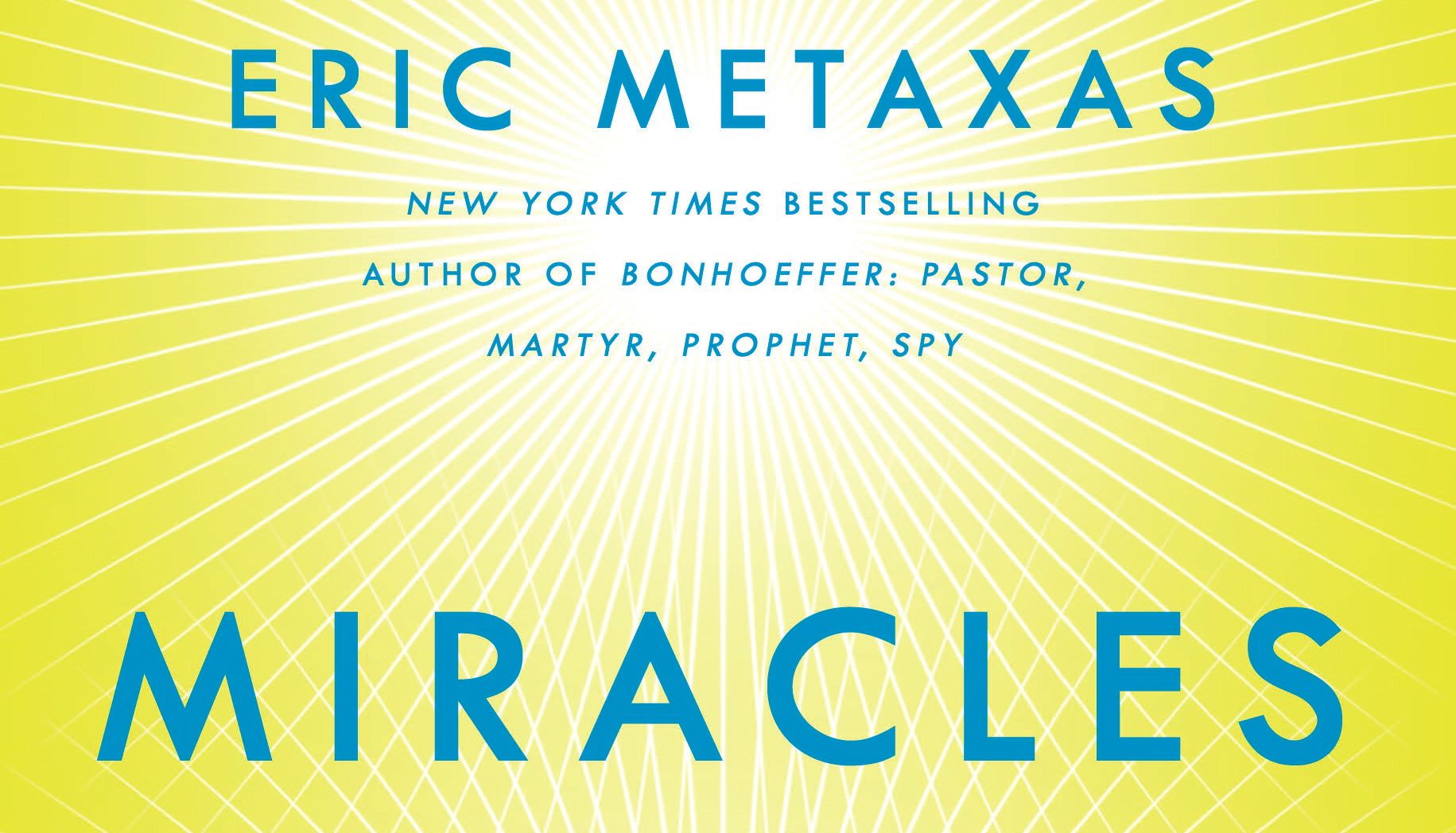 Throughout this year, the staff of Central Baptist Church has been working through Eric Metaxas’ Miracles: What They Are, Why They Happen, and How They Can Change Your Life. Like so many others, I was interested to see what Metaxas would do to follow up his enormously successful and insightful Bonhoeffer: Pastor, Martyr, Prophet, Spy. The result, Miracles, proved to be, in my estimation, and, if I may say so, in the estimation of the CBC staff, an interesting if uneven book. In truth, I would almost call this book a curiosity, and one that I do not quite know how to summarize.
The book consists of two parts. Part one, “The Question of Miracles,” was, in my opinion, the best section of the book. Here, Metaxas turns his undeniably perceptive mind and effective writing skills toward an apologetic for miracles. These first one-hundred-and-eleven pages provide a very accessible, very balanced, and very helpful summary of what miracles are and why we are justified in believing that miracles occur. The section ends with the most powerful and significant miracle of all: the resurrection of Jesus. To be honest, this first section would make a nice stand-alone booklet on the topic that I think would be very useful to the Church today.
The second part of the book is entitled “The Miracles Stories.” Here, Metaxas simply passes on miracles stories as they were told to him by people he knows personally. This is an engaging approach, to be sure, as one would expect miracle stories to be. Even so, this section was simply odd at points. Sometimes the miracle stories seem to end abruptly at points that catch the reader off guard. Sometimes the miracle stories raise more questions than they answer. Some aspect are troubling, such as the occasional presence of preachers and ministries in the stories that are rightly considered borderline heterodox by most in the Church today. Sometimes one cannot help but ask if the story recounted was even really a miracle.
It is a mixed bag. Many of these stories are profoundly inspirational. Some are odd. Some are confusing. Some fall flat. All of this is, of course, highly subjective. You may read these stories and disagree completely. But I guess that is the beauty of personal narratives: they hit all of us in different ways.
To be sure, the idiosyncratic, eclectic, and uneven nature of the second part of the book in no way detracts from the strength of the whole or dilutes the central contention of the book. I would say instead that it rather bolsters it. Even so, I personally could not help but feel that perhaps the book could have been a good thirty pages shorter with a few of the more questionable stories left out.
Regardless, that is Metaxas’ call, thank goodness, and not mine. The book seems to be a real encouragement to folks, and I’m certainly glad I read it. It was an intriguing and occasionally odd exercise, but one that is worth checking out.
Exodus 20
13 You shall not murder.
We come now to a commandment that serves as one of the fundamental building blocks of all just societies. This commandment undergirds the law codes of many lands and its violation consumes the courts of our own lands day in and day out in countless cases. We are speaking of the sixth commandment, most well known in the words of the King James Version, “Thou shalt not kill.”
In his novel The Unvanquished, William Faulkner writes of this commandment.
…if there was anything at all in the Book, anything of hope and peace for His blind and bewildered spawn which He had chosen above all others to offer immortality, Thou shalt not kill must be it.[1]
To be sure, there is much more of hope and peace in the Book than this, but Faulkner is correct that this commandment against killing is a foundational tenet of any society in which men and women have any hope of living together in peace and happiness.
Yet, what does it mean? “Thou shalt not kill,” sounds so very simple, but the moment we begin to get at its meaning or the moment we even ponder its application questions arise. Is it a ban literally on any and all forms of killing? Does the prohibition against killing include animals? Are there exceptions? What if I must kill to stop somebody else from killing? Can the state kill? Are soldiers violating the command in wartime.
On and on the questions go. Let us explore, then, this most crucial commandment.
Concerning the meaning of the “kill”: unlawful killing.
I am tipping my hand a bit at one of the issues surrounding this verse by quoting the English Standard Version translation.
13 You shall not murder.
Before we can get at what the commandment means, we need to understand exactly what the commandment actually says. In point of fact, it is not quite so simple as saying that the commandment means “you are never to kill.”
Philip Ryken points out that “the Hebrew language has at least eight different words for killing” and that the word used in Exodus 20:13, ratzach, refers to “the unjust killing of a legally innocent life.” Ryken translates the commandment as, “You shall not kill unlawfully.”[2]
William Propp argues that the translation, “Thou shalt not kill,” is “misleading” and “far too broad.” He points out that the verb rasah “means illegally to kill a human being” and translates the phrase, “Don’t murder.”[3]
Finally, Douglas Stuart says the word “kill” is “specific to putting to death improperly, for selfish reasons rather than with authorization (as killing in the administration of justice or killing in divinely ordained holy war would be)” and translates this commandment, “Never murder.”[4]
It is important to understand that these commentators are not hedging their bets, looking for some sort of loophole. They are actually trying to offer an honest translation based on how the Old Testament itself speaks of killing. And this much seems true: the Hebrew is not offering us a wooden, blanket ban on all killing in every circumstance.
The moment one says this today one is confronted with a very uncomfortable situation. Namely, those who do interpret this commandment as a blanket and simple prohibition against literally all killing tend to taunt those who argue for nuance in the text as being somehow secretly desirous of upholding structures of killing, almost as if those who argue against such a wooden translation somehow deep down very much want to kill or allow killing to satisfy some sort of primal bloodlust.
Speaking only for myself, I can clearly say that this is not the case. One may readily admit that the vast majority of killing in the world today and throughout human history has been a violation of the sixth commandment and yet hold that the sixth commandment does not actually forbid all killing in every case. That is certainly my position. I deplore the violence in the world today, even violence that purports not to be violating this commandment. In truth, almost all of it is in violation of this commandment. But that does not mean that all killing necessarily is so.
In the 2014 Irish film “Calvary,” the following conversation takes place between the priest and one of his parishioners.
Father James Lavelle: I’ve always felt there’s something inherently psychopathic about joining the army in peacetime. As far as I’m concerned, people join the army to find out what its like to kill someone. I hardly think that’s an inclination that should be encouraged in modern society, do you? Jesus Christ didn’t think so, either. And the commandment “Thou shalt not kill” does not have an asterisk beside it, referring you to the bottom of the page where you find a list of instances where it’s okay to kill people.
Milo Herlihy: What about self defense?
Father James Lavelle: That’s a tricky one, all right. But we’re hardly being invaded, though, are we?
While Father James hints in the end that there might theoretically be some kind of exceptions, his take on the sixth commandment represents the kind of oversimplified interpretation I am speaking of: “’Thou shalt not kill’ does not have an asterisk beside it, referring you to the bottom of the page where you find a list of instances where it’s okay to kill people.”
But there are two problems with this way of approaching this commandment. First, as we have already seen, there is a linguistic problem. Namely, the Hebrew word used is more akin to the word “murder” than to the word “kill.” Second, the Lord Himself commanded His people to kill others at times. And third, there appear to be passages of scripture that allow and even call for killing in certain circumstances.
I say this in all honesty: I have long been attracted to the tenets of pacifism and absolute, across the board non-violence. I really am drawn to this. I very much want, and have long tried to figure out a way to say, that I am opposed to all war in every circumstance and to all killing in every circumstance. Regrettably, I cannot say that, and, it is on the basis of God’s Word that I cannot. Tragically, in our fallen world, sometimes killing is the most just thing to do, the thing that must be done in order to save those who are being ravaged by the violence of tyrants, and even occasionally the most necessary thing to do to insure peace.
But this much is clear: the exceptions are limited and our world appears at times to be nearly drowning in violence and killing. This commandment forbids the unlawful, unjustified taking of human life, and it simply must be reclaimed for our day.
Human life, bearing the image of God, is sacred, and the taking of it is only and ever justified when it is God who takes it or when it is taken in strict harmony with divine principles of justice.
It must be understood that the prohibition against murder does not arise in a vacuum or as some kind of mere anthropological necessity or sociological principle. No, it is given by God. Specifically, it is given by the God of Israel. In other words, it is given by the God in whose image all men and women are created.
Behind the sixth commandment is the biblical teaching of the uniqueness of man as a being bearing God’s image and as a being into whom God breathes life. In Genesis 1, we find the foundation of for this truth.
26 Then God said, “Let us make man in our image, after our likeness. And let them have dominion over the fish of the sea and over the birds of the heavens and over the livestock and over all the earth and over every creeping thing that creeps on the earth.” 27 So God created man in his own image, in the image of God he created him; male and female he created them.
Similarly, in Genesis 2, God breathes life into man.
7 then the Lord God formed the man of dust from the ground and breathed into his nostrils the breath of life, and the man became a living creature.
Why is this significant? It is significant because it means that God holds the ownership papers for humanity, that man is uniquely special among all creation, and that the taking of human life is a very serious thing. In fact, only God can rightly take life or dictate the just taking of it.
This means that there is a powerful and terrifying statement of self-deification in all acts of murder and unlawful killing. In taking another life, the killer is essentially asserting that he is God in that moment. This can be seen in the words of the notorious serial killer Pee Wee Gaskins, who told a reporter this while he awaited execution on death row in South Carolina.
No one, and nobody, and no thing can ever touch me.
I have walked the same path as God.
By taking lives and making others fear me, I become God’s equal. Through killing others, I become my own Master.
Through my own power I come to my own redemption.
Once I seen the miracle light, I didn’t ever again have to fear or obey the Rules of no Man or no God.[5]
How terrifying: “By taking lives and making others fear me, I become God’s equal.” That is indeed what is behind all unjust taking of life.
The man who murders another man does so because, in that moment, he believes he has the right to do so. But that right belongs only and ultimately to God. Thus, the first crime in all acts of murder is the crime of blasphemy.
When the rich murder the poor by robbing them of life, they are asserting that they have a divine right to do so.
When the powerful murder the weak through violence or neglect, they are asserting that they can be God in that moment.
It was Pope John Paul II who made the phrase “the culture of death” famous, and now it is used widely to describe modern man. We are indeed a culture of death. From the ravages of the industrial war machine to the ravages of abortion to the violence of our entertainment culture, we are awash in death.
“You shall not murder.”
Jesus said we could violate this commandment without every actually touching another person.
Even so, it is easy for us to tell ourselves that we are not personally part of the culture of death, that we are not personally guilty of such atrocities.
“I have never murdered somebody,” we are tempted to say. “I have never taken a life.”
Would that it was that easy. Would that we could so simply sidestep the charge of guilt in regards to murder. And, if Jesus had not delivered the Sermon on the Mount, perhaps we could. But he did deliver the Sermon on the Mount and, in it, He said something very telling about this commandment. We read this in Matthew 5.
21 “You have heard that it was said to those of old, ‘You shall not murder; and whoever murders will be liable to judgment.’ 22 But I say to you that everyone who is angry with his brother will be liable to judgment; whoever insults his brother will be liable to the council; and whoever says, ‘You fool!’ will be liable to the hell of fire.
As He does throughout the Sermon on the Mount, Jesus raised the stakes on the commandments by internalizing them, by showing us that we could actually violate them inwardly without ever having physically touched another person. Specifically, Jesus says that we can be guilty of murder by being angry with another and by insulting and cursing another.
And how can that be? It can be because murderous rage and insults are seeking to do the same thing that murder itself is seeking to do: diminish and ultimately destroy another human being. At least there is an end to murder. You can only literally murder a person once. But it is possible to murder the character of a person time and time again.
And behind such rage and insults is the same blasphemous mindset that is behind murder. To insult another is not only to tear them down but to exalt yourself upwards. To rage against another is to presume that you are so much better than they are they have offended your delusions of deity. The opposite of, “You are a fool!” is, “But I am God.”
How easily we traffic in murder.
How easily we murder even in the house of God.
Consider the spiritual reality of what is at stake when you debase another, destroying their name, their character, and their reputation. There are many ways to kill a man, and the most common and vicious is through words.
“You shall not murder,” the Lord says to us. The opposite is also true: “You shall honor. You shall love. You shall esteem.”
“Do nothing from selfish ambition or conceit,” Paul writes in Philippians 2:3, “but in humility count others more significant than yourselves.” There is the cure for the murderous spirit: humility for yourself and value for others.
Is this not what Christ has done for us: humility for Himself and value for others? Yet Christ would have been and would be justified in punishing us all as murderers. He could have come to us in wrath and vengeance, and He would have been right to do so. Instead, He humbled Himself, even to the point of death on a cross, and lay down His life so that He could lift us up.
We are all forgiven murderers in Christ. In truth, He submitted Himself to our own murderous hands to redeem us from the punishment we rightly deserve. He paid the price for us.
“You shall not murder.”
By action.
By word.
By thought.
“You shall not murder.”
Value human life. Love human beings. Even the guilty ones, for we are all guilty. Even the unlovable ones, for we are all unlovable. Even the rebellious ones, for we are all rebels.
Love one another.
[1] William Faulkner. The Unvanquished. (New York: Vintage Books, 1990), p.216.
[2] Philip Graham Ryken, Exodus. Preaching the Word (Wheaton, IL: Crossway Books, 2005), p.616.
[3] William H.C. Propp, Exodus 19-40. The Anchor Bible. Vol.2A. (New York, NY: Doubleday, 2006), p.179.
[4] Douglas K. Stuart, Exodus. Vol.2. The New American Commentary (Nashville, TN: B&H Publishing Group, 2006), p.462.
[5] Donald Gaskins and Wilton Earle. Final Truth: The Autobiography of a Serial Killer. (Starr, South Carolina: Adept Publishers, 1999), p.229.
I earlier posted a devotion I delivered before the Georgia House of Representatives in Atlanta in January of 2009. I remembered speaking there for the first time some years before then but I did not have the book for that earlier devotion that the Clerk of the House publishes each year. So I wrote the Clerk a letter a couple of weeks back and, to my surprise, the book of devotions for 2003 showed up today. I would have been the pastor of First Baptist Dawson, Georgia, for less than a year on January 28, 2003, when I delivered this devotion. Anyway, here it is if anybody is interested.
 On Sunday, August 16, Central Baptist Church member and Boston Conservatory student Victoria Mantooth sang “O Glorious Love” with Central Baptist Minister of Music Billy Davis. It was so powerful and so moving that I wanted to offer audio of the song here (mp3 file).
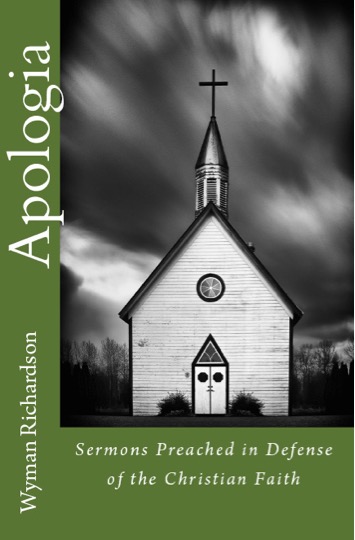 This summer I preached seven apologetic sermons focusing on six common challenges to the Christian faith. As I did so, a number of members of Central Baptist Church asked to have the sermons in written form. After looking first at publishing them in-house on our own equipment, I decided the easiest way to do this was to self-publish them through an online print-on-demand site. So that’s what we’ve done.
The book is now available through Amazon. Please note that I set the royalty rate as low as Create Space, one of Amazon’s self-publishers, would allow me (bringing the cost to $3.59). My intent here is not to profit, but simply to make these messages available in as affordable and accessible a medium as possible. The audio and manuscripts are already available here on the site, but, if you would like a copy in book form, feel free to get a copy.