
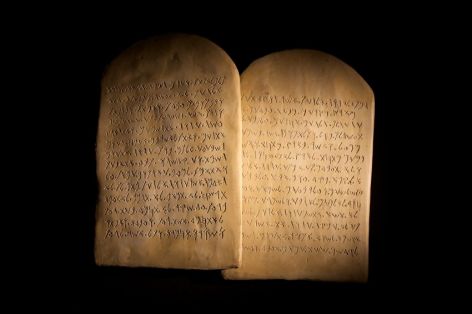
Exodus 20:22-26

what-are-ten-commandments_472_314_80Exodus 20

22 And the Lord said to Moses, “Thus you shall say to the people of Israel: ‘You have seen for yourselves that I have talked with you from heaven. 23 You shall not make gods of silver to be with me, nor shall you make for yourselves gods of gold. 24 An altar of earth you shall make for me and sacrifice on it your burnt offerings and your peace offerings, your sheep and your oxen. In every place where I cause my name to be remembered I will come to you and bless you. 25 If you make me an altar of stone, you shall not build it of hewn stones, for if you wield your tool on it you profane it. 26 And you shall not go up by steps to my altar, that your nakedness be not exposed on it.’

Having given the Ten Commandments to Israel, the Lord then expresses what we would call the theological implications of the giving of the Law. The fact that God gives His law has profound meaning and significance. It means much more than that God is a law-giver. He means that God is sovereign, that God reveals Himself, and that God seeks a relationship with His people. It also sets the stage for Israel’s worship as it establishes God’s holiness and otherness but also His desire for His people to walk rightly before Him.

God’s revelation of Himself from Heaven establishes a relationship that renders all alternative efforts at relationship inferior and blasphemous.

God had already forbidden the creation of graven images or idols. Even so, He condemns idolatry again here on this side of the giving of the commandments.

22 And the Lord said to Moses, “Thus you shall say to the people of Israel: ‘You have seen for yourselves that I have talked with you from heaven. 23 You shall not make gods of silver to be with me, nor shall you make for yourselves gods of gold.

There is an added dimension here to the earlier prohibition against idols. Now, having received the Law, Israel should be able to see the utter futility, absurdity, and insanity of creating false gods. Why? Because the true God of Heaven and earth has now spoken. It is on this basis that God repeats His forbiddance of idols: “You have seen for yourselves that I have talked with you from heaven.”

The implications are many and are compelling. God has spoken, so why would Israel want to create gods who cannot speak? God has moved toward Israel, so why would Israel want to craft gods who cannot move at all? God has revealed His nature and character, so why would Israel want to make gods of mute silver and gold?

Do you see? God speaking changes everything. In fact, this is a theologically rich sentence: “You have seen for yourselves that I have talked with you from heaven.” Specifically, this sentence carries with it three critically important theological truths:

  • Revelation: “I have talked…”
  • Relationship: “I have talked with you…”
  • Sovereignty: “I have talked with you from Heaven.”

Christianity is a revealed religion. It is not like one of the old mystery cults or one of the arcane gnostic sects. Its knowledge is not secret or hidden or coded. On the contrary, Christians worship the God who has revealed Himself.

“I have talked” is a statement the importance of which simply cannot be overstated. If God has not talked then we are still lost and blind and ignorant, for if God has not talked then we have not heard. The God of the deists does not talk. He merely observes from a distance. The gods of idolatry do not talk. They merely sit while their worshipers grovel before them. In 1 Kings 18, Elijah mocked the prophets of Baal for the silence and inactivity of their god.

25 Now Elijah said to the prophets of Baal, “Choose one bull for yourselves and prepare it first, for you are many; and call on the name of your god, but put no fire under it.26 So they took the bull which was given them, and they prepared it, and called on the name of Baal from morning even till noon, saying, “O Baal, hear us!” But there was no voice; no one answered. Then they leaped about the altar which they had made. 27 And so it was, at noon, that Elijah mocked them and said, “Cry aloud, for he is a god; either he is meditating, or he is busy, or he is on a journey, or perhaps he is sleeping and must be awakened.” 28 So they cried aloud, and cut themselves, as was their custom, with knives and lances, until the blood gushed out on them. 29 And when midday was past, they prophesied until the time of the offering of the evening sacrifice. But there was no voice; no one answered, no one paid attention. (NKJV)

Do you see the difference in God and Baal? The Lord says, “I have talked.” But of Baal it can only be said, “But there was no voice.” Our God is a revealing God.

And our God is a relational God. “I have talked with you.” He could have merely talked and thundered aloud to Himself for all to see. He could have talked at us, pronouncing righteous judgment over us. But instead, “I have talked with you.” What an amazing thing! The God who creates the Heavens and the earth has talked with us! He has spoken to us!

God is relational. Within Himself He lives in Trinitarian relationship and, outwardly, He seeks a relationship with us. The God who creates all knows your name. He speaks to you! This forever alters how we view God.

Even so, He speaks “from Heaven.” He seeks relationship, but this does not reveal any insufficiency on His part. He speaks to His creation but He is yet outside of and above His creation. He speaks to man, but He is not man. He speaks “from Heaven,” that is, He speaks from the vantage point of sovereignty and power.

Each of these elements – revelation, relationship, sovereignty – must be held to in order to have an adequate picture of God. Without revelation God becomes unknowable. Without relationship God becomes unapproachable. Without sovereignty God becomes “unworship-able.” However, when these three elements of the nature of God are seen for what they are, the majesty of God shines all the brighter! Our sovereign King reveals His nature and character to us!

God commissioned altars because altars highlighted God’s transcendence and reminded Israel of their distance from Him while providing Israel with a forum for sacrifice thereby reminding them of His love and forgiveness.

These truths also establish the nature of all true worship. While idols are forbidden, altars to the one, true God are encouraged. This must be read in light of what we have just seen: the revealing, relational, sovereign character of God!

24 An altar of earth you shall make for me and sacrifice on it your burnt offerings and your peace offerings, your sheep and your oxen. In every place where I cause my name to be remembered I will come to you and bless you.

The Lord commands His people to create altars on which they are to offer sacrifices to God. Victor Hamilton points out that “Verse 24 does not speak of four offerings but of two. The preposition mēʾēt should be understood in place of et (‘your whole-burnt offerings and fellowship offerings from your sheep and cattle’).”[1]

The offerings are important for they remind the people that while God is knowable He is nonetheless God and is nonetheless other. Furthermore, the need for them to offer offerings highlights their distance from Him, their sinfulness. Yet the fact that God has shown them a way to come before Him through worship and sacrifice reminds them that God’s otherness is not a cause of despair, for the God who is other is the God who has called His people to approach Him.

As a result, their worship should be holy and sacred and sincere. For this reason, we find two prohibitions in our text. The first has to do with the nature of the altar.

25 If you make me an altar of stone, you shall not build it of hewn stones, for if you wield your tool on it you profane it.

The altar is to be made of earth and stone, but the stone must not be hewn. Why? Because the hewing of stone introduces an element of human craftsmanship that, if allowed to run wild, can ultimately distract the worship, elevate the craftsman, and even introduce an element of idolatry into the act of worship. Thus, the stones should be offered as they are, not as man wishes them to be, even if his intentions are to honor God.

There is a principle in this prohibition that should be remembered and heeded: worship must not become about the skill of man or the production and showiness of man. Worship must ever and always be about the holiness and grandeur and glory and grace of God. At that moment when our hewn stones begin to pull us away from the purity of worship, we should cast them aside and repent.

What is more, the Lord calls for modesty in worship.

26 And you shall not go up by steps to my altar, that your nakedness be not exposed on it.’

That is an interesting verse, and perhaps even a verse that might makes us blush with embarrassment. The logistics are simple enough: if a man is going to be standing above the people, he must make sure that he is not exposed. In Exodus 28 we find more specific guidelines regulating this principle.

42 You shall make for them linen undergarments to cover their naked flesh. They shall reach from the hips to the thighs; 43 and they shall be on Aaron and on his sons when they go into the tent of meeting or when they come near the altar to minister in the Holy Place, lest they bear guilt and die. This shall be a statute forever for him and for his offspring after him.

Likewise, we find this in Leviticus 6.

10 And the priest shall put on his linen garment and put his linen undergarment on his body, and he shall take up the ashes to which the fire has reduced the burnt offering on the altar and put them beside the altar.

Like the prohibition against hewn stones, there is a timeless principle here as well. Modesty must be maintained in worship and anything we might do in terms of our appearance that might distract others from worship should be shunned. It is possible to offend in this area by wearing too little or by adorning oneself too much. Thus, Paul writes this in 1 Timothy 2:

8 I desire then that in every place the men should pray, lifting holy hands without anger or quarreling; 9 likewise also that women should adorn themselves in respectable apparel, with modesty and self-control, not with braided hair and gold or pearls or costly attire, 10 but with what is proper for women who profess godliness—with good works. 11 Let a woman learn quietly with all submissiveness.

Likewise Peter in 1 Peter 3:

3 Do not let your adorning be external—the braiding of hair and the putting on of gold jewelry, or the clothing you wear— 4 but let your adorning be the hidden person of the heart with the imperishable beauty of a gentle and quiet spirit, which in God’s sight is very precious.

While the two New Testament examples I have cited both pertain to the appearance of women, let us remember that the first warning concerning modesty was toward male priests approaching the altar. Truly this commandment applies to both men and women and there are numerous was we can violate it. The question is how? We should perhaps say that if there is a component of our appearance that is avoidable and that causes offense, distracts, violates accepted standards of decency and modesty, or in any way trivializes, cheapens, or mocks worship, the name of God, or the people of God, it should be avoided.

To be sure, there are grey areas, and churches can become overly legalistic in their monitoring of such things, but it likely will not be denied that ours is a day in which even the clearer violations of standards of modesty are not addressed at all. The pendulum, after all, can swing both ways: suffocating legalism or immodest libertinism. It is for the people of God to consider such matters and approach them prayerfully, carefully, and always with an eye toward keeping our worship focused.

What we find, then, in the call to worship is a desire on God’s part for His people to come before Him, seeking Him, confessing their sins to Him, and knowing that He loves them. Our worship should be driven by our knowledge of the goodness and holiness of God.

Jesus fulfilled all that Israel’s altars and sacrifices pointed to.

Our passage helps us understand the nature of true worship and, indeed, the nature of God. So why do we not worship like this today? Meaning, why do we not come to church, buy our sacrificial animal, and offer it on an altar of stone and earth? On this side of the cross, it is because we realize that a greater offering has been given, that a perfect Lamb has been slain.

The writer of Hebrews put is so beautifully in Hebrews 10.

11 And every priest stands daily at his service, offering repeatedly the same sacrifices, which can never take away sins. 12 But when Christ had offered for all time a single sacrifice for sins, he sat down at the right hand of God, 13 waiting from that time until his enemies should be made a footstool for his feet. 14 For by a single offering he has perfected for all time those who are being sanctified.

Ah! So all of the altars that Israel ever built and all of the components of the Temple that Israel would eventually build and all of the sacrifices that Israel ever offered to God pointed and point to Jesus, the one, supreme, eternal, sufficient, once-for-all, one-for-all offering. So we do not hope in the blood of bulls and goats and doves and lambs. We hope in the blood of Christ! His sacrifice is sufficient and His cross is the altar that is above all other altars.

Jesus the Lamb has given Himself. Jesus the sacrifice has paid the price. Jesus the Lord of Heaven and earth has both established the standards of righteousness and fulfilled them! Jesus the Righteous Judge has both passed sentence against all iniquity and paid the debt incurred by our own wickedness and rebellion. Jesus was stripped bear on the altar of God so that we can be clothed in His righteousness. Jesus was pierced so that we can be healed. Jesus was broken so that we can be made whole.

Behold the Lamb of God who takes away the sin of the world.


[1] Hamilton, Victor P. (2011-11-01). Exodus: An Exegetical Commentary (Kindle Locations 11725-11731). Baker Publishing Group. Kindle Edition.

Matthew 26:57-68

Screen Shot 2015-08-27 at 3.08.11 PMMatthew 26

57 Then those who had seized Jesus led him to Caiaphas the high priest, where the scribes and the elders had gathered. 58 And Peter was following him at a distance, as far as the courtyard of the high priest, and going inside he sat with the guards to see the end. 59 Now the chief priests and the whole council were seeking false testimony against Jesus that they might put him to death, 60 but they found none, though many false witnesses came forward. At last two came forward 61 and said, “This man said, ‘I am able to destroy the temple of God, and to rebuild it in three days.’” 62 And the high priest stood up and said, “Have you no answer to make? What is it that these men testify against you?” 63 But Jesus remained silent. And the high priest said to him, “I adjure you by the living God, tell us if you are the Christ, the Son of God.” 64 Jesus said to him, “You have said so. But I tell you, from now on you will see the Son of Man seated at the right hand of Power and coming on the clouds of heaven.” 65 Then the high priest tore his robes and said, “He has uttered blasphemy. What further witnesses do we need? You have now heard his blasphemy. 66 What is your judgment?” They answered, “He deserves death.” 67 Then they spit in his face and struck him. And some slapped him, 68 saying, “Prophesy to us, you Christ! Who is it that struck you?” 

In 1914 and 1915, Franz Kafka, the enigmatic writer from Austria-Hungary, wrote his novel, The Trial. He did not intend for it to be published and he left instructions that all of his works were to be destroyed. Fortunately his friends did not follow these instructions. Kafka died in 1924 and The Trial was published by his friend Max Brod the next year.

The Trial has come to mind a few times over the last few weeks. In the story, a young bank employee man named Josef K. wakes up to find two shadowy agents in his room who inform him that he is being charged with a crime and will stand trial. He demands to know what for but they will not say. He is led to a higher official who informs him that he is, in fact, to stand trial. Like the first two agents, this official will not tell Josef what he is being charged with, what agency they are with, what court they represent, or any details about the trial. In fact, they tell him to return to work at the bank and carry on with his life like normal though he is to keep in mind that he has been charged and will stand trial for the undisclosed crime.

The rest of the story unfolds like some weird episode of “The Twilight Zone” or like some kind of nightmare. Josef is slowly driven to despair and finally resignation through his efforts to find out what he has been charged with, when his trial is to be, who exactly this court is, and how he is to receive a fair and just trial and why he cannot know these things. Every turn he makes in trying to discover more about this leads him into increasingly absurd and frustrating discoveries that really are not discoveries at all. The story ends with two court officials showing up at Josef’s home, taking him outside of the city, and killing him.

It is a fascinating and intriguing tale. People discuss what Kafka was trying to say through this story. The exact meaning will never be known, but this much seems clear: Kafka was highlighting the absurdity that seems to reside in modern society and sometimes, it seems, in life itself.

As I said, I have thought of Kafka’s Trial a good bit lately as we have been considering the crucifixion with Jesus. Last week we saw the arrest of Jesus in the Garden of Gethsemane. Now we turn to the initial steps of His trial.

There are differences, of course, in the account of Jesus’ trial and in Kafka’s story. Jesus knew exactly who it was who had arrested Him and He also knew why he was being tried and then why, ultimately, He was going to be executed. But there is also a very basic similarity: namely the ever-increasing sense of the absurd that surrounds the trial of Jesus coupled with a profound sense of injustice. In the providence of God, this was necessary for Jesus to reach the cross. However, from a human perspective, each unfolding event in this trial is more absurd, unjust, nightmarish, and obscene than the one before.

Just imagine the insanity of it. In the trial of Jesus:

  • the guilty accuse, try, and then kill the innocent.
  • the blasphemous accuse the only one who is righteous of blasphemy.
  • those caught in a lie accuse the truth of telling lies.
  • those who are ignorant claim to know more than the one who is omniscient.
  • those who could not see God rebuke God in the name of God.

There is indeed something Kafkaesque about the trial of Jesus, something surreal. Yet Jesus submits Himself to this for us and for our salvation. The trial of Jesus reveals certain things about us and about Jesus. I would like to approach this by way of a thesis statement: Human beings tend to misunderstand the truth when they first hear it and to hate the truth when they finally understand it. The trial of Jesus demonstrates this. But the truth is the truth regardless of our reaction to it, and the truth is named Jesus.

Human beings tend to misunderstand the truth when they first hear it and to hate the truth when they finally understand it.

First, human beings tend to misunderstand the truth when they see it.

57 Then those who had seized Jesus led him to Caiaphas the high priest, where the scribes and the elders had gathered. 58 And Peter was following him at a distance, as far as the courtyard of the high priest, and going inside he sat with the guards to see the end. 59 Now the chief priests and the whole council were seeking false testimony against Jesus that they might put him to death, 60 but they found none, though many false witnesses came forward. At last two came forward 61 and said, “This man said, ‘I am able to destroy the temple of God, and to rebuild it in three days.’”

In an effort to find grounds rid themselves of Jesus, His accusers were finally forced to take a statement of His that they simply did not understand and use it against Jesus: “This man said, ‘I am able to destroy the temple of God, and to rebuild it in three days.’” Caiaphas acted with outrage and demanded a response. Jesus remained silent.

Face to face with the truth, they could not understand it.

The episode Jesus’ accusers referenced is found in John 2.

19 Jesus answered them, “Destroy this temple, and in three days I will raise it up.” 20 The Jews then said, “It has taken forty-six years to build this temple, and will you raise it up in three days?” 21 But he was speaking about the temple of his body. 22 When therefore he was raised from the dead, his disciples remembered that he had said this, and they believed the Scripture and the word that Jesus had spoken.

You will notice, first, that the words of Jesus are misquoted by His accusers. What Jesus had said was, “Destroy this temple, and in three days I will raise it up.” However, His accusers quoted Him as saying, “I am able to destroy the temple of God, and to rebuild it in three days.” Jesus had said that if they destroyed the temple He would build it back, not that He would destroy the temple.

Most tragic of all, they had completely misunderstood the meaning of Jesus’ saying. What they saw as talk of insurrection was really talk of resurrection. Jesus, John informs us, was not talking about the building, He was talking about His coming death and resurrection. This means, ironically, that in misunderstanding Jesus’ words they were fulfilling Jesus’ words by condemning Him and taking one step closer to the cross.

Faced with the truth, they misunderstood the truth, then fulfilled the truth. It is ever the case with lost man that he misunderstands the truth upon seeing it. And modern man misunderstands the truth because he does not believe it even exists. Some years ago, David Samuels was writing against pro-life activists in The New York Times Magazine and said this: “It is a shared if unspoken premise of the world that most of us inhabit that absolutes do not exist and that people who claim to have them are crazy.”[1]

Modern man does not believe that absolute truth exists. His problem is less one of misunderstanding than of simple denial. Even still, when he encounters Jesus, he is apt to misunderstand Jesus. For instance, consider Manson family member Squeaky Fromme’s response to be asked whether or not she thought Charles Manson was Jesus Christ.

“Did you think that Charles Manson was Jesus Christ?” Squeaky hesitated a moment before answering. Would she be the apostle who denied Jesus? Apparently she decided she would not, for she replied: “I think that the Christians in the caves and in the woods were a lot of kids just living and being without guilt, without shame, being able to take off their clothes and lay in the sun…And I see Jesus Christ as a man who came from a woman who did not know who the father of her baby was.”[2]

Yes, ever and again people misunderstand the point of Jesus. Then as now, His message seems to ricochet off of those whose minds and hearts are unprepared to receive Him. This helps us to understand Jesus’ lack of response at this point.

62 And the high priest stood up and said, “Have you no answer to make? What is it that these men testify against you?” 63a But Jesus remained silent.

He remained silent because there was no point to speaking. There are times when human beings are so oblivious to the truth that speech is almost wasted breath. In remaining silent, He also fulfilled the prophesy of Isaiah 53:7.

He was oppressed, and he was afflicted, yet he opened not his mouth; like a lamb that is led to the slaughter, and like a sheep that before its shearers is silent, so he opened not his mouth.

Human beings tend to misunderstand the truth when they hear it and to hate the truth when they finally understand it.

Yes, human beings tend to misunderstand the truth when they first hear it. However, when they finally understand it, human beings tend to hate the truth. This is evident in the trial of Jesus when He plainly reveals to them who He is.

63b And the high priest said to him, “I adjure you by the living God, tell us if you are the Christ, the Son of God.”

There is profound and tragic irony in Caiaphas’ words, “I adjure you by the living God…” In the name of God Caiaphas accuses God and then condemns God for revealing that He is God! Jesus responds:

64 Jesus said to him, “You have said so. But I tell you, from now on you will see the Son of Man seated at the right hand of Power and coming on the clouds of heaven.”

And there it is: the truth plain and simple. This Jesus is the Christ, the Son of God, and He reigns in power. Caiaphas? Response?

65 Then the high priest tore his robes and said, “He has uttered blasphemy. What further witnesses do we need? You have now heard his blasphemy. 66 What is your judgment?” They answered, “He deserves death.” 67 Then they spit in his face and struck him. And some slapped him, 68 saying, “Prophesy to us, you Christ! Who is it that struck you?”

This is how the world responds to the truth: misunderstanding then outright hatred. It is fascinating to see Jesus, the truth, standing alone among the majority who miss it. It is even more fascinating to consider how much weight we grant the opinion of the majority today in light of this fact. More than this, it is fascinating and curious to see how much weight we grant the pronouncements of the media and Hollywood celebrates, as if the opinions of either have any claim to accuracy.

See Jesus standing here alone against the majority who cannot see the truth and it will forever call into question the supposed wisdom of the mob. The idea of truth by majority vote is a terrifying idea indeed. In reality, the truth is generally missed and despised.

And it is mocked. After spitting on Jesus, slapping Jesus, and striking Jesus, they mocked Him, saying, “Prophesy to us, you Christ! Who is it that struck you?”

Again, behold how the world responds to the truth and take comfort when you are similarly despised for the truth.

But the truth is the truth regardless of our reaction to it, and the truth is named Jesus.

The world may misunderstand and then hate the truth, but its doing so does not render it less true. The truth is the truth regardless of our reaction to it, and the truth is named Jesus. Jesus Himself said in John 14:6, “I am the way, and the truth, and the life. No one comes to the Father except through me.” In doing so He went beyond merely claiming to know the truth or have the truth. He actually claimed to be the truth.

This is what renders the trial of Jesus so Kafkaesque, so nightmarish, so absurd. Mankind is privileged to look the truth in the eye, and his response is utter disdain. In fact, in the name of truth they seek to destroy the truth.

Part of following Jesus is embracing the conviction that Jesus is the truth even if the truth of Jesus stands alone against the alleged truths of the world. Dostoevsky once wrote the following:

I believe there is nothing lovelier, deeper, more sympathetic and more perfect than the Saviour; I say to myself with jealous love that not only is there no one else like Him, but that there could be no one. I would say even more. If any one could prove to me that Christ is outside the truth, and if the truth really did exclude Christ, I should prefer to stay with Christ and not with truth. There is in the world only one figure of absolute beauty: Christ. That infinitely lovely figure is as a matter of course an infinite marvel.[3]

This is occasionally quoted as a positive statement of devotion to Christ. However, I would like to object to the second part of this, the part in which Dostoevsky writes that he would prefer to stay with Christ even “if the truth really did exclude Christ.” As I read this, he is not speaking of the truth as defined by the world but the actual truth. In other words, if Jesus was not the truth Dostoevsky would still prefer Jesus.

To be charitable, Dostoevsky was probably simply lost in an admirable and maybe even enviable moment of ecstatic praise. Maybe he was trying to make a bigger point and was being a bit careless with His words. However he came to write this, I disagree. If Jesus is not the truth then Jesus is a lie and it does no good to say that we would prefer Jesus even if Jesus was not the truth. As a mental exercise, imagine how Jesus might respond if you were to say such a thing to Him: “Jesus, I believe you whether you are actually telling the truth or not.” I wonder if He would receive such a sentiment given how clear He was to establish His truthfulness.

No, we stand with Jesus not regardless of whether or not He is truth but because He is truth. We trust Him because He is trustworthy. We praise Him because He is praiseworthy. We follow Him because He alone knows the way. We pray in His name because it is only in and through His name that we can actually pray. We stand with Jesus because those who accused Him of telling a lie were in fact wrong. We stand with Jesus because He is the way, the truth, and the life, and nobody comes to the Father except through Him.

In the trial of Jesus, a lie was elevated above the truth. In the Church of Jesus, the truth must be elevated above the lie. And here is the truth: that man is a sinner but that God is a saving God. And here is truth as well: that this saving God sent His Son, Jesus, to lay down His life on the cross then rise victorious from the dead to save us, to redeem us, to purchase us for Himself.

Dear friends, Jesus is not on trial, we are. But the good news of the gospel is that the Judge has left His bench and stood beside us. More than that: the Judge has left His bench, stood beside us, and taken our punishment onto Himself, paying the price for our sins on the cross so that we might be forgiven. So the Judge becomes the condemned willingly so that the condemned can be set free.

All you need do is let the Son set you free. Trust in Jesus. He is merciful and mighty to save.


[1] RJN, “While We’re At It,” First Things. August/September 1999.

[2] Helter Skelter: The True Story of the Manson Murders (Vincent Bugliosi) – Highlight Loc. 10294-9

[3] Quoted in Calvin Miller. The Book of Jesus. (Simon and Schuster), p.52.


Matthew 26:47-56

Screen Shot 2015-08-27 at 3.08.11 PMMatthew 26

47 While he was still speaking, Judas came, one of the twelve, and with him a great crowd with swords and clubs, from the chief priests and the elders of the people. 48 Now the betrayer had given them a sign, saying, “The one I will kiss is the man; seize him.” 49 And he came up to Jesus at once and said, “Greetings, Rabbi!” And he kissed him. 50 Jesus said to him, “Friend, do what you came to do.” Then they came up and laid hands on Jesus and seized him. 51 And behold, one of those who were with Jesus stretched out his hand and drew his sword and struck the servant of the high priest and cut off his ear. 52 Then Jesus said to him, “Put your sword back into its place. For all who take the sword will perish by the sword. 53 Do you think that I cannot appeal to my Father, and he will at once send me more than twelve legions of angels? 54 But how then should the Scriptures be fulfilled, that it must be so?” 55 At that hour Jesus said to the crowds, “Have you come out as against a robber, with swords and clubs to capture me? Day after day I sat in the temple teaching, and you did not seize me. 56 But all this has taken place that the Scriptures of the prophets might be fulfilled.” Then all the disciples left him and fled.

The religious establishment saw the threat of Jesus and realized that they needed to move against Him if the power structures they had built were going to be maintained. Having plotted and schemed, they found an open door in the treacherous heart of Judas. Now, in the garden of Gethsemane, they make their move. Here in the garden where Jesus’ disciples slept and where He agonized, wicked men come to lay hands on the sinless Lamb of God. In doing so, they set in motion the most infamous and legally unjust proceedings in the history of the world. Even so, it was through these ignominious proceedings that God accomplished His great plan of salvation, for these proceedings will end with a cross and an empty tomb.

When we turn back to the garden, we see a number of revealing dynamics at play.

An act of betrayal intended to destroy.

First, we see the traitor, Judas, coming to perpetrate his heinous crime.

47 While he was still speaking, Judas came, one of the twelve, and with him a great crowd with swords and clubs, from the chief priests and the elders of the people. 48 Now the betrayer had given them a sign, saying, “The one I will kiss is the man; seize him.” 49 And he came up to Jesus at once and said, “Greetings, Rabbi!” And he kissed him. 50a Jesus said to him, “Friend, do what you came to do.”

Shame is heaped upon shame as Judas feigns loyalty by referring to Jesus as “Rabbi” and then feigns friendship by kissing Jesus. This kiss was not in and of itself abnormal for that time and culture. Male friends might kiss each other in such away as a sign of filial devotion. However, A.T. Robertson notes that the verb used for “kiss” is katephilesen which means “kissed him fervently.”[1]

Could it be that Judas overplayed his hand in a fit of nerves? Could it be that his kiss was more fervent than was customary because of the dastardly deed he was trying so very hard to conceal? The words of Proverbs 27 seem especially pertinent at this point:

6 Faithful are the wounds of a friend; profuse are the kisses of an enemy.

Profuse indeed are the kisses of an enemy. Profuse too are the kisses of true friendship and love. For instance, the same verb used for Judas’ kiss appears also in Luke 15:20, when the father welcomed home his prodigal son.

20 And he arose and came to his father. But while he was still a long way off, his father saw him and felt compassion, and ran and embraced him and kissed him.

So profuse are the kisses of actual love, but profuse as well are the kisses of an enemy. The difference is in the intent, the motivation, and, ultimately, the fruit. Jesus’ response is painful to read.

50a Jesus said to him, “Friend, do what you came to do.”

Jesus called Judas “friend.” What must have passed between the two in that moment? I envision Jesus looking deeply into the traitorous eyes of Judas as he said this. Did Judas go pail? Did he flinch? Did he blink or stare wide-eyed? Whatever his response, he surely understood that Jesus completely understood what he had come to do.

Jesus called Judas “friend.”

When I was a student at Southwestern Baptist Theological Seminary in Fort Worth, Texas, Dr. Thomas Long, then Professor of Preaching at Princeton Divinity School, came and spoke to us in chapel. I recall him making the point that “in the book of Matthew ‘friend’ is a bad word.” What he meant was that every time the word “friend” is used in Matthew it is in a scene of tension or conflict.

For instance, in Matthew 11 we see that Jesus’ friendship with sinners was used against Him by His critics. In this instance, the word “friend” is said with a sneer of contempt.

19 The Son of Man came eating and drinking, and they say, ‘Look at him! A glutton and a drunkard, a friend of tax collectors and sinners!’ Yet wisdom is justified by her deeds.”

In Matthew 20, Jesus used the word as he tried to explain to the outraged vineyard workers who were hired at the beginning of the day that he had done them no wrong by paying all the workers the same.

13 But he replied to one of them, ‘Friend, I am doing you no wrong. Did you not agree with me for a denarius?

In the parable of the wedding banquet in Matthew 22, the King questions a man who had come without proper attire.

12 And he said to him, ‘Friend, how did you get in here without a wedding garment?’ And he was speechless.

He next instructs that this man be tied up and thrown out into the darkness. Then here, in Matthew 26, Jesus used the word of Judas.

50 Jesus said to him, “Friend, do what you came to do.” Then they came up and laid hands on Jesus and seized him.

I recall Thomas Long saying that if ever you preach out of Matthew you should not sing, “What a Friend We Have in Jesus.”

Jesus called Judas “friend.” The heart pang of this moment comes in the fact that Jesus truly had extended friendship to Judas, and so much more. He had offered eternal life. Jesus could have been and should have been the greatest friend that Judas ever had, but Judas returned the love of Jesus with deceit and betrayal.

In Michael Card’s song, “Why?” he sings this:

Why did it have to be a friend

Who chose to betray the Lord

Why did he use a kiss to show them

That’s not what a kiss is for

Only a friend can betray a friend

A stranger has nothing to gain

And only a friend comes close enough

To ever cause so much pain

That is so very well said, and so very, very true.

An act of violence intended to defend.

Now we begin to see movement and a heightening of tension.

50b Then they came up and laid hands on Jesus and seized him. 51 And behold, one of those who were with Jesus stretched out his hand and drew his sword and struck the servant of the high priest and cut off his ear. 52 Then Jesus said to him, “Put your sword back into its place. For all who take the sword will perish by the sword.”

Here we see an act of violence intended to defend. Peter drew a sword and struck the ear of the servant of the high priest off. Why? What was he thinking?

Undoubtedly he was feeling a sense of outrage at Judas’ betrayal, a sense of need to defend Jesus, and likely a sense of fear coupled with a desire to take control of the situation himself. Most likely Peter’s actions were reflective of the feelings of most or all of the eleven disciples. They were, from our vantage point, very natural actions to take.

Peter was the head disciple, it would seem, and it is almost certainly the case that he wanted to do something brave. After all, he had sworn that he would stand with Jesus until the end. So, in a surge of adrenaline and righteous indignation, Peter drew his sword and then drew blood.

It is a critical moment, for here we see what Jesus is truly about. Will He endorse this act of violence and thereby call His followers to the sword, or will He not?

52 Then Jesus said to him, “Put your sword back into its place. For all who take the sword will perish by the sword.”

Jesus calls His disciples to the cross, not to a stockpile of weapons with an eye toward violent overthrow. And let us remember this as well: had the disciples of Jesus thwarted this arrest, they would have disrupted God’s plan for Jesus to lay down His life for the world.

It is a good thing that this episode appears in the garden of Gethsemane account, for it tells us that the posture of the Church is not to be one of violence, coercion, force, and power on the world’s terms, but rather one of love, obedience, and sacrifice. “Put your sword back in its place” is a word the Church has often ignored over the years. The Church has tragically taken up its sword at critical moments and the result has always been disaster.

Remember: we were called to carry a cross, not unsheathe a sword. We were called to love our neighbors, not attack our neighbors. We were called to speak truth to power, not overthrow power and replace it with our own version.

It is occasionally pointed out that in Luke’s account, Jesus tells His disciples to get swords for themselves. We find this in Luke 22.

35 Then Jesus asked them, “When I sent you without purse, bag or sandals, did you lack anything?” “Nothing,” they answered. 36 He said to them, “But now if you have a purse, take it, and also a bag; and if you don’t have a sword, sell your cloak and buy one. 37 It is written: ‘And he was numbered with the transgressors’; and I tell you that this must be fulfilled in me. Yes, what is written about me is reaching its fulfillment.” 38 The disciples said, “See, Lord, here are two swords.” “That’s enough!” he replied.

Jesus does indeed instruct His disciples to sell their cloaks and buy a sword. It is a fascinating statement and a curious one. However, a number of things should be kept in mind.

  • Immediately after this, Peter draws his sword and strikes the servant of the high priest and is rebuked by Jesus. This would seem to rule out the idea that what Jesus was doing in calling His disciples to get swords was calling them to a life of violent engagement with the enemies of the faith.
  • It should be noted that Jesus tells them that two swords are “enough” for eleven disciples. This would seem to rule out the idea that Jesus is calling for a stockpile of weapons that would be sufficient to arm the body of Christ for conflict.
  • Nowhere in the book of Acts do we see the early Church appealing to this saying and arming themselves for battle. That does not appear to be how the earliest Christians interpreted these words at all.

Almost certainly what Jesus is doing here is highlighting the fact that their mission will soon move beyond Judea and into increasingly hostile territory. Perhaps it is a statement filled with prophetic symbolism. There likely is a statement about the coming and likely occasional need to defend themselves in these words, though, once again, His proclamation of two swords as “enough” for eleven disciples must inform even that idea.

It is a basic rule of bible interpretation that more extensive and clearer passages should be allowed to inform more enigmatic passages. Given that immediately after this saying Jesus rebukes Peter for using the sword, and given that Jesus condemns the life of sword-bearing, we must simply rule out any notion that Christ Jesus was calling the Church to military power, to strategic force, and to a mission of dominance and coercion.

You cannot love your neighbor if you have him or her at the point of your sword. You cannot lead a person to Christ by the threat of death. That is not the way of Christ. That is not how the early Church overtook the world. The early Church overtook the world through radical demonstrations of selflessness, love, generosity, kindness, and the preaching of the gospel of Christ.

Perhaps this word is the word the Church most needs today: “Put your sword back into its place. For all who take the sword will perish by the sword.” I say this because in times of great social upheaval, times in which the Church feels beleaguered, we also feel the temptation to fight power with power. As the powers that previously were favorable to the Church become less so, we are tempted to topple the powers and enthrone ourselves. But note the Jesus did not call upon His disciples to overthrow the Romans or to slaughter the Jewish religious elites. He called upon them to take the gospel to the nations.

An act of submission intended to save.

Over and against Peter’s act of violence intended to defend we see Jesus’ act of submission intended to save.

53 Do you think that I cannot appeal to my Father, and he will at once send me more than twelve legions of angels? 54 But how then should the Scriptures be fulfilled, that it must be so?” 55 At that hour Jesus said to the crowds, “Have you come out as against a robber, with swords and clubs to capture me? Day after day I sat in the temple teaching, and you did not seize me. 56 But all this has taken place that the Scriptures of the prophets might be fulfilled.” Then all the disciples left him and fled.

In Jesus’ rebuke of Peter, He demonstrated radical power by revealing that He has the authority to call down an entire host of avenging angels should He so desire. The Zondervan Illustrated Bible Background Commentary points out that “a Roman legion had six thousand soldiers, which means Jesus could have called on 72,000 angels.”[2] Imagine the scene in Heaven! Thousands upon thousands of righteously angered angels wait with weapons drawn for the sign from Jesus that they should descend and slaughter and wreak havoc upon the earth because of this heinous crime. Had He given the sign, it would have been an immediate and horrifying bloodbath, and the angels would have been justified in bringing vengeance.

Had Jesus given the sign.

But Jesus did not give the sign. Here was Jesus’ demonstration of power: He kept the angels at bay, resisted the temptation to vengeance, resisted an escape from the pain that was coming, and submitted Himself to the will of the Father.

This, Church, is power!

And let us note that Jesus said he could have called more than twelve legions of angels. That number is most interesting. Michael Card sees the significance of “more than twelve legions of angels” as being a reference to the number of disciples: “For each of the twelve disciples, Jesus says he has a legion of angels ready.”[3] In other words, is it not possible that even here what Jesus is saying to Peter is not primarily about Jesus’ protection but about the disciples’ protection? If so, this may reveal a subtle acknowledgment on Jesus’ part that what Peter’s act of violence was really about was saving his own neck and not Jesus’. Thus, Jesus reminded Peter that He could call down an entire legion of angels for each of the disciples.

But He did not.

Praise God, Jesus did not call down the army of angels.

Jesus embraced the salvific will of the Father and embraced the cross.

In John 10, Jesus said this:

14 I am the good shepherd. I know my own and my own know me, 15 just as the Father knows me and I know the Father; and I lay down my life for the sheep. 16 And I have other sheep that are not of this fold. I must bring them also, and they will listen to my voice. So there will be one flock, one shepherd. 17 For this reason the Father loves me, because I lay down my life that I may take it up again. 18 No one takes it from me, but I lay it down of my own accord. I have authority to lay it down, and I have authority to take it up again. This charge I have received from my Father.”

“I lay down my life for the sheep.”

“I lay down my life.”

“No one takes it from me, but I lay it down of my own accord.”

“I have authority to lay it down, and I have authority to take it up again.”

Jesus gives His life!

And yet, He does so in accordance with the will of the Father: “This charge I have received from my Father.”

Dear Church: behold true power! Behold true love! Behold true glory! Jesus is the manifestation of the power, love, and glory of God, and He manifests it in the most shocking and scandalous and unlikely of places: the cross!

We have a crucified and risen King, Church! Not a Caesar. Not a President. Not a Prime Minister. Not an earthly King. Not a dictator. Human beings are under these temporal powers for a temporal time, but the Church’s ultimate devotion is to a King who embraced a cross…and that matters. It matters a lot. It shows us the way of life, the way of ultimate victory, the way of true power, the way of the Kingdom.

To embrace Christ is to embrace His cross.

This is the way He has shown us.

This is the means by which He has saved us.


[1] A.T. Robertson, Matthew, Mark. Word Pictures in the New Testament. Vol.I (Nashville, TN: Broadman Press, 1930), p.215.

[2] Clinton E. Arnold, ed., Matthew, Mark, Luke. Zondervan Illustrated Bible Background Commentary. Vol 1 (Grand Rapids, MI: Zondervan, 2002), p.167.

[3] Michael Card, Matthew (Downers Grove, IL: InterVarsity Press, 2013), p.231-232.

Exodus 20:17-21

what-are-ten-commandments_472_314_80Exodus 20

17 “You shall not covet your neighbor’s house; you shall not covet your neighbor’s wife, or his male servant, or his female servant, or his ox, or his donkey, or anything that is your neighbor’s.” 18 Now when all the people saw the thunder and the flashes of lightning and the sound of the trumpet and the mountain smoking, the people were afraid and trembled, and they stood far off 19 and said to Moses, “You speak to us, and we will listen; but do not let God speak to us, lest we die.” 20 Moses said to the people, “Do not fear, for God has come to test you, that the fear of him may be before you, that you may not sin.” 21 The people stood far off, while Moses drew near to the thick darkness where God was.

In Michelle Van Loon’s Christianity Today article, “Green with Housing Envy: Bursting the Bubble of Coveting My Neighbor’s Home,” she points out that coveting is deeply ingrained in who Americans are as a people.

This desire is deeply embedded in our collective psyche, beginning with the arrival of the Pilgrims at Plymouth in 1620. Though religious liberty was their primary motivation, within a generation, the original group dispersed in search of more space. Governor William Bradford explained, “For now as their stocks incresed, and ye increse vendible, ther was no longer any holding them togeather, but now they must of necessitie goe to their great lots; they could not other wise keep their katle; and having oxen growne, they must have land for plowing & tillage.” The desire for a place to keep our own “katle,” oxen, or that massive collection of kitschy salt and pepper shakers has shaped us ever since.[1]

Indeed, American society does not have to be taught how to want more, how to covet. In truth, nobody anywhere has to be taught to covet. It is natural to fallen human nature to desire what our neighbor has. For this reason, we should pay special attention to the tenth commandment, “You shall not covet…”

The sin of coveting reveals a fundamental lack of trust in the love and providential care of God.

The tenth commandment offers a general prohibition buttressed by specific examples.

17 “You shall not covet your neighbor’s house; you shall not covet your neighbor’s wife, or his male servant, or his female servant, or his ox, or his donkey, or anything that is your neighbor’s.”

To covet is to desire to own what your neighbor has. J.I. Packer says that coveting is “the first cousin to envy.”[2] That seems true enough, for we covet what we jealously desire.

Why is this so dangerous and why is it so detrimental to the human soul? It is because, at its core, the sin of coveting reveals a fundamental lack of trust in the love and providential care of God.

When Jesus teaches us to pray in Matthew 6:11, He teaches us to call upon God for provision: “Give us this day our daily bread.” The nature of that request is telling. It reveals that we should trust God for enough, not for everything we jealously desire to possess. We are to trust God for daily bread, not for a lifetime of bread all at once.

In Luke 12, Jesus showed the utter folly of this covetous desire to have more by telling a memorable and jarring story of a man who was not content with what he had.

13 Someone in the crowd said to him, “Teacher, tell my brother to divide the inheritance with me.” 14 But he said to him, “Man, who made me a judge or arbitrator over you?” 15 And he said to them, “Take care, and be on your guard against all covetousness, for one’s life does not consist in the abundance of his possessions.” 16 And he told them a parable, saying, “The land of a rich man produced plentifully, 17 and he thought to himself, ‘What shall I do, for I have nowhere to store my crops?’ 18 And he said, ‘I will do this: I will tear down my barns and build larger ones, and there I will store all my grain and my goods. 19 And I will say to my soul, “Soul, you have ample goods laid up for many years; relax, eat, drink, be merry.”’ 20 But God said to him, ‘Fool! This night your soul is required of you, and the things you have prepared, whose will they be?’ 21 So is the one who lays up treasure for himself and is not rich toward God.”

The all-consuming desire to have more blinds us to the temporal nature of life, to the judgment that awaits mankind, and to the sufficiency of God’s daily provisions. Daily bread, after all, seems so paltry and small when compared to weekly, monthly, and yearly bread. But daily bread keeps us reliant upon and content with God and His provisions.

To covet is to tell God that you do not truly trust Him.

The cure for coveting is a Kingdom-shaped reprioritizing of values and an embrace of the economy of Christ.

In order to conquer a covetous spirit, we must reprioritize our values. In order to reprioritize our values, we must embrace the economy of Christ. We must value what Christ values and content ourselves with the provisions of the Kingdom. After the story of the rich fool in Luke 12, Jesus demonstrated the sufficiency of the Kingdom with these words:

22 And he said to his disciples, “Therefore I tell you, do not be anxious about your life, what you will eat, nor about your body, what you will put on. 23 For life is more than food, and the body more than clothing. 24 Consider the ravens: they neither sow nor reap, they have neither storehouse nor barn, and yet God feeds them. Of how much more value are you than the birds! 25 And which of you by being anxious can add a single hour to his span of life? 26 If then you are not able to do as small a thing as that, why are you anxious about the rest? 27 Consider the lilies, how they grow: they neither toil nor spin, yet I tell you, even Solomon in all his glory was not arrayed like one of these. 28 But if God so clothes the grass, which is alive in the field today, and tomorrow is thrown into the oven, how much more will he clothe you, O you of little faith! 29 And do not seek what you are to eat and what you are to drink, nor be worried. 30 For all the nations of the world seek after these things, and your Father knows that you need them. 31 Instead, seek his kingdom, and these things will be added to you. 32 “Fear not, little flock, for it is your Father’s good pleasure to give you the kingdom. 33 Sell your possessions, and give to the needy. Provide yourselves with moneybags that do not grow old, with a treasure in the heavens that does not fail, where no thief approaches and no moth destroys. 34 For where your treasure is, there will your heart be also.

It is so simple, so beautiful, and so liberating. In the Kingdom, God cares for the little birds and God clothes the grass. None of these things have savings accounts or warehouses. They live simply, daily, and trusting in God.

God cares for His creation. He will likewise care for us.

To be sure, the scriptures speak elsewhere of the nobility of work and provision for our families and appropriate savings. For instance, in 1 Timothy 5, Paul writes:

8 But if anyone does not provide for his relatives, and especially for members of his household, he has denied the faith and is worse than an unbeliever.

Certainly providing for your family involves work and appropriate savings. Paul extols the virtue of work in 2 Thessalonians 3.

10 For even when we were with you, we would give you this command: If anyone is not willing to work, let him not eat.

Furthermore, in Proverbs 6, Israel is instructed to work and to save.

6 Go to the ant, you sluggard; consider its ways and be wise!

7 It has no commander, no overseer or ruler,

8 yet it stores its provisions in summer and gathers its food at harvest.

9 How long will you lie there, you sluggard? When will you get up from your sleep?

10 A little sleep, a little slumber, a little folding of the hands to rest—

11 and poverty will come on you like a thief and scarcity like an armed man.

Jesus is therefore not calling for the abandonment of our jobs and responsible, appropriate, reasonable savings. He is talking about the spirit of coveting that leads to anxiety because its thirsts are never slaked. He is talking about a society, like ours, that deep down believes that happiness is bound up with acquisition and that peace can be achieved if we just have enough in the bank or the pantry.

Christians must live their lives with the calm, consistent, rock-solid conviction that all we have has come from God and that the lustful desire to have more only pulls us farther from Him.

Christians must value daily bread and the sufficiency of the Kingdom. This will be scary for consumers like us, but it is ultimately freeing. Deep down we know this. How beautiful would it be to be free of the tyranny of coveting, of the insatiable desire for more? The Kingdom of God shows us how. In the Kingdom, the good of our neighbor is of more value than our comfort. In the Kingdom, daily bread is enough. In the Kingdom, the danger of inordinate acquisition is clearly seen and rejected as the poison that it is.

The giving of the law led to an increased understanding of the holiness and the love of God.

Our text concludes with the peoples’ response to the giving of the law.

18 Now when all the people saw the thunder and the flashes of lightning and the sound of the trumpet and the mountain smoking, the people were afraid and trembled, and they stood far off 19 and said to Moses, “You speak to us, and we will listen; but do not let God speak to us, lest we die.”

In the immediate aftermath of the revelation of the law, Israel reels with trembling and fear before the awesome sovereignty and holiness of God. They backed further away from the mountain and they asked that Moses and not God speak to them. They are now once again aware of the otherness of God, but also of the responsibility of being the people of God.

The law was given with power and a truly overwhelming display of divine might. The people appear to conclude on that basis that the law establishes distance between them and God and that their relationship will henceforth be one of shame and judgment and despair. Moses intervenes to show them that this is not the case.

20 Moses said to the people, “Do not fear, for God has come to test you, that the fear of him may be before you, that you may not sin.” 21 The people stood far off, while Moses drew near to the thick darkness where God was.

This response is telling. It reveals that, yes, there will be a kind of fear present, but it is a fear intended to keep humanity from transgressing the law of God, a fear that, ultimately, will drive us into the gracious arms of God, and not a fear that leads us to mistrust like the Greeks would have mistrusted their gods.

The giving of the law reveals to us the holiness of God, our need to obey His commands, but also His love. Had God not revealed the law, human beings would never have had a complete understanding of right and wrong, or morality and ethics. The law protects us from the ravages of soul-destroying sin.

Of course, it does bring a kind of despair as well, for it reveals to us our own insufficiencies to keep the law. It reveals the holiness of God but also the sinfulness of man. And this, of course, drives us to desire forgiveness and liberty from the tyranny of our own wickedness. And this means we cry out in faith to Jesus…and Jesus is always faithful to answer and to forgive. Paul put it so beautifully in Galatians 3.

23 Before the coming of this faith, we were held in custody under the law, locked up until the faith that was to come would be revealed. 24 So the law was our guardian until Christ came that we might be justified by faith. 25 Now that this faith has come, we are no longer under a guardian. 26 So in Christ Jesus you are all children of God through faith, 27 for all of you who were baptized into Christ have clothed yourselves with Christ. 28 There is neither Jew nor Gentile, neither slave nor free, nor is there male and female, for you are all one in Christ Jesus. 29 If you belong to Christ, then you are Abraham’s seed, and heirs according to the promise.

The law reveals our distance from God, but the Lord Jesus brings us to Him. Through faith in Jesus, we are saved, for by faith we are able to receive the grace of God.

Are you crushed by thoughts of the holiness of God and your own guilt before Him? Then see how God has made a way home by sending His Son to lay down His life in obedience of the law.

The righteousness of Christ is our hope, and it is an unfailing hope!


[1] https://www.christianitytoday.com/women/2012/july/green-with-housing-envy-bursting-bubble-of-coveting-my.html

[2] Packer, J. I. (2008-01-07). Keeping the Ten Commandments (Kindle Location 879). Crossway. Kindle Edition.

Matthew 26:36-46

Screen Shot 2015-08-27 at 3.08.11 PMMatthew 26

36 Then Jesus went with them to a place called Gethsemane, and he said to his disciples, “Sit here, while I go over there and pray.” 37 And taking with him Peter and the two sons of Zebedee, he began to be sorrowful and troubled. 38 Then he said to them, “My soul is very sorrowful, even to death; remain here, and watch with me.” 39 And going a little farther he fell on his face and prayed, saying, “My Father, if it be possible, let this cup pass from me; nevertheless, not as I will, but as you will.” 40 And he came to the disciples and found them sleeping. And he said to Peter, “So, could you not watch with me one hour? 41 Watch and pray that you may not enter into temptation. The spirit indeed is willing, but the flesh is weak.” 42 Again, for the second time, he went away and prayed, “My Father, if this cannot pass unless I drink it, your will be done.” 43 And again he came and found them sleeping, for their eyes were heavy. 44 So, leaving them again, he went away and prayed for the third time, saying the same words again. 45 Then he came to the disciples and said to them, “Sleep and take your rest later on. See, the hour is at hand, and the Son of Man is betrayed into the hands of sinners. 46 Rise, let us be going; see, my betrayer is at hand.”

When I was a boy we would sing old hymns out of the hymnbook. One came to mind as I was considering our text. It came to mind the way old things sometimes come to mind: I had not thought of it in forever but, when I thought of it, it was like I had never really forgotten it. I am speaking of Jennie Evelyn Hussey’s 1921 hymn, “Lead Me To Calvary (King of My Life I Crown Thee Now).” In particular I remember the chorus because it struck me as a boy as somehow curious and poetic. It stayed with me. Here is the first verse and the chorus.

King of my life, I crown Thee now,

Thine shall the glory be:

Lest I forget Thy thorn crowned brow,

Lead me to Calvary.

Lest I forget Gethsemane;

Lest I forget Thine agony;

Lest I forget Thy love for me,

Lead me to Calvary.

Again, that strikes me as an interesting way of putting it, and likely not a way that modern musicians would put it. But there’s something poignant and even a bit haunting about that to me. The hymn’s stated fear is that we would forget three things: Gethsemane, Thine agony, and Thy love for me. And the solution offered to help us not to forget these three things is one thing: Calvary. The cross helps us to remember Gethsemane, Thine agony, and Thy love for me.

Both present at Gethsemane: Thine agony and Thy love for me.

We continue to approach Calvary, but first, the garden. There are three principle players here: the Lord God above all, the Lord Jesus, God with us, and the disciples. Each demonstrate a powerful component of what was happening as Jesus agonized in the garden.

The will of the Father: the cross.

We first see the Father. Jesus calls out to the Father three times in the garden of Gethsemane.

36 Then Jesus went with them to a place called Gethsemane, and he said to his disciples, “Sit here, while I go over there and pray.”

39 And going a little farther he fell on his face and prayed, saying, “My Father, if it be possible, let this cup pass from me; nevertheless, not as I will, but as you will.”

42 Again, for the second time, he went away and prayed, “My Father, if this cannot pass unless I drink it, your will be done.”

44 So, leaving them again, he went away and prayed for the third time, saying the same words again.

As Jesus looks upon the coming horror of the cross, He is driven to prayer. In His moment of greatest crisis, He calls out to God, and He does so repeatedly. The content of the prayers are essentially the same each time, and each prayer has two points: (1) a prayer for deliverance if such deliverance be possible and (2) a complete acceptance of the will of the Father, regardless.

We will consider the first of these components in a moment, but it is the second component that is preeminent: the will of God the Father. “Nevertheless, not as I will, but as you will.” Jesus was consumed by a total acceptance of the will of God, even if the will of God meant the agonies of the cross.

From our perspective, there is a deafening silence in the text that hangs between the prayers. We see the agonizing prayers of Jesus and then, seemingly, the silence of God. Yet, God truly was not silent. For one thing, Luke’s account of the garden of Gethsemane in Luke 22 reveals something telling that happened between the prayers.

39 And he came out and went, as was his custom, to the Mount of Olives, and the disciples followed him. 40 And when he came to the place, he said to them, “Pray that you may not enter into temptation.” 41 And he withdrew from them about a stone’s throw, and knelt down and prayed, 42 saying, “Father, if you are willing, remove this cup from me. Nevertheless, not my will, but yours, be done.” 43 And there appeared to him an angel from heaven, strengthening him. 44 And being in an agony he prayed more earnestly; and his sweat became like great drops of blood falling down to the ground. 45 And when he rose from prayer, he came to the disciples and found them sleeping for sorrow, 46 and he said to them, “Why are you sleeping? Rise and pray that you may not enter into temptation.”

If you read that closely, you see that the angel appears to encourage Jesus after the first of the three prayers. He is therefore presumably there through the prayers, strengthening Jesus. Furthermore, in Hebrews 5 the writer of Hebrews tells us that God both heard and answered Jesus’ prayer.

7 In the days of his flesh, Jesus offered up prayers and supplications, with loud cries and tears, to him who was able to save him from death, and he was heard because of his reverence. 8 Although he was a son, he learned obedience through what he suffered. 9 And being made perfect, he became the source of eternal salvation to all who obey him, 10 being designated by God a high priest after the order of Melchizedek.

This passage is occasionally appealed to as evidence of the fact that Jesus could not have been actually praying for deliverance from the horrors of the cross. For instance, in his First Things article, “What Jesus Prayed for in the Garden,” James R. Rogers makes this argument.

There are a couple of reasons for my skepticism. First is that an early commentator, no less than the author of the book of Hebrews, suggests that the Father answered Jesus’ Gethsemane prayers in the affirmative: “In the days of his flesh, he offered up both prayers and supplications with loud crying and tears to the one able to save him from death, and he was heard because of his piety.”

The author of Hebrews must be mistaken if the common take on Jesus’ Gethsemane prayers is correct, and Jesus asked to be spared the cross. After all, the author writes that God “heard” Jesus’ prayer. Yet Jesus went to the cross and in fact died.

The author of Hebrews suggests another reading of Jesus’ prayer, however, a reading in which the Father responds in the affirmative to his prayer, thereby “sav[ing] him from death,” even though Jesus went to the cross and died. The author of Hebrews does not have Jesus asking God the Father to be spared from the cross. Rather the author has Jesus’ prayer to be a request to be resurrected after dying on the cross. And that prayer the Father answers with a dramatic affirmative.[1]

That is a provocative thesis, and, undoubtedly, the question of what exactly is happening in the garden is one that Christians have wrestled with for two thousand years. Even so, it must be pointed out that the fact that God “heard” and answered Jesus’ prayer does not necessarily mean that Jesus was not praying for deliverance from the cross, for alongside praying that the cup might pass, Jesus also prayed for God’s will to be done.

And God heard.

And God’s will was done.

And the will of God was the cross.

Thus, what may appear to us to be the silence of God was in fact an answer. It was a painful answer, as God’s answers can sometimes be, but it was an answer nonetheless.

This is what we must learn: pain should drive us to prayer. Our need should drive us in to the arms of God. I have always marveled at church people fleeing from the Church when things go badly for them. I am speaking of those times when you encounter somebody and say, “How are you? We have not seen you in church in a while,” and they respond, “Oh. Yeah. Sorry. I have been going through a hard time.” What an odd thing to say! Are you hurting? Are you in pain? Are you suffering? Then let us run into the arms of God together. I will remind you that even though they were not good companions, Jesus nonetheless took three disciples with Him when He went in to pray.

And we must learn that God does indeed hear the prayers of His people, even if we feel that He is being silent. He is not. He hears you. He loves you. He will answer.

I am struck by Andrew Peterson’s beautiful song, “The Silence of God.” It resonates deeply with me.

It’s enough to drive a man crazy, it’ll break a man’s faith

It’s enough to make him wonder, if he’s ever been sane

When he’s bleating for comfort from Thy staff and Thy rod

And the Heaven’s only answer is the silence of God

It’ll shake a man’s timbers when he loses his heart

When he has to remember what broke him apart

This yoke may be easy but this burden is not

When the crying fields are frozen by the silence of God

And if a man has got to listen to the voices of the mob

Who are reeling in the throes of all the happiness they’ve got

When they tell you all their troubles

Have been nailed up to that cross

Then what about the times when even followers get lost?

‘Cause we all get lost sometimes

There’s a statue of Jesus on a monastery knoll

In the hills of Kentucky, all quiet and cold

And He’s kneeling in the garden, as silent as a Stone

All His friends are sleeping and He’s weeping all alone

And the man of all sorrows, he never forgot

What sorrow is carried by the hearts that he bought

So when the questions dissolve into the silence of God

The aching may remain but the breaking does not

The aching may remain but the breaking does not

In the holy, lonesome echo of the silence of God

The obedience of the Son: painful acceptance.

We next see Jesus, agonizing in the garden. Our text is saturated with pain.

36 Then Jesus went with them to a place called Gethsemane, and he said to his disciples, “Sit here, while I go over there and pray.” 37 And taking with him Peter and the two sons of Zebedee, he began to be sorrowful and troubled. 38 Then he said to them, “My soul is very sorrowful, even to death; remain here, and watch with me.” 39 And going a little farther he fell on his face and prayed, saying, “My Father, if it be possible, let this cup pass from me; nevertheless, not as I will, but as you will.”

42 Again, for the second time, he went away and prayed, “My Father, if this cannot pass unless I drink it, your will be done.”

What are we to make of the agony of Christ. Throughout history, there have been a few answers that simply will not do. Patrick Henry Reardon points out one infamous example.

[W]hen the pagan Celsus, late in the second century, wrote the first formal treatise against the Christian faith, he cited that Gospel scene in order to assault the doctrine of Jesus’ divinity: “Why does he shriek and lament and pray to escape the fear of destruction, speaking thus: ‘Father, if it is possible, let this cup pass from me’?”[2]

Undoubtedly other enemies of the faith have made the same argument: if Jesus was God then why does He sweat drops of blood and cry out for deliverance in the garden?

Others have simply denied that He was agonizing over the cross at all. For instance, Hilary of Poitiers, the 4th century bishop of Poitiers, argued that Jesus’ agony had to do with Peter, James, and John, and not the cross.

Having brought with him Peter, James and John, he began to grieve. Before he brought them along with him, he did not feel sad. It was only after they had accompanied him that he grew exceedingly sad. His sadness thus arose not from himself but from those whom he had taken with him…Did he say, My soul is sad because of death? Certainly not. For if death were the reason for his fear, he certainly ought to have said so. But the reason for his fear lies elsewhere.[3]

That is an attempt to sidestep the whole awkward question of Jesus’ agony, but it is profoundly deficient. The natural reading of the text is that Jesus is agonizing over what it about to happen to Him: “Father, if it be possible, let this cup pass from me…”

We must remember that Jesus was fully God and fully man. He is one person with two natures, divine and human, that are hypostatically bound together in the one person, to use the earlier language of the Church. Thus, Leo the Great, the 5th century bishop of Rome, argued that each of the two components of the prayers emanated from one of the two natures of Christ.

The first petition [“Father, if it be possible, let this cup pass from me…”] arises from weakness, the second [“…nevertheless, not as I will, but as you will.”] from strength: He desired the former based on our nature and chose the latter based on his own.[4]

Church, it is no sin to agonize at the prospect of a grueling, brutal death. More than that, it is no sin for the Lamb of God to sweat drops of blood at the prospect of taking onto Himself the fullness of the horendous sinfulness of man!

Why does Jesus agonize? Because of the cup He is about to drink. This, after all, was the language He used:

39 And going a little farther he fell on his face and prayed, saying, “My Father, if it be possible, let this cup pass from me; nevertheless, not as I will, but as you will.”

42 Again, for the second time, he went away and prayed, “My Father, if this cannot pass unless I drink it, your will be done.”

44 So, leaving them again, he went away and prayed for the third time, saying the same words again.

That is very interesting. That is also very telling. Jesus agonizes over the cup. What is this cup? To be sure, it is a reference to suffering. Yet, we also find this image of a cup used throughout the Old Testament to refer to the judgment and wrath of God. Consider the terrifying image of the cup:

Psalm 60

1 O God, you have rejected us, broken our defenses; you have been angry; oh, restore us. 2 You have made the land to quake; you have torn it open; repair its breaches, for it totters. 3 You have made your people see hard things; you have given us wine to drink that made us stagger.

Psalm 75

7 but it is God who executes judgment, putting down one and lifting up another. 8 For in the hand of the Lord there is a cup with foaming wine, well mixed, and he pours out from it, and all the wicked of the earth shall drain it down to the dregs.

Isaiah 51

17 Wake yourself, wake yourself, stand up, O Jerusalem, you who have drunk from the hand of the Lord the cup of his wrath, who have drunk to the dregs the bowl, the cup of staggering. 18 There is none to guide her among all the sons she has borne; there is none to take her by the hand among all the sons she has brought up. 19 These two things have happened to you—who will console you?—devastation and destruction, famine and sword; who will comfort you? 20 Your sons have fainted; they lie at the head of every street like an antelope in a net; they are full of the wrath of the Lord, the rebuke of your God. 21 Therefore hear this, you who are afflicted, who are drunk, but not with wine: 22 Thus says your Lord, the Lord, your God who pleads the cause of his people: “Behold, I have taken from your hand the cup of staggering; the bowl of my wrath you shall drink no more; 23 and I will put it into the hand of your tormentors, who have said to you, ‘Bow down, that we may pass over’; and you have made your back like the ground and like the street for them to pass over.”

Jeremiah 25

15 Thus the Lord, the God of Israel, said to me: “Take from my hand this cup of the wine of wrath, and make all the nations to whom I send you drink it. 16 They shall drink and stagger and be crazed because of the sword that I am sending among them.” 17 So I took the cup from the Lord’s hand, and made all the nations to whom the Lord sent me drink it: 18 Jerusalem and the cities of Judah, its kings and officials, to make them a desolation and a waste, a hissing and a curse, as at this day; 19 Pharaoh king of Egypt, his servants, his officials, all his people, 20 and all the mixed tribes among them; all the kings of the land of Uz and all the kings of the land of the Philistines (Ashkelon, Gaza, Ekron, and the remnant of Ashdod); 21 Edom, Moab, and the sons of Ammon; 22 all the kings of Tyre, all the kings of Sidon, and the kings of the coastland across the sea; 23 Dedan, Tema, Buz, and all who cut the corners of their hair; 24 all the kings of Arabia and all the kings of the mixed tribes who dwell in the desert; 25 all the kings of Zimri, all the kings of Elam, and all the kings of Media; 26 all the kings of the north, far and near, one after another, and all the kingdoms of the world that are on the face of the earth. And after them the king of Babylon shall drink. 27 “Then you shall say to them, ‘Thus says the Lord of hosts, the God of Israel: Drink, be drunk and vomit, fall and rise no more, because of the sword that I am sending among you.’ 28 “And if they refuse to accept the cup from your hand to drink, then you shall say to them, ‘Thus says the Lord of hosts: You must drink! 29 For behold, I begin to work disaster at the city that is called by my name, and shall you go unpunished? You shall not go unpunished, for I am summoning a sword against all the inhabitants of the earth, declares the Lord of hosts.’

Jeremiah 49

12 For thus says the Lord: “If those who did not deserve to drink the cup must drink it, will you go unpunished? You shall not go unpunished, but you must drink. 13 For I have sworn by myself, declares the Lord, that Bozrah shall become a horror, a taunt, a waste, and a curse, and all her cities shall be perpetual wastes.”

Oh Church! Do you hear? Do you see?

Imagine a giant cup. And imagine that for each individual sin we commit the righteous wrath and judgment of God falls like a single drop into that cup. And imagine that each drop is eternal. Then imagine what that cup must look like after the drops of the wrath of God have accumulated for of all the sins of every person ever committed everywhere in the world throughout all of human history have been collected in that cup.

Then imagine that cup, filled to the brim with the righteous wrath of a holy God because of your sins and my sins and the sins of the entire world is set before the spotless, sinless, perfect, holy, obedient, beautiful Lamb of God, Jesus. And Jesus, looking at you and at me (the ones whose sins led to the filling of the cup with the judgment of God), takes the cup of wrath and drinks it until it is empty.

That is what happened on the cross! That is the cup that was set before the Lord Jesus! That is the cup over which He had anguish but before which He stood in absolute obedience to the will of God.

“Let this cup pass from me; nevertheless, not as I will, but as you will.”

Our hearts break at the amazing beauty of the grace of God in Christ!

Jeff Peabody, in his poem “Gethsemane,” writes:

Gethsemane means “olive press.”

A place where the fruit of the tree is crushed and squeezed

and the unbearable pressure releases the oil inside.

And as the will of the Father

met the will of the Son,

the unbearable pressure

crushing and squeezing him,

the thorns of our wasteland digging ever deeper,

the sweat of our curse pooling on his skin,

he made his choice and cried,

“Not my will, but yours be done.”

And the oil of the Spirit flowed freely.[5]

Praise God! Praise God for the obedience of the anguished Son!

The fickleness of the disciples: sleeping through their salvation.

Yet, even here, in the theater of such astounding grace, we see one of the more pitiful and absurd demonstrations of human fickleness and frailty and sin.

36 Then Jesus went with them to a place called Gethsemane, and he said to his disciples, “Sit here, while I go over there and pray.” 37 And taking with him Peter and the two sons of Zebedee, he began to be sorrowful and troubled. 38 Then he said to them, “My soul is very sorrowful, even to death; remain here, and watch with me.” 39 And going a little farther he fell on his face and prayed, saying, “My Father, if it be possible, let this cup pass from me; nevertheless, not as I will, but as you will.” 40 And he came to the disciples and found them sleeping. And he said to Peter, “So, could you not watch with me one hour? 41 Watch and pray that you may not enter into temptation. The spirit indeed is willing, but the flesh is weak.” 42 Again, for the second time, he went away and prayed, “My Father, if this cannot pass unless I drink it, your will be done.” 43 And again he came and found them sleeping, for their eyes were heavy. 44 So, leaving them again, he went away and prayed for the third time, saying the same words again. 45 Then he came to the disciples and said to them, “Sleep and take your rest later on. See, the hour is at hand, and the Son of Man is betrayed into the hands of sinners. 46 Rise, let us be going; see, my betrayer is at hand.”

The disciples sleep.

While Jesus weeps drops of blood…the disciples sleep.

A.T. Robertson observes that “the hour was late and the strain had been severe, but Jesus pleaded for a bit of human sympathy as he wrestled with his Father. It did not seem too much to ask.”[6]

No, it does not seem too much to ask.

Craig Keener offers some other interesting background that helps us understand this scene.

It was customary to stay awake late on the Passover night and to speak of God’s redemption. They should have been able to stay awake to keep watch…According to a Jewish teacher, if anyone in the Passover group fell asleep (not merely dozed), the group was thereby dissolved.[7]

Ironically, the group will indeed soon be dissolved as the Son is arrested and His disciples scattered. But they should have been dissolved at the absurd weakness of the disciples. They were not, though, for it is precisely for weak and lost and fickle humanity, like the disciples…like us…that Jesus has come.

I ask you, are you so sure that you would have stayed awake? Would I have? I daresay we know what it is to sleep through our own salvation.

There is further irony here. Stanley Hauerwas has pointed out that, “In the boat Jesus slept even though the boat was threatened by the chaos of a storm…In the garden, when the chaos of the world threatens the kingdom, the disciples sleep, indicating that they have not yet learned what is the true danger.”[8]

We are alert for the lesser things and asleep for the greater things.

Behold the folly of mankind.

Even so…Jesus remains obedient to the Father.

There is a lot happening here in the garden, but nothing as important as this: the Son remains obedient to the Father.

The Son does not abandon His calling.

The Son wrestles, but He does not quit.

The Son bends, but He does not break.

The Son weeps, but they are tears of submission to the will of the Father.

Again, we praise God for the obedience of the Son, for the obedience of the Son is humanity’s only hope.

Come to the Lamb who drank the cup in your place.

Come to the Lamb and He will give you life.


[1] https://www.firstthings.com/web-exclusives/2013/03/what-jesus-prayed-for-in-the-garden

[2] https://www.touchstonemag.com/archives/article.php?id=19-03-020-f

[3] Manlio Simonetti, ed. Matthew. Ancient Christian Commentary on Scripture. New Testament, Vol.Ib (Downers Grove, IL: InterVarsity Press, 2002), p.254.

[4] Manlio Simonetti, ed., p.256.

[5] https://www.firstthings.com/article/2015/04/gethsemane

[6] A.T. Robertson, Matthew-Mark. Word Pictures in the New Testament. Vol.I (Nashville, TN: Broadman Press, 1930), p.212.

[7] Craig S. Keener, The IVP Bible Background Commentary: New Testament. (Downer’s Grove, IL: InterVarsity Press, 1993), p.121.

[8] Stanley Hauerwas, Matthew. Brazos Theological Commentary on the Bible (Grand Rapids, MI: Brazos Press, 2006), p.222-223.

Matthew 26:1-16

Screen Shot 2015-08-27 at 3.08.11 PMMatthew 26

1 When Jesus had finished all these sayings, he said to his disciples, 2 “You know that after two days the Passover is coming, and the Son of Man will be delivered up to be crucified.” 3 Then the chief priests and the elders of the people gathered in the palace of the high priest, whose name was Caiaphas, 4 and plotted together in order to arrest Jesus by stealth and kill him. 5 But they said, “Not during the feast, lest there be an uproar among the people.” 6 Now when Jesus was at Bethany in the house of Simon the leper, 7 a woman came up to him with an alabaster flask of very expensive ointment, and she poured it on his head as he reclined at table. 8 And when the disciples saw it, they were indignant, saying, “Why this waste? 9 For this could have been sold for a large sum and given to the poor.” 10 But Jesus, aware of this, said to them, “Why do you trouble the woman? For she has done a beautiful thing to me. 11 For you always have the poor with you, but you will not always have me. 12 In pouring this ointment on my body, she has done it to prepare me for burial. 13 Truly, I say to you, wherever this gospel is proclaimed in the whole world, what she has done will also be told in memory of her.” 14 Then one of the twelve, whose name was Judas Iscariot, went to the chief priests 15 and said, “What will you give me if I deliver him over to you?” And they paid him thirty pieces of silver. 16 And from that moment he sought an opportunity to betray him.

Some years ago, the following joke made the rounds on email and websites. The three men it mentions were all very intelligent and renowned theologians in their day.

Karl Barth, Paul Tillich, and Reinhold Niebuhr find themselves all at the same time at Caesarea Philippi. Who should come along but Jesus, and he asks the four famous theologians the same Christological question, “Who do you say that I am?”

Karl Barth stands up and says: “You are the totaliter aliter, the vestigious trinitatum who speaks to us in the modality of Christo-monism.”

Not prepared for Barth’s brevity, Paul Tillich stumbles out: “You are he who heals our ambiguities and overcomes the split of angst and existential estrangement; you are he who speaks of the theonomous viewpoint of the analogia entis, the analogy of our being and the ground of all possibilities.”

Reinhold Niebuhr gives a cough for effect and says, in one breath: “You are the impossible possibility who brings to us, your children of light and children of darkness, the overwhelming oughtness in the midst of our fraught condition of estrangement and brokenness in the contiguity and existential anxieties of our ontological relationships.”

And Jesus writes in the sand, “Huh?”

It is a humorous little joke, to be sure. The humor comes in the disconnect between the humility and self-sacrifice of Christ on the one hand and the self-promoting and ostentatious language of the theologians on the other. Even before we reach Jesus’ “Huh?” we know that the pretensions of the theologians are going to fall flat. For if the average person knows anything at all about Jesus, it is that he came lowly, not haughtily. Even so, we all seem to paint Jesus in such a way that He ends up looking just like us, as William Blake recognized.

The vision of Christ that thou dost see

Is my vision’s greatest enemy:

Thine has a great hook nose like thine,

Mine has a snub nose like to mine. . . .

Both read the Bible day and night,

But thou read’st black where I read white.[1]

There is an indictment there, and it is an indictment of the human spirit. The one thing we must not do is distort the image of Christ we find in the New Testament, for it is the New Testament image of Christ that we most need. Why? Because the New Testament image of Christ is an image of Christ coming to embrace the agonies of the cross. However we might like to recast Jesus in our own images, we must resist the urge, for the haughtiness of man will inevitably eventually discard the cross. But Jesus came for the cross. He came specifically for it. As His ministry progressed, Jesus continued to move closer and closer to the cross.

We are now going to begin a chronological walk toward the cross by considering the events recorded in Matthew 26 and following. Specifically, in this chapter, we begin to see various individuals and entities moving into their respective places in the divine drama of the passion of Jesus, and as each piece moves on the board, each tells a story about the nature of man and the goodness of God. Above all, the sovereign will of God is not dormant, and as the Son moves toward the cross, He moves in harmony with the saving intent of the Father.

The religious powers move against Jesus in order to capture and kill Him.

We first see the religious establishment beginning to circle around Jesus like carrion birds of prey.

1 When Jesus had finished all these sayings, he said to his disciples, 2 “You know that after two days the Passover is coming, and the Son of Man will be delivered up to be crucified.” 3 Then the chief priests and the elders of the people gathered in the palace of the high priest, whose name was Caiaphas, 4 and plotted together in order to arrest Jesus by stealth and kill him. 5 But they said, “Not during the feast, lest there be an uproar among the people.”

The religious leaders plot.

The religious leaders.

Do not let this fact be lost on you: the religious people plotted to kill Jesus.

Why? Because the vision of God that Jesus proclaimed and modeled and called people to was a vision of God that did not fit the carefully crafted template that the religious elites had constructed on the backs of their fearful subjects. The religious establishment that sought to remove Jesus from the scene was an establishment that burdened the people with heavy loads of guilt and shame. The God portrayed by them was a God whose true character had been largely obscured by their numerous man-made laws and rituals and customs. It was a shame-based religion. It was also very profitable. A section of the Temple had been distorted from its original purpose in order to house the lucrative sacrifice market.

And then, Jesus comes onto the scene. And Jesus shatters the paradigm. He proclaims an accurate depiction of the God of Israel. He pronounces that God has come to Israel and, indeed, the entire world, through Him. He pronounces that God has come in Christ to set free the captives, to open the doors of the prisons of guilt in which the people were trapped, and to set them free. His was a love-based vision of God, a forgiveness-based vision.

Jesus threatened the religious establishment. He threatened the financial racket they had created as well as the faulty theology on which it was founded. He called their bluff on their man-made and oppressive burdens of tradition and suffocating rules. He pronounced that, through Him, man could now come to God.

So Israel’s power structure began to plot. The priests and the religious professionals plotted. The wealthy and the upper echelon plotted. Those who were most threatened by the message of Jesus plotted.

So it was.

So it is.

It is always the power structures that most resent Jesus, be they religious power structures or political. Why? Because Jesus redefined power in a way that the powers could never tolerate. He demonstrated that true power is radical submission to the will of God, even to the point of the cross.

The worldly powers cannot abide the cross. It is a threat to them.

In 1961, Woody Guthrie published his song, “Jesus Christ.” The lyrics are powerful because they are so very accurate. They perfectly capture the threat that Jesus poses to power

Jesus Christ was a man who traveled through the land

A hard-working man and brave

He said to the rich, “Give your money to the poor,”

But they laid Jesus Christ in His grave

Jesus was a man, a carpenter by hand

His followers true and brave

One dirty little coward called Judas Iscariot

Has laid Jesus Christ in His Grave

He went to the preacher, He went to the sheriff

He told them all the same

“Sell all of your jewelry and give it to the poor,”

And they laid Jesus Christ in His grave.

Jesus was a man, a carpenter by hand

His followers true and brave

One dirty little coward called Judas Iscariot

Has laid Jesus Christ in His Grave

When Jesus come to town, all the working folks around

Believed what he did say

But the bankers and the preachers, they nailed Him on the cross,

And they laid Jesus Christ in his grave.

Jesus was a man, a carpenter by hand

His followers true and brave

One dirty little coward called Judas Iscariot

Has laid Jesus Christ in His Grave

And the people held their breath when they heard about his death

Everybody wondered why

It was the big landlord and the soldiers that they hired

To nail Jesus Christ in the sky

Jesus was a man, a carpenter by hand

His followers true and brave

One dirty little coward called Judas Iscariot

Has laid Jesus Christ in His Grave

This song was written in New York City

Of rich man, preacher, and slave

If Jesus was to preach what He preached in Galilee,

They would lay poor Jesus in His grave.[2]

So very true! If Jesus came today He would be just as much a threat to the worldly powers as He was two thousand years ago.

But of course, Jesus still reigns today and He is present in His Church, the body of Christ. It is therefore a great tragedy when the church colludes with power instead of undermining it with the subversive power of the cross of Christ. Christ is still a threat to power, and He should remain one as the Church, His body and bride, continues His life in the world today.

A woman moves toward Jesus in order to anoint Him for His burial.

While the religious elites plot and scheme, one unlikely follower of Jesus moves toward Him, demonstrating her understanding of what Jesus had actually come to do.

6 Now when Jesus was at Bethany in the house of Simon the leper, 7 a woman came up to him with an alabaster flask of very expensive ointment, and she poured it on his head as he reclined at table. 8 And when the disciples saw it, they were indignant, saying, “Why this waste? 9 For this could have been sold for a large sum and given to the poor.” 10 But Jesus, aware of this, said to them, “Why do you trouble the woman? For she has done a beautiful thing to me. 11 For you always have the poor with you, but you will not always have me. 12 In pouring this ointment on my body, she has done it to prepare me for burial. 13 Truly, I say to you, wherever this gospel is proclaimed in the whole world, what she has done will also be told in memory of her.”

The power structures scheme, but this woman comes with a beautiful manifestation of love. In her devotion to Christ and her anticipation of His sacrifice, she approaches Him at dinner and pours a container full of perfume on His head. To say this is provocative would be an amazing understatement. First, she is a woman approaching a man. In that day and culture, that was an eyebrow-raising act to be sure. Second, her act of devotion was extreme and unorthodox. Craig Keener points out, “this perfume (undoubtedly imported from the East) was expensive, worth a year of a common laborer’s wages, and had probably been kept in her family as an heirloom.”[3]

This woman’s offering is as over-the-top in its display of love as the scheming of the priests is in its display of malice. The woman acts in accordance with God’s will, and, surprisingly, even Jesus’s closest disciples fail to see this at first. For a brief moment, it is just her and Jesus contra mundum.

It is interesting to observe the indicting numerics of this: all of the disciples are present but only one lady seems to understand that Jesus has come for the cross. Only one truly “gets it,” even in the midst of His disciples. If this be taken as normative, that means that those who truly understand the significance of the cross are always in the minority, even among God’s people.

Furthermore, it means that those who truly understand what Jesus is about will oftentimes receive the rebuke of those who assume that they do, for this woman is chastised. And notice the nature of the chastisement. It is couched in philanthropic language, the language of compassion for the poor. That is, it is couched in terminology that presumes and assumes the favor of God on the indictment. “Why this waste? For this could have been sold for a large sum and given to the poor.”

Waste? This is how minds and hearts that have yet to be opened to the reality of Christ must ever and always view true devotion: as a wasteful thing. So they rebuke her, sure that Christ will stand with them against her.

But they are wrong.

10b “Why do you trouble the woman? For she has done a beautiful thing to me. 11 For you always have the poor with you, but you will not always have me. 12 In pouring this ointment on my body, she has done it to prepare me for burial. 13 Truly, I say to you, wherever this gospel is proclaimed in the whole world, what she has done will also be told in memory of her.”

Ah! So it is the woman who sees clearly and the disciples who are blind. Who could have guessed such a thing?

Again, notice the pieces as they move. The religious leaders begin to circle and to plot. One woman, however, moves towards Jesus with a heart full of devotion and love. And yet, another of Jesus’ followers moves away.

A disciple moves away from Jesus in order to betray Him for profit.

Judas moves from Christ as the woman moves toward Christ.

14 Then one of the twelve, whose name was Judas Iscariot, went to the chief priests 15 and said, “What will you give me if I deliver him over to you?” And they paid him thirty pieces of silver. 16 And from that moment he sought an opportunity to betray him.

Behold the shame of Judas!

One theory is that Judas was associated with the Sicarii, “the dagger men,” a group of violent Jewish revolutionaries who sought the expulsion of the Romans from Palestine by acts both political and physical. The suggestion seems to hinge on the similarity between “Sicarii” and “Iscariot.”

While this connection is perhaps impossible to prove, the theory suggests that Judas took up with Jesus after mistaking Jesus as a fellow revolutionary along the lines of the Sicarii. Then, perhaps frustrated with Jesus’ lack of action and this strange talk of the cross, Judas sought to betray Jesus in order to force Him out into the open, as it were. The idea is that Judas did not actually intend for Jesus to be killed. He simply intended for Jesus to be forced into a situation where He would have to act and move against the Roman presence in the area.

According to this theory, Judas’ suicide is explainable on the basis of his shock at realizing that Jesus never was a revolutionary as he had conceived of Him, that Jesus perhaps meant all that He had said, and that Judas had greatly misunderstood what Jesus had come to do.

Perhaps. Who knows?

One interesting thing to note against this theory is that Judas looks for personal financial profit in the deal. “What will you give me if I deliver him over to you?” We know that Judas had some fondness for money. In John 13:29 we are told that “Judas had the moneybag.” In John 12:6, we are also told that “[Judas] was a thief, and having charge of the moneybag he used to help himself to what was put into it.”

In other words, it could just be that Judas saw the end approaching and wanted one final payday.

Again, who knows?

What we do know is this: Judas goes to the priests to plot the death of Jesus. In so doing, he seals his fate as an accursed figure in human history.

In Umberto Eco’s novel, The Island of the Day Before, a 17th century man named Ferrante encounters Judas Iscariot chained to a rock in the sea. After inquiring as to the nature of his punishment, Judas offers this explanation:

            Why, because God has willed that my punishment consist in living always on Good Friday, to celebrate always and every day the Passion of the man I betrayed. The first day of my suffering, when for other human beings sunset approached, and then night, and then the dawn of Saturday, for me only an atom of an atom of a minute of the ninth hour of that Friday had gone by. As the course of my sun began to move even more slowly, for the rest of you Christ was rising from the dead, but I was still barely a step from that hour. And now, when centuries and centuries have passed for you, I am still only a crumb of time from that instant…[4]

Calvin Miller passes on an Irish legend about Judas.

On the island Brendan [the first Celtic sailor] meets Judas Iscariot, the betrayer of Jesus! Judas explains that, by the mercy of Jesus, he is on the island for a brief respite from his never-ending suffering in hell:

I am Judas, most wretched, and the greatest traitor. I am here not on account of my own merits but because of the mysterious mercy of Jesus Christ. For me this is not a place of torment but rather a place of respite granted me by the Savior in honor of his Resurrection.” It was the Lord’s own day. “It seems to me when I sit here that I am in the Garden of Delights in comparison with the agonies which I know I shall suffer this evening. For I burn like molten lead in a crucible day and night at the heart of the mountain which you see, where Leviathan lives with his companions. I have a respite here every Sunday from first to second vespers, from Christmas until Epiphany, from Easter until Pentecost, and on the Feast of the Purification and the Assumption of the Mother of God. The rest of the year I am tortured in the depths of hell with Herod and Pilate, Annas and Caiaphas. Therefore I beseech you by the Savior of the world to be kind enough to intercede for me with the Lord Jesus Christ that I may be allowed to remain here until sunset tomorrow and that the devils may not torment me, seeing your arrival here, and drag me off to the hideous destiny which I purchased with so terrible a price.” St. Brendan replied: “The Lord’s will be done. You shall not be consumed by devils tonight until dawn.[5]

In Dante’s Inferno, Judas is eternally chewed upon by Satan in hell.

Yes, history has not been kind to Judas, and rightfully so. He has received his punishment both in reality and in the imaginations of men and women down through the ages.

In Matthew 26 we see and behold the great drama of the ages moving toward its apex. At the very top stands a cross and an empty tomb, the emblems of our salvation. And surrounding it are many who plot and scheme, one who betrays, and one who comes in obedience and adoration to Jesus.

It raises the question: who are you in this grand scene? Who am I? The threatened religious establishment, wishing deep down that Jesus could be removed from the scene? Or maybe you are hypocritical Judas, posing and posturing as a follower of Jesus but, all the while, asking yourself, “What is in this for me?”

Or are you the woman with the costly ointment? Do you desire to approach Jesus and give Him all that you have and all that you are? Do you desire to withstand the curiosity and possibly even the outrage of the watching crowd to come to Jesus with simple faith and humility and love because you simply can do no other?

Who are you?

Who am I?

Church, we are all somebody. Perhaps at times we have played all the parts. Likely that is so. But may I implore you to come to Jesus like this lady? Approach the King of Kings and the Lord of Lords and know that you will find there a Friend above all other friends.


[1] Quoted in Philip Yancey, The Jesus I Never Knew ((Grand Rapids, MI: Zondervan, 1995)), p.18.

[2] https://woodyguthrie.org/Lyrics/Jesus_Christ.htm

[3] Craig S. Keener, The IVP Bible Background Commentary: New Testament. (Downer’s Grove, IL: InterVarsity Press, 1993), p.119.

[4] Umberto Eco. The Island of the Day Before (New York: Harcourt Brace & Company, 1994), p. 466-467.

[5] Calvin Miller, The Path of Celtic Prayer: An Ancient Way to Everyday Joy (Downers Grove, Illinois: IVP Books, 2007), p.76.

Exodus 20:16

what-are-ten-commandments_472_314_80Exodus 20

16 You shall not bear false witness against your neighbor.

Lying is a very enjoyable activity in the moment. In the moment that you tell a lie, you are able to craft reality in the way that you want it to be or in the way that you think it should be. You know that you are lying, of course, unless you have become so proficient in it that you actually start believing it yourself. But believing your own lie no more makes it true than others believing your lie. Regardless, it is enjoyable in the moment and, if done effectively, you can derive some fun benefits from it…before the world of lies you have built comes crashing down on you, destroying you in the process, that is.

In Catch-22, Joseph Heller records the thrill that Major Major felt after he lied.

Major Major had lied, and it was good. He was not really surprised that it was good, for he had observed that people who did lie were, on the whole, more resourceful and ambitious and successful than people who did not lie.[1]

What is more, a well-placed strategically-timed lie can get you out of hot water in the moment. Adlai E. Stevenson put it like this, “A lie is an abomination unto the Lord, and a very present help in trouble.”[2] That is likely how many Christians view lying: a bad thing but a practical necessity at times.

I keep using the phrase “in the moment” because the pleasure of lying is as temporal as the pleasure afforded by all sin. It does not last. Lying ends in ruin, despair, and spiritual despondency. It is very difficult to keep a lie going and, if you succeed in doing so, you are left living in a fictitious world.

The ninth commandment forbids a particular kind of lying: lying about your neighbor.

16 You shall not bear false witness against your neighbor.

That is, you shall not say things about your neighbor that simply are not true. Do not lie about your neighbor.

Our posture toward our neighbor should be one of love…and our neighbor is everyone.

Throughout the scriptures we find God calling His people to love their neighbors. For instance, in Leviticus 19.

9 You shall not take vengeance or bear a grudge against the sons of your own people, but you shall love your neighbor as yourself: I am the Lord.

That concluding, “I am the Lord,” is significant. God puts a divine exclamation point on the commandment. “Love you neighbor…I am the Lord!” To violate this commandment is to violate a truth that comes from God and is very dear to God. Jesus positively repeats the commandment in Matthew 5.

43 “You have heard that it was said, ‘You shall love your neighbor and hate your enemy.’”

Following that, Jesus goes on to call for loving our enemies as well. In so doing, He effectively extended the definition of the word “neighbor” to include everybody. Jesus’ clearest affirmation of the divine command to love our neighbor is found in His contest against the Pharisees in Matthew 22.

34 But when the Pharisees heard that he had silenced the Sadducees, they gathered together. 35 And one of them, a lawyer, asked him a question to test him. 36 “Teacher, which is the great commandment in the Law?” 37 And he said to him, “You shall love the Lord your God with all your heart and with all your soul and with all your mind. 38 This is the great and first commandment. 39 And a second is like it: You shall love your neighbor as yourself. 40 On these two commandments depend all the Law and the Prophets.”

Love God. Love your neighbor. “On these two commandments depend all the Law and the Prophets.” Loving our neighbor is therefore a summation of the final six of the ten commandments. There is a comprehensive quality about the idea of loving our neighbor. We see this in the way that Paul and James speak of it. For instance, Paul speaks of the summary character of loving our neighbor in Romans 13.

8 Owe no one anything, except to love each other, for the one who loves another has fulfilled the law. 9 For the commandments, “You shall not commit adultery, You shall not murder, You shall not steal, You shall not covet,” and any other commandment, are summed up in this word: “You shall love your neighbor as yourself.” 10 Love does no wrong to a neighbor; therefore love is the fulfilling of the law.

We “owe” each other love. When we love we have “fulfilled the law.” Furthermore, Paul tells us, the commandments against adultery, murder, theft, coveting “and another other commandment” are “summed up” in this one commandment: “You shall love your neighbor as yourself.”

We need to stop and feel the full weight of that! Loving your neighbor is how we fulfill all the other commandments concerning our neighbor. Paul says the same in Galatians 5.

13 For you were called to freedom, brothers. Only do not use your freedom as an opportunity for the flesh, but through love serve one another. 14 For the whole law is fulfilled in one word: “You shall love your neighbor as yourself.” 15 But if you bite and devour one another, watch out that you are not consumed by one another.

Loving your neighbor fulfills the law! James puts it in a particularly powerful way in James 2.

8 If you really fulfill the royal law according to the Scripture, “You shall love your neighbor as yourself,” you are doing well.

“The royal law.”

Wow!

Here is the foundation upon which we understand the commandment against bearing false witness against our neighbor: loving our neighbor is a commandment from God that encompasses within itself all the commandments concerning our neighbor. It is the royal law. We dare not violate this commandment!

Lying about our neighbor is not an act of love.

We must love our neighbor. However, lying about our neighbor is not an act of love. In fact, it is an act of wanton cruelty. Perhaps we wish to deny this truth. Perhaps we wish to say that it is possible to lie and to love. We might even tell ourselves that our lies are not only not harmful, they may even be helpful to the person we are lying about. Ralph Keyes puts it like this;

Even though there have always been liars, lies have usually been told with hesitation, a dash of anxiety, a bit of guilt, a little shame, at least some sheepishness…Now, clever people that we are, we have come up with rationales for tampering with truth so we can dissemble guilt-free.[3]

But we should indeed feel guilt about bearing false witness. The words of David from Psalm 109 show David crying out to God for mercy and salvation and vindication because others are lying about him.

1 Be not silent, O God of my praise! 2 For wicked and deceitful mouths are opened against me, speaking against me with lying tongues. 3 They encircle me with words of hate, and attack me without cause. 4 In return for my love they accuse me, but I give myself to prayer. 5 So they reward me evil for good, and hatred for my love.

To lie about your neighbor, to bear false witness about your neighbor, is to act wickedly and deceitfully toward your neighbor, to encircle your neighbor with hatred, and to attack your neighbor. This pulls back the veil we put over our lies when we wish to tell ourselves that our false witness is not that big of a deal. Of course it is! It is a vicious attack upon our neighbor, even and especially when they are unaware of it (for who, after all, lies about their neighbor in such a way that they will know about it).

David makes the same cry for deliverance in Psalm 120.

2 Deliver me, O Lord, from lying lips, from a deceitful tongue.

Consider when you are tempted to lie about your neighbor that people, when they are lied about, often feel that they must cry out to God for actual deliverance from the lie! It may be a small thing to you. It certainly is not to them. Furthermore, bearing false witness is an act of malicious hatred according to scripture. In Proverbs 10 we read:

18 The one who conceals hatred has lying lips, and whoever utters slander is a fool.

That is telling. Our lying is an attempt to hide our hatred. Perhaps you might protest that the lies you tell about others are not hateful but harmless. But there is no such thing as a harmless lie. It certainly does not feel harmless to the one being lied about. Instead, it feels like hate, because it is hate. To lie about your neighbor is to hate your neighbor regardless of how you say you feel in the moment. This is stated even more bluntly in Proverbs 26.

28 A lying tongue hates its victims, and a flattering mouth works ruin.

Hatred and ruin. These are not the fruits of love, and we are commanded to love. Patrick Miller recounts an interesting story about boxer Floyd Patterson.

When former heavyweight boxing champion Floyd Patterson died, the New York Times published a long obituary, noting what a sensitive person Patterson had been, easily embarrassed, quiet, not at all the blustering, bragging boxer that is our stereotypical, and usually accurate, image of a boxing champion. He was quoted as saying once: “You can hit me and I won’t think much of it, but you can say something to me and hurt me very much.”[4]

In truth, are we not all like that? Would we not all agree that the sting of words is much worse than any other wounds? The victims of lying do not need to be convinced that lying is not love. Only the one lying can sell himself that lie.

Lying about our neighbor also destroys us.

But there is even more happening here. Lying not only wounds the person lied about, it wounds the one lying. It does so in a number of ways. For instance, we read this in Proverbs 12:

19 Truthful lips endure forever, but a lying tongue is but for a moment.

One way that lying hurts us is by pulling us into an action that is necessarily temporal and that will have no place in the eternal Kingdom of God. “A lying tongue is but for a moment.” This does not mean “temporal but morally neutral.” It means “temporal and unsatisfying as all sin and wickedness necessarily is.”

Lying is exhausting. It requires constant tending. In William Fauklkner’s novel The Reivers, Lucius Priest makes the following commitment not to lie anymore:

I said, and I believed it…I will never lie again. It’s too much trouble. It’s too much like trying to prop a feather upright in a saucer of sand. There’s never any end to it. You never get any rest. You’re never finished. You never even use up the sand so that you can quit trying.[5]

The eternal things of God are things in which you can rest. They are rejuvenating and reviving. They bring life and peace. Not so, lying. You have to keep working to keep lying going. Three verses later we read:

22 Lying lips are an abomination to the Lord, but those who act faithfully are his delight.

This tells us that God finds lying abominable and that God does not delight in those who lie. Thus, lying brings the judgment of God upon us. Furthermore, lying is destructive and leads to death. We see this in Proverbs 21:

6 The getting of treasures by a lying tongue is a fleeting vapor and a snare of death.

Here again we see the temporal nature of lying and its supposed benefits: “the getting of treasures by a lying tongue is a fleeting vapor.” But this last phrase is most arresting: “and a snare of death.” Lying does not lead to life. Lying leads to death. It is not of God. It is of the devil.

In John 8, Jesus said something absolutely devastating to the scribes and Pharisees after they appealed to Abraham as their father.

44 You are of your father the devil, and your will is to do your father’s desires. He was a murderer from the beginning, and does not stand in the truth, because there is no truth in him. When he lies, he speaks out of his own character, for he is a liar and the father of lies. 45 But because I tell the truth, you do not believe me. 46 Which one of you convicts me of sin? If I tell the truth, why do you not believe me?

What is so chilling about this is that Jesus reveals the diabolical reality behind all lying. We call our lies “little white lies” but, biblically, it would be much more accurate to call them “huge Satanic lies,” for that is what they are. To lie is to traffic in the character of Satan. Jesus says that Satan’s character naturally gives birth to lies. It is who Satan is. He is a liar.

Most devastating of all, Satan is “the father of lies.” That means that all lies call Satan “daddy.” Our lies are his spawn. When we bear false witness against our neighbor, we are joining Satan in his attack against them. We are, in that moment, agents of vicious, hellish destruction.

What can overcome such a spirit of falsehood? Only the Spirit of the living God. The light of the gospel dispels all darkness. Thus, John 1:

1 In the beginning was the Word, and the Word was with God, and the Word was God. 2 He was in the beginning with God. 3 All things were made through him, and without him was not any thing made that was made. 4 In him was life, and the life was the light of men. 5 The light shines in the darkness, and the darkness has not overcome it.

Even the darkness of lying. The darkness of lying has not overcome the light of gospel truth.

Do you find it easy to lie? Give your life to Jesus and lies will begin to taste most bitter in your mouth, for light has no fellowship with darkness.

Have you lied about your neighbor? If so, I implore you, I plead with you: make it right. Repent before God and apologize to the victim of your crime. Work to undo the damage of your lie. This will be hard to do. It will likely be impossible to do in any complete way. But you can start to work to make things right, right now.

This will be awkward. This will be painful. This will hurt.

But this is the path of life: repentance and confession and working to make it right.

Jesus is the truth. He never told a lie. But Jesus is in the business of forgiving liars.

He will forgive you.

He will put a truthful tongue in your mouth.

This is what Jesus does.

The light still shines in the darkness, and the darkness cannot overcome it.


[1] Joseph Heller, Catch-22 (New York, NY: Everyman’s Library, 121.

[2] Adlai E. Stevenson, quoted in Ra McLaughlin, https://www.thirdmill.org/files/english/ new_testament/ 48762% 7E8 _26_2003_2-41 23_PM%7ENT.Mclaughlin.Lies.8.25.03.html #F17A)

[3] R. Albert Mohler, Jr., Culture Shift: Engaging Current Issues With Timeless Truth (Colorado Springs, CO: Multnomah Books, 2008), p.97.

[4] Miller, Patrick D. (2009-08-06). The Ten Commandments: Interpretation: Resources for the Use of Scripture in the Church (p. 345). Presbyterian Publishing Corporation. Kindle Edition.

[5] William Faulkner. The Reivers. (New York: Vintage Books, 1990), p.58.


Exodus 20:15

what-are-ten-commandments_472_314_80Exodus 20

15 You shall not steal.

In Timothy Hall’s Touchstone article, “A Law for All Seasons,” he passes on a very interesting anecdote from one of G.K. Chesterton’s Father Brown detective stories.

In G. K. Chesterton’s first Father Brown story, “The Blue Cross,” criminal mastermind Flambeau has lured Father Brown to a desolate height on Hampstead Heath as the last act in his plot to steal a jeweled cross. Flambeau is disguised as a priest, and before he discloses his true identity, he and Father Brown discuss moral reason.

Flambeau insists that the universe is too wild a place to be governed by any single concept of reason or justice. “Who can look at those millions of worlds,” he asks as twilight encroaches on the last light of day, “and not feel that there may well be wonderful universes above us where reason is utterly unreasonable?” Father Brown, however, sniffs bad theology in this attack on the reasonableness of reason, and he responds.

Reason and justice grip the remotest and the loneliest star. Look at those stars. Don’t they look as if they were single diamonds and sapphires? Well, you can imagine any mad botany or geology you please. Think of forests of adamant with leaves of brilliants. Think the moon is a blue moon, a single elephantine sapphire. But don’t fancy that all that frantic astronomy would make the smallest difference to the reason and justice of conduct. On plains of opal, under cliffs cut out of pearl, you would still find a noticeboard, “Thou shalt not steal.”[1]

What Father Brown is arguing is that God’s law is objective and universal, that if, “Thou shalt not steal,” is true on Earth, it is true everywhere in the universe. This is a profoundly biblical position. The eighth commandment is a universal truth and a fundamental truth. It resides within law codes the whole world over. As such, it is a fundamental component of all civilized and just societies, and, like all true commandments, it emanates from the holy character of God.

The act of theft treats another as lesser than oneself and treats oneself as greater than another and is therefore a crime against God and man.

The challenge for us is to interpret this commandment as God’s people and not as capitalists. If you’ll observe your own mental processes, you might find that your initial agreement with the commandment is more political or sociological than theological. But while the social tenet of the right of private property is not without merit, we should ask ourselves why exactly it is that theft is wrong. The wording of the commandment is simple.

15 You shall not steal.

First, we note again that the commandment is given by God. It is only as a divine commandment that it ultimately makes sense. A few years ago, Richard John Neuhaus recounted an interesting statement from a secular atheist organization that was seeking to make a statement about their being no God.

At the state capitol in Madison, Wisconsin, the confessing atheist organization, Freedom from Religion Foundation, for the second year in a row put up a sign next to the Christmas tree. “In this season of the Winter Solstice, may reason prevail. There are no gods, no devils, no angels, no heaven or hell. There is only our material world. Religion is but a myth and superstition that hardens hearts and enslaves minds.” On the backside of the sign they put the admonition, “Thou shalt not steal.”

To this last statement, Neuhaus asked, “Sez who?”[2] It is a good question, and an important one, for if there is no God why should I not take what belongs to another? Of course, an atheist would answer, “In order to maintain civil order,” yet it is not abundantly clear why, in the absence of God, I should care about social order or how, given that standard, I should refrain from thefts that presumably do not threaten civil order.

The commandment forbids theft. Good capitalists that we are, we instinctively interpret this as the stealing of property. However, it is clear that in its original context the commandment also spoke to stealing other people. For instance, we read this in Deuteronomy 24:

7 If a man is found stealing one of his brothers of the people of Israel, and if he treats him as a slave or sells him, then that thief shall die. So you shall purge the evil from your midst.

We may ask ourselves whether or not the modern world would need a commandment against stealing another person. Indeed it does. Slavery is a huge reality in the modern world. People are stolen all the time. Sex trafficking is a huge deal as well. That is a reality right here in the United States, and a growing number of Christians are beginning to fight against these diabolical trades. So the application of this commandment to the stealing of people certainly needs to be remembered in our day.

The commandment also applies to the stealing of property. But, again, this raises the question of why? Why is it a violation of a divine commandment to steal from another person?

There are many ways of putting it, but one way is to say that the act of theft treats another as lesser than oneself and treats oneself as greater than another and is therefore a crime against God and man. Behind the act of theft is the idea that the one from whom you are stealing is, at least in that moment, lesser than you, that you can and perhaps even should take from him. There is something profoundly dehumanizing about stealing from someone. It treats the property and happiness and goals and dreams and well-being of another as less than your own happiness and goals and dreams and well-being. And this cannot be done without making yourself more. So there is a kind of self-deification in the act of theft. You are assuming the right of ownership over the other’s right of ownership. Implicit in this assumption is the corollary assumption that you and your rights are greater than the other and the other’s rights.

Theologically speaking, this is a violation of the image of God in the other. As such, it is blasphemy against God Himself. It is no small thing to take from another, not only because of its weakening of the social order but more so because of its blasphemy and arrogance. For this reason, God’s judgment comes against the thief, as we see in Zechariah 5.

1 Again I lifted my eyes and saw, and behold, a flying scroll! 2 And he said to me, “What do you see?” I answered, “I see a flying scroll. Its length is twenty cubits, and its width ten cubits.” 3 Then he said to me, “This is the curse that goes out over the face of the whole land. For everyone who steals shall be cleaned out according to what is on one side, and everyone who swears falsely shall be cleaned out according to what is on the other side.

J.I Packer has summarized the commandment like this:

It is not God’s will for us to have anything that we cannot obtain by honorable means, and the only right attitude to others’ property is scrupulous concern that ownership be fully respected.[3]

Packer goes on to list various ways we steal in the modern world.

  • Theft of time
  • “When a tradesman fails to give value for money.” (“overpricing goods…cashing in on another’s needs…profiteering…all forms of overcharging”)
  • Not paying off your debts
  • Stealing a person’s reputation[4]

This is significant because it does not allow us to let ourselves off the hook. We are reminded that the theft of another’s property is not the only way we might steal from him, and neither is it necessarily the most damaging. For instance, stealing a person’s reputation is much more damaging than stealing a person’s car. A car can be replaced, a reputation might never be.

It all begs the question: are you possibly stealing from another? If so, how?

Theft is one of the attributes of Satan.

It would also help us to see the seriousness of stealing if we could recall that theft is one of the attributes of Satan. We see this in John 10.

10 The thief comes only to steal and kill and destroy. I came that they may have life and have it abundantly.

The devil not only seeks to steal joy and peace and hope from us, he seeks to steal us from the God who made us! He is the thief who seeks to carry us away. Notice, too, that in the words of Jesus the thief does the very opposite of what Jesus does. The thief takes but Jesus gives. Ultimately, the thief comes to kill, to take our lives, but Jesus comes to give life.

This is why it can be a painful thing to be wrongfully accused of stealing. When I was in college I had a good friend, who remains a friend to this day, with whom I would eat breakfast and then go to the gym to row together. One day at breakfast he told me that there was something he needed to say to me, something that was heavy on his mind and heart. I told him to go ahead. He shared with me that the day before, when he and I had dropped by a pharmacy to pick something up, he had thought he saw me slip a pack of breath mints into my pocket and carry them out the store.

This flabbergasted me, for, I am glad to say, I had done no such thing. I told him that he had to have been mistaken and that I did not and would not do such a thing. He told me he believed me. But then I grew angry. It angered me to be falsely accused, though, in truth, he was not even accusing me. It angered me that he would think I would do such a thing. Then he grew angry that I had grown angry! It was all very awkward.

That was twenty years ago but I cannot think about the situation without still feeling irritated. I supposed he may think about it as well, but maybe not. Regardless, on occasion I ask myself why I was so angered by that. It was not because I am incapable of theft. For instance, I vividly recall stealing a sucker from the store as a child and then lying to my mother about it…who, of course, saw straight through my lie. Perhaps my friend’s question simply wounded my ego. Who knows? All I know is even now I want to proclaim my innocence (I was innocent!), even though none of you knew nothing about it!

That is an odd and somewhat funny and somewhat awkward memory, but it reminds me each time I ponder it of this fact: nobody wants to be thought a thief! The devil is a thief! Even so, as we have seen, there are many different ways we can steal, and, as with all the commandments, we are all guilty of violating the commandment in different kinds of ways if not outright.

The cure for theft is deep repentance, divine forgiveness, appropriate restitution, and a change in how possessions are obtained and handled.

What is a thief to do, then? Is he to continue stealing since he is already guilty, or is there hope? We may thank God that, yes, there is hope. The blood of Christ can wash away the stain of even theft. Forgiveness is there if we will but ask for and receive it.

In Ephesians 4, Paul suggests a further plan of recovery.

28 Let the thief no longer steal, but rather let him labor, doing honest work with his own hands, so that he may have something to share with anyone in need.

That is most helpful. Consider the steps Paul lays out:

  • Stop stealing.
  • Work.
  • Use your hands for honest work.
  • Learn to give to those in need.

We Protestants are understandably weary of the whole system of penance because of how the very idea of penance has been abused throughout the history of the Church. Even so, these are good proactive plans for the penitent person to carry through.

Stop stealing. Learn to see the diabolical origins of theft. Learn to see the theological statement you are making when you take from another. Learn to see the full wickedness of the act.

Then work. Learn to work hard and earn what you have by honest labor. Do not look for the quick fix, the easy payday, the get-rich-quick scheme. Instead, work with honesty.

And then give. Whereas your hands once took from others who had, now your hands can give to others who do not have. It is a blessed thing to give! And here is what you will discover: the joy of giving is deeper and fuller and more satisfying than the thrill of stealing. Putting something of yours into the hands of others will satisfy you in a way that taking into your hands the goods of others never can.

And keep your eyes on the cross. The cross is God’s demonstration of His giving, loving heart. God is a giving God. We come to Him with wicked and empty hands, and we find there mercy and healing and the open storehouses of Heaven itself! God richly blesses His children with love and with His presence and with everlasting life. And that is not something you have to steal! It is yours…here…and now!


[1] https://www.touchstonemag.com/archives/article.php?id=22-05-024-f

[2] https://www.firstthings.com/article/1998/03/critical-realignments

[3] Packer, J. I. (2008-01-07). Keeping the Ten Commandments (Kindle Locations 776-778). Crossway. Kindle Edition.

[4] Packer, J.I., Kindle Location 790-795.

Mark 8:27-37

Screen Shot 2015-08-27 at 3.08.11 PMMark 8:27-37

27 And Jesus went on with his disciples to the villages of Caesarea Philippi. And on the way he asked his disciples, “Who do people say that I am?” 28 And they told him, “John the Baptist; and others say, Elijah; and others, one of the prophets.” 29 And he asked them, “But who do you say that I am?” Peter answered him, “You are the Christ.” 30 And he strictly charged them to tell no one about him. 31 And he began to teach them that the Son of Man must suffer many things and be rejected by the elders and the chief priests and the scribes and be killed, and after three days rise again. 32 And he said this plainly. And Peter took him aside and began to rebuke him. 33 But turning and seeing his disciples, he rebuked Peter and said, “Get behind me, Satan! For you are not setting your mind on the things of God, but on the things of man.” 34 And calling the crowd to him with his disciples, he said to them, “If anyone would come after me, let him deny himself and take up his cross and follow me. 35 For whoever would save his life will lose it, but whoever loses his life for my sake and the gospel’s will save it. 36 For what does it profit a man to gain the whole world and forfeit his soul? 37 For what can a man give in return for his soul? 38 For whoever is ashamed of me and of my words in this adulterous and sinful generation, of him will the Son of Man also be ashamed when he comes in the glory of his Father with the holy angels.”

Death is a terrifying prospect to most people. John Stott offers two examples of non-Christians who acknowledge this fact.

[Woody] Allen’s angst in relation to death is well known. He sees it as a total annihilation of being and finds it “absolutely stupefying in its terror.” “It’s not that I’m afraid to die,” he quips,” I just don’t want to be there when it happens.”

            Another similar example is given by Ronald Dworkin QC, the American legal philosopher, who has held chairs in London, Oxford and New York universities. He has written: “Death’s central horror is oblivion – the terrifying absolute dying of the light…Death has dominion because it is not only the start of nothing, but the end of everything.”[1]

It is even terrifying, it would seem, to many Christians. This is evidenced in the way that Christian ministers have occasionally wielded the threat of death and judgment abusively as a weapon of fear over their congregations. Timothy George provides two historical illustrations.

A Franciscan friar, Richard of Paris, once preached for ten consecutive days, seven hours a day, on the topic of the Last Four Things: death, judgment, heaven, hell. He delivered his sermons, appropriately enough, in the Cemetery of the Holy Innocents, the most popular burial ground in Paris. Hardly less dramatic was his contemporary, John of Capistrano, who carried a skull into the pulpit and warned his congregations: “Look, and see what remains of all that once pleased you, or that which once led you to sin. The worms have eaten it all.”[2]

Similarly, in Umberto Eco’s novel The Mysterious Flame of Queen Loana, Yambo reflects on the time he experienced this same kind of approach when he spent time as a boy in a monastery.

            Spiritual exercises, in a little monastery out in the countryside. A rancid smell from the refectory, strolls through the cloister with the librarian, who advises me to read Papini. After dinner we all go into the choir of the church, and illuminated by a single candle we recite the Exercise for a Good Death.

            The spiritual director reads us the passage on death from The Provident Young Man: We do not know where death will surprise us – you do not know if it will take you in your beds, as you work, in the street or elsewhere; a burst vein, a catarrh, a rush of blood, a fever, a sore, an earthquake, a bolt of lightning – any could be enough to deprive you of your life, and it could happen a year from now, a month, a week, an hour, or perhaps just as you finish reading this passage. In that moment, we will feel our head darkened, our eyes aching, our tongue parched, our jaws closed, heavy our chest, our blood cold, our flesh worn, our heart broken. When we have breathed our last, our body, dressed in a few rags, will be thrown in a ditch, and there the mice and the worms will gnaw away all our flesh, and nothing of us will remain save a few bare bones and some fetid dust.[3]

Just think: that was children’s church!

Yes, the certainty of death is a jarring thought. Though it should not be for the people of God, sometimes it is even for us. We do not like to think about death and we do not like our friends to talk openly about it.

As a young pastor I came eventually to see the folly of denying the reality of death. When, for instance, elderly church members would be told that they did not have long to live because of, say, advanced cancer, I would oftentimes rebuff their acknowledgements that they were going to die with denials. I felt at the time that it was somehow obscene to agree with a person who said, “I am going to die soon.” However, I came to realize that this was somehow frustrating to these dear people who had done the hard work of coming to terms with this fact and of being at peace with it. Even so, there is something within us that does not want to agree with a friend’s assertion that he or she will die.

I think the disciples went through something like this as well. In our text, the disciples hear for the first time a plain pronouncement from Jesus that He is going to die. Their reaction was understandably one of shock. They had to grow in this area. They had to come to terms with the fact that Jesus not only had accepted His coming death, He had come precisely for this death.

The crucifixion of Jesus was a necessity for the forgiveness of man.

We first see Jesus’ plain pronouncement of this unpleasant news. The occasion for this pronouncement was a rather surprising one and, from the disciples’ perspective, certainly an unlikely one. Jesus’ announcement of His coming death comes immediately on the heels of one of the great spiritual breakthroughs for the disciples: the recognition of Jesus as the Christ, the Son of God.

27 And Jesus went on with his disciples to the villages of Caesarea Philippi. And on the way he asked his disciples, “Who do people say that I am?” 28 And they told him, “John the Baptist; and others say, Elijah; and others, one of the prophets.” 29 And he asked them, “But who do you say that I am?” Peter answered him, “You are the Christ.” 30 And he strictly charged them to tell no one about him.

Here we see a truly beautiful thing! Peter, blessed Peter, finally gets it right. And not only does he get it right, he hits the ball out of the park. After recounting the various theories about Jesus that the disciples had heard, Peter makes bold to answer Jesus’ question about their personal beliefs. And…he…nails…it! “You are the Christ!” Peter gets it! He now understands!

This is, to use the jargon of evangelical Christians, “a mountaintop experience”! This is a great Jesus moment! Imagine Peter’s elation at getting this right and imagine the disciples’ amazement at Peter getting it right! There were likely murmurs of approval and pats on the back! Matthew’s account of this scene in Matthew 16 reveals Jesus’ affirming response.

17 And Jesus answered him, “Blessed are you, Simon Bar-Jonah! For flesh and blood has not revealed this to you, but my Father who is in heaven. 18 And I tell you, you are Peter, and on this rock I will build my church, and the gates of hell shall not prevail against it. 19 I will give you the keys of the kingdom of heaven, and whatever you bind on earth shall be bound in heaven, and whatever you loose on earth shall be loosed in heaven.” 20 Then he strictly charged the disciples to tell no one that he was the Christ.

Now that is high praise indeed! What an “atta boy!” Smiles all around! Then, returning to our text, this happens.

31 And he began to teach them that the Son of Man must suffer many things and be rejected by the elders and the chief priests and the scribes and be killed, and after three days rise again.

Like a punch in the stomach.

To use our evangelical terminology, “From the mountaintop to the valley!”

Wow! What a devastating time for Jesus to drop this on the disciples.

Why? Why did He tell them this now, right in the midst of this beautiful scene of revelation and joy? He chose this moment because He needed for their understanding of who He was to break through their preconceived notion of “the Christ” and to give way to a fuller definition of the Christ as the Lamb who would lay down His life for His sheep.

Their understanding of “the Christ” was frontloaded with all kinds of assumptions. When they thought of “Messiah” they thought of these words: power, victory, deliverance, freedom.

All of those words apply to Christ, but not like they thought! He needed to show them that His power, and the victory He would secure, and the deliverance He would bring, and the freedom He would offer would come through the most unlikely of ways: the cross. His wording is fascinating.

31 And he began to teach them that the Son of Man must suffer many things and be rejected by the elders and the chief priests and the scribes and be killed, and after three days rise again.

Must.

“The Son of Man must suffer many things…must be rejected…must be killed.”

James Brooks observes that “the verb translated ‘must’ (dei) suggests divine necessity, probably as it is indicated in the Scriptures [i.e., Isaiah 52-53].”[4] Why must Jesus be killed? Because this is how God redeems the world. The cross rests in the very heart of God. It is the way, the path His Son need walk to secure our salvation. Ronald J. Kernaghan observes:

Behind this translation is a Greek construction called the divine passive, which conveys the idea that God is the one who is ultimately responsible for the impending death of the Son of Man. Stated simply, the Son of Man must suffer because it is God’s will.[5]

“The Son of Man must suffer because it is God’s will.” Yes. That is true. But we must be careful here: while that “must” emanates from the sovereign will of God, it does not mean there was an arbitrary law above Christ that He had to obey begrudgingly. Rather, as the second Person of the Trinity, the “must” for Jesus was the “must” of His own union with the Father. The will of the Father was the will of the Son. So, did Jesus “have” to die? Yes, but not in the way that you and I “have” to go to court if we receive a jury duty summons.

Jesus “had” to die because it was the will of the Godhead that this was how the world would be redeemed, but Jesus could still say in John 10:

17 For this reason the Father loves me, because I lay down my life that I may take it up again. 18 No one takes it from me, but I lay it down of my own accord. I have authority to lay it down, and I have authority to take it up again. This charge I have received from my Father.

Do you see? The will of the Son is the will of the Father. The Son must live in accordance with the Father’s will, but the Father’s will is the Son’s will. They are one.

This must happen. The cross must happen!

The crucifixion was part of God’s plan and any attempt to stop it was satanic.

This means that any attempt to thwart Christ’s movement toward the cross was ultimately Satanic in origin. Peter learned this the hard way.

Perhaps Peter was emboldened by his recent success. Perhaps that great moment solidified his leadership in his own mind and he felt compelled to voice aloud what all the disciples were undoubtedly thinking. So Peter does what most folks do when they feel that a friend has said something too dark or perhaps even self-destructive. He rebuked Jesus.

32 And he said this plainly. And Peter took him aside and began to rebuke him.

Throughout the gospels we see the disciples struggling to understand Jesus’ words about His own coming death. In Mark 9:30-32, in the very next chapter, we find that they react with outright confusion and fear at the idea.

30 They went on from there and passed through Galilee. And he did not want anyone to know, 31 for he was teaching his disciples, saying to them, “The Son of Man is going to be delivered into the hands of men, and they will kill him. And when he is killed, after three days he will rise.” 32 But they did not understand the saying, and were afraid to ask him.

Peter’s behavior was therefore provocative but it was not unnatural. Jesus’ response, however, was most shocking.

33 But turning and seeing his disciples, he rebuked Peter and said, “Get behind me, Satan! For you are not setting your mind on the things of God, but on the things of man.”

Oh my! Why does Jesus say such a hard thing? Simply because if, as Jesus said in Matthew’s account of this scene, Peter’s confession of Jesus as the Christ was from God, and if, as Jesus also said, His dying was necessary and the will of God, then Peter’s attempt to stop Jesus’ movement toward the cross was Satanic.

Again, the desire to stop Jesus from going to the cross is completely understandable. We recoil at the very notion that the beautiful, sinless Son of God would be killed on the cross. Stanley Hauerwas illustrates this memorably by telling of his cousin’s reaction to the story of the cross.

The stories of the Bible and the stories of the family were intertwined.   The family loved to tell the story of how Billy Dick, my six-year-old cousin, reacted to the story of the crucifixion at Sunday school by shouting out, “If Gene Autry had been there the dirty [expletive] wouldn’t have gotten away with it.”[6]

Well! We laugh, but we understand. Even so, any attempt to stop the cross from happening was ultimately Satanic in origin. Imagine the reality of what is happening here: Peter is trying to dissuade Jesus from doing what was necessary for the salvation of mankind! What if, in some parallel universe, Peter’s will had been done here. Do you understand what would have happened? We would all be doomed and damned to an eternity in hell!

Oftentimes what seems right to the flesh is actually evil in its origin! Peter thought he was speaking as a friend, but he was really speaking the words of the devil.

The crucifixion is not just the door, it is the path.

Jesus next does something even more provocative. You must get the flow of movement in this passage to appreciate what is happening. Jesus was talking to His twelve disciples when Peter gave his amazing answer and when Peter gave his ill-advised rebuke and then when Jesus responded with His stinging response. While the disciples were no-doubt still reeling from this, Jesus then turned to the larger crowd and said this:

34 And calling the crowd to him with his disciples, he said to them, “If anyone would come after me, let him deny himself and take up his cross and follow me. 35 For whoever would save his life will lose it, but whoever loses his life for my sake and the gospel’s will save it. 36 For what does it profit a man to gain the whole world and forfeit his soul? 37 For what can a man give in return for his soul? 38 For whoever is ashamed of me and of my words in this adulterous and sinful generation, of him will the Son of Man also be ashamed when he comes in the glory of his Father with the holy angels.”

Stunning! No sooner has Jesus dropped the bomb of His own crucifixion on the disciples than He turns to the crowd and tells them that they too must take up their cross and follow Him. In saying this, Jesus was saying that the crucifixion is not just the door, it is the path. To follow Jesus is to accept what He has done on the cross, but it also to accept the life of the cross for ourselves.

“I am going to take up the cross,” He tells the disciples.

“You must take up the cross too,” He tells the larger crowd.

There is a difference, of course. Jesus is not telling the crowd and His disciples that they must literally do what He does, for He knows they cannot. Only the Son of God can lay down His life on the cross in payment for our sins. Only the Son of God can die in the place of guilty sinners. Only Christ has the perfection to satisfy the demands of God’s holiness. We do not.

No, Jesus is not saying that we can die as the propitiation for the sins of the world.

But we can die. And we must. We must die in order to live.

What does this mean? It means that we must die to self, lay ourselves at the foot of the cross of Christ, and embrace Him and His obedience as our own life. Thus, we must die in order to live. Jesus put it like this in John 12:

23 And Jesus answered them, “The hour has come for the Son of Man to be glorified. 24 Truly, truly, I say to you, unless a grain of wheat falls into the earth and dies, it remains alone; but if it dies, it bears much fruit. 25 Whoever loves his life loses it, and whoever hates his life in this world will keep it for eternal life. 26 If anyone serves me, he must follow me; and where I am, there will my servant be also. If anyone serves me, the Father will honor him.

Oh, dear Church: the cross is not only the gate, it is the path! Some of you want it as the gate but not as the path. To you, it is only how you enter heaven. It is the door you walk through to be saved. You want it as the gate but not as the path. To you, the cross is your ticket but it is not your life.

It must become our life.

We must embrace the life of the cross. We must die to self. If we do not, then we distort the cross into a purveyor of goods. Why? What does carrying the cross mean?

It means I am now freed to love as Christ loved.

I am now free to suffer wrong without being consumed by the self-destroying cancer of revenge.

I am now free to win my enemy with grace and love and not seek to destroy my enemy with rage.

The cross means I am now free to be last place without resenting the person who is first place.

I am now free to win through humble service and not through arrogant self-advancement.

It means I no longer have to be in charge.

The cross means I no longer have to lust after power, wealth, esteem, fame.

Why? Because the cross has redefined all of this. The cross tells me that this – this! – is what success looks like!

For the cross is the ultimate symbol of absolute selfless obedience to the will of God. The cross is the symbol that the inbreaking Kingdom is redefining the structures of power and greed and our supposed progress that is actually turning the entire world mad.

The cross, church, is our way out of the rat race. But by “out” I do not mean “escape,” I mean “freedom,” the freedom to live in the midst of a blind culture and offer sight and life and light through the blood and empty tomb of Jesus…the freedom to subvert the dehumanizing structures of the world that destroy us.

Christian, the cross is your salvation but the cross must also be your life!

Church, we will be a great church when we deny ourselves, take up our cross, and follow the King!

May we do so. May we do so.


[1] John Stott, The Radical Disciple (Downers Grove, IL: InterVarsity Press, 2010), p.128.

[2] Timothy George. Theology of the Reformers. (Nashville, TN: Broadman & Holman, Publishers, 1988), p.24.

[3] Umberto Eco. The Mysterious Flame of Queen Loana (New York: Harcourt Inc., 2004, p.390.

[4] James A. Brooks, Mark. The New American Commentary. Vol. 23 (Nashville, TN: Broadman Press, 1991), p.136.

[5] Ronald J. Kernaghan, Mark. The IVP New Testament Commentary Series. Vol.2. Ed., Grant R. Osborne (Downers Grove, IL: InterVarsity Press, 2007), p.159.

[6] Hannah’s Child: A Theologian’s Memoir (Stanley Hauerwas) – Highlight Loc. 130-32 | Added on Thursday, September 16, 2010, 03:04 AM