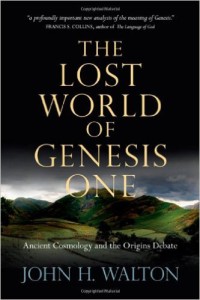
John H. Walton’s The Lost World of Genesis One

41GOJy03JKL._SX331_BO1,204,203,200_There’s been a lot of buzz surrounding John Walton’s The Lost World of Genesis One and his The Lost World of Adam and Eve.  I have finished the former and have begun the latter and would like to offer a few comments at this point.

Walton’s thesis is basically that Genesis 1, like other ancient creation accounts, is concerned with function as opposed to material origins and should be read accordingly.  That is, it is describing how God created the world to work and His control over the world more than the question of how He made something out of nothing.  To be sure, Walton agrees that God did created everything.  He is simply arguing that Genesis 1 is not concerned with that particular issue.  His argument is that when ancient people talked about creation they were talking about it in terms of function and were not concerned with the kinds of questions we are concerned with in empirical science.  However, Walton argues, we have imposed our modern concerns on the text and read it as discussing material creation.  In so doing, we are eisegeting modern categories into the text.  The result is we are threatened by scientific theories that would appear to conflict with our modernistic reading when, in fact, they are no threat at all since Genesis 1 is really not discussing those questions anyway.

Allow me to reflect a bit more on what I think I hear him saying.  I hear Walton saying (unless I am hearing him wrongly) that Genesis 1 cannot be concerned with creatio ex nihilo as it has been classically defined because it doesn’t actually posit nihilo.  That is, “the deep” exists before the first day.  I gather that “the deep” could almost be seen (in Walton’s proposal) as pre-functional creation, the shadowy realm of cosmic chaos and whatever processes were taking place at that time.  Thus, according to Walton, something like evolution could actually be true (he doesn’t say it is or isn’t, though he seems to have sympathies with some aspects of biological evolution so far as it does not lapse into teleology).

Walton argues that Genesis 1 is about function:  how God sovereignly designed and created the world to operate, to work.  It isn’t discussing how it came to be as much as it is discussing what God made it to be.  He then works through Genesis 1 showing what that looks like.

Furthermore, Genesis 1 is employing temple language, language that would have been readily apparent to many ancient cultures.  Thus, when God “rests,” He takes His place as Lord of the creation that He designed to function with specificity and purpose and harmony.  That is, the whole world is a temple.

Well.  Heady stuff indeed.

Anyway, what Walton has in his favor is his strong emphasis on the hermeneutical principle of “authorial intent,” his critique of the modern penchant for eisegeting our categories onto an ancient worldview, his helpful point that science is always in flux and that every age has a scientific worldview in which any communication necessarily takes place and which, necessarily, informs this communication, his correct premise that the “literal” reading of the text is, by definition, the reading that most accurately harmonizes with what the author was trying to do.

What concerns me is the novelty of the proposal, for starters.  Walton does not deny this.  Tellingly, he cannot muster a single example from two millennia of exegesis that says what he is saying.  His response is that we have now discovered ancient texts from ancient cultures that allow us to reconstruct to some extent the ancient context regarding creation accounts and can therefore now better understand the language and ideational content of words employed in Genesis 1.  I have no doubt that that the gist of that argument is true.  Understanding any historical context should sharpen our hermeneutics.  But (and I realize this is a rather simplistic argument), would not the most ancient Jewish exegetes have picked up, preserved, and passed on at least some vestiges of these concepts were they as self-evident to the ancients as Walton suggests?

I am not trying to suggest that Walton’s proposal is wrong simply because it can point to no earlier reflection of its claims.  I am simply saying that there is good reason to be extremely cautious about such proposals.  The burden is on Walton at this point, though he has certainly offered an intriguing proposal.

Furthermore, I have questions about whether or not the witness of the rest of scripture as it pertains to creation really does verify this “function” as opposed to “material creation” hypothesis.  If Walton is correct, certainly we should be able to read the other references to creation in this light and sense that our hermeneutic flows more naturally with the removal of our imposed and foreign constructs.  But does scripture harmonize with this view?  That is a larger question that will require some specific and detailed work.

This is my first exposure to this line of thinking, so my comments are going to be cursory.  But this is very interesting stuff and I thank my friend Pastor Kevin Griggs for recommending Walton’s work.  (Not, I should add, that Griggs necessarily agrees with Walton either.  He, like me, is simply trying to process and think about this.)

Some Calvin Miller Videos

A recent comment on this site as well as the fact that a friend of mine is now reading The Singer has led me to think again about Calvin Miller.  What a wonderful and unique voice Calvin had!  He is sorely missed by so many of us who have benefited from his ministry.  He was an amazing writer.  He was also a fascinating preacher.  I’ve found a few videos of Calvin that I’d like to post here.

Calvin Miller does not need to be forgotten…not that there is any danger of that happening.

“Heaven” – Dr Calvin Miller from Westside Church on Vimeo.

Dr. Calvin Miller from CrossPoint Community Church on Vimeo.

Calvin Miller Evening Sermon – November 8, 2010 from CrossPoint Community Church on Vimeo.

Entire Cross Examination Sermon Series

I have removed these sermons from the sidebar “Current Series” menu and they are now embedded in the sermon audio archives under their respective books, but I wanted to preserve them here together as a series as well.

cross_nail

“Cross Examination, Part I”
(1 Corinthians 1:14-25)

“Cross Examination, Part II”
(Mark 8:27-37)

“Cross Examination, Part III”
(Matthew 26:1-16)

“Cross Examination, Part IV”
(Matthew 26:36-46)

“Cross Examination, Part V”
(Matthew 26:47-56)

“Cross Examination, Part VI”
(Matthew 26:57-68)

“Cross Examination, Part VII”
(Matthew 27:1-2,11-14,22-26)

“Cross Examination, Part VIII”
(Matthew 27:27-44)

“Cross Examination, Part IX”
(Luke 23:34)

“Cross Examination, Part X”
(Luke 23:43)

“Cross Examination, Part XI”
(John 19:25-27)

“Cross Examination, Part XII”
(Matthew 27:45-49)

“Cross Examination, Part XIII”
(John 19:28)

“Cross Examination, Part XIV”
(John 19:30)

“Cross Examination, Part XV”
(Luke 23:46)

“Cross Examination, Part XVI”
(Galatians 6:14-16)

“Cross Examination, Part XVII”
(Hebrews 12:1-4)

“Cross Examination, Part XVIII”
(Romans 6:1-14)

[Note: Poor Audio Quality] “Cross Examination, Part XIX”
(Colossians 2:13-15)

“Chesterton and the Baptists”: A New Article

GKCover300The Chesterton Review has published an article I have written entitled “Chesterton and the Baptists” in Volume 41, Issue 3/4, Fall/Winter 2015.  As it is currently for sale only, I will not post it here, but it can be purchased here if you are interested.  I have also updated the sidebar publications menu to include this article.

It was joy to be able to look more closely at what G.K. Chesterton had to say about Baptists.  I am grateful to The Chesterton Review for publishing it.

Job 10-11

Job-SufferingJob 10

1 “I loathe my life; I will give free utterance to my complaint; I will speak in the bitterness of my soul. 2 I will say to God, Do not condemn me; let me know why you contend against me. 3 Does it seem good to you to oppress, to despise the work of your hands and favor the designs of the wicked? 4 Have you eyes of flesh? Do you see as man sees? 5 Are your days as the days of man, or your years as a man’s years, 6 that you seek out my iniquity and search for my sin, 7 although you know that I am not guilty, and there is none to deliver out of your hand? 8 Your hands fashioned and made me, and now you have destroyed me altogether. 9 Remember that you have made me like clay; and will you return me to the dust? 10 Did you not pour me out like milk and curdle me like cheese? 11 You clothed me with skin and flesh, and knit me together with bones and sinews. 12 You have granted me life and steadfast love, and your care has preserved my spirit. 13 Yet these things you hid in your heart; I know that this was your purpose. 14 If I sin, you watch me and do not acquit me of my iniquity. 15 If I am guilty, woe to me! If I am in the right, I cannot lift up my head, for I am filled with disgrace and look on my affliction. 16 And were my head lifted up, you would hunt me like a lion and again work wonders against me. 17 You renew your witnesses against me and increase your vexation toward me; you bring fresh troops against me. 18 “Why did you bring me out from the womb? Would that I had died before any eye had seen me 19 and were as though I had not been, carried from the womb to the grave. 20 Are not my days few? Then cease, and leave me alone, that I may find a little cheer 21 before I go—and I shall not return—to the land of darkness and deep shadow, 22 the land of gloom like thick darkness, like deep shadow without any order, where light is as thick darkness.”

Job 11

1 Then Zophar the Naamathite answered and said: 2 “Should a multitude of words go unanswered, and a man full of talk be judged right? 3 Should your babble silence men, and when you mock, shall no one shame you? 4 For you say, ‘My doctrine is pure, and I am clean in God’s eyes.’ 5 But oh, that God would speak and open his lips to you, 6 and that he would tell you the secrets of wisdom! For he is manifold in understanding. Know then that God exacts of you less than your guilt deserves. 7 “Can you find out the deep things of God? Can you find out the limit of the Almighty? 8 It is higher than heaven—what can you do? Deeper than Sheol—what can you know? 9 Its measure is longer than the earth and broader than the sea. 10 If he passes through and imprisons and summons the court, who can turn him back? 11 For he knows worthless men; when he sees iniquity, will he not consider it? 12 But a stupid man will get understanding when a wild donkey’s colt is born a man! 13 “If you prepare your heart, you will stretch out your hands toward him. 14 If iniquity is in your hand, put it far away, and let not injustice dwell in your tents. 15 Surely then you will lift up your face without blemish; you will be secure and will not fear. 16 You will forget your misery; you will remember it as waters that have passed away. 17 And your life will be brighter than the noonday; its darkness will be like the morning. 18 And you will feel secure, because there is hope; you will look around and take your rest in security. 19 You will lie down, and none will make you afraid; many will court your favor. 20 But the eyes of the wicked will fail; all way of escape will be lost to them, and their hope is to breathe their last.”

Recently a friend of mine sent me a February 13, 2016, New York Times article written by Kate Bowler, an assistant professor of history at Duke Divinity School, and entitled, “Death, the Prosperity Gospel, and Me.” Interestingly, she has written a history of the prosperity gospel in America, the unfortunate idea that God wants you to be wealthy and healthy and that, if you just believe enough, you will be both. Kate Bowler is 35 years old. She was recently told that she is dying from stage four cancer. This is what her article is about.

…a neighbor knocked on our door to tell my husband that everything happens for a reason.

“I’d love to hear it,” my husband said.

“Pardon?” she said, startled.

“I’d love to hear the reason my wife is dying,” he said, in that sweet and sour way he has.

My neighbor wasn’t trying to sell him a spiritual guarantee. But there was a reason she wanted to fill that silence around why some people die young and others grow old and fussy about their lawns. She wanted some kind of order behind this chaos. Because the opposite of #blessed is leaving a husband and a toddler behind, and people can’t quite let themselves say it: “Wow. That’s awful.” There has to be a reason, because without one we are left as helpless and possibly as unlucky as everyone else.

One of the most endearing and saddest things about being sick is watching people’s attempts to make sense of your problem. My academic friends did what researchers do and Googled…it. When did you start noticing pain? What exactly were the symptoms, again? Is it hereditary? I can out-know my cancer using the Mayo Clinic website. Buried in all their concern is the unspoken question: Do I have any control?

I can also hear it in all my hippie friends’ attempts to find the most healing kale salad for me. I can eat my way out of cancer. Or, if I were to follow my prosperity gospel friends’ advice, I can positively declare that it has no power over me and set myself free.

The most I can say about why I have cancer, medically speaking, is that bodies are delicate and prone to error. As a Christian, I can say that the Kingdom of God is not yet fully here, and so we get sick and die. And as a scholar, I can say that our society is steeped in a culture of facile reasoning. What goes around comes around…And God is always, for some reason, going around closing doors and opening windows. God is super into that.[1]

One cannot help but wonder if many who suffer do not find themselves in the place of Job to some extent: surrounded by well-meaning and concerned friends who are trying to make sense of the seemingly senseless tragedy of human suffering. Dr. Bowler appears to have good friends indeed, but there is within them, as there is within all of us, an almost insatiable desire to explain and, as she says in her article, to control. There is, in other words, an almost insatiable desire within us to not have to face the mystery of it all, the mystery of the goodness of God that resides so uncomfortably near the suffering of humanity.

As we have seen, Job’s friends have continued to poke and to prod into this mystery denying that it is a mystery at all! We see this in the next round of Job’s series of confrontations with his friends. In chapters 11 and 12, Job and Zophar discuss the dilemma of the goodness of God and the reality of human suffering.

Job, keeping with his courtroom metaphor, offers a struggling but believing indictment of God.

In Job 9 Job invoked a courtroom metaphor bemoaning the lack of an arbiter between himself and God and also bemoaning the fact that God can never truly be summoned to court because he is God. In Job 10, he continues this metaphor by offering his indictment of God.

1 “I loathe my life; I will give free utterance to my complaint; I will speak in the bitterness of my soul.

John Chrysostom saw in the phrase “in the bitterness of my soul” a way to let Job off the hook for what he was about to say for Chrysostom concluded that Job speaking “in the bitterness of my soul” meant that “it is not him who speaks but his bitterness.”[2] To be sure, it is possible, as we have said, to speak uncharacteristically when one speaks out of one’s pain. Again, Job’s words should be seen as the words of a severely suffering man and we should seek to be understanding and withhold withering judgment. However, it is indeed Job who is speaking, and I will remind us that when God finally responds at the end of the book, He does not merely overlook Job’s words, chalking them up to emotional excess, He also rebukes and corrects.

2 I will say to God, Do not condemn me; let me know why you contend against me. 3 Does it seem good to you to oppress, to despise the work of your hands and favor the designs of the wicked?

8 Your hands fashioned and made me, and now you have destroyed me altogether. 9 Remember that you have made me like clay; and will you return me to the dust? 10 Did you not pour me out like milk and curdle me like cheese? 11 You clothed me with skin and flesh, and knit me together with bones and sinews. 12 You have granted me life and steadfast love, and your care has preserved my spirit. 13 Yet these things you hid in your heart; I know that this was your purpose.

Verses 2-3 and 8-13 are a bit of a mixed bag, theologically. On the one hand, Job recognizes God’s power and authority as well as the fact that God is Creator. Job has not become an atheist. On the other hand, Job points to his affliction as a potentially absurd reality, for through it God was marring His own creation. He next asks if God might potentially be committing the same error as his friends.

In verses 4-7, Job wonders aloud if God has not perhaps been guilty of the same error of which Job’s prying friends are guilty.

4 Have you eyes of flesh? Do you see as man sees? 5 Are your days as the days of man, or your years as a man’s years, 6 that you seek out my iniquity and search for my sin, 7 although you know that I am not guilty, and there is none to deliver out of your hand?

In other words, “Are you, God, also looking for sin within me when You know that I am innocent.” Job’s rhetorical question about God’s “eyes of flesh” and God seeing “as man sees” carry an indictment of the men that surround him, including the man to whom he was speaking, at that very moment. It is almost as if Job wants to know if everybody, including God, is going to join in condemning him of sins that he has not committed. The rhetorical nature of these questions carries with it some ambiguity. Does Job think that God sees him in this way? I suspect he does not think this. But his suffering raises the absurd idea that God is not treating him any better than his own finite and fallen friends.

14 If I sin, you watch me and do not acquit me of my iniquity. 15 If I am guilty, woe to me! If I am in the right, I cannot lift up my head, for I am filled with disgrace and look on my affliction. 16 And were my head lifted up, you would hunt me like a lion and again work wonders against me. 17 You renew your witnesses against me and increase your vexation toward me; you bring fresh troops against me. 18 “Why did you bring me out from the womb? Would that I had died before any eye had seen me 19 and were as though I had not been, carried from the womb to the grave. 20 Are not my days few? Then cease, and leave me alone, that I may find a little cheer 21 before I go—and I shall not return—to the land of darkness and deep shadow, 22 the land of gloom like thick darkness, like deep shadow without any order, where light is as thick darkness.”

Job concludes his case against God by saying that he is in the ultimate lose-lose. If Job sins, God will not show him mercy, and if Job does not sin God will still hunt and smite him as if he had. Therefore, in his despair, Job sees God as something of an unjust despot.

In Thomas Harris’ novel Red Dragon, the psychopathic killer Hannibal Lecter writes a letter to FBI agent Will Graham (who is hunting another killer named Hobbs) about the pleasure of killing. In the letter, Lecter alleges that God himself enjoys killing.

Why shouldn’t it feel good? It must feel good to God— He does it all the time, and are we not made in His image? You may have noticed in the paper yesterday, God dropped a church roof on thirty-four of His worshipers in Texas Wednesday night— just as they were groveling through a hymn. Don’t you think that felt good? Thirty-four. He’d let you have Hobbs. He got 160 Filipinos in one plane crash last week— He’ll let you have measly Hobbs. He won’t begrudge you one measly murder. Two now. That’s all right.

Watch the papers. God always stays ahead.

Best, Hannibal Lecter, M.D.[3]

It is a terrible letter, and a blasphemous one. Lecter’s letter comes out of a twisted and depraved mind. Job’s words are not quite like Lecter’s. Job does not accuse God of being a sadist, of taking perverse joy in the pain of others. Most significantly, Job’s accusation does not arise from a warped mind but rather from a broken heart and a grieving heart.

Both Lecter and Job are in error, but the former’s error is sinister, calculated, and the reflections of a lost mind whereas Job’s error is the error of a struggling child. I offer Lecter’s letter as a contrast to Job’s because it is important that we are fair to Job even while we grieve over his unfortunate and mistaken words.

Zophar offers a defense of God but, in so doing, really only defends his faulty view of God.

Zophar shows Job considerable less understanding in Job 11.

1 Then Zophar the Naamathite answered and said: 2 “Should a multitude of words go unanswered, and a man full of talk be judged right? 3 Should your babble silence men, and when you mock, shall no one shame you?

You will immediately notice that Zophar comes out of the gate with considerable more heat than light. He accuses Job of trafficking in mere words, of being “full of talk,” of being a babbler, of being a mocker, and being worthy of shame. Zophar has no sympathy for Job. He next reveals why:

4 For you say, ‘My doctrine is pure, and I am clean in God’s eyes.’ 5 But oh, that God would speak and open his lips to you, 6 and that he would tell you the secrets of wisdom! For he is manifold in understanding. Know then that God exacts of you less than your guilt deserves.

Amazingly, and cruelly, Zophar takes the theory of retributive justice up a notch by claiming that Job is so guilty that God is actually showing him mercy. In other words, Job must be extremely wicked indeed and Job must actually deserve more than God is giving him. It is an amazingly shortsighted and stubborn and thoughtless thing for Zophar to say.

7 “Can you find out the deep things of God? Can you find out the limit of the Almighty? 8 It is higher than heaven—what can you do? Deeper than Sheol—what can you know? 9 Its measure is longer than the earth and broader than the sea. 10 If he passes through and imprisons and summons the court, who can turn him back? 11 For he knows worthless men; when he sees iniquity, will he not consider it? 12 But a stupid man will get understanding when a wild donkey’s colt is born a man! 13 “If you prepare your heart, you will stretch out your hands toward him. 14 If iniquity is in your hand, put it far away, and let not injustice dwell in your tents. 15 Surely then you will lift up your face without blemish; you will be secure and will not fear. 16 You will forget your misery; you will remember it as waters that have passed away. 17 And your life will be brighter than the noonday; its darkness will be like the morning. 18 And you will feel secure, because there is hope; you will look around and take your rest in security. 19 You will lie down, and none will make you afraid; many will court your favor. 20 But the eyes of the wicked will fail; all way of escape will be lost to them, and their hope is to breathe their last.”

“Worthless.”

“Stupid.”

“Iniquity.”

“Wicked.”

Here are the offerings of Zophar, a man so committed to a theological a priori that it colors even how he treats his friends. It is a common trap, and one in which any of us could fall: allowing our preconceived assumptions about what suffering must mean and imply about the one who is suffering. When we take this approach, we embrace too narrow a view of both God and man, assuming that the latter simply must be guilty and that the former simply must be punishing.

Or maybe you’re a priori assumption is not the theory of retributive justice. Maybe it is some other template, some other theological mold into which you instinctively force any and every situation of suffering. It is scary to allow mystery to stand, to reject the need to explain and to diagnose.

Let us return to where we began, with the story of Kate Bowler, her devastating diagnosis, and her friends’ attempts to understand, to explain. She continues thus in her article:

The prosperity gospel tries to solve the riddle of human suffering. It is an explanation for the problem of evil. It provides an answer to the question: Why me? For years I sat with prosperity churchgoers and asked them about how they drew conclusions about the good and the bad in their lives. Does God want you to get that promotion? Tell me what it’s like to believe in healing from that hospital bed. What do you hear God saying when it all falls apart?

The prosperity gospel popularized a Christian explanation for why some people make it and some do not. They revolutionized prayer as an instrument for getting God always to say “yes.” It offers people a guarantee: Follow these rules, and God will reward you, heal you, restore you. It’s also distressingly similar to the popular cartoon emojis for the iPhone, the ones that show you images of yourself in various poses. One of the standard cartoons shows me holding a #blessed sign. My world is conspiring to make me believe that I am special, that I am the exception whose character will save me from the grisly predictions and the CT scans in my inbox. I am blessed.

The prosperity gospel holds to this illusion of control until the very end. If a believer gets sick and dies, shame compounds the grief. Those who are loved and lost are just that — those who have lost the test of faith. In my work, I have heard countless stories of refusing to acknowledge that the end had finally come. An emaciated man was pushed about a megachurch in a wheelchair as churchgoers declared that he was already healed. A woman danced around her sister’s deathbed shouting to horrified family members that the body can yet live. There is no graceful death, no ars moriendi, in the prosperity gospel. There are only jarring disappointments after fevered attempts to deny its inevitability.

The prosperity gospel has taken a religion based on the contemplation of a dying man and stripped it of its call to surrender all. Perhaps worse, it has replaced Christian faith with the most painful forms of certainty. The movement has perfected a rarefied form of America’s addiction to self-rule, which denies much of our humanity: our fragile bodies, our finitude, our need to stare down our deaths (at least once in a while) and be filled with dread and wonder. At some point, we must say to ourselves, I’m going to need to let go.

Yes, we need to let it go: the need to explain, the need to diagnose, the need to understand every mystery, the need to tell ourselves and others why. These needs are understandable, but they tempt us to think that we are more than we are. We are not God. We cannot explain everything. We cannot understand everything.

Christ has come not to answer all of our questions but to tell us that God is with us and God is with us this much. As Dr. Bowler said, at the center of our faith is a dying man. We must remember that. A dying man. But not only a dying man: the dying God-man. And not only the dying God-man: the dying and rising God-man.

The God man who has passed through suffering and pain to eternal bliss.

The God man who sweat drops of blood in the garden and now sits at the Father’s right hand.

Jesus is the answer to our questions.

He is the way.

He is the mystery that has been revealed.

He comes not to satisfy our curiosity or even to explain all of our pain. He comes to stand with us in the midst of it and remind us that the one option we can definitely rule out is that God does not love us or that God hates us or that God is playing a game with us. Jesus reminds us that whatever the answer to the “Why?” that we ask in our suffering is, it is rooted in the loving heart of a holy God who does care and who does love us.

Christ is the love of God…especially for the hurting.

[1] https://www.nytimes.com/2016/02/14/opinion/sunday/death-the-prosperity-gospel-and me.html?_r=3&utm_ source=This+nightly&utm_campaign=c481ee7bc2-Feb+15+Nightly&utm_medium=email&utm_ term =0_ 4b29b52ce6-c481ee7bc2-248594133

[2] Manlio Simonetti and Marco Conti, eds. Job. Ancient Christian Commentary on Scripture: Old Testament. Vol. VI. Thomas C. Oden, Gen. Ed. (Downers Grove, IL: InterVarsity, 2006), p.2

[3] Harris, Thomas (2008-12-24). Red Dragon (Hannibal Lecter) (p. 322). Penguin Group US. Kindle Edition.


Umberto Eco Has Died

399px-Umberto_Eco_1984The great Italian novelist, essayist, semiotician, and public intellectual, Umberto Eco, died on February 19.  He was appropriately honored at his funeral in Milan last Friday.  He will be missed.  Eco’s most popular work was the novel, The Name of the Rose, a monastic murder mystery filled with arcane theological and historical discussions all presented in the context of a fascinating, memorable, and expertly-told story.  Eco was at his best when discussing and, in some case, simply cataloguing the arcane, the esoteric, the idiosyncratic, and the perplexing.  To read Eco is to allow yourself to get caught up in and carried along with his oftentimes seemingly inaccessible but almost never uninteresting reflections on life, culture, history, philosophy, and theology.  Eco was not a Christian yet he still seemed to have a certain respect of Christianity.  Though he was a man of the left he could indeed skewer the excesses of leftist politics and ideology.  He was, in all, an intriguing and enthralling person and one whose writings are well worth reading.  A final volume of his essays will be published in the near future with the English translation of it coming later.

The Gospel and Creativity: An Example

The gospel is not open to being edited or altered.  It is what it ever and always has been and what it ever and always will be:  the good news of God coming to man in Jesus Christ to save us from our sins.  The gospel is not open to being edited, but it is open to creative ways of communicating it.  Here is one such creative and artistic way, from Josh Garrels.

Job 8 and 9

Job-SufferingJob 8

1 Then Bildad the Shuhite answered and said: 2 “How long will you say these things, and the words of your mouth be a great wind? 3 Does God pervert justice? Or does the Almighty pervert the right? 4 If your children have sinned against him, he has delivered them into the hand of their transgression. 5 If you will seek God and plead with the Almighty for mercy, 6 if you are pure and upright, surely then he will rouse himself for you and restore your rightful habitation. 7 And though your beginning was small, your latter days will be very great. 8 “For inquire, please, of bygone ages, and consider what the fathers have searched out. 9 For we are but of yesterday and know nothing, for our days on earth are a shadow. 10 Will they not teach you and tell you and utter words out of their understanding? 11 “Can papyrus grow where there is no marsh? Can reeds flourish where there is no water? 12 While yet in flower and not cut down, they wither before any other plant. 13 Such are the paths of all who forget God; the hope of the godless shall perish. 14 His confidence is severed, and his trust is a spider’s web. 15 He leans against his house, but it does not stand; he lays hold of it, but it does not endure. 16 He is a lush plant before the sun, and his shoots spread over his garden. 17 His roots entwine the stone heap; he looks upon a house of stones. 18 If he is destroyed from his place, then it will deny him, saying, ‘I have never seen you.’ 19 Behold, this is the joy of his way, and out of the soil others will spring. 20 “Behold, God will not reject a blameless man, nor take the hand of evildoers. 21 He will yet fill your mouth with laughter, and your lips with shouting. 22 Those who hate you will be clothed with shame, and the tent of the wicked will be no more.”

Job 9

1 Then Job answered and said: 2 “Truly I know that it is so: But how can a man be in the right before God? 3 If one wished to contend with him, one could not answer him once in a thousand times. 4 He is wise in heart and mighty in strength—who has hardened himself against him, and succeeded?—5 he who removes mountains, and they know it not, when he overturns them in his anger, 6 who shakes the earth out of its place, and its pillars tremble; 7 who commands the sun, and it does not rise; who seals up the stars; 8 who alone stretched out the heavens and trampled the waves of the sea; 9 who made the Bear and Orion, the Pleiades and the chambers of the south; 10 who does great things beyond searching out, and marvelous things beyond number. 11 Behold, he passes by me, and I see him not; he moves on, but I do not perceive him. 12 Behold, he snatches away; who can turn him back? Who will say to him, ‘What are you doing?’ 13 “God will not turn back his anger; beneath him bowed the helpers of Rahab. 14 How then can I answer him, choosing my words with him? 15 Though I am in the right, I cannot answer him; I must appeal for mercy to my accuser. 16 If I summoned him and he answered me, I would not believe that he was listening to my voice. 17 For he crushes me with a tempest and multiplies my wounds without cause; 18 he will not let me get my breath, but fills me with bitterness. 19 If it is a contest of strength, behold, he is mighty! If it is a matter of justice, who can summon him? 20 Though I am in the right, my own mouth would condemn me; though I am blameless, he would prove me perverse. 21 I am blameless; I regard not myself; I loathe my life. 22 It is all one; therefore I say, ‘He destroys both the blameless and the wicked.’ 23 When disaster brings sudden death, he mocks at the calamity of the innocent. 24 The earth is given into the hand of the wicked; he covers the faces of its judges—if it is not he, who then is it? 25 “My days are swifter than a runner; they flee away; they see no good. 26 They go by like skiffs of reed, like an eagle swooping on the prey. 27 If I say, ‘I will forget my complaint, I will put off my sad face, and be of good cheer,’ 28 I become afraid of all my suffering, for I know you will not hold me innocent. 29 I shall be condemned; why then do I labor in vain? 30 If I wash myself with snow and cleanse my hands with lye, 31 yet you will plunge me into a pit, and my own clothes will abhor me. 32 For he is not a man, as I am, that I might answer him, that we should come to trial together. 33 There is no arbiter between us, who might lay his hand on us both. 34 Let him take his rod away from me, and let not dread of him terrify me. 35 Then I would speak without fear of him, for I am not so in myself.

The 3rd century Greek philosopher, Epicurus, once posed four questions about God and the reality of evil in the world.

Is God willing to prevent evil, but not able? Then he is not omnipotent.

Is he able, but not willing? Then he is malevolent.

Is he both able and willing? Then whence cometh evil?

Is he neither able nor willing? Then why call him God?

What is interesting about these four questions is that they have become something of a meme, a popular idea that is frequently repeated within our culture. In fact, were you to Google the words “Epicurus,” “God,” and “evil,” you would find numerous images depicting these famous four questions and Epicurus’ response.

The point of the questions seem to be that it is impossible to hold to the idea of a good and powerful God in a world where evil things happen. There is a kind of tight logic, seemingly, to Epicurus’ arguments, and it is an apparent logic to which many are drawn.

The first point he makes seems unassailable. If God is unable to prevent evil, then he is not omnipotent. The fourth point likewise seems true enough. If God cannot stop evil and does not evil want to stop, then he is not God at all. The third point is true if by “willing” Epicurus means “always determines to never allow evil to happen.” If God were always determined to never allow evil to happen and was able to stop it, then we would have a real conundrum in explaining evil. Hold that thought.

The second point seems to present us with a non sequitur and a mistaken premise. There is, in fact, no inherent conflict between the idea that God is able to prevent evil but not always willing to do so. There is, admittedly, a great question at this point, but not really a contradiction, for God might have higher reasons that reside in the mystery of His will for allowing certain evils to happen. What is more, back to the third point, the witness of scripture would appear to be that God abhors evil but sometimes allows it to happen in a fallen world for these same mysterious reasons.

Epicurus’ arguments are therefore not unassailable. They are not airtight. It would seem that his second point is the primary point with which Job struggled.

Is he able, but not willing? Then he is malevolent.

At least in the case of Job, God was able to prevent evil but not willing to do so. He allowed Satan to strike Job. This presented Job, and us, with very real questions, but in and of itself it does not make God evil. The challenge of Job is therefore the challenge of being at peace with the mystery of God even when that mystery allows pain to befall us. It is into the midst of these kinds of questions that Job now converses with his friend Bildad the Shuhite.

Bildad simply doubles down and reasserts the old formula of retributive justice with renewed vigor.

Bildad is a fundamentalist. By that I mean that his is a posture of defensiveness, simplistic thinking, and an inability to allow his blunt and unyielding theology on difficult issues to be changed. For the record, this is not what fundamentalism originally was. It is simply what it has become. Furthermore, there are theological issues to be unwavering about: the gospel, for instance, or the person and work of Christ. But I am speaking here of Bildad’s refusal to think that he might be mistaken on what he thinks about a difficult and highly controverted issue like the issue of how a good God can allow evil. Clearly our good God does allow it at times, but how we understand that where honest disagreements can come into the picture.

Bildad simply hunkers down. We see this happening in Job 8.

1 Then Bildad the Shuhite answered and said: 2 “How long will you say these things, and the words of your mouth be a great wind? 3 Does God pervert justice? Or does the Almighty pervert the right? 4 If your children have sinned against him, he has delivered them into the hand of their transgression. 5 If you will seek God and plead with the Almighty for mercy, 6 if you are pure and upright, surely then he will rouse himself for you and restore your rightful habitation. 7 And though your beginning was small, your latter days will be very great.

This is exasperating. You will notice that Bildad simply doubles down on the principle of retributive justice and insists that since Job and his children have suffered they simply must have sinned. The key statement is the first point of verse 3: “Does God pervert justice?” Well, of course God does not, but then that depends on what Bildad means my justice. What he clearly means is the old formula of retributive justice: the upright are blessed and the sinful are cursed.

You will perhaps notice the tendency in certain religious people to shout louder when questioned or challenged. It has been my experience that when people double down on their pet doctrines it is usually because those are the doctrines about which they are most uncertain. Their protests reveal their insecurities. Perhaps this is happening in Bildad.

In verse 8, Bildad goes historical and plays the tradition card.

8 “For inquire, please, of bygone ages, and consider what the fathers have searched out. 9 For we are but of yesterday and know nothing, for our days on earth are a shadow. 10 Will they not teach you and tell you and utter words out of their understanding?

Translation: “Trust what we have always been told.” And what had they always been told? They had always been told that the righteous are blessed and the unrighteous are cursed.

Tradition is a powerful thing, of course. Jaroslav Pelikan once wrote that “tradition is the living faith of the dead” whereas “traditionalism is the dead faith of the living.”[1] Pelikan went on to say that it is traditionalism that gives tradition a bad name. That seems reasonable enough. There is a healthy sense of tradition and then there is an unhealthy sense of traditionalism. Put in those terms, what we find in Bildad is traditionalism, the dead faith of the living.

I have marveled as a pastor at how often otherwise bright adult Christians will simply accept utterly unbiblical ideas as true simply because it is what they have always been taught. One such example would be the eternal fate of those who commit suicide. It has always puzzled me how many bright Christians simply take it for granted that if a person commits suicide they will go to hell. When pressed on the numerous theological challenges to such a blanket assertion, those who hold to this will usually end up saying that it is what they have always been taught. But always having been taught something is not, in and of itself, a sufficient reason for actually believing something.

Bildad had always been taught the theory of retributive justice. So had Job. And so have most people today. Today it manifests itself in the prosperity preachers who tell you that if you believe enough and give enough money then God will give you great blessings, but if you experience hardship or tragedy it is because you did not believe enough.

Beware the lure of Bildad!

Bildad next gives a metaphor which appears intended to buttress his central idea. J. Gerald Janzen notes that verses 11-19 present a parable “which has puzzled many commentators” and then recommends Robert Gordis’ interpretation which “identifies a parable in two parts, describing the wicked (vv. 12-15) and the blameless (vv. 16-19) in terms of two kinds of plant.”[2] Perhaps that is a good approach, though it is hard to tell whether or not the parable can be divided in that way at all.

11 “Can papyrus grow where there is no marsh? Can reeds flourish where there is no water? 12 While yet in flower and not cut down, they wither before any other plant. 13 Such are the paths of all who forget God; the hope of the godless shall perish. 14 His confidence is severed, and his trust is a spider’s web. 15 He leans against his house, but it does not stand; he lays hold of it, but it does not endure. 16 He is a lush plant before the sun, and his shoots spread over his garden. 17 His roots entwine the stone heap; he looks upon a house of stones. 18 If he is destroyed from his place, then it will deny him, saying, ‘I have never seen you.’ 19 Behold, this is the joy of his way, and out of the soil others will spring.

Francis Andersen bemoans the fact that “the climax of this strophe in verse 19 is clouded by textual obscurities that nobody has been able to penetrate. Nearly every word involved has more than one meaning or connotations.”[3] Even so, the central point seems clear enough for the central point is simply another expression of Bildad’s main argument: if papyrus and reeds and flowers die it is because they do not have what they need to live. Job is the dying papyrus, the unflourishing reed, and the withering flower.

Bildad concludes thus:

20 “Behold, God will not reject a blameless man, nor take the hand of evildoers. 21 He will yet fill your mouth with laughter, and your lips with shouting. 22 Those who hate you will be clothed with shame, and the tent of the wicked will be no more.”

There it is yet again: “God will not reject a blameless man.” There is a note of hope and encouragement here, but also the same old indictment. For if “God will not reject a blameless man” that means that the man who has been rejected is not blameless. Thus, Job is to blame.

Stephen Chase sums up Bildad’s approach nicely.

Bildad wastes little time making clear his only doctrinal position in this chapter…God’s ways are just…and without exception the righteous are blessed and the wicked are punished. For Bildad, any apparent exceptions are momentary or illusory…Bildad’s is a premodern position, what we might call an old-time religion in a which he puts forth his own evidence based on tradition and the teaching of the ancestors…Bildad gives the clearest and most forthright depiction of divine, retributive justice in the book of Job. There is no ambiguity in Bildad’s universe: some people are righteous, others are wicked, the righteous are blessed, and the wicked are punished. End of story.[4]

Job rejects the old formula on the basis of his own innocence, depicts God as a transcendent power who does what He wants and cannot be questioned by suffering humanity, and yearns again for a mediator.

In a sense, the theory of retributive justice is easily destroyed. All that needs to be produced is a single person who is (a) righteous and (b) suffering. If a single example of this can be shown to exist, then Eliphaz and Bildad are mistaken and the theory implodes. Job knows this, of course, and it is the central argument he makes: he is innocent yet he suffers.

This is not to say that Job’s theology is not without its own problems, for in the midst of protests of innocence he increasingly questions the goodness of God. Job may no longer subscribe to the theory of retributive justice, but he still cannot imagine how God can be good and let a righteous man suffer. Job responds to Bildad beginning in Job 9.

1 Then Job answered and said: 2 “Truly I know that it is so: But how can a man be in the right before God? 3 If one wished to contend with him, one could not answer him once in a thousand times. 4 He is wise in heart and mighty in strength—who has hardened himself against him, and succeeded?—5 he who removes mountains, and they know it not, when he overturns them in his anger, 6 who shakes the earth out of its place, and its pillars tremble; 7 who commands the sun, and it does not rise; who seals up the stars; 8 who alone stretched out the heavens and trampled the waves of the sea; 9 who made the Bear and Orion, the Pleiades and the chambers of the south; 10 who does great things beyond searching out, and marvelous things beyond number. 11 Behold, he passes by me, and I see him not; he moves on, but I do not perceive him. 12 Behold, he snatches away; who can turn him back? Who will say to him, ‘What are you doing?’

I agree with Francis Andersen who sees in the preceding verses words of praise and not sarcasm. Andersen argues that these verses mean Job’s “faith is still intact, even though he has been plunged into darkness, or, as he says more dramatically, into ‘muck’ (verse 31).”[5] That is a good way of putting it: Job’s faith is in tact but has been plunged into darkness. It is reminiscent of C.S. Lewis’ observation during a time of struggle in his life that he did not fear that there was no God, but he did fear that there was a God and this is what He is like.

It is also interesting to note how Job’s words of praise in those first twelve verses sound a great deal like God’s rebuke of Job at the end of the book. There is the same recognition of God’s power. The difference is that, at this point in the book, Job is beginning to see God’s power as perhaps detached from God’s goodness whereas at the end of the book God’s power is attached to His own wisdom and glory and goodness leading Job to trust. But what we find here is that Job is beginning to see God as pure unassailable might. And, interestingly, Job moves on to complain that one cannot confront God about injustice because God’s might and power keep him beyond the reach of suffering humanity.

13 “God will not turn back his anger; beneath him bowed the helpers of Rahab. 14 How then can I answer him, choosing my words with him? 15 Though I am in the right, I cannot answer him; I must appeal for mercy to my accuser. 16 If I summoned him and he answered me, I would not believe that he was listening to my voice. 17 For he crushes me with a tempest and multiplies my wounds without cause; 18 he will not let me get my breath, but fills me with bitterness. 19 If it is a contest of strength, behold, he is mighty! If it is a matter of justice, who can summon him? 20 Though I am in the right, my own mouth would condemn me; though I am blameless, he would prove me perverse. 21 I am blameless; I regard not myself; I loathe my life. 22 It is all one; therefore I say, ‘He destroys both the blameless and the wicked.’ 23 When disaster brings sudden death, he mocks at the calamity of the innocent. 24 The earth is given into the hand of the wicked; he covers the faces of its judges—if it is not he, who then is it? 25 “My days are swifter than a runner; they flee away; they see no good. 26 They go by like skiffs of reed, like an eagle swooping on the prey. 27 If I say, ‘I will forget my complaint, I will put off my sad face, and be of good cheer,’ 28 I become afraid of all my suffering, for I know you will not hold me innocent. 29 I shall be condemned; why then do I labor in vain? 30 If I wash myself with snow and cleanse my hands with lye, 31 yet you will plunge me into a pit, and my own clothes will abhor me. 32 For he is not a man, as I am, that I might answer him, that we should come to trial together.

Two things are happening here. First, Job is essentially yearning for his day in court against the Lord. This text is filled with legal imagery and legal language. Job wonders how one could ever even begin to approach God about matters of justice when God is above all powers and God can neither be summoned nor questioned. God cannot be put on the witness stand and God cannot be questioned. Even if he could, Job suggests that it would end only in his own condemnation though he is innocent.

The second dynamic is related to the first. Job wants his day in court with God because he is innocent. He repeats this three times in verses 15-21.

v.15 “I am in the right”

v.20 “I am in the right”

v.21 “I am blameless”

There is a dogged determination in Job. The only thing he seems very clear of at this point is his own innocence. This is no small thing, for, as we have said, the case of a single innocent man suffering destroys the theory of retributive justice, the theory to which his friends have appealed and out of which they speak. Job’s innocence is what is compelling him to call for his day in court. There is a kind of praise even in this, for Job realizes that God and God alone can explain how such a thing can be.

Tellingly, he concludes by once again wishing aloud that there was a mediator, an arbiter between himself and God.

33 There is no arbiter between us, who might lay his hand on us both. 34 Let him take his rod away from me, and let not dread of him terrify me. 35 Then I would speak without fear of him, for I am not so in myself.

How very fascinating: after pointing to God’s power, might, otherness, and transcendence, Job’s expresses his desire that there might be somebody between him and God who could help bridge the impassable chasm. It reminds us of what Abraham said to the rich man in Luke 16 about the impossibility of him being able to bring a drop of water to the rich man in hell.

26 And besides all this, between us and you a great chasm has been fixed, in order that those who would pass from here to you may not be able, and none may cross from there to us.

Job, though not in hell, felt as if he was, and this chasm was as real to him as it is to the damned. Thus, he called for mediation. Yet, even as he did so, he did so with a note of futility as if such an arbiter were a mere pipedream. How very interesting it is for us, then, to compare Job 9:33 with 1 Timothy 2:5.

Job 9

33 There is no arbiter between us, who might lay his hand on us both.

1 Timothy 2

5 For there is one God, and there is one mediator between God and men, the man Christ Jesus

One of the many beautiful truths of the gospel is that it presents us with an arbiter. This arbiter is not, however appointed by some outside court or system of justice in order to protect us from the arbitrary and cruel caprices of a malevolent and sadistic deity. No, this arbiter comes from the very heart of the holy and good God who loves us even when we do not and cannot understand. There is no court of justice above the will of God and there does not need to be one, for God is good. His goodness is seen in the mediator, Jesus Christ, who stands between us and God not in order to protect us from an evil God but, as God, to bring us to Himself so that we might begin to understand, to trust, and to have a relationship with Him.

God is good, and the good mediator is God, the God-man Jesus Christ, who has hung between heaven and earth to bridge the impassable chasm and who even now sits at the right hand of the Father making intercession for us, His people.

Job did not know this at the time, but he knows it now. We are privileged to live on this side of the cross. We still see through a glass dimly, but not as dimly as those before the coming of Christ saw, for Christ has come and he who has seen Christ has seen the Father, has seen the very heart of God…and it is good.


[1] Jaroslav Pelikan, The Vindication of Tradition. (New Haven, CT: Yale University Press, 1984), p.65.

[2] J. Gerald Janzen, Job. Interpretation. (Louisville, KY: Westminster John Knox Press, 1985), p.85.

[3] Francis I. Andersen, Job. Tyndale Old Testament Commentaries. 14 (Downers Grove, IL: InterVarsity Press Academic, 2008), p.153.

[4] Steven Chase, Job. Belief. (Louisville, KY: Westminster John Knox Press, 2013), p.58.

[5] Francis I. Andersen, p.156.

Colossians 2:13-15

Screen Shot 2015-08-27 at 3.08.11 PMColossians 2

13 And you, who were dead in your trespasses and the uncircumcision of your flesh, God made alive together with him, having forgiven us all our trespasses, 14 by canceling the record of debt that stood against us with its legal demands. This he set aside, nailing it to the cross. 15 He disarmed the rulers and authorities and put them to open shame, by triumphing over them in him.

I heard on the news last week that the national debt has now surpassed nineteen trillion dollars. If you would like a sobering visual depiction of what that means, go to https://www.usdebtclock.org and watch the big debt clock in real time. In the upper left hand corner you will see the main number in red under the heading “US National Debt.” You will see that it is over nineteen trillion, but what will strike you most is how quickly the number is growing. Off to the side of that big number you will see two other figures: “Debt Per Citizen” and “Debt Per Taxpayer.”

As an experiment, you might pull that up and see how long you can watch that top left-most square without becoming completely demoralized and depressed. It is demoralizing because the sheer speed with which that number is increasing every second raises the obvious question, “How on earth could such debt ever be paid off?”

It is an interesting thing, the debt clock. The two most interesting and unsettling things it reveals are (1) our corporate debt as a people, the debt that we all owe together as a country called the United States of America, and (2) what share of that debt each of us owes as individuals.

Take a look at that.

Just watch that number grow and grow and grow.

How could we ever begin to pay that off?

Now imagine with me another debt clock, a clock recording the debt that mankind owes God because of our sin both collectively and individually. The way this clock works is it records the growing penalty for mankind that increases every time you and I sin against the holiness of God. It is a debt because each and every sin requires a payment to atone for that sin, to make us right with God. So the greater the sin, the greater the sin debt, the greater the atonement that is needed to pay for the sins of humanity.

I am not, of course, suggesting that there is a literal sin debt clock in heaven, but I am saying that the image of a debt clock fits pretty well with what Paul said in Colossians 2.

13 And you, who were dead in your trespasses and the uncircumcision of your flesh, God made alive together with him, having forgiven us all our trespasses, 14 by canceling the record of debt that stood against us with its legal demands. This he set aside, nailing it to the cross. 15 He disarmed the rulers and authorities and put them to open shame, by triumphing over them in him.

This is a most fascinating and a most provocative passage of scripture! It speaks not only to what God was doing in Christ on the cross for lost humanity, for you and for me, but also to the abiding reality of the cross for our lives today.

It has been suggested that there are clues in our text (i.e., verse 13 is “couched in the traditional style of preaching,” the use of the first person plural at the end of verse 13 as a possible congregational response to the first part of the verse, “the piling up of…participles” in verse 13, “the remarkably large number of uncommon words and expressions,” etc.) that suggest the presence here of elements that comprised a hymn or kind of responsive reading in the early Church.[1] In other words, we may be getting to hear in this passage a bit of what a “worship service” might have sounded like in the early Church. More important than that, if we have actual early Christian liturgical elements present in this text, we can see those aspects of the faith that were considered so crucial and foundational to the early Church that they were included in the Church’s life of worship.

God nailed the record of your sin debt to the cross and thereby pronounced that your debt has been paid and its penalties fully met and satisfied.

We begin with Paul’s metaphor of sin as a “record of debt.”

13 And you, who were dead in your trespasses and the uncircumcision of your flesh, God made alive together with him, having forgiven us all our trespasses, 14 by canceling the record of debt that stood against us with its legal demands. This he set aside, nailing it to the cross.

First, we find in these verses a beautiful picture of the reality of conversion. Whereas we “were dead” now we have been “made alive together with Christ.” And how did that happen? It happened through the great gift of forgiveness that God has given us. And how did that happen? That happened because of a legal clearing of our “record of debt that stood against us with its legal demands.” Eduard Lohse has pointed to the Jewish framework of this image.

…Rabbi Akiba used to compare God to a shopkeeper who would lend money and goods and record all the amounts on a ledger. Whosever wished to borrow would come and borrow. Just as the shopkeeper got back what was his due through collectors, so too God, through the angels, demands of men what they owe him. Just judgment is rendered according to the record kept on the ledger…Therefore, in the prayer Abinu Malkenu God is addressed: “Our Father, our King, in your great mercy cancel all our debts.”…According to the view of Judaism, God cancels a debt only when the scales of merits and debts balance.[2]

This is most interesting and, practically speaking, most terrifying, for how can “the scales of merits and debts” be balanced when we are sinners whose sins are constantly increasing our debt? This “record of debt” (or “written code”) stands against us, condemning us. Clinton E. Arnold explains the background for this term.

The “written code” (cheirographon) was a note of indebtedness…One Jewish document well illustrates how it was used: “‘Let us find how we might be able to repay you.’ Without delay, I would bring before them the note (cheirographon) and read it granting cancellation.”[3]

Peter O’Brien has helpfully pointed out that the cheirographon refers to a record of debt “written in one’s own hand as a proof of obligation” and is “like an IOU” that contains “penalty clauses.”[4] What this means is now clear: there is a record of our sin debt that perpetually condemns us as unworthy of the grace of God. It records all of our violations against God’s holiness and majesty and glory. Each sin we commit therefore increases our debt for each sin needs an atoning payment to make us right again. The late New Testament scholar F.F. Bruce spoke of our text by referring to “a mountain of bankruptcy which those who had incurred it were bound to acknowledge but could never have any hope of discharging.”[5]

That is so very true: “a mountain of bankruptcy”! However, we now see the full implications of our text: there is something greater than the mountain of bankruptcy that stands against us, and that is God’s forgiveness of this debt.

13 And you, who were dead in your trespasses and the uncircumcision of your flesh, God made alive together with him, having forgiven us all our trespasses, 14 by canceling the record of debt that stood against us with its legal demands. This he set aside, nailing it to the cross.

Already in the Old Testament we find the beautiful truth that God is a God of forgiveness. For instance, we find this in Isaiah 43:

25 I, I am he who blots out your transgressions for my own sake, and I will not remember your sins.

But what we find on this side of the cross is an explanation for how our transgressions are blotted out. They are blotted out because God has taken the record of our sin debt and nailed it to the cross in and through the crucifixion of Jesus, His only begotten Son, who serves as the payment for all of our debts. Christ’s payment brings satisfaction for our sin debt, for Christ’s payment was Himself. Christ paid our debt by taking our debt upon Himself and meeting its demands through His own perfect righteousness and obedience to the Father (2 Corinthians 5:21).

What an absolutely beautiful and staggering picture this is! Our debt has been nailed to the cross in Christ Jesus the Lord! This means our debt was met and wiped away. It has been canceled, to use Paul’s language, and the “legal demands” have now been satisfied! The punishment due us was fulfilled in Christ. The payment we owed has been paid. Christ has made satisfaction for us!

In nailing the record of your debt to the cross, God crushed and publicly shamed those who had been using this record to paralyze you with guilt and fear and the threat of punishment.

If Christ’s death on the cross freed us from our sins, it also served to shame those forces that had used our debt to harass and torment us.

15 He disarmed the rulers and authorities and put them to open shame, by triumphing over them in him.

These rulers and authorities are the devil and his demonic hosts who ever and always harass humanity over our own unworthiness and over our own sinfulness. These are the “rulers and authorities” who F.F. Bruce called “those blackmailing powers that were holding it over men and women in order to command their allegiance.”[6] The devil and his minions are forever whispering in our ears, “You do not deserve forgiveness! Look at what you have done! Who are you to seek the favor of God?! Who do you think you are? You are condemned, damned, and doomed! Judgment awaits you!” And as they whisper or shout these accusations, they wave the record of your debt before your eyes, the indisputable proof that what they say is true, that you are indeed guilty. More than that, they use our sin debt to tell us that we are ultimately in their service, on their team, and should simply serve them as masters.

It is these “rulers and authorities” that Paul says God has “put…to open shame, by triumphing over them in him.” That “in him” is key, for the “in him” is “in Christ!” Through the work of Christ on the cross, God has shamed the harassing tormentors of mankind by paying the debt that they have used to torment us. He has “put them to open shame” in fact, which is an image that comes from antiquity. R. Kent Hughes explains:

The image that Paul had in mind can be seen in Plutarch’s description of the three-day Triumph given the Roman General Aemilius Paulus upon his return from capturing Macedonia. Great scaffolds were erected in the forum and along the boulevards of Rome for spectator seating, and all of Rome turned out, dressed in festive white. On the first day, 259 chariots displayed in procession the statues, pictures, and colossal images taken from the enemy. On the second day, innumerable wagons bore the armor of the Macedonians. As Plutarch tells it:

…all newly polished and glittering; the pieces of which were piled up and arranged purposely with the greatest art, so as to seem to be tumbled in heaps carelessly and by chance: helmets were thrown upon shields, coats of mail upon graves; Cretan targets, and Thracian bucklers and quivers of arrows, lay huddled amongst horses’ bits, and through these there appeared the points of naked swords, intermixed with long Macedonian sarissas. All these arms were fastened together with just so much looseness that they struck against one another as they were drawn along, and made a harsh and alarming noise, so that, even as spoils of a conquered enemy they would not be held without dread.

            Following the wagons came 3,000 carrying the enemies’ silver in 750 vessels, followed by more treasure. On the third day came the captives, preceded by 120 sacrificial oxen with their horns gilded and their heads adorned with ribbons and garlands, next Macedonian gold, then the captured king’s chariot, crown, and armor. Then came the king’s servants, weeping, with hands outstretched, begging the crowds for mercy. Next came his children. Then King Perseus himself, clad entirely in black, followed by endless prisoners. Finally came the victorious general,

…seated on the chariot magnificently adorned, dressed in a robe of purple, interwoven with gold, and holding a laurel branch in his right hand. All the army, in like manner, with boughs of laurel in their hands, divided into their hands and companies, followed the chariot of their commander; some singing verses, according to the usual custom songs of triumph and the praise of Aemilius’s deeds.[7]

The fact that Paul is drawing on such an image is most comforting, for it shows us that whereas the devil and his demons would humiliate us, it is in fact they who have been humiliated at the cross and before the empty tomb. They have been defanged and declawed though not yet utterly destroyed. They yet murmur and harass, though the children of God are now free to see through their noise and clamoring. At Calvary, their stranglehold on mankind was broken and men and women are now free to be free! Their only weapon was your debt but the record of your debt has now been obliterated through the saving, forgiving, life-bringing blood of the Lamb of God, Jesus, who gave Himself on Calvary that we might be free.

You are now free to be free!

You no longer need to listen to the motley cries of the forces of hate that have held you in bondage for far too long! You can now silence the accusers by pointing them to Christ and saying, “He has taken my debt upon Himself and He has paid the price in full! I am free and forgiven because of what He has done for me!”

What an amazing, amazing thing grace is! What a wonder! What a joy to be forgiven!

The note has been paid.

The work of you hand condemned you

The work of Christ’s hands has saved you.

Come to the Jesus who has paid your debt and cast away its penalties! Come to Jesus and be free!


[1] Eduard Lohse, Colossians and Philemon. Hermeneia. (Philadelphia, PA: Fortress Press, 1971), p.106.

[2] Eduard Lohse, p.108,110.

[3] Clinton E. Arnold, “Colossians.” Zondervan Illustrated Bible Backgrounds Commentary. Vol. 3. Clinton E. Arnold, gen. ed. (Grand Rapids, MI: Zondervan2002), p.386.

[4] Peter T. O’Brien, Colossians, Philemon. Word Biblical Commentary. Vol.44. (Nashville, TN: Thomas Nelson, 2000), p.124-125.

[5] F.F. Bruce, The Epistles to the Colossians, to Philemon, and to the Ephesians. The New International Commentary on the New Testamanet. (Grand Rapids, MI: Wm. B. Eerdmans Publishing Co., 1984), p.109.

[6] F.F. Bruce, p.110.

[7] R. Kent Hughes, Colossians and Philemon. (Wheaton, IL: Crossway Books, 1989), p.79-80.

Romans 6:1-14

Screen Shot 2015-08-27 at 3.08.11 PMRomans 6

1 What shall we say then? Are we to continue in sin that grace may abound? 2 By no means! How can we who died to sin still live in it? 3 Do you not know that all of us who have been baptized into Christ Jesus were baptized into his death? 4 We were buried therefore with him by baptism into death, in order that, just as Christ was raised from the dead by the glory of the Father, we too might walk in newness of life. 5 For if we have been united with him in a death like his, we shall certainly be united with him in a resurrection like his. 6 We know that our old self was crucified with him in order that the body of sin might be brought to nothing, so that we would no longer be enslaved to sin. 7 For one who has died has been set free from sin. 8 Now if we have died with Christ, we believe that we will also live with him. 9 We know that Christ, being raised from the dead, will never die again; death no longer has dominion over him. 10 For the death he died he died to sin, once for all, but the life he lives he lives to God. 11 So you also must consider yourselves dead to sin and alive to God in Christ Jesus. 12 Let not sin therefore reign in your mortal body, to make you obey its passions. 13 Do not present your members to sin as instruments for unrighteousness, but present yourselves to God as those who have been brought from death to life, and your members to God as instruments for righteousness. 14 For sin will have no dominion over you, since you are not under law but under grace.

John MacArthur has offered a nice summary of the fascinating life of John Newton.

            In his early teens, John Newton ran away from England and joined the crew of a slave ship. Some years later he himself was given to the black wife of a white slave trader in Africa. He was cruelly mistreated and lived on leftovers from the woman’s meals and on wild yams he dug from the ground at night. After escaping, he lived with a group of natives for a while and eventually managed to become a sea captain himself, living the most ungodly and profligate life imaginable. But after his miraculous conversion in 1748, he returned to England and became a selfless and tireless minister of the gospel in London. He left for posterity many hymns that are still among the most popular in the world. By far the best-known and best-loved of those is “Amazing Grace.” He became the pastor of a church in England, and to this day the churchyard carries an epitaph that Newton himself wrote:

John Newton, Clerk,

Once an infidel and libertine,

A servant of slaves in Africa,

Was, by the rich mercy of our Lord and Saviour,

Jesus Christ,

Preserved, restored, pardoned,

And appointed to preach the faith

He had long labored to destroy.[1]

That is what conversion looks like: a person moving from a life of sin to a life of forgiveness and grace. Newton’s story is one expression of what that can look like. If you have come to Christ, you have your own story of what that looks like. Regardless, each story should have these basic elements: (1) a person dead in their sins and (2) a person made alive by the grace of God received through repentance and faith.

The gospel is the good news that this transformation is now possible. But it must be maintained that this is, in fact, a transformation, that coming to Christ does, in fact, mean new life. If this truth is not proclaimed, it might be assumed that the purpose of the cross is merely to punch one’s ticket for Heaven. It is true that the cross of Christ is what enables us to go to Heaven, but the point is that the cross also has radical and life-changing dynamics right here and right now.

In Romans 6, Paul is responding to a severe and tragic version of this kind of reduction. Specifically, he is referring to the notion that if a person is truly saved and forgiven, that person can now sin with impunity. This is because (the thinking goes) Christ will forgive us our sins so they do not really matter. What is more, the people to whom Paul was responding in Romans 6 were seemingly going so far as to say that their sinning actually makes God look even better because as they sin and He forgives His grace shines brighter and brighter.

Now, this is obviously a monstrous and blasphemous idea, but human beings, even those who are redeemed, can justify some pretty absurd ideas. This is one of those, and this is the idea that Paul rejects in Romans 6. He does so on the basis of the cross: what Christ did on the cross and what the cross means for believers.

Your coming to Christ through faith means a participation with Him in His death and resurrection.

Paul begins be speaking of conversion in terms of participation with Christ in His death, burial, and resurrection.

1 What shall we say then? Are we to continue in sin that grace may abound? 2 By no means! How can we who died to sin still live in it? 3 Do you not know that all of us who have been baptized into Christ Jesus were baptized into his death?

The argument is, in a sense, simple, though it is not in any way simplistic. Paul’s argument is that a believer dare not continue in a life of sin because we have died to sin. We have died to sin because have been “baptized into Christ Jesus,” “into His death.” This is a most provocative and fascinating image, and one that needs to be unpacked. Paul continues this image of baptism:

4 We were buried therefore with him by baptism into death, in order that, just as Christ was raised from the dead by the glory of the Father, we too might walk in newness of life. 5 For if we have been united with him in a death like his, we shall certainly be united with him in a resurrection like his.

Now this is an interesting image that Paul uses and it raises certain important questions. The most important question it raises is whether or not Paul is teaching baptismal regeneration, the idea that the act of water baptism confers upon the person being baptized saving grace. There are Christians who believe this, but I think it is a serious misreading of what Paul is saying.

For one thing, such a notion goes utterly against Paul’s entire teaching on salvation as being by grace through faith apart from works (Ephesians 2:8-9). Paul’s theology simply leaves no room for works to be smuggled into salvation, even important acts of obedience like baptism.

What is more, some have argued that Paul is not necessarily even talking about water baptism here at all. There are some who point out that not every reference to baptism in the New Testament applies to water baptism. For instance, James Montgomery Boice has made the point that “there are two closely related words for baptism in the Greek language and…they do not necessarily have the same meaning.” The first, bapto, means “dip” or “immerse.” The second word, baptizo, can mean that but has a wider range of meanings. To illustrate the point, Boice points to a pickle recipe from an ancient Greek, Nicander, who, around 2200 years ago, used both of these words for baptism to describe how to make pickles!

Nicander says that to make a pickle, the vegetable should first be “dipped” (bapto) into boiling water and then “baptized” (baptizo) in the vinegar solution. Both verbs concern immersing the vegetable in a solution, but the first is temporary. The second, the act of “baptizing” the vegetable, produces a permanent change.[2]

The same dynamic is at play in the New Testament. Not every use of “baptized” means water baptism. For instance, Paul writes this in 1 Corinthians 10:

1 For I do not want you to be ignorant of the fact, brothers and sisters, that our ancestors were all under the cloud and that they all passed through the sea. 2 They were all baptized into Moses in the cloud and in the sea.

Clearly Paul is using “baptized into Moses” here to mean that the Israelites in the exodus were radically united with Moses in his calling and ministry and work of liberation. In the exodus, they truly were one. This is almost certainly the way that Paul is using the image in our text. When Paul writes references “all of us who have been baptized into Christ Jesus” he is speaking of our radical identification with Christ through salvation. The same must be said of the idea of us being baptized “into His death.” We are caught up with Christ in His saving work for us. We have been crucified with Him and buried with Him and will rise with Him.

It should be noted, however, that Paul’s reference to baptism here could very well be speaking of water baptism without it meaning anything like baptismal regeneration. This is possible, though as Boice has pointed out, it is not utterly clear that it is so. But it could be that Paul is speaking of water baptism as the sign and symbol of the fact that we have been united with Christ through saving faith. For instance, the Greek scholar A.T. Robertson rejected the idea “that baptism makes one dead to sin and alive to God” and sees in Paul’s words instead “a plea to live up to the ideal of the baptized life.”[3] New Testament scholar Douglas Moo believes that “baptism…is Pauline shorthand in this text for the conversion experience” and that what we see in these verses is “the Old Testament/Jewish notion of corporate solidarity” that is “judicial or forensic.”[4]

However precisely you understand this, it is absolutely clear that the New Testament presents conversion as something that marks a profound break with our old lives and an entry into new life, and it marks this by saying that we stand in solidarity with Christ and His saving work on the cross and in and through the empty tomb.

Your participation with Christ in His death and resurrection means that sin no longer has overpowering force in your life.

This participation in the death and resurrection of Christ on the part of the believer means that sin no longer has overpowering force in the life of the believer.

6 We know that our old self was crucified with him in order that the body of sin might be brought to nothing, so that we would no longer be enslaved to sin. 7 For one who has died has been set free from sin. 8 Now if we have died with Christ, we believe that we will also live with him. 9 We know that Christ, being raised from the dead, will never die again; death no longer has dominion over him. 10 For the death he died he died to sin, once for all, but the life he lives he lives to God.

These phrases are most telling: “the body of sin might be brought to nothing,” “no longer be enslaved to sin,” “set free from sin,” “the death he died he died to sin.”

When we come to Christ and are born again, we are no longer bound in servitude to sin. We are now free to walk in the victory that Christ has won for us. Our old self was enslaved to sin and had to do what sin demanded, but that old self is now dead, it was crucified and buried with Christ. The new self is the self that has risen with Christ and will rise with Christ, the resurrected self, the new creation that Christ has made and is making in us.

This constitutes a legal change of status. Craig Keener has illustrated this by pointing out that “when a Gentile slave escaped from a Jewish owner and converted to Judaism by baptism, in Jewish legal theory his or her new personhood made the slave free from the former owner.”[5] In other words, the new convert could no longer be treated as the old slave because the convert was now a new person by virtue of his baptism and conversion into Judaism. The same is true for us when we come to Christ: we are no longer what we were!

It must be understood that this does not mean that sin no longer harasses us or that sin no longer tempts us. It also does not mean that Christians will never again sin as if being born again means we will never again desire to sin. Christians still struggle and battle. Even so, Christians now struggle and battle with sin from the vantage point of being in the One who has conquered sin, death, and hell! We now struggle, when we do, from the winning side!

This is vitally, crucially important.

Grant Osborne put it well when he wrote that sin “no longer is an internal force controlling us. Christ is the internal power in our lives, and sin is now an external power trying to defeat us.” Furthermore, in commenting on the phrase “that the body of sin might be brought to nothing,” Osborne notes that “[w]hile the verb can mean that the sinful nature has been ‘annihilated’ or ‘destroyed’…it more likely means ‘rendered ineffective.’”[6] This is quite helpful!

To return to John Newton, he captured well the reality of what Paul is arguing when he said:

I am not what I ought to be. Ah! How imperfect and deficient! I am not what I wish to be. I abhor what is evil, and I would cleave to what is good. I am not what I hope to be. Soon, soon, I shall put off mortality, and with mortality all sin and imperfection. Yet, though I am not what I ought to be, nor what I wish to be, nor what I hope to be, I can truly say, I am not what I once was—a slave to sin and Satan. And I can heartily join with the apostle, and acknowledge, “By the grace of God, I am what I am.”[7]

Yes, we still feel the pull of sin, and, tragically, we sometimes even fall into it, but we are now set free from sin, we now no longer have to sin, we are no longer slaves to sin. We have been set free. We have been redeemed and forgiven. Sin may harass, but it no longer controls. Sin may tempt, but it can no longer overpower.

The reality of what has happened to you in Christ should now set you free to live in the victory He has won for you.

Accepting the reality of what Christ has done for us is utterly crucial to being able to walk in victory. For this reason, Paul calls upon us to think rightly about these matters and live in and into the fullness of the victory we have in Christ.

11 So you also must consider yourselves dead to sin and alive to God in Christ Jesus. 12 Let not sin therefore reign in your mortal body, to make you obey its passions. 13 Do not present your members to sin as instruments for unrighteousness, but present yourselves to God as those who have been brought from death to life, and your members to God as instruments for righteousness. 14 For sin will have no dominion over you, since you are not under law but under grace.

Here again, Paul’s phraseology is profound. “Consider yourselves dead to sin and alive to God in Christ.” We are to “consider” or “reckon” our old lives as gone and our new lives in Christ as the reality in which we can and should walk. As a result of this reorientation in our thinking, we will refuse to let sin “reign” in our bodies or to do what it tempts us to do. Nor will we use our bodies for wickedness, but rather in righteous service of our holy God. This is because sin has lost its “dominion,” it no longer gets the final say over us.

James Montgomery Boice has offered some quite helpful advice on this point.

A holy life comes from knowing – I stress that word – knowing that you can’t go back, that you have died to sin and been made alive to God. Stott says, “A born-again Christian should no more think of going back to the old life than an adult to his childhood, a married man to his bachelorhood, or a discharged prisoner to his prison cell.”[8]

Part of the problem is that many Christians seem to think that they are still stuck in the old place of sin. Many Christians cannot accept that they are where Christ says they really are through Him.

I have an uncle, my Uncle Billy, who is a big motorcycle guy. He loves to ride and, in particular, he loves to ride with his best friend. He is close to his best friend though, by his own admission, his friend is probably the most bull-headed and stubborn guy in the world. He says that his buddy simply will not admit when he is wrong.

My Uncle Billy was telling my father that he and his friend were riding in Pennsylvania when they became lost. They had no idea where they were. Finally, after, I am sure, waiting way too long to do so, they pulled over at a little store and asked the guy behind the counter where they were.

The gentleman behind the counter was a local guy so he was in a good position to tell them where they were. So he pulled out a map and turned it around so that my uncle and his buddy could see it, pointed at their location at that moment and began, “Now, you guys are right here…”

“No we’re not,” my uncle’s friend responded to the gentleman.

“What?” he responded.

“That’s not where we are.”

“Yes,” the gentleman rejoined, “it is. You are currently, right now, right here.” And he pointed at the map.

My uncle’s friend refused to give. “No. That’s not where we’re at.”

The man behind the counter, growing irritated, said, “Yes. You are. We are standing right here.” And again he jabbed at a point on the map.

“We can’t be there. You’re mistaken.”

My uncle reported that by this time my uncle was growing increasingly embarrassed by his friend’s behavior. The man behind the counter, exasperated at the other’s stubbornness, persisted: “Listen. I live here. I’ve lived here all of my life. You’re not from here. You’re lost. Believe me, this is where we are.”

To which my uncle’s friend shook his head and said, “No. That’s not where we’re at.”

At this, my uncle walked outside while the two men commenced arguing.

The gentleman behind the counter was, of course, correct. He knew what he was talking about. My uncle’s friend did not. That is what makes the story so maddening and also so very funny. If there was an Olympics for defiant stubbornness, my uncle’s friend would have won gold that day.

As humorous and frustrating as my Uncle’s friend was being with this old gentleman, do we not do the very same with Christ? Is Christ not trying to tell us that if we are in Him we are no longer there in the land of sin and death and judgment but we are rather here in the land of mercy and forgiveness and obedience and new life? And do we not, with infuriating stubbornness, protest to Christ that while we are indeed saved we in fact are not where He says we are but are rather still there in the land of sin and its dominion? Do we not frequently refuse to accept what Christ says about us? Do we not deny that we are where He says we are: in the land of peace and new creation?

Christ is calling to us. He is telling us that we are now in a place we cannot imagine, a place of freedom from sin, a place of abundant life in and through Him, a place of joy and peace. But we feel the call of our former home, our former land. We must not go back there! We must not think we still live there! We have been called out from that place. That is a land of darkness, but Christ has called us and placed us in the light of the Kingdom.

Do not believe the lie that you must continue to be and do what you were and did before Christ set you free. He is telling you where you are. Believe Him! Believe Him and live!


[1] John MacArthur, Jr., Romans 1-8. The MacArthur New Testament Commentary (Chicago, IL: Moody Press, 1991), p.311-312.

[2] James Montgomery Boice, Romans. Vol. 2 (Grand Rapids, MI: Baker Book House, 1992), p.659.

[3] A.T. Robertson, Word Pictures in the New Testament. Vol. IV (Nashville, TN: Broadman Press, 1934), p.363.

[4] Clinton Ed. Arnold, ed. Zondervan Illustrated Bible Backgrounds Commentary. Vol. 3 (Grand Rapids, MI: Zondervan, 2002), p.35.

[5] Craig S. Keener, The IVP Bible Background Commentary: New Testament. (Downers Grove, IL: InterVarsity Press, 1993), p.425.

[6] Grant R. Osborne, Romans. The IVP New Testament Commentary Series. Vol. 6 (Downers Grove, IL: InterVarsity Press, 2004), p.150,154.

[7] Quoted in John Whitecross, The Shorter Catechism Illustrated (Edinburgh: Banner of Truth, 1968), question 35. quoted in The Christian Pioneer (1856) edited by Joseph Foulkes Winks, p. 84. Also in The Christian Spectator, vol. 3 (1821), p.186.

[8] James Montgomery Boice, p.656.