A Brief Note Concerning the Walking Together Ministries Website

For some time, and for various reasons, I have been thinking about changing the format of the sermon archives so that the sermons are listed by date preached instead of by biblical passage.  I have begun that process and will be doing so along and along as I’m able.  To get a sense of what that will look like, you can take a look at the archives pages for Matthew, Mark, and Luke.  These are the only three books I have reorganized thus far.  Check back for updates.  I’ll be doing the New Testament archives first.

Mark 1:12-15

MarkSeriesTitleSlide1Mark 1

12 The Spirit immediately drove him out into the wilderness. 13 And he was in the wilderness forty days, being tempted by Satan. And he was with the wild animals, and the angels were ministering to him. 14 Now after John was arrested, Jesus came into Galilee, proclaiming the gospel of God, 15 and saying, “The time is fulfilled, and the kingdom of God is at hand; repent and believe in the gospel.”

The Los Angeles Times ran a fascinating online article entitled “21 creepiest abandoned amusement parks.” The article consists of a brief introduction followed by numerous pictures of amusement parks that are no longer in operation.

The surreal graveyards of abandoned amusement parks pique our curiosity with their juxtaposition of once pulsating kinetic energy eerily frozen in time.

Trashed by trespassers, tagged by vandals and reclaimed by Mother Nature, the deteriorating and collapsing Ferris wheels, carousels and roller coasters transform with each passing season into rusting and rotting still-life portraits of benign neglect.

The once brightly colored playgrounds of whirling rides, turreted castles and bizarre attractions were inevitably brought low by some combination of bad planning, poor timing, negligent management, financial ruin, changing times, ill-conceived ideas, natural disaster or even man-made tragedy.

Some of the deserted theme parks operated for a century or more. Others never opened their doors to the public. Most closed in the past three decades.[1]

The pictures are indeed very creepy. There is just something unsettling about an abandoned, decaying amusement park. The article says it well: the creepiness of the images are rooted in the juxtaposition between the “once pulsating kinetic energy” of the parks and “the surreal graveyard” of their current, decayed form.

A juxtaposition is a jarring and unsettling contrast between two very different things. When the two images are dramatically at odds – like, say, children laughing at an amusement park and a decaying, nightmarish, abandoned amusement park – the reaction can be quite visceral and outright frightening.

That juxtaposition between “once pulsating kinetic energy” and “the surreal graveyard” is the same juxtaposition that is inherent between say, a garden and a wilderness, or, say, the Garden of Eden and the wilderness. It was a juxtaposition that the Jews knew well, which is why they popularly saw the wilderness as a wild wasteland haunted by demonic forces and wild beasts. The Garden of Eden once pulsated with kinetic energy. The wilderness was a surreal graveyard.

It was to the wilderness that Jesus was taken by the Spirit of God immediately after His baptism, and it was there that Mark gives us our next picture of the significance of Jesus.

Jesus is God stepping into the wilderness ruins of the life we destroyed through our own foolishness and wickedness.

As we approach Mark’s account of the temptation of Jesus in the wilderness by Satan, we need to understand that oftentimes the biblical writers tell the same story with different emphases in order to make different points. The wilderness temptation of Christ is recounted in Matthew, Mark, and Luke. Matthew and Luke describe the episode with more detail, describing the exact nature of the temptations and describing Jesus’ victory of Satan. There are other differences in the details as well.

None of these differences are contradictions, mind you. The three accounts are not at odds. They simply are trying to make different points, points that, when put together, serve to offer us an even fuller picture of what was happening in the wilderness. This is the beauty of having four gospels.

There are two notable differences between Mark’s account and Matthew and Luke’s account. The first difference is Mark’s brevity. Mark’s account is very brief. It consists of only four clauses:

(1) “The Spirit immediately drove him out into the wilderness.”

(2) “And he was in the wilderness forty days, being tempted by Satan.”

(3) “And he was with the wild animals”

(4) “and the angels were ministering to him”

That is it. We naturally want to fill in this seemingly skeletal framework from the details of Matthew and Luke, and we would not be wrong to do so as far as having a more comprehensive account of the details is involved. But let me suggest that we should avoid doing that initially and ask instead why it is that Mark recounts this episode in just this way.

I would like to propose that what Mark is doing is kind of “fly over” for the purpose of making a bigger and wider point about Jesus: who He is and why He came. We can get at this by understanding a second difference between Mark’s account and Matthew and Luke’s account. I am referring to the fact that Mark alone mentions that Jesus “was with the wild animals.” Matthew’s account is much longer than Mark’s and has a lot more details, but Matthew does not mention that Jesus was with wild animals in the wilderness. Luke’s account is much longer than Mark’s and has a lot more details, but Luke does not mention that Jesus was with wild animals in the wilderness.

So why does Mark mention the wild animals? Why, in an account so brief that it consists of only four clauses, does Mark devote one of those four clauses, or twenty-five percent of his account, to this reference to Jesus being with wild animals?

It is because of what Mark is trying to tell us about Jesus.

12 The Spirit immediately drove him out into the wilderness. 13 And he was in the wilderness forty days, being tempted by Satan. And he was with the wild animals, and the angels were ministering to him.

There are some important words in this account that we need to define properly. The first is the word “immediately.” Mark is a gospel of rushing. A lot of things happen “immediately.” Michael Card calls the word “immediately” (eutheos) “Mark’s favorite word,” points out that it is used eleven times in Mark 1, and then says that “immediately,” for Mark, “is the verbal razor blade he uses for the quick cuts of his fast-paced portrayal of Jesus’ life.”[2] That is well said, thought we do not need to rush so quickly we miss the point.

The second word is “drove him out” in “the Spirit drove him out into the wilderness.” Ronald Kernaghan observes that “the Greek word translated ‘sent out’ [‘drove’] is a particularly forceful term” that “appears most often in reports of the exorcisms that Jesus performed, where it is translated ‘cast out.’”[3] We saw in the account of Jesus’ baptism that Mark uses a violent, forceful verb, schizo, to describe the rending of the heavens. Here he uses another forceful verb to describe the Spirit taking Jesus to the wilderness. It almost has a connotation of something being hurled, as if Jesus was hurled into the wilderness. This should not be read to mean that Jesus did not desire to go into the wilderness. He did. But it means that this was an intense movement of action in which Jesus is taken quickly and decisively further into the wilderness.

Then we have the animals: “he was with the wild animals.” Robert Gundry has made the fascinating observation (an observation, he points out, that “is rarely if ever remarked upon)” that “Mark does not put the wild beasts with Jesus; rather, Jesus with them.” This wording, Gundry argues, “suggests therefore that Jesus was an object of the wild beasts’ unfriendly threat just as he was an object of Satan’s unfriendly temptation.”[4]

So Jesus, cast into the wilderness, the realm of demons and danger and wild beasts, is surrounded by wild animals (who do not harm him) and is tempted by Satan (before whom He refuses to abandon the Father).

We can already tell that Mark is doing more here than just offering us a thumbnail sketch. He is not writing briefly because he does not have much to say. Rather, he is writing very precisely, very carefully, and trying to get his readers, then and now, to see something.

What is he getting us to see? He is trying to get us to a see a picture, a picture that will help us understand something. And what is this picture? Well, consider the components:

  • Wilderness
  • Jesus
  • Wild Animals
  • The tempter, Satan

Ok, but what is Mark doing with those elements?

Juxtaposition. Specifically, the juxtaposition between “once pulsating kinetic energy” and “the surreal graveyard.”

Consider:

  • Wilderness
  • Jesus
  • Wild animals
  • The tempter, Satan

Juxtaposition:

  • The garden
  • Adam
  • Naming the tame animals
  • The tempter, Satan

Many of the early church fathers saw in Mark’s account of Jesus’ wilderness temptation echoes of and a juxtaposition with Adam in Eden. Joel Marcus has argued that “the primary biblical model for our passage’s portrait of Jesus is…Adam” and “our passage is strongly stamped with an Adamic typology.” In defense of this, he and other commentators point to:

  • In Mark 1:1, Mark is possibly nodding toward Genesis 1:1 with his opening, “The beginning of the good news about Jesus the Messiah, the Son of God…”
  • Adam is in a garden. Jesus is in a ruined garden, a decayed garden, an anti-garden: a wilderness.
  • Adam and Eve are led into temptation by Satan. Jesus is tempted by Satan but refuses to be disobedient.
  • Adam and Jesus were both around animals, and “in the OT and later Jewish writings the enmity between human beings and wild animals is regarded as a distortion of the original harmony that existed between them in Eden.”
  • In some Old Testament prophecies like Isaiah 11:6-9; 65:25 and Hosea 2:18, wild animals living at peace and not harming human beings is depicted as a sign of God’s healing of falling creation.
  • One Jewish legend stated that Adam’s meals in Eden were provided by angels. Jesus was ministered to by angels.
  • In “an influential pseudepigraphal account of the Fall,” the number forty appears. Jesus was in the wilderness forty days.
  • Adam and Jesus both leave their Eden after their respective encounters with the Tempter.[5]

In the beginning of Mark’s gospel, we saw in the figure of John the Baptist interesting parallels to Israel’s wilderness wanderings in the exodus. There are echoes of Israel’s wilderness wanderings here as well. In a sense, Mark is depicting Jesus as a second Moses who likewise goes into the wilderness to liberate us, his people.

But the image of Adam is the primary image here, and it is an important one. It is an image that Paul himself will draw. Thus, it is a thoroughly New Testament idea: Jesus as the second Adam.

“For as in Adam all die,” Paul wrote in 1 Corinthians 15:22, “so also in Christ shall all be made alive.” He made an even fuller statement about this in Romans 5:

12 Therefore, just as sin came into the world through one man, and death through sin, and so death spread to all men because all sinned— 13 for sin indeed was in the world before the law was given, but sin is not counted where there is no law. 14 Yet death reigned from Adam to Moses, even over those whose sinning was not like the transgression of Adam, who was a type of the one who was to come. 15 But the free gift is not like the trespass. For if many died through one man’s trespass, much more have the grace of God and the free gift by the grace of that one man Jesus Christ abounded for many. 16 And the free gift is not like the result of that one man’s sin. For the judgment following one trespass brought condemnation, but the free gift following many trespasses brought justification. 17 For if, because of one man’s trespass, death reigned through that one man, much more will those who receive the abundance of grace and the free gift of righteousness reign in life through the one man Jesus Christ.

Jesus is therefore the second Adam. The first Adam was put in a garden and left in a wilderness. The second Adam was put in a wilderness and calls us to a garden. The first Adam was tempted and fell and brought ruin. The second Adam was tempted and did not fall and brought life. The first Adam was put among peaceful beasts and through his sin turned them wild. The second Adam was a lamb who was put among wild beasts but they could not harm him. The first Adam is the broken link through whom all that is miserable and horrible entered the world. The second Adam is the obedient Son through whom all this is beautiful and good enters the world.

Jesus is God stepping into the wilderness ruins of the life we destroyed through our own foolishness and wickedness. Where the garden once stood there is now only demonic wilderness, but Jesus the God-man stepped into the wilderness in order to do battle with the forces of darkness and announce that the darkness does not win.

This depiction of Jesus as the second Adam entering the ruins of the garden we destroyed through our sin helps us understand what Mark shows us next and why he shows it.

Jesus is the re-creating Creator God who offers new life in the midst of the ruins through the path of repentance and belief.

Having entered the wilderness ruins of paradise lost, what does Jesus, the second Adam, announce after he refuses to fall before Satan?

14 Now after John was arrested, Jesus came into Galilee, proclaiming the gospel of God, 15 and saying, “The time is fulfilled, and the kingdom of God is at hand; repent and believe in the gospel.”

The action continues in Mark’s account. Jesus’ forty days in the wilderness ends, John is arrested, Jesus goes into Galilee, and then he proclaims: “The time is fulfilled, and the kingdom of God is at hand; repent and believe in the gospel.”

Standing there in the wilderness ruins of the paradise we destroyed, Jesus pronounces a kingdom.

“The kingdom of God is at hand!”

There are fourteen references to “kingdom of God” in Mark’s gospel, all but two of which appear to be referring to the Kingdom as present as opposed to future.[6] Ben Witherington has written that “kingdom” “seems to refer to an activity, in this case God’s divine activity, when used of something happening in the present” and that it “involves the idea of God taking control of a human being or human situation such that his reign becomes manifest and his intentions become fulfilled on the human scene.”[7]

That is a good definition. The kingdom of God is the transforming reign and rule of God. It is new creation, a realm in which the healing and restoring powers of God are loosed upon all who enter. It is also a kingdom of righteousness, a kingdom where the will of God is done, a kingdom of holiness, a kingdom in which there is no darkness or wickedness or evil or suffering or pain. It is the kingdom whose King is God Himself, the Kingdom in which the people of God find their rest in service to Him and find their joy in worshiping Him.

This is the kingdom…and Jesus pronounces, “The time is fulfilled, and the kingdom of God is at hand!”

In Christ, the kingdom has come and in the coming Christ the kingdom will come with finality. That is to say, the kingdom is “already/not yet,” to use the language of theologians who try to stress this point. It is here and it is coming. It has arrived and it will arrive.

And how are we who are lost in the ruins of Eden to enter the kingdom of God?

14 Now after John was arrested, Jesus came into Galilee, proclaiming the gospel of God, 15 and saying, “The time is fulfilled, and the kingdom of God is at hand; repent and believe in the gospel.”

“Repent and believe in the gospel.”

Repent. Turn around. Stop loving the wilderness and its darkness. Learn to see the sinfulness of the fallen world for what it is: a curse that destroys us. Repent. Turn around!

Believe. Believe what? Believe that the Hero has come into the wilderness to bring the kingdom. Believe that the Lamb has come and laid down His life to save us and to forgive us. Believe that the Son who was killed on the cross yet overcame sin, death, and hell on that first Easter morning and now offers us a path through the wilderness, a road to glory. Believe that the second Adam has undone and is undoing the damage that the first Adam wrought. Believe that Jesus is going to put a garden where the wilderness is, is going to usher in the Kingdom of peace and restoration. And believe that He has even now begun that great work – here, now, through his people, in and through the church – and will complete it.

Believe all of these good tidings, this gospel. Repent and believe in the gospel…and enter the Kingdom! The door has been kicked off the hinges and now all who repent and believe may enter.

See our King there in the wilderness! He has conquered. He is conquering. His weapons are love and truth and grace and mercy and righteous judgment. And his invitation is to you…and to you…and you!

Behold our God, the Lamb who takes away the sin of the world.


[1] https://www.latimes.com/travel/themeparks/la-trb-21-creepiest-abandoned-amusement-parks-20140225-htmlstory.html

[2] Michael Card, Mark. (Downers Grove, IL: InterVarsity Press, 2012), p.31.

[3] Ronald J. Kernaghan, Mark. The IVP New Testament Commentary Series. Ed., Grant R. Osborne. Vol.2 (Downers Grove, IL: InterVarsity Press, 2007), p.39.

[4] Robert H. Gundry, Mark. Vol.1 (Grand Rapids, MI: William B. Eerdmans Publishing Company, 1993), p.55,58.

[5] Joel Marcus, Mark 1-8. The Anchor Bible. Vol.27 (New Haven, CT: The Anchor Yale Bible, 2005), p.168-171. R.T. France notes that there has been an “interesting movement of opinion” on this point and mentions a number of modern commentators who now adopt it. He also points out that the view has strong patristic attestation. The Gospel of Mark. The New International Greek Testament Commentary. Gen. Eds. I. Howard Marshall and Donald A. Hagner. (Grand Rapids, MI: William B. Eerdmans Publishing Company, 2002), p.86. Ben Witherington sees an allusion to Eden as “unlikely” but notes that “the association of wilderness, animals, and temptation, coupled with the term ‘beginning,’ makes such a connection a possibility.” The Gospel of Mark. (Grand Rapids, MI: William B. Eerdmans Publishing Company, 2001), p.76, n.28.

[6] James A. Brooks, Mark. The New American Commentary. Gen. Ed. David S. Dockery. Vol.23 (Nashville, TN: Broadman Press, 1991), p.47.

[7] Ben Witherington III, p.78.

Job 12-13

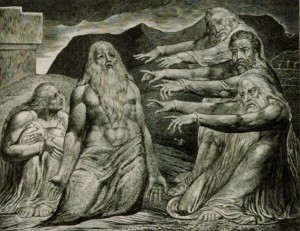
blake-Job600Job 12

1 Then Job answered and said: 2 “No doubt you are the people, and wisdom will die with you. 3 But I have understanding as well as you; I am not inferior to you. Who does not know such things as these? 4 I am a laughingstock to my friends; I, who called to God and he answered me, a just and blameless man, am a laughingstock. 5 In the thought of one who is at ease there is contempt for misfortune; it is ready for those whose feet slip. 6 The tents of robbers are at peace, and those who provoke God are secure, who bring their god in their hand. 7 “But ask the beasts, and they will teach you; the birds of the heavens, and they will tell you; 8 or the bushes of the earth, and they will teach you; and the fish of the sea will declare to you. 9 Who among all these does not know that the hand of the Lord has done this? 10 In his hand is the life of every living thing and the breath of all mankind. 11 Does not the ear test words as the palate tastes food? 12 Wisdom is with the aged, and understanding in length of days. 13 “With God are wisdom and might; he has counsel and understanding. 14 If he tears down, none can rebuild; if he shuts a man in, none can open. 15 If he withholds the waters, they dry up; if he sends them out, they overwhelm the land. 16 With him are strength and sound wisdom; the deceived and the deceiver are his. 17 He leads counselors away stripped, and judges he makes fools. 18 He looses the bonds of kings and binds a waistcloth on their hips. 19 He leads priests away stripped and overthrows the mighty. 20 He deprives of speech those who are trusted and takes away the discernment of the elders. 21 He pours contempt on princes and loosens the belt of the strong. 22 He uncovers the deeps out of darkness and brings deep darkness to light. 23 He makes nations great, and he destroys them; he enlarges nations, and leads them away. 24 He takes away understanding from the chiefs of the people of the earth and makes them wander in a trackless waste. 25 They grope in the dark without light, and he makes them stagger like a drunken man.

Job 13

1 “Behold, my eye has seen all this, my ear has heard and understood it 2 What you know, I also know; I am not inferior to you. 3 But I would speak to the Almighty, and I desire to argue my case with God. 4 As for you, you whitewash with lies; worthless physicians are you all. 5 Oh that you would keep silent, and it would be your wisdom! 6 Hear now my argument and listen to the pleadings of my lips. 7 Will you speak falsely for God and speak deceitfully for him? 8 Will you show partiality toward him? Will you plead the case for God? 9 Will it be well with you when he searches you out? Or can you deceive him, as one deceives a man? 10 He will surely rebuke you if in secret you show partiality. 11 Will not his majesty terrify you, and the dread of him fall upon you? 12 Your maxims are proverbs of ashes; your defenses are defenses of clay. 13 “Let me have silence, and I will speak, and let come on me what may. 14 Why should I take my flesh in my teeth and put my life in my hand? 15 Though he slay me, I will hope in him; yet I will argue my ways to his face. 16 This will be my salvation, that the godless shall not come before him. 17 Keep listening to my words, and let my declaration be in your ears. 18 Behold, I have prepared my case; I know that I shall be in the right. 19 Who is there who will contend with me? For then I would be silent and die. 20 Only grant me two things, then I will not hide myself from your face: 21 withdraw your hand far from me, and let not dread of you terrify me. 22 Then call, and I will answer; or let me speak, and you reply to me. 23 How many are my iniquities and my sins? Make me know my transgression and my sin. 24 Why do you hide your face and count me as your enemy? 25 Will you frighten a driven leaf and pursue dry chaff? 26 For you write bitter things against me and make me inherit the iniquities of my youth. 27 You put my feet in the stocks and watch all my paths; you set a limit for the soles of my feet. 28 Man wastes away like a rotten thing, like a garment that is moth-eaten.

A man had a tire blow out and his car came to a stop along a highway outside the fence of a large mental hospital. He got out of the car, assessed the damage, pulled a spare tire from his trunk, removed the hubcap, loosened the lugnuts, jacked the car up, removed the lugnuts, put the four lugnuts in the hubcap, took off the old tire, and replaced it with the new tire. All the while, on the other side of the fence, standing inside the yard of the mental facility, a patient in all white was casually leaning on the fence, chewing gum, and watching the man.

The man noticed him standing there as he turned back to gather the lugnuts out of the hubcap. The patient’s presence startled him just enough that he hit the hubcap with his hand tipping it over and causing all four of the lugnuts to fall into the grate of a storm drain in a ditch behind him. Flabbergasted, the man stood to see the new but unsecured tire sitting crookedly on the car, the overturned hubcap, and the lugnuts now all gone.

“Oh GREAT!” he exclaimed.

The patient, still slowly chewing gum, stood quietly watching from the other side of the fence.

Half to the patient and half to himself, the man said aloud, “Now what am I going to do?!”

The man behind the fence cleared his throat. The man outside of the fence turned to stare at him. “Why don’t you just take one lugnut off of the other three tires so you’ll have three on each tire?”

The man beside the car paused. “That’s a brilliant idea he said. Huh.”

He turned back to the car to begin his work then paused and turned again to speak to the patient.

“Hey, tell me something. How is it that I’m out here and didn’t think of that and you’re in there and you did think of it?”

The man in all white behind the hospital fence did not miss a beat. “Mister, I’m in here because I’m crazy, not because I’m stupid.”

Nobody likes to be thought of as stupid. That is so today and it was so in Job’s day. In Job’s response to Zophar the Naamathite, he makes this clear. Job is tired of being patronized, tired of being treated like a fool. He wants to impress upon his friends that he understands that God is sovereign, but he still maintains that he is not being punished for secret sins.

Job agrees with the basic premise that God is ultimately sovereign and that the unfolding of all things is ultimately in his hand.

Job 12 marks something of a breaking point for Job. He has sparred with his friends numerous times, but now he appears to bristle at the patronizing tone they have taken in lecturing him.

1 Then Job answered and said: 2 “No doubt you are the people, and wisdom will die with you. 3 But I have understanding as well as you; I am not inferior to you. Who does not know such things as these? 4 I am a laughingstock to my friends; I, who called to God and he answered me, a just and blameless man, am a laughingstock. 5 In the thought of one who is at ease there is contempt for misfortune; it is ready for those whose feet slip. 6 The tents of robbers are at peace, and those who provoke God are secure, who bring their god in their hand. 7 “But ask the beasts, and they will teach you; the birds of the heavens, and they will tell you; 8 or the bushes of the earth, and they will teach you; and the fish of the sea will declare to you. 9 Who among all these does not know that the hand of the Lord has done this? 10 In his hand is the life of every living thing and the breath of all mankind. 11 Does not the ear test words as the palate tastes food? 12 Wisdom is with the aged, and understanding in length of days.

Verse 1 is as sarcastic an insult as one is likely to find anywhere: “No doubt…wisdom will die with you.” It is as if Job is saying, “Oh, yes, you truly are the wisest, are you not? Nobody knows as much as you!” He then retaliates by assuring Zophar the Naamathite that, yes, Job too knows the Lord and even knows certain things about him. His friends do not have a corner on theology and they should stop thinking that they do. Didymus the Blind paraphrased Job like this:

“But I have understanding as well as you,” and still I do not think the same thoughts as you. Or do you think that your thinking is unsurpassed? I am reasonable too, and reason is not different from reason, but the difference is in the application. So it is said for example about the evil ones, “Listen to me, you stubborn of heart,” for not the creature but its evil activity he calls “stubbornness of heart.”

John Chrysostom imagines Job saying, “Did I lose my common sense, by any chance, because I fell into misery?”[1]

No, Job has not become a fool. He understands who God is. Specifically, Job understands and agrees that God is sovereign over heaven and earth. He demonstrates this powerfully:

13 “With God are wisdom and might; he has counsel and understanding. 14 If he tears down, none can rebuild; if he shuts a man in, none can open. 15 If he withholds the waters, they dry up; if he sends them out, they overwhelm the land. 16 With him are strength and sound wisdom; the deceived and the deceiver are his. 17 He leads counselors away stripped, and judges he makes fools. 18 He looses the bonds of kings and binds a waistcloth on their hips. 19 He leads priests away stripped and overthrows the mighty. 20 He deprives of speech those who are trusted and takes away the discernment of the elders. 21 He pours contempt on princes and loosens the belt of the strong. 22 He uncovers the deeps out of darkness and brings deep darkness to light. 23 He makes nations great, and he destroys them; he enlarges nations, and leads them away. 24 He takes away understanding from the chiefs of the people of the earth and makes them wander in a trackless waste. 25 They grope in the dark without light, and he makes them stagger like a drunken man.

Job 13

1 “Behold, my eye has seen all this, my ear has heard and understood it 2 What you know, I also know; I am not inferior to you.

Job therefore makes a partial concession, but a significant one: the sovereignty and power of God are not what is being debated. The power of God is so self-evident that even the beasts of the earth know it. That God is almighty is not a great secret and it is certainly not something that his friends know and he does not.

To be challenged on one’s theology is one thing. To be treated as if you have forgotten even the rudimentary things of theology is quite another. Job appears to have begun to feel as if his friends are questioning his grasp on even the most self-evident truths. Paul speaks of the power of God as evident through the witness of creation in Romans 1.

19 For what can be known about God is plain to them, because God has shown it to them. 20 For his invisible attributes, namely, his eternal power and divine nature, have been clearly perceived, ever since the creation of the world, in the things that have been made. So they are without excuse.

The question, then, is not what can God do. Job makes it abundantly clear that this is a settled question. The question is what does God do. In other words, the question of whether or not God could enact retributive justice is not the question. The question is whether or not this is, in fact, how God works.

Yet Job still maintains that Zophar and his other friends are still mistaken in their basic assumption that human tragedy is always a result of human sinfulness.

In chapter 13, Job makes it clear that this is not how God works. He knows this because he has not sinned and therefore this cannot be the cause of his tragedy.

3 But I would speak to the Almighty, and I desire to argue my case with God.

Job reveals a staggering confidence at this point. He wants his day in court. This is not presumption and it is not blasphemy. This is the confident if broken heart of one who knows that were he to admit guilt he would be violating his own conscious as well as affirming a view of God he knows is faulty. His disdain for this faulty theology and the damage it can cause can be seen in his rebuke of his friends.

4 As for you, you whitewash with lies; worthless physicians are you all.

Job’s friends are worthless physicians because they are offering medicine that does not address the real sickness. The wise ancient, Didymus the Blind, explains this analogy quite skillfully.

A worthless physician is literally one who applies curing strategies that are not useful for the suffering. This happens in two ways: either it is due to lack of experience in the physician or to his wickedness. The friends who are contradicted here speak out of a lack of knowledge rather than wickedness in saying, “You suffer due to your sins.”[2]

Didymus the Blind rightly argues that Job’s friends are ignorant, not malicious. Job pleads for silence and he yearns for his friends to understand that if they are wrong in what they say about God, they are guilty of bearing false witness in a most tragic way.

5 Oh that you would keep silent, and it would be your wisdom! 6 Hear now my argument and listen to the pleadings of my lips. 7 Will you speak falsely for God and speak deceitfully for him? 8 Will you show partiality toward him? Will you plead the case for God? 9 Will it be well with you when he searches you out? Or can you deceive him, as one deceives a man? 10 He will surely rebuke you if in secret you show partiality. 11 Will not his majesty terrify you, and the dread of him fall upon you? 12 Your maxims are proverbs of ashes; your defenses are defenses of clay. 13 “Let me have silence, and I will speak, and let come on me what may.

After chastising his friends for their empty and dangerous words, Job now moves to his defense. It is predicated, as always, on Job’s conviction that he is innocent.

14 Why should I take my flesh in my teeth and put my life in my hand? 15 Though he slay me, I will hope in him; yet I will argue my ways to his face.

Verse 14 is extremely important. It reveals that even now Job trusts in God even as he is convinced that God has struck him. Regardless, he trusts and he will argue his case. For those who do not realize that faith can still be faith even if it is struggling, this is a difficult verse, but, in reality, Job is saying something very similar to the suffering boy’s father in Mark 9:24: “I believe; help my unbelief!”

Job offers his defense:

16 This will be my salvation, that the godless shall not come before him. 17 Keep listening to my words, and let my declaration be in your ears. 18 Behold, I have prepared my case; I know that I shall be in the right. 19 Who is there who will contend with me? For then I would be silent and die. 20 Only grant me two things, then I will not hide myself from your face: 21 withdraw your hand far from me, and let not dread of you terrify me. 22 Then call, and I will answer; or let me speak, and you reply to me. 23 How many are my iniquities and my sins? Make me know my transgression and my sin. 24 Why do you hide your face and count me as your enemy? 25 Will you frighten a driven leaf and pursue dry chaff? 26 For you write bitter things against me and make me inherit the iniquities of my youth. 27 You put my feet in the stocks and watch all my paths; you set a limit for the soles of my feet. 28 Man wastes away like a rotten thing, like a garment that is moth-eaten.

Again and again throughout the book, Job asserts that he is innocent.

16b the godless shall not come before him

18b I know that I shall be in the right

23b Make me know my transgression and my sin.

To say that Job’s entire case depends upon his innocence is an understatement. If Job is indeed innocent his friends are mistaken about God. However, if Job is innocent it still leaves the question of why he suffers. In a sense, Job’s response to Zophar is not intended to prove what is, it is intended to prove what is not. That is, Job is simply trying at this point to prove that whatever the answer might be, it is not what his friends are claiming: the theory of retributive justice.

Job might be wrong about many things, but he is not wrong about his innocence, therefore, the answer to the question of why he suffers as he does must be situated elsewhere. This admission moves him no closer to the correct answer, but it helps to move him beyond certain wrong answers, namely, those being offered by his friends.

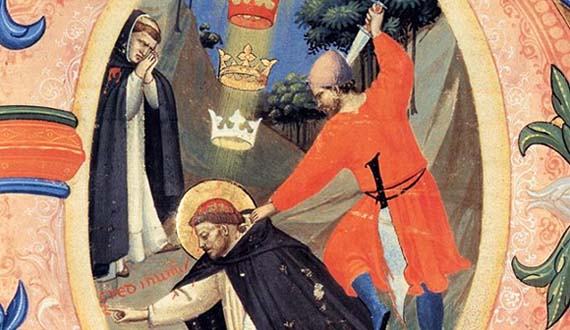
At this point in Job’s argument, the most significant admission is found in verse 15: “Though he slay me, I will hope in him.” It reminds us of the image of St. Peter Martyr, a Christian martyred by Cathars in the 13th century. In some artistic depictions of his death, the Cathar stands behind Peter, killing him with a sword. In these particular scenes, Peter Martyr can be seen in his last moments of life stooped to the ground and writing with his finger in his own blood the word, “Credo,” “I believe.”

angelicopeter

Job is having his own Peter Martyr moment. Even as he suffers, and even as he struggles to understand why he suffers, and even as he questions the throne of Heaven, he still writes in his own blood, “Credo!”

Credo…I believe…I still believe. Even if God slays me, I believe!

It raises an important question: is our faith strong enough to survive and endure even if it does not have all of the answers it wants? Can we write “Credo!” in our own blood? Are we willing to believe, even as we struggle to understand?

Job could, even in the midst of seemingly incomparable suffering, still say that he hoped and that he still believed.

Wherever you are, do not let go. Whatever you are going through, do not let go. Whatever you are suffering through, do not let go. Dare to believe, against all that your doubting mind might tell you, that God has not let go of you. For, indeed, He has not.


[1] Manlio Simonetti and Marco Conti, eds. Job. Ancient Christian Commentary on Scripture: Old Testament. Gen.Ed. Thomas C. Oden. Vol.VI (Downers Grove, IL: InterVarsity Press, 2006), p.67.

[2] Manlio Simonetti and Marco Conti, eds., p.74.

Mark 1:9-11

MarkSeriesTitleSlide1Mark 1

9 In those days Jesus came from Nazareth of Galilee and was baptized by John in the Jordan. 10 And when he came up out of the water, immediately he saw the heavens being torn open and the Spirit descending on him like a dove. 11 And a voice came from heaven, “You are my beloved Son; with you I am well pleased.”

A few years back articles began appearing in numerous news sources about a growing “depbaptism” movement, particularly in Europe. This is a movement in which people who were baptized as infants by their parents formally request to be debaptized, to have their baptisms rendered null and void. Here is one such article.

More than 100,000 Britons have recently downloaded “certificates of de-baptism” from the Internet to renounce their Christian faith.

The initiative launched by a group called the National Secular Society (NSS) follows atheist campaigns here and elsewhere, including a London bus poster which triggered protests by proclaiming “There’s probably no God.”

“We now produce a certificate on parchment and we have sold 1,500 units at three pounds (4.35 dollars, 3.20 euros) a pop,” said NSS president Terry Sanderson, 58.

John Hunt, a 58-year-old from London and one of the first to try to be “de-baptised,” held that he was too young to make any decision when he was christened at five months old.

The male nurse said he approached the Church of England to ask it to remove his name. “They said they had sought legal advice and that I should place an announcement in the London Gazette,” said Hunt, referring to one of the official journals of record of the British government.

So that’s what he did — his notice of renouncement was published in the Gazette in May 2008 and other Britons have followed suit.

Michael Evans, 66, branded baptising children as “a form of child abuse” — and said that when he complained to the church where he was christened he was told to contact the European Court of Human Rights.

The Church of England said its official position was not to amend its records. “Renouncing baptism is a matter between the individual and God,” a Church spokesman told AFP…

De-baptism movements have already sprung up in other countries.

In Spain, the high court ruled in favor of a man from Valencia, Manuel Blat, saying that under data protection laws he could have the record of his baptism erased, according to a report in the International Herald Tribune.

Similarly, the Italian Union of Rationalists and Agnostics (UAAR) won a legal battle over the right to file for de-baptism in 2002, according to media reports. The group’s website carries a “de-baptism” form to facilitate matters.

According to UAAR secretary Raffaele Carcano, more than 60,000 of these forms have been downloaded in the past four years and continue to be downloaded at a rate of about 2,000 per month. Another 1,000 were downloaded in one day when the group held its first national de-baptism day last October 25.

Elsewhere, an Argentinian secularist movement is running a “Collective Apostasy” campaign, using the slogan “Not in my name” (No en mi nombre)…

Sanderson meanwhile remains resolute. “The fact that people are willing to pay for the parchments shows how seriously they are taking them,” he said.”[1]

Yes, they do seem to be taking these debaptism parchments serious indeed. It is a curious thing. I am tempted to beat my Baptist drum here and say that this is yet another reason why believer’s baptism is important. If you listen to what these folks are saying, their primary argument seems to be that their baptisms were imposed upon them, that they were not ready for them and did not seek them.

When I think of this anger and resentment concerning baptism unsought for, I cannot help but think of what a contrast the baptism of Jesus is. Jesus sought, embraced, and submitted to His baptism as the beginning of earthly ministry and as a prophetic pointer to what He would accomplish on the cross and the empty tomb.

Over and against the allegations of injustice from these debaptizers stands the Lord Jesus and His clear sense of readiness, of purpose, and of obedience to the Father.

Mark’s record of the baptism of Jesus is deceptively brief. It is brief, but it is not simple. In fact, it is a deeply moving passaged filled with powerful and poignant markers that reveal that something amazing happened in this moment. John MacArthur, Jr., suggests that this event probably happened on “a summer day in the year A.D. 26.”[2] Perhaps, but it was a day like none other!

The baptism of Jesus was Trinitarian and speaks to us of the nature of God.

We need not to miss the fascinating Trinitarian note that is sounded in this baptism account. Simply put, we see the Triune God present and at work in the baptism of Jesus. Consider:

11a And a voice came from heaven, “You are my beloved Son…”

9a In those days Jesus came from Nazareth of Galilee

10b …and the Spirit descending on him like a dove

St. Augustine summed it up nicely when he wrote that “the Trinity appears very clearly: the Father in the voice, the Son in the man, the Spirit in the dove.”[3]

In his book, God the Trinity, Malcolm Yarnell makes the point that while the New Testament contains no formal, propositional, doctrinal statement on the Trinity in the way that we would formulate it today, the Trinity is present all throughout the Bible and that, in fact, the very idiom of the Bible is Trinitarian. “God the Trinity,” writes Yarnell, “is revealed through word and deed in the Bible, even though not in our propositional form.”[4]

Our text would be an example of the Trinity revealed in deed. That is, at the baptism of Jesus, the Father speaks, the Son submits, and the Spirit descends. While the primary point of the passage is not to formulate a doctrine of the Trinity, it is through texts like these that the doctrine of the Trinity is formulated. We should behold and marvel at the Triune God: the Father who commissions and speaks, the Son who obeys and fulfills, and the Spirit who descends, inaugurates, and empowers.

We must also be careful not to see the baptism of the Jesus as the point at which Jesus became the Son of God. This idea is the ancient adoptionist heresy that was condemned at the Synod of Antioch and the first Council of Nicaea. This heretical notion proposed that at His baptism Jesus was adopted into sonship, that it was here that Jesus became the Son of God. Thus, in this idea, before the baptism of Jesus He was merely a man, even a very good man, but a man nonetheless.

This idea must continue to be rejected. Jesus is the Son of God from eternity past. The descent of the Spirit upon Christ does not confer sonship or make any ontological change in the person of Christ. It is a sign of the blessing and power of God on Christ, but that is not a blessing that was withheld before. Christ, fully God and fully man, in a sense, inaugurates His ministry at His baptism, but He does not inaugurate His Sonship. He has been, is, and ever will be the eternal and uncreated Son of God. He stands in full equality with the Father and the Spirit as the Triune God.

The baptism of Jesus was fulfilling and speaks to us of the ministry of Jesus.

Jesus’ baptism was eyebrow-raising to John the Baptist, who knew at least enough to know that this Jesus was no mere man, that this Jesus had no sin of which He needed to repent, and that this Jesus was to be bowed before and worshipped, not baptized by a sinful man like himself! In Matthew’s account of this scene in Matthew 3, we find a fascinating exchange between Jesus and John the Baptist about this very point:

13 Then Jesus came from Galilee to the Jordan to John, to be baptized by him. 14 John would have prevented him, saying, “I need to be baptized by you, and do you come to me?” 15 But Jesus answered him, “Let it be so now, for thus it is fitting for us to fulfill all righteousness.” Then he consented.

First, the baptism of Christ was, as He said, a fulfillment. Specifically, it was a fulfillment of all righteousness. Here we see the active righteousness of Jesus Christ, His active obedience to all that humanity is called to. In a sense, it is almost as if Jesus will not call others to do something He Himself does not do. Jesus was not baptized because He was a sinner. He was baptized because He was not. As the righteous Son of God, Christ submits to the call of God in all of life and one of those calls here in the wilderness with John was baptism.

Was there a kind of example being made here? Perhaps it can be seen like that in a sense. In a sense, it might be said that Christ does this for the benefit of those watching, but only in a sense. His own wording suggests that He Himself wanted to be obedient in this area and that would suggest that Christ would have done this had nobody been watching. So an example is there, to be sure, but it is not His primary motivation.

There is also a powerful prophetic element here as well. On the cross, Jesus will take our sins upon Himself. He will, as Paul wrote in 1 Corinthians 5:21, somehow “be sin” on the cross as He takes the sin of the world upon Himself. John’s baptism was a baptism of repentance. Jesus did not need to repent, but Jesus would, on the cross, feel the full weight of human sinfulness and the human need for repentance. He will feel the terrible burden of human lostness as a result of the human rebellion that He took upon Himself when He took our sins.

Tellingly, Jesus referred to the coming cross as a baptism. In Luke 12, Jesus spoke of the cross as a coming baptism that caused Him great distress.

50 I have a baptism to be baptized with, and how great is my distress until it is accomplished!

In Mark 10, Jesus told His disciples that His coming baptism on Golgotha was a baptism they could not even begin to fathom, much less endure or undergo.

38 Jesus said to them, “You do not know what you are asking. Are you able to drink the cup that I drink, or to be baptized with the baptism with which I am baptized?”

Put altogether, we might say that Jesus submitted to John’s watery baptism in preparation for and as a prophetic announcement of the baptism of His coming cross. As John would bury Christ under the water, so Christ would be buried in a tomb. As John raised Jesus up out of the water, so Jesus would be raised out of death.

What an amazing thing it is that the Son of God submitted to this baptism! Our hope is in what this baptism anticipates, the cross of Jesus Christ!

The baptism of Jesus was freeing and speaks to us of the beauty of salvation.

There is something else happening here and it is something violent and cage rattling in the most glorious of ways. It is something we might miss if we do not read carefully. It is found in verse 10.

10a And when he came up out of the water, immediately he saw the heavens being torn open

The phrase “being torn open” comes from the word schizo. It is a word that speaks of a violent tearing. So Mark says that the heavens were being ripped, torn open. Interestingly, Matthew and Luke did not use this verb. They used the more common word for “opened.” If, as is commonly believed, Mark was written first and if, as is also commonly believed, Matthew and Luke used Mark as one of their sources in writing their gospels, that means that Matthew and Luke changed the verb from “torn” to “opened.” In and of itself, that is fairly insignificant. Both speak of an opening and perhaps Matthew and Luke simply wanted to use the word that their audiences would have been more familiar with.

Eugene Boring notes that the image of the heavens being torn (schizo) is “an apocalyptic motif” and is “portrayed violently” in Mark (though not in Matthew and Luke).[5] Gundry points out that the more traditional language of the heavens being “opened” “is tame by comparison.”[6] And Robert Stein suggests that Matthew and Luke changed Mark’s verb to “opened” because Mark’s use of schizo was “sufficiently strange” and “open” (anoigo) was “more common.”[7]

Fine and good…but I do so love what Mark wrote here! For Mark, the heavens were not neatly opened, they were ripped!

Now that is most fascinating, but it is made even more so when you realize that Mark only used that verb schizo one other time in his gospel. He used it in Mark 15.

38 And the curtain of the temple was torn in two, from top to bottom.

Wow! Fascinating! But wait: Josephus tells us that on the temple veil “was portrayed a panorama of the heavens.” That is, the veil looked like the heavens, it looked like the night sky!

Imagine it: as a Jewish worshiper of Yahweh God you would have known that God was in some way present behind this veil, behind the sky, behind a barrier that was penetrable only at certain times and only by the high priest who entered it, trembling, to make atonement for the sins of the people. The heavens were therefore a sign of wonder, to be sure, but also a sign of power and of dread, for who could go behind the Heavens and see God?

The high priest could, when allowed, but even he feared being struck dead. But certainly you could not. The heavens therefore constituted the barrier between you and God. It was separation. It was distance. God was behind there and you were here.

And when he came up out of the water, immediately he saw the heavens being torn open

And the curtain of the temple was torn in two, from top to bottom.

Mark is telling us something. He is telling us that the coming of Christ meant that the barrier between God and man had now been removed, obliterated, ripped to shreds. We can now come to God through Christ! What an amazing thing this is, this tearing of the heavens! Jesus did not come to neatly ease the door open. No, Jesus came to kick the doors off the hinges and pronounce to one and to all, “WHOSEVER WILL MAY COME! WHOSEOVER WILL MAY COME! WHOSOEVER WILL MAY COME!”

You can now come home! God is no longer shrouded in fearful distance. God is near to us in Christ! God is not thereby reduced in power or glory. The coming of Christ does not diminish the majesty of God. The coming of Christ magnifies it. For what kind of God would do such a thing as this except a God mighty in grace and love and mercy!

The door is gone! The barrier is gone! You are no longer lost in the darkness! You…may…come!

The 2nd/3rd century church father, Hippolytus

Do you see, beloved, how many and how great blessings we would have lost if the Lord had yielded to the exhortation of John and declined baptism? For the heavens had been shut before this. The region above was inaccessible. We might descend to the lower parts, but not ascend to the upper. So it happened not only that the Lord was being baptized – he also was making new the old creation. He was bringing the alienated under the scepter of adoption…A reconciliation took place between the visible and the invisible. The celestial orders were filled with joy, the diseases of the earth were healed, secret things made known, those at enmity restored to amity…So when the Holy Spirit descended in the form of a dove, and the Father’s voice spread everywhere, it was fitting that “the gates of heaven should be lifted up.”[8]

But wait a minute. There is even something else happening here. It is true that the ripping of the heavens means that Heaven is now open to us in and through (and only in and through) Jesus. But is the motion in this story primarily from the ground up or is it from Heaven down?

Consider that what is happening in the baptism of Jesus is actually a fulfillment of a plea from Isaiah 64.

1 Oh that you would rend the heavens and come down, that the mountains might quake at your presence— 2 as when fire kindles brushwood and the fire causes water to boil—to make your name known to your adversaries, and that the nations might tremble at your presence!

But in this verse the action is not an ascent, us coming to God, but rather a descent, God coming to us. What if our being able to come to the Father is not the primary point of the rending of the heavens?

One of the best explanations I have ever heard for this comes from a most unlikely source. When I was a student at Southwestern Baptist Theological Seminary in Fort Worth, Texas, Dr. Thomas Long, then the professor of preaching at Princeton Divinity School, came and lectured. I will never forget him telling a story about a friend of his who was asked to teach a boy’s Sunday School class. His friend, like Dr. Long, is an academic, a religious scholar we might say, so this was a bit of a daunting task for him, teaching the Bible to young, unruly boys.

Dr. Long recounted that his friend how one boy in this class (we will call him Alan) who very clearly was not interested in the class and did not want to be there. His body language, his lack of participation, his prickly demeanor, and his overall terrible attitude communicated all of this very effectively. In vain the teacher tried to get the young man to engage, to speak, or even just to acknowledge the presence of other people in the room. Week after week Alan showed literally no interest at all. In fact, he oozed a kind of hostile disgust at everybody in the room.

Except for one time. Once, Dr. Long’s friend was teaching the class on our passage. He was teaching them about the baptism of Jesus. As he did so, he reached the part about the ripping of the heavens. “As a result,” he said, “we can now come to God through Jesus.”

When he said this, to his utter amazement, he saw Alan shift uncomfortable in his seat. Alan even appeared to mutter something under his breath.

The teacher, amazed, addressed the boy.

“Alan, is there something you wanted to say?”

Alan simply looked down and shook his head no.

Undeterred, the teacher pressed. “Alan, truly I think we would all like to hear from you. You seem like you have a thought about this passage. Would you be willing to share it with the class.”

There was a pause as Alan, arms crossed, continued to look down at his feet. After a moment, though, the boy looked up. There was something of a snarl on his lips as he surveyed his fellow students and then locked eyes with the teacher. Finally, as if burdened by a great weight of irritation, Alan spoke.

“That ain’t what that means.”

The teacher, amazed, said, “What? That isn’t what what means, Alan?”

“That verse. That ain’t what that verse means.”

Intrigued and slightly nervous, the teacher asked, “Well, what does it mean?”

Another pause, then a deep breath, then Alan responded: “That verse don’t mean that we can get to God. It means that God can get to us. It means that God’s on the loose, and there ain’t nothin’ safe anymore.

I would submit to you that that is one of the greatest interpretations of this passage ever uttered in the long history of biblical interpretation!

God’s on the loose…and there ain’t nothin’ safe anymore!

Yes! God is on the loose! He is on the loose in Jesus! God has come to us, hunting us, pursuing us with radical love and mercy and forgiveness, seeking to overwhelm us with new life, new creation, a new heart, and a relationship with Him! Will you accept this God who has kicked the doors of Heaven off the hinges for you? Will you come to the God who has come to you?

God’s on the loose…and there ain’t nothin’ safe anymore!

Amen and amen.


[1] https://www.breitbart.com/article.php?id=CNG.ae71a038e9b3b47af4f0e9eac9598fd8.2b1 &show_article=1

[2] John F. MacArthur, Jr. Mark 1-8. MacArthur New Testament Commentary. (Chicago, IL: Moody Press, ), https://books.google.com/books?id=mLIfAwAAQBAJ&pg=PT39&dq=Mark+1:9-11&hl=en&sa=X&ved= 0ahUKEwjO_tPFqP3LAhXIRyYKHYQwD1gQ6AEIHDAA#v=onepage&q=Mark%201%3A9-11&f=false

[3] Thomas C. Oden and Christopher A. Hall, ed. Mark. Ancient Christian Commentary on Scripture. Gen. Ed., Thomas C. Oden. New Testament. Vol. II (Downers Grove, IL: InterVarsity Press, 2005), p.11.

[4] Malcolm Yarnell, God the Trinity. (Nashville, TN: Broadman and Holman Academic, 2016), p.18.

[5] M. Eugene Boring, Mark. The New Testament Library. (Louisville, KY: Westminster John Knox Press, 2006), p.45.

[6] Robert Gundry, Mark. Vol. 1. (Grand Rapids, MI: William B. Eerdmans Publishing Company, 2004), p.48.

[7] Robert Stein, Mark. Baker Exegetical Commentary on the New Testament. (Grand Rapids, MI: Baker Publishing Group, 2008), p.56-57.

[8] Thomas C. Oden and Christopher A. Hall, ed., p.11.

Michael Punke’s The Revenant

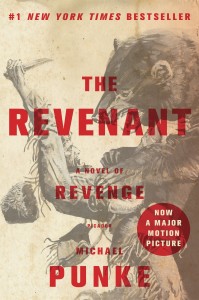
91ZsWF0DYhLHaving enjoyed the movie, “The Revenant,” I was excited to read the book, especially after hearing that the novel was extremely good in its own right.  Michael Punke’s The Revenant is indeed a very good book and a great story.  I suppose my problem is in having  seen the film version first.  When you see a movie version before reading a book version it is very hard not to spend the entire time subconsciously contrasting and comparing the two or trying not to eisegete the images and scenes of the film into the book.  Even then, my problem was only with resisting those kinds of dynamics and not with the book itself.  The book is great.  It is significantly different from the movie.  If you have not seen the movie but intend to do so, you might want to stop reading here.  There will be spoilers.

The story itself is actually fairly straightforward.  While on an expedition for the Rocky Mountain Fur Company, a band of trappers and fur traders are set upon by hostile Native Americans.  The survivors are making their way through the Western wilderness of the early 1800s when their guide, Hugh Glass, is viciously mauled by a bear.  Captain Harris leaves behind two men to care for and bury Glass once his seemingly inevitable death arrives.  Ultimately, however, Fitzgerald and Bridger, the two men left behind with Glass, rob him and abandon him for dead, though Fitzgerald is the main antagonist here.  The rest of the story involves Hugh Glass’ attempt to find the two men and seek revenge for the theft.

As for the differences, the movie was, of course, much more “Hollywoodized” than the book.  There is no doomed romance in the book, no haunting slain love, no Native American child, and, most significantly, no ultimate reckoning with Fitzgerald.  In the movie, Hugh Glass kills Fitzgerald (or floats him down to his death, to be more accurate) and never lays a finger on Bridger.  In the book, Glass beats Bridger to a bloody pulp but never kills Fitzgerald (though he does try).  The book ends with a courtroom drama gone awry and not with a Native American war party looking down with some modicum of understanding upon the avenged Hugh Glass.  There is essentially no mystical relationship between Glass and the Native Americans in the book.

In the book, when Glass finally gives voice to his grievance, he surprisingly reveals that he does not fault the men for the abandonment but he does fault them for stealing his rifle, knife, steel, and flint.  The movie had to concoct the death of Glass’ son at the hands of Fitzgerald to make the quest more primal and visceral.  There is something profoundly anticlimactic in the idea of the whole story being essentially about a rifle, though, in the book itself, it seems clear enough that being abandoned for dead surely must be driving Glass as well.

The book takes a welcome philosophical and even theological turn as Glass ultimately has to come to terms with his inability to obtain the justice he desires.  In a powerful scene, Glass asks himself how he can possibly just turn and walk away from Fitzgerald without getting his ultimate revenge.  As he asks this, he finds himself looking up in the night sky at  The Northern Cross constellation.  Without overplaying the scene, Punke seems to be suggesting that Glass abandons his obsessive desire for revenge as he is staring at the cross in the sky.  It is, again, a powerful scene.  I am not suggesting that Glass has anything like a conversion (or that he does not), but I will say that Christian readers will be struck by the poignancy of this moment.  It is a refreshing note of transcendence and a much needed one.

In all, the movie and book are different enough to be almost different stories.  In the movie, revenge is exacted.  In the book, revenge is ultimately abandoned.  I very much appreciated the philosophical nuance of the novel and its grappling with the human problem of revenge.  There is something strangely profound about Glass noticing Fitzgerald’s initials on his rifle once it is reclaimed.  It is almost as if Punke is trying to say not only that we never get all the justice we think we are entitled to in this life, but we forever bear the painful and reminding marks of the injustices we endure on the lives we try to rebuild.

As I think about it, there is no grappling over this issue in the movie at all.  The viewer simply roots Glass on toward Fitzgerald’s final reckoning with his justly deserved fate.  Punke subtitled his book, “A Novel of Revenge,” and this is significant.  The book leaves the reader with interesting questions of justice, vengeance, and the nature of the universe itself.  The movie is a revenge story plain as simple, as beautiful and moving as it was.

You should probably see the movie.  You should definitely read the book.

Job 38 and 39

whirlwind_by_luisbc-d79ft49Job 38

1 Then the Lord answered Job out of the whirlwind and said: 2 “Who is this that darkens counsel by words without knowledge? 3 Dress for action like a man; I will question you, and you make it known to me. 4 “Where were you when I laid the foundation of the earth? Tell me, if you have understanding. 5 Who determined its measurements—surely you know! Or who stretched the line upon it? 6 On what were its bases sunk, or who laid its cornerstone, 7 when the morning stars sang together and all the sons of God shouted for joy? 8 “Or who shut in the sea with doors when it burst out from the womb, 9 when I made clouds its garment and thick darkness its swaddling band, 10 and prescribed limits for it and set bars and doors, 11 and said, ‘Thus far shall you come, and no farther, and here shall your proud waves be stayed’? 12 “Have you commanded the morning since your days began, and caused the dawn to know its place, 13 that it might take hold of the skirts of the earth, and the wicked be shaken out of it? 14 It is changed like clay under the seal, and its features stand out like a garment. 15 From the wicked their light is withheld, and their uplifted arm is broken. 16 “Have you entered into the springs of the sea, or walked in the recesses of the deep? 17 Have the gates of death been revealed to you, or have you seen the gates of deep darkness? 18 Have you comprehended the expanse of the earth? Declare, if you know all this. 19 “Where is the way to the dwelling of light, and where is the place of darkness, 20 that you may take it to its territory and that you may discern the paths to its home? 21 You know, for you were born then, and the number of your days is great! 22 “Have you entered the storehouses of the snow, or have you seen the storehouses of the hail, 23 which I have reserved for the time of trouble, for the day of battle and war? 24 What is the way to the place where the light is distributed, or where the east wind is scattered upon the earth? 25 “Who has cleft a channel for the torrents of rain and a way for the thunderbolt, 26 to bring rain on a land where no man is, on the desert in which there is no man, 27 to satisfy the waste and desolate land, and to make the ground sprout with grass? 28 “Has the rain a father, or who has begotten the drops of dew? 29 From whose womb did the ice come forth, and who has given birth to the frost of heaven? 30 The waters become hard like stone, and the face of the deep is frozen. 31 “Can you bind the chains of the Pleiades or loose the cords of Orion? 32 Can you lead forth the Mazzaroth in their season, or can you guide the Bear with its children? 33 Do you know the ordinances of the heavens? Can you establish their rule on the earth? 34 “Can you lift up your voice to the clouds, that a flood of waters may cover you? 35 Can you send forth lightnings, that they may go and say to you, ‘Here we are’? 36 Who has put wisdom in the inward parts or given understanding to the mind? 37 Who can number the clouds by wisdom? Or who can tilt the waterskins of the heavens, 38 when the dust runs into a mass and the clods stick fast together? 39 “Can you hunt the prey for the lion, or satisfy the appetite of the young lions, 40 when they crouch in their dens or lie in wait in their thicket? 41 Who provides for the raven its prey, when its young ones cry to God for help, and wander about for lack of food?

Job 39

1 “Do you know when the mountain goats give birth? Do you observe the calving of the does? 2 Can you number the months that they fulfill, and do you know the time when they give birth, 3 when they crouch, bring forth their offspring, and are delivered of their young? 4 Their young ones become strong; they grow up in the open; they go out and do not return to them. 5 “Who has let the wild donkey go free? Who has loosed the bonds of the swift donkey, 6 to whom I have given the arid plain for his home and the salt land for his dwelling place? 7 He scorns the tumult of the city; he hears not the shouts of the driver. 8 He ranges the mountains as his pasture, and he searches after every green thing. 9 “Is the wild ox willing to serve you? Will he spend the night at your manger? 10 Can you bind him in the furrow with ropes, or will he harrow the valleys after you? 11 Will you depend on him because his strength is great, and will you leave to him your labor? 12 Do you have faith in him that he will return your grain and gather it to your threshing floor? 13 “The wings of the ostrich wave proudly, but are they the pinions and plumage of love? 14 For she leaves her eggs to the earth and lets them be warmed on the ground, 15 forgetting that a foot may crush them and that the wild beast may trample them. 16 She deals cruelly with her young, as if they were not hers; though her labor be in vain, yet she has no fear, 17 because God has made her forget wisdom and given her no share in understanding. 18 When she rouses herself to flee, she laughs at the horse and his rider. 19 “Do you give the horse his might? Do you clothe his neck with a mane? 20 Do you make him leap like the locust? His majestic snorting is terrifying. 21 He paws in the valley and exults in his strength; he goes out to meet the weapons. 22 He laughs at fear and is not dismayed; he does not turn back from the sword. 23 Upon him rattle the quiver, the flashing spear, and the javelin. 24 With fierceness and rage he swallows the ground; he cannot stand still at the sound of the trumpet. 25 When the trumpet sounds, he says ‘Aha!’ He smells the battle from afar, the thunder of the captains, and the shouting. 26 “Is it by your understanding that the hawk soars and spreads his wings toward the south? 27 Is it at your command that the eagle mounts up and makes his nest on high? 28 On the rock he dwells and makes his home, on the rocky crag and stronghold. 29 From there he spies out the prey; his eyes behold it from far away. 30 His young ones suck up blood, and where the slain are, there is he.”

Steven Lawson tells of a college student who went to take a final exam at the end of his Fall semester and realized to his horror that he did not know the answer to a single question. After mulling over what to do, the young man wrote the following on his exam: “Only God knows the answer to these questions. Merry Christmas!” Over Christmas break, the graded exam arrived in the mail. On the top of it the professor had written this: “Then God gets a 100, and you get 0. Happy New Year!”[1]

There is something of that humorous but very real truth here in Job 38 and 39. Whatever else we learn from God’s speech in these chapters, we see clearly the staggering distance between God and man. But we also learn more than this.

God is less concerned with the answer than with the presumption behind the question.

God’s dramatic appeal to the distance between us and Him reveals to us that God is less concerned with the answer than with the presumption behind our questions. Consider what God says in the beginning of Job 38:

1 Then the Lord answered Job out of the whirlwind and said: 2 “Who is this that darkens counsel by words without knowledge?

The Lord begins by telling Job that he does not and cannot know as much as God about the issue at hand or any issue for that matter: “Who is this that darkens counsel by words without knowledge?” Job’s wisdom can only succeed in darkening the truth. Later, Paul will make this point powerfully through his memorable words in 1 Corinthians 1:

20 Where is the one who is wise? Where is the scribe? Where is the debater of this age? Has not God made foolish the wisdom of the world? 21 For since, in the wisdom of God, the world did not know God through wisdom, it pleased God through the folly of what we preach to save those who believe. 22 For Jews demand signs and Greeks seek wisdom, 23 but we preach Christ crucified, a stumbling block to Jews and folly to Gentiles, 24 but to those who are called, both Jews and Greeks, Christ the power of God and the wisdom of God. 25 For the foolishness of God is wiser than men, and the weakness of God is stronger than men.

Imagine: the wisest theologian on earth right now knows less than the simplest person in Heaven. I realize that when we speak from a place of raw transparency and pain we speak, in our minds, from our greatest vantage point of clarity, a point where all pretensions have passed away, a point where we have no need or desire to posture or impress. Pain is the place of the baring of our souls. But we must realize that we can be most sincere and yet still be sincerely incorrect. “Raw” and “transparent” are not synonyms for “correct” and “true.”

What is more, it is not merely that Job does not have the wisdom he thinks he has, it is also that Job’s presumption of his ability to hear and receive the answer is also mistaken. Behind all of Job’s questions is the assumption that were God to answer, Job could receive it. But it is this assumption, indeed, this presumption, that is so very mistaken.

As we will see, the premise of human ability to receive divine wisdom concerning the deepest mysteries of reality is fatally flawed. Only God can fully understand God. Man can receive and, to some extent, understand those things about God that God has chosen to reveal, but even those things have been put in images and words and pictures that are accessible to us. We stumble like blind men and women over what God has revealed, then we presume to be able to receive any more!

What God has revealed, He has revealed out of love and mercy and grace. We can know what He has spoken, but we can only know it to the extent that we are able. Job assumes that he can receive the answer. He cannot.

The Lord continues:

3 Dress for action like a man; I will question you, and you make it known to me.

Steven Lawson tells us that “dress for action like a man” can be interpreted “brace yourself like a man” and “was a military command that called a soldier to prepare for a fierce battle.”[2] In other words, God tells Job to prepare to defend Himself and to prepare to answer. Job had asked enough questions. Now it was time for him to answer God’s questions.

God is transcendent, above, and other in a way that should lead us to awe-inspired trust and humbling perspective.

In February of 2016, Umberto Eco died. Eco was one of my favorite authors. He is most well known for writing the international bestselling novel, The Name of the Rose. He wrote numerous other novels, collections of essays, works on semiotics (his field of study), culture, history, philosophy, and literature. He was, to put it mildly, a fascinating man with a dizzying mind!

In 2009, he published an entire book devoted to lists entitled The Infinity of Lists. In it, he gives numerous examples of lists in literature, sacred texts, and other historical media. Early in the book, Eco discusses why people write lists and what the overall effect of lists on a reader is. He suggests that lists are employed as a…

…mode of artistic representation, one where we do not know the boundaries of what we wish to portray, where we do not know how many things we are talking about and presume their number to be, if not infinite, then at least astronomically large. We cannot provide a definition by essence and so, to be able to talk about it, to make it comprehensible or in some way perceivable, we list its properties…

Eco goes on to say that lists represent “an actual infinity made up of objects that can perhaps be numbered but that we cannot number.” Lists, then, according to Eco, are representations that suggest “infinity almost physically, because in fact it does not end, nor does it conclude in form.”[3]

I cannot help but think of Eco’s explanation of lists as I read the following words from Job 38 and 39. And, make no mistake, the best way to process this list of questions, this list of attributions, this list of evidence for the sovereignty of God, is to hear it read, to catch the full sensation of infinity, or transcendence, of otherness that arises at such a reading. This is not a text to be dissected. We will see that Job’s response is to put his hand over his mouth. No, it is a text to be heard, absorbed, and adored. More than that, it is a text that, if rightly heard and rightly received, will lead us into the very throne room of God.

So still your mind and heart. If need be, shut your eyes. Imagine you are standing before a terrifying whirlwind reverberating with the tremors of transcendent glory. You are broken – physically, mentally, emotionally, spiritually – and your have had your say. You have said things you never thought you would to and about God. You still love Him, but it has become a fragile touch instead of a confident grasp. And you are there, before the whirlwind, and out of the whirlwind, God speaks.

Listen:

4 “Where were you when I laid the foundation of the earth? Tell me, if you have understanding. 5 Who determined its measurements—surely you know! Or who stretched the line upon it? 6 On what were its bases sunk, or who laid its cornerstone, 7 when the morning stars sang together and all the sons of God shouted for joy? 8 “Or who shut in the sea with doors when it burst out from the womb, 9 when I made clouds its garment and thick darkness its swaddling band, 10 and prescribed limits for it and set bars and doors, 11 and said, ‘Thus far shall you come, and no farther, and here shall your proud waves be stayed’? 12 “Have you commanded the morning since your days began, and caused the dawn to know its place, 13 that it might take hold of the skirts of the earth, and the wicked be shaken out of it? 14 It is changed like clay under the seal, and its features stand out like a garment. 15 From the wicked their light is withheld, and their uplifted arm is broken. 16 “Have you entered into the springs of the sea, or walked in the recesses of the deep? 17 Have the gates of death been revealed to you, or have you seen the gates of deep darkness? 18 Have you comprehended the expanse of the earth? Declare, if you know all this. 19 “Where is the way to the dwelling of light, and where is the place of darkness, 20 that you may take it to its territory and that you may discern the paths to its home? 21 You know, for you were born then, and the number of your days is great! 22 “Have you entered the storehouses of the snow, or have you seen the storehouses of the hail, 23 which I have reserved for the time of trouble, for the day of battle and war? 24 What is the way to the place where the light is distributed, or where the east wind is scattered upon the earth? 25 “Who has cleft a channel for the torrents of rain and a way for the thunderbolt, 26 to bring rain on a land where no man is, on the desert in which there is no man, 27 to satisfy the waste and desolate land, and to make the ground sprout with grass? 28 “Has the rain a father, or who has begotten the drops of dew? 29 From whose womb did the ice come forth, and who has given birth to the frost of heaven? 30 The waters become hard like stone, and the face of the deep is frozen. 31 “Can you bind the chains of the Pleiades or loose the cords of Orion? 32 Can you lead forth the Mazzaroth in their season, or can you guide the Bear with its children? 33 Do you know the ordinances of the heavens? Can you establish their rule on the earth? 34 “Can you lift up your voice to the clouds, that a flood of waters may cover you? 35 Can you send forth lightnings, that they may go and say to you, ‘Here we are’? 36 Who has put wisdom in the inward parts or given understanding to the mind? 37 Who can number the clouds by wisdom? Or who can tilt the waterskins of the heavens, 38 when the dust runs into a mass and the clods stick fast together? 39 “Can you hunt the prey for the lion, or satisfy the appetite of the young lions, 40 when they crouch in their dens or lie in wait in their thicket? 41 Who provides for the raven its prey, when its young ones cry to God for help, and wander about for lack of food?

Job 39

1 “Do you know when the mountain goats give birth? Do you observe the calving of the does? 2 Can you number the months that they fulfill, and do you know the time when they give birth, 3 when they crouch, bring forth their offspring, and are delivered of their young? 4 Their young ones become strong; they grow up in the open; they go out and do not return to them. 5 “Who has let the wild donkey go free? Who has loosed the bonds of the swift donkey, 6 to whom I have given the arid plain for his home and the salt land for his dwelling place? 7 He scorns the tumult of the city; he hears not the shouts of the driver. 8 He ranges the mountains as his pasture, and he searches after every green thing. 9 “Is the wild ox willing to serve you? Will he spend the night at your manger? 10 Can you bind him in the furrow with ropes, or will he harrow the valleys after you? 11 Will you depend on him because his strength is great, and will you leave to him your labor? 12 Do you have faith in him that he will return your grain and gather it to your threshing floor? 13 “The wings of the ostrich wave proudly, but are they the pinions and plumage of love? 14 For she leaves her eggs to the earth and lets them be warmed on the ground, 15 forgetting that a foot may crush them and that the wild beast may trample them. 16 She deals cruelly with her young, as if they were not hers; though her labor be in vain, yet she has no fear, 17 because God has made her forget wisdom and given her no share in understanding. 18 When she rouses herself to flee, she laughs at the horse and his rider. 19 “Do you give the horse his might? Do you clothe his neck with a mane? 20 Do you make him leap like the locust? His majestic snorting is terrifying. 21 He paws in the valley and exults in his strength; he goes out to meet the weapons. 22 He laughs at fear and is not dismayed; he does not turn back from the sword. 23 Upon him rattle the quiver, the flashing spear, and the javelin. 24 With fierceness and rage he swallows the ground; he cannot stand still at the sound of the trumpet. 25 When the trumpet sounds, he says ‘Aha!’ He smells the battle from afar, the thunder of the captains, and the shouting. 26 “Is it by your understanding that the hawk soars and spreads his wings toward the south? 27 Is it at your command that the eagle mounts up and makes his nest on high? 28 On the rock he dwells and makes his home, on the rocky crag and stronghold. 29 From there he spies out the prey; his eyes behold it from far away. 30 His young ones suck up blood, and where the slain are, there is he.”

Behold the awesome majesty of God!

Steven Chase has pointed out that “the questions in the speech directed by God at Job do not seem to ask if Job is a righteous human, but rather if Job is, like YHWH, a god; YHWH asks questions more suited to a rival god than to a human suffering in rotting skin, as if the human were knowledgeable enough to share an intimate conversation with YHWH as co-creator of the universe.” Chase further argues that “the implicit answer…is that there is a moral order to the universe, but it is beyond human understanding, and it can be accessed, not changed, by faith.”[4]

That is as good a summation of any of what is happening here.

God is God.

Job is not.

There is the answer.

In a sense, God’s response to Job’s questions is the same as God’s response to Moses concerning what he was to tell Pharaoh when questioned: “I AM!”

This is a paraphrase of Job 38 and 39: “I AM!”

I ask you and I ask myself: are we content to rest in the sovereignty of a holy God?

Is it enough for us to know that God is God, to let God be God, and to accept with comfort and with praise that great fact?

Does this sound cruel to you? Perhaps it does. We think that human beings are entitled to know. But what if we not only are not entitled to know the mysteries of God, we could not know them if God spoke them to us. We do not possess the mental and spiritual space to contain, much less understand, certain truths.

We will one day.

Or perhaps then we will not care.

Perhaps when we stand before the blazing fire and whirlwind of the grandeur of God Almighty all of our presumptions and our sense of entitlement and even our need to know will melt away before the beauty and awesomeness of God.

We need Job 38 and 39. We need to hear again this amazing list and learn to tremble again before the God who loves us and who has revealed Himself to us in Christ.

Yes, we need to learn to tremble.

And to love.

And to trust.

“Why!” cries Job.

“I AM!” answers God.

It is enough.

Amen.


[1] Steven J. Lawson, Job. Holman Old Testament Commentary. Vo.10 (Nashville, TN: Holman Reference, 2004), p.333.

[2] Steven J. Lawson, p.327.

[3] Umberto Eco, The Infinity of Lists. (New York, NY: Rizzoli, 2009), p.15,17.

[4] Steven Chase, Job. Belief. (Louisville, KY: Westminster John Knox Press, 2013), p.256.

Mark 1:1-8

MarkSeriesTitleSlide1Mark 1

1 The beginning of the gospel of Jesus Christ, the Son of God. 2 As it is written in Isaiah the prophet, “Behold, I send my messenger before your face, who will prepare your way, 3 the voice of one crying in the wilderness: ‘Prepare the way of the Lord, make his paths straight,’” 4 John appeared, baptizing in the wilderness and proclaiming a baptism of repentance for the forgiveness of sins. 5 And all the country of Judea and all Jerusalem were going out to him and were being baptized by him in the river Jordan, confessing their sins. 6 Now John was clothed with camel’s hair and wore a leather belt around his waist and ate locusts and wild honey. 7 And he preached, saying, “After me comes he who is mightier than I, the strap of whose sandals I am not worthy to stoop down and untie. 8 I have baptized you with water, but he will baptize you with the Holy Spirit.”

In his biographical introduction to St. Patrick of Ireland, the late Patrick Francis Cardinal Moran writes of how Patrick, having returned as a missionary to Ireland after escaping slavery and making his way back to his family in England, was locked in spiritual combat with the forces of paganism there as he sought to evangelize the Celtic people. Moran writes that Patrick “learned from Dichu that the chieftains of Erin had been summoned to celebrate a special feast at Tara by Leoghaire, who was the Ard-Righ, that is, the Supreme Monarch of Ireland.” What is more, Leoghaire had decreed that all the fires of Ireland should be extinguished until “the signal blaze was kindled at the royal mansion.” So Patrick determined to go to Tara and confront from the pagan assembly with the gospel of Christ. Moran informs us that the event happened on Easter Sunday, March 26, 433.

…the chiefs and Brehons came in full numbers and the druids too would muster all their strength to bid defiance to the herald of good tidings and to secure the hold of their superstition on the Celtic race, for their demoniac oracles had announced that the messenger of Christ had come to Erin. St. Patrick arrived at the hill of Slane, at the opposite extremity of the valley from Tara, on Easter Eve, in that year of the feast of the Annunciation, and on the summit of the hill kindled the Paschal fire. The druids at once raised their voice. “O King,” (they said) “live forever; this fire, which has been lighted in defiance of the royal edict, will blaze for ever in this land unless it be this very night extinguished.” By order of the king and the agency of the druids, repeated attempts were made to extinguish the blessed fire and to punish with death the intruder who had disobeyed the royal command. But the fire was not extinguished and Patrick shielded by the Divine power came unscathed from their snares and assaults.

            On Easter Day the missionary band having at their head the youth Benignus bearing aloft a copy of the Gospels, and followed by St. Patrick who with miter and crosier was arrayed in full episcopal attire, proceeded in processional order to Tara. The druids and magicians put forth all their strength and employed all their incantations to maintain their sway over the Irish race, but the prayer and faith of Patrick achieved a glorious Triumph.[1]

What a gloriously dramatic and fascinating scene, Patrick walking into the valley of Tara in defiance of the Druids and magicians and their pagan monarch. You have got to get the scene right in your mind: the pagan horde and their dark king gathered in the valley in darkness. All the fires of the land had been extinguished. All the eyes of the Celts were looking toward the great royal mansion awaiting the lighting of the fire that would signal the beginning of their defiant feast. Suddenly, on the hill of Slane on the far end of the valley of Tara a fire leaps into the air, but it is not the fire of Leoghaire, the fire of pagan revelry. Instead, there on the hill, the druids and magicians and the Celts look up to see Patrick, missionary to Ireland, standing on Easter Eve shrouded in the orange glow of the Paschal flame!

What an amazing sight that must have been! It sounds like those scenes in the movies when the hero walks cooly toward the camera as a massive explosion goes off behind him. And so Patrick, fire behind him and darkness ahead of him, walked into the valley to proclaim the gospel to the pagan Celts!

Amazing!

But there is one other detail we need to put into this scene to get the full effect. One of the most moving aspects of this image can be found in this little line from the description: “On Easter Day the missionary band having at their head the youth Benignus bearing aloft a copy of the Gospels…”

Ah! At the head of this brave little band of missionaries walked a young man holding high above his head a copy of the gospels: Matthew, Mark, Luke, and John. Now that is a wondrous thing indeed!

As we approach the gospel of Mark, let us have this scene in our minds: the gospels, the stories of Jesus, held aloft like light in the darkness. The Church must once again learn the power of the gospels. They tell us the story of Jesus, the story of salvation. They should indeed be held aloft against the encroaching darkness, for they tell us of the light. The gospels are beautiful witnesses to Jesus, and Mark, it is widely agreed today, is the earliest one.

John prepared the way for Jesus by powerfully reminding the Jews of their (and our) need for exodus liberation, wilderness repentance, and promised land deliverance.

Mark does not begin with the birth of Jesus. Rather, Mark begins with the preaching of John the Baptist.

1 The beginning of the gospel of Jesus Christ, the Son of God.

Here is a most beautiful and powerful sentence. Mark tells us that this marks the beginning of the gospel, the evangel, the good news of Jesus Christ. “Gospel,” here, is not referring to the book of Mark but rather to the beautiful proclamation that Christ has come. The first four books of the New Testament will not be referred to as “gospels” until some years later. It refers here to the proclamation about which Mark is writing, the proclamation of Jesus Christ, the Son of God. It does so by proclaiming first the one who proclaimed Christ, John the Baptist.

2 As it is written in Isaiah the prophet, “Behold, I send my messenger before your face, who will prepare your way, 3 the voice of one crying in the wilderness: ‘Prepare the way of the Lord, make his paths straight,’” 4 John appeared, baptizing in the wilderness and proclaiming a baptism of repentance for the forgiveness of sins. 5 And all the country of Judea and all Jerusalem were going out to him and were being baptized by him in the river Jordan, confessing their sins. 6 Now John was clothed with camel’s hair and wore a leather belt around his waist and ate locusts and wild honey.

John the Baptist begins his introduction of Jesus with a quotation from scripture. The quotation itself appears to be a kind of amalgamation of three verses.

Exodus 23:20 – Behold, I send an angel before you to guard you on the way and to bring you to the place that I have prepared.

Malachi 3:1 – Behold, I send my messenger, and he will prepare the way before me. And the Lord whom you seek will suddenly come to his temple; and the messenger of the covenant in whom you delight, behold, he is coming, says the LORD of hosts.

Isaiah 40:3 – A voice cries: “In the wilderness prepare the way of the LORD; make straight in the desert a highway for our God.

John used these as prophetic verses, pointing to the coming Messiah. They are also wilderness texts that speak of Israel’s exodus journey through the wilderness. It is at this point that we need to appreciate that something is happening here that would have been apparent to first century Jews but is not as readily apparent to us. Namely, Mark’s usage of wilderness texts and wilderness imagery and even his own wilderness appearance was evoking the idea of Israel’s exodus from Egypt and their wilderness wanderings. And this is significant because in Israel’s psyche the wilderness was the place of repentance and and the place of true sonship. William Lane explains.

The biblical concept of repentance…is deeply rooted in the wilderness tradition. In the earliest stratum of OT prophecy, the summons to “turn” basically connotes a return to the original relationship with the Lord. This means a return to the beginning of God’s history with his people, a return to the wilderness. Essential to the prophetic concern with repentance in Hosea, Amos and Isaiah is the concept of Israel’s time in the wilderness as the period of true sonship to God…Although there is no trace of this understanding in orthodox Jewish circles in the first century, the theology of the Qumran Community indicates that this strand of the prophetic tradition was kept alive in sectarian Judaism.[2]

This is profoundly provocative and profoundly significant. At one level, John’s words are simply preparatory. I do not use “simply” to mean “unimportantly.” On the contrary, John’s preparation for Christ and his call for the people to repent and prepare for the coming Messiah was precisely why John had come. But on another level, the fact that John called the people to (a) leave Jerusalem and (b) come to the wilderness means that this preparatory call was pregnant with meaning and imagery that itself made this a strategically nuanced and prophetic call to remember and then to prepare. In other words, the fact that John the Baptist called the Jews out of Jerusalem and into the wilderness meant that, in a certain sense, Jerusalem had become a kind of Egypt, the Jordan had become a kind of Red Sea, the coming Messiah was a greater and superior kind of Moses, and the wilderness remained the place where God disciplines and loves and leads His people.

That great ancient scholar Erasmus of Rotterdam made the same point. He wrote in his 1523 Paraphrase of Mark that the Jews going out from Jerusalem to the wilderness to see and hear John can be likened to a sinner who leaves the comforts of his past life to come to Christ.

He must leave behind everything who wishes to be worthy of the evangelical grace that lavishly gives everything. In the cities there are riches, pleasures, delights, ambition, and pride, but Jerusalem surpassed the rest: it had a temple which was its pride, it had carnal victims in which it trusted, it had feast days, sabbaths, choice of foods, and other ceremonies in which it vested righteousness; it had the arrogance of the priests, the hypocrisy of the Pharisees. But he who desires evangelical baptism must cut himself loose from trusting in any of these things. Judaea must be abandoned altogether with its Jerusalem, with its temple, its victims, its priesthood, its Pharisaism. You must migrate into the wilderness to receive there the very glad tidings of the imminent coming of the Saviour.[3]

This raises, of course, a very intriguing comment: what is your Jerusalem? What is mine? What is that place of bondage we need to leave? God is ever and again calling his wayward children to the wilderness of discipline, of repentance, and of restoration, but from where is He calling you?

And are we willing to go? Are we willing to leave our Jerusalem and go into the wilderness? Are we willing to go to the river of repentance, the river of rebirth, the river of relationship restoration?

And are our hearts open to the Savior who comes to save? Are we willing to meet Him there, in the wilderness so that He might change us?

Michael Card captured the essence of this idea so beautifully in his song, “The Wilderness.”

In the wilderness

In the wilderness

He calls His sons and daughters

To the wilderness

But He gives grace sufficient

To survive any test

And that’s the painful purpose

Of the wilderness

In the wilderness we wander

In the wilderness we weep

In the wasteland of our wanting

Where the darkness seems so deep

We search for the beginning

For an exodus to hold

We find that those who follow Him

Must often walk alone

In the wilderness

In the wilderness

He calls His sons and daughters

To the wilderness

But He gives grace sufficient

To survive any test

And that’s the painful purpose

Of the wilderness

In the wilderness we’re wondering

For a way to understand

In the wilderness there’s not a way

For the ways become a man

And the man’s become the exodus

The way to holy ground

Wandering in the wilderness

Is the best way to be found

In the wilderness

In the wilderness

He calls His sons and daughters

In the wilderness

But He gives grace sufficient

To survive any test

And that’s the painful purpose

Of the wilderness

Groaning and growing

Amidst the desert days

The windy winter wilderness

Can blow the self away

In the wilderness

In the wilderness

He calls His sons and daughters

To the wilderness

But He gives grace sufficient

To survive any test

And that’s the painful purpose

Of the wilderness

And that’s the painful promise

Of the wilderness

John prepared the way for Jesus by presenting his watery baptism as a symbol that was lesser and weaker than the greater and stronger spiritual baptism that only Christ could offer.

The people came to the wilderness to see John the Baptist. Mark told us in verse 5 that “all the country of Judea and all Jerusalem were going out to him.” I recall in college having a liberal New Testament professor who pointed to this verse as probably an error in the biblical text. “You do not really think that all the country was going out to John, do you?” His point was that if literally all did not go out to John then here we have an error in the text. But of course Mark did not mean this literally any more than you or I do if we say, “It was a great party. Everybody was there!” This is called a synecdoche, a figure of speech in which the whole is referred to in order to communicate a large part. We use this kind of figure of speech all the time. So did the ancient writers. This is no error.

Regardless, such squabbles miss the point. The point is that something controversial and intriguing was happening in the wilderness. No doubt the crowd that went out to the wilderness was a mixed crowd, as Matthew reveals in his account in Matthew 3.

7 But when he saw many of the Pharisees and Sadducees coming to where he was baptizing, he said to them: “You brood of vipers! Who warned you to flee from the coming wrath? 8 Produce fruit in keeping with repentance. 9 And do not think you can say to yourselves, ‘We have Abraham as our father.’ I tell you that out of these stones God can raise up children for Abraham. 10 The ax is already at the root of the trees, and every tree that does not produce good fruit will be cut down and thrown into the fire.

So there were hypocrites there, the oppressors of the Jewish people, their new Pharaoh’s. And there were undoubtedly also onlookers, the kind of folk who like to follow the religious circus. Then as now, these people are the people who are always looking for the next hot thing on the religious scene, the religious consumers.

The expectations of the crowd were no doubt varied and ran the gamut from the self-serving to the sincere. Regardless, John the Baptist resisted his own temptation in the wilderness by saying that he and his ministry were both inferior to the One who was coming. He did this by speaking of how his baptism, while important, could not accomplish what Jesus’ baptism would accomplish.

7 And he preached, saying, “After me comes he who is mightier than I, the strap of whose sandals I am not worthy to stoop down and untie. 8 I have baptized you with water, but he will baptize you with the Holy Spirit.”

John shows true humility. He does not buy into his own press. He is there not for himself but rather for Christ, and his mission is to prepare the people for the mission of Christ. Specifically, John says that the coming Christ is “mightier” than him. Put another way, John was weaker and lesser than Christ. So it is with us all! We bow before Christ Jesus as Lord and King! We are certainly not His superior. We are clearly not His equal. He is above us and beyond us. Like John, we are not worthy to untie the strap of His sandals. We are only worthy to kiss the feet of the Lamb, and doing this is a great honor indeed!

Furthermore, John’s ministry was not as powerful as Jesus’. John’s ministry was a ministry of preparation. Jesus’ was a ministry of fulfillment. Jesus would do something that John could not do. Jesus is able to baptize our very hearts with the Holy Spirit! The medium with which He works is not mere water but rather the Holy Spirit. Christ baptizes all who will come to Him with the Spirit of the living God.

John the Baptist was the forerunner, the crazily dressed calm before the storm of amazing grace. He called the people to the wilderness to meet their new Moses, a superior Moses, a Moses who will lead all who come to Him out of the Egypt of our sin, through the wilderness of sonship and daughtership, and into the Promised Land of eternal life.

Come to the wilderness! It is there that we meet the Savior and King! Leave the comforts of your Jerusalem and come to the Christ who changes everything!


[1] Fr. Neil Xavier O’Donoghue, trans. and ed., St. Patrick: His Confessions and Other Works. (New Jersey: Catholic Book Publishing Corp., 2009), p.49-50.

[2] William Lane, The Gospel According to Mark. The New International Commentary on the New Testament. Gen. Ed., Joel B. Green (Grand Rapids, MI: William B. Eerdmans Publishing Company, 1974), p.50-51.

[3] Desiderius Erasmus, Paraphrase on Mark. Collected Works of Erasmus. Gen. Ed., Robert D. Sider. Vol. 49 (Toronto: University of Toronto Press, 1988), p.15-16.

St. Patrick: His Confession and Other Works

St-Patrick-9780899421810Here is a beautiful and powerful little collection of works by and about St. Patrick.  I have thoroughly enjoyed and been inspired by this collection and highly recommend it. St. Patrick: His Confession and Other Works contains Patrick’s Confessio and his open Letter to Coroticus, the two writings that are accepted as coming authentically from Patrick’s pen.

Patrick’s Confessio is a moving if brief overview of his life written late in his life at a time when his detractors were seeking to undermine his reputation.  Obviously, this wounded Patrick, but his Confessio does not bear the marks of bitterness or some petty need to level the books.  Rather, this confession reads like a work of praise for the marvelous things that God had done throughout Patrick’s amazing life.  It is a compelling chronicle of one man’s conversion and clear sense of calling.  Patrick showed a courage throughout his life, particularly in his evangelistic efforts, that will not fail to inspire the modern reader.  His humility is apparent and also quite moving to see.  It is not that Patrick did not have a sense of just what God had accomplished through him.  It is just that Patrick did not see this as evidence of his own greatness but rather of God’s.

The Letter to Coroticus is a blistering broadside against a Roman British General who had come to Ireland and either killed or carried into slavery numerous Irish people, many of whom had been recently baptized.  Patrick rebukes Coroticus and all who showed him favor, pointing out that for any Christian to participate in the enslavement and murder of his brothers and sisters in Christ was a crime of unimaginable evil.  Even so, Patrick calls Coroticus and his men to repentance, a fact, the editor points out, that led to the idea of perpetual repentance within Catholic theology as opposed to a one time repentance for all pre-baptismal sins.

Patrick Francis Cardinal Moran’s biography of Patrick is also included in this volume and it is extremely well done, concise, and inspiring.  He includes Patrick’s “Breastplate” or “Lorica” prayer, which is just absolutely beautiful.  There are also a few other documents included as well that would be more interesting to Catholic readers than they were to me.

This is a nice little collection, and a great introduction to the life of St. Patrick of Ireland.

Two helpful Resources on Erasmus of Rotterdam

I’ve been thinking about Erasmus a good bit lately and have been reading his Paraphrase on Mark as I preach through that great gospel.  Erasmus of Rotterdam was a fascinating figure.  Timothy George published an interesting article on him in First Things a few weeks ago.  Also, here is an interesting podcast on his life and work from October 2014.

John H. Walton’s The Lost World of Adam and Eve

9780830824618This work constitutes a continuation of Walton’s The Lost World of Genesis One, that I reviewed earlier.  The basic thesis of The Lost World of Genesis One is repeated here and that line of thought is thereafter applied to Genesis 2 and 3.  This work is more detailed and also, I would say, more difficult than the first book.  Allow me to say up front that this is one of those works that I’m going to need to tackle a second time, so my comments here need to be seen as first-pass reflections.

Walton continues here is thesis that Genesis is talking more about function than material origins and that Genesis 1 is using temple inauguration language and not propounding empirical science.  We find here the same heavy reliance on parallel ancient creation accounts as a hermeneutical key and the same application of Walton’s conclusions to the modern controversies surrounding biblical creationism and evolution.  Concerning this last aspect, I would say that Walton offers a more passionate and, it seemed to me, more personal plea for Christians not to create conflicts where they don’t actually exist.

Walton argues that Adam and Eve serve a priestly function in Eden which, when compared to other ancient understandings of temple, should be seen as a sacred grove.  Priests in the ancient world often tended to sacred groves and served the deity within temples.  Among other interesting proposals, Walton suggests that Genesis does not necessarily suggest that Adam and Eve lived in Eden (priests in the ancient world did not live in the sacred groves – they simple entered them to tend and maintain them), that the serpent should be seen as a “creature of chaos” that came to threaten order with disorder, that Genesis does not necessarily say that Eve and the serpent had their conversation in the garden (it could have been in the disordered world outside of the garden), that since Genesis is not discussing science and material origins it is not necessary to read it as saying that Adam and Eve were actually the first people created, that nothing in the Bible suggests that death itself was part of the Fall, that there was a historical Adam but that Genesis’ description of Adam is primarily archetypal (which is not unusual, Walton argues, since there are other figures in the Bible, like Melchizedek and, indeed, like Jesus, who appear to be historical and archetypal), that Adam’s “rib” is more accurately translated as Adam’s “side” and that this may mean that Adam was cut in two, as it were, and Eve made from the other side, and that Adam and Eve should be seen not as the first two humans but as the first two humans that God chose to call to be His image bearers and to call humanity from disorder to order.

It should be said that Walton consistently argues that he believes what the Bible says and has a high view of scripture.  He is not arguing that the Bible is wrong.  He is arguing that our interpretations of Genesis have been wrong.  He does point to a few historical cautions concerning hermeneutics that might help his cause, primarily from the Reformation era, but it again must be noted that if what Walton is proposing here is correct then two millennia of interpretation concerning Genesis 1-3 are false.  The fact that there are wide divergences of opinion about Genesis 1-3 throughout these two millennia actually strengthens my point, for even with this lack of a monolithic hermeneutic and the presence of a wide range of interpretations on these issues over the last two-thousand years, nobody, to my knowledge, has ever proposed what Walton is proposing here in the way that he is proposing it.  Walton appears to understand this and to admit as such, but he then appeals to Reformation hermeneutical principles contra simply allowing tradition to eclipse current study and findings in his defense.

I suppose my interest after this first journey through the book is more philosophical than anything.  Again, one does not gather that Walton is trying to retreat from science (he actually seems to be as skeptical of modern naive scientism as he is of naive modern a-contextual hermeneutics) in his proposals but rather than he genuinely feels that the ancient context of these creation accounts leads naturally to these interpretations.  I will say – and I speak as one who is instinctively extremely cautious about these kinds of paradigm shattering proposals (thank you Vincent of Lerins) – that Walton certainly does not deserve to be dismissed as a mere contrarian or as some kind of heresy peddler.  His proposal – right or wrong – seems sincerely to want to honor the scriptures as God’s word to humanity and to take into account how ancient people thought and spoke of these matters.

I feel that a great deal hinges on Walton’s hermeneutical apriori concerning what role ancient cosmologies should have in our interpretations of Genesis.  His arguments have weight to the extent that his premises are true, the primary premise being this:  when ancient people did cosmology they did not have material origins in mind but rather function.  One wonders if it really is quite that simple, though the evidence Walton marshall’s cannot responsibly be dismissed with a shrug of the shoulders.  One wonders further, if that premise is true, if that necessarily means that Genesis 1-3 is speaking of creation in that way or, if it is, if it is speaking of it in that way with such rigid categorization and hermeneutical myopia.  It seems to me that Walton is trying to argue on the one hand that the entire enterprise of the first few chapters of Genesis are strongly beholden to the framework of ancient cosmologies but that this enterprise was simultaneously unique and paradigm shifting in certain crucial ways as well.  Not, I should add, that this is inherently problematic, for we find this phenomenon throughout the Bible:  the appropriation of ancient structures of thought and then their reappropriation in unique and surprising ways. But one cannot help but wonder if the material origins vs. function argument quite so easily closes the door to the concept of creation traditionally understood…or does it simply nuance and qualify it?

Walton has offered a fascinating set of proposals.  He discussion of sin and Adam’s role in it (a discussion that he first says should be carried out by theologians but that he then dives into with real fervor) seemed less clear to me than his arguments concerning Genesis 1-3.

These, again, are some initial reactions to the book.  I intend to work more on understanding what is being said here and the set of issues Walton raises.  For that I do indeed thank him.  It has certainly stretched and challenged me.