
Exodus 23:1-9

justice_iconExodus 23

1 “You shall not spread a false report. You shall not join hands with a wicked man to be a malicious witness. 2 You shall not fall in with the many to do evil, nor shall you bear witness in a lawsuit, siding with the many, so as to pervert justice, 3 nor shall you be partial to a poor man in his lawsuit. 4 “If you meet your enemy’s ox or his donkey going astray, you shall bring it back to him. 5 If you see the donkey of one who hates you lying down under its burden, you shall refrain from leaving him with it; you shall rescue it with him. 6 “You shall not pervert the justice due to your poor in his lawsuit. 7 Keep far from a false charge, and do not kill the innocent and righteous, for I will not acquit the wicked. 8 And you shall take no bribe, for a bribe blinds the clear-sighted and subverts the cause of those who are in the right. 9 “You shall not oppress a sojourner. You know the heart of a sojourner, for you were sojourners in the land of Egypt.

A couple of years ago a movie called “The Gift” came out. It turned it out to be something of a minor hit. It is the story of a couple who moves to California near the husband’s, Simon’s, hometown. Shortly after moving, they encounter one of the Simon’s old classmates. This man, Gordo, is awkward and soon begins an uncomfortable process of showing up unannounced when Simon is away and being generally creepy and dishonest. There is a slightly menacing air about Gordo.

As the film progresses, however, you begin to discover that Simon and Gordo have a dark past and that, in fact, Simon had cruelly bullied Gordo when they were children in school. In particular, Simon had told a malicious lie about Gordo, spreading it all around school. As a result, Gordo’s was ostracized from his peers and nearly killed by his own father. All of this happened because Simon bore false witness.

The ending of the movie is shocking and unnerving and the point is powerfully driven home: bearing false witness, especially about somebody weaker than you who cannot defend themselves, is a profoundly cruel and vicious thing to do that can leave deep and lasting scars on the victim. Baring false witness is grossly unjust and should never be done.

The first nine verses of Exodus 23 deal largely with this issue.

Continue reading

John 2:7-14

1john_title1 John 2

7 Beloved, I am writing you no new commandment, but an old commandment that you had from the beginning. The old commandment is the word that you have heard. 8 At the same time, it is a new commandment that I am writing to you, which is true in him and in you, because the darkness is passing away and the true light is already shining. 9 Whoever says he is in the light and hates his brother is still in darkness. 10 Whoever loves his brother abides in the light, and in him there is no cause for stumbling. 11 But whoever hates his brother is in the darkness and walks in the darkness, and does not know where he is going, because the darkness has blinded his eyes. 12 I am writing to you, little children, because your sins are forgiven for his name’s sake. 13 I am writing to you, fathers, because you know him who is from the beginning. I am writing to you, young men, because you have overcome the evil one. I write to you, children, because you know the Father. 14 I write to you, fathers, because you know him who is from the beginning. I write to you, young men, because you are strong, and the word of God abides in you, and you have overcome the evil one.

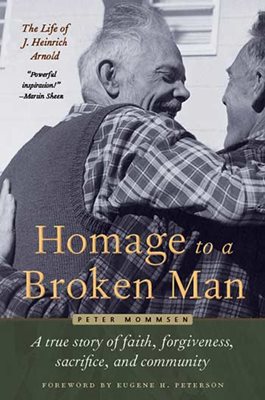
I recently finished reading a biography of J. Heinrich Arnold entitled Homage to a Broken Man. I can honestly say it was one of the more powerful and beautiful books I have ever read. J. Heinrich Arnold was the son of Eberhard Arnold who founded the Bruderhof in Germany in the first half of the twentieth century. The Bruderhof, which is still in operation in various branches in the United States and around the world, began as an intentional effort at living out the Sermon on the Mount and teachings of Christ in the world. The story follows the ups and downs of the Bruderhof community with special focus on J. Heinrich Arnold and his family.

At a certain point, Heinrich and his wife are sent to lead the Woodcrest Bruderhof community in Rifton, New York. The Bruderhof community they were coming from (at “Primavera” in Paraguay) had been torn by dissension and strife and Heinrich himself had suffered a great injustice there. What the Arnolds encountered in Woodcrest was quite different.

One thing that struck Heiner and Annemarie almost daily was how straightforward people were at Woodcrest. Not always and not everyone, to be sure; but still, there were none of the intrigues and decades-long grudges that had come to poison Primavera. Instead, there was an insistence on open, honest relationships, and people took literally the “First Law in Sannerz,” a brief house rule Heiner’s father had composed in 1925: There is no law but love. Love is joy in others. What then is anger at them? Words of love convey the joy we have in the presence of our brothers and sisters. It is out of the question to speak about another person in a spirit of irritation or vexation. There must never be talk, either in open remarks or by insinuation, against any brother or sister, or against their individual characteristics – and under no circumstances behind their back. Gossiping in one’s family is no exception. Without this rule of silence there can be no loyalty and thus no community. Direct address is the only way possible; it is the brotherly or sisterly service we owe anyone whose weaknesses cause a negative reaction in us. An open word spoken directly to another person deepens friendship and will not be resented. Only when two people do not come to an agreement quickly is it necessary to draw in a third person whom both of them trust. In this way they can be led to a solution that unites them on the highest and deepest levels.[1]

Continue reading

Mark 5:1-20

MarkSeriesTitleSlide1Mark 5

1 They came to the other side of the sea, to the country of the Gerasenes. 2 And when Jesus had stepped out of the boat, immediately there met him out of the tombs a man with an unclean spirit. 3 He lived among the tombs. And no one could bind him anymore, not even with a chain, 4 for he had often been bound with shackles and chains, but he wrenched the chains apart, and he broke the shackles in pieces. No one had the strength to subdue him. 5 Night and day among the tombs and on the mountains he was always crying out and cutting himself with stones. 6 And when he saw Jesus from afar, he ran and fell down before him. 7 And crying out with a loud voice, he said, “What have you to do with me, Jesus, Son of the Most High God? I adjure you by God, do not torment me.” 8 For he was saying to him, “Come out of the man, you unclean spirit!” 9 And Jesus asked him, “What is your name?” He replied, “My name is Legion, for we are many.” 10 And he begged him earnestly not to send them out of the country. 11 Now a great herd of pigs was feeding there on the hillside, 12 and they begged him, saying, “Send us to the pigs; let us enter them.” 13 So he gave them permission. And the unclean spirits came out and entered the pigs; and the herd, numbering about two thousand, rushed down the steep bank into the sea and drowned in the sea. 14 The herdsmen fled and told it in the city and in the country. And people came to see what it was that had happened. 15 And they came to Jesus and saw the demon-possessed man, the one who had had the legion, sitting there, clothed and in his right mind, and they were afraid. 16 And those who had seen it described to them what had happened to the demon-possessed man and to the pigs. 17 And they began to beg Jesus to depart from their region. 18 As he was getting into the boat, the man who had been possessed with demons begged him that he might be with him. 19 And he did not permit him but said to him, “Go home to your friends and tell them how much the Lord has done for you, and how he has had mercy on you.” 20 And he went away and began to proclaim in the Decapolis how much Jesus had done for him, and everyone marveled.

What to do about demon possession? One modern example reveals the problems that people today have with the idea of possession and exorcism.

Here’s an item that gives “experimental technique” a new definition. “Exorcism is not a legitimate psychological treatment. An Arizona board revoked the license of Kenneth Olson, a psychologist and Lutheran minister who said he cast demons from a ten-year-old last year. Foster parents referred the boy, a victim of physical and sexual abuse, to Olson because repeated hospital treatments had not stopped his violent behavior. Olson said he laid hands on the child and prayed for him. News reports said the minister has a Bible, holy water, and a crucifix nearby. The exorcism was discovered when Olson billed the state $180 for a two-hour session. The Board of Psychologist Examiners, which earlier had placed Olson on probation for a 1988 exorcism, described the action as ‘an experimental technique’ and ‘ritual on someone who had already been ritually abused.’ But ‘no one seems to care that the boy seems to be cured,’ said Olson, who claimed he would perform other necessary exorcisms. The foster mother says the boy’s condition is improved markedly.”[1]

Now, assuming that the details of this case actually are as stated, one has to wonder what, in particular, is abusive about the following facts:

Continue reading

Exodus 22:16-31

deadseascrollExodus 22

16 “If a man seduces a virgin who is not betrothed and lies with her, he shall give the bride-price for her and make her his wife. 17 If her father utterly refuses to give her to him, he shall pay money equal to the bride-price for virgins. 18 “You shall not permit a sorceress to live. 19 “Whoever lies with an animal shall be put to death. 20 “Whoever sacrifices to any god, other than the Lord alone, shall be devoted to destruction. 21 “You shall not wrong a sojourner or oppress him, for you were sojourners in the land of Egypt. 22 You shall not mistreat any widow or fatherless child. 23 If you do mistreat them, and they cry out to me, I will surely hear their cry, 24 and my wrath will burn, and I will kill you with the sword, and your wives shall become widows and your children fatherless. 25 “If you lend money to any of my people with you who is poor, you shall not be like a moneylender to him, and you shall not exact interest from him. 26 If ever you take your neighbor’s cloak in pledge, you shall return it to him before the sun goes down, 27 for that is his only covering, and it is his cloak for his body; in what else shall he sleep? And if he cries to me, I will hear, for I am compassionate. 28 “You shall not revile God, nor curse a ruler of your people. 29 “You shall not delay to offer from the fullness of your harvest and from the outflow of your presses. The firstborn of your sons you shall give to me. 30 You shall do the same with your oxen and with your sheep: seven days it shall be with its mother; on the eighth day you shall give it to me. 31 “You shall be consecrated to me. Therefore you shall not eat any flesh that is torn by beasts in the field; you shall throw it to the dogs.

One of the interesting things about reading these holiness codes is the way that they highlight the differences and the similarities between ancient Israel and modern America. They are similar in that both recognize the need for the rule of law and both see the need for laws to be just. Both recognize the right of property but also the responsibility of those who have to care for those who do not have enough to survive. There are other similarities, but there are also striking differences. Ancient Israel was organized in a very different way than is modern America. Navigating these differences while honoring the immutable character of God from which these legal codes came is an interesting but important challenge.

Continue reading

1 John 2:1-6

1 John 2

1 My little children, I am writing these things to you so that you may not sin. But if anyone does sin, we have an advocate with the Father, Jesus Christ the righteous. 2 He is the propitiation for our sins, and not for ours only but also for the sins of the whole world. 3 And by this we know that we have come to know him, if we keep his commandments. 4 Whoever says “I know him” but does not keep his commandments is a liar, and the truth is not in him, 5 but whoever keeps his word, in him truly the love of God is perfected. By this we may know that we are in him: 6 whoever says he abides in him ought to walk in the same way in which he walked.

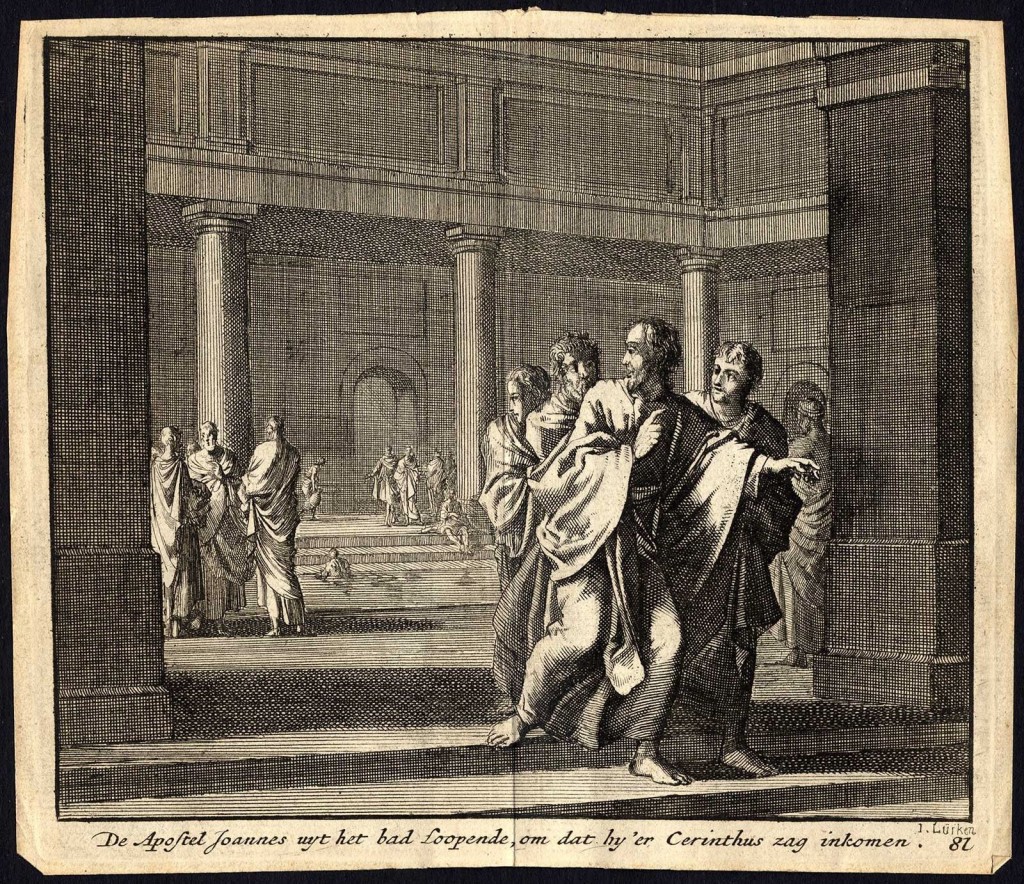
Let me show you an interesting image.

john-bathhouse-cerinthus-luyken-1740

To understand what is depicted in this image, we need a little bit of background information.

Continue reading

Job 40-42

Job-SufferingJob 40

1 And the Lord said to Job: 2 “Shall a faultfinder contend with the Almighty? He who argues with God, let him answer it.” 3 Then Job answered the Lord and said: 4 “Behold, I am of small account; what shall I answer you? I lay my hand on my mouth. 5 I have spoken once, and I will not answer; twice, but I will proceed no further.” 6 Then the Lord answered Job out of the whirlwind and said: 7 “Dress for action like a man; I will question you, and you make it known to me. 8 Will you even put me in the wrong? Will you condemn me that you may be in the right? 9 Have you an arm like God, and can you thunder with a voice like his? 10 “Adorn yourself with majesty and dignity; clothe yourself with glory and splendor. 11 Pour out the overflowings of your anger, and look on everyone who is proud and abase him. 12 Look on everyone who is proud and bring him low and tread down the wicked where they stand. 13 Hide them all in the dust together; bind their faces in the world below. 14 Then will I also acknowledge to you that your own right hand can save you. 15 “Behold, Behemoth, which I made as I made you; he eats grass like an ox. 16 Behold, his strength in his loins, and his power in the muscles of his belly. 17 He makes his tail stiff like a cedar; the sinews of his thighs are knit together. 18 His bones are tubes of bronze, his limbs like bars of iron. 19 “He is the first of the works of God; let him who made him bring near his sword! 20 For the mountains yield food for him where all the wild beasts play. 21 Under the lotus plants he lies, in the shelter of the reeds and in the marsh. 22 For his shade the lotus trees cover him; the willows of the brook surround him. 23 Behold, if the river is turbulent he is not frightened; he is confident though Jordan rushes against his mouth. 24 Can one take him by his eyes, or pierce his nose with a snare?

Continue reading

Job 36-37

job-berkJob 36

1 And Elihu continued, and said: “Bear with me a little, and I will show you, for I have yet something to say on God’s behalf.I will get my knowledge from afar and ascribe righteousness to my Maker.For truly my words are not false; one who is perfect in knowledge is with you.“Behold, God is mighty, and does not despise any; he is mighty in strength of understanding.He does not keep the wicked alive, but gives the afflicted their right.He does not withdraw his eyes from the righteous, but with kings on the throne he sets them forever, and they are exalted.And if they are bound in chains and caught in the cords of affliction,then he declares to them their work and their transgressions, that they are behaving arrogantly. 10 He opens their ears to instruction and commands that they return from iniquity. 11 If they listen and serve him, they complete their days in prosperity, and their years in pleasantness. 12 But if they do not listen, they perish by the sword and die without knowledge. 13 “The godless in heart cherish anger; they do not cry for help when he binds them. 14 They die in youth, and their life ends among the cult prostitutes. 15 He delivers the afflicted by their affliction and opens their ear by adversity. 16 He also allured you out of distress into a broad place where there was no cramping, and what was set on your table was full of fatness. 17 “But you are full of the judgment on the wicked; judgment and justice seize you. 18 Beware lest wrath entice you into scoffing, and let not the greatness of the ransom turn you aside. 19 Will your cry for help avail to keep you from distress, or all the force of your strength? 20 Do not long for the night, when peoples vanish in their place. 21 Take care; do not turn to iniquity, for this you have chosen rather than affliction. 22 Behold, God is exalted in his power; who is a teacher like him? 23 Who has prescribed for him his way, or who can say, ‘You have done wrong’? 24 “Remember to extol his work, of which men have sung. 25 All mankind has looked on it; man beholds it from afar. 26 Behold, God is great, and we know him not; the number of his years is unsearchable. 27 For he draws up the drops of water; they distill his mist in rain, 28 which the skies pour down and drop on mankind abundantly. 29 Can anyone understand the spreading of the clouds, the thunderings of his pavilion? 30 Behold, he scatters his lightning about him and covers the roots of the sea. 31 For by these he judges peoples; he gives food in abundance. 32 He covers his hands with the lightning and commands it to strike the mark. 33 Its crashing declares his presence; the cattle also declare that he rises.

Continue reading

Peter Mommsen’s Homage to a Broken Man: The Life of J. Heinrich Arnold

homageenFor a long time now I have been intrigued by intentional Christian communal experiments.  I used to live about a half hour away from Koinonia Farms, Clarence Jordan’s community in Americus, Georgia (which, incidentally, makes a fascinating appearance in Mommsen’s book), and would go by from time to time to visit.  Similarly, like many people, I have been intrigued with groups like the Amish, the Mennonites, and the Hutterites, though never uncritically so.  I have been interested in the Bruderhof, a German Anabaptist group foundered by Eberhard Arnold, since I read Arnold’s anthology of patristic statements, The Early Christians: In Their Own Words, some years back.  So my interest was piqued when I saw theologian Scot Mcknight tweet praises for Peter Mommsen’s Homage to a Broken Man: The Life of J. Heinrich Arnold.

Continue reading

1 John 1:5-10

1john_title1 John 1

5 This is the message we have heard from him and proclaim to you, that God is light, and in him is no darkness at all. 6 If we say we have fellowship with him while we walk in darkness, we lie and do not practice the truth. 7 But if we walk in the light, as he is in the light, we have fellowship with one another, and the blood of Jesus his Son cleanses us from all sin. 8 If we say we have no sin, we deceive ourselves, and the truth is not in us. 9 If we confess our sins, he is faithful and just to forgive us our sins and to cleanse us from all unrighteousness. 10 If we say we have not sinned, we make him a liar, and his word is not in us.

Characters who do not believe in the existence of sin turn up time and again in literature. For instance, in The Grapes of Wrath, Preacher Casey tells Tom Joad how he came to deny the existence of sin after battling with guilt over his promiscuous and hypocritical life.

I says, “Maybe it ain’t a sin. Maybe it’s just the way folks is…” Before I knowed it, I was sayin’ out loud…”There ain’t no sin and there ain’t no virtue. There’s just stuff people do. It’s all part of the same thing. And some of the things folks do is nice, and some ain’t nice, but that’s as far as any man got a right to say.”[1]

Continue reading

Mark 4:35-41

MarkSeriesTitleSlide1Mark 4

35 On that day, when evening had come, he said to them, “Let us go across to the other side.” 36 And leaving the crowd, they took him with them in the boat, just as he was. And other boats were with him. 37 And a great windstorm arose, and the waves were breaking into the boat, so that the boat was already filling. 38 But he was in the stern, asleep on the cushion. And they woke him and said to him, “Teacher, do you not care that we are perishing?” 39 And he awoke and rebuked the wind and said to the sea, “Peace! Be still!” And the wind ceased, and there was a great calm. 40 He said to them, “Why are you so afraid? Have you still no faith?” 41 And they were filled with great fear and said to one another, “Who then is this, that even the wind and the sea obey him?”

Adela Yarbro Collins has recounted a fascinating example from history of a king attempting to exert authority over water.

               Herodotus tells how Xerxes had bridges built across the Hellespont from Asia to Europe. The distance was seven-eights of a mile. In the first attempt, he had the Phoenicians make a bridge of flaxen cables, the Egyptians one of papyrus. No sooner was the strait bridged than a great storm occurred and destroyed their work. Xerxes was very angry and commanded that the Hellespont be scourged with three hundred lashes…and a pair of fetters be thrown into the sea…He sent branders with the rest to brand the Hellespont…He charged them while they scourged to utter words, which were in Herodotus’s view, outlandish and presumptuous…: “You bitter water,” they should say, “our master thus punishes you, because you did him wrong although he had done no wrong to you. Yes, Xerxes the king will pass over…you, whether you wish it or not; it is but just that no man offers you sacrifice, for you are a turbid and a briny river.” Thus he commanded that the sea should be punished…and they who had been overseers…should be beheaded…[1]

There is something amusing about this to us. Throwing fetters into a body of water, whipping it, and rebuking it is the kind of thing that, in our minds, only a crazy man would do, for no man has authority over the waters and the waters are not animate objects over which authority could even be exerted. You might as well yell at a tree to stand up taller as yell at the ocean to be still.

In fact, in all of human history only one has rebuked the sea and it obeyed, and only one could. The miracle that Mark now recounts is a miracle with which many people are quite familiar. Even so, familiarity does not necessarily mean understanding. In fact, this miracle on the Sea of Galilee was about much more than getting the waters to calm down. It says something significant about Christ and His mission and it says something that we all need to hear for the living of our lives today.

Continue reading